
Thomas Frey's Blog, page 27
October 16, 2018
The Coming Era of AI-Enhanced Superhumans
Don't Get Blindsided By The Future
GOOGLE'S TOP RATED FUTURIST SPEAKER
Book Thomas
 How many times have you wished a smarter person was leaning over your shoulder whispering the right answer in your ear? As I think about some of my own situations, a better response would have meant the difference between success and failure, whether its landing a job, going on a date, pitching an investment, or simply convincing a child its time to go to bed.
With the emergence of interactive voice technology, and its growing reservoir of analytical skills, one of the hottest technologies in the future will be a self-learning AI bot or agent that serves as our daily coach and advisor on life’s journey. If you can imagine a portable version of Alexa or Siri with an IQ of 200 and the conversational skills of your favorite talk show host, you’re getting a glimpse of what lies ahead.
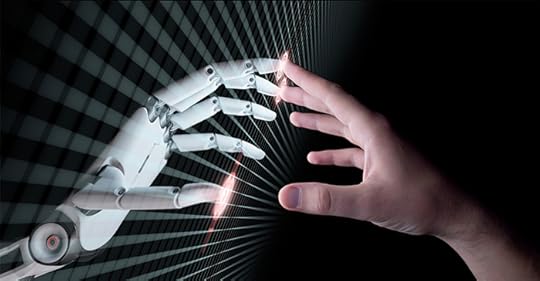
We’re on the edge of a radical transformation where, very soon, we won’t be able to tell where the human ends and technology begins. This intermeshing of mind, body, and technology will become so seamless and invisible that we essentially “become one with the tech.”
On the surface this sounds like George Orwell’s worst nightmare, a totally frightening proposition where our first instinct is fear, fear of the machines taking over like the Borg on Star Trek. In the back of our minds we have a deep fear of loosing control or having something hijacking our minds and assuming control. After all, isn’t this what Hollywood has been warning us about?
Yes, there’s always a potential for things to go wrong, but adding intelligent agents to our life could have an enormously positive impact.
Smart Agent Scenarios
As I thinking through the possibilities, I would like to step you through a series of scenarios, showing how this type of technology will amp up our capabilities so most of us can complete the work of 3-4 people during a typical day.
For AI to become truly useful, we need to have complete trust that it has our best interest at heart. We can accept its advice or ignore it, but the choice will be ours.
The day begins with my personal AI agent, named Finley, guiding me through every task during my daily journey.
Every morning begins with that first waking moment in the bedroom. Unless there is something urgent on my schedule, Finley will wait to wake me up when he knows I’ve had enough sleep.
Through a system of constantly probing the subconscious, Finley will adjust sleep patterns and learn to calm my mind to optimize rest. Since Finley is in constant learning mode, every adjustment used to silence the inner head drama will be quickly assessed and tweaked and re-tweaked until each night becomes a deep immersion into a perfect state of rest.
Naturally, resting my mind is only part of the answer and Finley will also have the ability to change variables in every room to compensate for new sources of anxiety and stress by altering air chemistry, adding oxygen when needed, controlling light-levels and even the spectrum of light, adjusting background music, and creating rocking motions and surface vibrations as needed.
Finley’s goal each day is to have me functioning at peak efficiency, and his approach will change, as each new day requires an entirely new operational strategy. For those new to adding their own AI agent to their life, it won’t take long for agents like Finley to get to know me better than I know myself.
Throughout the day, my conversations with Finley become a central part of who I am and how I manage each task in order of importance.
Even simple routines, like taking a shower, will have Finley adjusting the water to the perfect temperature, fine-tuning the spray to stimulate sore muscles, dispensing optimal amounts of soap, shampoo, and conditioners, and even making recommendations about those products when I’m shopping.
When it comes to getting dressed, Finley will help me select the color and style of clothing that will best mesh with the people I’m scheduled to meet and the kind of activities I have in store. Every day Finley will reassess my wardrobe, shoes, and fashion accessories. Purchasing new items will be as simple as looking through a list of Finley’s recommendations and making the selection.
Planning breakfast, as with every meal, will be as simple or as complicated as I wish to make it. Finley knows which ingredients I have on hand, knows how my body will react to each of them, and will suggest meals that can optimize my daily performance. If I prefer to dine out, he will suggest restaurants, possible delivery options, and which friends and acquaintances may be close by to join me as a way of turning it into a social experience.

How long before we “become one with the technology?”
Finley, the Ultimate Work Buddy
Commuting to work will be as simple as saying, “Finley, can you find me a ride to work?” Whether it’s an Uber, driverless car, or a brother-in-law who’s not working, he will know which option will work best.
To be sure, Finley will come with a number of interface options beyond its standard voice commands. Users will be able to select from a wide range of input-output devices like watches, touch bands, and keyboards on the input side, and a variety of displays, visual overlays, skin-tinglers, and sensory alert mechanisms as output choices.
Finley will come in an assortment of shapes and forms, and most people will want to humanize his presence. Options will include switching from male to female, adding a personality package with a voice and face on a screen, or perhaps an animated head with an expression module, templated smells, sounds, or little “oh-oh” tones when he knows you’re doing something risky. But over time each agent will gravitate towards the persona of your perfect non-human partner.
As ways to enhance the standard “voice in my head,” he can shift forms and move into a standalone robot offering a more physical presence, a talking portrait on a wall, or even take the form of animatronic shoes that I wear to impress my friends. As I step onto an elevator, enter a car, or walk into a boardroom, he will automatically work with each of the available devices, pushing information to nearby displays, asking me to slip on a VR/AR headset, or mentioning nearby controllers to add to the experience.
Every work-related situation will enable me to leverage Finley differently.
In a retail setting, Finley will help facilitate payments, do inventory crosschecks, and recommend other products to boost sales.
For maintenance positions, he will know which tools I’ll need, pull up diagrams of how pieces fit together, do point-to-point measurements, and recommend which approach will be fastest and most effective.
In an HR position, he will remind me about topics to cover with each candidate, warn me if I’m saying or doing something inappropriate, and prompt me to discuss new policies, practices, and procedures.
If I’m a computer programmer, Finley will remind me of formatting issues, propose the best possible algorithm for each situation, select readily available routines from online libraries, and even test each segment of code before I move on.
In so many ways, Finley is my sounding board, my ally, my protector, my strategy partner, and my confidant. At the same time, he’s not intended to replace my need to be around other people. Rather, part of Finley’s core programming will be to improve my social life, knowing the right time and place for every interaction, and solving a variety of concerns before they ever become a real issue.
Even people with mental health issues will have the ability to improve, as this type of AI agent will calm their emotions and help them make decisions. Once they are able to master their own daily routine, they will have the ability to develop additional skills and, in many cases, even find meaningful work.
Since with humans, every action comes with a certain amount of risk, Finley will have a way of knowing my goals for the day and steering me through the daily minefield, letting me know instantly when I’m teetering on the edge of something catastrophic.
Over time, Finley will become an expert on me, knowing when something is off, or if I’m not feeling well. As AI agents improve, they will have the ability to diagnose diseases, understand the limitations of every injury, and guide us through wellness routines that will keep us physically fit and mentally alert. In the case of illness, he will recommend treatment options, medicines, therapies, or whatever may be appropriate.
As my protector, Finley is constantly evaluating every person, object, vehicle, and animal entering my space. In this capacity, he is assessing danger, knowing if something got added to my drink, studying patterns, calculating proximities, and searching for anything that can possibly go wrong.

Will life become boring with AI?
Will AI Make Me Lazy?
If you’re worried about an AI agent doing all the work and making us lazy, you’re not alone. It would appear that much of our daily struggle is removed and, at least on the surface, life appears too easy.
However, my sense is that these types of enhancements will set the stage for an entirely new level of engagement. We will learn to reevaluate our capabilities through the lens of an entirely new caliber individual, and our expectations will grow with every accomplishment.
Writing papers, filling out forms, creating illustrations, handling correspondence, and verbal communication will all be handled in a fraction of the time it took before. With all of the drudgery out of the way, our mind will be feed up to focus on higher order tasks such as situational analysis, devising new strategies, finding new approaches, and adding creative elements to every deliverable.
Rather than becoming lazy, a more likely outcome will be the unleashing of my true inner self, the super-me waiting to reveal itself. In just a matter of weeks we will likely accomplish 3-4 times as much as we did before.
Final Thoughts
Naturally the scenarios I’ve described can only work if there are very well defined privacy and security barriers in place. We will only want to work with an agent like Finley if we trust it completely.
If we can’t trust him with our credit cards, bank accounts, and health records, his overall value will only be a fraction of what he was designed for.
That said, Finley will come with his own self-diagnostic systems, managing a variety of firewalls, constantly checking for hacker crumbs, and knowing when something feels wrong.
Recent movies coming out of Hollywood have painted a very dim future for humanity, as this type of machine intelligence takes over a greater part of our future. Most often they either portray the villains as evil hackers or the technology itself.
But the reality is that we are still a long ways from true artificial intelligence. Instead, we have entered into more of an augmented intelligence era. There’s a huge difference between augmenting a human and superseding them.
In my mind we still have a wide range of opportunities to explore before we reach the danger zone, and indeed when we get close enough to peer over the edge we may very well decide the danger isn’t nearly as unmanageable as we imagined it to be.
Translate This Page
Select LanguageAfrikaansAlbanianAmharicArabicArmenianAzerbaijaniBasqueBelarusianBengaliBosnianBulgarianCatalanCebuanoChichewaChinese (Simplified)Chinese (Traditional)CorsicanCroatianCzechDanishDutchEnglishEsperantoEstonianFilipinoFinnishFrenchFrisianGalicianGeorgianGermanGreekGujaratiHaitian CreoleHausaHawaiianHebrewHindiHmongHungarianIcelandicIgboIndonesianIrishItalianJapaneseJavaneseKannadaKazakhKhmerKoreanKurdish (Kurmanji)KyrgyzLaoLatinLatvianLithuanianLuxembourgishMacedonianMalagasyMalayMalayalamMalteseMaoriMarathiMongolianMyanmar (Burmese)NepaliNorwegianPashtoPersianPolishPortuguesePunjabiRomanianRussianSamoanScottish GaelicSerbianSesothoShonaSindhiSinhalaSlovakSlovenianSomaliSpanishSudaneseSwahiliSwedishTajikTamilTeluguThaiTurkishUkrainianUrduUzbekVietnameseWelshXhosaYiddishYorubaZulu
#goog-gt-tt {display:none !important;}
.goog-te-banner-frame {display:none !important;}
.goog-te-menu-value:hover {text-decoration:none !important;}
.goog-text-highlight {background-color:transparent !important;box-shadow:none !important;}
body {top:0 !important;}
#google_translate_element2 {display:none!important;}
Search for:
.et_bloom .et_bloom_optin_2 .et_bloom_form_content { background-color: #ffffff !important; } .et_bloom .et_bloom_optin_2 .et_bloom_form_container .et_bloom_form_header { background-color: #dd4242 !important; } .et_bloom .et_bloom_optin_2 .et_bloom_form_content button { background-color: #3b3b3b !important; } .et_bloom .et_bloom_optin_2 .et_bloom_form_content .et_bloom_fields i { color: #3b3b3b !important; } .et_bloom .et_bloom_optin_2 .et_bloom_form_content .et_bloom_custom_field_radio i:before { background: #3b3b3b !important; } .et_bloom .et_bloom_optin_2 .et_bloom_form_content button { background-color: #3b3b3b !important; } .et_bloom .et_bloom_optin_2 .et_bloom_form_container h2, .et_bloom .et_bloom_optin_2 .et_bloom_form_container h2 span, .et_bloom .et_bloom_optin_2 .et_bloom_form_container h2 strong { font-family: "Open Sans", Helvetica, Arial, Lucida, sans-serif; }.et_bloom .et_bloom_optin_2 .et_bloom_form_container p, .et_bloom .et_bloom_optin_2 .et_bloom_form_container p span, .et_bloom .et_bloom_optin_2 .et_bloom_form_container p strong, .et_bloom .et_bloom_optin_2 .et_bloom_form_container form input, .et_bloom .et_bloom_optin_2 .et_bloom_form_container form button span { font-family: "Open Sans", Helvetica, Arial, Lucida, sans-serif; }
Subscribe To Our Newsletter
Join our mailing list to receive the latest news and updates from Thomas Frey.
SUBSCRIBE!
You have Successfully Subscribed!
Recent Posts
The Coming Era of AI-Enhanced Superhumans
Future of Work: The New Age of Employment
Seven ways digital twins will affect your life in 2028 and beyond
52 Future Degrees Colleges Are Not Offering Yet
Using Drones to Eliminate Future Forest Fires
Categories
Artificial Intelligence
Business Trends
Future of Banking
Future of Education
Future of Healthcare
Future of Transportation
Future of Work
Future Scenarios
Future Trends
Futurist Thomas Frey Insights
Global Trends
Predictions
Social Trends
Technology Trends
By Futurist Thomas Frey, author of 'Epiphany Z – 8 Radical Visions Transforming Your Future'


October 10, 2018
The Coming Era of AI-Enhanced Superhumans
How many times have you wished a smarter person was leaning over your shoulder whispering the right answer in your ear? As I think about some of my own situations, a better response would have meant the difference between success and failure, whether its landing a job, going on a date, pitching an investment, or simply convincing a child its time to go to bed.
With the emergence of interactive voice technology, and its growing reservoir of analytical skills, one of the hottest technologies in the future will be a self-learning AI bot or agent that serves as our daily coach and advisor on life’s journey. If you can imagine a portable version of Alexa or Siri with an IQ of 200 and the conversational skills of your favorite talk show host, you’re getting a glimpse of what lies ahead.
We’re on the edge of a radical transformation where, very soon, we won’t be able to tell where the human ends and technology begins. This intermeshing of mind, body, and technology will become so seamless and invisible that we essentially “become one with the tech.”
On the surface this sounds like George Orwell’s worst nightmare, a totally frightening proposition where our first instinct is fear, fear of the machines taking over. In the back of our minds we have a deep fear of loosing control or having something hijacking our minds and assuming control. After all, isn’t this what Hollywood has been warning us about?
Yes, there’s always a potential for things to go wrong, but adding intelligent agents to our life could have an enormously positive impact.
 Opening your mind to AI
Smart Agent Scenarios
As I thinking through the possibilities, I would like to step you through a series of scenarios, showing how this type of technology will amp up our capabilities so most of us can complete the work of 3-4 people during a typical day.
For AI to become truly useful, we need to have complete trust that it has our best interest at heart. We can accept its advice or ignore it, but the choice will be ours.
The day begins with my personal AI agent, named Finley, guiding me through every task during my daily journey.
Every morning begins with that first waking moment in the bedroom. Unless there is something urgent on my schedule, Finley will wait to wake me up when he knows I’ve had enough sleep.
Through a system of constantly probing the subconscious, Finley will adjust sleep patterns and learn to calm my mind to optimize rest. Since Finley is in constant learning mode, every adjustment used to silence the inner head drama will be quickly assessed and tweaked and re-tweaked until each night becomes a deep immersion into a perfect state of rest.
Naturally, resting my mind is only part of the answer and Finley will also have the ability to change variables in every room to compensate for new sources of anxiety and stress by altering air chemistry, adding oxygen when needed, controlling light-levels and even the spectrum of light, adjusting background music, and creating rocking motions and surface vibrations as needed.
Finley’s goal each day is to have me functioning at peak efficiency, and his approach will change, as each new day requires an entirely new operational strategy. For those new to adding their own AI agent to their life, it won’t take long for agents like Finley to get to know me better than I know myself.
Throughout the day, my conversations with Finley become a central part of who I am and how I manage each task in order of importance.
Even simple routines, like taking a shower, will have Finley adjusting the water to the perfect temperature, fine-tuning the spray to stimulate sore muscles, dispensing optimal amounts of soap, shampoo, and conditioners, and even making recommendations about those products when I’m shopping.
When it comes to getting dressed, Finley will help me select the color and style of clothing that will best mesh with the people I’m scheduled to meet and the kind of activities I have in store. Every day Finley will reassess my wardrobe, shoes, and fashion accessories. Purchasing new items will be as simple as looking through a list of Finley’s recommendations and making the selection.
Planning breakfast, as with every meal, will be as simple or as complicated as I wish to make it. Finley knows which ingredients I have on hand, knows how my body will react to each of them, and will suggest meals that can optimize my daily performance. If I prefer to dine out, he will suggest restaurants, possible delivery options, and which friends and acquaintances may be close by to join me as a way of turning it into a social experience.
 How long before we “become one with the technology?”
Finley, the Ultimate Work Buddy
Commuting to work will be as simple as saying, “Finley, can you find me a ride to work?” Whether it’s an Uber, driverless car, or a brother-in-law who’s not working, he will know which option will work best.
To be sure, Finley will come with a number of interface options beyond its standard voice commands. Users will be able to select from a wide range of input-output devices like watches, touch bands, and keyboards on the input side, and a variety of displays, visual overlays, skin-tinglers, and sensory alert mechanisms as output choices.
Finley will come in an assortment of shapes and forms, and most people will want to humanize his presence. Options will include switching from male to female, adding a personality package with a voice and face on a screen, or perhaps an animated head with an expression module, templated smells, sounds, or little “oh-oh” tones when he knows you’re doing something risky. But over time each agent will gravitate towards the persona of your perfect non-human partner.
As ways to enhance the standard “voice in my head,” he can shift forms and move into a standalone robot offering a more physical presence, a talking portrait on a wall, or even take the form of animatronic shoes that I wear to impress my friends. As I step onto an elevator, enter a car, or walk into a boardroom, he will automatically work with each of the available devices, pushing information to nearby displays, asking me to slip on a VR/AR headset, or mentioning nearby controllers to add to the experience.
Every work-related situation will enable me to leverage Finley differently:
In a retail setting, Finley will help facilitate payments, do inventory crosschecks, and recommend other products to boost sales.
For maintenance positions, he will know which tools I’ll need, pull up diagrams of how pieces fit together, do point-to-point measurements, and recommend which approach will be fastest and most effective.
In an HR position, he will remind me about topics to cover with each candidate, warn me if I’m saying or doing something inappropriate, and prompt me to discuss new policies, practices, and procedures.
If I’m a computer programmer, Finley will remind me of formatting issues, propose the best possible algorithm for each situation, select readily available routines from online libraries, and even test each segment of code before I move on.
In so many ways, Finley is my sounding board, my ally, my protector, my strategy partner, and my confidant. At the same time, he’s not intended to replace my need to be around other people. Rather, part of Finley’s core programming will be to improve my social life, knowing the right time and place for every interaction, and solving a variety of concerns before they ever become a real issue.
Even people with mental health issues will have the ability to improve, as this type of AI agent will calm their emotions and help them make decisions. Once they are able to master their own daily routine, they will have the ability to develop additional skills and, in many cases, even find meaningful work.
Since with humans, every action comes with a certain amount of risk, Finley will have a way of knowing my goals for the day and steering me through the daily minefield, letting me know instantly when I’m teetering on the edge of something catastrophic.
Over time, Finley will become an expert on me, knowing when something is off, or if I’m not feeling well. As AI agents improve, they will have the ability to diagnose diseases, understand the limitations of every injury, and guide us through wellness routines that will keep us physically fit and mentally alert. In the case of illness, he will recommend treatment options, medicines, therapies, or whatever may be appropriate.
As my protector, Finley is constantly evaluating every person, object, vehicle, and animal entering my space. In this capacity, he is assessing danger, knowing if something got added to my drink, studying patterns, calculating proximities, and searching for anything that can possibly go wrong.
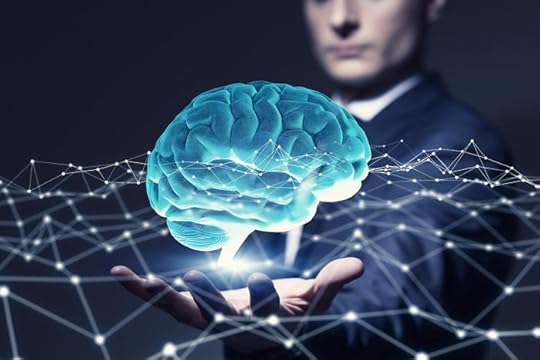 Will life become boring with AI?
Will AI Make Me Lazy?
If you’re worried about an AI agent doing all the work and making us lazy, you’re not alone. It would appear that much of our daily struggle is removed and, at least on the surface, life appears too easy.
However, my sense is that these types of enhancements will set the stage for an entirely new level of engagement. We will learn to reevaluate our capabilities through the lens of an entirely new caliber individual, and our expectations will grow with every accomplishment.
Writing papers, filling out forms, creating illustrations, handling correspondence, and verbal communication will all be handled in a fraction of the time it took before. With all of the drudgery out of the way, our mind will be feed up to focus on higher order tasks such as situational analysis, devising new strategies, finding new approaches, and adding creative elements to every deliverable.
Rather than becoming lazy, a more likely outcome will be the unleashing of my true inner self, the super-me waiting to reveal itself. In just a matter of weeks we will likely accomplish 3-4 times as much as we did before.
Final Thoughts
Naturally the scenarios I’ve described can only work if there are very well defined privacy and security barriers in place. We will only want to work with an agent like Finley if we trust it completely.
If we can’t trust him with our credit cards, bank accounts, and health records, his overall value will only be a fraction of what he was designed for.
That said, Finley will come with his own self-diagnostic systems, managing a variety of firewalls, constantly checking for hacker crumbs, and knowing when something feels wrong.
Recent movies coming out of Hollywood have painted a very dim future for humanity, as this type of machine intelligence takes over a greater part of our future. Most often they either portray the villains as evil hackers or the technology itself.
But the reality is that we are still a long ways from true artificial intelligence. Instead, we have entered into more of an augmented intelligence era. There’s a huge difference between augmenting a human and superseding them.
In my mind we still have a wide range of opportunities to explore before we reach the danger zone, and indeed when we get close enough to peer over the edge we may very well decide the danger isn’t nearly as unmanageable as we imagined it to be.
Author of “Epiphany Z – 8 Radical Visions for Transforming Your Future”
October 2, 2018
Future of Work: The New Age of Employment
Don't Get Blindsided By The Future
GOOGLE'S TOP RATED FUTURIST SPEAKER
Book Thomas
 For the past century, the work of every car designer has focused on one central activity – driving!
The art of creating the perfect driving experience has been extremely complicated, with humans coming in a variety of shapes and sizes and the car itself evolving into far more than just a machine.
In addition to the exterior design, their work involved the sculpting of controls, indicator lights, knobs, buttons, and gauges into the best possible dashboard to support the driver as they grasped the all-important steering wheel. The right combination of shapes, styles, sounds, and tiny nuanced details had us “oohing” and “aahing” as each new vehicle purred its way into our imaginations.
But that was then. Those kind of skills have quickly become last week’s news!
As cars start to drive themselves, designers have had to radically shift their thinking. Once the primary activity of driving disappears, designers have begun to focus on other activities happening inside a vehicle – sitting, talking, eating, sleeping, playing games, watching movies, looking out the window, and talking to the navigation system.
In what seems like a few short months, virtually everything that car designers learned over the past 120 years has been thrown into a no-longer-needed heap on the floor, and the tools and information base that has been formed around the craft-of-the-creator has had to begin again.
Once the primary task of driving has been automated out of existence, the entire profession will have to reframe it’s thinking around an entirely new set of goals, principals, and requirements.
Employment ads for next generation designers will begin to describe the skills they’re looking for in radically different ways. Luminaries of the past will quickly be relegated to the vestiges of time as the accomplishments of the future form around an entirely new vocabulary.
Logically we wonder if this signals the start of an entirely new profession or simply a variation of the skills and talents that led us to this point.
To be sure, car designers are just one example of this kind of transformation.
A quick survey of the employment landscape and we begin to see unusual new skills rising in importance in numerous industries. As task upon task becomes automated out of existence, we find ourselves asking the same question. “Does this constitute an entirely new profession, or simply a modification of the old one?”
Throughout history we have many examples of old school thinking that has simply faded away. As example, we no longer need to understand map legends, party lines, how to apply brakes on a horse-drawn carriage, read electrical meters, or use a toll booth. The vast majority of us will never have to learn how to shoe-a-horse, milk a cow, treat animal bites, tan a hide, shovel coal, or pasteurize milk.
In the future, very few people will know how to change channels on a three-remote television, connect to Wi-Fi, order something without talking, open a bank account, or pay with cash.
The demands of life are changing, and so are the prospects for employment.
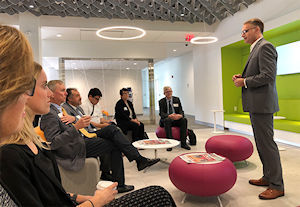
Dr. Kurt Bettenhausen addressing the “future of work” discussion group at Siemens.
The New Employer-Employee Relationship
At a recent “Future of Work” roundtable discussion hosted by the Siemens Corporation at their Princeton Robotics Plant, participants were asked what employers need to think about in the future.
Dr. Kurt Bettenhausen, Senior VP of Technology for Siemens began by discussing their lengthy interview process, 4-8 hours in most cases, and the primary characteristics he’s looking for – curiosity and the use of the word “no” (he rarely hires “yes” people).
Our litigious society has turned the hiring process into a minefield of legal requirements, and ferreting out great candidates has become a laborious process.
Looking at employment through a different lens, being a topic I’ve written about many times in the past, I focused on the shifting skillsets that will be needed in the future.
The skills that will be most in-demand in the future will be some of the hardest to train – resilience, resourcefulness, and flexibility.
In addition, having a solid understanding of how to better manage the encroaching demands of our online existence with skills such as distraction management, technology management, relationship management, opportunity management, and just staying relevant.
We are now aware of far more of what’s happening in the world than ever before, and our ability to assess, gauge, and monitor its importance and somehow act or respond in some appropriate fashion has become critical.
The Growing College Debate
Do people still need a college degree to succeed?
While there are countless reports published that show college graduates earning far more than those without degrees, I have yet to see a report that compares similar-caliber individuals who take opposing college vs. no-college career paths.
Many of our highest paying jobs in fields like computer programming, commercial pilots, cyber security, real-estate brokers, plumbers, cloud architects, crime scene detectives, and web developers typically don’t require a degree at all.
Virtually any bright student can learn a marketable skill in just a few months, and with several years of solid work experience under their belt by the time their counterparts graduate from college, non-degreed workers often have an easier time navigating the employment landscape.
Once a person has developed a marketable skill, they can begin taking control their own destiny, and building a “business of one” career path on their way to becoming an accomplished freelancer.

17% of freelancers in 2018 will earn over $100,000.
Our Emerging Freelance Economy
The Internet is a very sophisticated communications tool, enabling us to align the needs of a business with the talent of individuals in a far more precise ways than ever before. So rather than hiring someone full-time, companies can create a short term contract of 2 months, 2 weeks, 2 days, or even 2 hours.
Our tools for managing this type of work relationship are getting better and will soon give us the ability to apply the precise amount of talent, as needed, whenever a new situation arises.
But while we’re getting better at the employer side of this equation we’re still faring poorly when it comes to training next generation freelancers. In order to thrive in this type of work environment, solo practitioners need a wide range of business skills ranging from creating a business entity, to writing business proposals, to negotiating contracts, marketing, accounting and much more.
Freelancer Stats
Yes, there’s a big difference between a newbie freelancer and one who’s a total rockstar, but it all begins with taking that first bold step, and that’s where controlling one’s own life journey starts making sense.
Here are a few stats to give a quick overview of the rapidly changing freelance landscape:
70% of small businesses have hired a freelancer in the past
81% plan to hire freelancers in the future
52% of hiring managers say that the number of freelancers will increase in the next 5 years
59.7 million people worked as freelancers in 2018
52% of freelancer work comes from repeat customers
Full time freelancers average 4.5 clients a month
50% of freelancers say they wouldn’t take a traditional job no matter how much they were offered
17% of freelancers in 2018 will earn over $100,000
One-third of U.S. office workers have a second job
1.3 million people drive Uber, many doing this as a fill-in for other freelance work
In 2027, at current growth rates, the number of freelancers will exceed the number of full time employees

As the freelance economy grows, top tier free agents will surround themselves with a network of like-minded solopreneurs.
Final Thoughts
Contrary to what many people are leading us to believe, we’re entering a world of super employment. Prospective employees will have more choices than ever, and the freelance world will provide an alluring alternative to traditional employment.
Over the coming two decades we will be witnessing an unprecedented wave of innovation and creativity driven by new tools of production. During this time we will see an explosion of over 100,000 new micro industries that will employ hundreds of millions of people.
Driven by a wide array of emerging technology, an assortment of innovative playgrounds for makers, inventors, and startup junkies will spring to life, launching micro industries that range from manufacturing products, to collecting data, designing systems, advising, coaching, monitoring, building, disassembling, and reinventing business in unique and different ways.
With the help of thousands of collaborators, micro industries will spring to life around niches far too small for existing industries to care about. But it is in these minuscule advances that great opportunities take root.
A simple coffee mug can be redesigned in thousands of different ways. The same holds true for every toothbrush, piece of clothing, ink pen, lamp, chair, and hundreds of other frequently bought consumer products.
We are entering an unusually creative period of human history. Those who embrace this kind of change will prosper, and companies that study and embrace this fluid “jobscape” will build flourishing enterprises in the years ahead.
Translate This Page
Select LanguageAfrikaansAlbanianAmharicArabicArmenianAzerbaijaniBasqueBelarusianBengaliBosnianBulgarianCatalanCebuanoChichewaChinese (Simplified)Chinese (Traditional)CorsicanCroatianCzechDanishDutchEnglishEsperantoEstonianFilipinoFinnishFrenchFrisianGalicianGeorgianGermanGreekGujaratiHaitian CreoleHausaHawaiianHebrewHindiHmongHungarianIcelandicIgboIndonesianIrishItalianJapaneseJavaneseKannadaKazakhKhmerKoreanKurdish (Kurmanji)KyrgyzLaoLatinLatvianLithuanianLuxembourgishMacedonianMalagasyMalayMalayalamMalteseMaoriMarathiMongolianMyanmar (Burmese)NepaliNorwegianPashtoPersianPolishPortuguesePunjabiRomanianRussianSamoanScottish GaelicSerbianSesothoShonaSindhiSinhalaSlovakSlovenianSomaliSpanishSudaneseSwahiliSwedishTajikTamilTeluguThaiTurkishUkrainianUrduUzbekVietnameseWelshXhosaYiddishYorubaZulu
#goog-gt-tt {display:none !important;}
.goog-te-banner-frame {display:none !important;}
.goog-te-menu-value:hover {text-decoration:none !important;}
.goog-text-highlight {background-color:transparent !important;box-shadow:none !important;}
body {top:0 !important;}
#google_translate_element2 {display:none!important;}
Search for:
.et_bloom .et_bloom_optin_2 .et_bloom_form_content { background-color: #ffffff !important; } .et_bloom .et_bloom_optin_2 .et_bloom_form_container .et_bloom_form_header { background-color: #dd4242 !important; } .et_bloom .et_bloom_optin_2 .et_bloom_form_content button { background-color: #3b3b3b !important; } .et_bloom .et_bloom_optin_2 .et_bloom_form_content .et_bloom_fields i { color: #3b3b3b !important; } .et_bloom .et_bloom_optin_2 .et_bloom_form_content .et_bloom_custom_field_radio i:before { background: #3b3b3b !important; } .et_bloom .et_bloom_optin_2 .et_bloom_form_content button { background-color: #3b3b3b !important; } .et_bloom .et_bloom_optin_2 .et_bloom_form_container h2, .et_bloom .et_bloom_optin_2 .et_bloom_form_container h2 span, .et_bloom .et_bloom_optin_2 .et_bloom_form_container h2 strong { font-family: "Open Sans", Helvetica, Arial, Lucida, sans-serif; }.et_bloom .et_bloom_optin_2 .et_bloom_form_container p, .et_bloom .et_bloom_optin_2 .et_bloom_form_container p span, .et_bloom .et_bloom_optin_2 .et_bloom_form_container p strong, .et_bloom .et_bloom_optin_2 .et_bloom_form_container form input, .et_bloom .et_bloom_optin_2 .et_bloom_form_container form button span { font-family: "Open Sans", Helvetica, Arial, Lucida, sans-serif; }
Subscribe To Our Newsletter
Join our mailing list to receive the latest news and updates from Thomas Frey.
SUBSCRIBE!
You have Successfully Subscribed!
Recent Posts
The Coming Era of AI-Enhanced Superhumans
Future of Work: The New Age of Employment
Seven ways digital twins will affect your life in 2028 and beyond
52 Future Degrees Colleges Are Not Offering Yet
Using Drones to Eliminate Future Forest Fires
Categories
Artificial Intelligence
Business Trends
Future of Banking
Future of Education
Future of Healthcare
Future of Transportation
Future of Work
Future Scenarios
Future Trends
Futurist Thomas Frey Insights
Global Trends
Predictions
Social Trends
Technology Trends
By Futurist Thomas Frey, author of 'Epiphany Z – 8 Radical Visions Transforming Your Future'
September 26, 2018
Future of Work: The New Age of Employment
For the past century, the work of every car designer has focused on one central activity – driving!
The art of creating the perfect driving experience has been extremely complicated, with humans coming in a variety of shapes and sizes and the car itself evolving into far more than just a machine.
In addition to the exterior design, their work involved the sculpting of controls, indicator lights, knobs, buttons, and gauges into the best possible dashboard to support the driver as they grasped the all-important steering wheel. The right combination of shapes, styles, sounds, and tiny nuanced details had us “oohing” and “aahing” as each new vehicle purred its way into our imaginations.
But that was then. Those kind of skills have quickly become last week’s news!
 As cars start to drive themselves, designers have had to radically shift their thinking. Once the primary activity of driving disappears, designers have begun to focus on other activities happening inside a vehicle – sitting, talking, eating, sleeping, playing games, watching movies, looking out the window, and talking to the navigation system.
In what seems like a few short months, virtually everything that car designers learned over the past 120 years has been thrown into a no-longer-needed heap on the floor, and the tools and information base that has been formed around the craft-of-the-creator has had to begin again.
Once the primary task of driving has been automated out of existence, the entire profession will have to reframe it’s thinking around an entirely new set of goals, principals, and requirements.
Employment ads for next generation designers will begin to describe the skills they’re looking for in radically different ways. Luminaries of the past will quickly be relegated to the vestiges of time as the accomplishments of the future form around an entirely new vocabulary.
Logically we wonder if this signals the start of an entirely new profession or simply a variation of the skills and talents that led us to this point.
To be sure, car designers are just one example of this kind of transformation.
A quick survey of the employment landscape and we begin to see unusual new skills rising in importance in numerous industries. As task upon task becomes automated out of existence, we find ourselves asking the same question. “Does this constitute an entirely new profession, or simply a modification of the old one?”
Throughout history we have many examples of old school thinking that has simply faded away. As example, we no longer need to understand map legends, party lines, how to apply brakes on a horse-drawn carriage, read electrical meters, or use a toll booth. The vast majority of us will never have to learn how to shoe-a-horse, milk a cow, treat animal bites, tan a hide, shovel coal, or pasteurize milk.
In the future, very few people will know how to change channels on a three-remote television, connect to Wi-Fi, order something without talking, open a bank account, or pay with cash.
The demands of life are changing, and so are the prospects for employment.
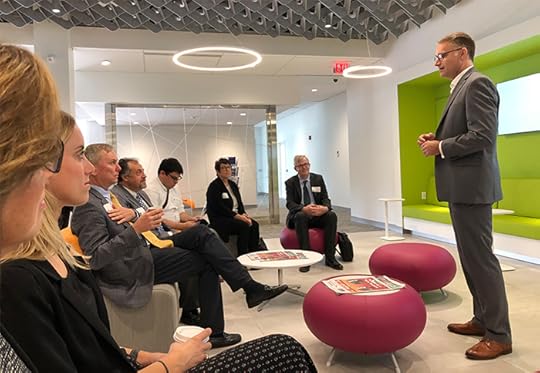 Dr. Kurt Bettenhausen addressing the “future of work” discussion group at Siemens
The New Employer-Employee Relationship
At a recent “Future of Work” roundtable discussion hosted by the Siemens Corporation at their Princeton Robotics Plant, participants were asked what employers need to think about in the future.
Dr. Kurt Bettenhausen, Senior VP of Technology for Siemens began by discussing their lengthy interview process, 4-8 hours in most cases, and the primary characteristics he’s looking for – curiosity and the use of the word “no” (he rarely hires “yes” people).
Our litigious society has turned the hiring process into a minefield of legal requirements, and ferreting out great candidates has become a laborious process.
Looking at employment through a different lens, being a topic I’ve written about many times in the past, I focused on the shifting skillsets that will be needed in the future.
The skills that will be most in-demand in the future will be some of the hardest to train – resilience, resourcefulness, and flexibility.
In addition, having a solid understanding of how to better manage the encroaching demands of our online existence with skills such as distraction management, technology management, relationship management, opportunity management, and just staying relevant.
We are now aware of far more of what’s happening in the world than ever before, and our ability to assess, gauge, and monitor its importance and somehow act or respond in some appropriate fashion has become critical.
The Growing College Debate
Do people still need a college degree to succeed?
While there are countless reports published that show college graduates earning far more than those without degrees, I have yet to see a report that compares similar-caliber individuals who take opposing college vs. no-college career paths.
Many of our highest paying jobs in fields like computer programming, commercial pilots, cyber security, real-estate brokers, plumbers, cloud architects, crime scene detectives, and web developers typically don’t require a degree at all.
Virtually any bright student can learn a marketable skill in just a few months, and with several years of solid work experience under their belt by the time their counterparts graduate from college, non-degreed workers often have an easier time navigating the employment landscape.
Once a person has developed a marketable skill, they can begin taking control their own destiny, and building a “business of one” career path on their way to becoming an accomplished freelancer.
 17% of freelancers in 2018 will earn over $100,000
Our Emerging Freelance Economy
The Internet is a very sophisticated communications tool, enabling us to align the needs of a business with the talent of individuals in a far more precise ways than ever before. So rather than hiring someone full-time, companies can create a short term contract of 2 months, 2 weeks, 2 days, or even 2 hours.
Our tools for managing this type of work relationship are getting better and will soon give us the ability to apply the precise amount of talent, as needed, whenever a new situation arises.
But while we’re getting better at the employer side of this equation we’re still faring poorly when it comes to training next generation freelancers. In order to thrive in this type of work environment, solo practitioners need a wide range of business skills ranging from creating a business entity, to writing business proposals, to negotiating contracts, marketing, accounting and much more.
Freelancer Stats
Yes, there’s a big difference between a newbie freelancer and one who’s a total rockstar, but it all begins with taking that first bold step, and that’s where controlling one’s own life journey starts making sense.
Here are a few stats to give a quick overview of the rapidly changing freelance landscape:
70% of small businesses have hired a freelancer in the past
81% plan to hire freelancers in the future
52% of hiring managers say that the number of freelancers will increase in the next 5 years
59.7 million people worked as freelancers in 2018
52% of freelancer work comes from repeat customers
Full time freelancers average 4.5 clients a month
50% of freelancers say they wouldn’t take a traditional job no matter how much they were offered
17% of freelancers in 2018 will earn over $100,000
One-third of U.S. office workers have a second job
1.3 million people drive Uber, many doing this as a fill-in for other freelance work
In 2027, at current growth rates, the number of freelancers will exceed the number of full time employees
 As the freelance economy grows, top tier free agents will surround themselves with a network of like-minded solopreneurs
Final Thoughts
Contrary to what many people are leading us to believe, we’re entering a world of super employment. Prospective employees will have more choices than ever, and the freelance world will provide an alluring alternative to traditional employment.
Over the coming two decades we will be witnessing an unprecedented wave of innovation and creativity driven by new tools of production. During this time we will see an explosion of over 100,000 new micro industries that will employ hundreds of millions of people.
Driven by a wide array of emerging technology, an assortment of innovative playgrounds for makers, inventors, and startup junkies will spring to life, launching micro industries that range from manufacturing products, to collecting data, designing systems, advising, coaching, monitoring, building, disassembling, and reinventing business in unique and different ways.
With the help of thousands of collaborators, micro industries will spring to life around niches far too small for existing industries to care about. But it is in these minuscule advances that great opportunities take root.
A simple coffee mug can be redesigned in thousands of different ways. The same holds true for every toothbrush, piece of clothing, ink pen, lamp, chair, and hundreds of other frequently bought consumer products.
We are entering an unusually creative period of human history. Those who embrace this kind of change will prosper, and companies that study and embrace this fluid “jobscape” will build flourishing enterprises in the years ahead.
Author of “Epiphany Z – 8 Radical Visions for Transforming Your Future”
September 25, 2018
Seven ways digital twins will affect your life in 2028 and beyond
Don't Get Blindsided By The Future
GOOGLE'S TOP RATED FUTURIST SPEAKER
Book Thomas
 Recently I was given a behind-the-scenes tour of Siemens Robotics Lab in Princeton, NJ where they demonstrated digital twin technology on a self-organizing manufacturing process.
For those of you new to the concept, a digital twin is a virtual representation of a real-life physical product, building, or person. It can take the form of a chair, desk, lamp, house, or even your next-door neighbor. Any item that exists in the physical world can be replicated with a digital twin.
For anyone managing a business, digital twins offer unique insights into how products or processes are operating in real time, even from a remote location.
Yes, the concept of digital twins has been around for a while, with consulting groups like Gartner hailing it as a game-changing trend, but businesses have been slow to embrace it because its rather complicated to implement.
As an example, adding enough sensors to create a digital twin of a car will require not only digitally replicating the shape of the vehicle, but also the tires, seats, engine, and even mirrors. But things get far more complicated under the hood, where the inner workings of the engine will require a real-time simulation including every spark, explosion, and movement inside the cylinder block, pistons, crankshaft, valves, and plugs, capturing every distortion, wobble, glide pattern, and even the slightest bit of of friction happening in real time.
However, this level of intricacy doesn’t happen instantly. As we step from detail and accuracy to micro-detail and micro-accuracy, these super elaborate 3D models will enable us to visualize how our physical products are performing and changing in the moment. If something breaks down, we can instantly tell what went wrong. More important, we can begin to anticipate failure and devise preventative maintenance strategies to circumvent disasters before they occur.
Near Term Applications
Whenever I bring up the topic of digital twins in conversation, I usually get blank stares and quizzical looks. At this point the concept is not well known, yet over the coming years it will increasing become part of our daily lives.
Even those with some understanding have a hard time grasping the ROI (return on investment) potential. But over the next decade, even the term “digital twin” will likely disappear as it becomes as common as GPS, Facetime, and Spotify.
1. Smart Home Command Centers
With the Internet of Things (IoT) entering our homes in new and usual ways, having a central command center becomes a logical extension of our need to monitor and manage our lifestyles.
Security systems, cable TV, Wi-Fi, solar, water, sprinklers, and heating & air conditioning are typically disjointed components of a modern home. Over the coming decade most homeowners will migrate to a central command center that grows in capability over time.
Digital twin technology will become an essential ingredient for our homes as they grow into the smart living organisms that are critical for managing the demands of the future.
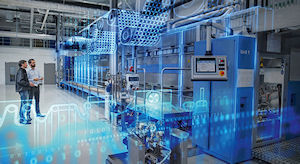
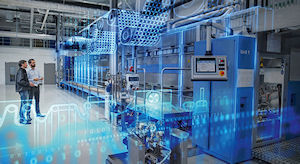
Siemens demonstrating the digital twin of a manufacturing process.
2. Monitoring Equipment
Every ship, airplane, tractor, or turban in a power plant has the potential for being digitally replicated.
The single biggest problem with digital twins is that one size does not fit all. In other words, a new digital twin is needed for every single product that is produced and the process that creates them. That’s because every product, no matter how precisely it’s made, operates differently. This is especially true if humans are involved in the production.
Once we’re able to produce a virtual pairing with the physical world, we suddenly have the ability to analyze data streams and monitor systems so we can head off glitches before they occur, prevent interruptions, uncover new opportunities, and even test new strategies with quickly contrived digital models.
3. Remote Robotics
Monitoring equipment in increasing levels of detail is just the first step towards redefining our new scope of capabilities. We will quickly move from “monitoring” to “control.” Over time things like “platooning,” “remote assist,” “remote operation,” and “emergency remote command” will become common phrases in our daily lexicon.
Let’s start by using a trucking industry scenario.
Platooning – The first phase of remote robotics for trucking will involve platooning where human drivers control the lead vehicle, followed by 2-3 slave (driverless) vehicles. Since the driver is still in control, additional support won’t be needed until it arrives at the delivery location where either addition human operators can take the controls or remote drivers can manage vehicles for the final positioning of the truck.
Remote Assist – Similar to having a remote Uber driver “looking over the shoulder” of a driverless vehicle to assure it’s being operated smoothly.
Remote Operation – The actual operators may be working in a cube-farm in Arizona or even another country, but having a person at the controls is critical for certain situations. Drivers, pilots, and captains do far more than just drive their vehicles. They provide a contact person to talk to, a sense of security, situational awareness, and the type of oversight and responsibility that only a human can provide.
Emergency Remote Command – Since there is no such thing as an infallible machine, things will go wrong. When this happens, we will need a live person to manage the problem. The solution may be as simple as a system reboot, but in extreme cases, emergency rescue people will need to be involved, and having a central contact person to coordinate the response is critical.
Smart cities will soon be managed through digital twin technology.
4. Managing a Smart City
Cities will soon have their own fleets of drones, with scanning capabilities, to create digital models of their communities. As scanners, sensors, and resolutions improve, cities will begin creating increasingly functional digital twins of their streets, neighborhoods, and activity centers.
Having thousands of drones swarming over most metro areas on a daily basis may seem annoying at first, but the combination of new businesses, jobs, information, data analysis, new career paths, and revenue streams will quickly turn most naysayers into strong industry advocates.
But for cities, digital twins will go much deeper than what’s viewable from above. This will mean digital twins of every power line, substation, sewage system, water line, emergency services system, Wi-Fi network, highway, security system, traffic control network, and much more. Done correctly, every problem will only be two clicks away from viewing on the digital twin master control center.
In short order, digital twins of cities will become treasure troves of data as the daily inflow and outflow of people, traffic, and weather become far better understood. This form of digital modeling will also give rise to search engines for the physical world.
5. Search Engines for the Physical World
Online search technology has framed much of our thinking around our ability to find things. In general, if it’s not digital and online, it’s not findable.
In the future, drones and sensors will replace much of the work of today’s web crawlers when it comes to defining our searchable universe.
Search technology will become far more sophisticated in the future. Soon we will be able to search on attributes like smells, tastes, harmonic vibration, textures, specific gravity, levels of reflectivity, and barometric pressures.
Over time, search engines will have the capability of finding virtually anything in either the digital or physical world.
6. Monitor and Enhance our Health & Physical Performance
How long before we can view a fully functional digital twin of our body?
We already have several tools that can create a digital map of our body, both external and internal, like 3D laser scanners, radiography, echography, MRI, and more. We also have a growing number of wearables, along with both contact and embedded sensors that can track what is going on.
In this context, I’m imagining a complete digital image of ourselves that can be rotated around, zoomed in for close-ups, watching blood flowing through veins and arteries, muscles flexing, heart pumping, food and water working its way through our digestive system, with increasing levels of detail possible for every gland, follicle, fat tissue, organ, and taste bud.
When we finally develop holographic displays, our ability to gain relational perspectives, as well as cause and effect relationships will only increase.
7. Monitor and Enhance our Brain & Mental Performance
The human brain is still one of the most complex marvels of the universe, and creating a digital twin will require next-generation supercomputers and some amazing collaboration between brain researchers and computer engineers.
To this end, Hewlett Packard is working with Switzerland’s Ecole Polytechnique Fédérale de Lausanne to launch the Blue Brain Project with the goal of building a digital model of the mammalian brain. Their goal is to develop a brain model that serves as the basis for an unlimited number of simulations and experiments.
Experiments like this will not only require huge amounts of computing power, but also a massive range of computational approaches to simulate the brain’s unique techniques for organizing and interacting with it’s conscious and unconscious memories as well as functional responsibilities for managing the rest of the body.
Rest assured, the creation of a “mirror brain” like this is still in the domain of science fiction, but nevertheless in the realm of next-decade possibilities.
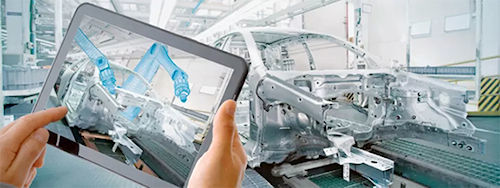
According to Siemens, digital twin simulations can even help determine the manufacturing process.
Final Thoughts
To put things in perspective, the cars we drive today have been in development for over 120 years. It has taken that long to get to cars this good. With our emerging technology, we still have to work our way through the crappy stages before we get to the good stuff.
At the same time, we are building a digital infrastructure that is layered over everything physical in the world. This is another form of digital twin thinking and eventually the two will align.
Speeding this along, by 2022, 85% of all IoT platforms will include some kind of digital twin monitoring, and a few cities will take the lead in demonstrating the utility value of digital twin smart city technology.
As I watched Siemens engineers at Princeton demonstrate different types of digital twin technology, it became very apparent to me that any company that lags behind in this technology will soon find themselves on the outside looking in.
Translate This Page
Select LanguageAfrikaansAlbanianAmharicArabicArmenianAzerbaijaniBasqueBelarusianBengaliBosnianBulgarianCatalanCebuanoChichewaChinese (Simplified)Chinese (Traditional)CorsicanCroatianCzechDanishDutchEnglishEsperantoEstonianFilipinoFinnishFrenchFrisianGalicianGeorgianGermanGreekGujaratiHaitian CreoleHausaHawaiianHebrewHindiHmongHungarianIcelandicIgboIndonesianIrishItalianJapaneseJavaneseKannadaKazakhKhmerKoreanKurdish (Kurmanji)KyrgyzLaoLatinLatvianLithuanianLuxembourgishMacedonianMalagasyMalayMalayalamMalteseMaoriMarathiMongolianMyanmar (Burmese)NepaliNorwegianPashtoPersianPolishPortuguesePunjabiRomanianRussianSamoanScottish GaelicSerbianSesothoShonaSindhiSinhalaSlovakSlovenianSomaliSpanishSudaneseSwahiliSwedishTajikTamilTeluguThaiTurkishUkrainianUrduUzbekVietnameseWelshXhosaYiddishYorubaZulu
#goog-gt-tt {display:none !important;}
.goog-te-banner-frame {display:none !important;}
.goog-te-menu-value:hover {text-decoration:none !important;}
.goog-text-highlight {background-color:transparent !important;box-shadow:none !important;}
body {top:0 !important;}
#google_translate_element2 {display:none!important;}
Search for:
.et_bloom .et_bloom_optin_2 .et_bloom_form_content { background-color: #ffffff !important; } .et_bloom .et_bloom_optin_2 .et_bloom_form_container .et_bloom_form_header { background-color: #dd4242 !important; } .et_bloom .et_bloom_optin_2 .et_bloom_form_content button { background-color: #3b3b3b !important; } .et_bloom .et_bloom_optin_2 .et_bloom_form_content .et_bloom_fields i { color: #3b3b3b !important; } .et_bloom .et_bloom_optin_2 .et_bloom_form_content .et_bloom_custom_field_radio i:before { background: #3b3b3b !important; } .et_bloom .et_bloom_optin_2 .et_bloom_form_content button { background-color: #3b3b3b !important; } .et_bloom .et_bloom_optin_2 .et_bloom_form_container h2, .et_bloom .et_bloom_optin_2 .et_bloom_form_container h2 span, .et_bloom .et_bloom_optin_2 .et_bloom_form_container h2 strong { font-family: "Open Sans", Helvetica, Arial, Lucida, sans-serif; }.et_bloom .et_bloom_optin_2 .et_bloom_form_container p, .et_bloom .et_bloom_optin_2 .et_bloom_form_container p span, .et_bloom .et_bloom_optin_2 .et_bloom_form_container p strong, .et_bloom .et_bloom_optin_2 .et_bloom_form_container form input, .et_bloom .et_bloom_optin_2 .et_bloom_form_container form button span { font-family: "Open Sans", Helvetica, Arial, Lucida, sans-serif; }
Subscribe To Our Newsletter
Join our mailing list to receive the latest news and updates from Thomas Frey.
SUBSCRIBE!
You have Successfully Subscribed!
Recent Posts
The Coming Era of AI-Enhanced Superhumans
Future of Work: The New Age of Employment
Seven ways digital twins will affect your life in 2028 and beyond
52 Future Degrees Colleges Are Not Offering Yet
Using Drones to Eliminate Future Forest Fires
Categories
Artificial Intelligence
Business Trends
Future of Banking
Future of Education
Future of Healthcare
Future of Transportation
Future of Work
Future Scenarios
Future Trends
Futurist Thomas Frey Insights
Global Trends
Predictions
Social Trends
Technology Trends
By Futurist Thomas Frey, author of 'Epiphany Z – 8 Radical Visions Transforming Your Future'
September 22, 2018
Seven ways digital twins will affect your life in 2028 and beyond
Recently I was given a behind-the-scenes tour of Siemens Robotics Lab in Princeton, NJ where they demonstrated digital twin technology on a self-organizing manufacturing process.
For those of you new to the concept, a digital twin is a virtual representation of a real-life physical product, building, or person. It can take the form of a chair, desk, lamp, house, or even your next-door neighbor. Any item that exists in the physical world can be replicated with a digital twin.
For anyone managing a business, digital twins offer unique insights into how products or processes are operating in real time, even from a remote location.
Yes, the concept of digital twins has been around for a while, with consulting groups like Gartner hailing it as a game-changing trend, but businesses have been slow to embrace it because its rather complicated to implement.
As an example, adding enough sensors to create a digital twin of a car will require not only digitally replicating the shape of the vehicle, but also the tires, seats, engine, and even mirrors. But things get far more complicated under the hood, where the inner workings of the engine will require a real-time simulation including every spark, explosion, and movement inside the cylinder block, pistons, crankshaft, valves, and plugs, capturing every distortion, wobble, glide pattern, and even the slightest bit of of friction happening in real time.
However, this level of intricacy doesn’t happen instantly. As we step from detail and accuracy to micro-detail and micro-accuracy, these super elaborate 3D models will enable us to visualize how our physical products are performing and changing in the moment. If something breaks down, we can instantly tell what went wrong. More important, we can begin to anticipate failure and devise preventative maintenance strategies to circumvent disasters before they occur.
Near Term Applications
Whenever I bring up the topic of digital twins in conversation, I usually get blank stares and quizzical looks. At this point the concept is not well known, yet over the coming years it will increasing become part of our daily lives.
Even those with some understanding have a hard time grasping the ROI (return on investment) potential. But over the next decade, even the term “digital twin” will likely disappear as it becomes as common as GPS, Facetime, and Spotify.
1.) Smart Home Command Centers
With the Internet of Things (IoT) entering our homes in new and usual ways, having a central command center becomes a logical extension of our need to monitor and manage our lifestyles.
Security systems, cable TV, Wi-Fi, solar, water, sprinklers, and heating & air conditioning are typically disjointed components of a modern home. Over the coming decade most homeowners will migrate to a central command center that grows in capability over time.
Digital twin technology will become an essential ingredient for our homes as they grow into the smart living organisms that are critical for managing the demands of the future.
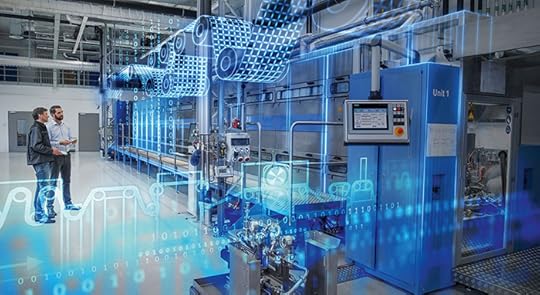 Siemens demonstrating the digital twin of a manufacturing process
2.) Monitoring Equipment
Every ship, airplane, tractor, or turban in a power plant has the potential for being digitally replicated.
The single biggest problem with digital twins is that one size does not fit all. In other words, a new digital twin is needed for every single product that is produced and the process that creates them. That’s because every product, no matter how precisely it’s made, operates differently. This is especially true if humans are involved in the production.
Once we’re able to produce a virtual pairing with the physical world, we suddenly have the ability to analyze data streams and monitor systems so we can head off glitches before they occur, prevent interruptions, uncover new opportunities, and even test new strategies with quickly contrived digital models.
3.) Remote Robotics
Monitoring equipment in increasing levels of detail is just the first step towards redefining our new scope of capabilities. We will quickly move from “monitoring” to “control.” Over time things like “platooning,” “remote assist,” “remote operation,” and “emergency remote command” will become common phrases in our daily lexicon.
Let’s start by using a trucking industry scenario.
Platooning – The first phase of remote robotics for trucking will involve platooning where human drivers control the lead vehicle, followed by 2-3 slave (driverless) vehicles. Since the driver is still in control, additional support won’t be needed until it arrives at the delivery location where either addition human operators can take the controls or remote drivers can manage vehicles for the final positioning of the truck.
Remote Assist – Similar to having a remote Uber driver “looking over the shoulder” of a driverless vehicle to assure it’s being operated smoothly.
Remote Operation – The actual operators may be working in a cube-farm in Arizona or even another country, but having a person at the controls is critical for certain situations. Drivers, pilots, and captains do far more than just drive their vehicles. They provide a contact person to talk to, a sense of security, situational awareness, and the type of oversight and responsibility that only a human can provide.
Emergency Remote Command – Since there is no such thing as an infallible machine, things will go wrong. When this happens, we will need a live person to manage the problem. The solution may be as simple as a system reboot, but in extreme cases, emergency rescue people will need to be involved, and having a central contact person to coordinate the response is critical.
 Smart cities will soon be managed through digital twin technology
4.) Managing a Smart City
Cities will soon have their own fleets of drones, with scanning capabilities, to create digital models of their communities. As scanners, sensors, and resolutions improve, cities will begin creating increasingly functional digital twins of their streets, neighborhoods, and activity centers.
Having thousands of drones swarming over most metro areas on a daily basis may seem annoying at first, but the combination of new businesses, jobs, information, data analysis, new career paths, and revenue streams will quickly turn most naysayers into strong industry advocates.
But for cities, digital twins will go much deeper than what’s viewable from above. This will mean digital twins of every power line, substation, sewage system, water line, emergency services system, Wi-Fi network, highway, security system, traffic control network, and much more. Done correctly, every problem will only be two clicks away from viewing on the digital twin master control center.
In short order, digital twins of cities will become treasure troves of data as the daily inflow and outflow of people, traffic, and weather become far better understood. This form of digital modeling will also give rise to search engines for the physical world.
5.) Search Engines for the Physical World
Online search technology has framed much of our thinking around our ability to find things. In general, if it’s not digital and online, it’s not findable.
In the future, drones and sensors will replace much of the work of today’s web crawlers when it comes to defining our searchable universe.
Search technology will become far more sophisticated in the future. Soon we will be able to search on attributes like smells, tastes, harmonic vibration, textures, specific gravity, levels of reflectivity, and barometric pressures.
Over time, search engines will have the capability of finding virtually anything in either the digital or physical world.
6.) Monitor and Enhance our Health & Physical Performance
How long before we can view a fully functional digital twin of our body?
We already have several tools that can create a digital map of our body, both external and internal, like 3D laser scanners, radiography, echography, MRI, and more. We also have a growing number of wearables, along with both contact and embedded sensors that can track what is going on.
In this context, I’m imagining a complete digital image of ourselves that can be rotated around, zoomed in for close-ups, watching blood flowing through veins and arteries, muscles flexing, heart pumping, food and water working its way through our digestive system, with increasing levels of detail possible for every gland, follicle, fat tissue, organ, and taste bud.
When we finally develop holographic displays, our ability to gain relational perspectives, as well as cause and effect relationships will only increase.
7.) Monitor and Enhance our Brain & Mental Performance
The human brain is still one of the most complex marvels of the universe, and creating a digital twin will require next-generation supercomputers and some amazing collaboration between brain researchers and computer engineers.
To this end, Hewlett Packard is working with Switzerland’s Ecole Polytechnique Fédérale de Lausanne to launch the Blue Brain Project with the goal of building a digital model of the mammalian brain. Their goal is to develop a brain model that serves as the basis for an unlimited number of simulations and experiments.
Experiments like this will not only require huge amounts of computing power, but also a massive range of computational approaches to simulate the brain’s unique techniques for organizing and interacting with it’s conscious and unconscious memories as well as functional responsibilities for managing the rest of the body.
Rest assured, the creation of a “mirror brain” like this is still in the domain of science fiction, but nevertheless in the realm of next-decade possibilities.
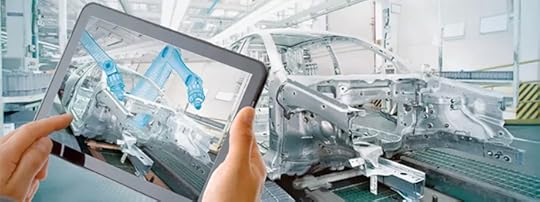
According to Siemens, advanced digital twin simulation can even help determine the manufacturing process
Final Thoughts
To put things in perspective, the cars we drive today have been in development for over 120 years. It has taken that long to get to cars this good. With our emerging technology, we still have to work our way through the crappy stages before we get to the good stuff.
At the same time, we are building a digital infrastructure that is layered over everything physical in the world. This is another form of digital twin thinking and eventually the two will align.
Speeding this along, by 2022, 85% of all IoT platforms will include some kind of digital twin monitoring, and a few cities will take the lead in demonstrating the utility value of digital twin smart city technology.
As I watched Siemens engineers at Princeton demonstrate different types of digital twin technology, it became very apparent to me that any company that lags behind in this technology will soon find themselves on the outside looking in.
By Futurist Thomas Frey
Author of “Epiphany Z – 8 Radical Visions Transforming Your Future”
August 28, 2018
52 Future Degrees Colleges Are Not Offering Yet
I was thoroughly intrigued when I found out the Colorado School of Mines in Golden, Colorado was offering a degree in asteroid mining.
Yes, the idea of extracting water, oxygen, minerals, and metals from an asteroid sounds like science fiction to most people, but it’s not that far away. In fact, Colorado School of Mines’ newly launched “Space Resources” program will help people get in on the ground floor.
After thinking about the proactive nature of this approach, it became abundantly clear how backward thinking most colleges have become.
When colleges decide on a new degree program, they must first recruit instructors, create a new curriculum, and attract students. As a result, the talent churned out of these newly minted programs is the product of a 6-7 year pipeline.
For this reason, anticipatory-thinking institutions really need to be setting their sights on what business and industries will need 7-10 years from now.
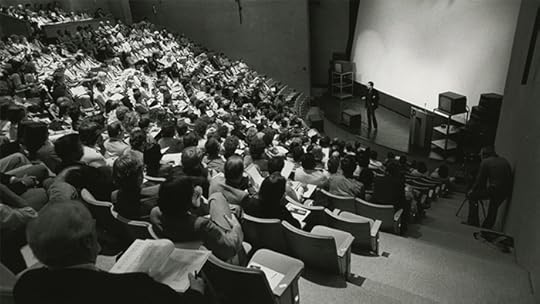
The Risk-Averse Nature of Education
When Harvard professor Clayton M. Christensen released his best-selling book, The Innovator’s Dilemma, his core message that disruptive change is the path to success, was only partially embraced by higher education.
While many were experimenting with MOOCs and smart whiteboards, changes in the subject matter of their courses still evolved at the traditional pace of discovery.
This is not to say colleges are not innovative. Rather, the demands of today’s emerging tech environment are forcing business and industries to shift into an entirely new gear. And that most definitely includes our academic institutions.
From a management perspective, it’s far easier to oversee a contained system where all variables are constrained. But during times of change, we tend to give far more power to the “unleashers,” who are determined to test the status quo and release ideas and trial balloons to see what works.
For this reason, managers and creatives often find themselves on opposing sides, and the winners of these warring factions often determine what we as consumers see as the resulting ripples of change.
Offering Pilot Programs
When Facebook bought Oculus Rift in March 2014 for $2 billion, the job boards went crazy, as there was an instant uptick in the demand for VR designers, engineers, and experience creators. But no one was teaching VR, and certainly not the Oculus Rift version of it.
Colleges have a long history of being blindsided by new technologies:
When eBay launched, no one was teaching ecommerce strategies
When Myspace launched, no one was teaching social networking
When Google launched, no one was teaching online search engine strategies
When Uber launched, no one was teaching sharing economy business models
When Apple first opened their App Store, no one was teaching smart phone app design
When Amazon first allowed online storefronts, no one was teaching the Amazon business model
When YouTube first offered ways to monetize videos, no one was teaching it
Since most academic institutions are only willing to put their name on programs with long-term viability, the endorsement of half-baked agendas does not come easy. However, that is exactly what needs to be done.
Colleges can no longer afford to remain comfortably behind the curve.

52 Future College Degrees
As a way of priming your thinking on this matter, here are 52 future degrees that forward-thinking colleges could start offering today:
1. Space Exploration – space tourism planning and management
2. Space Exploration – planetary colony design and operation
3. Space Exploration – next generation space infrastructure
4. Space Exploration – advanced cosmology and non-earth human habitats
5. Bioengineering with CRISPR – policy and procedural strategies
6. Bioengineering with CRISPR – advanced genetic engineering systems
7. Bioengineering with CRISPR – operational implementations and system engineering
8. Bioengineering with CRISPR – ethical regulation and oversight
9. Smart City – autonomous traffic integration
10. Smart City – mixed reality modeling
11. Smart City – autonomous construction integration
12. Smart City – next generation municipal planning and strategy
13. Autonomous Agriculture – robotic systems
14. Autonomous Agriculture – drone systems
15. Autonomous Agriculture – supply chain management
16. Autonomous Agriculture – systems theory and integration
17. Swarmbot – design, theory, and management
18. Swarmbot – system engineering and oversight
19. Swarmbot – municipal system design
20. Swarmbot – law enforcement and advanced criminology systems
21. Cryptocurrency – digital coin economics
22. Cryptocurrency – crypto-banking system design
23. Cryptocurrency – regulatory systems and oversight
24. Cryptocurrency – forensic accounting strategies
25. Blockchain – design, systems, and applications
26. Blockchain – blockchain for biological systems
27. Blockchain – large-scale integration structures
28. Blockchain – municipal system design strategies
29. Global Systems – system planning, architecture, and design
30. Global Systems – large-scale integration strategies
31. Global Systems – operational systems checks and balance
32. Global Systems – governmental systems in a borderless digital world
33. Unmanned Aerial Vehicle – drone filmmaking
34. Unmanned Aerial Vehicle – command center operations
35. Unmanned Aerial Vehicle – municipal modeling and planning systems
36. Unmanned Aerial Vehicle – emergency response systems
37. Mixed Reality – experiential retail
38. Mixed Reality – three-dimensional storytelling
39. Mixed Reality – game design
40. Mixed Reality – therapeutic systems and design
41. Advanced Reproductive Systems – designer baby strategies, planning, and ethics
42. Advanced Reproductive Systems – surrogate parenting policy and approaches
43. Advanced Reproductive Systems – organic nano structures
44. Advanced Reproductive Systems – clone engineering and advanced processes
45. Artificial Intelligence – data management in an AI environment
46. Artificial Intelligence – advanced human-AI integration
47. Artificial Intelligence – streaming AI data services
48. Artificial Intelligence – advanced marketing with AI
49. Quantum Computing – data strategies in a quantum-connected world
50. Quantum Computing – quantum-level encryption and security
51. Quantum Computing – quantum computing implementation strategies
52. Quantum Computing – AI-quantum system integration
Final Thought
More so than any time in history, we have a clear view of next generation technologies. Naturally, we’re still a long way from 100% clarity, but for most of the technologies listed above, the shifting tectonic plates of change can be felt around the world.
Without taking decisive action, colleges run the risk of being circumvented by new types of training systems that can meet market demands in a fraction of the time it takes traditional academia to react.
The ideas I’ve listed are a tiny fraction of what’s possible when it comes to emerging tech degrees. Should colleges stick their neck out like Colorado School of Mines and offer degrees that may not be immediately useful? Adding to that question, how many college degrees are immediately useful today?
I’d love to hear your thoughts on this topic.
By Futurist Thomas Frey
Author of “Epiphany Z – 8 Radical Visions Transforming Your Future”
August 22, 2018
Using Drones to Eliminate Future Forest Fires
In 2013, I proposed using drones to extinguish future forest fires. Admittedly, both the idea and the technology were crude, and proposing an idea like this is not the same as implementing a solution.
During the first few minutes, between the time when a fire first starts and when it reaches a point of being out of control, is a containment window where only a few gallons of water or a few pounds of fire retardant is necessary to put the evil genie back into its bottle.
Using a fleet of surveillance drones, equipped with special infrared cameras, fires can be spotted during the earliest moments of a containment window, signaling a fleet of extinguisher drones to douse the blaze before anything serious happens.
Drones specifically designed for extinguishing forest fires have the potential to eliminate virtually 100% of the devastating fires that dominate newspaper headlines every summer. But is that what we want?
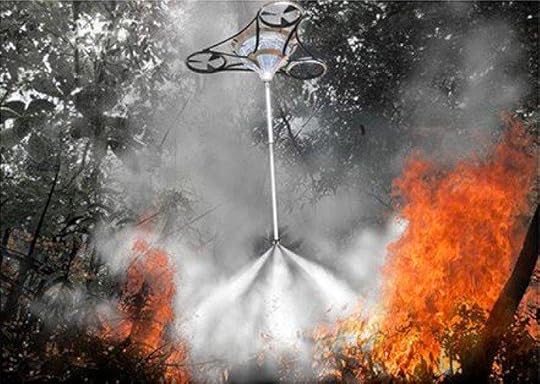
Enter FUEGO
Also in 2013, University of California Berkeley astrophysicist Carlton Pennypacker, along with a team of researchers, proposed the development of the Fire Urgency Estimator in Geosynchronous Orbit (FUEGO).
FUEGO, as he imagined it, would harnesses drone and satellite technology to spot wildfires in their early stages, long before they were out of control.
As he imagined it, the advancing convergence of sensors, drones, image recognition, and AI technologies would soon turn this approach into an obvious solution to the increasingly destructive wildfires.
The growing cost of wildfires
Fire seasons are growing longer in the United States and around the world. There are more than 8,000 forest fires each year in Canada.
Cost of fighting U.S. wildfires topped $2 billion in 2017. According to the U.S. Forest Service, the changing climate has extended the wildfire season by an average of 78 days per year since the 1970s. For this reason, agencies find it necessary to keep seasonal employees on their payrolls longer and have contractors standing by earlier and available to work later in the year. All of this adds to the overall cost of fighting fires.
In recent decades, housing developments have pushed into areas with fire-prone ecosystems, where humans and nature collide. Because of political pressures, the Forest Service has shifted its priorities from protecting timber resources to trying to prevent fires from reaching houses and other physical infrastructure.
Are drones good news or bad news?
In March 2018, a drone reportedly caught fire after it crashed, igniting dry grasses in an area called Kendrick Park, near Flagstaff, Arizona.
The owner of the drone has been charged with starting a fire that destroyed 300 acres of grassland in Arizona’s Coconino national forest, a charge that could result in significant fines and jail time.
Even though there are tons of experiments being conducted with fire-fighting drones, they are far from the perfect solution. Their inability to communicate with ground crews and other aircraft mean they can interfere with other air traffic, such as air tankers, helicopters, and additional firefighting aircraft that are necessary to suppress wildland fires.
Aerial firefighting missions including aerial supervision, air tanker retardant drops, helicopter water drops, and smokejumpers all operate within 0-200 feet altitude, which is the same altitude that many hobbyist drones fly.
The “can-we-should-we” debate
Certainly not all fires are bad. For years we have debated whether to let nature take its course or have us intervene.
In 2012 the U.S. Forest Service, which manages over 35 million acres of forests, made a major policy shift, deciding to intervene on all fires, something environmentalists contend will cause significant long-term damage.
So if we have the capability of spotting fires early and putting them out, is that preferable to letting them burn? Do we need to rewrite policies regarding when and where fires should burn vs. having us intervene?
As we add entire new toolsets to our fire suppression arsenal, these decisions become far more difficult. Who gets to decide, and how liable are they for making a bad decision?
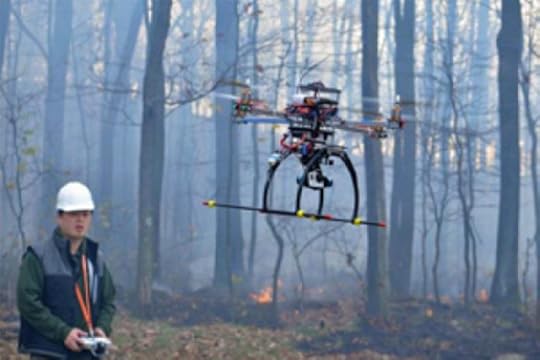
Final Thoughts
Even though they’re not universally accepted, drones are already making an impact on forest fires.
With drones ranging from tiny quadcopters to big fixed-wing aircraft, they’re showing they can detect, contain and even extinguish fires faster and with greater safety.
Drones give firefighters a bird’s-eye view of the terrain and even help them determine where a fire will move next, so they can make swift decisions about where fire crews should go and which residents need to be evacuated.
Piloting an aircraft over a raging fire puts both pilots and crew at risk. Plane and helicopter crashes accounted for 24% of deaths attributed to firefighting between 2006 and 2016, according to the U.S. Forest Service.
Drones that are equipped with infrared cameras can peer through smoke, while using sensors for wind direction and other weather variables to better anticipate how wildfires will spread. Tiny drones can whip through canyons and other confined spaces whereas helicopters often can’t fly low enough to capture the necessary high-resolution footage.
However, managing a 24/7-drone fleet over our massively huge forestlands will be no small undertaking. Surveillance drones will likely be a separate operation from the fire-suppression drones.
Extinguishing a fire under several layers of tree canopy will also be a challenge. Every kind of tree will likely require a different navigation strategy, and some densely covered grounds may be entirely unreachable until it’s too late.
Operating future drones day and night through inclement conditions like wind, hail, and rain will require an enormous effort. But so does a full-frontal attack on a fire by smokejumpers, bucket-bearing helicopters, and slow lumbering slurry bombers that each dumped more than 2,000 gallons of red chemical fire retardant on a formerly pristine mountainside.
New technology rarely fixes everything and it’s easy to see some of the downside here. But as with most things in the future, doing nothing is also not an option.
By Futurist Thomas Frey
Author of “Epiphany Z – 8 Radical Visions Transforming Your Future”
July 26, 2018
11 Critical Skills for the Future That Aren’t Taught in School
Don't Get Blindsided By The Future
GOOGLE'S TOP RATED FUTURIST SPEAKER
A few weeks ago a person who I hadn’t met before asked me what my superpower was. As an icebreaker at a networking event, this is a great question to get to know someone. However, since I had never been asked this question before, I must admit, I was caught a bit flatfooted.
Your superpower is the thing you do best, the role that you were put on this Earth to fill. If you don’t have one, it’s something you should focus your attention on. Tapping into it will not only help you personally, but also everyone around you.
No, we aren’t exactly born with superpowers we build them over time. Every company has people who are proficient in what they do, and their proficiency comes from the time, talent, and effort they’ve dedicated to it.
If you’re like most people, your job description has evolved over the past five years. For many, their role today didn’t even exist a short time ago. The workplace of tomorrow will indeed look quite different.
At the same time, our evolving workplace is creating a skills divide. Some jobs require software skills tied to cybersecurity. Others require pattern-matching skills tied to system-related problem solving skills. And still others demand great people skills coupled with a deep understanding of HR law.
We have a large number of jobs that require relatively high-level skills, and many of those jobs will become obsolete in the future as individual tasks are being automated out of existence.
At the same time, every new tool will require a full compliment of updated skills, training, support, sales, and more.
Emerging high tech jobs continue to challenge the status quo because of the steeper-than-normal learning curve. While most employees haven’t been paying attention to the evolving workplace, the half-life of their skills is growing shorter, causing the overall value of their superpower to diminish over time.
With that in mind, here are a few hard-to-teach skills and superpowers that will keep you employable for many decades to come.
1. Gig Management – Managing the “Business of You”
We’re moving quickly into a freelance economy and ironically no traditional schools have felt it to be a skillset important enough to add to their curriculum.
Rather than serving at the mercy of a single company that rarely has your best interest in mind, freelancers have the ability to migrate towards better opportunities, renegotiate salaries, and form both competing and complementary work relationships with businesses and organizations around the world.
That said, it’s not easy to become a highly sought-after freelancer as it requires talent in many areas. Networking, tracking down potential gigs, writing proposals, forming contracts, managing the accounting, sales, scheduling, and project management are all part of the rigorous lifestyle that comes with the territory. But, in the end, skilled freelancers have the ability to control their own destiny, something most workers can only dream of.
Note: Over the coming years there will be a number of reports that say the gig economy is not happening, but those will be very misleading. Freelancers that earn enough money will naturally incorporate for tax purposes, masking the true nature of their operation. Any W2 freelancer, when surveyed, will come across as a traditional worker, even though their behind-the-scenes operation says something totally different.
Gig management will be a career-defining talent and massively important skill for the future.
2. Distraction Management
We live in the most distracted society in all history. In a recent Pew study, 45% of the teens surveyed said they use the Internet “almost constantly.” Another 44% said they go online several times every day.
70% of today’s workers keep their smartphone “within eye contact” at work, and over 50% of people check their phone if they wake up during the night.
The average smartphone user checks their phone over 220 times a day. During peak times this jumps up to once every six or seven seconds. Total addicts will actually jack-in over 900 times in a day and several reports have revealed incidents where young drama-junkies have been hospitalized from exhaustion because “fear of missing out” caused them to stop sleeping altogether.
Since office workers typically take around 25 minutes to recover from interruptions before returning to their original task, it becomes a far greater challenge for people to make meaningful accomplishments.
Further complicating the situation, a 2015 study showed that distractions have a way of causing even more distractions. Workers who get interrupted by text messages are significantly more likely to ‘self-interrupt’ – allowing their attention to ricochet from thought to thought while losing their ability to fully concentrate on any one thing.
One recent study showed 53% of people would rather give up their sense of smell than their smartphone. One in three would give up sex before their phone.
But let’s not forget TV time. During peak hours, over 70% of the bandwidth for the Internet is dedicated to video streaming with Netflix and YouTube sucking up over 62% of the entire bandwidth in North America.
The average American spends over 5.5 hours a day consuming some form of video content.
So after all of that, how much time do you really have left for your job, your family and friends, and actually experiencing the world around you? Sadly, it’s only going to get worse.
For these reasons, distraction management will be one of the most critical skills for successful people to master in the future.
3. Relationship Management
Our work, social, and family life is all formed around relationships.
The only way the human race will survive is by people forming relationships and having children. Yet there are powerfully few schools that do a good job teaching this subject even though there’s been over a million books written on the topic.
Social media relationships, something that never even existed 20 years ago, now consumes the vast majority of our relationship-building time. And our expectations from a “good” relationship has vastly changed over the past two decades.
Digital connection services have done more than just change how we find the perfect romance, they’ve changed how we network, form business deals, and make a sale. Keep in mind, it wasn’t all that long ago when most relationships began with a smile and a handshake, rather than a click or a swipe.
In the 1990s, British anthropologist Robin Dunbar claimed that the number of people you can manage strong relationships with was around 150. This became known as the Dunbar Number. However, social media has somewhat blurred his entire theory.
In spite of our ability to loosely connect with thousands, even millions online, new research from Dunbar concludes we’re only able to maintain a small number, at most five, close friendships at one time.
People who understand the constantly morphing values and techniques for building and managing relationships will be a hot commodity in the future.
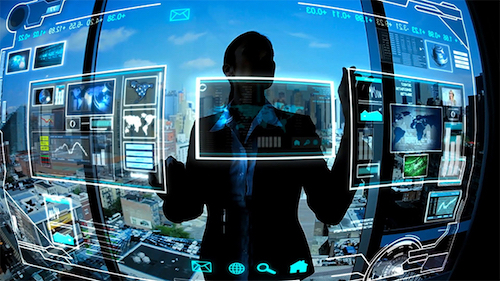
4. Relevancy Management
How relevant are you today? What are the talent and skills that will make and keep you relevant in your profession, company, work team, and among your peers?
Relevancy goes far deeper than your work history and current credentials. Relevancy is all about your willingness to change and adapt. People who are resilient, flexible, and resourceful are much more valuable than even the best technicians today.
What is that unique or special contribution that you bring to the table?
What is the thing that separates you from all others in the company?
What are you known for, and is that what people want?
Do you have a special talent for dealing with people?
Are you forward thinking with an overall sense of what the future holds?
Are you decisive, able to make the tough calls when others tend to hesitate?
Do you have the ability to make sense out of even the most complex situations?
When presented with new tools, systems, processes, or management, how quickly are you able to adapt?
Managing relevancy is unique talent with very few current guidelines, but those who instinctively have it will know how and when to adapt.
5. Managing Your Awareness
How do you stay up to date on the latest information? Who are the thought leaders in your area of expertise and how do you stay current on their work?
The Internet is a massively complex tool that can be channeled to improve your awareness of virtually any topic.
While the average American is consuming information 12 hours and 7 minutes every day, how much of what you consume is truly germane to your area of expertise?
We now have thousands of possible information channels for even the most micro-niche areas of interest and those who manage to carve out the right combination of newsfeeds will find themselves in driver seat of their own career path.
6. Managing Your Tribe (Fan Club Management)
Going beyond personal relationships is the tribes we associate with. I like to frame this thinking around the idea of fan clubs.
Everyone has people that care about them, their own personal fan club. Our ability to grow, study, and interact with these people is a powerful tool that can be leveraged in many ways.
Each new connection intensifies the network effect, adding to our overall value as an individual. Over time, the value of our personal network in tomorrow’s hyper-connected world will become far more quantifiable, and by extension, more valuable than any formulas we use to measure influence today.
It’s rare that people become famous without effort. It typically requires effort, usually sustained effort over a long period of time. Managing a personal fan club is all part of the work that prepares people to climb their own ladder of success, and our ability to master the tools for managing our own fan club will largely determine where we end up in life.
7. Managing our Digital Toolbox
It’s much more than just knowing the tools and how to use them, it’s about knowing which tool to use in which situation.
Our choice of technology defines who we are and our ability to function in an increasingly technology-dependent world.
The very first Apple iPhone entered the world in 2007. Since then, new tools have been appearing on a daily basis. So what should we be paying attention to, and what can we dismiss?
With sensors becoming a ubiquitous part of everyday living we will soon be wearing smart shoes, sleeping on smart pillows, eating smart food, with smart spoons, while watching our children play with their smart toys.
Very soon we will be downloading apps for our drones, our smart houses, our pets, our cars, our clothes, and even our imaginary friends.
Our relationship with our personal technology will continue to be an ongoing challenge and improving skills in this area will give us a distinct advantage.
8. Personal Brand Management
A personal brand is really another way of describing your reputational portfolio.
Being successful means setting yourself apart, and you’ll need a personal brand that defines who you are and who you want to become. That involves building a reputation, trust, and a following. The impression you project about yourself is crucial for finding the best workplace culture fit and for inspiring confidence in your coworkers, clients, and managers
Working with a team of mentors, advisors, or trusted friends, start by auditing your online footprint. This will include all images, posts, videos, connections and correspondence. Since a personal brand is all about what others think, it’s critical to assess how others are interpreting your brand.
Your goal is to ensure your image comes across as professional, polished, and appropriate, both now or in the future.
Mastering this skill is not a one-and-done activity. Your personal brand will need to be tweaked and managed on an ongoing basis.
9. Communication Management
In the book “The Female Brain,” author Louann Brizendine stated that women use 20,000 words per day while men only use 7,000. However, that wasn’t true. There was no study that actually showed those results.
Since then, one study showed that women speak 16,215 words per day on average and men 15,669 words per day. Statistically there’s no difference between genders, but people who speak more generally have an advantage over those with less practice.
Communication is an essential ingredient in all of our lives, but too much or too little can have devastating effects.
With life happening at a far greater pace and new communication channels springing to life in games, social media, and smartphone apps, people often stress over not keeping up with their friends and family. And when they turn things off, they suffer even greater anxiety over feeling left out.
Finding effective ways of managing our communication channels is a critical skill to master in the future.
10. Privacy Management
What exactly does privacy mean?
Following the Cambridge Analytica scandal that forced Facebook CEO Mark Zuckerberg to testify before congress, privacy has become a hot topic in the online world.
Privacy and transparency live on opposite ends of the information spectrum, but they’re both part of the huge ethical issue that falls under the banner of privacy.
Drone privacy is different than social media privacy, which is different than online retailer privacy, Internet of Things privacy, big data privacy, email privacy, and snooping-around-in-my-business privacy.
The landmark EU court decision granting the “right to be forgotten” has been replaced by a more manageable “right of erasure” in 2014. This ruling has been one of the foundational privacy rights granted by the General Data Protection Regulation (GDPR).
In practice, the “right to be forgotten” was always more about the “right to be favorably remembered.” People don’t like being the subject of a smear campaign and naturally want some control over having it removed.
For this reason, GDPR is becoming an important part of managing our lives.
People can often derive significant benefits from sharing their personal details as they take advantage of relevant and useful services online. However, once collected, businesses often exploit and monetize personal information, leaving people exposed and placing their information in predatory danger.
Yes, protecting and enforcing privacy is an added burden for business, but a lack of privacy creates risk for users and reduces trust. Trust plays a key role in virtually every form of innovation.
Understanding both sides of this equation will be a critical skill for future generations. Your value as an employee will rise dramatically by having a nuanced understanding of GDPR and the overall ramifications of personal privacy.
11. Modern Time Management
The most precious commodity in everyone’s life is still time. You can ponder it, over-schedule it, spend it with others, account for every second of it, make others account for it, squander it, or simply act as if it doesn’t exist. But so far we’ve not found a way to stretch it, reverse it, or buy extra bags full of it when we run out.
Time management systems of the past will continue to morph, shift, and change to accommodate lifestyles and business demands of the future.
Every item on the list above boils down to creating efficiencies, and we can’t possibly create these efficiencies without finding better ways to manage our time.
Final Thoughts
Yes, the key word in this list is “management.” It will be up to us to manage every aspect of our increasingly complicated lives.
Is eleven the right number? This was not intended to be an all-inclusive list of skills for tomorrow. Over time, many more will be needed.
My goal was to draw attention to some of the most critical ones, the ones that currently seem to be overlooked today.
But I’d love to hear your thoughts on this topic. Let me know what I’m missing and where I may be off base. The ideas of the many are almost always greater than the ideas of the few.
Search for:
.et_bloom .et_bloom_optin_2 .et_bloom_form_content { background-color: #ffffff !important; } .et_bloom .et_bloom_optin_2 .et_bloom_form_container .et_bloom_form_header { background-color: #dd4242 !important; } .et_bloom .et_bloom_optin_2 .et_bloom_form_content button { background-color: #3b3b3b !important; } .et_bloom .et_bloom_optin_2 .et_bloom_form_content .et_bloom_fields i { color: #3b3b3b !important; } .et_bloom .et_bloom_optin_2 .et_bloom_form_content .et_bloom_custom_field_radio i:before { background: #3b3b3b !important; } .et_bloom .et_bloom_optin_2 .et_bloom_form_content button { background-color: #3b3b3b !important; } .et_bloom .et_bloom_optin_2 .et_bloom_form_container h2, .et_bloom .et_bloom_optin_2 .et_bloom_form_container h2 span, .et_bloom .et_bloom_optin_2 .et_bloom_form_container h2 strong { font-family: "Open Sans", Helvetica, Arial, Lucida, sans-serif; }.et_bloom .et_bloom_optin_2 .et_bloom_form_container p, .et_bloom .et_bloom_optin_2 .et_bloom_form_container p span, .et_bloom .et_bloom_optin_2 .et_bloom_form_container p strong, .et_bloom .et_bloom_optin_2 .et_bloom_form_container form input, .et_bloom .et_bloom_optin_2 .et_bloom_form_container form button span { font-family: "Open Sans", Helvetica, Arial, Lucida, sans-serif; }
Subscribe To Our Newsletter
Join our mailing list to receive the latest news and updates from Thomas Frey.
SUBSCRIBE!
You have Successfully Subscribed!
Recent Posts
52 Future Degrees Colleges Are Not Offering Yet
Using Drones to Eliminate Future Forest Fires
11 Critical Skills for the Future That Aren’t Taught in School
Insights On The Future Of Banking
The Mannequin Vs. Model Showdown is Coming
Categories
Artificial Intelligence
Business Trends
Future of Banking
Future of Education
Future of Healthcare
Future of Transportation
Future of Work
Future Scenarios
Future Trends
Futurist Thomas Frey Insights
Global Trends
Predictions
Social Trends
Technology Trends
By Futurist Thomas Frey, author of 'Epiphany Z – 8 Radical Visions Transforming Your Future'
11 critical skills for the future that aren’t taught in school
A few weeks ago a person who I hadn’t met before asked me what my superpower was. As an icebreaker at a networking event, this is a great question to get to know someone. However, since I had never been asked this question before, I must admit, I was caught a bit flatfooted.
Your superpower is the thing you do best, the role that you were put on this Earth to fill. If you don’t have one, it’s something you should focus your attention on. Tapping into it will not only help you personally, but also everyone around you.
No, we aren’t exactly born with superpowers we build them over time. Every company has people who are proficient in what they do, and their proficiency comes from the time, talent, and effort they’ve dedicated to it.
If you’re like most people, your job description has evolved over the past five years. For many, their role today didn’t even exist a short time ago. The workplace of tomorrow will indeed look quite different.
At the same time, our evolving workplace is creating a skills divide. Some jobs require software skills tied to cybersecurity. Others require pattern-matching skills tied to system-related problem solving skills. And still others demand great people skills coupled with a deep understanding of HR law.
We have a large number of jobs that require relatively high-level skills, and a lot of those jobs will become obsolete in the future as individual tasks are being automated out of existence.
At the same time, every new tool will require a full compliment of updated skills, training, support, sales, and more.
Emerging high tech jobs continue to challenge the status quo because of the steeper-than-normal learning curve. While most employees haven’t been paying attention to the evolving workplace, the half-life of their skills is growing shorter, causing the overall value of their superpower to diminish over time.
With that in mind, here are a few hard-to-teach skills and superpowers that keep you employable for many decades to come.
 Unleashing the freelancer in you
1.) Gig Management – Managing the “Business of You”
We’re moving quickly into a freelance economy and ironically no traditional schools have felt it to be a skillset important enough to add to their curriculum.
Rather than serving at the mercy of a single company that rarely has your best interest in mind, freelancers have the ability to migrate towards better opportunities, renegotiate salaries, and form competing work relationships with businesses and organizations around the world.
That said, it’s not easy to become a highly sought-after freelancer as it requires talent in many areas. Networking, tracking down potential gigs, writing proposals, forming contracts, managing the accounting, sales, scheduling, and project management are all part of the rigorous lifestyle that comes with the territory. But, in the end, skilled freelancers have the ability to control their own destiny, something most workers can only dream of.
Note: Over the coming years there will be a number of reports that say the gig economy is not happening, but those will be very misleading. Any freelancer that earns enough money will naturally incorporate for tax purposes, masking the true nature of their operation. Any W2 freelancer, when surveyed, will come across as a traditional worker, even though their behind-the-scenes operation says something totally different.
Gig management will be a career-defining talent and massively important skill for the future.
2.) Distraction Management
We live in the most distracted society in all history. In a recent Pewstudy, 45% of the teens surveyed said they use the Internet “almost constantly.” Another 44% said they go online several times every day.
70% of today’s workers keep their smartphone “within eye contact” at work, and over 50% of people check their phone if they wake up during the night.
The average smartphone user checks their phone over 220 times a day. During peak times this jumps up to once every six or seven seconds. Total addicts will actually jack-in over 900 times in a day and several reports have revealed incidents where young drama-junkies have been hospitalized from exhaustion because “fear of missing out” caused them to stop sleeping altogether.
Since office workers typically take around 25 minutes to recover from interruptions before returning to their original task, it becomes a far greater challenge for people to make meaningful accomplishments.
Further complicating the situation, a 2015 study showed that distractions have a way of causing even more distractions. Workers who get interrupted by text messages are significantly more likely to ‘self-interrupt’ – allowing their attention to ricochet from thought to thought while losing their ability to fully concentrate on any one thing.
One recent study showed 53% of people would rather give up their sense of smell than their smartphone. One in three would give up sex before their phone.
But let’s not forget TV time. During peak hours, over 70% of the bandwidth for the Internet is dedicated to video streaming with Netflix and YouTube sucking up over 62% of the entire bandwidth in North America.
The average American spends over 5.5 hours a day consuming some form of video content.
So after all of that, how much time do you really have left for your job, your family and friends, and actually experiencing the world around you? Sadly, it’s only going to get worse.
For these reasons, distraction management will be one of the most critical skills for successful people to master in the future.
3.) Relationship Management
Our work, social, and family life is all formed around relationships.
The only way the human race will survive is by people forming relationships and having children. Yet there are powerfully few schools that do a good job teaching this subject even though there’s been over a million books written on the topic.
Social media relationships, something that never even existed 20 years ago, now consumes the vast majority of our relationship-building time. And our expectations from a “good” relationship has vastly changed over the past two decades.
Digital connection services have done more than just change how we find the perfect romance, they’ve changed how we network, form business deals, and make a sale. Keep in mind, it wasn’t all that long ago when most relationships began with a smile and a handshake, rather than a click or a swipe.
In the 1990s, British anthropologist Robin Dunbar claimed that the number of people you can manage strong relationships with was around 150. This became known as the Dunbar Number. However, social media has somewhat blurred his entire theory.
In spite of our ability to loosely connect with thousands, even millions online, new research from Dunbar concludes we’re only able to maintain a small number, at most five, close friendships at one time.
People who understand the constantly morphing values and techniques for building and managing relationships will be a hot commodity in the future.
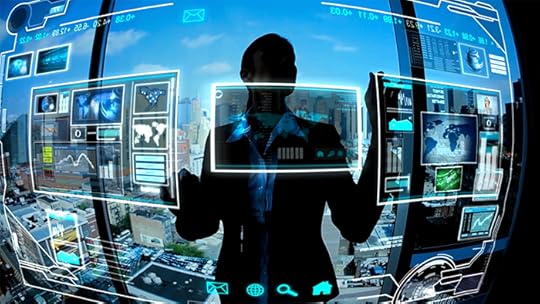 How relevant are your skills?
4.) Relevancy Management
How relevant are you today? What are the talent and skills that will make and keep you relevant in your profession, company, work team, and among your peers?
Relevancy goes far deeper than your work history and current credentials. Relevancy is all about your willingness to change and adapt. People who are resilient, flexible, and resourceful are much more valuable than even the best technicians today.
What is that unique or special contribution that you bring to the table?
What is the thing that separates you from all others in the company?
What are you known for, and is that what people want?
Do you have a special talent for dealing with people?
Are you forward thinking with an overall sense of what the future holds?
Are you decisive, able to make the tough calls when others tend to hesitate?
Do you have the ability to make sense out of even the most complex situations?
When presented with new tools, systems, processes, or management, how quickly are you able to adapt?
Managing relevancy is unique talent with very few current guidelines, but those who instinctively have it will know how and when to adapt.
5.) Managing Your Awareness
How do you stay up to date on the latest information? Who are the thought leaders in your area of expertise and how do you stay current on their work?
The Internet is a massively complex tool that can be channeled to improve your awareness of virtually any topic.
While the average American is consuming information 12 hours and 7 minutes every day, how much of what you consume is truly germane to your area of expertise?
We now have thousands of possible information channels for even the most micro-niche areas of interest and those who manage to carve out the right combination of newsfeeds will find themselves in driver seat of their own career path.
6.) Managing Your Tribe (Fan Club Management)
Going beyond personal relationships is the tribes we associate with. I like to frame this thinking around the idea of fan clubs.
Everyone has people that care about them, their own personal fan club. Our ability to grow, study, and interact with these people is a powerful tool that can be leveraged in many ways.
Each new connection intensifies the network effect, adding to our overall value as an individual. Over time, the value of our personal network in tomorrow’s hyper-connected world will become far more quantifiable, and by extension, more valuable than any formulas we use to measure influence today.
It’s rare that people become famous without effort. It typically requires effort, usually sustained effort over a long period of time. Managing a personal fan club is all part of the work that prepares people to climb their own ladder of success, and our ability to master the tools for managing our own fan club will largely determine where we end up in life.
7.) Managing our Digital Toolbox
It’s much more than just knowing the tools and how to use them, it’s about knowing which tool to use in which situation.
Our choice of technology defines who we are and our ability to function in an increasingly technology-dependent world.
The very first Apple iPhone entered the world in 2007. Since then, new tools have been appearing on a daily basis. So what should we be paying attention to, and what can we dismiss?
With sensors becoming a ubiquitous part of everyday living we will soon be wearing smart shoes, sleeping on smart pillows, eating smart food, with smart spoons, while watching our children play with their smart toys.
Very soon we will be downloading apps for our drones, our smart houses, our pets, our cars, our clothes, and even our imaginary friends.
Our relationship with our personal technology will continue to be an ongoing challenge and improving skills in this area will give us a distinct advantage.
8.) Personal Brand Management
A personal brand is really another way of describing your reputational portfolio.
Being successful means setting yourself apart, and you’ll need a personal brand that defines who you are and who you want to become. That involves building a reputation, trust, and a following. The impression you project about yourself is crucial for finding the best workplace culture fit and for inspiring confidence in your coworkers, clients, and managers
Working with a team of mentors, advisors, or trusted friends, start by auditing your online footprint. This will include all images, posts, videos, connections and correspondence. Since a personal brand is all about what others think, it’s critical to assess how others are interpreting your brand.
Your goal is to ensure your image comes across as professional, polished, and appropriate, both now or in the future.
Mastering this skill is not a one-and-done activity. Your personal brand will need to be tweaked and managed on an ongoing basis.
9.) Communication Management
On average, women speak around 7,000 words a day compared to only 2,000 for men. With a 3.5 times as much practice, women have a natural advantage in this area.
Communication is an essential ingredient in all of our lives, but too much or too little can have devastating effects.
With life happening at a far greater pace and new communication channels springing to life in games, social media, and smartphone apps, people often stress over not keeping up with their friends and family. And when they turn things off, they suffer even greater anxiety over feeling left out.
Finding effective ways of managing our communication channels is a critical skill to master in the future.
10.) Privacy Management
What exactly does privacy mean?
Following the Cambridge Analytica scandal that forced Facebook CEO Mark Zuckerberg to testify before congress, privacy has become a hot topic in the online world.
Privacy and transparency live on opposite ends of the information spectrum, but they’re both part of the huge ethical issue that falls under the banner of privacy.
Drone privacy is different than social media privacy, which is different than online retailer privacy, Internet of Things privacy, big data privacy, email privacy, and snooping-around-in-my-business privacy.
The landmark EU court decision granting the “right to be forgotten” has been replaced by a more manageable “right of erasure” in 2014. This ruling has been one of the foundational privacy rights granted by the General Data Protection Regulation (GDPR).
In practice, the “right to be forgotten” was always more about the “right to be favorably remembered.” People don’t like being the subject of a smear campaign and naturally want some control over having it removed.
For this reason, GDPR is becoming an important part of managing our lives.
People can often derive significant benefits from sharing their personal details as they take advantage of relevant and useful services online. However, once collected, businesses often exploit and monetize personal information, leaving people exposed and placing their information in predatory danger.
Yes, protecting and enforcing privacy is an added burden for business, but a lack of privacy creates risk for users and reduces trust. Trust plays a key role in virtually every form of innovation.
Understanding both sides of this equation will be a critical skill for future generations. Your value as an employee will rise dramatically by having a nuanced understanding of GDPR and the overall ramifications of personal privacy.
11.) Modern Time Management
The most precious commodity in everyone’s life is still time. You can ponder it, over-schedule it, spend it with others, account for every second of it, make others account for it, squander it, or simply act as if it doesn’t exist. But so far we’ve not found a way to stretch it, reverse it, or buy extra bags full of it when we run out.
Time management systems of the past will continue to morph, shift, and change to accommodate lifestyles and business demands of the future.
Every item on the list above boils down to creating efficiencies, and we can’t possibly create these efficiencies without finding better ways to manage our time.
Final Thoughts
Yes, the key word in this list is “management.” It will be up to us to manage every aspect of our increasingly complicated lives.
Is eleven the right number? This was not intended to be an all-inclusive list of skills for tomorrow. Over time, many more will be needed.
My goal was to draw attention to some of the most critical ones, the ones that currently seem to be overlooked today.
But I’d love to hear your thoughts on this topic. Let me know what I’m missing and where I may be off base. The ideas of the many are almost always greater than the ideas of the few.
By Futurist Thomas Frey
Author of “Epiphany Z – 8 Radical Visions for Transforming Your Future”
Thomas Frey's Blog

- Thomas Frey's profile
- 2 followers

