
Laurie L.C. Lewis's Blog: Bloggin' It Up Here, page 45
March 17, 2011
MAKING A HISTORICAL CASE FOR FOOD STORAGE AND EMERGENCY PREP
A Fox News report this afternoon was held via Skype, with an American aid worker holed up in a shelter in Sendai. He went in to provide aid, and now he and those he went to save are on the nuclear safety fringe, out of food, worried no one will come because of the proximity of their location to the the reactors.
When the Japanese authorities gave out the first safety information after the leaks from the nuclear plants, they were simply this: "Stay inside your homes." Later, officials admitted that staying indoors provided little safety. What these people really should have been told to do was to evacuate, but in a nation with so many displaced persons, the idea of shelter seemed more comforting to many, and now some are stuck in regions within the newly updated 18-mile evacuation perimeter. All three incidents point out a fundamental need for portable well-planned 72-hour kits and long term food storage, some of which also should be fairly portable.
This is history in the making. In the future, experts will look at this situation and create new paradigms for emergency preparedness. As a historical writer who has researched the preparations made by our ancestors, we can look there and see where our guard has dropped in recent years.
E
 ven wealthy plantation owners with money to spend knew the importance of storing food on their premises. Without benefit of refrigeration, they turned to drying, salting, canning, pickling, and smoking food for long term storage. They built cool, humidity-protected root cellars to keep fruits and vegetables fresh beyond their season, smoke houses to preserve meats, spring houses to extend the life of dairy products. It was hard work, but they never forgot an important lesson--that failure to prepare leaves you one growing season away from starvation.
Most of us have grocery stores within our rea
 dy reach, and refrigeration so shopping isn't a daily chore, but I doubt there are many of us who haven't looked at Japan and wondered, "What if?" Sadly, many will slip back into complacency instead of allowing the lessons to stick.
I live on the east coast in the midst of a great many military bases. Several years ago, one base was moving missiles from one location to another. Rather than transport them via the highway, a less-traveled route was chosen that took the convoy over a few miles of country roads. At one point the flatbed carrying the payload had to cross an older bridge. The structure wasn't built to handle the weight and as a result, the truck jostled, the missiles slipped, and several broke loose from their straps, breaking through the rail and into the ravine below.
A friend lived within five miles of that bridge. She had no knowledge of the accident until a knock sounded on her door and an official told her she had fifteen minutes to evacuate her house. That's all she knew. No return time or date was given, no best-case, worst-case scenario was provided. She didn't know if she would ever see her house again, but she knew what she should take. She and her family had rehearsed this scene out in preparation for just such an eventuality.
Her important documents and selected photos were assembled and at the ready. Her 72-hour kit was stocked with food, clothes, toiletries, water and small bills. An emergency meeting area and contact plan was in place so other family members could find her and one another later in the day. In short, a stressful situation was made less so, and a possible disaster was made manageable.
We laugh at stories about ancestors who "stuffed their money into mattresses" but if a real emergency arose, would you have small bills on hand? A few years ago a terrible winter storm hit us, knocking out all the power for several days. Electric doors wouldn't open, cash registers wouldn't work. A small convenience store was operating on a cash-only basis. Returning change was a luxury. Some people surrendered larger amounts than their bill because they were at the manager's mercy. We've made it a practice to store an emergency stash of one-dollar bills since then. And change. If cell phone lines get jammed or your battery goes dead, you'll appreciate change for a call.I copied the fronts and backs of all our credit cards, insurance cards, membership cards, etc. When my husband's wallet was picked from his pocket at the airport we had every number we needed at our disposal. I also had a list of the three major credit reporting agencies, and the Social Security Administration's phone number so we could alert everyone within minutes.I don't garden. I should, and I might again. Instead, I store food. On more than one occasion our storage helped us out when a paycheck was small, an unexpected expense hit us, a job was lost, or we just wanted something without having to go to the store to get it. Shopping ahead is a great hedge against inflation since you are eating food purchased when foods were cheaper. Also, when you have a nice supply you don't need to buy items that aren't on sale. You can afford to wait for a coupon or a sale.So learn the need to prepare from current events, and learn how to prepare from the past. Find a cool, dry space in your basement, or build a root cellar. (The web is loaded with plans. It's actually a "new" trend.") Begin with a 72-hour kit. Store a change of clothes, a first-aid kit, some cash, some water, a radio, 3-days worth of meds and hygiene items based on your family's needs. Include a copy of all your important documents like mortgage, investment and bank statements. Update them frequently, but even older statements will at least provide a record of account numbers and a point of reference for research if electronic files fail.Then increase your storage. There are dozens of reputable companies that will sell bulk food in lots, but you can shop weekly and add a few items with each trip, creating a supply that will rotate into your regular diet. Here's a link to one on my blog.In short, do something. None of us are completely impervious to disaster. The time to prepare is now. Copyright 2009 Laurie LC Lewis, (To obtain permission to copy or reprint any portion of this post, please contact the author at lclewis2007@gmail.com)


March 15, 2011
LESSONS FROM JAPAN
The images stunned us. We were wrenched by Japan's suffering. I heard prayers uttered for her and her people in every Church meeting, at meals and at bedsides. I knew it was happening across the United States and the world.
Good people of conscience reach out to others when disaster strikes, but who could imagine such a catastrophic triple punch heaped upon a suffering people as occurred when the nuclear power facilities began to go critical. Homeless, displaced persons were now bringing blanketed babies to white-suited officials to be scanned for radiation. Those images made me want to cry.
Following the earthquake and tsunami, an American journalist questioned an on-location colleague asking, "There was widespread looting after Katrina. Is looting a problem there?" The journalist looked behind himself at the broken ruins of a shopping district where the physical disorder was otherwise a scene of empty quiet. "No, I haven't heard any reports of looting, but I wouldn't expect to. In Japan, if you drop your wallet, you're likely to have it returned with all the contents intact."
I've watched the images in the background of reports since that interview. I haven't seen looters, sign carriers, or displays of violence. Instead, I've heard reports of people who've stood in long lines waiting for ration of water, who after receiving two bottles, handed one to someone in need. I've seen civility.
I've heard it explained as the "collective mindset" of the people. The memories of some will leap to World War II and the pain of that day. My mind shifted to the chaos in Wisconsin--to angry assemblies whose vitriol erupted into threatenings and abuse over issues far less life-altering than the loss of loved ones, destroyed homes, the erasure of entire communities, or the collective shift in life being experienced by our Japanese neighbors.
We will send government aid, and Americans will do what we do well--we'll send personal donations to relief organizations, we'll continue to pray, we'll answer the call for help in whatever way we can--but in the end, I hope we take the opportunity to receive as well as give, and model the example of civility displayed by the Japanese this week.Copyright 2009 Laurie LC Lewis, (To obtain permission to copy or reprint any portion of this post, please contact the author at lclewis2007@gmail.com)

March 12, 2011
HAIR-IMPAIRED
 I'm hair-impaired. No, this isn't actually me, but like this lady, I have hair-issues. And though you won't find Hair-Impaired on any known list of groups granted governmental or civil libertarian protection, let me assure you that having a bad hair day can be just as crippling. I've been late for dates, appointments, even church because I needed a complete re-do on an irritatingly disobedient do. I bet you've done it too.
I also have a flat head. I have to assume that my mother was ahead of her time, placing me to sleep on my back long before pediatricians declared that position to be the Holy Grail of infant rest. Or maybe it's genetic. My mother has a rounded head, but she wears a wig 24/7, so who really knows? And my father? Well . . . he wore a flat-top, and that cut makes everyone's head seem flat in back.
So take a flat-headed woman, give her difficult hair, and compound her problems by also leaving her devoid of any natural hair-styling abilities, and you've got a person in need of a serious support group.
For years I asked my stylist if I had enough gray to warrant coloring my hair. I always enjoyed her enthusiastic, "You? Not for a long time." And then one day there was a pause in her assessment, and then next trip the answer was a gum-snapping, "Yeah . . . we really ought to address this before it gets worse." Worse?
The grays have taken over. I mean, like a good infantryman, I battle back against the encroaching enemy line, but they are a new generation of combatant. Gray hairs have a mind and constitution all their own. They don't easily obey the round brush, or the blow dryer. In fact, they often mock the blow dryer, sadistically using the heat to advance their own wild, split-ended agenda. Ohhhhhh. . . I've seen it, ladies! I've lived it!
And my problems are not unique to me. I've seen the spirits of other brave women broken by errant hair. I ask you, why was such a needful topic like hair not universally addressed in public school? I'm not talking Cosmetology-level courses which, like AP Bio and History, are clearly constructed for future professionals in those fields. No, I mean, why wasn't it a PE elective like Health? I ask you, which life skill is more universally needful--Hair Care 101 or Volleyball? Which is more likely to be detrimental to getting hired--a mangy mop of hair, or a sloppy serve from the baseline? I think we can all agree on this.
It may be too late for me, or for the poor daughter I abused by repeatedly putting her hair in the same Princess Leia side-knots for seven years, but I urge all mothers to set aside the flash cards, the soccer drills and the oboe lessons long enough to skill your girl on basic hair. You'll all thank me someday.Copyright 2009 Laurie LC Lewis, (To obtain permission to copy or reprint any portion of this post, please contact the author at lclewis2007@gmail.com)

March 10, 2011
THE "TOO-MUCH-GOIN'-ON" DILEMMA
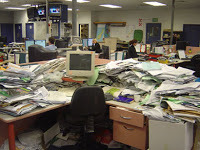
No, this isn't actually my desk, but it's close . . . or at least it was, and will be again unless I clear the calendar a tad. You see, I've simply got too much going on right now.
The daily "must-deal withs," have been overrun by the "small-projects" and the "if-you-don't meet-this-deadline-bad-things-will-happen" stuff. You know. I bet you do it too.
So on the daily list, there are the necessities of life. It may be that "Fish got to swim and birds got to fly," but likewise, food must be bought, meals prepared, dishes done, or surely you'll die.¸.•´¸.•´¨) ¸.•*¨)¸.☆
(¸.•´ (¸.•´•¸.•*(¸.♥´´¯`♥.¸¸.♫´¯`♥.¸¸.♈
The same holds true for laundry and and bill-paying, and certain household chores that may not literally kill you, but will likely remove you from the social roster.
I've got several of those "project things with a deadline" going on too--tax prep, a pioneer trek I'm planning for the youth of my stake, tax prep, preparation for a class I'm teaching at the Storymakers' Writing Conference in May, tax prep . . . (did I mention tax prep? That really stresses me out.)
There are also other needful concerns that are always there, like a three-year-old, tugging relentlessly at your heart--the people things like genealogy, and my Mom who is beginning to slip away, or my children whom I miss, and faraway grandchildren Tom and I need to see. Poor Tom. . . that's another neglected issue altogether. . .
Right now, a deadline is looming for book five, the final volume of Free Men and Dreamers, "In God Is Our Trust," and that is currently the biggest stress in my life. I want it to be great, to tie up every loose end, to leave my faithful readers satisfied and sad that the journey is over, and to make new readers anxious to grab a copy of book one and begin. And that takes a a mind that can focus.
So last night I cleared my desk of trek papers, tax stuff, research material, genealogical group sheets, and articles that need writing so I can focus. I might seem aloof or distant for a while, but I'm here, "clearing the mechanism" as Kevin Costner would say.
I'll have updates from time to time, but basically I'm hiding out from my editor, so if you chance to see her, mums the word, okay?

March 6, 2011
GET OUT OF THE BOAT!
 Vince Lombardi once said: "Fatigue makes cowards of us all," and let me add that Mr. Lombardi's counsel is true whether that fatigue has spiritual, physical, or emotional causes at its root. We've all felt it from time to time. We know it will pass, though we often can't dispel it in the moment of our need. This weekend, peace came in beautiful music, through sweet association with old friends, and in messages of hope and empowerment.
The words and stories weren't new. Perhaps it was my state of mind that made them fresh, or perhaps it was the evocative delivery that made them ring so true. In either case, they slingshot-ed me out of my foxhole, injecting optimism back in my heart. Every message was wonderful, (probably a sign that I had succeeded in adjusting my attitude for good reception), but a few closing points made by our visiting Church authority, really resonated with me--
1. "Yet if Thou wilt, I'll drink it up."
2. Sometimes we need the faith to do the impossible.
3. Get out of the boat!
Point one comes directly from the fourth verse of LDS hymn 191, "Behold the Great Redeemer Die," the point being, hard things will come.
In the September 2009 Ensign article titled, "Lessons From Liberty Jail," Elder Jeffrey R. Holland warns us with painful honesty, "In one way or another, great or small, dramatic or incidental, every one of us is going to spend a little time in Liberty Jail—spiritually speaking. We will face things we do not want to face for reasons that may not be our fault. Indeed, we may face difficult circumstances for reasons that were absolutely right and proper, reasons that came because we were trying to keep the commandments of the Lord."
God knows us. He knows what we're going through. He can and will consecrate them for our good, but what these events do to us, or for us, relies in large part, on how we handle our circumstances. Will we drink them up, or choke on them? Some of these experiences will make us better, wiser, stronger, more compassionate, more grateful, they'll move us onto a new path, open a new door we wouldn't have seen with our own half-closed eyes. In short, follow God, drink it up, and become more holy.
How do we do that? That's point two--having the faith to do the impossible. Now faith to do the impossible isn't a license to be reckless or irresponsible, but to follow inspiration, to leap further than you believed you could, past the light and a step into the darkness. It means to stretch muscles--spiritual and physical--beyond your comfort because He asked you to, and because like all proud fathers, He's at the finish line cheering you on.
And where do we begin? By getting out of the boat. Remember Peter? For a second, he believed he could do the impossible, and though he eventually faltered, what did he learn about Jesus, about himself, and about his relationship to divinity because of the few seconds when he did not fear? And it all began because he had the courage and faith to simply get out of the boat.
That's my motto this week--to get out of the boat! My boats are many. They pen me in and keep me . . . safe? Perhaps, but they also limit me and define my boundaries. I want to be unbounded and filled with possibilities.
What are your boats? What keeps you bounded? Weak faith? Fear of failure? Age? Lack of education? An over-scheduled life? What if none of those things had any power to define you? What would you try? What would you become? So long as our ears are tuned to His voice, we have no fear to walk, even on water. Peter did it, even if just for a few steps. But first, we have to have the courage to get out of the boat.
(Painting, "Fishermen at Sea" by Joseph Mallord William Turner)Copyright 2009 Laurie LC Lewis, (To obtain permission to copy or reprint any portion of this post, please contact the author at lclewis2007@gmail.com)

March 3, 2011
READING ACROSS AMERICA with ME, FLAT STANLEY, and a GAGGLE OF THIRD-GRADERS!
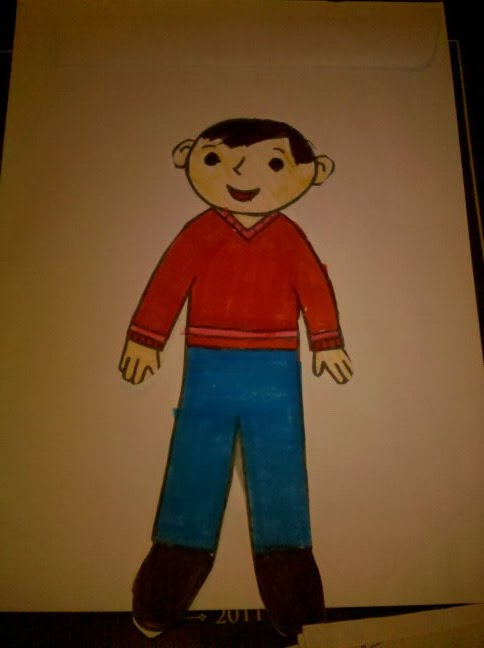 Flat Stanley is a unique book character created by author Jeff Brown nearly fifty years ago. When a bulletin board over his bed falls from the wall and smashes Stanley flat, a world of new adventures open to him. The Flat Stanley Project encourages pen pal-type relationships to develop through Stanley as he is mailed around the world.
Annette Lyon--author, wife, mother, editor, mentor--provided me with a new opportunity last week. Her daughter was involved in a Flat Stanley project, and she asked me to participate. A dear friend and I carried Stanley to Washington on a very windy day, to photograph him at some of the Capital's most interesting sights. We nearly lost the paper guy in gusts of fifty-mile-per-hour winds over the Potomac, so much of our tour had to be conducted from within a car, but we had a blast. (No pun intended.)
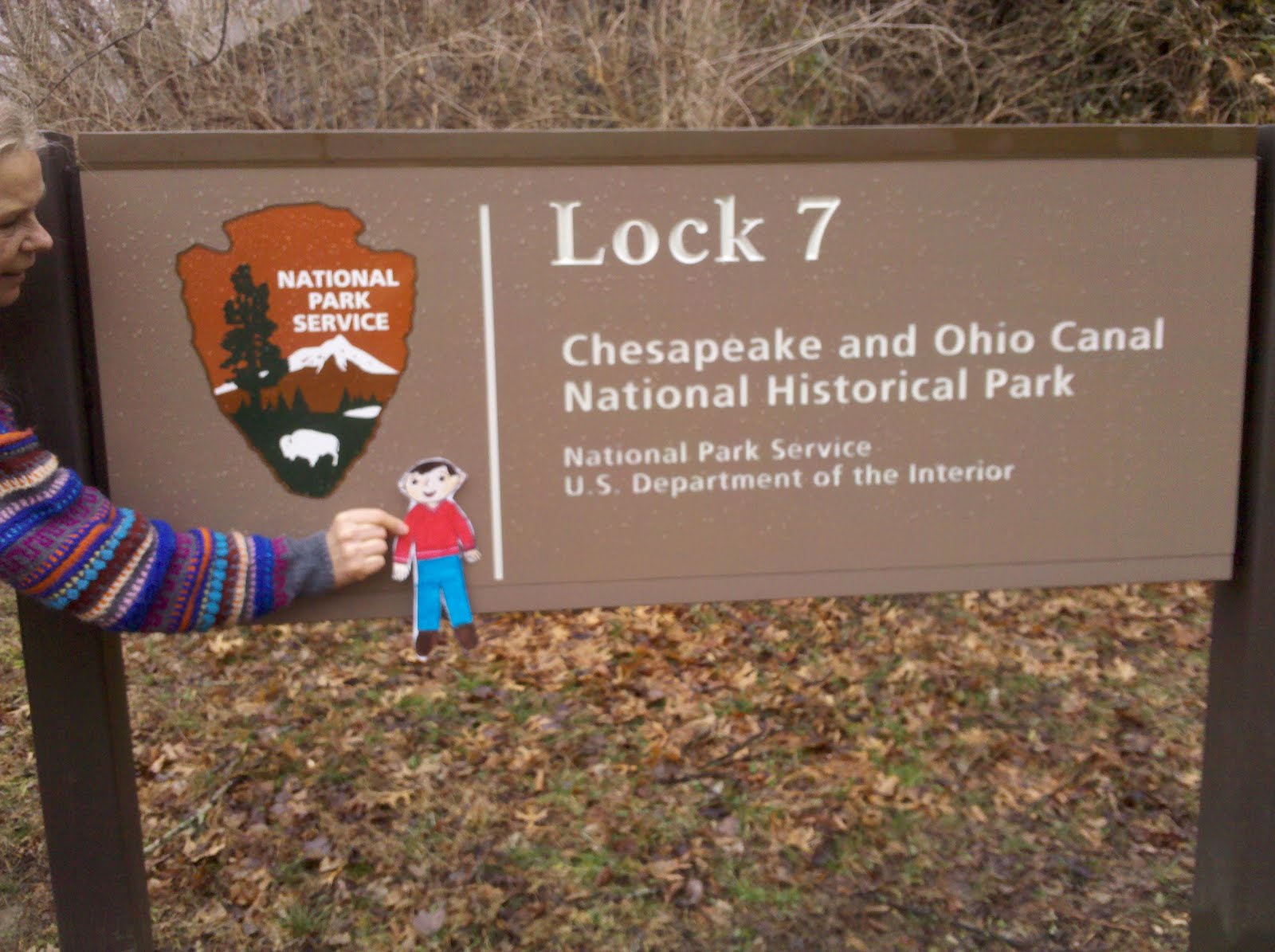 The timing of Stanley's arrival coincided with an invitation I had received to visit a third-grade class on "Read Across America" day. I packed Stanley up and carried him to Winfield Elementary School here in Maryland, to meet Mrs. Cage's class. Her students are roughly the age of my Stanley's creator--Annette's daughter--and they were very familiar with Stanley.
We talked about books and about writing. I brought along some of m
 y favorite children's books including my ultimate favorite, "The Velveteen Rabbit," and a few others I thought would be interesting, like my husband's "Roy Rogers" Golden Book from 1948, and an old book we inherited titled, "Prairie Boys" that bears an inscription on the cover that reads, "Christmas 1900."
I read a few paragraphs from "Prairie Boys," and noted how different the language and topics of children's literature was a century ago, then I read them my children's favorite storybook, "Leo the Lop." Though my children are grown, and the world has changed considerably from the one they grew up in, the story of accepting oneself and others was perhaps more relevant than ever to these sweet-eyed students.
Stanley took center stage next as I showed them some images of his visit to D.C. The students were probably most impressed by a bit of dazzling trivia--that the Library of Congress contains 530 miles of bookshelves! I have to admit, that little factoid boggles my own mind.
All in all, it was a therapeutic afternoon to be back in a classroom with children. I suppose the truth of it is, I miss the recentering that comes from being with children on a daily basis. I had spent the early morning listening to reports of Charlie Sheen's meltdowns, and news of Libya's civil unrest, the DOW's plunge and rising oil prices. After all that, it was revitalizing to spend a few hours with lovable children as we read about bunnies and cowboys, and allowed our imaginations to run wild. This is the stuff that matters.Copyright 2009 Laurie LC Lewis, (To obtain permission to copy or reprint any portion of this post, please contact the author at lclewis2007@gmail.com)

February 28, 2011
WHAT DO WE REALLY WANT IN A LEADER?
 I spent much of Presidents' Day at the ER with my husband. Gratefully, he's fine, but I missed the chance for my annual rant about the dissing of poor George Washington. Again I say. the more you know, the more you understand, but Americans have short memories, or maybe I should say that Americans in many cases have little knowledge, and that is both disheartening and worrisome. The old saying about those who forget the past are destined to repeat it? Apply that logic to the people we place on pedestals and then set in the White House.
On February 18, Gallup released the latest presidential poll. President Reagan was the winner, in fact, this question has been asked eight times in the last twelve years and the winner has consistently been Lincoln, Clinton or Reagan. George Washington, the father of our country, the leader of the Continental Army, victor of the Revolutionary War, the glue that held the Constitutional Convention together, beloved first President of the nation, the man who could have been a king but who resigned the presidency to secure this nation's liberty--this man comes in at number five, behind Clinton and Kennedy. What of Jefferson, the author of the Declaration of Independence, or Madison who framed the Constitution. Are we still grateful for these men? Do we even remember? Hmmm. . . .
I loved Ronald Reagan, and who can deny Abraham Lincoln's courage and vision, but couldn't the same be said of Washington? It all begs the question, "What do we actually know of our nation's presidential history?" Perhaps it raises an even more critical question. "What do we really want in a leader?"
While pollsters and pundits analyze every move or non-move by Barack Obama, we need only look at this poll to see that the American people are slightly schizophrenic when choosing a president. Obama was called "a rock star" by some voters who, if the polls are correct, now wish he was more decisive like Reagan. Others upset by his recent withdrawal of support by the "Defense of Marriage Act" seem to want a more morally conservative president, but then how does that jive with the number two ranking of Clinton, and Kennedy's number six slot, behind Washington? My head is spinning.
I'm over fifty. My peers and I grew up with the images of the presidents in every classroom. We were taught the biographies of the Founding Fathers, and we were quizzed on the major accomplishments of the early presidents. As a guest speaker, I've visited classrooms and I rarely see those comforting, familiar images anymore. They were once the supermen of history, but time and political correctness have been their Kryptonite.
I wish parents and teachers would bring the pictures back out, dust them off and teach this generation about these visionaries. Tell the whole story--the good, the bad, the amazing stories of valor. Greatness can stand the scrutiny. The race is already beginning for 2012. What do we really want in a leader?Copyright 2009 Laurie LC Lewis, (To obtain permission to copy or reprint any portion of this post, please contact the author at lclewis2007@gmail.com)

February 22, 2011
BOOK NOOK REVIEW
 FINDING ROSE
by
Stephanie Humphreys
Stress levels are running high at the moment with deadlines and other obligations, and what I needed was a sweet bedtime read that wouldn't tax my overwrought mind but still deliver a satisfying escape. Finding Rose fit the bill nicely. From the back cover:
On his deathbed, Rose Sterling's father asks her to consider Miles Crandall as a suitor. Then Rose is sent to live with an uncle in Spring Creek, Montana, far from her carefree life with her family in Utah. Miles is returning to his hometown of Spring Creek to set up a medical practice, so Rose is certain her being sent there is a setup. Yet Miles doesn't seem interested in her, and after Rose falls ill in Montana, he seems content to act as her physician and friend. When Rose captures the attention of Miles's younger, flamboyant brother as well as the town sheriff, Miles retreats even further from any attempt at courtship.
How can Rose honor her father's last wish if Miles doesn't even try to court her? Will she have the courage to put her heart on the line and fight for the one she really loves?
The premise is familiar and the read is sweet and lazy, providing some interesting glimpses of life on the frontier. I particularly enjoyed these historical aspects of the story, however the time frame isn't clearly revealed for quite a while, which leads the reader scratching their heads in the early chapters.
 Stephanie Humphreys has created a cast of characters with room to grow, and we see that growth most clearly in Rose, Abbie, and Miles.
Rose debuts as a headstrong daughter who opts for rebellion when the family's future plans require a move from familiar surroundings. She is a somewhat overpowering counterpart to Miles, who comes across as a frustratingly reluctant prospect. And when she is thrust into her uncle's household, she finds her match in her uncommunicative aunt, Abbie, and in Miles' overconfident brother Zach.
After reading the author's bio it's clear Ms. Humphreys draws upon personal knowledge for settings and to flesh out Rose's able character. This accounts for the historical feel of the piece.
The plotting and conflicts provides good impetus for character growth and drama, and while the storyline is a familiar one, Stephanie Humphreys' tosses in some interesting plot twists that cause this love triangle to pleasantly satisfy an afternoon.
Copyright 2009 Laurie LC Lewis, (To obtain permission to copy or reprint any portion of this post, please contact the author at lclewis2007@gmail.com)

February 21, 2011
A LITTLE REFLECTION
 Yesterday was my birthday, and such milestones always cause a little reflection. I've been flooded with the sweet wishes from friends, old and new, and from family members flung across the nation, and my heart is pretty full today.
It was a strange birthday, spent in large part, at the ER. Tom had a pain in his calf and the doctors felt he should have an ultrasound to check for blood clots. He's had some pretty big scares in the past with his heart. We were there for six and a half hours, spent primarily in the lobby because every triage and treatment room was filled with a flood of incoming patients. It was pretty crazy.
We were never terribly afraid. Caution was more our state of mind, but these little moments make you pause and reflect on all the things that overwhelm your gratitude. And since my birthday is also that of the great American humorist, Erma Bombeck, I offer my grateful wisdom in our combined behalf.
I frequently curse technology, but yesterday I was certainly grateful for it. During the long wait I was grateful we could allay loved ones fears without having to traipse around loking for quarters and phone booths. When the lobby TV started a run of afternoon soap operas, and after Tom and I had tired to talking in hushed tones, we were grateful for games on our phones that added a little diversion.
I'm grateful for reading material in all its forms. I saw a Kindle, magazines and books. I had five novels on my netbook. I was glad to see so many peope engaged in reading something.
I'm grateful for vending machines when I didn't dare leave for the cafeteria. After four hours, a pretzel is a glorious thing.
I'm so grateful for acts of kindness. I saw adult children bringing in their elderly parents, and friends bringing in aged neighbors whose children weren't available. I saw blankets being tucked in around frail limbs, soft touches, whispered words of encouragement, and so many reassuring smiles. I saw strangers show supprt to one another with a smile, a hand when needed, or with entertainment for a small child when a worried parent was spent.
I saw frazzled caregivers repeatedly apologize for long waits, and face fearful and sometimes disgruntled families with smiles and courtesy.
I'm grateful that medical care is so readily available. Even with the long wait, I knew if an emergency happened, I was near help.
I'm grateful for random acts of mercy, like a tank of gas that made it possible to just go without another complication, for change in my pockets for the vending machine, for clear roads and a safe return home when the storm began. For insurance, and the means to pay the co-pays.
I'm grateful for great kids who worry a bit much over us. I'm thankful for the security that brings, and for the strength is creates.
I'm grateful for friends who called, emailed, texted, and Facebooked their care. What a flood of support we felt, and how such things help.
I'm grateful for a restaurant and a hot meal I didn't have to prepare on a day when I was pretty spent.
I'm grateful for a home to return to and a bed to climb into, and a husband still beside me.
I'm grateful for prayers, even quick ones uttered in hurried moments that are received by an understanding Heavenly Father. I'm grateful for scriptures that when tucked into a purse, provide comfort and relief.
Today things are pretty much back to normal. I'm a day older, Tom has a little limp, we have snow on the ground which he couldn't resist climbing on his tractor to plow away. I hope I remember how sweet little things are, and remember to be grateful for them.
Time to shovel. Thanks for listening.Copyright 2009 Laurie LC Lewis, (To obtain permission to copy or reprint any portion of this post, please contact the author at lclewis2007@gmail.com)

February 16, 2011
SETTING THE RECORD STRAIGHT
 I spent a wonderful evening with the ladies of two congregations last evening, presenting a program about the importance of keeping a journal and other personal records. The invitation was a perfect extension off the research I do as a historical author because most of my primary sources are the personal writings of people in the past. My favorites are letters, and among the many available for public viewing, I have some very personal favorites--those of Jefferson and Dolley Madison.
There are some amazing journals, kept meticulously in previous centuries, which provide a true glimpse, not only of another life, another family, but of a complete era, and they are critical historical references.
I shared some letters exchanged between Dolley and James Madison during the nights preceding and following the British attack on Washington. Attitudes towards President Madison ran from disaffected to rabid, even amongst some of his former friends. One such friend, named John Mason, wrote a letter describing Madison's abandonment of his wife, making no plans for her and showing no concern for her as he fled to save his own skin. Then we read James Madison's letters to Dolley during that period, pleading with her to pack and be read to flee. Next we read Dolley's replies to James, and notes she penned to her sister as the British began their march into the capital. It told of a woman receiving regular, panicked notes from her husband, written in pencil from the perimeter of the battlefield, as she drew the fury of the many men James sent to rescue her and ferry her away. Why was her retreat so late and endangered? Because she wrote that she would not leave the President's house until she knew James was safe, nor until the treasures of the nation were secured and packed in a wagon.
Imagine how differently the memory of James and Dolley would have been recorded if the only surviving source had been the embittered perspective of Madison's friend, John Mason.
Likewise, we must write our own story, setting the record straight. If not, the tale and lessons of our lives will be interpreted by those who follow, forced to draw their conclusions based on what few random memories they can recall. And our lives are important. Even the seemingly mundane routines of our lives describe our era, and will be fascinating to our grand daughters as they set up households and care for families in the future.
The best part of journal writing is that in recollecting our day, we often can see the intervention of God in the minutia of our lives--a tender mercy here, a moment of sweet peace there. Gratitude and peace are the result of recognizing that despite our struggles, we are not alone.
President Henry B. Eyring offers us this thoughtful question he pondered each night as he began his daily entry:
"'Have I seen the hand of God reaching out to touch us or our children or our family today?" As I would cast my mind over the day, I would see evidence of what God had done for one of us that I had not recognized in the busy moments of the day."
(Henry B. Eyring,"O Remember, Remember," , (Ensign, October 7, 2007)
The more we look for these tender mercies, the more we will see, and our journal will not only bless those who follow us, but it will bless us each evening. And in our hour of sorrow, in our time of reflection, we will be able to return to these pages and remember, remember.Copyright 2009 Laurie LC Lewis, (To obtain permission to copy or reprint any portion of this post, please contact the author at lclewis2007@gmail.com)

Bloggin' It Up Here

Forgive me. I've been terrible about staying in touch. How are you doing? I hope life is sweet and peaceful, and that things are normalizing wherever you are.
As for me, well . . . I've u ...more
- Laurie L.C. Lewis's profile
- 490 followers

