Timothy P. Brown's Blog, page 78
May 5, 2023
Today's Tidbit… IFA Rule #29 Punt-Out
This is #29 in a series covering football's original 61 rules adopted by the Intercollegiate Football Association in 1876. We review one rule each Friday.
The puntout was among the last of the original rugby rules that remained in football before disappearing in 1920. Puntouts appear odd to modern eyes but deserved a place when football was still a kicking game rather than a rushing and forward passing game.
The puntout was defined by Rule 29. Hopefully, the rule makes as little sense to you as i...


May 4, 2023
Today's Tidbit... The RPO of 1947
My recent book, Hut! Hut! Hike!, looks at when various elements of football's vocabulary entered the game and what was happening in football that caused them to coin a new term. For example, the run-pass option emerged after WWII, and the term has been used since then. However, the abbreviation, RPO, is more recent, first appearing in a newspaper in 2015.
Option football arrived with Don Faurot's Split-T Offense in 1941. Faurot put horizontal pressure on defenses by using even wider splits in the...
May 3, 2023
Today's Tidbit... Changes In The College Football Landscape Since 1954
I’ve previously looked at how the mix of teams playing college football at its highest level has changed over the years, yet when I find a document that illustrates those changes in a new (or old) way, I’m compelled to share it. This time around, we’re looking at parts of a 1954 composite football schedule used as a premium or giveaway by SWS Chevrolet, “your convenient downtown Chevrolet dealer for 32 years” in Dayton. Their tagline tells us the dealership was founded in 1922, so it was nearly ...
May 2, 2023
Today's Tidbit... The Flying Wedge and Horse's Neck
Lorin Deland, a Bostonian and student of military tactics, borrowed from military tacticians of the late 1800s by creating football plays using miniature figures set up on a tabletop football field. One output of his tabletop generalship was the Flying Wedge, which remains among the game’s most famous designed plays. Harvard sprung the Flying Wedge on Yale when they kicked off to start the second half of their game in 1892.
Harvard had run many inside wedges from scrimmage during the game’s first...
Pigskin Dispatch Podcast: Football's Two-Yard Penalty
Pigskin Dispatch podcaster Darin Hayes and I discussed a recent TidBit about football’s only two-yard penalty, why it came about, and why it went away.
Click here to listen, or subscribe to Pigskin Dispatch wherever you get your podcasts.
If you want to read the Tidbit itself, here it is.
Subscribe for free and never miss a story. Support this site with a paid subscription, buy me a coffee (or two), buy my books, or a blog-used item.
May 1, 2023
Today's Tidbit... Much Ado About Nothing To Nothing
Fordham and Pitt were top Eastern and evenly-matched teams in the mid-1930s, sporting similar records in 1935, 1936, and 1937. Fordham went 6-1-2, 7-1-2, and 8-0-1 during that stretch, while Pitt went 7-1-2, 8-1-1, and 9-0-1, claiming national championships in 1936 and 1937. Fordham's coach was Jim Crowley, one of the Four Horsemen in his playing days. On the other hand, Jock Sutherland was at the helm at Pitt. He replaced Pop Warner in Steel Town, earning as good as or a better record.
Given the...
April 30, 2023
Today's Tidbit... Herbert Vollmer, The Human Motor Boat, Plays Football
The days are long gone when a swimmer could set three world records in an afternoon and later that year letter as a college football lineman, but that is what Herbert Vollmer did at Columbia in 1916. Called the Human Motor Boat when speed boats were still new, Vollmer was among the top swimmers of the pre-WWI era.
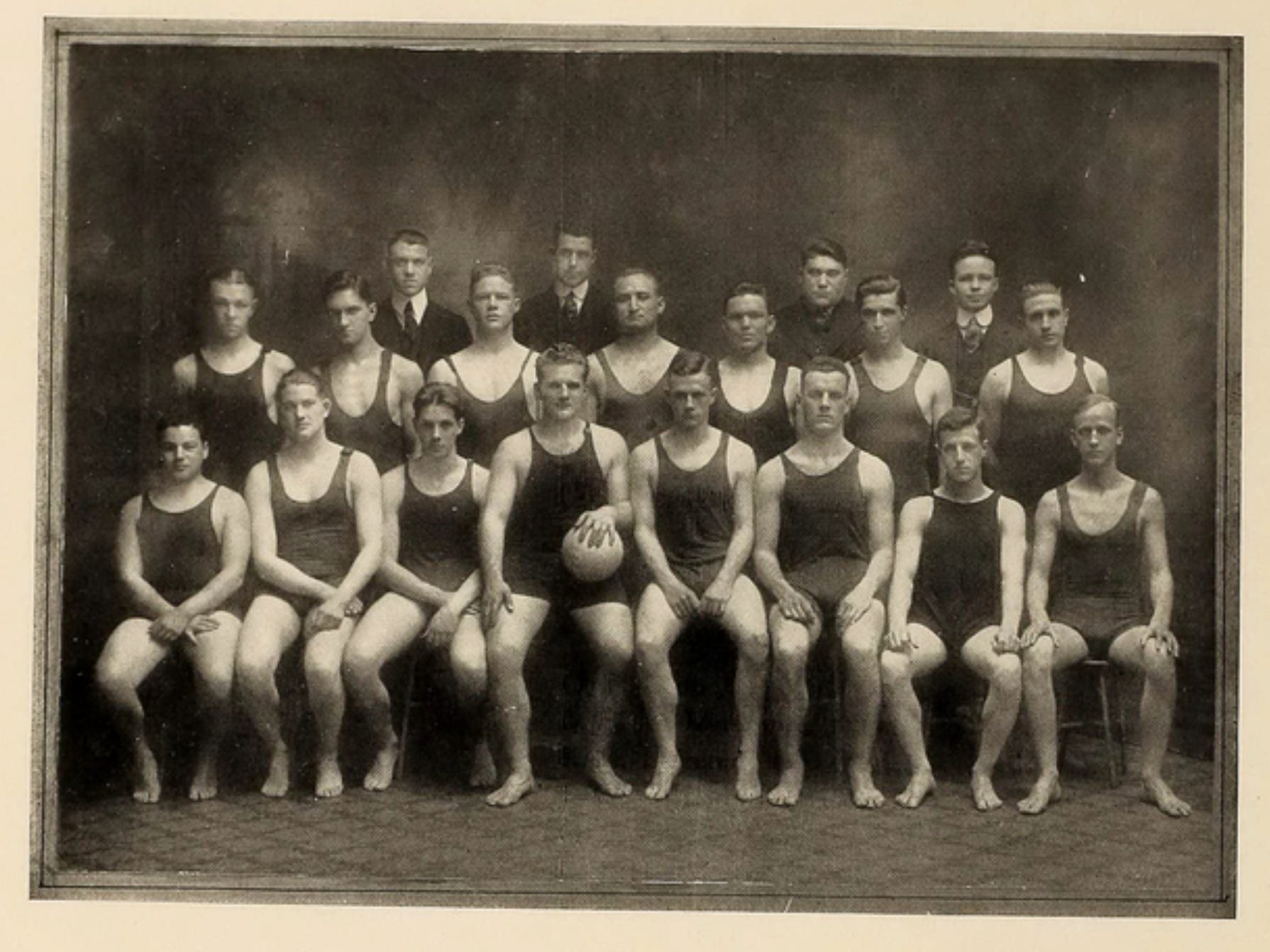 Vollmer, seated to the left of the captain holding the ball, also played water polo at Columbia. (1917 Columbia yearbook)
Raised in New York City, Vollmer played football at Stuyvesant H...
April 29, 2023
Today's Tidbit... Art and Wyllys Terry's 115-Yard TD Run
Halfback Kahlil Keys ran 94 yards for a touchdown in Yale's 53-12 victory over Columbia in 2013, extending by one yard the school's modern record for the longest run from scrimmage. Denny McGill set the previous record versus Dartmouth in 1956.
Of course, both runs set the "modern" record, a term whose meaning depends on who you ask. Back in the day, every football record depended on who you asked because the game did not have a consistent record-keeping system or definitions to use in that syste...
April 28, 2023
Today's Tidbit… IFA Rule #28 Fair Catch
This is #28 in a series covering football's original 61 rules adopted by the Intercollegiate Football Association in 1876. We review one rule each Friday.
Only those catching punts or kickoffs can fair catch the ball today, but the fair catch applied to four other situations in early football. In addition, the fair catch signal differed from today and was often unclear, leading to a new signal and rule change.
Rule 28: A fair catch is a catch made direct from a kick or a throw forward, or a knock...
April 27, 2023
Film Breakdown: 1903 Princeton @ Yale
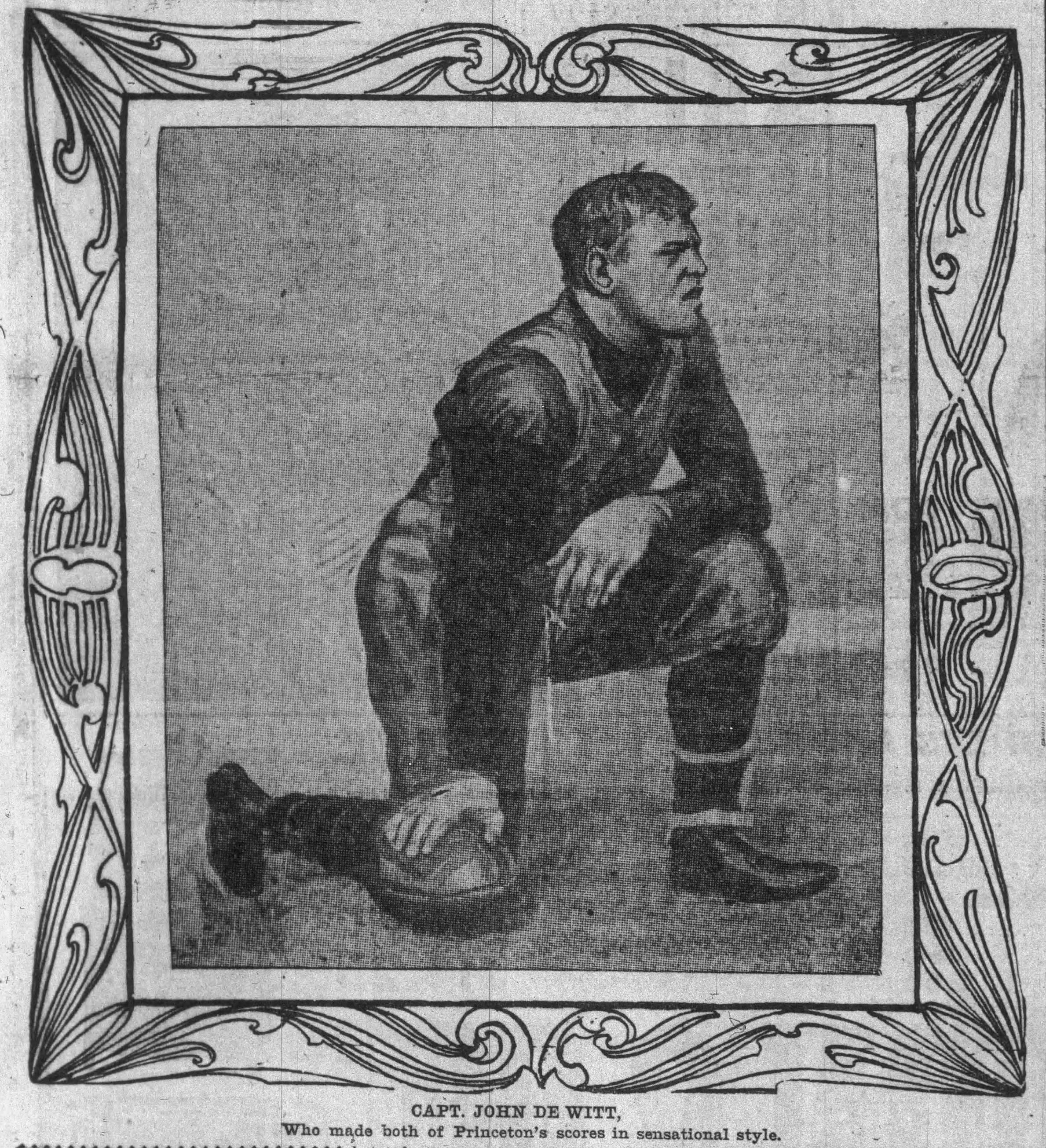 (‘Capt. De Witt Wins Brilliant Victory for Princeton; Yale Giants Outclassed in Mighty Football Struggle,’ St. Louis Globe-Democrat, November 15, 1903.)
Using available images and illustrations is helpful when describing football's early days. Since the game has evolved substantially, certain concepts are challenging to get across despite using images, diagrams, and text. Some concepts, such as the early game's rapid pace of play, are easier to recognize when seen on film, and this becomes eviden...