Timothy P. Brown's Blog, page 75
May 29, 2023
Today’s Tidbit… The 1918 Case Institute and Western Reserve Seasons
Case Western Reserve in Cleveland resulted from the 1967 consolidation of Case Institute of Technology and Western Reserve University. Now a world-class university that competes at the DIII level, the separate schools competed at higher athletic levels in the past, as they did during WWI.
The 1918 college football season was the oddest in the game’s history. WWI was in full swing, and many collegians volunteered to serve, leaving the campuses and athletic fields behind. However, Uncle Sam had pla...


Logoed Football Archaeology Stuff
A few readers asked me to offer some logoed Football Archaeology items, so you can now find the following available at the Football Archaeology store on Zazzle. These items will help impress your friends, neighbors, or yourself with your commitment to football history.
I will add some additional items, but the site allows shoppers to add the logo to almost any available item, including golf balls, baby onesies, mouse pads, or whatever.
But don’t think only of yourself. These items make wonderful ...
Books
Tim Brown is the author of three books on football history, appears on various football history podcasts, and has been quoted in articles by The Athletic, The Chicago Tribune, and other publications. He guest authors articles on UniWatch, and his research on the 1920s West Point Cavalry Detachment teams contributed to All American: The Power of Sports, currently on display at the National Archives Museum in Washington, D.C.
His newest book, Hut! Hut! Hike! A History of Football Terminology, explo...
May 28, 2023
Today's Tidbit... America Gave Return Kicks The Boot
Among the least remembered tactics in American football history is the return kick, which was little used for fifty or more years before the NCAA eliminated it in 1967. Primarily used on punt returns when teams had an effective punter as its return man, a return kick was legal whenever a player took possession of the ball on a kickoff, punt, fumble recovery, or interception and immediately punted the ball back to the team that just lost control of the ball. The idea of kicking the ball back to t...
May 27, 2023
Today's Tidbit... Canadian Football Is Open For Business
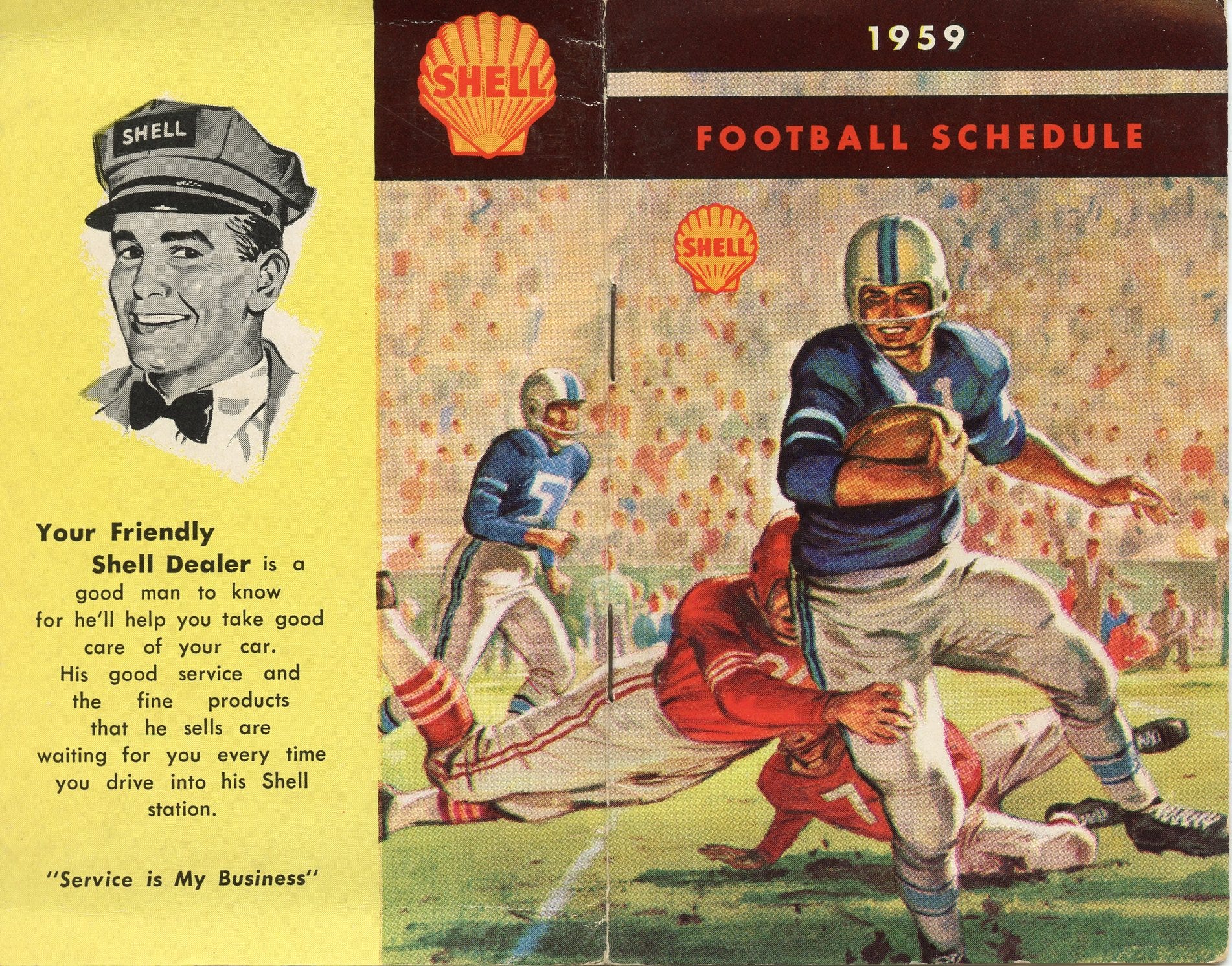 (1959 Shell Football Schedule for Eastern Canada)
Today's Tidbit is published early as a public service to those who do not regularly watch the CFL but should. It is a wide-open game featuring five wide receivers, though that did not stop Montreal and Ottawa from playing to a 22-21 score last night in a game featuring ten made field goals.
Like football below the border, Canadian football evolved from a game played in tighter quarters with four running backs and two tight ends. Now, the ball is fl...
May 26, 2023
Today's Tidbit… IFA Rule #32 Inbounding
This is #32 in a series covering football's original 61 rules adopted by the Intercollegiate Football Association in 1876. We review one rule each Friday.
Options for inbounding the ball are not something that comes to mind when we think about football, and yet, early football had five options for bringing the ball back into play after it went out of bounds. Rule 32 names those options and describes the procedures for some of them.
Rule 32: He must then himself, or by one of his own side, either b...
May 25, 2023
Today's Tidbit.. Football's Longest Half-The-Distance Penalty
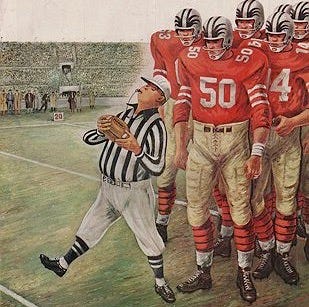 (Saturday Evening Post, December 5, 1959, Constantin Alajalov, Illustrator)
Football instituted its first half-the-distance penalty in 1889 for intentionally tackling below the knees, butting, tripping, and throttling (choking). Teams guilty of those offenses were penalized 25 yards. However, if the 25-yard penalty would take the ball over the goal line, they limited the penalty to half the distance.
The specifics changed occasionally, but the unsportsmanlike penalties had safety implications, so ...
May 24, 2023
Today's Tidbit... Football Experiments In the Motor City
Back when the University of Detroit played football, their coach Chuck Baer wanted a deeper understanding of how his Modern T formation offense threatened the six and seven-man defenses still common in those days. His questions involved the speed in which T formation backs hit the line of scrimmage and whether defensive linemen could read the play and get to the hole the offense targeted.
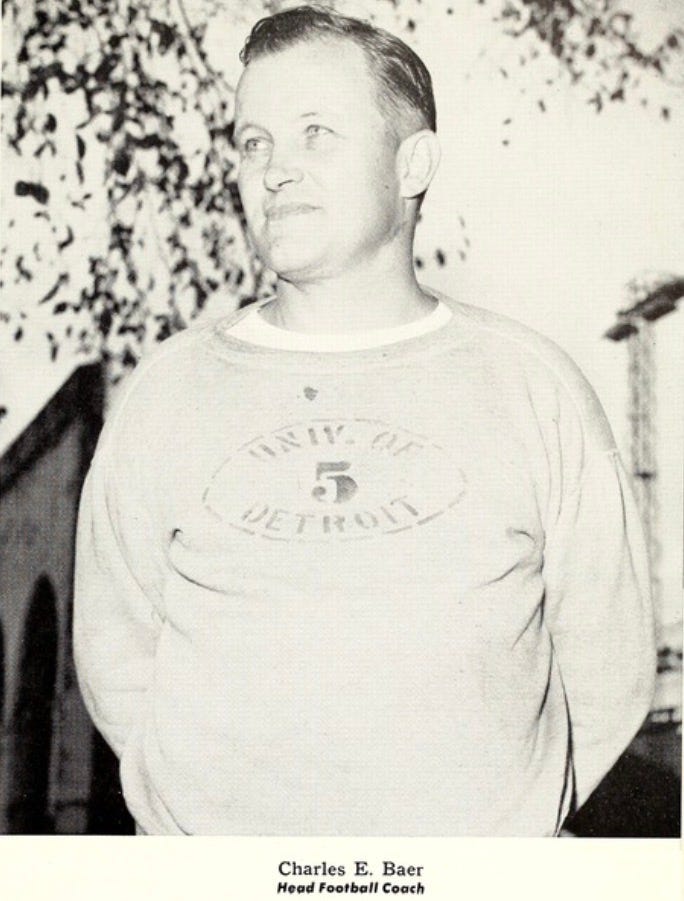 Chuck Baer went 35-21-1 in six seasons at Detroit, winning the Missouri Valley Conference in 1949. (1948 Detr...
Pigskin Dispatch Podcast: Disintegrating Football Pants
Pigskin Dispatch podcaster Darin Hayes and I discussed a recent TidBit about the evolution of football pants and particularly the transition from all-in-one units to the pants and various pads being separate units.
Click here to listen, or subscribe to Pigskin Dispatch wherever you get your podcasts.
Here’s the original Tidbit:
Subscribe for free and never miss a story. Support this site with a paid subscription, buy me a coffee (or two), or buy a book or a blog-used item.
May 23, 2023
Today's Tidbit... Kicking Off With New Hampshire Football
Today we look at the image of the 1928 New Hampshire football team kicking off, covering a few elements of late 1920s football that pop out from the image.
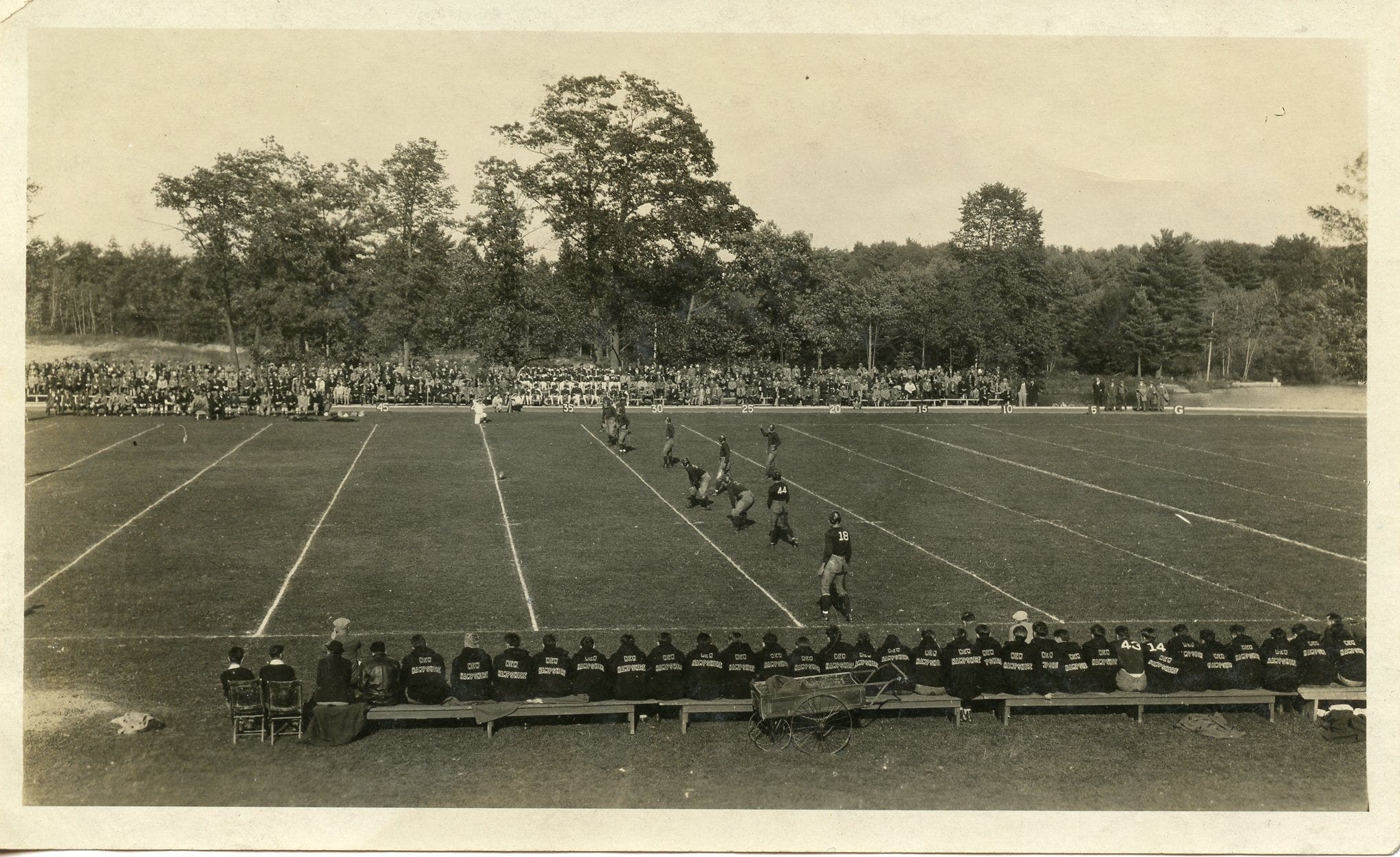
One notable element is that everyone on the near sideline is seated or kneels in front of the bench. Coaching from the sideline was illegal then, and everyone had to be seated to prevent coaches from signaling plays or strategies using motion or body positioning.
 (1931 Official Foot Ball Rules)
Next, all but one or two of the players wear sweate...