Timothy P. Brown's Blog, page 72
June 24, 2023
Today's Tidbit... Unintended Consequences of the Fair Catch Signal
As football transitioned from rugby, it brought along rugby's rules and traditions, including rugby's fair catch, in which players signaled the fair catch by "heeling in" as they made the catch. Heeling in occurred when players struck the ground with the heel of their foot, creating a divot to mark the spot. Since heeling in occurred simultaneously with or just after the catch, the kicking team players covering the punt could not tackle the returner until they saw whether or not he heeled in. Ho...


June 23, 2023
Today's Tidbit… 1876 IFA Rule #36: Kickoff
This is #36 in a series covering football's original 61 rules adopted by the Intercollegiate Football Association in 1876. We review one rule each Friday.
Rule 36 was among those in which the IFA modified the existing Rugby Union rule, though it is unclear why they did so. The rule is quite simple:
Rule 36: Kick-off is a place kick from the center of the field, and cannot count as a goal. The opposite side must stand at least ten yards in front of the ball until it has been kicked. (If the ball pi...
June 22, 2023
Today's Tidbit... Youth Football in 1895 Boston
While chasing down information on football in old newspapers, the line drawings in articles about top players or games always catch my eye. They are from before newspapers could reliably print half-tone "photographs" on their pages. Even then, the early photographs were still images (e.g., posed players or teams) since it was not until post-WWI that lighter cameras with fast lenses allowed game-action images to replace illustrations on the nation's sports pages.
So it was the illustration below t...
June 21, 2023
Today's Tidbit... Early Jocks and Abdomen Protectors (aka Cups)
Football Archaeology has covered many aspects of the clothing and equipment worn by early football players but has never written about one of football’s most important pieces of equipment, the jock.
“Jock” is the Scottish and Northern English diminutive of John, just as Jack or Jacky is the Southern English form. Jock and Jack also described men or boys generally, and a boy riding a horse was a jockey, so when bicycles came along in the 1800s, men who rode them were also called jockeys.
As painf...
Pigskin Dispatch Podcast: The Sidesaddle Quarterback and Tennessee Formation

Pigskin Dispatch podcaster Darin Hayes and I discussed a recent TidBit about the Sidesaddle Quarterback, also known as the Tennessee Formation. Standing parallel to the line of scrimmage, the sidesaddle QB originated under Robert Neyland in the 1930s and continued in use in a few locations until the early 1970s.
Click here to listen, or subscribe to Pigskin Dispatch wherever you get your podcasts.
Here’s the original Tidbit:
Subscribe for free and never miss a story. Support this site with a paid s...
June 20, 2023
Hyperbole and the Game of the Century
Hut! Hut! Hike!, published in November 2022, describes the origins of over 400 football terms. This is article #5, covering additional aspects of football’s terminology.
A "game of the century" is a huge matchup that football fans nationwide anticipate, watch, and look back upon at levels, unlike your run-of-the-mill big game. While few agree on the criteria for what constitutes a game of the century (GOTC), they have proven popular.
Wikipedia tells us 18 games have achieved GOTC status in the las...
June 19, 2023
Officiating and Fonsa A. "F. A." Lambert
Fonsa A. "F. A." Lambert has been mentioned in previous Tidbits discussing variations in the referees' first down signal and officials' uniforms, but this Tidbit will cover him in more detail. Lambert was a top official in his day who published How to Officiate Football in 1926. As the first, or among the first, books detailing the philosophy and mechanics of officiating, any serious official of the day read it thoroughly.
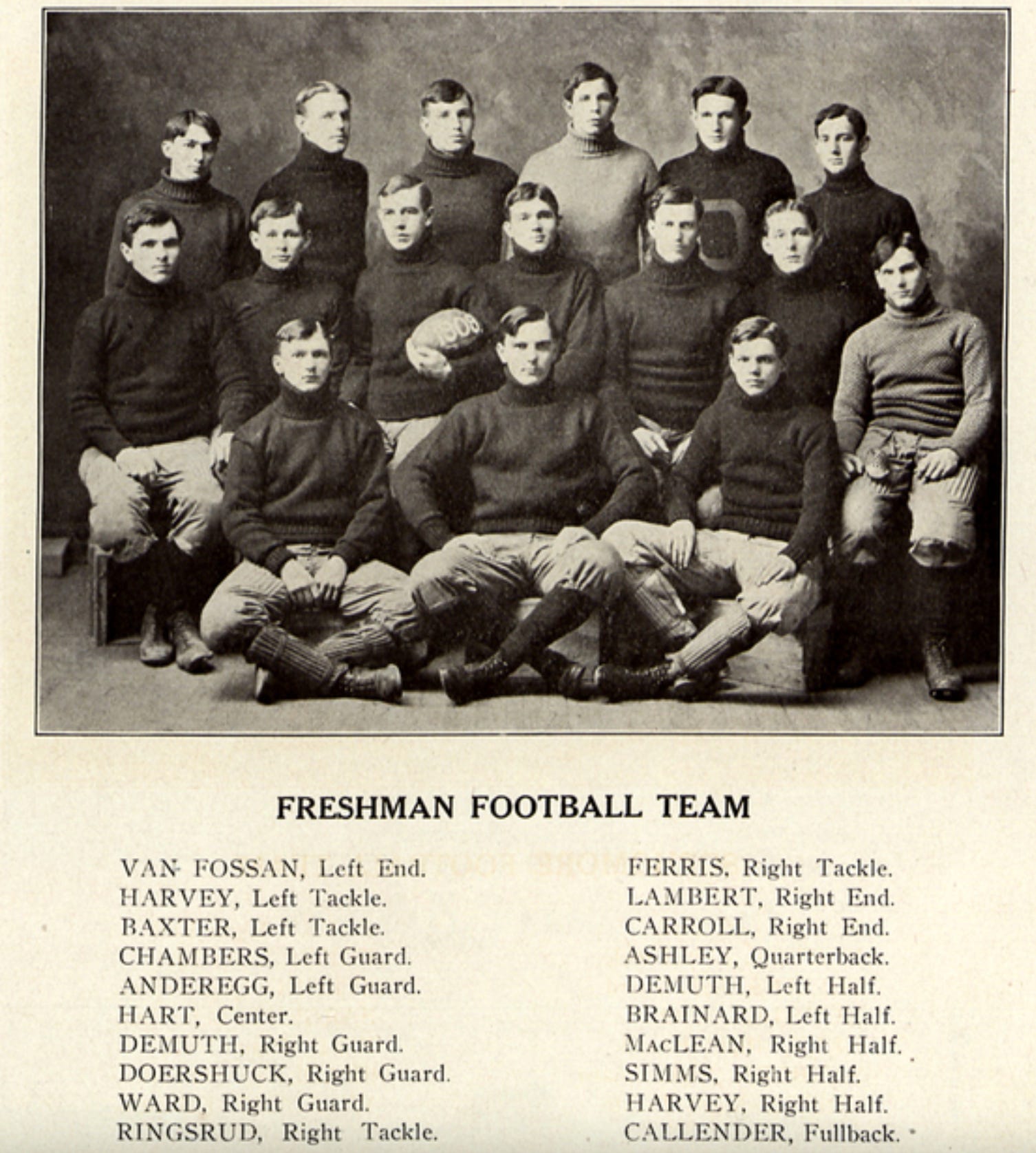 Lambert is believed to be the team captain holding the ball. (1907 Oberli...
June 18, 2023
Today's Tidbit... Peru State Football 1908-1910
Football Archaeology has run a handful of stories about football at normal and teachers' colleges in recent months that covered:
1950 Florence State (North Alabama)
Each resulted from an RPPC or schedule that caused me to dig into the team's story. Readers are fortunate today because I managed to string together RPPCs of the 1908, 1909, and 1910 teams from Nebraska State Normal. Most called it Peru Normal then, and it i...
June 17, 2023
Today's Tidbit... Make Room for Daddy
Football borrowed many elements of its terminology from the military, but few would think that “Dad's Day” also originated in the military. Dad's Day came into relatively wide usage during WWI when many military camps held Dad's Days for fathers to visit their sons. Soldiers drafted into the National Army during WWI typically underwent their initial training at camps within their state or region, making it easy for some Dads to attend those events. Dad's Days also occurred in Europe, with soldie...
June 16, 2023
Today's Tidbit… 1876 IFA Rule #35: No Fair Catch
This is #35 in a series covering football's original 61 rules adopted by the Intercollegiate Football Association in 1876. We review one rule each Friday.
Rule 32 told us that one of the methods to bring the ball back into play from in touch was the fair or lineout, while Rule 34 told us that if the throw was not made at a right angle to the touch line, the captain of either team could appeal for a redo. Recall as well that Rule 28 told us that players could far catch the ball under almost any co...