Timothy P. Brown's Blog, page 71
July 3, 2023
Today's Tidbit... The Trailing Team's Choice To Kick Or Receive
We have been on a recent kick looking at the rules affecting which team boots the ball to start the game or second half, and today we get to review another oddball kicking rule. A story from a few days ago described the NCAA rule that gave the team scored upon the option to kick or receive, which remained in effect until 2003.
Another story variation began in 1934 when the Pacific Coast Conference voted in favor of a rule giving the trailing team the option to kick or receive. The PCC representat...


July 2, 2023
Today's Tidbit... A Small School, A Top Official, And Other Cool Stuff
I've gathered all of you here today so we can share our favorite stories about the 1909 St. Mary's of Kansas team. I will tell a few tales but jump in whenever you want to share.
Let's start at the beginning when the postcard below arrived in my mailbox.
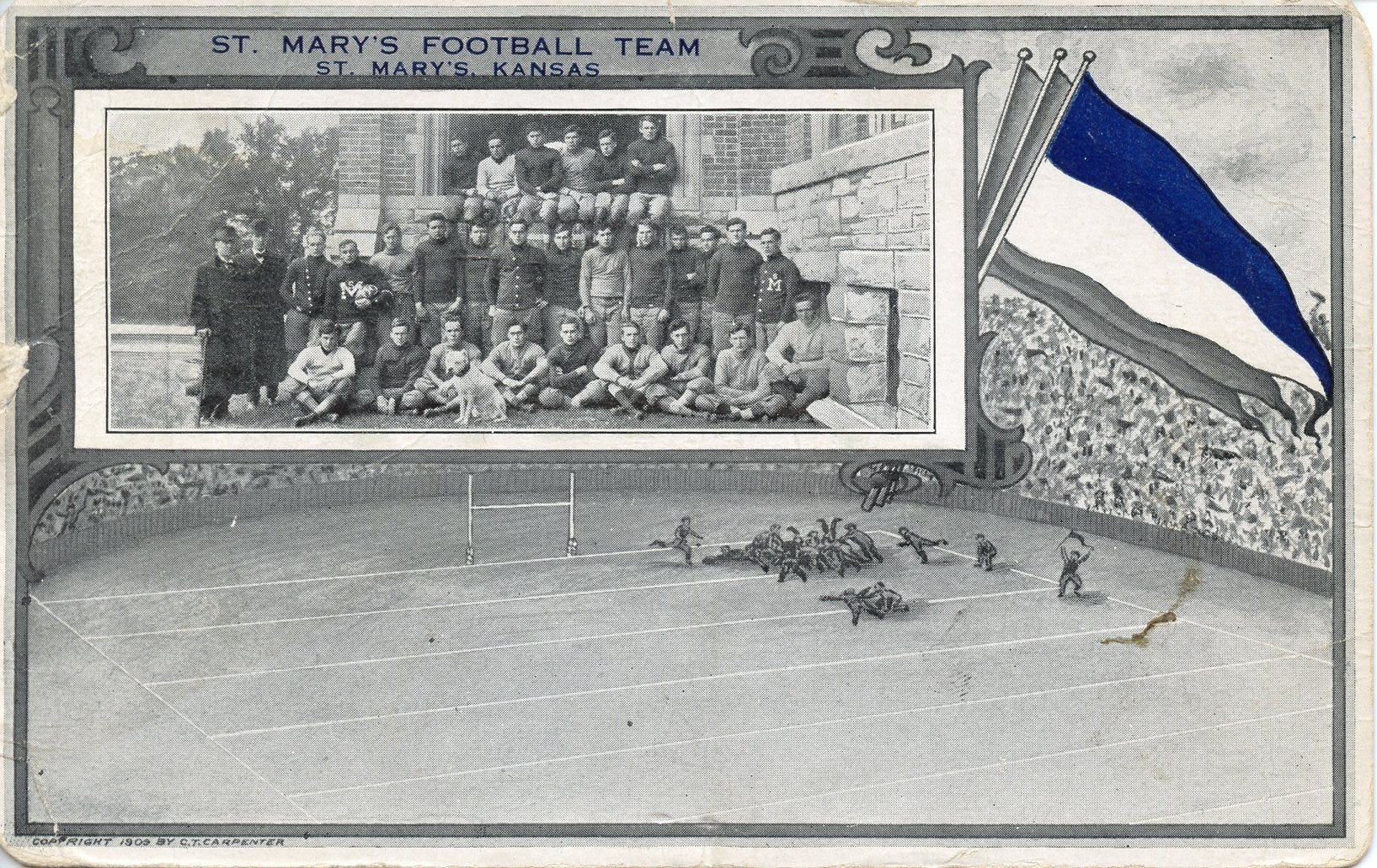 1909 St. Mary's Kansas football team fantasy postcard (Personal collection)
The postcard shows 1909 as its copyright date, so I assume the picture shows the 1909 team as well. While there are interesting stories about the team, the fantasy backgrou...
July 1, 2023
Today's Tidbit... Alternating Sets Of Downs
A Tidbit published a few days ago described how American football transitioned between 1906 and 1912 from requiring teams to gain five yards in three downs to ten yards in four downs. Some prominent coaches argued that teams should gain eight or fifteen yards in four downs, but they adopted the four downs to gain ten yards approach, which remains the rule today.
While footballers then argued the merits of various down and distance combinations, Eddie Cochems (pronounced COKE-ems) proposed a diffe...
June 30, 2023
Today's Tidbit... 1876 IFA Rule #37: Kickoff Timing
This is #37 in a series covering football's original 61 rules adopted by the Intercollegiate Football Association in 1876. We review one rule each Friday.
Rule 36 told us kickoffs occur from the center line, cannot count as goals, and the opposing team must stand at least ten yards back from the ball. Rule 37 tells us when kickoffs should occur.
Rule 37: The ball shall be kicked off (i) at the commencement of the game (ii) after a goal has been obtained.
By 1881, the rule makers recognized they had...
June 29, 2023
Today's Tidbit... The YMCA And Football's Growth
The YMCA had an underappreciated role in football's development. The organization developed out of the same Muscular Christianity stream that promoted the need to exercise the mind and body, with some, like Teddy Roosevelt, considering it vital to ensuring the right sort of people dominate the world.
The YMCA's influence began in 1890 when Yale graduate Amos Alonzo Stagg enrolled in the School for Christian Workers' one-year graduate course to become a YMCA Physical Director. The school became th...
June 28, 2023
Today's Tidbit... When Football Was A Game Of Millimeters
 Pondering yards versus meters (All images are from the Carleton College Archives unless noted)
Since 1912, American football has been played on a field 100 yards long and 160 feet (53 1/3 yards) wide, but in the 1970s, there was a movement to encourage the U.S. to shift to the metric system, culminated by the Metric Conversion Act of 1975. The Act encouraged federal agencies and others to voluntarily switch to the metric system. The movement and the Act had some success, but the American public p...
June 27, 2023
Today's Tidbit... First and Five, Eight, Ten, or Fifteen
 (1911 Navy Yearbook)
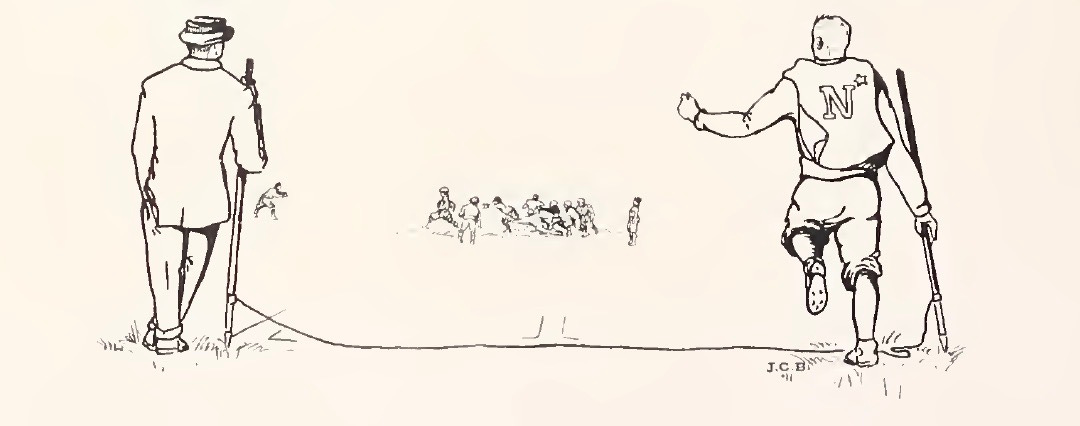
During the game's early years, football's rules were virtually identical to those of rugby which did not allow teams to maintain possession from one scrimmage or scrummage to another. When football went down the possession path in 1880, the rule makers assumed that teams possessing the ball would play honorably, punting when they could not advance the ball after a few scrimmages. However, Princeton had other ideas and kept the ball play and after play versus Yale in 1880 and ...
Pigskin Dispatch Podcast: The Year of Living Seniorlessly

Pigskin Dispatch podcaster Darin Hayes and I discussed a recent TidBit about the year of living seniorlessly, which came in 1906 when the Western (Big Ten) Conference limited athletic eligibility to three years and did so retroactively. That meant those who had played during the freshman, sophomore, and junior seasons suddenly were not eligible as seniors.
Click here to listen to what happened, or subscribe to Pigskin Dispatch wherever you get your podcasts.
Here’s the original Tidbit:
Subscribe fo...
June 26, 2023
Today's Tidbit... The First College Team To Fly To A Game
The aviation world advanced tremendously during WWI as planes grew sturdier, faster, and larger. Those advances leaked over to the civilian sector after the war, along with a desire by the military to promote flying by civilians to ensure a steady supply of trained pilots. Government agencies joined the game by advocating for taxpayer-funded airports to support the flying craze, ensuring their communities would not be left out if heavier-than-air flight took off as expected.
There were, of cours...
June 25, 2023
Today's Tidbit... Press Boxes and Sideline Communication
As baseball and other sports stadium operators sought the coverage and publicity provided by newspapers and magazines in the late 1880s, they offered advantageous, separate seating to reporters. Such areas became known as press box, with the first mentions of press boxes at football games coming at the 1892 Yale-Princeton game at Manhattan Field in New York and the 1893 Harvard-Yale game in Springfield, Massachusetts.
Like all other elements of stadiums, press boxes evolved, becoming fancier and ...