Timothy P. Brown's Blog, page 67
August 7, 2023
Sammy White's Moments Of Glory
The 1911 Harvard-Princeton game was a doozy that followed a fourteen-year span during which the schools did not play one another. Few conferences existed around the turn of the century, and they focused on eligibility requirements rather than scheduling, so when one school upset another, they stopped playing one another. But Harvard and Crimson decided to let bygones be bygones in 1911 and scheduled an early November game at Princeton's Osborn Field.
The game was notable not only for the play on ...


August 6, 2023
Today's Tidbit... Getting Pumped Up for Pneumatic Football Pads
An 1898 newspaper article described recent advances in football gear: a helmet with a hard shell and pneumatic thigh pads. Previously, football players wore head harnesses that resembled wrestling headgear. They protected the ears and portions of the head but lacked a protective shell covering the top of the skull.
 A player wearing a head harness in the early 1900s. (RPPC, Personal collection)
Reports of true helmets or headgear with hard leather shells offering mechanical protection began appeari...
August 5, 2023
Today's Tidbit... When It Rains, It Punts, 65 Times
Football fans who enjoy oddball stories from the game's history are familiar with the 1939 Texas Tech-Centenary game played in Shreveport, Louisiana. Played in a torrential downpour, the rain-soaked field made it difficult to run or pass, so the teams repeatedly punted the ball to one another until they did so 77 times, setting a still-standing record for combined punts in a game. Game records were set for most punts by a player, most punting yards by a player, most punt returns by a player, and...
August 4, 2023
Today's Tidbit... 1876 IFA Rule #42: Kickout Procedure
This is #42 in a series covering football's original 61 rules adopted by the Intercollegiate Football Association in 1876. We review one rule each Friday.
Last week we reviewed Rule 41, which defined the kickout and when it applied, and football’s later decision to distinguish safeties from touchbacks. We also covered how touchbacks evolved over time. This article addresses the kickout procedure in more detail and then covers the evolution of the safety.
Rule 42: Kick-out must be a drop kick and f...
August 3, 2023
Today's Tidbit... Football Training Camp In The 1910s
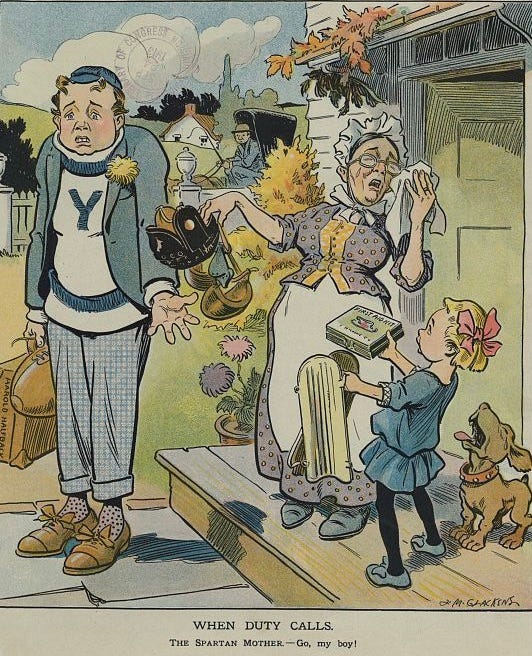 A Yale letterman heads off to training camp as his mother cries. ('When Duty Calls,' Puck, September 24, 1913,
Library of Congress
)
A Yale letterman heads off to training camp as his mother cries. ('When Duty Calls,' Puck, September 24, 1913,
Library of Congress
)It is that time of year. College football training camps are opening nationwide, almost all filled with hope, if not optimism, since we are one month from launching a new season. Most camps are held on campus nowadays, though some venture off for bonding and other purposes.
Still, the modern training camp differs from that of the 1910s. Today, athletes remain on campu...
August 2, 2023
Today's Tidbit... Reenacting The 1927 Little Brown Jug Game
Before the widespread availability of radio and television broadcasts of away games, one option available to hardcore football fans was to stand outside the local newspaper offices. The newspapers arranged for telephone updates from the game, and as they were received, newspaper employees shouted updates to the crowd or posted them on a scoreboard. Others sat in movie theaters or auditoriums where they simulated games using light displays or by moving small figures around a representation of a f...
August 1, 2023
Who Invented The Hidden Ball Trick, And When?
It is often claimed that Pop Warner's Carlisle Indians executed the first hidden ball trick against Harvard in 1903, but that claim is wrong several times over. During the 1903 game, the last game played on Harvard’s Soldiers' Field with the nearly-finished Harvard Stadium looming in the background, Carlisle came close to upsetting the Crimson, as the Bostonians won 12-11.
 Jimmy Johnson, Carlisle Q, is stopped on a run as Harvard Stadium looms in the background. ('Smashing Up A Flank Movement,' B...
Pigskin Dispatch Podcast: The Longest Half-The-Distance Penalty
Pigskin Dispatch podcaster Darin Hayes and I discussed a recent TidBit about the longest half-the-distance penalties in the game’s history, which occurred before those penalties were capped at 15 yards.
Click here to listen to what happened, or subscribe to Pigskin Dispatch wherever you get your podcasts.
Here’s the original Tidbit:
Subscribe for free and never miss a story. Support this site with a paid subscription, buy me a coffee (or two), or buy a book, blog-used or logoed item in the store.
July 31, 2023
Today's Tidbit... 1969 and the 100th Anniversary Sticker
It could have been a big deal and should have been a big deal, but college football's centennial celebration fizzled. Intended to honor the 100th anniversary of the 1869 Princeton-Rutgers games, the NCAA announced their intention to celebrate the anniversary in March and opened the events with the June Coaches' All America, when they honored Barbara Sprecht, the National Centennial Queen, at halftime.
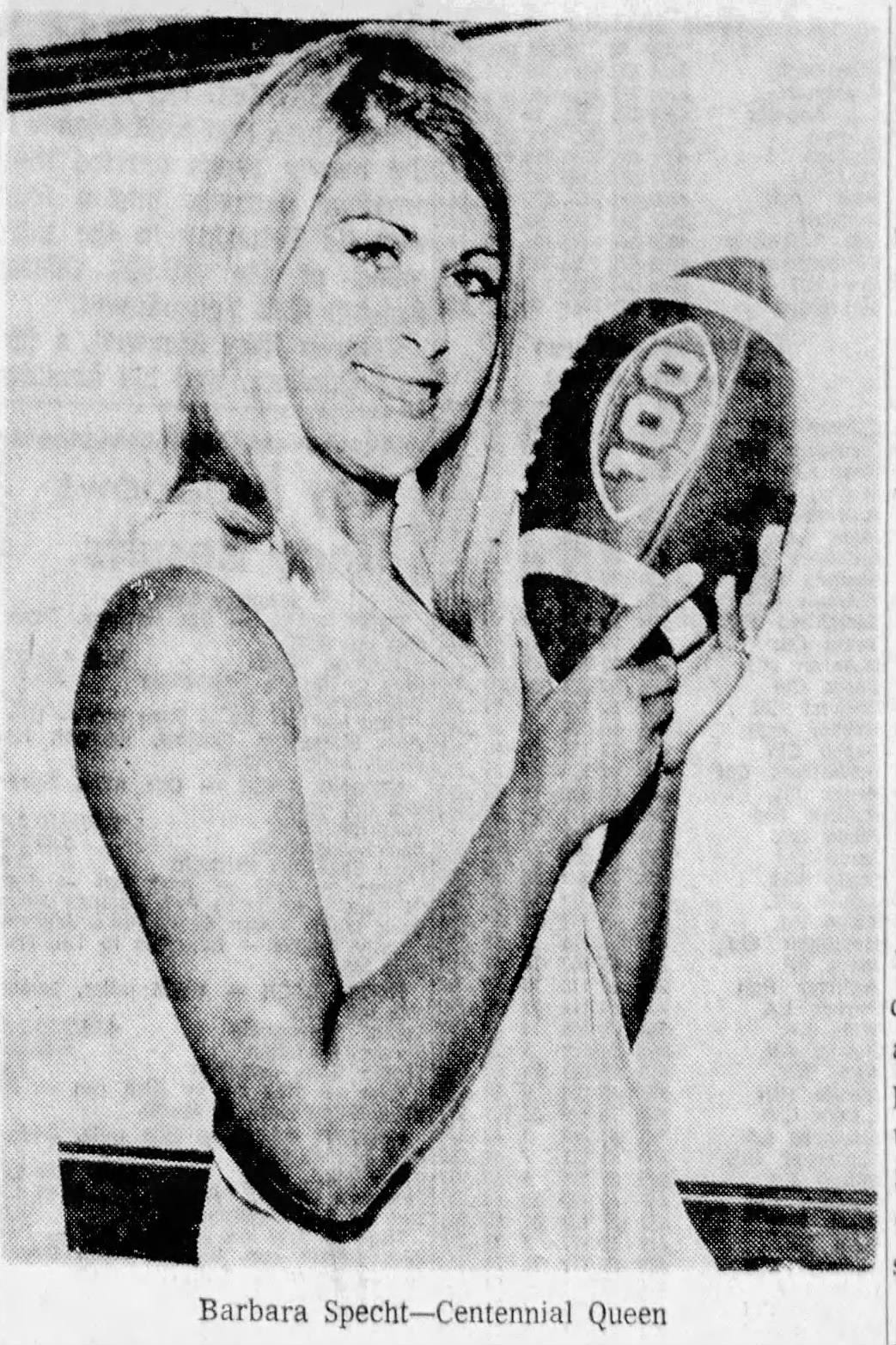 ('A Time To Recall 100 Grid Years,' Fresno Bee, September 14, 1969.)
Perhaps it was the Vietnam W...
July 30, 2023
Today's Tidbit... What's Old Is New Again: A History Of Football Equipment Reconditioning
Football equipment has been repaired and reconditioned for as long as the game has existed to save costs. All indications are that players, coaches, and managers handled the process themselves into the 1920s, while local seamstresses, cobblers, and harness makers handled work requiring particular expertise or equipment. Whoever did the job, however, appears to have done so locally.
That began to change in 1924 when Lloyd's Cleaners of Springfield, Missouri, which laid claim to being the country's...