Durga Prasad Dash's Blog, page 4
May 22, 2021
The Beauty of Sanskrit Language and Texts – the book
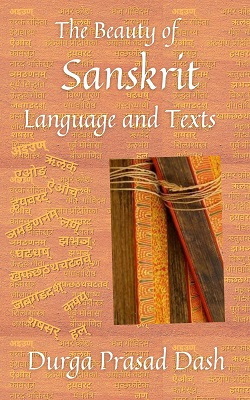
As part of the AtoZ series challenge in April 2021 I had written a series of posts about specific compositions in Sanskrit and the unique features of the Language. All these posts are now part of my latest E-book: The Beauty of Sanskrit Language and Texts.
For a long time I had been planning to write a book to introduce the beautiful world of Sanskrit and Sanskrit texts which is not part of our curriculum except for a few who opt for it. Forget about westerners, generations of Indians, since the advent of British system of education in India, never got the opportunity as part of their formal education to gain even the basic knowledge about the vast and the intricate knowledge system of ancient India.
Needless to say, 99% of the ancient wisdom of India are available in Sanskrit texts, because it was the language of the intellectuals of India prior to the Moghul invasion. Even Buddhist and Jaina scholars, who preferred pali or prakrut, learnt Sanskrit and wrote many books in Sanskrit.
Whenever we think of Sanskrit literature it is the religious ones that usually come to our mind. It happens because we are more familiar with the religious ones. The religious ones are more widely discussed upon and commented upon. But there are a large number of non-religious texts in Sanskrit which are known only in limited circles and rarely do these make it to the popular discourse.
Of course many are aware about popular texts like Ramayana, or Mahabharata. But there are hundreds of surviving texts about which I find that the awareness is dismal. Sometimes even if a person has heard about the text, her idea about the text is very strange. I hope this book to be helpful in not only creating awareness about many hidden gems but also in dispelling the myths associated with some popular texts.
These articles were originally written for the AtoZ challenge, which means one wrote twenty six posts corresponding to the twenty six letters of the English alphabet. So it becomes really difficult to represent the vast number of Sanskrit texts in addition to giving glimpses of the specialties of the languages within the twenty six articles. So I worked out a kind of algorithm at the outset to decide which book or topic to represent which alphabet so to give the reader glimpses into each genre of text in twenty four articles, two being reserved to devote exclusively to the Sanskrit language. By the way, as the reader progresses through the book, she will learn more about this algorithm and the algorithm of the Sanskrit Language which has a kind of scientific structure to it.
At present the book is part of Blogchatter’s E-book Carnival and is available for free download.


May 7, 2021
Making Air Breathable

The urban rural divide in the context of the Covid pandemic is clearly discernible. The percentage of infection and causality is very high in case of cities. The bigger the worse. No doubt overcrowding is one reason. A study about the pandemic in Delhi has found that the lungs of people living in Delhi are already weak. Hence the high percentage of serious cases.
A well greened city like Bengaluru has no better in air quality. Its notorious traffic jams makes each vehicle ten to twelve times more dangerous. So, only planting trees is not enough. Cities anyway pose inherent limitations on space and there is a limitation on how many trees can be planted.
Whenever I go past the city outskirts I pity the trees of the farmhouses. I imagine how in a future that is not far away ninety percent of these trees would be cut to make space for a new apartment complex or villa or school or office or some other commercial establishment.
Cities are exploding with population. A city like Bengaluru houses twice the population of a country like New Zealand. While more houses are built to house the increasing population there is hardly any plan in place to neutralize the damage to the environment.
Cities are expanding in as bizarre manners as possible. An outer ring road becomes a road inside the city in just five years. Every year a city claims more and more areas as part of its urban jurisdiction so as to collect more tax and so that the property rates can appreciate. Policy makers seem to favour the increase of urban area as urban areas contribute more to the GDP than the rural areas. Once again economics wins over environment.
I am all for urbanization. But it should not come in the form of bizarre horizontal expansion of the big cities which are already so much strained to provide basic amenities and congestion free roads and which are already deprived of greenery and clean air.
To ease the congestion in big cities the concept of satellite towns had come up a few decades back. But unfortunately these are satellite towns no more even though they may be still existing on paper as such. Hardly any gap exists between these so called satellite cities and the big cities.
Perhaps governments should draw a lakhmana rekha around big cities and say that it should not expand beyond this point. Let there be vertical growth. Let more and more sky scrapers come up. Cities like Singapore, that have natural limitations to horizontal growth, have found ways to accommodate growing population and increased economic activity. At least such a step will not destroy the greenery of its outskirts. Moreover, as the distance from place to place within the city does not increase, it may to some extent curb vehicular pollution.
Perhaps governments should turn attention to develop tier-II cities. Here again care should be take to avoid horizontal expansion. There are some industries that require allied industries to be located nearby. But why should the IT and ITES industries be concentrated at one place? In fact if the internet capabilities are improved employees can work from their native places. The pandemic has shown that it is possible. Even after the pandemic is over such practices can be encouraged to reduce burden on traffic.
Steps should be taken on priority to reduce vehicular pollution – whether it is by introducing more and more vehicles using green energy, or improving mass transit systems that run on clean energy, or using other alternatives like enforcing work from home for certain number of days for sectors where remote working is possible, or ensuring that place of works are located near the respective place residence, or any other suitable method.
Remote rural areas are not totally devoid of air pollution. Take the case of stubble burning. In addition to causing air pollution, it impacts the quality of the soil. Lots of awareness drives are needed to persuade the farmers not to do this.
Or, take the cases when polluting industries are relocated from cities to hinterlands. The sooner we get rid of polluting technology of any kind it is better. Till such time policies should be in place to mitigate the damages done by the industries whether these are in urban areas or remote areas.
But it is not so easy. Because, adoption of environment friendly technologies increases the cost of production which in turn impacts the competitive edge. For example if it is made mandatory that before the the liquid or gaseous wastes are exited to the environment each industry must treat them to reduce harmful contents, this will obviously increase the cost of production. The Chinese industrial hubs have been struggling with severe air pollution for decades since the industries did not go for such such extra costs to mitigate the damage to environment. China has retained the competitive edge. But it has come at great human cost. Most of the Chinese industrial cities have become uninhabitable.
In view of today’s globally competitive open market system, such economic consequence, always puts local policy makers in a dilemma. Things are complicated. But nothing is worse than being callous. Sometimes developed countries ignore such humanitarian issues of developing and underdeveloped countries. If they were, they would stop buying products from Industries that do not implement technology to reduce harm to the environment.
However, the current pandemic has shown that what is a local problem today has every potential of becoming a global problem tomorrow. If environmental problems are caused due to technology, the solutions also come in the form of technology. Speed with which new technologies are adopted and new policies are made and implemented makes the difference. But that can happen only if all of us us across the globe woke up to the clear and present danger.
************************************
This post is part of Blogchatter’s CauseAChatter’
April 30, 2021
Zero to Infinity

My purpose in this series was to give a taste of every type of Sanskrit Literature. I did not write any post for well known texts like the Vedas, Mahabharata or Ramayana. Of course I have mentioned these and highlighted some of their aspects from time to time. This being the last post in the series, in addition to summarizing, I have included some of Sanskrit or Sanskrit texts that I have missed.
In the post ‘varieties of vidya‘, I have given an overview of the entire knowledge system of ancient India. It is interesting to note that the ancient seers tried to address all dimensions of human life. If they declared that in order to have a fulfilled life human beings should be engaged in four pursuits – Dharma, Artha, Kama and Moksha, it is a logical follow up that Shastras should be composed to address all these aspects.
In fact they wanted to probe and have theories about all and everything. The inclusion of everything is not only seen in the knowledge system but also in individual texts texts like Mahabharat or Charaka Samhita. There is a saying that there is no story in the whole world that you would not find in Mahabharat. All the permutation of combinations that any plot can have can be found in Mahabharat. This attempt to include everything is seen in the Sanskrit alphabet system (varnamala) also. The inventors of Sanskrit varnamala attempted to cover the entire range of possible sounds that a human mouth can make.
This is the civilization that gave to the world the concept of zero and infinity – infinity not only in the sense of multiplicity but also in the sense of infinitesimal divisibility (which is at the root of the decimal system) so as to cover all the possibilities of a number system.
And mathematics did command a central place. There was no excuse for any expert of any field for not knowing mathematics. We have seen this in the context of Jyotisha. It is no mere coincidence that all the Jyotisha Shastris were great mathematicians.
Music is considered to be a right brain activity where as logic and mathematics are said to be left brain activities. We see this dichotomy fade away as ancient Indian theories of music had a mathematical base. I have brought out this aspect in my post Ones and Zeros. Charaka used combinatorics to show various permutations and combinations of humours. Each Jantra or Mantra has a mathematical base.
In the blogpost ‘varieties of vidya‘ we have gone through various types of classifications of texts based on the subjects or the issues they addressed. Texts can also be classified according to their style of their composition. It can be in a sutra format where the contents are condensed like telegraphic messages. However the majority of the ancient texts were in verse form – whether Vedas, epics, dramas, or even medical texts. In the later period a large number of works were composed in prose especially the extensive commentaries on various Upanishads and other treatises. Vishnu Sharma’s Panchatantra is in simple prose forms, which provides good and interesting reading material for all, whether beginner or an expert in Sanskrit language.
Many of the treatises have a well laid out logical sequence. In one of the posts I have already mentioned about how the Rishis were particular about defining the main terms in the beginning itself. Narada Bhakti Sutras starts with the definition of Bhakti. Same way Patanjali’s Sutras Yoga starts with the definition of Yoga. If you want to talk to me first define your terms – said Voltaire. This is essential before probing into a subject or engaging in a debate.
The pattern is – first define the main terms, then state the goal, and subsequently tell how to achieve it. If there are other related contents, those come last. The goal of yoga is Samadhi. So, in Patanjali Yoga Sutra the first section is called Samadhi Pada, where Patanjali Maharishi discusses various types of Samadhi and the symptoms and feelings associated with it. Once you are interested enough in the goal, the Rishi tells you how to do it. There is no point telling you about the ways if you are not interested in the goal in the first place.
Hope, under the constraints of relating the posts serially to English alphabets and the number of posts, I have been able to give at least some glimpses into various aspects of Sanskrit Language and literature. My purpose was to arouse interest and clear prevailing misconceptions about the indic texts. Since most of us never got the opportunity as part of our curriculum to explore Sanskrit beyond the primary or secondary level, we remained ignorant of the beauty, vastness and the depth of the language and literature.
It has been as much a learning experience for me as it must have been for those who have followed my journey of BlogchatterAtoZ Challenge 2021. Or so do I hope.
I began this series with a prayer. Let me end with a shanti path:
Om Shanti, Shanti, ShantihAum! Let there be peace in me!Let there be peace in my environment!
Let there be peace in the forces that act on me!
************************************
This is the alphabet concluding (Z) post of Blogchatter AtoZ Challenge 2021. My theme this year is ‘The beauty of Sanskrit and Sanskrit texts’, where in I explore selected compositions in Sanskrit and also some unique aspects of Sanskrit language and texts. Join with me in my journey to understand India’s spiritual and intellectual heritage. All the posts of AtoZ Challenge 2021 can be accessed here.
.
Yogavashistha – the path of pure knowledge
Without giving the right context it is difficult to talk about spiritual traditions of India. That is also the difficulty one faces when planning to write any short article on spirituality. First of all spirituality and religion are not the same thing. As Gurudev Sri Sri Ravi Shankar says, ‘Religion is the banana peel and spirituality is the pulp”. One can be religious without being spiritual. Religion refers to all the outer rituals one does that distinguished one from the practitioners of other religions. On the other hand to be spiritual is to live the philosophies that lead to a higher consciousness, or that makes one realize the zenith of human potential.
As I have mentioned in a number of previous posts, many spiritual paths in India ignored the concept of God altogether. In Patanjali’s Yogasutras, concept of God is a method to be used for reaching Samadhi. Concepts like ‘God Realization’, ‘Reaching God,’ or ‘Achieving the status of Godhood’ etc. became popular perhaps after the puranas were written. Subsequently, this gained momentum as the Bhakti movement prevailed all over India.
The difference between religion and spirituality can be explored in terms of Dharma, Artha, Kama, and Moksha which are the four pursuits (purusharthas) recommended by our ancients so to have a balanced life. In my post about Kamasutra, the definition of the first three have been given. Vatsyayana defines Dharma as the act of following the injunctions of Shastras so that, even though it may not be apparent immediately, you get good results in this life as well as the next. But, moksha is all about getting rid of this vicious cycle of doing good and bad things and its consequences. This vicious cycle is called the cycle of karma.
For the sake of simplicity let us understand that Moksha is living life with the sense of ultimate freedom, not effected by the vicissitudes and vagaries of life. King Janaka is said to have lived such a life even though he remained a householder. It is akin to the state of Samadhi described in Yogasutras, or the state of Sthitaprajna described in Bhagavad Gita. If moksha means the ultimate freedom, mumukshu means an intense desire to be free. A genuine spiritual seeker must have an intense desire to be free.
Well you have an intense desire to be free. Now what? The options available for a spiritual seeker in India are endless – crores of gods, lakhs of scriptures and thousands of spiritual gurus.
Such an intense desire to be free dawned on young Ram after he was back from a pilgrimage tour of the whole of India. Luckily for him Maharishi Vashistha, the guru of their clan (Kulaguru), himself was an enlightened master.
Yogavashistha contains the discourses of Guru Vashistha to address the afflictions of a distraught Ram. Unlike the Bhagavad Gita it is not a one ton one dialogue. It takes place in the royal court of Ayodhya and all the courtiers of King Dasaratha including celestial beings like Narada gather to listen to the discourses.
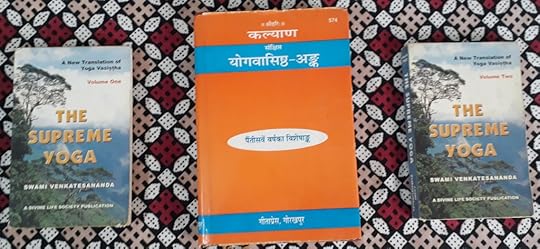
As the name suggests it is the yoga as expounded by Sage Vashistha. Here yoga is taken in its broader sense of achieving the state of higher consciousness. The book in the middle of the picture above says ‘Sankhipta Yogavashistha’ to mean ‘the abridged version of Yogavashistha’. Its pages are of A4 size and it has 700 pages. So if the abridged version is so big, what about the original version?
The original version has about 30, 000 verses. In size it is perhaps next to Mahabharata that has about 1,00,000 verses. The entire discourse was given in eighteen days. This concept of eighteen seems to be interesting. Perhaps it has some esoteric connotation. Bhagavad Gita has eighteen chapters. Mahabharata has eighteen sections (parvas) and the Mahabharata war lasted eighteen days. I don’t know whether it is a coincidence or an inspiration, the ideal duration of a TED talk is about eighteen minutes.
Even though the text has contents about hatha yoga and bhakti, the underlying emphasis is on jnana. The principles enunciated have close relationship with advaita vedanta. Interestingly this text predates Adi Shankara who is regarded as the proponent of advaita.
Yogavashistha does not go into high philosophical debates or tries to probe things from the perspectives of intellectuals who are capable of understating the jargons of any field. Rather it enunciates the ultimate knowledge through stories and examples. There are lots of repetitions and the format is such that one does not need commentaries about its texts. This is unlike the Upanishads and other spiritual texts that require elaborate commentaries.
The two English versions shown in the picture above are composed by Swami Venkateshananda – a disciple of Swami Sivananda. He has condensed the Yogavashistha into two volumes with each volume having 365 pages of primary content – a page for each day of the year. It can be taken as a daily ritual of spiritual practice to read one page every day. As the composer of the original Yogavashistha claims, one can get enlightened just by its regular study. By the way, for the first time in this series I am using pictures of books which are part of my personal library.
Even though there seem to be so many paths of spirituality, I feel primarily there are four broad paths – Jnana, Yoga, Karma, and Bhakti. They are not mutually exclusive. That is the reason a text on bhakti also talks about jnana, a text on jnana talks on bhakti and yoga, and so on. Bhagavad Gita talks about all four. By Yoga here I mean the philosophy of yoga as given in Patanjali’s Yogasutras and the physical practices as given in Hathayoga Pradipika.
Even though some propagate Bhagavad Gita as primarily as text of Bhakti marga, I feel that the underlying emphasis of Bhagavad Gita is on Karma. Perhaps Bhagavad Gita is the only text that talks of Karmayoga – doing one’s duty selflessly as a spiritual path. Narada Bhakti Sutra and Shandilya Bhakti Sutra probe into the principles of Bhakti. Coming to the path of Jnana, there are perhaps thousands of texts. However for the honest seeker who does not want to get into debates with other scholars but to experience it and live it, there is nothing to beat Yogavashistha.
Perhaps that is the reason when I requested a number of advanced seekers and masters to recommend me that one book, supposing that I had no other choice but to read only one book as part of my spiritual journey, the anonymous response was – Yogavashistha.
********************************
This is the alphabet Y post of Blogchatter AtoZ Challenge 2021. My theme this year is ‘The beauty of Sanskrit and Sanskrit texts’, where in I explore selected compositions in Sanskrit and also some unique aspects of Sanskrit language and texts. Join with me in my journey to understand India’s spiritual and intellectual heritage. All the posts of AtoZ Challenge 2021 can be accessed here.
April 29, 2021
X-factors of Sanskrit
 ॐ सह नाववतु ।सह नौ भुनक्तु ।सह वीर्यं करवावहै ।तेजस्वि नावधीतमस्तु मा विद्विषावहै ।ॐ शान्तिः शान्तिः शान्तिः ॥Aum! May He protect us both together; may He nourish us both together;May we both (teacher and student) work conjointly with great energy,May our study be vigorous and effective;May we not bear any grudge against each other.Aum! Let there be peace in me!Let there be peace in my environment!Let there be peace in the forces that act on me!(We / our are used in the sense of we two)
In this series majority of the posts have been about Sanskrit literature. This is the second and last post about Sanskrit language. Of course any language is enriched by the literature and literature gives plenty of glimpses into the nature of the language.
In the earlier article ‘The Language of Gods’ the legends associated with the origin of the language were mentioned and I tried to establish why it is called the devabhasaha. A few aspects have been highlighted in some other posts also. This post is written mainly to consolidate a few aspects already mentioned and explore more. However the beauty of Sanskrit language is so deep, I do not think a few posts can bring to light all the aspects. Some glimpses can be given, though.
Speaking of the alphabets
Just speak the first five consonants – ka, kha, ga, gha, aun and note the spot in your mouth from where these sounds originate. Then speak the next batch – cha, chha, ja, jha, nya. Well by this time you must have observed that the first batch originate as near to your throaty as possible. the ext. batch a little further up. Like wise the last batch of alphabets pa, pha, ba, bha, ma use your lips. Hope by now you have realised the logical arrangements of the consonants. Well while pronouncing the consonants the stress is on the palate of the lips. Then there are vowels.
The vowels are called swara varna. Swara means something that stands on its own. While pronouncing the vowels the tongue does not touch any part of the palate. Here also if you pronounce serially from a to ai you can feel how the point of the creation of the of sound starts from near the throat and move further. This alphabet system is something unique to Sanskrit. The alphabets of all the Indian languages follow this pattern. Alphabet system of Tamil is also similar. Where it is different is that instead of having separate alphabets in each batch it has only one alphabet. For example Tamil Ka represents Ka, kha, ga and gha.
Such a system takes away the ambiguities associated with pronunciation unlike English where only knowing the alphabets is not enough to pronounce a word.
You and Me
For countable nouns and pronouns every language has two forms i.e. singular and plural. But Sanskrit has three – Eka bachana (Singular), Dvibachana (Dual), Bahubachana (Plural). Some older languages of Indo European languages also had it. But in no other language is it so pronounced as in Sanskrit. All languages that developed later dropped the Dual form for the sake of simplicity. However, it has always fascinated me as to why the ancients had this Dual form.
In any transaction, relationship or conflict at any given point of time there are two main parties. Even though a million people may gather for a speech, there is the speaker and the audience. In both the world wars so many countries were involved, but the allied themselves into two conflicting groups. India may be a multiparty democracy. But there is the government and the opposition.
I am sure the ancient Rishis had deep insight into group behaviour, relationships and conflicts. The most popular Indian philosopphy is the advaita (non-dual) philosophy restablied by Adi Shankaracharya. Concept of non-duality has confused many. Some translate non dual as oneness. But this word oneness does not bring the whole essence of advaita. If duality or dvaita stands for attachment or conflict, by non-duality what is indicated is a state where there is no conflict.
The sloka at the beginning is full of dvibachana. It also in some way indicated that conflict could be part of any relationship, even between a master and a disciple.
The algorithm
So Sanskrit has three bachanas (number indicator forms) against two of all modern languages. That is not all. Against two cases ( indicating whether subject or object) in most of the modern languages, Sanskrit has eight. Further the verb and adjectives have to follow the gender, bachana and the case of the subject. So each noun, pronoun, verb and adjective have multiple forms that has to be memorised by a student of Sanskrit to be grammatically correct. It seems all so complicated. Some may think it will take a life time just to master the Sanskrit grammar.
Well it not exactly so. It all seems complicated untill you understand the underlying principles. It is like the algorithm of a complicated software. To the uninitiated one, any software programme seems so complicated, untill one masters the algorithm. And any algorithm is not simple. But once you master it, the software programming becomes easy for you. Same is the case with Sanskrit.
All the words ever used till now in Sanskrit, there may be seven million of them, can be reduced to about seven hundred root words. By applying a defined structure of prefixes, suffixes and fusion of the words, millions of meaningful words can be constructed. If you have followed this algorithm to form a new word, you do not need to inform another expert about its meaning. If the other person also knows the algorithm he or she will automatically get the meaning.
So Sanskrit seems complex and impossible untill you get the algorithm. Then in stead of the complexity, you realise its profundity and the beauty. The givers of this algorithm are three sages – Panini, Katyayani and Patanjali through their compositions Astadhyayi, Vartikakara and Mahabhasya respectively. Actually the original code is contained in panini’s Astadhyayi and the other two are its elaborate explanations.
I learn that by the age of ten a vidyarthi used to have this algorithm at his back and call since by that time he had memorised all the three above texts.
Why should the Sanskrit Poet have all the fun
Well it is unfair but nothing can be done. You must have already understood from the previous section why it is so. It is all because of this algorithm developed by our ancient seers.
Because verbs and adjectives must follow the subject in letter and spirit and sarvopari (on top of everything) as this language has no concept of the preposition having a separate existence from its corresponding word, you put a word anywhere in the sentence, reorder the words of a sentence any which way you like, neither are you violating any rule of grammar nor are you causing any change in the meaning of the sentence.
The large number of synonyms for every word also helps the poet. If as a poet you are still not satisfied you can create your own word and if you have done so following Panini’s algorithm, you need not fear of being misunderstood or being boycotted by the lexicographer.
Thus as a poet you are already licensed to fiddle with the word order and create new words. Now tell me, as a Sanskrit poet, what more privileges do you want?
***********************************
This is the alphabet X post of Blogchatter AtoZ Challenge 2021. My theme this year is ‘The beauty of Sanskrit and Sanskrit texts’, where in I explore selected compositions in Sanskrit and also some unique aspects of Sanskrit language and texts. Join with me in my journey to understand India’s spiritual and intellectual heritage. All the posts of AtoZ Challenge 2021 can be accessed here.
April 27, 2021
who wrote and how?
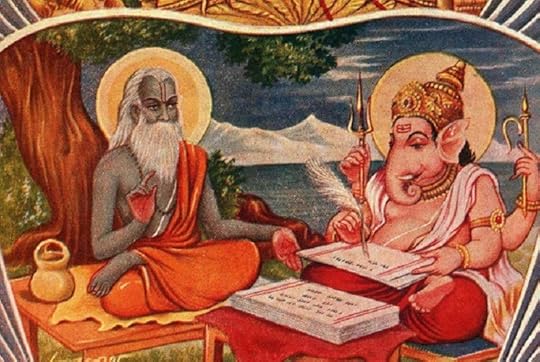
Researchers and scholars are divided in opinion by wide margins when it comes to the period of the composition of most of the ancient Indic texts. In an earlier post I have addressed it. Similarly opinions vary about their authorship. In some posts I have brought out this issue. But there being so many sides, I thought a separate post is needed.
When devotees go to Badrinath in Uttarakhand, they do not miss the cave where the composition of Mahabharata is said to have taken place. You might have heard about the legend related to the writing of Mahabharata. Sage Vedavyasa needed a scribe. He was recommended with the name of Lord Ganesha. The later agreed but with a condition that the dictation should be without any break. Vedavyasa too agreed, but he too put a condition that Lord Ganesha should write only after understanding each stanza. Occasionally Vedavyasa would dictate a very difficult sloka and Ganeshji would take some time to understand it. That allowed Vedavyasa the much needed break to compose the next slokas.
In addition to Mahabharata, Vedavyasa is said to have compiled all the four Vedas and the eighteen major Puranas. Some believe that there indeed was a sage named Vedavyasa who was endowed with super yogic powers and was able to accomplish all these. According to some, there were a group of Rishis and collectively they were known as Vedavyasa. Then there are others who believe that these were written by different Rishis or group of Rishis who later dedicated their work in the name of Vedavyasa. The same thing is sometimes said about Kalidasa about a few portions of his works that have different styles of composition from his usual style.
It is this writing style that has helped to find out the author of many ancient texts which were rediscovered. The works of famous playwright Bhasha were almost lost and a chance discovery led to further investigation which resulted in the retrieval of his works from different parts of India, majority of them being from Kerala. Bhasha’s works are considered at par with those of Kalidasa. But there was no mention of the author’s name in most of the retrieved works. It was only through careful analysis of the style of composition that the experts could trace the authorship to Bhasha.
Some works seem to have been composed in the manner of today’s Wikipedia. A large number of composers were involved. But the difference between today’s Wikipedia and the ancient texts is that Wikipedia just gives a surface knowledge where as the ancient texts have amazing depth. Secondly, subsequent authors of indic texts usually did not disturb the earlier versions, but went on adding to it. Of course, this stopped at some point of time and the texts achieved a finality. This minor revisions and additions went on for a log period of time, sometimes extending over millennia. As I have already mentioned in my post about the period of writing, this factor has allowed different researchers to allot different dates to the same text without being logically incorrect.
I hope you have watched Mira Nair’s movie Kamasutra and realized that the title is totally deceptive. It has hardly anything to do with Sage Vatsatayana’s Kamasutra. The script writer has put a few thin threads forcefully to connect it with Vatsyayana’s work and justify its title. For example there is a character named Vatsyayana who goes around the public houses of the city, behaving like a peeping tom and noting down the proceedings inside. According to the movie this was how Kamasutra was written. But let us listen to what Vatsyayana himself says about who should take credit for the contents of his book:
In the beginning, the Lord of Beings created men and women, and in the form of commandments in one hundred thousand chapters laid down rules for regulating their existence with regard to Dharma, Artha, and Kama. Some of these commandments, namely those which treated of Dharma, were separately written by Swayambhu Manu; those that related to Artha were compiled by Brihaspati; and those that referred to Kama were expounded by Nandi, the follower of Mahadeva, in one thousand chapters.Vatsyayana further narrates how the knowledge got transmitted further and it reached him. He states that he was only putting together the knowledge that had got scattered due to the passage of time.
Like Vatsyayana many authors attributed the knowledge to previous Rishis or to God. They never took credit that they were the original authors. Some even shied away from mentioning their names altogether. In the context of my blog post on Narada Bhakti Sutras I have briefly mentioned this.
We also come across texts whose authorship credits are given to kings. King Bhartruhari’s Vairagya Shataka is one such example. Some say such works were written by someone else but were dedicated in the name of the kings. It seems ghost writing has been in vogue since ancient times.
So, there are conflicting opinions about the authorship of the texts. But is it really something that should deter us from exploring the beautiful world of ancient texts?
An author is sometimes important to distinguish it from other works of similar nature, as in the case of Ramayana that has many versions. But, we should not get so lost in debates about the authorship that we miss the wisdom of its contents. I found that the ancient text Yogavashistha has something in similar lines. It advises – “If the knowledge is helpful to you in improving your wisdom and broadening your vision, how does it matter whether it is of divine origin or human origin?”
***************************
This is the alphabet W post of Blogchatter AtoZ Challenge 2021. My theme this year is ‘The beauty of Sanskrit and Sanskrit texts’, where in I explore selected compositions in Sanskrit and also some unique aspects of Sanskrit language and texts. Join with me in my journey to understand India’s spiritual and intellectual heritage. All the posts of AtoZ Challenge 2021 can be accessed here.
April 25, 2021
varieties of vidya
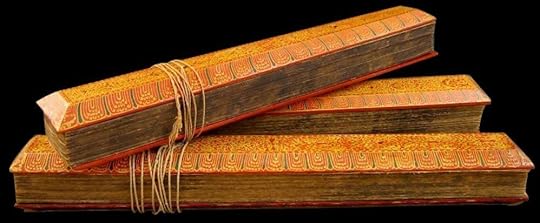
As we move towards the end of the AtoZ season it will be good to take an overview, then address a few important left out issues and conclude with a summarizing post. Giving an overview of all types of indic texts at this stage will make sense because, the reader who has been following my posts regularly must have got some idea about what these Sanskrit texts are all about. Let us also understand how how these vast number of indic texts are classified and interrelated.
Veda, Vidya, Vidushi, Vidwan, vidyarthi – all have been derived from the same root word vid which means to know. The ancient Rishis divided all types of vidya primarily into two types – para vidya and apara vidya. Hindi word paar comes from para. So para means beyond or going across. In Ramayana when Rama seeks the help of a boatman to cross the river, the boatman in turn makes a condition that Ram should help him cross over this ocean of sansara. Para vidya is the knowledge or skill to develop higher consciousness so as to rise above the world and its maya. All kinds of spiritual knowledge and related skills comes under para vidya. Apara vidya is the worldly knowledge. It is the knowledge that helps one to take care of one’s worldly needs. So a vidyarthi in ancient India learnt both para and apara vidya.
Let me remind the reader that moral and ethical education is not para vidya. Of course when one is established in para vidya, one naturally becomes a responsible member of the society. On the other hand being righteous helps one progress fast in spiritual path. These days para vidya is absent from our education system.
Of course many religious institutes run schools and colleges in India even though our education system is supposed to be secular. Again religious education teaching the supremacy of a particular concept of God or Gods is not para vidya. It is much more than believing in concepts of God, his dictates and his miracles. Many spiritual traditions of India did not give primacy to concepts of God. Para vidya is more about developing a higher consciousness to realise the truth than submitting to the commandments of a fear inducing God.
There is another classification that divide all shastras as paurusheya and apaurusheya. Texts that are products of human imagination and inferences are paurusheya. Knowledge that is revealed to higher senses and are of universal in nature are apaurusheya. Vedas are said to be apaurusheya. The Vedic system of knowledge is as follows:
The four Vedas 1. Rigveda 2. Yajurveda 3. Shamaveda4. Aharvaveda The four upavedas5. Ayurveda (Life Science) - origin traced to Rigveda6. Dhanurveda (Science of weaponry) - origin traced to Yajurveda7. Gandharva veda (Science of music and aesthetics) - origin traced to Shamaveda8. Arthashastra (Pursuit of wealth and material resources) - origin traced to AtharvavedaThe Six Vedanga (limbs of Vedas or knowledge that helps one understand the Vedas or perform Vedic rituals)9. Shiksha (Phonetics)10. Kalpa (Practices) 11. Vyakaranam (Grammar)12. Niruktam (Etymology)13. Chhanda (Poetic metre)14. Jyotisham (astronomy / astrology)Each Veda has four distinct sections. They are Samhita, Brahmana, Aranyaka and Upanishad. Samhita and Brahmana are part of Karma Kanda. These are associated performance of rituals. Aranyaka and Upanishads are reflections and enquiries about the ultimate reality and part of Jnana Kanda.Overall, all types of spiritual literature or scriptures or sacred texts are divided into six categories as follows:
1. Shrutis or revelaed knowledge : Vedas come under this. 2. Smritis : It literally means that which is remembered. These are not apaureshayea like the vedas. The vedangas come under this. 3. Itihasa : Mahabharata and Ramayana are considered Itihasa4. Puranas: There are eighteen maha puranas (major puranas) and twenty seven upa-puranas (subsidiary puranas) according to some. But upa-puranas can be more. It is said that the maha puranas were written by a compassionate Veda Vyasa to popularise the teachings of the Vedas among common men. 5. Agamas : These contain detailed guidelines for the external worship of Gods. Different sects like the Vaishnavs, the Saivas, the Saktas etc. have their own agamas. These also contain expositions on jnana and yoga. 6. Darshanas : There are a total number of six orthodox schools of Darshana. Darshana are loosely translated as philosophy. I have briefly discussed about Darshanas in my post on Tarka Shastra.In addition to the scripturas there were a large number of texts pertaining to all kind of knowledge and skill: vastu shastra, shilpa shastra, krishi shastra, kama shastra, natya shastra and so on. There was no area of human knowledge that was left untouched. Unfortunately a large number of texts have been lost.
Then there are a large number of Kavyas which are creative compositions like drama and are studied from literary point of view. Most of the works of the great poet Kalidasa come under Kavya. It may be in the form of a drama or poem. In fact dramas were also mostly in the form of verses. Kavyas are composed following the principles of rasa and other guidelines as given in Natya Shastras. The Kavyas are further subdivided according to their size and content. Kumarasambhava is a Mahakavya while Ritusamhara is a Khanda Kavya.
Bhasya or Commentaries are also part of the rich repository of Sanskrit literature. There are thousands of them written in every age. Commentaries not only made the texts understandable, but also to made knowledge relevant to the age. Adi Shankaracharya has written commentaries on Bhagavad Gita, Upanishads and a number of other texts. Since Sanskrit itself underwent changes, without the commentaries it would have been near impossible to decipher the meaning of many ancient texts, especially those written in sutra format.
While the theoretical part was considered as Vidya, the applied part of knowledge was called as kala (art / craft). Many ancient texts including the Kamasutras mention sixty four such kalas. Men and women were supposed to learn as many of those kalas as possible. Learning these kalas not only helped one earn livelihood but also make life a pleasant experience for oneself and the near and dear ones. So the list of kalas include serious activities like metallurgy as well as art of cooking, embroidery, conversation and making tattoos.
***************************
This is the alphabet V post of Blogchatter AtoZ Challenge 2021. My theme this year is ‘The beauty of Sanskrit and Sanskrit texts’, where in I explore selected compositions in Sanskrit and also some unique aspects of Sanskrit language and texts. Join with me in my journey to understand India’s spiritual and intellectual heritage. All the posts of AtoZ Challenge 2021 can be accessed here.
April 24, 2021
Uddhava Gita – a sequel to Bhagavad Gita?
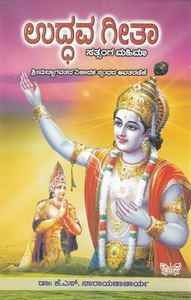
If Bhagavad Gita was the knowledge given by Lord Krishna at the backdrop of the Mahabharata war that destroyed the unrighteous Kurus, Uddhava Gita was given at the backdrop of the internal strife of the Yadavas which resulted in the wiping out of the Yadava clan to which Lord Krishna himself belonged.
While Bhagavad Gita is a dialogue between Lord Krishna and his friend Arjuna, Uddhava too is a dear childhood friend of Lord Krishna. Bhagavad Gita, which is also available as an independent text, is a part of the Bhisma Parva of Mahabharata. Similarly Udhava Gita is available as an independent text. But is part of the Bhagavata Purana which is exclusively dedicated to Lord Krishna and his various Leelas beginning from early childhood. Srimad Bhagavatam or Bhagavata Mahapurana is one of the eighteen Mahapuranas said to have been compiled by Veda Vyasa.
Uddhava Gita, which is also known as the last message of Lord Krishna, can be said to be a sequel to the Bhagavad Gita. Some contents of the Bhadavad Gita has been repeated while some of its concepts have been further elaborated.
The background of Uddhava Gita is like this. Uddhava is not only Lord Krishna’s close friend but also a counsellor of the Yadava clan. Learning about the impending disaster that would wipe out the Yadava clan and also learning that Lord Krishna himself would end his own human avatar and return to his abode in Baikuntha, Uddhava is desperate. He asks Lord Krishan to take him but the Lord in turn advises him to stay behind and also empowers him with spiritual knowledge to rise above the vicissitudes of life and lead a calm and contended life.
Even though Bhakti is the underlying theme of Uddhava Gita, all systems of yoga and darshana are expounded. One popular story from Uddhava Gita is Avadhuta or Dattatreya and his twenty four gurus. They range from inert objects like earth and mountain to dancing girls, thieves and serpents which may sound strange in spiritual context. But, it signifies the fact that if we are open and positive we can even learn something from a thief. If closed, even the knowledge of Yogeswara Krishna will be lost on us.
The Gita which is popular with Devi devotees is Devi Gita. Like the two Gitas mentioned above, it is available as an independent text even though it is actually part of Srimad Devi Bhagavata Purana. This also contains advises and explanations on various types of spiritual practices and concepts.
The most esoteric of the Gitas is perhaps the Astavakra Gita which is considered to contain the ultimate knowledge of Jnana Yoga. It is a dialogue between king Janaka and Rishi Astavakra. King Janaka is considered as the best example of someone who was enlightened but continued to carry on with his worldly duties.
In case you want to undertake serious study of any of these Gitas, please bear in mind certain points that I have explained in my post – Interpretation of Indic Texts. By the way, Uddhava Gita is also known as Hansa Gita. Hansa or swan has great spiritual significance as it is a symbol of viveka (prudence /discrimination). A swan is said to have the capability to separate milk from water with ease. A spiritual seeker must develop viveka. Without this, there are chances he may get lost in the ocean of knowledge itself.
A confused mind sees a world of multiplicities, a world of good and bad. This creates a compulsion to act or refrain from acting, depending on perceived gain or loss. Thus are attachments and repulsions created and both are reasons of bondage. Therefore, practise to have a say over your senses and the tendencies of your mind. See this entire universe as the Self and see this self in me, its supreme abode. In this way you will come to know and realize that the self with you is the same self of all embodied beings. Once you know this your mind will shed restlessness and all obstacles will be removed.(Lord Krishna’s advice to Uddhava)***************************************
This is the alphabet U post of Blogchatter AtoZ Challenge 2021. My theme this year is ‘The beauty of Sanskrit and Sanskrit texts’, where in I explore selected compositions in Sanskrit and also some unique aspects of Sanskrit language and texts. Join with me in my journey to understand India’s spiritual and intellectual heritage. All the posts of AtoZ Challenge 2021 can be accessed here.
Tarka Shastras and the culture of the argumentative Indian

Self styled liberal authors and film makers do frequently misrepresent Indian traditions. In the Tamil movie Dashavatara, which has nothing to do with the ten incarnations of Lord Vishnu, the film makers show Shaivites and Vaishnavites engaged in violent clashes. It is now widely known that Isalmic Invaders and rulers desecrated and destroyed thousands of temples. Maybe, the film makers tried to project that Shaivites, Vaishnavites and other sects did similar things to one another.
Whatever might be their intention, what is shown in the movie is devoid of any historical fact or logical possibility. No doubt there were rivalries among various sects. But the rivalries were settled in very sophisticated ways without involving violence.
There was a time when Buddhism was just another path of spirituality. There were already so many paths of spirituality in India. Buddhism was one of them. Its popularity increased and later on it branched out as a separate religion. Then also there were lots of fluidity of movement. One could go to attend a Buddhist discourse and still remain a Hindu. Or one could be a Hindu today, a Buddhist next year and come back again to Hindu fold after a couple of years. In the same family there could be Hindus and Buddhists living under the same roof for years together. There were Buddhist kings whose wives continued to be Hindus. Unlike today, religious or sectarian affiliations were never rigid.
Since last six or seven centuries religious conversions have been happening in India either by force, or by material inducement, or by psychological manipulation. Funded by foreign hardliners, religious conversion in India is a very lucrative industry. But in those days even the process of conversion was a beautiful tradition. At least that was how great intellectuals got converted. It is said that a Buddhist teacher with his disciples and a Hindu guru with his disciples would meet for a debate. If the Hindu lost, he along with all his disciples would embrace Buddhism and vice versa. It was a logical follow up of the outcome of the debate. The guru who lost the debate became the disciple of the victor to fulfill the terms of the debate. According to the legends, that was how Adi Shankaracharya established the supremacy of advaita vedanta and revived Hindusim.
And those debates must have been anything but today’s TV debates where kutarka dominates. When you open a news channel it feels like you have entered to witness the fight between the crows and the owls. Kutarka appears on surface to be logical but as you dig deep you come to know that it is a fallacy. It is easy to deceive the gullible with kutarka. One popular kutarka is – zero divided by five is zero and zero divided by ten is zero, so five is equal to ten.
When conclusions are drawn from partial truth that is also a type of kutarka. We have these professional M haters. Or let us say P haters. Or K haters. So, if out of ten occasions M has done right on eight occasions and wrong on two occasions, these professionals quote only the two failures to say that M is a total failure. Kutarka is so dominant in our poplar discourses that in spite of having access to so much information, it becomes difficult to find out the truth, because, to get to the truth you have to wade through so much propaganda that appears to be logical at surface.
Those were the days when intellectuals were judged not based on their decibel level or position in society or the number of followers they had, but purely on the quality of their tarka. By the way, though tarka is literally translated as logic, in the context of the Indian knowledge systems, tarka is connected with guidelines for art of debate. It defines the basic terms and states methods to explore so as to gain knowledge and find out the truth.
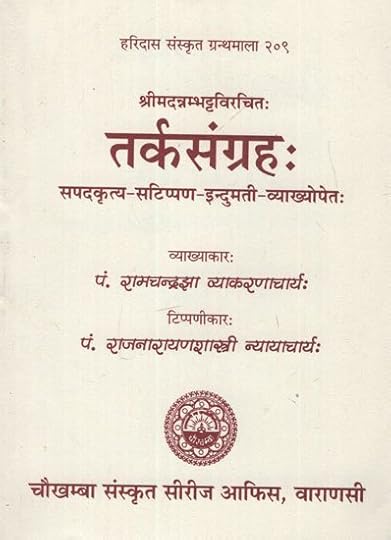
The art of debate had to be refined to avoid kutarka and ambiguity. It was not that there were always face to face organised debates. The proponents of various philosophical schools put forth their arguments in elaborate books. To avoid ambiguity and make their arguments fair, forceful and appeal to common sense, each school elaborately explained the system of their tarka. Such explanations were sometimes embedded inside the texts or sometimes these were separate books. Tarka Sangraha of Annambhatta is such a text which is associated with Nyaya school of Indian philosophy. In this context let me briefly mention various systems of Indian philosophy.
There are nine scholols of Indian philosophy (Bharatiya Darshana) – Sankhya, Yoga, Nyaya, Vaisheshika, Purba Mimamsa, Uttara Mimamsa, Jaina, Buddhist and Charvaka. The first six are astika schools and are known as orthodox systems. The rest are nastika schools and are known as heterodox schools. The astika schools are called so not because the proponents believed in a concept of Gods, but because they believed in the authorities of the Vedas. In fact God is either not at all important or all together missing even from some of the astika schools and sub-schools.
So translating astika as theist and nastika as atheist may sometimes be misleading, especially in the context of Indian philosophy. It is also worthwhile to note that though philosophy and darshan are used interchangeably, etymologically they have different meanings. Philosophy, a combination of two words ‘philein’ (love) and ‘sophia’ (knowledge) means love of knowledge. Darshan means to see deep into.
Any kind of debate is futile unless all the parties have the required background knowledge and derive the same meaning from the same words. The cacophony of today’s debates whether on social media or on TV is mostly because the parties don’t bother to have the necessary background knowledge before coming to debate. It goes without saying that sometimes panelists are called only because they have some celebrity value and even though they may have zero background knowledge on the topic. It gets compounded when the parties assign different meanings to the same word. Subsequently, they are lost only in shouting out to establish supremacy in stead of listening and basing their arguments after properly understanding what the other party is saying.
Maybe, if not to have a better world, at least to to have sensible dialogue and debates on all platforms, knowledge of ancient systems of civilised debate should be made compulsory for all participants and spokespersons.
Coming to the Dashavatara Tamil movie, the premise itself is wrong. Most of our so called intellectuals focus only on the surface and never probe into the underlying deeper philosophical aspects. Exclusivity has never been in the Sanatani tradition which is an organic and integrative system. Moreover, as I have mentioned in the previous post all the different deities are considered as the manifestation of the same supreme Brahman. Hari and Hara are not different at the core. There used to be rivalries among various sects. But these were either resolved by civilised and sophisticated debates using the principles of tarka or left unresolved with each sect following its path without resorting to violence of any kind or desecrating the sacred places or symbols of others.
*******************************************
This is the alphabet T post of Blogchatter AtoZ Challenge 2021. My theme this year is ‘The beauty of Sanskrit and Sanskrit texts’, where in I explore selected compositions in Sanskrit and also some unique aspects of Sanskrit language and texts. Join with me in my journey to understand India’s spiritual and intellectual heritage. All the posts of AtoZ Challenge 2021 can be accessed here.
April 22, 2021
The Stuti Genre of Sanskrit Literature
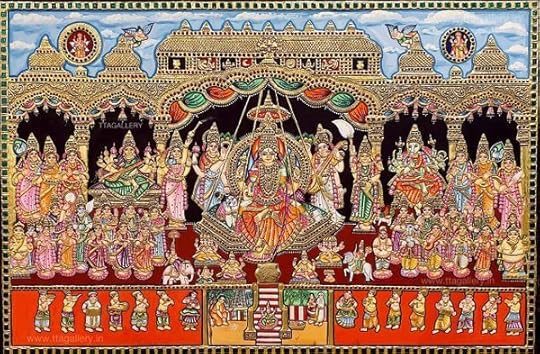
Stuti is a musical composition in praise of a particular form of the divine. Sometime it includes the prayer element, sometimes not. The nearest word for it is hymn. Of course for the compositions of the post vedic periods, the word hymn is rarely is used since hymn has an ancient connotation to it being associated with the composition of the ancient Greeks addressed to their pagan gods. The hymns in the vedas are addressed to the presiding deities of various elements of nature – Indra (rain), Varuna (water), Surya, Prithvi, Vayu, Agni etc. So were perhaps the Greek hymns.
Songs in praise of the divine are there in all religions whether the divinity is conceived with form or formless. The sanatana tradition, with its thirty three crore gods, obviously has to outdo others when it comes to the number of stutis. If we collect all the stutis in Sanskrit, the size may be bigger than Ramayana. And I am not including the vedic hymns in this.
This concept of so many gods often confuses those who come from a monotheistic background. In fact at the core, all these gods are said to be not different from one another. They are all said to be manifestations of one supreme power. As Lord Krishna says in Bhagavad Gita, whomsoever you worship, ultimately it comes to me. Each god is said to be a manifestation of the the supreme Brahman.
In the sanatana tradition God is the creator as well as the creation. The dance of Nataraja is often quoted by the mystics to indicate this phenomenon. The dancer is not separate from the dance. Same way God is not different from his creation. The whole creation is a play and display of consciousness and at the core God is formless.
There are sects where belief in a concept of god is not primary. In the path of yoga of Patanjali, god is a method to realize samadhi. The system of gods in the sanatana tradition is a very complex system. Since that may require a book length post to explain the intricacies I will set down a few salient feature which I hope anyone will be able to connect with and then realize the compassion of the ancients who conceived such gods with various qualities.
Just do this experiment. For ten minutes think about bad people or the bad qualities of people you know. Then observe what happens to you. Are you feeling light? Are you feeling better? Then think about a person who you think is good and think of his good qualities or talk to a friend about his good qualities. Then observe what is happening inside you.
Stutis basically highlight the good qualities of the divine. When you chant the stuti or listen to the chant of a stuti whether the divine is pleased or not, something positive happens inside you. Many of the stutis are basically auto suggestions and when you listen even with partial understanding it gives you a positive vibe. I am sure most of you must have experienced this. The ancient Rishis had insights into human psychology and incorporated certain practices into religious rituals so that a common man could also benefit from it without going to expensive therapists or reading tons of self help literature.
Sometimes even if you do not understand anything you get a positive feeling after listening to a stuti. The reason is that there are two layers of some stuti compositions. One is its meaning and the other is its sound. Some stutis have an underlying esoteric theme. I am not going into the details of this topic except mentioning that ‘Soundarya Lahari‘ falls in this category. In case you are interested you may explore further. Experts have written books exploring all aspects of Saundarya Lahari which is said to have been composed by Adi Shankaracharya. For our simple understanding it would suffice to know that if an instrumental music composition can trigger specific moods in us so can vocal compositions that we do not understand.
A stanza in Sanskrit is known as a sloka. The number of slokas in a Stuti may range from four to one hundred plus. Popular shorter versions are ‘panchakam‘ consisting of five slokas and ‘ashtakam‘ consisting of eight slokas. Stutis are also named after the number of names of the deity it enumerates, each name usually connoting a special quality of the divine. A dwadashanamavali has tweleve names while a sahasranamavalli has thousand names. Lalita Sahasranamavalli is very popular in South India and sometimes devotees gather in a group and sing in chorus. Vishnu Sahasranama is another popular sahasranamavalli. Almost every principal deity has a sahasranambvalli.
While some strotras have been composed independently, many are taken form the puranas. Since puranas themselves are about the glory of their associated divinity it is obvious that stutis would form part of puranas. Sometimes particular stutis are attributed to different characters of the epics even though these may not be part of those epics. Shiva Tandava Strotra is said to have been composed by Ravana. It is a beautiful composition and the metric system is simple but it arouses very powerful feelings. Anyone with a little practice can also chant it. It is very popular among Indian classical dancers. In fact Indian classical singers and dancers from all traditions use stutis extensively.
When it comes to singing or performing stutis, the religious barriers usually are non existent. Artists belonging to other religions do it without any hesitation. There are occasional backlashes though. But that has not deterred the artists.
Most of the stotras consist of simple metric arrangement. But some like the Shiva Mahimna Strotra have complex metric structures and is not easy to for every one chant. However, when sung by an expert, it gives such delight to the listener. It is a favourite stutis and I am giving a link to a favourite you tube video at the end.
You may remember sometimes waking up to a chant in a female voice assailing your ears from the loudspeakers of nearby temple, the refrain of the chant being – ‘utistha pundarikaksha trailokyam mangalam kuru‘. That is MS Subhalakshmi singing Venkateswara Suprabhatam for you. Here the devotee gently prods the lord to wake up for the welfare of the whole universe. This can be taken as an auto suggestion to wake up the divinity with in us and to engage ourselves for the welfare of the society. According to sanatana tradition there is divinity in each of us. But it is dormant. All it needs is a little awakening.
**************************************
This is the alphabet S post of Blogchatter AtoZ Challenge 2021. My theme this year is ‘The beauty of Sanskrit and Sanskrit texts’, where in I explore selected compositions in Sanskrit and also some unique aspects of Sanskrit language and texts. Join with me in my journey to understand India’s spiritual and intellectual heritage. All the posts of AtoZ Challenge 2021 can be accessed here.