Christopher D. Connors's Blog, page 50
April 3, 2018
What it Really Means to Win, Lose and Find Success Through it All
 What is winning?
“Winning is great, sure, but if you are really going to do something in life, the secret is learning how to lose. Nobody goes undefeated all the time. If you can pick up after a crushing defeat, and go on to win again, you are going to be a champion someday.” — Wilma Rudolph
What does it actually mean to win at something? In sports and competitive endeavors, there are clear-cut winners and losers. What do you think about winning and losing when you look at each day in your life. Are you winning? Are you growing, learning, succeeding?
I throw these questions out for you consideration, because winning has become an arbitrary hashtag in the social media and pop culture world. Turns out, winning actually has a lot of definitions. According to Merriam-Webster, to win means:
“to get possession of by effort or fortune; to obtain by work: earn”
It also means, “to gain in or as if in battle or contest.”
Here’s my favorite definition because I think it’s the one that is most relevant to all of us: to obtain by work — to earn. The more I’ve worked with and coached Fortune 500 executives, military officers and successful athletes, the more I’ve learned this very simple life truth:
To lose is truly to win.
We learn a tremendous amount from losing! We learn from failures, mistakes, adversity and setbacks. How we begin to win is by moving forward with a positive attitude and strong work ethic and building our foundation for our next win on the previous losses. That my friends is how success begins.
No one wins all the time. No one.
Steve Jobs was FIRED from the company he founded! When he returned to Apple over 10 years later, he built it into the most profitable company on the planet.
Michael Jordan suffered crushing playoff defeats for six seasons. He didn’t win a championship until his seventh season in the NBA.
J.K. Rowling endured depression, physical and mental abuse, poverty and humliation. Today, we know her as one of the most successful authors to ever live.
Everyone can win. Everyone can also lose. It’s through our experiences that we grow and experience success, which only we can truly define for ourselves.
Dr. Laurence Weinzimmer, author of the book, The Wisdom of Failure, found that by researching 25 leadership books that many of them said the same thing. But what he extracted as a hidden lesson provides tremendous value to all of us:
“What we found with most of our interviews was that most leaders told us the most important lessons came from their toughest challenges, not from imitating somebody else’s success.”
“We learn wisdom from failure much more than from success. We often discover what will do, by finding out what will not do; and probably he (she) who never made a mistake never made a discovery” — Samuel Smiles
You must be willing to give things a shot, even when you think that in probability it won’t work out. Probability means that the supposed odds are not in your favor. But make no mistake — probable does not equal possible. The world is gifted with many contributions from great women and men that endeavored to do something special that was highly improbable at the time.
Losing leads to winning and winning does lead to success. It’s imperative that you define success for yourself in your hobby, career or entrepreneurial venture by defining what success means for you. Have measurable goals that will back up your definition of success. You are the architect of your plan, whether it’s a long or short-term plan. Have one. Have a purpose.
Because once you’ve committed to this both mentally and emotionally, you are better able to invest yourself and immerse your mind to succeed in whatever you choose to do. I thought of the example of one of the world’s greatest athletes, Tom Brady. He wasn’t an overnight success. He was picked in the late round of the NFL draft and has worked for everything he’s earned.
He’s earned success. He’s lost. He’s been overlooked. And he’s now one of the greatest winners in sports history.
Building Toward Success“Too often in life, something happens and we blame other people for us not being happy or satisfied or fulfilled. So the point is, we all have choices, and we make the choice to accept people or situations or to not accept situations.” — Tom Brady
As NFL executives plan for each season, they are reminded of their eternal regret. As the 2000 NFL Draft wore on and name after name went off the board, a skinny kid from northern California was simply waiting for his shot. All he needed was a chance. An opportunity to make a team.
The New England Patriots provided that opportunity. And Tom Brady made the roster. But it seemed he would have to wait years to have a chance to start with the Patriots. He was behind a three-time all-pro, Drew Bledsoe, who had led New England to the Super Bowl only a few seasons earlier. Well, technically.
Brady was the fourth-string quarterback, also behind two other signal callers.
One year later, following an injury to Bledsoe, Brady, who had become the team’s back-up quarterback for the 2001 season, was thrust into the action. He stumbled at first, but matured quickly and went on to lead New England to the NFL Playoffs. Just a few weeks later, he was a Super Bowl Champion. And the MVP of the game.
Alternating as starter during his college days. Passed up in the draft. Assumed to be a back-up for a while.
Brady was ready for his opportunity when it came. He worked tirelessly, had a fierce competitor’s attitude and exuded remarkable confidence. He waited his turn and persevered to make the most of it.
Eight Super Bowl appearances, a record five championships, and holding a place among the greatest players ever to live, Brady has succeeded beyond measure. Not on talent alone. Instead, because he never stopped believing and working toward becoming the best he could be. He learned through mistakes and adversity what it truly meant to win and succeed. On his terms.
Every great innovation, idea and breakthrough in personal development comes from building upon losses and mistakes. Outstanding accomplishments in our lives come when we stay positive, work passionately and fervently in a cause or for a goal that may seem impossible. It likely won’t happen overnight, yet over time we’ll realize the success of a venture that seemed like a total pipe dream years before.
I think about this in the context of our lives. While we may not compete for a professional sports championship, we have decisions — choices — to make every day. A winning choice is always to collaborate with a group of people who will bring out the best in us and vice versa. Our goal should be to elevate our thinking, as well as our performance.
And winners know that it is through losing that we begin to build for the next win. We’re forced to go back to the drawing board and draw up the plans that will lead us to the life of our dreams.
Go for the WinJoin my newsletter and let me know if y ou’d like to work together as you build each day toward living the life you truly want. Let’s GO!
Also check out my Amazon Bestselling book, The Value of You . This will give you inspiration to start planning for success on your journey.
Additional ReadingHow to Overcome Procrastination and Develop a Productive Daily Routine
1 Hour Per Day Doing this Mental Exercise Will Exponentially Increase Your Success
30 Excuses Stopping You From Living Your Best Life (And 30 Solutions)

What it Really Means to Win, Lose and Find Success Through it All was originally published in The Mission on Medium, where people are continuing the conversation by highlighting and responding to this story.


April 2, 2018
Look in Front of You — Not Behind — to Design the Life You Truly Want

The biggest difference between those who live life on their terms and those who pine for the life they want is a willingness to put the past behind and focus on the present and future. We have no control over the past. We do have control and influence over how we act today and what we do to carve out future plans. Intensive, deep thinking and action form the foundation for personal growth.
My three-year old son is one of the most perceptive people I’ve ever met. He’s brilliant, focused and thoughtful. And yet when we walk around, I sometimes have to make sure he doesn’t walk into a wall or pole. His immersion in thought and reflection on what he’s already seen sometimes leads to him turning back and staring at what’s already come, without looking in front of him.
That’s what leads to the trips, falls and bumps on the head! Ouch!
As his parent, I serve as his “tour guide” to ensure he escapes without bodily harm. He’s infatuated with all the stimuli and amazing things going on in this big, bold world around him. He’s using these experiences to fuel his imagination. He has to grow. He has to try and make sense of things he’s already seen and done. And that’s perfectly fine. But he also has to maintain presence and concern for the moment and future.
I use this analogy as a microcosm for what I feel every one of us faces on our quest for personal growth each day. The hungry and hardworking of us mostly know what will help us and lead us to achieving our goals. We’re instinctively drawn to what’s right and beneficial.
It’s what’s wrong and unhelpful that bogs us down, serving as the “turnovers” or mistakes that wipe out the positive advancements we make. When we dwell on the past and continue to reflect on what’s in our rearview mirror, we stop living in the present and we use less of our creative imagination on designing our future plans.
Intense focus and absorption on the moment leads us to a bolder thinking around future planning. In fact, the more we plan for deep-thinking moment-by-moment, the more we pave the path for our future of continuous progression toward our goals. Take this concept of flow from psychologist Mihaly Csikszentmihalyi, which illuminates the need for building for our next step.
“To set the stage for flow, goals need to be clearly defined so that you always know your next step. ‘It could be playing the next bar in a scroll of music, or finding the next foothold if you’re a rock climber, or turning the page if you’re reading a good novel. At the same time, you’re kind of anticipating.’”
When we take this concept and apply it in our own lives, we think about the importance of goal-planning, anticipation and concern for both our present and future. It’s vital to look in front of us and tackle the moment with vigor, enthusiasm and devoted attention. Few people have been as successful at accomplishing this than Lynda Weinman.
It’s in her story that we see a woman who found tremendous value in immersing herself in the moment to build a bright future for aspiring learners.
A Story to TellThe incredible story of Lynda Weinman should be an inspirational launching point for many who aim to take their skills, experiences and passions and build their dream. She was a graphic arts professor who recognized the potential of an expanding art and decided to get hands-on and build the future. She knew she had to start now. She knew that her path was the future.
Lynda Weinman started out writing columns in a monthly magazine series aroudn web design. Those columns became the foundation of an industry-changing book, Designing Web Graphics, which sold hundreds of thousands of copies. From there, she knew she was on to something. She had recently created Lynda.com in an effort to share her passion and enthusiasm of web design with the world.
That passion developed into a billion-dollar company aimed at improving people’s lives in the Internet-age. Lynda Weinman started with focusing on ways she could help people now, which spawned a brilliant future idea that enabled her to plan and set goals for seeing it into fruition.
You likely have some great ideas yourself. The way to see these come to life is to start planning and doing today, so that your future will open up with greater opportunities. You completely limit your creative energy and thoughts by dwelling too much on the past. Dedicate time each day to thinking about what you want to accomplish. Like Lynda Weinman, start with your passion and enthusiasm.
Keep building skills. Heck, write the book on it, if need be!
The way to get better everyday is to seek continuous improvement by focusing on the present and building upon gains to plan your future. Keep your eyes in front of you, accepting your past experiences, growing from them and moving forward. There’s so much powerful growth and opportunity ahead of you. Too much looking back can harm your future vision. And can lead to some bumps on the head. Just ask my three-year old.
Keep Moving ForwardJoin my newsletter and let me know if you’d like to work together as you build each day toward living the life you truly want. Let’s GO!
Also check out my Amazon Bestselling book, The Value of You . This will give you inspiration to keep moving forward on your journey.

Look in Front of You — Not Behind — to Design the Life You Truly Want was originally published in Personal Growth on Medium, where people are continuing the conversation by highlighting and responding to this story.
Sophie Ball Absolutely- it’s so common it’s amazing more people don’t open up about it.
Sophie Ball Absolutely- it’s so common it’s amazing more people don’t open up about it. A good amount of questioning is smart. Too much can hurt us. Thanks for reading!

Geoffrey Watson Thank you, Geoffrey! I really appreciate it!
Geoffrey Watson Thank you, Geoffrey! I really appreciate it!

Thank you so much for reading and kindly sharing your thoughts, Emmanuelle Duhamel.
Thank you so much for reading and kindly sharing your thoughts, Emmanuelle Duhamel. I enjoy reading your thoughts!

Mukundarajan V N You’re 100% right and you raise an outstanding point.
Mukundarajan V N You’re 100% right and you raise an outstanding point. Doubt in others creates a narrow-minded and even cynical point of view. Loved this and as always, I greatly look forward to your insights!

March 30, 2018
How to Improve Productivity and Build Positive Relationships

Weren’t expecting a piece combining productivity AND having that correlate with the important of relationship-building, were you? Here’s the thing — the two go hand-in-hand. Allow me to explain: Every great stride in productivity, performance and planning comes from what we learn and put into action from others. None of us are given all the answers. We have to figure that out. We do so from teachers, mentors, coaches and partners.
A fascinating analysis from Harvard Business Review details Dr. Emma Seppala’s findings in studying workplace happiness and productivity. She writes:
“A positive work climate also leads to a positive workplace culture which, again, boosts commitment, engagement, and performance. Happier employees make for not only a more congenial workplace but for improved customer service. As a consequence, a happy and caring culture at work not only improves employee well-being and productivity but also improved client health outcomes and satisfaction.”
This happiness she speaks of comes directly from empathy, values and a willingness of leaders to build positive relationships. We can take this model and apply it to our personal lives, relationships and in entrepreneurship. Kindness, Respect, Positive Attitude all lead to building lasting relationships with others. This mindset attracts like-minded people to help us become more successful.
It’s also a winning strategy for boosting your productivity. So many of us wander around looking for the magic elixir or formula for how to become more productive. There are no secrets and certainly no shortcuts. It begins with discipline, confidence and a strong competitive desire — with yourself — to continue refining, building and progressing toward your peak potential.
Once you’ve done the self-mastery and moved closer toward your own self-actualization, you need to reflect and look upon the ways others have helped you to grow in the process. It’s a reciprocal relationship of continuing to take the inputs of others to keep building yourself. Then, doing the same for others and picking someone else up.
I’ve highlighted four important principles to consider and reflect on as you look at yourself, your impact and how you want to impact the world around you. Your productivity will run directly proportional to your ability to build positive relationships with those around you, but also through encouragement and enrichment for yourself.
1. We’re able to produce and do more than we thinkThe saying “mind over matter” is real. Our willpower is so strong, yet we only get to know and realize this once we begin to tap into it. Our ability to overcome pain, loss, disadvantages and adversity is largely controlled in the power of our minds! But remember this — the other side of this coin is thinking you can do too much, in too short of a period of time.
 Source: https://www.flickr.com/photos/oninnovation/4996229367
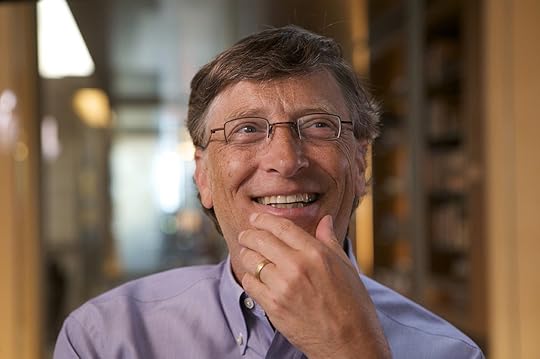
This great Bill Gates quote exemplifies this:
“Most people overestimate what they can do in one year and underestimate what they can do in ten years.”
In other words, while we are strong beyond measure, we often fall into a trap of overestimating our short-term plans and underestimating the “long game.”This is why I believe so strongly in the power of a five-year plan. Once you put things in writing and commit to a realistic plan, you can truly do anything within reason of your talents and natural abilities.
You’re only ever limited by your attitude and your work ethic. If you’re willing to stay positive and work hard, you will always produce more than you ever thought possible. And through this ethos, you’ll attract more people who will help you continue building toward your biggest goals.
2. Time is your most valuable commodity“My favorite things in life don’t cost any money. It’s really clear that the most precious resource we all have is time.” — Steve Jobs
Well, there you go! I can tell you. Your friends and colleagues can tell you. And heck, one of the greatest innovators ever can tell you. But you’ll only truly understand this truth through your experience. I’ve personally found the best way to learn just how valuable time really is, is to strike things out on your own in an endeavor where you are dependent solely on yourself for success.
I believe everyone should become their own boss at some point in their life. If nothing else, it causes you to become resourceful and take ownership like you never have before. Once you are doing this for something you believe in and have passion for, you’re on a road toward success and fulfillment. And as you keep traveling, you’ll find just how much you value you time. Because you are both the manager and delivery specialist for your time.
Ask any entrepreneur and they’ll tell you — “My time is valuable.” Once you go through a similar experience, you know why, too. You come to value your time for your personal ambitions, your time with family, business time and even volunteer time in a totally different way. This engenders a call to action to be more competitive with yourself, so you’ll become the person you can be.
3. You’ll never have it all figured out — that’s OKDespite many a successful person’s efforts to gain influence and control over every part of their life, it will never happen. Never. And you know what? That’s actually a great thing. You have to seek to influence that which you can, just know it’s not possible to influence everything. As a result, you won’t figure out the answer to everything.
Those of us with dominant personalities fight this battle each day. Eventually, you have to let go. Faith needs to enter the equation. Faith in yourself, faith in others, faith in God — faith that things will work out in harmony with your life. Faith is one of the most fundamental values to living a life you can be proud of. Speaking of values…
4. Values & Structure will Sustain You Through Life“When your values are clear to you, making decisions becomes easier.” — Roy E. Disney
Relationships. Goals. Determining your Why and personal definition of success. These things provide structure for your life! Building relationships begins “local” with family, friends and co-workers. In this digital-age, it expands to social media and professional networking sites. Powerful, loving, mutually beneficial relationships help give your life meaning and purpose.
 Source: https://unsplash.com/photos/Ds0ZIA5gzc4
Goals provide you with something to reach for and work to attain. Most successful people I’ve observed and studied succeed by setting small, incremental goals. Those goals can then fit into the context of a long-term plan, if you choose the five-year plan route above. Either way, having something to aim for is a winning strategy.
Values are what give your life definition and serve as the foundation for every move you make. I believe so passionately in the power of values, I wrote a book on the topic. I realized that we all need a framework of reference that helps with making decisions, finding opportunities and building great relationships.
Values are the key to beginning on the path that you want to take. Find that structure you crave. Find your values and know they lead to the truth. Once you know your true path, it’s so much easier to be productive and to attract the people you want to share your journey with.

March 29, 2018
Doubt — What It Is and How to Overcome It

“Don’t waste life in doubts and fears; spend yourself on the work before you, well assured that the right performance of this hour’s duties will be the best preparation for the hours and ages that will follow it.” — Ralph Waldo Emerson
There’s a prowling force that can rob us of joy, confidence and hope, sending us spiraling from a self-assured state of mind to one of worry, self-consciousness and uncertainty. We read and hear a lot about fear and the ways to both combat it and use it to our advantage. We often don’t talk much about doubt. It’s worth opening up the conversation on this pernicious enemy, largely because it’s the secret battle all of us fight — and many of us are (ironically) to fearful to open up about.
According to Merriam-Webster, fear is, “an unpleasant often strong emotion caused by anticipation or awareness of danger.”
Doubt is, “to call into question the truth of: to be uncertain.” It is also to demonstrate a lack of confidence.
Right there, we’ve identified the distinction — fear is emotionally-based and can overpower our mental faculties purely by virtue of how it influences our emotional life. Doubt is basically the manifestation of self-consciousness, uncertainty and intensive questioning of the truth — all when we’d be best left to take and accept the truth as we know it to be.
Of course, a certain amount of questioning is critical to living a thoughtful, discerning life. All of us should do this. This article from Harvard Business Review assures us of the importance of this questioning:
“All healthy human beings have an inner stream of thoughts and feelings that include criticism, doubt, and fear. That’s just our minds doing the job they were designed to do: trying to anticipate and solve problems and avoid potential pitfalls.” Source: HBR
When it comes to doubt, it’s a matter of recognizing that fine line between following the Socratic method and taking it to the extreme. As Susan David and Christina Congleton point out, it’s a matter of emotional agility:
“The first step in developing emotional agility is to notice when you’ve been hooked by your thoughts and feelings. That’s hard to do, but there are certain telltale signs. One is that your thinking becomes rigid and repetitive... Another is that the story your mind is telling seems old, like a rerun of some past experience.” Source: HBR
We can be riding high emotionally and mentally, believing we’re going in the right direction with our purpose and dreams. Then suddenly, overthinking, too much self-questioning leads to doubt. Those big dreams and goals seem far away. The life we want to live most feels like less of a certainty and much more of a question mark.
It’s absolutely crazy how much doubt can pervade our lives and lead us to question the people, dreams and purpose we believe in.
“You don’t get to moments of breakthrough by accepting failure at face value, believing your self-doubts to be accurate, and quitting altogether.” — Vic JohnsonHere are five ways to confront doubt and put up your best offense in the battle to persevere toward your goals.Practice self-awareness on a weekly basis, but make a mental/verbal/written promise to accept yourself and not beat yourself up
2. Be willing to change course. We all need to course correct, at times. We should always decide whether our plans, goals and feelings align with our mission and purpose. It’s imperative to change course if what we’re doing isn’t in line with what matters most to us.
But oftentimes, if you’ve done the work, if your intuition tells you that you’re right, and if you’ve received validation and positive feedback from colleagues, friends and loved ones, you should proceed with what you’re doing. To not do so, would be to doubt.
3. As Napoelon Hill says, “Indecision crystalizes into DOUBT, the two blend and become FEAR!”
Think about this — when you sense doubt coming on, do you find yourself sitting still and wondering too long? Doubt is brought on by indecision. That leads to fear. And before you know it, you’ve taken yourself out of the game. Be willing to move forward and know that you won’t always have all the answers. Rely on faith, not doubt. Speaking of which…
4. Dig deep in your faith and in your values structure — find the wins and positives in your life. As you build upon your previous wins, you build “compound interest” and grow. Faith is something which is always there for you, yet it’s strengthened the more you utilize the muscle.
5. Use your experience to self-teach and then help others to overcome their doubt. Experience is the best teacher
I’ve found the best way to overcome the emotions and external forces that challenge us is to remove ourselves as much as possible from the situation both mentally and emotionally. Take a break. Then, spend some clear, deep thinking objectively analyzing things and ask yourself, “How would I advise or help someone else in the same situation?”
So many people are embarrassed and flabbergasted about how to handle doubt and how to make sense of it. They’re less likely to open up to others, because it’s a blow to their ego. They think they’re alone and they struggle, often in silence, yet it’s the playback that occurs in their minds that can be truly destructive.
Be willing to be honest with yourself and open up to others about how you feel. Doubt casts itself upon us like a spell and can rip our happiness away from us if we’re not prepared. Fear is one thing — doubt and overpowering self-consciousness that leads to a a lack of confidence and self-happiness can destroy you if you let it.
Know the signs and be willing to fight back by sticking to your values, morals and past records of achievement that drive you toward happiness.
You Have to BelieveJoin my newsletter and let me know if you’d like to work together as you build each day toward living the life you truly want. Let’s GO!
Also check out my Amazon bestselling book, The Value of You . I believe it will change your life for the better.

Doubt — What It Is and How to Overcome It was originally published in Personal Growth on Medium, where people are continuing the conversation by highlighting and responding to this story.
March 28, 2018
How to Exponentially Increase Your Happiness by Challenging Limiting Beliefs From Yourself and…
 How to Exponentially Increase Your Happiness by Challenging Limiting Beliefs From Yourself and Others“Always be yourself and have faith in yourself. Do not go out and look for a successful personality and try to duplicate it.” — Bruce Lee
Recently, I spoke in front of a group of 70 business leaders about the power of converting our biggest losses, adversity, failures and mistakes into our biggest wins. As I walked away from the podium, I met and shook hands with members of the audience and shared stories. Most people identified with my theme and told me so. But there was one hold-out. A successful doctor who wasn’t quite buying my message of empowerment, positivity and continuous self-improvement.
And it challenged me to my core.
The thing is, I know what it’s like to live in that world. Maybe you do, too.
When I was younger I was pessimistic, afraid of what might happen if I took a chance. I thought playing things conservatively and “falling in line” would be the way to go. I didn’t take the time to plan for what I really wanted to do in life — and it cost me. I struggled with anxiety, I wasn’t confident enough in my abilities and I didn’t believe I was the right person for the jobs I wanted or the woman I wanted to spend my life with.
I was both simultaneously excited for the future, while also scared of the success I believed I would achieve. As I talked to many friends, colleagues and as I learned from many successful people, it’s not uncommon to doubt and feel self-conscious about our dreams. The critical step we must take in becoming successful is converting our doubt into faith by turning dreams into goals through faith, planning and action.
“True desire in the heart- that itch that you have- that thing that you want to do to help others, and to grow and to make money- that desire, that itch- that’s God’s proof to you, sent beforehand already, to indicate that it’s yours. So claim it. Work hard to get it. When you get it, reach back, pull someone else up.” — Denzel WashingtonDon’t Let Others Limit Your Imagination
Thing is, many people will tell you it’s not so easy to remain positive and enthusiastic as you get older. Life can beat you down. It gets easy to doubt or at least become more cloistered in your thinking of “limitless” possibilities. In other words, once you stop thinking that your goals and dreams aren’t possible, you begin to start limiting yourself.
I’ve seen enough in the lives of my parents, brothers, loved ones, coaching clients and through all of my reading and research that life truly does get better as you keep moving forward. It’s all about believing.
Cognitive behavioral therapy is one way to stay positive and think deeper into protecting yourself against negative thoughts and naysayers. It’s all about recognizing, taming and then converting the negative thoughts and beliefs into positives that we come to master through the power of our mental and emotional faculties. This Harvard Medical School paper points out:
[A person] starts recognizing negative thoughts and beliefs that distract from or disrupt positive events. The ultimate goal is to challenge and eventually change negative ways of thinking, to enable positive events to have more of an impact on the patient’s life.
Famous success stories like Elon Musk, Steve Jobs, Sheryl Sandberg and J.K. Rowling have taught me that adversity is truly our greatest asset. I’ve learned in my own life that sometimes, getting fired from a job, breaking up with the woman of our dreams or even experiencing failure in a business venture can all lead to our greatest breakthroughs.
All of the inspirational stories and lessons on positivity won’t mean a thing if you don’t go and create the life you truly want. You have to take action. You have to steel your mind with the power of faith, which leads to action when you’re willing to forge ahead with a solid game plan. You simply cannot do this when you live in disbelief and doubt.
Psychologist Carol Kauffman of Harvard highlights four ways to develop a more sound, positive psychological approach to combat limiting beliefs. It’s geared toward changing your thoughts and building on self-encouragement as a source of empowerment:
Reverse the focus from negative to positiveDevelop a language of strengthBalance the positive and negativeBuild strategies that foster hopeSource: Harvard Medical School
Find Your Inspiration. Find Your FaithLearn to balance your mental approach with a keen self-awareness and cultivation of your emotional intelligence. The development of confidence and passion for what you do, coupled with practicality and understanding of your skills and natural talents, will enable you to ditch limiting beliefs and increase your desire to believe in what matters most to you.
While we’ll tackle urgent, pressing items that we think may not add value (but really do), we’ll also have plenty of time we can create for the things we care about most.
“Once we believe in ourselves, we can risk curiosity, wonder, spontaneous delight, or any experience that reveals the human spirit.” — E.E. Cummings
The best use of your time is CREATING the time to pursue work that adds value to the lives of others, invigorates you with passion and inspires you to keep giving your gift back to the world as you grow in all areas of your life.
Know this — people WILL tell you that you can’t do something. They’ll tell you why you’re not going to be a great artist. They’ll discourage you from starting your own business, possibly because they failed on their own. And worst case, you’ll actually start to believe these things. And you’ll beat yourself up and begin to wonder whether everything you’ve believed in is just Pollyanna.
As people get hardened to failures and refuse to capitalize on the tremendous growth opportunities that come from adversity, they get more conservative. Sometimes, people who took big chances when they were younger, are keen to tell you why they shouldn’t take bold risks. They’ll tell you it’s hard to be bold, confident and positive and they’ll think it’s safer to tell you to take the easy way out.
Don’t ever let failure increase a limiting belief that you may hold deep inside. It’s not worth it, namely because in an ironic way, our failures and stumbles along the way should actually teach us to increase our faith for the next venture and opportunity.
“Failure meant a stripping away of the inessential. I stopped pretending to myself that I was anything other than what I was, and began to direct all my energy into finishing the only work that mattered to me.” — J.K. Rowling
The safe way out, in terms of your creative ventures, ideas, big goals and dreams, DOES NOT WORK. It’s for those who want to live lukewarm. What does work is summoning the courage, conviction and determination to build your life around your dreams, backing them with goals and a solid game-plan for how to do what you want to do.
You owe it to yourself and to others to not stop when others tell you to take the easy way out. To continue increasing in faith. Because there would be nothing greater than converting a doubter into a believer, showing them through your own example that you will find happiness, purpose and your chosen calling as you keep growing in enthusiasm, confidence and faith as you grow with time.
You Have to BelieveJoin my newsletter and let me know if you’d like to work together as you build each day toward living the life you truly want. Let’s GO!
Also check out my Amazon bestselling book, The Value of You . I believe it will change your life for the better.

How to Exponentially Increase Your Happiness by Challenging Limiting Beliefs From Yourself and… was originally published in Personal Growth on Medium, where people are continuing the conversation by highlighting and responding to this story.
March 26, 2018
3 Ways Deep Thinking and Goal Planning Will Change Your Life

“Your beliefs become your thoughts,
Your thoughts become your words,
Your words become your actions,
Your actions become your habits,
Your habits become your values,
Your values become your destiny.” — Mahatma Gandhi
Every day you are given the freedom to think big, deep, powerful thoughts — some of which will literally change your life. Our creative imagination makes deep thinking and possible. Deep thinking leads to bold ideas that are unfettered, unfiltered, unbiased and free from overly positive or negative emotion. Because it is through this type of thinking that we find and seek the truth about who we are and what we want.
Deep thinking is fueled by two types of honesty: honesty with yourself and asking someone or those very close to you — who you trust — to be honest with you. As I’ve written about previously, step one in personal development is all about honesty.
If you’ve been putting off your goals and dreams for a few days, months or perhaps even years, it’s time that you instill some discipline and make changes to think introspectively and truthfully about how you can get the results and outcomes you desire in your life.
The distillation of the best advice that I’ve received from successful entrepreneurs like Elon Musk and Sheryl Sandberg, to entertainment icons Denzel Washington and Oprah Winfrey is to set small, incremental goals for yourself. On a personal level, I’ve seen my friend Amy Schumer, as well as my brother, ESPN broadcaster Kevin Connors, and many brilliant business minds reach incredible heights because they pushed themselves to keep setting goals.
I do believe it’s of high importance to have an overarching objective of how you define success, but where the “battle is really won” is in the trenches of achieving wins on small goals.
Amy Schumer is a close childhood friend of mine and someone whose dedication, commitment, hard work and confidence I greatly admire. I’ve watched her become the star she is today by grinding it out and taking small steps, which have led to enormous success.
When we spoke recently, she told me about her mindset and the role that confidence has played during what has been her ascension to the top of the entertainment world. She first wanted to be a stand-up comedian. Then she decided that she wanted to make a living doing stand-up comedy. Next, it was the desire to become a comedian who hit the road and traveled the country and world.
She didn’t wake up one day and think, I’m going to be the next titan of comedy and it’s going to start right away! As she told me,
“When you think and dream in terms of instant gratification, you fall flat on your face.”
So, you’ve likely come to this article with a desire to grow and add valuable insights to improve the way you think and act. That is, after all, what the net result of personal development should be! So, where are you on your journey? Have you spoken what you want for yourself over your life? Have you written it down? What’s holding you back?
We all know that real-life gets in the way, both in a good and bad way, and that obligations to work and family must come first. Where I’m interested in diving into with you is the time management mastery of your “free time.” What does that free time look like? What are we talking about?
I’m talking about the time you have after school has ended and before dinner. And after you’ve put your little one down to bed. That extra 30 minutes where you could get a little bit more sleep, but you know you’d benefit from some extra thought and goal-planning time. And it may come in the morning, where if you wake up a little bit earlier and plan your day, you’ll be well on your way to a much more productive day!
So let’s talk about that and figure out how we can both get better together.
1. Thoughts“Self-discipline begins with the mastery of your thoughts. If you don’t control what you think, you can’t control what you do. Simply, self-discipline enables you to think first and act afterward.” — Napoleon Hill
As the age-old saying goes, “Everything begins with a thought.” This principle applies well to personal development work. You can’t just “dive in” and begin when you haven’t thought out what you really want to do. Or, you can. But the chances of succeeding without proper thought and planning are slim.
Then, you’re only reacting rather than proactively making decisions that are in the best interest of your time, money and future happiness.
It took me a while to master the self-discipline of actually waking up early. Do you struggle with that, as well? But now that I am able, it has revolutionized my thought process and productivity. I’m able to focus with greater intensity and energy during the time of the day where the most lucid, vivid thoughts enter my mind.
I begin each day by meditating and truly just letting my mind listen to all the thoughts that come my way. After about 10 minutes, I let those thoughts simmer and I write down what I want to accomplish each day. I do plan by the week, each Sunday, but I’m always willing to make adjustments if something is not working.
It’s critical that you are willing to adjust, if necessary, to the changes that come and can alter your plans. Because improvisation is very often a requirement!
Start with your thoughts. Plan out your objective, then think about and write down your goals in small, incremental measures. Before long, you have a plan that you can be proud of. And be proud of the goals and dreams that you want to accomplish. Don’t give in to self-criticism or the criticism of others. And equally as important, avoid jealous or envious thinking at all costs!
The only race that matters is the one you are running in. Compete with yourself and don’t worry about others.
WordsThe reason why I am a huge proponent of speaking your dreams and goals over your life — particularly to your family or loved ones — is because it strikes a verbal contract of accountability. Research and empirical observation have taught me that many people run away from their dreams because of others might think of them. As this Harvard Business Review article shows, some people actually fear reaching their true potential.
For far too long, I was a living example of that. I was afraid to be vulnerable in my writing but not just that, I was afraid to demonstrate vulnerability in words to my readers. It took me overcoming insecurity and personal fear to even speak about my personal struggles and adversity with my wife! But once I did, it blasted open the door to interior freedom, courage and self-confidence.
What about you? Are you afraid of opening up both publicly and privately about the thing that matters most to you? Or even about your feelings and thoughts?
Once I started telling people that I desire to become a New York Times bestselling author and a person who makes his living — and supports his family — based on the work that blends his enthusiasm and talents, I started moving in that direction. I urge you to take your thoughts and convert them into words with someone — or several people — who you trust.
Find your family. I’m not talking about your Mom or Dad, necessarily, it could be your close friend, mentor or business partner. Someone who has rock-solid integrity and is willing to listen to what you truly desire for yourself. Infuse your words with positivity and hope! And then…
ActionFrom there, it’s all about action. Are you willing to do what you said you would do — and what you imagined in your beautiful mind — through the power of your thoughts? From there, I can tell you what has worked for me. I use the Stephen Covey “Time Management Quadrant” as my guiding methodology.
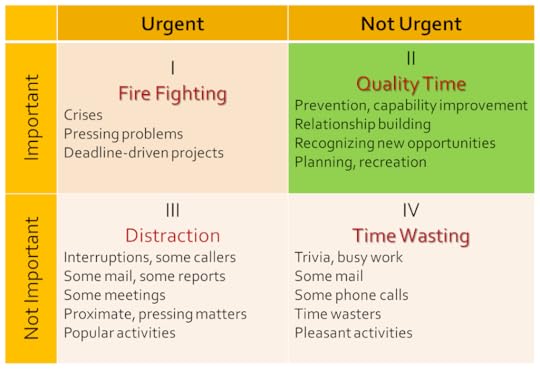 Stephen Covey’s Time Management Quadrant, courtesy of The 7 Habits of Highly Effective People
I encourage you to plan your day and work toward getting to Quadrant II with all that you do. There will be distractions and fires to fight. Surely, there is work you won’t want to do. Make a concerted effort to organize and categorize the “Not Important” time so you can maximize your efficiency.
I use Microsoft Outlook Tasks to group my 10 categories by color. I’ll list five examples for you:
Family and Home LifeJob (Coaching and Freelance Writing)Health and Well-beingFaith LifePersonal DevelopmentI put my family first, as well as my work, while focusing on things like personal development, meditation, prayer and taking care of my body. There are more, but this offers some insight into how I view several of the most important things in my life. I’m always looking for “an edge” in my writing and coaching for clients.
How can you get better today?
It’s best to demand a lot of yourself without being too critical and thinking negatively. You’ll find your most productive days are when you’re honest with yourself, self-encouraging, and when you work with enthusiasm and discipline to achieve your goals. Find things to inspire you throughout the day, whether it’s a new article, thinking of your next big idea or a great song that makes you jam.
The actions that you take to be productive and your commitment toward personal development is always time well spent. Try to improve everyday and continue to refine and improve your system with new guidance. Think deeply about where you want to be. Think of the values that you hold dear. As you begin to take flight, you’ll realize you built something special to get your started.
Get to Doing!Join my newsletter and let me know if you’d like to work together as you build each day toward living the life you truly want. Let’s GO!
Also check out my Amazon bestselling book, The Value of You . I believe it will change your life for the better.

3 Ways Deep Thinking and Goal Planning Will Change Your Life was originally published in The Mission on Medium, where people are continuing the conversation by highlighting and responding to this story.