Michelle Higgs's Blog, page 2
December 17, 2015
DAY 6: 12 DAYS OF VICTORIAN CHRISTMAS CARDS
On Day 6 of 12 Days of Victorian Christmas cards, here's an example of the Victorians' often very odd sense of humour.
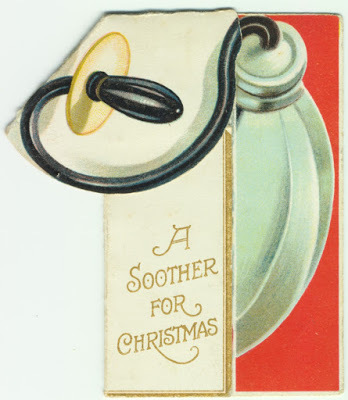 Copyright Michelle HiggsThe card looks very unassuming with a baby's bottle design but it opens up to reveal this:
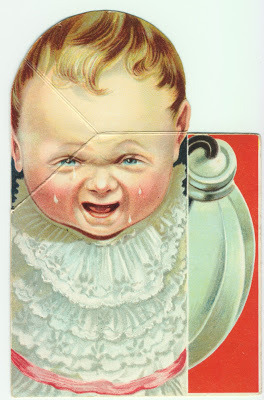 Copyright Michelle HiggsImagine receiving this card as a 'soother' for Christmas! This is a very late Victorian or early Edwardian card published by Raphael Tuck & Sons.
 Copyright Michelle HiggsThe card looks very unassuming with a baby's bottle design but it opens up to reveal this:
 Copyright Michelle HiggsImagine receiving this card as a 'soother' for Christmas! This is a very late Victorian or early Edwardian card published by Raphael Tuck & Sons.


December 16, 2015
DAY 5: 12 DAYS OF VICTORIAN CHRISTMAS CARDS
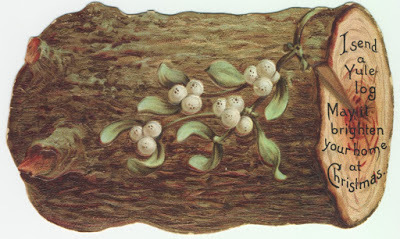
Today, I'd like to share an image of a shaped Victorian Christmas card. These are my favourite types of cards because they're all so different and unusual. This one has a Yule log design.
 Copyright Michelle Higgs
Dating from the 1880s, the card is entirely flat but it's embossed and has a three-dimensional effect. 'Bringing in the Yule log' was a tradition when a large log was brought home on Christmas Eve and burned for the 12 nights of Christmas until Twelfth Night.
 Copyright Michelle Higgs
Dating from the 1880s, the card is entirely flat but it's embossed and has a three-dimensional effect. 'Bringing in the Yule log' was a tradition when a large log was brought home on Christmas Eve and burned for the 12 nights of Christmas until Twelfth Night.
December 15, 2015
DAY 4: 12 DAYS OF VICTORIAN CHRISTMAS CARDS
Today, it's Day 4 of 12 Days of Victorian Christmas Cards and we return to the anthropomorphic theme - I did warn you!
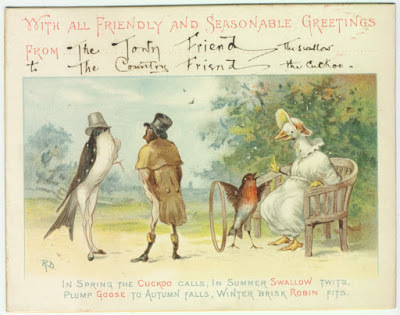
This card from the late 1880s is signed RD for Robert Dudley and it's published by Castell Bros. In case you can't read the verse, it says:
In spring the cuckoo calls, in summer swallow twits.
Plump goose to autumn falls, winter brisk robin fits.
The sender has hand-written in the 'from' section:
The Town Friend the swallow
To the Country Friend the cuckoo.

This card from the late 1880s is signed RD for Robert Dudley and it's published by Castell Bros. In case you can't read the verse, it says:
In spring the cuckoo calls, in summer swallow twits.
Plump goose to autumn falls, winter brisk robin fits.
The sender has hand-written in the 'from' section:
The Town Friend the swallow
To the Country Friend the cuckoo.
December 14, 2015
DAY 3: 12 DAYS OF VICTORIAN CHRISTMAS CARDS
On Day 3 of 12 Days of Victorian Christmas cards, here's a design that doesn't look very Christmasy at all: a chick with a special message.
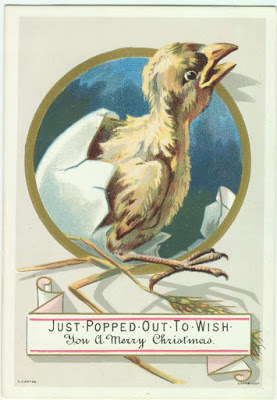 Copyright Michelle HiggsThis slightly scary card is dated 1878 and is published by R. Canton. The design was part of a set which also included parrots, mice, cats and dogs. This is the card that first got me interested in Victorian Christmas cards, not just because of the unusual design but because it has a very cryptic message on the reverse. As mentioned...
 Copyright Michelle HiggsThis slightly scary card is dated 1878 and is published by R. Canton. The design was part of a set which also included parrots, mice, cats and dogs. This is the card that first got me interested in Victorian Christmas cards, not just because of the unusual design but because it has a very cryptic message on the reverse. As mentioned...
December 13, 2015
DAY 2: 12 DAYS OF VICTORIAN CHRISTMAS CARDS
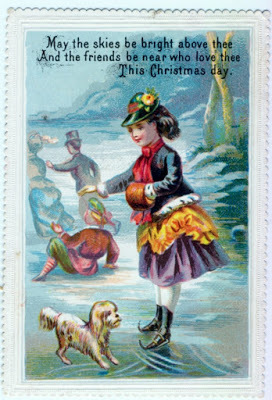
Yesterday, I shared an image of a Victorian Christmas card featuring rabbits riding penny farthings. Today, I'd like to show you a more 'typical' design of a child enjoying winter pursuits.
 Copyright Michelle Higgs
Here we have a young girl with her dog skating on the ice (probably a frozen river or lake), complete with a very stylish muff! This card is a typical design from the late 1860s and early 1870s; it has a scalloped edge and it's relatively small, about the same size as a visiting car...
 Copyright Michelle Higgs
Here we have a young girl with her dog skating on the ice (probably a frozen river or lake), complete with a very stylish muff! This card is a typical design from the late 1860s and early 1870s; it has a scalloped edge and it's relatively small, about the same size as a visiting car...
December 12, 2015
DAY 1: 12 DAYS OF VICTORIAN CHRISTMAS CARDS
Last year, in the run-up to Christmas, I shared some images of Victorian Christmas cards from my small collection (my very first book was a Shire book on collecting cards). People seemed to like these images so I've selected twelve more unusual, humorous or downright odd cards to show you. Hope it's a good antidote to the madness of Christmas shopping...
On Day 1, I give you rabbits riding bicycles! Penny farthings, to be precise. These bunnies are extremely good at multi-tasking because some...
On Day 1, I give you rabbits riding bicycles! Penny farthings, to be precise. These bunnies are extremely good at multi-tasking because some...
December 9, 2015
VICTORIAN PRISON BABIES
Back in 2006, when I did the research for my book Prison Life in Victorian England, I remember being struck with sadness and pity for the babies of female prisoners who were born in prison and incarcerated with their mothers. Women who gave birth in prison could keep their babies with them, providing they were breastfeeding, sometimes until the end of their sentences.
In the 1860s, when Henry Mayhew visited Brixton Prison, the chaplain explained the rules about infants in the prison: ‘If the...
In the 1860s, when Henry Mayhew visited Brixton Prison, the chaplain explained the rules about infants in the prison: ‘If the...
September 17, 2015
LIFE AS A POLICE CONSTABLE IN LATE VICTORIAN LONDON
As the current series of Ripper Street draws to a close on BBC1, I decided to devote this blog post to policing in late Victorian London. I've been impressed by the character of P.C. Bobby Grace in Series 3 and will look forward to his development in the next series. But how were police constables recruited and what were their day-to-day duties?
In 1901, a journalist for Living London observed the Metropolitan Police Force at work. When referring to police constables, he wrote: "Any young man...
In 1901, a journalist for Living London observed the Metropolitan Police Force at work. When referring to police constables, he wrote: "Any young man...
May 7, 2015
TANTRUMS, TEARS & TOIL: DOMESTIC SERVICE IN A VICTORIAN COACHING INN
The second episode of the BBC's 24 Hours in the Past was set in a coaching inn in the 1840s, with the National Trust's New Inn at Stowe providing a very authentic backdrop. Coaching inns (or stages) were the hub of stagecoach activity, providing extensive stables, fresh horses and refreshments for passengers en route. They were also the principal hotels for the towns in which they are located. On a major route, there could be as many as 15 or 20 coaches passing through every day, from early i...
April 30, 2015
DUST, DOG DIRT AND DUNG IN VICTORIAN ENGLAND
I wasn't sure about the concept of the BBC's 24 Hours in the Past at first. Watching celebrities complain about the frankly unpleasant nineteenth century tasks they had to undertake didn't sound very appealing. However, I was impressed by how realistic the scenes in the first episode were. Filmed at the wonderful Black Country Living Museum, episode 1 was set in a dust-yard where dust and other rubbish was sifted through to collect bones, rags and pieces of metal.
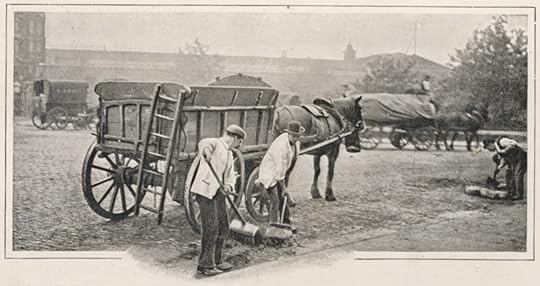 'Removing Street Refus...
 'Removing Street Refus...