Jeffrey Miller's Blog: Jeffrey Miller Writes, page 6
January 23, 2016
Yes, You can Judge a Book by its Cover
 You know the old adage, “you can judge a book by its cover?”
It’s true.
It’s especially true if you are an indie author and you’re trying to fight for a piece of the action in a market that is getting smaller and smaller. If you want your book to get noticed you are going to need a design that speaks volumes (excuse the pun) that’s about the size of a pack of cigarettes (and sometimes smaller).
Book cover design. Can’t say enough about it. There are plenty of freelance designers who can take your ideas and come up with a good design. Sadly, there are some not so good designers who might even use the design for your book for another project. This has happened to two of my writing friends. I hear 99 Designs is a good place to get started. Their rates are compatible and you can choose from several designs.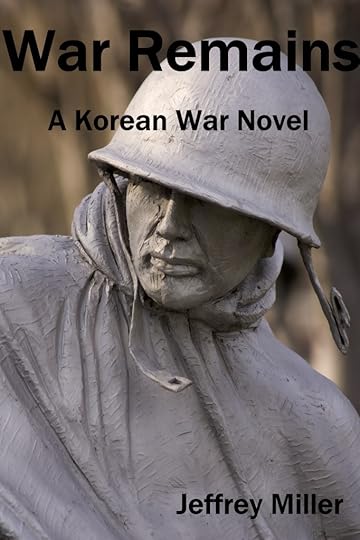
I’m fortunate that I have my own designer, Anna Takahashi Gargani who works her visual magic time and time again.
Recently, she redid the cover design for my first book, War Remains. I think she did a pretty good job. This was the original design. For starters, it’s a lot stronger and the font and color she uses is both bold and soft. She also was able to bring out more definition from the original photograph.
It’s a sweet design for a very good book and story.


January 21, 2016
Mojave Green
 Of all my short fiction, one of my stories that is near and dear to me is “Mojave Green” which I originally wrote in 1988 for my MA Thesis at Western Illinois University. The story, which takes place in the small town of Adelanto, California outside of George AFB, is about an airman who finds out a troubling secret about his wife and the visit of his wife’s ex who liked to hunt for Mojave Green rattlesnakes.
I cut my teeth as a writer with the story and it will be featured in a collection of short fiction I hope to publish this year. I learned a lot about the craft of writing with this story and the importance of the rewrite.
Mitch moved past me, kicking up some sand as he moved toward his truck. From the back, he pulled out a cooler. “Didn’t want Betsy to know I had this. She used to get really bent out of shape with my drinking. I don’t think I could have gone another minute without a cold one. Beer?”
“Listen, Mitch, if it’s about—”
“You know why I’m here.” He pulled out a dripping bottle of Budweiser, opened it on the lip of the truck’s rust-flecked bumper and hoisted it to his lips. Beer streamed out the corner of his mouth that he wiped away with the back of his hand. “It’s a hot one today. I don’t know how you two can still live in this place. I figured you for base housing, being an E-5 and all. Betsy probably told you that I was redlined for promotion a couple of times because of my drinking. No promotion. No base housing. That sucked.”
Oh, yeah the photo. That’s the barracks I lived when I was stationed at George from 1978-1980.
January 19, 2016
Self-Promotion: Does it Work?
 Let’s face it, if you’re an indie author you’ve got a long, upward battle ahead of you each time you come out with a new book. That battle is the marketing and promotional battle to publicize and promote your book.
Please buy my book or I’ll end up in a van down by the river.
If you’ve been around Facebook for a while and are a writer or have a friend who is, you might have seen this posted. It’s funny. It’s cute. And as much as I admire the comic genius of the late Chris Farley, it’s a painful reminder of what all of us authors are up against when we publish. We want people to buy our books. We want people to leave reviews. We want people to tell their friends, family members, hairdressers, mechanics, clients, patients, and clergy about this amazing and wonderful book by ________________.
So, how do we self-promote effectively?
Please shut-up: Why self-promotion as an author doesn’t work.
I came across this article today and I have to admit the author makes some valid points about how some social media platforms don’t live up to the promotional expectations we might have as authors. A lot of authors bemoan the limitations of Facebook and Twitter, but that’s what you get for a free platform. I use Facebook a lot to talk about my books, but also to talk about other authors and books the same way that I would strike up a conversation with a friend and talk about a book that I am reading or have read. People will “like” it that you have a new book out or published another short story, but that doesn’t mean that person is going to buy your book or read your story, the same way that telling that person face-to-face about them. For myself, that “like” is sometimes simply a “nod” and a, “Oh, that’s nice response.”
Still, we all hope that it will work. We hope that someone will buy our books and like them so much that they will spread the word. It happens. Maybe not as much as we would like, but it still happens.
It’s tough these days promoting our books. But we still march on.
By the way, have your checked out my latest, The Panama Affair?
Just kidding. No, really. I don’t want to end up in a van down by the river.
January 18, 2016
On the Passing of Glenn Frey and David Bowie
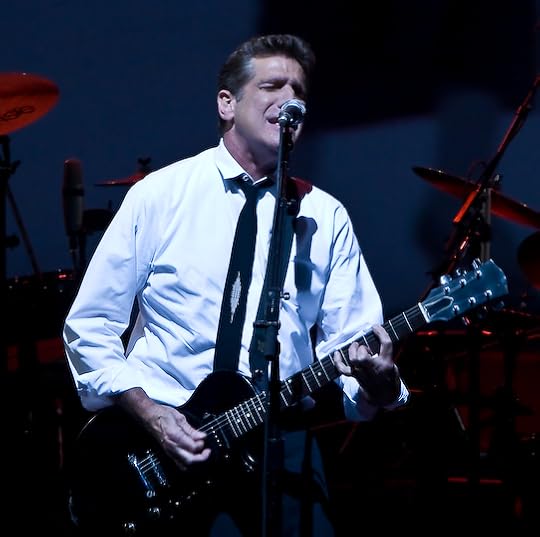
The other day I saw this Twitter comment someone had left about the death of David Bowie that resonated strongly with me. The person said that the reason we feel sad over the death of someone we never met is that the person touched and influenced our lives through his of her art. No matter if it’s David Bowie, Glenn Frey, Alan Rickman, Lemmy, or Stevie Wright (lead singer of The Easybeats) we all feel this sense of loss in our own lives. It’s more pronounced in this age of social networking when as soon as it’s reported that an artist, musician, artist, or writer has passed away, we’re all updating our statuses, changing our profile photos, or sharing personal anecdotes of that person. In life and in death we are all brought together by these individuals who touched our lives.
One can only imagine what it might have been like if there was Facebook or Twitter when Elvis, John Lennon, or Kurt Cobain died. We are living in an age when we can express our grief more publicly than ever before. And it is through this grief that brings us closer.
At the same time, what exactly are we mourning? Are we mourning the loss of this person or are we mourning our own inevitable mortality? Although we might be, to paraphrase Allen Ginsberg, losing the best minds of a generation, we are in the case musicians like Bowie or Frey, also losing a part of our youth. We can all remember the first time we listened to these musicians and the soundtracks they provided for our lives. That’s why it hurts so much. I can still remember the day I slapped Ziggy Stardust on my turntable and played it over and over. I’m still playing it today: “Starman” is in constant rotation on my iPod.
Some are harder to take than others. I felt that way about David Bowie. Watching his final, haunting video, put the zap in me. Thinking about it now still sends a shiver down my spine.
However, we will always have their music, their movies, and their books. One of my friends, David Steele said it best upon the news of Glenn Frey’s death: “Their music is their artistic immortality, the gift to the rest of us. As long as it is played somewhere, part of the artist lives.” I like that.
If you’re feeling a bit down because the world has lost yet another music legend, listen to their music again and share in the joy, not in the loss that it brings. Just be sure to turn it up.
Photo Credit
“Glenn Frey” by Steve Alexander – originally posted to Flickr as Glenn Frey. Licensed under CC BY-SA 2.0 via Commons – https://commons.wikimedia.org/wiki/Fi...
Word Count
 How many words do you write every day?
Some of my author friends are quite prolific when it comes to the number of words they write each day. Some stick to a daily quota and meet that quota no matter what. Others choose a more manageable and polished quota.
I’m quite happy if I can write 300-500 polished words a day. That might not seem very much, but it’s definitely been more manageable for me. Anyone with little kids running around the house knows exactly what I mean.
Reviews Do Matter
I am a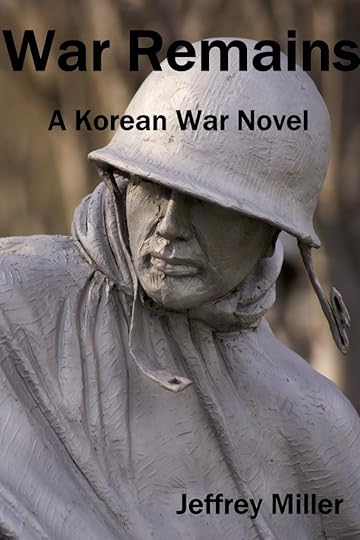 lways grateful when someone takes out the time to leave a review for one of my books at Amazon or Goodreads. When you’re an indie writer you need all the help you can get promoting your book and there’s no better way than by word-of-mouth when someone writes an honest review.
Recently, this is what one reader had to say about my novel War Remains:
“This is a story told through letters found 50 years later about the Korean War. So well written you are taken along with those in war and become scared, yet know it was much worse than you could imagine. Ronnie and his son Michael found long forgotten artifacts in a footlocker belonging to Ronnie’s father who went to Korea and fought for South Korea’s freedom. A police state action, not labeled a war, but Bobby never came home and was listed as MIA. This is a story about the journey to learn about Bobby and those who served with him. Makes you grasp for an emotion you may not realize you have inside. I can’t read this without crying and praying for all servicemen and their families.”
Although I don’t have any clear or hard evidence how a book review will drive sales or help me reach a wider market, I am just grateful that my book resonated with a reader and touched them.
December 14, 2015
Discovery
 I love where my writing takes me.
You never know the journey your going to take when you sit down and start writing. Even when you think you have everything outlined, once you start writing and your characters begin to come alive, they sometimes take you to places, real and imagined, that you hadn’t considered.
For my latest novel, a Cold War techno-thriller, I thought my beginning was solid until I tried to fit in a scene that just wouldn’t work no matter how many times I tried.
Then I began to look at what was happening from one of the character’s perspectives and everything changed.
September 7, 2015
Work in Progress: The Roads We Must Travel
 For my next book, I am returning to my roots: the short story.
I am tentatively calling it The Roads We Must Travel.
I’ve been writing some new stories and tweaking some old ones (ones which have already been published in online literary magazines). Unlike my previous self-publishing projects, for this one I will go with an indie publisher (keep your fingers crossed).
Currently, I have fifteen stories that I would like to include in this collection. Three short stories, in particular, “Mojave Green,” “Going After Sexton,” and “Black Roses” are stories that I cut my teeth on as a writer when I was in graduate school (1987-1989). These are stories which demand a wider audience. “Mojave Green” takes place at an Air Force in the Mojave Desert; “Going After Sexton” takes place in Carbondale, Illinois; and “Black Roses” takes place in Chicago.
This is a tentative list of stories which I hope to include in the collection:
As Long as I Have my Cokes and Smokes *
What Happens in Vegas, Stays in Vegas *
For Emily
Don’t Ask; Don’t Tell
The Footlocker
Black Roses *
And that’s why they call it the Blues
Greetings from Cambodia
Night Shift
The Roads We Must Travel
Maid Rite *
Mojave Green *
Going After Sexton *
(* previously published)
After spending nearly two years writing my last novel, The Panama Affair, it is refreshing to go back to my roots and write some short fiction. Don’t worry, I have already started another novel.
September 5, 2015
Full Circle
 Not long after I arrived in Korea in 1990, I started having breakfast at Paris Croissant in the Kangnam subway station. My buddy, Ken told me about the place where a fellow could get a fried egg, toast, and coffee for a couple thousand won. Not a bad deal.
On many a morning, before I started teaching my first class at ELS, I had my breakfast at Paris Croissant, sitting elbow to elbow with office ladies, dipping my buttered toast in the egg yolk, washing it down with black coffee, and listening to Frank Sinatra.
This past week, The SolBridge coffee shop started serving morning breakfast.
Although there were no office ladies or Frank Sinatra, I felt as though I had stepped back in time, twenty-five years.
August 27, 2015
Dealing with Rejection…Again
 I received another rejection notice from an online literary magazine that has published my writing before. It’s my second rejection from the magazine in as many months.
Even though rejection is a given is in the nature of the publishing beast, no matter how many times you have been published and no matter how many times people tell you that your writing is good, it still smarts a little when you start reading that email and get to the part where the editor or assistant says something like, “it’s not a right fit for us.”
Rejection. We have all felt its sting and slap. I would be lying to you if I said it doesn’t hurt. The challenge of course, is how to use the rejection to improve your writing?
Now before one immediately starts rewriting their poem or story, one should take another look at that piece of writing and try to understand why it was rejected. It might something as simple as the editor just didn’t like the story for one reason or another. In my case, the editors felt the story hadn’t been developed enough. Fair enough. I can live with that because as a writer we need some feedback that is not from a friend or a family member. Sure, it’s all objective, but objectivity is good and we should try to use it when we take another look at the piece of writing that had been rejected.