
Gerry Adams's Blog, page 17
May 30, 2022
British government cannot be trusted with our future: Acht na Gaeilge – Anois: Defending journalists
Sunday marked 24 years from the historic referendum in May 1998 that saw almost three quarters of people in the North vote in support of the Good Friday Agreement. Despite the twists and turns in the years since then the Agreement has proved resilient in maintaining peace and in plotting a course for constitutional, political and economic change in the North and across these islands.
Now the Good Friday Agreement is under threat. Arguably that has always been the case as far as elements of unionism are concerned. But for their part successive British governments have refused to implement parts of the Agreement. The Tories in particular have been guilty of this. Especially the current crowd.
The Agreement was a defining moment in our recent history. It underpinned the peace process. However the Good Friday Agreement was not a settlement. It provided the space in which our different political and constitutional perspectives, that are part of our shared colonial experience, can be debated and discussed and out of which a new future can be agreed.
For those of us who want it the Agreement provides a mechanism to achieve self determination and an opportunity to undo the disaster of partition and achieve a united Ireland democratically.
This essential part of the Agreement is now being targeted. The Agreement is clear. A majority is needed for constitutional change. However, there is currently a sinister effort underway by some to attack this core principle of the Agreement. There is a suggestion being made that it might be time for the provisions of the Good Friday Agreement to be rewritten. The Tánaiste Leo Varadkar went so far as to propose that any decision on a unity referendum should have a role for The Assembly.
The real politic is that any decision on a referendum will be taken by the two governments – not by a British Secretary of State. It is above his/her pay grade. Clarification on the criteria for this may be useful but any suggestion that the Good Friday Agreement should be rewritten and this crucial aspect of it be amended, must be resisted.
The Good Friday Agreement has stood the test of time. Its flaws rest primarily with the failures of the two governments to fulfil commitments made. The British Government is not to be trusted with our future. That is for the people of this island to decide.
The Agreement and the people of the North have not been well served so far by the current Irish Government. An Taoiseach Micheál Martin has allowed relationships with the British government to almost disappear. Arguably this is the British Governments fault. I accept that. But An Taoiseach has done little to counter this. He rarely mentions the North unless it is to attack Sinn Féin. His instinct on the issue is not good. For months there was no worthwhile contact between the two governments. That surely is An Taoiseach’s responsibility.
His government has refused to challenge the British Government in a strategic and consistent way. When moved, by dint of public pressure, for example on London’s Amnesty for its forces or their allies, its attitude has usually been rhetorical and without real substance.
So the Irish Government has a lot to do. It should be planning for the future in an inclusive, transparent democratic way. And it should be defending and implementing the Good Friday Agreement.
Acht na Gaeilge – Anois
The echo of thousands of cheerful, excited voices raised in defiance reverberated off the buildings along Royal Avenue and into Donegall Place to the front of Belfast City Hall. The raised voices called for Irish language rights – for equality and respect. The slogans demanded:
Acht na Gaeilge – Anois (Irish Language Act – Now!!).
Tír gan teanga, tir gan anam (A country without a language is a country without a soul.
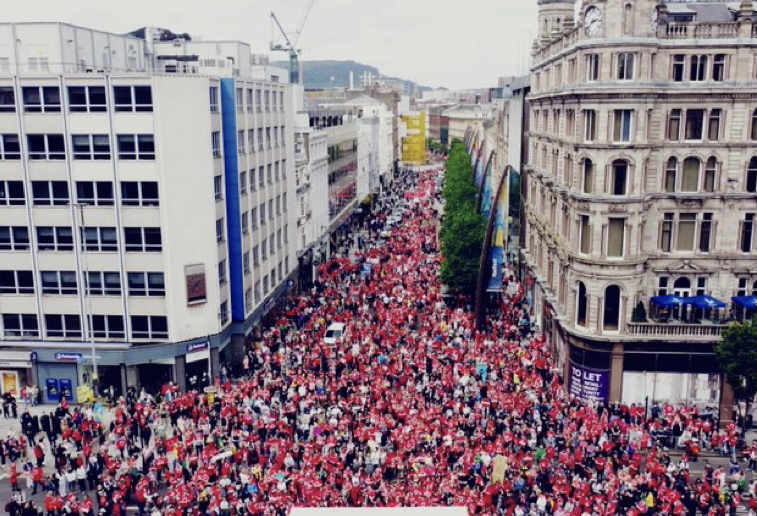
Saturday’s Lá Mor Dearg march, organised by An Dream Dearg, was undoubtedly one of the most colourful, exuberant, and spectacular protest marches that Belfast has witnessed in many years. From just before noon they began to arrive in their hundreds at An Cultúrlann McAdam Ó Fiaich on the Falls Road. Most were wearing the familiar red tee shirt with the white circle that is the symbol of Lá Dearg - the campaign for Irish language rights.
By 1 pm the hundreds had become thousands. A sea of red stretching across the Falls Road and packed into the small streets around it. Families pushing prams, parents carrying small children on shoulders, other children carrying their home made little posters -‘Acht Anois’; young people in their thousands. Laughing. Enthusiastic. Eager. Animated. Determined.
Banners from solidarity groups, trade unions, political parties. Colourful ethnic groups singing and dancing.
Unsurprisingly the march was late starting but as it slowly made its way down the Falls Road in bright sunshine the extent of the huge number of people participating quickly became apparent. One enterprising activist put up a drone. The video footage is startling. The Falls Road and Belfast City Centre are filled by a long river of red shirts. The chants of the marchers can be heard plainly.

Cearta Anois, Acht anois (Rights Now, Act Now).
Támid dearg: Dearg le fearg (We are red, Red with anger).
Saturday’s march and the growth in Irish medium education is an example of what can be achieved even when British governments and unionist political leaders refuse to honour commitments and legislate for rights. The Good Friday Agreement in 1998 said that; “All participants recognise the importance of respect, understanding and tolerance in relation to linguistic diversity” in respect of the“Irish language, Ulster-Scots and the languages of the various ethnic communities, all of which are part of the cultural wealth of the island of Ireland.”
Specifically, and in relation to the Irish language the British government committed to take “resolute action to promote the language”and to “facilitate and encourage the use of the language in speech and writing in public and private life where there is appropriate demand” and to “seek to remove, where possible, restrictions which would discourage or work against the maintenance or development of the language”.
These commitments were not honoured. Eight years later at the St. Andrew’s negotiations the British government committed to the introduction of Acht nba Gaeilge. In the 16 years since then one promise has followed on from another and all have fallen as one deadline for Acht na Gaeilge has passed without the legislation being introduced.
Despite the prevarication, the stalling, the discrimination and antipathy toward the Irish language and Gaelgeoirí the resilience and resolve of Irish language activists and those citizens who support language rights has frustrated the naysayers and begrudgers. The use of the Irish language and the numbers of young people attending Irish medium education has grown year on year.
If you were not able to get along to Saturday’s Lá Mor Dearg then click onto the link and watch six minutes of video that will do your heart good. https://www.youtube.com/watch?v=oAhzTS-avtc

.jpg)
Defending journalists
The shameful decision by Israel to cover-up the murder of Palestinian/American journalist Shireen Abu Aqleh by refusing to hold a criminal investigation into her killing will have come as no surprise to most people. In our own situation there are victims groups, representing hundreds of families struggling for truth decades after their loved ones were killed by British state forces. Last week the London government introduced its so-called ‘Troubles (Legacy and Reconciliation) Bill’ which makes future efforts at truth almost impossible for victims.
Its real objective is set out in the second paragraph of the Bill which states: “For too long, veterans and former service personnel have lived in fear of prosecution for actions taken whilst serving their country in order to uphold the rule of law”.
This is what rogue states do. They cover-up and protect the criminal actions of those charged with defending the policies, strategies and self-interests of governments involved in conflict. The apartheid Israeli regime has a long track record of this. So too have the British.
The families and victims are in the front line of challenging these decisions. So too are journalists many of whom are the target of vilification, censorship, threats and increasingly death.
According to Reporters without Borders Shireen Abu Akleh is one of 35 journalists to have been killed and 144 to have been wounded by the apartheid Israeli regime since 2000.
Israel isn’t the only dangerous place for journalists. In the North Martin O’Hagan and Lyra McKee were both killed as they carried out their work as journalists. Since the invasion of Ukraine media reports have put the number of journalists killed at around 20. Last year, the United Nations Educational, Scientific and Cultural Organisaiton (UNESCO) reported that 55 journalists were killed worldwide.
There is an imperative on governments and the international community to defend a free press and to protect journalists.


May 24, 2022
Lá Mór Dearg: Employers must talk to workers: Murder of Shireen Abu Akleh: Moore St raffle winner presented with 1914 Mauser rifle

Lá Mór Dearg
This column was written before the huge weekend march in Belfast in support of Lá Dearg - more on that next week.
However, a few words on the Irish language. Every day I learn a little bit more Irish. An extra word or two. For me there is a great joy in being able to speak and to read Irish. And to write a wee bit. I especially take great pleasure in speaking in Irish to the growing number of young people I meet every day. They use Gaeilge fluently and naturally. And they correct me when necessary.
Two weeks ago scores of children, parents and staff from Gaelscoil an Lonnáin on the Falls Road held a noisy and joyful protest outside their school in support of Lá Mór Dearg and an Acht na Gaeilge. We heard them from the office. Full of craic and fun. And Gaeilge.
On Saturday – 21 May – thousands more joined with An Dream Dearg for a march and rally in Belfast in support of Acht na Gaeilge and for the rights of Irish language speakers. More on that next week.
The growth in the Irish language and in Irish medium education has been phenomenal over recent years. Despite significant efforts by past British and Unionist governments to suppress the language and indifference by successive Irish governments, the revival of Irish in recent years has gone from strength to strength. Thousands of young Gaels are being educated every day through the medium of Irish.
In 2006 the British government committed to an Acht na Gaeilge. In the 16 years since then successive British governments have failed to deliver on this commitment. Nothing surprising about that. Mr Johnson won’t be here at the weekend but I appeal to everyone who supports the right of citizens to respect and equality to join with us. March in support of the rights of Irish speakers. See you on Saturday. And remember use whatever Irish you have whenever you can.
Employers must talk to workers
Several trade unions are involved in industrial action in the public and private sectors in an effort to get employers to increase wages and improve conditions for workers. With inflation heading toward 10% some current pay rates are clearly inadequate, especially given the cost of living crisis and huge increases in fuel, food and energy costs.
Some public service workers have been striking since late March resulting in disruption to waste collection services, schools, further education colleges, youth services, the Housing Executive and public transport.
Inevitably, trade union action can have a negative impact on those who rely on their services, and there has been a particular adverse affect on parents with children at special schools. There is an onus therefore on the employers to acknowledge the challenges facing workers and to do all within their power to ensure a sufficient outcome for their employees. They should talk to the workers.

Murder of Shireen Abu Akleh
On Wednesday 11 May Israeli forces in the occupied west Bank deliberately targeted and murdered a Palestinian journalist. Shireen Abu Akleh was a well respected Palestinian/American reporter working for Al Jazeera. The 51 year old veteran journalist was wearing a clearly visible press vest and helmet. She was in the Jenin refugee camp covering an attack by Israeli forces when she was shot in the face by a single shot from an Israeli sniper. A second Palestinian journalist, Ali al-Samoudi was also wounded.
A video covering the minutes around Shireen Abu Akleh’s murder was widely broadcast. The Israeli authorities then published a video which they claimed showed a Palestinian fighter firing at Israeli troops. Their claim is that it was he who killed Shireen. This claim was quickly rubbished by other media outlets.
In addition a researcher for B'Tselem - the Israeli Information Center for Human Rights in the Occupied Territories - filmed the locality and “documented the exact locations in which the Palestinian gunman depicted in a video distributed by the Israeli army, fired, as well as the exact location in which Journalist Shireen Abu Akleh was killed.” Their video is available at:
https://twitter.com/i/status/1524346246743396355
It proved that the Israeli claim is bogus.
Subsequently, in horrifying scenes reminiscent of RUC attacks on Republican funerals in the North during the period known as the Battle of the Funerals, Israeli forces raided Shireen Abu Akleh’s home during the wake and then launched a major attack on the funeral. Israeli troops viciously assaulted mourners, some of whom were carrying the coffin. There was widespread international condemnation of the assassination and the attack on the funeral.
Minister for Foreign Affairs, Simon Coveney said: “No self-respecting democracy could stand over this treatment of people.”
He’s right. And no self-respecting democracy can stand back and fail to take action against such behaviour. In the week that the Palestinian people commemorate Nakba – the time when more than 700,000 Palestinian Arabs fled or were expelled from their homes as Israel declared its independence - the Irish government should now move to positively use its position on the United Nations Security Council in support of Palestinian rights; recognise the State of Palestine
and stop blocking the passing into law of the Occupied Territories Bill.

Moore St raffle winner presented with 1914 Mauser rifle
The iconic Mauser rifle, generously donated by collector Pat O’Hagan, was recently presented to Conor Downes who won it in the raffle held by the Moore Street Preservation Trust. The historic Mauser rifle was part of the shipment smuggled into Howth in July 1914 which armed the Irish Volunteers for the 1916 Rising.
The raffle raised over twelve thousand euro to help fund the battle to save the 1916 Moore Street Battlefield site from destruction by a London based developer.
Micheál MacDonncha, Secretary of the Trust, and Proinsias Ó Rathaille, grandson of The O’Rahilly who helped to organise the gunrunning in 1914, and who was killed on Moore Street in 1916 leading a charge of Volunteers against a British Army barricade ,presented Conor Downes with his prize.
I want to thank all of those who bought tickets and supported the draw. The decision by the planners to accept the developers’ proposal, and the refusal of an oral hearing by An Bord Pleanála, mean that the battle to save Moore Street is set to significantly increase in the months ahead. The Moore Street Preservation Trust is determined to oppose the Hammerson plans for the area and if necessary take the case to court. This is an expensive process and this column appeals again for people to donate to the Trust’s appeal.
If you wish to contribute to the #SaveMooreStreet campaign, you can do so here:
https://pay-payzone.easypaymentsplus.com/fund.../campaign/26
Míle buíochas le gach duine a thacaigh leis an chrannchur. Ar aghaidh linn le chéile.
May 16, 2022
A transformative election: Attack on Human Rights Act is attack on GFA
It was never supposed to be like this. I watched with interest as one BBC presenter, reporting on the Assembly election results, told his largely British audience that the northern state was deliberately created to ensure that nationalists and republicans would be a permanent minority and that no nationalist/republican leader could ever take up the mantle of Prime Minister or First Minister.
No way. It was to be a unionist state ruled in perpetuity by a permanent unionist majority. Special laws; gerrymandered electoral boundaries; the Special Powers Act; the repression of the state police (the RUC) and the B Specials; and a deep rooted sectarian system of political and religious discrimination all combined to create an apartheid-like state.
The civil rights campaign, the decades of conflict and eventually the peace process and Good Friday Agreement in 1998 changed this by gradually transforming the political landscape.
Regrettably not everyone has embraced the new dispensation. There remain those within unionism who still see nationalists and republicans as second class, not worthy of respect, not worthy of equality, not worthy to hold the position of First Minister. They remain trapped in an ethos and culture that that has long passed its sell by date.
Notwithstanding this, last week’s Assembly election changed the fundamentals. There is now a Sinn Féin First Minister Designate. Sinn Féin is the largest party in the Assembly. It received a historic quarter of a million first preference votes. The increase in support for the Alliance Party and the drop in support for unionist parties is also evidence of a fundamental shift in our electoral politics.
The priority now is to get the Assembly and Executive up and running. Political leaders need to face up to the mounting challenge for citizens of increasing fuel, energy and food costs. People are confronted by a cost of living crisis unparalleled in recent decades and need urgent government support to chart a way forward. Almost all of the political parties are ready, willing and able to come together to meet this challenge. The DUP are not. That is their choice.
But their determination to hold everyone else to ransom over a protocol they negotiated and which was introduced by the British government, starkly underlines once again the deeply flawed nature of the northern state.
Republicans are prepared to work the institutions in the interest of all of our people. To do so does not diminish our commitment to or our ongoing efforts to persuade others of the merits of a united Ireland. On the contrary through greater all-island cooperation and harmonisation the imperative of unity will became even clearer. In addition, tackling the cost of living crisis in the longer term, and confronting poverty and inequality is only possible in the context of a united Ireland in which the people of our island have control over our own affairs.
No British government is going to tackle the cost of living crisis or pay for the policies needed to meet these challenges. This reality underlines the need for planning for change and for a rigorous debate on the merits of unity. I
100 years ago constitutional change was imposed by fear and intimidation, at the point of a gun and under threat of terrible war. That cannot be the way forward today. Any constitutional change must be democratic and peaceful. It must be rooted in the principles and ethos of equality, parity of esteem and equality. It has to be planned for. The Irish government cannot continue to bury its head in the sand and say no to the logic of dialogue. A citizens’ assembly in which all matters pertinent to constitutional change can be discussed imaginatively and in good faith is an obvious forum for this.
There will be a unity referendum. Republicans are not seeking it today or tomorrow. We want an inclusive empowering process leading to an informed decision. We don’t need a rerun of Brexit. That means planning and working with others to build the best possible future.
The reality is that the Assembly election marks a dramatic step change – another of those historic moments when hope and history has rhymed.
The overwhelming majority of citizens on this island want our future to be different from what went before. Those who voted last Thursday want those they have elected to represent their interests, to make power sharing work and to shape a new future.
Attacks on Human Rights laws must be opposed
The British government confirmed this week that it plans to replace the Human Rights Act with a British Bill of Rights. In a letter to Boris Johnson over 50 human rights groups warned of the “dire consequences” this move will have particularly in respect of the Good Friday Agreement.
A key component of the Agreement was its recognition of the importance of protecting and safeguarding human rights. The Agreement affirmed a series of core rights;
• the right of free political thought;
• the right to freedom and expression of religion;
• the right to pursue democratically national and political aspirations;
• the right to seek constitutional change by peaceful and legitimate means;
• the right to freely choose one’s place of residence;
• the right to equal opportunity in all social and economic activity, regardless of class, creed, disability, gender or ethnicity;
• the right to freedom from sectarian harassment; and
• the right of women to full and equal political participation.
Underpinning these rights the British government introduced the Human Rights Act in 1998 and completed the incorporation of the European Convention on Human Rights (ECHR) into law. In addition, there was to be a separate Bill of Rights for the North.
Almost immediately the Conservatives and Unionists opposed the introduction of a Bill of Rights. They successfully fought its introduction at every opportunity. To further their attack on the concept of citizens’ rights the Tories announced in the 2015 election manifesto that they would “scrap” the Human Rights Act 1998 (“HRA”). In its place they would “introduce a British Bill of Rights which will restore common sense to the application of human rights in the UK.”
The Bill of Rights the Tories now propose falls far short of what is needed to protect rights.
Recently, Barbara Bolton who is head of legal and policy at the Scottish Human Rights Commission said: “The reality is the rights enshrined in the Human Rights Act (HRA) touch all areas of our lives. Our family life, freedoms, privacy and right to be protected by the state from violence and harm.”
Additionally and in the North the Human Rights Act is also the foundation of rights protections in the exercise of policing.
The decision to scrap the Human Rights Act is a direct attack on the Good Friday Agreement. One result of such a move would be the British government breaching its international obligations. However, as we know only too well from the Brexit experience Tory governments and especially Boris Johnson, don’t accept that they are bound by international law. Breaking agreements is second nature.
The British government is intent on diluting human rights and abandoning any notion of accountability. This would make it more difficult for citizens to challenge bad decisions by government through the courts. Its underlying ethos is about promoting inequality in society and denying justice.
Amnesty International has said that the Human Rights Act “carefully and precisely” protects individuals’ rights. It dismisses Tory claims that there is public support for reform. Amnesty also warned that the repeal of the HRA could undercut “public confidence in the new political and policing arrangements” that emerged from the Good Friday Agreement (GFA).
A former Chief Commissioner of the Irish Human Rights and Equality Commission, Emily Logan warned some years ago that a repeal of the Human Rights Act “would have negative consequences for the uniformity of human rights standards across these islands.”
No effort should be spared in opposing any effort to subvert the human rights components of that Agreement.
Bad Manners
Simon Coveney, Irish Foreign Affairs Minister was gracious in his response to the election results and Michelle O Neill’s success in becoming First Minister Designate. An Tánaiste Leo Varadkar was most ungracious. An Taoiseach Micheál Martin was even worse. I wonder why? Sore losers. Or just bad manners.
May 5, 2022
Candidatitis
Candidatitis
I first published this article in 2005 and then, slightly amended in 2016. It is dedicated to all candidates from all parties and none and their families as well as all the valiant souls who work hard on their behalf. By the time you get to read or hear these insightful comments the outcome of the Assembly election should be clear. So I thought this would be a good time to republish it again, slightly amended once more, with a special thought for the majority of candidates who won’t get elected. In West Belfast there are seventeen candidates battling for five seats. Seventeen into five won’t go. Think of them as you digest all the outcomes.
Good luck to them all. Good luck especially to all Sinn Féin’s candidates. It is a great honour to represent Sinn Féin in any capacity and a huge privilege to seek a mandate from your peers for our historic republican mission. I hope we have a great result.
That’s all in the gift of the electorate. So I thank all the voters as well as all the candidates.
Opinion polls have become an integral part of every election campaign. Many newspaper and broadcast outlets try to second guess the electorate by commissioning polls. And then their columnists or pundits spend a huge amount of time analysing the poll they just commissioned.
So do many candidates. And their supporters. This can be very stressful. So every candidate and everyone else should be mindful of the particular and peculiar stresses and strains that come with being a candidate. It’s a form of ailment called Candidatitis. It begins with the candidate coming to believe – with a certainty known only to the prophets of old – that they are going to win.
This syndrome is capable of moving even the most rational aspirant or shy wallflower into a state of extreme self belief. It strikes without warning, is no respecter of gender, and can infect the lowly municipal hopeful, the aspiring Parliamentarian, as well as the lofty presidential wannabe.
The late Screaming Lord Sutch, or his Irish equivalent, who stand just for the craic, can fall victim of Candidatitis as much as the most committed and earnest political activist. I believe this is due to two factors. First of all most people standing for election see little point in telling the voters that they are not going to win. That just wouldn’t make sense. Of course not. So they say they are going to win.
That's when Candidatitis starts. As the 'we are going to win' is repeated time and time again it starts to have a hypnotic effect on the person intoning the mantra. By this time it’s too late.
Which brings me to the second factor. Most people encourage Candidatitis. Unintentionally. Not even the candidate’s best friend will say hold on, you haven't a chance. Except for the media. But no candidate believes the media. And most candidates are never interviewed by the media anyway.
So a victim of Candidatitis will take succour from any friendly word from any punter. Even a 'good luck' takes on new meaning and 'I won't forget ye' is akin to a full blooded endorsement.
So are we to pity sufferers of this ailment? Probably not. But we should be kind to them.
They are mostly consenting adults, although some parties occasionally run conscripts. In the main these are staunch party people who are persuaded to run by more sinister elements who play on their loyalty and commitment. In some cases these reluctant candidates run on the understanding that they are not going to get elected. Their intervention, they are told, is to stop the vote going elsewhere or to maintain the party's representative share of the vote. In some cases this works. But in other cases, despite everything, our reluctant hero, or heroine, actually gets elected. A friend of mine was condemned to years on Belfast City council years ago when his election campaign went horribly wrong. He topped the poll.
That’s another problem in elections based on proportional representation. Topping the poll is a must for some candidates. But in PR elections such ambition creates a headache for party managers. If the aim is to get a panel of party representatives elected they all have to come in fairly evenly. This requires meticulous negotiations to carve up constituencies. Implementing such arrangements make the implementation of the Good Friday Agreement look easy.
It means only placing posters and distributing leaflets in specific areas with clear instructions to the electorate on how we would like them to vote. In some elections I have noticed that some candidates (not Sinn Féin candidates folks) putting up posters in their colleagues territory. Not a good sign.
It requires an inordinate amount of discipline on the candidates' behalf not to fall into this trap. Many do. Some don’t. Some get really sneaky. Particularly as the day of reckoning comes closer. Panic attacks and an allergy to losing can lead to some sufferers poaching a colleague's votes. This is a very painful condition leading to serious outbreaks of nastiness and reprisals and recriminations if detected before polling day. It usually cannot be treated and can have long term effects.
So dear readers all of this is by way of lifting the veil on these usually unreported problems which infect our election contests. Politicians are a much maligned species. In some cases not without cause.
So the next time you look at a poster or get a leaflet through the letterbox or are confronted at your door by a wild eyed candidate – occasionally accompanied by a posse of cameras – then take a more tolerant and benign view of the sometimes strange behaviour of those citizens who contest elections .
Love them or hate them you usually get the politicians you deserve. Granted this might not always extend to governments, especially in the South, given the coalitions which come together there in blatant contradiction of all election promises or commitments. The lust for power causes this.
So too with the refusal to accept the outcome of this Assembly election unless it returns a unionist First Minister. This condition is probably the most serious ailment affecting our political system at this time. It could be terminal and will be a challenge for those returned as MLAs.
Before they get to that point, if they ever do, this exclusive insight shows that candidates suffer many torments. Space restrictions prevent me from documenting them all.
So, don’t ignore the visages on the multitudes of posters which defile lamp posts and telegraph poles during election times and in some cases for years afterwards. Think of the torment that poor soul is suffering.
When you are accosted by a pamphlet waving candidate, as you shop in the supermarket or collect the children at school or are minding your own business as you walk down the main street, try to see beyond the brash exterior. If they get carried away with themselves it’s not really their fault you see. Big boys and girls make them do it.
Most candidates are decent well meaning civic minded citizens. It’s a pity some have awful politics. So your votes should not encourage them. They will have difficulties enough dealing with defeat as well as the outworking of Candidatitis. But they will recover eventually.
If they get elected they or we may never recover. Please spare us from that.
The Sun Is Setting.
The legacy of empire, of colonialism and of slavery is for many still a matter of the present and not the past. This is especially true for many of the former British colonies in the Caribbean. Last November Barbados formally removed Queen Elizabeth II as its Head of State. Since then the British government sent two groups of British royals as part of a charm offensive to the region in an effort to solidify waning British influence. The tours had the opposite effect.
In March the Cambridge’s visited Belize, Jamaica, and the Bahamas. Their first official engagement in Belize was cancelled after the Q’eqehi Maya people organised protests about a land dispute involving a charity which William is a patron of.
In Jamaica the issue of slavery and the profits which the British monarchy accrued from that despicable practice generated more negative publicity and protests. The Royals offered no apology and made no reference to the role of the British Monarchy in transporting slaves from Africa to the region.
The local media recalled that when enslaved Africans arrived in the Caribbean the slave ships were owned by the Royal African Company and the slaves were branded with the initials ‘DV’ – Duke of York – their owner.
More recently the Wessexes spent six days visiting Antigua and Barbuda, St. Lucia, and St. Vincent and the Grenadines.
The refusal of successive British governments to properly address the issue of reparations arising from slavery and to acknowledge and apologise for it has added fuel to the increasing demand for independence in Belize, the Bahamas, Jamaica, Grenada, Antigua and Barbuda, and St. Kitts and Nevis.
The chair of Jamaica’s National Commission on Reparations and chair of the U.N. Committee on the Elimination of Racial Discrimination, Verene Shepherd said, “The move towards republicanism is grounded in the belief that it’s time for formerly colonized nations to really live their independence and claim self-determination and not be under a monarchical system.”
Instead of cementing Britain’s influence over the region the royal visits have helped galvanise a renewed interest in and demand for an end to colonialism, for reparations and for self-determination for the Caribbean nations. The Empire on which the sun never sat is reaching its end stage. Part of that is playing out in the Caribbean. Part of it is also playing out in Scotland and Wales. And here.
May 4, 2022
May 5th - The Peoples Day
May 5th - The Peoples Day
One day to polling day and the pundits and pollsters have been filling the airways and column inches with their take on who will be the big winners and who will be the losers. Who will emerge with more or fewer Assembly seats? Will the Protocol galvanise a so far lack lustre unionist campaign? Will the DUP/TUV and their loyalist allies succeed in frightening unionist voters into toeing the line? Or will Sinn Féin up-end a century of partition and the northern state by taking enough seats for Michelle O’Neill to become First Minister?
Most of the parties have now published their election manifestos. Where they stand on the constitutional issue; the cost of living crisis; Brexit and a host of other matters that are of varying importance to the electorate are pretty well understood by the public.
I folded my first election leaflets in 1964. A long time ago. The actions of the RUC, at the behest of Ian Paisley, in smashing the window of the republican election office in Divis Street to steal the tricolour, encouraged me to buy a copy of the Special Powers Act and to begin a process of personal learning and politicisation which continues to this day. There have been many other elections, North and South since then. All of them in their own way significant. Even those in which Sinn Féin did not fare as well as we hoped. All part of the learning process.
Tomorrow's election - 5 May - is a date seared into the memory of republicans as the date in 1981 on which Bobby Sands MP and hunger striker died.
The Fermanagh South Tyrone by-election was an education for republicans. I was rarely at home during that time, spending almost the entire campaign in the constituency. I met scores of great people. We learned about form filling, polling agents, presiding officers, personation officers, how to campaign. How to canvass. It was exhilarating.
The British government and opposition, followed enthusiastically by elements of the media, had consistently asserted that republicans – and especially the hunger strikers – represented nobody and enjoyed no support. The election result confounded them all.
41 years later and the political landscape has changed. New opportunities are emerging. Opportunities for reconciliation and peace; for economic and political equality; for a new shared Ireland shaped by the people of this island. For an end to division. We will be forever grateful to the 30,493 citizens in Fermanagh and South Tyrone who voted for Bobby. On Thursday you can join them. Thursday is the voters’ day. Your day. Vote for real change.
Taking a stand against hate crime
At the start of the year people across Ireland were shocked by the brutal murder of Ashling Murphy. The 23 year old primary school teacher was attacked while out jogging along the Grand Canal at Tullamore in County Offaly. The outrage and condemnation of her murder reflected the enormous frustration and anger that exists at the regular reports of violence against women, much of it related to domestic violence. Women’s Aid in the South has recorded 244 murders of women since 1996, when they first started keeping a record.
Two weeks ago 64-year-old Alyson Nelson, a retired nurse was murdered in Whitehead, County Antrim. Her death brought to 14 the number of women violently killed in the North in the last two years. Statistics from the PSNI reveal that between 2017 and 2021 a total of 26 women were murdered by either a partner, family member of relative.
This month also witnessed the cruel murder of Aidan Moffitt aged 42 in Sligo on April 10th. Two days later, also in Sligo, Michael Snee aged 58 was viciously killed. Both men were gay. It is widely believed that their murders were hate crimes. Both men were well known and widely respected.
In Dublin Evan Somers was attacked in Dublin City Centre. In a tweet on social media he described being assaulted by a stranger who “called me a faggot before beating the shit out of me. He left me with a fractured eye socket, 2 fractures in my ankle, a dislocation in my ankle & some other minor injuries.”
The Sligo deaths and the Dublin assault are evidence of a growing trend in hate crime directed at the LGBTQI community. The Rainbow Project in Belfast reported that between 2017 and 2019 there was a serious rise in homophobic attacks in the North. The number reported rose from 163 to 281.
Violence and the threat of violence against women and members of the LGBTQI community, or against those of a different colour or ethnicity whether in the home, in the workplace, while socialising and relaxing, and on social media, are too common. Condemnation is not enough. We all have a responsibility to ensure that there is zero tolerance of racism and of violence against women and against the LGBTQI community. That means tough legislation tackling hate crime in all its manifestations. But it also demands that as a society we stand for equality. Instead of shame, persecution or discrimination on the basis of sexuality or gender identity, everyone must have the freedom to love and to express his or her or their true identity. We have a responsibility to stand against hate crime.
In Praise Of Napping.
Our dogs seem to sleep a lot. They just lie down, close their eyes and doze off whenever the notion takes them. Especially in this good weather. They pick a sunny spot and drift off into doggie dreamland. I suppose that’s one of the advantages of being a dog. As long as you don’t annoy the humans too much you can generally laze about. Cats are the same. They also lie in favoured spots and doze off whenever they feel like it. From them we get the term catnap. We humans could learn a lot from dogs. And cats.
The older I get the more I appreciate the benefits of a wee sleep in the course of an afternoon. Or an early evening. It makes sense. But sometimes its hard to get the time to do nothing. I love my sleep. I also like to get up relatively early in the morning. So by the time late afternoon sneaks up on me I need to recharge my batteries. Easier said than done. Especially if Im in the office. When I was a TD I had a reclining chair in my room in Leinster House for sneaky power naps. Before that up in Stormont I got a settee. During the Good Friday Agreement negotiations I commissioned a folding bed which Siobhan O Hanlon procured. It was put to good use.
But there is nothing to lie down on in the office I work from nowadays. Not even space for a hammock. It’s the desk or the floor. Of course if I’m working from home it is much easier. Or at least there is comfortable furniture on which to repose. If you are allowed. But you usually actually have to get permission or negotiate the time for napping with other members of the household, especially the main female member who will always find something that she needs you to do just as you are ready to lie down. So having the house to yourself is almost a precondition for napping there. A dog doesn’t have that problem. Or a cat.
By the way we don’t have a cat. I have nothing against cats. They do lack the humility of dogs. But they can’t help that. Cats have a certain arrogance. Maybe because they are more independent from humans than dogs. Although we don’t have cats there are cats in our street who think they own our yard wall. They slink along our wall before they stretch themselves with a certain disdain towards the rest of us, into luxurious slumber. There they snooze beyond the reach of our dogs. I can only look up enviously at them.
The dogs have learned to ignore them. Except occasionally during the night when more amorous felines outrage them with their banshee wailing and other courting rituals. That provokes howls of indignant protest from our canine chums. I’m sure the neighbours are disturbed by all the clamour. I know I am. All other annoyances to one side, a night of broken sleep makes a nap a necessity the following day.
So that’s what I’m going to do now. A siesta is a very civilised little break from the travails of the day. We could learn a lot from our friends in warmer climes who build a siesta into their daily routine. Or we could just follow the example of our canine and feline pals. Either way the point is to take time to nap. You won’t regret it. Zzzzzzzzzzzzz.
April 25, 2022
Don't underestimate the power of a singsong; Rióísn Reimagined.
THE MUSIC MEN.

My recent tales of singsongs in the H Blocks have triggered more reminiscences of other such events. Two in particular stand out. Both were after Long Kesh was burned down. That was in October 1974. Following that eventful evening prisoners lived a very primitive shanty-town like existence among the ruins of the Kesh until the new huts were built. After the fighting stopped, the wounded were tended to, and the British Army pulled back we quickly readjusted to living in the ruins of the camp.
Some remnants of burnt huts remained after the fire and that gave shelter of sorts. I was in the internee end. In Cage 2. Some intrepid souls re-plumbed the piping from the demolished wash huts and there was an open air bathing area for those fussy folks who were obsessed by cleanliness like Mr Sheen, one of our older dapper comrades. Someone lit a fire below a tank filled with water and our intrepid plumber - was it Gerry Fitz - the Commander? - fixed up a shower and soon there were warm showers.
Al fresco. That’s how we ate also.
We slept where we could. Ted and I had a little bivouac comprising of a few sheets of corrugated tin. We crawled under it, settled ourselves on the tarmac and wrapped ourselves tightly- and separately- in our prison blankets. That was us. Luckily, as best I can remember, it stayed dry though it was bitterly cold at night.
Some of the lads lit fires and we huddled around them, telling yarns and spoofing. After a few nights someone produced a guitar from God knows where. That was a great night. Billy Reid and big Dominic - both fine singers - entertained us for hours. That became a regular feature of the weeks in Cage 2 after the burning of the Kesh.
We would all gather around a big fire in the middle of the cage. Billy and big Dominic had acres of songs. American ballads, Irish rebel songs, lesser known Dean Martin, Sinatra, Everly Brothers. The Beatles, Tony Bennett. Johnny Cash. Planxty. Frankie Lane, Patsy Cline. Old cowboy songs.
After a couple of sessions all of us could join in the choruses. That’s how we passed an evening. Gathered around our fire below a big starlit sky surrounded by barbed wired and search lights. Observed by armed guards and war dogs. Beyond the camp perimeter traffic zoomed along the MI probably oblivious to our existence and the songs we were singing.
We sang and we sang well. Even the screws were impressed and the Brits up in their watch towers on the perimeter fence would open the shutter in their spy post to listen to us. Billy, God rest him, and big Dominic knew how to sing.
Meanwhile in Cage 5, the cage closest to the motorway, a tunnel was inching its way underground towards freedom. Hugh Coney was shot dead by the British Army when they eventually surfaced some time later on 6 November. Hugh was twenty four years old. Thirty internees escaped but most were recaptured almost immediately. They were all badly beaten and some had the war dogs set upon them. There was no sing song that night.
 One another night before this, a concert was organised in what remained of one of the big huts in Cage 2. That also was a great night. Ted didn’t want to go. He went to ground early into our bivouac not long after dark. I thought he was doing heavy hack but he wasn’t, thanks be to God. A grumpy Ted is not to be disregarded so I was pleased when he quickly agreed to go to the concert.
That was another mighty gig. I laughed so much I almost wet myself a few times. Especially during ‘I Am The Music Man’ led by Paddy Barkley. Paddy - all five foot of him was in his element conducting us as if we were a male Welsh choir.
“I am the music man” he warbled at us.
“I come from down your way. And I can play”.
“What can you play” we roared back at him.
“ I can play ……… he paused theatrically. Then ……. “ The P….P… P… P…Piano. The Piano. The Piano….I can play the Pianooooooo.”
And so it went on. Verse after verse. Musical instrument after musical instrument.
Paddy, God rest him, could sing none. But could he make us laugh? Like there was no tomorrow. And in those days there was no tomorrow. That’s why they couldn’t beat us. Kitson, the infamous British counter insurgency ‘expert’ didn’t take account of the power of solidarity and craic and comradeship and a good singsong.
Ted was in great form when the concert was over and we were settled down again on the tarmac below our corrugated tin covering.
‘You know I was all for staying in tonight. I wasn’t gonna bother going out. But I’m glad we made the effort. That was a great night out. Oiche mhaith a mhic.’
‘Oiche mhaith Ted’

Rióísn Reimagined.
This column gives a huge cead míle fáilte to a new musical offering Re-imagining Roísín from Muireann Nic Amhlaoibh and the Irish Chamber Orchestra, produced by Dónal O Connor. I am a big fan of Muireann Nic Amhlaoibh. She is a regular contributor to TG4 and a gifted musician as well as a fine singer. Dónal O Connor is a Ceoltoir gan scoth. The Irish Chamber Orchestra is no stranger to us. As guests of Féile an Phobail in the past, I remember a mighty session many moons ago in Saint Agnes Parish Centre.
Seán O Riada is rightly credited with putting Irish sean nós music on the national and international stage in the mid 1960s. His Mise Éire and the score for the film of the same name, marking the 1916 Rising is a tremendous and wonderful classic of our time. And of all time. The old songs which are at the heart of the music of O Riada and Ceoltóirí Chualann have been sung and played for hundreds of years. In the mid sixties O Riada’s wonderful orchestration and reworking of our traditional music took it to a new level and to new audiences. It also kick-started the emergence of bands like Planxty, the Bothy Band, Clannad, De Dannan, Skara Brea,
The Chieftains and many many more with their modern interpretation of our ancient music.
This new CD re-imagines this ancient music once again. Roísín Dubh goes back possibly to the 16thcentury. Perhaps it started as a love song or poem. But it became a metaphor for Ireland, like many sean nós tunes of this kind.
As Dr Síle Denvir writes on the sleeve notes of ‘Reimagining Roísín’: “Muireann Nic Amhlaoibh and the Irish Chamber Orchestra have breathed new life into the noble, classical songs of our ancestors with this new project. Róisín Reimagined. Examples such as ‘Róisín Dubh’, ‘An Chúilfhionn’ and ‘Táin Sínte ar do Thuama’ are often referred to as ‘amhráin mhóra’ or ‘big songs’ within the tradition of Irish singing, and epic arrangements by the likes of Michael Keeney, Linda Buckley and Cormac McCarthy befit the concept of ‘an t-amhrán mór’. The arrangements are innovative and animated and the music adds greatly to the innate beauty of the songs.”
So there you are. Well done to all involved in this creative and extraordinary musical adventure, especially Muireann Nic Amhlaoibh whose interpretation and wonderful voice will bring new audiences to our sean nós tradition.
Listen and be uplifted.
Album:
Róisín Reimagined
Artist:
Muireann Nic Amhlaoibh & Irish Chamber Orchestra
Label:
Independent Release

Raffle for Howth Mauser Rifle won
I want to thank all of those who entered the raffle organised by the Moore Street Preservation Trust to raise funds for their campaign to Save Moore St. Thanks also to all of those who sold the tickets and to Pat O Hagan who very kindly donated the 1914 Mauser Rifle.
The 1916 Moore Street Battlefield site is under threat from a London based developer whose plans will destroy much of this historic part of Dublin inextricable linked to the 1916 Rising. The money raised will be used to support the save Moore St campaign.
Thanks also to Teamfeepay for providing the online facility for the raffle.
So, well done to the lucky winner. The Moore Street Preservation Trust will announce the winner’s name when he has been contacted.
April 22, 2022
Celebrating the Easter Rising: The Process of change is unstoppable

Celebrating the Easter Rising
Last Sunday Irish republicans across Ireland and globally commemorated and celebrated the men and women who rose up against the British Empire and in favour of an Irish Republic, at Easter time 1916. A century later their extraordinary courage is often passed over by some, particularly in the political establishment in Dublin, who occasionally pay lip service to their sacrifice. A few even dismiss it as foolish and a mistake.
But to understand the risks they were taking and the immensity of the challenge they faced it is important to remember that at that time the British Empire was the largest in world history. It was the global super power of the nineteenth and early twentieth century. Twenty three per cent of the world’s population was held in bondage and it occupied or controlled almost one quarter of the total land mass of the world. It was hugely wealthy through its ruthless exploitation of other people, their land and resources. It had a monarchy, a government, a political and economic establishment that believed it was their destiny to rule. Maps of the world were covered in the red of Empire. By 1918 it had four million men under arms to enforce its will.
Against this imperial colossus stood women and men from the four corners of Ireland – nationalists, republicans, socialists, trade unionists, gaelgeoirí, feminists –the women of the Cumann na mBan, the Irish Republican Brotherhood, the Irish Citizen Army and Irish Volunteers and others. Out of that emerged the Irish Republican Army. Poorly armed with out of date rifles and insufficient munitions they dared to dream and hope and to fight for a better Ireland – free from the divisions imposed by Westminster.0
The Proclamation they wrote for that Easter 1916 is not just a piece of polemic to hang on a wall. It is a manifesto of intent for real and lasting change. For a rights’ based society. For a new Ireland.
In a few hundred words and in language that still inspires today it addressed Irishmen and Irishwomen. No distinction. Equals in the struggle for freedom. It asserts the right of the Irish people to national sovereignty and independence. It guarantees “religious and civil liberty, equal rights and equal opportunities” to all. Its objective is the happiness and prosperity of every citizen and the creation of a new society that will cherish all citizens equally. These core values are as relevant today in the upcoming Assembly election as they were a century ago.
So, last Sunday we remembered all of those heroes who marched out that Easter. We remembered too those who fought in previous and later phases of the struggle for freedom. Including in our own time. Their focus was on the future. Making a better life for all our people and especially our children. To give them the best possible chance to fulfil their potential and to live happy, full and contented lives.
We believe that this can best be achieved through the establishment of an independent and sovereign Ireland – a united Ireland – a new and shared Ireland. A modern, progressive and fair Ireland fit for all who live here.
This Easter thankfully there is now a peaceful way to achieve this. Let’s redouble our efforts to make this happen. Freedom in our time.
The Process of change is unstoppable
24 years ago on Good Friday 10 April 1998 a 5pm plenary session of the talks in Castle Building brought to an end months of intense, daily negotiations. The parties present affirmed their support for the agreement that became for many forever linked to the day that was in it – the Good Friday Agreement.
It was a remarkable, historic moment after decades of conflict. The DUP had absented themselves when Sinn Féin joined the negotiations the previous September and just hours earlier Jeffrey Donaldson and Arlene Foster had stormed out of the Ulster Unionist Party rooms when the final shape of the Agreement became clear.
What is often forgotten is that the Agreement was achieved without the Ulster Unionist party ever engaging with Sinn Féin. The Loyalist parties had no such inhibitions but David Trimble had only ever said two words to me directly. We met in the toilet one day. There was no one else there.
‘We can’t keep meeting like this,’ I said to him in an effort to break the ice.
‘Grow up,’ he said.
Of course we met many, many times after that. I like to think we got some useful work done and that we got some sense of each other, not just as opponents but as people.
The Good Friday Agreement was a site of struggle for republicans. The Sinn Féin leadership understood this. We also knew, as George Mitchell later remarked to myself and Martin McGuinness that getting the agreement was the easy bit, implementing the Agreement was another days work. We knew that too.
In the years since there have been many more high wire negotiations. Significant elements of the Agreement have still not been implemented by the British and Irish governments, including a Bill of Rights for the north; an all-island Charter of Rights and the introduction of Acht na Gaeilge. The British government has also failed to honour its Weston Park commitment to hold an independent inquiry into the killing of human rights lawyer Pat Finucane. At the same time the Johnson government is intent on introducing legacy legislation to protect British state agencies from further exposure of wrong doing while denying victims access to truth.
Brexit too has caused huge problems. The UVF is now openly opposed to the Agreement, as is the TUV. The DUP is threatening to withdraw entirely from the power sharing process unless the Irish government, the European Union, the US administration and all of those parties North and South that support the Protocol acquiesce to their blackmail.
Despite all of these difficulties a new political landscape has been created. The Agreement has created new opportunities. Not least of these is the fact that for the first time there is a peaceful, democratic route to bring about constitutional change.
It is now “for the people of the island of Ireland alone, by agreement between the two parts respectively and without external impediment, to exercise their right of self-determination on the basis of consent, freely and concurrently given, North and South, to bring about a united Ireland, if that is their wish, accepting that this right must be achieved and exercised with and subject to the agreement and consent of a majority of the people of Northern Ireland’
It is now for those who believe in the union with Britain to present the merits of their case. For those of us who believe in Irish unity to present the arguments in support of that. And for the people North and South in referendums to vote in favour of either choice. As the debate on this issue expands and as more and more people are being drawn into it the onus on the Irish government to establish a Citizens’ Assembly also grows.
Next year the Good Friday Agreement will be a quarter of a century old. It might seem a long time but in the continuum of history it is a blink of an eye. The Agreement is part of a process. It has already brought about much positive change. If we who are change makers keep at it I believe that that process of change is unstoppable.
April 13, 2022
Celebrating the Easter Rising: The process of change is unstoppable
On Sunday Irish republicans across Ireland and globally will commemorate and celebrate the men and women who rose up against the British Empire and in favour of an Irish Republic, at Easter time 1916.
A century later their extraordinary courage is often passed over by some, particularly in the political establishment in Dublin, who occasionally pay lip service to their sacrifice. A few even dismiss it as foolish and a mistake.
But to understand the risks they were taking and the immensity of the challenge they faced it is important to remember that at that time the British Empire was the largest in world history. It was the global super power of the nineteenth and early twentieth century. Twenty three per cent of the world’s population was held in bondage and it occupied or controlled almost one quarter of the total land mass of the world. It was hugely wealthy through its ruthless exploitation of other people, their land and resources. It had a monarchy, a government, a political and economic establishment that believed it was their destiny to rule. Maps of the world were covered in the red of Empire. By 1918 it had four million men under arms to enforce its will.
Against this imperial colossus stood women and men from the four corners of Ireland – nationalists, republicans, socialists, trade unionists, gaelgeoirí, feminists –the women of the Cumann na mBan, the Irish Republican Brotherhood, the Irish Citizen Army and Irish Volunteers and others. Out of that emerged the Irish Republican Army. Poorly armed with out of date rifles and insufficient munitions they dared to dream and hope and to fight for a better Ireland – free from the divisions imposed by Westminster.
The Proclamation they wrote for that Easter 1916 is not just a piece of polemic to hang on a wall. It is a manifesto of intent for real and lasting change. For a rights’ based society. For a new Ireland. In a few hundred words and in language that still inspires today it addressed Irishmen and Irishwomen. No distinction. Equals in the struggle for freedom. It asserts the right of the Irish people to national sovereignty and independence. It guarantees “religious and civil liberty, equal rights and equal opportunities” to all.
Its objective is the happiness and prosperity of every citizen and the creation of a new society that will cherish all citizens equally. These core values are as relevant today in the upcoming Assembly election as they were a century ago.
So, this Sunday we will remember all of those heroes who marched out that Easter. We will remember too those who fought in previous and later phases of the struggle for freedom. Including in our own time.
Their focus was on the future. Making a better life for all our people and especially our children. To give them the best possible chance to fulfil their potential and to live happy, full and contented lives. We believe that this can best be achieved through the establishment of an independent and sovereign Ireland – a united Ireland – a new and shared Ireland. A modern, progressive and fair Ireland fit for all who live here.
This Easter thankfully there is now a peaceful way to achieve this. Let’s redouble our efforts to make this happen. Freedom in our time.
The Process of change is unstoppable
24 years ago on Good Friday 10 April 1998 a 5pm plenary session of the talks in Castle Building brought to an end months of intense, daily negotiations. The parties present affirmed their support for the agreement that became for many forever linked to the day that was in it – the Good Friday Agreement.
It was a remarkable, historic moment after decades of conflict. The DUP had absented themselves when Sinn Féin joined the negotiations the previous September and just hours earlier Jeffrey Donaldson and Arlene Foster had stormed out of the Ulster Unionist Party rooms when the final shape of the Agreement became clear.
What is often forgotten is that the Agreement was achieved without the Ulster Unionist party ever engaging with Sinn Féin. The Loyalist parties had no such inhibitions but David Trimble had only ever said two words to me directly. We met in the toilet one day. There was no one else there.
‘We can’t keep meeting like this,’ I said to him in an effort to break the ice.
‘Grow up,’ he said.
Of course we met many, many times after that. I like to think we got some useful work done and that we got some sense of each other, not just as opponents but as people.
The Good Friday Agreement was a site of struggle for republicans. The Sinn Féin leadership understood this. We also knew, as George Mitchell later remarked to myself and Martin McGuinness that getting the agreement was the easy bit, implementing the Agreement was another days work. We knew that too.
In the years since there have been many more high wire negotiations. Significant elements of the Agreement have still not been implemented by the British and Irish governments, including a Bill of Rights for the north; an all-island Charter of Rights and the introduction of Acht na Gaeilge. The British government has also failed to honour its Weston Park commitment to hold an independent inquiry into the killing of human rights lawyer Pat Finucane.
At the same time the Johnson government is intent on introducing legacy legislation to protect British state agencies from further exposure of wrong doing while denying victims access to truth. Brexit too has caused huge problems.
The UVF is now openly opposed to the Agreement, as is the TUV. The DUP is threatening to withdraw entirely from the power sharing process unless the Irish government, the European Union, the US administration and all of those parties North and South that support the Protocol acquiesce to their blackmail.
Despite all of these difficulties a new political landscape has been created. The Agreement has created new opportunities. Not least of these is the fact that for the first time there is a peaceful, democratic route to bring about constitutional change.
It is now “for the people of the island of Ireland alone, by agreement between the two parts respectively and without external impediment, to exercise their right of self-determination on the basis of consent, freely and concurrently given, North and South, to bring about a united Ireland, if that is their wish, accepting that this right must be achieved and exercised with and subject to the agreement and consent of a majority of the people of Northern Ireland."
It is now for those who believe in the union with Britain to present the merits of their case. For those of us who believe in Irish unity to present the arguments in support of that. And for the people North and South in referendums to vote in favour of either choice. As the debate on this issue expands and as more and more people are being drawn into it the onus on the Irish government to establish a Citizens’ Assembly also grows.
Next year the Good Friday Agreement will be a quarter of a century old. It might seem a long time but in the continuum of history it is a blink of an eye. The Agreement is part of a process. It has already brought about much positive change. If we who are change makers keep at it I believe that that process of change is unstoppable.
April 4, 2022
UDR Declassified by Micheál Smith: Radio Ga Ga
 UDR Declassified by Micheál Smith On 1 April 1970 the Ulster Defence Regiment of the British Army formally took its place in the ranks of the British Army. The UDR was a locally recruited militia established by the British government following its disbandment of the B Specials the previous year. When it too was disbanded 22 years later it had achieved an even greater level of sectarian notoriety than the Specials. Micheál Smith who is an advocacy case worker with the Pat Finucane Centre and who previously worked as a diplomat in the Department of Foreign Affairs in Dublin, has just published ‘UDR Declassified’ – an account of the British Army Regiment which looks at the “background to the regiment and the traditions from which it was born” … “the experience of those who served in the UDR and acknowledge their losses; we also aim to show the range of illegal, collusive and murderous acts of some if his numbers …” Smith describes the book as being “not a history of the regiment” rather “an attempt to tell what Whitehall, Number 10 and the MoD had to say about the regiment in papers found among declassified files.” The British government was warned of the dangers of establishing the UDR. The Ulster Special Constabulary - B Specials - had been a unionist paramilitary militia renowned for its sectarian and violent actions against the nationalist people of the North. It was, along with the RUC, the armed wing of the unionist state from partition. In 1969 the B Specials played a leading role in attacks on civil rights demonstrators and during the pogroms in Belfast which saw people killed, hundreds of Catholics homes destroyed and thousands forced to flee as refugees. The Hunt report in October 1969 called for its disbandment and the creation of a new force. Concern among unionists at the disbandment of the B Specials was assuaged by unionist leaders. Stormont Prime Minister Chichester Clark said on October 13th 1969: “The name and organisation of the Specials will change … our new security reserve will have the arms and other equipment it needs to be a highly effective defence force, not for the conditions of 21 for the 70s.” The UDR was established on 1 January 1970 and became operational on 1 April. By the end of March 1,420 of the 2,440 recruits into the UDR were former members of the B Specials. In some areas whole platoons of the Specials joined the UDR en masse. Within a very short time its reputation for sectarianism had exceeded that of the B Specials. In addition, as Smith acknowledges,; “For elements of the British establishment the UDR was used as a surrogate ‘counter-gang’ … the Ministry of Defence (MoD) knew UDR weapons were systematically stolen and used to murder Catholics… the British were in fact well aware of what was going on and frequently referred to it internally as ‘collusion’ from the early 1970s.” In the first ten years of its existence over 200 members of the UDR were convicted of offences, many relating to sectarian murders. Smith reports how in 1976 Hibernia magazine had catalogued a list of more than 100 UDR soldiers charged with crimes. He also notes how an internal investigation into 10 UDR based at Girdwood barracks in North Belfast concluded that “up to 70 members of the battalion had links to loyalist paramilitary groups at some level, while it was also suspected that up to 30 members of the battalion had engaged in large scale fraud, claiming an estimated £30k - £47k for duties not carried out. This money was strongly suspect of being passed to the local UVF.” UDR soldiers also formed part of the Glenanne Gang, which operated out of a farm in Armagh owned by James Mitchell. It was responsible for over 120 killings, and scores of injuries, including the Dublin and Monaghan bombs in May 1974 which killed 33 people. Sometimes the involvement of UDR soldiers was down to the individual but frequently it was part of a structured process of control and collusion by elements of the RUC; the RUC Special Branch and the various British security agencies, including the Force Reconnaissance Unit, MI5 and MI6. In a 1984 issue of Ulster – the UDA magazine – it listed 41 lifers belonging to the organisation in Long Kesh. Twenty four of the forty one UDA lifers “came from the security forces, five from the UDR.” Smith concludes that the UDR “functioned as a facility for loyalist groups within which paramilitaries had access to military training and equipment … there was also a steady traffic of weaponry and intelligence data from UDR personnel and bases into the waiting arms of loyalist paramilitary groups. This weaponry and intelligence was used repeatedly to kill Catholic civilians.” He also states that Whitehall, the NIO and the MoD knew there was collusion both in weapons thefts and in murderous attacks but “combating such collusion was never a priority … For many people, the UDR was simply the B Specials with better weapons.” UDR Declassified is a hugely informative account of a part of the conflict and of the role of the Ulster Defence Regiment, which generally gets scant mention today. The forensic examination of declassified documents by Smith and others has already resulted in similar publications, including Anne Cadwallader’s ‘Lethal Allies’ and Margaret Urwins ‘A State in Denial’. Tens of thousands of such files still remain hidden by the British state and wait to be uncovered and examined. Some, like those relating to the killing of two children by plastic bullets – Paul Whitters and Julie Livingstone remain closed for another 40 years. The reason for this and the rationale behind the British government’s amnesty proposals to end conflict related prosecutions is to ensure that the truth about Britain’s role in the war remains hidden. Micheál Smith says: “the denial of access to history is a part of a continuum of British state efforts to obscure its colonial past – ‘to protect the reputation of the British state of generations earlier, concealing and manipulating history – sculpting an official narrative – in a manner more associated with a dictatorship than with a mature and confidence democracy.” UDR Declassified by Micheál Smith published by Merrion Press.
 John Bennett Radio GaGa. I listen to the radio a lot. I always have. I’m more of a wireless listener than a television viewer. Raidió na Gaeltachta, Raidió Fáilte, RTE Radio 1 and Lyric FM. And Radio Ulster. Covid has reunited me with the radio. It was just like being back in Long Kesh. I am a long standing fan of John Bennett’s Sunday Club. His music selections match my tastes as do his dulcet tones as sleep beckons. Many a time he lulled me to sleep in my lonely cell. When I was in Long Kesh Downtown Radio was a favoured station, particularly Tommy Sands’ programmes. The request shows were always a favourite, regardless of the station. The unsuspecting presenter would cause ructions in our wing after lock up when he or she read out “Best wishes to wee Mickey who is away from home for a while. Best wishes from Sadie, his everlasting sweetheart.” Or “ Happy birthday Walter from your mammy. We are having a big party for you”. I wonder did they ever guess that their requests were for long suffering political prisoners. And sometimes from other long suffering political prisoners pretending to be mammies or sweethearts. Poor wee Mickey. Walter bocht. I used to love Gerry Anderson and Seán Coyle on Radio Foyle. Free spirits. Brilliant broadcasting.
March 29, 2022
Moore Street Exhibition for West Belfast: Moving Backwards?: Investing in Irish speakers

Micheál MacDonncha with Howth rifle
Moore St Exhibition for Belfast
For the last two weeks the alternative plan for the development of Moore Street prepared by the Moore Street Preservation Trust has been on exhibition in Cork. Regular readers will know that I have a particular grá for the 1916 Moore Street Battlefield site and the efforts to save this hugely important historic area from developers who plan to destroy much of it.
The exhibition opened in the Nano Nagle Centre in Cork on 12 March and runs to 26 March. Belfast will then have its opportunity to see it when it is officially launched here on 30 March at Arás Ó Chonnaighle. It will then be put on public display in the Kennedy Centre on Friday 1 April and Saturday 2 April.
At the same time the Moore Street Preservation Trust will sell raffle tickets to raise much needed funding for the Moore Street campaign.
The prize is one of the iconic Howth rifles smuggled into Ireland in 1914 and which were later used in the Easter Rising of 1916. The Mauser rifle is one of 900 that were landed at Howth harbour in July 1914. The shipment was brought to Ireland on board the yacht Asgard, skippered by Erskine Childers, Molly Childers, Roger Casement, Alice Green and Mary Spring Rice. Among those who were at Howth where hundreds of Volunteers, Countess Markievicz, with members of Na Fianna Éireann and Thomas MacDonagh, one of the signatories of the 1916 Proclamation. They carried the rifles into Dublin in handcarts and by bicycle and car.
The Moore Street Preservation Trust is supported by Relatives of the Signatories to the Proclamation and is committed to preserving the Moore Street Battlefield site. Come along to the Kennedy Centre on the first and second of April and look at it. Buy a raffle then or online.
You can join the Moore Street campaign and buy a raffle for the Howth rifle by logging on to the Moore Street Preservation Trust Facebook and following the links to the raffle.
http://arasuichonghaile.com/moorestreet
or through our Facebook page: https://www.facebook.com/MooreStreetTrust/
Moving Backwards?
One unionist twitter account at the weekend posed the question; “How many different ways can the DUP tell us we MUST vote DUP no matter how incompetent or corrupt they have been?”
The comment followed Jeffrey Donaldson’s claim that this election is the most important in a generation for unionists. He warned: “Sinn Féin will push for border poll unless DUP wins in May election.”
Of course, Jeffrey knows that whatever the outcome of the election – win, lose or draw –Sinn Féin’s efforts to secure a unity referendum will continue. It’s what we believe in. The Good Friday Agreement provides for it. As an Irish republican party our objective is to end the union with Britain and to create a new agreed Ireland. The shape and form of that new Ireland will be a matter for the people to decide, democratically, peacefully, respectfully. Jeffrey knows this too.
However, he also knows that the DUP is facing a significant electoral challenge in the Assembly election. That means his first task is to unite a disunited party. Secondly, he must motivate the unionist electorate – some of which has indicated that it is fed up with unionist politics - to vote for the DUP or at least transfer to the DUP. To achieve both goals he has fallen back on the oldest trick in the unionist playbook – the orange card.
Traditionally the orange card seeks to mobilise the unionist vote through fear. To scare it into believing that the republican bogeyman means to destroy their way of life. To claim that only by uniting behind whichever unionist party is dominant at any given moment - the Ulster Unionist Party/Vanguard Party/the DUP/the TUV – can they hope to protect the unionist status quo and emerge triumphant. They’ve all done it. From Carson to Brookeborough; from Craig to Paisley. Arlene Foster’s crocodile moment in 2017 was part of this ethos.
But this time a subtle change is taking place. The DUP is in disarray. Questions are increasingly being asked about its negative role in the Brexit shambles. Its support for Johnson, even when everyone around them knew and knows he is entirely untrustworthy. It’s rejection of a Protocol Johnson negotiated with their support. A Protocol that is protecting jobs and businesses.
Contrary to their efforts and that of others to whip up public opposition to the Protocol a recent opinion poll revealed that it is not the most important issue for the Protestant/unionist/loyalist electorate. On top of this the Court of Appeal definitively threw out unionist efforts to have the Protocol overturned.
The constitutional issue is hugely important but so too is the cost of living crisis. Hikes in energy, in electricity, oil and food – a war in Europe – these are also issues that matter. The DUP response has been to crash the Executive; refuse to take the steps needed to free £300 million of potential supports; and has opposed integrated education, marriage equality, women’s health rights, Acht na Gaeilge and much more.
At the same time many are appalled, but not surprised, by the DUP’s refusal to accept the democratic outcome of the election. Should Michelle O’Neill emerge as the leader of the largest party will they support her election as First Minister? This is Jeffrey Donaldson’s big moment. Democracy – DUP style – means only accepting an outcome they want – not what the electorate vote for.
Last week Jeffrey Donaldson unveiled the DUP’s 2022 Assembly election slogan for 5 May– Moving Forward Together. But who is he planning to move forward with? Is it their Executive partners in Government? Or is it just a message for unionism? Whoever it is aimed at the fact is that for an election slogan to be credible it must credible.
Moving Forward Together? With the UUP? The PUP? Alliance? The SDLP? The Greens? Sinn Féin? The English Tories? The DUP? Ok I give up.
However, Jeffrey did make one salient point. This election will be the most important of recent years. That means making sure you are registered to vote. You have until 14 April to Register. https://www.eoni.org.uk/Register-To-Vote//
If for any reason you can’t get to the polling station apply now for a postal or proxy vote. You have until 12 April. https://www.eoni.org.uk/Vote/Voting-by-post-or-proxy/
Investing in Irish speakers
Two weeks ago almost two hundred gaeilgeorí from across the North gathered in Belfast City Hall to celebrate 12 years of Ciste Infhéistíochta na Gaeilge. This is the Irish language investment fund that was established following a particularly fraught negotiation at Hillsborough Castle in early 2010 that centred in the main on the transfer of policing and justice powers to the Executive and Assembly. It was another of those occasions when the British government’s failure to honour previous commitments and the DUP’s opposition to those commitments brought the Good Friday Agreement institutions to the point of permanent collapse.
One issue for republicans in those negotiations was the lack of any progress on Acht na Gaeilge which had been promised in the St. Andrew’s agreement in October 2006.
The Sinn Féin negotiating team went into the discussions determined to challenge the British and Irish governments on this failure. For much of it both Gordon Brown, the British PM and An Taoiseach Brian Cowan refused to even talk about the Irish language. But eventually Sinn Féin succeeded in securing £20 million in funding. £12 million was to go to the Irish Language Broadcast Fund for a further four years after 2011 and £8 million was provided for funding for Irish Language capital projects that would provide much needed resources and facilities for the growing Irish speaking section of our people. An Ciste’s role is to sustain and assist the development of Irish language communities; provide financial support and fund capital projects which will create jobs, and to develop cultural hubs.
In the years since then it has succeeded, along with its partners in providing £20 million for some 30 projects. An Ciste made some presentations in the course of the evening, including one of a very fine photograph to this columnist. Go raibh maith agaibh.
So, it good to reflect on the progress which has been made over recent years. Thousands of our young gaels are being taught through the medium of Irish and making use of facilities provided by An Ciste. But much more progress is needed. Not least on the provision of Acht na Gaeilge. The St. Andrews Agreement was 16 years ago. It was agreed at the Hillsborough negotiations in 2010 that progress would be made. It was an integral part of the ‘New decade, New Approach’ deal hammered out in January 2020. From last summer the British government has set several dates for it to move the legislation in the British Parliament – legislation it has prepared. In recent months we were repeatedly told that it would be done before the Assembly dissolved for the May election. I never believed that. That’s next week.
Is it likely to happen – even at this late stage? It seems unlikely. This British government, even more so than its predecessors, is not known for keeping its word. Just ask the DUP. So no surprises there. Our task is to continue to demand of this British government Acht na Gaeilge. To argue for, to lobby, to campaign, to demand the right to equality of treatment and parity of esteem for Irish speakers. Nothing less is acceptable.
Gerry Adams's Blog

- Gerry Adams's profile
- 29 followers

