Annabel Fielding's Blog, page 7
June 9, 2017
Book review: The Scribe of Siena, by Melodie Winawer
From the official blurb:
“Accomplished neurosurgeon Beatrice Trovato knows that her deep empathy for her patients is starting to impede her work. So when her beloved brother passes away, she welcomes the unexpected trip to the Tuscan city of Siena to resolve his estate, even as she wrestles with grief. But as she delves deeper into her brother’s affairs, she discovers intrigue she never imagined—a 700-ye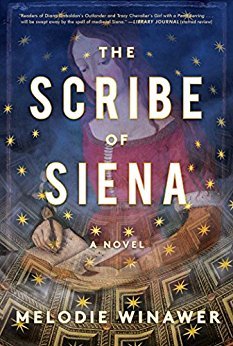 ar-old conspiracy to decimate the city.
After uncovering the journal and paintings of Gabriele Accorsi, the fourteenth-century artist at the heart of the plot, Beatrice finds a startling image of her own face and is suddenly transported to the year 1347. She awakens in a Siena unfamiliar to her, one that will soon be hit by the Plague.
Yet when Beatrice meets Accorsi, something unexpected happens: she falls in love—not only with Gabriele, but also with the beauty and cadence of medieval life. As the Plague and the ruthless hands behind its trajectory threaten not only her survival but also Siena’s very existence, Beatrice must decide in which century she belongs”.
I don’t read time-travel novels that often; I’ll even confess one shameful secret to you: I didn’t like the Outlander. But The Scribe of Siena, Melodie Winawer’s recent debut, was truly something new for me. While there was a pleasant love plot, the greatest passion in the story was the one heroine feels for history and art; and that was a very welcomed change.
I won’t talk about the plot itself too much, if only for the fear of revealing too much and spoiling the pleasure. I’ll just mention, that there is room for international conspiracies (well, sort of international – Florence and Siena were separate city-states back then!), exotic trade and poignant familial relationships alike. But, most of all, I’ll applaud the author for discarding the much-used and oft-abused Dark Ages trope. Melodie Winawer has really done a good job of gentle myth-busting, pertaining to various aspects of medieval life – from hygiene (the abundance of public bathhouses) to the treatment of women (the characters include a respected midwife, a capable merchant widow and, of course, the eponymous scribe).
I’ve also really enjoyed the loving, lingering descriptions of medieval art, be it an Ascension fresco blooming with gold on the hospital façade, illuminated manuscripts in the Sienese library, or a city cathedral flooded with multicolored light through the new stained glass.
Moreover, while I’ve recently reviewed plenty of historical novels about Italy ( here or here), The Scribe of Siena’s setting still strikes me as original – both in terms of the era (14th century, as opposed to the antiquity or the Renaissance) and the place (Siena, as opposed to the magnificent triumvirate of Rome, Florence and Venice). All in all, this is an enchanting debut by one of the new historical fiction writers on the scene.
The post Book review: The Scribe of Siena, by Melodie Winawer appeared first on History Geek in Town.


May 30, 2017
Summer in the Alps
The weather is finally getting (marginally) warmer, so it’s now the time to think of (or, at least, daydream about) summer holidays. Weeks on the seaside are all well and good, but, for me at least, nothing beats – the title kinda gave it away – a summer in the Alps.
I must confess, I have not been particularly adventurous in this regard; for years I’ve always came to stay in the exact same village in the Austrian Alps. In my defense I want to say, that this place, going by the name of Neustift (about 40 min. drive from Innsruck) is really worth it. 


The landscape is as brilliant, pulsing with colour, as we usually only see on postcards. The scent, the heady aroma of herbs and flowers, is impossible to describe; suffice to say, if I could bottle it up and hid it in my drawer, I would never suffer from winter spleen again. The mountain summits are blazing with snow against the deep-blue backdrop of the summer sky, and the slopes are covered with a blueish haze like with a veil of gauze.
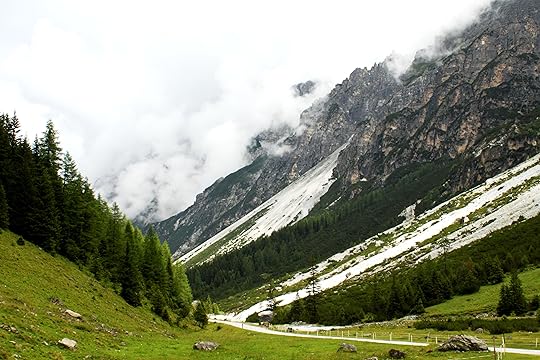
The village itself is, of course, brimming with spa hotels for the leisurely travelers and sport hotels for the more frugal ones. Some of them are clustered straight around the base of the Elfer lift – a gondola track, conveying the travelers to the quiet forests and winding mountain paths above. The paths in question are carefully drawn, mapped and dotted with unmistakable yellow markers. I am, however, often guilty of straying from these tracks, lured by the promise of tiny, wild red strawberries in the grass.
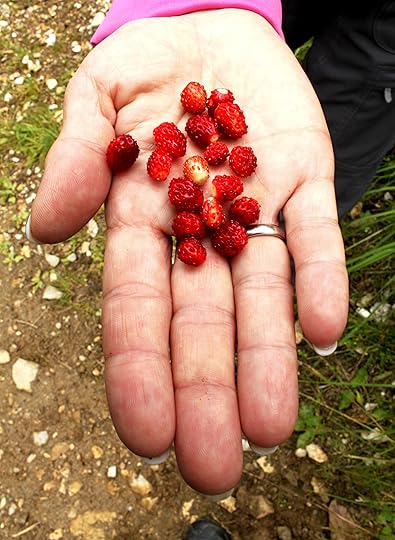
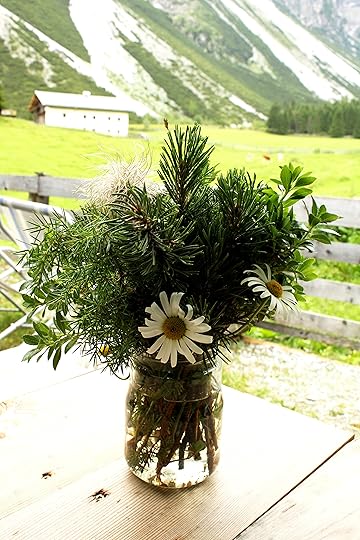
The strawberries make a meagre lunch for someone, who measured mountain kilometers with her steps, so at the first opportunity I usually descend upon the local hűtte – literally huts, actually hiker cafes. The schnitzel portions served inside are monumental, but I was certainly never the one to complain about that!


The post Summer in the Alps appeared first on History Geek in Town.
May 19, 2017
Book Review: In the Name of the Family, by Sarah Dunant
From the official blurb:
“It is 1502 and Rodrigo Borgia, a self-confessed womaniser and master of political corruption is now on the Papal throne as Alexander VI. His daughter Lucrezia, aged twenty-two, already thrice married and a pawn in her father’s plans, is discovering her own power. And then there is Cesare Borgia: brilliant, ruthless and increasingly unstable; it is his relationship with the diplomat Machiavelli which offers a master class on the dark arts of power and politics. What Machiavelli learns will go on to inform his great work of modern politics, The Prince.
But while the pope rails against old age and his son’s increasing maverick behavior it is Lucrezia who will become the Borgia survivor: taking on her enemies and creating her own place in history”.
When it comes to Renaissance Italy, there is hardly a family with more colourful associations attached to it than the Borgias. Likewise, when it comes to Renaissance Italy, there is hardly a writer with more colourful novels under her belt than Sarah Dunant; so, in a way, they were well-matched. In the Name of the Family is a concluding novel in a duology charting the rise and fall of this notorious dynasty. I opened the first one, Blood and Beauty, in the sweltering Italian summer of 2014, to be transported into the sweltering Italian summer of 1492; I’ve been entranced ever since.
One of the best things about this duology is the fact that, unlike most Borgia-themed historical fiction (and certain TV Shows That Must Not Be Named), it sweeps the usual lurid gossip away. So, no brother-sister incest here, and no dramatic poisonings; and thank Eru for that, because the true story turns out to be far deeper, far more complex, and far more engrossing.
Every character, from the Borgia Pope himself to the young Machiavelli’s usually forgotten wife, is gloriously written, deliciously flawed and throbs with life as much as the figures on Renaissance frescoes. In particular, Lucrezia’s journey from a demure maiden, a pawn in her family’s games, to a powerful figure in her own right is portrayed believably and poignantly over the two novels; and, Feminist Killjoy that I am, it moved me the most.
Like many others, he had arrived at the Vatican court his ears ringing with gossip, expecting to find some vain vixen, racked by lust and cruelty. Yet within weeks his dispatches were filled with descriptions of her [Lucrezia’s] sweetness and modesty. It has taken him a little longer to discover the metal beneath the softness. But then it has been years since the state of Ferrara had its own duchess, and it’s possible he has forgotten the subterfuge of clever women, how stubborn their gentleness can be.
No less colourful is Dunant’s portrayal of the era itself; the divided, dangerous, brilliant Italy of the late Renaissance.
A feral dog streaks across his path, going for a gobbet of offal near the wheel of a cart. It earns him a kick in the ribs for his daring but his jaws remain firmly clenched over the prize. Scavenging opportunist, Niccolò [Machiavelli] thinks, not without a certain admiration. Stick a feathered hat on him and give him a sword and you’ve got half the country.
One can almost feel the scent of the orange groves in Ferrara and see the fog that drowns its streets, admire the frescoes on the walls of its summer villas – and be shocked into speechlessness by the blood on fresh December snow. There is enough bloodshed, conspiracies, treacheries and wars – but there is also a space for beauty, for art, for simple pleasures. And, against this backdrop, a truly Shakespearean story of a rise and fall is set.
Even if the Borgia family never interested you in the least, I would still recommend you to at least have a look at what is definitely one of the best historical novels of 2017. Though chronologically it takes place after Blood and Beauty, it can also be enjoyed on its own.
The post appeared first on History Geek in Town.
May 11, 2017
Book review: The Most Beautiful Woman in Florence by Alyssa Palombo
If Renaissance Florence is your kick, if you like to read about women otherwise relegated to the footnotes of history, and if you like your books with a hint of forbidden passion, then The Most Beautiful Woman in Florence is a historical fiction must-read for you.
From the official blurb:
“A girl as beautiful as Simonetta Cattaneo never wants for marriage proposals in 15th Century Italy, but she jumps at the chance to marry Marco Vespucci. Marco is young, handsome and well-educated. Not to mention he is one of the powerful Medici family’s favored circle.
Even before her marriage with Marco is set, Simonetta is swept up into Lorenzo and Giuliano de’ Medici’s glittering circle of politicians, poets, artists, and philosophers. The men of Florence—most notably the rakish Giuliano de’ Medici—become enthralled with her beauty. That she is educated and an ardent reader of poetry makes her more desirable and fashionable still. But it is her acquaintance with a young painter, Sandro Botticelli, which strikes her heart most. Botticelli immediately invites Simonetta, newly proclaimed the most beautiful woman in Florence, to pose for him. As Simonetta learns to navigate her marriage, her place in Florentine society, and the politics of beauty and desire, she and Botticelli develop a passionate intimacy, one that leads to her immortalizati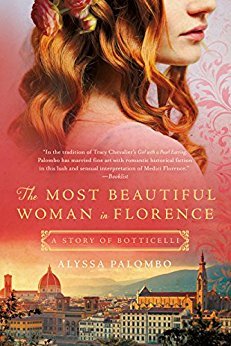 on in his masterpiece, The Birth of Venus”.
Plenty of reviewers have compared this novel to Sarah Dunant’s Birth of Venus. The reasons are quite obvious, of course – the setting in Renaissance Florence, th
e focus upon great works of art, and, above all, the vivid female perspective. There is a significant difference, though; whereas Birth of Venus deals with the dark years of Savonarola’s theocracy and the bitter struggle between the clerical power and the newborn secular art, Alyssa Palombo’s novel is set in an earlier, sunnier period.
The world was young, the mountains green, no stain yet on the moon was seen; in other words, Lorenzo the Magnificent was, well, young, the peace (seemingly) assured, and the horrors of both foreign invasion and conservative backlash still lay far in the future. It is into this world, glowing with optimism and brimming with new talents, the newly-betrothed Simonetta Cattaneo arrives.
The author excelled particularly in re-creating the confident, hopeful world of the early Renaissance. It is one of those cases, when the setting feels almost like another character.
At first, Simonetta’s incomparable beauty looks like a golden ticket, a key to every door. But, gradually, she starts to see the dark side to this seeming advantage. She realizes, that being desired by powerful men can be as dangerous as it is flattering; usually even more so.
I shook in sorrow, in fear, in rage at this world that sought to use me as it saw fit.
She is extremely vulnerable to both the desires and accusations of others, and even her status as a nobleman’s wife cannot save her. The danger as exacerbated by Simonetta’s interest in Botticelli’s new project, scandalous even for the secular and enlightened Florentines – and in the brilliant young artist himself…
The post Book review: The Most Beautiful Woman in Florence by Alyssa Palombo appeared first on History Geek in Town.
May 3, 2017
Book review: Feast of Sorrow by Crystal King
From the official blurb:
“On a blistering day in the twenty-sixth year of Augustus Caesar’s reign, a young chef, Thrasius, is acquired for the exorbitant price of twenty thousand denarii. His purchaser is the infamous gourmet Marcus Gavius Apicius, wealthy beyond measure, obsessed with a taste for fine meals from exotic places, and a singular ambition: to serve as culinary advisor to Caesar, an honor that will cement his legacy as Rome’s leading epicure.
Apicius rightfully believes that Thrasius is the key to his culinary success, and with Thrasius’s help he soon becomes known for his lavish parties and fantastic meals. Thrasius finds a family in Apicius’s household, his daughter Apicata, his wife Aelia, and he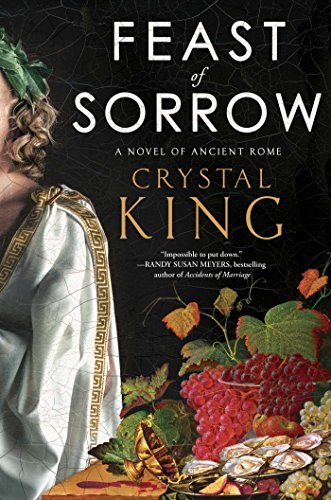 r handmaiden, Passia whom Thrasius quickly falls in love with. But as Apicius draws closer to his ultimate goal, his reckless disregard for any who might get in his way takes a dangerous turn that threatens his young family and places his entire household at the mercy of the most powerful forces in Rome”.
I must confess straight away – classical antiquity is not usually my thing. I tend to be much more comfortable among Renaissance gowns or bias-cut dresses than I am among stolas and togas. So the fact that I couldn’t put this book down really should say how great it was!
The atmosphere of extravagance and danger, of dark premonition and blinding glamour was superbly executed. The research was meticulous, and it showed. I could appreciate it all the more, because the author decided to show these momentous events through the eyes of a decidedly “downstairs” character – a highly skilled slave, but a slave nonetheless.
As we all know, history doesn’t tend to leave us many details about the daily life of people like Thrasius; those few bits of information that exist are hard to fish out – the further we go back in history, the harder it becomes. So, I really applaud Crystal King for this effort.
Among other things, she managed to capture perfectly this feeling of an ordinary person caught up in the struggles of the powerful; the human emotions and small, personal ambitions history so often forgets, the mix of helplessness and hope.
If you are looking for dark, brilliant and carefully researched historical fiction, look no further than the Feast of Sorrow. You can buy it on the Amazon here.
The post Book review: Feast of Sorrow by Crystal King appeared first on History Geek in Town.
February 2, 2017
3 of the most beautiful churches in Rome
Of course, an advice to visit some churches while in Rome is hardly a contender for the title of The Most Original Tip 2017. However, there’re some must-visit places in Rome among them, that hardly appear on the regular to-do lists. Here is a handful:
Santa Maria sopra Minerva
If there was one reason why I liked Santa Maria sopra Minerva, it was because, unlike other Baroque churches, it didn’t try to smother me with extravagance. No, it isn’t devoid of frescoes and marble columns. There are all the trappings of those post-Reformation years, when the Catholic Church desperately tried to keep its hold on power; it worked to convince the people of their vision of heavenly glory by using some quite earthy spectacles. However, this display of beauty and power isn’t as heavy as it could be. It’s dimmed and softened by the panorama of the night sky, covering the ceiling. The dark-blue of this vision, covered with golden stars, makes the vast church seem almost intimate. The light of the day is seeping through the small windows of stained glass.
St. Luigi Della Francesi
Remember this part about a Baroque church trying to smother you with magnificence? Well, San Luigi della Francesi, alias St. Louis of France, certainly makes a good effort. It’s an exuberant, creamy explosion of gold and white. Its extravagance could have been almost daunting, if not for one compelling dark corner. For it is an unlikely place, where I could see three masterpieces of Caravaggio. His figures, so full-blooded, natural and glistening with life, looked almost out of place in this gold-and-marble haven.
Basilica of San Clemente
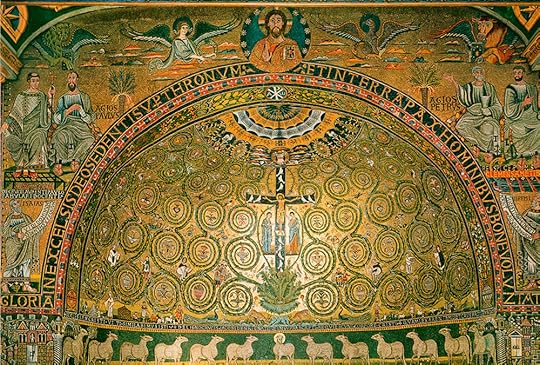
(c) the official site. Amateur photography is banned inside the basilica.
The ceiling of San Clemente is laden with gold, and its frescoes bloom with the cheerful, rosy flesh of Baroque angels. However, despite these later embellishments and somewhat clumsy additions, the church breathes with age. You can notice it first while looking at the darkened mosaic at the nave – even before you notice the door to the lower archaeological levels.
If Rome is, according to the locals, an archaeological lasagna, then the Basilica of San Clemente is quintessentially Roman. Once you descend the stairs into the darkness of the dug-out centuries, you will probably feel yourself in a crumbling layered cake. There are dim frescoes and austere saints of the 4th century church, which served as a foundation for the present Basilica. There are dark halls of the earlier Roman Mithreum – a sanctuary, where the gentlemen of the aged empire once threw banquets in honor of Mithras. This cult of this bull-god, a resurrected warrior of light, has provided inspiration for many people throughout the ages, from Roman soldiers serving in Northern England to the fascist philosophers of the postwar world. It originated in Persia, though.
At the bottom, following an elaborate system of signs, you will find a stunningly well-preserved succession of halls, once belonging in a house of a 1st century Roman nobleman. The rooms are quiet now, save for the sound of the warm underground spring, that once must have provided the owner with a rare luxury of one’s own baths. The floor, though, is slightly disfigured, but we have to blame the Great Fire of Rome here.
Looking for a place to stay in Rome? Here’re some options…
The post 3 of the most beautiful churches in Rome appeared first on History Geek in Town.
January 17, 2017
Photopost: Vatican Museums (Mostly Ceilings)
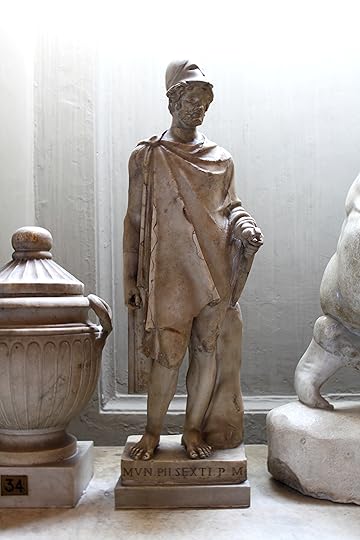
When it comes to choosing the places to visit in Rome, the Vatican Museums are probably high enough on your list. The queues and the ticket costs can be somewhat off-putting, I know; however, here’re some of the photos from my last trip, that may help you to make up your mind. There’s plenty to see beyond the Sistine Chapel and the famous staircase!
All the Baroque extravagance of gold and marble can get a little overwhelming sometimes. I love flowing silks and intricate carvings as much as anyone, but, to be honest, discovering some quieter ancient art was almost a relief. Not that they were not impressive, don’t get me wrong; it’s just next to the views like the one above, they looked downright frugal.
No, I still cannot explain my fixation on the local ceilings. Although the desire to exclude the endless heads of touristic groups from the frame might have had something to do with it…
Looking for a place to stay in Rome? Here’re some options…
The post Photopost: Vatican Museums (Mostly Ceilings) appeared first on History Geek in Town.
January 5, 2017
3 of the most beautiful places in Padua
Here’re some top places to see in Padua; after all, it’s a lovely place for a day trip from either Venice or Florence!
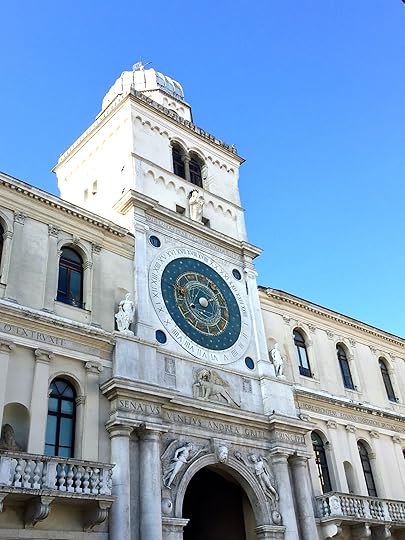
The Clock Tower:
The Piazza dei Signori is spacious and light, as it should be; after all, it had been initially designed for tournaments and celebrations, and was known in its time as the Square of Triumphs. Now that the days of jousting are over, the Piazza plays host to various concerts and music festivals. However, the square is still dominated by one magnificent construction: the Torre dell’Orologio, translated somewhat understatedly as the Clock Tower.
This construction of pristine white stone, built in the 15th century, has seen the flowering of the Renaissance, the revolution of the Enlightenment, and the horror of two World Wars.
The astronomical clock commemorates the age, when the measures of time were still uncertain, and when the human life was thought to be governed by a myriad of supernatural factors – including the movement of heavenly bodies. Apart from the hours and minutes, the clock also indicates the phases of the moon, and zodiac signs can be seen running around its inner face.
However, this sublime monument also bears some imprints of the affairs much more earthly. The lofty inscription in Latin is dedicated to the Venetian Doge, Andrea Gritti; there’s also a bas-relief of the winged lion. This was the depiction I was more used to seeing in a certain city with a bit more canals and a lot more tourists.
These are the remains of the Venetian attempt to carve out a small empire on the terra firma, once their maritime dominion started crumbling. This little colonial experiment was, of course, overshadowed by the imperialism galore of the later centuries. However, the white stone remembers, the tower shining as starkly against the dense blue of Italian sky, as if it was erected yesterday.
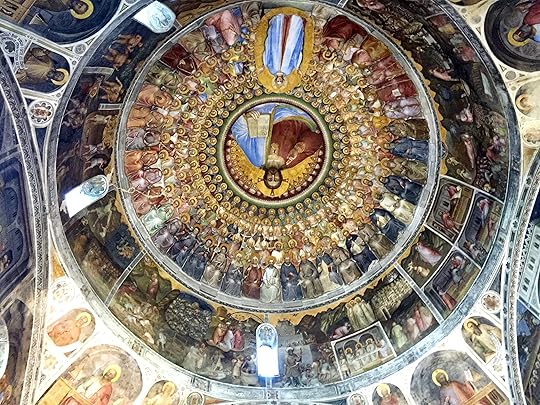
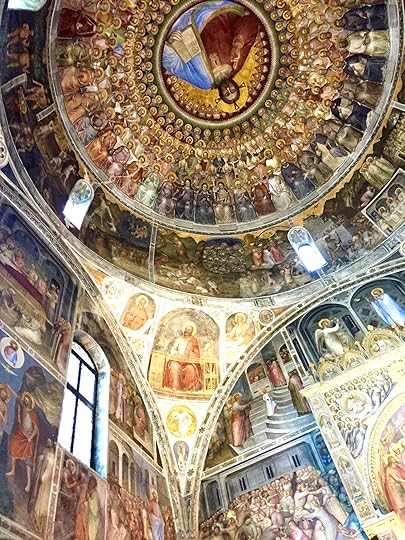
Padua Baptistery:
This church, dedicated to St. John the Baptist, looks especially humble next to the city’s grand cathedral, in whose shadow it sat for the last seven centuries. However, try not to skip it; more than anything, it resembles a plain jewelry-box, containing unimaginable treasures. Inside, you will see an explosion of colour – a magnificent fresco cycle, undimmed since its creation in the 14th century.
Even this thing of beauty didn’t escape the political upheavals of the outside world, though. Initially, the baptistery was designed as a mausoleum for the local rulers, the House of Carrara. However, after their power fell in 1405, and the city succumbed to the Venetian Republic, the soldiers of La Serenissima demolished the grand burial monuments and covered the numerous emblems of the Carrara with green paint. The restoration attempts began in the 20th century and are going on to this day.
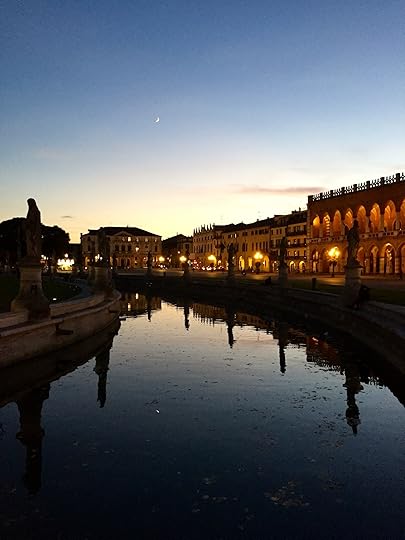
Prato della Valle:
This is a peculiar place, really; the largest square in Italy (about 90,000 square meter), situated so far from the major tourist centers. Were it located in Rome, there would’ve been hordes of tourists on any day of the week. As it is, I was greeted by the stillness of the black canal water and the serenity of the marble statues, enclosing it in two rings.
This vision of classical grace has been brought about only in 1785. However, it has a startling precursor – the preliminary excavations revealed the remains of an ancient Roman theater.
There really must be something in the soil, because, when this place was still an expanse of swampy marshland, it managed to become the birthplace of modern opera. In 1636, Venetian noblemen used to organize musical entertainment there as a prologue to jousting. These amateur festivals are considered to be the immediate predecessor of the first public opera performances, which began in Venice itself the following year.
Looking for a place to stay in Padua? Here’re some options.
The post 3 of the most beautiful places in Padua appeared first on History Geek in Town.
September 23, 2016
A Pearl for My Mistress
My debut novel, due in August 2017. Perfect for the lovers of British historical fiction, Sarah Waters and Upstairs Downstairs.
“Britain, 1934. Hester Blake, an ambitious girl from an industrial Northern town, finds a job as a lady’s maid in a small aristocratic household. Despite their impressive title and glorious past, the Fitzmartins are crumbling under the tribulations of the new century. In the cold isolation of these new surroundings, Hester ends up hopelessly besotted with her young mistress, Lady Lucy. Fragile and enthralling, Lucy can weave fascinating stories like a spider weaves her web. Armed with shrewd wits and an iron will to match, she is determined to carve out a new life for herself.
They are drawn to each other as kindred spirits, eager to take advantage of the new opportunities the world has to offer. Moreover, soon Hester gets to accompany Lady Lucy on her London Season, and readily plunges herself into the heady mix of passion, art and excitement of the glittering city.
However, there are plenty of dark undercurrents swirling beneath the majestic imperial capital. The country is rife with discontent, and radical political movements are growing in influence day by day. There is a controversy, surrounding the new dictatorships of Europe, and struggles are breaking out in the press as well as in the streets. The hushed whispers of yet another war are still rare, but the battle for hearts and minds has already started, and Lucy’s talent can be employed for very sinister ends.
Meanwhile, Hester seems to be harbouring some secrets of her own…”
The novel would be published by HQ Digital (HarperCollins) in August 2017.
The post A Pearl for My Mistress appeared first on History Geek in Town.
The Pearl and the Carnelian
My 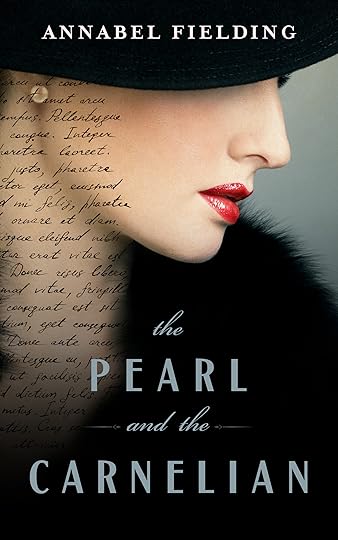 debut novel, published in September 2016.
“Britain, 1934. Hester Blake, an ambitious girl from an industrial Northern town, finds a job as a lady’s maid in a small aristocratic household. Despite their impressive title and glorious past, the Fitzmartins are crumbling under the tribulations of the new century. In the cold isolation of these new surroundings, Hester ends up hopelessly besotted with her young mistress, Lady Lucy. Fragile and enthralling, Lucy can weave fascinating stories like a spider weaves her web. Armed with shrewd wits and an iron will to match, she is determined to carve out a new life for herself.
They are drawn to each other as kindred spirits, eager to take advantage of the new opportunities the world has to offer. Moreover, soon Hester gets to accompany Lady Lucy on her London Season, and readily plunges herself into the heady mix of passion, art and excitement of the glittering city.
However, there are plenty of dark undercurrents swirling beneath the majestic imperial capital. The country is rife with discontent, and radical political movements are growing in influence day by day. There is a controversy, surrounding the new dictatorships of Europe, and struggles are breaking out in the press as well as in the streets. The hushed whispers of yet another war are still rare, but the battle for hearts and minds has already started, and Lucy’s talent can be employed for very sinister ends.
Meanwhile, Hester seems to be harbouring some secrets of her own…”
The book can be found here:
The post The Pearl and the Carnelian appeared first on History Geek in Town.