Shauna Letellier's Blog, page 5
May 28, 2019
Hope in Any Language
When my husband experienced a sudden loss of vision, we made a precarious visit the Mayo Clinic in Rochester, Minnesota. The explanation requires lots of words that spell-check doesn’t recognize, but suffice it to say, we had a scare.
Our schedule was filled with hours of waiting and intermittent appointments and tests. We waited in the lobby, lab, cafeteria, exam room, coffee shop, atrium, and elevator. The kind folks there know you’ll have some time on your hands, so they provide a few activities. There’s a grand piano in the atrium, and artwork of every variety adorns the walls and halls.
They’ve even curated artifacts for their museum, the Mayo Clinic Heritage Hall. Through brittle photos and dusty prescription bottles, each exhibit tells the story of the Mayo brothers, generous surgeons who founded the clinic.
Their story was interesting and well documented, but the exhibit that stood out to me was a modern display.
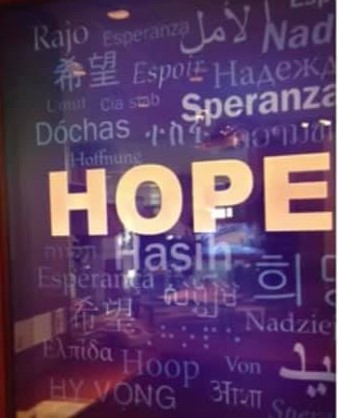
Behind the reception desk a back-lit sign glowed with the word HOPE at its center. Surrounding it, in smaller print, hope was translated into many different languages using different alphabets. It even included dots that represented Braille. {Read more…}
The post Hope in Any Language appeared first on Shauna Letellier.


May 21, 2019
Mourning Dashed Hopes: Biblical Wisdom for Changing Seasons
This is the first article in our summer series, Stories of Hope–modern stories of people who placed their hope in Christ and felt–at first–disappointed with his plan, purpose, or timing much like the biblical characters of Remarkable Hope.
I’m thrilled to introduce Christine Chappell. Christine is the author of Clean Home, Messy Heart, the host of The Mental Hope Project podcast, and is a guest contributor at Desiring God. She writes frequently about mental health topics at her blog, has completed biblical counseling certificates with the Institute for Biblical Counseling & Discipleship, and is currently pursuing certification with the Association of Certified Biblical Counselors. Christine lives with her husband and three children in South Carolina.
Christine also curates weekly Christ-centered mental health resources for her subscribers. If you’re looking for gospel hope & help for facing mental health challenges, please click here to learn more and subscribe to Christine’s helpful email deliveries.
Be encouraged by our first Story of Hope presented by Christine M. Chappell.
I felt abandoned by God for more than five weeks. I asked friends to pray the prayers I couldn’t mutter myself, hoping they’d rub off on me while rising like incense to the One who hid his face behind the clouds. I’d battled depression on and off for years, but this go-round was different. Darker. Deeper. Disorienting. Dangerous.
All these years and dips and highs and lows and I never wanted much help. I wanted to will my emotional stability and weave God’s truth into a beautiful testimony of wellness—on my terms. I wanted to stand high on the mountaintop of victory and dance before the Lord with all my might (2 Samuel 6:14), having achieved a pinnacle of mental freedom through Christ. Finally in control. Finally level. Finally well.
But there was no dancing, just the suicidal tremblings of a desperate soul sobbing on the bathroom floor. Instead of pinnacles of freedom, there were crevices of despair. Instead of yearning for change, I ached to disappear from the sorrow and the stains and the shame of my sheer mortality. Self-help was no help for me at all. I could not wrestle the demons alone. I could not care for my body solely through spiritual means.
Recognizing Dashed Hopes as Seasons of Mourning
I knew I had come to a crossroads, and I knew my body did not belong to me (1 Corinthians 6:19-20). After years of resistance, I forced myself to seek medical treatment. The decision flew in the face of everything I had been striving for. I cried. I lamented. I thrashed and wailed, and then wept and sulked. I wasn’t supposed to still be broken like this. I knew the gospel, I “did all the right things,” I had beaten this thing back before and wondered if I could do it once more. Try a little harder to get it right the next cycle around, I’d think to myself.
But after talking with my husband, we knew what had to be done. I had to lay my weapons down. I had to let the Holy Spirit lead me where I didn’t want to go: the mental hospital.
I knew what I was walking into, having been there once before. With weighted, burdened, hesitant steps across the linoleum hospital floor, I shuffled through the doors. After five weeks of spiritual destitution, words of consolation were given to me by the Holy Spirit:
“When I am afraid, I will put my trust in you.” (Psalm 56:3)
I finally sought treatment for the physical components of my struggles with depression and hypomania. That day, Jesus made clear a new season was about to come: I could surrender the hope of fixing myself and instead find peace by simply belonging to him—no strings of wellness attached.
Learning to Adapt to the Seasonal Spectrum
Author Zack Eswine writes, “Many of our frustrations rise from our blindness to the change of season or to the pain or joy of them, and we struggle to adjust our expectations.” This was true of the experience I shared above. I could not perceive the new way the Lord was bringing help and healing into my life because I blindly presumed the only way to recover was through self-determination. I wanted to dance, to laugh, to sew, to experience peace—but such were not the times (Ecclesiastes 3:4-8). During those days of struggle I mourned, wept, tore, and was at war with myself, believing I was experiencing a season I should have been immune to.
The arms of a clock take their turns pointing upward and downward. The sunrise requires a sunset. The dusting of white winter snow yields to the dusting of yellow spring pollen. There are times when we’ll struggle and experience the full-blown severity of life with a broken body. And there are times where we’ll progress and celebrate the sweet sensation of our wounds finding their balm in Christ and his helps. Like the numbers on the clock, seasons are what they are—no season is “wrong” when its turn is summoned. Seasons each have their purposes, their pleasures, their pains, their pressures, and we either adapt and trust God with all our times (Psalm 31:15) or we desperately cling to the times we imagine for ourselves and slowly self-destruct when they don’t come to fruition (Proverbs 16:9).
Through the dashed hope of self-preservation, Christ taught me the true and better hope of trusting him fully with my ever-evolving times.
Through the dashed hope of self-preservation, Christ taught me the true and better hope of trusting him fully with my ever-evolving times.' Click To Tweet
Whatever season we find ourselves in, the Scriptures tell us that Christ is always working to spring forth a new thing we cannot yet perceive (John 5:17, Isaiah 43:19). Yet, sometimes our inability to perceive the road ahead causes us to become hopeless or fearful. When this happens, Eswine encourages us “that the way forward in our seasons is not found in rehearsing what we do not know, but in remaining faithful to what we do.”
Clinging to Gospel Hope in Every Season
Jesus knew the seasons of his life on earth were ordained. My time has not yet come, he said (John 2:4, John 7:6, John 7:30). My time is at hand, he later proclaimed (Matthew 26:18). His sensitivity to the times is sage wisdom for us. But more than wisdom, Jesus’s experiential knowledge of our times under the sun ushers in divine hope. In Christ, we have a high priest who himself traversed the entire spectrum of mortal seasons, and promises to walk through them with us (Matthew 28:20). Eswine comforts, “We are learning that whatever time it is, Jesus is there with us.”
The worst of seasons, Jesus has overcome! And the best of seasons are no match for the times to come in Heaven (1 Corinthians 2:9)! We may mourn, but praise God we will never know the depths of mourning experienced by the forsaken Son upon the cross (Matthew 27:46). We may dance, but one day we will spin and leap and wave our arms as the thrill of redemption finds its fulfillment at the wedding feast (Revelation 19:9).
'The worst of seasons, Jesus has overcome! And the best of seasons are no match for the times to come in Heaven.' ~Christine Chappell @chappellwritesClick To Tweet
All of this hope and resurrection life is granted to us because Christ volunteered to put aside his crown for a season; he obediently drank the cup of wrath when his time had come; he victoriously conquered death and rose again when three days passed; he shares the promise of new life with those who put their trust in him for eternal salvation. Our times are bound up in his times, that we may learn how to be brought low and how to abound in every season:
Through him who strengthens us (Philippians 3:4:12-13).
{Want more stories of hope? Sign up here.}
 Christine is the author of Clean Home, Messy Heart, the host of The Mental Hope Project podcast, and is a guest contributor at Desiring God. She writes frequently about mental health topics at her blog, has completed biblical counseling certificates with the Institute for Biblical Counseling & Discipleship, and is currently pursuing certification with the Association of Certified Biblical Counselors. Christine lives with her husband and three children in South Carolina.
Christine also curates weekly Christ-centered mental health resources for her subscribers. If you’re looking for gospel hope & help for facing mental health challenges, please click here to learn more and subscribe to Christine’s helpful email deliveries.
The post Mourning Dashed Hopes: Biblical Wisdom for Changing Seasons appeared first on Shauna Letellier.
May 14, 2019
Summer Series: Stories of Hope
We’ve thought a lot about “hope” this year, haven’t we? We know we ought to place our hope in Christ alone and not in other people, not in preferable circumstances, and not even in the changed behavior of loved ones.
But what does that look like in 2019? We look at Bible people like John the Baptist and Mary, and we clearly see their unwavering hope in Christ in the midst of disappointment, devastation, and even death. But I wonder, and maybe you do too, if these folks had it just a wee bit easier than you and I do, because they could see Jesus with their eyes.
It might seem like an advantage to get a visual on “the Word made flesh.” If Jesus has sat at your table slurping your soup, or if you’ve lifted him from the Jordan River with his hair draped over your arm, then surely you have an advantage over those of us who are squinting into 2000 years of history through the lens of scripture.
But friends, crazy as this might sound, that is not the case. Mary and John the Baptist, had no greater advantage than you or me. Know how I know? Jesus said so. “I tell you the truth: it is to your advantage that I go away, for if I do not go away, the Helper will not come to you. But if I go, I will send him to you.” (John 16:7, ESV)
It is to our advantage that Jesus ascended to heaven and sent his Holy Spirit to live in each of us individually. And isn’t it especially noteworthy that Jesus says he’ll send “The Helper.”
If there’s one thing we need in conjunction with hope, it’s help. The Helper we’ve been given isn’t a flaky advice columnist. We’ve been given the Holy Spirit.
Maybe you’re whispering, “Well, that sounds all theological and fancy, Shauna, but I need something a little more practical, because so far He hasn’t really helped in the ways I’d hoped.”
What does it look like to Hope in the Helper and trust him as you…
…trudge through single-parenting
…gasp with suffocating loneliness
…leave when everyone expects you to stay
…stay when everyone expects you to leave
…forgive in order to free yourself
…strain to see his presence even when you don’t feel it.
Friends, there are women who’ve experienced those disapointments. She may sit just down the row from you at your church. She might walk her dog at the park near your house. She might be your realtor, your child’s teacher, your lawyer, or the high school track coach. This summer, it is my pleasure to introduce you to a few of these regular and remarkable women through a series of articles called, Stories of Hope.
 These women have placed their hope in Christ and experienced devastating disappointments. With the help of the Holy Spirit, over time, they have each discovered that he gives immeasurably more than they could have imagined even though it was not what they asked for and nothing like they expected.
I know you’ll be encouraged and inspired. And I’m praying your hope in Christ will be strengthened. He is drastic, surprising, and even unpredictable, but he is always present, loving, and good.
If you don’t already receive email from me, you can sign up here. Then look for the first powerful story in your inbox next week.
The post Summer Series: Stories of Hope appeared first on Shauna Letellier.
April 17, 2019
What was in Mary’s Heart on that Skull-shaped Hill?
 For those who’ve grown up in church, the Easter story is a familiar one. So familiar are the words hope and doubt, death and resurrection, that the true meaning of them lose their splendor. Sometimes their familiarity in our Easter vocabulary even breeds a heart-level boredom.
So, when I was cruising through the Easter story a few years ago, I was shocked to find a verse I’d never noticed. Surely I’d read it before. At the very least I’d heard it. But I had certainly never stopped to consider it and marvel. And yet there it was, standing like an open wound on the pages of my Bible.
“Near the cross of Jesus stood his mother.” {Read more…}
I’ve shared these reflections at my friend Saundra Dalton-Smith’s website. Join me here.
The post What was in Mary’s Heart on that Skull-shaped Hill? appeared first on Shauna Letellier.
March 30, 2019
The Remedy for Disappointment
It wasn’t the worst place for a baby to sleep, but I didn’t like the thought of putting a baby in a laundry basket. For a newborn it would be safe and portable, but I felt ashamed.
Our second son was born ten weeks premature. A job change, a move, and his premature birth had drained our bank account. Our first son, just 14 months old at the time, was still in the crib and a new bed for him was not in the budget. We’d been financially responsible, made the wisest decisions we could, but instead of a six-figure family income, we had accrued a six-figure medical bill. [Read More…]
I’m sharing this story over at (in)courage today. To join me, click here.
The post The Remedy for Disappointment appeared first on Shauna Letellier.
March 12, 2019
When Uncertainty Rattles Your Hope
 {Photo by
Martha Dominguez de Gouveia
on
Unsplash}
{Photo by
Martha Dominguez de Gouveia
on
Unsplash}
It was an expensive, last-minute hotel reservation we didn’t want to make. It came with a seven-hour drive and a complimentary shuttle to the Mayo Clinic. With the help of a clinic scheduler and family members, my husband and I left our three sons with family, promised to get them home for their first day of the new school year, and scurried off to Rochester, Minnesota to get some answers.
When my hope got rattled by uncertainty, I did the wrong thing first. I’m sharing about how to hope in the storm at my friend, Lisa Appelo’s blog. Join me there?
The post When Uncertainty Rattles Your Hope appeared first on Shauna Letellier.
March 4, 2019
Is Hope Steadfast or Slippery?
Please enjoy this excerpt from the introduction of Remarkable Hope: When Jesus Revived Hope in Disappointed People.
Steadfast Hope
Hope. We use the word every day.
I hope it doesn’t rain.
I hope you feel better.
I hope I get to sleep in.
With the best intentions, we cast pleasant desires for ourselves and our friends into the air to vanish. We mean well, but we have precious little control over actual outcomes.
I hope it doesn’t rain. (But there are clouds rolling in.)
I hope you feel better. (But sympathy doesn’t chase away the virus.)
I hope I get to sleep in. (But I have young children.)
Our expressions are also colored with unlikelihood. “Dashed hope” gives way to the announcement that the situation is “beyond hope.” Even when we speak positively, hope is a small “glimmer,” a singular “ray,” or a fine “thread.”
Obedience Means Blessing . . . Doesn’t It?
It is a strange and sad irony that our well-wishes are thin and unreliable. In devastation and unmet expectations, we may mistakenly conclude that our hope in Christ is as slippery as the rain we were hoping not to get.
A Christian marriage is destroyed by abuse, addiction, or rebellion. We know parents who “trained up a child in the way he should go” but found themselves speaking through microphones to their beloved on the other side of bulletproof glass, and we become suspicious of the hope Christ offers.
A series of ongoing calamities can prove just as baffling. For me it was a relocation that was clearly God’s direction. It resulted in a nontraveling work schedule that morphed into an eighty-hour workweek. A policy loophole turned a salaried position into an hourly one that didn’t include overtime pay. A rented house depleted our savings for a down payment and didn’t feel like home. To add insult to injury, I found myself grinding up dog food for eleven yelping puppies in my laundry room while my own newborn preemie lay in an Isolette with a feeding tube in an NICU three hours away.
You could insert your story here too. My string of catastrophes may sound minor if you’ve endured the miseries of chemotherapy, testified in court against a family member, or purchased a tiny casket. We have obeyed God and placed our hope in him. We anticipate a life full of blessings tailored to our preferences. Instead of feeling blessed, we feel sucker punched.
A Mystery Secured
Hope is a pillar of our Christian faith. It is not the vaporous wish tainted by doubt that we employ as we blow out birthday candles. When the apostles wrote about it, they spoke with confident assurance. Peter tells us we have a “living hope.”* The writer of Hebrews calls it an “anchor for the soul.” Dictionary definitions include, “An expectation of what is sure (certain).” Biblical hope is expectant certainty. It is knowing that Christ guarantees everything he has promised and purchased. When Paul prayed for the church in the city of Ephesus he said, “I pray that the eyes of your heart may be enlightened in order that you may know the hope to which he has called you.” (Ephesians 1:18) That kind of hope is no evaporating well-wish. It is absolute—a hope that does not put us to shame. (Romans 5:5)
Nothing Less, Nothing More
Hymn writer Edward Mote wrote, “My hope is built on nothing less than Jesus’ blood and righteousness.” That’s true, but it’s also built on nothing more. Perhaps that sucker-punched feeling stems from placing our hope in something besides Jesus. Without realizing it, we may have placed our confidence in our spiritual performance to gain the blessings we prefer. Perhaps we’ve counted on a “promise” that was merely inspirational language. The discovery can disorient us. How can we regain our footing?
Throughout the Gospels we read the accounts of people who hoped in Christ and experienced disappointments ranging from confusion to devastation. Think of the four men who carried their paralyzed friend to Jesus. They laid their silent request before the whole room. Atrophied limbs screamed for help. When Jesus said, “Friend, your sins are forgiven,” every observer was either devastated or incensed. They wanted Jesus to restore the body they could see, but Jesus’ priority was to revive the soul they couldn’t see (See Mark 2:1-12).
Surprised by God
When I began scribbling ideas for this book, I could think of a few stories in the Gospels where people felt let down by Jesus. As I studied, I found many more. Pastor and author John Koessler writes, “If the Gospels are any indication, we might even say that disappointment is a certainty. Read the Gospels with all their sharp edges intact. What are they but a record of disappointment with Jesus on a grand scale?” (The Surprising Grace of Disappointment, p. 48) In each of those sharp-edged stories, Jesus transformed disappointment into unexpected gifts. To look carefully at these Bible stories is to see an ongoing pattern of people being surprised by God’s methods in the most drastic ways. His work was rarely what they anticipated but always immeasurably more than they could have asked or imagined.
The following chapters are biblical vignettes: short retellings of times when people placed their hope in Christ and appeared— at first— to be disappointed by him. Eventually, they experienced ultimate freedom instead of physical freedom, a permanent kingdom instead of a political kingdom, a lifelong mission instead of a mission trip.
In each vignette, I have laid the fabric of fiction over the framework of Scripture. Everything God gave in his word is all we need, and storytelling is a powerful tool to help us remember concepts. Jesus used parables often. To teach the value of God’s kingdom, Jesus told of a man who bought an entire field because of the treasure buried there. To demonstrate God’s response to repentant sinners, Jesus described a father’s lavish celebration over the return of his wasteful son. When we unfurl the backdrop of history, humanity, and a few details of sanctified imagination, a concept comes to life.
I have tried to stay close to the Scriptures with these retellings. Where parallel passages were different, I combined the words and accounts of the Gospel writers into one. Where Scripture was unclear on motives, I imagined one I felt was reasonable in the situation. Where Scripture was silent, I sifted through possibilities presented in a variety of Bible commentaries. Then I wove in a little historic, geographic, political, religious, and cultural detail to provide context for the passage.
I operated with the understanding that these Gospel characters had committed much, if not all, of the first five books of our Bible, as well as Psalms, to memory. There are occasions inside these chapters where I have inserted dialogue or prayers. Although they do not appear in the biblical accounts, I assumed the person would be familiar with the Scripture and hymnbook of their day.
My prayer is that through this series of Bible moments retold, we who have clung to Christ will be greatly encouraged. As we observe his faithful commitment to those who hope in him, we will be wowed by his unseen plan, comforted by his words, and revived by his presence. We will finally chime in with Paul and declare that our “hope does not disappoint” us (Romans 5:5). Because when we are downcast and disturbed, our hope is in God, who gives more than we can imagine but rarely what we expect.
You can read each story in my new book when you order ~> Remarkable Hope: When Jesus Revived Hope in Disappointed People[image error].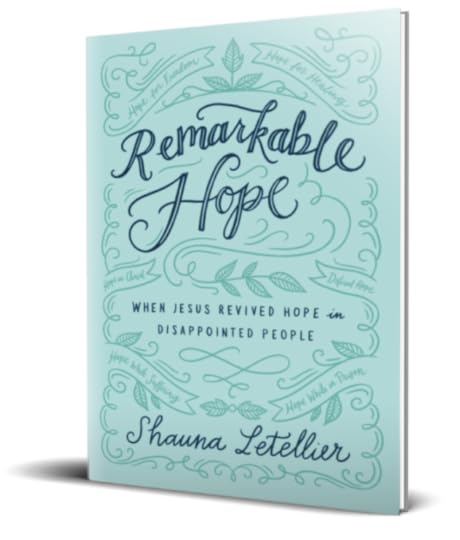
{Excerpted from the introduction to Remarkable Hope by Shauna Letellier Copyright © 2019 pp. xi-xviii FaithWords}
What if hope isn't a flimsy shred? What if it's a certainty you can count on? Preview the introduction to #RemarkableHope written by @shaunaletellier and published by @FaithWords
Click To Tweet
The post Is Hope Steadfast or Slippery? appeared first on Shauna Letellier.
February 26, 2019
Hope for this Life
Thomas Chisholm was not a formally educated man. But in 1941 he wrote in a letter, “My income has not been large at any time due to impaired health in the earlier years which has followed me on until now. Although I must not fail to record here the unfailing faithfulness of a covenant-keeping God and that He has given me many wonderful displays of His providing care, for which I am filled with astonishing gratefulness.”*
You will not be surprised to learn that a man who writes such a letter is also the author the poem which, when set to music, became the famous hymn “Great is Thy Faithfulness.”
With a long history of poor health and financial strain, Chisholm penned this lyric:
Strength for today and bright hope for tomorrow,
blessings all mine with ten thousand beside.
Chisholm would have been the first to admit that the assurance of a glorious future reality does not automatically alleviate ongoing pain in this life.
In a dying marriage, the glory of heaven doesn’t numb the sadness. To the parent sitting in the waiting room of Pediatric Oncology, that bright future is barely visible. To the Christian battered by a series of small disasters, eternity with Jesus is a long way off, and the way forward is strewn with more trouble.
Jesus was also familiar with long-term sadness. The prophet Isaiah writes of Jesus, “He was a man of sorrows, acquainted with grief.” At the pinnacle of his obedience in the Garden of Gethsemane, Jesus was engulfed in agony, and his Father sent an angel to strengthen him.
“In this world you will have trouble,” Jesus said. The stories of people who saw Jesus and the stories from our own lives are proof. Simeon–a righteous and devout man waited decades to see Jesus. Mary and Martha endured the agonizing decline of their brother, Lazarus. As Mary the mother of Jesus witnessed the murder of her blameless son, her soul was pierced. God’s chosen people are not spared the battering waves of uncertainty and trouble.
But in our despair and distress, God will supply all we need to hold fast to him. We observe it repeatedly throughout the gospels.
God will supply all we need to hold fast to him. We observe it repeatedly throughout the gospels. #remarkablehope
Click To Tweet
Simeon heard a promise. “You will see the Lord’s Christ.” (Luke 2:26)
Martha of Bethany received a next-step instruction. “Believe, and you will see the glory of God.” (John 11:40)
Mary the mother of Jesus was reminded of her all-powerful God and his provision. “Dear woman, here is a son who will care for you after I’m gone.” (John 19:26-27)
God revived their hope in ways they never could have imagined. Each word of warning, confirmation, and instruction was a means to solidify their hope of his promised future.
He will do the same for us. Our hope is a confident expectation—”an anchor for the soul, firm and secure” (Hebrews 6:19).
For those who’ve placed their hope in Christ, discouragement and confusion are not indicators that the mooring has come loose. Regardless of how we feel, or how well we understand our circumstances, we are bound to a fixed hope.
Christ Jesus is our remarkable hope. As we read of his past faithfulness to the people he encountered face-to-face, and fellow believers like Thomas Chisholm, our faith is strengthened and our assurance grows. We can know with confidence that he may shock and surprise us, but he does not ultimately disappoint. In the circumstances of today and in the grand scope of eternity, God’s faithfulness great indeed.
Jesus may shock and surprise us, but he does not ultimately disappoint.
Click To Tweet
*Osbeck, Kenneth W. 101 Hymn Stories (Grand Rapids, MI: Kregel Publications 1982), p. 84.
{Excerpt adapted from Remarkable Hope: When Jesus Revived Hope in Disappointed People, by Shauna Letellier. © 2019 FaithWords, Nashville}
The post Hope for this Life appeared first on Shauna Letellier.
February 19, 2019
A Free 6-Day Devotional: Jesus Revives Hope
You’re familiar with the YouVersion Bible App, right? More than likely, it’s on your smartphone right now because it’s used by more than 361 MILLION devices. I use the app almost daily to look up a verse, listen to scripture, or participate in one of their daily devotional reading plans.
It’s all free. That’s why I’m thrilled to tell you that my 6-day devotional is available on YouVersion now!
It’s called Jesus Revives Hope in Disappointed People, and it’s based on scripture and stories from Remarkable Hope. If you already have the app on your phone, this devotional is already in your pocket or purse!
It’s for anyone who feels shocked at the way God has allowed circumstances to work out. It’s tempting to wonder if you’ve done something wrong, or worse, been duped. Hope seems slippery. But what if the hope Christ offers isn’t a flimsy shred but a certainty you can count on, even when you feel disappointed? For six days we’ll get a glimpse of what biblical hope is, and how Jesus revived hope for people in the gospels. We’ll be assured he’ll do the same for us today.
The YouVersion Bible App makes it easy to share the plan with friends. If you’re encouraged, please share the plan and the book with anyone who needs the anchor of hope we have in Christ.
Get started HERE!

Pre-order before March 5 and receive three gifts! Here’s how you can get them:
1. Pre-order “Remarkable Hope” from any online retailer:


2. Fill out the form with your receipt number by clicking HERE.
3. Check your email to confirm and receive your gifts!
The post A Free 6-Day Devotional: Jesus Revives Hope appeared first on Shauna Letellier.
February 12, 2019
How to Color with Hope

I’m not sure if it’s a hobby, or a habit. Maybe it’s just how God regularly reminds me of his creative power and reliability. I’ve grown fond of taking photos of the sky, and particularly the sky over our nearby lake. My camera fits in my pocket, no fancier than a smartphone (which now that I think of it, is pretty fancy).
But before my smartphone days, I’d comment to my boys as we drove to school, “Wow, you guys! Look at the sky!!” They’d stare through windshield, squinting into the sunrise, and barely nod.
“It looks the same every day,” one of them growled.
They were young, tired, and headed to school, so I probably shouldn’t blame them for their unenthusiastic response. I probably uttered the same ridiculous sentence to my mom.
I was irritated until I realized they are completely accustomed radiant sunrises. When purple and coral come spilling over the horizon, they are not surprised. Perhaps because they’ve seen it so often.
A missionary from China visited our church at the height of the SARS virus outbreak. He spoke of their work and commitment to their Chinese church despite the health concerns. He talked about the dense population and the needs of the culture. They were headed back to China but glad to be near home in South Dakota. As he talked about the comforts of home, he got choked up talking about the sunrise.
The sunrise.
In China, (in the city where they worked) massive buildings and dense smog obscured the sunrise and sunset. Every day. To see it and talk about it, brought him to tears.
He did not harbor the bored over-familiarity of my tired little minivan passengers.

How can the sunrise bring tears? Why do I marvel and think it worthy of a photo and a caption, and an Instagram post? After all, “It looks the same every day.”
Some would say the sunrise brings hope. Hope of a bright new day, which conjures up happy feelings that things will be better. In the musical Annie, our beloved protagonist sang, “The sun’ll come up, tomorrow,… clears away the cobwebs and the sorrow.” But that’s not completely true, is it?
I’ve wrestled with the word “hope” this year as I wrote a book titled, Remarkable Hope.
Here is what hope does not mean: wish hard and it might come true.
We desperately need hope. We need an anchor, a steadying foundation, something we can know for certain will happen, something good and solid we can fix our eyes on like the steady line of the blazing horizon.
Hope, as it’s used in the Bible, has none of the uncertainty of wishes. Biblical hope is a future certainty you can expect and count on. It’s not based on the strength of your wishing or outside chances. For the believer, our hope is based on the irrevocable work and words of Jesus.
The great exchange Jesus initiated on the cross—our sin for his perfect life—is the reason we have hope and certainty. It’s a guarantee of a future bright new day the apostle John glimpsed when he write: “And he who was seated on the throne said, “Behold, I am making all things new.”
There is a future certainty—a hope—a day when sadness and sorrow will be washed away. When God will wipe every tear from our eyes, and there will be no more death or sorrow or crying or pain. All those things will be gone forever (See Revelation 21:4). The apostle Peter writes, “…set your hope completely on the grace that will be brought to you when Jesus Christ is revealed.” (1 Peter 1:13, NET)
It doesn’t mean the in-between time will be a cake walk. But Jesus guarantees the certainty of his presence in the pains of earth and the promise of a pain-free future. With a hope like that flaming on the horizon “the things of earth become strangely dim.”

Alexander MacLaren writes: “Just as when a man’s eye is fixed upon the reddening dawn of the morning sky, all the trees and objects between him and it are toned down into one uniform blackness, so when we have that great light shining beyond the earthly horizon all the colours of the objects between us and it will be less garish, and they will dwindle into comparative insignificance. It is not so hard to bear sorrow when the light of a great hope makes the endurance but for a little moment, and the exceeding and eternal weight of glory more conspicuous than it.”
Annie was partly right, we have this hope, this certainty: the sun will come up tomorrow. The bright new day is most certainly up ahead, even if it’s obscured by buildings and smog or thunderheads and fog. God will be painting the sky, turning the Earth, and preparing a pain-free, glory-filled future.
May it color every circumstance with the brilliant hues of eternity and obscure every temporal trial in between.
Pre-order before March 5 and receive three gifts! Here’s how you can get them:
1. Pre-order “Remarkable Hope” from any online retailer:
2. Fill out the form with your receipt number by clicking HERE.
3. Check your email to confirm and receive your gifts!
The post How to Color with Hope appeared first on Shauna Letellier.