Shauna Letellier's Blog, page 4
April 7, 2020
One More Important Cancellation
Is your Easter Sunday going to look a little different this year?
Every year on Easter Sunday, our extended family begins our resurrection celebration with a sunrise service.
At the end of a low-maintenance gravel road, 20-30 people–depending on the unpredictable spring weather—gather on the highest point in town. Strangely, or perhaps fittingly, the highest point of this village, nestled in the grasslands of the Midwest, is in the cemetery.
On the coldest mornings, we huddle beside a row of cedars that block the wind. We sing the same songs and hymns with tired, early-morning voices. No vocal warm-ups. No instruments. Just wrinkled song sheets that have circulated through the same hands year after year. Some of them are printed in purple, indicating they originated from that ancient relic called a ditto machine.
After we’ve shivered and scared off the wildlife with our singing, we drive three blocks to the church where the same group of ladies has been awake since the wee hours preparing a counter full of breakfast goodies. There are egg bakes labeled as “ham,” “sausage,” and “spicy sausage.” Cinnamon rolls and sticky buns–with raisins and without, with pecans and without—steam in their respective pans. A pile of biscuits teeters beside a crockpot of gravy. And at the end of the line, for the most discriminating and suspicious guests, there is a very safe pile of buttered toast—too much food for a few dozen people.
If that weren’t enough to make it feel like a feast, Easter grass runs down the middle of the long tables hiding chocolate eggs for dessert.
It’s a tradition I’ve done nothing to create. I’ve merely enjoyed it for the past 22 years. (Make that 21. One year, when I had a newborn, I skipped it and used my baby and the cold weather as my pass.)
But this year, like many other traditional Easter services, it’s canceled.

The village is Rural–with a capital R. Cell service is poor. Although I suspect on the cemetery hill, you might have a couple of bars. Besides that, the average age of the parishioners is…well, let’s just say they didn’t grow up with cell phones. Neither did their children. And without the grandkids home for a visit, streaming the sunrise service isn’t really an option or a priority.
I suspect there may be a few rebels who will gather there on Easter morning though. They’ve survived wars, drafts, dustbowls, and depressions. They’ve buried children, spouses, and parents, and—right or wrong—an unseen virus seems inconsequential.
We know we’re in for a different kind of Easter this year.
I think of Jesus’ disciples, though. They journeyed from Bethany to Jerusalem every day, assuming the week would culminate with their traditional Passover celebrations. They’d sing the same songs—from memory and not song sheets. They’d eat the traditional meal with the same symbolic foods—lamb, bitter herbs, sweetened apples, wine, and bread. But they would remember that evening as the most devastating night of their lives.
As Jesus was ushered to his execution by a gang swinging clubs and swords, his closest friends fled. Passover celebrations, for the disciples, were canceled.
When the arresting mob grabbed one of Jesus’ disciples by the collar, he wriggled free of his robe and escaped, naked. In deep humiliation he must have rushed through the grove hiding in the shadows of gnarled tree trunks, shocked that the night had ended like this.
Peter fled with blood from a Roman’s ear drying on his knife.
The rest of them hid in Jerusalem’s spare rooms and alleys.
The celebration was canceled.
But what they didn’t understand was that God was orchestrating another cancellation.
There were cosmic charges leveled against the disciples. Instead of dying with Jesus in solidarity and loyalty as they had so recently promised, they each panicked. In fear, they reasoned it would be better to live without Jesus than to die with him.
They committed cosmic treason. Denial. Desertion. Self-preservation at the expense of a loved one.
But while we–and the disciples–were making well-reasoned excuses and rationalizing sin, Jesus was crucified in our place.
The sin was ours, but he suffered for it. He accepted my sentence, endured my punishment, hung under my charges, and died in my place. And Christ’s punishment for my sin was acceptable to God.
“He canceled the record of the charges against us and took it away by nailing it to the cross” (Colossians 2:14, NLT).
Jesus said, “It is finished.” God forgave us all our sins.
At the cross, Jesus initiated an unfair trade. In exchange for my record of sin, he held out his own holy, perfect record to me and said, “Here, this is for you. Take it and claim it as your own. It’s a gift.”
God’s gift of grace to us in Christ can’t be canceled or retracted.
Such a permanent gift turns panic into preaching. It clothes naked cowards with clean linen robes. Rebels become sons and daughters. It is the reason we remember Christ’s crucifixion as “Good Friday.”
If your Easter celebrations were canceled, let it be a precious reminder that sin’s power and penalty are canceled too, but God’s gifts of forgiveness and grace continue as planned.
Get your free e-devotional for Holy Week –>Rediscovering Holy Week: A 5 Day Devotional.

The post One More Important Cancellation appeared first on Shauna Letellier.


February 12, 2020
What’s Your Love Story?

Every year around this time, especially when I’m pondering what to write about “love,” I’m bombarded with song lyrics from the soundtrack of my teen years.
Most of them come from pop songs I recorded on cassette with my single-speaker boom box. In so many of the lyrics about love, questions surround the concept.
Questions about Love
“What is love?” Haddaway asked, and has asked repeatedly for two decades.
“What’s love got to do with it?” lamented Tina Turner with her signature hair wobbling to the beat.
Even Eddie Van Halen confessed to being bewildered by the concept of love: “How will I know when it’s love? I can’t tell you, but it lasts forever.”
Perhaps the most aching lyrical question surrounding love comes from my elementary years when I saw the movie Oliver, a musical based on the Dickens novel, Oliver Twist.
Our music teacher, Mrs. Beem, wasn’t terribly nurturing. Students who talked during class were ordered to stand with noses pressed into the corner of the glossy white cinderblock walls. (I left my nose print there a time or two). But Mrs. Beem loved musicals. She introduced me to the original Annie—wherein the little orphan had brown bobbed hair instead of red curls–and the 1960s version of Oliver.
I adored them both.
I vividly remember watching Oliver peer into the dining room where his cruel headmaster stuffed himself to the gills. Oliver and his fellow orphans drooled and satiated themselves with a song.
Food glorious food,
hot sausage and mustard.
When we’re in the mood,
cold jelly and custard.
But the song that haunts me, and still makes me weep, was Oliver’s solo. His melodic question was the refrain and the theme of the story:
As I sat in Mrs. Beem’s class, my chin quivered. I was just two years into grieving the death of my father, and I suppose that’s why I felt Oliver’s pain so acutely, even if it was fictional.
Must I travel far and wide?
‘Til I am beside
the someone who
I can mean something to …
Where is love?
While I was far from orphaned (My mom was a heroic single parent), I ached to know I could always keep love.
So I latched on to lyrics and went around singing questions that God had already answered.
The Problem with God’s Love
The “problem” with God’s love is that it confounds us. We can barely comprehend the outer edges of God’s love, so we grasp for words to explain a love we don’t fully understand.
Humans have been doing it for centuries.
The Apostle Paul piled up dimensional words when he wrote about God’s love. For his friends in Ephesus, he prayed they would understand the breadth, length, height, and depth of God’s love. And in the same prayer, he asked God to give them the strength to know a love that surpasses knowledge.
The hymn writer, Frederick Martin Lehman, tried his hand at a metaphor to explain God’s love.
Could we with ink the ocean fill,
And were the skies of parchment made;
Were every stalk on earth a quill,
And every man a scribe by trade;
To write the love of God above
Would drain the ocean dry;
Nor could the scroll contain the whole,
Though stretched from sky to sky.
More recently, Sally Lloyd-Jones has translated the magnitude of God’s love. How? She strung together words children could understand. She calls it his “Never Stopping, Never Giving Up, Unbreaking, Always and Forever Love.” (The Jesus Storybook Bible, pg. 36).
Michael Card spent ten years writing his book Inexpressible—an explanation of the untranslatable Hebrew word for God’s loving-kindness: hesed. Bible translators have used 112 English words and phrases to communicate the Hebrew concept of hesed—the love of God.
After years of study, Card distills the inexpressible love of God to this sentence:
Hesed: When the person from whom I have a right to expect nothing gives me everything.” (Inexpressible, pg. 5)
It’s fascinating that Card’s definition is more of a story than an explanation. I suppose he took a cue from the apostle John who wrote, “This is how we know what love is….” Then he told a one-sentence story, “Jesus Christ laid down his life for us” (1 John 3:16).
The One who laid down his life for his friends told compelling stories too. We call them parables. One of his most familiar parables fleshes out the of God’s loving-kindness (hesed).
But when Jesus told it, He used more than once sentence. You can read it in Luke 15.
A quick retelling might sound like this…
Once upon a time, in a patchwork of pasture and grain fields, a wealthy man raised two sons.
Neither of them had “turned out.”
His younger son had proclaimed a death-wish, demanded money he hadn’t earned, and ran away.
His oldest son had remained silent and unmoved that day. He didn’t come to his father’s defense, didn’t try to persuade his brother to stay, didn’t run to drag his brother off the path to self-destruction. He had just rolled his eyes at his father’s consent and gone back to work.
Neither loved their father. But only the younger son realized it. And when he did, he came home to suffer the embarrassing gift of his father’s excessive loving-kindness.
“Hesed: When the person from whom I have a right to expect nothing gives me everything.”
What’s Your Love Story?
Whether we know it or not, this is our story too.
Some of us have rebelled outright. We’ve thrown a punch and stuck up a finger at God because we wanted what we wanted. Now. We refused to believe our generous father knew best.
So, instead of a scolding, he gave what we thought we wanted: unaccountable freedom, which incidentally always leads to a kind of slavery. Eventually, we found ourselves serving a habit that mastered us and paid us the wages of death.
But some of us have thrown our punches more covertly. Our rebellion manifests as impatient eye-rolling at a Father who is too generous to an undeserving piece of trash. We’ve toed the line. Gritted our teeth at the boundaries of our Father’s home and hated it. We stayed because leaving prematurely would tarnish our sparkling reputation. We were unconcerned about run-away siblings because we were obsessed with giving a stellar performance. We are white-washed tombs.
Every day, we must spit-shine our “gospel-shod” feet. Any misstep requires extra work—repayment—and we won’t bear the shame of owing anything to anyone. Debt costs pride, and we are hoarders. We are slaves to earning our keep in order to deserve it. Grace is a notion for weaklings.
You’ve probably been one or the other. In alternating decades, I’ve been both.
Where is God’s inexpressible love in the parable? In your story?
It is present from beginning to end.
God loved us before we loved him. While we were still cursing restraints, scoffing at his wisdom, and complaining about his provision, he was planning a homecoming celebration.
So, when he ran to scoop up a barefoot vagabond, and screamed, “Kill the fattened calf!” his servants knew precisely what to do. They scrambled to build a fire, carve the steaks, strike up the instruments, and cue the dancing.
When the rebellious and the prideful return empty-handed to suffer the humiliation of receiving God’s excessive love, we call it grace.
That kind of love requires a supernatural strength to comprehend. To know it requires child-like faith. And to tell about it requires more than a definition.
God’s love demands a story.
Jesus told the story with his life. The world sings questions about love, and we can answer with the refrain of the gospel.
You don’t need to recite a definition to explain it. You must simply tell the story of how God demonstrated his love and grace to you.
The world is dying to understand.
The post What’s Your Love Story? appeared first on Shauna Letellier.
January 8, 2020
Recommended Reads for 2020

Two year ago, I scribbled a sloppy list of books to read. Amazingly, it’s still on my desk. Titles have been added and checked off (and a few random phone numbers languish in the margins). The biggest challenge has been deciding what to read next.
Audible and Overdrive (both audiobook platforms) are the ONLY reasons I’ve been able to maintain a robust (for me anyway) reading life.
In 2019, my goal was to read two books each month, and I’m thrilled to say, I have some great ones to recommend.
Memoir was my genre of choice this year, but not on purpose. As I reviewed my list, I realized my favorites in 2019 were memoirs. It’s funny, because in the publishing industry, the word on the street is that “memoirs don’t sell.”
So without further ado, I present my recommendations by genre, beginning, of course, with Memoir.
{Pssst…All of the following book cover images are affiliate links. That means if you click on the cover and end up buying the book from Amazon, they will pay me a few cents for telling you about the book 
November 27, 2019
Confessions of a Discontented Dreamer

Last year around this time I had a vivid dream. It was the stuff of cinema, where you sit up in bed, rub sleep from your eyes, and discover your dream has come true. Only in this case there was a twist.
I place zero stock in the content of my strange and discombobulated nighttime dreams. I marvel that my brain—mushy as it is during waking hours—can concoct bizarre plots and events without my conscious assistance.
But on that freezing morning, I woke up convinced that Kurt and the boys had secretly purchased a new vehicle for my Christmas gift. I know nothing of engines or features, so the make, model and color were the only ingredients available to my subconscious. I dreamed a red Toyota Forerunner was parked in the drive just waiting for me to load my groceries in style!
We’ve never bought a vehicle without a long discussion. In our family, large purchases always require deliberation and basic math. I loved our current vehicle and had vowed to drive it until it dies. Although it’s probably in its “sunset years,” it had been performing fine. So outside of my overactive, nocturnal imagination, I had no legitimate reason to believe I’d be getting a new vehicle.
Alas, on Christmas morning, I was surprised to see my name on a large box under the tree since everybody knows keys come in small boxes. Except, of course, if Kurt and the boys were trying to throw me off the trail of their stealthy and extravagant plan.
But there were no keys in the box.
I was momentarily shocked. I also felt stupid, childish, and glad that I hadn’t told anyone about my red Toyota Forerunner dream (yet).
Shame clouded what should have been a moment of astonished joy at my actual gift. Truly it lasted less than a minute before I shook myself fully awake and the delusion lost it’s grip.
I’ve thought about that feeling all year long, especially when I pass a Toyota Forerunner—of any color—on the highway.
Wonky expectations ruin occasions for real gratitude.
But contrast my over-inflated Christmas expectations with the legitimate needs of a fourth grader in a class where I was the substitute teacher. The assignment was to write an answer to the question, “What would you do with one million dollars?”
Students pined, in writing, about video games, concerts, and luxuries.
Weaving my way between desks I stopped beside a girl who had attended a different school in our district where I had subbed earlier in the year. I remembered her mostly because her little sister was adorably chatty, while she seemed quiet and somber.
Little Sister freely rattled off details of their situation: They were living in a domestic violence shelter, and their mom was looking for a place with a fence so they could play outside. I hated to imagine what had brought them there, but since she was attending school in a different part of town, I hoped they’d found that place with a fence.
Curiously, I peered over her shoulder to see what she would do with $1,000,000. In her best cursive she had written, “I would buy food for all the hungry people.”
No wish for lunch with Taylor Swift. No blathering about new video games. No dreams of a red Toyota Forerunner.
What would make a fourth grader want to buy food for all the hungry people? I wondered if she’d been one of them.
My heart was strangely instructed. Generosity and gratitude grow more quickly in the soil of need than in the suffocating overgrowth of abundance.
To me it was a demonstration that in the places where we are most needy–whether it be the physical pain of hunger or the emotional pain of loneliness–are the places we are most sensitive to others.
It’s because we’ve “been there.” And strangely enough, those broken, sensitive places are often where generosity grows so willingly.
The one who was hungry shares food. The one who was lonely becomes a friend.
God does not squander our pain or disappointments. If we are willing, he will use them.
Need presupposes gratitude and gratitude produces generosity. Generosity meets the needs of another, and the cycle repeats.
Overabundance, on the other hand, messes with reasonable expectations.
Is the remedy to snuff out every expectation? To make ourselves artificially needy?
I don’t think so.
To cultivate gratitude and generosity in a culture of abundance we must remember that every good gift comes from God.
“Every good and perfect gift is from above, coming down from the Father of the heavenly lights, who does not change like shifting shadows.” (James 1:17)
Health, strength, and education are gifts from God that allow us to work and create, produce and consume.
The fact that I can type and spell, and that you can read and evaluate, is evidence of his gifts. Our use of these expensive electronic devices to communicate at this moment classifies us as indisputably wealthy, regardless of tax bracket classification.
This year, while we’re rolling out pie crusts or scrolling for bargains, let’s thank God for every good gift, even the ones we take for granted—like being able to read.
Perhaps the exercise will keep our expectations from getting sideways and put us on alert for ways we can share with others.
“For God is the one who provides seed for the farmer and then bread to eat. In the same way, he will provide and increase your resources and then produce a great harvest of generosity in you. Yes, you will be enriched in every way so that you can always be generous. And when we take your gifts to those who need them, they will thank God.” (2 Corinthians 9:10-11 NLT)
God gives to us so we can give to others, and he receives the thanks he is due.
No matter how you celebrate Thanksgiving this week, may reminders of God’s gifts—material and spiritual—always be the basis for your future generosity (whether you get your dream car or not).
The post Confessions of a Discontented Dreamer appeared first on Shauna Letellier.
October 8, 2019
How I Learned about “Murder, Motherhood & Miraculous Grace”
It’s always risky to share a hotel room with a stranger. Some would call it crazy. But I did it anyway. Lest you think I’m completely out of my mind, the risk was mitigated by the fact that my roommate and I were both women attending a Christian Writers conference in Estes Park, Colorado.
By the time we met on that May evening in 2014, I was exhausted. I had driven eight hours, located registration, lodging, dining and classrooms, and attended a pre-conference session. When the first key-note speaker that evening was finished, I unpacked my rickety Honda and hauled my stuff up the stairs to our room. Since spring in the Rockies can be unpredictable, I had packed for every temperature and was advised to dress in layers. I waddled into the room looking like a coat-tree with bags, backpack, and purse dangling from my arms and a fist full of conference papers.
Deb Moerke was the quintessential professional. She was real estate agent. At age 63 she was fit as a fiddle since she worked out with her personal trainer–her daughter—every Thursday. I was 23 years her junior and huffing and puffing on the sidewalks of Estes Park like I’d been sitting on a couch for the last decade. Colorado’s elevation is always a smack in the face to this flat-lander.
We were both tired but excited to be attending our first writers conference. While we visited, we unpacked, swapped travel stories, and scrolled through family photos on our camera rolls. Eventually we were in pajamas having a grown-up slumber party when Deb politely asked the question you expect when you attend a writer’s conference.
“What are you writing?”
You’re supposed to have a canned answer prepared before you arrive. It should be clever and interesting. If you do it correctly, somebody important will snatch up your book idea like parade candy and make it into a book with your name on it. It’s called an elevator pitch, because you ought to be able to communicate it in the time it takes to ride from the first to the third floor.
But I had not perfected mine. I didn’t really know if I was a writer or if I was just a busy mom with a brain full of silly ideas who saw an opportunity for a kid-free vacation in Colorado. So, I babbled about a series of Bible stories retold based on unlikely examples of faith in the gospels.
“I’d like to title it Remarkable Faith,” I said. We had crawled into our respective beds, continuing our conversation by the light of the lamp between us when I returned the favor and asked, “How about you? What are you writing?”
“Well,” she said, “My husband and I used to be foster parents. We fostered about 140 children over the years.”
And without a fancy elevator pitch she had my full attention. I’m not going to sleep until I hear the end of this, I thought. We talked into the early morning hours. We were both former foster parents. Hers was a story of radical obedience, unfathomable heartbreak, and unbelievable, real-life plot twists. I could hardly sleep. Finally, I drifted off thinking, “Only God could write that story, but it sure needs to be told.”
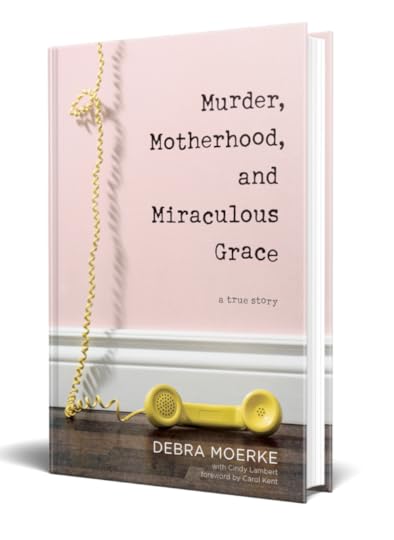
Five and a half years have passed. Today, it is my absolute pleasure to tell you about Deb’s book, “Murder, Motherhood, and Miraculous Grace: A True Story.”
Her story reminded me of a parable Jesus told. He said, “Everyone who hears these words of mine and puts them into practice is like a wise man who built his house on the rock. The rain came down, the streams rose, and the winds blew and beat against that house; yet it did not fall, because it had its foundation on the rock” (Matthew 7:24-25).
Deb and her husband Al built their house and life on the rock of Jesus Christ. They fostered children, hosted students from a local school for the deaf, and helped struggling friends by temporarily caring for their kids.

If I had known the Moerkes at the time, I would have expected God to spare them the steady rain, threatening floods, and repeated battering by the winds of tragedy.
They were not spared. While they were grieving and reeling, God made a mind-bending request, and Al and Deb said yes.
Their story rocked and inspired me. Murder, Motherhood, and Miraculous Grace is a testament to the undeniable, unexplainable, palpable presence of God. He empowers radical obedience and provides miraculous heart change even when the tragedy remains.
'Murder, Motherhood, and Miraculous Grace' is a testament to the undeniable, unexplainable, palpable presence of God who empowers radical obedience and provides miraculous heart change even when the tragedy remains. @shaunaletellier Click To Tweet
In places, the book is difficult to read. As the title implies, a brutal, and unnoticed, murder occurred. But long after the journalists had printed stories and the judges had hung up their robes, God wove redemption into tragedy, and we are witnesses to His glory. In Deb Moerke's story, God wove redemption into tragedy, and we are witnesses to His glory. @shaunaletellier reviews 'Murder, Motherhood and Miraculous Grace.' Click To Tweet
News feeds are littered with devastating catastrophes, but Deb’s story is proof that God deploys his obedient, ordinary people to tend to the carnage so he can bring redemption from rubble.
I invite you to get your copy here.
Deb’s Interview by Janet Parshall
Deb in her own words:

Debra Moerke and her husband, Al, were foster parents for eighteen years, taking in more than 140 children. Debra has served as the director of women’s and children’s ministries of the Central Wyoming Rescue Mission; the executive director of a Christian crisis pregnancy and counseling center; a jail guard; and a jail chaplain. In 2017 she graduated from Gateway Seminary in California with a certificate in Christian ministries. She is currently an associate real estate broker and owner of Stratton Real Estate. Debra and Al live in Casper, Wyoming and have six children and seven grandchildren.
The post How I Learned about “Murder, Motherhood & Miraculous Grace” appeared first on Shauna Letellier.
September 10, 2019
How to Hope in a Storm
That enormous flash of sunlight and heat that just flew by…that was summer! And with the close of the season comes our final Story of Hope from Lisa Appelo. Her summer has been a whirlwind of weddings, babies, and now Hurricane Dorian. But Lisa is no stranger to storms. Eight years ago, Lisa suddenly became a widow and single mom to seven kiddos. Today she’s shared her story of God’s faithful mercy before, during, and after a tragic family storm.
Be encouraged. Our hope, our certainty, is in God, even when storms are raging.
I’m writing this in the midst of a storm. Hurricane Dorian has been lurking for the last week and we are just now getting bands of wind and rain. We prepped and waited as it lashed the Bahamas, but the storm’s turned and, gratefully, we won’t get a direct hit.
Storms in life aren’t always so easy. Those usually come unannounced, washing over us with such fury that they threaten to pull us under completely. They leave a trail of destruction and often, life is never the same again.
Maybe you’ve had one of those storms?
Ours came a few years ago, in the midst of a glorious, ordinary summer.
I woke in the dark morning hours to the sounds of my husband’s heavy breathing and with eyes still closed, I reached over and nudged him.
“It’s just a nightmare, Hon. It’s okay.” A few seconds later, more awake, I realized this was not nightmare breathing and when I jumped out of bed to flip on the overhead light, I could see instantly that something was very wrong.
I went into storm management mode. “Nick, dial 9-1-1. Seth, run down and get our fireman neighbor. Rachel, take the little kids upstairs.”
As the 9-1-1- operator talked me through CPR on speakerphone and I counted out the compressions, my head swirled to take in the gravity of what was happening. Surely, I was not giving CPR to the rock of our family, the only man I’d ever dated, the amazing father to our seven kids.
“I love you, Dan. We love you,” I said through tears and through compressions. Was he still with us? If these were the last words he heard, I wanted him to know.
Within minutes the paramedics arrived and took over. I paced the living room in my nightgown. “Please, God, have mercy on us. Please Lord, give us your mercy.” Over and over I begged God out loud to spare us.
When the paramedics took Dan to the hospital, I went upstairs to see my kids before following the ambulance. The scene in their bedroom crushed my heart all over again. Six kids from four to 17 years old were on the floor together, each audibly sobbing. My oldest was at camp, still blissfully unaware of the black clouds hanging over our family.
Everything in me wanted to assure them their dad would be okay, but as the words formed on my tongue, I realized I couldn’t promise it. So, I did the only thing I could. I prayed with them. Then I hugged each one and told them I would be back.
Not long after arriving at the ER, I was called back to the room you never want to go into. A kind doctor came in, telling me they’d worked for over an hour but had never been able to revive Dan.
And in that moment, this storm we never saw coming engulfed all of life as we knew it.
Tomorrow’s plans, next week’s list, all our hopes and shared vision for our family were gone and would never be again.
What do you do in this kind of storm?
Honestly, part of me wanted to curl up and just let it wash over. It was too big, and I felt utterly helpless with the tasks ahead of me.
I had no idea how to lead my preschoolers, tweens, and teens through their grief, let alone try to grapple with mine. The future I thought would always be there now felt like a sheer drop off. I had so much fear for our finances, for decisions, for my children’s health.
How in the world would God fix eight broken hearts?
I had prayed for God to spare us from the storm. Begged him for his mercy and yet, in his sovereignty, God had neither spared my husband nor our gut-wrenching grief.
But I found God’s mercy everywhere.
His mercy met me each morning as I clung to his word and his promises, giving me just enough hope to show up for my kids and meet the tasks of that day.
He brought Bible stories and scripture I’d memorized to mind with new insight that lifted my heavy heart.
Multiples times, God gave me words to say to my children and others that felt like a direct download.
God met countless needs as they came up – a new to us car, college expenses for my kids, money for Christmas, and perfect part-time work.
His mercy showed up in the body of Christ who brought meals, who prayed faithfully, who took my sons fishing and cheered for my daughter, who came to clean the house or carol on the lawn at Christmas, who helped with driving and surprised us with flower beds on Mother’s Day.
In a thousand tender ways, God’s mercy has carried us.
After a family tragedy, Lisa Appelo asked herself, 'How in the world can God fix eight broken hearts?' In time she discovered, 'In a thousand tender ways, God's mercy carried us.' Stories of Hope by @appelolisa hosted by @shaunaletellierClick To Tweet
As I listen to the last of the wind gusting outside my window, I’m reminded that God’s mercy never guarantees the storms of life will bypass us completely.
God will not spare us from every storm.
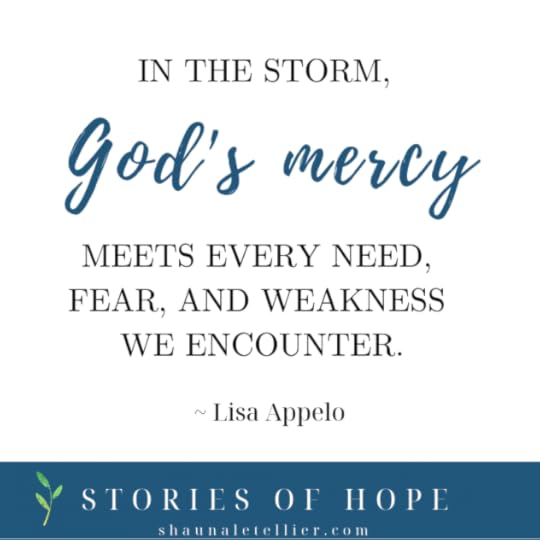
But God’s mercy is promised, and those mercies will meet every need, every fear, every weakness we encounter in the storm.
Facing a storm? Lisa Appelo writes, 'God’s mercy is promised, and his mercies will meet every need, fear, and weakness we encounter in the storm.' in the Stories of Hope Series hosted by @shaunaletellier. @AppeloLisaClick To Tweet
The steadfast love of the LORD never ceases; his mercies never come to an end; they are new every morning; great is your faithfulness. Lamentations 3:22-23 (ESV)
 Lisa Appelo is a speaker, writer and Bible teacher who inspires women to deepen their faith in grief and find hope in the hard. Eight years ago, Lisa became a sudden widow and single mom to 7. She’s passionate about rich Bible study and teaches a weekly ladies Bible class at First Baptist Church, Jacksonville. She’s a speaker with She Found Joy and has been published at Proverbs 31 Ministries, (in)courage, Risen Motherhood and more.
As a former litigating attorney, her days are now filled with parenting, ministry, writing, speaking and running enough to justify lots of dark chocolate. Find Lisa’s encouragement for faith, grief and hope at LisaAppelo.com and on Instagram @lisaappelo.
The post How to Hope in a Storm appeared first on Shauna Letellier.
August 6, 2019
What is God’s promise in my pain?
 This is the fourth article in our summer series, Stories of Hope–modern stories of people who placed their hope in Christ and felt–at first–disappointed with his plan, purpose, or timing much like the biblical characters of my book Remarkable Hope.
It’s my pleasure to introduce Glenna Marshall (again…she was a guest in November of 2018 as well!). Glenna is married to her pastor, William, and lives in rural Southeast Missouri where she tries and fails to keep up with her two energetic sons. She is a singer, songwriter and the author of a brand new book: The Promise is His Presence: Why God is Always Enough[image error], which I was privileged to read!
It is a stellar, biblical companion for anyone wrestling with deferred hope or grieving the life you thought you wanted.
Glenna has walked through infertility, chronic illness, and stressful relationships. As the struggles piled up, she discovered a life-giving promise and she’s shared it with us in her book. You’ll be encouraged by Glenna’s story of finding the certainty God gives even while we struggle. She’s talked about it on the Hope + Help podcast. (iTunes)
Here’s Glenna…
These are slow summer days, stretching long at the ends from first light to last. We drink them in deep swallows, savoring the absence of hurried schedules before school begins again. We sleep later than normal and wear pajamas longer than we should. The hours unspool without our notice or care. It seems a luxury.
I’ve not had such a peaceful summer in years, and I couldn’t put my finger on the reason until I remembered the shroud of pain that used to wrap me up tight with fear and misery. The familiar heaviness of summer heat has settled over our low corner of Missouri, a wool blanket dipped in boiling water and hung out to steam and dry above our heads. It’s hard to get a good breath when the air is so hot and wet. In being well these past three years, I’ve nearly forgotten the summers past when I struggled to separate the heat of a southern summer with the fire that encased my spine.
It was always hot, inside and out.
Four summers past, I was on the brink of a breakdown. My health had deteriorated to the point I was losing my hair, struggling to remember things, sleeping only an hour or two at night, wrestling with pain like it was my full-time job. Physically, I was wrecked. I was also losing my grip on faith. I’d been in pain for years, but in my sixth year of it I didn’t think I could take it anymore.
What if God never healed me?
I was sorely tempted to hold hands with bitterness. Bitterness is the knee-jerk response to suffering and easily justified when your present and future only look like pain. But bitterness is a difficult root to kill, the kind of plant nobody wants in their garden, a tangle of vines that spreads with ferocity. Bitterness is the kudzu of discontentment. At its best, kudzu cloaks the world in greenery, turning trees into stooped giants with draping, viny arms. It kills everything underneath, but it’s not until winter when we see the degree of damage. Kudzu inhabits what it covers. And I know that bitterness works the same, inhabiting the heart with tightly wound tendrils that suffocate life and light.
I was afraid of the kudzu effects of bitterness in my life. Desperate for relief from the inferno in my spine, I turned with halting steps and faltering prayers to Christ. I opened my Bible with fierce determination to come away changed. The believing part of me knew Jesus was the one to run to, but the doubting part of me couldn’t hold His gaze. I felt like Peter in Matthew 14, sinking in the Sea of Galilee, unable to take my eyes off the choppy, churning waves. But Jesus was Jesus, chastising my weak faith while also holding on to me. His grip was stronger than bitterness, His gaze steadier than mine. His strength overrode my weakness.
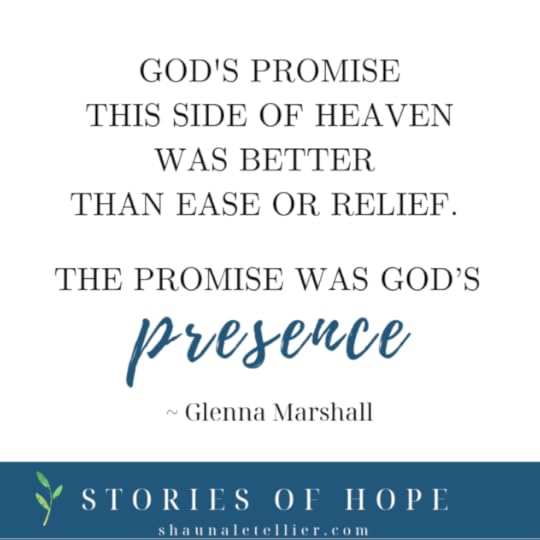
When I searched Scripture for some kind of promise that life would get better, I learned that the promise this side of heaven was better than ease or relief.
'When I searched Scripture for some kind of promise that life would get better, I learned that the promise this side of heaven was better than ease or relief.' ~ @glennadmarshall shares her story of hope hosted by @shaunaletellierClick To Tweet
As I walked the floor in pain, His words ran through my mind over and over again.
I am with you always. (Matthew 28:20)
I will never leave or forsake you. (Deuteronomy 31:6, Hebrews 13:5)
When you pass through the waters, I will be with you. (Isaiah 43:2)
I will be with you in trouble. (Psalm 91:15)
Nothing can separate you from My love, not things present or things to come. (Romans 8:35, 38)
While I waited long for healing, He held fast to me. He did it in every turn of the page in my worn Bible. He did it when I struggled to pin down the words to pray. He was present. Visibly, no. But in every way I needed, He was present because He has promised to be, even (and maybe especially) in pain and doubt. In the white-fisted vise of pain, I learned that Christ could sustain me. He could hold my gaze and teach me to hold His. He could deepen my faith when He reminded me who He was. And more valuable than a pain-free existence was the certainty that God was always with me.
I wasn’t healed that summer. My pain worsened, actually. It would be another year before I would begin to experience pain’s release. It slipped away slowly, hesitant to leave me, I guess. And then one morning, I woke with a jolt and scrambled to name the startling absence I felt. It was nothing. I felt nothing. Instead of a body on fire, there was just a body. I turned to the clock in a room bathed in bright morning light and realized I’d slept all night for the first time in six years.
When new trials press in so hard that bitterness begins to leak out, I stop to remember the way I called out to the Lord to heal me and the way He responded by being with me instead. I remember the words He spoke long ago that He would be with us in every dark valley of shadow and death. His words of promise and presence. Words I needed then, words I need now. Words that remind me that He is enough for every pain we feel.
'When new trials press in so hard that bitterness begins to leak out, I stop to remember the way I called out to the Lord to heal me and the way He responded by being with me instead.' ~ @glennadmarshall shares her story of hope hosted by @shaunaletellierClick To Tweet

Glenna Marshall is married to her pastor, William, and lives in rural Southeast Missouri where she tries [image error] and fails to keep up with her two energetic sons. She is the author of The Promise is His Presence: Why God is Always Enough[image error]. Connect with Glenna on Instagram, Facebook, Twitter, or on her website. [image error]
The post What is God’s promise in my pain? appeared first on Shauna Letellier.
July 16, 2019
When Your Hope Gets Hijacked
Our July “Story of Hope” is from my friend Yolanda Smith. In a “Yours, Mine & Ours” spin, she and her husband are parents to a combined total of twelve children. She has approximately a million practical tips on how to manage a dozen kiddos, and she reads more books than anyone I know. She is currently revising her first novel featuring historical Appalachian fiction which I’m dying to read.
I asked Yolanda to share her story because in an onslaught of devastation, her hope was shattered. But, as you may expect by now, when her hope was hijacked, Jesus swooped in to redefine and revive her hope in him.

Dolls and stuffed animals lined the foot of the bed as my sister and I held a conversation with our “children.” Like most little girls, we dreamed of the day we’d meet Mr. Wonderful, say, “I do,” wear lipstick and high heels, and pack our houses full of cribs and high chairs. We dressed our babies, shushed and burped them, and told them how much we loved them.
Twenty years later I was living the dream. I’d married a pastor. We had children by adoption and birth, and being a mom was my greatest joy. My wildest childhood prayers had become my reality.
But along with the fairytale came a sudden wave of terror. I’d never considered the possibility I might fail at parenting. What if my children turned out “wrong”? My worst fear was that someday they might abandon Christ and live for the world.
Parenting fears are normal, but mine were rooted in a false belief system. I had married into a cultish sect of fundamentalism that worshiped a transactional god. This god poured blessings on those who diligently followed his precepts and meted out chastisement for folks who strayed from his ways. I trusted Christ for my salvation, but I fell under the pressure of striving to please him and constantly earn his favor by my good works.
These notions played out in my parenting something like this: if I trained my children well, God would bless my efforts and all my kids would grow up to love and serve him. We would be an example of what a godly family should be. When they were grown, they would “rise up and call me blessed.” If I failed in parenting, I would reap the consequences. My children would bring me shame and sorrow, and I’d carry a heavy heart for all my days.
From the earliest days of parenting I recognized I had no ability to produce godly children on my own, and I thought I placed my hope in Christ to get us to the finish line. Nothing on earth was more precious than family, except a family rooted in Christ.
But hope in Christ, when tangled with the subtle skewing of scriptures, eventually becomes a cheap imitation. The thing I hoped FOR—a godly family—became the thing I hoped IN. If my children were spirit-filled Christ followers, it would indicate I had followed the precepts set before me in scripture, and God couldn’t help but be pleased with me. We would portray a picture of “successful” Christian living and what it meant to wholly follow Jesus. Faulty theology fueled both my fears and my pride.
I had also unwittingly placed my hopes in the teaching of my church. Our denomination believed we were the one group of Christians with the right Bible and the right doctrine. I was clueless how arrogant (and wrong) that statement was.
And when the children of other church members rebelled? Walked away from the faith? Those parents had surely done something wrong or harbored some secret sin. I observed their perceived failures from a distance and worried I might have missed something in my own parenting. I begged the Lord to spare my family from the same outcome. If I asked, he would surely answer.
Then life blew up in my face.
My husband was arrested on criminal charges. He’d done the unthinkable, and overnight I became a single mom with a passel of kids.
We were now a family devastated by sin and crime, separation and shame. My children were hurt tremendously, and the godly foundation I’d hoped to give them had gone up in smoke. I went from being a pastor’s wife—someone others looked up to—to being a criminal’s wife, then a divorcèe—someone despised and pitied.
All my efforts to raise a godly family had backfired, and the promises of God seemed to fall short. I cried out to him in anger and confusion. “I tried my best to obey you, and look where it got me! Is this how you bless those who try to live for you?”
But the moment I became a single mom, stepped away from the fundamentalist cult, and was truly “on my own” the Lord swooped in like the hero I always hoped he’d be. He was husband and father, protector and provider. He showed me the truth that had gotten buried by years of lies. I was insufficient, but he was indescribably sufficient. Pleasing him was not his ultimate goal for me. Rather, it was knowing and enjoying him. My hope had long since slipped down a glassy slope until it rested on a different patch of ground altogether. And now Jesus tenderly picked up the pieces and showed me he was my place of rest and healing.'Jesus tenderly picked up the pieces and showed me he was my place of rest and healing.' Today, @yolanda_smith_ shares her story of hope in a series hosted by @shaunaletellierClick To Tweet
He’d never left me, but I had lost sight of the gracious, loving Father he had always been. I’d misunderstood his expectations for me. Ours had been a religion of performance and image protection. And now I lived in freedom and a NEW hope, based on the truth and grace Jesus offered. “And since it is through God’s kindness, then it is not by their good works. For in that case, God’s grace would not be what it really is—free and undeserved.” (Romans 11:6, NLT)

My hope was no longer wrapped up in producing a godly family. I loved my children, whole or damaged, believing or unbelieving, and my identity wasn’t linked to my achievement as a mother. I could give my best parenting efforts to my children and, no matter how they turned out, Christ loved me the same.
Jesus was all I needed, and this hope transcended relationships and outcomes. I found peace in knowing he was sovereign.
Six years ago God allowed me to marry an amazing man, and we have a blended family of a dozen kids. Our children range from spirit-filled to slightly rebellious, solid citizens to desperate wanderers. They look nothing like the godly family I envisioned years ago, but my hope—and God’s love—isn’t based on their performance or mine.
God is the perfect father. And when his first children rebelled, he implemented his eternal plan. That plan included a cross, where Jesus took my guilt and shame and replaced it with peace and assurance of his great love for me. So, whether my family looks “put together” or a shambled mess, he loves and cares for me. Whether my children adore him or abhor him, God loves them better than I ever will, and that’s where I fully place my hope.
'Whether my children adore him or abhor him, God loves them better than I ever will, and that’s where I fully place my hope.' @yolanda_smith_ shares how Christ was the hero when her hope was hijacked. 'Stories of Hope' hosted by @shaunaletellierClick To Tweet
 Yolanda enjoys life in the foothills of North Carolina. In a “Yours, Mine & Ours” spin, she and her husband are parents to a combined total of twelve children. Yolanda serves on her church’s worship team, is a freelance editor, and writes in the cracks of life. She is currently revising her first novel featuring historical Appalachian fiction. A former member of a legalistic, cultish church, Yolanda is passionate about helping people find freedom in Christ. She is also enthusiastic about reading good books and correcting bad grammar. You can connect with her on Facebook, Instagram, Twitter or Goodreads.
The post When Your Hope Gets Hijacked appeared first on Shauna Letellier.
Stories of hope Yolanda
The post Stories of hope Yolanda appeared first on Shauna Letellier.
June 27, 2019
Chasing Hope through Grief
Our second story of hope in our summer series, is from Dorina Lazo Gilmore. Dorina is passionate about helping people navigate grief because she’s journeyed through it herself. Today she’s shared about her tremendous loss and how God brought her through and surprised her on the other side of grief.

Chasing Hope through a journey of grief
I was standing in the community garden on a field trip with my daughter’s second grade class when I received the phone call. My husband’s voice on the other end was hushed, notably different from his typical playful and loud coaching voice.
Results of biopsy. Melanoma cancer. I stood there frozen between the rows of kale and corn, holding a bag of water bottles for the kids. My healthy, athletic husband had cancer. At 40. I felt the wind knocked clear out of me. The fear started to suffocate me.
We had known for weeks about this strange bump on his right hip. I witnessed him experiencing increasing discomfort in that area, but we had believed as many had told us that this was a torn muscle. I had never let my mind wander to the C-word. My first instinct was to sink into a heap right there in the garden and cry. I had no idea what God was doing, but I knew He intended to use our story for His glory. I had to choose to push back the fear and cling to hope.
Clinging to hope as our anchor
As the summer progressed, so did my husband’s cancer. After a pet scan we learned that his cancer was in stage four. The cancer had already spread to his lymph nodes and spots were showing on his lungs. We canceled our mission trip to Haiti and our summer vacation. My husband stepped down from his jobs directing a non-profit and coaching at the CrossFit gym. We visited lots of doctors and considered lots of treatments. One way I chose hope in those moments was to bathe myself and my fears in God’s word.
A mentor of mine encouraged me years ago to make a little notebook of scriptures to read when I was fearful or anxious. In the doctor’s office and the hospital room, at home and in the car, I read these truths over my husband. I memorized them. These meditations lifted us out of the mental battle, the worst-case scenario fears that threatened to sink our ship.
The book of Hebrews talks about hope as an anchor: “Therefore, we who have fled to him for refuge can have great confidence as we hold to the hope that lies before us. This hope is a strong and trustworthy anchor for our souls” (Hebrews 6:18-19). During these months, as I watched my husband and all our dreams as a couple and family quickly deteriorating, I ran to my Heavenly Father for refuge. While everything felt uncertain, he was my confidence and strength. I knew He had been faithful in the past. My boat was weary and whipped by the stormy waters, floundering in the wind, but surprisingly my anchor was secure.
Hope journeys hand-in-hand with faith. Hope believes in the unseen. Hope is a confident expectation in the loving and deliberate work of the Father. It’s leaning into the pain and trusting the outcome. My husband took a giant leap into Heaven on September 9, 2014. That was certainly not the outcome I prayed for or expected.
'Hope is a confident expectation in the loving and deliberate work of the Father.' @DorinaGilmore as featured in a summer series 'Stories of Hope' hosted by @shaunaletellierClick To Tweet
After my husband’s death, I wrestled with God. Hundreds of people across the globe had prayed for my husband’s healing, and it didn’t come. But God was patient with me. If He could handle the bold prayers of Paul, the emotional prayers of David, and the heart cries of Job, then He could handle my doubting, imperfect, raw prayers.
Over time, I was reminded that just because we pray doesn’t mean we get our way. We don’t put in a certain amount of time on the prayer time clock to gain a certain outcome. In fact, the purpose of prayer is not to persuade God to do things our way; it’s to draw close to the Heavenly Father and sit in His presence. There in His presence, I found tender shoots of hope.
Grieving with hope
I know I cling to a different kind of hope than many people have. My grief is different from someone who does not have faith because I grieve with hope. I grieve believing I will see my Ericlee in the future. I draw hope from the knowledge that if we commit our lives to following Jesus Christ and share Him with others, our separation from loved ones on earth through death will only be temporary.
I have always loved the Bible story of Ruth. It’s a story of redemption. A story of beauty from ashes. An unexpected love story. A story of hope. Ruth takes refuge under the wings of God (Ruth 2:12), and He provides miraculously for her. When her husband dies, she remains loyal to her mother-in-law and takes a bold step to follow the God of Israel. The radical choice she makes to follow her mother-in-law, Naomi, helps her break loose from the chains of poverty. Through her hard work and integrity, she gains not just food but also the attention of a man named Boaz.
Not by accident I found myself reading the book of Ruth in the months following my husband’s death when I was learning to navigate my own grief. Although I had studied the book before, it gained new meaning for me as a widow. I read the story with fresh eyes and discovered something distinct: Ruth grieves with hope. Once a worshipper of pagan gods, she steps into God’s plan for her future. She experiences redemption and is grafted into the family tree of Jesus Christ. Her choices also bring hope and new life for her mother-in-law Naomi.
I began to pray that God would help me to live with courage like Ruth. Three years ago, through a wild weaving together of threads in my life, I married one of my late husband’s best friends, Shawn. He was a single friend who we had prayed for through the years. I believed God had a special woman for Shawn to marry one day. I never imagined it would be me!
Shawn has courageously walked through grief with my daughters and me. He has joined us in the daily dance of joy and pain. He has provided comfort, companionship and confidence where we needed it most. My girls love him as their new daddy. His presence in our lives is a daily reminder that we serve a God of hope who always holds our future in His hands.

Dorina Lazo Gilmore is the author of two Bible studies, Glory Chasers and Flourishing Together. She is also published children’s book author, speaker, blogger, runner, justice seeker, and mama to three active girls – ages 7, 10 and 13. Dorina is passionate about helping people navigate grief and flourish in their callings. Connect with Dorina at www.DorinaGilmore.com or on her Facebook author page. You can also find her sharing about daily life on Instagram as @DorinaGilmore.
The post Chasing Hope through Grief appeared first on Shauna Letellier.