
Louis Armand's Blog, page 4
October 23, 2018
GLASSHOUSE
[image error]ISBN 978-0-9931955-7-0. 128 pages. 1st edition. Paperback. Publication date: October 2018. Equus Press: London.
“À ces mots, il s’est tu. Assez de mots! Il c’est tué.”
Set in and around Jardin des Plantes, Paris, Europe, the World, the Universe, Armand’s short novel is a whodunit with multiple twists. The setting of the tale against a backdrop of fossils and marvels of taxidermy gives Armand’s story a macroscopic dimension. As if the evolution of an entire species could be compressed into several hours of a Sunday morning. As if a tale of a murdered schoolteacher and a vengeful mob could tell of speciation and extinction throughout the evolutionary history of life on Earth. And it can. Armand’s deftly written fragmentary narrative is a point-counter-point of silent unheard voices, whose apocalyptic finale eschews euphony in favour of a cacophonous refusal of resolution. “NO END” – loose ends being preferable to final solutions…
*Read an excerpt at Minor Literature[s]: “La Grande serre”
“Louis Armand is among the best literary authors working today. In GlassHouse, he ushers us into a world of intrigue, surreality and dark romanticism, exposing the intricacies of (un)consciousness with the combined flair of Joyce, Kafka and Burroughs. This is first-rate writing—Armand’s exquisite prose is a delicacy to be savored.”—D. Harlan Wilson, author of J.G. Ballard
“Armand writes to the self-reflexive atmospherics of a wild hallucinatory noir. His narrative folds itself again and again, so that each new chapter deepens a sense of cramped desolation and despair. The constant mood of this inescapable dread comes from the tangible stink of evil evoked by his image-lathered prose. He writes in vivid spit gobs of language that detonate carnal images into a wrecked spiritual landscape. Who are his characters? They’re fragments, angles and suffocating close-ups thrown back at us out of receding nightmares. And Armand really does get close up enough to show that not every argument from evil fails. If he’s asking what it would take to redeem these characters and their worlds he’s doing it knowing that if you have to ask then you aren’t reading him right. Armand’s is a bleak and fierce imagination, filtering life’s rancid nightmare through detective tropes that often feel like they’ve drowned. By the time we get to the end we realise the detectives and the dead are all skewered by the incoherence of any final resolution. That, and by Armand’s smart black humour. A great read.” —Richard Marshall, 3AM Magazine
“GlassHouse by Louis Armand should first be read as the novel that refuses at once any overload of words and the silence, as its epigraph in French suggests, because both overload and silence are fatal. It should also be read, as its title indicates, as the presentation and the defense of transparency. The latter is paradoxical since it is attached to the power of observation that the novel exemplifies and to the menagerie and exhibitions of the Musée d’histoire naturelle of the Jardin des Plantes in Paris, that it is to say, to the transparency of the glass that protects what is enclosed or fixed. This protection is synonymous with the spectacle and designation of the whole history of evolution with its continuities and holes. This double reading defines the poetics of GlassHouse — a detective story that should turn silence and clues into words and finally meets the enigma of the mob — and its universe, at once cosmic — the evolution commands a cosmic view — and strictly local — the Jardin des Plantes, its neighbourhood and its residents. Or in other words, a whole world and the cosmos are included in a glass house, the Musée d’histoire naturelle and the novel. Because the latter cannot be an overload of words, it offers only a series of portraits and scenes, from the offices of the Musée to the murder of a young female teacher, with many holes that are figurations of the hole of the universe. The portraits — a detective and his associate, a secretary at the Musée, the head of a department, his successor, a female student, some others, and a ‘fishboy’ — are kinds of images that confirm this novel is a play upon totalization and detotalization, lucidity and obscurity. It consequently offers an ironic or contradictory view upon our present, the alliance of realism and fantasy, causticity and playfulness.”—Jean Bessière, Sorbonne-Paris III
“A corpse slathered in ectoplasm has film noir detective Schönbrunn pursuing the killer rapist through a familiarly unrecognizable Paris – Louis Armand’s sectioned novella finds narrative creeping forth from an excavated Jardin des Plantes; seams of poetry spiel throughout a masterly array of vertiginous prose mechanisms – pitch visceral, snot-gilded sequences that leach forth plot at oblique slant. ‘The vast constellated grid was like a metaphor for all he believed in, all he’d sought to achieve or know, all he doubted.’ – Before we engage with their thoughts and actions, our protagonists’ names themselves spin about arresting conceptual orbits: a Lacanian conceit of Oneness; the baroque architecture of imperial Habsburg; racial politics; keyboard Kabbalah of Mitteleuropa; the prophet Mohammad; an evolutionary algorithm that creates computer programs who adapt like a living organism (GEP); a dildo in the shape of a penis with a scrotum; the trigger of a gun; an extinct genus of lobe-finned fish ‘who lived a long time ago in a rock’, and of course is a stoner. Ruinously crystalline, GlassHouse confines a rewarding pell-mell of literary tip-offs and esoteric taxonomies, fracking each other up before the fatality’s dissolve to lucid absolute – all this, plus an inexplicable fear of ants, Persistent Genital Arousal Disorder, oasis pelicans and a wallaby enclosure: ‘How, despite everything, Paris always gave him, Qwertz, the impression of God staring down into his own navel. . . .’ – maelstromphalos, ripper.”—Richard Makin, author of Dwelling
“Set around the same Parisian Jardin des Plantes which inspired Goethe and Rilke’s romantic outpourings, GlassHouse offers a counter-narrative to this tradition by leading natural history to the point of its autocritique, where words and things have a hard time matching. By cycling through a host of vividly realised characters and stylistic modes, between searing black humour and soaring unfettered poetry, it decomposes rigid arborescent taxonomies into prismatic subdivisions of the event. Poised in this uncanny border zone of the incompleteness of formal systems, this is writing which pushes language to a state of disequilibrium.”—Thomas Murphy
.


CITY PRIMEVAL: NEW YORK, BERLIN, PRAGUE
[image error]curated by Robert Carrithers & Louis Armand
552pp. ISBN 978-80-7308-726-5 (paperback, full colour). Publication date: September 2017
CITY PRIMEVAL is a constellation of personal documentaries of place & time by key contemporary writers, poets, musicians, designers, filmmakers, photographers, artists, editors, performers from within the New York, Berlin & Prague underground scenes from the late 1970s to the present; from New York Post-Punk & No Wave, to the fall of the Berlin Wall & Reunification, to the Velvet Revolution & the Prague Renaissance; including contributions by Bruno Adams, Penny Arcade, Louis Armand, Dale Ashmun, J.Jackie Baier, Markéta Baňková, Varhan Orchestrovič Bauer, Lina Bertucci, Gaby Bíla-Günther, Mykel Board, Victor Bockris, Christoph Brandl, Gary Ray Bugarcic, Robert Carrithers, David Černý, Roman Černý, Michal Cihlář, Antonio Cossa, William Coupon, Max Dax, Christoph Dreher, Sara Driver, Glen Emery, Vincent Farnsworth, Nat Finkelstein, Roxanne Fontana, Thor Garcia, Susanne Glück, Carola Goellner, Anthony Haden Guest, Carl Haber, Jex Harshman, Henry Hills, Nhoah Hoena, Michael Holman, John Hood, Chris Hughes, Jolana Izbická, Timo Jacobs, Bethany Eden Jacobson, Tobiáš Jirous, Bettina Köster, Julius Klein, Hubert Ketzschmar, Jaromír Lelek, Lydia Lunch, Rinat Magsumov, Peter Milne, Steve Morell, Mona Mur, Julia Murakami, Shalom Neuman, Paul Pacey, Puma Perl, Rudolf Piper, Rudi Protrudi, Mark Reeder, Marcia Resnick, Ingrid Rudefors, Ilse Ruppert, Šimon Šafránek, Honza Sakař, Oliver Schütz, Marcia Schofield, Tom Scully, Semra Sevin, Phil Shoenfelt, Peter Smith, Azalea So Sweet, Mark Steiner, Kenton Turk, André Werner, Ian Wright, Nick Zedd, Dave Zijlstra, Richard & Winter Zoli, Miron Zownir.
“This book perfectly captures the unique personalities of the many artists, musicians, writers, performers and just plain kooks who made the 80s zeitgeist rock!” – Ann Magnuson
August 10, 2018
THE GARDEN
[image error]In 1994, in the company of Italian anarchist & photographer “Dekaro,” the author travelled across Morocco & the disputed Western Sahara. The notebooks from that journey furnished the basis for The Garden which, after appearing piecemeal in magazines, was published as the inaugural title in the Salt Modern Fiction Series (Cambridge, 2001). Long out-of-print, this complete, unexpurgated edition restores to its full scope a work that more than twenty years after it was written remains confronting. Hashish-infused, amphetamine-driven & ranging in bold thematic cross-cuts from the seminal “garden” of the Book of Genesis to Hieronymous Bosch’s Garden of Earthly Delights & The Perfumed Gardenof Shaykh Nefzawi to Pierre Guyotat’s Eden Eden Eden & Derek Jarman’s film of the same name, Armand’s The Gardenis by turns excoriating & lyrical, political & pornographic, a blasphemous ransacking of literary & theological pieties – “a practice, an ascetic aesthetic,” as McKenzie Wark wrote in one early review, “for moving toward feeling in the pure form of its impurity.”
Published by Minor Literature[s] in 6 parts (8, 15, 22, 29 August & 5, 12 September 2018)
Part 1: https://minorliteratures.com/2018/08/08/the-garden-1-louis-armand/
May 8, 2016
THE COMBINATIONS
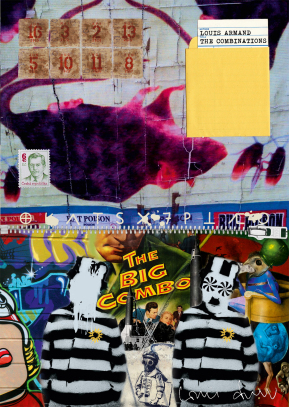 ISBN 978-0-9571213-6-2. Paperback. 888pp + xxxvii. Publication date: May 2016. Equus Press: London. Order direct from Equus Press (paperback only); or via Amazon UK / US; or try the Kindle edition.
In 8 octaves, 64 chapters and 888 pages, Louis Armand’s The Combinations is an unprecedented “work of attempted fiction” that combines the beauty & intellectual exertion that is chess with the panorama of futility & chaos that is Prague (a.k.a. “Golem City”), across the 20th-century and before/after. Golem City, the ship of fools boarded by the famed D’s (e.g. John) and K’s (e.g. Edward) of the 16th/17th centuries (who attempted and failed to turn lead into gold), and the infamous H’s (e.g. Adolf, e.g. Reinhard) of the 20th (who attempted and succeeded in turning flesh into soap). Armand’s prose weaves together the City’s thousand-and-one fascinating tales with a deeply personal account of one lost soul set adrift amid the early-90s’ awakening from the nightmare that was the previous half-century of communist Mitteleuropa. The Combinations is a text whose 1) erudition dazzles, 2) structure humbles, 3) monotony never bores, 4) humour disarms, 5) relentlessness overwhelms, 6) storytelling captivates, 7) poignancy remains poignant, and 8) style simply never exhausts itself. Your move, Reader.
“Kafka’s The Trial meets Robert Musil’s The Man Without Qualities.”
Read an excerpt from THE COMBINATIONS in Offcourse #60, March 2015, “The Case of Eldrich von N.”


August 23, 2015
ABACUS
 220pp. July 2015. ISBN 978-1-922181-49-7. Cover art by Glendyn Ivin
A decade-by-decade portrait of 20th-century Australia through the prism of one family. Abacus is a novel about the end times, of generational violence and the instinct for survival by one of Australia’s leading contemporary poets.
“There is writing here that is twisted towards poetic vibrations of disgust and horror that’s inevitably funny in a wry desolate register, making the reading a degenerate pilgrimage.” Richard Marshall, 3AM Magazine
“Abacus weaves an erudite but harsh beauty from the tattered seams of Australian history.” Cameron Woodhead, Sydney Morning Herald


June 22, 2014
Shot and Countershot
by Louis Armand
Spencer Dew
First published in decomP magazinE
http://www.decompmagazine.com/canicul...

“Close-up of the plaid bathing suit above a double exposure of a fish,” writes Lorca, in “Trip to the Moon,” a cinematographic poem, a poem not only written under the sign of cinema, but mimicking the tactics thereof, such that we get:
Motion (“With a greatly accelerated rhythm, the camera descends the stairs...”)
Visual staging (“The circulatory system is drawn on his naked body”)
Literal renderings of imagery (“A guitar appears, and a hand quickly cuts the string with scissors.”)
Nods to noir, pulp mystery (“They wear their collars turned up.”)
Self-referentiality, the wink of kitsch or wilted shrug of nonetheless effective cliché (“Shot of a vulgar cinematic kiss”)
And, finally, montage: (“These words fade out into faucets violently gushing water.”)1
Eisenstein, quoted in this novel, Canicule, the name of a film and the name for that stretch of long and hot days as summer peaks: “Cinematography is, first and foremost, montage,” he says. Montage gives us surrealism, something Lorca appreciates, but cinematic montage is super-realism, thing linked to thing, a suturing of images undeniable on the big screen, illuminated.
This novel offers a meditation on the image, alone and in progression. It, too, is written under the sign of cinema, mimicking the tactics thereof, narrative interspersed with stills from films, or those images intercut with narrative pieces, assembled out of order but in their own insistent order. Montage / Juxtaposition / Shock. Suicide-by-petrol, a bathing suit, the sun, Black September, Sarajevo:
Like being locked in an editing room with a pile of random out-cuts I’m supposed to splice together into sequence. To establish some sort of continuity my any means possible. With the added constraint that I’m only allowed to see each of the frames once.
I start with the sea, citation, marine life on the beach and in the water, both because Lorca offers an uncanny echo to this entrancing novel but also because so much comes back to the sea, its motions, its force, its mystery and smells and possibilities and uses as flat but richly associative landscape. The shape of the so-called jellyfish matters here, to Armand, a creature which inflates like a burn mark across celluloid, pulsing, its own engine, and named in French for the Gorgon Medusa, she who cast things as images via her gaze: freeze-frame. Scenes of beaches repeat: a girl in a red bikini, a man kneeling in a suit, a crowd examining some sort of creature... Juxtaposition / Montage / Shock. History as a string of fragments, spliced together, characters overlapping and then gone...
Black sand stretches away as far as the humid mind’s eye can see. Branching, in the middle distance, an inky channel flows north to the sea, flanked by tidal flats. Sheets of greasy water in which heron stand, thin, grey, calligraphic. The longer you look, the greyer they become, drawn shapes bleeding at the edges, contrast dialled to zero. To the left, a strip of shaly beach slopes into the water, fringed with pines, grassed dunes where the broken ends of stormwater drains vent their discard. A saturated, estuarine smell lingers in hot unshifting air like sex or effluent. Reminding of wet concrete floors in public shower blocks. Grey-white flowers loll above reeds and spear grass, casting no shadows. Across the sandbar, seagulls swoop at a carcass exposed by the surf, chased away by a yapping mutt.
A tracking shot, to establish the sort of chops Armand brings to this game. Writing, ladies and gentlemen. Armand may pay tribute to filmmaking, to the medium that is film, but he knows from writing and he writes, even speaking of and to cinema in a way that cinema itself, locked in images, cannot:
I went alone to cinemas and watched the same films over and over again, absorbing the lives of others, trying to divine the secret of the tortured soul. But my conscience would never be pure. Staring into the screen the way a man stares at a mirror.
Having established a narrative voice, a narrator, Armand flashes back and forth, a memory of rosemary, the Paris heat wave, Reagan’s Strategic Defense Initiative, George W. on Iraq, corporate capitalism as the only true revolutionary force in the world, 1983 and the US embassy bombing in Beirut, the trajectories of our main characters overlapping. An encounter, in memory and imagination, fanning out to events, global and intimate. All in an image:
I wait facing the dead Indian outside Wenzel’s concession. The old chief always seemed bigger when I was a kid. Perhaps he just shriveled up as the world got smaller. I want to ask him if humanity can ever be content, but it’s an idiotic question. It reminds me of Nietzsche’s last letters, when he wrote how he’d go around the streets tapping strangers on the shoulder, and shout at them: Are you happy? I’m God, I made this caricature.
One character is an explicit, which is to say self-identified, revolutionary, for whom “politics . . . was and always has been a sadistic little boy’s adventure. An endless erotic struggle with death.” Film in the French tradition, titles of Freud and Marx, assigned in one case as arrows pointing to the head and crotch, respectively, of a nude girl on the beach, or one that in any case seemed nude, as the image flashed by, was perceived and remembered as such. Entertainment or enlightenment? Art and capitalism. A cigar store Indian, icon of the New World and genocide, addiction, expansion, the fable of the ever-West. Stills in shot and countershot. Shock / Juxtaposition / Montage.
Is there any good reason for blowing someone else up? This is another question Armand wants to ponder, in slow-motion, a botched execution on some tarmac somewhere temporary. History: “Like a film driven by internal tensions only incidentally related to the characters and plot. Is history just 24-hour news fed on a loop?” Wolf, the revolutionary character, says that history doesn’t exist. Only memory and dream. And in this book, the mechanics of which follow those of film, this is expressed by a character proposing an image, on Reinaldo Arenas: “He was a Cuban writer. He committed suicide in New York, where he was dying of AIDS. Before he killed himself, he wrote that an exile is a person who, having lost a loved one, keeps searching for the face he loves in every new face. And forever deceiving himself, thinks he’s found it.” The image as an image of an other, which is another way of saying the image as ineluctable, irreplaceable, though even when presented in endless waves, seemingly the same, crashing and crashing, eroding everything else, such that self and time or politics and history are so much powdered glass swallowed and spread, a shifting horizon visible only in extreme time-lapse.
But do images have meanings? This, to me, seems key to Armand project, or, rather, a recurring question in the book, predicated on an answer, a dynamic, which is key to the project. Our narrator keeps a notebook, no longer for the purposes of building a film but now as something like a source for potential divination, “a repository—for scraps, pieces of evidence to prove the inner life hadn’t yet completely withered away.” This is beyond politics, resisting the category of production, work. Rather than splicing such images into chronological order, forcing them to become a piece, the images are appreciated for their own innate quality, which is like that of being alive, flickering with association:
The tiniest fragment breathes forth its connection to everything else. The unknown under the surface of the water. A suppressed thought about to return, threatening to return, having already returned.
The image, received always as alive. Film stills as anything but—vibrating, rather, or, in Armand’s phrasing, “breathing forth.” Film as revolution, the array of images, their flickering projection. Marx here, Freud here: and in between, that ocean of the organic, just beneath the concrete; the beach, just below the pavement.
1. Translated by Greg Simon and Steven F. White, pp. 749-55 in Federico García Lorca, Collected Poems. Revised edition, with an introduction and notes by Christopher Maurer. New York: Farrar, Straus and Giroux, 2002.↑
May 29, 2014
INDIRECT OBJECTS
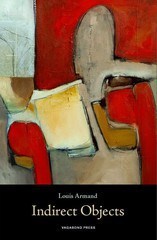 Published by Vagabond Press and launched at the Sydney Writers’ Festival by Pam Brown, INDIRECT OBJECTS is an exploration of physical, psychological and linguistic topographies forming a poetic grammar. The indirect objects of the title are emergent states of experience, perception as language, the unarticulated “real” we encounter as strange and remote in even the most familiar forms of saying. The volume is divided into five sections – “Realism,” “Dark Mingus,” “Broadcast Graffiti,” “Zapata Retrospect,” and “Tür zum Nichts” – each concerned with an exploration of landscapes of fact. Armand’s poetry is populated by places, people, things whose existence describes a potential contained in language as singular and vital as they are.


February 10, 2014
BEWARE THE SAVAGE JAW!
http://equuspress.wordpress.com/cairo/
February 5, 2014
CAIRO
What do a crashed satellite, a string of bizarre murders and a time-warp conspiracy have in common? Welcome to CAIRO, where the future’s just a game and you’re already dead.
Set between New York, London, Prague, Cairo and the Australian desert, CAIRO has been described as “a vivid, dizzying and ultimately exhilarating exploration of the global nightmare… forceful and convincing and fist-pumpingly hilarious” (Thor Garcia, author of The News Clown).
“A genre defying anti-novel… Like communism it is the movement of vast majorities unfettered by a state!” Stewart Home, author of Blood Rites of the Bourgeoisie
Cairo. ISBN 978-0-9571213-7-9. Paperback. 366pp. January 2014. Equus Press: London. Kindle edition on Amazon UK / US. Paperback on Amazon UK / US
Frightening, hilarious, insane…
Shortlisted for the 2014 Guardian Not-the-Booker Prize
“Hard to find this kind of fusion-lit combining highbrow sci-fi with semi-noir mystery; nearly impossible to find it done well. Hell yeah it’s a romp, but it’s a serious, time-shifting, corpse-bumping romp as Joblard the anti-hero lurches through a grungy kaleidoscope of a world.” Vincent Farnsworth, author of Theremin
“The book follows a disparate collection of narrators. Lawson is an Aboriginal geophysicist in central Australia, tracking meteorite debris to sell to collectors. Osborne, a lost soul in New York City, is recovering from a mental breakdown with the help of the mysterious Dr Suliman. Joblard is a former heavyweight boxer turned low-level thug, working for a pornographer with a fascination for the weird. Shinwah is an assassin from the future, tasked with hunting down anachronisms – future technology – in our present. The fifth protagonist begins the novel nameless and confused, waking in a Cairo that doesn’t yet exist, led by instinct through its decaying ruins to an uncertain destination. An apparent accident, the destruction of a previously unknown satellite, brings each of these characters into conflict with shadowy forces.” Sky Kirkham, Australian Book Review
“A timely reminder of what fiction can do when it chases ideas, Cairo will reward those looking for a way to escape the enclosure of realism, cutting a hole in the fence so readers can wriggle out into the more interesting and dangerous terrain of the unknown.”Jennifer Mills, Sydney Review of Books
“CAIRO… is a reflection not only of the current independent European publishing scene, but also of literature’s ability to globalize.” Mycah McCrary, Bookslut
“Beware the savage jaw. The future is here now, and it’s gonna eat you up and shit you out like a half-digested Wozzie Burger. Louis Armand as the Swiftian prophet of the Virtual Age? CAIRO is the best psychogeographic sci-fi detective novel I’ve read. An original take on the genetically engineered, pornographic surveillance state that we are living in right now (in case you hadn’t noticed). Dark, frightening, hilarious and utterly gripping.” Phil Shoenfelt, author of Junkie Love
“CAIRO is downright playful… filling us in on not only the tangible space, but also its sonic properties, its perfume, truly creating in three dimensions the underbelly of the underbelly.” Benjamin Woodard, Numéro Cinq
“Armand’s prodigious gifts as a storyteller, wordsmith, imagineer and general fiend are copiously and carnivorously on display in this wonderful, horrifying book. CAIRO is a vivid, dizzying and ultimately exhilarating exploration of the global nightmare and our big ideas about mental illness and democracy. Raw and ruthless, yet richly detailed and human, Armand takes a circular saw to the dusty corpse of western narcissism and the dread afflictions that torment and beguile the contemporary psyche. Peopled with a staggering array of the doomed, depraved and flat-out zorched, everybody’s on the last gasp and time’s running short. It’s forceful and convincing – and fist-pumpingly hilarious. Armand is a formidable, first-class writer.” Thor Garcia, author of The News Clown
“CAIRO is a dazzling cross-genre novel, blending sci-fi, noir fiction, surrealism and satire all mixed with a smidge of Pynchon.” Ken Nash, author of The Brain Harvest
“Much has been written about Louis Armand’s affinities with noir fiction and cinema. His eloquence dealing with the sordid reminds one of Raymond Chandler, and in CAIRO his cinematic cuts from short chapter to short chapter containing seemingly-unrelated plots remind one of the best of film spy thrillers. But imagine the hallucinatory opening of The Mystery of Edwin Drood punctuating a whole book; imagine the fog and smoke darkening the beginning of Bleak House, the dust penetrating Our Mutual Friend darkening our whole planet. Imagine an author as familiar with the landscapes of New York, Northern Africa, London, Prague, the Australian outback as Dickens was with London, The Thames, and Rochester. Imagine the latter’s 19th-century grime become radioactive, dusting our globe. Then imagine a frustrating and destructive conspiracy like Dickens’ Chancery insinuating itself everywhere, but armed and dangerously aware of all current technologies, and characters’ lives caught up in this conspiracy they understand no better than Chancery’s victims understood their tormentor. All this comes to you, no at you, in a complex style that blends staccato phrases, short sentences, deadpan observation of amazing phenomena with apt quotations from philosophy, and with an instructive but never bothersome range of technical information. A gripping, lively, intelligent novel both rooted in tradition and absolutely current. And hip: why give up style when all the lights might go out?” Lou Rowan, author of Alphabet of Love
“A grim and hilarious reckoning with the future and how we got there. Jonathon Swift on a crack binge channeling James Ellroy on a transnational time-warping blitz through the contemporary hallucination and these strangest of end days. Compulsive reading, relentless, unlike anything you have read but uncomfortably close to the life you’ve been living in some fractured corner of the moment.” Michael Brennan, author of Unanimous Night
“A dark, challenging, dystopian novel that is addictive to read. It warps the boundaries of genre, time, identity and place. It’s like being sucked into a video game where you have to figure out the rules on the go. You hit the ground running and hold on till the end with this novel. I’ve not read anything quite like it before.” Michele Seminara, author of Everything Strange & Sacred
“Cairo is an anachronism waiting to happen, a black hole, a black-market book, a demolition of the corporate oasis, a walk through the city of the dead. Transnational but never global, CAIRO is also what WILL happen if things go on as they are. Shinwah’s gaze meets the picture of a future more artificial and more real than you could ever imagine. A novel of ruins. The name of a place. A return to zero, the apex of all possible futures. Psycho-pharmaceutical biocapitalism is tomorrow’s news; so ours too. Cairo: a perfect encapsulation of what it means also to be living in the end times.” A.J. Carruthers, author of The Tulip Beds
“A terrifying and mad mix of sci-fi and international conspiracy.” Damien Ober, author of Doctor Benjamin Franklin’s Dream America
CAIRO, a novel
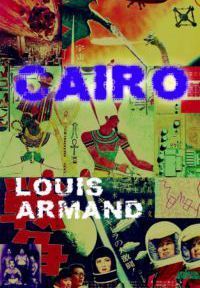 “Frightening, hilarious, insane…”
What do a crashed satellite, a string of bizarre murders and a time-warp conspiracy have in common?
Welcome to CAIRO where the future’s just a game and you’re already dead.
Set between New York, London, Prague, Cairo and the Australian desert, CAIRO has been described as “a vivid, dizzying and ultimately exhilarating exploration of the global nightmare… forceful and convincing and fist-pumpingly hilarious” (Thor Garcia, author of The News Clown).
“Cairo is downright playful… filling us in on not only the tangible space, but also its sonic properties, its perfume, truly creating in three dimensions the underbelly of the underbelly” (Benjamin Woodard, Numéro Cinq).
From the author of BREAKFAST AT MIDNIGHT “a perfect modern noir” (Richard Marshall, 3AM)
ISBN 978-0-9571213-7-9. PAPERBACK. 366PP. PUBLICATION DATE: FEBRUARY 2014. EQUUS PRESS: LONDON.


Louis Armand's Blog

- Louis Armand's profile
- 126 followers

