
Srini Pillay's Blog, page 3
March 24, 2019
Inside the Mind of a Troubled Leader
Srini Pillay, M.D. and Jim Selman

It is not easy to be a leader of any business.
Leader Challenges: CEOs are challenged by various factors including the governance structure and board composition, as well as the four factors pointed out by McKinsey senior partner Richard Dobbs and his colleagues: the rise of emerging markets, the accelerating impact of technology on the natural forces of market competition, an aging world population, and accelerating flows of trade, capital, people, and data.
Mindset Challenges: Given these challenges, the mind of a company leader is often overrun with self-doubt, fluctuating confidence, uncertainty and fears.
Traditional Approaches: Traditionally, we think of helping leaders by understanding and addressing the factors underlying these emotional states, but there are several problems with this approach: (1) There are too many possible “causes” of these emotional states. We do not really understand the mechanisms behind our emotions at any given time; (2) Getting leaders to talk about their emotions usually does nothing and may actually worsen the trauma that a CEO is experiencing. For example, among police officers who responded to a civilian plane crash, those who underwent debriefing exhibited significantly more disaster-related hyperarousal symptoms at an 18-month follow-up than those who did not receive the treatment; and (3) Reality is counterintuitive to what we would expect. For instance: People often do the opposite of what they are told. Some people dislike receiving a favor. Propaganda is frequently ineffective in persuading people. And the grass is often greener on the other side.
A New Approach — Existential Confidence: Instead of targeting a “cause”, asking leaders to debrief their challenges, or relying on reason alone to alleviate the troubles in the mind of a leader, we propose a new leadership model that will embolden leaders. This model is based on a way of being called “existential confidence”.
The term “existential confidence” (EC) refers to a way of being in which we trust the way we are. In this state, we believe that we are sufficient enough to deliver on promises that have not been delivered in the past.
In 1978, psychiatrist Benjamin Wolman explained that EC requires high self-esteem, confidence and morale. And in 2010, author David Grossman referred to EC as an optimism that would come from expecting to live your life in peace without the threat of violence and despair looming around every corner.
When we have EC, we drop our shields of defense and allow other people to see us fully, so that we can see them fully. And we also have a comfortable relationship with the mysteries of existence.
Essentially, existential confidence stems from self-actualization.
Components of Existential Confidence: So how do you develop this sense of self sufficiency, and what mindset shifts can help to foster it? To help leaders develop more boldly, we have identified 10 mindset shifts that leaders can use to change how they lead. Each of these has a philosophical, psychological, and brain-based foundation that will help leaders lead with greater boldness.
When you are a leader with EC, you lead more boldly when you do the following:
Create problems worth solvingLearn how to navigate without controlLead from possibilityLearn how to develop an actionable imaginationLead from the future — let the future use youUnderstand paradoxLearn to trust the process deeplyUse language to create your realityLet your commitments determine your realityRecognize that caring is the foundation for relationship and possibilityDifference between Traditional and EC Ways of Being: The table below illustrates how these competencies contrast with existing approaches.
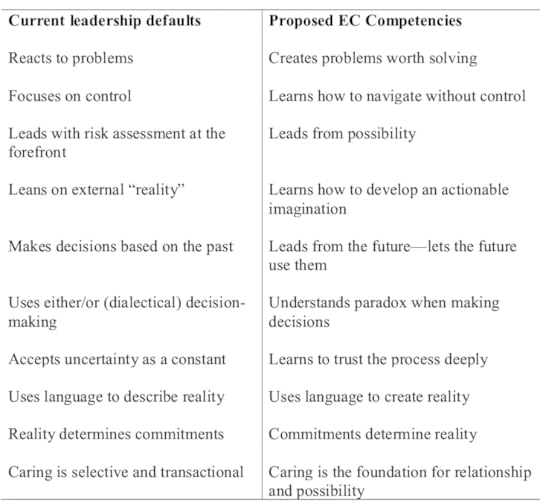
Each of these competencies is a radical shift from simply being a reactive leader. It places the leader in the driver’s seat, psychologically and strategically, but it also helps the “passengers” enjoy the journey.
After all, living with a knot in your stomach and a constant voice in your head that asks, “Will this really work?” is no way to lead a life. EC is a way of being that can embolden leaders as they deal with the daunting and changing realities of the business landscape and their lives.
We invite leaders to consider these ideas. In future blogs, we will propose the structures and practices associated with each of these principles to implement within an organization.

Inside the Mind of a Troubled Leader was originally published in Center for Existential Confidence on Medium, where people are continuing the conversation by highlighting and responding to this story.


Inside the Mind of a Troubled Leader

And a proposed solution called “existential confidence”
March 17, 2019
Thank you for your comment.
Thank you for your comment.
In response to your comments, I would say the following: people of all ages experience anxiety, struggles with perfectionism, and a search for meaning with many obstacles along the way. So, I think all people would benefit from love and support.
The reason I focused on millennials in this piece was related to the alarming rise in depression and suicide in this age group. Yet, even though it is lower in other age groups, it remains a top concern in all age groups, so I appreciate your prompting me to point this out.
However, it’s also probably true that different generations experienced different stressors. Generation X would be people born from approx. 1965–1980 (39 to 54 years old.) and millennials would be people born from approx. 1981–1996 (23–38 years old).
Richard Dobbs and his colleagues in “No Ordinary Disruption” pointed out the increase financial volatility from 1990 to 2000 and then 2010. (https://bit.ly/2Y3nR5b).
They also pointed out a 5X increase in goods, services and financial flows from 1990–2012 and a 3X increase in international migration from 1960–2013.
The oldest gen X’ers would have been entering the workforce at age 21 in 1987 whereas the older millennials would be entering the workforce at age 21 in 2002. There were huge differences in financial volatility, goods, services and financial flows and international migration then. The youngest in each category at the 21 would be entering the workforce in 2001 and 2017, and again, the volatility is significantly higher for millennials. These are just a few examples of environmental stressors that could have an impact.
Also, technology demands and change are significantly higher, and there is some evidence that older generations use more self-control while younger generations use more escapism (https://bit.ly/2Fj1hxX).
So, one question is: Do millennials use less self-control or is their self-control so impaired by financial and other volatility that they wish they could do what the older generations could, but they can ‘t?
More importantly, can we reach out to them (and people of any other age group suffering the same) to help them with the repercussions of these challenges? And what can we do to stop this alarming increase in suicides?
That said, if your basic points are that some self-control and resilience is necessary, I would agree. And I too admired the resilience of my parents and grandparents through tremendous hardships.
It’s just currently quite clear that depression, anxiety and suicide are higher in millennials. Perhaps we can use the resilience we have learned to help them? And perhaps they can help us with the disorienting change around us too?
I agree with your thoughts about boredom, disengagement and the need for reskilling too. These are other big issues that I believe we need to take on, while having fun in the process.
Thanks again for sharing your thoughts and experiences.

March 16, 2019
Is Anyone Noticing That Millennials Are Killing Themselves at Work?
Why the veil of our denial needs to be lifted

“I don’t know what to f*cking do”, said a millennial client of mine . “I can’t stand anything. I hate technology. I hate whiny people on the Internet. I hate having to change jobs all the time. I hate my family for wanting to keep me alive. And I hate you for the same reason.”
This was not a young man who was prone to tabloid lip service. He was done with the “look on the bright side”, “be positive”, “make a list of things you’re grateful for” type of superficial advice. He was disappointed that I couldn't change the world, and he didn't want to change himself to adapt to it either.
I’d like to say that this story is rare. Yet, as a psychiatrist and executive coach, this is not an unfamiliar one.
Though their dejection may not be as severe, many other clients who fall into the same age group are also lost, overwhelmed, confused about their careers, and lonelier than ever.
When I mention this to colleagues in other fields, they often say “That’s the problem with people in this age-group. They don’t know about adaptation. They’re allergic to effort.”
But there’s something more serious going on: Millennials are “the anxious generation” with a texture of suffering that stands out.
They’re lost, and the world around them is moving on with or without them. That’s why they want to metaphorically jump off the train, even though they’d be better off seeking help.
Mental health problems of millennials: According to the American Psychological Association, 12% of millennials have an officially diagnosed anxiety disorder — which is nearly double the percentage of baby boomers. And other sources have found that anywhere from 30–60 percent of millennials are generally anxious. They are also prone to perfectionism and are experiencing higher levels of depression too.
A 2018 study demonstrated that millennials have higher rates of binge drinking and substance abuse associated with the global financial crisis.
One major result of this mental health burden: SUICIDE. For people who fall into this age group, suicide is the second leading cause of death — more than cancer, homicide, diabetes, pneumonia or heart disease. And between 2000–2016, the suicide rate of the US working population increased by 34 percent.
Why is this happening? In 2019, work and organizational psychologist Tariku Ayana Abdi and his colleagues found that among 783 Spanish workers whose satisfaction and health were measured, most people were unsatisfied and/or unhealthy. Among the factors causing this distress were:
Low level of job importanceHigh level of job ambiguityOver-qualificationRole overloadRole conflictPsychiatrists do not have access to the majority of people in these work situations. It’s incumbent upon leaders within organizations to address this. In fact, 24 percent of millennials think that most people with a mental health condition can get well on their own without professional help.
Why suicide? In these days of rushed and diagnostic psychiatry, the most people understand about suicide is that it might have been impulsive, or due to depression, anxiety, mood swings or drugs. Yet, it has been recognized for a long time that death signifies so many different things to the young. Sometimes, a deeper examination helps.
When people kill themselves, they are usually experiencing rage, hopelessness, despair, and/or guilt. And for different people, death may signify reunion, rebirth, retaliatory abandonment, revenge, and self-punishment or atonement. These are all wishful fantasies that become exaggerated as frustration mounts. It’s important to nip these in the bud.

Why are people in denial? Suicide and mental illness come with a stigma. That’s why they’re hard to talk about. Both the person suffering and the person observing the suffering may ignore this.
A recent study found that between 30-40 percent of respondents considered suicide as a punitive, selfish, offensive, or reckless act; and 20–30 percent of people saw it as a sign of weakness or a thoughtless, irresponsible, cowardly, senseless, or attention-seeking act.
Also, intergenerational tensions may make millennials isolate themselves from others, or feel isolated. It’s important to be inclusive of all ages at all levels of power in an organization.
Why seek help? First, it’s possible that wanting to kill yourself signifies a reversible chemical imbalance. And it may even be due to medications that you are taking. If it’s easy enough to reverse this, why not? Then remember that there is plenty of help out there for you (employee assistance programs, suicide hotlines, hospital emergency rooms, your primary care physician, psychiatrists, psychologists, social workers or registered nurses) even if the first few interventions don’t work. Also, you’re not alone. Millions of people like you are suffering too. There is social support out there.
Where to seek help? Prevention is better than cure. Online resources for depression, anxiety and substance abuse prevention or early interventions may help. Employee Assistance Programs can also help. And Human Resource leaders can institute screening programs or peer check-ins where appropriate.
If you are acutely suicidal, go to your local emergency room. If you’re wondering about this, and can wait, a primary care physician or psychiatrist are good places to start, since they can rule out medical illnesses. Then, they can advise you about the available therapies, and you can choose a treater based on this.
What can organizational leaders do?
Notice the plight and frustrations of the millennials in your businessAddress them privately when you doReduce role ambiguity and conflictReduce work overload, but allow millennials to function at their level of qualificationBuild frequent breaks into the day and make this part of your cultureCreate an employee assistance programHire experts to educate people about depression, anxiety, drug abuse and suicideProvide information resources to your employeesMention resources for mental illnesses and suicide at town meetings and in writtten communicationTrack and respond to suicides at workMillennial suicide is reaching epidemic proportions. Rather than bickering online, being prejudiced within our own age groups, succumbing to stigma, and being obsessed with work at the expense of all else, let’s work together to develop a loving, caring culture that can take care of one another, be critical in civil ways if we want to be, but not frighten people away from the help they could get by just reaching out.
That person could be you, me, your best friend, or your child.It’s not about pretending to care. It’s about caring because you can.

March 11, 2019
How Your Judgment Can Be Skewed About The Michael Jackson Documentary
Know about your potential cognitive biases when you evaluate anything

I had real trouble submitting this perspective to other prominent news outlets. Although some were interested in the content, they wanted to ensure that this did not come across as “victim blaming.” The amount of padding necessary just strengthened my point of view. If news outlets are afraid of the backlash against an opinion, then only “politically correct” opinions are publishable. That just increases the likelihood of biases I’d like to point out, especially if you are evaluating a distinctly one-sided documentary.
Let me first point out: I don’t know what Michael Jackson actually did. And I am not blaming the alleged victims. That’s for a court of law to decide. That’s why they have them. When one friend opined, “Come on! It’s just a creepy situation and my gut feeling is that he probably did it”, I responded by explaining that these supposed strong gut feelings may indicate the truth. Or they may indicate a prejudice, since that is exactly what prejudice is. “Strong gut feelings” do not prove validity.
I am against child abuse. And I am also against people ignoring their own prejudices. When you watch the Michael Jackson documentary, you might be tempted to weigh in based on your “gut reaction.” But before you do, recognize that this is exactly what prejudice is.
The bias against blacks: If you think that Michael Jackson being black has nothing to do with your opinion, think again. There is considerable evidence of racism in the criminal justice system. And in 2016, sociology professor Calvin John Smiley and doctoral candidate David Fakunle explained that Americans falsely and widely associate criminality with Black people. In fact, this is especially true of “posthumous demonization and criminalization”, where black men are at increased risk of racial bias against them, especially after they die.
For those looking for overt examples of racism, you might notice that the white alleged victims are the only people with a voice or perspective in the documentary. The alleged black perpetrator not only has no voice, but is dead. In an eloquent piece in The Hill, Harvard Law professor Alan Dershowitz described the legal injustice behind posthumous defamation. But it’s not just the overt racism I caution you against. It’s our hidden racism that we cannot see, yet implement in our decisions.
Those of you who work with children or who have children may feel especially moved by the horrific depictions of Jackson’s allegations. That’s understandable. Whether these stories are true or not, it’s worth noting that , in 2018, social research professor Naomi Priest and her colleagues indicated that these negative biases against black people can specifically occur in people who work with children. So, people who work with children, and perhaps those who have children, will understandably also be subjected to this subtle mental manipulation and bias.
The bias against creativity: Did you know that we are also two-faced about creativity? As much as we think we love creativity, in 2010, social psychologist Jennifer Mueller and her colleagues found that we actually unconsciously associate creativity with words like “vomit”, “agony” and “poison.” Many would substantiate their views by associating Jackson’s creativity with “being sick”. We should probably be aware of this notable addition to our list of biases.
As much as we might want to believe that we are not prejudiced, we are. And some other more disturbing prejudices might also pertain to Michael Jackson.
The bias against successful people: For instance, did you know that we are all wired to want to see people of status fall from grace? And this propensity, called schadenfreude, is higher in real life situations than in hypothetical scenarios. In 2014, psychologist Simone G. Shamay-Tsoory and her colleagues reported that even children as young as 24-months old display schadenfreude. Michael Jackson was a superstar. We need to examine these prejudices within ourselves as well.
The memory bias: Then there is the question of whether you can believe or blame the alleged victims. In reality, both are quite difficult. Memory is notoriously unreliable, or at least debatable. On the one hand, they are certified perjurers, so you may be inclined to believe that they are staging a show. On the other hand, many studies have demonstrated that when people are traumatized, they produce more false memories unintentionally.
And numerous other studies have shown that we are all capable of false memories. In fact, when we remember falsely, we may have an abnormal sense of certainty too.
This collection of biases is a quadruple threat to our judgment. Racial, creativity, fame, and memory biases are real in all of us. Nobody can say what truly happened in the Michael Jackson case, not only because we don’t actually know. But because these biases add to the dilemma of how to make a judgment from afar.
Should our sympathies be for the alleged victims or alleged perpetrators? Or should they be for our somewhat dubious human selves prone to biases as we are, and unable to discern the truth?

February 19, 2019
Why does it take us so long to be who we truly are?
5 Research-Based Perspectives on Self-Neglect and How to Correct This
 Man’s reflection on body of water photography: Courtesy of Randy Jacob/Unsplash
So many people go through their entire lives, never being who they truly are. Why does this happen and what can they do about this?
Normality: People strive to be normal, but when you are part of the norm, you lose touch with your unique characteristics. You often hear people judging or reassuring one another about the normality of their behavior. While normality does allow us to adhere to a set of social conventions, it has disadvantages too.
In 2007, social psychologist Dustin Wood and his colleagues explored what it meant if people judged themselves as normal. They found that if you thought that you were normal, you were generally agreeable, conscientious, and emotionally stable. But they also found that you lacked a certain psychological trait called “openness to experience.” (OTE) While this may help you fit in, it does not help you explore yourself or what the world has in store for you. As a result, you lose out on potentially defining experiences.
For example, Renee Wu left her Ph.D. program in physics and quit her job at Microsoft to become a pole dancer. Such a change would not be possible without OTE.
Also, when you have OTE you are also more creative. People who judge themselves as normal give up on their creativity too.
Takeaway: What is one safe non-normal thing that could move your life forward? Schedule it into your day now.
Too much focus: We might think that if we focus, we will stride ahead and become who we are. But your psychological center of gravity—your core self—comes alive when you build unfocus times into your day.
As I explained in my book Tinker Dabble Doodle Try, learning to build unfocus time into your day will enhance your self-connection and allow puzzle pieces of yourself to come together too.
For example, when Doris Kearns Goodwin was asked to name the most underrated leadership quality of several US presidents including Lincoln and FDR, she said that it was that they made sure that they took time off so that they could think more clearly.
Takeaway: Schedule a 15-minute nap, free-walk on a curvy path or block off time to doodle now. Repeat every day. Each of these can refresh your mind, enhance your originality and help you retrieve important memories that were long forgotten.
The trauma of normal life milestones: In life, we cross several thresholds, and when we do, we leave something behind. For example, when you enter a romantic relationship, you gain intimacy but lose autonomy. And when you have children, you satisfy your personal needs for generativity but your personal life may stagnate.
Usually people just accept their choices in life, when in fact, it helps to regain autonomy and prevent stagnation. Of course, it’s hard to juggle too many things at once, but when you stop to ask yourself important questions about what you have given up, it will help you prevent regret in the future.
Studies have shown that when you lack autonomy in your relationships, you are less satisfied and also have poorer conflict management skills. In fact, ensuring your independence increases your overall sense of wellbeing.
Takeaway: Take 30 minutes off right now to ask yourself: Do I have the autonomy I want? Am I stagnating? Most people can improve on both aspects of their lives. So schedule one action today that will help you regain your sense of self.
Goal obsession: People spend so much time focusing on their goals, they lose out on their full power of self-awareness. If fact, studies show that too much focus on goals will not get you there.
It’s compassion that you need, more than someone whipping you to the finish line. In fact, too much goal focus will turn on your fight-or-flight system and freak you out. You won’t be able to concentrate.
If you’ve ever watched a tennis player like Roger Federer play, you would have noticed that his eye is always on the ball, not where he wants to hit it.
Takeaway: Know your goals. Feel them in your bones. But when the time comes to pursue them, stay rooted in the moment. To help yourself develop this capacity, practice five minutes of mindfulness before you start any task. A brief period of mindfulness will help you connect with your deeply felt priorities.
Frozen self syndrome: The problem with trying to “become” yourself is that there is no actual person to become. The process of living is one of always being and becoming.
Who you truly are, is someone who is always evolving. You have to stay committed to this truth so that you don’t become an emotional couch potato.
Psychological flexibility and activity will help you always question where you are and where you will next go. But sometimes, you have to stop and ask the question overtly.
For example, afetr seeing a movie you like, you might ask, “What did this movie teach me about myself? If I stopped living my life in autopilot, what different thing might I do today?
Takeaway: You must be committed to constant evolution to experience the idea of “becoming” yourself. Make it a habit tto ask yourself, “Is it time to re-invent myself?”
When you think of what a short time we have to live on earth, why not do all that you can to optimize your self connection? When you take time out to ask and answer important questions, it can add the very speed and depth you’ve been looking for in self-evolution.
Srini Pillay, M.D.is a Harvard-trained psychiatrist, brain-imaging researcher, certified master executive coach, musician, technology entrepreneur and author of Tinker Dabble Doodle Try: Unlock the Power of the Unfocused Mind. He will be holding a LIVE WORKSHOP ON SELF-DISCOVERY .
To learn more about the workshop, click here: https://nbgcorporate.com/transformational-leadership/

October 1, 2017
5 Ways To Find Your Inner Voice
Your Most Powerful Navigation System is Discoverable

A few years ago, I asked my music teacher for a favor. I told him that I wanted to sing — but not safely…that I wanted to simply invent songs, travel up and down my vocal range, encounter even my “ugly” notes bravely. Sometimes I would stay there. At other times, I would retreat because I coudln’t stand it. I had no idea how instructional that would be.
Finding one’s own voice is a lifelong mission, in part because one’s voice keeps changing, and in part, because one never quite hits the spot. And although I am being literal when I associate “voice” with singing, this reflection is really about “voice” as it reflects your most powerful self.
In my book, “Tinker Dabble Doodle Try”, I call this “voice” your psychological center of gravity — a mental “balancing point” where no wind gust is too strong to knock you over, and no obstacle, too large to stop your self-expression. And there are ways that you can access this too.
Choose the right of pride: As I point out, when you express yourself from your mental sixpack, you feel balanced, energetic, and even powerful. That’s because you are not pretending to be loud or powerful, but you have pride in your personal growth as one of many human beings. Called “authentic pride”, this kind of pride comes from a genuine sense of accomplishment or a heartfelt desire for something and recent research shows that it gives you more self-control too. This stands in sharp contrast with hubristic pride, which comes from arrogance or self-importance and makes you angrier and more impulsive. Avoid that. Activism should never hide your own heartfelt desire.
Spend time imagining: Imagining is not a fool’s errand. Done the right way, it can form just the blueprint that you need to instruct your unconscious about what to do to reach your goals. It warms up your action brain, but more importantly, serves as a template for the goal that you want. Positive imagery makes you feel better. And when you imagine, think of something that you want to improve, but also think of outperforming others. A recent study showed that when tennis players did both, they served better than when they did just one of those things. Don’t shy away from competition.
Know your shadow: We all like to lead with our strengths in life, and there’s nothing wrong with that. But as I point out in “Tinker Dabble Doodle Try”, being human often means that we have a two-sided self. We may be caring, but also have a propensity for anger. We may be selfless, but also have strong personal desires. We may be ambitious, but also lazy. Whatever your contradictions are, get to know them. At times, you will battle your contradictions, and when you get more familiar with them, they will feel less threatening. Repressing this will lead to a feeling of inner tension. The world doesn’t have to know about all of your contradictions, but it helps you to become familiar with them.
Use a regret minimization framework: Jeff Bezos uses a decision-framework based on whether he will regret not taking action when he is 80 years old. Often, projecting yourself into the future helps you recognize your own vision for yourself, and your desired life trajectory. Take breaks to think actively about how you would want your future to look. Then ask yourself if you are on course or not.
Choose something to say “no” to: On a daily basis, we often say “yes” to too many things. We don’t need to. Say “no” to feeling endlessly bad about a mistake. Say “no” to self-sabotage. Say “no” to mediocrity. Keep a list of things that you say “no” to, and at the end of the week, check in with yourself to see how your life has changed. As you say “no”, your open up space for your brain to say “yes” to things you truly want.
To do any of these things, you have to break away from your focused tasks to reflect a little. We all daydream 46.9% of the day anyway, so why not reflect on things that will bolster your inner voice instead?
To learn more about finding YOUR inner voice, get a copy of “Tinker Dabble Doodle Try: Unlock the Power of the Unfocused Mind” (Ballantine Books, 2017)
#1 on CBNC : 10 Life-Hacking Books That Will Power Your Way to More Creativity
Coastal Living : 50 Best Books for the Beach This Summer

September 30, 2017
The Perils of Following Advice
And how you might “listen” to advice more intelligently

When we hear the success stories from others, we are often tempted to emulate or copy them. Yet, recent research shows that we may be barking up the wrong tree when we do. Below are several reasons why you should not simply listen to others, whether they are experts or success stories themselves.
Successful people only remember 10% of what they did: Most of our “thinking” is processed outside of conscious awareness. i.e. It is unconscious. In fact, experts estimate that only 2% of mental functioning is conscious. The rest is happening under the radar.If this is the case, every time you hear “5 ways to hack your brain” or “3 steps to entrepreneurial success”, know that you are only hearing what that person can consciously remember — which is very little of what they actually did.
What should you do instead? Ask people to tell you their stories. Do not just listen to the steps that they followed. Listen to the underlying unconscious factors. Did they overcome self-doubt? Did fear propel them out of a difficult situation? Were they so hurt about something that they had to break an old habit? Then, rather than following what they said, let this simply wash over you and structure a plan that feels true and exciting to you.
2. Memories of successful people are much more inaccurate than they seem: Successful people and experts will not necessarily deliberately lie to you. They simply can’t remember the truth always.
As I describe in my book, “Tinker Dabble Doodle Try”, our memories are like a house of mirrors. In 2006, Chad Dodson and Lacy Krueger conducted a study to explore misremembering. They found that people distorted stories by misremembering associated ideas rather than what actually happened.
We also completely invent memories of things that never happened, and we cannot remember timelines well at all. That’s because memories are not videotapes that we switch on. When we remember, we are reconstructing those memories from scratch, and sometimes, we misremember.
What should you do instead? Don’t take the convictions of others as evidence of what actually happened. Rather, listen to their stories, and recognize that what they remember only accounts for part of their story. Your own story matters more, moving forward.
3. When you listen to advice, your brain is turned off: Even when someone is giving you the best possible advice, your brain offloads decision-making. It’s as if the advice-giver is doing all the work, so your brain may take in the information, but it does not actually do anything.
What should you do instead? Instead of just listening, ask questions. See how this “advice” applies to you, and why you are similar, but also different.
4. Successful people only remember their “focus”, yet “unfocus” circuits are key too: As I explain in “Tinker Dabble Doodle Try”, focus helps us take in information, but it is unfocus that helps us put puzzle pieces together in order to find creative solutions to our problems. We need both. Without building in unfocus times into our days our brains do not have time to make use of the valuable information we take in. Successful people do unfocus, but they rarely remember to remind you of it.
When Bill Gates and Warren Buffet were asked about their secret to success, they answered “focus”. Yet, when you look more closely at their lives, you see that Gates creates a “think week” for himself twice a year, when he does nothing else but seclude himself to think about the bigger picture. He unfocuses. Buffet, when asked about investing said it was part art and part science — that models don’t tell you everything you need to know. Clearly, it’s not all just focus for him either.
What should you do instead? When successful people tell you about how they focus, ask them about how they unfocus. It will help you understand how you could build both focus and unfocus into your day to make the best use of your brain.
5. Your own life is different from anyone else: Say you asked me how to go from Point A to Point B, and there were two ways — one that was direct (x), as the crow flies, and the other more indirect (y). There is no guarantee that path x is best for you, as there may be a storm on path x. Or path x may require you to do something you are not prepared to do. You have to do what’s right for you, and sometimes, because you don’t know it, you have to follow your instinct.
As Steve Jobs said, ““You have to trust in something — your gut, destiny, life, karma, whatever. This approach has never let me down, and it has made all the difference in my life.”
What should you do instead? Take time off to examine your gut instinct. What is your intuition? Do you trust everyone in your inner circle? Should you? Do you trust your current path? How can you refresh your life with a plan that reflects your deepest instincts?
There’s no telling which advice is right or wrong. And there are many well-intentioned people who will want to give you advice. Yet, I write this piece because I want to remind you that advice sometimes obscures your own ingenuity. Pay attention to your own instincts . They deserve a voice too.
You can learn more about how to tap into your ingenuity in “Tinker Dabble Doodle Try: Unlock the Power of the Unfocused Mind” (Ballantine Books, 2017)
#1 on CBNC : 10 Life-Hacking Books That Will Power Your Way to More Creativity
Coastal Living : 50 Best Books for the Beach This Summer

The Perils of Following Advice was originally published in MAQTOOB For Entrepreneurs on Medium, where people are continuing the conversation by highlighting and responding to this story.
August 1, 2017
A Harvard Psychiatrist Explains How to Bring New Motivation Into Your Life
 Photo by Teddy Kelley
The year after medical school, I attended a conference in biological psychiatry. I was in South Africa at the time, unclear about how my future was going to look. At the very last talk that I attended at the conference, I was blown away. The speaker’s depth of knowledge and charm had me riveted. I wanted to talk to him, but missed the chance.
Later on, I stood curbside, waiting for a car to pick me up. I suddenly realized that the speaker was next to me. I felt compelled to mutter something just to make a connection. To my utter surprise, inspired by our proximity, I feverishly asked him, “Could you say something that will influence my life?” Somewhat surprised and taken aback, he asked me what I was interested in. I told him that I was curious about the brain changes underlying feeling states. He recommended that I apply for a scholarship that I had a very small chance of getting. It was due the following day.
When I got back home, I hurriedly faxed over my application. To my surprise and delight, to make a long story short, I got the scholarship. I moved to a different province for a year, and after another serendipitous ask, came to Harvard. My life would never be the same again.
What is curiosity? This willingness to recognize and search for new knowledge and experiences is called curiosity. As children, we have it in spades, and it generally works for us until we try sticking our fingers into electrical sockets or randomly pushing buttons that we shouldn’t be pushing. Not all curious acts result in dreams coming true. In fact, sometimes, curiosity leads to devastating rejection, shame, and humiliation. That’s why we may grow into adults who are more timid than curious. Yet, when we give up curiosity, we surrender our tickets to a lifetime of amazing opportunities.
The benefits of curiosity: When we are curious, we engage the world by exploring, learning, and making meaning from our discoveries. In fact, neuroscientist Jaak Panksepp regarded curiosity as one of the key factors in thriving. When you are rewarded for your curiosity, you approach more situations with a sense of wonder. But when you are not, you shut the door on wondering and avoid the unknown. Upon shutting this door, you also inadvertently close yourself off from many other positive experiences as well. When psychologist Todd Kashdan and his colleagues examined what people themselves, their friends and parents thought of the benefits of their curious personalities, they found that curiosity allowed them to tolerate anxiety and uncertainty more. In addition, they were more playful, funny, unconventional, non-defensive and non critical. The curious brain thrives on conflict, and then delights in the resolution of it. This allows you to have a more engaged social life.
Can curiosity be developed? Some people think you have to born curious and that you’re either wired that way or not. But curiosity can be developed in small steps too. Take for example, how you might engage somebody at a party. Rather than asking them about their professions and families, you might express an actual interest in something that you notice about them. One way to open the door to a more curious conversation is for you to be more vulnerable. For example, you might even smile and say, “I was wondering what would happen if I had a genuine interest in people I met tonight.” Called top-down curiosity, this approach arises from an interest in novel interactions or things. Of course, you can’t just be curious for the sake of being curious if you want to stay motivated. Your curiosity needs to be authentic.
But how can you be authentically curious when life has taught you to avoid the unknown? What can you do to reactivate your curiosity?
In my book, “Tinker Dabble Doodle Try” I provide many suggestions for mindset shifts. They all involve activating the brain’s unfocus circuit, but you have to do this strategically and productively too.
Three mindset shifts and behaviors to enhance curiosity:
Positive constructive daydreaming: Simply slipping into distraction or a daydream won’t make you more curious. But if you plan to daydream for 15 minutes, and if you do this while doing something low key like walking, knitting, or gardening, your brain’s unfocus circuit will get to work by seeking out new connections between ideas that are lurking about in your brain. This practice is associated with being more curious too. You can start it by turning your attention inward, then thinking of something positive or wishful like relaxing on the beach, or shopping at your favorite store.
Possibility thinking: People who believe in the positive impact of unknown things activate the brain’s reward system. Dopamine increases. Natural opioids increase. And their brains become excited and relaxed all at the same time. Of course, you can’t just be a positive thinker if you were previously cautious and realistic. But you can live your life by exploring hypotheses that you believe in enthusiastically. That’s what scientists do when they conduct experiments, and they usually conduct experiments on things that interest them too. Interestingly, 75% of scientific findings occur by accident. They are not even related to the initial hypothesis. So ask yourself, “What do I believe that I would like to prove?” Then pursue that with vigor and enthusiasm.
Pursue inspiration: Most people think that inspiration is a elusive. But there are three easy steps that will increase the chances that you can get inspired. First, find a beautiful image, video or object. Then, with that in mind, go out for a walk, letting your mind wander as you proceed. This will also activate your unfocus circuit, and with new brain connections, you will be more likely to be inspired to act on something. Finally, come back to your desk and while inspired, perform that action. For example, you may have a startup idea that comes to you while walking. When you return to your desk, connect with relevant people on LinkedIn. Just this act will open the door to more possibilities.
Curiosity is worth indulging safely. It does not have to be an innate quality. You can cultivate it by shifting your mindset. And when you do, you will reap the many thriving benefits that it offers.
To learn about more mindset shifts to lead a more vital and energized life, get a copy of “Tinker Dabble Doodle Try: Unlock the Power of the Unfocused Mind” (Ballantine Books, 2017)

A Harvard Psychiatrist Explains How to Bring New Motivation Into Your Life was originally published in Thrive Global on Medium, where people are continuing the conversation by highlighting and responding to this story.
Five Ways To Use Sex to Boost Your Energy, Creativity, and Clarity
Sexploration is an alternative route to greater health and longevity

Many people feel drained after sex, with young couples using up 85kCal of energy. In addition, studies have shown that people experience psychological symptoms like irritability after sex, while others experience a depression known as post-coital dysphoria too. Given these facts, the idea that sex could increase your energy, creativity and clarity may at first seem strange. Yet like many other human experiences (e.g. sad songs that make you happy), sex is a paradox all unto itself. Understanding the psychological opportunities sex offers may help you shine an even brighter light on its benefits. Also, sex offers an opportunity to connect with abstract ideas that may be difficult to grasp. Below are five ideas that sex can help to illuminate.
Inspiration: Whether it involves working out, getting up to go to work, cooking, or doing something creative, inspiration can be an invaluable aid to getting things done. Although the term itself is nebulous, as I point out I my book, “Tinker Dabble Doodle Try”, researchers have determined that inspiration has an architecture. And the first step to activating it is to be exposed to something beautiful.
Action: Sex offers you the opportunity for inspiration when you are engaged in it with someone you love or admire. Either they are overtly beautiful, or you find something about them beautiful. If you are feeling uninspired, consider having sex and focus on what you find beautiful about your partner to beckon your inspiration.
Openness to experience (OTE): There are five major personality characteristics that have been studied, and one of them is openness to experience. This term is exactly what it implies — the attitude of being curious, interested, and engaged in something new. And it comes about when you stimulate your brain’s unfocus network.
Many people settle for the comfort of having sex with someone familiar, yet they might consider being more open within that relationship. OTE increases creativity, promotes upward mobility at your job, decreases bias, and even prolongs survival in men and women.
Action: Change up your sexual routines. It’s not just about sexual positions or sex toys, but also the context in which you have sex (bedroom vs. dining room vs. a night away). Sex allows you the opportunity to be open in private too, thereby giving you adequate practice for the rest of life.
Hobbies: Hobbies have been shown to increase success amongst scientists, especially if they relate to the primary work. Also, engaging in a hobby for one hour a day can prevent dementia. Hobbies can also lower your blood pressure and waist circumference too.
Action: Either you can make sex your hobby, or you can incorporate sex with a hobby. Perhaps you can start by playing chess in the nude, cook (safely!) in the nude together, or lay out an entire stamp collection on the body of your partner. This kind of playfulness can increase laughter, and this can be good for your overall health too.
Tinkering: When we think of tinkering, we think of someone with a car fidgeting with the electrical system or engine. But sex also offers many opportunities to tinker too.
Sex doesn’t have to be perfect all the time. Sometimes, people try, and either they feel too clumsy, or they can’t arouse their partner sufficiently. But the goal doesn’t always have to be orgasm. Sometimes a tinkering attitude is just what you need.
Adjust the positions in which you have sex without the help of an instruction booklet. Change what you are stimulating. Bring in toys. Enact scenarios. Whatever new thing you try, think of it as an exploration. Success is not the goal — discovery is! Being curious helps you learn more about the other person, and it can help you live longer too.
Action: Set aside one night per week for pure curiosity without the goal of orgasm. Explore your partner’s body with different body parts. For example, massages with the forearm feel quite different from massages with the hands. Make “discovery” an attitude for all sex — recognize that the surface area of the body is large, and that there is a lot to discover if you really apply yourself to it.
Surrender: You can’t usually think yourself to an orgasm. You have to let go. Being taken over by the heat of the moment is something to allow, but often, people get stuck in their thoughts and are unable to let go.
Action: Use imagery to allow yourself to float into the sexual experience. Either think of yourself floating in a pool, or use breathing out as a way of guiding your mind toward surrender. If you’re stuck in your thoughts, consider writing them out with lipstick on your partner’s body.
Sex offers many amazing opportunities to activate the brain’s unfocus circuit. In so doing, it will re-energize your brain, make you more creative, and your thinking will be clearer too. You can discuss these things with your partner while lying on a beach chair, or surprise your partner with your ingenuity.
Either way, these activities all involve some measure of risk, but it is important that you recognize that these risks can lead to great fulfillment in many dimensions of your life.
To learn more about unfocus techniques, get a copy of “ Tinker Dabble Doodle Try: Unlock the Power of the Unfocused Mind ” (Ballantine Books, 2017)
#1 on CBNC : 10 Life-Hacking Books That Will Power Your Way to More Creativity
Coastal Living : 50 Best Books for the Beach This Summer

Srini Pillay's Blog

- Srini Pillay's profile
- 15 followers

