
Michael Roberts's Blog, page 16
January 8, 2024
ASSA 2024 part one: the mainstream: growth uncertainty, inflation confusion, climate paralysis
ASSA, the Alliance of Social Science Associations, holds the biggest annual economic conference in the world. It is hosted by the American Economics Association and this year was held in San Antonio, New Mexico. Over 13,000 economics students and professors attend and hundreds of papers are presented in sessions over three days. And there are addresses by the ‘great and good’ of mainstream economics, attended by hundreds. But also, there are sessions organized by radical economics group, attended by handfuls.
Let us start by discussing some of the mainstream economics sessions. I reckon we can single out three main issues taken up at the big meetings: the state and future of the US economy; why there was an inflationary surge after COVID; and whether climate change and global warming can be curbed or stopped.
One session was entitled: Where is the economy headed? The panellists in this session expressed ‘uncertainty’ about the direction of the US economy over the next few years because of the ‘jolts’ from the COVID pandemic and its impact on commercial real estate (home working), possible banking crises and ‘geopolitical instabilities’. “These instabilities, in particular, make the path forward less predictable and less resilient to systemic shock.” said Janice Eberly of Northwestern University
What was surprising is that the panellists seemed most worried about the size of the public debt and fiscal deficits weakening the US economy. It seems that the mainstream is still obsessed with reducing the size of the public sector and spending, rather than addressing any faultlines in the dominant capitalist sector of the economy. James Hines of the University of Michigan forecast that by 2030 the cost of servicing the public debt (interest and bond repayments) would exceed all tax revenues and then there would have be cuts in public spending – even defence spending (shock!). And this was the real obstacle to growth in the US economy.
The comforting thought, however, Hines said was that the US “does capitalism” better than any other country, with strong entrepreneurial companies and well organised financial and public institutions to ensure that US capitalism works. “Most of the things that are going to be helpful are going to come from free markets—lots of trade, lots of investment,” said Hines. What about the high and rising inequality of income and wealth in the US?, a questioner asked. Yes, this was concerning was the reply, and economists needed to consider the problem carefully…. but no answer was offered.
Then there was the question of artificial intelligence – would this provide a new boost to productivity and take the US economy up and away? The panellists were cautious, pointing out that often technology innovations remain confined to their sectors and do not diffuse across the economy. However, sometimes, the current equilibrium can be ‘punctuated’ by a disruptive innovation that transforms the economy, said Eberly (by the way the use of the term ‘punctuated equilibrium’ comes from the paleontology work of Steven Jay Gould and Niles Eldridge, who argued that things don’t change just gradually, but sometimes can leap forward.
In another session on the US economy, Glenn Hubbard, former economic adviser to the Trump presidency, was hopeful that AI would be a big boost to US growth, but much depended on getting public finances under control and reducing unnecessary regulation of industry and finance. In the same session, the well-known ‘debt’ economist, Kenneth Rogoff reckoned the AI could overcome the productivity growth slowdown that the US and other major economies are suffering from but such a ‘turning point’ would also depend on avoiding a debt crisis especially in developing economies engendered by high interest rates imposed by central banks in the ‘fight against inflation’.
And indeed, the cause of the post-pandemic inflation burst dominated many mainstream sessions at ASSA 2024. In one big session, attendees were presented with every possible mainstream theory on the cause of inflation.
“We didn’t really understand why inflation spiked in the first place. So maybe we shouldn’t be surprised that it came down faster than we thought, too,” said Hines. There is now a wide body of evidence that the inflationary spiral from 2021-23 was mainly cause by supply blockages and the poor recovery of production and international trade in goods, as well as by companies in key sectors taking the opportunity to hike their prices in order to preserve profit margins.
But nearly all the presenters in this session spent their time trying to find other reasons for the inflationary spiral, sticking to their old mainstream theories that inflation is caused by ‘excessive demand’ generated either by too much money being injected into the economy (monetarism) or by too much government spending (austerianism); or in the case of the Keynesians by tight labour markets driving up wages.
Take the Keynesian case. A leading Keynesian macroeconomist Gauti Eggertsson from Brown University did his best to revive the failed Phillips curve, namely that if unemployment falls towards full employment, this will push up wages and that will lead to increased inflation. Eggertsson agreed that the traditional Phillips curve did not apply to current inflation, BUT, you see, the curve has become ‘non-linear’ ie unemployment can fall straight down without any impact on inflation and then suddenly turn a corner and inflation jumps. That’s why you can get full employment and no inflation for much of the time – until now.

Eggertsson agreed that it was ‘supply-side shocks’ that caused inflation to rise and now that the supply-side blockages have receded, inflation rates have fallen. But he wants to save the Keynesian theory as well, by arguing that lower inflation has only been possible because of a ‘non-linear’ Phillips curve. Ironically, the reverse of the non-linear curve is that any new supply blockages could cause a sharp spike back up in inflation rates.
Whether you agree with the Keynesians’ attempt to preserve their labour market theory (and it is hard to do so, in my opinion), given that wage rises never kicked off inflation in the first place and always fell behind the inflation rate until recently, it is another argument against the monetarist view that the Federal Reserve adjustment of interest rates had any effect on reducing inflation in the last year.
Yet the monetarists were still present at ASSA. One of the most famous is John Taylor, author of the Taylor rule which supposedly sets limits on how to avoid inflation or unemployment by manipulating the ‘right’ interest rate to be set by the Fed. At ASSA, Taylor told his audience that the inflationary spiral was due to the Fed being too lax on hiking rates even before the pandemic and not following his Taylor rule. Then they hiked and now they should reverse.
Then there are the ‘Austerians’. They argue that the inflationary burst was caused by ‘too much’ government spending. Governments ran annual budget deficits and so drove up debt levels and this generated ‘excessive demand’ that was not productive for growth and also made Federal Reserve interest rate policy ineffective.
Robert Barro, a conservative economist from Harvard, who has always been obsessed with reducing government spending which he sees as ‘crowding out’ the private sector, presented evidence for 37 OECD countries that “fiscal expansion underlies the surge in inflation for 2020-2022.” In my view, this is a classic case of not recognizing the causal direction. Fiscal spending relative to output rose sharply during the pandemic because economies were closed down. When economies begin to recover, the size of budget deficits compared to GDP will fall (and they have). What Barro also argued was that the Fed’s high interest rates policy would not reduce inflation but just provoke banking crises as in last March and “a recession by 2024, likely mild unless the financial crisis turns out to be severe.”
Christopher Sims from Princeton University also promoted this ‘fiscal theory of inflation’ as against the Keynesians. He argued that since 1950 the US had suffered three bouts of high inflation and they were caused by ‘fiscal expansions’: it’s overspending by governments that causes high inflation, not lax monetary policy (a la Taylor above).
Finally, there was the ‘trendy’ theory of inflation expectations. The IMF under director Gita Gopinath, having seen that monetarist, fiscal and Phillips curves theories don’t explain the recent inflation, have turned to ‘inflation expectations’. The idea is that people think prices are going to rise and so buy more things, thus causing ‘excessive demand’ and thus rising prices. In a recent blog, the IMF economists claim that since 2020, ‘near-term inflation expectations’ have been the biggest driver of price increases in advanced economies and the second biggest factor in emerging markets.
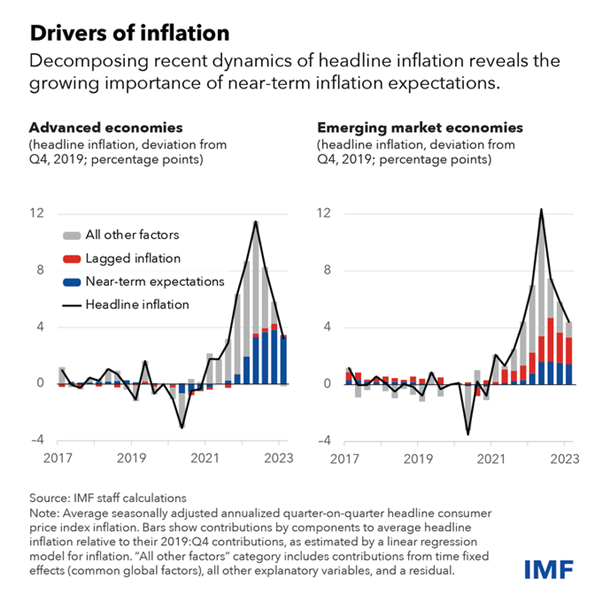
At a special lunch session, MIT professor Ivan Werning gave a long presentation trying to show that inflation expectations played the most important role in boosting recent inflation. His conclusion was that rising inflation was caused by consumers ‘overshooting’ their expectation of price rises and so delivering the very thing they were trying to avoid. So rising inflation is the result of ‘irrational expectations’ by consumers. Thus the theory of inflation is reduced to psychology.
But if you look at the IMF graph above closely, you can see that ‘other factors (ie supply blockages) were the main factor kicking off rising inflation and ‘expectations’ only came later, once people realized that prices were going to continue to rise sharply. Expectations follow real causes. As Keynesian Larry Summers summed it up recently: “The theory to which many economists are gravitating to is that the Phillips curve is basically flat, inflation is set by inflation expectations, and inflation expectations are set by the people who form inflation expectations. And that’s a little bit like the theory that the planets go around the universe because of the orbital force. It’s kind of a naming theory rather than an actual theory. So I think inflation theory is in very substantial disarray, both because of the Phillips curve problems and because we don’t have a hugely convincing successor to monetarist-type theory.”
In his presentation, Werning attempted to come up with an inflation theory that covered all the bases. It all starts with too much demand caused by too much money injections from the central bank and by too much government spending. Then there are various rigidities (monopolies, trade unions etc) that push up prices and by energy price shocks; and finally inflationary expectations.

This cocktail of causes leaves with us with no explanation at all. No wonder Werning summed his address with the words: “that often we end up knowing less than we knew before” but that’s science for you.
The other mainstream debate was around climate change and global warming. The main mainstream method of estimating the impact of global warming on economies has been by what are called Integrated Assessment Models (IAMs), first developed by Nobel prize winner William Nordhaus. And the main policy answer is to introduce carbon pricing and taxes. I have discussed the merits (or not) of IAMs and policy solutions in previous posts. But nothing has changed among the mainstream at ASSA 2024. These are still the methods and policies advocated.
On the method, Steve Keen, a heterodox economist, has produced a blistering critique of IAMs and how they understate hugely the impact on global warming on economies and the planet. See this latest piece by him. For example, (from Steve Keen), the IAM “assumed that empirical relationships derived from data on change in temperature and GDP between 1960 and 2014 can be extrapolated out to 2100—thus assuming that 3.2°C more of global warming won’t alter the climate!: They have assumed that tipping points—critical features of the Earth’s climate such as the Greenland and West Antarctic icesheets, the Amazon rainforest, and the “Atlantic Meridional Overturning Circulation” which keeps Europe warm today—can be tipped with only minimal additional damage to GDP”.
As for policy, as we well know after COP28, nowhere near enough is being done by governments or companies to stop the accelerating rise in global warming and its impact on the planet. That’s because sustaining the fossil fuel industry is more important than sustaining species on the planet and living standards for the majority. of humanity. There was nothing at ASSA mainstream sessions that recognised this.


January 2, 2024
Forecast 2024: stagnation, elections and AI
2023 ended with the US stock market hitting a record high.
US S&P-500 index

Financial markets and mainstream economists breathed a sigh of relief that the US economy had not dropped into a recession i.e. technically two consecutive quarters of contraction in real national output. Instead, despite the Federal Reserve hiking its policy rate to a 15-year high, US real GDP rose by about 2.0-2.5% in 2023, possibly slightly higher than in 2022. At the same time, the consumer inflation rate dropped from an average 8% in 2022 to 4.2% in 2023 with the latest figure at just 3.1%. Unemployment did not rise averaging 3.6%, the same as 2022, although there were signs of it ticking up in the last few months.
So the consensus of economic forecasts at the beginning of 2023 proved wrong. As I wrote in my 2023 forecast entitled ‘The impending slump’: “it seems most leading forecasters are agreed – a slump is coming in 2023, even if they hedge their bets on the depth and in which regions.”
But as I have said in previous posts, the GDP measure seems a bit of an outlier compared to the measure of economic activity based on gross domestic income (GDI). There has been no growth at all in real national income (i.e. profits plus wages). If we average these two different rates, then US economic growth has been about half the GDP rate and considerably slower than in 2022.
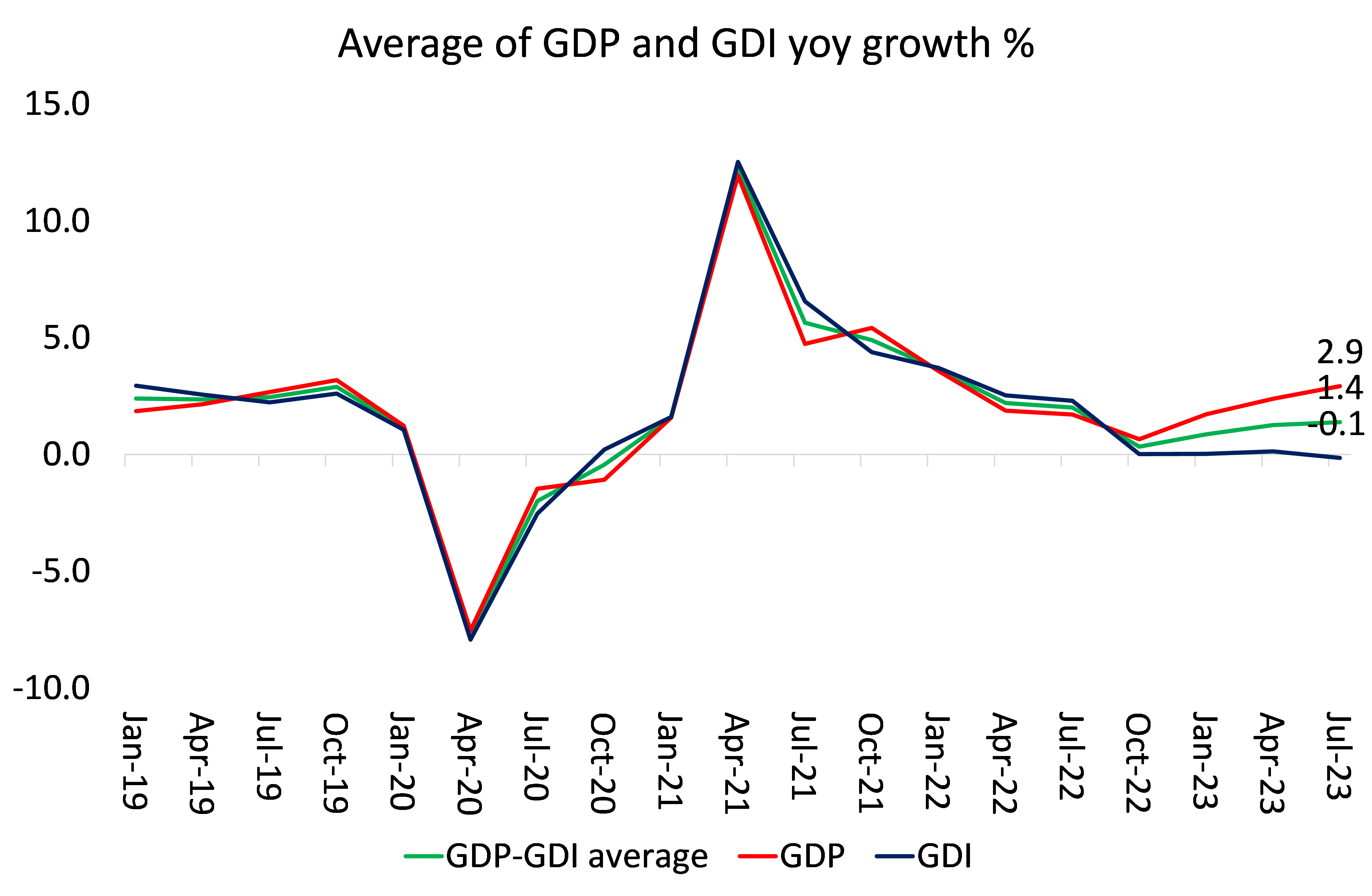
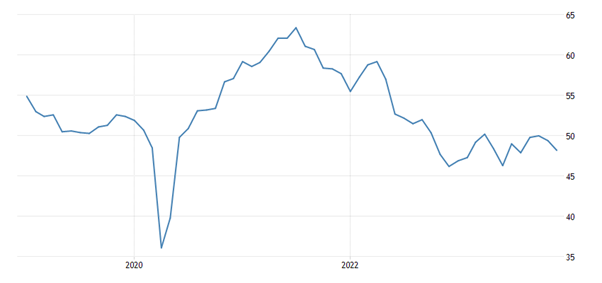
Why the significant difference in 2023? The main reason is that GDP growth has not been transformed into increased sales and revenue at the same rate. Stocks of goods produced have instead built up. US manufacturing industry is in fact mired in the longest slump in more than two decades. Activity in the manufacturing sector has weakened for 13 straight months, the longest stretch since 2002, according to surveys of purchasing managers (PMI) by the Institute for Supply Management.
US manufacturing PMI (below 50 = contraction)
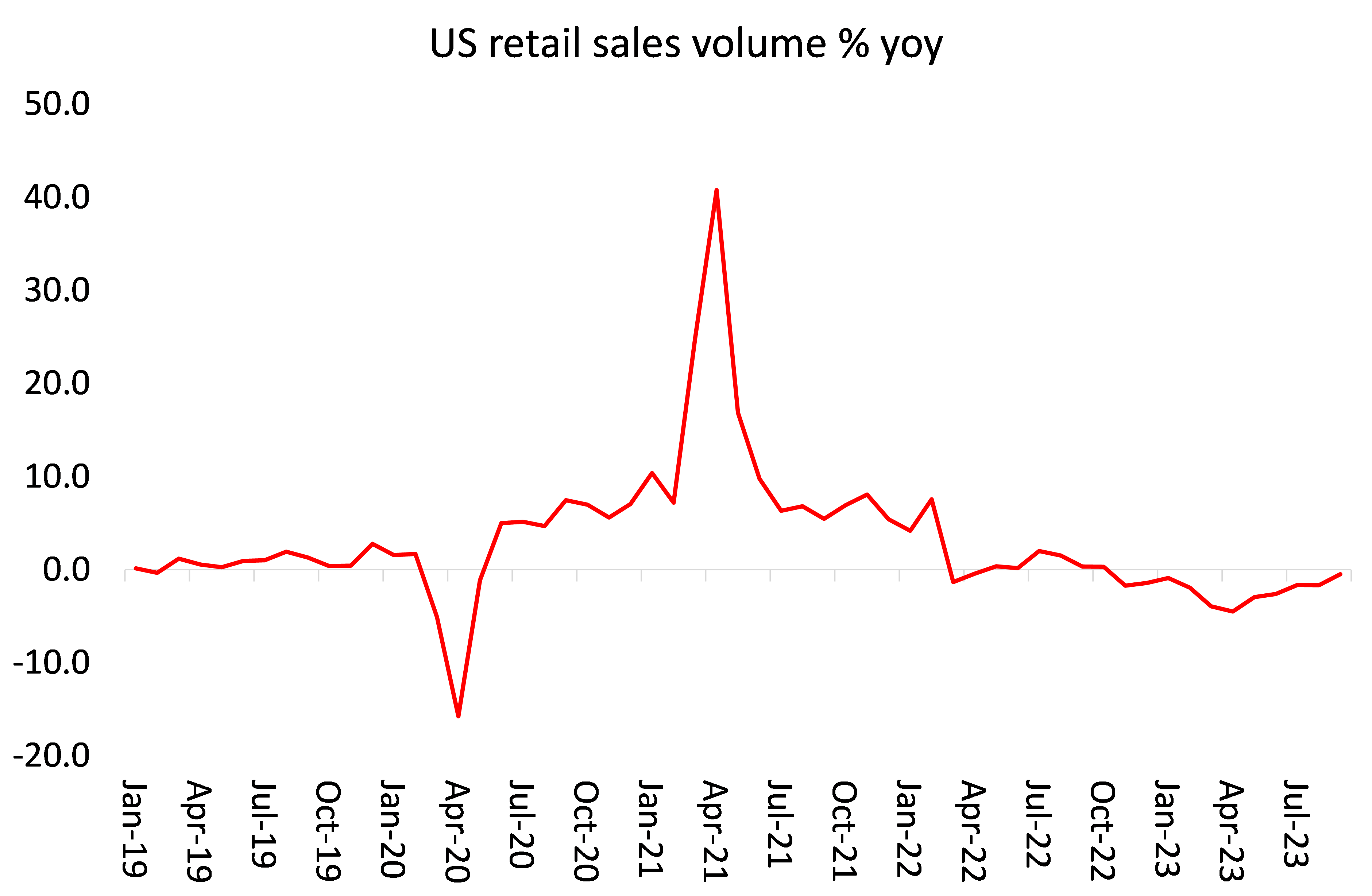
Indeed, when price inflation of goods in the shops and online is accounted for, US retail sales volumes are down compared to 2022.
And manufacturing output is also falling.

It’s only the large so-called services sector in the US that has expanded. And in that sector, the fastest growth has been in healthcare, education and, of course, technology. Technology boomed in 2023, as government subsidies for technology companies mushroomed. The Inflation Reduction Act offered tax incentives for renewable-energy equipment manufacturers and buyers of electric vehicles. The Chips and Science Act included $39 billion in subsidies for semiconductor makers.

Spending on manufacturing construction (mainly IT) rose almost 40% in 2022 and is up a further 72% through the first 10 months of 2023 versus the same period the previous year.
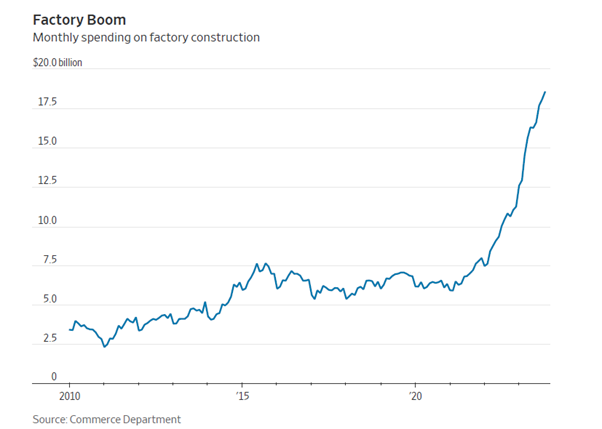
“You’ve got these acyclical drivers that are really pushing up investment in manufacturing structures just in this one sector, but the broader sector is still struggling,” said Bernard Yaros, lead US economist at Oxford Economics. Investment in factories has occurred in the most high-tech sliver of the sector, while other industries struggle with a pandemic-induced inventory overhang and higher interest rates.
Business orders of capital goods, excluding aircraft and military goods, have been falling for about two years (after adjusting for inflation), according to the Commerce Department.

So even if the technology sector is growing and profitable, the rest of US business is not doing so well. Non-financial sector corporate profits are up only 3% on last year so far and are now falling.
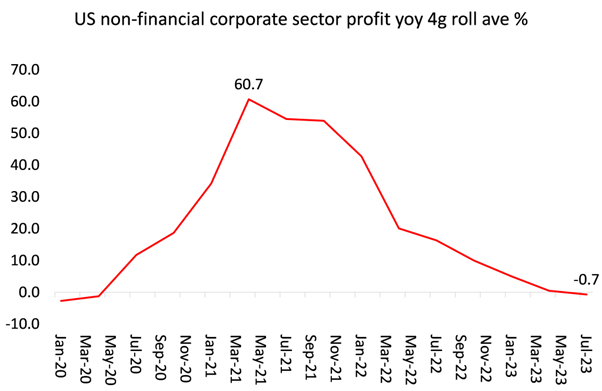
And all this is in the US, the strongest of the G7 economies since the end of the pandemic.
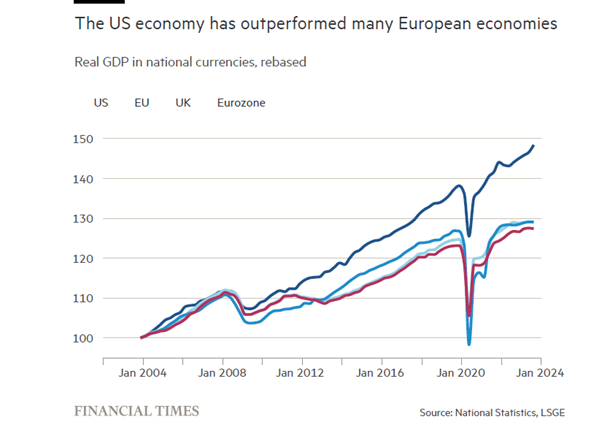
But note, even in the US, the trajectory of growth is lower than before the Great Recession of 2008-9 and is no better than during the average of the 2010s. Europe has performed poorly since the Great Recession and even worse since the end of the pandemic. In 2023, in Europe, Sweden, the Netherlands and Germany entered a recession, with the UK, Italy and France close to it. Canada is in recession and Japan close to it.
But what about 2024? This time, the consensus view is not for a recession in the US or globally. Douglas Porter, chief economist at BMO Capital Markets Economics sums the consensus up. “I expect most major economies to grow more slowly in 2024 than in 2023, but rate cuts, cooling energy and food prices, and normalized supply chains will stave off a global recession.”
Let’s consider those claims. For a start, the consensus is still for even slower global growth than in 2023. I quote the IMF forecast made in October 2023: “The baseline forecast is for global growth to slow from 3.5 percent in 2022 to 3.0 percent in 2023 and 2.9 percent in 2024, well below the historical (2000–19) average of 3.8 percent. Advanced economies are expected to slow from 2.6 percent in 2022 to 1.5 percent in 2023 and 1.4 percent in 2024 as policy tightening starts to bite. Emerging market and developing economies are projected to have a modest decline in growth from 4.1 percent in 2022 to 4.0 percent in both 2023 and 2024.”
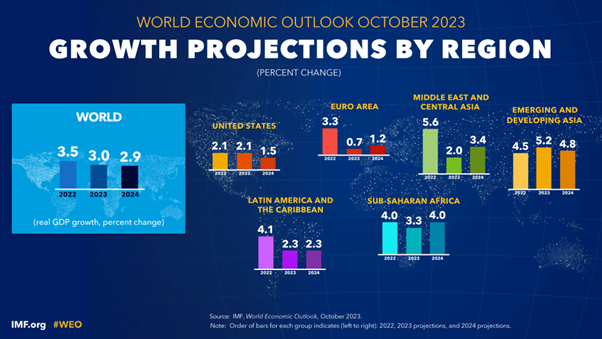
This does not look like a booming 2024 in the US or globally.
But there seems to be a peak in central bank policy interest rates. So financial markets are now expecting significant reductions during 2024, starting as early as March. Inflation rates are falling everywhere in the major economies and unemployment has not risen – as I showed above. Indeed, the so-called ‘misery index’ (the sum of inflation and unemployment rate) in the US and other major economies has halved 18 months.
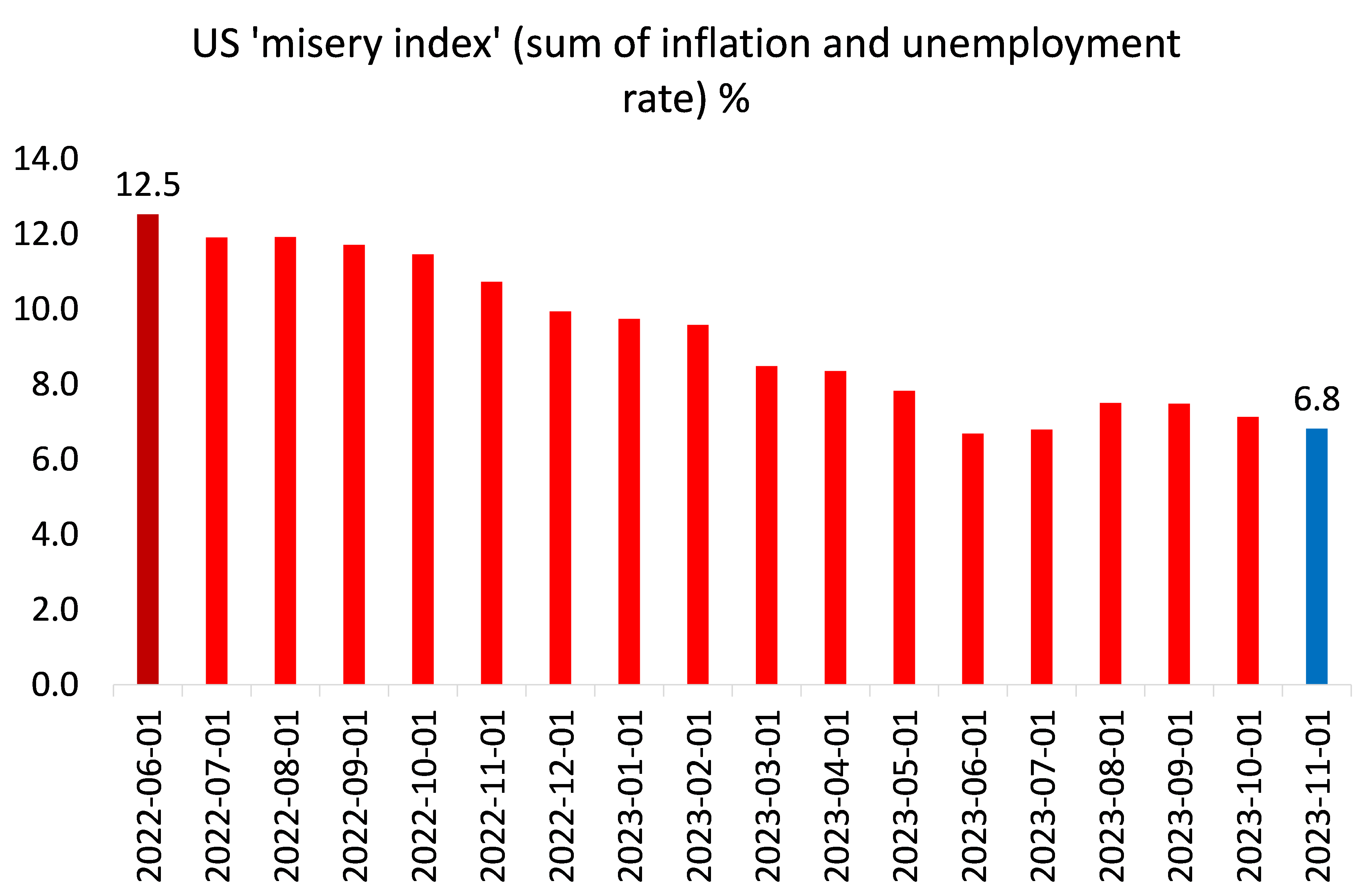
What is puzzling many is that the US economy at least is apparently achieving a ‘soft landing’ from the pandemic, with inflation down, unemployment low and average real incomes beginning to rise, but the American public still seems depressed and uncertain about the future.

The problem is that inflation has only fallen by half and remains well above the pre-pandemic level of under 2%. And that fall is almost entirely due to the end of supply blockages caused by the pandemic and the eventual fall in energy and food prices. As many have explained, it has had little to do with the monetary policy of the central banks.
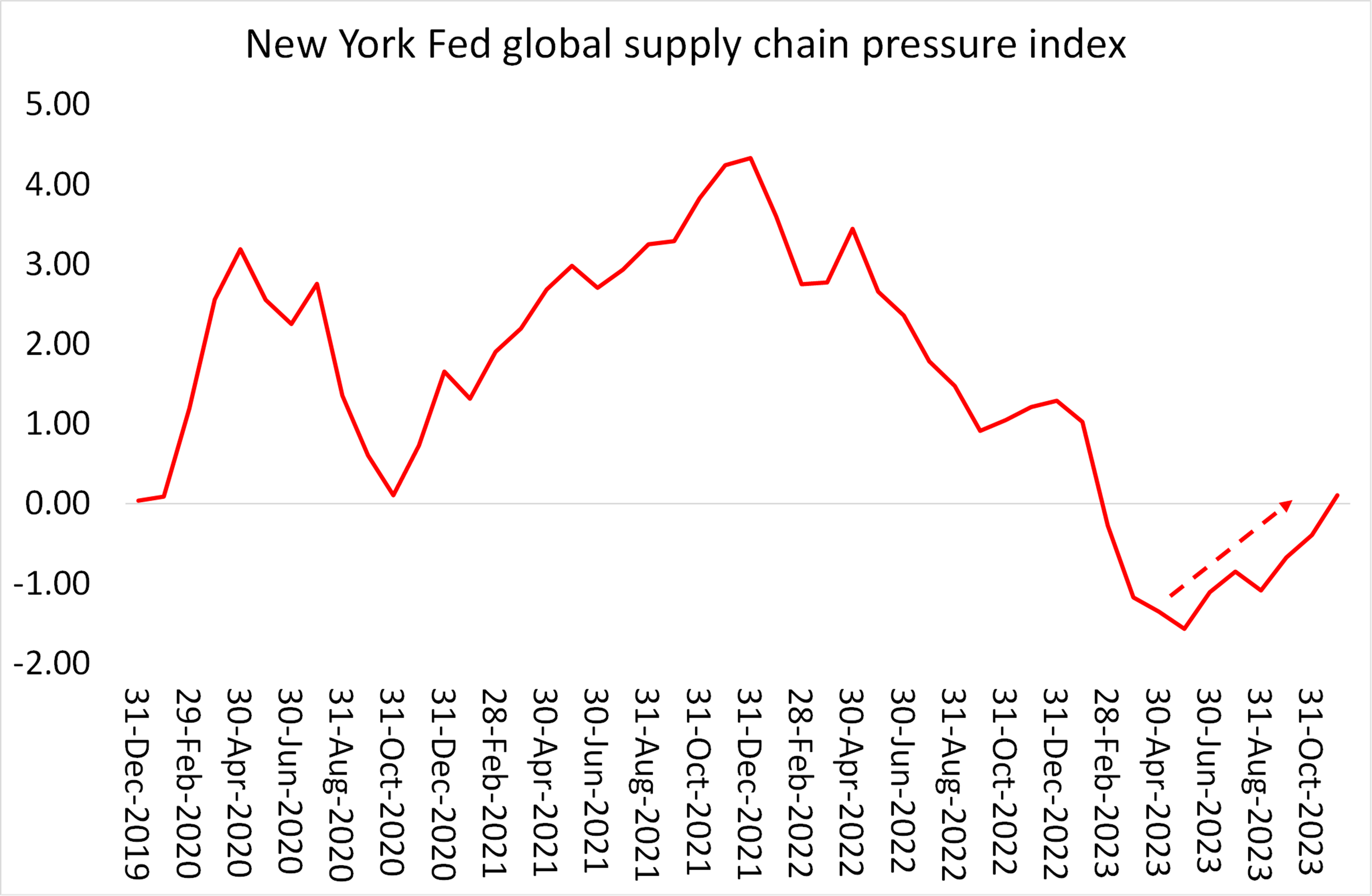
The misery index may be down, but most households in the US, Europe and Japan are still suffering the after-effects of the pandemic slump. Prices in Europe and the US are higher by about 17-20% compared to the end of the pandemic. Jobs may be plentiful, but in general they do not pay well and are often part-time or temporary. Moreover, the continuing war in Ukraine and now the horrendous decimation of Gaza could lead to a reversal of the past fall in global supply chain pressure – according to the New York Fed index.
And what is missing from all these optimistic forecasts is the state of so-called emerging or developing economies of the Global South. Take China, India and Indonesia out of the equation and the rest of these economies, particularly the poorest and often most populous, are facing a another year of a severe debt crisis, which has seen mounting defaults by poor country governments and companies on their debt.
I have discussed this in many previous posts and even though interest rates might eventually start falling later in 2024, the impact on the ability of many countries to meet their ‘obligations’ to the rich countries’ investment funds and banks and to the international agencies will be even weaker this year than last.
All this suggests that, although the US economy technically avoided a slump in 2023, which could have triggered a global contraction, the optimistic sounds of this year’s consensus could again prove wrong – this time in the opposite direction.
That’s the economy in 2024. But there is also politics. 2024 is the year of elections. There are 40 national elections slated, the effects of which will cover 41% of the world’s population, in countries representing 42% of global GDP.
The most important election will be the US presidential poll in November, the result of which has the potential to destabilise every economy and financial market. Donald Trump says that the stock market and the economy are only staying strong because everybody expects him to win in November. If he does not, “then there will be a new Great Depression.” Well, that prognosis does not seem likely – indeed the opposite might well be the case if he loses. But there is no certainty about who will win; or whether Biden will actually stand again; or whether either Trump or Biden would even serve another full term.
Russia too has a presidential election, but there the result is clear and guaranteed, not just because the levels of the media, election commissions and state control are entirely in the hands of Putin and any opposition is suppressed, but also because Russia’s invasion of Ukraine has actually boosted his popular support. The Russian economy has avoided a slump and indeed has grown in the last year, driven by mainly military spending.
In Europe, there are the European Assembly elections in June which are expected to see a significant swing to the anti-immigrant, anti-EU integration rightist parties, which are also opposed to further support by the EU for Ukraine. But the current ‘centre’ right pro-Israel, pro Ukraine parties will probably maintain a majority. Portugal holds an election that will almost certainly throw out the Socialists who have been embroiled in a corruption scandal.
And here in the UK there will be a general election this year. The opposition Labour party, now controlled and run by a pro-business right-wing faction, looks set to win over an incompetent and corrupt Conservative government, no longer even supported by its increasingly crazed and aged party members. But a Labour government would merely continue with ‘business as usual’ in both domestic economic policy and in uncritical support for US global hegemony.
The other big election is in India, where again the incumbent ex-fascist president Modi, in power since 2014, looks set to walk the election, given India’s strong economic growth and the disarray of the opposition parties. Across the border, in Pakistan, things will be very tense as the current right-wing government backed by the military aims to defeat the party of former PM Imran Khan, who fell out with the military. In neighbouring Bangladesh, the incumbent autocratic government will win as the opposition is set to boycott the elections.
Votes in Indonesia and South Korea will probably lead to the status quo of pro-capitalist governments. The African National Congress is likely to hang on in South Africa at May elections as the opposition is split, but the ANC may dip below 50% of the vote for the first time since the end of apartheid.
Claudia Sheinbaum, incumbent President Andrés Manuel Lopez-Obrador’s preferred candidate, leads the polls by a huge margin in Mexico. Another key election is in Venezuela. Through an agreement reached with the US, sanctions against the country have been relaxed in return for holding general elections. The US aim is to bring about the end of the Maduro government through a popular vote.
It’s just a fortnight before the general election in Taiwan where the pro-independence governing party looks like retaining the presidency over the more pro-mainland China parties. This could ratchet up the tensions between the US and China.
2024 could also be the year when the impact on productivity and jobs of the rise of generative AI becomes clearer. The techno-optimists like Goldman Sachs are drooling at the prospect of sharp increases in US productivity growth over the rest of this decade, mainly achieved by massive reductions of jobs in many service sectors.

In 2024, spending on generative AI next year will amount to little more than $20bn, or 0.5% of total global IT spending, says John-David Lovelock, chief forecaster at IT research firm Gartner. By comparison, IT buyers will spend five times as much on security, he adds. Yet Goldman Sachs estimates that investment in AI will jump in the latter part of this decade to reach more than 2.5% of GDP by 2032.
Even if that happens, that may not deliver a generalised increase in productivity growth. The great internet revolution of the late 1990s produced a stock market boom, bubble and bust, but it did little to boost growth in the overall productivity of labour in the 2000s onwards. As the recently deceased mainstream economic expert on the impact of technology on productivity, Robert Solow, commented at the time, “You can see the computer age everywhere, but in the productivity statistics.” Productivity growth has been slowing globally as a trend throughout the first two decades of this century.
The hope of the optimists is that AI and LLMs will kick-start a ‘roaring 20s’, similar to that experienced in the US after the end of the Spanish flu epidemic from 1918-20 and the subsequent slump of 1920-21. But some things are different now. In 1921, the US was fast-rising manufacturing power, sweeping past war-torn Europe and a declining Britain. Now the US economy is in relative decline, manufacturing is stagnating and the US faces the threat of the rise of China, forcing it to conduct proxy wars globally to preserve its hegemony.
Much more likely is that 2024 will be another year of what I have called a Long Depression that began after the Great Recession of 2008-9, similar to the depression of the late 19th century from 1873-95 in most major economies then. Unless average profitability sharply rises, then business investment growth across the board will remain low even if AI boosts productivity in some sectors. To get a step-change in the profitability of global capital would require a major cleansing (slump) to remove the weak (zombies) and raise unemployment in low-value sectors. So far, such a ‘liquidation’ or ‘creative destruction’ policy has not gained support in the mainstream or in official policy circles. ‘Muddling through’ is better.
In sum, 2024 looks like being one of slowing economic growth for most countries and probably more slipping into recession in Europe, Latin America and Asia. The debt crisis in those countries in the so-called global south that don’t have energy or minerals to sell will worsen. So even if the US avoids an outright slump again this year, it wont feel like a ‘soft landing’ for most people in the world.
December 31, 2023
Top ten posts of 2023: AI, polycrisis, banking and inflation
2023 was the 13th year since I launched this blog. Over those years, I have posted 1194 times with over 5.23 million viewings and over 2m visitors. There are currently 7572 regular followers of the blog; and now 13670 followers of the Michael Roberts Facebook site, which I started eight years ago. On that Facebook site, I put short daily items of information or comment on economics and economic events. Please follow.
And at the beginning of 2020, I also launched the Michael Roberts You Tube channel, https://www.youtube.com/channel/UCYM7I0m-I9EVB-5gaBqiqbg/. This now has 2960 subscribers. If you haven’t joined up yet, have a look at the channel, which includes presentations by me on a variety of economic subjects; interviews with other Marxist economists; and some zoom debates in which I participated.
My top three videos of 2023 were: Henryk Grossman with Rick Kuhn; Capitalism in the 21st century on our new book with Mino Carchedi; and what would Marx and Engels say about the 21st century capitalism. I hope to do some new videos very soon.
This year I also launched a Twitter site. https://twitter.com/BlogRoberts That has not taken off with only 129 followers. That’s partly because the blog and my Facebook site cover the same things and Twitter requires much more work on a daily basis. I’ll try and boost it this coming year, although it seems in general that Twitter is beginning to flag in social media. Watch that Twitter space.
As for the blog, 2023 saw 488,000 views, down from last year and the record COVID year when everybody was stuck at home online. But I did 83 posts this year, up from 77 last year and those that read them stayed on the site for more views with an average 2.76 views per visitor – a record.
Where do my blog viewers come from? From over 199 countries globally! Led by 114k yearly viewings in the US (or about 24%); 60k from UK (14%); then all the G20 and BRICs countries. Brazil and Spain are the next largest viewers followed by Canada, Argentina, Germany and Australia. Right at the other end of the spectrum, I have had viewings from Vanuatu, Greenland, Yemen, Mali, Timor, New Caledonia and Gabon.
So what was the top post of this year? It was my post on AI-GPT. The rise of generative AI was the big technology event of the year and so, not surprisingly, it attracted the interest of blog followers. In that post, I discussed the strength and faults in the new Language Learning Models LLMs) with some examples; the likely impact of LLMs of jobs in many occupations and whether new technology leads to a net loss or rise in jobs; and whether AI really will surpass and replace human intelligence.

A second post on ChatGPT and whether knowledge can have value in Marxist terms also got into the top ten. In this post, my close colleague in Marxist economics, Guglielmo Carchedi, discussed the production of knowledge and how it could be commodified under capitalism. This provoked a lot of debate in comments when he said: “to believe that computers are capable of human thinking is not only wrong; it is also a pro-capital ideology because that is being blind to the class content of the knowledge stored up in labour power and thus to the contradictions inherent in the generation of knowledge.”

What happens with AI is something for the future, but the next most popular post was for here and now. It was analysis of the current contradictions in 21st capitalism caused by the Long Depression in the world economy in the last decade and the coming together of a bunch of crises: climate change; rising inequality; the after-effects of the COVID pandemic on human development globally; the rising geopolitical conflicts; and the significant decline in confidence about the future of humanity.

The other big issue that absorbed blog readers was the policy of central banks to control inflation through hiking interest rates to post-2009 highs this year. In one post I argued that central bank interest rate hikes were not going to bring inflation down because the rise in inflation was not due to ‘excessive demand’ or ‘excessive wage increases’ but to supply blockages, poor recovery in manufacturing and falling international trade after the end of the pandemic.

By the end of this year, the evidence was overwhelming that inflation was a supply-side matter (including rising profit margins) and, in that sense, ‘transitory’ – although it remains to be seen if inflation rates ever get back to pre-pandemic levels.
What rising interest rates did lead to were bank failures like SVB, the reasons for which I described in another popular post.

Indeed, there were a surge of failures in small US regional banks last March and the collapse of the huge Credit Suisse bank in Europe. That led to bailouts and central bank credit injections to stabilize the financial sector.
In another post, I again pointed out the uselessness of so-called regulation of the financial sector to stop such crashes. As David Kane at the New Institute for Economic Thinking put it, as “the instruments assigned to this task are too weak to work for long. With the connivance of regulators, US megabanks are already re-establishing their ability to use dividends and stock buybacks to rebuild their leverage back to dangerous levels.” Kane notes that “top regulators seem to believe that an important part of their job is to convince taxpayers that the next crash can be contained within the financial sector and won’t be allowed to hurt ordinary citizens in the ways that previous crises have.” But “these rosy claims are bullsh*t.”
In another post I argued that the banking crisis last March could return because interest rates are set to stay high for some time and companies are stocking up sizeable debt servicing costs while profit growth is slowing.

‘Zombie’ companies are growing in number – companies where profits are not even sufficient to cover debt servicing costs so they have to borrow even more to survive. But the traditional process of ‘cleansing’ of the weak under capitalism through a slump has been avoided by yet more injections of credit (loans and bonds). The Federal Reserve balance sheet rose during banking crisis (graph). ‘Creative destruction’ has been replaced by ‘moral hazard’ as monetary policy.

Interestingly, my post on pensions got into the top ten. The story was built around the pension cut protests in France last March. Pensions are not just important to older people but also to young workers – with the knowledge that state pensions will never be adequate on retirement.
In the post I opposed the mainstream economic arguments that ‘we cannot afford proper state pensions’ any more unless we raise the retirement age and/or contributions from wages. I put it this way: “Does a country want to use its resources so that people can stop work at the age of 60 or 65 and have enough income to live on in reasonable comfort, or not? It can be done.” It depends on two things: first, that an economy creates enough resources and expands sufficiently to cater for its elderly population that may also be getting larger as a share of the population. And second, given finite resources, decent pensions can be provided by cutting out other calls on government revenues i.e. such as bailing out the banks; increased arms spending; more subsidies for private corporations to invest in fossil fuels; and lower taxes for top earners and corporations etc.
Indeed, just a 1% pt sustained rise in average real GDP per capita in the major economies could deliver enough extra revenue to governments to easily maintain current pension levels and terms with something to spare.
The Israeli horrendous decimation of Gaza starting last October compelled me to write something about the economic rise of the Israeli state. I called it ‘a shattering of a dream’ – I now think that was a wrong title because, even back in 1947, those who thought Israel would build a model democratic socialist state were a naïve minority. The driving force for Israel from the beginning was capitalist investment to establish a bulwark for imperialism in the Middle East. But I did outline the economic story of Israel for readers, particularly the huge inequalities or wealth and income within Israel.

The last post to make the top ten was the recent one of the debate between two Marxist scholars on Marx’s meaning of a ‘commodity’ and the implications for understanding the contradictions of within the capitalist mode of production. The comments on the blog continue.

Just to finish, you might want to know what the top post of all time was on the blog. The winner was the post on global wealth inequality (repeated every year) showing a pyramid with the top 1% of wealth holders (about 50m) having 40-45% of all net personal wealth globally, while around 3bn adults in the world have next to nothing. Not far behind were my posts on the economics of the pandemic, a Marxist theory of inflation, the debate I had with David Harvey on Marx’s value theory, measurement of the rate of profit on capital and my critique of modern monetary theory.

You can find these posts through the search tab on the blog.
December 28, 2023
Books of the year
Every year at this time, I look back at the books that I have reviewed during the year on this blog.
Let me start with the The Big Con: How the Consulting Industry Weakens our Businesses, Infantilises our Governments and Warps our Economies. by Mariana Mazzucato and Rosie Collington.

Mazzucato has built up a big reputation for espousing the benefits of public investment and the public sector over the private. scanning her popularity from the left in the labour movement through to mainstream governments in Europe and Latin America. In this new book, Mazzucato and Collington expose the scam that the management consultancy business is.
Their premise is that consulting is really a confidence trick. “A consultant’s job is to convince anxious customers that they have the answers, whether or not that’s true”. The authors point out that governments and companies everywhere rely on consultancies, companies that ‘talk the talk’ but know little about the problems they claim to solve. Billions are parted everywhere to the likes of McKinsey and other ‘management consultancies’ with little resulting benefit. The ‘management consultancy con’ is really a product of neo-liberal ideology that the private sector knows best and will be more efficient than public sector workers doing the job. Mazzucato and Collington expose the scam but are vague about what to do about it. Still an eye-opening book on the myth that work for profit is more ‘efficient’ than work for need.
Branco Milanovic is the world’s greatest expert on global inequality of wealth and income. In 2023 he published yet another book, Visions of Inequality.

This takes a different approach from analysing the stats on inequality. Instead Milanovic discusses those he considers provide the most important explanations of why inequality of wealth and income is so great between humans. As Milanovic puts it: “The objective of this book is to trace the evolution of thinking about economic inequality over the past two centuries, based on the works of some influential economists whose writings can be interpreted to deal, directly or indirectly, with income distribution and income inequality. They are François Quesnay, Adam Smith, David Ricardo, Karl Marx, Vilfredo Pareto, Simon Kuznets, and a group of economists from the second half of the twentieth century (the latter collectively influential even as they individually lack the iconic status of the prior six).” The latter includes Thomas Piketty.
In my review, I concentrated on Milanovic’s account of Marx’s view. Milanovic unfortunately accepts many misconceptions about Marx’s value theory and the law of the tendency of the rate of profit to fall, which I think leads him to conclude that a falling rate of profit will mean reduced inequality because it is the rise in real wages that lowers profitability. I think this confuses the rate of surplus value with the rate of profit.
Nevertheless, Milanovic correctly argues that Marx considered that any distribution of income and consumption was only a consequence of the distribution of the conditions of production. The capitalist mode of production rests on the fact that the material conditions of production are in the hands of non-workers in the form of property in capital and land, while the masses are only owners of their personal condition of production, of labor power. Thus, the distribution of income and wealth cannot be changed in any material way until the system is changed. “To clamor for equal or even equitable remuneration on the basis of the wages system,” Marx writes, “is the same as to clamor for freedom on the basis of the slavery system.”
“For all that we are told we live in an increasingly dematerialised world where ever more value lies in intangible items – apps and networks and online services – the physical world continues to underpin everything else.” So starts Ed Conway, economics editor at the British Sky TV channel, in his fascinating little book, Material World.

The vast bulk of the world economy is still built on the production of things, ‘stuff’ that can be commodified from the labour of billions. The material world, as Conway calls it, is still the basis of the global economy. Conway singles out just six key materials that drive the world economy in the 21st century: sand, salt, iron, copper, oil and lithium. They are the most widely used and the very hardest to replace. In the book, Conway takes us on a journey of history and technology surrounding these key resources.
Conway notes two things that Marx’s value theory predicts – of course, unknowingly. “As the amount of stuff we remove from the ground and turn into extraordinary products continues to increase, the proportion of people needed to make this happen decreases.” Thus there is a continual rise in what Marx called the organic composition of capital.
And the other is that capitalist production takes no account of what mainstream economics calls ‘externalities’, the ‘collateral damage’ to the environment for humans and the rest of the planet. “There are no environmental accounts or material flow analysis, which count only the refined metal. When it comes to even the United Nations’ measures of how much humans are affecting the planet, this waste rock doesn’t count.” Conway ends his book with the great contradiction of the 21st century: global warming and climate change. How can the world get to ‘net zero’ when it needs so many raw material resources?
Can technology do the trick? This is the issue that Daren Acemoglu poses in his book, Power and Progress – a thousand- year struggle over technology and prosperity’, jointly authored with Simon Johnson. Acemoglu is a leading economist on the impact of technology on jobs, people and economies. I have referred to his work before in various posts.
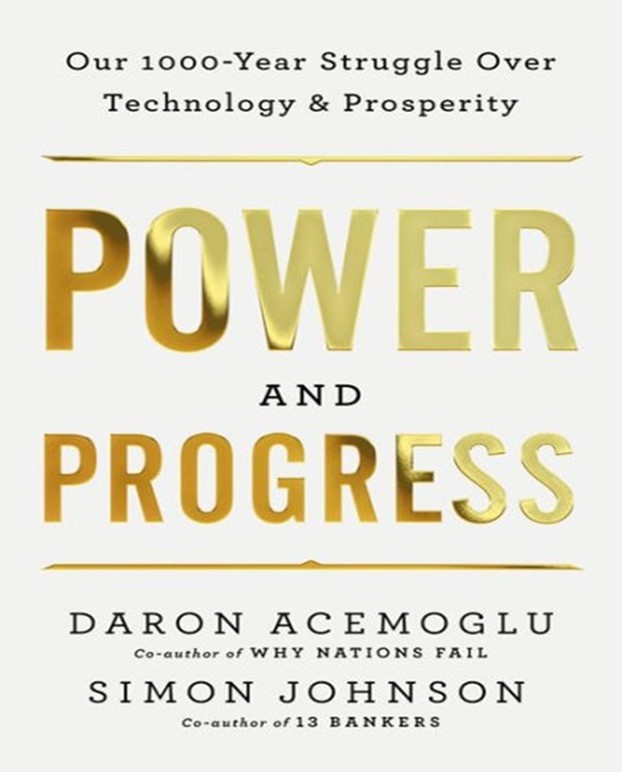
In Power and Progress, we get a sweeping historical account of how technology has taken humanity forward in terms of living standards but also often created misery, poverty and increased inequality. The book considers what can be done to ensure that the gains from the productivity ‘bandwagon’ of modern technology like robots, automation and AI can be spread among the many and not just garnered by the few.
The authors fall back on the ‘policy levers’ of taxation and subsidies to research; regulation of markets; the breaking up of the big tech monopolies; and stronger trade unions. All these measures in one form or another have failed sufficiently to achieve the spread of the gains of technology in the past and would for the current innovations – assuming these policies were ever to be implemented. What Power and Progress tells us about technology and its impact on our lives, for good or bad, is that whoever has the power gets the benefit.
On the same theme of the impact of technology, Matteo Pasquinelli authors a book called In the eye of the master, which argues that, whereas in the past labour was supervised and controlled by the masters ( the owners and their agents, the managers), now supervision will be increasingly automated. So, instead of AI and automation being used collectively by us all, machines will rule our lives for the benefit of the master.

The theme of an increasingly authoritarian state is raised in a new book, entitled, The rise and fall of American Finance by Stephen Maher and Scott Aquanno.

The authors argue that the ‘financialisation’ of capitalism since the 1980s has not weakened the capitalist mode of production but changed and strengthened its ability to exploit with the support of “an increasingly authoritarian state.” The authors claimed that they were arguing differently from “strict financialist theorists” by not claiming “a qualitatively new phase of capitalist development is emerging” but just the same interlocking of finance, industry and the state that has always existed in capitalism.
What to do about this authoritarian state? The authors’ policy conclusions are vague, namely that: “reducing economic inequality and bringing investment in “Good Jobs” back to the United States requires challenging the competitive logic of global financial integration with state-imposed barriers on the movement of investment worldwide.” Or to be clearer: “establishing a greater public role in determining the allocation of investment”. That seems somewhat feeble if capitalism is taking a more repressive formation.
Two of my book reviews have caused some controversy among readers and others. The first is Dependency theory after 50 years, by Claudio Katz. Katzo delivers a comprehensive account of dependency theory as expounded mainly in Latin America over the last 50 years.

Dependency theory is really a theory of imperialism. Dependency’ can take different meanings but in essence it identifies two main groups of countries in the global economic system: the core and the periphery. The core countries are wealthy countries that control the global economy. The periphery countries are poor countries that are dependent on the core countries for trade, investment and technology. ie prosperity.
Katz concentrates his account of dependency theory on its Marxist variant, which argues that these countries will remain ‘dependent’ because of the huge extraction of value from labour in their economies to the imperialist bloc through trade, finance and technology. What Katz does show is that Marx’s value theory of “productive globalization based on the exploitation of workers remodels the cleavages between center and periphery through transfers of surplus value.” And it is “the omission of that mechanism prevents the critics of dependency from understanding the logic of underdevelopment.”
I have got some stick from supporters of the theory because of my criticism in my review of Argentine Marxist economist Mario Marini who developed a theory of ‘super-exploitation’ and the idea of ‘sub imperialism’, ie small imperialist countries. Even though I have doubts about the validity of these two concepts in explaining modern imperialism, Katz does show how Marini seemed close to a classic Marxist view that imperialist gains are a product of ‘unequal exchange’ in international trade and the general extraction of surplus value from the periphery.
Long standing Marxist scholar, Fred Moseley presented a new book entitled Marx’s theory value in, Chapter one of capital: a critique of Michael Heinrich’s value form interpretation. The book discussed the debate over the meaning of the value form of commodities under capitalism.

Moseley interprets Marx to argue that there is a common property of all commodities that determines their value, namely the objectified abstract human labour contained in commodity production. Leading Marxist scholar Michael Heinrich argues, on the other hand, that labour in production is only concrete labour and abstract labour comes to exist only in exchange.
It’s a complicated plot but the debate does have important implications for our understanding of capitalism. For me, Marx’s analysis of the value in a commodity is about showing the fundamental contradiction in capitalism between production for social need (use-value) and production for profit (exchange value). Units of production (or commodities under capitalism) have that dual character which epitomises that contradiction. In my view, Heinrich loses that contradiction by arguing that Marx meant a commodity only has value when it is sold for money on the market and not before in production through the exploitation of human labour.
It is no accident that Heinrich dismisses Marx law of profitability as illogical, ‘indeterminate’ and irrelevant to explaining crises and instead looks excessive credit and financial instability as causes. Heinrich even claims that Marx dropped his law of profitability – although the evidence for that is non-existent. If profits (surplus value) from production by human labour disappear from any analysis to be replaced by profits from exchange for money, then we no longer have a Marxist theory of crisis or any theory of crisis at all.
December 23, 2023
Marx’s value theory and the value form interpretation
This post is long but something well worth reading during the festive break.
As I mentioned in a recent blog, at the Historical Materialism conference in London in November, there was a book launch for Fred Moseley’s new book Marx’s Theory of Value in Chapter 1 of Capital: A Critique of Heinrich’s Value-Form Interpretation. Michael Heinrich and Winfried Schwarz (a German Marxist who is also critical of Heinrich’s interpretation) participated in the book launch.

Moseley’s book is an examination of Marx’s theory of value in Chapter 1 of Capital, almost paragraph by paragraph in Sections 1 and 2, and a detailed critique of Heinrich’s value-form interpretation of Chapter 1, as presented in his 2021 book How to Read Marx’s Capital, which is a translation of his 2018 book Wie das Marxsche Kapital Lesen?

Heinrich is a well-known German Marxist who has published widely on his value-form interpretation of Marx’s theory of value, and his work is influential not only in Germany, but also in the UK and other countries in Europe and around the world. He criticises the traditional interpretation of the labour theory of value, according to which the value of commodities is determined solely in production, and he argues that value is created only when it is converted into money through the sale of commodities on the market.

Moseley is one of the foremost scholars in the world today on Marxian economic theory. He has written or edited many books on Marxist theory. He reckons instead that Marx presented a labour theory of value according to which the value of commodities is determined solely in production by the socially necessary labor time required to produce the commodities. And Moseley argues in his book that the textual evidence in Chapter 1 overwhelmingly supports the labour theory of value interpretation of Marx’s theory of value.

The relevance and importance of this debate may seem obscure to many readers of Marx. So Fred Moseley kindly agreed to be interviewed on his new book and the controversy with Heinrich.
MR: How did this book come about?
FM: ”First of all, I want to thank you for the opportunity to discuss my book with you and your many readers.
Heinrich’s book cited above is a detailed textual study of the first seven chapters of Capital. Heinrich is not very well known in the US, but he is very influential in Germany and other European countries. He is something like a David Harvey of Europe. But I am convinced that Heinrich’s book is a fundamental misinterpretation of Marx’s theory, so I decided to engage critically with Heinrich’s book.
I started by writing a paper on Chapter 1, the foundation of Marx’s theory and Heinrich’s interpretation. I presented this paper in a Zoom conference in June 2021 sponsored by Gyeongsang National University in South Korea. An assistant editor of Palgrave’s Marx, Engels and Marxism series, Paula Rauhala, watched the my presentation and she contacted me and suggested that I write a longer version of my paper as a Palgrave Pivot book. A Pivot book is a new initiative by Palgrave of short books, with a limit of 50,000 words (which I exceeded by 10,000 words!). I am grateful to Paula for that suggestion and this little book is the result.”
MR: Please give us an overview of your book
FM: “My little book is a detailed textual study of Marx’s Chapter 1 and Heinrich’s interpretation of Chapter 1. The book consists of only 4 chapters.
Chapter 1 of this book presents my interpretation of Marx’s theory of value in Chapter 1 of Capital, including a section on each of the four sections of Marx’s Chapter 1. Chapter 2 presents Heinrich’s interpretation of Chapter 1 of Capital and my detailed critique of Heinrich’s interpretation 1, with the same four sections.
Chapter 3 is about a 55-page manuscript that Marx wrote in 1872 in preparation for the 2nd German Edition of Volume 1, which is mainly about Section 3 of Chapter 1, entitled ‘Additions and Changes to the First Volume of Capital’, which Heinrich has emphasised in his book and in previous works to provide textual support for his ‘value-form interpretation’ of Chapter 1. This important manuscript has not yet been translated into English. A translation of a 4-page excerpt of this manuscript is included in Heinrich’s book as an appendix. So Chapter 3 of my book presents my interpretation of this manuscript and a critique of Heinrich’s interpretation. A translation of this entire manuscript should be a high priority of Marxian scholarship.
My book is very abstract theory, about the most abstract part of Marx’s theory, the beginning of Marx’s theory in which he presents the foundation of his labour theory of value. Marx said in the Preface to the 1st edition of Volume 1 of Capital that “beginnings are always difficult in all sciences”, and that is certainly true of Marx’s theory. The best way to read my book is to have Heinrich’s book and Volume 1 of Capital close at hand.”
MR: How would you summarise the main conclusions of your book?
FM: “The main conclusions of my book are the following:
1. The subject of analysis of Chapter 1 is the commodity, not a separate, isolated commodity, but a representative commodity, a commodity that represents all commodities and the properties that all commodities have in common (use-value and exchange-value). In the Preface to the 1st edition, Marx described the commodity as the “elementary form” or the “cell form” of capitalist production. So Marx analyses the properties of a representative commodity similar to the way cellular biology analyses the properties of a representative cell. It’s like putting a commodity under a microscope and analysing its main properties.
Marx’s representative commodity in Chapter 1 is assumed to have been produced, but not yet exchanged. This is crucial for the critique of Heinrich’s interpretation. According to Heinrich, the subject of analysis of Chapter 1 is not the properties of a representative commodity, but instead is what he calls an “exchange relation” between two commodities, which he argues is the end result of two actual exchanges between the two commodities and money on the market.
2. The value of commodities is derived in Section 1 of Chapter 1 from the property of the exchange-value of the representative commodity (i.e. from the property that each commodity is equal to all other commodities in definite proportions). And this general relation of equality between each commodity and all commodities requires a common property that is possessed by all commodities and that determines the proportions in which different commodities are equal.
Marx argued that this common property of all commodities that determines their exchange-values is the objectified abstract human labour contained in commodities. And this is the result of the abstract human labour expended in production to produce the commodities.
According to Heinrich, on the other hand, the value of commodities is not derived from a relation of equality between all commodities, but instead is derived from an analysis of an “exchange relation” between two commodities, which he argues presupposes actual exchanges of the two commodities with money on the market.
3. The magnitude of the value of each commodity is “exclusively determined” (p. 129) by the quantity of socially necessary labour-time expended in production to produce each commodity. Heinrich argues, on the other hand, that the magnitude of value of a commodity depends in part on the relation between supply and demand for the commodity on the market. This is the best-known assumption of the value-form interpretation of Marx’s theory of value.
4. The labour that produces commodities has a dual character in production: both concrete labour and abstract labour are characteristics of the same labour process in production. Section 2 of Chapter 1 in particular presents very strong textual evidence to support this interpretation of the dual character in production of labour that produces commodities.
Weaving and tailoring are Marx’s two examples in Section 2. The labour process of weaving produces the use-value of linen, its dual character also being abstract human labour that produces the value of the linen. The same dual character is true of the labour process of tailoring (and all other particular labour activities). The values of the linen and the coat are compared by comparing the labour-time required to produce each one of them and nothing is said in this about exchange in this section.
Heinrich argues, on the other hand, that labour in production is only concrete labour and is not yet abstract labour. Abstract labour comes to exist only in exchange, and thus the dual character of the labour that produces commodities comes to exist only in exchange. According to Heinrich’s interpretation, tailoring and weaving (and any other labour process) possess only a single character in production, not a dual character. This interpretation is clearly contradicted by Section 2.”
MR: Please say more about Heinrich’s interpretation of “exchange relation”. That seems to be a central concept in Heinrich’s interpretation.
FM: “Heinrich’s concept of “exchange relation” is completely original with him. No one else puts so much emphasis on this term and defines it the way he does. And it is a new concept in his interpretation; it was not included in his 2012 book Introduction to Marx’s Capital. And unfortunately, he does not explain this very well in this book, especially for such a fundamental concept. There is nothing in his Introduction about this concept; there are only 1½ pages in an appendix in the back of the book on the abstractions that result in this concept (which he doesn’t refer to once in the rest of the book) and 1½ pages in his first discussion of this concept on pp. 53-54. And from then on, he just presumes his interpretation of exchange relation and applies it to different passages in Marx’s text.
I am pretty sure that most readers of Marx (especially beginning readers) will not understand the meaning and significance of Heinrich’s concept of exchange relation in his interpretation. A young Marx scholar from Australia wrote a 2000-word review of Heinrich’s book for Marx and Philosophy and she didn’t mention the concept of exchange relation at all. I myself had to work pretty hard to understand it because it is so poorly presented.
Heinrich defines exchange relation as an exchange between two commodities. To take one of his examples that is borrowed from Marx:
1 quarter of wheat is exchanged for x boot-polish.
Heinrich comments that this definition seems like direct barter exchange between the two commodities, but he states that this is not so, because direct barter seldom actually happens in capitalism. Instead, Heinrich interprets the exchange relation between two commodities as the end result of two actual acts of exchange between the two commodities and money on the market. Thus…
1 qtr. of wheat is sold for 10 shillings and 10 shillings is used to purchase x book-polish
The important point is that Heinrich’s concept of exchange relation between two commodities presupposes actual exchanges between these two commodities and money on the market. Heinrich does not clearly specify whether these acts of exchange that are presupposed in his interpretation of the exchange relation are assumed to be actual acts of exchange on the market. However, they must be actual acts of exchange in order to be consistent with Heinrich’s general value-form interpretation, according to which commodities possess value only if they have been actually exchanged on the market.
Before actual exchange, according the Heinrich’s interpretation, commodities do not possess value (indeed, products are not even commodities) before exchange. Products of labour become commodities and commodities come to possess value only as a result of actual exchanges on the market. Therefore, since the commodities that Marx analyses in Section 1 (e.g. wheat and boot-polish) are assumed to possess value, in order to be consistent with Heinrich’s general value-form interpretation, he must also assume that these commodities have been actually sold and bought on the market. If the commodities have not been actually exchanged on the market, then these commodities would not possess value, according to Heinrich’s general value-form interpretation.
However, there is absolutely no textual evidence in any of Marx’s several drafts of Chapter 1 to support Heinrich’s idiosyncratic interpretation of the exchange relation between two commodities – that it presupposes actual acts of exchange between these two commodities and money on the market. This interpretation is Heinrich’s invention. He does not cite any other authors with a similar interpretation of exchange relation, because there are none. And the exchange relation is the most important concept in Heinrich’s interpretation of Chapter 1. If his fundamental concept of exchange relation is a misinterpretation of Marx’s theory, then the rest of Heinrich’s interpretation of Chapter 1 is a misinterpretation and is unacceptable.
I think it is clear that the subject of analysis of Chapter 1 is the commodity, a representative commodity that is used to analyse the properties that all commodities have in common – use-value and value. Chapter 1 is not about exchange at all. The commodity that is analysed in Chapter 1 has been produced, but not yet exchanged. Exchange is not considered until Chapter 2 (“The Process of Exchange”).
In recent weeks, while preparing for the HM conference and for this interview, I have come to realise more clearly that there is a fundamental contradiction in what Heinrich is trying to accomplish in his recent book. In his previous works, he has presented (many times and all over the world) a strong value-form interpretation of Marx’s theory of value, according to which the value of a commodity exists only as a result of an actual exchange on the market. Before exchange, a commodity does not possess value (it only possesses use-value). For the textual evidence to support this interpretation, he has used a handful of key passages that are taken from various texts in isolation and out of context. As we know, one can always find passages that seem to support almost any interpretation of Marx’s theory. And Heinrich is very good at this quotation game.
However, his most recent book is different; it is an attempt to interpret the first seven chapters of Volume 1, especially Chapter 1, as a value-form theory – and that Marx was the original value-theorist! Heinrich goes from page to page in Chapter 1 and consistently tries to interpret key passages in a value-form way. This is a very difficult task because there are so many passages in these chapters, especially Chapter 1, that contradict a value-form interpretation. Indeed, in my view, Heinrich’s task is an impossible task. My book follows his detailed commentaries point by point and exposes the errors in his value-form interpretation.”
MR: What was the main disagreement between you and Heinrich in your book launch at the recent Historical Materialism conference?
FM: “Not surprisingly, the main disagreement in the session was over the meaning of exchange relation in two paragraphs in Section 1. He argued that I misinterpreted Marx’s concept of exchange relation, not as an act of exchange between two commodities, but as a relation of equality between two commodities, and that I just substituted my meaning of exchange relation for Marx’s meaning in the two passages. And he argued that these two passages are proof that that Section 1 analyses individual commodities as part of an exchange relation.
But that is not true. I did not just substitute my meaning of exchange relation for Marx’s meaning in these paragraphs. Rather, I argued that the exchange relation in these paragraphs is a synonym for exchange-value. The exchange-value of each commodity is defined in the preceding paragraphs in Section 1 as the property of each commodity that is equal to all other commodities in definite proportions that are mutually consistent. That implies that all commodities possess a common property that determines the proportions in which different commodities are equal. Therefore, the exchange relation between two commodities in these paragraphs is also a relation of equality between two commodities, which implies the necessity of a common property possessed by each one of them.
Instead I argued that Heinrich is the one who misinterprets Marx’s concept of exchange relation with his strange definition as the end result of actual exchanges between the two commodities and money on the market,. There is absolutely no textual evidence to support this interpretation of actual market exchanges presupposed in Chapter 1. My interpretation of exchange relation as a relation of equality between commodities is much more reasonable and plausible than Heinrich’s complicated and idiosyncratic interpretation of the end result of actual exchanges between commodities and money on the market. “
MR: Are there other points that you would like to emphasise?
“I also want to mention Heinrich’s unusual interpretation of the word “common” in Marx’s derivation of value in Section 1 – that value is the common property of commodities that determines their exchange-values – because it is an important point in his interpretation that he has emphasised in all his writings, including in the book I am criticising.
Take the concluding paragraph of Marx’s derivation of value on p. 128: “All these things now tell us is that human labour-power is expended to produce them, human labour is accumulated in them. As crystals of this social substance, which is common to them all, they are values – commodity values. ” I argue that Marx’s meaning of “common to them all” in this passage is the usual meaning of “common” , namely that the same property is possessed by each individual commodity by itself, on its own.
Heinrich argues, on the other hand, that the meaning of “common” in this passage and in other passages is ambiguous – i.e. it could also mean a property that each individual commodity possesses, not by itself, but only together with another commodity in an exchange relation (exchange relation again!), and this is what Marx means here and elsewhere when he says that value is a common property of commodities. According to Heinrich, outside of an exchange relation, an individual commodity does not possess the ‘common property’ of value.
However, I don’t think Marx’s meaning of “common to them all” is ambiguous at all; Marx states that the common property of commodities is the human labour accumulated in them as a result of the labour expended to produce them (each one of them), prior to and independent of its exchange with another commodity. Nothing is said about exchange and exchange relation in this key concluding passage.
Three paragraphs before the passage just quoted, Marx presents a geometric example of area as a common property of different geometric figures. Area is a ‘”common property” of each figure, independent of its comparison to the area of another figure. The similarity between the area of geometric figures and the value of commodities is that, in both cases, the objects possess a common property independently of a quantitative comparison between them. Heinrich does not comment on this illuminating geometric example which contradicts his interpretation that the common element of value is created in the exchange itself. Clearly, the area of geometric figures is not created by a comparison of their areas.
One other point I want to mention. In working on this book, I noticed for the first time that Marx repeatedly used the phrase the “own value” of an individual commodity in Section 3 of Chapter 1 (seven times); for example, the “own value” of 10 yards of linen or the “own value” of a coat (see pp. 100 and 104-06 of my book). The own values of the linen and the coat are compared and equated, but nothing is said about exchange. These passages are clear and unambiguous textual evidence that each individual commodity possess its “own value”, independent of acts of exchange between commodities and money on the market. This directly contradicts Heinrich’s interpretation that an individual commodity possesses value only if it has been actually exchanged with money on the market. Heinrich quotes only 3 of these 7 ‘own value’ passages and presents little or no commentary on any of them. Twice he quotes the adjoining sentences, but not these revealing sentences.”
MR: What difference does this debate over the details of Marx’s value theory make in the bigger picture?
FM: “I think it is important to get the details of Marx’s theory of value straight, because it is the foundation for Marx’s theory of surplus-value as a theory of exploitation in Volume 1. And the theory of value is also the foundation of his theory of the falling rate of profit and crises that you have presented so well in your own work. In the Preface to the 1st edition of Capital, Marx stated: “To the superficial observer, the analysis of these forms [the commodity-form of the product of labor and the value-form of the commodity] seems to turn upon minutiae. It does in fact deal with minutiae, but so does microscopic anatomy.” Microscopic anatomy is necessary for the understanding of organic bodies, and similarly Marx’s theory of value is necessary for an understanding of the capitalist economy.
My book is specifically about Heinrich’s book, but it applies to the value-form interpretation of Marx’s theory in general. And my conclusion is that Marx’s theory of value cannot be reasonably be interpreted as a value-form theory. I think that is an important conclusion. We should move on from the value-form interpretation of Marx’s theory.
I worry about Heinrich’s influence on the understanding of Marx’s theory. His interpretation is very influential in Germany and elsewhere in the world, especially among young people. And I am convinced that it is a fundamental misinterpretation of Marx’s theory. So I think it is important to engage with his popular but mistaken interpretation. I hope that my book will be read especially by young people and it will encourage them to make a deeper study of Marx’s theory of value in Chapter 1 of Capital and beyond.
Let me add my pennyworth to what I think are the wider issues arising from this debate between Heinrich and Moseley (MR).
Marx put it this way: “As the commodity is immediate unity of use value and exchange-value, so the process of production, which is the process of the production of a commodity, is the immediate unity of process of labour and process of valorisation.” So, for Marx, it’s the process of production, the exertion of human labour that creates value. As Marx once put it: “Every child knows that any nation that stopped working, not for a year, but let us say, just for a few weeks, would perish. And every child knows, too, that the amounts of products corresponding to the differing amounts of needs demand differing and quantitatively determined amounts of society’s aggregate labour.”
The value-form approach of Heinrich is implicitly a simultaneist approach. Its characteristic feature is the belief that value comes into existence only at the moment of realisation on the market. Consequently, production and realisation are collapsed into each other and time is wiped out. But the process of production and circulation (exchange) is not simultaneous, but temporal. At the start of production there are inputs of raw materials and fixed assets from a previous production period. So there is already (constant or ‘dead labour’) value in the commodity before exchange. Then production takes place to make a new commodity using human labour. This creates ‘potential’ new value, which is realised later (in a modified quantity) when sold.
But why does all this matter? For me, Marx’s value theory is about showing the fundamental contradiction in capitalism between production for social need (use-value) and production for profit (exchange value). Under capitalism, units of production are commodities that have a dual character which epitomises this contradiction.
For Marx, money is a representative of value, not value itself. If we think that value is only created when selling the commodity for money and not before, then the labour theory of value is devalued into a theory of money. Then, as mainstream neoclassical economics argues, we don’t need a labour theory of value at all because the money price will do. Money prices are what mainstream economics looks at, ignoring or dismissing value by human labour power – and therefore the exploitation of labour by capital for profit. It removes the basic contradiction of capitalist production.
Also, it leads to a failure to understand the causes of crises in capitalist production. It is no accident that Heinrich dismisses Marx law of profitability as illogical, ‘indeterminate’ and irrelevant to explaining crises and instead looks to excessive credit and financial instability as the causes. Heinrich even claims that in later years, Marx dropped his law of profitability although the evidence for that is non-existent.
If profits (surplus value) from human labour disappear from any analysis to be replaced by money, then we no longer have a Marxist theory of crisis or any theory of crisis at all.
December 21, 2023
Prices, profits and debt again
Apparently 85% of economists forecast a recession in the US in 2023 – and they were wrong. My own forecast post for 2023 was headed, “the impending slump”. So I must join the bad forecasting majority.
The US economy looks set to finish the year with an increase in real GDP of about 2%, although, as I explained in a previous post, when measured by gross domestic income (GDI), ie adding up the income accrued in profits, rent and wages in real terms, there has been no growth at all.
But if we stick to GDP as the measure of expansion in the US economy, then 2% is a lot more than forecast by the majority at the beginning of 2023. Also, the US official unemployment rate of about 4% and headline inflation of about 3% is way better than most forecasts at the beginning of 2023.
Thus, the cry now is for a ‘soft landing’ or no landing at all. No wonder investment bank economists at Goldman Sachs are having a ‘victory lap’ in having predicted no recession and a ‘return to normal’ for the US economy – while the stock market is having a record ‘Santa’ rally up to Xmas.
But remember this is the US. The situation in the rest of the G7 is pretty much as forecast at the beginning of 2023. The Eurozone is clearly in recession with real GDP flat at best. The same applies to the UK and Sweden, while Canada has suffered a contraction over several quarters. Japan is basically stagnant. Australia and New Zealand are similarly placed.
In a previous report I discussed why the US economy has done better: it’s partly due to significant fiscal stimulus under Biden in 2022; partly due to increased military spending on all America’s proxy wars (now leading to sizeable government deficits and rising public debt); but mostly due to profits in the corporate sector holding up and thus enabling at least a section of the corporate sector to invest. The other large factor has been better consumer spending in the US, as households run down savings built up during the COVID pandemic lockdowns and now through fast-rising consumer debt. None of these spending forces have been visible in the rest of the G7, particularly Europe, hit hard by the loss of cheap Russian energy imports.
But 2024 may not be so rosy for the US. As I said in a previous post, capitalist economies are, in the last analysis, driven by profits and the profitability of capital.

Outside of the ‘magnificent seven’ of mega tech and social media corporations and the energy companies, the rest of the US corporations are experiencing low profitability on their capital.

Profit margins rose sharply after the pandemic slump. The supply chains were broken, the production of manufactured goods faltered and international trade fell. So those companies that had some ‘pricing power’ i.e. with not many competitors and interrupted supply sources, were able to hike margins and boost profits.
Inflation rose sharply and the contribution from profit was considerable. But recent research has confirmed that the rise in corporate profit margins “appears mostly driven by a subset of high-markup firms.” In my view, this is different from what some have called ‘greedflation’ – a rather nebulous term. Markups increased for other reasons than firm ‘greediness’, such as firms recouping pandemic losses or because of the uncertainty about future cost increases. So firms that could hike prices were just being capitalist’ i.e. maximising profits.
The now well-known Weber-Wasner thesis on profit-driven inflation was more nuanced. They suggested that supply chain bottlenecks crimped competition by leaving some firms unable to service demand. And that enabled some firms to hike margins and prices. Other studies were even more doubtful about ‘greedflation’ or ‘price gouging’. Bernardino Palazzo of the Federal Reserve board found that American profits as measured in the national accounts were boosted by plunging interest rate costs during the pandemic, as well as government support for businesses. That muddies any other analysis of whether market power mattered.
A Bank of England study found that yes, profits rose a lot in nominal terms. But so did costs. And so they concluded that other than in oil, gas and mining, profits up to2022 behaved pretty normally. A study from the Bank of Italy estimated that in Germany prices were constant in industry and manufacturing in 2022, but rose in construction, retail, accommodation and transport. And in Italy, they returned to pre-pandemic levels pretty quickly. Another study by the IMF studying the eurozone concluded that “limited available data does not point to a widespread increase in mark-ups”. A paper by Christopher Conlon of New York University and Nathan Miller,Tsolmon Otgon and Yi Yao of Georgetown University found no correlation between mark-ups and price increases between 2018 and the third quarter of 2022 in the US. A different study from the Kansas City Fed found that mark-ups in the US surged in 2021 but then dipped during the first two quarters of 2022 despite high inflation. That looks like companies raised prices in anticipation of their future costs going up, not price gouging.
Indeed, the data show that, in aggregate, the increase in US markups was temporary and, since mid-2022, it has been receding towards pre-pandemic levels. The economy-wide markup increased following the re-opening of the economy in 2021, reaching a peak in 2022 Q2 at around 15% above pre-pandemic levels. Since then, the markup has been receding towards pre-pandemic levels.
Aggregate price markups (indices; 2018 Q1 = 100)

Profit-driven inflation seems to have been are highly concentrated in a small number of firms and a small number of ‘systemic’ sectors, including extractive industries, manufacturing, IT & finance. In the UK 90% of the increase in nominal profits was made by just 11% of firms. One sector that has caught attention recently is food manufacturing. It is very concentrated: four firms have more than 70% market share for some goods.
Inflation rates are now falling sharply. So it appears that inflation was ‘transitory’, driven mainly by supply-side factors, and was not due to ‘excessive monetary injections’ or ‘excessive aggregate demand’ or ‘excessive wage demands’ – the explanations of the monetarists, Keynesians and the central banks.
Keynesian guru, Paul Krugman has taken the opportunity to criticise his Keynesian colleagues: “Economists who were wrongly pessimistic about inflation—most prominently Larry Summers, although he isn’t alone—remain unwilling to accept the obvious. Instead, they argue that the Fed, which began raising interest rates sharply in 2022, deserves the credit for disinflation. The question is, how is that supposed to have worked? The original pessimist argument was… a lot of unemployment…. As best I can tell, the argument now is that by acting tough, the Fed convinced people that inflation would come down, and that this was a self-fulfilling prophecy…”
Krugman makes the point that if the inflationary spike was driven by supply factors, then central banks have played little role in reducing inflation by hiking interest rates – an argument made in this blog on many occasions. Of course, central bank officials will still take the credit for getting inflation down.
Summers responded revealingly in an FT interview. On Keynesian explanations for inflation, Summers commented: “it certainly hasn’t been a glorious period for the Phillips curve theory in any of its forms. But I’m not sure we have a satisfactory alternative theory. The theory to which many economists are gravitating to is that the Phillips curve is basically flat, inflation is set by inflation expectations, and inflation expectations are set by the people who form inflation expectations. And that’s a little bit like the theory that the planets go around the universe because of the orbital force. It’s kind of a naming theory rather than an actual theory. So I think inflation theory is in very substantial disarray, both because of the Phillips curve problems and because we don’t have a hugely convincing successor to monetarist-type theory.”
But Summers reckoned monetarist theory was little better: “Monetarist theory had an idea that the price level had to do with the quantity of paper versus the quantity of goods. But now that money pays interest, what the nominal quantity is, that is divided by a real quantity and sets the price level, is unclear. We know from extreme examples, like the monetary history of Argentina, that in some contexts a theory about the price level and nominal quantity of money becomes the right theory for thinking about inflation. But how one thinks about that in the context of relatively low inflation environments, I think economics is embarrassingly short on clear, operational theories.”
I quote Summers at length here, because it reveals that mainstream inflation theory has been found totally inadequate in explaining the inflationary spike. That also applies to the bogus argument that ‘excessive wages’ caused the rise in inflation – or at the least would cause a ‘wage-price spiral’ unless moderated. Remember the remarks of Bank of England governor Bailey and his current position that he won’t cut the bank’s base rate until wage rises moderate.
The wage rise argument has been wrong from the beginning. Indeed, if we look at the fourth quarter of 2019, which was the last quarter before COVID, the real wage in the US was $362. Now nearly four years later, it sits only $3 higher at $365 – four years of near zero wage growth.

Most American workers saw their real wages decline throughout nearly all of 2021 and 2022. Positive real wage growth only resumed in February of this year.

A caveat here. Inflation rates are coming down, but as argued in a previous post, the major economies are not going to get annual inflation down to the central bank targets of 2% a year any time soon, if ever – short of a slump. Inflation will stay around 3-4% a year because productivity growth is poor and costs of production will remain ‘sticky’. As for the real causes of price inflation in capitalist economies, that will have to be left to another post in 2024. But these posts may help.
Ok, so the US economy has just about avoided a recession in 2023, although Q4 data will not be pretty. I have argued in previous posts that a slump in the US economy would only happen when profit growth stops and rising interest rates push up borrowing costs for companies that look to invest. Then companies will be squeezed from two directions. Such a squeeze would lead of bankruptcies of the weakest and a reduction in investment and employment by all.
Corporate profits in the US are now falling.
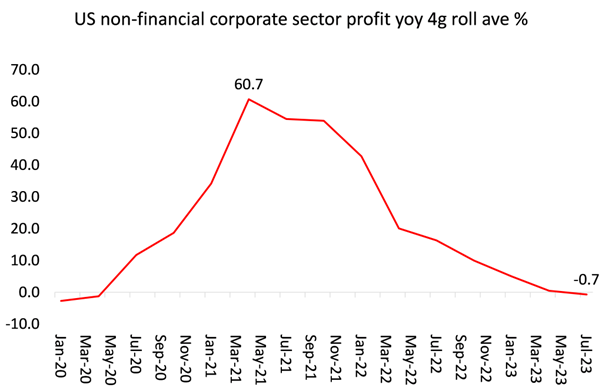
Global non-financial earnings before tax have contracted for three quarters in a row on a year-over-year basis, and fell 4% on an annual basis. All regions have seen a decline, notably Asia-Pacific, where pre-tax earnings are down 7%. Even North America has had two negative quarterly year-over-year declines. This is a profits recession.

When profits fall, business investment follows (with up to a year’s lag).

Then there is debt. As a Federal Reserve paper pointed out earlier this year, lower interest expenses and tax rates explain 40% of the real growth in US corporate profits between 1989 and 2019. But debt servicing costs are now rising significantly.

Goldman Sachs estimates that returns on equity for the S&P 500 companies has shrunk by 69 basis points this year to 23.4% and half of that is because of higher interest payments.
Corporate bankruptcies are increasing at double-digit rates in most advanced economies as borrowing costs rise and governments unwind pandemic-era measures to support business worth trillions of dollars.

And don’t forget the ‘zombies’, companies that are already failing to cover their debt servicing costs from profits and so cannot invest or expand but just carry on like the living dead. They have multiplied and survive by borrowing more.
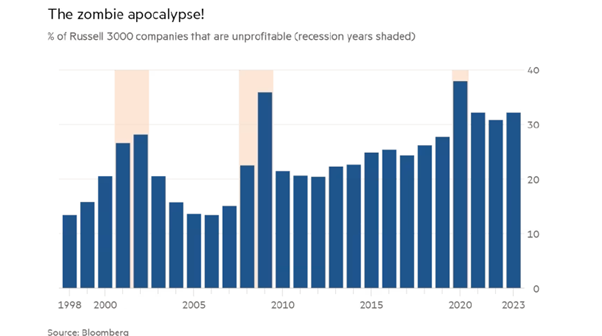
Defaults on such debt will rise. Rating agency Moody expects the global speculative-grade default rate to continue to increase in 2024 well above the historic average.
Whether the US economy goes into an outright slump in 2024 or just avoids it again, is only an issue to discuss for economists. The major economies are still growing at a pitiful pace, if at all, while the poorer economies are trapped in an inescapable debt disaster. Debt servicing costs in a clutch of the world’s poorest countries are set to soar to “crisis” levels as high interest rates damage already fragile economies, according to the World Bank, in its latest International Debt report.
Twenty-four of the world’s lowest income economies are set to spend a total of $21.5bn on financing their external public debt across this year and next, as bond repayments become due and the impact of higher interest rates feeds through. That represents a rise of almost 40% over the previous two years.
“Record debt levels and high interest rates have set many countries on a path to crisis,” said Indermit Gill, the World Bank Group’s chief economist. “Every quarter that interest rates stay high results in more developing countries becoming distressed — and facing the difficult choice of servicing their public debts or investing in public health, education, and infrastructure….For the poorest countries, debt has become a near paralysing burden,” said Gill.
In the past three years alone, there have been 18 sovereign defaults in 10developing countries including the likes of Zambia, Sri Lanka and Ghana — greater than the number recorded in all of the previous two decades. The World Bank forecasts that by the end of 2024, economic activity in low and middle income countries will be 5% below pre-pandemic levels, with growth over the 2020-24 period projected to be the weakest five-year average since the mid-1990s.
According to IMF forecasts, emerging market and middle-income countries’ average gross government debt burden is heading above 78% of GDP by 2028, compared with just over 53% a decade earlier. Some of the world’s poorest countries also face an additional burden as they repay accumulated debt owed for participating in the G20’s debt service suspension initiative in 2020 and 2021, the exact costs of which, the World Bank said, will not be known until 2024. All this will have dire consequences for the livelihoods of the millions in the Global North and the billions in the Global South next year.
So even if the US economy crawls along next year, the rest of the world’s economies are heading down.
December 16, 2023
COP28: business as usual
The COP28 conference on what to do about global warming and climate change held in Dubai finished last Thursday. Attended by a record 70,000 people (carbon footprint?) and hosted by the head of Dubai’s state oil company (!), the final statement appeared to make a major breakthrough. The statement talked of “a transition away from all fossil fuels”. For the first time, it was agreed that fossil fuel exploration, production and use must end. An historic step, it has been argued.
But a ‘transition away’ is really mealy-mouthed sophistry to avoid ‘phasing down’, let alone ‘phasing out’ fossil fuels that cause over 90% of all carbon emissions into the atmosphere. The ‘transition away’ means that fossil fuel companies can go on producing oil, gas and coal and countries and governments and companies can go on using these energy sources with no agreed reductions. It’s business as usual for the energy companies and for countries with high greenhouse gas emissions.
Supposedly, fossil fuel production and use will gradually be reduced to avoid emissions that are driving global average temperatures above the 1.5C target limit above pre-industrial levels. This target was set in 2015 at the Paris COP to be achieved by 2030 and then zero net emissions by 2050. But words are easy to say. In action, it won’t happen. The targets will not be met and the consequences for people and the planet will follow.
Indeed, just as the COP28 communique was agreed, temperatures hit 43C in Brazil and Australia – records for this time of year. The average global temperature reached a record 1.5C above pre-industrial levels in November and the year is likely to end with an average 1.2C above – so not far short of 1.5C already.

Global greenhouse gas emissions are rising inexorably to put the world on course for a near 9% rise by 2030 from 2010 levels, according to the latest progress report by the UN scientific body, the Intergovernmental Panel on Climate Change (IPCC) that is the world’s leading authority. So no fall at all. While the rise projected by the IPCC is slightly better than the 11% rise forecast in last year’s assessment, it remains vastly short of the 45% cut needed to limit warming to the 1.5C goal set as part of the Paris Agreement.
The energy plans of the petrostates contradict their climate policies and pledges, the UN report said. By 2030, their plans would lead to 460% more coal production, 83% more gas and 29% more oil than it was possible to burn if global temperature rise was to be kept to the internationally agreed 1.5C. The plans would also produce 69% more fossil fuels than is compatible with even the more damaging 2C target.
The countries responsible for the largest carbon emissions from planned fossil fuel production are India (coal), Saudi Arabia (oil) and Russia (coal, oil and gas). The US and Canada are also planning to be major oil producers, as is the United Arab Emirates. Another recent report found that the state oil company of the United Arab Emirates, whose CEO, Sultan Al Jaber, presided over COP28, has the largest net zero-busting expansion plans of any company in the world.
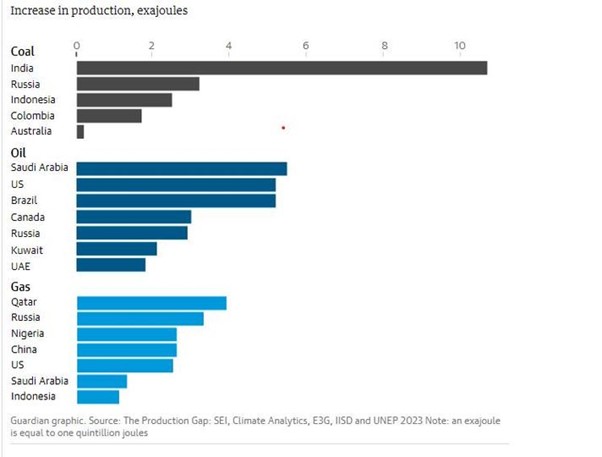
Yes, renewables and clean energy production are rising fast. The International Energy Agency (IEA) in its annual World Energy Outlook reckons that global investment in all clean energy technologies in 2023 is on track to be 40% higher than in 2020. “The transition to clean energy is happening worldwide and it’s unstoppable. It’s not a question of ‘if’, it’s just a matter of ‘how soon’ – and the sooner the better for all of us,” said the IEA’s executive director Fatih Birol. However, it’s not enough by any measure. The IEA Outlook concludes that current global energy commitments from policymakers are aligned with a temperature trajectory of 2.4C above pre-industrial levels by 2100.
The Outlook also comes with several warnings about the delivery of existing commitments. Supply chain disruptions in sectors including wind, plus the grapple for energy security in the face of the Russia-Ukraine war and global economic downturn, are prompting many countries to seek to bolster fossil fuels. Birol emphasised: “Taking into account the ongoing strains and volatility in traditional energy markets today, claims that oil and gas represent safe or secure choices for the world’s energy and climate future look weaker than ever.”
The Outlook concludes that, unless additional policy interventions are made, the share of fossil fuels in the global energy supply will still be 73% in 2030, down from around 80% at present. But, according to the IEA, to align with a 1.5C temperature, the trajectory would require the share dropping to around 60% by the end of this decade. So much for a ‘transition away’.
The commitments and actions to achieve sufficient emissions-cutting are just not anywhere near enough. Pledges made by about 130 countries and 50 fossil fuel companies made before COP28 will still leave the world far off track in limiting global warming to 1.5C above pre-industrial levels, according to the IEA. The planned reductions in 2030 emissions, even if implemented honestly and transparently. represent only around 30% of the emissions gap that needs to be bridged to get the world on a pathway compatible with limiting global warming to 1.5 C (the IEA’s Net Zero Emissions by 2050 Scenario). Indeed, the IEA said fossil fuel demand must fall by a quarter by the end of this decade.
Not a single G20 country has policies in place that are consistent with that, says Climate Action Tracker.

The IPCC report found that existing national pledges to cut emissions would mean global emissions in 2030 were 2% below 2019 levels, rather than the 43% cut required to limit global heating to 1.5C. Only one of the more than 20 sponsors of COP28 had signed up to UN-backed net zero science-based targets, (SBTi). Most of the corporate sponsors, which include the oilfield services company Baker Hughes as well as Bank of America, have made no commitment to reduce emissions to net zero in any time period under the target system. Lincoln Bauer of Spendwell, which carried out the analysis, said: “Science-based targets are the gold standard validation system for companies. The fact that so few of the sponsors are signed up to their net zero targets, and that EY itself, chosen to verify the climate commitments of the sponsors, doesn’t have set targets yet, suggests this is just greenwashing.”
The carbon budget is the maximum amount of carbon emissions that can be released while restricting global temperature rise to the limits of the Paris agreement. The latest figure is half the size of the budget estimated in 2020 and would be exhausted in six years at current levels of emissions. Instead, the world’s fossil fuel producers are planning expansions that would blow the planet’s carbon budget twice over, the UN report found.
A new analysis found the carbon budget remaining for a 50% chance of keeping global temperature rise below 1.5C is about 250bn tonnes. Global emissions are expected to reach a record high this year of about 40bn tonnes. So to retain a 50% chance of a 1.5C limit, emissions would have to plunge to net zero by 2034, far faster than even the most radical scenarios. “Having a 50% or higher likelihood that we limit warming to 1.5C is out of the window, irrespective of how much political action and policy action there is” ,said the report’s author.
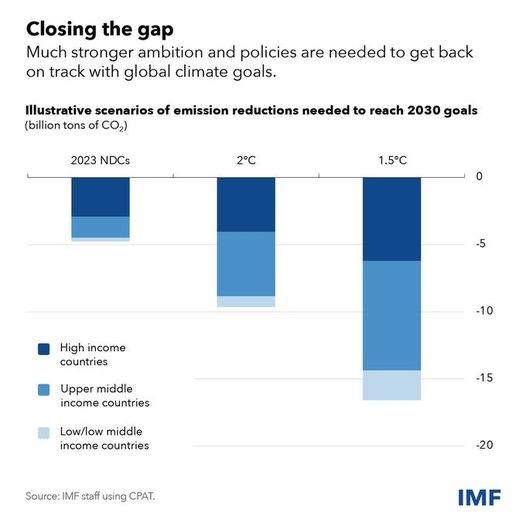
The reality is that the planet is on the verge of five catastrophic climate tipping points. Five important natural thresholds already risk being crossed, according to the Global Tipping Points report and three more may be reached in the 2030s if the world heats 1.5C (2.7F) above pre-industrial temperatures.
The tipping points at risk include the collapse of big ice sheets in Greenland and the West Antarctic, the widespread thawing of permafrost, the death of coral reefs in warm waters, and the collapse of one oceanic current in the North Atlantic. Unlike other changes to the climate such as hotter heatwaves and heavier rainfall, these systems do not slowly shift in line with greenhouse gas emissions but can instead flip from one state to an entirely different one. When a climatic system tips – sometimes with a sudden shock – it may permanently alter the way the planet works.
What to do? First, remember that it is the poor that will take the hit from global warming and climate change, while the rich (and I mean very rich) are the main contributors to global emissions. The richest 1% of people are responsible for as much carbon output as the poorest 66%, research from Oxfam shows. Luxury lifestyles including frequent flying, driving large cars, owning many houses and a rich diet, are among the reasons for the huge imbalance.
Inequalities are not just between the global north and the global south: the research from Oxfam shows that the differences in carbon footprint of rich and poor people within countries are now greater than the differences between countries. So reducing global inequality and inequality within countries would also reduce global warming rises.
Kevin Anderson, a climate scientist, says the 1% of richest emitters also influence far wider consumption. “The 1% group use their hugely disproportionate power to manipulate social aspirations and the narratives around climate change. These extend from highly funded programmes of lying and advertising to proposing pseudo-technical solutions, from the financialisation of carbon to labelling extreme any meaningful narrative that questions inequality and power. Such a dangerous framing is compounded by a typically supine media owned or controlled by the 1%. The tendrils of the 1% have twisted society into something deeply self-destructive.”
Since the 1990s, the richest 1% have burned through more than twice as much carbon as the bottom half of humanity. But more than 91% of deaths caused by climate-related disasters of the past 50 years have occurred in developing countries. The death toll from floods is seven times higher in the most unequal countries compared to more equal countries.

Is too late and if not, what’s the answer? The solutions proposed by mainstream economics and governments are no solutions at all but just ‘greenwashing’. The IMF and the World bank promote carbon pricing and taxation. The theory is that we make polluters pay for what they emit, providing a strong nudge to clean up their act. It can take the form of a tax or an emissions trading scheme (ETS) that requires companies to purchase tradable allowances to cover their emissions.
This market solution won’t deliver. To get emissions down, the global price of carbon would need to reach an average at least of $85 a tonne by 2030, compared with just $5 today. And less than 5%of global GHG emissions are covered by a direct carbon price equal to or higher than the suggested range for 2030.
What about increasing investment in renewables? It’s true that the cost of renewables is falling fast. The cost of electricity from solar power is now 85% lower than it was in 2010. Battery technology is progressing far faster than anticipated, powering the electrification of road transport: in China, 35% of all new passenger car sales are now electric. But this still pales in comparison with capital spending on fossil fuels, while subsidies by governments and credit by banks outstrip the same for renewables and other green investments.
Oil and gas producers should be spending about half of their annual investment on clean energy projects by 2030 to be aligned with global climate goals, the IEA has said. But so far, producers account for just 1% of global green energy investment and last year committed just 2.5%, or $20bn, of their capital to the sector. Not much of a ‘transition away’ from fossil fuels yet!
Chevron will spend just $2bn of its $14bn capital spending budget on lower-carbon investments this year. Exxon said last December it planned to spend $17bn in total on lower-emission initiatives through to the end of 2027, while annual capital spending on fossil fuels would remain at $20bn-$25bn during the period. Shell has said it planned to invest about $5bn on average a year between 2023 and2025 on low-carbon energy, against overall capital spending of $22bn-$25bn a year. France’s TotalEnergies said it planned to put 33% of its capital expenditure between 2023 and 2028, or about $5bn a year, towards investments deemed low carbon.
The problem for capitalist industry is that it is still more profitable to invest in fossil fuels than in clean energy projects. The IEA estimated the return on capital employed in the oil and gas industry was 6-9% between 2010 and 2022, compared with less than 6% for clean energy projects.
Then there is talk of new technologies to capture carbon in the air. This was the cry of the fossil fuel lobby at COP28. Industrial carbon capture technologies come in many flavours, but the most prominent are carbon capture and storage (CCS), which removes carbon dioxide from highly concentrated point sources like power plants; and direct air capture (DAC), which attempts to remove CO from open air, where concentrations are much lower. Limiting global warming to 1.5C would require significant carbon dioxide removals, achieved either by nature-based solutions such as reforestation, or by capturing CO₂ direct from the air and storing it permanently underground.
But currently, the planned Regional Direct Air Capture Hubs the US Department of Energy is supporting will only be able to capture one million metric tonnes of CO every year; while the world emits 40.5 billion. The technology is also expensive, costing thousands of dollars for every tonne of CO2 removed. The US Department of Energy has already poured tens of billions into poorly conceived and managed ‘clean coal’ and CCS projects. They have almost entirely failed, earning the condemnation of the Government Accountability Office. The US government has tax credits for these carbon capture projects at $60 a tonne for carbon used in enhanced oil recovery—which delays the retirement of the fossil fuel production.
So there is no escaping it. Since fossil-fuel combustion currently produces about 32Gt of CO₂ emissions a year, that means more than 85% of emission reductions must come from ending fossil-fuel use and less than 15% from applying carbon capture.
All these proposals are avoiding the elephant in the room – getting rid of fossil fuel production and use in the planet. Yes, the technology is there to do it and the money is there to help those poor countries and people to make the transition. What stands in the way are the vested interests of the global energy companies; the current profitability of fossil fuel production and use; and of course, the lack of any global agreement, let alone coordination, to implement any phasing out plan.
According to Daniela Gabor, an associate professor in economics at the University of the West of England, we need states to undertake an “extensive, deep intervention in the reorganisation of economic activity that is necessary for a just transition. Carbon wealth taxes don’t even begin to scratch the surface of that transformation.” Jason Hickel wants “democratic control over investment … and production, because profit-seeking markets prioritise the wrong things. When people have democratic control over production, they prioritise human well-being and ecological sustainability,” he says.
This must mean a campaign to bring into public ownership the fossil fuel industry globally and to use the profits and revenues to dramatically invest in renewables, electrification and environmental projects. The solution does not lie in replacing petrol and diesel vehicles with electric cars, but in replacing private transport with carbon and price-free public transport. The solution is not in building homes for profit and speculation, but in well planned urban housing projects built by governments and controlled by working people.
And we still face hell if we do not stop the destruction of nature and instead save the forests, wetlands, land and ocean life. Saving the planet and its species is inexorably connected to controlling global warming.
December 9, 2023
Napoleon’s war economy
Ridley Scott’s new film on Napoleon Bonaparte has been criticized from many angles. Filmwise, some reckon it is boring, inexplicable in parts and inaudible in others. Historical critics claim that it is just not historically correct – to which Scott retorted that “Excuse me, mate, were you there? No? Well, shut the fuck up then.” Clearly, Scott has a great understanding of the point of historical research.
However, my criticism of the film is that there is no real explanation of why Napoleon rose to the top in the French revolution, why he won his battles and why he lost the war in the end. Moreover, as others have pointed out, the film takes the view that the revolution turned into terror and then dictatorship and that is the way of all revolutions where the ‘mob’ is involved. This conventional reactionary angle leaves out some of the key changes that the revolution achieved and Napoleon introduced.

Indeed, it is the economics of Bonaparte’s war against the reactionary monarchial powers of Britain, Austria, Prussia and Russia that is missing from Scott’s primitive biopic which concentrates on the battles, his personality and on his sexual relationship with Joséphine de Beauharnais, the daughter of a slave-owning sugar planter. Yes, individuals can affect history, but as Marx pointed out in his essay, The 18th Brumaire of Louis Bonaparte (when analysing the coming to absolute power of Napoleon’s nephew ‘Emperor’ Louis in 1852): “Men make their own history, but they do not make it as they please; they do not make it under self-selected circumstances, but under circumstances existing already, given and transmitted from the past.”
Napoleon started as a radical revolutionary supporting the Jacobin regime and ended up as an ‘emperor’ (much to the disgust of democrats like the composer Beethoven who in protest removed his dedication to Napoleon for one of his symphonies). Napoleon came to power as the defender of the republic, but he turned a war of defence into wars of conquest for an empire in Europe to compensate for the empire that had been lost in India, the Caribbean and North America in the latter part of the 18th century. Millions of combatants and civilians died in the ‘Napoleonic wars’., the same number proportionately as in the WW1.
The term Bonapartism was coined to describe how one man can gain absolute power in a situation where the class forces are so balanced and unstable that the progressive class forces are unable to rule directly in the face of the opposition of reactionary class forces.
Before Bonaparte, there were other Bonapartes. There was the Roman Julius Caeser, a military leader who leant on the peasant and urban masses against the aristocrats of the Senate and eventually (if briefly) gained autocratic power. Then in the 1640s England, there was Cromwell, a landowning farmer, who became a military leader in the parliamentary forces that defeated the royalist reaction and then ruled as ‘Lord Protector’ for ten years. Then there was Stalin, a Bolshevik revolutionary who eventually established a vicious one-man dictatorship resting above and between a weakened workers democracy and the forces of capitalist reaction surrounding Russia.
In his 18th Brumaire Marx reckoned that “Camille Desmoulins, Danton, Robespierre, Saint-Just, and Napoleon” were “the heroes as well as the parties and the masses of the old French Revolution” and they “performed the task of …. unchaining and setting up modern bourgeois society. The first ones knocked the feudal basis to pieces and mowed off the feudal heads which had grown on it. The other (Napoleon – MR) created inside France the conditions under which alone free competition could be developed, parceled landed property exploited and the unchained industrial productive power of the nation employed; and beyond the French borders he everywhere swept the feudal institutions away, so far as was necessary to furnish bourgeois society in France with a suitable up-to-date environment on the European Continent.”

The young Jacobin soldier
One man can make history but only within the conditions given. It was the economic conditions and balance of forces that decided the ‘Napoleonic wars’. Napoleon won many battles, but he still lost the war. Why? The evidence reveals that France just did not have the resources of manpower, arms and, above all, finance to wage a long war against the combined powers of the absolute monarchies backed by the firepower and wealth of a rising hegemonic Britain.
To sustain war depends on two measures: the economic resources available to fund war and the ability to get armaments supplied and fit men to the battlefield. From 1789 to 1815, France faced seven opposing Coalitions and managed to defeat six. As one analyst put it: “this feat is often attributed to the tactical and strategic thinking of Napoleon Bonaparte. However, the country was eventually defeated under the pressure from the combined superior economic, demographic, industrial strengths of the Allies.”
The French revolutionary republic after 1789 was immediately faced with a reactionary counter-revolution from the Royalists at home and foreign invasion from abroad. And it had no money to fund the defence of the republic. The Jacobin leaders hoped that the confiscation of Church wealth and royal properties would deliver. But what was raised was just not enough to build a fighting successful army and meet the social needs of a starving population. So the revolutionary government printed money – indeed there was already private printing of money that was out of their control. The money supply rocketed and so did inflation.
In 1793, under the Jacobin government, total money in circulation was valued at almost 3 billion francs, more than double the original sum raised from confiscations. The starving population looted shops for clothes and food. The government then paid out social benefits to restore stability. By 1795, total money supply increased to 4.4 billion francs and the franc exchange rate with the British pound plummeted by 45%. By the point of the counter-revolutionary removal of the Jacobin leadership and the establishment of the Directory, the money supply had multiplied to 20 billion francs, on top of which the government has issued bonds for another 50 billion.
But it was not all disaster, contrary to the views of historians today. The French republican economy was actually beginning to motor. Coal production doubled between 1794 and 1800 when Napoleon took over. Iron production rose 50% and salt by even more. These were key products for a budding industrial and urbanising economy. This industrial production was driven by the needs of the war economy. The French defence industry was developing fast. Above all, agricultural and food production recovered – if not enough to stop food prices rising. While Britain’s war economy managed a 25% rise in agricultural production in the first decade of the 1800s, France under Napoleon raised agro production by 500% – but it started from such a low level, even that increase was not enough to meet demands of the army and the civil population’s needs.
The right-wing Directory eventually gave way to a Bonapartist coup in 1799-1800, giving Napoleon supreme powers to ‘save the revolution’ and defeat royalist reaction at home and abroad. Like a good ‘bonapartist’, Napoleon balanced between the class forces of bourgeois and merchants and the ‘masses’ of peasantry and artisans (sans culottes). Formerly a ‘fellow traveller’ of Robespierre’s Jacobins, he came to power preaching prosperity for the masses over the interests of the big merchants and the aristocracy and ended up as an emperor of Europe.

Emperor Napoleon
Napoleon always stood on the side of the capitalist mode of production against that of feudalism and the ancient regime, despite declaring himself emperor in 1805. On the other hand, he was strongly opposed to any ‘socialistic’ alternatives that some more radical forces among the Jacobins proposed. Napoleon reckoned that in any society “the abler minority will soon govern the majority and absorb the greater part of the wealth”; as it was human nature: “it is hunger that makes the world move.” As he put it: “Whilst an individual owner, with a personal interest in his property, is always wide awake, and brings his plans to fruition, communal interest is inherently sleepy and unproductive, because individual enterprise is a matter of instinct, and communal enterprise is a matter of public spirit, which is rare.”
“Before 1789,” says Taine, “the peasant paid, on 100 francs’ net income, 14 to the seignior, 14 to the clergy, 53 to the state, and kept only 18 or 19 for himself; after 1800 he pays nothing of his 100 francs of income to the seignior or the clergy; he pays little to the state, only 25 francs to the commune and département, and keeps 70 for his pocket.” Before 1789 the manual worker laboured from 20-39 working days per year to pay his taxes; after 1800, from six to 19 days and “through the almost complete exemption [from taxes] of those who have no property, the burden of direct taxation now falls almost entirely on those who own property.”
Napoleon introduced a special land registry which by 1814 had registered 37,000,000 plots of land with their owners. Napoleon reckoned that state “finances founded upon a good system of agriculture never fail.” He introduced protective tariffs, reliable financing and well-maintained transport by roads and canals should encourage the peasants to labor steadily, to buy land, to bring more and more of it under cultivation, and to provide sturdy youngsters for his armies. Too many French farmers were sharecroppers or hired farm laborers, but half a million of them, by 1814, owned the acres that they sowed.
An English lady travelling in France in that year described the peasants as enjoying a degree of prosperity unknown to their class anywhere else in Europe. These tillers of the soil looked to Napoleon as a living guarantee of their title deeds and remained loyal to him until their lands languished in the absence of their conscripted sons.
As Marx put it in the 18th Brumaire: “After the first Revolution had transformed the semi-feudal peasants into freeholders, Napoleon confirmed and regulated the conditions in which they could exploit undisturbed the soil of France which they had only just acquired, and could slake their youthful passion for property ….Under Napoleon the fragmentation of the land in the countryside supplemented free competition and the beginning of big industry in the towns. The peasant class was the ubiquitous protest against the recently overthrown landed aristocracy. The roots that small-holding property struck in French soil deprived feudalism of all nourishment. The landmarks of this property formed the natural fortification of the bourgeoisie against any surprise attack by its old overlords.”
The workers who dug the canals, raised the triumphal arches and manned the factories were not allowed to go on strike, or to form unions to bargain for better working conditions or higher pay. However, Napoleon’s government saw to it that wages should keep abreast of prices, that bakers and butchers and manufacturers were under state price regulation, and that—especially in Paris—the necessaries of life should be supplied. Until the last years of Napoleon’s rule, wages rose faster than prices and the proletariat shared (modestly) in the general prosperity and proud of Napoleon’s victories. There was no unemployment, so no political revolt. “Nobody is interested in overthrowing a government in which all the deserving are employed.”, said the great man.
While the reactionary monarchies financed their war by printing money and relying on the huge empire war chests of the British treasury, Napoleon’s France had to rely on domestic taxation, which was never enough, and on booty from conquests in the Netherlands, Italy, Austria and Prussia. At home, Napoleon sorted out the finances. Money printing was ended and inflation receded. And up to at least 1812, war booty usually brought in more than the battles cost. The defeated countries were charged high fees.
In 1811, Napoleon boasted that he had 300m gold francs in the Caves des Tuileries. He used this fund to ease stringencies in the Treasury, to correct volatility in the stock market, finance public works or municipal improvements and to pay for his secret police. Enough remained to prepare for the next war and to keep taxes far below their level under Louis XVI. In 1805, Napoleon reorganized the Bank of France, which had been established in 1800 under private management. This new Banque de France opened branches at Lyons, Rouen, and Lille and began its key role in service to the French capitalist economy and the state.

Banque de France
When Las Cases, an émigré returned in 1805 from a tour of sixty départements, he reported that “France had at no period of her history been more powerful, more flourishing, better governed, and happier.” In 1813 the Comte de Montalivet, minister of the interior, claimed that this continuing prosperity was due to “the suppression of feudalism, titles, mortmain, and monastic orders; … to the more equal distribution of wealth, to the clearness and simplification of the laws.”
But France’s economy was still inefficient when compared to that of Britain. French industry could not meet the demands of the prolonged war that Napoleon initiated and this forced the Grand Armée to rely heavily on war booty. The irony is that it was Britain that printed money and issued bonds to pay for the war. But Britain could do that because bond holders could be confident that after the war revenues from Britain’s industrialization and huge colonial empire would easily service such debt. France had no such economic credibility.
The reality was that overall French finances were much lower compared to that of Britain. In 1805, the French budget was just £27m, whereas the British was £76 million. In 1813, the French expenditure rose to £46m but the British budget reached £109 million. In spite of the continued exploitation of occupied countries, the French government debt rose five times between 1809 and 1813.
In 1800, per capita GDP in England was twice as large as France.

Per capita GDP
For France, booty was the answer. But these sums began to dry up with growing resistance from and even victories by the European monarchies. The economic writing was on the wall. Napoleon’s France could not win the war no matter how many battles he won. The retreat from Russia signalled the end as Napoleon faced a new coalition of Prussia, Russia and Britain assisted by Sweden and Austria. Napoleon’s final gambit at Waterloo was made possible by a huge mobilisation of support and financial borrowing. By June 1815, just three months after the arrival of Napoleon from his exile in Elba, the strength of the French army increased from 224,000 men to 662,331 men. But it was not enough.
Napoleon managed to defeat almost all of France’s continental enemies including Austria, Prussia, Russia, and Italy in most engagements. However, his tactical and strategic skills failed to overcome the two major French deficiencies. First, the economic looting of Europe stressed out the conquered territories and pushed them into nationalist rebellions against him. Second, there was an immense imbalance in economic power between Britain and France. France may have occupied Europe, but Britain had the colonies of America, Canada, Africa, India, and Asia behind it. Britain, based on its international trade, could mobilize more economic resources, raw materials and labour than France. In a prolonged war, Britain could survive longer and better than France.
A lesson to be learnt now – which has the stronger war economy: Ukraine or Russia?
December 6, 2023
Goldilocks and the last mile
Last week, the second estimate for the US real GDP in Q3 of 2023, i.e. national output, was released. It came in at 5.2% on an annualised basis. That seemed a very strong figure, only surpassed in the recent period by Q4 2021, when the US economy was recovering fast from the pandemic slump of 2020.
But this is a weird way of measuring GDP. The annualised figure does show the pace of growth in any quarter – but it is misleading. That 5.2% annualised figure means the US economy actually grew 1.26% in the quarter over the previous quarter (5.2/4 quarters). That’s still pretty strong compared to the trend in recent quarters. But another measure of real GDP growth is to compare the GDP in one quarter with where it was in the same quarter one year ago. This is the year-on-year figure, mostly used in other countries to gauge the growth rate in an economy. In Q3 US GDP rose 3.0% yoy compared to 2.4% yoy in Q2, still the strongest rate since the first quarter of 2022, but not over 5%.
Also last week, we got the latest measure of inflation in prices in the US economy. Having peaked at 8.9% yoy in June 2022, the ‘headline’ inflation rate is now down to 3.2% yoy in October 2023. Similarly, the inflation rate for the prices of goods and services bought by American households, called the personal consumption expenditure (PCE) index, has fallen from a peak of 7.1% in June 2022 to 3.0% in October 2023. The PCE is the measure that the US Federal Reserve economists follow most closely for interest-rate policy.
Both the CPI and PCE inflation rates have more than halved. At this rate of decline, the US inflation rate could be back to the target set by the US Federal Reserve of 2% a year pretty soon. But there is a caveat to that. If food and energy prices are excluded from the price index, then ‘core’ CPI inflation, as it is called, has not fallen so much: from a peak of 6.6% yoy in September 2022 to 4.0% in October. That suggests that the main driver of falling inflation up to now has been falling energy and food prices. Other prices have been ‘stickier’ in coming down.
As for jobs, the official rate of US unemployment at the last count was 3.9% – it’s been ticking up since April when it fell to 3.4%, a figure below that of end 2019 just before the pandemic broke. So unemployment is now rising, but still low by historic standards. Also, average hourly earnings from wages are now rising faster than inflation, so real incomes from work (before tax and benefits) are improving.
No wonder the consensus view among economists has swung from pessimism at the beginning of this year about the economy (with forecasts of recession ie. falling output for at least two consecutive quarters) to optimism and the ruling out of a slump in the US economy, not only now but in 2024 onwards.
Take the view of the economists at Goldman Sachs, the leading investment bank in the US. GS economists report that “the global economy has outperformed even our optimistic expectations in 2023. GDP growth is on track to beat consensus forecasts from a year ago” and “we continue to see only limited recession risk”. So, they conclude, the US Federal Reserve’s policy of hiking interest rates has succeeded in getting inflation down without incurring a slump in production and employment – at least in the US. As the GS economists put it, the US economy is on “its final descent to a soft landing”, with real GDP growth projected to expand 2.1% in 2024.
This is what is sometimes called a ‘Goldilocks’ outcome ie the US economy is not too ‘hot’ that inflation stays high and not too ‘cold’ that there is a contraction in output and rising unemployment. And this is happening despite the Ukraine-Russia war and now the Israel-Gaza nightmare. Perfect!
But hold your horses! Let’s re-examine each of these measures of the health of the US economy before accepting the Goldilocks scenario is in operation. First, there is another measure of economic growth than the change in gross domestic product (GDP). There is gross domestic income (GDI). In macroeconomic accounting both these measures should be equal in theory. GDP measures the total value of goods and services produced in an economy. GDI measures aggregate income received across all sectors of the economy, including wages, corporate profits, and tax receipts from that output. Accounting-wise, these two measures should add up to the same. But the measures can vary because the data to measure them come from different sources.
However, currently GDP and GDI growth rates are diverging to a degree not seen since 2007, just before the Great Recession of 2008-9. As said above, US GDP growth was (an annualised) 5.2% in Q3 this year, but GDI growth was just 1.5% annualised. And although GDP yoy growth has slowed, it remains positive, implying a strong economy, but GDI yoy has been falling for two consecutive quarters, implying a recession.
Why the big difference? And which measure is more accurate? Various explanations have been presented. It’s ‘statistical noise’ that will subside and both measures will soon be in line. That’s one answer. Another is that, according to the official statisticians at the US BEA, “corporate profits, proprietors’ income (small business and self-employment income), and capex are the components of GDP/GDI that are most prone to revision.” In other words, production of goods and services may rise but that may not be translated into increased incomes (profits and wages).
Indeed, the strong GDP figure was partly due to a large rise in inventories or stocks of unsold goods, not earning any revenue. Private inventory investment contributed 1.3 percentage points to GDP in Q3. Inventory swings could even subtract from GDP in future quarters, bringing it closer to the GDI measure. If you strip out the build-up of stocks and just measure the increase in actual sales (after inflation), then sales growth was about 2% yoy in Q3, not over 3% yoy as measured in GDP. Real final sales are still 7-8% below pre-pandemic trend growth.
GDP has been growing faster than GDI because there is more consumer borrowing (and running down savings) and because there is more production without sales. So the GDI measure may well be more accurate about what is happening to the US economy than GDP. Over the last four quarters US GDP is up 3.0% while US GDI is down 0.2%.
The average of the two is 1.4% over the last four quarters. One answer to this conundrum then is to do an average of the two measures. The Congressional Budget Office (CBO) does that. There is also a similar combined measure called GDP-plus, produced by the Philadelphia Federal Reserve.
I put these three measures together in the graph below. I think it is significant that the GDI and GDP diverge most when production growth is being driven more by credit than by increased revenues (wages and profits), as just before recessions. Since the pandemic, real wages have fallen behind inflation and now profits for all companies have also started to slow sharply. That’s a sign that GDP growth may well slow soon as well.

Indeed, the latest forecast by the well-followed Atlanta Fed GDP Now model reckons real GDP growth in this current Q4 quarter is likely to be just 1.2% at an annualised rate, or up only 0.3% on Q3.

Then there is the issue of inflation. Is it really heading back to ‘normal’ or low rates? The first thing to say on this is that inflation means inflation of price levels. Prices of the average basket of goods and services or of all commodities are not falling in the US, or elsewhere. Since the end of the pandemic, average price levels in the US have risen 17.5%. A gallon of milk costs 7% less than at its peak, but the price is about 23% higher than in early 2020. Meanwhile, rents and housing prices remain stubbornly high, as do mortgage rates.
Even Jared Bernstein, the chair of Biden’s Council of Economic Advisers, has acknowledged that, while slowing inflation is “extremely welcome…people want to hear about falling prices, because they remember what prices were, and they want their old prices back.” They are not going to get those old prices back, although it is true that ‘durable goods’ (household appliances etc) prices are falling.

All that has happened is that the rise in price levels is slowing and now wages are rising to match or surpass current inflation. But wages have not risen enough in the last three years to compensate for that 17.5% rise in prices.

Moreover, the inflation rate is down, not really because of anything done by central banks, namely hiking interest rates to squeeze ‘aggregate demand’ and thus slow spending growth. The main reason for the slowing inflation rate is the fallback in energy and food prices – in other words, key raw material and commodity prices. In this blog, I have reviewed arguments over whether post-pandemic inflation was caused by “excessive demand” or “weak supply” from supply chain blockages. The evidence has mounted that inflation was kicked started by the latter and the former only came into play as result of the former.
Marxist theory suggests that there is tendency for prices to fall over time as productivity growth rises and costs per unit of production fall. Indeed, before the pandemic, durable-goods prices fell an average of 1.9% a year from 1995 to 2020 as globalisation shifted US manufacturing production to low-wage countries and productivity improvements lowered costs.
But if production is disrupted, then the opposite will occur. Post-pandemic, product shortages snarled supply chains and a surge in demand from consumers flush with cash sent prices soaring in 2021 and 2022. Durable-goods inflation peaked at a 47-year high of 10.7% in February 2022.
Research by Adam Shapiro, an economist at the San Francisco Fed, finds that supply disruptions such as those from closed factories or shipping backups accounted for roughly half the run-up in inflation in 2021 and 2022. Today, supply chains are running smoothly, according to a New York Fed index.

The White House Council of Economic Advisers (CEA) estimated better-functioning supply chains accentuated by weaker demand accounted for roughly 80% of the fall in inflation since 2022. The CEA reckoned that inflation after the pandemic was driven by two primary factors: pandemic-driven supply-chain bottlenecks and strong consumer demand, which includes compositional shifts in demand from goods to services. Moreover, supply and demand do not occur in isolation; they interact with one another. Supply chain disruptions are more inflationary if they occur in the context of strong demand, where they are more likely to bind, than in a weak one where demand is slack.
The CEA found that supply chains, either alone or interacted with slack, explain most of the excess core inflation from 2021-23. Likewise, supply chains in some form—either alone (purple bars in Figure 2) or in tandem with slack, xplain more than 80 percent of the disinflation the US has experienced since 2022. By contrast, because the unemployment rate has not changed much since 2022, the model assigns little effect to labor market slack on its own – the latter being the usual Keynesian explanation of inflation.

Another mainstream report did a similar exercise and found that “negative supply shocks to factors of production, labor and intermediate inputs, initially sparked inflation in 2020–2021. Global supply chains and complementarities in production played an amplification role in this initial phase.” Then “aggregate demand shocks, due to stimulative policies, widened demand-supply imbalances, amplifying inflation further during 2021–2022.”
The study reckoned that in 2020 supply shocks contributed about 80% of the inflation rise. And during 2021 it was the improvement in supply chains that led to fall in the inflation rate. “actual inflation would have been much higher without the improvement in supply chains that acted as a disinflationary force (measured via the sector-level supply shock) in the last part of 2021 and throughout 2022.”
They concluded that “The overarching policy implication of our paper is that, in a world with more supply shocks (a fragmented and de-globalized world), at sector or at the aggregate level, we will see more inflation, regardless of the fact that monetary policy stays restrictive.”
What this suggests is that the continued levels of high interest rates imposed by the Federal Reserve did not get inflation rates down and won’t do so from hereon. So what central banks call ‘going the last mile’ to reach the Fed’s arbitrary 2% a year rate is not likely to be achieved by Fed policies. Indeed, there are signs that inflation may start to rise again.

ECB member Isabel Schnabel discussed the ‘last mile’ for Eurozone inflation: “while it took a year to bring inflation from 10.6% to 2.9%, it is expected to take about twice as long to get from here back to 2%.” A key problem is productivity growth. And US treasury secretary Janet Yellen noted what we have discussed on this blog many times. “Over the last decade, U.S. labor productivity growth averaged a mere 1.1 percent—roughly half that during the previous fifty years. This has contributed to slow growth in wages and compensation, with especially slow historical gains for workers at the bottom of the wage distribution.” When productivity growth is low, then the upward pressure on inflation rises as firms try to compensate for higher unit costs with price increases. Once productivity growth picks up, then unit costs do not rise as fast and inflation can subside. This is clearly revealed in the relation between productivity and prices in the US post-pandemic.

US worker productivity grew at its quickest pace in three years in Q3 2023. But average growth is really only back to the slow rate of growth of the 2010s at best. So that’s likely to make any further reductions in the inflation rate from here much more difficult to achieve.
As Schnabel put it: “Meagre productivity growth is putting additional pressure on firm’s unit labour costs, which have been rising sharply since the beginning of 2022. Given these rigidities, disinflation will slow down appreciably. For core inflation to evolve in line with ECB staff projections, two key conditions need to be met. One is that the growth in unit labour costs eventually falls back to levels that are broadly consistent with 2% medium-term inflation. The second is that firms will use their profit margins as a buffer to limit the pass-through of the current strong wage increases to consumer prices.”
In other words, productivity growth must rise to reduce costs per unit of production AND companies must stop trying to sustain profit margins at high levels. Otherwise, inflation rates will not come down much further from here and may even start to rise.

The impact of other factors on prices also cannot be dismissed. This year’s El Niño is expected to bring months of extreme heat and rainfall to parts of the world, reinforcing the risks stemming from global warming. This is threatening to disrupt crop cycles and put further pressure on global food markets.
What about employment and jobs? The Goldilocks optimists like the GS economists emphasise how in the US and in most of the major economies, official unemployment rates are at or near all-time lows. Everybody can get a job if they want one, it’s claimed. It seems that, particularly after the experience of the pandemic, employers have tried to keep their workers on the books in case they cannot replace them later (as happened to the airlines which sacked their workforce during the pandemic and then found it difficult to fill the gaps afterwards). Replacing workers with robots is still not happening, so productivity growth is weak.
But now the US labour market is cooling off. Job creation is down this year from the high rates of 2022 and the unemployment rate has risen from a more than 50-year low of 3.4% in April to 3.9% in October. And as I pointed out in a previous post, there is a reliable (Sahm) model that argues if the unemployment rate rises more than 50bp for at least three months, then a recession is likely on its way.

The ratio of job vacancies to people seeking work has fallen, and so has the rate of people voluntarily quitting their jobs. Similar declines have happened only three times since 2000: in the dot.com bubble burst of 2001; the financial crash of 2008 and the pandemic slump of 2020.

From Jason Fulman.
And if you look at long-term unemployment (out of work for more than six months), then things are getting worse. You may still be able to get a job in America (low-paid and/or part-time) but if you lose that job, it’s getting more difficult to get another.

But here is the main thing. The economic indicators that the optimists and mainstream economics single out to judge the health of a capitalist economy are mainly ‘lagging’ indicators’. They look at employment, consumer spending, GDP and prices. But Marxist theory tells us that what drives capitalist economies first is profits; then profits as invested in productive investment (this raises the productivity of labour and output, not invested in fictitious capital like stocks and bonds); and only then does investment and production growth feed down to employment, wages and consumer spending. And when we look at these ‘forward looking indictors of the US economy, it is not so rosy.
First, corporate profit growth is dropping away.

Indeed, 40% of the top 2000 companies in the US now have negative earnings.

With profit growth dropping off, business investment growth is beginning to follow (it usually follows with up to a year’s lag).

During 2024, slowing growth in investment will keep productivity growth weak. Why? Well, a recent McKinsey report found that the productivity slowdown has mainly come from a decline in capital per worker and in innovation ie productive investment: “since the Great Recession, capital intensity, or capital per worker, in many developed countries has grown at the slowest rate in postwar history. An important way productivity grows is when workers have better tools such as machines for production, computers and mobile phones for analysis and communication, and new software to better design, produce, and ship products, but this has not been occurring at rates that match those recorded in the past. A decomposition of labor productivity shows that slowing growth of capital per hour worked contributes about half or more of the productivity decline in many countries.”
I have argued in previous posts that a slump in the US economy would happen when profit growth stops and rising interest rates push up borrowing costs for companies that look to invest. These two blades have been closing.
With debt servicing costs rising, many small companies are struggling to make ends meet and bankruptcies are rising. The huge backlog of so-called zombie companies that are drip fed by the banks to keep them going are still there. If they start to fall over, then the banking crisis experienced earlier this year will resurface. US banks still have huge ‘unrealised’ potential losses from the bonds on their books.

The optimists are puzzled at why Americans, on the whole, are very pessimistic about the US economy despite their rosy picture. The explanation they have come up with is that US households are either stupid or biased politically against the Biden administration!
Perhaps more likely is that with average prices up 17-20% in two years, wages not rising to match that; transport and infrastructure neglected; student fees and debt rising again; record house prices; rising credit and mortgage costs; and government money going to fund wars elsewhere, Americans are not so convinced that all is well.

And remember the US economy is the best performing of the major advanced capitalist economies. Many in Europe are already in recession or near to it (Germany, France, Netherlands, Sweden and the UK). Japan is back into contract territory too and Canada has suffered four consecutive quarters of contraction in GDP. Virtually every major economy’s manufacturing sector is contracting with little sign of turning around, while global trade is also going down.

So the GS economists may be taking a victory lap over their forecast that the US economy would avoid a recession in 2023 that many others (including me) thought was coming, but the underlying fault lines in the US economy remain and are likely to surface in 2024.
December 3, 2023
Why real-world economics matters
Last weekend, I delivered a keynote lecture at the London School of Economics to economics students at Britain’s Open University on their Economics Day. This is a transcript of my presentation.
Today I have been asked to speak on the topic of: Why ‘real world economics’ matters? That title begs a few questions: What is real world economics? And this implies that there is economics that is not about the real world. And if there is real world economics, what can it contribute to making a better world for us all?
Real world economics should be about understanding what is happening in the world around us: what causes inflation, unemployment, poverty, inequality, climate change etc. And what are the economic policy answers. But there is a problem. What I call mainstream economics does not discuss or deal with these real world issues very well.
One example directly involving this very building springs to mind. Back in the depth of what came to be called the Great Recession of 2008-9 when all the major economies were suffering a sharp and deep fall in national output, employment and average incomes, after a humungous collapse in the banking and financial systems, Queen Elizabeth visited the London School of Economics.
As she stepped into this very building, she asked the gathering of eminent economists who met her: “Why did no one see it coming?” In other words, she asked why no one had predicted the financial collapse and the ensuing slump, the worst since the 1930s depression years. The eminent economists were nonplussed by the Queen’s question about the real world. It took them three months before they responded – in a published three-page letter to the Queen.

I quote: “Everyone seemed to be doing their own job properly on its own merit. And according to standard measures of success, they were often doing it well. The failure was to see how collectively this added up to a series of interconnected imbalances over which no single authority had jurisdiction.” I think the economists were saying that their theories seemed to be fine but then lots of different things that they knew about somehow all came together in a perfect storm to create the crash and they could not have foreseen that.
Six months later the Queen visited the Bank of England and one of the Bank’s top financial policy experts stopped the Queen to say he would like to answer the question she first posed to those economists at the LSE. He told the Queen that financial crises were a bit like earthquakes and flu pandemics in being rare and difficult to predict and reassured her that the staff at the Bank were there to help prevent another one. Prince Philip did not miss his opportunity: “so is there another one coming?” No answer.
But here is my point. It’s not just that the economists didn’t notice it coming ‘out of the blue’ like an asteroid hitting the earth, a shock to a perfectly working economic system. Their theories assumed away the possibility entirely.
Robert Lucas is an eminent mainstream economist, indeed a Nobel prize winner for economics. In 2003, some five years before the global financial crash he pronounced that “macroeconomics has succeeded: Its central problem of depression prevention has been solved, for all practical purposes, and has in fact been solved for many decades.”
Eugene Fama is another Nobel prize winner in economics. His prize is for showing that markets work efficiently and, as long as you and me and everybody has enough information about what is going on, then the market will ensure full employment, steady growth and rising incomes for all. This is called the Efficient Markets Hypothesis (EMH). After the Great Recession, Fama was asked what went wrong. He replied, “We don’t know what causes recessions. We’ve never known. Debates go on to this day about what caused the Great Depression. Economics is not very good at explaining swings in economic activity”.
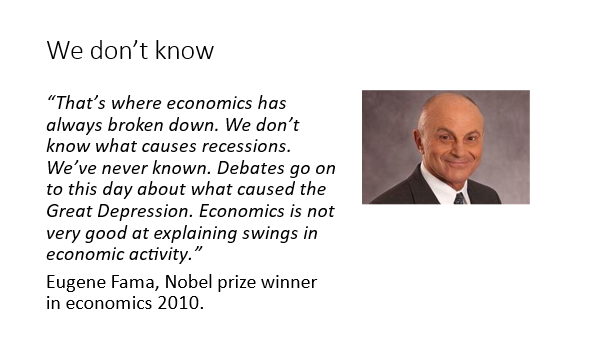
Up to now I have talked about one economics event and one strand of explanation: what I have called mainstream economics and its failure to forecast or deal with that event, i.e. global financial collapse of banks and a deep contraction in employment and incomes globally. A real problem but with no answer from the mainstream. But that poses the question that if mainstream market economics cannot explain the real world very well, then we need new theories to guide our policy decisions.
And there are other theories. Indeed, we can categorise economics into various schools, with the main division between ‘mainstream’ and ‘heterodox’. In the mainstream, we have two great sub-divisions. The first is called the neoclassical school. This school starts from a basic assumption that a ‘free market’ ie. without interference or imperfections caused by monopolies or trade unions or the government, will deliver harmonious economic improvement in what is called a ‘general equilibrium’. As one neoclassical economist once put it: ‘the market economy is like a calm lake or pool. Sometimes a rock or stone can disturb it, a shock to the calm environment, but eventually if those interferences stop, the ripples in the pool will subside and the pool will be calm again’.
Within the mainstream, there is also the Keynesian school, named after the theories of John Maynard Keynes, the great British 20th century economist. Keynesian theory rejects the equilibrium idea of the calm pool of the neoclassical school. The Keynesians think the neoclassical model is not ‘real world’ economics. The Keynesians argue that market economies sometimes get into ‘disequilibrium’ leading to depressions and unemployment, which economies do not get out of unless governments intervene with measures including printing more money or increasing government spending to restore equilibrium.
But both the neoclassical and Keynesian schools agree on one thing: that a market-based system is the only viable form of economy. It’s just that one school thinks that ‘harmonious’ growth can be achieved by a free market without interference and the other thinks government and central banks must intervene to correct any disequilibrium.
But mainstream economics starts from an assumption that it has not proved – namely that a market economy where companies employ people like us to produce goods and services to sell on a market for money – and more importantly for profits for the owners and shareholders of those companies – is the only way to organize the production and distribution of things that we humans need.
But the market economy has not always existed – indeed it has been around for only about 250 years. Before that there were feudal economies where peasants or serfs worked the land for their masters who consumed the produce. That system was around for over 1000 years. Before that there were slave economies where people captured in wars were forced to work for their slave owners – that system was around for thousands of years.
I make this point because we should be aware that how economies are run now has not always been here and may not last as the best way to meet the needs of humanity. Indeed, in my view, the market economy shows significant signs of failing to do so. So there may be other ways of economic organization.
As such, there are economists who have serious criticisms of mainstream market economics. There is what we can call the heterodox schools of economics – the term meaning what it says, outside the orthodox mainstream. Within this broad strand, these economists highlight the irrational behaviour of markets and the inherent instability of the market economy. They include the Marxist school which argues the market economy will always have crises that cannot be resolved by the market and so the market economy (called capitalism by Marxists) needs to be replaced by a planned economy based on common ownership of all producers.
The heterodox school is very critical of the mainstream. Indeed, almost exactly six years ago, leading heterodox economists held a seminar right here at the LSE on the state of mainstream economics, as taught in the universities. They kicked this off by nailing a poster with 33 theses critiquing mainstream economics to the door of this building. (You can google it). It was the 500th anniversary of when Martin Luther nailed his 95 theses to the Castle Church, Wittenberg which provoked the beginning of the Protestant reformation against the ‘one true religion’ of Catholicism.
The heterodox economists were telling us that mainstream economics was like Catholicism and must be protested against as Luther did back in 1517. As they put it, “Economics is broken. From climate change to inequality, mainstream (neoclassical) economics has not provided the solutions to the problems we face and yet it is still dominant in government, academia and other economic institutions. It is time for a new economics.”
What should that new economics be? Recently, Benoît Cœuré, a leading French member of the Executive Board of the European Central Bank, delivered an address just like I am doing now to you, to economics students at the Paris School of Economics, if you like, the sister university to the LSE. Cœuré told his student audience that “economics is a social science. Models will not take away the burden and responsibility of making judgements. Economics involves much trial and error – you have to take decisions in the fog when you can barely see your hand in front of your face. This makes our profession exciting!”
For me, economics is a science – if a social science dealing with humans, not a physical science. As a science, it requires scientific method. For me, that means you start with a hypothesis that has realistic assumptions that have been ‘abstracted’ from reality and then construct a model or set of laws that can be tested against evidence. The model can use mathematics to refine its precision, but eventually the evidence decides. In my view, like physicists and astronomers, economists too must be able to develop theories about the economies in the real world and test them empirically so that we can make predictions and hopefully avoid the economic crises that modern economies have on a regular basis.
Up to now, I have discussed the big events like the Great Recession and the contribution or failure of mainstream economics to forecast or explain them or provide effective economic policies to remedy them and avoid more in the future. But much of mainstream economics is not about these big events. Benoit Cœuré in his Paris lecture dismissed the criticism that economists failed to predict the outbreak of the financial crisis. “This criticism is nonsense. Do we expect physicians to predict illnesses? We don’t, of course. But we expect them to help us cure illnesses. Economists should do the same.” So it’s not the job of economics to forecast or predict but to develop policies to cure any messes that emerge.
This is a common theme among economists. Another recent Nobel prize winner, Esther Duflo, reckoned economists should give up on the big ideas and instead just solve problems like plumbers “lay the pipes and fix the leaks”. Economists were more like engineers than physicists. Keynes made a similar point: that economists should be like dentists – sorting out troublesome teething problems so that capitalism can then run smoothly.
Duflo reckons the analogy of plumbers means that pure scientific method of analysing cause and effect was less important than practical fixes. So economists should be more like doctors than medical researchers. Plumbers, dentists, engineers, doctors – but not, it seems, social scientists.
But are doctors all that matter in human health? Actually, improved doctoral skills in treating patients once they have become ill comes from scientific discovery about diseases, biology and the environment. Successful drugs and medical practices are the result of learning what the cause of the illness is.
In medieval times, doctors applied all sorts of useless and dangerous treatments (leeches etc) because they did not know that about ‘germs’ (bacteria or viruses). Cholera was eventually abated by a geographical study in London showing it was prevalent near bad drinking wells. Malaria and smallpox were resolved by discovering the carriers of the bacteria in various animals. Treatments by doctors then followed.

Of course, that does not mean economics is not about understanding an economy at micro or small levels and coming up with policies to change things for the better – the right taxes to raise funds for government programmes and achieve better equality; suitable price caps to curb energy prices; the right congestion charges to reduce fossil fuel traffic, clear cost benefit analysis to gauge whether the HS2 rail should be built or not. This is also part of economics.
Indeed, this is the sort of economics and policy making that most economists do and probably how you would make a living if and when you graduate and stay in economics. And you could do well. Couere explained to his Paris students that becoming an economist was a great thing to do and paid well. “For many, a master’s degree is a natural step towards a PhD. And a PhD is essentially a promise of employment. In the United States, for example, the unemployment rate for PhD economists is about 0.8%, the lowest among all sciences. Not a bad place to start from.” But said Couere, the money was less important because “your PhD should be fuelled by your passion and your love for research rather than by hopes of earning more money.”
I am sure that is the case for all of you too. However, I must be blunt here. Cœuré’s experience in the public sector may be different from those of us who have worked in the private sector. Having worked in the private sector, in banks and other financial institutions in my ‘career’, economic policy advice and making things better for all is not the target, but instead it is ‘how to make money’. Economics there is geared to either corporate strategy for profits in production and trade or to investment strategy for profits in financial speculation.
In my view, real world economics must look at the ‘big picture’. Economists should not be just doctors but social scientists, or more accurately they should develop an economics that recognises the wider social forces that drive economic models. That is called political economy, mostly not taught in universities. Let me remind you of some of the big picture economic issues that will affect us all much more than anything like whether the HS2 rail line is built or income taxes should be raised or reduced.
First, there is global warming and climate change. The international Cop28 is meeting in Dubai right now on how to reduce greenhouse gas emissions – what is needed is a 43% reduction in emissions by the end of this decade if the world is to avoid an average increase in global temperature more than 2C above pre-industrial levels.
What are the economic theories and policies that can achieve that reduction? It is worrying to know as the LSE’s own Nicholas Stern, the world’s leading climate economist, has noted: “Economics has contributed disturbingly little to discussions about climate change. As one example, the most prestigious mainstream Quarterly Journal of Economics, currently the most-cited journal in the field of economics, has never published an article on climate change!”
Then there is the issue of global poverty and rising inequality of wealth and income between nations around the world and within nations. According to the World Bank, there are around 3.65bn people living on less than $6.85 a day. There are over 700m people facing daily hunger. There are over 3bn people not eating a healthy diet and so getting ill, obese, or even wasted. Is it morally right or even good economics that the top 1% of the world’s adults own nearly 50% of all the personal wealth in the world while the bottom 50% have only 1%? What can we do about this?
Angus Deaton is a British Nobel prize winner in economics and an expert on poverty economics, working in America. In a recent book, Deaton angrily said that “mainstream economists deliberately ignore rising levels of inequality and the horrendous impact of poverty, claiming that this is not the business of economics. …. “there is this very strong libertarian belief that inequality is not a proper area of study for economists. Even if you were to worry about inequality, it would be best if you just kept quiet and lived with it.”
Then there is the technology of the 21st century: robots, automation, artificial intelligence, in particular the emergence of super-intelligent language learning models (LLMs). Have you used LLMs like ChatGPT yet for leisure – but hopefully not for writing automatic dissertations for your professors? Apparently, four out of five British teenagers are using it for school work, according to Ofcom, the technology regulator. What does all this mean for your future jobs when you graduate – will AI have replaced you before you graduate? Some economists estimate that 300m jobs will go globally. Here is another vital area for real world economics.
I finish by saying to you all: remember that there is a world out there beyond supply and demand curves and mathematical formulae.
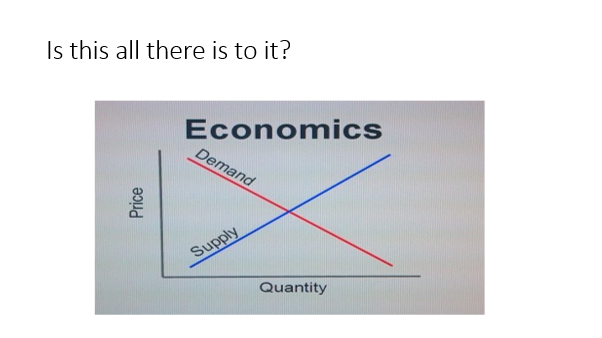
Economics and economists should not be sucked into just being like dentists fixing teeth, but also use their skills and the scientific method to understand the big picture and so help to make a better world for all. Then perhaps we can avoid being visited by King Charles at some time in future and have him repeat what Queen Elizabeth said: “why did you not see that coming?”
Michael Roberts's Blog

- Michael Roberts's profile
- 35 followers

