Lynn Farley-Rose's Blog, page 6
December 4, 2016
Retuning

A couple of months ago, I realised that even though I love music, my range is embarrassingly limited. I’ve never knowingly listened to a Bruce Springsteen album all the way through, or a Velvet Underground, or a Leonard Cohen, or even a Bob Dylan. And as with other things recently, I’ve been getting that nagging feeling that life runs out eventually and I want to colour in some of the pictures before it’s too late.
I’m not sure how these huge omissions happened. Music was with me all the time as a teenager but then I got involved in other things, and it got buried under marriage, work, and raising children and goats. I forgot who I was in so many ways.

When I was young, it was all about being the same as everyone else. I listened to Pink Floyd, Focus, Cat Stephens, and The Moody Blues, and loved them. But I couldn’t admit to my friends that I also loved the quirky wit, spectacular timing and fabulous orchestration of Frank Sinatra. And years later when the children developed their own musical interests, they were decidedly prescriptive about what we could listen to.
Now I want to know what I like.
So, I’ve started out on a project to broaden my knowledge and as usual I’ve turned to a list for support. I looked at several but opted in the end for Channel 4’s Greatest 100 Music Albums. It offered just what I was looking for, which was a wide range of styles and lots of different artists. I could get into many arguments about the order of the list, the omissions and inclusions but to do so is to miss the point. There are more than 37 million songs on iTunes and that’s a fraction of those available in the world. Where would I start without a bit of guidance?

I began with Number 1 and so far have listened through to Number 10. I’m fully intending to get to Number 100. My initial look at the list was enough to identify it as being what I wanted but then I instantly forgot what was on it apart from the first and last (OK Computer by Radiohead, and Dare by the Human League). So an added bonus is that each step is a surprise. When I’m ready for the next one, I email my son, who looks it up for me. And as he’s knowledgeable about music it’s fun to chat with him about what I discover. It’s a semi-shared treat.
So far it’s done exactly what I’d hoped for. It’s challenged my prejudices and filled in some gaps. I struggled a bit with Radiohead. They sounded dark and dystopian. But I persevered and after a few days I realised that I was humming something unfamiliar. It was one of the more challenging tracks and somehow it had got under my skin and infiltrated my brain. In his book, 31 Songs, Nick Hornby writes about ‘courting a new song’. And that’s just how it feels. There’s an initial wariness and then sometimes I fall in love unexpectedly and can’t get the new song out of my head. It becomes what he describes as a ‘narcotic need’ to hear it again and again. But it’s a harmless need, and as he says, it’s ‘one that’s easily satisfied.’
Since then I’ve given time to U2, Nirvana, Michael Jackson, Oasis, and Madonna. I won’t burden you with all the details, other than to say that I’ve fallen in love with a few songs but liked U2 least. I enjoyed renewing my acquaintance with Dark Side of the Moon, Sergeant Pepper and Revolver but as I know them all inside out and back to front they were too much within my comfort zone to give me what I want right now.

When Henry told me that Number 9 was Appetite for Destruction by Guns ‘n Roses I sighed and wondered why I would put myself through listening to something that is so clearly outside my taste. But that’s where I was wrong. At first it sounded awful but gradually the miraculous process happened. I was making the bed and found I was humming one of their tracks complete with swear words and brief stops for a head bang.
I never know what’s going to come up next: soul…reggae…country…rock…grunge…folk…rap… It’s addictive. Every time I find a new song to love, I can’t believe there will be another one but there always is. And as with books, places, films and people, it’s not always the ones I expect to like, who worm their way into my heart. That’s one of the things that makes it so rewarding.


November 20, 2016
A Truth That Should Be Universally Acknowledged

Photo: Anthony Albright
A few weeks ago I completed something that has been on my list for a long time — reading all of Jane Austen’s novels. I’ve written previously about the trouble I had in getting through Mansfield Park, but on the fifth attempt I managed to finish it and surprised myself by liking it best of all. For those who are similarly list-minded, then Emma came in at number two.
Having done that, I decided to round off my treat by having an indulgent morning out, visiting her home in the village of Chawton. It’s where she wrote and published most of her novels, and I enjoyed the twenty-mile drive through Hampshire countryside with its great sweeping fields stretched out red-gold in the late autumn sunshine. It’s an intimate little house and I spent a gentle, but interesting couple of hours there delving around in the relics of her life and watching a short film. In one of the rooms, I stood next to a small round table where she wrote, and I read that a nearby door had a useful creak, granting time to hide her manuscript whenever anyone approached. I learned, too, that by the time she left school at just eleven, she’d already been sent away to schools in Oxford, Southampton and Reading.
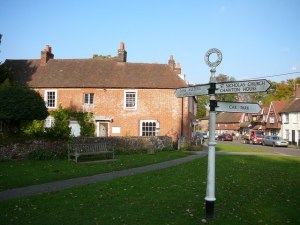
Photo: Colin Park
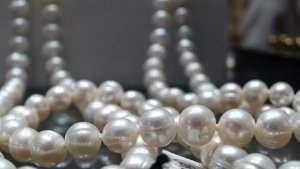
Afterwards, at the café, opposite, I sat outside with a warming bowl of vegetable chilli, and my hands cupped around a large coffee. It was a still moment in an otherwise busy week, and I reflected on some of the things I’d learned from reading these novels. So much was unfamiliar. This was a rigid world where the simple act of wearing pearls or diamonds in the morning could result in being labelled a woman of questionable moral virtue. Genteel society allowed for morning calls with the presentation of a visiting card left on a special tray, but these calls were short, with typically just fifteen minutes of polite conversation in the drawing room. Everyone knew the rules and adhered to them. And I realised why shrubberies make so many appearances in Georgian novels. In a constrained society where all eyes were upon you, they provided a place where couples could find some privacy.
But one of the biggest differences between then and now is the general attitude to women and our role in the world. In Jane’s society, men read the serious histories, newspapers and biographies of the day, whilst women were expected to look charming and to read nothing more taxing than a genteel novel. Marriage tied women to the whims of their husbands, but in some respects it was also a key to freedom. As Jane herself put it, “Marriage is the best preservative against want.” Charlotte Lucas in Pride and Prejudice holds her nose and marries the repellent Mr Collins in order to escape the old maid’s duty of caring for her brothers. We all know the opening line of that novel “It is a truth universally acknowledged, that a single man in possession of a good fortune must be in want of a wife.”
The view of an independent woman might be quite different today and I like this twenty-first century version of Jane’s famous opening line—“It is a truth universally acknowledged that a woman is capable of building her own good fortune.” Women have come a long way in the past two hundred years.

Now in these three weeks since my visit to Jane’s house, the world seems to have shifted. I wore my lucky knickers on November 8th but it did no good. The American election was a shock. In a short while, Trump will be the most powerful person in the world. This is a man who was the co-owner of Miss Universe, who told a woman she was disgusting for breastfeeding, who is anti-abortion and therefore believes that women do not have rights over their own bodies, who has made thoroughly creepy comments about his own daughter, and who has many claims of sexual assault against him. Such accusations are a constant risk for anyone in power but he dug his own grave on that one when he was filmed bragging about “grabbing women by the pussy”. “When you’re a star, they let you do it. You can do anything.” Yet despite all of this he was elected democratically. It’s interesting that non-white women were less convinced, with only 3% of non-college-educated black women voting ‘Trump’. But I find it astonishing that 45% of the college-educated white women who voted, put a cross next to his name, whether holding their noses or not, and that a massive 64% of their non-college-educated counterparts did the same.
In a few years we might look back and think we haven’t come so far after all.


November 5, 2016
Lucky Knickers

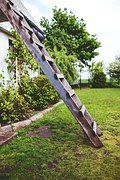
We’ve still got builders working busily round us as we settle into our new home. They’re finishing off various bits and pieces in a very good-humoured way and I’ll miss them when they move on. Usually we manage not to trip over one another too much but the other day I was on my way to the dustbin when I realised that the path was blocked. I could have simply ducked under the ladder that was propped against the wall but instead I chose to wait patiently whilst Paul the builder finished sawing a piece of wood. As I stood there holding a bag of rubbish and getting wet in the drizzle, I wondered whether I could dispense with my superstitions—I’m embarrassed to say that I just couldn’t bring myself to do it.
Old habits run deep and these have been passed to me through my mother who was full of odd notions. She wouldn’t open an umbrella in the house, she threw salt over her shoulder, and she said that if you accidentally put your clothes on inside out then you mustn’t take them off and put them on the right way. I’ve never been convinced by that as I don’t recall her ever going out and looking strange. Perhaps she just gave lip service to that one.
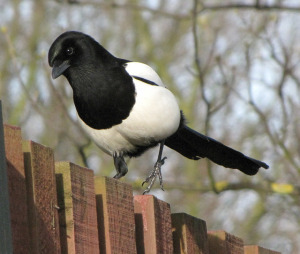
Annoyingly, I acquired a new superstition a few years ago when a friend told me that failing to greet a single magpie brings bad luck. At the time I was in the midst of some tricky life events and didn’t dare risk making them worse so although it was something new to worry about, I started doing what my friend does, which is to salute them. It quickly became a reflex action and suddenly these imposing black and white birds seemed to be everywhere, hopping about like lone delinquents. Then I met the man who is now my husband. As we drove through the New Forest on one of our first dates, I was aware out of the corner of my eye that he was looking at me curiously. We were both wary at this early stage of our relationship, and eventually he asked why I kept jerking my arm up to my head. We stopped for a drink in the garden of a pretty little pub and I tried to explain. But it sounded silly and as a confirmed scientist he was bemused.
Of course I know rationally that superstition is nonsense. It’s just a collection of odd habits and an unquestioning trust in magical beliefs. The psychologist, Professor Richard Wiseman found experimentally that people who use superstitions to ward off bad luck were no luckier than those who were not superstitious.
Perhaps it’s time to drop the funny habits and salutes. Particularly as some of Wiseman’s other research into luck is thought-provoking and much more useful. He got people to rate themselves as either lucky or unlucky and then compared them. The reality of luck is that people who believe they’re lucky aren’t inherently luckier than those who consider themselves unlucky. They’re no more likely to win the lottery, for example, because that’s simply down to probability. But where the difference between ‘lucky’ and ‘unlucky’ people starts to matter is in the way they create their opportunities.
People who believe they’re lucky have different personality characteristics from those who feel unlucky. They’re more extrovert so they keep in contact with people better, smile more and make more eye contact. These social skills create opportunities. ‘Lucky’ people are also more open. They welcome unpredictability and are not bound by conventions. As such, they tend to travel more and to welcome new experiences. Wiseman describes a man who noticed that he always talked to the same kind of people at parties. So he decided to disrupt the routine, make life more fun and create new opportunities by thinking of a colour and gravitating towards people wearing that colour. At one party he only spoke to women wearing red, and at another to men wearing black.
Even those ‘lucky’ people who have real bad luck, tend to turn it round. I saw this with a dear friend who was dying of a dreadful disease. She never asked, “Why me?” Instead she said in her final days that she felt very lucky because she was surrounded by love.

I recently watched Inside Obama’s White House and there was a wonderful moment when Obama had to struggle with a difficult decision about healthcare. ‘You’ll need to be lucky for it to work,’ said his advisers. He stood still for a few moments and stared out of the window. ‘Where are we?’ he asked. ‘Sir, we’re in the Oval Office,’ came the reply. ‘And what’s my name?’ he said. ‘President Barack Obama,’ replied the aide. ‘Then I feel lucky every day,’ he said.
The United States of America is going to need some luck on Tuesday and I for one, am not taking any chances. I’ll be saluting those magpies, keeping my fingers firmly crossed and wearing my lucky knickers. I only hope that Hillary’s wearing hers too.



October 23, 2016
Dances with Goats
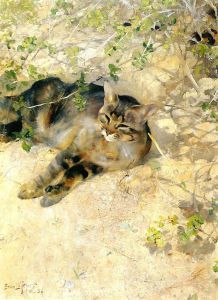
This week I was walking home and met a couple of cats. The first sauntered across the pavement, arched its back, yowled and invited me to fuss it. I can’t help but feel honoured when a cat deigns to talk to me so I stopped and stroked it but within seconds it got bored and wandered off to find someone else. Later, when I reached the golf course at the back of our house, a second cat darted out of the long grass and wound itself round my feet.
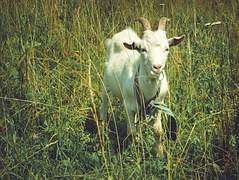
At the moment I have no animals of my own but there was a time when I had rather a lot. There were cats, dogs, chickens, geese, goats, and from time to time some lambs and pigs. We had a bit of land and in the morning I would lead the two goats down to the tangled woods where they would browse contentedly all day amongst the brambles. In the evening I would bring them back to their shed and lock them up for the night. That was the general plan but sometimes life didn’t go smoothly and I’d get distracted and forget to collect them. Then I’d wake up in the small hours and lie there feeling guilty. Goats hate getting cold and wet, so eventually my conscience would propel me out in my dressing gown; across the dark field and through the gate by the stream. There, Gwyneth and Mirabel would appear from amongst the shadowy, crowded trees, full of curiosity. What inevitably followed was a merry dance as I attempted to attach them to my rope and they did their best to trip me up.
Life’s a bit different twenty years on. Not only do I have no animals, but the children have grown up, and I live in a city. Several times recently I’ve crept out in the dark in my dressing gown but this has been for entirely urban reasons. The garage in our last house didn’t lock properly and as there had been a spate of petty burglaries we used to drive the car down the back alley and park it across the garage door to block it off. A few times we forgot and had to go out late at night to do it. Each time as I walked along the alley back to the house I’d remember the goats and be grateful that I no longer had to get involved in a moonlit rope dance. All I had to do was park my car, lock it and go back to my nice warm bed.
My joy at no longer having to do this, makes me wonder why I did it in the first place. I liked the idea of keeping animals and raising our own meat in an idyllic country setting. But the cold, muddy reality was a challenge. It did create a rich mine of family memories which we all relive when we get together, but I do wonder if I might have been more ‘me’ if I’d done something else.
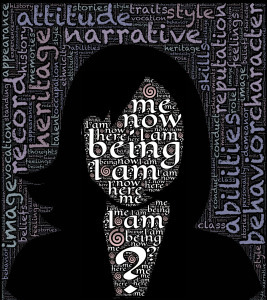
Often life doesn’t allow us to have free choice, but there are mixed difficulties in even getting to the starting point of knowing what we want. It’s all too easy to get stuck in a role that bends us out of shape. Sometimes we’re not honest with ourselves. We might aim for a fantasy lifestyle, or make choices that are driven by how we want others to see us. I look back at the goat days and wonder whether I knew myself at all. It’s only been in recent years that I’ve started to remember what I love and to explore what I really want. The treats have played an unexpected part in this. They’ve been experiments in identity.
Some of the things I’ve done have forced me to confront the truth that I’m not brave, sporty or good at sewing. I never was and I may as well accept now that it’s unlikely to change. Other treats have reinforced that I love films, cooking, walking by the sea, and travel. I’ve also discovered a few new pleasures—jazz, live music, birds, industrial history and urban landscapes.

I hope I’ll never stop trying new things. But maybe with age I’m getting better at choosing the kinds of things that I like. It’s also worth remembering that it wouldn’t be real if life was all perfect—we need challenges, wrong turns and changes of heart. They write the novels of our lives and make us who we are. I talked last time about my favourite words—kitten, elastic and home. Every list has a counter-list and I’ve only just started to wonder what my least favourite word might be. I think that a strong contender has to be ‘regret’. The goats were frustrating and exhausting but on balance, I don’t want regrets and I’m glad to have had these experiences—it’s just the way things turned out. Nonetheless in the spirit of getting to know myself better, I’m going to hang onto the thought that these days I much prefer a backstreet city alley to a dark, slippery field.
And that issue of exploring who we are brings me to another in the chain interview series. This time, Maria Leaf, talks about her life in drama. Click here to read about her inspiring work and her mid-life treat.


October 9, 2016
Home Thoughts
I’m keen on lists but am well aware that this divides people – many of my friends and family avoid them at all costs. But for me it’s a love affair. I even wrote a book about a list. And I particularly like ranking things—I just can’t seem to help it. For years my favourite book and favourite film have been unchanged. There’s something about knowing that Remains of the Day and Cinema Paradiso are important to me that helps define who I am. The Great Gatsby and Don’t Look Now are my second-favourite book and film; 101 Dalmatians and The Shawshank Redemption come in at number three, and Far From the Madding Crowd and The Railway Children are at number four. I could go on…but there’s a strong chance that you’re not as keen on rankings as me, so I’ll stop there.
“Which do you prefer?” I asked my husband when we first met – “Beatles or Stones?” He looked mystified and said “Can I have both?” He’s of the non-ranking persuasion.
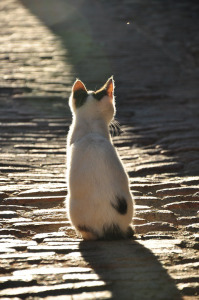
I’m aware that I might take my obsession too far and for years have even been able to say what my favourite word is. For a long time it was ‘elastic’. I just loved how it sounded so stretchy. Then I moved on to something altogether more heart-warming—‘kitten’. That’s been my favourite word for quite some time now. Then the other day I read something that the Little House on the Prairie author, Laura Ingalls Wilder once said: “Home is the nicest word there is”.
I’ve been thinking about home a lot over the past few weeks as I’ve just moved house—again. This will be my seventh home in twelve years. The moves have been triggered by changing circumstances—financial ruin, divorce and then a different life in a new city. But I’d like to feel settled now—at last. The dictionary definition of ‘home’ is ‘the place where one lives’. But it’s so much more than that. I was watching a David Attenborough documentary the other day – one of my treats – and he said in relation to animals that a home is somewhere to feel safe and comfortable.
The Danish art of ‘hygge’ has been in the media recently and has inspired a number of books. It’s not about wealth or possessions but it’s about making life good in simple ways. We’ll each have our own version of this. For me it’s hot porridge with maple syrup and cinnamon, fragrant coffee in the morning, candles, fresh flowers, rose-scented bath oil, and reading a good book with a soft blanket, open fire and ideally a piece of fruit cake on a pretty china plate.
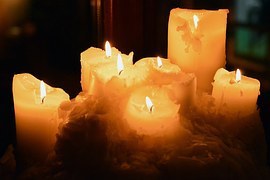
Our new home has been completely renovated and is all ready for some hygge. The builders have been working on it for six months. There’s a new kitchen, French windows in the bedroom and it’s freshly painted throughout. It feels light and bright and my heart gives a skip each time I come back to it. It’s also wonderfully clean.
In recent years life has felt overwhelming at times so that day-to-day housekeeping has been an unwelcome drudgery. I’ve much preferred the treats. Sometimes I’ve felt like it’s less effort to move house than to clean it. The grime and the dirt seem to get everywhere in a most tiresome way. And what is this dust that settles on every surface? It’s popularly believed that dust is predominantly dead human cells but I read recently that most of these go down the plughole when we wash. Instead it’s more about pollen, the husks of insects, pet hair, soil, tiny particles from outer space, and pretty much anything else that is very, very small.
This week, my sister-in-law has been visiting from Australia. We asked what she would particularly like to see and she said, “An English castle and a pub.” So on Tuesday we had lunch in a proper English pub, sitting outside in the thin autumn sunshine and then we went on to a nearby National Trust property, Hinton Ampner. It’s not quite a castle, but it is a beautiful example of a classic English home. I liked the gentleman’s bedroom—and especially the breakfast tray laid out with a boiled egg, fine china, silver cutlery and a folded linen napkin. I imagined breakfasting there whilst gazing out over the walled gardens and Hampshire meadows. The seductive charm of this hygge fantasy even overrode my aversion to boiled eggs.

Photo: Chris Gunns
Some areas of the house were inaccessible as it was having its annual deep clean. We peered through doorways into rooms where odd-shaped furniture sat shrouded in white cloth. With so many treasures the cleaning has to be done in a very precise and ordered way. Everything is inspected carefully and particular attention is paid to any insects that might cause damage. Then the housekeepers get to work on the dusting using hogs hair brushes. Unlike normal hair, hogs hair has multiple split ends which give it plenty of spring so that it’s gentle but firm on delicate, creviced surfaces.
I looked at the information boards with interest. Perhaps this is what I need in my new house—a hogs hair brush and an annual deep clean. That way the pain could be concentrated into a few days. I might even be convinced that it’s easier to clean than to move. I do hope so as I’d like to stay here for the forseeable future.
Home—that nicest of words.



September 25, 2016
Beginning, Middle and End

Molly, my youngest, went off to university this week and this set me thinking about the cycle of life. I’ve had the odd brief message, just enough to know that Fresher’s Week is going well and that she’s making friends and getting used to living in London. This has nudged my twenty-eight years of parenting into a new phase—being there for them, but not all the time. People often talk of empty nest syndrome but right now even though she’s gone, the nest isn’t empty and that’s because my father-in-law Frank lives with us.
Molly is eighteen, I’m fifty-seven and Frank is ninety-six. That means that I’m positioned right in the middle – thirty-nine years older than one, and thirty-nine years younger than the other. In looking at these two members of my family I get a sense of what has passed and a taste of what the future might hold.
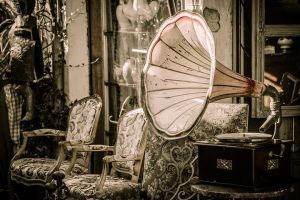
We brought Frank to live with us fourteen months ago and hoped to spend some happy times with him. We managed that quite well up until the Spring—pushing his wheelchair across the Common to the pub, lunch in the sunny haven of my little garden, meeting up with friends, and having him there for family meals and celebrations. But he is very old and frail. Over the past year he has had three episodes of pneumonia, umpteen urine infections, several falls, two brain bleeds, seizures, his voice is reduced to a croak, and there is ever increasing deafness, loss of vision and confusion.
It’s been hard for him to give up control. We’ve tried for as long as possible to keep him doing things independently but he now needs help with almost everything. He gets very frustrated at these losses. “Don’t worry, we’ll look after you,” I’ve said at times, thinking it was reassuring. “Why can’t I do it myself?” he’s replied. And he’s then repeated that question over and over again. “Because you are old,” we say, but it doesn’t seem to help.
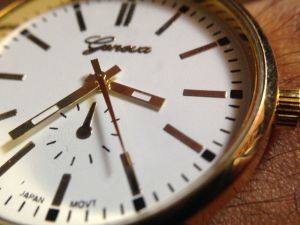
I’ve realised through being with him that’s it’s crucial to know where we are in time—the season, the day of the week and most vital of all, the time of day. I can only imagine that without this knowledge it would be like floating in space with no anchor. Frank has a talking watch and presses the button throughout the day and night. But it doesn’t always give him what he needs. “What time is it?” he’ll ask, his face full of barely suppressed fear. “My watch says it’s one. There are two one-o’clocks in the day aren’t there – after lunch and at night. Which is it?” There’s little we can do to reassure him. We tell him and two minutes later he has forgotten.
So much of his body and his mind have suffered erosion. But his hair remains—thick and white. A carer said on washing and dressing him for the first time, “I’m really sorry but I’ve made him look a bit punky.” “Don’t worry,” we said, “It always looks like that.” I enjoy imagining his mother back in the 1920s—a woman I will never meet being exasperated with her small son’s hair as she gets him ready for school. I’m bonding through the ages with her; mother to mother.
We’ve met many good people in this year of living with Frank. The NHS and Social Services have been wonderful. Various carers come to get him washed and dressed and this week one of them offered to sit with him on her day off so that we could have some time together. “I don’t want any payment,” she said. “Just a cup of tea and a biscuit.” We happened to know that she is working fifteen days in succession. We couldn’t let her use her day off like this but the offer was undoubtedly genuine. Our friend Sheila regularly makes us meals and is sitting with Frank this weekend as we move furniture and boxes into our new home. And there was the elderly care consultant who came to see us in June and said gently what we had been denying to ourselves. He has progressive dementia. And in these past few weeks it has progressed very fast. He is lost in a world of agitated pacing and unintelligible rambling.
When he first came to us we considered finding someone to come and chat to him about the war. This was the formative period of his life and the one that he referred back to when other memories had gone. Then we realised that anyone who was able to chat about the war would themselves be in their nineties. As a child I knew plenty of people who remembered the First World War, let alone the second one. Now they are all gone. Life passes quickly. I don’t want to waste a moment.


September 11, 2016
Word Journeys

I was at a large branch of Sainsbury’s this week, and one of the items on my list was a pack of pens. I wasn’t sure where to find them so glanced up at the signs hanging from the ceiling and was surprised to see one that said ‘Stationary’. “Look at that!” I said to my daughter, Molly who was helping with the shopping. “A major company and they can’t even spell. It’s ‘ery not ‘ary”. An elderly man overheard my rant and chipped in. “Yes, it’s like the apostrophes,” he said. When I thought about it later I couldn’t be sure whether he was supporting me with my gripe or mocking my pedantry.
But does the spelling matter? A lexicographer from the Oxford English Dictionary seems to think it does. She argues that the words ‘stationary’ and ‘stationery’ have totally different meanings and that to use them wrongly causes confusion. In truth, there probably aren’t too many situations where serious confusion could occur – most schools have a stationery cupboard but these don’t usually move about so it’s rare that people need to comment on their state of stationariness. However, I’m all for linguistic propriety so am happy to go along with the opinion of the OED.
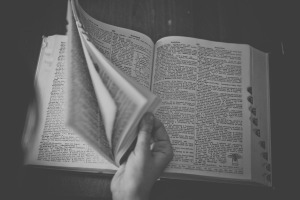
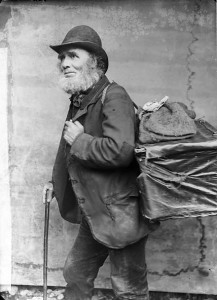
This got me thinking about the origin of the two words and I discovered that they both come from the Latin ‘statio’ which means a standing place. Stationary, in the context of ‘still’, appeared in the English language in the Middle Ages while the word, ‘stationer’ was used to refer to traders who set up permanent stalls selling books and writing materials, generally next to a university. These stationary stationers were the exception at that time as most traders were pedlars who travelled around the countryside, selling their goods at fairs and markets.
Another connected word is station—where one stands to wait—and I stood stationary on several stations last Monday. I was returning to Southampton after doing some work in Kent and decided to take the slightly longer but considerably cheaper route that avoids London. It did involve three changes but I didn’t let that deter me. However, it turned out to be an error of judgement when the journey of about a hundred miles ended up taking five and a half hours. Umpteen connections were cancelled and announcements were made citing trespassers on the track, signalling problems, an emergency up the line, and a member of staff who was unable to get to work. Each time, the announcer said very politely that Southern Railways was sorry for any inconvenience, before adding the further good cheer that there was a strike planned for Wednesday and Thursday.
With commuter journeys, it’s the arrival that’s the goal. But leisure trips are another thing altogether. The journey itself can be the purpose and a treat in itself. Travelling by train across America is one of the big treats on my list and as yet I’ve no idea when I’ll be able to do it. Planning is part of the fun, though, and so I’ve already done some preparatory research. At some point I shall have to decide whether to travel coast-to-coast via Chicago or New Orleans. At the moment I’m leaning towards Chicago.

I’m pre-disposed to love the railways as I travelled to school by steam train including, for a brief period, on the famous Flying Scotsman. Not many people of my age can say that. The railway line alongside my school was closed by Dr Beeching in the 1960s but then bought by the Dart Valley Railway which runs steam locomotives and carriages as a tourist attraction. The trains would puff past as we schoolgirls ran up and down the hockey pitch on misty mornings. I loved the sulphurous choking smell of the smoke. And there’s something mysterious about old trains with their narrow corridors, and secluded compartments with slide-up windows. They rattle along and whistle, passing through tunnels with the sounds and the darkness offering dramatic opportunities. Hitchcock demonstrated these brilliantly in The 39 Steps, Strangers on a Train and The Lady Vanishes; all recent treats—see Murder, Blackmail and Other Stuff.
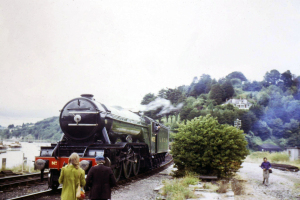
Photo: Symonds Family Archive
Last Monday as I waited for several delayed trains, my mind wandered idly and I started speculating about the origin of the word ‘train’. I discovered later that it derives from the French for ‘to draw along’. So you can have a train of people or a train on a dress, and the first trains were known as ‘trains of carriages’. Oddly, the word ‘train’ was also once used to mean ‘delay’ because of the sense of ‘drawing things out’. I realised that in the same way as stationary and stationery have an unexpected connection and have been on a linguistic journey together, then so have trains and delays.
The trains and delays were too closely connected this week on my slow commute. But hopefully, an American train trip will be quite different and delays could even be opportunities. That’s an essential difference. Goals are all about standing on stations, fretting and longing to get to your destination. Treats are all about the journey.


August 28, 2016
Someone to Poke

I’ve been thinking a lot about siblings this week because of an important anniversary in our family. ‘What do you like about having siblings?’ I asked Molly the other day. ‘Having someone to tease,’ she said. ‘And when I was little there was always someone to poke on car journeys.’
Over the years there’s been a lot of research into parent-child relationships but sibling relationships have only attracted serious interest more recently. And yet they’re clearly very important. Psychologist Daniel Shaw put it well: “Parents serve the same big-picture role as doctors on grand rounds. Siblings are like the nurses on the ward. They’re there every day.”
There are benefits to being stuck with siblings. Constant arguments make for choppy family life so you have to negotiate. A Canadian study found that on average, siblings aged two to four years, have some kind of conflict at least once every ten minutes. As they get older the conflicts usually get less frequent—but things don’t always work out well. Noel and Liam Gallagher are famously distanced brothers. When asked about an Oasis reunion, Noel said that “It won’t ever happen unless they do it without me,” adding modesty, “but without me it would be rubbish.”
My four children squabbled a great deal when they were little but I’m relieved to find that they get on well as adults. Past offences are mostly forgiven, though they’re not all forgotten. Molly is the youngest and once said wistfully, ‘All the accidents I had when I was little were Henry’s fault.’ She then reeled off a list of episodes that I’d pushed conveniently to the back of my mind. Suddenly they all came rushing back. The ‘being up a tree incident’ didn’t end well nor did the time he pulled her out of a bunk bed on a barge. And there was the occasion when he told her to ride ‘no hands’ on her bike as she whizzed down a hill for the very first time.
In amongst all the falling out and making up, siblings are in a unique position to provide support when there’s family trauma. They can often appreciate what their brothers and sisters are going through in a way that no-one else is able to do. But not everyone has a sibling. Average family size is gradually shrinking and in the UK it’s increasingly common for parents to have just one child. As with all human activity people are quick to try to argue about which situation is best. But this seems pointless. Not everyone has a choice about the number of children they have and those parents who actively choose to have one child do so for their own particular pragmatic or economic reasons. And there are advantages to being an only child like getting undivided parental attention and more exposure to adults. You also learn from an early age how to be happy in your own company.
I feel as though I have a foot in both camps as my upbringing was similar to that of an only child but with some sibling benefits. My sister is twelve and a half years older than me so I didn’t get the experience of squabbling, sharing secrets, or swapping make-up. Instead she was like a second mother and had more formative influences on me than anyone else.
There’s been a lot of speculation about the effects of birth order ever since Adler linked this to personality in 1928. Oldest children are popularly believed to be assertive and conformist while youngest ones are rebellious and adventurous. But this is not substantiated by research findings. It’s possible that what are interpreted by parents as personality traits, are in fact an effect of age rather than of birth order. At any point in time, the older child has simply had more experience of life and so will be seen as different from their younger sibling. It’s hard to view them equally. It seems logical that birth order affects each individual within their particular family situation, but at the moment there’s no evidence to suggest that you can extrapolate this more broadly and call it a personality trait rather than a behaviour pattern.
These sibling behaviour patterns are deeply rooted. I know a family where the brother never married and the three sisters all outlived their husbands. In their seventies when they were all single once more, the four siblings went on holiday together. I was amused to hear one of their daughters recount with exasperation how they reverted to the same kinds of squabbles that they’d had as children.

Throughout life it’s easy to slip into old familiar roles within your family group even though you might behave quite differently in the outside world. Emma’s flatmate went to visit her younger sister who had just spent her first term at Cambridge. This younger sister was a successful student and managed her life perfectly well. But as they walked and walked and walked, the visiting older sibling eventually asked where they were going as she’d never been to Cambridge before. Her younger sister looked astonished and said, ‘I’ve no idea, I was following you.’ I can relate to that. For as long as I can remember, a defining role for me has been as a younger sister and I slot into that easily. I’ve turned to Bonnie when life has been difficult and feel fortunate that she’s always been there.
I started this post by mentioning an important family anniversary. Happy Special Birthday to Bonnie. I may be quite grown-up most of the time but just for you, I’m happy to be a little sister.


August 14, 2016
A Mixed Diet
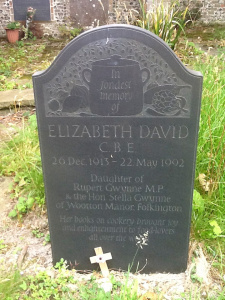
Photo: Guillaume Tell
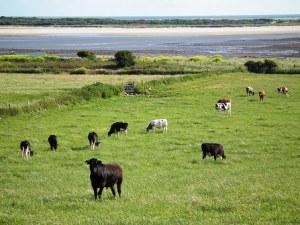
Earlier this week I spent half an hour trudging through my online supermarket order and thinking about the advice on eating a varied diet. As I dutifully included a multi-coloured assortment of fruit and vegetables, protein and so on, I wondered, not for the first time, why human food has to be so complicated and take up so much time. There’s the shopping, the planning, the cooking, the serving, clearing up the spills, cleaning the fridge—it seems a great deal of effort. After all, cats seem quite happy with cat food, cows eat grass, and reindeer warble flies survive perfectly well on reindeer tissue.
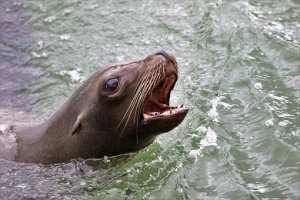
Indeed, not only do most animals have a narrow diet, but a varied one can be positively harmful. During the Second World War it was difficult to source the right food for zoo animals and the sea lions in Manchester’s Belle Vue Zoo were fed strips of beef soaked in cod liver oil. They were unable to digest this unaccustomed food and died of stomach ulcers. But the opposite applies to humans as too much of one thing is clearly not good. I recently discovered some rather nice apricot biscuits. The first was delicious. The second was pleasant, if a bit greedy. The third made me feel thoroughly sick and now I never want to see an apricot biscuit again.
And so, back to the subject of food shopping which can be so repetitive and tedious. I regularly get stuck in a rut with day-to-day catering and wish I could just order a hundredweight of hay to get my family through the week. That way there would be no decisions to be made. But I do enjoy cooking for special meals and celebrations and I suppose that if I had a family of elephants then I’d miss out on all of that.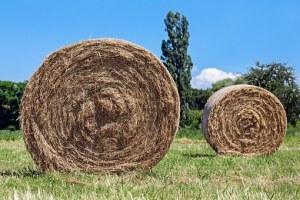
If I missed out on all of that then I’d also have missed out on a recent food-related treat. I’ve known for some time that the food writer, Elizabeth David is credited with transforming British attitudes to eating after the Second World War, but I was curious to find out more. So when I wrote my list of sixty treats she got a mention. ‘Cook three recipes from each chapter of an Elizabeth David book’ seemed a good way to explore her influence and ideas.
Things change, though, and since making the list five years ago, I’ve given up eating meat. I decided to forgo the pleasures of her classic books ‘French Country Cooking’ and ‘Italian Food’ in case they instructed me to pluck a pigeon, jug a wild hare or boil, breadcrumb and grill a pig’s trotter. Instead I chose to focus my interest on ‘Elizabeth David on Vegetables’. This is a compilation of vegetable recipes and food writing taken from a number of her books. It includes chapters on soup, pasta, main courses, and small vegetable dishes, as well as the unexpected inclusion of chapters on bread and puddings.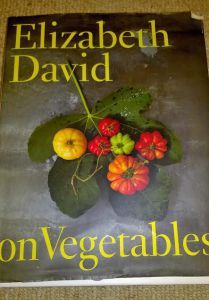
Her first volume, A Book of Mediterranean Food, was published in 1950. She wrote of sun-drenched, honest, peasant dishes which must have seemed so vibrant to a country that was still under the grey thumb of post-war rationing. Wartime recipe books included instructions on crow boiled in suet and how to create a pie from sparrows, whilst marzipan had become a ‘delicacy’ concocted from mashed haricot beans and a splash of almond essence. It’s hard to imagine a week in which I don’t use olive oil, aubergines, avocado, courgette, garlic, yogurt or basil but when Elizabeth David first started writing, these ingredients were largely unavailable. It was partly thanks to her influence, that they appeared in the shops. She died in 1992 and one obituarist observed that she had done more to change British middle-class life, than any poet, dramatist or novelist of the time.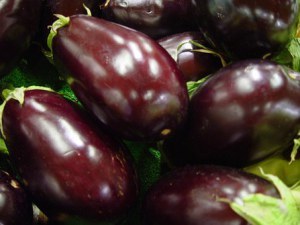
So, as the treat progressed I selected and cooked my way through twenty-four recipes, and with her impeccable reputation I expected to be roundly wowed. But I was surprised. There were only two that I thought outstanding. These were truly wonderful, though, and I’ve already returned to them again and again. One is her mushroom risotto which is absolutely perfect. I’ve struggled in the past to get enough flavour into a risotto but this manages it with a simple and cheap list of ingredients: olive oil, stock, mushrooms, onion, Italian rice and garlic. It works every time and is creamy, comforting and easy. The other big discovery from the book is her sweet pepper and watercress salad. Again, simple with just a shallot, half a bunch of watercress and a fleshy red pepper. It’s lightly dressed with lemon juice, olive oil, salt and a pinch of sugar, but the revelation is that the shallot is sliced paper-thin and the red pepper is cut into matchstick strips. The end result is beautifully balanced and so much more elegant than my usual sling-it-all-in affair.
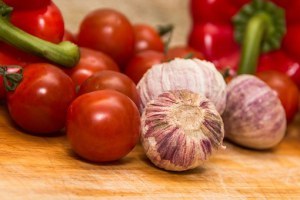
There was also a fresh tomato pasta sauce; a gratin made from grated courgettes; a Normandy apple tart sprinkled towards the end of its oven-time with buttery apple juices and a little sugar, and a cold dish of mushrooms cooked with coriander seeds. All were good and I’ll probably make them again. But I was disappointed with the other dishes. The orange ice cream was horrid and the green vegetable risotto was dull. Maybe some tastes change over time.
I’m not completely won over but I am glad to have made her acquaintance, and like so many of these treats, this one has changed me. I find myself opting more for straightforward good-quality ingredients and letting them stand alone, when I once would have reached unthinkingly for a stock cube or a splash of instant flavouring. My interest in cooking has been invigorated once more—and with that good news, my family is saved from hay, hay and hay for a little longer.



July 31, 2016
A Coastal Jigsaw
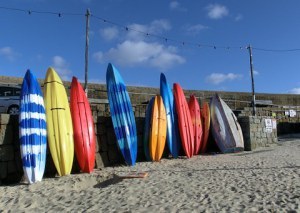
The honeymoon is over. It was a glorious week on Guernsey where we cycled, swam, and did a bit of sea kayaking. I’d like to sound brave and sporty about that last one, but when the wind pushed me sideways, I confess that I panicked. My imagination ran riot for a few dramatic seconds as I fantasised about being swept off to the Pacific and spending years on a desert island. That seemed tragic as I’d only just got married but luckily I was rescued by the group leader, Skip. He was young and competent and didn’t make me feel hopeless as he tethered my kayak to his, and towed me through the tricky bits.

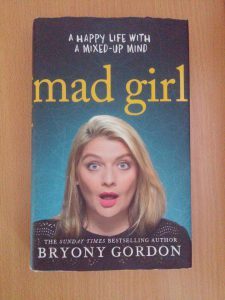
Guernsey is beautiful and one of the best moments was when we stood high above a tiny bay late at night. The Channel stretched beyond and the full moon was reflected in rippling, golden stripes–a true honey moon. Another holiday pleasure was having time to read. I still struggle with fiction (see Parkus Interruptus), but thankfully I do now enjoy non-fiction and one of the books I took with me was Bryony Gordon’s ‘Mad Girl’. A journalist with a glossy career, loving husband and baby daughter, she seems to have everything. But she’s remarkably candid about the obsessive compulsive disorder and rigid thoughts that have troubled her for years. At one stage she found it easier to take the iron to work rather than having to go back and check a dozen times that she’d switched it off. It made me reflect on my own behaviour which veers towards rigidity at times.
When we got home, there was still a bit of holiday left so we decided to spend three days walking the South West Coastal Footpath in Dorset. This is probably the most challenging treat on my list. The act of writing it down was simple enough but at times I’ve wondered whether I’ve bitten off more than I can chew. It’s 630 miles long and as each section gets further away from home it becomes more of a time-consuming and costly obstacle. There’s a list on my study wall that breaks it down into fifty-two stages and so far, only eight stages have been crossed off with my pink highlighter pen. I’ve started to wonder whether this treat will fail to reach crossed-off Nirvana by the time I have my next big birthday. That’s only two and a half years away. Help.
The only way I know how to tackle a challenge is to try to tame it and impose some order. However, this treat is presenting particular challenges and I’ve already had to hold my nose and make a major tweak to my method. When I started five years ago, I was intending to walk anti-clockwise from Minehead to the Dorset coast near Poole. I got as far as Barnstaple. Then when my marriage ended I abandoned the walk for several years. When I restarted, I was living in another part of the country and it made logistical sense to resume at the Poole end and to walk clockwise in stages until I got back to Barnstaple. It felt like a daring break with the natural order but I justified it to myself as a symbol of a new and different life salvaged from the chaos.
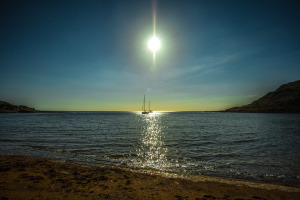
Then, last week when we were planning this second half of our honeymoon a radical thought planted itself in my head. I realised that it might be sensible to postpone a few stages. These were close enough to home to be done as day trips and staying away for two nights would give us an opportunity to do others that were further away. I hyperventilated and struggled. Once again, chaos seemed to be threatening my nice ordered list.
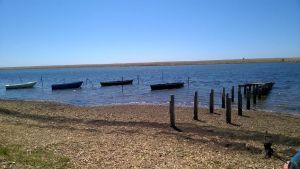
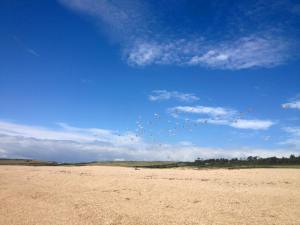
In the end I managed to overcome my discomfort and we had three memorable days of walking. Each was different and brought unexpected pleasures. We spent much of the first day walking alongside the Fleet Lagoon that runs beside Chesil Beach. Three cormorants sat motionless in a wooden rowing boat, mountains of pebbles rose up to our left and we saw only a handful of people. The next day we trudged along the beach for miles. The pebbles made it hard work but once again it was unexpectedly deserted. Several times we walked close to great flocks of gulls that had gathered by the sea. As we approached they took off and gave us a private aerial display.
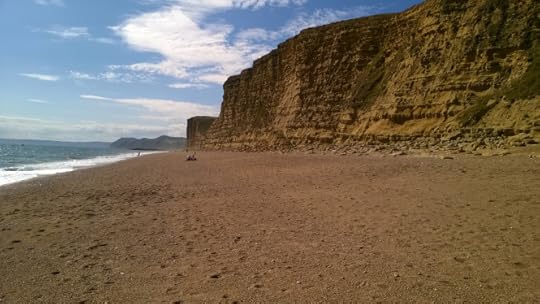
I enjoyed seeing the sea kale that has colonised the inhospitable shingle and as we approached West Bay, the cliff towered above us, steep and golden like an Egyptian sphinx. We swam and then we explored the small resort. I was expecting it to be staid and faded but instead we found ourselves eating wonderfully fresh fish at one of the coolest places I’ve ever been. Sins at the Bay is furnished in a salvage-gone-mad kind of way with red rusty metal rafters and techno music. I felt fully alive.
The third day was different again with lots of upsy-downsies. I puffed my way unhappily up the first one and realised that I needed a better strategy. Golden Cap, the highest point on the South Coast loomed as an after-lunch challenge so I tried a new approach: thirty steps then rest for five breaths, and so on. It worked and I reached the top having barely broken into a sweat. I also made some new friends on the way. A young couple were just behind on the uphill trudge, and when I told them about my new discovery they looked pleased. From then on, every time I paused, I looked back to see them standing still as they concentrated earnestly and puffed out their cheeks. It felt like an unusual kind of antenatal class.
And now that the honeymoon is over I find myself longing for the next opportunity to get back to the footpath. I’m hoping to do another two stages soon, and for logistical reasons it’s likely that one will be in a clockwise direction from our accommodation, and the other in an anticlockwise direction. I’ve managed not to hyperventilate too much at this impending disorder. A friend asked the other day, ‘So does this mean that if I invited you to join me in Falmouth, that you’d be prepared to do some stages out of order?’ I took a deep breath and said, ‘Yes’.
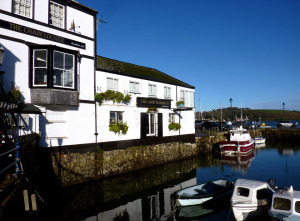
The Sixty Treats project that led to my book 31 Treats and A Marriage started out so innocently. But it continues to teach me all sorts of surprising things. I realise that I’ve misled myself into thinking that the pleasure of this great walk lies in its ordered completeness. I’ve yet to find out whether I’ll finish the entire walk before my sixtieth birthday but I do know that it won’t be in any kind of order and that ultimately neither the completion nor the order matters. I want more of the great sweeping views but even more than that I want to uncover the small unexpected pleasures that make each day such a unique mini-treat. Maybe the honeymoon’s not over after all.