Julia McCoy's Blog, page 8
May 21, 2024
What Are Conventions in Writing and Why Do They Matter?
Ever wondered why some written pieces just click while others fall flat? It’s all about the writing conventions. These rules help make your text readable and engaging.
You might have aced essays in school but found online content bafflingly different. That’s because academic and online writings follow distinct sets of guidelines.
If you’re scratching your head thinking, “What are conventions in writing?”— don’t worry! We’re here to demystify it all.
 Table Of Contents:What Are Conventions in Writing?Types of Writing ConventionsWriting Conventions in Different Genres and StylesYour Journey from Good to Great Starts with Writing ConventionsWhat Are Conventions in Writing?
As a writer, you’ve probably heard the term “writing conventions” thrown around a lot.
But what are conventions in writing, exactly? And why do they even matter?
Let me break it down for you.
Writing conventions are the standardized practices and rules that we writers follow to make our writing clear, understandable, and meaningful to our readers. They’re like a secret handshake – a code that all good writers know and use to communicate effectively.
These conventions cover everything from capitalization and punctuation to spelling and grammar. They’re the building blocks that help us construct powerful, coherent pieces of writing that engage and inform our audience.
Importance of Writing ConventionsSo why should you care about writing conventions? Because they’re absolutely essential for creating written work that packs a punch. Without conventions, your writing would be a jumbled mess that leaves readers scratching their heads in confusion.
When you use writing conventions consistently and correctly, you’re essentially giving your readers a roadmap to follow. You’re guiding them through your ideas and arguments in a way that makes sense and helps them fully grasp your message.
For example, using proper sentence structure and punctuation helps to clarify relationships between ideas and makes the logical flow of your writing easier to follow.
Correct spelling and capitalization also make your writing look polished and professional, which builds trust with your readers.
But letter writing conventions aren’t just about making your writing easier to read – they also play a key role in making it more powerful and effective.
When you have a strong command of writing conventions, you can use them to add emphasis, create rhythm and flow, and convey your unique voice and style.
By using conventions strategically and creatively, you can take your writing to the next level and really make an impact on your readers.
So don’t think of writing conventions as restrictive rules – think of them as tools that you can use to craft clear, compelling, and memorable pieces of writing.

Now that you know why writing conventions matter, let’s dive into the different types of conventions you need to master.
Grammar and Syntax ConventionsAt the heart of writing conventions are the rules of grammar and syntax. These conventions govern how we structure our sentences, use punctuation marks, and put words together in a way that makes sense.
For example, basic grammar rules tell us that a complete sentence needs a subject and a verb and that subjects and verbs need to agree in number (singular or plural).
Syntax conventions help us arrange words in a logical order and use things like conjunctions and prepositions to show relationships between ideas.
Punctuation ConventionsPunctuation marks are like the traffic signals of writing – they tell readers when to pause, stop, or change direction. Using punctuation correctly is crucial for clear and effective writing.
Some key punctuation conventions include using a period at the end of a sentence, using a comma to separate items in a list or to set off introductory phrases, and using quotation marks to indicate dialogue or direct quotes.
Capitalization ConventionsCapitalization conventions tell us when to use capital letters and when to stick with lowercase. In general, we capitalize the first letter of a sentence, the first letter of proper nouns (like names and places), and important words in titles.
Following capitalization conventions helps to distinguish between common nouns and specific people, places, or things, and makes our writing look polished and professional.
Spelling ConventionsLast but not least, spelling conventions are all about using the correct spelling of words. While English spelling can be tricky, mastering common spelling rules and patterns is essential for clear communication.
Using tools like spell checkers and dictionaries can help you avoid embarrassing spelling errors and ensure that your writing is error-free.
After all, nothing undermines your credibility like a glaring spelling mistake.
Paragraph ConventionsEach new paragraph previews a shift in topic or perspective, making it easier for readers to follow along.
Together with appropriate formatting – such as indentation, line spacing, and heading allocation – it helps portray a coherent narrative.
Best practices involve starting paragraphs with clear topical sentences followed by supporting sentences that elaborate on the main idea. Concluding sentences should tie back to the primary thought, enriching content flow.
Formatting ConventionsFormatting is the art of presenting your writing in a visually appealing way. It encompasses a wide range of elements, including font size, spacing, margins, headings, and page layout. Proper formatting can make your writing more readable and accessible while drawing the reader’s eye to the most important parts of your text.
Font Size and StyleThe choice of font size and style plays a crucial role in readability. Using standard fonts like Arial or Times New Roman at an appropriate size (usually 12-14 points) ensures that your content is easy to read on various devices.
Spacing and MarginsAdequate spacing between lines and paragraphs helps prevent visual clutter. Similarly, proper margins ensure that text does not appear cramped against the edges of the page or screen.
Line Spacing: A line-height value between 1.5 to 2 times the font size improves readability.Paragraph Spacing: Adding space before or after paragraphs helps separate ideas.Margins: Standard margin sizes are typically around one inch on all sides for printed documents but may vary for digital formats.HeadingsHeadings structure content logically, making it easier for readers to navigate through sections quickly. They also improve SEO by helping search engines understand your document’s hierarchy.
Main sections have higher-level headings (e.g., H1) and subsections use progressively lower-level headings (e.g., H2, H3).
H1: Main titleH2: Section headerH3: Subsection of H2, and so on.Citation and Referencing ConventionsProper citation conventions are crucial in writing as they protect intellectual property rights and affirm the authenticity of your work. By acknowledging source materials correctly, you maintain academic integrity and lend credibility to your arguments, enabling readers to cross-verify information if needed.
Different organizations may require different referencing styles such as APA, MLA, or Chicago. Despite these variations, the central convention remains consistent — adequately crediting sources.
This practice not only prevents plagiarism but also enhances the trustworthiness of your content.
APA Style: Commonly used in social sciences; focuses on author-date citations.MLA Style: Preferred in humanities; emphasizes page numbers for direct quotes.Chicago Style: Often utilized in history publications; allows for both footnotes and endnotes.You can find more about these styles at their respective official websites: APA Style Guide, MLA Handbook Online, and The Chicago Manual of Style Online.
Your reputation is paramount whether you’re an entrepreneur, founder, business owner, or marketer. Failing to cite sources accurately could lead to potential plagiarism allegations which can severely damage your reputation.
To avoid this risk:
Always attribute ideas that aren’t originally yours.Use quotation marks when directly quoting another text.Provide a comprehensive bibliography at the end of your document.Remember: Correct citations not only safeguard against legal issues but also enhance readability by providing context through reliable references.

While the basic writing conventions apply to all types of writing, some specific conventions vary depending on the genre or style you’re working in.
Understanding these genre-specific writing conventions is key to meeting your audience’s expectations and crafting effective pieces of writing.
Formal Writing ConventionsFormal writing, like academic papers or business documents, has some of the strictest writing conventions. This type of writing generally requires a more serious tone, complex sentence structures, and a formal vocabulary.
Some specific formal writing conventions include avoiding contractions or slang, using the third-person point of view, and following a clear, logical structure with an introduction, body paragraphs, and a conclusion.
Narrative Writing ConventionsNarrative writing pulls readers in by using rich details for all senses, emulating lifelike dialogue.
Narrative writing also often uses a more casual, conversational tone and may play with sentence structure and pacing to create a desired effect.
Persuasive Writing ConventionsPersuasive writing, like opinion pieces or advertisements, aims to convince the reader to agree with a particular point of view.
To be effective, persuasive writing often uses rhetorical devices like ethos, pathos, and logos, and includes a clear thesis statement and supporting evidence.
Persuasive writing conventions also often involve addressing counterarguments, using strong and confident language, and ending with a clear call to action.
Conventions in Specific GenresWithin these broad categories, there are even more specific conventions for particular genres of writing.
For example:
News articles use an inverted pyramid structure, putting the most newsworthy information at the beginning.Screenplays have specific formatting conventions for dialogue, scene headings, and stage directions.Poetry often uses conventions like meter, rhyme, and figurative language to create a particular rhythm or mood.The key is to familiarize yourself with the conventions of the genre you’re working in so you can use them to your advantage and craft a piece of writing that resonates with your audience.
Conventions in Letter WritingOne specific genre that has its own set of conventions is letter writing. Whether you’re writing a formal business letter or a casual personal note, certain conventions help to convey your message effectively.
For example, most letters include a heading with the date and the recipient’s address, a greeting (“Dear Mr. Smith”), body paragraphs, and a closing (“Sincerely”).
The level of formality in the language and tone may vary depending on the purpose of the letter and the relationship with the recipient.
Conventions in Short Story WritingAnother genre with its own conventions is short story writing. Short stories are typically focused on a single event or character, and often have a surprise or twist at the end.
To be effective, short story writing conventions include starting in the middle of the action, using concise and evocative language, and creating a clear story arc with a beginning, middle, and end.
Dialogue and descriptive details are also key elements of most short stories.
By understanding and following these genre-specific writing conventions, you can craft short stories that engage your readers and leave a lasting impact.
Your Journey from Good to Great Starts with Writing ConventionsSo now you know what are conventions in writing — they’re not just boring rules; they’re tools that enhance readability and clarity.
Whether it’s grammar, punctuation, or style guides specific to genres, mastering these can set you apart as a polished writer.
It’s time to build your blog empire.
Want to be a real Content Hacker along with us, but not sure where to start?
We’ve got custom-created resources just for you, friend.
Get inside the Content Hacker Community  – at just $20/month, it’s a no-brainer. On-call, expert support, live calls, and so much more.
Want to go deeper? Check out our AIO Blogger course – an immersive one-week course teaching you everything you need to know to build a money-making online blog.
Can’t WAIT to welcome you inside.
with gratitude,
Julia

The post What Are Conventions in Writing and Why Do They Matter? appeared first on Content Hacker.


May 20, 2024
What is an Outline in Writing? A Roadmap to Better Content
Have you ever stared at a blank page, wondering where to start? An outline might just be what you need.
What is an outline in writing?
Think of it as a roadmap guiding you through your thoughts. No more getting lost mid-way or missing key points.
An outline isn’t just some academic chore; it’s the secret sauce behind organized, compelling content that grabs readers’ attention.
Whether you’re drafting a research paper or planning out your next blog post, learning how to write an outline can elevate your work from chaotic to clear-cut brilliance.
 Table Of Contents:What is an Outline in Writing?Types of OutlinesWhen to Use Writing OutlinesProper Outline Structure and FormatHow to Create an OutlineTips for Effective OutliningTurn Your Ideas Into Structured Pieces That Engage and InformWhat is an Outline in Writing?
An outline organizes your thoughts, main points, and supporting details before you start writing. Think of it as the blueprint for your blog post, essay, term paper, or book.
The purpose of an outline is to organize written ideas about a topic into a logical order. It helps establish a structure for a paper and demonstrates the main argument, main points, and main pieces of evidence before writing.
Outlining is a crucial part of the writing process that can save you time and frustration later on.
Benefits of OutliningA research paper outline offers several benefits such as helping you organize your thoughts, building your story structure, keeping you on topic, and serving as a blueprint for your paper.
When I first started writing, I thought outlining was a waste of time. I just wanted to dive in and start writing.
But as I took on bigger writing projects, I realized that outlining is one of the most important prewriting techniques. It helps me organize my thoughts, stay focused on my topic sentence, and write more efficiently.
Types of OutlinesThere are different types of outlines you can use depending on your writing project and personal preference.
Let’s take a look at some of the most common ones.
Topic OutlinesTopic outlines present the main points of a paper as single words or short phrases. They provide a quick overview of the main ideas and the planned order in which they will be presented.
Sentence OutlinesSentence outlines go into more detail than topic outlines. They include full topic sentences for each main point, subpoint, and supporting detail.
This type of outline can help ensure that each point is fully developed before writing begins.
Formal OutlinesFormal outlines follow a specific format example with Roman numerals, capital letters, Arabic numerals, and lowercase letters to designate the level of importance for each point.
They are often required by instructors and tend to be more detailed than informal outlines.
Informal OutlinesInformal outlines are less rigid in outline format and may use bullet points, dashes, or other symbols to organize ideas. They can be as simple or as detailed as you need, making them a more flexible option for organizing thoughts.
Personally, I prefer using a combination of topic and sentence outlines. I start with a topic outline to get a bird’s eye view of my main points. Then, I flesh it out into a sentence outline to make sure each point is fully developed before I start writing.
When to Use Writing OutlinesOutlines are incredibly versatile tools that can be used for all kinds of writing projects. Here are a few ways how you can use outlines to improve your writing.
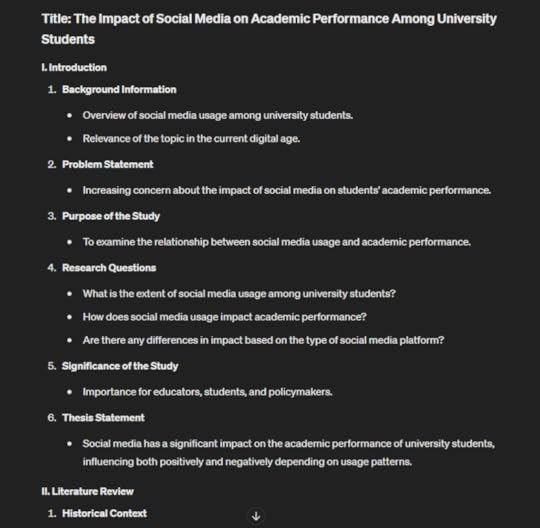
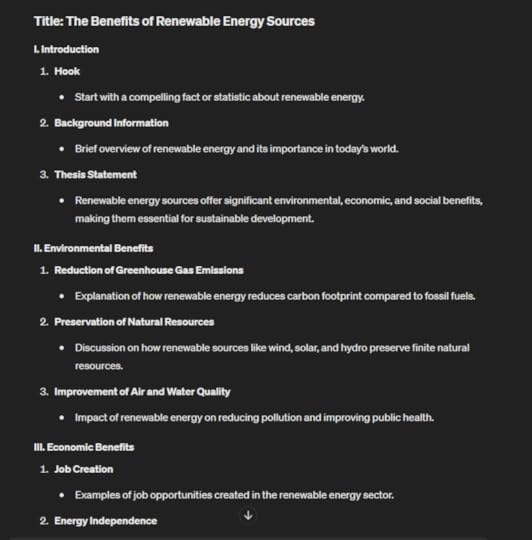
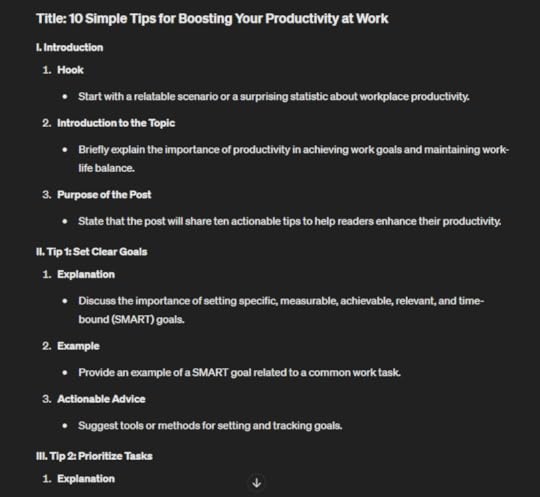
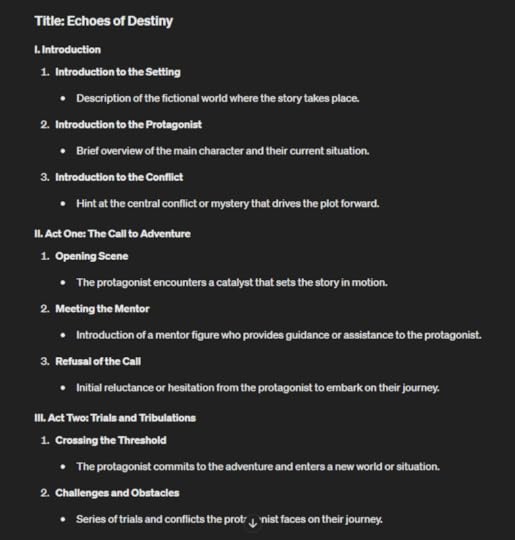
I have also included samples created by ChatGPT for each type of outline.
Academic PapersIf you’re writing a research paper, a good outline can help you stay organized and focused.
Start by outlining your introduction, thesis statement, and main points. Then, fill in your supporting details and evidence.
Be sure to include your sources and citations in your outline to save time later on.
Whether you’re writing a persuasive, narrative, or expository essay, an outline can help you organize your thoughts and arguments.
Start with your essay outline including your introduction, thesis statement, and main points. Then, add in your supporting details and evidence.
If you’re writing a blog post or article, an outline can help you stay on topic and ensure your writing is clear and concise.
Start with your headline and introduction, then outline your main points and supporting details. Be sure to include any research or examples you want to include.
Check out this comprehensive guide on how to write an SEO-friendly blog post outline and get your free template.
BooksOutlining is essential for writing a book or novel. A good book outline can help you keep track of your plot, characters, and themes.
Start by outlining your main plot points, then add in your character arcs and subplots.
Be sure to include any research or world-building details you need.
I’ve used outlines for all kinds of writing projects, from blog posts to books. I find that having a clear outline helps me stay focused and avoid writer’s block. It also makes the editing process much easier, since I can see the overall structure of my piece and make changes as needed.
Proper Outline Structure and FormatA well-structured outline can make the writing process much smoother. Here are the key components to include in your outline format.
Introduction and Thesis StatementStart your outline with your introduction and thesis statement. This will help you stay focused on your main point throughout the writing process.
Body ParagraphsNext, outline your body paragraphs. Each paragraph should focus on one main point or idea, with supporting details and evidence.
Use your major points as headings and your minor points as subheadings or bullet points.
ConclusionFinally, outline your conclusion. This should tie back to your thesis statement and summarize your main points.
You can also include a call-to-action or final thought.
How to Create an OutlineNow that you know the different types of outlines, let’s dive into how to actually create one.
Here’s a step-by-step guide to help you get started.
Step 1: Brainstorm IdeasThe first step in creating an outline is to brainstorm ideas related to your topic. This can involve listing key points, making a mind map, or using other prewriting techniques to generate content and identify connections between ideas.
Step 2: Organize Your Main PointsOnce you have your ideas, it’s time to organize topics into main points that support your thesis or central argument.
These main points will form the backbone of your outline and help you stay on track as you start writing.
Step 3: Arrange Supporting DetailsUnder each main point, arrange your supporting details and evidence. These might include quotes, examples, statistics, or anecdotes that back up your main points.
Be sure to keep them organized and relevant to each main idea.
Step 4: Finalize The Outline StructureOnce you have your main points and supporting details in place, it’s time to finalize the structure of your outline. This means deciding on the order of your points, making sure each point flows logically into the next, and adjusting your outline structure as needed.
When I plan an outline for a book or long-form blog post, I like to start with a basic structure and then add more detail as I go. I might start with just my main points and then fill in supporting details and evidence later on.
The key is to stay flexible and adapt your outline as your writing evolves.
Tips for Effective OutliningOutlining is a skill that takes practice to master. Here are a few tips to help you create effective outlines for any writing project.
Focus on the Main IdeaWhen outlining, focus on your main ideas and points. Don’t get bogged down in minor details or tangents. Stick to the key information that supports your thesis or argument.
Use a Consistent FormatWhen formatting your outline, use a consistent numbering system or order. For example, you might use Roman numerals for main points, capital letters for subpoints, and numbers for supporting details.
Be sure to indent each level for clarity.
I like to keep my outlines simple and easy to read. I use bullet points for main ideas and supporting details, and I indent each level to show the hierarchy of information.
I also leave plenty of white space so I can jot down notes or make changes as I go.
Be Flexible and AdaptableYour outline is a guide, not a rigid set of rules. Be willing to adapt and change your outline as you write and revise.
If you find that a certain section isn’t working or that you need to add new information, don’t be afraid to make changes to your outline.
Revise and RefineOnce you have a draft of your outline, take some time to revise and refine it. Look for areas where you can add more detail or clarify your points. Make sure each section flows logically into the next and that your overall structure makes sense.
One tip that has helped me create more effective outlines is to start with a basic structure and then add more detail as I go. For example, I might start with just my main points and then fill in subpoints and supporting details later on. This allows me to focus on the big picture before getting bogged down in the details.
Another tip is to use my outline as a tool for plot clarity and character growth when book outlining. I make sure each scene and chapter has a clear purpose that ties back to my overall content strategy and message.
Turn Your Ideas Into Structured Pieces That Engage and InformI hope this guide has helped you understand what is an outline in writing and how to create one for your next content piece.
Remember, outlining is a powerful tool that can save you time and frustration in the long run. So next time you sit down to write, take a few minutes to create an outline first and watch how it reshapes your entire approach to crafting meaningful content.
It’s time to build your blog empire.
Want to be a real Content Hacker along with us, but not sure where to start?
We’ve got custom-created resources just for you, friend.
Get inside the Content Hacker Community – at just $20/month, it’s a no-brainer. On-call, expert support, live calls, and so much more.
Want to go deeper? Check out our AIO Blogger course – an immersive one-week course teaching you everything you need to know to build a money-making online blog.
Can’t WAIT to welcome you inside.
with gratitude,
Julia
The post Get Premium Content appeared first on Content Hacker.
May 19, 2024
The Shortcomings of Universal Basic Income for Humanity
The future is here, whether we’re ready or not.
AI and automation aren’t just buzzwords anymore—they’re transforming everything from customer service to manufacturing.
Imagine a world where mundane tasks are handled by machines, giving us more time for creativity and innovation.
Sounds like science fiction? It’s happening right now.
As we look ahead, it’s clear that these technologies will continue to evolve at breakneck speed. From self-driving cars making commutes less stressful to virtual assistants streamlining our day-to-day activities—this isn’t just about convenience; it’s about revolutionizing how we live and work.
The Rising Tide of AI and Automation
The world is changing rapidly, and one of the biggest drivers of this change is the rise of artificial intelligence (AI) and automation. As these technologies continue to advance, they’re transforming how we work, live, and interact with the world around us.
But what does this mean for the future of work? How will AI and automation impact the global workforce and economy?
Let’s take a closer look.
The Predicted Future of WorkAccording to a McKinsey Global Institute report, by 2030, up to 375 million workers worldwide may need to switch occupational categories due to automation. This means that many jobs as we know them today could disappear, while new ones emerge.
While some jobs may be lost, others will be created. The key is to understand which industries and skills are most likely to be impacted and to start preparing for the future now.
Universal Basic Income: A Potential SolutionOne potential solution to the job losses caused by automation is the concept of a universal basic income (UBI). This idea has gained traction in recent years, with proponents like Andrew Yang proposing a “freedom dividend” of $1,000 per month for every American adult.
The idea behind UBI is that it could provide a safety net for those who lose their jobs due to automation, allowing them to retrain and find new opportunities. However, the concept is not without its critics, who argue that it could be expensive and discourage people from working.
According to a survey of over 2,700 AI researchers, nearly all human labor could be replaced by AI, automation, and robotics in the future.
The Human Touch in an Automated WorldWhile AI and automation are transforming many industries, there are still some jobs and sectors where human skills remain irreplaceable. These are the jobs that require empathy, creativity, and dexterity – skills that machines simply can’t replicate.
Empathy and Creativity: AI’s LimitationsOne of the key limitations of AI is its inability to truly understand and empathize with human emotions. While machines can be programmed to recognize facial expressions and respond accordingly, they lack the nuance and context that humans bring to interactions.
Similarly, while AI can be used to generate creative works like music and art, it still relies on human input and guidance. True creativity requires a spark of inspiration and a deep understanding of the human experience – something that machines simply can’t replicate.
As Dr. Kai-Fu Lee suggests, jobs that require a human touch like massage therapy and caretaking are likely to remain in demand even as automation increases. These are the jobs that require empathy, compassion, and a deep understanding of human needs and desires.
Navigating the Ethical Landscape of AI DevelopmentAs AI continues to advance, it’s important to consider the ethical implications of these technologies. From data privacy concerns to the potential for AI to perpetuate biases, many challenges need to be addressed.
The Role of Education in an AI-Driven FutureOne of the key ways to prepare for an AI-driven future is through education. As the nature of work changes, so too must the way we educate and train the next generation of workers.
This means placing a greater emphasis on skills like critical thinking, problem-solving, and creativity – skills that are less likely to be automated. It also means providing opportunities for lifelong learning and retraining, so that workers can adapt to changing job markets.
Protecting Privacy in the Age of Big DataYou’re not alone if you’re worried about how AI handles your information. With machines rapidly improving their ability to process and analyze huge chunks of data, there’s always the possibility that our personal details might fall into the wrong hands or be exploited.
To address this, we need strong data protection laws and regulations as well as greater transparency around how data is collected and used. Individuals should have control over their own data, and companies should be held accountable for any breaches or misuse.
Books like “2084” by John Lennox explore the dangers of transhumanism and the potential for AI to be used in ways that harm humanity.
In “AI 2041,” Dr. Kai-Fu Lee discusses the impact of AI on jobs and proposes attaching training to UBI as a potential solution.
The Economic Implications of Widespread AutomationThe rise of AI and automation is not just a technological shift – it’s also an economic one. As machines take over more tasks, there are concerns about job losses and the impact on workers.
Automation’s Impact on Manufacturing JobsOne of the sectors that has been hit hardest by automation is manufacturing. According to a report from the Brookings Institution, automation destroyed 4 million manufacturing jobs between 1987 and 2016.
This trend is likely to continue as machines become more sophisticated and able to take on more complex tasks. While some new jobs may be created in the process, it’s unclear whether they will be enough to offset the losses.
The Potential for Economic Growth Through AIDespite the challenges, there is also potential for AI and automation to drive economic growth. By optimizing efficiency in sectors like supply chains, healthcare, and customer service, these technologies could help to boost productivity and create new opportunities.
However, it’s important to ensure that the benefits of this growth are distributed equitably. Without proper policies in place, there’s a risk that the gains could be concentrated among a small group of people, while others are left behind.
Preparing for a Post-Labor EconomyAs automation continues to transform the economy, some experts are beginning to envision a post-labor world – one where work as we know it today is no longer the central organizing principle of society.
In a post-labor economy, the traditional notion of a job as the primary source of income and identity may no longer hold true. Instead, we may need to rethink what we value as a society and how we define success and fulfillment.
This could mean placing a greater emphasis on leisure time, personal growth, and community involvement. It could also mean finding new ways to distribute wealth and resources, such as through a universal basic income or other forms of social support.
In his book “Utopia for Realists,” Rutger Bregman explores the idea of a post-labor economy and the need for meaningful work in a world where traditional jobs are increasingly automated. He argues that we need to rethink our relationship to work and find new ways to create value and purpose in our lives.
The rise of AI and automation presents both challenges and opportunities for the future of work. While there are certainly risks and uncertainties ahead, there is also the potential for these technologies to create new possibilities and drive positive change. The key is to approach these changes with a spirit of creativity, compassion, and a commitment to building a future that works for everyone.
ConclusionWe’ve explored how the future of AI and automation is shaping up — and it’s nothing short of groundbreaking.
This isn’t Hollywood’s dystopian nightmare; this is real progress helping us lead better lives every day. Whether it’s smarter fraud detection systems or personal assistants that remember your preferences, AI makes things easier for everyone involved.
I’ve seen firsthand the power of these technologies in action. And as they keep advancing, so do our growth opportunities — both personally and professionally.
It’s time to build your blog empire.
Want to be a real Content Hacker along with us, but not sure where to start?
We’ve got custom-created resources just for you, friend.
Get inside the Content Hacker Community – at just $20/month, it’s a no-brainer. On-call, expert support, live calls, and so much more.
Want to go deeper? Check out our AIO Blogger course – an immersive one-week course teaching you everything you need to know to build a money-making online blog.
Can’t WAIT to welcome you inside.
with gratitude,
Julia

The post Test Humanlike Writer appeared first on Content Hacker.
May 16, 2024
What Is Argumentative Writing? Master The Art of Persuasion
You’ve got an opinion, and you’re not afraid to share it. But how do you convince others to see things your way? That’s where argumentative writing comes in.
Argumentative writing is more than just spouting off your thoughts – you need facts, evidence, and a logical argument to back up your claims. That’s what separates a persuasive piece from a mere rant.
So, whether you’re writing an essay for school, trying to convince your boss to give you a raise, or pitching a new product to a potential client, mastering the art of argumentative writing is key.
Table Of Contents:What Is Argumentative Writing?Structure of an Argumentative EssayArgumentative Essay Writing TipsCommon Mistakes to Avoid in Argumentative WritingArgumentative Essay ExamplesChallenge The Status Quo and Make Your Reader ThinkWhat Is Argumentative Writing?If you’ve ever tried to convince someone to see things your way, you already know the basics of argumentative writing. It’s all about building a case, brick by brick, until the reader has no choice but to agree with you.
But there’s an art to it. You can’t just throw out random facts and expect to win people over.
Nope, argumentative writing is a delicate dance of logic, persuasion, and cold, hard evidence.
So what is argumentative writing?
At its core, argumentative writing is about taking a stance on an issue and backing it up with well-researched facts. It’s not about emotions or personal opinions. It’s about building an airtight argument that leaves no room for doubt.
Think of it like a court case. You’re the lawyer, and your readers are the jury. It’s your job to present the evidence in a way that convinces them to agree with you. And just like in a real court, you can’t rely on flimsy evidence or logical fallacies. You need cold, hard facts.
What is The Purpose of Argumentative Essay Writing?Ultimately, the goal of writing an argumentative paper is to persuade the reader to agree with your perspective on a controversial topic. You’re not just sharing information – you’re trying to change minds.
But it’s not about strong-arming your readers into submission. The best argumentative essays use logic and evidence to gently guide the reader to a certain conclusion. It’s like a mental map, leading them step by step until they arrive at your point of view.
Key Elements of Argumentative WritingTo create a truly persuasive argumentative essay, you need a few key ingredients:
A debatable topic with multiple sidesA good thesis statement that’s clear and specificLogical reasoning and transitionsCredible, relevant evidence to support your argumentAcknowledgment of opposing viewsA compelling, convincing conclusionSkip any of these, and your argument will be about as sturdy as a house of cards. But nail them all, and you’ll have a bulletproof essay.

Alright, so you’ve got your topic and your evidence. Now it’s time to put it all together into a cohesive argumentative essay structure.
Here’s the typical writing process of a persuasive essay:
Introduction and Thesis StatementFirst, write your introduction. Think of it as your opening argument in a courtroom drama. It’s your chance to captivate the jury, provide context for the case, and lay out your main point in a compelling thesis statement. This is the bedrock upon which your entire essay rests, so craft it with care.
Body Paragraphs and Supporting EvidenceThen lay out your case, point by point. Each body paragraph should focus on one main idea, supported by specific facts and examples. And don’t just state the evidence – explain how it logically backs up your argument.
Think of it like building a brick wall. Each piece of evidence is a brick, and your explanation is the mortar holding it all together. Without that mortar, your argument will crumble.
Conclusion and Reiterating Main PointsFinally, nail your closing argument. This is your last chance to drive your point home. Restate your thesis, sum up your main evidence, and leave the reader with a strong impression.
But don’t just rehash what you’ve already said. Use the conclusion to take your argument to the next level – perhaps by posing a new question or calling the reader to action. End on a high note and make it impossible for the reader to disagree with you.
Argumentative Essay Writing TipsSo, you’re gearing up to write an argument essay that packs a punch. Want to make sure it’s ironclad? Here’s how to do it.
Choose a Debatable TopicThe best argumentative essays are about controversial, debatable topics. If everyone already agrees with your thesis, there’s no point in arguing it. Pick something that has multiple sides and tons of evidence to explore.
Here are some of the most controversial topics that have spawned great debates:
Banning mobile phones in schoolsAnimal testingSocial media addictionArtificial intelligenceCloningSchool uniforms should be requiredAbortionCapital punishmentFree collegeHomework should be bannedViolent video games should be bannedAll police officers should carry gunsStudent loansTobacco and alcohol bansClimate changeUniversal healthcareHomeschooling vs. traditional schoolingEuthanasiaMandatory vaccinationHumans colonizing other planetsLegalization of drugsLegalization of prostitutionAlternative energyConduct Thorough ResearchAfter you have chosen a topic, it’s time to gather evidence.
You can’t argue effectively without the facts to back you up. Dive deep into credible sources – academic journals, reputable news outlets, expert interviews. The more evidence you have, the stronger your argument will be.
Outline Your EssayBefore you start writing, sketch out the structure of your essay.
Start with a topic sentence. What main points will each body paragraph cover, and what evidence will you use to support them?
Having a blueprint will keep you focused and make the actual writing much easier.
Use Strong Evidence and ExamplesThe heart of any argumentative essay is its evidence. Make sure each claim you make in your writing is backed up by facts, statistics, studies, or other logical proof. And use vivid examples to illustrate your points and make them more concrete for the reader.
Address Opposing ViewsA strong argumentative essay doesn’t present just one side – it also addresses and refutes the opposing view.
Acknowledge the other perspectives on the topic and use evidence to explain why they’re incorrect or incomplete. This shows you’ve really done your research.
Edit and Revise Your WorkOnce you’ve got a draft, the real work begins.
Go through your essay with a fine-toothed comb, checking for logical flow, persuasive language, grammar mistakes, and more.
Don’t be afraid to cut, rearrange, or rewrite sections to make your argument as strong as possible.

Writing essays can be tricky, even for the pros. Watch out for these common mistakes that could trip you up along the way.
Failing to Address CounterargumentsIf you ignore the other side of the argument, you’re essentially sticking your head in the sand. A good argumentative essay acknowledges and refutes the opposing viewpoints. Otherwise, your piece is just a written speech.
Relying on Emotional AppealsYou might be inclined to sprinkle emotional language and personal stories throughout your argumentative essay, hoping to tug at your readers’ heartstrings.
Resist that urge.
In argumentative writing, logic and evidence are your most powerful tools.
Overusing emotional appeals can make your argument appear weak and unconvincing, causing your readers to question your credibility. Stick to the facts and let them speak for themselves.
Lacking Credible EvidenceAn argument is only as good as the evidence that backs it up. If you’re using outdated, unreliable, or incomplete sources, your whole essay will suffer. Make sure each claim is supported by current, credible facts from authoritative sources.
Straying from the Main ArgumentIt’s easy to get sidetracked, especially when you’re passionate about a topic. But if you stray too far from your main thesis, you’ll confuse and lose your readers.
Stay laser-focused on proving your central argument, and cut any irrelevant info.
Argumentative Essay ExamplesSometimes the best way to learn is by example. Reading argumentative essays can show you what works in terms of choosing a topic, crafting a thesis, structuring your argument, and more.
Here are some of the most influential argumentative essays throughout history:
“Letter from Birmingham Jail” by Martin Luther King Jr.“Declaration of Sentiments and Resolutions” by Elizabeth Cady Stanton“A Modest Proposal” by Jonathan Swift“Politics and the English Language” by George Orwell“Self-Reliance” by Ralph Waldo Emerson“Civil Disobedience” by Henry David Thoreau“Shooting an Elephant” by George OrwellJohn F. Kennedy’s Inaugural AddressEach of these texts presents a compelling argument using the tools of logic, evidence, and persuasive language. Study how they hook the reader, lay out their reasoning, and drive their point home. Then try to emulate those techniques in your own writing.
With these tips and examples in mind, you’re well on your way to writing an argumentative essay that would hold up in any court of public opinion.
Remember – it’s all about building a logical, evidence-based case that leaves your readers no choice but to agree with you.
Challenge The Status Quo and Make Your Reader ThinkArgumentative writing is all about taking a stand, backing it up with evidence, and convincing your reader to join your side.
Want to write a powerful argumentative essay? Be clear, logical, and persuasive. Take on those counterarguments directly and paint a vivid picture with concrete examples.
With these tips in mind, you’re ready to tackle any argumentative writing challenge that comes your way.
It’s time to build your blog empire.
Want to be a real Content Hacker along with us, but not sure where to start?
We’ve got custom-created resources just for you, friend.
Get inside the Content Hacker Community – at just $20/month, it’s a no-brainer. On-call, expert support, live calls, and so much more.
Want to go deeper? Check out our AIO Blogger course – an immersive one-week course teaching you everything you need to know to build a money-making online blog.
Can’t WAIT to welcome you inside.
with gratitude,
Julia
The post Get Premium Content appeared first on Content Hacker.
May 15, 2024
What Is Active Voice in Writing? Engage Your Readers Now
Have you ever wondered why some sentences seem to effortlessly capture your attention while others fall flat? One key element that can make a significant difference in writing is the use of active voice. What is active voice in writing?
Active voice is a grammatical structure in which the subject of a sentence performs the action expressed by the verb. We often change passive voice to active voice not only to improve clarity but also to make your writing more engaging and dynamic.
In this blog post, we’ll delve into what exactly active voice is, why it’s important for effective communication, and how you can easily incorporate it into your writing. Whether you’re a student or professional, knowing how to use active voice in writing can elevate your content pieces to new heights.
Table Of Contents:What Is Active Voice in Writing?Benefits of Using Active VoiceHow to Identify Passive VoiceTechniques for Changing Passive to Active VoiceWhen to Use Passive Voice IntentionallyTurn Those Passive Sentences Into Active VoiceWhat Is Active Voice in Writing?You’ve probably heard it a million times from your English teacher: “Use active voice in your writing.”
But what does that mean and why is it such a big deal?
Active voice means the subject of your sentence is performing the action. It’s direct, clear, and well, active.
Like this:
The dog chases the ball.
Here, the subject (the dog) is doing the chasing. It’s an active sentence that gets straight to the point.
A few more examples of active voice:
The chef cooked the meal to perfection.She is going to bed.I wrote the report yesterday.In each case, the subject (chef, she, I) is doing something. There’s no question about who’s performing the action.
Active Voice vs. Passive VoiceSo what about passive voice? In a passive sentence, the target of the action gets promoted to the subject position.
Like this:
The ball was chased by the dog.
See how the ball (the object) comes before the action (was chased)? That’s passive voice.
The focus shifts from the doer (the dog) to the thing being acted upon (the ball).
While passive voice isn’t grammatically incorrect, it can make your writing feel awkward, indirect, wordy, and well, a little dull.
Active voice, on the other hand, tends to be crisper, clearer, and more engaging.
In any writing class, it is recommended to avoid passive voice and focus on the sentence subject.
Benefits of Using Active VoiceSo why is your teacher always harping on about using active voice? Turns out, there are some pretty compelling reasons to make it your go-to.
Clarity and DirectnessThe biggest advantage of writing in an active voice is that it makes your sentence crystal clear. There’s no ambiguity about who’s doing what. Your reader doesn’t have to untangle the sentence structure to figure out what’s going on.
Let’s look at an example:
Passive: The cake was eaten by the kids.
Active: The kids ate the cake.
The active version is so much more straightforward, right? We know exactly who did the eating without having to think twice.
Stronger and More Engaging WritingActive voice doesn’t just make your writing clearer – it makes it more compelling too. By putting the focus on the subject, your sentences have more oomph and energy.
For example:
The race ended with an unexpected champion: the underdog. They said it couldn’t be done, but the underestimated competitor proved them all wrong by securing the victory.
Can you feel the difference? The active sentence packs way more punch. We can visualize the underdog surging across the finish line, tasting their victory.
Improved ReadabilityHere’s the thing: Our brains are wired to understand active voice more easily than passive.
Active sentences flow logically from subject to verb to object, mirroring how we process information.
Passive voice, on the other hand, requires more mental gymnastics. We have to flip the sentence around in our heads, puzzling out who did what to whom. All that extra work can slow down your reader and make your writing harder to follow.
Active voice is your secret weapon for crafting content that’s not only clear and concise but also incredibly engaging. By using active voice, you’ll keep your readers interested from the first word to the last.

So how can you tell if you’re using passive voice? It’s not always as obvious as you might think.
Look for the Verb “To Be”One of the biggest clues of a passive sentence is the presence of a form of the verb “to be.”
These include is, am, are, was, were, be, being, and been.
For example:
“A delicious cake was baked by Sheila.”
“The project was completed ahead of schedule.”
“The old house next door is being renovated.”
If you see a “to be” verb followed by a past participle (a verb ending in -ed), chances are you’ve got a passive voice on your hands.
Check if the Subject Performs the ActionAnother way to identify passive voice is to look at what the subject of your sentence is doing.
Are they performing the action of the main verb? Or are they just kind of…sitting there, letting the action happen to them?
Let’s look at an example:
“The students were praised by the teacher for their hard work.”
Here, the real doer of the action (the teacher) is tacked on at the end like an afterthought.
Identify the Target of the ActionIn an active sentence, the subject is front and center, doing the verb. In passive voice, the target of the action steals the spotlight, being acted upon.
Like this:
The election results were announced this morning.
The focus here is on the election results (the target) rather than who did the announcing (the subject). That’s a surefire sign you’re dealing with passive voice.
Techniques for Changing Passive to Active VoiceOkay, so you’ve identified some passive voice in your writing. Now what?
How do you flip those sentences around and make them active?
Identify the Real SubjectFirst things first: Figure out who or what is actually doing the action in your sentence. In passive voice, the subject is often hiding out at the end of the sentence, after the word “by.”
For example:
“A new product will be launched by the company next month.”
Here, the company is the one doing the launching, so it’s the real subject of the sentence.
Rearrange the Sentence StructureOnce you’ve pinpointed the subject, it’s time to give your sentence a makeover. Move the subject to the front of the sentence, and have it perform the action directly on the object.
So our passive example from before:
“The company will launch a new product next month.”
Now it’s in active voice.
Replace Passive Verbs with Active VerbsSometimes, simply rearranging the sentence isn’t enough. You may need to swap out those weak, passive verbs for stronger, active ones.
Let’s look at an example:
It was determined that the project would be completed by the team.
That’s about as passive as it gets. To make it active, we need to ditch “was determined” and give the subject (the team) a more decisive verb.
The team decided to complete the project.
See the difference? The team’s running the show. It’s crystal clear, cuts right to the chase, and infinitely better.
When to Use Passive Voice IntentionallyNow, I know I’ve spent this whole post singing the praises of active voice. But here’s a little secret: Sometimes, passive voice can actually be a good thing.
I know, I know – it sounds like heresy. But there are a few specific situations where passive voice is not only acceptable but actually preferable.
Emphasizing the Action or ObjectIn some cases, you might want to deliberately shift the focus away from the subject and onto the action or object of the sentence. That’s where passive voice can come in handy.
For example:
The suspect was arrested early this morning.
Here, the emphasis is on the arrest itself, not on who made the arrest. Using passive voice allows you to highlight the action and its consequences.
Maintaining Objectivity in Scientific WritingIn scientific writing, researchers often use passive voice to keep the focus on the experiments and results, rather than on the scientists themselves.
The data was collected for six months.
This sounds more objective and impartial than saying “We collected the data for six months.” The passive voice helps maintain that all-important scientific detachment.
Stylistic ChoicesFinally, there may be times when you choose a passive voice for stylistic reasons – to create a certain tone or rhythm in creative writing.
For example:
The air crackled with anticipation as the stage was prepped for an unforgettable fight.
Passive voice, in this case, is a powerful tool that heightens the dramatic tension, making you eager to discover what happens next.
The key is to use passive voice sparingly and intentionally. Active voice should still be your default, but don’t be afraid to mix things up now and then for effect.
Turn Those Passive Sentences Into Active VoiceActive voice is the key to making your writing come alive. By putting the subject front and center, using strong verbs, and keeping your sentences concise, you can create content that grabs your reader’s attention.
Now that you know what active voice is and how to use it, it’s time to put it into practice. Your readers are waiting for content that speaks directly to them, pulls them in, and keeps them engaged. With the active voice in your writing toolbox, you’ve got the power to make that happen.
It’s time to build your blog empire.
Want to be a real Content Hacker along with us, but not sure where to start?
We’ve got custom-created resources just for you, friend.
Get inside the Content Hacker Community – at just $20/month, it’s a no-brainer. On-call, expert support, live calls, and so much more.
Want to go deeper? Check out our AIO Blogger course – an immersive one-week course teaching you everything you need to know to build a money-making online blog.
Can’t WAIT to welcome you inside.
with gratitude,
Julia
The post Test Humanlike Writer appeared first on Content Hacker.
May 14, 2024
What is Syntax in Writing? A Simple Guide for Beginners
Syntax is like the backbone of your writing. It’s the way you arrange words and phrases to create meaning. Without proper syntax, your sentences can fall flat or leave readers scratching their heads.
Syntax got you feeling lost? No worries! We’ll break it down together, step by step.
By the end of this guide, you’ll have a solid grasp of the fundamentals of the English language and be ready to write like a seasoned pro.
Let’s jump right in and start exploring what is syntax in writing.
Table Of Contents:What is Syntax in Writing?Types of Sentence StructuresElements of SyntaxSyntactic PatternsSyntax and Writing StyleCommon Syntax Mistakes to AvoidBest Practices for Improving Your SyntaxMaster Syntax to Write BetterWhat is Syntax in Writing?Syntax refers to the set of rules, principles, and processes that govern the structure of sentences in a given language, including word order, sentence organization, and the relationship between words and phrases. It dictates how words from different parts of speech are combined to convey meaning.
The basic rules of syntax govern how words and phrases can be combined to form sentences in a language. Here are some fundamental principles of syntax:
Word Order: Syntax determines the order in which words appear in a sentence. For example, in English, a typical sentence structure is Subject-Verb-Object (SVO), as in “She (subject) eats (verb) an apple (object).”
Sentence Structure: Syntax involves the arrangement of words into phrases, clauses, and sentences. It includes rules for forming questions, commands, statements, and exclamations.
Grammatical Relations: Syntax defines how different elements in a sentence relate to each other grammatically, such as which words function as subjects, objects, and predicates.
Phrase Structure: Phrases are groups of words that function as a single unit within a sentence. Syntax rules determine how phrases are constructed and combined. For instance, a noun phrase can include a noun and its modifiers, like “the big dog.”
Hierarchical Structure: Syntax often involves hierarchical relationships, where certain words or phrases depend on others. For example, in the sentence “The cat that chased the mouse is black,” the clause “that chased the mouse” modifies “the cat.”
Transformations: Syntax also covers transformations, which are rules that move elements within a sentence to create questions, passive constructions, or other variations. For instance, transforming the statement “She can swim” into the question “Can she swim?”
Syntax vs. Semantics: While syntax is concerned with the formal structure of sentences, semantics deals with their meaning. A sentence can be syntactically correct but semantically nonsensical, like “Colorless green ideas sleep furiously.”
Now, you might be thinking, “Why should I care about syntax? Isn’t writing just about putting my thoughts on paper?”
Well, my friend, syntax is what makes your writing readable and understandable.
Without proper syntax, your sentences can become a jumbled mess. Your readers will be left scratching their heads, trying to decipher what you’re trying to say. And let’s be real, nobody wants to read a word salad.
Plus, good syntax can take your writing style to the next level. It allows you to create emphasis, convey tone, and add variety to your sentences. It’s like giving your writing a little extra pizzazz.
Types of Sentence StructuresJust like how you mix and match different outfits to create your personal style, you can use different sentence structures to add variety and flair to your writing.
Simple SentencesFirst up, we have the trusty simple sentence. These are the no-frills, get-to-the-point kind of sentences. They have one independent clause, which means they can stand on their own two feet.
Here’s an example: “I love writing.”
Short, sweet, and to the point.
Simple sentences are great for making a strong statement or keeping your writing concise.
Compound SentencesNext, we have compound sentences. They have two or more independent clauses joined together by a coordinating conjunction (like “and,” “but,” or “or”) or a semicolon.
Check out this example: “I love writing, but it can be challenging at times.”
The two independent clauses are “I love writing” and “it can be challenging at times,” joined together by the conjunction “but.”
Compound sentences are great for showing the relationship between ideas and adding variety to your writing.
Complex SentencesNow, let’s talk about complex sentences. They have one independent clause and one or more dependent clauses.
A dependent clause cannot stand on its own – it needs the independent clause to make sense. It usually starts with a subordinating conjunction like “because,” “although,” or “when.”
Here’s an example: “Although writing can be challenging, I still love it.”
The dependent clause is “Although writing can be challenging,” and the independent clause is “I still love it.”
Compound-Complex SentencesLast but not least, we have compound-complex sentences. These types of sentences have two or more independent clauses and one or more dependent clauses.
Here’s an example: “I love writing, but it can be challenging at times, especially when I’m struggling to find the right words.”
The independent clauses are “I love writing” and “it can be challenging at times,” joined by the conjunction “but.” The dependent clause is “especially when I’m struggling to find the right words.”
When you want to convey multifaceted concepts and showcase how different ideas relate to each other, compound-complex sentences are your best friend. Just remember, moderation is key – if you pack too many of these sentences into your writing, it can quickly become convoluted and challenging for your readers to follow along.

Alright, we’ve covered the different sentence structures, so let’s dig into the nuts and bolts of syntax.
Word OrderIn the English language, we typically follow a subject-verb-object pattern. This means that the subject of the sentence comes first, followed by the verb and then the object.
For example: “The cat (subject) chased (verb) the mouse (object).”
Mixing up this word order can confuse your readers and make your sentences harder to understand.
Of course, there are exceptions to this rule. Sometimes, writers will use inverted word order for emphasis or stylistic effect. But in general, sticking to the subject-verb-object pattern will keep your writing clear and easy to follow.
PhrasesPhrases are like little word families that stick together, but they don’t quite make up a complete thought.
There are different types of phrases, like noun phrases (e.g., “the big, fluffy dog”), verb phrases (e.g., “will be running”), and prepositional phrases (e.g., “under the table”).
Phrases can add detail and description to your sentences, but be careful not to overuse them. Too many phrases can make your writing feel cluttered and hard to follow.
ClausesFinally, we have clauses. Clauses are groups of words that have a subject and a verb, and they can be either independent or dependent.
Independent clauses can stand on their own as complete sentences, like “I love writing.”
Dependent clauses, on the other hand, can’t stand alone and need to be attached to an independent clause to make sense.
For example: “Because I love writing, I practice every day.”
The dependent clause is “Because I love writing,” and it’s attached to the independent clause “I practice every day.”
Using a mix of independent and dependent clauses can add variety and complexity to your writing. Just make sure that your dependent clauses are properly connected to your independent clauses, or your sentences might end up feeling incomplete or confusing.
Syntactic PatternsNow that you’re up to speed on syntax basics, let’s explore some syntactic patterns to add flair to your writing.
Subject-Verb-Object PatternThe classic subject-verb-object syntactic pattern is the foundation of English sentence structure and the perfect starting point for crafting your sentences.
Here’s an example: “The writer (subject) crafted (verb) a compelling story (object).”
This pattern emphasizes the action and the object of the sentence, making it clear and easy to understand.
Subject-Verb-Indirect Object-Direct Object PatternNext, we have the subject-verb-indirect object-direct object pattern. This pattern is used when the verb involves the transfer of something from one person or thing to another.
For example: “The writer (subject) gave (verb) the editor (indirect object) a draft of the story (direct object).”
The indirect object comes before the direct object, showing who or what is receiving the action.
Subject-Verb-Subject Complement PatternThe subject-verb-subject complement pattern is used with linking verbs, where the subject complement describes or renames the subject.
Here’s an example: “The story (subject) was (verb) a masterpiece (subject complement).”
The subject complement “a masterpiece” describes the subject “the story,” giving more information about its quality or nature.
Subject-Verb-Object Complement PatternThe subject-verb-object complement pattern is similar to the subject-verb-subject complement pattern, but it describes the direct object instead of the subject.
For example: “The writer (subject) found (verb) the story (direct object) intriguing (object complement).”
The object complement “intriguing” describes the direct object “the story,” giving more information about how the writer perceived it.
Subject-Verb-Adverbial Complement PatternWhen you want to add more context to a verb, try the subject-verb-adverbial complement pattern in your writing.
An adverbial complement can specify the time, place, manner, or reason behind the action, giving your reader a clearer understanding of what’s going on.
Here’s an example: “The writer (subject) worked (verb) diligently (adverbial complement) on the story.”
The adverbial complement “diligently” describes how the writer worked, giving more information about how the action was performed.
By using these different syntactic patterns in your writing, you can add variety and clarity to your sentences. Mix and match them to create a unique and engaging writing style that keeps your readers hooked from start to finish.
Syntax and Writing StyleLet’s dive into how syntax can impact your writing style and take it to the next level.
The way you arrange words as a writer can make all the difference in how your work feels to readers. You can fine-tune the rhythm and tone of your writing by carefully crafting each sentence.
Mix and Match Sentence StructuresOne way to keep your readers engaged is by varying your sentence structures. Mix it up with short, punchy sentences alongside longer, more complex ones.
This creates a natural flow and keeps things interesting. In my writing, I love using a variety of structures to emphasize key points and keep the reader on their toes.
Word ChoiceSelecting the right words is an essential aspect of syntax. Vivid, precise language can transform your writing into something truly memorable.
Metaphors and similes are the secret ingredients that transform bland writing into a savory feast for the mind. Sprinkle them throughout your paragraphs to add zest, making your ideas more memorable for your readers.
Sentence Length and RhythmPlaying with sentence length is a great way to create rhythm in your writing. Short sentences can pack a punch, while longer ones can convey more complex ideas.
Experiment with different lengths to find the perfect balance for your piece. When I’m writing, I always read my work aloud to make sure the rhythm feels natural and engaging.
Syntax in Different Writing StylesSyntax can vary depending on the writing style you’re using.
Academic writing often uses more complex structures, while creative writing may play with unconventional syntax for artistic effect.
Want to write like a pro? The secret is simple: read, read, read.
Soak up the styles of your favorite authors and see how they craft their sentences. Before you know it, you’ll be switching up your syntax like a literary chameleon.
Common Syntax Mistakes to AvoidEven the most experienced writers can fall prey to syntax mistakes. Here are a few common ones to watch out for:
Sentence FragmentsSentence fragments are incomplete sentences that lack a subject, verb, or both. They can confuse readers and disrupt the flow of your writing.
To avoid fragments, make sure each sentence has a complete independent clause. If you’re unsure, read your work aloud and listen for any awkward or abrupt endings.
Run-on SentencesOn the flip side, run-on sentences occur when two or more independent clauses are joined without proper punctuation. They can be just as confusing as fragments.
To fix a run-on, try breaking it into separate sentences or using a coordinating conjunction to join the clauses.
Misplaced ModifiersMisplaced modifiers are words or phrases that are placed too far from the word they’re meant to modify. This can lead to unintentional hilarity or confusion.
To avoid this, always place modifiers as close as possible to the word they’re describing.
When in doubt, rephrase the sentence for clarity.
Incorrect SubordinationIncorrect subordination happens when the relationship between a main clause and a subordinate clause is unclear or illogical.
Make sure your main idea is in the main clause and that subordinating conjunctions are used correctly.
Reading your work aloud can help you catch any awkward or confusing subordination.
Lack of Parallel StructureParallel structure means using the same grammatical form for elements in a series or list. A lack of parallel structure can make your writing feel clunky and unbalanced.
Parallel structure is like a well-choreographed dance. When all elements in a series, such as nouns or phrases, move in sync with the same grammatical form, your writing flows seamlessly, captivating your audience with its coherence and clarity.
Best Practices for Improving Your SyntaxReady to take your syntax to the next level? Here are some tips and techniques to try:
Analyze Sentence StructuresElevate your writing by examining your sentence structures under a microscope. Analyze how each one contributes to the overall flow and impact of your piece. Embrace variety and creativity to keep your readers hooked.
Are you relying too heavily on simple sentences? Could your writing benefit from more complex structures?
Asking yourself these questions can help you identify areas for improvement.
Practice Combining SentencesSentence combining is a great exercise for improving your syntax skills. Start with a series of short, simple sentences and experiment with different ways to combine them using conjunctions, relative pronouns, and punctuation.
Keep ReadingCurling up with a good book is like taking a masterclass in writing. As you flip through the pages, soak in the author’s sentence structures, punctuation, and word choice. These elements work together to create meaning, style, and a connection with you, the reader.
Analyze passages you find particularly effective and consider how you can apply similar techniques to your own writing. The more you read, the more tools you’ll have in your syntactic toolbox.
Edit for ClarityOne last thing – don’t forget how crucial editing is when you want to level up your syntax game. Try reading your work out loud to catch any clunky or confusing bits, then switch them up for a smoother, easier read.
Scan your writing for common mistakes like incomplete sentences, endless rambling, and confusing modifiers. Fix these issues and make sure each sentence supports your main point.
Don’t be afraid to cut or rework sentences that aren’t pulling their weight.
With practice and persistence, you’ll be a syntax master in no time.
Master Syntax to Write BetterSo there you have it – the lowdown on what is syntax in writing.
English syntax is not as complicated as it sounds. Just remember to use proper word order, construct complete sentences, and vary your sentence structures to keep things interesting.
When you master syntax like a pro, your writing will shine with clarity and style. Sentences will effortlessly flow from one to the next, leaving your audience captivated and grateful for the smooth reading experience.
So go ahead and put these syntax tips into practice. Experiment with different sentence patterns and structures. Pay attention to how the pros do it in the books and articles you read.
It’s time to build your blog empire.
Want to be a real Content Hacker along with us, but not sure where to start?
We’ve got custom-created resources just for you, friend.
Get inside the Content Hacker Community – at just $20/month, it’s a no-brainer. On-call, expert support, live calls, and so much more.
Want to go deeper? Check out our AIO Blogger course – an immersive one-week course teaching you everything you need to know to build a money-making online blog.
Can’t WAIT to welcome you inside.
with gratitude,
Julia
The post Get Premium Content appeared first on Content Hacker.
May 13, 2024
What Is Passive Voice in Writing? The Lowdown for Creators
Passive voice is a grammatical construction that can subtly shift the focus of a sentence, often resulting in less direct and engaging prose.
In this blog post, we’ll explore what is passive voice in writing, how to identify it, when it’s appropriate to use (and when it’s not), and most importantly, how to transform passive voice usage into more dynamic, active sentences.
Whether you’re a seasoned writer or just starting out, mastering how to change passive voice to active voice will undoubtedly elevate the quality of your work.
Let’s talk about what is passive voice in writing and discover the secrets to written works that pack a punch!
Table Of Contents:What Is Passive Voice in Writing?When to Use Passive VoiceHow to Identify Passive VoiceTips for Avoiding Passive Voice in WritingTools and Resources for Identifying and Fixing Passive VoiceDitch The Passive Voice for More Engaging ContentWhat Is Passive Voice in Writing?In English grammar, the passive voice is a type of sentence or clause in which the subject receives the action of the verb. Contrast this with the active voice, where the subject performs the action expressed by the verb.
You can be sure a sentence is passive if it uses any form of the verb “to be” followed by a past participle.
For example:
The cake was baked by my grandmother.The novel was written by an unknown author.Another indicator of passive voice is the use of the past tense of “is” or “are” as you can see below:
The package was delivered by FedEx.The decision was made by the committee.Mistakes were made.In each of these sentences, the subject of the sentence (package, decision, mistakes) is the receiver of the action rather than doing the action itself.
One of the flaws of AI in generating content is the tendency to overuse passive voice. This is where my human writing skills stand out.
Restructuring AI-generated content into human-friendly text is my forte. I take robotic paragraphs and breathe life into them, ensuring a lively, active voice that captures the reader’s attention. When I’m done editing, the text reads as if it were written by a person, not a machine.
Using our previous examples, here’s how you can change those passive constructions into the active voice:
FedEx delivered the package.The committee made the decision.We made mistakes.The active voice makes a world of difference, doesn’t it?
When the subject takes charge and performs the action, sentences become more straightforward, concise, and easier to digest. FedEx delivers, the committee decides, and we make mistakes – it’s that simple.
In most cases, writing in an active voice will make your sentences clearer and more engaging for the reader. That’s why it’s generally recommended to avoid passive voice when possible.
But are there times when passive voice is actually the better choice? Let’s look at some of those situations next.
When to Use Passive VoiceI know, I just spent all that time telling you to avoid passive voice – and now I’m saying there are times when you should use it?
I promise I’m not trying to confuse you.
The truth is, while active voice is preferred in most cases, there are situations where passive voice does sound better.
Scientific Writing and Lab ReportsIf you’ve ever written a lab report, you know that passive voice is pretty much the standard.
Why? Because in scientific writing, the focus is on the experiment and the results, not on the researcher.
For example, instead of writing “I mixed the chemicals,” you would write “The chemicals were mixed.”
This emphasizes the chemicals and the mixing process, rather than you as the person doing the mixing.
Scientific writing often uses passive voice to create an objective, impersonal tone and to emphasize the experimental process and results.

Passive voice can also be useful when the person or thing doing the action is unknown or unimportant.
For example:
My car was stolen.The store was robbed last night.In these cases, we don’t know who stole the car or robbed the store, so it makes sense to use passive voice.
Emphasizing the Action or ObjectSometimes you might want to emphasize the action being performed or the object receiving the action, rather than the subject doing the action. In these cases, passive voice can be effective.
For example:
The suspect was arrested by police.The bill was passed by Congress.Here, the focus is on the suspect being arrested and the bill being passed, not on the police or Congress performing those actions.
So while active voice is generally preferred, there are situations where passive voice is the better choice. The key is to use it intentionally and sparingly.
How to Identify Passive VoiceOkay, so now you know what passive voice is and when to use it. But how can you tell if a sentence is written in passive voice?
It’s not always immediately obvious, especially if you’re not used to looking for it.
Here are a few tips and tricks for spotting passive voice in writing.
Identify the Verb PhraseThe first step in identifying passive voice is to locate the verb phrase in the sentence.
Remember, passive voice always involves a form of the verb “to be” plus a past participle. So look for phrases like “was taken,” “is being built,” “have been called,” etc.
The project was completed on time.Complaints were made by several customers.The bold portions are the verb phrases, and they follow the pattern of “to be” verb + past participle, indicating passive voice.
Find the Sentence SubjectIn an active voice sentence, the subject typically comes before the verb and is doing the action. In passive voice, the subject either comes after the verb or is missing entirely.
Active: The dog chased the ball.Passive: The ball was chased by the dog.In the active sentence, “the dog” is the subject and comes before the verb “chased.”
In the passive sentence, “the dog” is the subject and comes after the verb phrase “was chased.”
Recognize the Receiver’s PositionIn a passive voice sentence, the receiver of the action often moves into the subject position at the beginning of the sentence.
Active: The cat ate the mouse.Passive: The mouse was eaten by the cat.In the passive version, “the mouse” (the receiver) has moved into the subject position at the front of the sentence, while “the cat” (doer of the action) has been moved to the end.
By keeping an eye out for these telltale signs – the verb phrase structure, the placement of the subject, and the position of the receiver – you can start to recognize passive voice more easily in your writing.
Tips for Avoiding Passive Voice in WritingWe’ve covered what passive voice is, when to use it, and how to identify it. But what if you want to avoid using passive voice in your writing altogether? Or what if you’ve written a draft and realized it’s chock-full of passive sentences that need fixing?
I’ve got some tips to help you banish passive voice from your writing for good (or at least use it more sparingly).
Use Action VerbsOne of the easiest ways to avoid passive voice is to use active, dynamic verbs whenever possible.
Instead of relying on forms of “to be” plus a past participle, choose verbs that show the subject taking action.
For example:
Passive: The meeting was led by the chairperson.Active: The chairperson led the meeting.The active version is more concise and easy to understand. It puts the focus on the person doing the action (the chairperson) rather than the thing being acted upon (the meeting).
Rearrange Sentence StructureSometimes all it takes to change a passive voice sentence into an active voice is a little rearranging.
Move the subject to the beginning of the sentence and make it perform the action.
For example:
Passive: The cake was baked by my mother.Active: My mother baked the cake.The active version packs a punch, doesn’t it? Just a tiny tweak, but what a world of difference in readability.
Consider First-Person Active VoiceSometimes, using the first person (I or we) can help you avoid passive voice and make your writing more engaging. This is especially true in casual or personal writing like blog posts or narratives.
For example:
Passive: The data was analyzed and a conclusion was reached.Active: I analyzed the data and reached a conclusion.The first-person active voice puts the writer front and center, making the writing feel more immediate and personal.
Of course, this won’t be appropriate for every context – you probably wouldn’t want to use the first person in a formal research paper. But it can be a great way to write in the right situation.
Tools and Resources for Identifying and Fixing Passive VoiceEven with all these tips and tricks, identifying and correcting passive voice in your writing can still be a challenge. Trust me, I’ve been there. It’s easy to fall into passive voice habits without even realizing it.
Luckily, there are some great tools and resources to help you spot and fix passive voice in your writing. Here are a few of my favorites:
Online Grammar CheckersWant to clean up your writing and avoid the passive voice trap? Check out these handy online tools that’ll spot those sneaky instances in a snap.
GrammarlyHemingway EditorThese tools will scan your writing and flag passive voice sentences for you. Some of them even offer suggestions for how to rephrase the sentence in active voice.
Of course, no grammar checker is perfect, and they can sometimes flag false positives. But they’re a great starting point for identifying grammatical errors and passive voice issues in your writing.
University Writing CentersIf you’re a student, you have access to a valuable resource right on campus – the writing center. Take advantage of their one-on-one consultations where an experienced tutor will review your drafts, help you identify areas for improvement, and provide guidance on eliminating passive voice.
Some writing centers also offer workshops or handouts specifically on active and passive voice. Check your university’s writing center website to see what resources they offer.

The Purdue Online Writing Lab, or Purdue OWL, is a fantastic free resource for writers at all levels. They have an extensive collection of handouts and exercises on grammar and mechanics, including several on active and passive voice.
Some specific resources to check out:
Active Versus Passive VoiceChanging Passive to Active VoiceWith these tools in your arsenal, you’ll be well-equipped to tackle passive voice head-on and write clear, engaging sentences that pack a punch.
Ditch The Passive Voice for More Engaging ContentSo, what is passive voice in writing? It’s a way of structuring sentences that emphasizes the action rather than the doer. While it has its place in certain contexts, like scientific writing or when the subject is unknown, it can make your writing feel dull and lifeless.
Ready to supercharge your writing? It’s time to bid farewell to the passive voice and embrace the power of active verbs and clear subjects. With this simple shift, you’ll create content that captures attention and refuses to let go.
It’s time to build your blog empire.
Want to be a real Content Hacker along with us, but not sure where to start?
We’ve got custom-created resources just for you, friend.
Get inside the Content Hacker Community – at just $20/month, it’s a no-brainer. On-call, expert support, live calls, and so much more.
Want to go deeper? Check out our AIO Blogger course – an immersive one-week course teaching you everything you need to know to build a money-making online blog.
Can’t WAIT to welcome you inside.
with gratitude,
Julia
The post Get Premium Content appeared first on Content Hacker.
May 12, 2024
What Is Parallelism in Writing? The Secret to Engaging Content
Parallelism is the hidden gem in a writer’s toolkit. Master this technique, and you’ll be able to craft compelling, engaging content that leaves your readers wanting more.
Parallelism in creative writing refers to the repetition of grammatical structures, phrases, or patterns within a sentence or paragraph to create rhythm, emphasis, and balance. It’s a stylistic device that adds coherence and elegance to the writing, often enhancing its impact on the reader.
From the classics to the contemporary, parallelism has been working its magic, shaping stories and bringing them to life in ways you might not even realize.
I’m here to break down what is parallelism in writing, with examples and anecdotes that’ll make you go, “Aha!”
Whether you’re a seasoned storyteller looking to up your game or just someone curious about the craft, I’ve got you covered.
Table Of Contents:What Is Parallelism in Writing?Benefits of Using Parallelism in Your WritingTypes of ParallelismHow to Create Parallelism in Your WritingCommon Mistakes to Avoid with ParallelismExamples of Effective Parallelism in Literature and SpeechesLet Your Voice Echo, Your Dreams Flourish, and Your Narratives ResonateWhat Is Parallelism in Writing?Parallelism is all about balance and symmetry in your grammatical construction. It’s when you use the same grammatical structure for similar elements in a sentence or paragraph to create a sense of rhythm and make your writing more engaging and persuasive.
For example:
“He likes to hike, to swim, and to bike.”
Here, parallelism is achieved by repeating the structure “to [verb]” for each activity listed. This repetition creates a pleasing rhythm and emphasizes the equality of the actions.
Parallelism can also be used in more complex structures:
“She not only excelled in academics but also in sports.”
Here, parallelism is achieved by using the structure “not only [verb] but also [verb]” to show that the subject excelled in both academics and sports.
A few more examples of parallelism from the greats:
“I came, I saw, I conquered.” – Julius Caesar
“Ask not what your country can do for you; ask what you can do for your country.” – John F. Kennedy
“We shall fight on the beaches, we shall fight on the landing grounds, we shall fight in the fields and in the streets, we shall fight in the hills; we shall never surrender.” – Winston Churchill
In creative writing, parallelism can be a powerful tool to enhance the flow of the narrative, create memorable phrases, and convey themes or ideas effectively.
Benefits of Using Parallelism in Your WritingParallel structures make your writing more digestible and clear. When you use parallelism, readers quickly understand how ideas connect, following your thoughts with ease.
Here are some more benefits of using parallelism in your writing:
Creates Rhythm and BalanceParallel constructions create a pleasing rhythm and sense of balance in writing. By using the same grammatical patterns, parallelism can make your prose more musical and satisfying to read, almost like poetry.
Emphasizes Key IdeasParallelism is a surefire way to highlight your crucial ideas and make them linger in your reader’s thoughts.
How? By echoing essential words or phrases in a parallel structure that creates a catchy rhythm and reinforces your message.
Improves PersuasivenessIn persuasive writing and speeches, parallelism can be used to drive home arguments and make them stick in your reader’s mind. Parallel grammatical elements sound convincing because of their order and balance, making them rhetorically powerful.
Types of ParallelismNow that you know what parallelism is and why it’s important, let’s dive into the different types of parallelism you can use in your writing.
Word-Level ParallelismWord-level parallelism is the most basic form of parallelism. It involves using the same part of speech (such as nouns, verbs, or adjectives) in a series of words or phrases.
For example: “She was smart, kind, and beautiful.”
Phrase-Level ParallelismPhrase-level parallelism takes things up a notch by using similar phrases in a sentence or paragraph. This type of parallelism is often used to create a sense of balance and symmetry.
For example: “He loved to read, to write, and to explore new ideas.”
Clause-Level ParallelismClause-level parallelism involves using similar clauses in a sentence or paragraph. This type of parallelism is often used to create a sense of rhythm and emphasis.
For example: “I will not be silent, I will not be complacent, and I will not back down.”
Sentence-Level ParallelismSentence-level parallelism is the most complex form of parallelism. It involves using similar sentence structures in a paragraph or even an entire essay. This type of parallelism can be used to create a sense of unity and coherence in your writing.
For example:
“I have a dream that one day this nation will rise up and live out the true meaning of its creed: ‘We hold these truths to be self-evident, that all men are created equal.’ I have a dream that one day on the red hills of Georgia, the sons of former slaves and the sons of former slave owners will be able to sit down together at the table of brotherhood. I have a dream that one day even the state of Mississippi, a state sweltering with the heat of injustice, sweltering with the heat of oppression, will be transformed into an oasis of freedom and justice.” – Martin Luther King Jr.
 How to Create Parallelism in Your Writing
Creating parallelism in your writing is easier than you might think. Here are some tips to get you started:
Identify Elements to Make ParallelThe first step is to identify the elements in your sentence or paragraph that could be made parallel.
Look for items in a series, paired phrases, or related clauses. Make sure these elements are expressing similar or equal ideas.
Use Coordinating ConjunctionsCoordinating conjunctions like “and,” “but,” and “or” are your friends when it comes to creating parallelism. Use them to connect parallel words, phrases, or clauses.
For example: “She was intelligent, articulate, and driven.”
Repeat Key Words or PhrasesWant to add some oomph to your writing? Try repeating key words or phrases.
By beginning consecutive clauses or sentences with the same words, you create a rhythmic pattern that stands out.
Abraham Lincoln nailed it with his famous quote “Government of the people, by the people, for the people.”
Use Similar Grammatical FormsTo avoid faulty parallelism, ensure the connected words, phrases, or clauses have the same grammatical form.
If the first item is a noun, the following items should also be nouns. If the first item is a verb, the parallel structure should also contain a verb in the same tense.
Common Mistakes to Avoid with ParallelismWhile parallelism can make your writing more effective, it’s important to use it correctly.
Here are some common mistakes to watch out for:
Mixing Different Grammatical FormsOne of the most common parallelism problems is mixing different parts of speech or verb tenses in a parallel construction.
For example: “I like hiking, swimming, and to fish.”
The first two items are gerunds, while the third is an infinitive, breaking the parallel structure.
Omitting Necessary WordsSometimes the second part of a parallel structure omits a word that is necessary for the sentence to be grammatically correct.
For example: “The coach told the players that they should get plenty of sleep, they should eat well, and to do some warm-up exercises.”
The third clause should begin with “they should” to maintain parallelism.
Overusing ParallelismWhile parallelism is a powerful tool, overusing it can make your writing seem artificial or monotonous.
Use parallelism strategically for emphasis and clarity without overdoing it. Vary your sentence structures to keep your readers engaged.
Examples of Effective Parallelism in Literature and SpeechesSome of the most memorable examples of parallelism come from literature and speeches.
Here are a few famous examples:
“I Have a Dream” Speech by Martin Luther King Jr.In his iconic “I Have a Dream” speech, Martin Luther King Jr. uses parallelism to powerful effect. He repeats the phrase “I have a dream” in successive sentences, underscoring his vision of a racially equal America. This rhetorical device still resonates with readers and listeners today.
“We Shall Fight on the Beaches” Speech by Winston ChurchillWinston Churchill’s wartime speech “We Shall Fight on the Beaches” employs parallelism to convey unwavering resolve in the face of Nazi aggression during World War II. He repeats the phrase “We shall fight” while detailing different locations, creating a sense of determination and unity.
“Veni, Vidi, Vici” by Julius CaesarJulius Caesar’s famous quote “Veni, vidi, vici” (“I came, I saw, I conquered”) is a concise and forceful example of parallelism. The three clauses are perfectly balanced with matching verb tenses, making the statement highly memorable.
Let Your Voice Echo, Your Dreams Flourish, and Your Narratives ResonateNow that you know the secret to what is parallelism in writing, it’s time to put it into practice. This versatile tool is your key to unlocking clearer, more emphatic, and stylistically engaging writing.
No matter the project – an essay, a speech, or even a single sentence – parallelism can elevate your ideas, making them more impactful and persuasive. Embrace parallel structures in your own writing and witness the difference it makes.
It’s time to build your blog empire.
Want to be a real Content Hacker along with us, but not sure where to start?
We’ve got custom-created resources just for you, friend.
Get inside the Content Hacker Community – at just $20/month, it’s a no-brainer. On-call, expert support, live calls, and so much more.
Want to go deeper? Check out our AIO Blogger course – an immersive one-week course teaching you everything you need to know to build a money-making online blog.
Can’t WAIT to welcome you inside.
with gratitude,
Julia
The post Test Humanlike Writer appeared first on Content Hacker.
May 9, 2024
What Is Academic Writing? A Comprehensive Guide for Authors
You’ve been there before. Staring at a blank screen, wondering how to start that essay or research paper. Academic writing can feel like a daunting task, especially if you’re not sure what’s expected of you.
But fear not! In this comprehensive guide, we’ll break down what is academic writing exactly and how you can become a pro at it — whether you’re a wide-eyed freshman or a been-there-done-that grad student.
Table Of Contents:What Is Academic Writing?Types of Academic WritingAcademic Writing Style GuideStructure of Academic WritingThe Academic Writing ProcessCritical Thinking in Academic WritingAcademic Writing TipsTake Your Writing to The Next LevelWhat Is Academic Writing?Academic writing is the core of your college journey. It’s how you share your thoughts, highlight your findings, and show off your critical thinking abilities.
But what is academic writing, really, and what makes it so crucial?
When you strip it all away, academic writing is really about one thing – getting complex ideas and information across to others in the academic world. This is the kind of writing you’ll face in writing assignments like research papers and college essays.
But academic writing isn’t just for students. Experts in various fields also use academic writing to share their research findings and contribute to their areas of study. These writings often end up published in academic journals or books.
Purpose of Academic WritingSo, what’s the purpose of academic writing? Here are some of the reasons why you should learn this skill:
To demonstrate your understanding of a topicTo convey your research findings and original ideasTo engage in scholarly conversation and debateTo showcase your critical thinking and analytical skillsAcademic writing is like your secret handshake into an exclusive club – it shows you belong, that you’ve mastered the language and conventions of your field, and that you have something valuable to add.
Key Characteristics of Academic WritingAcademic writing is often characterized by:
A formal tone and styleA clear, focused structureEvidence-based arguments and claimsProper citation of sourcesObjective, impartial languageMastering these characteristics is key to succeeding in college writing and beyond.
But don’t worry, with practice and guidance, anyone can develop the writing skills needed to excel at academic writing. It just takes time, effort, and a willingness to learn and improve.

Now that we’ve covered the basics of what is academic writing, let’s dive into the different types you might encounter.
EssaysIf you’ve ever pursued higher education, you’ve undoubtedly encountered the ubiquitous essay. These written works are a cornerstone of academic writing, and for good reason – they allow students to showcase their understanding of a subject and ability to articulate their thoughts effectively.
Want to explore a topic and show off your writing chops? Essays are the way to go. You can argue a point, break down an idea, or even tell a story.
Sure, there are different types of essays out there, but they all have the same basic setup and aim. It’s all about making a clear point and backing it up with some solid writing.
Research PapersIf academic writing were a meal, essays would be the appetizer – tasty, but not quite filling. Research papers, on the other hand? They’re the main course, the real substance. Expect to put in the time and effort to conduct original research, analyze your data, and present your findings in a structured, compelling way.
Research papers are a fantastic opportunity to immerse yourself in a subject and make a meaningful contribution to the academic dialogue. While they’re a regular part of graduate-level studies, you might also find them in advanced undergraduate classes.
Literature ReviewsLiterature reviews are critical analyses of scholarly literature on a specific topic or research question. They are common components of academic writing, particularly in research papers, theses, and dissertations.
Literature reviews typically involve searching for, reading, and synthesizing a wide range of academic sources, including peer-reviewed journal articles, books, conference proceedings, and other scholarly publications.
The structure and format of literature reviews can vary depending on the academic discipline and the specific requirements of the research project, but they generally include an introduction, body paragraphs organized thematically or chronologically, and a conclusion that summarizes key findings and identifies areas for future research.
Lab ReportsFor those in the sciences, lab reports are a fact of life. These detailed papers chronicle the journey of your experiment, from the first hypothesis to the final analysis, painting a clear picture of your laboratory triumphs (and the occasional blunder.).
Lab reports follow a specific writing structure, including an abstract, introduction, methods, results, and discussion sections. They’re a way to demonstrate your scientific reasoning and communicate your findings to others in your field.
Case StudiesCase studies are in-depth analyses of a particular person, group, event, or phenomenon. They’re common in social sciences fields like psychology and sociology as well as business where real-world examples can illustrate key concepts and theories.
Want to see how theories actually work in the real world? A case study is your ticket. You’ll get an up-close look at a specific subject, diving deep into the details to uncover important themes and lessons. It’s like a bridge that connects the classroom to the real world.

One of the keys to mastering college writing is nailing the style and tone. Here are some tips for any academic writing situation:
Formal ToneAcademic writing demands a certain level of formality. You’ll want to steer clear of slang and keep your language crisp, clear, and professional from start to finish.
To establish yourself as an authority, here are a few writing tips:
Use precise, elevated language and proper grammarActive voice is more engaging, so prioritize it over the passive voice.Avoid idioms and personal anecdotesAcademic writing eschews casual language. That means avoiding contractions like “don’t” or “can’t”. Instead, use the full versions of words and choose a more sophisticated vocabulary.
It might feel a bit stuffy at first, but it’s an important part of the academic writing style.
Clear and Concise LanguageAcademic writing should be polished but not pretentious. Keep your language straightforward and to the point, so your ideas shine through loud and clear.
Rambling on and on in your writing can quickly lose your audience. Chop those long sentences and paragraphs into manageable morsels, and sprinkle in some transitions to guide readers along.
Proper Citation and ReferencingIn academic writing, it’s crucial to properly cite your sources and give credit where it’s due. This helps you avoid plagiarism and demonstrates your engagement with the existing literature.
Different fields and institutions have their preferred citation styles, such as APA, MLA, or Chicago style guides. Make sure you’re familiar with the style guide for your particular assignment or publication.
Structure of Academic WritingAnother key aspect of academic writing is structure. A well-organized paper is easier to read and understand, and it demonstrates your ability to craft a coherent argument.
Here are the main components of a typical academic paper:
IntroductionThe introduction is your chance to hook the reader and provide context for your paper. It should include some background information on your topic, as well as a clear thesis statement that outlines your main argument or point of view.
Think of the introduction as a roadmap for the rest of your paper. It should give the reader a sense of where you’re going and why it matters.
Thesis StatementThe thesis statement is the core of your paper – a concise, arguable claim that encapsulates your central point.
A good thesis statement is specific, focused, and debatable. It should be something you can support with evidence and reasoning throughout your paper.
BodyThe body is where you develop and support your thesis statement. Each paragraph should focus on a single main idea or point, and include evidence and analysis to back it up.
Use topic sentences to introduce the main idea of each paragraph, and make sure to use transitions to link your ideas together logically.
Topic SentencesTopic sentences are like mini-thesis statements for each paragraph. They introduce the main idea you’ll be discussing and provide a transition from the previous paragraph.
A good topic sentence is specific, focused, and relates back to your overall thesis statement. It helps guide the reader through your argument and keeps your writing organized.
ConclusionThe conclusion is where you bring it all together. Summarize your main ideas, emphasize your thesis statement one last time, and give your reader closure. Make sure they walk away with a clear understanding of your message.
When crafting your conclusion, avoid introducing fresh ideas. Focus on wrapping up and synthesizing the key points you’ve already made. Take a moment to contemplate the wider context of your argument, or suggest avenues for future exploration.
Mastering academic writing takes time and effort, but by sticking to a clear structure and staying focused, you’ll be churning out well-organized papers in no time. It’s a valuable skill that’ll pay off in school and beyond.
The Academic Writing ProcessThe writing process is a crucial aspect of academic writing. It’s not just about putting words on paper, but rather a systematic approach to crafting a well-structured, coherent piece of writing.
As someone who has been through the academic writing process countless times, I can attest to the fact that it’s not always easy. But with practice and persistence, it becomes second nature.
There are five essential stages to exceptional academic writing:
PrewritingDraftingRevisingEditingProofreadingPrewriting involves brainstorming ideas, researching the topic, and creating an outline. This is where you lay the foundation for your piece.
Drafting is where you start putting your ideas into sentences and paragraphs. Don’t worry about perfection at this stage – just get your thoughts down on paper.
Revising is where the real work begins. This is where you take a critical look at your draft and make changes to improve the content, structure, and flow of your writing. It’s important to be open to feedback from others at this stage.
Editing involves fine-tuning your writing at the sentence level. This is where you focus on word choice, grammar, and punctuation. The goal is to make your writing as clear and concise as possible.
Proofreading is the last line of defense before submitting your work. It’s your chance to spot and fix any remaining errors, polishing your writing to a professional gleam.
Remember, writing is a process, not a one-time event. It takes time, effort, and patience to produce high-quality academic writing that will please your editor and reader.
Critical Thinking in Academic WritingCritical thinking is at the heart of academic writing. It’s not enough to simply regurgitate information – you need to analyze, evaluate, and synthesize ideas to create something new and original.
As an experienced academic writer, I’ve discovered that honing your critical thinking abilities takes time and effort. You need to be open to challenging your own beliefs, looking at things from different angles, and diving into complex ideas head-on.
To sharpen your critical thinking skills in academic writing, take arguments apart piece by piece. Look closely at the reasoning and proof offered for each point made.
When you’re trying to figure out if an argument holds water, you’ve gotta look at what’s backing it up. Is the evidence from a source you can trust? Does it actually have anything to do with the claim being made?
And here’s the real question: does it honestly support the argument, or is it just smoke and mirrors?
Academic writing isn’t just about regurgitating facts from different places. It’s about taking those nuggets of knowledge, seeing how they fit together, and building a solid case that considers multiple angles.
Remember, critical writing requires more than just summarizing information. It requires actively engaging with ideas, questioning assumptions, and creating something new and valuable.
Academic Writing TipsListen, academic writing can seem like a real beast at times. But here’s the thing – with a few tricks up your sleeve and the right attitude, you can totally crush it.
Over the years, I’ve picked up some handy tips that I’m excited to share with you.
First and foremost, it’s crucial to understand the assignment. Read the prompt carefully and make sure you know exactly what is expected of you. If you’re unsure about anything, don’t hesitate to ask for clarification.
Creating an outline is another essential step in the academic writing process. An outline helps you organize your thoughts and ensures that your writing has a clear structure and focus.
When you’re trying to get your point across, keep it simple and to the point. Ditch the fancy words and complex vocabulary – they’ll just make your message harder to understand. Stick to language that’s easy to follow, so your ideas come through loud and clear.
Citing sources properly is another crucial aspect of academic writing. Make sure to follow the appropriate citation style for your discipline and include all necessary information.
Proofreading and editing are the final, essential steps in the writing process. While spell check can catch some mistakes, it’s not a substitute for a careful review of your work. Read through your writing slowly, watching for errors and opportunities to improve the structure and flow of your text.
By taking the time to refine your writing, you’ll produce clear, error-free content that effectively communicates your message.
Reading voraciously is a surefire way to elevate your academic writing game. Diving into diverse writing styles and viewpoints can help you craft your own voice and approach that stands out from the crowd.
Take Your Writing to The Next LevelAcademic writing is a skill that takes time and practice to master. But by understanding its purpose, characteristics, and different types, you’re well on your way to becoming a rockstar in the world of scholarly communication.
Next time you’re faced with an academic writing assignment, don’t panic. Embrace the challenge and use what you’ve learned in this guide to craft a piece that would make even your professors proud.
It’s time to build your blog empire.
Want to be a real Content Hacker along with us, but not sure where to start?
We’ve got custom-created resources just for you, friend.
Get inside the Content Hacker Community – at just $20/month, it’s a no-brainer. On-call, expert support, live calls, and so much more.
Want to go deeper? Check out our AIO Blogger course – an immersive one-week course teaching you everything you need to know to build a money-making online blog.
Can’t WAIT to welcome you inside.
with gratitude,
Julia
The post Test Humanlike Writer appeared first on Content Hacker.
Google Cracking Down on AI Spam? Why You Need Undetectable Content
Does Google care that your content was written by AI?
Will search engines rank content that reads like ChatGPT wrote it?
And if you’re using AI, should Google and your human reader be able to tell?
What does undetectable content even mean?
Let’s dive in!
The Importance of Human-Like AI Content in Digital Marketing
In 2024, content is no longer king. Human-like AI content is.
If you’re not prioritizing it, you’re already falling behind.
Why? Because consumers are craving authenticity more than ever before. They want to connect with brands on a personal level, not feel like they’re being sold to by a robot.
Google’s Core Update and Its Impact on Content QualityIn March 2024, Google rolled out a major core update that sent shockwaves through the digital marketing community. This update targeted a whopping 40% of spam on the web, penalizing sites with robotic, spammy, boring, misleading, outdated, and fluffy content.
As a digital marketer, this update has huge implications for your digital marketing strategy.
It’s no longer enough to churn out generic, keyword-stuffed content. To rank well and engage your audience, you need to create content that reads like it was written by a real person – even if it was generated by AI.
The Consumer Preference for Human-Like ContentSo why do consumers gravitate towards human-like content?
It all comes down to trust. When your content feels personal and relatable, it builds a connection with your audience. They start to see your brand as authentic and trustworthy, which makes them more likely to engage with your content and ultimately make a purchase.
On the flip side, content that sounds robotic or spammy is a major turn-off for consumers. It feels impersonal and inauthentic, which can damage your brand reputation and drive potential customers away.
The bottom line? Undetectable AI content is critical for maintaining brand authenticity and driving consumer engagement in today’s digital marketing landscape.
By creating content that reads like it was written by a human, you can build trust with your audience and stand out in a sea of generic, robotic content.
Navigating the Challenges of AI-Generated ContentWhile AI-generated content can be a game-changer for your digital marketing campaigns, it’s not without its challenges.
One of the biggest risks is relying on AI models that can introduce inaccuracies or outdated information into your content.
The Risk of Outdated or False InformationTake ChatGPT for example. While it’s an incredibly powerful language model, it has a cutoff date of January 2022. That means any information it generates about events or developments after that date could be inaccurate or outdated.
Similarly, AI models can sometimes “hallucinate” information that sounds plausible but is actually false. This can be especially problematic if you’re creating content around sensitive topics like health or finance.
How to Build Trust with Humanlike AI ContentAI detectors are getting smarter at spotting content that sounds artificial or spammy, but they still have their limitations.
To make your AI-generated content sound like you, sharpen your writing abilities and learn how to produce captivating, genuine content that connects with your audience on a human level. That’s the key to “outsmarting” these detectors and creating content that makes a real impact.
Some strategies to try:
Use a conversational tone and write like you’re speaking to a friendIncorporate personal anecdotes and experiences to make your content relatableUse vivid descriptions and storytelling to tug at the reader’s emotionsBreak up long paragraphs with short, punchy sentences for better readabilityBy combining these writing techniques with the power of AI, you can create content that not only ranks well in search engines but also builds trust and credibility with your audience.
Save Time and Money with Undetectable AI WritersNow we all know that creating high-quality, engaging content consistently can be time-consuming and expensive – especially if you’re relying on human writers. That’s where AI SEO writers like Content at Scale come in.
Tired of spending countless hours crafting content that sounds robotic? With an AI writer that’s undetectable, you can create authentic, human-like content quickly and easily, without breaking the bank.
Think about it – instead of paying a human writer $100+ per blog post, you could generate dozens of high-quality posts in a fraction of the time and cost with an AI tool.
And because the content is optimized for search engines and reads like it was written by a human, you can attract more organic traffic and engagement.
Of course, AI isn’t a magic bullet. You still need to provide the right inputs, edit for quality and brand voice, and fact-check for accuracy. But when used strategically, AI content generation can give you a serious competitive advantage.
The key is to treat AI as a helpful sidekick, not a replacement for your skills.
So if you want to stay ahead of the curve in 2024 and beyond, it’s time to start leveraging undetectable AI in your digital marketing strategy. Your audience (and your bottom line) will thank you.
It’s time to build your blog empire.
Want to be a real Content Hacker along with us, but not sure where to start?
We’ve got custom-created resources just for you, friend.
Get inside the Content Hacker Community – at just $20/month, it’s a no-brainer. On-call, expert support, live calls, and so much more.
Want to go deeper? Check out our AIO Blogger course – an immersive one-week course teaching you everything you need to know to build a money-making online blog.
Can’t WAIT to welcome you inside.
with gratitude,
Julia
The post Test Humanlike Writer appeared first on Content Hacker.