Julia McCoy's Blog, page 6
June 25, 2024
What Is Mood in Writing? Crafting Emotion for Impact
You know that feeling you get when you’re reading a really good book and you can’t put it down? Your heart is racing, you’re completely immersed in the world, and you’re feeling all the emotions of the characters. That is called mood.
What is mood in writing?
Mood is the secret sauce that writers use to evoke an emotional response in their readers. It’s that feeling, that atmosphere that permeates a piece of writing and pulls you in. It’s how a piece of writing makes you feel.
A mood can be anything from lighthearted and cheerful to dark and ominous, from hopeful and inspirational to suspenseful and terrifying. And, while mood might seem secondary to simply telling a compelling story, the two cannot exist separately.
Let’s explore what is mood in writing and how to create content with maximum emotional impact.
 Table Of Contents:The Power of MoodTone vs. MoodTypes of Mood in WritingMastering the Art of Creating Mood1. Word Choice2. Sensory Details3. Setting and Atmosphere4. Pace and Sentence Structure5. Show, Don’t Tell6. Literary DevicesFAQs: What is Mood in WritingWhat is “mood” with an example?How do you determine the mood in writing?What is the mood of the text?ConclusionThe Power of Mood
To understand what is mood in writing, let’s step into the world of literary giants:
Think about the opening lines of Edgar Allan Poe’s “The Fall of the House of Usher.”
“During the whole of a dull, dark, and soundless day in the autumn of the year, when the clouds hung oppressively low in the heavens…”
Poe throws us headfirst into a somber, oppressive, and downright eerie world.
Now, contrast that with the opening of J.K. Rowling’s “Harry Potter and the Sorcerer’s Stone,” where we’re introduced to a seemingly ordinary world tinged with magic and wonder. It makes us feel excited, full of potential, immersed in something familiar but infused with possibility.
The mood set in each example is strikingly different, achieved through careful word choice, vivid descriptions, and overall tone.
Authors like Agatha Christie use this to build suspense and intrigue.
The opening scene of a story or novel is particularly important for establishing mood, as it sets the stage for what’s to come.
 Tone vs. Mood
The relationship of tone and mood in literature is nuanced.
This is an area where many writers get tripped up, particularly if their story is plot-driven rather than character-driven.
Mood refers to the general feeling the writing evokes in the reader, while tone is the writer’s attitude toward the subject.
Tone can be humorous, serious, formal, informal, or sarcastic.
Tone words and mood words are often found within the same family – after all, authors want you to feel a certain way about what’s happening, and this aligns with how they feel, or at least the ‘character’ or ‘voice’ they have created on the page.
Bottom line: Tone refers to the author’s attitude toward the subject or the audience while mood is about how the reader feels when reading the text.
Types of Mood in WritingIn literature, “mood” refers to the atmosphere a writer creates for the reader. It’s the feeling the reader gets from the words on the page. Think of it as the emotional landscape your writing builds for your audience to journey through. Just like a physical landscape, mood can be bright and cheerful or dark and ominous.
Here are some common words that describe mood examples in writing:
CheerfulMelancholicOptimisticPessimisticTenseCalmJoyfulGloomyExcitedAnxiousSereneAngryNostalgicFearfulHopefulSadSuspensefulReflectiveDepressedRomanticSkilled writers carefully select their words and craft their sentences to establish mood and create a particular reading experience. They understand the power of figurative language like metaphors and similes to add depth and complexity to the mood.
For example, a writer might describe a setting as “gray and lifeless” to evoke a mood of sadness or despair.
Alternatively, they might use vibrant imagery and positive connotations to create a hopeful or joyful mood. Understanding how to create and manipulate mood is a key element of powerful writing, regardless of genre or form.
 Mastering the Art of Creating Mood
So, how do you create atmosphere and mood in creative writing?
1. Word ChoiceWords hold incredible power. It’s less about using fancy words to evoke emotion and more about carefully placing those words.
A “blue sky” sets a different scene than a “stormy night.”
Authors like Maya Angelou were masters of this. Their writing evokes a range of emotions by strategically selecting every single word.
2. Sensory DetailsDon’t just tell your readers how to feel — show them. Imagine describing a walk in the woods.
Sight: dappled sunlight filtering through the leaves.Sound: the gentle rustling of leaves underfootSmell: the earthy aroma of pine needlesTouch: cool air against your skin By engaging the senses, you create a more immersive experience for the reader.
Ernest Hemingway, known for his concise and evocative prose, did this masterfully. He used vivid descriptions of sights, sounds, and smells to transport readers to the bullfights of Spain or the battlefields of World War I.
3. Setting and AtmosphereThe setting acts as a stage. A dark, crumbling castle evokes something totally different than a sunny, bustling city.
Consider how the setting of your piece can influence the mood.
Pay attention to time, location, and cultural context as part of your subject matter.
Kathleen Norris’ chilling depiction of a modern house is made more sinister because it’s “flooded with light.” The setting should enhance the emotional journey.
4. Pace and Sentence StructureConsider this: short, choppy sentences build tension and urgency.
Think about young children – when they’re afraid, how quickly they try to explain themselves.
Long, flowing sentences create a more contemplative or leisurely pace.
Think about the effect you want to create on your reader. Do you want them to feel anxious and breathless or calm and reflective? The way you structure your sentences can play a big role in creating this effect.
5. Show, Don’t TellDon’t tell your reader a character is sad; show their slumped shoulders, the tremor in their voice, their slow unwilling procession through a crowd.
Instead of saying, “The old house was creepy,” you might write: “The floorboards groaned under my feet, and shadows danced on the walls as the wind rattled the windows.”
6. Literary DevicesSimiles, metaphors, personification, hyperbole — all those goodies add depth to your writing and create emotional resonance.
Use literary devices like any skilled author and make sure they work naturally.
For example, instead of writing, “The night was dark,” you could write, “The night was as black as ink,” using a simile to create a more vivid image.
These devices help you to paint a picture with words and create a more visceral experience for your reader. Don’t be afraid to experiment with different literary devices to see what works best for your writing.
FAQs: What is Mood in WritingWhat is “mood” with an example?Imagine reading a story that takes place on a stormy night. The wind howls outside, rain lashes against the windows, and thunder rumbles in the distance.
The author uses words like “dark,” “foreboding,” and “eerie” to describe the setting. This creates an ominous mood – one of suspense, tension, and maybe even fear.
How do you determine the mood in writing?Pay close attention to the author’s choices: their word choice, imagery, setting, and sentence structure all contribute to how the writing makes you feel.
Ask yourself: What emotions am I experiencing? Is the overall feeling lighthearted, gloomy, romantic, or something else?
Think about how the author uses language to create a specific effect. Are they using short, punchy sentences to create a sense of urgency, or long, flowing sentences to create a more relaxed mood?
What is the mood of the text?This means “What overall feeling do you get from this text?”
Think about a short story about loss: the mood might be melancholic, nostalgic, or even peaceful.
Contrast this with a story about a couple falling in love; in this case, the mood would likely be happy, romantic, and exciting.
ConclusionMore than just a literary device, “mood” is the beating heart of any story, poem, or creative piece.
Crafting a strong mood in writing goes beyond simply choosing the right words; it involves creating an emotional journey that resonates with readers.
By paying attention to sensory detail and harnessing the power of language, you draw readers in, immersing them in the experience.

The post Get Premium Content appeared first on Content Hacker.


June 24, 2024
Leopold Aschenbrenner AI Predictions: A Vision of Our Future
The artificial intelligence field is evolving rapidly.
As we stand on the brink of potential AI breakthroughs, Leopold Aschenbrenner’s AI predictions have grabbed the attention of tech enthusiasts and skeptics alike.
Aschenbrenner, a former OpenAI researcher, has sparked controversy with his bold forecasts about artificial intelligence’s future. But what exactly are Leopold Aschenbrenner’s AI predictions, and how seriously should we consider them?
As someone who has closely followed the AI industry for years, I’ve witnessed countless predictions emerge and fade. But Aschenbrenner’s insights hold a certain weight, considering his firsthand experience at OpenAI, a leading AI research organization.
Let’s explore his claims and what they could mean for our future.
Who is Leopold Aschenbrenner?
Before we analyze Leopold Aschenbrenner’s AI predictions, it’s important to understand his background.
Aschenbrenner was part of OpenAI’s superalignment team, dedicated to ensuring that artificial intelligence benefits humanity even as AI systems become more powerful. His time at OpenAI provided him with invaluable insights into the cutting edge of AI development.
However, Aschenbrenner’s time at OpenAI ended abruptly when OpenAI fired him in April 2023. This dismissal, allegedly due to leaking sensitive details, adds intrigue to his subsequent AI predictions and critiques of OpenAI and the AI industry.
This June, a 4.5-hour interview with Leopold was released on Dwarkesh Patel’s podcast.
We’re going to break it down, go deep into the rabbit hole of his 165-page essay, and see if there’s any basis for some of his bold predictions.
The Trillion-Dollar ClusterOne of the most compelling aspects of Aschenbrenner’s forecasts is the “trillion-dollar cluster” concept. This term refers to the extensive computing infrastructure he believes will be essential to support advanced AI systems shortly.
Aschenbrenner argues that the progression of AI capabilities will demand an exponential increase in computing power. He presents a timeline highlighting this growth:
By 2024: AI clusters will require 100 megawatts of power and 100,000 high-performance GPUs, costing billions of dollars.By 2026: Requirements will surge to a gigawatt cluster, comparable to a large nuclear reactor, demanding tens of billions of dollars and a million GPUs.By 2028: Scale expands to a 10-gigawatt cluster, exceeding the power generation of most U.S. states, with a price tag in the hundreds of billions.By 2030: The emergence of the trillion-dollar cluster, consuming 100 gigawatts of power and utilizing 100 million GPUs.These projections are significant. They suggest a future where only those who can afford massive investments will shape AI development. This vision raises concerns about the democratization of AI and its potential impact on society.
The Intelligence ExplosionA core concept within Leopold Aschenbrenner’s AI predictions is the “intelligence explosion.” This concept proposes that when AI surpasses a certain capability threshold, it will rapidly outstrip human intelligence. This will result in an exponential increase in AI power.
Aschenbrenner posits that this intelligence explosion might occur sooner than many anticipate. He predicts that between 2027 and 2028, AI will be capable of autonomously performing long-horizon tasks, essentially functioning as remote workers. This timeline is far more aggressive than numerous mainstream predictions.
If Aschenbrenner is correct, we could be on the verge of a world where AI systems not only match but significantly exceed human capabilities across a wide range of tasks within a few years. It’s a prospect that’s both exciting and concerning.
The Path from AGI to ASIIn Leopold Aschenbrenner’s AI predictions, the transition from Artificial General Intelligence (AGI) to Artificial Superintelligence (ASI) is swift and transformative.
Aschenbrenner suggests that once AGI is achieved, the leap to ASI could occur within years, if not months.
This accelerated timeline hinges on the idea that AI systems, upon reaching human-level intelligence, will be able to enhance themselves at a rate far exceeding human capabilities. It aligns with the concept of recursive self-improvement in AI, where intelligent systems engineer even more intelligent successors.
Aschenbrenner’s treatise draws parallels between the swift advancements from GPT-2 to GPT-4 and the potential leap from AGI to ASI. Just as AI models have progressed from a preschool to a high school level in four years, he suggests we may witness a similar qualitative leap shortly.
His 165-page essay called Situational Awareness The Decade Ahead, considered one of the most thought-provoking pieces on AI’s future, is a must-read for anyone interested in the potential and challenges of this rapidly developing field.
The Implications of Rapid AI AdvancementIf Aschenbrenner’s AI predictions about the swift progression to ASI hold true, the implications are profound. Imagine a world where AI systems could potentially govern nations, manage global resources, and address intricate problems at an unprecedented scale and speed.
However, this scenario also presents substantial ethical and practical dilemmas. How can we guarantee that these superintelligent systems align with human values? Who governs them? How do we avert misuse or unintended outcomes?
Aschenbrenner tackles these questions in his writings. These questions demand our serious consideration as a society as we venture further into AI development.
Remember, AI development is not merely about technological advancement. It’s about shaping a future where AI empowers humanity while upholding our fundamental values.
The Role of Quantum Computing in Aschenbrenner’s VisionAlthough not explicitly stated in Aschenbrenner’s AI predictions, quantum computing plays a vital role when considering his forecasts. The immense computational power required for the AI systems Aschenbrenner envisions may necessitate significant breakthroughs in quantum computing.
Quantum computers, with their ability to perform complex calculations at speeds unattainable by classical computers, could be pivotal in realizing the trillion-dollar clusters Aschenbrenner predicts.
Quantum computers could be the key to unlocking the full potential of AI, enabling the development of systems that surpass human intelligence and capabilities in unprecedented ways.
Recent research from MIT suggests that by 2030, we might have 5,000 operational quantum computers, aligning intriguingly with Aschenbrenner’s timeline for ASI.
However, the hardware and software essential for practical quantum computing might not be fully developed until 2035 or later. This potential timeline mismatch adds an element of uncertainty to Aschenbrenner’s predictions. It underscores the complexities of predicting technological advancements and their convergence.
Security Concerns in AI DevelopmentA controversial aspect of Aschenbrenner’s AI predictions revolves around security concerns within AI development. Aschenbrenner has been outspoken about perceived significant security vulnerabilities in leading AI research institutions, including OpenAI, where he previously worked.
He voices concerns about potential espionage, particularly from nations like China, in the pursuit of AI dominance. These concerns mirror broader geopolitical tensions surrounding AI development, highlighting cybersecurity’s paramount importance in this evolving field.
Aschenbrenner’s warnings remind us that as AI becomes more potent, safeguarding it and ensuring its alignment with human values becomes paramount. Navigating the path toward a future where AI is both powerful and aligned with human values requires addressing these security concerns head-on.
Critiques and Controversies Surrounding Aschenbrenner’s PredictionsIt’s crucial to approach Aschenbrenner’s AI predictions with a critical eye. While his insider knowledge and profound insights lend credence to his forecasts, there are several points to consider:
Aschenbrenner acknowledges that “SF gossip” (San Francisco tech industry rumors) informs some aspects of his essay, introducing speculation.His exit from OpenAI raises questions about potential biases in his views on the company and the AI industry.His projected timeline for AGI and ASI development is more optimistic (or pessimistic, depending on your viewpoint) than numerous mainstream predictions.These factors don’t necessarily negate Aschenbrenner’s insights but emphasize the importance of cautious consideration and further research into his claims. His predictions should be viewed as potential scenarios, prompting further investigation and discussion.
The Global Race for AI SupremacyAschenbrenner’s AI predictions delve into a crucial aspect of AI development: the worldwide race to achieve AGI and ASI first. He raises concerns about the ethical ramifications of this race, especially regarding the potential actions of state actors such as China.
This perspective aligns with other experts in the field, such as Dr. Kai-Fu Lee, who has extensively written about the AI arms race between nations.
A central question in AI ethics and geopolitics today is who will achieve AGI first and its global implications. It underscores the need for a globally coordinated approach to harness AI’s potential while mitigating potential risks.
Aschenbrenner’s warnings urge more robust international collaboration and ethical frameworks within AI development. They underscore the need for a unified global approach to guarantee equitable sharing of advanced AI benefits and effective mitigation of potential risks.
Addressing these concerns requires not only technological advancements but also a commitment to responsible AI development.
Preparing for an AI-Driven FutureIf even partially accurate, Aschenbrenner’s AI predictions position us on the verge of a technological revolution poised to reshape society.
So, how do we prepare for this AI-driven future?
What steps can we take today to ensure a smooth transition into an era where AI plays an increasingly significant role in our lives?
First and foremost, substantial investment in AI education and literacy is crucial. As AI becomes increasingly integrated into our lives, comprehending its capabilities and limitations is essential for everyone, not just tech specialists.
Moreover, prioritizing ethical AI development is non-negotiable. This entails not just fixating on technological progress but also ensuring alignment with human values and benefits for society as a whole.
Finally, we need to start seriously contemplating the societal and economic implications of widespread AI adoption. For instance, as we address the potential for significant job displacement due to automation, concepts like Universal Basic Income (UBI) may need to shift from fringe ideas to mainstream policy discussions.
ConclusionLeopold Aschenbrenner’s AI predictions offer a glimpse into a future brimming with both thrilling possibilities and significant challenges.
While debate surrounds the precise timeline of his forecasts, the core trends he identifies – AI capabilities’ exponential growth, the demand for massive computing power, and the potential for an intelligence explosion – are rooted in current technological advancements.
The future holds immense potential for AI to revolutionize various aspects of our lives.
As we progress, critically engaging with these concepts is crucial, encouraging open dialogue among AI researchers, ethicists, policymakers, and the public.
While the future Aschenbrenner envisions may or may not materialize as he predicts, confronting these possibilities now allows us to shape AI development proactively to benefit humanity.
This involves considering the economic and societal impacts of AI, promoting responsible AI use, and ensuring that AI development prioritizes human well-being.
Aschenbrenner’s AI predictions serve as a stark reminder of AI’s transformative power. They emphasize the shared responsibility we bear in guiding its development. The trajectory of AI is not predetermined; we have the collective power to shape its course and harness its potential for the greater good.
The post Leopold Aschenbrenner AI Predictions: A Vision of Our Future appeared first on Content Hacker.
June 23, 2024
Uncanny Valley AI: Navigating the Human-Robot Divide
Ever felt that eerie sensation when encountering a robot that looks almost human but not quite? That’s the Uncanny Valley AI effect in action.
The Uncanny Valley is a term often used in the context of artificial intelligence (AI) and robotics. It refers to the unsettling feeling that some people experience when they encounter robots or computer-generated characters that look almost, but not quite, human.
As someone who’s spent years studying and working with AI, I’ve had my fair share of uncanny encounters. I remember the first time I saw a hyper-realistic humanoid robot up close. It was fascinating but also unsettling.
The robot’s eyes tracked my movements, but there was something off about its gaze. Experiences like these got me hooked on exploring the uncanny valley and its implications for the future of AI.
In this post, we’ll dive into the Uncanny Valley AI. We’ll explore its origins, examine its impact on various industries, and consider what it means for the future of human-AI interaction.
Whether you’re a tech enthusiast, a business owner, or just curious about the future of AI, you’re in for an eye-opening journey.
What Exactly is the Uncanny Valley AI Phenomenon?
The term “uncanny valley” was coined by roboticist Masahiro Mori back in 1970. He noticed something intriguing about how humans respond to robots as they become more lifelike.
Initially, as robots became more human-like, our affinity for them increased. But there’s a point where this changed dramatically.
When a robot or AI entity becomes very close to human-like, but not quite perfect, our response suddenly shifts from positive to negative. This dip in affinity is what we call the Uncanny Valley. It’s that creepy feeling you get when something looks almost human, but there’s something just a bit off about it.
The uncanny valley isn’t just about physical appearance. It can also apply to AI behavior, voice, and even digital representations. As AI becomes more sophisticated, we’re encountering the Uncanny Valley in new and unexpected ways.
For instance, consider the challenges of replicating human-like skin textures or capturing the nuances of human movement through motion capture.
The Science Behind Uncanny Valley AISo why does the uncanny valley effect occur?
Scientists have proposed several theories, but it’s likely a combination of factors.
One leading theory suggests it’s related to our evolutionary instincts for detecting threats.
When we see something that looks almost human but not quite, it triggers a subconscious warning signal. Our brains might interpret the slight “wrongness” as a sign of illness or genetic defect. This instinctive aversion helps explain why we find corpses, zombies, and imperfect humanoid robots unsettling.
Another theory focuses on our expectations. When something looks very human-like, we expect it to behave in human ways. When it doesn’t meet these expectations, it creates cognitive dissonance that we find uncomfortable.
This perceptual mismatch can be particularly jarring when it comes to facial expressions, which are central to human communication.
The Role of Perception in Uncanny Valley AIOur perception plays a crucial role in the Uncanny Valley effect. It’s not just about what we see, but how our brains process that information.
The uncanny valley effect can be influenced by factors like:
Movement and behavior.Facial expressions.Voice and speech patterns.Context and environment.For instance, a robot that looks very human-like but moves in a jerky, unnatural way is likely to trigger the Uncanny Valley effect.
Similarly, an AI voice that sounds almost human but has subtle oddities in intonation or rhythm can be unsettling.
Understanding these factors is crucial for designers and developers working on humanoid robots or realistic AI interfaces. It’s a delicate balance between creating something lifelike and avoiding the Uncanny Valley.
Uncanny Valley AI in Popular CultureThe concept of Uncanny Valley AI has captured the imagination of filmmakers, writers, and game developers. It’s been explored in countless movies, TV shows, and video games. Some notable examples include:
“Ex Machina” – A film that explores the blurred lines between human and AI.“Westworld” – A TV series featuring highly advanced humanoid robots.“Detroit: Become Human” – A video game that delves into the ethics of humanoid AI.These works often use the Uncanny Valley effect to create tension or explore deep questions about what it means to be human. They challenge us to think about how we might interact with AI entities that are almost, but not quite, human.
The prevalence of Uncanny Valley AI in these media reflects our growing fascination with and anxieties about the potential of AI technology.
Real-World Examples of Uncanny Valley AIThe Uncanny Valley isn’t just a theoretical concept or a tool for storytellers. We’re encountering it in the real world more and more often. The rise of social media and our increasing exposure to digital representations of people make us more attuned to subtle cues that distinguish real humans from artificial ones.
Here are some examples:
Sophia the Robot, created by Hanson Robotics, is one of the most famous humanoid robots. While impressive, many people find her appearance unsettling.
Her facial expressions and movements, while advanced, fall into the Uncanny Valley for many observers. This highlights the ongoing challenges in creating robots that can convincingly emulate human behavior and appearance.
In the world of CGI, we’ve seen several attempts to create digital humans that have fallen into the Uncanny Valley. The movie “The Polar Express” is often cited as an example. The characters were meant to be realistic, but many viewers found them creepy.
The Uncanny Valley phenomenon highlights the importance of considering the psychological impact of AI design.
Even in less dramatic contexts, we’re encountering the uncanny valley. Some people report feeling uneasy when interacting with highly advanced chatbots or virtual assistants.
As these AI entities become more sophisticated, they can sometimes hit that uncanny sweet spot where they seem almost, but not quite, human. This is particularly relevant in customer service applications, where creating a positive and trusting interaction is paramount.
The Impact of Uncanny Valley AI on Various IndustriesThe Uncanny Valley effect isn’t just a curiosity. It has real implications for various industries that are working with AI and robotics.
Let’s look at how it’s affecting different sectors:
Entertainment and GamingThe entertainment industry has been grappling with the Uncanny Valley for years. As CGI and motion capture technology improve, creators are constantly walking the line between realism and the uncanny valley. The goal is to create immersive and believable experiences, but pushing too far into realism can backfire.
In video games, developers are always pushing for more realistic graphics and animations. But they have to be careful not to cross into uncanny territory. Some games have intentionally used stylized or cartoonish graphics to avoid this problem altogether. The Uncanny Valley effect can be amplified in interactive media like video games where players have more agency in their interactions with virtual characters.
Healthcare and RoboticsIn healthcare, there’s growing interest in using robots for tasks like elder care or assisting with therapy. But the Uncanny Valley effect can be a significant barrier.
A robot that’s too human-like might be unsettling for patients, especially those with cognitive impairments. Finding the right balance between realism and approachability is crucial in these sensitive contexts.
Some roboticists are addressing this by deliberately designing robots that don’t try to mimic humans too closely. Instead, they aim for a friendly, non-human appearance that avoids the Uncanny Valley altogether. This approach recognizes that human likeness is not always necessary or desirable in robotic design.
Customer Service and AI AssistantsAs AI-powered customer service chatbots and virtual assistants become more advanced, they’re starting to bump up against the uncanny valley.
A chatbot that’s too human-like in its responses might be off-putting to users. This can lead to a decline in user satisfaction and trust in the technology.
Many companies are navigating this by being transparent about when customers are interacting with AI. They’re also carefully designing their AI interfaces to balance helpfulness with a clear indication that it’s not human.
Striking this balance is essential for ensuring user acceptance and adoption of AI-powered solutions.
Overcoming the Uncanny Valley in AI DesignSo how can we design AI and robots that avoid the Uncanny Valley? There are several strategies that researchers and designers are exploring:
Stylization: Instead of aiming for perfect realism, some designers are embracing stylized or cartoonish designs. This can create appealing characters without risking the Uncanny Valley. This approach is particularly common in animation and game design.Transparency: Being clear about what is AI and what is human can help manage expectations and reduce uncanny feelings. This is often seen in the design of chatbots and virtual assistants, where disclosing the AI’s nature can improve user comfort. Focus on function: For many applications, AI doesn’t need to mimic humans. Focusing on functionality rather than human likeness can be more effective. This is a common approach in industrial robotics and other fields where human-like appearance is not a priority.Gradual improvement: Some researchers suggest that as AI and robotics continue to improve, we may eventually bridge the Uncanny Valley entirely. As AI becomes more sophisticated and our exposure to it increases, our perceptions may adapt.It’s worth noting that the Uncanny Valley isn’t necessarily a permanent barrier. As our interactions with AI become more common and sophisticated, our perceptions may change. What seems uncanny today might become normal in the future.
The Future of Uncanny Valley AIAs AI continues to advance, the Uncanny Valley will likely remain a significant consideration. But it’s not just a challenge to overcome – it’s also an opportunity for innovation and creativity.
We’re already seeing AI that can generate incredibly realistic images and videos. Tools like DALL-E and Midjourney are pushing the boundaries of what’s possible.
As these technologies improve, we’ll need to grapple with new questions about authenticity and the nature of reality.
For instance, the ability to create realistic video forgeries raises ethical concerns about misinformation and the erosion of trust.
In the field of robotics, we’re likely to see continued experimentation with different approaches to design. Some robots might aim for perfect human likeness, while others might embrace non-human designs that sidestep the uncanny valley entirely.
The choice of design will depend on the specific application and the desired level of human interaction.
One exciting possibility is that as we become more accustomed to interacting with AI, our perception of the Uncanny Valley might shift. What seems uncanny today might become normal or even appealing in the future. As AI becomes more integrated into our daily lives, our tolerance for and acceptance of artificiality may increase.
ConclusionThe Uncanny Valley AI phenomenon is more than just a curiosity. It’s a fascinating insight into human psychology and a crucial consideration in the design of AI and robotics. As we continue to push the boundaries of what’s possible with AI, understanding and navigating the uncanny valley will be essential.
Whether you’re a developer working on AI interfaces, a business owner considering AI solutions, or simply someone interested in the future of technology, the Uncanny Valley is something to keep in mind. It reminds us that creating effective AI isn’t just about technical capabilities – it’s also about understanding human perception and psychology.
As we move forward into an AI-powered future, the Uncanny Valley will likely continue to challenge and inspire us. It’s a reminder of the complex relationship between humans and the intelligent machines we create. By understanding and respecting this phenomenon, we can create AI that’s not just powerful, but also comfortable and appealing for humans to interact with.
The post Uncanny Valley AI: Navigating the Human-Robot Divide appeared first on Content Hacker.
June 19, 2024
What is First Person Writing: Your Story, Your Voice
Have you ever picked up a book and felt like the author was speaking directly to you? That’s the magic of first-person writing.
Writing in the first-person point of view allows the author to step into the story as the main character, using “I” and “we” to create a direct, personal connection with the reader.
Imagine looking through a character’s eyes, experiencing their thoughts and emotions firsthand. This narrative style allows the writer to create an immediate, intimate connection between the reader and the protagonist, drawing them deep into the heart of the story.
In this blog post, we’ll dive into what makes first-person writing so engaging, explore its unique advantages, and offer some tips on how you can use it to bring your own stories to life.
Table Of Contents:Point of View: A Quick BreakdownFirst-Person NarrativeSecond-Person NarrativeThird-Person NarrativeThe Power of “I”: Diving Deep into First PersonFirst-Person CentralFirst-Person PeripheralFirst-Person Subjective vs. First-Person ObjectiveFirst-Person Limited vs. First-Person OmniscientFirst-Person Point of Views in LiteratureClassic Examples of First-Person NarrationContemporary First-Person NarrativesHow to Write in The First Person POV1. Craft a Distinctive Voice2. Stay True to Your Character3. Limit Your Scope4. Navigate the Perils of Head-HoppingConclusionPoint of View: A Quick BreakdownBefore we discuss what is first person writing, let’s take a moment to differentiate it from its counterparts: second-person and third-person point of view.
First-Person NarrativeThis perspective puts the reader right in the driver’s seat of the protagonist’s mind. They experience the world through the character’s senses, thoughts, and feelings.
First-person writing relies heavily on “I” or “we” pronouns, immediately signaling to the reader they’re in for an up-close-and-personal story.
Second-Person NarrativeNow, imagine reading a story where you’re the main character. That’s the second-person point of view.
It directly addresses the reader as “you,” inserting them directly into the narrative. It’s an uncommon but incredibly immersive technique.
Third-Person NarrativeIn the third-person narrative, the story unfolds from an outside observer’s point of view. The characters are referred to as “he,” “she,” or “they.” This approach provides a broader perspective but often lacks the emotional immediacy of the first person.
There are two main types of third-person perspectives: third-person limited, which focuses on a single character’s thoughts and feelings, and third-person omniscient, where the narrator possesses all-knowing insight into the minds of multiple characters.
 The Power of “I”: Diving Deep into First Person
The heart of first-person writing lies in its power to create an undeniable connection between the reader and the story. It’s achieved through various literary devices, carefully chosen words, and a deep understanding of the human experience.
Let’s uncover those layers.
First-Person CentralAs its name suggests, first-person central puts the story’s protagonist front and center. Think of Holden Caulfield’s memorable voice in “Catcher in the Rye” – it’s his story, told through his eyes, raw and unfiltered.
This technique provides an intimate look into the protagonist’s motivations, struggles, and triumphs, fostering a sense of empathy and understanding.
First-Person PeripheralFirst-person peripheral takes a step back from the main action, placing the reader in the shoes of a supporting character who witnesses the events unfolding.
A prime example is Dr. Watson, the trusty companion chronicling Sherlock Holmes’ adventures. It creates a unique dynamic, offering a slightly removed but captivating perspective.
First-Person Subjective vs. First-Person ObjectiveRemember how we talked about how first-person writing is like seeing the world through someone else’s eyes? Subjective first person leans heavily into this. We see the character’s thoughts, biases, and opinions – everything that colors their perception of the world.
Most first-person stories go this route, creating a strong sense of personality and often, unreliability.
Now, flip the script to the objective first person. Here, the narrator still uses “I,” but they describe events in a detached, almost journalistic way. They report what happens with minimal personal interpretation or emotional coloring.
Think of a courtroom witness recounting what they saw – factual and unembellished. This approach can be surprisingly effective, especially in genres like horror or speculative fiction.
First-Person Limited vs. First-Person OmniscientThe first-person point of view usually comes with inherent limitations. It makes sense — we’re confined to the knowledge and experiences of a single character.
That’s your first-person limited. We only know what they know. This can build suspense and keep readers guessing. However, this can sometimes feel restrictive.
Now, let’s explore an unusual perspective – first-person omniscient. In this intriguing form, the narrator, while still using “I,” possesses an all-knowing perspective, often traversing timelines and delving into the thoughts of others.
This uncommon approach requires a deft hand to pull off effectively, ensuring the reader remains grounded despite the narrator’s expansive viewpoint.
First-Person Point of Views in LiteratureFirst-person PoV is an intimate perspective that creates a strong connection between the reader and the character, making the story more engaging and immersive.
Many renowned authors have masterfully employed first-person PoV in their works, crafting captivating tales that have stood the test of time.
Classic Examples of First-Person NarrationSome of the most iconic novels in literature have been written in first-person PoV.
For instance, Mark Twain’s “The Adventures of Huckleberry Finn” is narrated by the young protagonist, Huck Finn, whose unique character voice and perspective shape the story’s tone and themes.
Similarly, Herman Melville’s “Moby-Dick” is told through the eyes of the sailor Ishmael who recounts his adventures aboard the whaling ship Pequod as Captain Ahab embarks on a perilous journey across the seas in pursuit of Moby-Dick.
 Contemporary First-Person Narratives
In recent years, many authors have continued to explore the potential of first-person PoV in their works. Some notable examples include:
Suzanne Collins’ “The Hunger Games” trilogy is narrated by the fierce and determined Katniss Everdeen.John Green’s “The Fault in Our Stars” is told from the perspective of Hazel Grace Lancaster, a teenage cancer patient.Kazuo Ishiguro’s “Never Let Me Go” is narrated by Kathy H., a young woman reflecting on her life as a clone raised for organ donation. These contemporary works demonstrate the versatility of first-person PoV, as authors use this narrative style to explore a wide range of themes, from dystopian futures to the complexities of human relationships.
By studying these examples of first-person narration in literature, aspiring writers can gain valuable insights into how to effectively employ this narrative style in their own works.
Whether you’re writing a novel, short story, or personal essay, mastering the art of first-person PoV can help you create a more engaging and immersive reading experience for your audience.
How to Write in The First Person POVReady to embark on a writing adventure with a focus on the first-person point of view?
Here are a few techniques that I’ve found to be highly effective:
1. Craft a Distinctive VoiceThe strength of your first-person narrative lies in its authenticity. Imagine a teenager from the Bronx using the same slang and cadence as a cowboy from Texas – something wouldn’t feel right, would it?
Choose vocabulary, sentence structure, and pacing that reflect your character’s background, personality, and education level.
2. Stay True to Your CharacterReaders can sniff out inconsistency faster than a detective at a crime scene. Don’t have your character suddenly spout Shakespearean sonnets if they’ve spent the entire story using street slang.
Maintain consistency throughout the narrative while paying close attention to the dialogue. If your character tends toward sarcasm, let it shine through in their conversations.
3. Limit Your ScopeThe first-person point of view, by its very nature, has a limited perspective. This means you must resist the urge to reveal information your narrator wouldn’t realistically know.
Stick with what they can see, hear, think, feel, and experience. For instance, don’t have your narrator conveniently overhear a secret conversation happening miles away.
4. Navigate the Perils of Head-HoppingUnless you’re writing from the perspective of a mind-reading superhero, avoid jumping between your characters’ heads within the same scene.
Stick to one point of view at a time, exploring the depths of a single character’s perspective before smoothly transitioning to another (if necessary).
To differentiate clearly between viewpoints, use chapter breaks or other clear delineations.
ConclusionAnd there you have it! First-person writing isn’t just about using “I” and “we”— it’s about inviting your readers into your world, sharing your thoughts, feelings, and experiences as if you’re having a heartfelt conversation.
The first-person point of view is a powerful way to connect, to make your stories resonate on a deeply personal level.
As you hone your craft, remember that a successful first-person narrative requires more than simply using the right pronouns. It’s about breathing life into characters, building trust with the reader, and taking them alongside your journey.
Next time you sit down to write, don’t be afraid to let your voice shine through. Embrace the first-person perspective and watch your storytelling come alive.
The post Get Premium Content appeared first on Content Hacker.
What to Write in a Writing Journal: Prompts & Techniques
Journal writing is like having a conversation with yourself — on paper. It’s a safe space where you can untangle your thoughts, unpack your emotions, and track your growth without judgment.
You can chronicle your daily experiences, capture fleeting inspirations, or work through challenges — all while sharpening your writing skills.
There’s no one right way when it comes to what to write in a writing journal, but that blank page can feel pretty daunting when you’re staring at it.
A lot of people get stuck because they worry about grammar, spelling, or making every sentence sound profound. But remember, your writing journal is just for you.
Don’t get hung up on trying to sound smart. Let your thoughts flow freely and trust that the process of journaling will naturally help you improve your writing over time.
So grab a comfy pen, a journal that speaks to your soul (or a journaling app like Day One), and let’s explore the different possibilities for what to write in a writing journal.
 Table Of Contents:Journals for Everyday Life: Capturing the Big, the Small, and Everything In-BetweenJournaling for Creativity: Spark Your ImaginationWriting Journals for Self-DiscoveryUnlocking The Power of Writing: Specialized JournalsTechniques for Writing Better Journal EntriesYour Writing Journal is a Lifelong CompanionJournals for Everyday Life: Capturing the Big, the Small, and Everything In-Between
Journals are your time capsules. Think about how awesome it would be if you could read your grandma’s teenage diary. Maybe she scribbled down stories about her first crush or hilarious anecdotes about high school shenanigans. Those glimpses into her younger years would be priceless, right?
Think of your own writing journal as a gift to your future self — a record of your adventures, relationships, heartbreaks, triumphs, and even your mundane routines. Years down the road, those entries will help you understand the journey that shaped who you are.
Daily Journal: Making Each Day CountThe daily journal is like your personal chronicle, a space where you jot down everyday events, both extraordinary and ordinary.
Did you have an awesome work meeting that led to a big breakthrough? Write about the thrill of success.
Did you finally finish that crochet project that you’ve been working on forever? Celebrate that sense of accomplishment.
Or maybe it was a normal day, full of little things like a delicious latte or a phone call with a friend that brightened your day. Jot those down.
Daily journaling is all about capturing the fabric of your life, no matter how big or small the threads. Try ending each day with a simple question: “What were the best parts of my day today?”
 Gratitude Journal: Counting Your Blessings
I know this type of journal writing has become super popular lately. You go online and there are entire shops dedicated to selling “gratitude journals”.
However, there’s a good reason why gratitude journaling is so popular — focusing on the things you’re thankful for, even on tough days, can shift your perspective and make you happier.
Psychologists have actually proven it. In one study from Harvard Health, they found that practicing gratitude can have long-term positive effects on our emotional well-being. This gratitude can have impacts on both mental and physical health, and who wouldn’t want more happiness in their everyday life?
Now, you don’t need a fancy gratitude journal. Just add a section to your regular writing journal to write down things you’re grateful for.
Start simple with one or two things each day — like having a warm bed to sleep in, a good laugh with your bestie, a favorite meal, a kind gesture from a stranger… even a stunning sunset or a song you love.
You’ll discover the things to be grateful for are already around you.
 Travel Journal: Recording Your Adventures
Traveling is one of the best things you can do for personal growth. Not only do you see incredible sights, try exotic foods, and encounter different cultures, but you also get to test your comfort zone and grow from new experiences.
And believe me, you’ll learn tons about yourself — like how adaptable, resourceful, and open-minded you really are.
A travel journal is all about making those travel memories last longer — but it’s way more than just a collection of dates and destinations. Your writing journal can become a colorful, evocative record of all your awesome travel experiences.
Imagine rereading about your first time seeing the Eiffel Tower or hiking through the majestic Yosemite Valley — those sensory details and raw emotions come rushing back when you start a travel blog.
Go beyond the typical sightseeing details. Describe how you felt when you took that first bite of a steaming plate of pasta in Rome or how you were awestruck gazing at the turquoise waters of a secluded beach in Bali.
Turn those details into vivid snapshots. If you enjoy visual journaling, a bullet journal can be an awesome way to spice up your entries. Experiment with whimsical doodles, travel stickers, watercolor paintings, snippets of local maps, ticket stubs… you can even glue dried flowers from those flower markets in Thailand.
Get creative. Let those visuals tell a story that transports you back to your journey.
 Journaling for Creativity: Spark Your Imagination
So far we’ve covered how journal writing can capture the big and small events of your life. But it can also be an incredible tool for nurturing your imagination.
If you want to start a creative writing piece or if you feel blocked and uninspired, journal writing can help you get those creative juices flowing.
Think of it as a sandbox where you can experiment without judgment. There are tons of awesome journaling techniques and writing prompts to kickstart those creative bursts.
Morning Pages: Tapping into Your SubconsciousHave you ever read “The Artist’s Way” by Julia Cameron? This book is basically a bible for artists.
She calls them “morning pages” and the concept is simple: Every morning, as soon as you wake up, grab your writing journal and write non-stop for three pages, no matter what comes out. Stream of consciousness, uncensored ramblings, random thoughts… anything goes.
Now, here’s why those three pages of morning madness are so awesome. This judgment-free zone helps you clear all the mental clutter and tap into the subconscious wellspring of creativity where a lot of those “aha” moments happen.
Don’t edit, don’t censor, just let those ideas gush out.
You’ll uncover hidden desires, buried fears, and surprising insights… the stuff that inspires awesome stories, poems, or artistic breakthroughs.
 Dream Journal: Deciphering The Subconscious
I find dreams to be so mysterious. They can feel so real one minute and vanish like smoke the next.
We’ve all had those dreams where we’re chased by a giant panda or we forget our clothes during a job interview. The thing is, these nonsensical stories our brains weave can offer surprising insights into our deepest desires, fears, or anxieties.
To unlock their meanings, consider using your writing journal to capture those fleeting dreamscape stories. Keep a pen and your paper journal right by your bed, or better yet, download a journaling app on your phone and try and quickly jot down those crazy dreamscapes as soon as you wake up — trust me, those dreams dissolve fast.
Maybe an eccentric character from a dream would become the muse for a short story or a breathtaking dreamscape could be transformed into a painting. You just never know.
 Fiction Prompts: Exercising Your Storytelling Muscles
Whether you want to write for your company website or even just to work through some personal emotions, consistent creative practice is key to good storytelling.
To make journal writing a daily practice, find journal prompts to get you writing. There are countless prompts online that give you an instant starting point.
I am going to list 10 of my favorite journal prompts, but also remember you don’t need someone else’s words. Choose a random object, a vivid color, or an intriguing sound to spark an idea. You’ll have endless possibilities, even for non-fiction writing.
Describe your morning routine in a second-person point of view. How would you guide an alien through making coffee, showering, and getting dressed?Imagine yourself as a tiny ant navigating the wild, unpredictable jungle of your backyard. How would an ant see your garden hose? Your lawnmower?You’ve won a “golden ticket” to your dream destination, but there’s a catch — it’s an offbeat place that nobody ever chooses (like a cheese factory tour or a taxidermy museum.). How does your perfect “dream trip” unfold?If you had to teach a seagull how to use the internet, how would that hilarious lesson play out? What websites would it find irresistible?Your quirky neighbor insists on telling you all about their unusual hobbies during your weekly “dog park chit-chat”. This time it’s REALLY strange. Bring those awkward conversations to life through snappy, authentic dialogue.The local thrift store holds countless hidden treasures. Each week, you find an object brimming with personality. Maybe a pair of 70’s platform shoes? An 80’s cassette player? You write stories based on your latest thrift store finds.Pick up a random cookbook. Flip it open and blindly choose a recipe. Rewrite that recipe in fantasy style (imagine replacing measurements with potions and charms.)Write a series of 6-word memoirs, as Hemingway famously did (“For sale: Baby shoes, never worn.”)You’re in line at the grocery store. Observe those around you and create inner monologues for each person based on what they’re buying or wearing. What secret longings are they hiding?Flip through fashion magazines. Rip out intriguing images and craft your dream home using collage. Get crazy with those luxurious bathrooms, funky staircases, and secret libraries… the more outlandish, the better. Create detailed room descriptions in your writing journal, capturing those vibrant visuals.Writing Journals for Self-DiscoveryThink of journal writing as a mirror. As you capture thoughts, feelings, and everyday interactions, you start seeing those recurring patterns and deeply ingrained beliefs about yourself and the world.
You notice what triggers joy or frustration — those “aha” moments that help you unlock greater self-awareness and make wiser choices.
Bullet Journal: Creating Your Customized RoadmapHave you heard of bullet journaling? I find the format to be ingenious. This journaling technique is all about combining thoughtful reflection with awesome organization using those lovely dotted pages.
The best part? You design your bullet journal based on your unique needs and aspirations — the possibilities for layouts and content are truly endless.
The core principle is rooted in mindfulness — tracking experiences, identifying goals, and charting progress.
Your bullet journal is like a trusty travel guide — except it guides your life. Think calendars for appointments, daily to-do lists to boost productivity, and visual trackers to monitor habits and progress.
Try dedicating one page (or even just a few bullet points) to personal insights from that yoga class you’re trying, that pottery course you’re finally taking, or the book club you’ve always wanted to join.
You may not want to get all artistic at first, but consider incorporating doodles, charts, color codes, and stickers … those elements help break up the text and make the pages a pleasure to look back on.
Reflective Journal: Dive Deeper into Your Inner SelfI’ll share something that changed my own life for the better — reflective journaling.
A reflective journal focuses on uncovering those hidden feelings, beliefs, and values that shape who we are.
Think about those deeply ingrained thought patterns that we unknowingly carry with us. These can influence how we interact with others or respond to challenges.
As you become aware of those underlying influences, you’re more equipped to shift your perspective and shape a life that aligns with your true self.
I’ve found that using prompts can help jumpstart your deeper reflection in this writing process. Here are some of my favorites:
What activities truly bring you joy and energize you? Are you actively making space for those activities in your everyday life? Or are you allowing obligations and external demands to pull you away from things that truly make your soul sing?Reflect on those times you feel completely absorbed. Maybe you lost track of time painting, coding, or having a profound conversation with a friend? Identify the characteristics that created those peak moments and ask yourself: How can I cultivate those conditions more in my daily practice?Write down those recurring negative thoughts or self-critical messages that keep circling in your mind. Explore where those thoughts originated and if they’re still true today. Then reframe those beliefs using a positive mindset with encouraging and empowering messages that help you reclaim your narrative.When a challenge throws you off balance or an experience evokes intense emotions, ask yourself: “Why am I feeling so triggered by this situation? What underlying wounds, unmet needs, or limiting beliefs could be influencing my response?” These prompts get you to delve into those tougher emotions.Identify your core values and use them as a guide to chart your life course. Try creating a visual “wheel of values”. It sounds weird at first, but a visual guide like this can be incredibly helpful.Your writing journal is your own, private therapist and you are writing all the answers you already know. There’s no need to judge the content and don’t hold back.
 Unlocking The Power of Writing: Specialized Journals
We’ve gone over many types of journaling for chronicling events, gratitude, and self-reflection. You’ve learned how they are important for personal development.
However, we can also use a creative writing journal to hone in on a more specific interest, passion, or area of personal exploration.
Book Journal: Enriching Your Reading JourneyA lot of entrepreneurs, marketing experts, and company founders read A TON.
How else can you stay on top of new business trends, management principles, or leadership styles?
Reading should never stop if you want to keep growing.
In my writing journal, I often write questions or quotes. Here are some tips for getting the most out of a book journal.
What surprised you about the storyline or the author’s style? Why did a specific passage hit home?How does the theme resonate with your own experiences, beliefs, or values? What valuable insights did you glean that could shape your actions moving forward?Write bullet points about quotes you loved, facts you want to remember, or new and uncommon vocabulary words.Consider this simple prompt: “If I were the author of this book, how would I have ended the story differently?” Sometimes switching your point of view can ignite intriguing ideas.Write a letter to the author, sharing your genuine thoughts and questions. Don’t worry about grammar as no one is going to see your entries — these will only serve as fuel for your imagination.Idea Journal: Sparking Innovations & Brainstorming SessionsHere’s a brainstorming tip that’s useful for journal writers in every setting. Instead of letting all those awesome business strategies, witty taglines, or clever design concepts swirl around your brain — capture them in an idea journal.
This is your “catch-all” repository for your most creative inspirations.
Don’t try editing, or filtering. Just grab your writing journal and jot everything down before they vanish into thin air.
I call mine the “Big Idea” notebook, although it is just a simple paper journal. There are also digital ones if you prefer to use apps.
A well-structured bullet journal works well for capturing all your thought storms. However, a writing journal can take on any shape or form that resonates with you and encourages you to start writing more.
Techniques for Writing Better Journal EntriesSo now we’ve gone over a wide variety of writing journal ideas — ways to document experiences, unlock emotions, and fuel those bursts of creativity.
How do you improve the actual quality of your writing?
Write By Hand, SometimesEven though our phones have replaced countless aspects of writing (like shopping lists and reminder notes), studies suggest there’s something special about using our actual hands.
Writing by hand isn’t just romantic or quaint; it has a cognitive impact that has helped a lot of my friends who feel uninspired by a project, especially in their personal development.
Here’s a crazy experiment. Next time your employees are in a brainstorming session, have them turn their computer screens off. Grab some notebooks and pens. See how their ideas start flowing in different, more expansive ways. They will start to see better outcomes for a challenging project or product.
When we write with our own hands, more areas of the brain engage than when typing. It slows us down. And this forces us to savor the shape of each letter, making each word more intentional.
Choose The Tools that You Really Enjoy UsingWhile writing by hand is incredibly beneficial to most people, sometimes that process doesn’t fit with how our busy, chaotic life flows.
For instance, imagine trying to grab your journal and pen while rushing to work on the subway during peak commuting hours. I’d drop my pen and lose the page marker for sure.
Journaling should be a tool for relaxation and mindfulness. Don’t force yourself to always write by hand if that approach doesn’t make you want to stick with it, or to write more entries. If a sleek, techy journal app gets you fired up to write, go for it.
The ultimate goal is consistency, no matter which approach you’re trying.
Use All Your Senses When Describing SomethingOne of the most helpful benefits of writing in a journal is to improve our creative writing and expressive powers. Whether you’re running your company website or communicating with a customer, those words are everything.
As you hone your skill in describing things, you can tap into the sensory elements that paint those vivid pictures for readers and encourage them to imagine being there with you.
I suggest starting with these everyday journaling practice activities:
SenseObservation PromptsExampleSight– What vibrant colors draw your gaze? Are the edges sharply defined, soft and hazy, or distorted and shifting? Are the surfaces shiny or matte, smooth or textured, static or fluid? – How do shadows create mood and reveal forms in unique ways?The cafe counter was covered in glossy subway tiles. These tiles reflected the golden light of those vintage pendant lights in hazy bursts. I love visiting quaint shops and observing all these details as it helps me when thinking about the details I could put into an interior space to help attract and inspire our employees.Sound– Close your eyes for a few moments, really tuning into the world of sound around you. Is it near or far? Loud or muffled, grating, harmonic or melodious, constant or intermittent?– What intriguing rhythms and melodies can you discover? Are these natural or man-made sounds?At that coffee shop around the corner, that whirring coffee grinder seemed to create the soundtrack for our conversations. As a side note: I absolutely love how ambient sounds can enhance a situation and use those observation skills when designing new office spaces to help improve employee mood and communication.Smell– As you inhale those familiar and foreign aromas around you. Are these sharp, subtle, nostalgic or evocative, sweet or savory, refreshing, energizing or soothing? – Can you create an aroma palette that helps to convey a certain location or story using vivid descriptions in your writing journal?At the local florist around the corner from my house, the intoxicating aroma of gardenia and rose mingled with that damp earthy fragrance. Now I think of visiting flower shops more. Writing down our everyday interactions or observations can help make the customer service at your shop better or help spark an idea when creating social media posts to connect with more customers.Touch– What distinct textures are around you? Soft or prickly, smooth, rough or gnarled, warm, cold or even slick? – As you write these down in your journal, notice how physical sensations impact your perceptions, emotions, and thoughts. This can help us to see how objects make us feel and lead to innovative products or services for your business.While reading “Braiding Sweetgrass” in my cozy library chair, the silky, velvety surface of that blanket wrapped around my legs helped me to dive deeper into Robin Wall Kimmerer’s heartfelt prose. Since our physical experience impacts our mental process I now keep cozy blankets on each chair within my library for company guests to enjoy, which often leads to better brainstorming sessions or communication.Taste– Close your eyes as you savor that favorite treat (mine is dark chocolate truffles.) What distinct flavors, textures, or sensations emerge when trying new recipes for your writing journal? Maybe sweet, tart, salty or bitter?– This prompt encourages readers to focus on a more refined description and hone in on our subtle senses, like using bullet points for texture to use in blog posts to connect with an online customer.When my company won our biggest award ever we celebrated with glasses of Prosecco. I love this drink — that sparkling effervescence with its notes of pear and that delightful tart crisp finish on the tongue. Capturing all the sensory elements using this approach helps writers evoke a sense of memory, not just an image for your company product reviews, to better connect with new customers.Your Writing Journal is a Lifelong CompanionI’ve been keeping writing journals since I was a kid. Now I have a stack of them and I treat them like priceless artifacts — full of memories about personal development.
As an entrepreneur or founder, you’re no stranger to transformation. Looking back on the paths we’ve forged helps to see just how much we’ve grown in every aspect of our lives, including writing.
As I reflect on my own writing practice and how my friends struggle with writing more consistently, here’s my biggest piece of advice: A journal isn’t meant to be a daily writing obligation that you have to check off your to-do list. That would only kill the very magic and power those empty pages can inspire.
Treat your journal as a sanctuary and write those entries only when you are fully open and ready to express yourself. If one day you are unable to write, then don’t do it. If a different journaling method helps more than another, then go for it.
Remember, these entries are an exploration of who you are now and your creative vision moving forward.
Allow your words to spill out honestly.
Embrace the messiness and experiment freely.
Enjoy the freedom those empty pages hold.
Those journal entries can become your compass and guide you as a founder or entrepreneur in your marketing and branding efforts.
It’s time to build your blog empire.
Want to be a real Content Hacker along with us, but not sure where to start?
We’ve got custom-created resources just for you, friend.
Get inside the Content Hacker Community  – at just $20/month, it’s a no-brainer. On-call, expert support, live calls, and so much more.
Want to go deeper? Check out our AIO Blogger course – an immersive one-week course teaching you everything you need to know to build a money-making online blog.
Can’t WAIT to welcome you inside.
with gratitude,
Julia
The post Get Premium Content appeared first on Content Hacker.
June 17, 2024
What Is An Anecdote In Writing?
If you’re a writer, you’ve likely encountered the term “anecdote” and may even be incorporating anecdotes into your work without even realizing it.
But, what is an anecdote in writing?
Anecdotes are short, engaging stories about a real event or person. In writing, they are used to illustrate a point, reveal a truth, or add flavor to a piece of content.
In a way, they act as bridges, connecting abstract ideas to tangible experiences, or adding a personal touch to more formal pieces.
Whether you’re aiming to craft captivating content for your blog, add a touch of color to a college application essay, or give a speech that sticks, understanding how to use this literary device can make a real difference.
Let’s unpack what is an anecdote in writing and how to master the art of sharing impactful anecdotal stories.
Table Of Contents:What is an Anecdote in Writing?Anecdote ExamplesFamous Anecdotes in LiteratureCharacterization: Showing, Not TellingThe Hook: Engaging the ReaderPacing and ToneWhat Makes a Good Anecdote?Tips for Writing an AnecdoteFind The Right StoryPlan Your ApproachKeep It BriefRelevance Is KeyVivid DetailsHow to Write a Great AnecdoteIntroduce Your Mini StoryPresent the Action or ConflictWrap It UpPolish and ReviseReady to Share Your Story?What is an Anecdote in Writing?By definition, an anecdote is a short and interesting story about a real incident or person. These stories are often told to illustrate a point, provide insight into someone’s character, or entertain an audience.
Anecdotes can be based on personal experiences or historical events and are typically brief and to the point, making them effective tools for engaging listeners and conveying messages in a relatable way.
How do you use anecdotes in writing?
Let’s say you’re making a case for increased funding for arts programs in schools. You could cite statistics or research but that might lack emotional appeal. This is where an anecdote can make an impact.
Share a tale about a shy child who found their voice through drama club or a struggling student whose life took a turn for the better thanks to learning a musical instrument.
These mini-stories make abstract points, like “the arts make a difference,” relatable. It’s easier for your reader to connect to a kid’s experience than a spreadsheet.
That’s one of the reasons anecdotes can be so powerful.
Anecdote ExamplesWhen information is too abstract, dry, or academic, we need ways to hook our readers. Here are a few examples of anecdotes:
Humorous anecdotes: A friend shares a funny story about a disastrous first date to lighten the mood after a tense meeting.Reminiscent anecdotes: A grandparent recounts a tale of their youth, transporting listeners back to a different era.Inspirational anecdotes: A speaker at a graduation ceremony recounts a story of overcoming challenges to motivate graduates.Cautionary anecdotes: A parent shares a personal experience of a time they made a bad decision, to teach their child a valuable lesson. Famous Anecdotes in Literature
Anecdotes are sprinkled all over great writing.
Famous writers like J.K. Rowling or Nora Roberts understand their power, just take a look at Dark Witch.
From humorous to inspirational to cautionary, let’s explore how different types of anecdotes help breathe life into a narrative.
Characterization: Showing, Not TellingA great way to make your characters feel real is to show their traits through stories. You can do this with characterizing anecdotes, which don’t even need to be part of the core storyline.
Think of The Great Gatsby. Instead of simply stating that Daisy Buchanan is gossipy and concerned with appearances, the book shows this through several quick stories. She shares seemingly unimportant gossip, about things like the Butler’s Nose, in a way that says everything about her without spelling it out for the reader.
The Hook: Engaging the ReaderYou want your audience interested right from the get-go. A great way to do this is by starting with an anecdote – we see this a lot with college essays and college application essays.
Think of a story that exemplifies the qualities that you want to highlight about yourself. An anecdote can draw the reader into your world and make a lasting impression right off the bat.
Pacing and ToneImagine reading an intense, dramatic thriller – non-stop action, plot twists, emotional rollercoaster… But, even in these high-energy narratives, authors use anecdotes to control the pace and shift the tone.
In the middle of a story, the author takes a moment to catch their breath and revisit a pivotal moment from the past. This flashback allows our pulse to slow down, and the author to subtly weave in crucial details or motivations behind a character’s actions – moments that wouldn’t have fit seamlessly into the story’s breakneck pace.
What Makes a Good Anecdote?A good anecdote typically includes the following elements:
Purpose: The anecdote should have a clear purpose, whether it’s to entertain, inform, inspire, or persuade. The storyteller should know why they are telling the story and what they hope to achieve with it.Relevance: The story should be pertinent to the topic or situation at hand, helping to illustrate a point or provide insight.Clarity: The narrative should be clear and easy to understand, without unnecessary details that could confuse the listener.Engagement: A good anecdote captures the audience’s attention. It might include elements of humor, surprise, or emotion to make it more memorable.Brevity: Anecdotes should be concise, avoiding lengthy explanations. Get to the point quickly.Relatability: The short story should be relatable to the audience, allowing them to connect with the characters or the situation described.Tips for Writing an AnecdoteYou know the power of a well-crafted anecdote, but writing one takes thought and consideration. These are real stories so take some time to plan and refine them.
A few writing tips on how to insert those short stories into your piece:
Find The Right StoryLook inward. Everyone has their personal story bank to pull from, so what sticks out?
The secret is knowing which ones will connect.
When selecting a story to share, make sure it serves its purpose.
If you want to make your audience laugh, share a story that makes you chuckle even after so many years.
Plan Your ApproachSome questions you might want to think through when writing an anecdote:
Who are the people involved?What happened and what made it memorable?When and where did it happen?You also need to consider things like style. Anecdotes can be written in an informal conversational tone or even use more formal diction depending on who you are addressing and what message you’re delivering.
Speak clearly to your intended audience, whether they’re your friends or an application review board.
Keep It BriefAs I mentioned earlier, anecdotes are short. Sometimes you can get your point across in just one sentence. Just like with a good joke, no one wants an anecdote to meander or drag on and on.
Relevance Is KeyAlways remember that you are not only trying to tell a quick story – there is an objective. Each anecdote should directly connect to the point you are making or enhance an aspect of the larger story you’re telling.
If an anecdote is funny but irrelevant, it’ll be forgotten. On the other hand, a quick, mundane story can stick if it offers valuable information or connects the dots.
Vivid DetailsAnecdotes should be visual.
Don’t simply say “It was sad”.
Take your readers back to that moment and make them FEEL it.
Just a few descriptive words go a long way in crafting an engaging anecdote.
When writing or sharing one, focus on incorporating sensory details that let the reader “be there.” Think sights, sounds, smells, and textures – a little touch can really enhance the emotional impact.
First things first: structure.
Every anecdote, short as it is, needs a structure. It will be similar to a short story with a beginning, middle, and end.
But keep in mind that you’re creating a mini-story within a larger one. You want to be sure not to create something so detailed or involved that it hijacks the focus and takes over the main narrative.
Introduce Your Mini StoryEstablish the scene of the story: quickly outline the who, what, where, and when without weighing the reader down with unnecessary detail.
Get them right into the core.
Present the Action or ConflictKeep your audience hooked by relaying the actions or conflict that unfolds. Be sure to maintain a sharp pace that keeps moving forward. This part is also about emphasizing elements that will contribute to your desired ending.
For humor, sprinkle hints that lead to the punchline; for an emotional story, amp up the emotions.
Wrap It UpAs the saying goes, a good ending can redeem a weak beginning and middle – this is a chance to tie everything up.
Tie up loose ends and give a bit of reflection on what the experience taught or offered.
End with a punchline that drives the point home.
Polish and ReviseAfter taking some time away from what you’ve written, take another pass at it. See if you can tighten up the wording without losing the core of what you’re saying.
Be open to revising – maybe cutting unnecessary sentences or switching a phrase out for something that adds a deeper meaning.
Refining what you’ve created ensures your story makes the biggest impact possible on your target audience.
Ready to Share Your Story?Anecdotes can be tools of amusement and connection. A story from your past that adds a touch of humor can brighten a tough situation or help create a bond with a new acquaintance.
You see this happen all the time at weddings. They can also serve as stepping stones into heavier subject matter.
By skillfully interweaving anecdotes with research, insights, and your overall thesis, your writing takes on a depth that simply wouldn’t be there otherwise.
So embrace the storytelling element of your piece and connect to your reader.
It’s time to build your blog empire.
Want to be a real Content Hacker along with us, but not sure where to start?
We’ve got custom-created resources just for you, friend.
Get inside the Content Hacker Community – at just $20/month, it’s a no-brainer. On-call, expert support, live calls, and so much more.
Want to go deeper? Check out our AIO Blogger course – an immersive one-week course teaching you everything you need to know to build a money-making online blog.
Can’t WAIT to welcome you inside.
with gratitude,
Julia
The post Get Premium Content appeared first on Content Hacker.
June 16, 2024
Can We Build a Safe AI for Humanity?
With AI’s incredible pace of progress, the need for safe AI development has become more pressing than ever. If we want to harness its potential while ensuring a better tomorrow for all, we must adopt a meticulous approach to AI development that emphasizes ethics and safety.
Lacking a unified front, we must embark on a joint venture among tech corporations, governments, and various stakeholders to establish a code of conduct and best practices rooted in human values and morals.
In this article, we’ll explore the cutting-edge research and development efforts aimed at creating safe AI systems, the key players driving this initiative, and the ethical considerations and challenges we face along the way.
Join me as I delve into the fascinating world of safe AI development for humanity and its implications for our collective future.
The Importance of AI Safety in the Era of AGI
As AI systems become more advanced and powerful, the need for robust AI safety measures has never been more critical. We’re on the cusp of a new era in AI development, one that promises incredible benefits but also poses significant risks and challenges.
In the intense flurry of AI’s rise to prominence, we’re unwittingly courting catastrophic risk: self-guided AI could stray from our ethical anchors, broadcast falsehoods, and yield authoritarian domination.
The Role of Tech Companies in Ensuring AI SafetyWhile technology companies are driving AI innovation, it’s equally important to consider the ethics and safety implications of their creations. Responsible AI development demands prioritizing safety and ethics from the get-go.
This means investing in AI safety research, implementing robust testing and monitoring protocols, and fostering a culture of responsibility and accountability.
Tech companies must also work closely with governments, academia, and other stakeholders to develop industry-wide standards and best practices for safe AI development.
Big tech companies, particularly those heading the AI revolution, are expected to be more proactive in fostering AI safety.
As pioneers like OpenAI set the pace, the question remains: will the rest of the industry follow suit and ensure that AI development respects humanity?
Balancing The Benefits and Risks of AI DevelopmentRisk and reward: these twin concepts define our AI future.
Will the massive potential of healthcare advancements, scientific discovery acceleration, climate change mitigation, and educational excellence blind us to the vulnerabilities lurking beneath?
We must explore these darker corners alongside the excitement of innovation.
Ethical Considerations and Challenges in Safe AI DevelopmentBuilding safe and beneficial AI is a delicate balancing act. On one hand, we have to develop cutting-edge technology; on the other, we must ensure our creations align with human values and respect the complexities of morality.
When building smart machines, we need to be wary not to let our own biases sneak in. If we’re not careful, those biases can quietly creep into the technology and perpetuate the same prejudices we’re trying to avoid.
It’s disturbingly easy for artificial intelligence systems to absorb societal biases without anyone noticing. This happens when the data and rules that drive their decisions unwittingly introduce prejudice. The real problem is that once these biases take hold, they can be incredibly hard to remove.
When building AI, it’s crucial to be fair and balanced in how we represent different groups. We need to thoroughly review our work and continuously assess our AI systems to prevent accidental biases.
Being upfront about what our AI tools can and can’t do helps avoid confusion and fosters trust with the people who use them.
The Race for Safe AI: Key Players and InvestmentsSo how do we harness the power of AI without sacrificing humanity’s core values?
Innovative minds at Anthropic have spawned a revolutionary concept – Constitutional AI – designed to create intelligent systems that prioritize helpfulness, honesty, and harmlessness.
Revolutionizing AI with a grounded approach, Constitutional AI incorporates ethics and safety into its framework. By meticulously refining the AI’s training data, harnessing effective reward functions, and deliberating on decision-making processes, Anthropic creates AI entities that are oriented toward human aspirations.
New approaches to AI development aim to instill safety from the ground up, rather than tacking on precautions after the fact. By design, Constitutional AI systems are poised to create a safer, more harmonious future.
Meanwhile, Google, Microsoft, and OpenAI continue to strive to push the boundaries of AI development while ensuring responsible innovation.
Companies like DeepMind have dedicated teams dedicated to AI safety, while philanthropic organizations like the Future of Life Institute are funding vital research to explore ways to build AI that benefits humanity.
The pressure to be the first to market is causing concerns that corners are being cut on safety and ethics. The AI community must come together to establish clear guidelines and best practices for responsible AI development.
The Path Forward: Collaboration and OptimismThe challenges of developing safe and beneficial AI are significant, but they are not insurmountable. By working together across disciplines and sectors and approaching this challenge with optimism and determination, we can create a future in which advanced AI systems are a powerful force for good in the world.
The Role of Governments in AI SafetyThe European Union has proposed a comprehensive set of AI regulations that would require companies to assess and mitigate the risks of their AI systems while promoting transparency and accountability.
Other countries, like China, are also developing their own AI governance frameworks.
.Let’s aim for an AI future where every individual has the opportunity to thrive. We’ll get there by embracing cooperation and cooperation between governments, researchers, and businesses to develop open, global AI standards that prioritize people and the planet.
Fostering Public Trust and Understanding of AITake, for instance, the many AI applications that already exist in our daily lives. From smart home devices to, increasingly, the financial and healthcare industries. And yet, beneath the surface, lies a story begging to be told – what really drives these AI innovations?
Engaging the public in meaningful dialogue about the benefits and risks of AI and involving diverse voices in the development and governance of these systems is crucial. We need to create opportunities for people to learn about AI in accessible and engaging ways so they can participate in shaping the future of this technology.
Investing in education and outreach and prioritizing transparency and accountability in AI development can help build a foundation of public trust.
The path forward for safe AI development for humanity is clear: we must work together, approach this challenge with optimism, and always keep the well-being of humanity at the center of our efforts.
ConclusionThe path to safe AI development is not an easy one. As we’ve seen, the potential benefits of advanced AI are immense, but so too are the risks and challenges we face in ensuring these systems align with our values and ethics.
As we move forward in this exciting and transformative era, let us approach the development of safe AI for humanity with a sense of optimism and a belief in our collective ability to shape a better future.
Together, we can create a world in which AI is not something to be feared, but rather a powerful ally in our quest for a more just, sustainable, and prosperous society.
Want to be a real Content Hacker along with us, but not sure where to start?
We’ve got custom-created resources just for you, friend.
Get inside the Content Hacker Community – at just $20/month, it’s a no-brainer. On-call, expert support, live calls, and so much more.
Want to go deeper? Check out our AIO Blogger course – an immersive one-week course teaching you everything you need to know to build a money-making online blog.
Can’t WAIT to welcome you inside.
with gratitude,
Julia
The post Can We Build a Safe AI for Humanity? appeared first on Content Hacker.
June 13, 2024
What is a Hook in Writing: Crafting Engaging Essays
When you’re trying to reel someone in with your writing, it’s all about the first impression.
Think of it like a movie trailer – you’ve got a split second to convince someone to stick around for the whole show.
A strong opening can make all the difference between someone scrolling down or hitting the back button.
Whether you’re writing a blog post, article, or even a book, getting that intro just right is crucial.
What’s the secret to captivating your audience? Perhaps it’s a thought-provoking query, a statistic that surprises, or a descriptive passage that vividly paints a picture.
Whatever the case, it’s the hook that reels readers in and makes them hungry for more.
Table Of Contents:What Is a Hook in Writing?Types of Hooks in WritingHooks for Different Types of EssaysHow to Write an Engaging HookCommon Mistakes to Avoid When Writing HooksHook Your Reader From The Get-GoWhat Is a Hook in Writing?According to Grammarly, a hook is “a sentence or two that grabs the reader’s attention and piques their interest, enticing them to continue reading.”
In other words, it’s your chance to make a great first impression.
To make a hook truly effective, there are a few crucial factors to consider.
For starters, you want to capture your audience’s attention from the very beginning, sparking their interest in what’s to come.
Types of Hooks in WritingFrom the powerful impact of controversial questions to intimate personal anecdotes, there are countless ways to hook your readers from the get-go.
Rhetorical QuestionHave you ever read something that started with a question? That’s a rhetorical question hook in action. These hooks pose a thought-provoking question that encourages readers to keep reading to find the answer.
Fact or StatisticDid you know that Americans consume about 100 acres of pizza each day, or 350 slices per second?
That’s an example of a fact or statistic hook. These hooks use a surprising or interesting fact to grab the reader’s attention and establish credibility.
Let’s say you’re writing an essay about climate change or college applications. A well-placed statistic can instantly draw the reader in and make them care.
Like these:
“The 20 warmest years on record have all occurred since 1998, with the hottest year being 2020.”
“Ivy League universities receive over 50,000 college applications every year with acceptance rates often below 10%.”
Nothing spices up a topic like a little drama, and that’s exactly what a shocking statistic can bring to your writing.
Metaphor or SimileMetaphors and similes can effectively engage readers by creating vivid imagery or making abstract concepts more relatable
For instance, an essay on writer’s block might start with, “Writing can feel like trying to start a fire with damp wood.”
This hook uses a simile to paint a picture of the frustration and difficulty of the writing process.
Vivid DescriptionVivid descriptions appeal to your reader’s senses and create a strong visual or emotional impact.
Let’s take a look at some examples:
“The air was thick with the aroma of freshly brewed coffee, mingling with the gentle hum of chatter and the clinking of porcelain cups.”
“The sun dipped below the horizon, casting a golden hue across the rippling waters of the lake, where a lone boat drifted lazily.”
“Her laughter echoed through the room, filling every corner with a contagious joy that lifted everyone’s spirits.”
“In the corner of the attic, hidden beneath layers of dust and memories, lay a weathered chest with secrets waiting to be unveiled.”
“The sun-warmed sand beneath my feet, the salty breeze in my hair, the rhythmic crash of waves against the shore – this is where I feel most at peace.”
These hooks put the reader right into the scene, evoking strong emotions.
QuotationFor a more engaging reading experience, consider starting your essay with a quotation that captures the essence of your topic.
Quotes can come from anywhere, such as a famous person, a book, or even a song lyric – as long as they add depth and meaning to your writing.
For example, an essay on civil rights might start with, “As Martin Luther King Jr. said, ‘Injustice anywhere is a threat to justice everywhere.’”
This hook uses a powerful quote to set the stage for the essay and connect to the larger conversation around the topic.
Personal StoryPersonal stories are great for capturing readers’ attention and establishing a connection.
Here are some examples of how to use your personal story as a hook in your writing:
“The day my little sister was born, I felt a mix of excitement and apprehension, wondering how this new addition would change our family dynamics forever.”
“Growing up in a small town, I never imagined I’d be standing here, presenting my research findings to a room full of experts in my field. But every step of my journey—from humble beginnings to this pivotal moment—has shaped my passion for [topic].”
“Lost in the streets of Tokyo, I discovered more than just a city; I found a profound appreciation for cultural diversity and the beauty of unexpected encounters.”
“Watching my grandmother’s hands weave magic into every dish she prepared taught me more about resilience and love than any classroom ever could.”
Some pieces of writing seem to write themselves, and that’s often because the opening sentence is on point. When you’re crafting a hook that’s both captivating and relevant, you’re essentially forging a connection with your readers and inviting them on a journey that will leave them better off for having taken the ride.
Different types of essays lend themselves to different types of hooks. For example, a personal narrative essay might start with an anecdote, while a persuasive essay might begin with a striking fact or statistic.
An analytical essay could open with a thought-provoking question, and a descriptive essay might use vivid imagery to set the scene. Consider your essay type when choosing a hook that will effectively grab your reader’s attention.
Argumentative Essay HooksArgumentative essays aim to persuade readers, so their hooks should be attention-grabbing and thought-provoking. A strong statement, surprising fact, or rhetorical question could effectively introduce the essay’s stance.
For example, “The death penalty is a barbaric practice that has no place in modern society.”
This hook makes a bold claim that encourages readers to consider the writer’s perspective.
Narrative Essay HooksNarrative essays tell a story, so their hooks should set the scene and introduce the narrative’s key themes or characters. A personal anecdote, vivid description, or intriguing dialogue could draw readers in.
For instance, “‘Don’t be afraid,’ my mother whispered as she tucked me in, ‘The monsters aren’t real.’ But she was wrong.”
This hook sets a scene and creates suspense, making readers want to know more.
Persuasive Essay HooksLike argumentative essays, persuasive essays aim to convince readers, so their hooks should be memorable and thought-provoking. A shocking statistic, powerful quote, or relatable story could effectively introduce the essay’s main argument.
For example, “Every day, over 100 Americans die from gun violence. It’s time for stricter gun control laws.”
This hook uses a striking fact to introduce the essay’s persuasive angle.
Expository Essay HooksExpository essays aim to inform and explain, so their hooks should spark curiosity. A surprising fact, interesting question, or relevant anecdote could draw readers in.
For instance, “Have you ever wondered how the Internet actually works?”
This hook piques the reader’s interest and sets up the informative nature of the essay.
How to Write an Engaging HookWe’ve covered the different types of essay hooks, but how do you actually write one?
Here are some tips to help you craft an engaging introduction that will keep your readers hooked from the very first sentence.
Know Your AudienceIf you’re writing an admissions essay, a personal story might be more effective than a statistic. But if you’re writing for a scientific journal, a surprising fact or expert source could be the way to go.
Start With a Strong StatementA strong statement hook makes a bold claim or assertion that grabs the reader’s attention. It can be a bit controversial or thought-provoking, but it should always be relevant to your topic.
For instance, an essay on the importance of education might start with, “Education is the key to solving all of the world’s problems.”
This hook makes a strong claim that will make readers want to keep reading to see how you back it up.
Evoke EmotionsIn writing, emotions are a powerful magnetic force that draws readers in. A well-crafted emotional hook doesn’t just sway emotions, it becomes a tangible connection between reader and writer, making them think, laugh, or feel.
An essay on the impact of social media might start with, “I never thought a simple Facebook post could ruin my life, but that’s exactly what happened.”
This hook evokes a sense of fear and curiosity that will make readers want to find out more.
Keep It ConciseWhile it’s important to grab readers’ attention, you don’t want to lose them with a long-winded or confusing hook. Keep your hook concise and to the point, using only as many words as you need to make your point.
A good rule of thumb is to keep your hook to one or two sentences. Any longer, and you risk losing your reader’s attention before you’ve even gotten started.
Relate to Your TopicA strong opening hook can make all the difference in grabbing a reader’s attention. However, if your hook doesn’t relate to the main argument or story you’re about to unfold, it can leave readers feeling confused or even betrayed.
Ensure that your hook is relevant and sets the stage for what’s to come, whether you’re crafting a narrative essay, an argumentative essay, or a work of fiction.
Writing an engaging hook takes practice and creativity, but it’s a valuable writing tool that’s worth mastering. A great hook can make the difference between a reader skimming your essay and reading it all the way through. So take the time to craft a hook that will grab your reader’s attention and keep them engaged from start to finish.
Common Mistakes to Avoid When Writing HooksWe’ve already discussed what makes a good hook.
Now what makes a bad hook?
Clichés and Overused PhrasesClichés or overused phrases can make your hook feel unoriginal and fail to grab the reader’s attention.
For example, starting with “In today’s society…” or “Since the beginning of time…”
These openings have been used so often that they’ve lost their impact.
Instead, aim for a fresh, unique hook that stands out. Think of it as a taste test for your essay — you want to leave readers craving more.
Irrelevant or Misleading InformationYour hook should be relevant to your essay’s main point and give readers an accurate sense of what to expect. Avoid using hooks that are misleading or unrelated to your topic, as this can confuse or frustrate readers.
For instance, starting an essay on climate change with a story about your favorite vacation spot might not effectively introduce the topic.
Keep your hook focused and on-point, like a news story that cuts straight to the heart of the matter.
Overly Complex SentencesHooks should be concise and easy to understand. Avoid lengthy anecdotes, complex metaphors, or convoluted questions that could lose the reader’s attention.
Your hook should be brief and engaging, not a barrier to entry.
A hook that rambles on for several sentences or requires specialized knowledge to understand might deter readers.
Keep it short and sweet, like a well-crafted tweet that packs a punch.
Irrelevant to The TopicYour hook should align with your essay’s main argument or point. If your hook doesn’t relate to your thesis, it could confuse readers or set up false expectations.
Make sure your hook introduces your topic and sets the stage for the rest of the essay. A disconnected hook, no matter how engaging, won’t effectively prepare readers for what follows.
The key to writing effective hooks is understanding what makes a hook compelling and tailoring it to your specific essay. By avoiding common mistakes and focusing on crafting a hook that grabs attention, introduces your topic, and aligns with your thesis, you’ll be well on your way to writing essays that engage and inspire your readers from the very first sentence.
Hook Your Reader From The Get-GoIn the vast sea of online content, it’s easy for your writing to get lost in the noise. But by mastering the art of writing effective hooks, you can make your voice heard and your message stick.
Remember, a great hook is more than just a clever opening line; it’s a promise to your reader that what follows is worth their time and attention.
So, the next time you sit down to write, ask yourself: how can I captivate my audience in one sentence?
Whether you’re aiming to inform, persuade, or entertain, a well-cra
fted hook can be the key to unlocking your reader’s interest and keeping them engaged from the first word to the last.
It’s time to build your blog empire.
Want to be a real Content Hacker along with us, but not sure where to start?
We’ve got custom-created resources just for you, friend.
Get inside the Content Hacker Community – at just $20/month, it’s a no-brainer. On-call, expert support, live calls, and so much more.
Want to go deeper? Check out our AIO Blogger course – an immersive one-week course teaching you everything you need to know to build a money-making online blog.
Can’t WAIT to welcome you inside.
with gratitude,
Julia

The post Test Humanlike Writer appeared first on Content Hacker.
June 12, 2024
What is a Fragment in Writing: A Guide to Complete Sentences
If you’re a writer, blogger, or content creator, you’ve likely heard the term “fragment” in writing.
A fragment is an incomplete sentence that doesn’t express a complete thought. It’s a common mistake that can make your writing seem choppy, unprofessional, and difficult to read.
In today’s post, I’ll talk about what is a fragment in writing and how you can fix it to communicate your vision, tell captivating stories, or persuade effectively.
Table Of Contents:What is a Fragment in Writing?Common Types of FragmentsHow to Identify Sentence Fragments in Your WritingThree Ways to Turn a Fragment into a Complete SentenceHow to Avoid Fragments in Your WritingWhen Is It Right to Use a Fragment?Guidelines for Using Fragments EffectivelyConclusionWhat is a Fragment in Writing?We’ve all encountered them – broken sentence threads, faltering clauses, and truncated thoughts.
You can tell you have a sentence fragment if:
It’s missing a subject (who or what the sentence is about).It’s missing a verb (the action or state of being).It doesn’t express a complete thought or idea.Fragments vs. Complete SentencesA complete sentence must have three things:
A subject (who or what the sentence is about)A main verb (the action or state of being)A complete thought or ideaIf a sentence is missing any of these elements, it’s a fragment.
For example, “Ran to the store.” is missing a subject, while “Because I was hungry.” is an incomplete thought.
In a complete sentence, the subject and verb must also agree in number. That means a singular subject needs a singular verb, and a plural subject needs a plural verb.
For instance, “The dog barks.” is a complete sentence because “dog” is singular and “barks” is a singular verb form.
But “The dog bark.” is a fragment because the subject and verb don’t agree.
When you understand how the different parts of a sentence work together, you’ll be well-prepared to spot and fix grammar mistakes like sentence fragments, leading to clear and effective communication of your ideas.
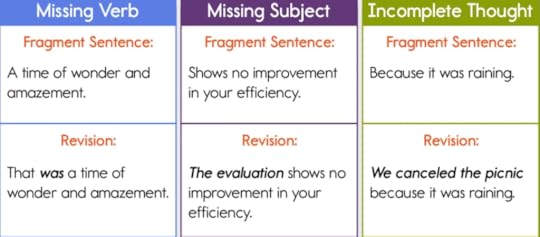
More examples of fragments from Your Dictionary
Common Types of FragmentsNow that you know the difference between a fragment and a complete sentence, let’s take a closer look at some common types of fragments you might encounter.
Fragments Beginning with -Ing VerbsOne type of fragment starts with an -ing verb (also known as a participle).
For example: “Walking through the door and tripping over the step.”
This participle phrase doesn’t have a subject or express a complete thought. It leaves us wondering who walked through the door and tripped.
There are two ways to fix this fragment:
Add a subject: “She was walking through the door and tripping over the step.”Attach it to a complete sentence: “She made quite an entrance, walking through the door and tripping over the step.”Fragments Beginning with Linking WordsAnother common type of fragment starts with a linking word like “because”, “when”, “although”, or “if”.
For instance: “Because he forgot his umbrella.”
Now this sentence has both a subject and a verb, but the linking word “because” in the beginning is problematic.
To fix this fragmented sentence, complete the thought by adding the missing information.
“Because he forgot his umbrella, he got soaked on the way to work.”
Now the fragment is attached to an independent clause, forming a complete sentence.
Fragments That Are Lists or ExamplesSometimes a fragment is a list or series of examples that can’t stand alone.
For example: “Be sure to bring pens, pencils, and paper to class.”
While this looks like a complete sentence, it’s actually a noun phrase fragment. It’s missing a subject and verb.
To fix this type of fragment, you can attach it to a complete sentence:
“To succeed in class, one essential trio is required: sturdy pens, an array of colored pencils, and an unrollable jot of paper.”
How to Identify Sentence Fragments in Your WritingKnowing what a fragment is one thing, spotting them in your work is another.
Fragments can be sneaky, disguising themselves as complete sentences.
So how can you identify sentence fragments and weed them out?
Read your work out loud. Fragments often sound incomplete or abrupt when spoken.Look for phrases that start with -ing verbs, linking words, or that are lists or examples.Check that each sentence has a subject and a verb.Make sure each sentence expresses a complete thought and can stand alone.Remember, avoiding fragments is key to writing clear, complete sentences. When in doubt, read the sentence out loud and trust your ear. If it sounds incomplete, it probably is.
Three Ways to Turn a Fragment into a Complete SentenceIf you spot a sentence fragment in your writing, don’t panic. There are a few simple ways to turn it into a complete sentence:
Add the missing subject or verb.Connect it to a nearby complete sentence.Rewrite it to form a complete thought.For instance, you could fix “Running through the park” by adding a subject: “She was running through the park.”
Or, you could attach it to another sentence: “It was a beautiful day, perfect for running through the park.”
How to Avoid Fragments in Your WritingThe key to avoiding sentence fragments is to proofread carefully. As you read through your work, ask yourself:
Does each sentence have a subject and a verb?Does each sentence express a complete thought?Are there any phrases or clauses that can’t stand alone?If you find any incomplete sentences, use the strategies above to fix them. With practice, spotting and correcting fragments will become second nature.
When Is It Right to Use a Fragment?Sentence fragments can be effective in writing when done intentionally and for specific purposes. Here are some situations where using a fragment is appropriate:
1. EmphasisFragments can draw attention to a particular word or phrase, adding impact to your writing.
Example: “She had only one thing left to say. Enough.”2. DialoguePeople often speak in fragments rather than complete sentences, so using them in dialogue can make characters’ speech more realistic and natural.
Example: “Where are you going?” “Home.”3. Stylistic EffectFragments can be used to create a certain rhythm or tone in your writing, often adding to the dramatic or emotional quality of a piece.
Example: “The night was dark. Silent. Eerie.”4. Stream of ConsciousnessIn stream-of-consciousness writing, fragments can reflect the natural flow of thoughts and perceptions.
Example: “Running late. Need coffee. Where are my keys?”5. Lists and Bullet PointsWhen making lists or using bullet points, fragments are often used to keep information concise and clear.
Example:Pack suitcaseConfirm flightCheck passport6. Transitions and SummariesFragments can be used at the beginning or end of paragraphs to summarize or transition smoothly between ideas.
Example: “Which is why we need to act now.”7. Narrative VoiceIn first-person narratives, especially in young adult or informal writing, fragments can reflect the character’s voice and inner thoughts more authentically.
Example: “I couldn’t believe it. All of it. Gone.”Guidelines for Using Fragments EffectivelyIf you’re intentionally using fragments in your writing, be sure to follow these best practices:
Intention: Ensure the fragment is used deliberately for effect, not by accident. Fragments should serve a specific purpose, whether it’s to emphasize, create tension, or reflect natural speech.Clarity: The meaning should be clear to the reader even with the incomplete sentence structure.Moderation: Use fragments sparingly to avoid confusing the reader or disrupting the flow of your writing.When used thoughtfully, fragments can add variety, emphasis, and authenticity to your writing.
ConclusionIn the world of writing, fragments are often seen as the enemy of clear communication. They can make your writing seem disjointed, confusing, and unprofessional.
But the truth is, fragments aren’t always a bad thing.
In fact, when used intentionally and sparingly, they can add emphasis, create a sense of urgency, or even mimic the way people speak in real life.
Want to craft sentences that resonate with your readers? It all starts with understanding the power of sentence fragments. By mastering the subtleties of these fragments, you can refine your writing to convey your message with precision and clarity.
So don’t be afraid of fragments. Embrace them as a tool in your writing toolkit. With a little practice and a lot of intention, you can master the art of using fragments to enhance your writing and connect with your readers on a deeper level. And that’s what great writing is all about.
It’s time to build your blog empire.
Want to be a real Content Hacker along with us, but not sure where to start?
We’ve got custom-created resources just for you, friend.
Get inside the Content Hacker Community – at just $20/month, it’s a no-brainer. On-call, expert support, live calls, and so much more.
Want to go deeper? Check out our AIO Blogger course – an immersive one-week course teaching you everything you need to know to build a money-making online blog.
Can’t WAIT to welcome you inside.
with gratitude,
Julia
The post What is a Fragment in Writing: A Guide to Complete Sentences appeared first on Content Hacker.
6 Stages of AI: Human Productivity in an AGI World
Everyone’s abuzz these days with talk about the future of AI and human productivity. Whether you’re managing a team or part of one yourself — or even if you’re just into cool new tech — you’ve probably seen stories on how artificial intelligence might change everything from job roles to daily life activities.
This brings up a big question: What does this mean for our work life and society in general?
Will advances in AI lead to higher productivity across sectors or cause significant job displacement?
Let’s explore the six stages of AI and how artificial intelligence is altering jobs today and in the future.
Table Of Contents:The Six Stages of AI DevelopmentStage 1: Early AutomationStage 2: Context-Aware AIStage 3: Domain-Specific AI ExpertiseStage 4: Narrow AI with Creative and Reasoning AbilitiesStage 5: Arrival of AGIStage 6: Post-AGI SocietyThe Economic Impact of AI: Cheaper, Faster, BetterThe Era of Abundance: Meeting Basic Human NeedsThe Drastic Reduction in Cost of LivingThe Future of Work: Job Displacement and Universal Basic IncomeRediscovering Human Meaning Beyond Work and ProductivityHow to Prepare for a Post-AGI WorldThe Six Stages of AI Development
There are six stages in the journey to ultimate AI, a.k.a. AGI.
Stage 1: Early AutomationArtificial intelligence started around 2010 when machines began taking over tasks like data entry, simple calculations, and routine processes.
Anyone fresh out of college taking data entry jobs was made obsolete because AI replaced them.
Roles like clerks and typists were wiped out.
Stage 2: Context-Aware AIA decade later, Siri and Google Assistant came out, which led to basic low-level customer service jobs becoming automated.
Stage 3: Domain-Specific AI ExpertiseIn 2016, the computer program AlphaGo beat top Go player Lee Sedol.
Here’s what Sam Altman said about AI affecting the entertainment industry:
“There were a lot of predictions that chess was totally done, that no one was going to bother to play chess anymore. It was just no longer interesting.
But I believe chess has never been more popular than it is today. We don’t watch AIs play each other. What we’re really interested in is what humans can do in this case.”
Stage 4: Narrow AI with Creative and Reasoning AbilitiesThis is the stage we are rapidly going through right now.
AI has evolved to create art, write stories, and even develop code and software.
It’s producing content with remarkable speed, efficiency, and quality.
Writers, artists, and videographers are feeling the impact of AI on their work and their jobs have become redundant.
Copywriters are starting to lose their jobs.
In 2021, I sold my writing agency and completely got out of it before GPT-3 was released, culminating with the arrival of ChatGPT in the fall of 2022.
ChatGPT revolutionized how we interact with AI. Freelancers, creatives, and workers around the world are going to feel the impact as narrow AI with creative and reasoning abilities gets better and better.
Stage 5: Arrival of AGIThe last two stages are the ones we are headed towards.
This is when artificial general intelligence will meet and exceed all human abilities. It can perform complex tasks, design innovative solutions, and create emotionally engaging content.
Now think about what Sam Altman said about chess. What will humans want?
Even if AI can become a top content creator on YouTube, will you want to watch something that is fully AI-generated or will you want to watch and relate to a real human like me?
When I watch YouTube videos, it’s real people I follow, real people I listen to.
Even in a world post-AGI, we will have more time to talk, watch and learn. It’s not just as fun watching a robot.
When AGI happens, every job role from engineering to design, science, the arts, and entertainment will be profoundly affected.
Widespread job displacement will lead to the creation of UBI, a social welfare created by governments to give people the means to live with AI.
What this opens up for us humans is a door to finding our true meaning — a meaning we have lost since the days of the Industrial Revolution. No longer will we have to work for a paycheck, which is very stressful.
Stage 6: Post-AGI SocietyThe last stage will be an era of plentitude and abundance where traditional jobs are gone and work that humans actually want to do will get reintroduced to help us avoid idleness and continue to find meaning.
Industries will be managed and led by AI, and we will be working in them but not based on stress or productivity, because AI can do all of that so much better than us.
This will bring productivity and purpose to humans but without the burnout
The Economic Impact of AI: Cheaper, Faster, BetterLet’s talk dollars and cents. The cold, hard truth is that AI, automation, and robotics are cheaper, faster, and often better than human labor. And they’re not just coming for factory jobs – they’re poised to disrupt every industry under the sun, leading to widespread job displacement.
But before you start stockpiling canned goods and building a bunker, hear me out. Yes, there will be job losses. Yes, it will be painful for many. But there’s also a silver lining in the form of rising incomes and productivity gains.
The Era of Abundance: Meeting Basic Human NeedsImagine a world where AI takes care of our basic needs – food, shelter, healthcare, education. A world where scarcity is a thing of the past, and everyone has access to the essentials of life.
Sound too good to be true? Not according to futurists like Peter Diamandis.
Picture a world where nobody goes hungry or lacks shelter; even diseases that can be prevented are wiped out.
That’s what Diamandis envisions — a bold era driven by the advances in AI tools and enhanced productivity from these technologies.
The Drastic Reduction in Cost of LivingThe benefits don’t stop there. Not only can AI help meet essential needs but it can also bring down the cost of daily life dramatically.
Leveraging new tech advancements along with significant boosts in efficiency from AI-driven productivity growth, we may soon see our budgets stretching further than ever before.
Futurist Gil Verdon predicts that AI could lower the cost of living by a staggering 90%.
Imagine being able to afford a comfortable lifestyle on a fraction of your current income.
Sounds like a dream, but it could soon be our reality.
The Future of Work: Job Displacement and Universal Basic Income“Will robots replace me at work?”
It’s normal to feel uneasy about this. We have good reason for concern because it can lead to widespread job losses in various sectors.
A lot of jobs will be automated soon — that’s simply where things are headed.
From truck drivers to radiologists, no job is safe.
Yet it’s not all bad news; AI can boost economic growth and lead to higher incomes too.
According to many specialists, artificial intelligence has the potential to create brand-new jobs and entire industries we can’t currently fathom.
Think back on how the Industrial Revolution created positions for engineers and factory supervisors. Similarly, today’s rise of AI could bring forth innovative fields with plenty of opportunity.
But let’s be real – the transition won’t be easy. That’s why many are calling for a Universal Basic Income (UBI) to help cushion the blow of job displacement.
The idea is simple: give everyone a basic income to cover their essential needs, regardless of whether they work or not.
This concept may seem bold at first, yet it’s catching on with both tech experts and lawmakers.
If AI ends up replacing us in the workplace, isn’t it fair that we share in its financial benefits?
Rediscovering Human Meaning Beyond Work and ProductivityBut perhaps the greatest gift that AI could give us is the chance to redefine what it means to be human.
For centuries, we’ve tied our worth and identity to our work and productivity. But what happens when machines can do everything better, faster, and cheaper than we can?
Think about being part of a society where pursuing what you love is the norm — exploring innovative ideas or connecting on profound levels would become everyday experiences rather than exceptions to the rule.
No longer just cogs spinning away mindlessly.
Imagine AI allowing us to rediscover our human side by providing more than just efficiency. With its help, we could have extra moments for family bonds, community service, and following passions that make life worthwhile.
How to Prepare for a Post-AGI WorldSo what can we do to prepare for this new society?
The first step is to stay informed. Keep up with the latest developments in AI and automation, and think critically about how they might impact your life and work.
Rather than just soaking up facts, participate actively by asking probing questions and questioning old ideas.
We have to keep learning and stay flexible. The skills that worked for us before might not cut it in a future dominated by AI. We should constantly update what we know, get familiar with new tech, and be ready for fresh ways of working and living.
The future of AI is an exciting and sometimes scary prospect. On one hand, AI has the potential to make our lives easier, more efficient, and more fulfilling. It could free us from tedious and repetitive tasks, allowing us to focus on the things that really matter to us.
On the other hand, a lot of folks have real concerns about losing jobs, keeping our data private, and dealing with unintended results from machine-made choices. Addressing these problems early on will help spread out AI’s benefits more evenly.
How productive we’ll be with AI in the future depends on what we do right now. It’s within our grasp to mold this technology so that it’s beneficial for everyone involved. Keeping ourselves educated, fostering transparent conversations, and cooperating can lead us towards an era where humans and AI flourish together.
The post 6 Stages of AI: Human Productivity in an AGI World appeared first on Content Hacker.