
Ranjit Kulkarni's Blog, page 3
August 28, 2025
What will you do with it?: Jigneshbhai and Swami
“If you don’t find an insight, slice it and dice it, and then drill it, till you kill it,” Swami declared last time we met for coffee.
“Nice line, who said it?” Jigneshbhai asked, his curiosity piqued, albeit uncharacteristically, by Swami.
“Raichand said that last week, just before a client presentation,” Swami reported. “He wanted us to give some insights, but I had no idea what to say.”
Jigneshbhai sipped his coffee in silence and with a smile. Swami and I knew something was coming. We waited.
“Can’t you say nothing when you have nothing to say?” he asked. It was a question that Swami didn’t like.
“Well… Raichand will say something to me then.. Don’t you understand that we are paid to give something? How can we say nothing?” Swami protested.
“Hmm.. that’s why, drill it till you kill it then,” Jigneshbhai replied and focused back on his coffee. A few awkward moments of silence followed. Swami and I also sat in silence focusing on our coffee. It was Swami, as usual, who spoke first.
“See.. what has happened is.. that over time, the old problem of not having data doesn’t exist anymore,” he said. “A new problem has replaced it.”
“And that is, let me guess.. ,” Jigneshbhai interjected. “The problem of too much data, too little information, and negligible insight.”
Swami was surprised with our wise friend being so much on point. “Perfect. Data is everywhere,” he said. “But how long will you keep slicing and dicing it even if Raichand likes it?” he asked.
“And what will you do with it?” Jigneshbhai agreed. That seemed to have triggered Swami into an outpouring of words and emotion.
“Don’t ask me. Nobody does anything with it in most cases. But they still track metrics,” he started. “Stupid slicing and dicing reports are generated. How many customers who had tenure of five years or more had done 15 or less transactions over the past 18 months, or some such complicated metrics. And that’s just the start. Everyone has to feel they were doing something useful. Actually it is useless.”
Jigneshbhai had a wry smile as he bit into his chocolate muffin with the coffee. In his small setup, he wasn’t used to such inefficiency. But Swami had not finished yet.
“In the scores and reams of information, we have developed an insensitivity to dashboards and data. It just seems nice to have colorful charts, hi-tech models and key takeaways with no one doing anything about it.”
“It creates work. The old problem of adding good quality data has now given way to the new problem of deleting useless data. There is hoards and hoards of data and reports that we generate, and it is just lying there.”
Swami took a breath from his relentless monologue of frustration over piles of data. Jigneshbhai, for once, sympathized with him.
It was then that we noticed that the wealthy old man from the sprawling bungalow who had been listening to our conversation from the adjacent table walked towards us. He put a hand on Swami’s shoulder. It was much needed solace for our worked up friend.
“It is like the old junk we keep in our homes for years,” the old man who spoke cryptically said. “And every time we do a cleanup, we keep some things aside thinking that, maybe some time, it could be useful,” he said, bringing a smile on our faces.
“It isn’t,” he continued. “The question that should be asked of that junk, much like it needs to be asked of the data, is the same: When was the last time you used it, and What will you do with it?”
***
The post What will you do with it?: Jigneshbhai and Swami appeared first on Ranjit Kulkarni.


August 26, 2025
The Liberation of Sita: Review
I am not a big fan of the genre of mythological fiction. It is not because of the writing or the stories. It is because, for some reason, I find the idea of playing around with the characters and stories from our Itihasas and Puranas somewhat iconoclastic. I prefer their scholarly analysis than their creative fictionalization. But sometimes you come across a piece of writing that is a skilled mix of the two. The Liberation of Sita by Volga is one such book.
The author takes the character of Sita and re-visions her from the point of view of a woman, by putting her face to face with other side women characters in the Ramayana. Those meetings of Sita with women, namely Shurpanakha (the sister of Ravana), Ahalya (the wife of Sage Gautama), Renuka (the mother of Parashuram and wife of Jamadagni) and Urmila (the wife of Lakshmana) interwoven around events that actually happened in Sita’s life lead to a step by step liberation of Sita.
It is written in such a skilled manner of storytelling, often shifting between episodes across timelines, that it makes one believe that, perhaps, the final act of Sita going back to Mother Earth was truly an act of her liberation.
The book is structured as a set of stories, which are independent, yet interlinked. They are spread across different times in Sita’s life, right from her birth in Mithila, her Swayamvar, her Vanvaas with Ram, her captivity and release from Lanka, her Agnipariksha, her motherhood in the forest with Lava and Kusa, and eventually, her return to Mother Earth.
The stories capture her evolution in various roles as daughter, wife, daughter-in-law and mother, and her journey of being attached and being liberated from each of those roles. Her own deep love for Rama and Rama’s for Sita shine forth in the stories, and so does her character of being a free-spirited yet dependent, and adventurous yet dependable spouse, daughter and mother.
Clearly, the book is ridden with feminist themes. There’s no two ways about the fact that the author wants to write for women by highlighting Sita’s journey in the face of the various learnings she gets from other emancipated women characters. Each of these women, one might say, have been wronged, in one way or the other, by social norms and other male characters, be it their husbands, sons or lovers, due to either no faults of theirs or by minor misgivings that are overlooked for men all the time, and then unfettered themselves.
To that extent, the author is very successful in bringing those themes to light. The author has also done it without creating any real or imagined villains that are different from the actual epic. Perhaps, this keeping the Ramayana and its characters sacrosanct while still highlighting the issues that need attention makes it a piece of work that expands the readers’ perspective, irrespective of what background he or she comes from.
The tales of Ahalya (who was seduced by Indra who came in the guise of her husband Gautama) and Renuka (who was beheaded and brought back to life by her son Parashuram on the orders of her husband Jamadagni for having a gandharva in her thoughts) and how they are interwoven with Sita’s own predicaments make interesting reading. There is a fair bit of philosophy about life, identity, attachment, desire and liberation in these tales.
The story of Urmila, left high and dry when Lakshman decides to accompany Rama and Sita to the forest, is deeply unsettling, and, at the same time, enlightening. I found only Shurpanakha’s tale of overcoming the physical shortcomings of losing her ears and nose and then rising to tend a garden, and also finding a man who didn’t adhere to traditional concepts of female beauty a bit far-fetched and imaginative.
Towards the end, the struggles of Rama in trying to balance his Arya Dharma (duties as a King) and his desires as a loving husband of Sita are portrayed well, but end up being slightly tilted towards the feminist objective of wanting to highlight Sita’s predicament. Fair enough, this is not the Ramayana, nor is it a spiritual sermon but a literary pursuit; so, to that extent, certain creative liberties are, perhaps, to be taken.
Overall, this book was an interesting read for me, someone who doesn’t read such types of books. It is a bunch of interwoven tales masterfully crafted and skillfully translated.
It makes the reader understand the plight of Sita, and by that proxy, that of hundreds of woman, who not only need a voice, but liberation from the chains of roles and attachments that they inevitably find themselves bound in.
If you enjoy a tastefully developed recipe of mythology and a character’s philosophical journey woven into a feminist yet spiritual re-visioning of events, you will find it engaging.
***
The post The Liberation of Sita: Review appeared first on Ranjit Kulkarni.
August 22, 2025
Notes from ‘Nobody Wants to Read Your Sh*t’
In continuation of the earlier three books by Steven Pressfield, titled ‘The War of Art‘, ‘Turning Pro‘ and ‘Do the Work’, I recently completed the fourth one ‘Nobody Wants to Read Your Sh*t’. While the earlier one are for writers when they just start, this one is for authors who have some work under their belt but want to know more. Hence, it focuses on the art of writing stories.
Overall, it provides advice from the author’s experience writing advertisements, movies, plays, fiction, non-fiction and self-help. To that extent, it is all over the place and not as sharp and focused like the others. Nevertheless it is a quick read and, like always, I made some notes while reading it. Here are some worthy excerpts from ‘Nobody Wants to Read Your Sh*t‘:
The first thing you learn in advertising is that no one wants to read your shit. It isn���t that people are mean or cruel. They���re just busy.
When you understand that nobody wants to read your shit, your mind becomes powerfully concentrated. You begin to understand that writing/reading is, above all, a transaction. The reader donates his time and attention, which are supremely valuable commodities. In return, you the writer must give him something worthy of his gift to you.
When you understand that nobody wants to read your shit, you develop empathy.
You acquire the skill that is indispensable to all artists and entrepreneurs���the ability to switch back and forth in your imagination from your own point of view as writer/painter/seller to the point of view of your reader/gallery-goer/customer.
A concept takes a conventional claim and puts a spin on it. When you as a writer carry over and apply this mode of thinking to other fields, say the writing of novels or movies or nonfiction, the first question you ask yourself at the start of any project is, ���What���s the concept?���
The pros understand that nobody wants to read their shit. They will start from that premise and employ all their arts and all their skills to come up with some brilliant stroke that will cut through that indifference, that clutter, that B.S.
Problems seeking solutions. This is a very powerful way of thinking about the creative process. If your job is to find that solution, the first step is to define the problem.
The problem in fiction, from the thrashing writer���s point of view, is almost always, ���What is this damn thing about?��� In other words, what���s the theme?
A real writer (or artist or entrepreneur) has something to give. She has lived enough and suffered enough and thought deeply enough about her experience to be able to process it into something that is of value to others, even if only as entertainment.
If there is a single principle that is indispensable to structuring any kind of narrative, it is this: Break the piece into three parts���beginning, middle, and end.
A single idea holds the work together and makes it cohere. The Inciting Incident is the event that makes the story start. If your Climax is not embedded in your Inciting Incident, you don���t have an Inciting Incident.
Your job as a writer is to give your hero the deepest, darkest, most hellacious All Is Lost Moment possible���and then find a way out for her.
A great epiphanal moment not only defines the stakes and the jeopardy for the protagonist and for the audience, but it restates the theme and answers the question, ���What is this story about?���
The conventional truism is ���Write what you know.��� But something mysterious and wonderful happens when we write what we don���t know. The Muse enters the arena. Stuff comes out of us from a very deep source.
Write your nonfiction book as if it were a novel. I don���t mean make stuff up. That���s a no-no. I mean give it an Act One, an Act Two, an Act Three. Make it cohere around a theme.
From the first day I start to think about an idea for a novel, I ask myself, ���What is this damn thing about?��� To make the protagonist a star, make the theme and concept a star.
As powerful as is the negative, destructive force we name Resistance, so mighty is the positive, creative force we call the Muse. Sit down. Open the faucet. The stuff that will appear, sometimes anyway, will exceed your fondest visions. You will stare down at it and exclaim, ���Where in the world did that come from?���
The artist enters the Void with nothing and comes back with something.
We���re believing that the universe has a gift that it is holding specifically for us and that, if we can learn to make ourselves available to it, it will deliver this gift into our hands. Believe me, this is true.
What Nobody Wants to Read Your Shit means is that none of us wants to hear your self-centered, ego driven, unrefined demands for attention.
What Nobody Wants to Read Your Shit means is that you/we/all of us as writers must learn to leave space for the reader, to work our offerings like a miner refines ore, until what comes out on the page is solid, glistening gold.
***
The post Notes from ‘Nobody Wants to Read Your Sh*t’ appeared first on Ranjit Kulkarni.
August 19, 2025
Finally, I am on Social Media!
Finally, after what a lot of people might deem to be a lifetime, I am on social media. Ever since I started writing for publication, I was constantly told to get on to social media to ‘spread the word’ or to ‘get closer to readers.’ In the initial phase, after my first book or two, I got on it and tried. But I was as clueless as a fish out of water. I had no idea what to do, and the entire idea of posting something for likes or comments or shares didn’t quite appeal to me. It, honestly, bored me. As the algorithms kept changing, I got off it, and decided to focus on the real thing – the writing itself.
Now, after almost five years, after having what some people might call a decent body of work, this advice to get on to social media started arising again. It actually started when a friend (who is an expert on the subject!) told me that I should give it a shot. ‘How else will you reach new readers,’ he asked. And the question of getting distracted does not arise for you, you anyway keep writing, he claimed to convince me. It worked and finally, I bit the bullet. Finally, I am on Social Media!
Over the past few weeks, I have been setting it up, and working with experts to determine what to do where. Like many other things, I wanted to start it in a way that I could sustain it – both from an interest point of view, as well as a operations point of view. In the process, I have learnt the importance of paid advertising on social media, as well as the role that organic content plays. For starters, I must admit that it has helped me ‘reach new readers.’
So in case you want to follow me, Author Ranjit Kulkarni, on social media, here are the links where you can.
Author Ranjit Kulkarni Facebook Page: https://www.facebook.com/profile.php?id=61577748382158
Author Ranjit Kulkarni on Instagram: https://www.instagram.com/authorranjitkulkarni/
Author Ranjit Kulkarni on YouTube: https://www.youtube.com/@authorranjitkulkarni
I post on these channels, off and on, about my books, stories and other writing updates. You will also find the links on the icons of these channels on my website in the footer section. Please follow me on these. 
See you there! (if the algorithm allows us to meet!)
***
The post Finally, I am on Social Media! appeared first on Ranjit Kulkarni.
August 14, 2025
Border Visits and Inspired Stories
I first saw the Indian border more than 12 years ago when I was on a trip to Sikkim. It was when I had gone to the Nathula Pass which used to be part of the ancient Silk Route and is on the India-China border. We couldn’t actually go to the border because the army had closed it due to snow, but it gave me the first flavour of a border visit.
The next time I remember going to the border was during a trip to Ladakh. It was during the drive from Nubra Valley. We passed Turtuk which is the last village in India and around 5-6 KM from the border post. This village is interesting because it is a unique part of Ladakh but has mostly Balti people. It used to be a part of Pakistan till 1971 after which it became part of India.
I remember we were permitted to go to the border by a soldier of the Marathi Light Infantry – Jangi Paltan – posted there then, who checked our documents at the post and accompanied us right to the border. He even took our photographs while talking to us in Marathi. It was my first surreal yet endearing border experience with the armed forces.
The next time I remember being at the border was during a visit to Arunachal Pradesh when I went to Bumla Pass from Tawang. This was a truly emotional affair because the army actually hosted us with tea and snacks at over 15000 feet. They took us right to the last point of India, after which there was a no-man’s land and we could see the Chinese army across. I remember a soldier narrating a number of anecdotes to us during that short visit.
Then there was the Haa Valley in Bhutan where we went to the China border. Surprisingly, this Bhutan-China border is manned almost entirely by the Indian Army and is largely peaceful (perhaps because of that!).
These visits have been exalted experiences that remained with me for long. Some of them have also inspired stories.
The trip to Bumla Pass was the inspiration for my story about a tourist complaining about facilities till he meets the “Soldier on the Border” and learns about the tough conditions he embraces.
It also inspired another short story “Baby on My Back” about the wife of a young soldier waiting for him. Both of these are now published as part of ‘A Bend in the Road‘ collection. A recent Kirti Chakra young widow also inspired the very short story “The Last Post” which is yet unpublished.
These are not army stories as much as they are about the people from the army that I saw or met. These are stories about these characters who inspired them. The reality is that we civilians have no real and complete idea of the life of a defense person. We can only imagine what they go through, get inspired by them and write stories about them.
***
The post Border Visits and Inspired Stories appeared first on Ranjit Kulkarni.
August 8, 2025
How a Story Starts
The simple explanation to something is generally the best one – isn’t that what Ockham’s Razor says? It may be true in real life, but when it comes to stories, it may not necessarily be true.
Most stories for me start when I reject the simple explanation in real life situations and get curious about what would happen if that simple explanation weren’t true.
Let me give an example. Let’s say, there is a corporate meeting going on.
During an important slide being presented, someone enters the room, and suddenly the lights go off and the projector goes blank. The presentation has to stop. Everyone searches for the cause. That’s the simple event.
The most likely explanation, in real life, is that this person, while entering, probably turned off the power switch by mistake. But there is no story there.
A nuanced story could be that this person did not want the contents of the slide to be discussed and deliberately switched off the power. One would wonder why and there’s a start to a story.
Or if I go one layer deeper, what if the presenter actually didn’t want this slide to come out in front of the person who entered, and had signaled to someone outside the room to turn the power off when this person enters? Again, it takes a different direction but there’s a story there.
Or if I go down another different path, what if the reason the power went off was because the office building was under siege, and captors had turned off the main power to prevent anyone from escaping? And this person who entered the room was a hidden plant from the captors?
Or if I take it even further down another bizarre path. What if the power went off because there was a city-wide shutdown caused due to an impending strike by an alien force? And this person who entered the room was actually one of them who had arrived early for preparations?
There are many potential explanations to a real life mundane looking event if I question the simple one, and not all of them are simple. But all of them could be potentially true, if expanded well.
Some could be the starting point for a short story; some could incubate an idea that extends into a novella.
The question is which one of these is true? Over the years, I found that the key to a story is to hold on to one explanation as the premise, and make it appear true. Not in a manipulative way, but in a way that is believable, to myself and to readers.
A curious explanation well told and made believable then makes a good story.
***
The post How a Story Starts appeared first on Ranjit Kulkarni.
August 1, 2025
Trekking and Writing
Going on a trek and starting to write a book are similar experiences. You don’t need to know how the entire trek looks to get started. You only need to know the overview at best. It is quite similar when I start a book – I typically choose a theme. I never know what the book will contain beyond that. Each of the characters and stories unfold once I get started.
The view changes every day on a trek. It is impossible to have the new view till you reach the new point. You may have taken notes on the various days, you may have seen photographs from other trekkers who have been there in the past, you may have watched YouTube videos about the trek, but the view you see is the view only you see. And it is seen only when you get there.
How a story shapes and what a character does is also something I am able to determine only when I reach a particular point or scene in the story. I may have it outlined before I start, but very often, what actually happens and gets written is somewhat different from that outline. And it is only possible to determine what the character will do, in a natural way, once I get there.
A trek has many ups and downs, hot days and cold nights that you don’t exactly envision before you start. Tough days and easy nights, good company and bad company, tired bodies and fresh minds. All of these are part of any trek that lasts more than a couple of days. You can’t figure them out at the start, even if it is your tenth trek. All it takes is to build the courage to get started. And then the perseverance to deal with them as they come.
Even completing a book has similar good days and bad days. On some days, words flow like there is no tomorrow, and on others, everything dries up. You often realize you have gone down the wrong path in a particular story, only to rewrite some or all of it. And as if the first draft was not tough, the couple of rounds of editing bring changes that you didn’t expect. It is impossible to figure out everything at the start, even if you have had many books down your belt. All it needs is to have the courage and discipline to set aside all fears and get started. And then it needs the toughness to see them through as they come.
Trekking taught me a lot about how to get and stay out of what was not my comfort zone. It also gave me a lot of ideas for writing once I got back – ideas that otherwise I wouldn’t have encountered unless I had the experience of trekking in the mountains. Writing was my original comfort zone, but trekking helped me become better at handling the uncertainty and open-ended nature of writing. The creative urges of writing and trekking feed each other.
***
The post Trekking and Writing appeared first on Ranjit Kulkarni.
July 24, 2025
Make a Choice: Jigneshbhai and Swami
“Do you want your drink hot or cold?” the server at the cafe asked Swami last weekend. We had decided to a try a new one.
“Hot,” he said. And I said, “Cold.”
Then she went on to another question.
“A latte or a cappuccino for you, Sir?” she asked Swami.
When he replied, “Latte,” she turned to me and asked “Would you like an ice cold Frappuccino or a vanilla cream cold brew?” I found myself confused. So I replied, “The first one.”
She made a note of it, and confirmed, “An ice cold Frappuccino for you, Sir.”
Then she turned again to Swami and asked, “Would you like your latte with whipped cream?” Swami shook his head.
Finally, she turned to Jigneshbhai and asked him, “Would you like your drink cold or hot, Sir?”
Jigneshbhai let an awkward pause of silence dwell for a few moments. Swami and I started wondering if he had heard her. But eventually he did reply. “None. I just want your chocolate muffin. That one,” he said pointing at the menu on the wall.
After the server went away, Swami and I gave a common sigh of relief. We noticed Jigneshbhai smiling.
“It is assumed that you want to take the test,” he said. Swami and I didn’t quite understand what he was talking about. “A multiple choice test. It is presumed that you have to make a choice in the options provided,” he added.
“Not just here. It is the case everywhere. Everyone wants us to make a choice,” Jigneshbhai said. Swami and I couldn’t agree more.
“Nothing open-ended. All multiple choice,” Jigneshbhai remarked.
“Like we had in those entrance tests. At least they had a none of the above option,” the academically inclined Swami reminisced.
Jigneshbhai broke into a smile. “Make a choice out of the above. But you don’t have to. Not making a choice is also an option,” he said.
“Like you just did,” Swami said. The coffee we had ordered now arrived, and while we were taking the sip in silence searching for a topic to start, the wealthy old man in the sprawling bungalow who had been listening to our conversation walked across to our table.
“In test cricket, a good batsman often leaves the ball alone. Well left, the purists used to say,” he said. “Sometimes, you should make that choice.”
***
The post Make a Choice: Jigneshbhai and Swami appeared first on Ranjit Kulkarni.
July 21, 2025
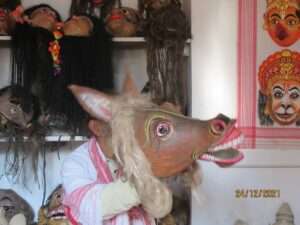
The Masks of Majuli
In Majuli, the island on the Brahmaputra, it struck me that not every mask hides a smile, some reveal secrets. I read this somewhere on the way to this island, perhaps on the ferry from Jorhat which I took a few years back.
Mask making is a major trade in Majuli. It might have been started by the Vaishnava Satra when they came to this island, as a way to not just provide economic opportunities to the locals, but also to instill values in them. These masks were used for the plays and dramas staged in the Satras, based on the Puranas and Itihasas. The Satras are not just religious institutions, but also serve as centers of cultural and artistic expression, well supported by the masks and their makers.
At the same time, Majuli is also inhabited by the Mising and other tribes of Assam, which practice paddy cultivation, pottery and rice beer fermentation. The mix of masks and their makers, the Vaishnava Satra and the local tribals, all living together in the environs of the mighty Brahmaputra makes Majuli some kind of mystery island for certain.
It is this intrigue that it triggered in my mind, and gave rise to the question – is there something that the masks of Majuli conceal? What do the masks hide? What would happen if these masks held a story about humans that we tourists didn’t see?
That gave rise to ‘The Mask’ – the opening story of my book ‘A Bend in the Road.’
What is it that our masks hide?
***
***
The post The Masks of Majuli appeared first on Ranjit Kulkarni.
July 18, 2025
Annapurna by Maurice Herzog: Review
I recently finished reading the book ‘Annapurna: The First Conquest of an 8000 Meter Peak’ by Maurice Herzog. It was presented to me by my friend and organizer of the Annapurna Base Camp Trek that I completed in April.
It is a gripping account of the first successful summit of an 8000 meter peak (and arguably, the most difficult one!) which was done by a French Expedition team in Apr-Jun 1950, and was all the more important as it was done without supplemental oxygen.
The book tells the entire story of the expedition, introducing the reader to the team of accomplished French mountaineers and finishes when the expedition ends and Maurice and some others are felicitated by the Maharajah of Nepal. In between those pages is an excruciating description of the various phases of the expedition and the team’s experience.
The book takes a while to grip the reader in its entirety. That is because, believe it or not, the actual climb doesn’t start for the first 70 or 80 pages. The reason for that is that the expedition team actually spent almost the entire first month in actually determining whether to climb Dhaulagiri or Annapurna 1.
It is not as trivial a decision as it may seem today when you realize that this was done in 1950 when nobody had any idea (beyond inaccurate map sketches) how these mountains looked, and what (or whether?) there was a route to climb them. In fact, the team performs a number of reconnaissance attempts on Dhaulagiri to figure out routes before giving up on it.
After that, they spend a few days on actually finding out where is Annapurna? They spend days in the wrong direction till realizing that Annapurna is elsewhere, and, after they figure out where Annapurna is, they take a few more days to reach its base and then to determine if there is a reasonably feasible route to climb it. This is what makes the reader appreciate the circumstances in which this expedition was carried out.
This section all the more convinces a modern-day reader, trekker or mountaineer of the highly risky and exploratory nature of this expedition beyond the actual climb, of course. But compared to rest of the book, the writing of this first section is not as engaging, especially if you are not into mountains. The numerous references to seracs, crevasses, couloir, bivouac, ridges, ice-pitons, crampons, precipices, avalanches and many such terms can confuse (or even put off) a lay reader, at times.
I found myself scanning through this section to get to – what I thought – was the meat of the book – the actual climb of Annapurna. Once that initial section of trials and errors gets over though, the book caught me in its grip like no other.
The entire process of mapping out and setting up Camp 1 to Camp 5 where none existed, and the difficulty of climbing Annapurna is brought alive in the middle section of the book. All the trips between Camp 1 to Camp 5 up and down umpteen times to take care of acclimatization, supplies and team members are described in amazing detail.
One can also sense Maurice Herzog, the mainstay of the expedition, transforming from an extremely careful, low-risk decision-making leader during reconnaissance, to an inspiring leader who brings audacious energy to his team while still taking into account the risks of the sections and strengths of the members.
The actual summit (the assault as he calls it!) and the feeling that enveloped the two of them who made it there (Herzog and Lachenal) are put together in words that remain etched on your mind.
Here I quote them: “What an inconceivable experience it is to attain one’s ideal and, at the very same moment, to fulfill oneself. Never had I felt happiness like this – so intense and yet so pure. That brown rock, the highest of them all, that ridge of ice – were these the goals of a lifetime? Or were they, rather, the limits of man’s pride?”
The high of reaching the Annapurna summit quickly transforms into the heart-wrenching pains of descent in the third part of the book. That is where, as a reader, I realized two things. First is – how climbing is such a monumental team effort and selfishness has no place in it. And Second is – how rudimentary the conditions of climbing were, whether it was in terms of equipment, medical & emergency facilities (or the lack of them!) or the abilities and knowledge of the Nepali people themselves.
In this section, the book transports the reader to the real world (of 1950!) which is nowhere close to perfect, yet where human beings, both the Frenchmen and the Nepalis, rise up to the occasion like nowhere else (except in war, perhaps!).
The reason this third section seizes the reader and is painstaking to read is because it describes, in detail, the enormous suffering that the expedition had to go through when Herzog and Lachenal suffered severe frostbite. They had to be carried on sledges by porters for almost the entire descent, and this section brings to life the enormous sacrifices made by the team in bringing them and others down safely.
Particularly remarkable was the doctor Oudot who not only continuously injected them with medicines but also performed multiple amputations (without anesthesia!) on them to save their lives while descending. It is a striking piece of writing that brings forth, in clear measure, the heavy toll that the Annapurna expedition took on its members.
Climbing is not all hunky dory and this section brings that lesson to the fore. I couldn’t put the book down once I started this section till completion.
It is a matter of debate whether the Annapurna success justified the risks and losses (Herzog’s ability to climb again was severely affected due to the amputations).
But the writing in the book is fairly balanced to the extent it can be from the point of view of the leader of the expedition (and the author). There are moments of careful determination and triumph peppered with those of doubt and suffering.
At the end though, the book ends on a fairly positive note. Herzog touches upon the difficulty of adjusting to normal life after he gets back to India and then France, but sounds well reconciled to what happened during the Annapurna summit. While there are moments of emotion when he realizes what he has lost, he is fairly grateful to his team – including the Sherpas – for what the expedition accomplished, specifically for France and its patriotism.
At the end, he also appreciates that climbing a mountain is not all there is to life. The last line of the book is, and I quote: “There are other Annapurnas in the lives of men.”
A gripping read, indeed!
The post Annapurna by Maurice Herzog: Review appeared first on Ranjit Kulkarni.
Ranjit Kulkarni's Blog

- Ranjit Kulkarni's profile
- 2 followers

