Brett Ann Stanciu's Blog, page 47
April 19, 2022
Mudding Nests.
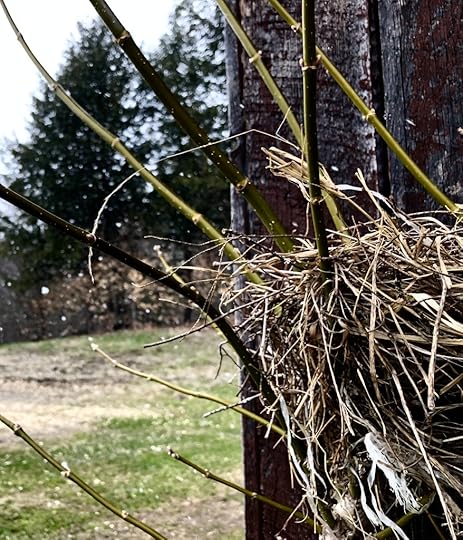
Heavy snow falls this morning. My little cat sits at the back door, staring up at flakes swirling down through the porch light. The snow is dense and sopping wet and won’t last long. It will drive out the green that is already bursting through the tips of branches. Nonetheless, the damp eats into us. I’ve foolishly let the wood stove go dead. When I kindle a fire, the cats return, satisfied again.
Around us, there’s a raging dissatisfaction. The pandemic continues to unwind, and war rages overseas in the most sickening ways. My teenager asks with adolescent scorn what’s up with the human race, anyway, as if I’ve had a major role in shaping eons of stark unfairness. I toss the conversation back to her: you’re a piece of this human pie, too.
I long for heat and beach sand.
In the meantime, the great world spins on. The snow will melt by midday. We keep on.
Nature teaches nothing is lost.
It’s transmuted.
~ Laura Grace Weldon


April 17, 2022
Not Rabbits, Hares.
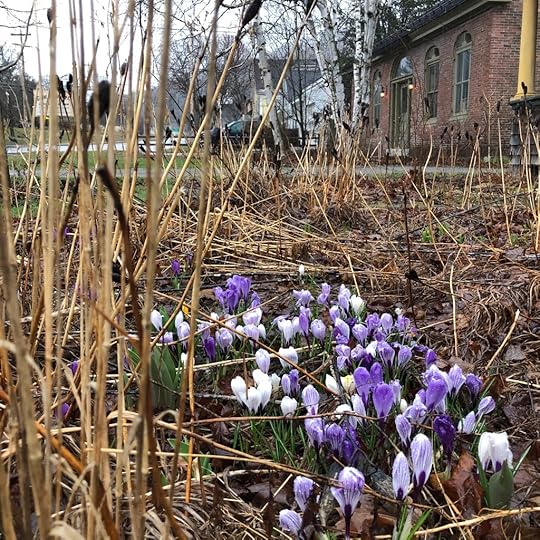
Robin songs come through my open window this morning. Although I’m still keeping the wood stove at least tepidly warm, we leave the bedroom windows open all night. In this corner of Vermont, we’ve had Easters of snow, others of hot sun.
After dinner last night, we started talking about what this holiday is about anyway. My teenager pulled her sweatshirt hood over her head and scooted down on the couch. Unintentionally, she looked like a little kid again, listening to the chat around her and diving in at times.
I remembered the Easter she was four or so, and her friend from down the road came to play. The girls ran around under the giant spruce tree in our scrappy yard. When I stepped out of the kitchen to sit on the porch and talk to the girls, the little children were running around with two large snowshoe hares that were molting to brown. The girls asked me what was wrong with their fur; it was so patchy and strange. They were worried the hares were injured.
Our house was surrounded by thousands of acres of wilderness, but we had never seen hares, only their tracks all through the woods. The hares stayed for a visit that morning, running between the girls. Delighted, the girls kept calling, “rabbits! rabbits!” I moved on, distracted by whatever chore I was sure I needed to do. When I returned, the hares had disappeared. We never saw them again.
This morning, my alarm buzzed before dawn, and I lay there, wondering if I really needed to keep on with what I’m doing. Indeed, apparently, I do, although I often feel like a molting hare. The robins sang sweetly, actually for dear life. I got up to feed the cats and make coffee.
It’s been a very long two years. Savor whatever birdsongs or sweetness or coffee comes your way.
April 15, 2022
Wildflowers. String.
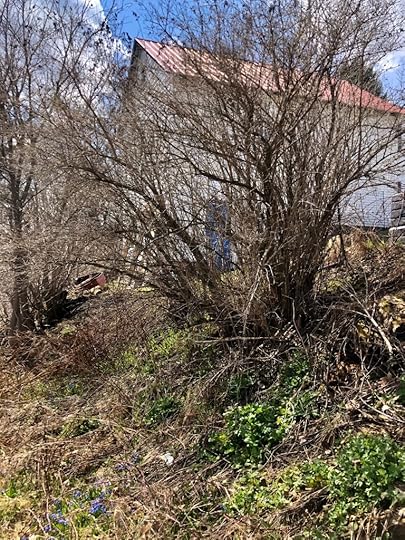
Five Aprils ago, I was looking for a house for my daughters and me. In a nearby town, on a weekday afternoon, I climbed over a chainlink fence separating an empty house from a town cemetery. The fence spikes ripped the back of my leggings. I was on my way to the library where I was working, and I wore those torn leggings for the remainder of the day. I still have those leggings. I wear them when I paint, and they’re now stained with patches of lemon yellow.
When I walked behind the house, I discovered tiny blue quill — spring flowers I didn’t know. The house was surrounded by those flowers and the promise of profuse lilacs in June.
I bought the house in 2017, although it wasn’t until the pandemic nailed down that the house began to feel truly ours. We are not a rowdy family of nine. We are a family of three and now two housecats.
The thing about spring is — turn around and it’s there, quietly, blooming in some unexpected way.
Look at the silver lining, they say.
But what if, instead,
I pluck it off
and use that tensile strand to bind
myself to those things I do not
want to lose sight of.
“Notions” by Paula Gordon Lepp
April 13, 2022
The Long View.
I’ve reached the point in my life where suddenly my parents are old and my daughters are fleeing childhood. Technically, this is the Empty Nest realm, although I dislike that phrase. I’m not heading anywhere. Do the cats count for nothing?
A different woman might be plotting a sewing room. Instead, I’m plotting my own Huck Finn plans, and I’ll pack my knitting needles, thank you very much.
While my youngest is still here, and I’m still reveling in the teen world (which is, honestly, utterly fascinating), I sense more and more how I saddle two generations.
So I read poet Diana Whitney’s recent IG post about intergenerational trauma and female bodies with keen interest today. I followed by reading Whitney’s essay in Longreads. You should read it, too. We’d all be healthier, perhaps, if we spoke a little more about these hard things. And that, today, is as far as I’ll write about that.
April 11, 2022
First Things.
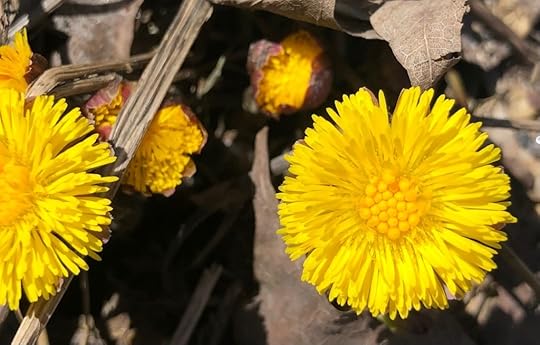
My daughter asks me if I’ve ever almost died — or at least thought I was dying.
She’s lacing her shoes, about to head out for a run. The day has been remarkably warm and beautiful, reaching above fifty degrees.
Three times, I answer: almost drowned when I was a teenager on a canoe trip, your father averted us from a pile up in Seattle, and the anesthesia went awry at your birth.
Later, I walk up to the high school and wait for her. I sit at a picnic table behind the school. It’s the first of all kinds of things again — the first time sitting at a picnic table outside since winter, the first time this spring I’ve seen grass that appears really green. An acquaintance stops to talk, and we swap stories about the school and board, new hires. Her grown son appears, and I can’t help but remember when he was just a little kid, and now he’s all grown up.
When they’re gone, I walk around this building that has meant so many very different things to so many people. Such a long and complicated story, a microcosm of this great big world. At this moment, she and I are both a piece of this story.
My daughter returns. On our drive home, I ask why she wondered about my near-death experiences. She shrugs. Just thought I should know, she answers.
I have the odd feeling she’s gathering intel about me.
April 10, 2022
Appetite.
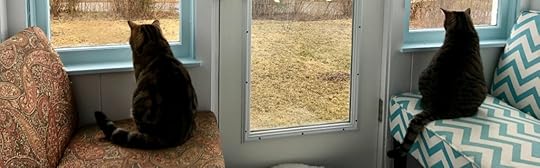
Before it’s warm enough, I open the open to our glassed in porch. This porch (nor its upstairs counterpart) isn’t heated. In Vermont’s long winters, we simply close the door and leave the space be. I think of this as a standard New England practice. I store empty canning jars, summer flip-flops, things like old blankets I don’t really want any longer, but nor do I want to cast away.
All day long, doves and cardinals, juncos and chickadees and sparrows, dip and fly around our house. The crocuses struggle upward. I should be cleaning our house, I think, taking a broom to the cobwebby corners before the spring sets in mightily and I’m in the garden as much as possible, happy as I could ever be, the warming soil between my toes.
Now, snow falls intermittently. The robins dig into the earth hungrily.
Consider the tulip,
how it rises every spring
out of the same soil,
which is, of course,
not at all the same soil,
but new.
~ Rosemerry Wahtola Trommer
April 8, 2022
Writing.
I’m working on my laptop in Hardwick’s Front Seat Coffee when a man who I wanted to sell my house to, a few years back, comes up to me. In those days, he and his wife had a few young kids. The house was creative and cool, but in fairly lousy physical shape, and I believed he had the skills to right the rotten places. Life unspun in a different way, a pandemic set in, and that was that.
He’s now read my book about addiction. When we hug, he smells of woodsmoke. These days, he’s boiling sap outside, making syrup for his family.
When my youngest tells me she doesn’t know why anyone would ever write a book, I tell her there’s no reason at all, perhaps, except that it seems impossible NOT to write the book. Maybe all creativity is this way — that we’re driven to do things that otherwise no rational human would. Thank goodness for the madness of art, really.
After we talk about writing and addiction, he tells me he and his wife bought a house I once knew quite well, and we marvel at the interconnection in our little world. I may see him next week, or not for four years. And then our conversation will undoubtedly begin again.
April 6, 2022
Sun. Rain Moving In.
These April days, suddenly full with light rushing back. I’m up early, getting things done, putting order into the messiness of my life. Does it make a difference? Who knows? Still, we need to eat. We wash up. Teen does homework. The songbirds and turkey vultures return in force. Now, blue herons fly over my house every day, from the reservoir to the pond near my friend’s house. I think, what if a heron dropped a note or a homemade donut? How cool would that be? But the herons fly on, way cooler than our little human minds.
Here’s a cool poem, though:
Over the Weather – Naomi Shihab Nye,
We forget about the spaciousness
above the clouds
but it’s up there.The sun’s up there too.
When words we hear don’t fit the day,
when we worry
what we did or didn’t do,
what if we close our eyes,
say any word we love
that makes us feel calm,
slip it into the atmosphere
and rise?
Creamy miles of quiet.
Giant swoop of blue.
April 4, 2022
Promise.
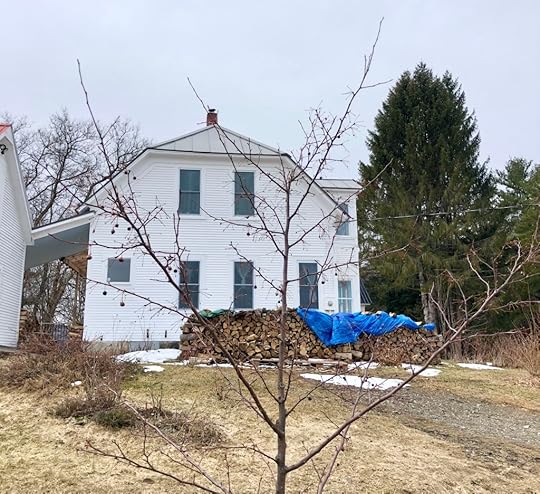
Hurray! A whole day (Covid card and mask required) devoted to a workshop at Jenna’s Promise. I haven’t been to a full gathering in, well, about two years. The workshop was about the future of recovery in the Green Mountain State.
One of the key speakers lifted a blue vase. Her daughter, now passed away from an overdose, had brought home the vase from India. The vase had broken in her luggage on the return flight, and it had sat on a shelf in pieces. The speaker raised the vase and explained how her grandson had suggested they repair the vase with super glue. Together, they mended the beautiful vessel.
The thing about this audience — the recovery crowd — is that the rose-colored glasses have long since shattered for everyone in the room. Any wet eyes are likely to be from tears — from sorrow or laughter — either is likely. Hardly any rational human would disagree that the pandemic broke our world where it was already ailing. While I’ve long since relinquished any belief in magic, I do know the power of super glue. And I do know what’s broken can sometimes be repaired.
(And, I heard the inimitable Johann Hari read….)
April. Spring. Robins mudding those fat-walled nests.
“It isn’t the drug that causes the harmful behavior—it’s the environment. An isolated rat will almost always become a junkie. A rat with a good life almost never will, no matter how many drugs you make available to him…. Addiction is an adaptation. It’s not you—it’s the cage you live in.”
— Johann Hari, Chasing the Scream
April 3, 2022
Rivers’ Roar.
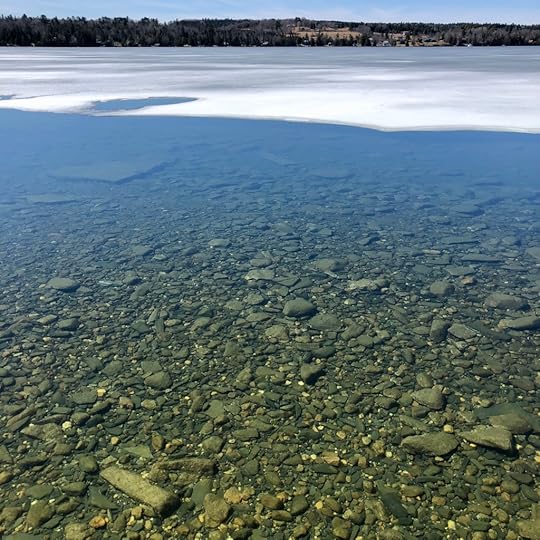
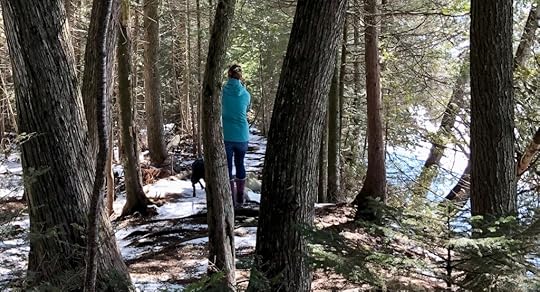 Caspian Lake, Greensboro, Vermont
The rivers are running again. I pause on a Sunday morning run, on a large bridge state money funded for the rail trail project. The river roars in spring lust. People can — and do — drown in April. This season is as fierce as winter.
The countdown has begun, the green steadily eroding the brown.
A year ago, my family was quarantined with my daughter’s positive Covid test. Yet unvaccinated, I lay awake at night, wondering why I hadn’t yet written a will, why I hadn’t added my oldest to my skimpy bank account. During the day, I painted the inside of our porch windows a brilliant blue and listened to Derek Chauvin’s trial for the murder of George Floyd.
When the jury verdict was read, our quarantine had ended. My youngest and I were sitting my car, listening to the radio, waiting for her soccer practice to begin on a cold evening. A V of geese flew over the wet field.
Years fly by. Sure. But that year doesn’t seem like yesterday. It was one full year. While my daughter played soccer, I walked among the cedars along the river, watching the remaining pieces of ice dislodge and wash into water.
…. In other news, grateful for two lovely review of Unstitched in Montpelier’s The Bridge by Tom McKone and for Tyler Orion Glauz-Todrank’s review in Lucky Cloud Books.