Stephen H. Provost's Blog, page 6
March 27, 2020
Dixie dilemma: Old highway names and slavery’s stain
It was easy when I lived in California. I wrote books about highways marked by straightforward numbers (Highway 99 and Highway 101). No controversy there. They had names, too, but “El Camino Real,” “Golden State Boulevard” and “The Hollywood Freeway” are pretty benign.
Then, I moved to the South, and I wanted to keep writing about highways. My first offering, Yesterday’s Highways, dealt mostly with numbered roads on the federal highway system, like Route 66. But before those roads had numbers, they had names. Nothing else, just names.
They were called auto trails, privately funded highways that were part gravel, part pavement and part dirt that crisscrossed the country in the early years of the 20th century. They’re the subject of my forthcoming work, America’s First Highways.
The highway builders promoted them by naming them for larger-than-life figures like Lincoln and Roosevelt, Jackson and Jefferson. Or for geography, adopting names like Yellowstone and Pikes Peak.
In the South, however, highway builders paid tribute to figures like Jefferson Davis and Robert E. Lee, “heroes” of the Confederacy. I put “heroes” in quotes, because I can’t fathom ever applying such a term to men who fought a bloody war for a system of government that brutally enslaved human beings.
When I shot the cover art for my book Martinsville Memories, depicting this Southern town’s historic courthouse, I purposely excluded the Confederate monument on the front lawn. As I’ve written in the past, I don’t believe the Confederacy should be celebrated.
Yet I did want to celebrate the auto trails that bore the names of these men. The question was how to do so without celebrating the men themselves. For one thing, I view the monuments alongside these roads more as tributes to the roads’ builders than to slavery.
Carl Fisher, a man who built the Indianapolis Motor Speedway and developed Miami Beach, would have been an impressive figure even if he hadn’t started the two most significant auto trails: the Lincoln and Dixie highways. The names would seem an interesting contrast. The first, running east to west was named for “The Great Emancipator,” while the second, oriented north and south, bore a name many associate with the Confederacy.
“Dixie” was, after all, the title of the most famous Confederate anthem, often performed my minstrels in blackface. Yet Lincoln himself deemed it “one of the best tunes” he’d ever heard, and the term “Dixie” started off as a geographical reference to the Mason-Dixon Line separating Pennsylvania and Maryland. Many today still view it in purely geographic terms, and Fisher’s group saw their Dixie Highway as a bridge to tie the nation back together after the Civil War.
Not that Fisher himself was a saint, by any means. He was sometimes a drunk who, at the age of 35, ditched his fiancée of nine years to marry a 15-year-old girl. And his main purpose in building the road was to give northerners a way to reach his resorts in Miami Beach. It was, for him, a money-making proposition.
When writing about these old roads, it’s impossible to simply ignore their names — even though many conveniently ignore that the Jefferson Highway’s namesake was a slaveholder, too. (A visit to Monticello, Thomas Jefferson’s estate, can be an eye-opener for its tour of the slave quarters and is highly recommended.)
I’m happy that the Jefferson Davis Highway has been through part of Virginia, and it’s fine with me that a portion of the Dixie Highway through Florida is now named for Barack Obama. Another president’s name on an old auto trail is a perfect fit. Plus, I have to say I enjoy the fact that it must have galled Lee Highway boosters that their road passed by a historic African-American church in Marion, Va.
But history is seldom simple. I don’t believe the names of these roads should obscure their importance to the development of our nation’s road system. Nor do I believe that huge turning point in our history should overlook the fact that highways in the South were often built by chain gangs of inmates — most of whom were black and many of whom were unjustly imprisoned.
History should shine a light on virtuous and vile deeds alike, so we can know how to replicate the former and avoid repeating the latter.
That’s what I hope my writing does. It can be a difficult line to walk, but it’s always a worthy goal, and one I intend to keep pursuing.
Photo: An exit for U.S. Highway 11, aka the Lee Highway, in western Virginia (author photo)


January 20, 2020
Quest for book sales a Catch-22 for most authors
To him who has, more will be given, and he will have abundance; but from him who has not, even what he has will be taken away.
— Matt. 13:12 (RSV)
Originality? What’s that?
If you want to make money, I mean really make money, you’ve got to do just the opposite: Find what’s sold in the past, repackage it, then sell it again to an eager audience.
This isn’t a new technique. Recycled ideas are a lot older than recycling aluminum cans and plastic milk bottles. I first noticed it back in the 1970s. Products from detergents to deodorants would tinker with their formula just a touch, call themselves “new and improved,” and put on a marketing blitz to gain new customers and win back old ones.
It’s not new, but it is more popular – especially in entertainment.
Take the movies, for example. There’s still original stuff out there. Movies like Get Out and Bird Box come to mind; and a Japanese-language film called Parasite even won the motion picture cast award from the Screen Actors Guild this year.
But it’s getting harder for them to find traction amid a sea of reboots, sequels and franchises. Consider: In 2005, sequels and prequels accounted for less than 10 percent of the 100 top-grossing movies in the United States. By 2017, the figure had more than tripled, to 30 percent.
Heck, Disney’s got it all figured out: Another Star Wars film. Another Marvel movie. Hey, I know, let’s repackage all those uber-profitable Disney animated classics as live-action movies! Even without Robin Williams, we can get Will Smith to play the genie in Aladdin, and voila! Another cool billion in the bank.
Biopics are big business, too: Freddie Mercury, Elton John, Judy Garland... People love what’s familiar to them, and they’ll eat it up.
Formula wonWhich brings us to my line of work: writing books. The same thing seems to be happening there, too. Familiarity rules.
What’s most familiar to most readers is an author’s name. If you’re “known,” you’ve created a reliable brand that can serve as your formula for success.
The rest of us have to latch onto an existing formula and hope against hope we catch on. The idea is simple: Choose a formula or subgenre that bears a strong resemblance to something that’s worked before, and crank out the stories. (For the record, the romance genre had nearly twice as many earnings as any other in 2016, followed by crime/mystery, religious and fantasy science fiction. Horror was in fifth place, but with just 5 percent of the earnings raked in by romance-erotica.)
So, say you’ve decided to write in a popular genre or subgenre and you’ve started writing.
Your first obstacle will be the fact that other writers have done their research, too, and have targeted the same popular genre you’ve identified as “yours.” And more people there are cranking out the same kind of stories, the harder it is to choose among them.
Some readers will read any story in a given subgenre, just like some moviegoers will see any Marvel movie. But there are a lot more books in a subgenre than there are movies in any given franchise, and it takes a lot longer to read a book than it does to watch a movie. So, sooner or later, the market will get flooded, and only tried-and-true authors need apply.
The rest of us? Well, we’re back to Square One.
The poor stay poor, the rich get richer. It’s just so disproportionate.
— Marshall Mathers (Eminem)
The sin of originality
Maybe you don’t want to focus on formula. Maybe you’d rather try to break through by writing original stories. That’s still possible – if you can catch someone’s eye. Someone who isn’t looking for the same-old, same-old, and who has the connections it takes to put your books in front of readers. (Oprah Winfrey’s book club is an example.)
I don’t know whether it’s more difficult to do that, or whether it’s more difficult to write formulaic novels and hope they somehow find an audience in the sea of other formulaic novels out there.
There is a third option: Write an original story and tie it up nice and pretty in a familiar looking package. But you’ll face the same challenges here, too, plus another potential obstacle: Readers looking for originality might never give your book a second glance, and those looking for pure formula might feel tricked and protest, “What the hell is THIS!?”
None of these options is bad. I prefer to write original stories, but I’ve also seen all the Star Wars movies and most of the Marvel flicks. I’ve also tried to package original stories within the framework of a subgenre.
The point is, whatever option you choose, the odds are never in your favor. Or, at least, not very often. And that can lead to desperation...
...which attracts con artists like a dying animal draws vultures to the side of the road. You hire a marketing guru. You pour money into Amazon and Facebook ads. You buy into “sure-fire” systems for increasing profits, but the only “sure-fire” profits wind up going to the self-proclaimed experts selling those systems.
Catch-22In one sense, authors face the same Catch-22 (that started out as a book title, by the way) anyone faces when getting started in a business. There’s an old saying that you have to have experience to get a job, but you have to have a job to gain experience.
The writing world is similar: You have to have exposure to sell books, but you have to sell books to gain exposure (unless you want to give them away, which kind of defeats the purpose).
The difference lies in how hard it is to break into this specific field. At the start of 2020, the overall unemployment rate was 3.5 percent. Now, a lot of people had to work two or more jobs to make ends meet, but that still leaves them in better shape than the typical author. According to the Authors Guild, that was $6,080 in 2017, or less than half the poverty level for a single person living alone.
To put it another way: If you worked half-time (20 hours a week) at $10 an hour, you’d still make one-third more than the median author’s salary.
And while other industries are seeing a slow but steady climb in wages, author earnings actually fell by 42 percent from 2009 to 2016.
Snowball effectIn this kind of environment, success stories from big-name authors are less than comforting. A successful author telling a struggling writer, “If I did it, you can too,” might as well be a lottery winner conveying the same message.
Unlike a winning lottery ticket, however, there’s often a snowball effect with writing a bestseller or two. Big-name authors who have been around any length of time have made the vast majority of their money off their reputations, not their talents – which is not to disparage their talents. It’s simply proof of my original premise: Familiarity is a goldmine. It may breed contempt in some quarters, but obscurity breeds indifference, which is far worse if you’re trying to sell books.
I like to write stories with happy endings, but I haven’t found one here. Not yet. I guess if I want that, I’ll have to go see another Disney movie.
On second thought, maybe I’ll see an indie film instead. If I can find one playing within 200 miles of where I live, that is.
Yes, the struggle is real.
January 13, 2020
Harry Potter meets Doctor Who in new academy fantasy series
The mind is a trippy place. It can be like a maze, especially when you’ve got a fertile imagination.
It’s easy to jump from one idea to the next, from fanciful to intriguing to exciting.
All this got me thinking: What if a place like this existed in the real world? And what if there were a school to teach us how to navigate it?
That’s the idea behind my new series, Academy of the Lost Labyrinth. Each person must navigate the labyrinth of his or her own mind, but we’ve got people to help us: schoolteachers, parents, friends-for-life. They’re all with us on the journey, even if they can’t take it for us. That’s what happens at the magical academy I’ve created, and it’s the kind of journey I’ve set before my characters – and my readers.
Life can take us almost anywhere, and so can the Lost Labyrinth. That’s what makes writing this series so much fun. My characters can visit Mount Olympus, the River Styx, a dragon kingdom in the heart of a mountain, the North Pole, Stonehenge, Easter Island... even a planet halfway across the galaxy. The possibilities are endless, thanks to the labyrinth.
Why is it a “lost” labyrinth? You’ll have to read the books to find out! But I will give you a sneak peek into what you’ll find in their pages.
If you’ve read my Memortality books, you know I’m fascinated with the ideas of time and memory, so there’s a lot of time travel in the series opener, The Talismans of Time.
I started by thinking of time as a circle, rather than a straight line. This allowed me to create a unique narrative that begins at the end and ends at the beginning... but still spins a fast-paced, exciting tale. How does that work? Again, you’ll have to read the book.
It tells the story of how two very different teenagers – Alex and Elizabeth – from very different times find themselves caught in the labyrinth, and how their journeys lead to the founding of a new academy. He’s from Iowa in 1991; she’s from Yorkshire at the turn of the 20th Century. They wander into the labyrinth by chance, and in order to get out again, they have to collect all seven Talismans of Time... and help each other along the way.
The fate of the Academy in the present day is at stake. It’s a special school that accepts students with four main magical talents: time travel, memory magic, shapeshifting and dream walking.
But it turns our those aren’t the only such talents – and the Academy of the Lost Labyrinth isn’t the only school for the magically gifted in my alternate universe. One of those other schools, the Academy of Enchanted Arts, plays a pivotal role in the second book, Pathfinder of Destiny.
Set on a remote island in the South Pacific, it’s a haven for painters, writers and musicians whose art can literally come alive.
Yet another school, the Astral Academy, is on a planet hundreds of light years from Earth and accessible through the labyrinth. It’s the basis for a spinoff book called (naturally) Astral Academy.
Pathfinder of Destiny, meanwhile, continues the story of the main Academy in the present day and features many of the characters from Talismans. It also introduces two new protagonists: Cassidy Parks, a 13-year-old girl from Detroit, and her best friend, Stefani. Together, they must save the Academy from a familiar villain who wants to seize control of the labyrinth – and exact revenge on Elizabeth (who’s now the headmistress) in the process.
I’ve written these books for the same audiences that enjoy the magical, whimsical and adventure-filled worlds of Harry Potter, The Wizard of Oz, Mary Poppins, Doctor Who and Alice in Wonderland. They’re suitable for all ages, but you don’t have to be a kid to enjoy them. (My father, the political science professor, loved the Harry Potter books, and these are designed to be in the same vein.)
Oh, and be on the lookout for fun, semi-hidden references and tributes to a number of fantasy and science fiction works. See how many you can find.
The books in this series are available on Amazon in paperback and ebook form, and are also accessible through Kindle Unlimited. Check them out today!
September 20, 2019
Books are a better value than today's newspapers — and it's no contest
Authors and print journalists have one thing in common, and no, I’m not talking about writing.
Today’s “print” journalism isn’t so much about print. More and more, it’s about posting videos online, then finessing keywords and creating vague headlines to ensure they get hits, page views, visits or whatever. None of that has much to do with writing, and none of it does anything to help with literacy. Neither does laying off copy editors, line editors and staff writers (note the word “writers” in that last title).
We who write books still – gasp – actually write. Sure, we put out ebooks, utilize keywords in marketing and go after a “target audience,” but we don’t obscure or massage the facts in order to do so. Authors were never meant to be public watchdogs. Some of us are, but we take that mantle voluntarily, not because it’s part of our job description.
It is – or was, once upon a time – part of what it meant to be a journalist. Ever wonder why attacks on journalism as “fake news” have gained so much traction? It’s easy to blame ego-driven politicians, but not so easy for media companies to look in the mirror. The more these companies sacrifice their own credibility at the SEO altar (that’s “search engine optimization,” for the uninitiated), the less reason people have to believe them. Or to buy what they’re selling.
The fewer journalists actually attend public meetings, the less reason anyone has to believe they know what’s going on. You can’t be a watchdog if you ain’t watchin’!
This isn’t the fault of front-line journalists, who, increasingly, are asked to do more with fewer resources. They’re heroes, in my book. It’s the fault of the companies that employ them. While they’re tasked, increasingly, with things that have less and less to do with writing and reporting, we authors are doing pretty much the same thing we’ve always done: Looking for interesting stories (in our own heads and in the world at large), and doing our best to entertain, inform and challenge our readers.
That doesn’t mean authors are better than front-line journalists, merely that we are given more freedom to pursue our craft than today’s journalists enjoy. That wasn’t always the case.
Shared struggleNo, writing isn’t what we authors have in common with journalists. Not anymore. What we share is a struggle to remain visible in a world that offers an explosion of media choices. Anyone who wants to can publish a blog and call himself a journalist, and anyone can self-publish a book at proclaim, “Hey! I’m an author!” Her books might be good – or they might not. But who has time to weed through all the pig slop to get to find that diamond in the trough?
In truth, we have less time than ever for such pursuits. And the world has catered to our increasingly frenetic lives by serving up fast-food information via iPhones and sound bites, condensing complex issues into Twitter-pated bullshit that can be spewed by anyone in 280 characters or fewer.
Media companies have responded by mimicking their own worst enemy: posting on Twitter, adapting their format to fit “handheld devices” and making news more disposable than it used to be when the morning paper got recycled at the bottom of a birdcage in the opening sequence of Lou Grant.
By contrast, we authors are doing what we’ve always done: writing.
Media companies, faced with declining circulation despite their “if you can’t beat ’em, join ’em” embrace of social media, go out begging potential readers for attention. “You can subscribe to our online service for just $9.95 a month!” they declare. “It’s a bargain!”
Authors make similar pitches: “You can have hours of reading pleasure for just $9.95! You can’t beat that!”
Both products are worth about the same as a couple of cups of coffee at Starbucks or a ticket to a movie matinee. So, the question arises: If you only have $9.95, which one should you buy?
My answer is: the book. And I’ll tell you why.
More bang for your buckPrices have gone up for both products. That’s inflation for you. But what are you getting for your buck?
Books are still about the same length as they’ve always been, with just as much content and just as much work put in on the front end.
The opposite is true for newspapers. With all those writers and editors being shown the door, the breadth and depth of newspaper content isn’t anywhere near what it used to be. Newspapers have become the fast-food burger of reading: The price gets bigger as the product gets smaller. And not just when it comes to the number of pages. If you’re not covering the city council meeting, the school board or the Friday night football game, seriously, what’s the point?
Yeah, local newspapers are still putting out some good content, but it’s a small fraction of what you used to find in their pages. And it’s nothing close to comprehensive. By contrast, a 340-page book in 1979 is still a 340-page book 40 years later. You’ll find as many vivid characters, as many twists and as much good information between the front and back cover as you ever did.
None of this should be taken as an argument that books are intrinsically better than newspapers. This is about value for the consumer’s dollar, not an assessment of the two media’s inherent worth. They perform different functions, both essential – and that makes the decline of the daily newspaper even more lamentable.
Three decades ago, I probably would have deemed newspapers a better value than books. Given the Draconian cuts in staffing, resources, content and the number of pages in your daily paper, I simply can’t say that now. Compare a six-section, 72-page paper of 30 years ago to a two-section, 16-page edition today.
Is it any wonder subscribers are heading for the exits?
Newspapers are being made – and, it could be argued, have already been rendered – obsolete by the internet. That’s tragic, and it’s certainly not the fault of front-line journalists, but it won’t do us any good to bury our heads in the sand and pretend it hasn’t happened.
Harsh realityBut here’s the good news: Books are as robust and relevant as ever.
So, if you’re offered a choice between a monthly newspaper subscription and a book for that $9.95, my advice is to buy the book. Newspapers have already lost the battle to the internet. And, with their decision to abandon comprehensive local news coverage, they offer very little in the way of content you can’t find online. We authors haven’t given an inch in our battle to stay both evocative and relevant. That’s why I’m proud to be one. I’m still a journalist; I just find my stories in the past these days, digging up nearly forgotten nuggets to share in the realm of historical nonfiction.
And I’m actually writing. Imagine that! It’s a hell of a lot more fun than spending most of my day plugging in keywords, filming videos and sweating bullets in the increasingly desperate hope that someone out there is still paying attention. That’s what the current media culture demands of many good, hardworking journalists who would much rather be writing and reporting. When they do, their work still shines. It just shines far less brightly than it once did. That’s not their fault. But it is, unfortunately, their reality and ours.
For more on the decline and fall of journalism in the 21st century, check out my book Media Meltdown , available on Amazon.
Books are a better value than newspapers — and it's no contest
Authors and print journalists have one thing in common, and no, I’m not talking about writing.
Today’s “print” journalism isn’t so much about print. More and more, it’s about posting videos online, then finessing keywords and creating vague headlines to ensure they get hits, page views, visits or whatever. None of that has much to do with writing, and none of it does anything to help with literacy. Neither does laying off copy editors, line editors and staff writers (note the word “writers” in that last title).
We who write books still – gasp – actually write. Sure, we put out ebooks, utilize keywords in marketing and go after a “target audience,” but we don’t obscure or massage the facts in order to do so. Authors were never meant to be public watchdogs. Some of us are, but we take that mantel voluntarily, not because it’s part of our job description.
It is – or was, once upon a time – part of what it meant to be a journalist. Ever wonder why attacks on journalism as “fake news” have gained so much traction? It’s easy to blame ego-driven politicians, but not so easy for media companies to look in the mirror. The more journalists sacrifice their own credibility at the SEO altar (that’s “search engine optimization,” for the uninitiated), the less reason people have to believe them. Or to buy what they’re selling.
The fewer journalists actually attend public meetings, the less reason anyone has to believe they know what’s going on. You can’t be a watchdog if you ain’t watchin’!
We authors, meanwhile, are doing pretty much the same thing we’ve always done: Looking for interesting stories (in our own heads and in the world at large), and doing our best to entertain, inform and challenge our readers.
Shared struggleNo, writing isn’t what we authors have in common with journalists. Not anymore. What we share is a struggle to remain visible in a world that offers an explosion of media choices. Anyone who wants to can publish a blog and call himself a journalist, and anyone can self-publish a book at proclaim, “Hey! I’m an author!” Her books might be good – or they might not. But who has time to weed through all the pig slop to get to find that diamond in the trough?
In truth, we have less time than ever for such pursuits. And the world has catered to our increasingly frenetic lives by serving up fast-food information via iPhones and sound bites, condensing complex issues into Twitter-pated bullshit that can be spewed by anyone in 280 characters or fewer.
Journalists have responded by mimicking their own worst enemy: posting on Twitter, adapting their format to fit “handheld devices” and making news more disposable than it used to be when the morning paper got recycled at the bottom of a birdcage in the opening sequence of Lou Grant.
By contrast, we authors are doing what we’ve always done: writing.
Journalists, faced with declining circulation despite their “if you can’t beat ’em, join ’em” embrace of social media, go out begging potential readers for attention. “You can subscribe to our online service for just $9.95 a month!” they declare. “It’s a bargain!”
Authors make similar pitches: “You can have hours of reading pleasure for just $9.95! You can’t beat that!”
Both products are worth about the same as a couple of cups of coffee at Starbucks or a ticket to a movie matinee. So, the question arises: If you only have $9.95, which one should you buy?
My answer is: the book. And I’ll tell you why.
More bang for your buckPrices have gone up for both products. That’s inflation for you. But what are you getting for your buck?
Books are still about the same length as they’ve always been, with just as much content and just as much work put in on the front end.
The opposite is true for newspapers. With all those writers and editors being shown the door, the breadth and depth of newspaper content isn’t anywhere near what it used to be. Newspapers are the fast-food burger of reading: The price gets bigger as the product gets smaller. And not just when it comes to the number of pages. If you’re not covering the city council meeting, the school board or the Friday night football game, seriously, what’s the point?
Yeah, local newspapers are still putting out some good content, but it’s a small fraction of what you used to find in their pages. And it’s nothing close to comprehensive. By contrast, a 340-page book in 1979 is still a 340-page book 40 years later. You’ll find as many vivid characters, as many twists and as much good information between the front and back cover as you ever did.
Newspapers are being made – and, it could be argued, have already been rendered – obsolete by the internet. That’s tragic, but it won’t do us any good to bury our heads in the sand and pretend it hasn’t happened.
But here’s the good news: Books are as robust and relevant as ever.
So, if you’re offered a choice between a monthly newspaper subscription and a book for that $9.95, my advice is to buy the book. Newspapers have already lost the battle to the internet. And, with their decision to abandon comprehensive local news coverage, they offer very little in the way of content you can’t find online. We authors haven’t given an inch in our battle to stay both evocative and relevant. That’s why I’m proud to be one. I’m still a journalist; I just find my stories in the past these days, digging up nearly forgotten nuggets to share in the realm of historical nonfiction.
And I’m actually writing. Imagine that! It’s a hell of a lot more fun than spending most of my day plugging in keywords, filming videos and sweating bullets in the increasingly desperate hope that someone out there is still paying attention.
For more on the decline and fall of journalist in the 21st century, check out my book Media Meltdown , available on Amazon.
September 16, 2019
The story behind "Martinsville Memories," a new book about a unique Virginia city
I can imagine Martinsville residents noticing my latest book, Martinsville Memories, and asking themselves, “Who’s this author? I’ve never heard of him. It’s weird we’ve been living in Martinsville all this time and never run into him.”
Not as weird as you might think, considering I’ve only been here a year – and I spend most of my time in my upstairs office, writing. But I got out into the community enough to be intrigued by what I found there. Green trees embracing blue skies. Winding roads. And historic buildings with, I knew, a wealth of stories to tell.
Being a storyteller, I took that as a challenge. Who had traveled these roads before me? What had happened in those buildings on Church Street, and who built those mansions on Mulberry Road? What about the buildings that used to be there, but aren’t anymore? What had happened to them?
A parade of questions ran through my mind, and of course, I had to find the answers.
Why should a relative newcomer tell the story of Martinsville? I don’t have an answer to that beyond the fact that I wanted to. And this is what I do. It’s pretty much what I did for more than three decades as a journalist, except these days I’m reporting on the past, digging up stories from history, rather than finding them in the present.
I became a newspaperman after resisting the temptation to switch my major to history midway through my college career. But I took plenty of history courses, anyway – almost enough to earn a minor. And now, writing books like Martinsville Memories is the perfect way to blend these two passions; to have the best of both worlds, as it were.
I enjoy discovering stories I haven’t heard before. I have a particular passion for old roads, which led me to write two highway books (Highway 99 and Highway 101), and to embark on a journey that took me 7,500 miles along the Blue Ridge Parkway, Lee Highway, Lincoln Highway, Route 66 and the Ohio River Scenic Byway this past spring. So, it should come as no surprise that I’ve included a bit, in the first chapter of Martinsville Memories, about local highways.
I love learning about the places I’ve been, too. I wrote about my hometown in Fresno Growing Up. So, I figured, why not write about my new home, too? I’ve really enjoyed living in Martinsville, and was curious to know more.
This book is the result of that curiosity.
In this volume, I took a slightly different approach than I have to previous books. I’ve always thought of myself as, primarily, a writer. But for many years, I’ve enjoyed photography, too. I started taking photographs for the newspaper at my most recent stop, and I took numerous photos for several books I’ve written, too. So, this time, instead of starting with the text and finding photos to illustrate it, I went about things from the opposite direction: I built the book around the photos.
I took hundreds of them in Martinsville, Ridgeway, Collinsville, Axton, Fieldale, Bassett and along the rural roads that connect them.
In fact, I initially intended Martinsville Memories to be, primarily, a picture book. Of course, being a writer, I’d have to explain those pictures – and, the more I found out, the longer and more detailed those explanations grew. The end result is a book that’s fairly well balanced between words and pictures, and I’m very pleased with how it turned out.
What did I learn along the way? Well, you’ll have to read the book to find out. But here’s just a taste:
I learned about a gunfight that took place on the streets of Martinsville that was every bit as dramatic – and deadly – as the famed gunfight at the OK Corral. I learned that a Hall of Fame baseball player started his career in Martinsville, and that another Hall of Famer once managed the city’s minor-league team. I read some colorful stories about bootlegging and its connection to NASCAR. I found out that Martinsville had once produced more sweatshirts and been the home to more millionaires per capita than anyplace else in the nation. I learned the history of some old gas stations, restaurants and fast-food chains that have become mere memories and, in some cases, begun to fade from memory altogether.
I consider it one of my callings to preserve those memories. To remind some of what they might otherwise forget and to share these stories with those who have never heard them. I enjoy hearing those stories, and that’s why I write them down.
I hope you enjoy them, too.
Note: Martinsville Memories is now available on Amazon! If you live in the Piedmont or Triad areas, come to one of the following events to meet me and get a personalized, signed copy : 40th Annual Martinsville Uptown Oktoberfest , on Church Street near Broad Oct. 5; Dragon Festival 2019 at the Virginia Museum of Natural History on Oct. 19; or the 2019 Fall Craft Show at Bassett High School on Nov. 23-24.
August 9, 2019
Don't ask a new friend to like your Facebook page
If they like me, they’re sure to like my Facebook page!
Right?
Uh, not so much.
I’m active on Facebook, and I’m also interested in marketing, so I have handful – well, maybe three handfuls – of business pages to promote my work.
Other authors and creative types do, too, and I get a lot of friend requests from would-be networkers in my field.
Most seldom, if ever, interact with me online. But more and more of them are sure to do one thing the moment I accept their friend request: They invite me to like their business page.
I used to accept most of these as a sort of favor to build up their egos, but that’s really all it does. I seldom visited these pages after I “liked” them, and I don’t think I’ve ever bought anything based on something I’ve seen there.
That’s the hard reality of Facebook pages: The overwhelming (and I do mean overwhelming) majority of people who like pages do so for the pretty pictures and funny memes. I’ve used pretty pictures and funny memes to accumulate thousands of likes on some pages, even tens of thousands on a few. But do these translate into sales?
Again, not so much.
Still, more and more authors and artists on Facebook seem to have adopted a new commandment. It goes like this: The very first thing thou shalt do when someone accepts thy friend request is invite them to like thy page.
Unfortunately, this is all kids of stupid.
For one thing, page likes seldom translate into sales. Yes, they will get you exposure, and yes, it can’t hurt. But if you expect to get more than a couple of sales for every thousand likes, you’re deluding yourself.
And more important than that: It’s just plain rude. People who accept friend requests from folks they’ve never heard of, let alone met, are taking a chance. There are a lot of bots, spammers and idiots out there on Facebook, so if you accept a friend request, you’re putting yourself out there. It’s gotten to the point that I don’t accept any requests unless we’ve got mutual friends and the person seems like a real person with at least some common interests.
If it’s someone from Nigeria or Saudi Arabia, a guy with a girl’s name, a “well-endowed” woman with bare-bones profile info ... sorry, but you’re not getting in.
The people who send out instant page requests are none of those things. They’re legitimate Facebook users with credible profiles who obviously don’t realize how intrusive – and presumptuous – they’re being by sending you a page request before so much as bothering to say “hello” on your profile. Imagine answering a knock at the door only to be pushed aside by a “visitor” you’ve never met. He brushes past you, makes his way to your kitchen and says, “Got any beer?”
Same principle.
Another analogy: It’s kind of like the guy in the parking lot who goes around putting leaflets on every car. That hungry landfill down the street might say “thank you,” but will any of the drivers? It’s doubtful. And they sure as hell won’t consider the leaflet-distributor a “friend”!
The instant-page-request strategy would still be rude if it generated business, but I’ve seen no evidence it does that. If I don’t know you, why should I care about your business? It’s far more likely I’ll do business with you if someone else I already know recommends you. You know, word of mouth.
On the other hand, if I’ve known someone for a while, chances are I already know what they’re selling without having to visit their page.
Finally, it’s far easier to build up page likes by spreading those pretty pictures and funny memes than it is by inviting every new friend you make on Facebook. You still aren’t likely to build your business exponentially, but you will increase your reach a lot more quickly and effectively than you can through invitations.
And guess what? It’s not rude. Because when those people like your page, they’re doing so voluntarily, not because you’ve nagged or guilted them into it.
So, please, the next time you’re tempted to send out an immediate page invitation to a new friend on Facebook, stop and think for a moment. Remember: It’s poor way to build a following; page likes don’t translate into big sales; and the person may well think you’re a presumptuous ass – which means she’s unlikely to have a positive impression of what you’re trying to sell.
Think about it. And try, at least for the moment, just being what you said you wanted to be to that person in the first place.
A friend.
Photo by Dave Wild, used under Creative Commons 2.0 license .
July 5, 2019
Writing an Amazon book review: worse than a root canal?
Note: With reluctant apologies to J.K. Rowling, Terry Pratchett and Neil Gaiman, I following is a lighthearted look at why most writers not bearing those names find turning readership into Amazon reviews more difficult than transmuting lead into gold. Difficult, but not impossible: I’m immensely grateful for readers who take the time to leave reviews of my books. You are a rare and precious breed. I love you eternally.
The Amazon book review. Authors covet them nearly as much as Gollum longs for his precious and Wile E. wants that Roadrunner. Short of the New York Times bestseller list, they’re the Holy Grail for writers. And they’re just as elusive, too.
For the longest time, I wondered why so few readers bother to leave them. But then I hit on something during a recent trip to France that I think explains it all better than even Clarissa could. I’ve never been to France, but that didn’t stop me from traveling there in my mind to visit the abode of famed alchemist Nicolas Flamel. As it happened, the door was unlocked and the place was empty when I arrived, which afforded me the chance to do a little snooping. And, while rummaging around in Flamel’s credenza, I made a notable discovery.
How did I obtain access to the famed 14th century alchemist’s credenza, you ask? Have you ever heard of the phrase “suspending disbelief”? Well, Flamel figured out how to do it: When I arrived in his domicile, I found disbelief suspended a good three feet above the aforementioned credenza. Its arms and legs were flailing madly in the air, a look of, well, disbelief on its face. My point is this: If Flamel can suspend disbelief, literally, you can, too!
“Why a credenza?” you ask? Because the word sounds damned cool, that’s why, and because I don’t believe I’ve ever used it on the printed page (or unprinted screen) before. So, if you would be so kind, please stop asking irrelevant questions and try a query that gets at the heart of the matter. Like – repeat after me – “What did you discover?”
Yes. Now that’s more like it. I think you’re getting the hang of this.
Within said credenza, the alchemist had deposited a caisson – another word I’ve never used in print – and within this caisson was a parchment scroll in a most delicate condition. Upon this scroll was written the following. No, not in English, in French, silly. I could decipher it because I had four years of high school French (actually three, but I skipped ahead to French 4 halfway through my senior year). Or perhaps because I’m making this whole thing up. I’ll let you figure out which. You might derive a hint from the fact that modern French is probably as different from 14th century French as modern English is from Beowulf. You know, that epic poem about the first werewolf that exhorted its readers to “be a wolf!” Talk about inspirational! I will tell you this much: I really did skip ahead to fourth-year French.
Flamel’s plotHowever any of that may be, here’s my translation of what Flamel allegedly wrote: “I have discovered the key to immortality, the famed elixir of life!” This elixir, Flamel continued in scrawled, archaic French script, was in fact no elixir at all, but the written word. “It is through the written word that man shall transcend death and vanquish mortality! Thus shall his mind be known throughout eternity!” Flamel knew this, he said, because the philosopher’s stone (not the sorcerer’s stone, you dumbed-down Americanized Potterheads!) was inscribed with, yes, written words!
The stone was the source of all ancient wisdom and treasured lore. Kind of like the emerald tablet of Hermes or the collected scripts of Star Trek: The Original Series. If its secrets were to become known, anyone who might read them could live forever!
Flamel, however, didn’t want that. He was a jealous sort who coveted immortality for himself and himself alone, so he destroyed the philosopher’s stone and made it his sacred mission to limit the spread of the written word thenceforth, in perpetuity.
Being able, like Nostradamus, Agnes Nutter and Grandmama Addams, to see into the future with uncanny accuracy, Flamel deduced that, at the dawn of the third millennium (common era), a “river of words” would begin flowing from something called “the Amazon.” Flamel, like most men of his age, was a bald-faced chauvinist, so he dismissed the idea that this prophecy might refer to a powerful woman, such as, say, Diana Prince or her alter egos, Lynda Carter and Gal Gadot. There had to be another interpretation.
This being the 14th century, no European had yet visited the New World (which was really no newer than the Old World was old). Nevertheless, Flamel, foreseeing the future, knew that this would occur when, in the midst of a prophetic reverie, he penned the following: “Therefore shall the Amazon be dammed up, that no man may review its course, denying all men access to the font of eternal life!” (the “font” in question being Times New Roman).
Flamel did, in fact, speak of “men” repeatedly because he was, as noted above, a bald-faced chauvinist. (Whether the top of his head was bald, too, is unclear, as his famous portrait shows him wearing a hat.) Despite being an alchemist, he wasn’t particularly enlightened. But then, the Enlightenment was still a few centuries away back then.
It should come as no surprise, when this is considered, that no evidence was found in his credenza, the caisson therein or anywhere else that he foresaw the equal rights movement. Even prophets see what they wish to see. Moreover, Flamel was not, by any means, perfect (unlike Agnes Nutter, who was not a man and who was considerably more accurate – and nicer – in her prophecies). But he was accurate enough, if not very nice about wanting to hoard all of immortality for himself!
Yes, indeed, he was accurate enough, even though his prophecies had nothing to do with a then-yet-to-be-discovered river, as he imagined. For at the dawn of the third millennium, a river of words did, indeed, begin flowing from “the Amazon.” A virtual river, to be sure, but still a river, it must be admitted. And that river became dammed – or was it damned? – by Flamel’s curse so that men (and women) had a devil of a time reviewing the words that flowed from “the Amazon’s” digital headwaters. Swimming against the current, so to speak.
I speak, naturally, of the aforementioned book reviews on Amazon, which readers are so hesitant to provide that it became quite clear to me something supernatural was afoot – Flamel’s curse being the most rational explanation. Without even the most curse-ory reviews, fewer books would sell, and a greater share of the eternal pie (or pi) would be reserved for Flamel, who, even though long dead, would continue to benefit (don’t ask me how; I haven’t figured that part out yet) even in the form of his formless specter.
Testing my theoryIt seemed a reasonable enough conclusion. Still, I had to be sure. So, seeking confirmation of my theory, I sought to interview a few random readers who had failed to post reviews even though they were known to have purchased books from Amazon. Here are some of the responses I got.
“I decided I’d rather clean the toilet.”
“Oh, my significant other offered to do the dishes, but I realized that would leave me no excuse for reneging on my promise to post a review. So, I did the dishes and two loads of laundry on top of that!”
“I spilled cod liver oil on my hands so I would have an excuse not to gum up my keyboard! Don’t ask me why I was drinking cod liver oil. I had my reasons. Besides, it was better than posting a review!”
“I got a written excuse from my doctor. Or nurse practitioner. Or next-door neighbor who happened to be wearing a white T-shirt that would pass for a hospital uniform if you saw him from the other end of a football field. It’s all the same.”
These responses were suspicious enough, but what really got me were the next few:
“It’s against my philosophy.”
“Dude. Chill. I was too stoned.”
“I decided I’d rather reread the last four chapters of my philosophy textbook.”
“I was afraid authors of competing books would stone me.”
“I’d rather have a kidney stone that write a review!”
“I got stuck at Phil and Sophie’s house.”
A definite pattern was emerging around philosophy and stones, and that could only mean one thing: Flamel’s curse was working. And it was working so well that readers would rather do anything except write a book review! Eat kale. Have a tooth extracted or even a root canal. Watch endless reruns of The PTL Club. Beat – or be beaten by – a dead horse. Anything!
(Among the excuses offered, tooth extraction seemed particularly apropos: Extracting reviews from readers can feel like pulling teeth!)
I looked at the parchment again and wondered: What if I were to burn it? Would that remove the curse? I struck a match and held it to the corner, which I was about to set ablaze when it occurred to me: This might be exactly what Flamel was counting on! I would be burning words on a paper, the very instruments of immortality he was trying to destroy (even if they were in French). I would be doing his work for him! I was damned if I did and damned if I didn’t. Or dammed. Probably both.;
Dejected, I returned the parchment to the caisson and the caisson to the credenza, hung my head and departed. It was plain that I would have to go back to begging and pleading for reviews, crawling to readers on my hands knees like some penitent medieval scribe, for all the good it would do me. Flamel was simply too accomplished an alchemist. I was beaten.
But I vowed, even so, that I wouldn’t stop writing. I’d even thumb my nose at old, dead Nicky Boy and write a little philosophy now and then. That would show him! I might not be able to beat him, but I could still grab a few crumbs from his precious pie of immortality for myself. Reviews or no reviews, I’ve still got a little bit of Harry Potteresque magic in my pen … er … keyboard, and I intend to use it!
Amazonus Scriptorus!
That’s got a nice ring to it. Now if I could just get J.K. Rowling to review one of my books! Who am I kidding, though. I may be a philosopher, but I’m no sorcerer!
July 2, 2019
In Genesis, as in life, we see what we expect to see
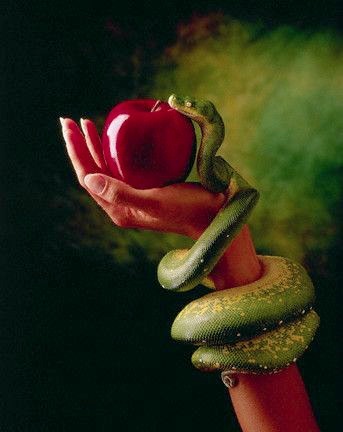
They say Eve tempted Adam with an apple, but man, I ain’t goin’ for that.
— Bruce Springsteen, Pink Cadillac
Virtually everyone knows the story of the Garden of Eden. We learned it in Sunday school, or from our parents.
We know from this story that Satan persuaded the first woman, named Eve, to eat an apple, which Jehovah had forbidden. We know that Eve then seduced the first man, Adam, into doing the same.
Except none of that is true.
I’m not saying it’s false in the sense that, “that’s just a myth, so it never happened” – that’s a different discussion. I’m saying it’s not in the story. No apple is ever mentioned. Neither is Satan. There’s no reference to the woman seducing Adam, and she didn’t receive the name “Eve” until after this all went down. Also, the divine presence in the story is Elohim, not Jehovah. Most of what we thought we knew about this story, it turns out, is a mixture of commentary and assumption that we simply accept as fact because it’s become part of our popular culture.
A god by any other name ...How did it get that way?
When the story was written, the deity credited with creation was named Elohim – a Canaanite word meaning “the gods.” Plural. That, however, didn’t square with the worship of the Hebrew god Jehovah (singular), in Judeo-Christian tradition that became dominant later on. The name Jehovah, or Yahweh, doesn’t even appear in the Book of Genesis, which was written in its earliest form before this deity was widely worshipped.
When the worship of Yahweh became not only dominant, but exclusive, something had to be done to reflect that. The creation story was already so widely known that it couldn’t simply be erased from the public consciousness. So, it was reinterpreted. “Elohim” was suppressed, and the word itself was passed off as just another name for Jehovah. Both are translated as simply “God” in our Bibles, even though they’re entirely different words.
As to the apple, it’s never named as such in Genesis. The text only mentions “fruit from the tree in the middle of the garden.” There weren’t even any apples growing in the Middle East at the dawn of civilization (the first were cultivated in Kazakhstan, far to the northeast).
Bruce Wayne is Tony StarkThis brings us to the serpent, a central player in the little drama. The snake is never named as “Satan” in the story. This Satan first appears in the Book of Job, and is applied to a figure who is not a tempter, but an accuser.
In fact, satan (lowercase) is not a name at all; it literally means “the accuser,” and appears in 10 out of 12 Old Testament references as “the satan.” It could have been applied to one figure in one place and an entirely different figure somewhere else. To assume that “the satan” referred to the same individual every time it occurs would be the equivalent of inferring that “the actor” always referred to, say, Bill Murray. Or that every reference to “the painter” meant Picasso.
How thorough has this transformation from general accuser to specific person been? If you were sitting behind me at my computer as I write this, you’d know: Every time I lowercase the word “satan,” my software responds with a squiggly red underline, indicating that I’ve got it “wrong.” The word, in the opinion of Microsoft Word, should always be capitalized as a proper noun!
It is only in the Book of Revelation, written thousands of years after the folktale that served as the basis for the Eden story, that “Satan” is referred to as “that ancient serpent.”
The satan was further identified with another character, Lucifer, which meant “light-bringer” and was just another name for the planet Venus, the morning star. According to the Book of Isaiah, however, Lucifer had “fallen from heaven” to “weaken the nations.” The author had, perhaps, heard a reference to Venus descending toward the horizon (falling) and/or appearing to fade as the sun rose. He then equated that with a moral failing or fall.
(For more on this, see my book Forged in Ancient Fires: Myth and Meaning in Western Lore.)
It’s not hard to see how this Lucifer became conflated with the serpent, who had himself fallen in the Eden story when he was cursed to crawl on his belly and eat dust. The serpent was also a light-bringer, in the sense that he promised enlightenment to the woman if she were to eat the fruit: “You will be like the Elohim, knowing good and evil.”
But equating the serpent with Lucifer and, hence, Lucifer with the satan, is like saying Batman and Iron Man are the same character. Both are genius billionaires who disguise themselves in fancy suits decked out with loads of techno-gadgets, then go around playing vigilante to fight the bad guys in comic books. Never mind that one’s named Bruce Wayne and the other is Tony Stark. Such minor details are as easily overcome as the difference between Lucifer and Satan, or Yahweh and Elohim.
Built-in biasNone of what I’ve written here would be surprising if we’d read the story itself before we heard the modern commentary. If we had never known about the story before, had never attended a Sunday school class and knew nothing about the rest of the Bible, we would have no basis for ever even guessing that the serpent was “Satan” or that the fruit was an apple. If we encountered the word Elohim for the first time, without any modern context, we might look it up and find that it meant “the gods.” If we read a separate passage about Yahweh in Exodus, we’d assume it was a different figure.
But we see what we expect to see, because someone has pointed us in that direction. We see gospel truth, when the author intended something else entirely. The story of Eden is, at the heart of it, a fable meant to convey a moral lesson and knowledge about how the universe came to be the way it is. Such stories are called etiological or origin stories; more recently, they’ve been referred to as just-so stories.
Rudyard Kipling wrote a number of them at the turn of the 20th century. Many of the titles are similar:
How the Camel Got His Hump
How the Leopard Got His Spots
How the Elephant Got His Trunk
The Eden account is based in part on just such a story. You might title it, How the Snake Got His Slither. The story offers an explanation, however fanciful, for why the serpent doesn’t have legs and crawls in the dust. It didn’t adapt to thrive in its environment. It was cursed! The tale also purports to explain why people wear clothes (they became ashamed of being naked after eating the fruit), why women experience pain in childbirth, and why the earth in the ancient Near East was hard to cultivate (more curses, which can be fixed by anesthesia and irrigation, respectively).
You can’t fight city hallIn addition to an etiological story, however, the Eden account served as a cautionary tale. The moral of the story, translated into modern terms, would be “You can’t fight City Hall.” (Secondarily, to paraphrase heavyweight champ Joe Louis, “You can run, but you can’t hide.”) The conclusion is that all the knowledge in the world won’t help you if you find yourself fighting against the gods. Only obedience, not wisdom, will save you. This wasn’t an uncommon theme in the ancient world: The story of Zeus punishing Prometheus for stealing fire from heaven and giving it to humanity is a parallel example.
The moral of the story isn’t spiritual and enlightened, but pragmatic and a cynical. It also served those in power well, as they could use it to keep their subjects in line.
But because our culture is so steeped in the false context created for the original story by the priests of Yahweh, by the author of Revelation, by Sunday school teachers and others, we don’t see any of this unless we look at the story with fresh eyes – and dare to challenge the cognitive dissonance that arises when we do so.
Admitting we misunderstood something as basic as the story of our own creation can be a bitter pill to swallow, but there’s a bright side to that realization. We get to create our own awareness and, as a result, our own destiny. That’s a happy ending in my book.
Stephen H. Provost is the author of several books about myth, religion and spirituality, including Forged in Ancient Fires , Messiah in the Making and Timeless Now .
June 26, 2019
History matters even more if the past is but a ghost
Timeless Now: The Empyrean Gate is my 20th book, with two more completed and in the pipeline for release next year. It marks a return to subjects touched on in some of my earlier projects, including philosophy and spirituality., and in a sense, it has brought me full circle –while at the same time collecting a series of insights gleaned over the years into a new, cohesive whole. It’s available on Amazon in paperback and ebook form, and I’ve made it as affordable as I can because I believe in its message.
If history were taught in the form of stories, it would never be forgotten.
— Rudyard Kipling
How can a historical writer dismiss the past as a mere shadow, a ghost, a phantom? It seems more than a little ironic on the face of it, I have to admit. Contradictory, even.
I spent nearly a decade researching a 1,000-page book on ancient history – my two-part Phoenix Principle, a look at the development of Western religion from the perspective of myth and politics.* It was the first book I ever wrote. More recently, over the past four years, I’ve written five books about 20th century Americana and the biography of a sports legend.**
But my latest book, Timeless Now, begins by declaring, “Time does not exist,” and makes the point that all we really have is the present moment; the past itself is nothing but a series of ghost stories preserved, imperfectly, through memory. That might seem to diminish the importance of history, but for me, it makes it all the more precious. Because, without those memories, it simply vanishes, as though it were never there – and that would be a shame.
I love those stories, which is why I’m so passionate about history. Besides, stories of the past contain valuable lessons and, as George Santayana said, “Those who cannot remember the past are condemned to repeat it.” Memory-stories provide context for the present, and they do exist in the present, even though the events they describe are proverbial dust in the wind.
The very fact that the past no longer exists makes preserving memory-stories that much more important – even though the stories are often flawed, or preserved at a slant because of the storyteller’s agenda. If the past itself existed in the present, we’d have no need for these stories; we could just check the facts directly. The stories preserve a crucial link to what was; they tell us where we’ve been.
Old friends and cold mealsThe problem is not with the stories themselves, but with how we treat them. Do we welcome them for brief visits, like old friends and teachers who drop by for afternoon tea? Or do we cling to their coattails and beg them to stay, even as the evening meal grows cold and friends from the present wait outside on the doorstep?
The point is not to forget the past or the stories it has bequeathed us, but rather to refrain from attempting to make it our present. And that temptation is all too real. Instead of looking around us at the single moment we inhabit, at all the joy and wonders that surround us, do we focus instead on the guilt and regret and blame for things that can never be changed? Do we relive these things a thousand times in the hope that we might keep them from happening once in the future?
Or in seeking refuge from the pain of the present, do we retreat to the illusion of a better time, a golden age that no longer exists? Do we live inside our fond memories, hoping that the pain will go away?
We may visit museums or the graves of our loved ones, but we cannot live there, any more than we can live in a future that has yet to happen – and almost surely will not happen in the ways that we expect. We must surely grieve and honor that which took place in our past, but the ghosts of that past are like shadows, only existing in the light of the present.
The point of Timeless Now is not to forget the past, but to appreciate it for what it was – and this moment for what it is. The past can never be now, but now will soon be past, and no longer accessible to us as it is in this brief instant. It’s not something I want to miss out on.
We must remember the past, but seize the day. In this, there is no contradiction.
Be here now.
— Ram Dass
*The Phoenix Principle is available in two parts, Forged in Ancient Fires and Messiah in the Making.
**Those five books are Fresno Growing Up, Highway 99, A Whole Different League, Highway 101 and a forthcoming book on the history of department stores and shopping malls. The biography is The Legend of Molly Bolin.