Stephen H. Provost's Blog, page 4
December 26, 2020
30 cool roadside signs and where to find them
As I’ve traveled the country researching four books on America’s highways, I’ve seen a lot of signs: some shiny and new, others old and faded; some official, others anything but. They tell you where you are and where you’re going. They advertise some businesses and point the way to others.
What follows is a list of 30 signs that caught my eye: the most striking or intriguing I’ve seen so far. This is a brief pictorial overview of my favorites and where to find them.
All the photos are mine, and I only included signs I’ve seen and photographed myself. I hope you enjoy the trip.
30Burma-Shave — Houck, Arizona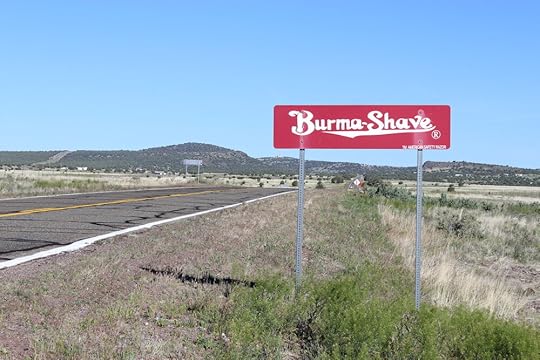
This one would rank higher on the list, except it’s not original. This replica is one of several that line a stretch of old Route 66 near Houck, Arizona. Burma-Shave erected thousands of signs, each in series of five or six lines that rhymed and touted the virtues of driving safely and (of course) using the company’s shaving cream. Learn more about Burma-Shave in Yesterday’s Highways.
29Fort Courage — Houck, Arizona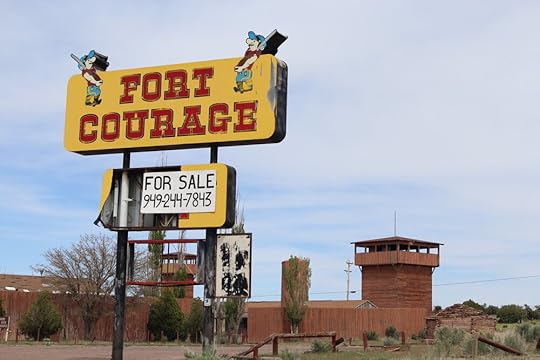
Just up the road from the Burma-Shave replicas on old Route 66 is this blast from the past: a now-abandoned tourist stop named after the fictional setting of TV’s F-Troop series, which starred Ken Berry, Forrest Tucker, and Larry Storch. The show was canceled in 1967 after its second season, and this roadside stop was eventually shut down, too.
28Chef’s Drive-In — Alta Vista, Virginia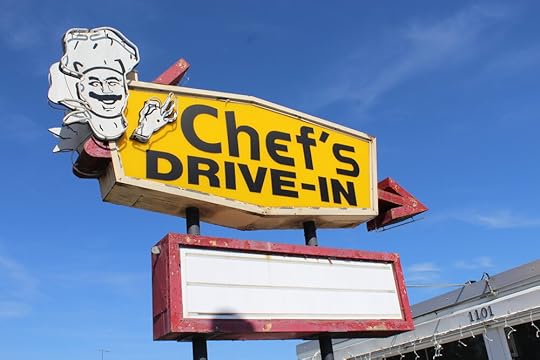
This old-school drive-in, which is sometimes spelled “drive-inn,” can be found at 1101 Main St. in Alta Vista, Va., otherwise known as U.S. Business Route 29. According to one newspaper review, it “hasn’t changed much since the days of carhops and poodle skirts.” You can give servers your order from the comfort of your car, or go inside and sit at one of four booths or the counter.
27Frontier Lanes — Selma, California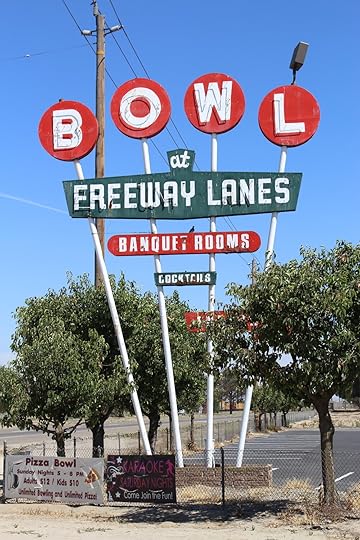
Bowling alleys were once common sights along highways across the country. Frontier Lanes, shown here, was built along Golden State Boulevard in Selma, California, a section of old Highway 99 now bypassed by a freeway just to the west. Bowling alleys and another highway staple, drive-in movie theaters, have both dwindled in number as interstates have replaced old rural highways.
26Mountaineer Inn — Asheville, North Carolina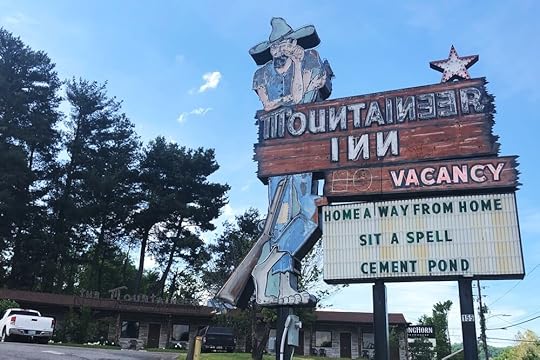
The Mountaineer Inn in Ashville, N.C., also features a neon Popeye on its roof. Its sign hails from a bygone era when neon signage reached its pinnacle, incorporating not just lettering but symbols (such as the star here) and intricately drawn figures. The invitation to “sit a spell” here is reminiscent of the old Beverly Hillbillies TV show.
25Fremont Street — Las Vegas, Nevada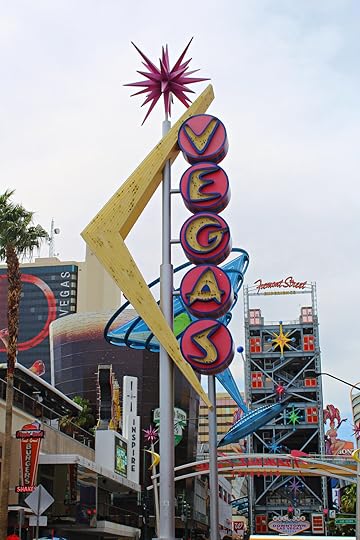
What would a celebration of signage be without a visit to Vegas? It would be a simple matter to include the iconic sign at the south end of the Strip, but this one at the north end of town is no less striking. It’s on Fremont Street, the original downtown gambling district, and features several other neon markers — including a replica of the south-end sign (lower right) and a neon showgirl in the distance.
24Pepsi-Cola — Roanoke, Virginia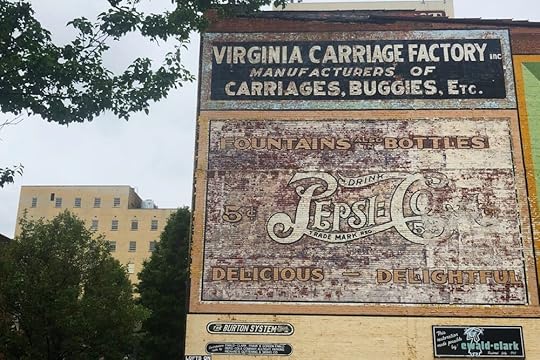
Billboards painted on the sides of buildings were once commonplace, and this one can still be seen in downtown Roanoke, Virginia. It advertises Pepsi-Cola and the Virginia Carriage Company. Over time, weather wore away the paint on the billboards, some of which were repainted, while others were left to fade into obscurity or painted over with other advertisements.
23Lim’s Cafe — Redding, California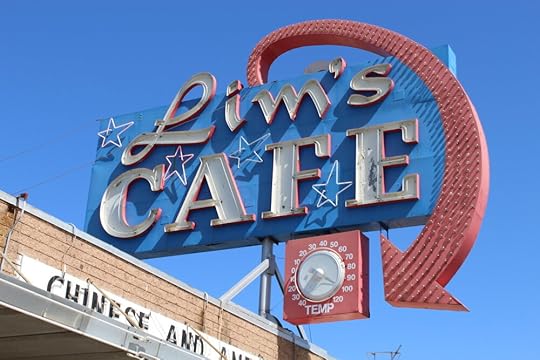
One of the most recognizable signs in Redding, California, this neon beauty could be found on a stretch of old Highway 99 (North Market Street) at the north end of town, where it moved in 1957. The restaurant was founded as a family business in the 1930s, serving up everything from Mongolian beef to burgers, milkshakes to mai tais.
22Western Motel — Santa Clara, California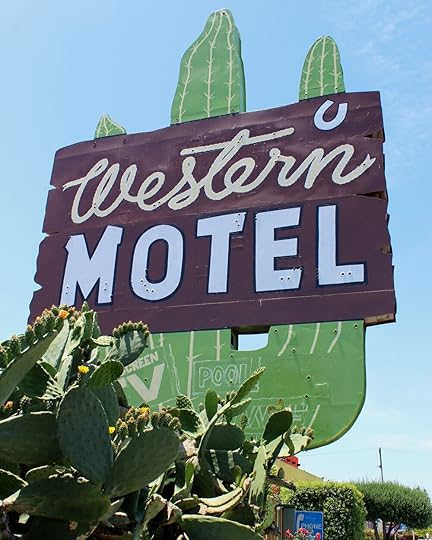
The Western Motel features one of the most distinctive signs in Northern California, a huge cactus. Unfortunately, the lights that once illuminated the sign at nigh have been removed, but you can still see the sign from a distance during the daytime. Built along U.S. 101, it can be found at 2250 El Camino Real in Santa Clara, California.
21Bill’s — Santa Maria, California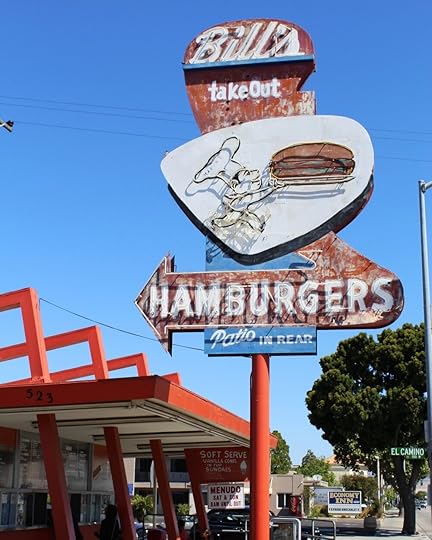
Another gem along old U.S. 101 — this time on a segment in Santa Maria, California — Bill’s Take Out stands along El Camino Real. It’s a throwback do the days of the drive-in, when you could get a burger for 15 cents and McDonald’s had plenty of competition from regional and local businesses like this one. It’s likely that the menudo mentioned on the lower sign is a more recent addition to the menu.
20McDonald’s — Fillmore, California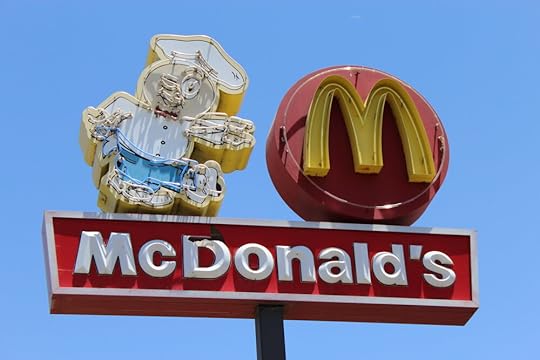
Speaking of the golden arches… Before there was Ronald McDonald, there was Speedee, the original McDonald’s mascot, a little guy in a chef’s hat seen here on this throwback Micky D’s location on State Route 126 in Fillmore. This entire area was submerged in a huge flood with the St. Francis Dam burst in 1928, one of the worst disasters on record. You can find a detailed account in my book on Highway 99.
1911-70 Motor Court — Knoxville, Tennessee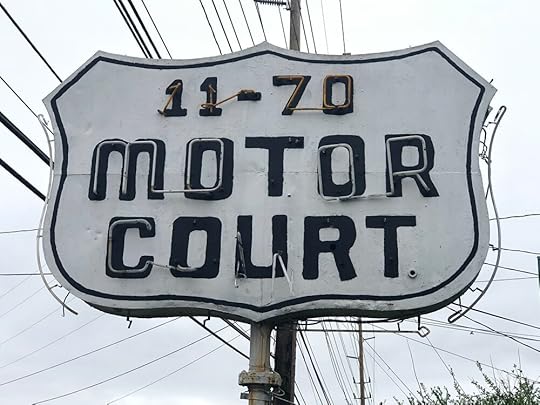
This iconic sign can be found along the old Dixie Lee Highway, south of Knoxville, Tennessee. The 11 and 70 are old federal highways that share the same routing in this area — the Dixie and Lee highways, names that date back before the federal highway system was created in 1926. The black-and-white U.S. highway shield forms the border of this motel sign. Find out more in my book America’s First Highways.
18Waylan’s Ku-Ku Burger — Miami, Oklahoma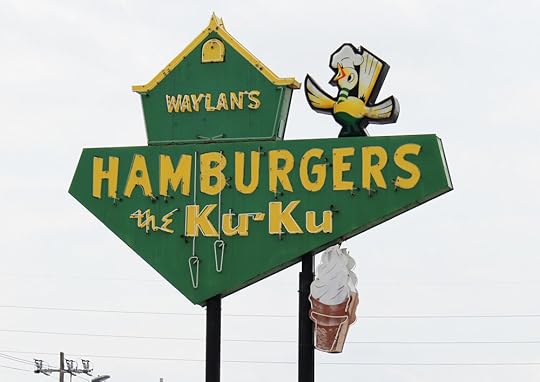
Ku-Ku Burger was once a thriving chain with as many as 200 locations in the Midwest during the mid-1960s, a time when McDonald’s had competition from chains like this one and Burger Chef. This sign’s got just about everything, from the birdhouse on top to the ice cream cone and, of course, the cuckoo bird in the chef’s hat. It’s a Route 66 icon, and the only one in the chain still left.
17Arby’s — Danville, Virginia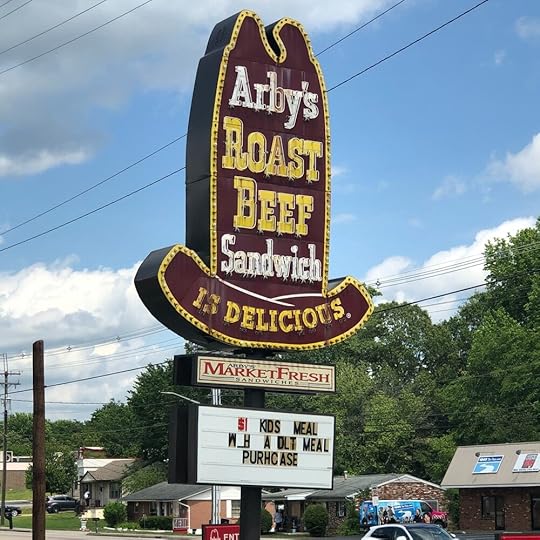
Arby’s has largely abandoned this iconic multi-lighted design in favor of cookie-cutter plastic box signs with lights inside. Thankfully, unlike the old-school Taco Bell and Jack-in-the-Box signs, a few of the original Arby’s models are still around. You can find this one in Danville, Virginia, in the southern part of the state, along U.S. Highway 29.
16Uranus — Uranus, Missouri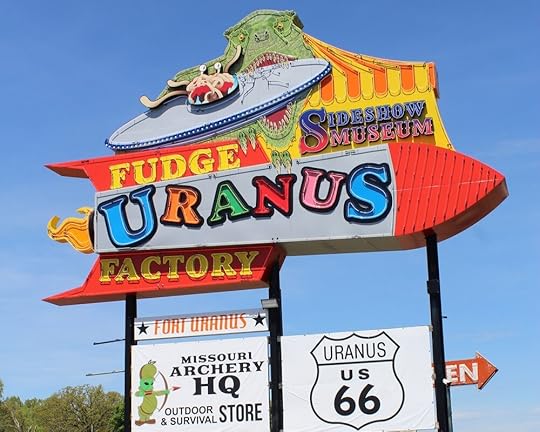
One of the newest and most expansive Route 66 roadside attractions, the Uranus Fudge Factory features everything from dinosaurs to spaceships and a whole lot of double-entendres. It looks like a collection of props from every movie set you can imagine, plus a store, a tattoo parlor, a museum, and a whole lot more. This sign, featuring a T-Rex and the Flying Spaghetti Monster, captures the spirit of the place perfectly.
15Eel River Cafe — Garberville, California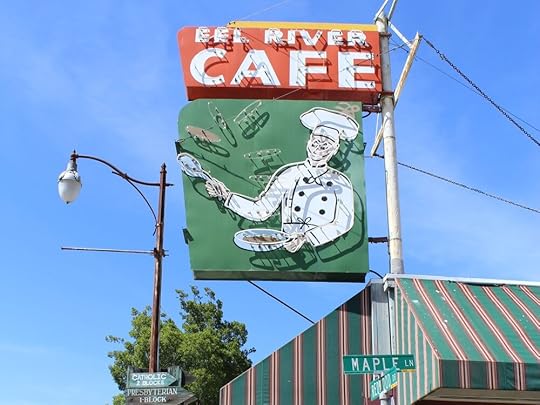
This sign, when seen at night, shows the chef flipping a pancake. Seven pancake outlines light up one at a time, in succession, showing a single pancake as it makes its way through the air from the chef’s spatula to his pan . The cafe along California’s Redwood Highway dates back to 1927, and the sign was added by 1952. For more about the Redwood Highway in Highway 101, the History of El Camino Real.
14Mail Pouch Tobacco — Lanesville, Indiana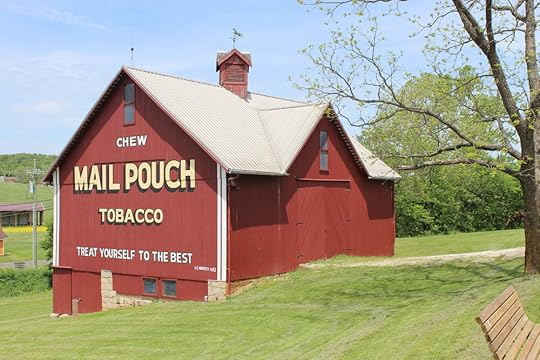
Mail Pouch Tobacco signs were ubiquitous in the early 20th century, adorning barns along numerous highways. Barn owners were paid a small fee to allow the West Virginia company to splash its name on one or two sides of the barn. A few of the barns remain, in various states of repair, many of them in the Ohio Valley and western Pennsylvania area. This restored sign is on Indiana Route 62 in Lanesville.
13Pink Motel — San Fernando, California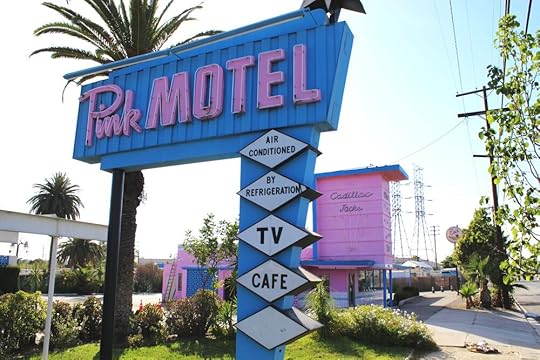
The Pink Motel along San Fernando Road, is one of the few remnants of an era in which motels lined this section of old Highway 99. A diner called Cadillac Jack’s is right next door. The motel has served as the backdrop for some Hollywood productions and is featured in my book Highway 99: The History of California’s Main Street.
12Palm Reader — Fowler, California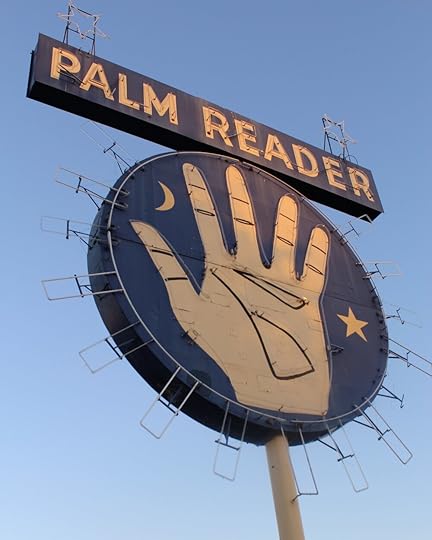
If you’re heading to Fresno from the south, you’ll know you’re almost there when you see this palm reader sign in Fowler, a small community just a few miles to the south on Highway 99. Palm reader signs along highways aren’t unusual, but this is one of the best ones you’re likely to find. It’s been there for about half a century, and (at least as of a couple of years ago) it still lights up at night.
11Hacienda Cowboy — Fresno, California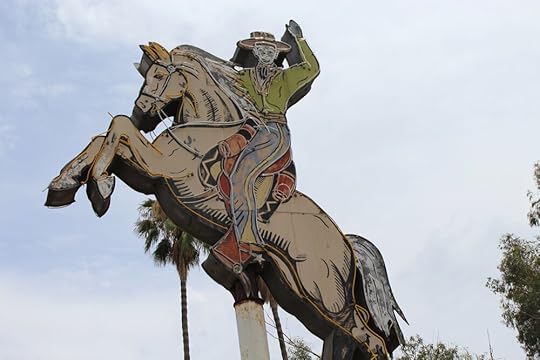
This neon (not rhinestone) cowboy once waved at travelers along Highway 99 in Fresno from his perch atop a sign at the Hacienda. The city’s most glamorous hotel during the 1960s, it hosted big-name entertainers and boxing matches in its heyday. The sign’s twin from the Las Vegas hotel of the same name is still visible at the north end of the Strip. Learn more about the Hacienda in my book Fresno Growing Up.
10James Dean — Blackwell’s Corners, California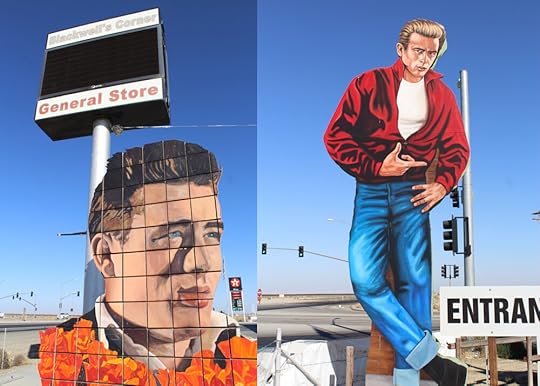
George Blackwell started a rest stop on California State Route 46 near Lost Hills, west of Bakersfield, in 1921. It was the last highway movie star James Dean drove on a trip that would end in a fatal car wreck near Paso Robles. These two signs at an intersection on Route 46 in the unincorporated community pay tribute to Dean in larger-than-life fashion.
9Star Theatre — Oceanside, California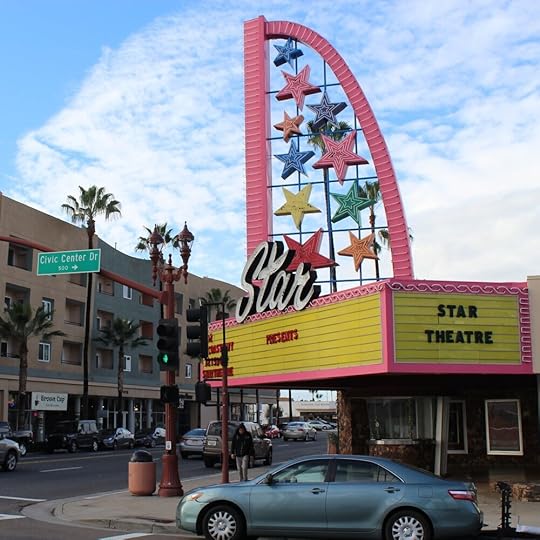
There are plenty of impressive theater signs and marquees along the nation’s highways. In California, the Ukiah, Crest (Fresno), and Fremont (San Luis Obispo) come to mind. But this one at 402 North Coast Highway in Oceanside, is among the most original and memorable. It opened in 1956, and the cascading stars have been lighting up U.S. 101 ever since.
8H&C Coffee — Roanoke, Virginia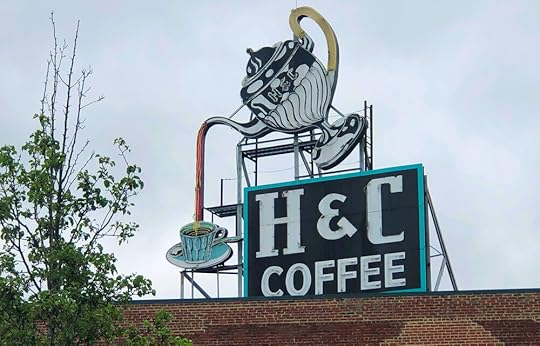
Built in 1948, the H&C Coffee sign in downtown Roanoke, Virginia, was originally animated: the coffee would appear to “pour” from the spout into the cup. That’s no longer the case, but it still lights up, sharing the skyline with a vintage Dr Pepper sign near the Roanoke City Market, a revitalized downtown district in this Southern city.
7Bakersfield Hotel — Bakersfield, California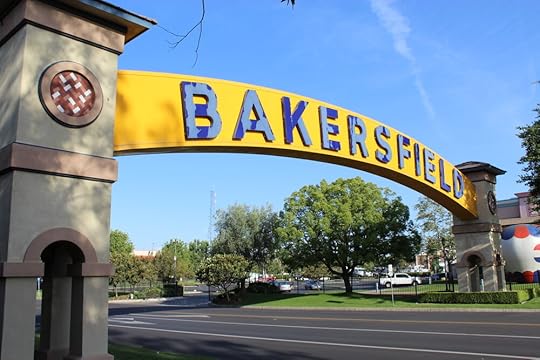
This sign at Buck Owens’ Crystal Palace, north Bakersfield, incorporates the original letters and design from the Bakersfield Inn Motel sign that once spanned old Highway 99 near the southern end of the city. The original sign was actually a bridge from one section of the motel to the other, across the highway. Country music star Owens salvaged the letters and recreated the sign on his property.
6Meadow Gold — Tulsa, Oklahoma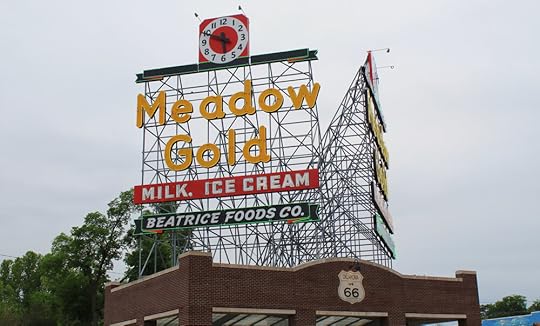
The Meadow Gold neon sign dates back to the 1930s in Tulsa, Oklahoma. It stood watch at 11th Street and Lewis Avenue until 2004, when the building that supported it was torn down. The sign, however, was saved and gifted to the city, which put it in storage until it could be reassembled and installed atop a single-story structure on historic Route 66.
5Henry’s — Cicero, Illinois
Who puts fries on their hot dog? Apparently, Chicagoans do — or at least patrons of this Route 66 fixture in Cicero, just south of the city. Henry’s has been open since the 1950s, serving up “a meal in itself”: a hot dog on a poppy-seed bun adorned with chopped onions, mustard, pickle relish, pepper, and of course those fries. Crazy stuff, but apparently very memorable, just like this iconic sign.
4Blue Swallow Motel — Tucumcari, New Mexico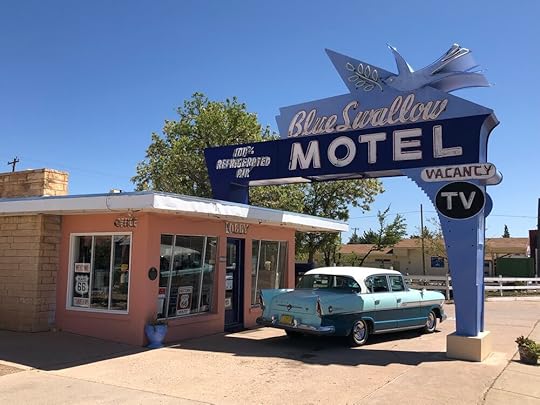
The Blue Swallow Motel is one of the must-see sights along Route 66. Located in Tucumcari, New Mexico, it’s the most iconic in a cluster of 66 relics and remnants. The 12-unit motel, built in 1939 and opened two years later, is on the National Register of Historic Places. it offered TV’s and “100% refrigerated air.” Pretty cool for a desert stop.
3Whiting Bros. — Moriarty, New Mexico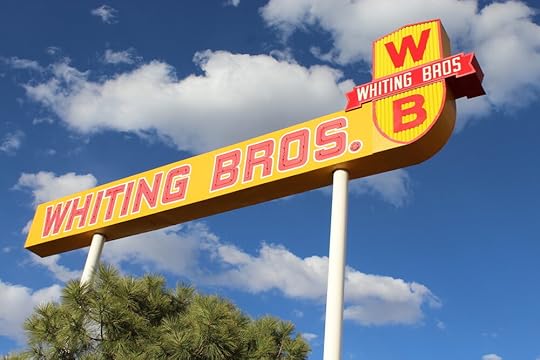
I was so taken with this restored sign in Moriarty, New Mexico, that I put it on the cover of Yesterday’s Highways. The Whiting Bros. chain was almost entirely a Route 66 phenomenon in the Southwest, with locations stretching from Texas to the Mojave Desert. The company has been out of business for many years, but its buildings and a few signs remain, mostly in Arizona, New Mexico, and eastern California.
2Madonna Inn — San Luis Obispo, California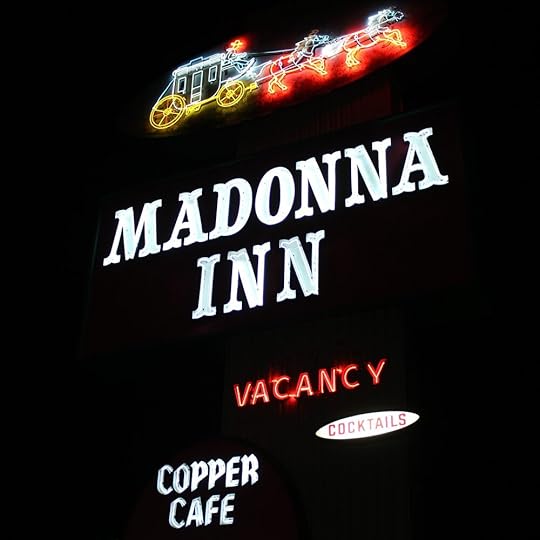
This neon masterpiece in San Luis Obispo, off U.S. 101, features a lighted horse-drawn carriage that appears to gallop along at night. How do you top that? Try a hotel with scores of themed rooms that fall somewhere between kitsch and luxury. This roadside inn was built by a contractor who actually built portions of many roads, as detailed in my book, Highway 101: The History of El Camino Real.
1Roy’s — Amboy, California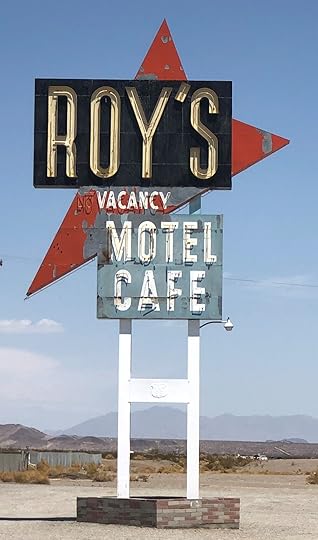
There’s nothing left in Amboy except for Roy’s. Even the school is closed, but the roadside gas stop and motel still welcome travelers in temperatures of up to 120 degrees in this Mojave Desert wasteland. Built along old Route 66, it stayed open after the Mother Road was bypassed by a modern interstate. The very fact that there’s nothing around for miles has helped make it one of the nation’s most recognizable signs.


30 distinctive roadside signs and where to find them
As I’ve traveled the country researching four books on America’s highways, I’ve seen a lot of signs: some shiny and new, others old and faded; some official, others anything but. They tell you where you are and where you’re going. They advertise some businesses and point the way to others.
What follows is a list of 30 signs that caught my eye: the most striking or intriguing I’ve seen so far. This is a brief pictorial overview of my favorites and where to find them. I hope you enjoy the trip.
30Burma-Shave — Houck, ArizonaThis one would rank higher on the list, except it’s not original. This replica is one of several that line a stretch of old Route 66 near Houck, Arizona. Burma-Shave erected thousands of signs, each in series of five or six lines that rhymed and touted the virtues of driving safely and (of course) using the company’s shaving cream. Learn more about Burma-Shave in Yesterday’s Highways.
29Fort Courage — Houck, ArizonaJust up the road from the Burma-Shave replicas on old Route 66 is this blast from the past: a now-abandoned tourist stop named after the fictional setting of TV’s F-Troop series, which starred Ken Berry, Forrest Tucker, and Larry Storch. The show was canceled in 1967 after its second season, and this roadside stop was eventually shut down, too.
28Chef’s Drive-In — Alta Vista, VirginiaThis old-school drive-in, which is sometimes spelled “drive-inn,” can be found at 1101 Main St. in Alta Vista, Va., otherwise known as U.S. Business Route 29. According to one newspaper review, it “hasn’t changed much since the days of carhops and poodle skirts.” You can give servers your order from the comfort of your car, or go inside and sit at one of four booths or the counter.
27Frontier Lanes — Selma, CaliforniaBowling alleys were once common sights along highways across the country. Frontier Lanes, shown here, was built along Golden State Boulevard in Selma, California, a section of old Highway 99 now bypassed by a freeway just to the west. Bowling alleys and another highway staple, drive-in movie theaters, have both dwindled in number as interstates have replaced old rural highways.
26Mountaineer Inn — Asheville, North CarolinaThe Mountaineer Inn in Ashville, N.C., also features a neon Popeye on its roof. Its sign hails from a bygone era when neon signage reached its pinnacle, incorporating not just lettering but symbols (such as the star here) and intricately drawn figures. The invitation to “sit a spell” here is reminiscent of the old Beverly Hillbillies TV show.
25Fremont Street — Las Vegas, NevadaWhat would a celebration of signage be without a visit to Vegas? It would be a simple matter to include the iconic sign at the south end of the Strip, but this one at the north end of town is no less striking. It’s on Fremont Street, the original downtown gambling district, and features several other neon markers — including a replica of the south-end sign (lower right) and a neon showgirl in the distance.
24Pepsi-Cola — Roanoke, VirginiaBillboards painted on the sides of buildings were once commonplace, and this one can still be seen in downtown Roanoke, Virginia. It advertises Pepsi-Cola and the Virginia Carriage Company. Over time, weather wore away the paint on the billboards, some of which were repainted, while others were left to fade into obscurity or painted over with other advertisements.
23Lim’s Cafe — Redding, CaliforniaOne of the most recognizable signs in Redding, California, this neon beauty could be found on a stretch of old Highway 99 (North Market Street) at the north end of town, where it moved in 1957. The restaurant was founded as a family business in the 1930s, serving up everything from Mongolian beef to burgers, milkshakes to mai tais.
22Western Motel — Santa Clara, CaliforniaThe Western Motel features one of the most distinctive signs in Northern California, a huge cactus. Unfortunately, the lights that once illuminated the sign at nigh have been removed, but you can still see the sign from a distance during the daytime. Built along U.S. 101, it can be found at 2250 El Camino Real in Santa Clara, California.
21Bill’s — Santa Maria, CaliforniaAnother gem along old U.S. 101 — this time on a segment in Santa Maria, California — Bill’s Take Out stands along El Camino Real. It’s a throwback do the days of the drive-in, when you could get a burger for 15 cents and McDonald’s had plenty of competition from regional and local businesses like this one. It’s likely that the menudo mentioned on the lower sign is a more recent addition to the menu.
20McDonald’s — Fillmore, CaliforniaSpeaking of the golden arches… Before there was Ronald McDonald, there was Speedee, the original McDonald’s mascot, a little guy in a chef’s hat seen here on this throwback Micky D’s location on State Route 126 in Fillmore. This entire area was submerged in a huge flood with the St. Francis Dam burst in 1928, one of the worst disasters on record. You can find a detailed account in my book on Highway 99.
1911-70 Motor Court — Knoxville, TennesseeThis iconic sign can be found along the old Dixie Lee Highway, south of Knoxville, Tennessee. The 11 and 70 are old federal highways that share the same routing in this area — the Dixie and Lee highways, names that date back before the federal highway system was created in 1926. The black-and-white U.S. highway shield forms the border of this motel sign. Find out more in my book America’s First Highways.
18Waylan’s Ku-Ku Burger — Miami, OklahomaKu-Ku Burger was once a thriving chain with as many as 200 locations in the Midwest during the mid-1960s, a time when McDonald’s had competition from chains like this one and Burger Chef. This sign’s got just about everything, from the birdhouse on top to the ice cream cone and, of course, the cuckoo bird in the chef’s hat. It’s a Route 66 icon, and the only one in the chain still left.
17Arby’s — Danville, VirginiaArby’s has largely abandoned this iconic multi-lighted design in favor of cookie-cutter plastic box signs with lights inside. Thankfully, unlike the old-school Taco Bell and Jack-in-the-Box signs, a few of the original Arby’s models are still around. You can find this one in Danville, Virginia, in the southern part of the state, along U.S. Highway 29.
16Uranus — Uranus, MissouriOne of the newest and most expansive Route 66 roadside attractions, the Uranus Fudge Factory features everything from dinosaurs to spaceships and a whole lot of double-entendres. It looks like a collection of props from every movie set you can imagine, plus a store, a tattoo parlor, a museum, and a whole lot more. This sign, featuring a T-Rex and the Flying Spaghetti Monster, captures the spirit of the place perfectly.
15Eel River Cafe — Garberville, CaliforniaThis sign, when seen at night, shows the chef flipping a pancake. Seven pancake outlines light up one at a time, in succession, showing a single pancake as it makes its way through the air from the chef’s spatula to his pan . The cafe along California’s Redwood Highway dates back to 1927, and the sign was added by 1952. For more about the Redwood Highway in Highway 101, the History of El Camino Real.
14Mail Pouch Tobacco — Lanesville, IndianaMail Pouch Tobacco signs were ubiquitous in the early 20th century, adorning barns along numerous highways. Barn owners were paid a small fee to allow the West Virginia company to splash its name on one or two sides of the barn. A few of the barns remain, in various states of repair, many of them in the Ohio Valley and western Pennsylvania area. This restored sign is on Indiana Route 62 in Lanesville.
13Pink Motel — San Fernando, CaliforniaThe Pink Motel along San Fernando Road, is one of the few remnants of an era in which motels lined this section of old Highway 99. A diner called Cadillac Jack’s is right next door. The motel has served as the backdrop for some Hollywood productions and is featured in my book Highway 99: The History of California’s Main Street.
12Palm Reader — Fowler, CaliforniaIf you’re heading to Fresno from the south, you’ll know you’re almost there when you see this palm reader sign in Fowler, a small community just a few miles to the south on Highway 99. Palm reader signs along highways aren’t unusual, but this is one of the best ones you’re likely to find. It’s been there for about half a century, and (at least as of a couple of years ago) it still lights up at night.
11Hacienda Cowboy — Fresno, CaliforniaThis neon (not rhinestone) cowboy once waved at travelers along Highway 99 in Fresno from his perch atop a sign at the Hacienda. The city’s most glamorous hotel during the 1960s, it hosted big-name entertainers and boxing matches in its heyday. The sign’s twin from the Las Vegas hotel of the same name is still visible at the north end of the Strip. Learn more about the Hacienda in my book Fresno Growing Up.
10James Dean — Blackwell’s Corners, CaliforniaGeorge Blackwell started a rest stop on California State Route 46 near Lost Hills, west of Bakersfield, in 1921. It was the last highway movie star James Dean drove on a trip that would end in a fatal car wreck near Paso Robles. These two signs at an intersection on Route 46 in the unincorporated community pay tribute to Dean in larger-than-life fashion.
9Star Theatre — Oceanside, CaliforniaThere are plenty of impressive theater signs and marquees along the nation’s highways. In California, the Ukiah, Crest (Fresno), and Fremont (San Luis Obispo) come to mind. But this one at 402 North Coast Highway in Oceanside, is among the most original and memorable. It opened in 1956, and the cascading stars have been lighting up U.S. 101 ever since.
8H&C Coffee — Roanoke, VirginiaBuilt in 1948, the H&C Coffee sign in downtown Roanoke, Virginia, was originally animated: the coffee would appear to “pour” from the spout into the cup. That’s no longer the case, but it still lights up, sharing the skyline with a vintage Dr Pepper sign near the Roanoke City Market, a revitalized downtown district in this Southern city.
7Bakersfield Hotel — Bakersfield, CaliforniaThis sign at Buck Owens’ Crystal Palace, north Bakersfield, incorporates the original letters and design from the Bakersfield Inn Motel sign that once spanned old Highway 99 near the southern end of the city. The original sign was actually a bridge from one section of the motel to the other, across the highway. Country music star Owens salvaged the letters and recreated the sign on his property.
6Meadow Gold — Tulsa, OklahomaThe Meadow Gold neon sign dates back to the 1930s in Tulsa, Oklahoma. It stood watch at 11th Street and Lewis Avenue until 2004, when the building that supported it was torn down. The sign, however, was saved and gifted to the city, which put it in storage until it could be reassembled and installed atop a single-story structure on historic Route 66.
5Henry’s — Cicero, IllinoisWho puts fries on their hot dog? Apparently, Chicagoans do — or at least patrons of this Route 66 fixture in Cicero, just south of the city. Henry’s has been open since the 1950s, serving up “a meal in itself”: a hot dog on a poppy-seed bun adorned with chopped onions, mustard, pickle relish, pepper, and of course those fries. Crazy stuff, but apparently very memorable, just like this iconic sign.
4Blue Swallow Motel — Tucumcari, New MexicoThe Blue Swallow Motel is one of the must-see sights along Route 66. Located in Tucumcari, New Mexico, it’s the most iconic in a cluster of 66 relics and remnants. The 12-unit motel, built in 1939 and opened two years later, is on the National Register of Historic Places. it offered TV’s and “100% refrigerated air.” Pretty cool for a desert stop.
3Whiting Bros. — Moriarty, New MexicoI was so taken with this restored sign in Moriarty, New Mexico, that I put it on the cover of Yesterday’s Highways. The Whiting Bros. chain was almost entirely a Route 66 phenomenon in the Southwest, with locations stretching from Texas to the Mojave Desert. The company has been out of business for many years, but its buildings and a few signs remain, mostly in Arizona, New Mexico, and eastern California.
2Madonna Inn — San Luis Obispo, CaliforniaThis neon masterpiece in San Luis Obispo, off U.S. 101, features a lighted horse-drawn carriage that appears to gallop along at night. How do you top that? Try a hotel with scores of themed rooms that fall somewhere between kitsch and luxury. This roadside inn was built by a contractor who actually built portions of many roads, as detailed in my book, Highway 101: The History of El Camino Real.
1Roy’s — Amboy, CaliforniaThere’s nothing left in Amboy except for Roy’s. Even the school is closed, but the roadside gas stop and motel still welcome travelers in temperatures of up to 120 degrees in this Mojave Desert wasteland. Built along old Route 66, it stayed open after the Mother Road was bypassed by a modern interstate. The very fact that there’s nothing around for miles has helped make it one of the nation’s most recognizable signs.
December 21, 2020
What if you could tip someone, and it cost you nothing?
What if, instead of calculating 15% or 20% or whatever, you could just put a card on the table that said “good service.” And what if that was just what servers wanted, because the more of these cards they collected, the better it looked to their bosses, and the more likely they were to get a raise.
Unfortunately, tipping doesn’t work like that. People who leave cards on the table at a restaurant are viewed as cheapskates who are actually eating into the income of the server. Tips are viewed as part of their wages by the U.S. government, so their employer can actually give them hourly pay that’s less than the minimum wage — a lot less.
In fact (as of December 2020), employees who receive tips could actually get as little as $2.13 an hour in hourly wages, as long as their tips bring them up to the minimum of $7.25.
And it’s not just restaurant waiters. Tipping can apply to a wide range of service employees to hotel workers to hairdressers, valets to skycaps, cab drivers to baristas. (Don’t try to tip a government worker or police officer, though: It’s illegal and might be considered bribery.)
Tips are taxed in the U.S., because they’re part of wages. Employees have to report them as income, not gifts — even though the word “gratuity” refers to “something given voluntarily or beyond obligation.” Sounds like a gift to me. The IRS assumes that restaurants generate at least 8 percent in tips, and if they report less than this, it’s a red flag to auditors, so if you tip less than 8 percent, it can get problematic.
Other countries are different. Some don’t tax tips, but instead impose a value added tax (VAT) that goes directly to the government, the way a sales tax would. This has always made more sense to me, because the original idea of a tip was a voluntary “thank you” for good service. When it becomes mandatory, or a guilt trip, it kind of negates the entire concept.
But because service workers depend on tips to bridge the gap between the tipped wage of $2.13 and the minimum wage — and because even that isn’t enough to live on — service workers need that money.
No money needed?Now imagine you had the opportunity to tip a worker who makes less than minimum wage without taking any money out of your pocket. You can’t do that with a restaurant server, but you can do it with another kind of worker who might give you just as much enjoyment, if you like to read.
All you have to do is leave a book review or rating. That’s it. No extra fee, and the books themselves are usually about the price of a meal (sometimes less) anyway. There’s a myth out there that people who have their names on books make a good living. Most of us don’t. Many of us, like restaurant servers, make less than minimum wage, and we don’t get gratuities to make up the difference.
In 2017, median income was just $6,080 for all published authors and $20,300 for full-time authors. That second figure pencils out to $10.15 an hour for 50 weeks of work at 40 hours — less than the current (2020) minimum wage in 16 states and well under the $15 level that fast food workers have been advocating for since 2012. That’s eight years ago.
Some food service workers share their tips with cooks, hosts, and other restaurant employees. In the same way, we authors need to pay editors, cover designers, etc.
Authors count on a different kind of tips — reviews and ratings — to raise the profile of our books and help us make a little more money. The good news is, it doesn’t cost readers a thing to leave this kind of tip.
The bad news, for authors anyway, is twofold. First, they risk getting bad reviews, which can be worse than leaving no tip at all in a restaurant; it’s more like asking to see the manager, and then letting them know how bad your service was. The worst part is, though, that most readers don’t leave reviews at all — or even ratings, which (on Amazon, anyway) just require you to hover over a series of stars and click 1, 2, 3, 4, or 5.
Easy peasy. But most people don’t do it. Unlike tipping, it’s not part of the culture, which means authors have to go begging for reviews. We ask people at public events, put notices in the back of our books and on our websites. We even pay to sign up for book blog tours and websites like NetGalley that offer reviews... which would be like a waiter paying you to eat at her table just so she could receive a tip. This is what desperation looks like.
So, when it comes right down to it, this post is another plea for reviews. If you’ve liked my books, or any author’s work, please leave a review or a rating, and try to get in the habit of doing so whenever you buy a book, just the way you’d leave a tip at a restaurant. You won’t have to open your wallet, and it won’t cost you anything but a moment of your time.
Believe me, the author you help will be extremely grateful.
Featured photo by Adeeto, Creative Commons 4.0
December 15, 2020
Amazon’s book reviews are a mess: Here’s how to fix them
It may be hard to remember now, but Amazon started out as a book-selling website. That’s what makes it so ironic that, more than 25 years later, it still hasn’t figured out how to fairly curate reviews of, well, books.
Maybe it should stop trying.
Full disclosure: Like any other author, I watch my reviews. For a while, a was very sensitive to them, basking in positive reviews and having a conniption fit over the bad ones. I’ve gotten a lot more good reviews than negatives, but I’ve stopped paying quite as much attention to them because the entire process is so poorly defined and managed.
My ego’s only marginally involved these days; I’m confident in my writing ability, and anyone who wants to disagree is free to do so. I’ll accept constructive criticism and put the haters where they belong.
The problem is that negative reviews can hurt sales, and this is especially true on lightly reviewed books. A whopping 82% of customers seek out negative reviews, and negative reviews can stop 4 in 10 people from using a business. While binge-watching the comedy show Schitt’s Creek on Netflix, I came across an episode titled “Motel Review,” in which motel owner Johnny Rose (Eugene Levy) complains that, after four positive reviews, one bad notice has tanked the business’ overall rating.
Most people who run small businesses have felt his pain.
Amazon’s flawed modelWith Amazon, it’s even worse.
For some inexplicable reason, Amazon doesn’t weigh all reviews the same, using a “machine learned model” (whatever that is) rather than a raw data average. The company explains its policy as follows: “The machine learned model takes into account factors including: the age of a review, helpfulness votes by customers and whether the reviews are from verified purchases.”
Three factors are listed. Let’s take them one by one.
Verified purchases count for more. This is, ostensibly, to curb bogus reviews — which it may do to some extent. But make no mistake about it, the main reason behind this policy is not to improve the quality of reviews. It’s to encourage authors to sell their books via Amazon, rather than through Barnes & Noble, at book shows, etc. (If you doubt this, note that Amazon offers extra money through KDP Select page views... but only to authors who sell their books exclusively on Amazon.)
Helpfulness votes by customers are also considered, but this isn’t particularly fair, because the person who’s scared away from something by a negative review is more likely to say it was “helpful” than someone intrigued by a positive one. There are two reasons for this:
First, people are more likely to look at negative reviews in the first place, because they want a reason not to spend their money. This is particularly true in lean economic times. Selling a book, or any product is a four-step process: You have to reach your audience, intrigue that audience, persuade that audience to buy your product, and then deliver a quality experience. Not buying something involves just one step: deciding it’s not worth the money.
Second, people are much more likely to mark a negative review as “helpful” because they’re already on the site. It’s easy to see a scathing review, breathe a sigh of relief that you didn’t buy the product, and click that “helpful” button. But in order to find a positive review helpful, you’ll have to buy the product, leave the site, wait for the product to arrive, use the product, and then return to the site, find the review, and click “helpful.” That sounds exhausting just writing it.
Negative reviews affect things far more than positive ones do, and even more than you might expect. The National Strategic Group suggests you need 10-12 good reviews to offset a single bad one. (Because 1 in 5 bad reviews are posted out of revenge, and others write critical reviews to feel knowledgeable or “superior,” this makes getting a good average more of an uphill slog.)
The third criterion Amazon uses is perhaps the most ridiculous of all: how recent the review is. This makes sense for a service, the quality of which may have declined over time —a restaurant that has changed ownership, for example, or a motel that’s gone downhill. But it’s an absurd standard to apply to static products such as books. They may have been published in 1950, but they’re still the same in 2020.
Books aren’t T-shirtsBut there’s another crucial difference between books and other products sold on Amazon: they’re creative products, which means they’re largely subject to viewer tastes.
Say you buy a cellphone that starts malfunctioning right out of the box, or an “assembly required” item with missing pieces, or a T-shirt that doesn’t fit because the sizing’s wrong. Those are all technical issues. You can’t really argue with them. But books are different. When a reader doesn’t like a book, it’s usually all about taste. The eye of the beholder. Yes, some books are better than others, but their shortcomings are far harder to quantify unless they arrive with a cracked binding or riddled with grammatical errors.
To make matters worse, Amazon now allows people to simply rate books (from 1 to 5 stars) without even leaving a review, and these ratings sometimes get weighted higher than actual reviews. Stars alone don’t tell you what’s good or bad about a product, so they can’t possibly be more “helpful” than a detailed critique. Plus, they’re left anonymously, which reduces accountability.
How to fix itThe result of all this is an unfair and misleading system that’s skewed against authors and publishers. Because people are more likely to leave and read negative reviews than positive ones, fairness would dictate that — if there’s any “weighting” to be done — it should actually favor good reviews.
The “helpful” button should be eliminated. People who read reviews can decide for themselves whether they’re helpful or not. That would also eliminate the practice of Amazon highlighting the most helpful positive and negative reviews, which often highlight the most scathing criticisms just because they stopped people from spending their money. While that may be “helpful” to their bank accounts, it says nothing about the quality of the book.
Amazon should also separate out quality and creative reviews. For example, a company shouldn’t get a bad quality review if an item arrives broken because it was damaged in shipping, yet Amazon lumps these reviews in with all the others.
And hey, Amazon, stop treating books like T-shirts and smartphones. You’re not just lumping apples in with oranges; you’re putting ketchup on ice cream.
When it comes to books, there should at the very least be two categories: One for creative content and the other for technical issues such as editing and the book’s condition. A customer could be asked to check either of these boxes upon beginning a review, and could be given the option of writing separate reviews on both topics.
Amazon should use recency ratings only for services that may decline over time, not for static products. And it should revisit the idea of allowing users to leave anonymous ratings without reviews attached. They don’t help buyers make an informed decision, and they can damage reputations without any accountability as to why.
All told, Amazon’s current review policy is a mess. It doesn’t take into account the psychology of reviewing, and it’s patently unfair to authors and publishers. It’s not even fair to customers, who may be scared off perfectly good products because negative reviews are overemphasized. The only people who really benefit are the reviewers.
And, of course, Amazon, which loves those “verified purchases.”
December 8, 2020
How to deal with COVID: Strategies for authors
Like many others, I’ve been largely confined to my home office for the past nine months. In some ways, that’s not as bad as it might sound.
As an only child and natural introvert, I’m a lot less affected by isolation as an extrovert might be. Being here at home just gives me more time to write, and I’ve taken advantage of it. I’ve released eight books and a new edition of another in 2020, making it my most productive year to date.
On the flipside, I haven’t been able to attend any author events or book signings. Four regular appearances — one in the spring and three in the fall — were all canceled. No TV appearances, either. As someone who suffers mild asthma and seasonal bronchial problems anyway, I wasn’t about to enter a TV studio to sell a few books.
I miss having the opportunity to interact with readers (in a limited way, at least: I am an introvert), especially since I’m not on social media apart from this blog and some Facebook pages my wife curates. But with fewer distractions, I have more time to brainstorm, research, and write.
Here are a few ways I’ve learned to cope with the pandemic.
Seize opportunityEvery hour you’re not going out to dinner or a movie or shopping at the mall is an hour you can dedicate to writing. (OK, most people don’t do that anymore anyway, but I’ve got a book on department stores and shopping malls due out in the next year or two, so I’ve got to mention it.) The fewer distractions you have, the more focused you’ll be.
I don’t do video games, and while some may question whether it’s worth it to disengage from Facebook and Twitter, it has been for me. I found myself spending far too much time dealing with trolls and worrying about what other people thought. Once I cut the cord, I could still use various news feeds to keep up on current events, without worrying about the backlash.
Comments aren’t enabled on this site for the same reason. Lo and behold, since I’ve become far less concerned with negative Amazon reviews than I used to be. It’s been great for my mental health.
Find your spaceSome writers go out to the library or a coffeeshop to write. If so, the pandemic has probably put a big damper on your normal routine. Fortunately, coffeehouses like Starbucks often have outdoor seating, which, if socially distanced, can be a great option.
Maybe you’re comfortable writing on your laptop from bed or at the kitchen table. That’s never been my style. I prefer to write on a PC whenever I can. It just feels more stable, somehow. If you’re like me, the extra time is a great opportunity to set up your own space.
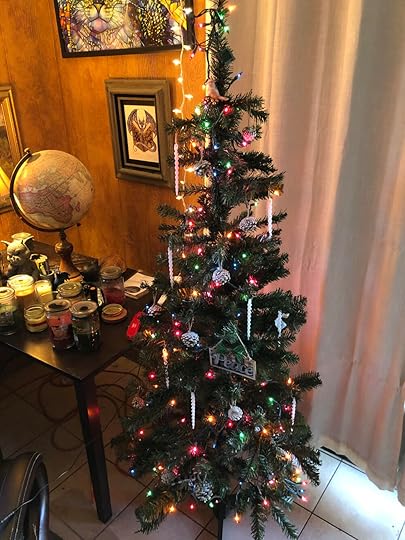
That’s what I did with our finished basement. I hung pictures, set up a horseshoe-shaped desk, hung some tapestries to define my workspace, hung some strings of white lights, and even set up a Christmas tree. I’ve got a bookshelf and some knick-knacks, and I’ve usually got a candle burning (evergreen spruce is my favorite). It’s the perfect writer’s sanctuary, at least for me.
You can see a bit of my workspace on my website’s new cover photo, and here (I even set up a Christmas tree):
Update your website
Speaking of websites, updating yours is a great way to stay productive on days when you want a break from writing. It’s a different kind of project that requires a different sort of creativity, so you’ll be guarding against burnout and rejuvenating yourself at the same time.
Plus, you won’t feel guilty about doing something that’s “not writing,” because it’ll still be related to your writing career.
Feeling uninspired to write anything this weekend, I decided to do a major revamp on my site, which had looked pretty much the same for the past four years or so. I changed the color scheme; reordered and retitled the pages to make them more easily searchable; changed the font and increased the size to make it more legible. And yes, I’d let some things lapse, so I updated several pieces of content and added info about some of those new books I’d published.
Set goalsWhether you’re a full-time writer or someone who has a “day job” working from home during the pandemic, it can be hard to stay home all the time. Hours can bleed together, and one week can blur into the next until you lose track of the calendar — especially with no outside events on your schedule.
Setting goals, whether they be word counts, timed sprints, or deadlines, or can allow you to define your days and celebrate concrete achievements. Allow yourself the grace to move a deadline if you need to, but don’t make a habit of doing it: That can lead to discouragement and a pattern of procrastination you may find it hard to shake.
Goals are your friends because they frame your days and keep them from becoming a continuous, amorphous slog. But it’s not just that. When you achieve your goals, it gives you an emotional boost that can propel you into your next big project (after a short break to celebrate with a glass of wine or movie-binge weekend).
Change things upSometimes, you don’t have this luxury, but if you do, it’s a great way of keeping your juices flowing.
Don’t make your writing goals so rigid that you don’t leave time for anything else. For one thing, there are different kinds of writing. Here are some ways to stay writing — and productive — while keeping your projects varied enough to stave off fatigue and “writer’s block” (at least one source of it).
Work on your newsletter if you have one. (Confession: I don’t. I found that emailed newsletters were often unwelcome — even if they’d been requested — and seldom effective in producing sales. But others have had better experiences.)
Write a blog.
Try a different genre. If you’re a novelist, work on some nonfiction, or vice versa. Try poetry.
Other ways to stay busyUpdate your Amazon, Goodreads, or other author page.
Update your Amazon categories for better targeting.
Research and set up ads on Amazon, Facebook, or elsewhere. Take some time to explore, then conduct some trials before jumping in with both feet. There are plenty of tutorials online about how to do this.
Network with other authors online.
Explore audiobooks.
Go virtual: You might not be able to do readings person, but you can still do them online via YouTube, Zoom, Skype, or on your website.
Map out a tentative post-pandemic calendar with events you’re reasonably sure will be a “go” when restrictions are lifted.
Read other authors’ blogs for ideas.
Browse cover artists’ collections online for inspiration.
If sales are down, explore various relief options that may be available to you.
Strategize on how to target your audience effectively.
Write and send press releases.
September 9, 2020
Movie review: "The Lighthouse" is as empty as Al Capone's vault
A story ain’t a story without a plot.
You may have learned in school that a story consists of five elements. You set the scene and introduce your characters with your exposition. There’s rising action, which sets up the conflict and leads to a climax — the turning point in the story. After that, there’s falling action, as you move toward your ultimate destination: the resolution of your conflict.
Poems don’t work like this. They can be word pictures or mood pieces or character sketches. But those things aren’t stories.
Written prose and movies aren’t supposed to be like reading a poem or, to use another analogy, looking at a painting in an art gallery.
Imaging staring at a painting for two hours (if you’re watching a movie) or six hours (if you’re reading a book). You’ll fall asleep. This is the effect of a novel or movie without a plot.
Case in point: The Lighthouse, a critically lauded 2019 film starring Willem Dafoe and Robert Pattinson.
It’s as if writer-director Robert Eggars has served his audience a jar full of frosting without bothering to bake a cake. It’ll leave you feeling cheated and make you sick to your stomach in the bargain. I wanted to like The Lighthouse because the frosting tasted good. At first. I kept eating layer after layer of it, hoping I’d get to the cake.
But I never did; it just made me ill.
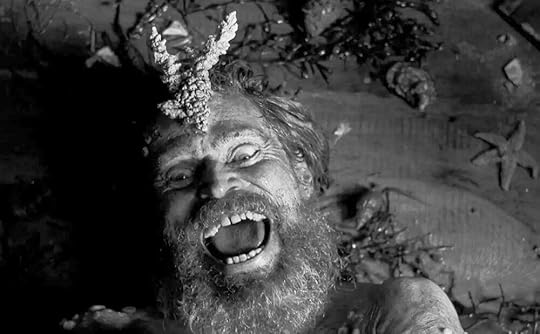
Piling on the pretenseEggars has created a haunting atmosphere, with black-and-white photography, churning waves, howling winds, a lonely setting in a forgotten corner of the world. He’s hired a cinematographer, Jarin Blaschke, who earned an Oscar nomination for his work. He’s cast two fine actors who give strong performances — especially Dafoe, who portrays the lighthouse keeper as an archetypal old sea captain so skillfully he transcends the stereotypes he draws upon.
But he doesn’t tell a story. There’s no “there” there.
IMDb summarizes The Lighthouse as follows: “Two lighthouse keepers try to maintain their sanity whilst living on a remote and mysterious New England island in the 1890s.”
If you’ve read that sentence, you might as well have seen the movie. That’s really all that happens in 110 minutes.
I’d say there are spoilers ahead, because I’ll refer to certain things that happen in the film. But you can’t really spoil anything if nothing of substance ever happens. Nevertheless, if you don’t like knowing certain things in advance, stop reading here.
Nonsense and dead endsI like a good psychological thriller: one that’s riddled with twists and turns, and unexpected revelations that lead to a chilling climax and a memorable conclusion. Think The Sixth Sense or The Matrix. If you want a movie that explores the tragic process of losing one’s marbles and actually goes somewhere, check out Joker.
Avoid The Lighthouse. There’s none of that here.
Without a bona fide plot to work with, Eggars somehow manages to fill up nearly two hours’ worth of film with loose ends, dead ends, and irrelevant nonsense. Pattinson’s character encounters a mermaid and sees Dafoe turn into a giant squid. Both characters get drunk. A lot. And masturbate. (Now that’s entertainment!) Dafoe launches into a soliloquy that’s impressive — not because of anything he says, but because it demonstrates he can recite so much material in one take.
But none of this advances the plot, because there is no plot.
Predictable and tedious
There’s also nothing unexpected about the movie, which is galling in the extreme precisely because it introduces threads in the non-plot that are neither explained nor resolved.
Pattinson’s revelation that he isn’t who he said he was seems significant, but it doesn’t have any bearing on where the movie winds up. He and Dafoe both end up dead, and they would have wound up dead with or without that revelation.
It’s never entirely clear whether Pattinson’s visions of the mermaid and the giant squid are real or hallucinations. I assume they’re the latter, but they don’t reveal anything about the character other than the fact that he’s going bonkers.
There’s the barest thread of a conflict that appears occasionally in the movie: The lighthouse keeper (Dafoe) jealously refuses to allow his assistant (Pattinson) to climb up and tend to the light. Near the end, Pattinson finally gains access to it. He climbs the staircase and enters the room. A cut-glass panel opens in front of him, and he gazes into the light, but we, the audience, never see what — if anything — he discovers.
The film’s tagline is, “The light has its mysteries.” But those mysteries, if they even exist outside the characters’ warped minds, are never resolved. We don’t even learn the answer to the most nagging of questions: why Dafoe’s character tries to smoke his pipe upside down.
Varied opinionsA lot of people liked this movie. Rotten Tomatoes gives it an audience rating of 72 percent, and the critics’ score is even higher. Maybe, for them, the cinematography, the bleak landscape, and the actors’ performances were enough to offset the lack of a plot.
But among those who didn’t enjoy it, the most frequent comments criticized its lack of plot, art-house pretensions and pointlessness. As one reviewer put it: “I'll never regain the two hours I lost watching this dreck.”
The Lighthouse is an artfully disguised exercise in the old bait-and-switch. Imagine you’re Dorothy and you’ve traveled down the Yellow Brick Road to the Emerald City, only to find out the wizard is really a snake-oil salesman hiding behind a curtain.
Better yet, maybe you remember Geraldo Rivera’s buildup before he opened Al Capone’s vault — only to find out there’s nothing there.
The Lighthouse is like that. It’s boring and pointless, yet it demands that you stay focused because if you don’t, you might miss something significant in Dafoe’s archaic dialogue, delivered in a thick Captain Ahab-meets-Montgomery Scott accent.
Not that it matters. Because in the end, there is nothing significant in Dafoe’s lines or anywhere else. There’s no cake beneath the frosting. No wizard behind the curtain. No treasure in the vault. It’s all just second-rate sleight-of-hand disguised by flourishes that keep you hoping the wait will be worth it.
It’s not. This movie will have you praying that a glittery vampire will show up to provide some bite and put you out of your misery. There’s no real story here. Just a meandering descent through insanity that leads you inexorably to a pointless dead end.
Rating: 1 (reluctant) star out of five
Just for fun: This parody contains just as much of plot as The Lighthouse and is actually funny. Best of all, it’s just 25 seconds long, so you won’t get bored.
September 2, 2020
5 cliché scenes most movies could do without
As a writer, I’m all about the story. That doesn’t change when I’m watching a movie.
Scenes from a good story, whether they’re written on a page or projected on a screen, should advance the plot. That’s not to diminish the importance of character development and context (background), but a good storyteller integrates these elements seamlessly in the structure of a story. He or she doesn’t interrupt the narrative for long detours into background and description.
Movies are filled with clichés. There’s the bomb that’s defused with one second left on the timer; the “dead” villain who comes back to life from out of nowhere to be dispatched one last time at the end; guns with infinite ammo; people who die suddenly of superficial wounds or find a way to keep fighting after they’ve been shot in the heart, disemboweled, and decapitated.
Not all clichés are filler, but some familiar filler scenes have been used so often they’ve become clichés.
Filler is anything that distracts from the narrative. In movies, such distractions have become more commonplace than ever. Most moviemakers, I suspect, include these “cheats” because they want to seem “edgy.” (Writers tend to put cigarettes in their characters’ mouths for the same reason.) They’re crutches. A good story can be plenty edgy without any of them.
Here are a few that make me want to walk out of a theater or, if I’m watching at home on video, hit the fast-forward button.
Nightclub scenesI picked this movie to spend five minutes watching people dancing to loud music in a nightclub.
Not.
Can you say, “filler”? It’s hard to hear anybody in a nightclub, so it’s not a good place for dialogue. It you’re not a fan of loud music, flashing lights, and drunk/high characters, these scenes can be pretty tedious.
If a nightclub scene is integral to the plot, I’ve got no problem with it. You wouldn’t expect a movie called The Last Days of Disco to take place on a soccer field.
But filmmakers have fallen back on this cliché time and time again to pad out skimpy stories. They’re the equivalent of empty calories, allowing viewers to become voyeurs at parties where they can’t get hangovers and pick-up joints where they can’t get STDs (an increasing number of these nightclubs seen to double as strip joints in the movies).
Close cousin to the nightclub scene is the party at the teen’s home when his/her parents are out of town for the weekend. Yawn.

Musical interludes
Some movies are all about the music: Bohemian Rhapsody, Rocket Man, and Yesterday without the music of (respectively) Queen, Elton John, and the Beatles would be pointless.
Other movies are actually called musicals. In these movies, the music does regularly interrupt the plot in order for the characters to break into song. I’m not a big fan of musicals for this reason. I think they work better on the stage, where you know there are no second takes and it’s a lot easier to become wrapped up in how impressive the performances are.
Some movie musicals work: The Sound of Music and Beauty and the Beast come to mind. But so much of these movies are spent singing and dancing that, if the music’s no good, the movie’s likely to be lousy, too.
I’m not talking about musicals or movies like Bohemian Rhapsody, though. I’m referring to movies that insist on inserting popular music at every opportunity during “transitional” scenes where nothing important is really happening. A kid rides his bike to school. A character gets dressed for work. That sort of thing. Scenes that could easily have been left on the cutting-room floor.
There are two big problems with these scenes, other than the fact that they’re superfluous:
First, if you don’t like the music, you’re screwed. Background music is one thing, but the use of music you don’t like (for me, that would be something like “Who Let the Dogs Out” or “Waterfalls”) can leave a bad taste in your mouth that lasts the rest of the movie. If you buy a ticket to see Rocket Man, you know you’re going to hear Elton John music; if you buy a ticked for an action movie, it’s a crapshoot.
Second, whoever’s mixing these scenes tends to crank the volume up to 10 when the music comes on, then turn it down to a whisper for the dialogue. I can’t count the number of times that I’ve had to adjust the volume on my TV whenever I’m bombarded with a sudden burst of music. I watch a movie to relax, not to feel like I need to be constantly on guard against an unexpected aural assault.
Sex scenesSomehow, the movies got along just fine for years without sex scenes, because the stories were good.
Some movies contain scenes in which two people are in bed together, and something actually happens (a rock flies through the window or a monster pops out from under the bed). But then there are those scenes where a couple is doing the beast with no backs just to titillate the audience — and/or fill a gap where the writers couldn’t come up with anything interesting to say.
This is not edgy. It’s lazy. It’s manipulative. And it’s annoying.
I don’t need to see two (or more) people moaning and gyrating, etc., to figure out what’s going on in the movie. There are plenty of other ways to show that two people are in a relationship, that they’ve broken up, or whatever. It’s like going to the bathroom: I don’t want to see someone sitting on the pot unless it’s Tywin Lannister and Tyrian’s shooting him dead with a crossbow. That was classic.
I’ll give you a personal example of why sex scenes are filler. When I was very young, my parents took me to a drive-in movie that included a scene where a couple was kissing. The scene concluded with the pair lying down — and disappearing below the bottom of the screen. I then asked one of those embarrassing questions kids ask before their parents are ready to explain such things: “Mommy, where’d they go?”
As a 3-year-old kid, I had no clue. But any adult who was watching the movie knew exactly what was going on. They didn’t need to see a couple of naked, sweaty bodies going at it to figure it out.
Car chasesSome car chases can be a lot of fun, but one way you know they’re expendable is that writers keep having to up the ante.
Audiences aren’t satisfied with the same old thing because the same old thing is boring. So, each new chase has to be wilder, more creative, and more outlandish than the last. Explosions and hairpin turns aren’t enough anymore. Big rigs have to be hanging halfway off a cliff, heroes need to cling to undercarriages and jump from one car to the next, and that’s the bare minimum.
The Fast and the Furious franchise has made the process of coming up with original and outlandish car chases art form. Audiences go to these movies specifically to see them. But one by-product of this is that chases in a lot of other movies — where they’re secondary elements, not the movie’s raison d’etre — look tedious by comparison. You know they’re filler. So, you head to the fridge or the concession stand and try to time your return for the point when they’ll be over.
Bar fightsA common crutch in action movies, they’re seldom essential to the plot. Most of the time, none of the main characters get killed, and nothing really happens to move the story forward. They’re included to provide an interlude (aka filler), just as musical numbers are used for the same purpose.
Bar scenes in general have become almost mandatory for science fiction films (and TV shows) set in a universe teeming with diverse races from countless star systems. And such scenes, predictably, often set the stage for fisticuffs. I blame the Star Wars cantina scene for the bars-in-space trend. At least that scene was important to the movie’s plot, as it introduced Luke to Han Solo and Chewbacca, but the same can’t be said for most bar-fight scenes.
The majority are just excuses to throw in some action and fill up some time. Want to know how you can tell they’re expendable?
Ask yourself how often you’ve seen one at the end of a movie. I personally can’t remember one. They’re never climactic or decisive. If you cut most of them, you probably wouldn’t know the difference.
Actually, that’s what all these scenes have in common.
August 19, 2020
A disturbing look at memory, and how it can betray us
– Barbra Streisand
Forty years later, I still remember a specific moment in time, sitting on a school bus, listening to Olivia Newton John sing “Have You Never Been Mellow?” on the radio speakers.
I remember the time I went up to Manzanita Lake, even longer ago than that, looking for pieces of obsidian and pretending they were arrowheads. And I remember playing ring-toss in the hallway of a home where I haven’t lived since I was a teenager.
Why do some events from our past leave such an imprint on our brains? Events that have no bearing on our lives today, but somehow get stuck there, like splinters embedded in our minds, sticking out from just below the surface?
Meanwhile, we forget other things we ought to remember. A good friend’s birthday. Where we put our keys. What day of the week it is.
Memory has always fascinated me because it isn’t as cut-and-dried as it seems. Eyewitness accounts of a crime are notoriously fallible. Yet a song can come on the radio, or a scent can waft through the air, and they can seemingly transport us back to a moment in time that seems real all over again.
How much of what we remember is real, how much is based on our perception at the time it happened, and how much has been altered through time?
What if someone had a perfect memory? And what if that someone was able to use it to conjure up those memories in the flesh? I explored that concept in Memortality and its sequel, Paralucidity. It’s the story of a young woman who brings her childhood friend back from the dead — and finds herself pursued by those who covet her ability, learning to master it as she finds herself fighting for her life.
That’s pure fantasy, of course.
But the opposite, sadly, isn’t fantasy at all. For some of us, memory degrades as we get older. Absent-mindedness, senility, and Alzheimer’s disease can rob us of our past — or at least our ability to access it.
It’s still there, just barely out of reach. Others may remember things about ourselves we don’t. But they’ll never share the thoughts, feelings, and emotional triggers that exist inside our minds, because those things are ours and ours alone.
Until they’re taken from us by age or some medical condition.
A disturbing taleMy newest release, Death’s Doorstep, explores what happens when a man sees the love of his life slowly losing her memory before his eyes.
There’s more going on than he could possibly know, and the journey that lies ahead of him is a reality-bending detour from life as he knows it into some no-man’s land that shares a border with the Twilight Zone.
If you enjoyed my collection of short, disturbing stories, Nightmare’s Eve, chances are you’ll enjoy Death’s Doorstep as well.
Samaire Wynne, author of Titania Academy, read it in one sitting and describes it as “A story that stays with you, long after you’ve read the last page. Disturbing... to say the least.”
It wrote it to be a quick read, fast-paced and engaging, with twists and turns along the way — kind of like memories themselves.
What if they aren’t what they think they are?
And what if death isn’t what we think it is?
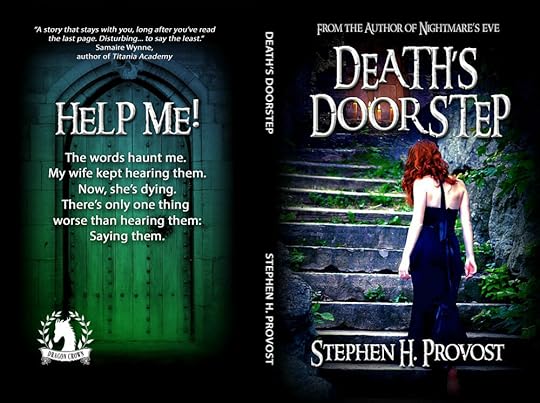
Death’s Doorstep is the story of Allen Hembridge, a physicist entering middle age, has been happily married to the love of his life for two decades when things start to go terribly wrong.
She’s slowly becoming a different person. Getting headaches. Becoming more forgetful. Lashing out at him as though he were a stranger.
There’s an old saying that life’s a journey, not a destination. What if the same is true of death?
Allen is scared to ask that “what if” question. He should be. The answer will scare him a thousand times more.
Death’s Doorstep is available on Amazon as a paperback, Kindle ebook, or free if you’ve got Kindle Unlimited.
Settle in under a warm blanket on a cool autumn night. Or any time you’re ready to have your fears brought to life, your assumptions tested and your perceptions turned upside down. It’s time to find out what it feels like to be on Death’s Doorstep.
August 16, 2020
How Donald Trump took America hostage in 12 steps
What would you get if you had Starbucks without the coffee? Or Microsoft without the software? Imagine if you drove up to a McDonald’s, saw those big golden arches, and ordered yourself a Big Mac, but heard:
“Sorry, we don’t serve that.”
You’d be baffled, but maybe you’d ask, “What else do you have on the menu?”
“Nothing.”
“Nothing?”
“That’s right.”
“Then, what are you selling?”
“The name.”
“Just the name?”
“That’s it. There’s no more famous name in the world, so that’s what we’re selling. Wanna give me a dollar?”
“Uh, no.”
What would you get if bought a can of Coke, but found out it was empty.
You’d have Donald Trump.
A lot of people, for a very long time, have been saying, “The emperor has no clothes.” But it’s the other way around: Trump’s a suit of clothes with no emperor, no nothing, inside.
All his life, he’s relied on other people for ideas — his father for real estate development, Mark Burnett for The Apprentice — and to do the heavy lifting for him: whether it’s underpaid undocumented workers on Trump Tower or ghostwriters to pen his books.
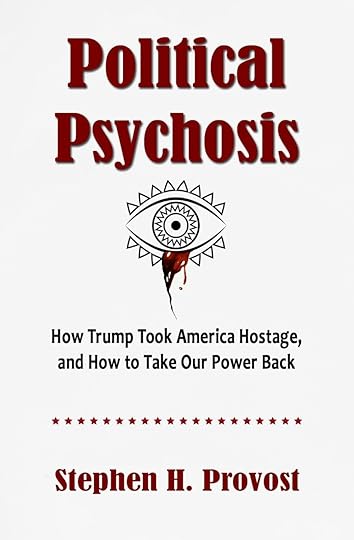
Well, I wrote a book, too, and I did it all by myself. It’s called Political Psychosis: How Trump Took America Hostage, and How to Take Our Power Back. You can get a paperback copy for just $8.95, an ebook for $4.95 (the cost of a cup of coffee at Starbucks), or read it on Kindle Unlimited for free.
Political Psychosis reveals how a man all but devoid of original thought and intellectual ability parlayed his only talent — a knack for bullying and conning others — into success and, ultimately, a seat in the Oval Office.
How did he do it? It’s really no mystery. That’s why I wrote the book.
Journalists, political scientists, and psychologists have spent years asking themselves how Donald Trump managed to take the American people captive. But the answers are right in front of their faces. This book spells them out, point by point, plainly and concisely.
In Political Psychosis, you’ll read about the 12 rules Trump followed to secure and retain his base’s devotion. You don’t need to ask him to find out what they are. Just watch him; listen to what he’s said. You’ll discover:
A man who’s not immoral, but amoral: He doesn’t care about what he fights for, as long as he wins.
A man whose life is built on an illusion and branding. On image, not substance. A modern-day snake oil salesman obsessed with preserving that image, because he’s deathly afraid of being exposed as the fraud he really is.
A man who depends entirely on others’ approval to validate him, because he’s never succeeded on his own. A man who’s substituted approval for achievement; who says he’s “self-made,” even though he’s the exact opposite.
A man so broken that no achievement is enough to provide him with the sense of self-worth he desperately craves.
A man who overcompensates for his own gross ignorance by claiming he knows everything about everything, from the military to the environment.
Here’s what Trump’s method tells us about him, and about ourselves. We can take our power back — from him and others like him — by exposing it for what it really is.
A man who’s lost touch with reality and demands that we do the same, to protect himself from the truth. A man whose entire time in the presidency can be summed up in two words.
Political psychosis.

August 7, 2020
Pop metal: New book traces history of the music that ruled the '80s
Most people probably wouldn’t suspect I’m a fan of what’s called “hair metal.” For one thing, I don’t have a whole lot of hair anymore.
But mostly it’s because people think of pop metal as shallow, mindless escapism, and I’m usually accused of being the opposite: stuck in my own head, analyzing everything, and trying to make sense of the world.
I look at it this way, though: I DO like pop metal, so why not analyze IT?
And write about it.
When I find something interesting, that’s what I tend to do, even if the subject is a bit off the beaten path. Old highways. Department stores. Forgotten sports leagues. And now the kind of metal music that has a beat AND a melody.
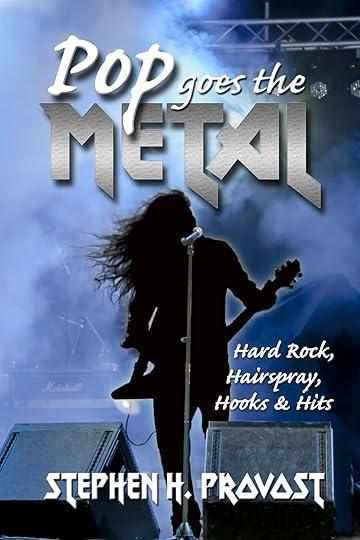
The result was my latest book, Pop Goes the Metal, which includes stories of the bands and music that made the 1980s so distinctive: bands like Poison, Def Leppard, Ratt, Mötley Crüe, Twisted Sister, Bon Jovi, and Dokken.
I didn’t want to just celebrate the music, though. I wanted to trace its back to its roots; follow its history; explore why it got as popular as it did — and why it suddenly became very unpopular.
I went back to the British Invasion, which spawned two very different styles of music, heavy metal and power pop, that nonetheless converged in pop metal. Then I explored how 1970s bands set the stage for the look and sound of the ’80s, from the comic-book superheroes of Kiss and the “Nightmare”-ish Alice Cooper, to the androgyny of Sweet and Angel, and hard rock of Van Halen and Aerosmith.
Pop Goes the Metal travels from the Sunset Strip in West Hollywood to Sheffield, England to examine the geographic origins of ’80s pop metal. It explores the role of MTV, album-rock radio, and the decade’s cultural shifts that led to the music’s rise and fall.
At more than 330 pages, it also includes a series of lists that chronicle No. 1 pop-metal songs, top-selling albums, hit anthems and power ballads, and much more. The book is available on Amazon in print or Kindle ebook form, and on Kindle Unlimited.
Here’s a bit of the introduction to set the scene with a little of my personal history:
When I young, my parents used to drive me down to the local record store set me loose to browse through the racks. The Wherehouse was out on Ventura Boulevard, which would later be Tom Petty’s hangout of choice for “all the vampires living in the Valley.”
The San Fernando Valley, that is: the same one mentioned in Frank and Moon Zappa’s “Valley Girl.”
That’s where I grew up, at least for six years during the heart of the ’70s, from Richard Nixon’s re-election through his resignation and the end of Vietnam. Then on through the birth of disco and Saturday Night Fever; The Rocky Horror Picture Show (which melded the glam-horror vibe of Alice Cooper with the gender-bending of Bowie) and Star Wars.
I hated disco, by the way. All of it. The Bee Gees’ falsetto. John Travolta’s stupid white jacket. (No, I didn’t see the movie; the poster outside the local theater was bad enough.) Mostly, I bemoaned the lack of a guitar — preferably electric — which was like a ticket to nirvana to anyone with real musical taste.
I lived next door to the L.A. Dodgers’ left fielder on one side and The Tonight Show’s music director on the other, but when I wasn’t at school, I spent most of my time in my room, listening to music and sorting baseball cards. Hanging out at the mall wasn’t my thing: too many people. But I did like going to the record store, where I could check out the latest releases and agonize over how to spend my saved-up allowance.
I could’ve gone to another record store, Licorice Pizza out on Topanga Canyon, but The Wherehouse was closer, so we usually went there.
I remember one trip in particular. It was 1976, and my limited record collection included The Beatles’ Rubber Soul (a Christmas gift from my aunt), Elton John’s Greatest Hits, and Their Greatest Hits by the Eagles, released earlier that year. I was still a fan of Elton, and I thought I’d probably end up getting Captain Fantastic and the Brown Dirt Cowboy. But I wanted to look around first.
I walked up and down the aisles, and as I did, a couple of other albums drew my attention. My reaction to the first one was, “Huh? Really? You’ve got to be kidding me?” I picked it up for a closer look: The four band members on the cover wore dress suits, but their faces looked like they belonged to clowns who’d escaped from a circus in some alternate dimension to audition for The Godfather.
The album was called Dressed to Kill, and the band’s name was Kiss. They had a cool logo, where the S’s in their name looked like lightning bolts. But the band members themselves looked ridiculous. I flipped the album over, looked back at the front again, and quickly decided it was the most idiotic thing I’d ever seen. I’d never heard of these guys, and I had absolutely zero interest in their album.
I put it back and moved on to the racks against the back wall, where I came across an LP called Desolation Boulevard by Sweet. This one really tempted me, because I’d gotten hooked on the band’s latest single, “Fox on the Run,” which was playing a lot on the radio.
I used to sit in my room with a cassette recorder and wait for it to come on the radio so I could record it. This took a lot of patience, and even more luck, because I had to hope that 1) no one would slam a door in the background while the song was playing and 2) the DJ wouldn’t talk over the end of the song and ruin it.
The second thing almost always happened. I hated DJs for it. I didn’t listen to the radio to hear them talk, anyway. The only time I wanted to hear a DJ say anything was after the song was finished. What was the song called? What was the name of the band? Most of the time, though, they didn’t say. More often, they launched into some B.S. product pitch or weather report, or announced the station’s call letters — which I already knew because I’d been listening all day waiting for “Fox on the Run.”
And because they talked over the end of it, I’d have to wait a few more hours for the rotation to come around again.
I liked “Fox on the Run,” and Desolation Boulevard was just about the coolest name for an album I’d ever heard. When I picked up the album to check it out at The Wherehouse, I thought the cover looked like someplace in L.A., but I didn’t know it was Sunset Boulevard in West Hollywood, which was just over the hills from where I lived and, it turns out, was the capital of the rock ’n’ roll world before it moved to Seattle with the birth of grunge. It was barely 20 miles away.
I looked at the long-haired band members in the foreground of the cover shot and wondered whether the two in the middle were guys or girls. I thought they were guys. Not that I cared; it just bugged me that I couldn’t be certain. I’d seen a poster of Bowie in the mall and wondered the same thing.
I didn’t end up buying Desolation Boulevard — not because of the gender thing, but because I had just enough cash for one record, and I didn’t know enough of the other songs to risk plunking down $5.99. “Fox on the Run” might have been the only good song on the disc, and then I’d have to start saving my money all over again. It wasn’t worth chancing it.
I went back to that rack couple of times and picked up the album as I debated buying it, but I finally put it back and decided to go with the album I’d come to buy: Captain Fantastic.