Stephen H. Provost's Blog, page 2
January 30, 2022
Is it OK to like J.K. Rowling?
Is it still OK to like Harry Potter?
How about J.K. Rowling?
Because, you know, her stance on transgender individuals isn’t PC.
Well, frankly, I couldn’t care less about what’s PC and what’s not. I do care about people’s feelings, though, and I think Rowling’s opinion on the matter is entirely off-base.
She tweeted: “If sex isn’t real, there’s no same-sex attraction. If sex isn’t real, the reality of women globally is erased.”
There are so many things wrong with this tweet I don’t know where to begin. First of all, transgender people are NOT saying sex isn’t real. Secondly, same-sex attraction isn’t dependent upon someone’s genitalia; it’s about the person they are. And speaking of the person they are, suggesting that “if sex isn’t real, the reality of women globally is erased” makes the identity of than half the population dependent on a single factor alone. Sex.
My reality wouldn’t be erased if I were of a different sex. I wouldn’t somehow cease to exist, and my life wouldn’t somehow become meaningless.
Rowling is simply flat-out wrong on this issue, and her opinion is hurtful and demeaning to a number of people. The fact that she says “I know and love trans people” sounds an awful lot like the old cliché, “A lot of my friends are Black.”
About that book...Rowling’s opinion puts me in a bit of an uncomfortable position. A while back, I wrote a book called 50 Undefeated that profiled 50 individuals from the past and present who overcame prejudice and bigotry. I devoted several pages of the same book to celebrating the lives and perseverance of transgender individuals, and I have grappled with whether or not to remove Rowling as a subject.
Ultimately, I chose not to.
While this may seem like a contradiction and might lead to criticism or accusations of hypocrisy, I think it’s the right call for several reasons.
The first, and most profound of which, is the fact that Rowling is dead wrong about people being defined by a single aspect of who they are. Women are not defined solely by their sex, despite what Rowling’s comments appear to suggest, any more than Rowling herself should be defined solely based on her misguided and hurtful attitude toward transgender individuals.
People are complex, and that can certainly be said for every one of the people I profiled in 50 Undefeated. Rowling is no different. A survivor of sexual assault and domestic abuse, she overcame incredible odds and numerous rejection letters to achieve enormous success. And once she did, she gave so much money to charity that she lost her billionaire status.
None of this makes her comments about transgender people any more acceptable or any less hurtful. But neither do those comments diminish her achievements or her deeds of compassion.
Defining prejudiceYes, people are complex.
But we seem to have forgotten that in the 21st century. We define people by a single aspect of who they are — something we find offensive — then discard like them like compost, then move on to fatten up the next sacred cow for slaughter. That single aspect might be the person’s race, their political party, their gender, sexual orientation, religion, you name it. We choose one thing, one single thing, and dismiss an entire person’s character, their life’s work and the totality of who they are, based on a single tweet, a single word, a single glance.
That’s the very definition of prejudice.
It’s as if all the things we’ve decided to willfully violate everything we purposely codified into our anti-discrimination laws. Repeatedly.
The controversy over Rowling’s words didn’t come from anything she’d written in one of her novels. This time. But there was a time when she was castigated for supposedly spreading “satanic” ideas about magic in her Harry Potter books that were offensive to people on the right. It’s almost as if authors these days are bound to be criticized for offending someone’s sensibilities.
Addicted to outrageThis isn’t about censorship, a word that has been so overused it’s become both a cliché and an enigma, used in so many different ways it’s all but lost its meaning. It’s about creative freedom: something that has been stifled to some extent by the refusal of people on all sides to expose themselves to things that might offend them.
But even that’s not really accurate. If they were honest with themselves, they might admit that they enjoy being outraged, because it makes them feel superior. If people didn’t enjoy being outraged, it wouldn’t sell newspapers, boost ratings, and get political candidates votes and donations. Outrage stokes prejudice — judging others based on a single facet of who they are or are perceived to be — by justifying it. And we as a society encourage it!
There’s a saying popular in evangelical circles: “Love the sinner, hate the sin.” It’s been used so much that it’s lost its impact, but it’s a concept worth revisiting, whether you’re an evangelical Christian, a Muslim, a Hindu, or an atheist, because it works regardless of one’s creed. You can accept a person and repudiate their actions. There’s no contradiction there. But we’ve gotten so caught up in identity — in condemning who people are rather than what they do — that it’s become almost a foreign concept.
There’s no contradiction in me condemning J.K. Rowling’s stance toward transgender people in the strongest possible terms, and at the same time lauding her talent as a writer, admiring her ability to overcome obstacles, praising her charity work, and affirming views she shares that I happen to agree with.
That’s why I left Rowling in the pages of 50 Undefeated. If you want to know my views toward transgender rights, you can read some of the other profiles in that volume. The purpose of writing it was not to condemn people but to applaud actions: to show that prejudice and bigotry could be overcome. It’s gotten harder, though, in an era when we judge others based on one-dimensional views and 240-word tweets.
That’s a shame.


January 6, 2022
Don't make New Year's resolutions: Do this instead
New Year’s resolutions are a dime a dozen, and 80 percent of them fail anyway.
I never make them.
I do something else instead: I plan.
Planning is different than resolving or goal-setting. A resolution is identifying a destination; planning is the road map that gets you there. As the author of several highway books, you might imagine I’m all about itineraries. But planning works whether you’re on the road or at home.
Why? Two reasons.
For one thing, it locks you in. If you’re an author, once you’ve agreed to a deadline for publication, you’ve made a commitment to someone else (your publisher and/or readers if you’re preselling and have announced the date on Amazon). If you’re on a trip to do research for a book and you’ve made reservations at a specific hotel, you know where you’re going to stay and when.
Fooling ourselvesResolutions are based on a lie we tell ourselves: Because it’s a new year, we have a fresh start, and that’s all we need to succeed.
Bullshit. It’s an opportunity to succeed (and really just a psychological one: You can set a goal or make a plan any day of the year). The rest is up to you.
Resolutions are amorphous. They give you an out. Planning holds your feet to the fire.
I’ve already planned to release at least five books this year. That’s not just a resolution: I’ve identified specific cities I’ll be covering as the next installments in my Century Cities series: Greensboro, Asheville, Winston-Salem, Reno, and Carson City. Last week, I took photos for the Greensboro project, and this weekend, I’ll be in Asheville. I’ve identified specific historical sites I want to photograph, and I’ve listed them on my phone, so I know where I’m going.
Resolutions involve two steps: Goal-setting and fulfillment. But they don’t tell you how to get from one place to the other because they leave two crucial steps in the process: setting your course and following it, otherwise known as planning and execution. If you’re an author, this may involve creating an outline. In the case of my highway books, this meant identifying chapter topics; my Century Cities books all follow the same format by decade (with one slight variation), so I don’t have to rethink things with every new book.
(Note: I don’t outline my novels; I just start with a general idea and let the characters take me from there, which just goes to show there’s an exception to every rule.)
Getting specificThe more specific your goal, the more likely you are to formulate and execute a plan. For instance, you may decide “I want to lose weight,” or you might say “I want to lose 50 pounds.” The second statement identifies a clearer objective and gives you some hints about the plans you might make to get there. Chances are, you’ll need a different kind of diet to lose 50 pounds than you will to drop just 10.
If you’re an author, you might tell yourself: “I want to write a book this year.” But if you have a good idea what you want to write about, your projected word count, your target audience, etc., you’ll be a lot more likely to get off your ass and plan. I can’t count the times I’ve heard someone say, “I’ve always wanted to write a book.” But they’ve never done it. That’s a failed resolution right there. A successful one begins by setting goals that are as specific as possible, which sets the stage for planning.
A successful journey involves four steps:
1. Goal-setting (where you’re going, specifically)
2. Plotting a course (how you’ll get there)
3. Execution (following through by staying true to your course)
4. Fulfillment (achieving your goal)
The first and last steps are easy. The hard work takes place in the middle.
It’s natural to want to leap right from resolution/goal to fulfillment. But life doesn’t work that way, and you’ll only be disappointed. You have to put in the work. Resolutions are like lottery tickets: They’re rarely winners. Planning is like a successful career: You’ll be amazed how much you’ve accomplished when you reach the end and start looking back.
I’ve had two careers: I spent 32 years as a journalist at five daily newspapers and one weekly. In the past decade, I’ve written and published 39 books. No. 40, The Great American Shopping Experience, will be out in five days. I’ve published 18 in the past two years, and not a single resolution was involved. A lot of planning was, though.
Whether you want to write a book, quit smoking, lose weight, cut your cholesterol, win a competition... whatever your goal or resolution, it’s easy to say, “I want to do that.” The proof is in the pudding: Making a specific plan and following it to completion.
Don’t “just do it.” Plan it first.
January 5, 2022
7 things we all hate about our news feed... that newspapers would never do
As a former newspaper editor, I hate the way news is presented online. This should come as no surprise. I’ve written critically about the way the news has evolved — or devolved — over the past 20 years or so, and I’ve poked fun at the way we communicate in catchphrases and buzzwords. I refuse to “circle back” to anything, and while I may “say the quiet part out loud,” you won’t catch me saying I’m saying the quiet part out loud.
Except here. As a way of making a point.
My continuing plea: “Please Stop Saying That!”
Like most people, I get my news online these days. Newspapers in general just aren’t what they used to be, because they’ve never found a way to compete in print with their online adversaries. In most cases, the print product is a shadow of its former self, providing bare-bones coverage with skeleton reporting staffs on a handful of pages. If I want to read something in print these days, I’ll read a book.
That doesn’t mean I like the way news is presented online. I don’t get it in a social media news feed because I’ve been off social media for a couple of years now (with the exception of LinkedIn, which I use rarely).
In fact, I laugh and cringe in equal measure when I see the lengths to which online sites go in their quest for clicks and ad exposure. It’s become almost comical: way beyond pop-up ads and clickbait. I’m sure you’ve run across some of these:
Misleading photosYou may have seen stories illustrated with photos in your feed that are misleading at best, often accompanying stories about celebrities.
“You won’t believe what Joe Celebrity and his wife are saying about each other!” The photo will show two celebrities... who aren’t even married to each other and never have been. The hook is to get you to say, “I didn’t know William Shatner and Tyra Banks are married!” (I’m making that up) and click on the link to confirm that they are.
Of course, they’re not. The site never says they are, but merely implies it by pairing their photo with a headline, even though it’s unrelated. And in doing so, the site has shocked you into visiting its ad-laden portal.
Can you imagine a newspaper doing this? I sure can’t.
(To illustrate: The cute kitten at the top of this page has nothing to do with any of the content here. I just happen to like cats!)
Can you believe what she looks like now?A photo of a celebrity from back in the day appears in your feed, and you’re invited to click the link to find out what that person looks like now.
But why on earth would you want to do that? It’s easy enough just to Google the person’s name and select the “Images” tab. Voila! You’ll get all sorts of pictures of any given celebrity at any and every age.
Yes, I can believe what she looks like now, because I can SEARCH FOR IT without looking at your clickbait-y site, thank you very much!
 Story continues…
Really? Thanks for telling me that. And thanks for making me press a button to see the rest of it. That’s awfully considerate of you. Not. Why not let me just decide FOR MYSELF whether I want to keep reading, without making me jump through hoops? Because the website designers don’t want to let me think for myself, that’s why.
[image error]People who think for themselves aren’t impulse buyers, which is exactly the kind of person who will click on an ad after clicking on that “story continues” or “continue reading” button.
This may not seem much different from a newspaper story that “jumps” from the cover to an inside page. But in print, that was necessary because you had limited space and needed room on another page for the rest of the story. Online, there are no such restrictions, so it’s a false comparison.
Still, that’s not nearly as bad as...
Next!“Continue reading” pales beside the ubiquitous “Next” button at the bottom of a page. It’s typically used in those popular list stories. You know the ones: “The 25 most popular seafood restaurants that also serve hot dogs” or “The 10 worst boy bands of all time” (as if there are any good ones, except for maybe the Beatles before they went psychedelic).
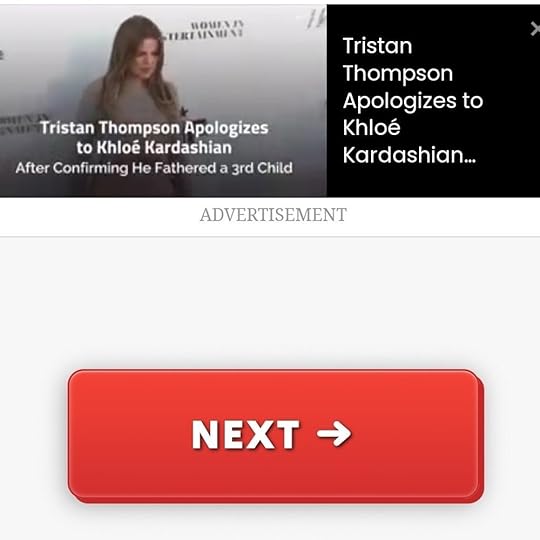
You reach the bottom of the first page, and you are confronted with the dreaded “Next” prompt, which you’ll have to click for each and every item on the list... that is, if the screen doesn’t shift unexpectedly, causing you to hit an ad link instead, by mistake. Except it’s not a mistake in the eyes of the website owners: That’s exactly what they want you to do.
Whenever I stumble into one of these, I exit rather than hitting “Next.” I won’t give them the satisfaction! In fact, I’ve learned to recognize these sites, in most cases, before I click on them.
Imagine a newspaper story that jumped from the front page to 23 different pages, one after another. It would never happen — especially since most newspapers today don’t have that many pages!
The story’s over... or is it?It’s difficult at times to know for sure when a story is over, because the text is broken up into small blocks that are divided, in each case, by a series of ads and links. They’re the same kind of ads and links that appear at the end of the story, so it’s hard to know whether you’ve read all there is to read or whether you need to scroll down for something more.
While you’re trying to figure it out, you focus on the ads.
Then you scroll down.
And see MORE ads.
And, we website owners hope, you click on them.
Can you imagine ads stuck in the middle of a newspaper story every other paragraph? I sure can’t.
Whitelists and paywallsI understand sites need ads to make money, but asking me to disable (whitelist) my ad blocker so they can show me those ads? Sorry. I’ll find another site with the same information that doesn’t require me to do that!
Imagine paying $2 for a newspaper and being told, “You can’t read this story unless you look at the ad below.” And if your refuse? The newspaper disappears in a puff of smoke. Sounds absurd, I know, because it would never happen with a newspaper.
But it happens online all the time.
I understand why news sites use paywalls, too, but that doesn’t mean I have to like them. Yes, reporters should get paid for what they write, but putting a story out there as though it’s available to be read and then hitting the reader with a paywall is dirty pool: It’s bait-and-switch. If the website were honest, a notation reading “subscription required” would appear alongside the story in your feed.
But honesty is seldom the best (read: most profitable) policy online, even for a news site.
Imagine someone handing you a newspaper. You open it and start to read it. Then the person grabs it out of your hands and says, “Not so fast, buddy! You gotta pay!” You know what I would do? I’d throw that newspaper back in their face. But that would never happen with a newspaper, which is exactly my point.
(Hint: Sometimes you can get around these restrictions by accessing the “cached” version of the page. It’s sneaky, and there isn’t always a cached page available, but it’s worth a try.)
Headlines that overpromise“Here’s why Celebrity X drinks Kool-Aid for breakfast. You’ll never believe the true reason!”
Who cares, right? But maybe you’re intrigued, so you click the link in hopes of finding out. You’re then led by the hand through a long, meandering piece about the celebrity’s childhood, her parents’ divorce, her success at school, how she was “discovered,” yada, yada, yada.
When do you get to the Kool-Aid?
If you get there at all, it’s near the end of the story, and there’s some lame explanation like, “She drinks Kool-Aid because she likes it.”
But you’re the one who’s drunk the proverbial Kool-Aid by clicking on this link in the first place!
Stephen H. Provost is the author of more than 30 books and a former journalist with more than 30 years of experience at daily newspapers. They are all available on Amazon.
December 15, 2021
Goldfield Century: Prizefights, ghosts, and lots of gold
Here’s a quiz-show stumper for you: What did boxing’s first great promoter, Virgil Earp from the O.K. Corral, the richest man in Nevada, and the founder of UPS have in common?
They all got came from Goldfield.
Where?
It’s the topic of Goldfield Century, the eighth book in my Century Cities series, and it’s a bit different than the rest.
Chances are you’ve never heard of Goldfield, even though it was, for a brief period, the biggest city in Nevada. In fact, during its heyday around 1906, nearly one-third of the state’s population lived in Goldfield. It had everything you could want in an Old West town: dozens of saloons, dance halls, gunfights, feuds, gold strikes, and jumped claims. Teddy Roosevelt once sent in troops to keep order during a mining dispute.
Goldfield was at the center of Nevada’s last big mining boom, one that rivaled the Comstock and Virginia City. Tonopah, just to the north, struck it rich with silver. And more gold was found in the Bullfrog District to the south, where Rhyolite boomed to become the state’s fourth-largest city. It’s a ghost town now, but at one time, it hailed as the budding “Chicago of the West.” Its newspaper was edited by Earle Clemens, a nephew of Samuel (aka Mark Twain).
Goldfield was the scene of the first fight of the century, a lightweight championship bout between Joe Gans and Oscar “Battling” Nelson that lasted 42 rounds: longer than any other fight staged in the 20th century. It was also the scene of an early test for Jack Dempsey when he was still a middleweight. The future heavyweight champ was knocked down in the final round and had to settle for a draw.
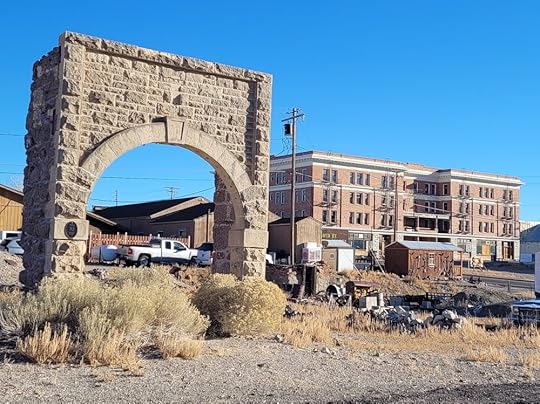
An arch is all that remains of the Sideboard Saloon, burned in a 1923 fire. The Goldfield Hotel is in the background.
Ghost town?Goldfield is a ghost town, but it’s not.
Ghosts are said to dwell in the Goldfield Hotel, once described as the finest lodging between Kansas City and San Francisco but vacant since the mid-1940s. Goldfield High School, an impressive three-story structure near the center of town, has ghosts of its own; it’s been vacant since 1953, but a restoration project is under way. If you take a tour of the place, it helps fund the restoration, so by all means do so.
Even though most of its buildings are deserted, Goldfield remains the seat of Esmeralda County (there are fewer than 1,000 people in the entire county), as it has been since way back in 1907.
But for all that, a few folks still live in Goldfield. Once home to more than 20,000, it survives with a population of something like 200 or 300 today. Most of the businesses are closed most of the time, and there’s nowhere to buy gas in town, so it’s best to fill up in Beatty to the south or Tonopah to the north.
Goldfield does have a radio station, a couple of saloons (dating to 1905 and 1934, respectively), a diner, a convenience store, and a souvenir shop or two. Don’t count on the visitors’ center being open, but the bathrooms there probably will be.
If you get out of your car to walk around, there’s a handy tour book that can show you where you’re going, but you’re likely to be the only one out and about on any given day.
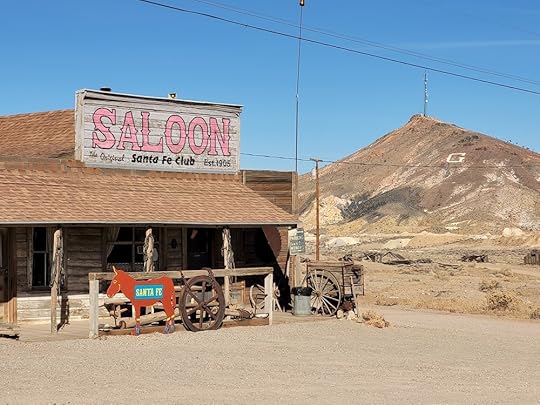
The Santa Fe Saloon has been open since 1905. Columbia Mountain is in the background.
A lot to seeThere’s not much to do, but there’s plenty to see. Grave markers at the old cemetery tell tales of how residents lived and died more than a century ago. One shoe store owner died of a heart attack as his store burned in a massive fire. Miners killed by falling rock and electrocution are buried there. So are gunshot victims. Then there are graves whose occupants’ names have been lost to time.
The fire station dates back to 1907, and the banking-and-mine office building to 1905.
There are abandoned gas stations and wood-frame houses that are falling down like a house of cards in suspended animation. Rusting antique cars seem to be everywhere. Someone even hauled in a pair of subway entrances and plopped them down in the middle of a vacant lot. But there’s no subway in Goldfield; never has been.
You can take a tour of the Florence Mine and mill, the second-most-productive in the region when it was churning out 9 million of dollars’ worth of gold... before inflation: That would be around $260 million today.
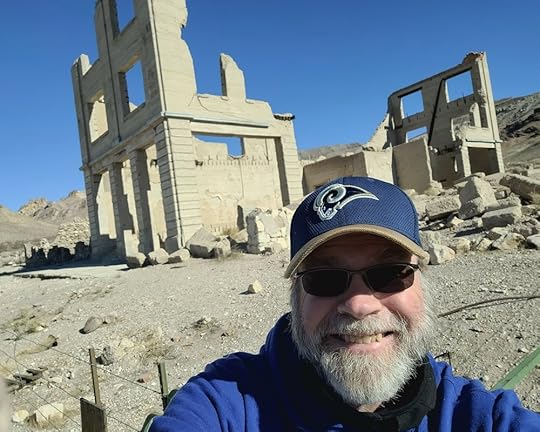
The author in front of the ruins of the John S. Cook Bank at Rhyolite.
NearbyDrive south to Rhyolite, and you’ll see skeletons of old buildings slowly decaying in the desert sun and wind. An old bank building; a schoolhouse built too big when the boom was fading; the stone façade of an old mercantile; a house made of bottles; an abandoned depot... It’s well worth the trip. You can even see some modern-art “ghost statues” by the side of the road on the edge of town.
Stop at nearby Beatty and see some of the buildings that used to be in Rhyolite before they were moved there, and check out the burros that roam the city streets. But keep your windows rolled up, or they’ll stick their noses into your car looking for a handout.
Gold Point is another nearby ghost town a little off the beaten path, southwest of Goldfield. It started out as a silver town called Hornsilver, but when they found gold there in the 1920s, they changed the name.
To the north, you can visit Tonopah, whose silver rush predated Goldfield’s gold fever by just a couple of years. Legend has it that a prospector picked up a stone to throw at a wayward burro and found it contained silver. If you want to spend the night there, you can stay at the Mizpah Hotel, haunted by the ghost of a prostitute called the Lady in Red. Or just up the road, there’s the Clown Motel, dubbed America’s scariest motel.
Goldfield Century includes information on all these places, too. Packed with more than 150 contemporary and historical images, it chronicles their growth and demise, from boomtown to ghost town, and everything that happened in between... and afterward.
If you’re curious about life in a Nevada mining town in the waning days of the Old West, pick up a copy on Amazon.
November 5, 2021
Charleston, West Virginia, shines in new book profiling city
My West Virginia has a distinctive beauty to it that's unlike any other. Its mixture of meandering rivers, rolling hills, and lush greenery is unlike almost any other.
And then, there's the history, which is what my Century Cities series is about. I’ve produced seven books in six months for this series, and each one is just as fascinating as the last.
The latest installment, Charleston Century, is a companion piece to Huntington Century, which I published last month. The two books capture the history of Mountain State’s two largest cities, just an hour’s drive apart on U.S. Highway 60. It’s a stretch of road that winds through rolling hills where you’ll find such historical treasures as an old covered bridge and a barn with a faded Mail Pouch Tobacco ad on the side.
For a highway enthusiast such as myself, that short trip was a lot of fun. So was the drive from my Virginia home up to West Virginia (except for those pesky toll booths).
But the big reward came when I entered the capital city. As you arrive in Charleston, you can't miss the sight of the golden state Capitol dome on the far bank and the Kanawha River. It's every bit as majestic as the Capitol building in D.C., but it's even more spectacular when the sun is shining. Its rays shine on the golden dome and dance the river in the foreground, providing a glorious scene that's sure to widen the eyes of any first-time visitor. I know it did mine.
There is, of course, a lot more to Charleston's story than its role as the state capital. It's the birthplace of the nation's petrochemical industry: the place where Union Carbide built a huge factory on an island in the middle of the river. Most of the smokestacks and storage tanks are gone now. They polluted the skies and the river even as they fueled the city’s growth to more than 80,000 people by 1960. Today, the population’s barely half of that, but the town remains vibrant.
Charleston’s ties to industry date back to the discovery of oil near Cabin Creek more than a century ago. The petroleum found there supplied the raw material that made the Pure Oil company a leader in the field. Pure gas stations are still frequent sights along the roadside in this part of the country.
And speaking of Cabin Creek, if that name sounds familiar, it's probably because an NBA Hall of Famer went to high school there. Jerry West, aka "Zeke from Cabin Creek," became a pro basketball star, top executive, and the inspiration for the league's iconic logo. He’s not the only notable basketball figure to come from the area, either. “Hot Rod” Hundley, a two-time all-star with the Lakers, took Charleston High School to the state finals in his sophomore year.
The Shoney’s restaurant chain got its start in Charleston as the Parkette Drive-In. The Heck’s chain of discount stores, once one of the largest in the east, did as well.
And one of the nation's most mysterious unsolved murders happened in the city. The brutal 1953 slaying of a newspaper publisher in her own home has baffled investigators for years – even though the police chief thought he knew whodunit.
Country music star Kathy Mattea was born in South Charleston, and the city had an undefeated pro football team seven years before the Miami Dolphins pulled off the feat. Few people remember the Charleston Rockets today, but they were a force to be reckoned with in their time. Future NFL star Coy Bacon was on the roster, and he wasn’t even the best player on the team.
As with all the Century Cities books, I had a blast researching and photographing Charleston Century. It’s a chronological portrait of a middle American city in the 20th century. Like all my books, it’s available on Amazon. I hope you enjoy it.
[image error]October 21, 2021
Huntington, West Virginia, focus of latest Century Cities book
A few weeks ago, I took a trip up to Charleston, West Virginia, to do some research and take photographs for my next Century Cities book.
Except it didn’t wind up being my next book in the series.
(Never fear, Charleston fans, I’m working on that one next, I promise.)
As is often the case, I needed a second trip to get all the photos I needed. I often neglect to include some things on my initial itinerary for such trips, so I wind up doing some more research and heading back up for another go-round. But this time, a thought occurred to me: Huntington, West Virginia, was just an hour up the road. So, I thought, “Why not take a trip over there and snap some photos?” (You don’t actually “snap” photos anymore, I realize.) I thought I could use them down the road as the basis for a book about Huntington.
Like Charleston, Huntington fits perfectly into my vision for Century Cities: a series about midsized and smaller cities and towns during the 20th century. There aren’t any truly big cities in West Virginia, but these two are the two biggest. They’ve both seen their populations decline in the past 70 years or so, but that doesn’t mean they’ve gotten any less interesting.
But a funny thing happened on my way to writing Charleston Century: I started writing Huntington Century at the same time. Then I became so involved in my research about Huntington that I actually completed that book first. In Huntington, I found a city rich in history and filled with interesting sights, all of which quickly crystallized into the material for the book.
Like the rest of my Century Cities books, Huntington Century takes readers on a chronological journey from 1900 to 1999, through 10 chapters (one for each decade), each of which is subdivided by year. The city’s businesses, athletics, retail shops, culture, government, and other facets of its history unfold across the pages of the book, illustrated by contemporary and vintage photos. The evolution of Huntington over the course of the century is a fascinating process to see unfold.
Like many American cities, Huntington started off as a railroad town on a river. In this case, the railroad was the C&O, short for Chesapeake and Ohio, and the waterway was the Ohio River.
Huntington wound up being built where it is because Collis P. Huntington, chose it as the place for the C&O’s western terminus. He also gave the city its name.
Huntington is notable for many reasons. It was the site of the easternmost bank robbed by the James-Younger Gang, and it’s home to the state’s largest mall, the Huntington Mall. Marshall University, located near the center of town, has drawn headlines for winning national championships and for a tragic plane crash that took the lives of the football team and everyone else on board in 1970.
NASCAR greats raced at a track just west of town on the Grand National circuit, and Camden Park — the state’s largest amusement park — has drawn families from around the Tri-State area (where West Virginia, Ohio, and Kentucky meet) for more than a century.
Huntington is a city with contemporary achievements to brag about as well as tales to tell from its pioneer days. But I wrote Huntington Century to tell the story of what happened in between.
Like all my books, it’s available for purchase on Amazon. And as always, if you enjoy it, please consider leaving a review on Amazon and Goodreads.
September 28, 2021
Century Cities books are now available in hardcover!
Great news: My Century Cities books are now available in hardcover!
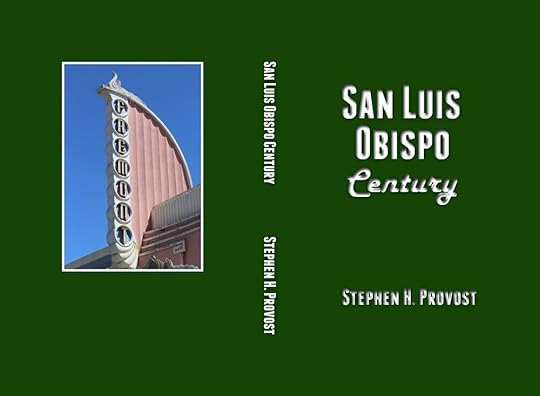
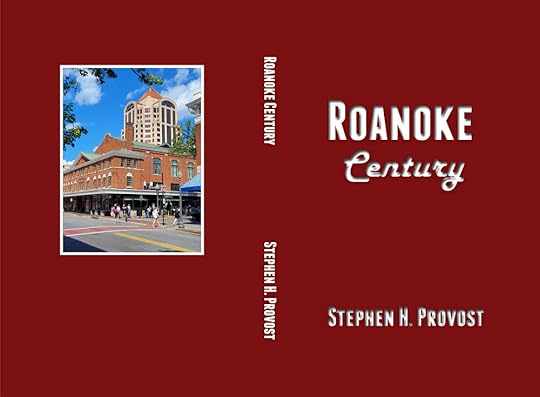
If you want a keepsake edition of Fresno Century, Cambria Century, Danville Century, Roanoke Century, or San Luis Obispo Century, they’re all available on Amazon.
To go with the hardback versions, I’ve designed all new covers to create a distinctive look, utilizing the fonts and colors from the paperbacks in a more understated design.
Unfortunately, I’m not able to offer my America’s Historic Highways series in hardback just yet. If it becomes an option that’s available to me, I certainly will.
In the meantime, I hope you enjoy having the option of owning a hardcover edition of your favorite Century Cities books. And you can look forward to two more books in this series arriving by winter: Charleston Century and Huntington Century, focusing on two beautiful West Virginia cities.
When those two books are published, Century Cities and I will have visited three states.
What’s next? Wait and see!
 [image error] [image error]
September 25, 2021
10 things to look for in a good editor
You’re looking for a good editor, but just what constitutes “good”?
If it’s your first time working with an editor, it can be difficult to know. Even if you’ve worked with editors before, it can be hard to find the right fit.
I’ve been a writer for almost four decades and an editor in different capacities for nearly as long, so I’ve been on both sides of the fence. Although I do offer editorial services, I’m not looking for new clients as of this writing (September 2021); that’s not my motivation.
To be frank, there are a lot of bad editors out there who won’t provide your manuscript with the kind of attention it deserves, and who might end up making you feel worse about your writing in the bargain.
How do you weed out the bad ones and identify the good? Based on my experience, I’ve assembled a list of things to look for in a good editor.
Any editor should do two things: fix errors and make your manuscript better. But those two goals are the bare minimum, and achieving them alone doesn’t make an editor good, so they’re not on my list.
Here’s what is:
1. Asks for a sampleThe first interaction you’ll have with a potential editor will be part of the feeling-out process. Do you want to work with this person, and does the editor want to work with you? Are you a good fit?
The only good way to answer these questions is to provide the editor with a short sample of the material you want edited. A good editor will ask you for this before committing to any job. Any prospective editor who agrees to a job based only on your willingness to pay a set fee isn’t interested in editing. That person is interested in money.
Priorities matter.
Good editors are willing to decline a project that doesn’t fit their skill sets or the amount of time they’re willing to commit, regardless of any potential payday. Bad editors just want your money.
2. Isn’t out to prove anythingThere’s a tendency among poor editors to try to “prove their worth” by providing unnecessary edits. If your copy is clean, it’s clean. No good editor tries to fix mistakes that aren’t there. But I’ll be blunt: A lot of editors do precisely this.
Part of their motivation is ego, and part of it is a desire to justify taking your money.
This is another good reason for providing a sample before working with any editor. Good editors will tell you if your copy is clean; they won’t manufacture problems to show you how thorough they supposedly are.
Overly aggressive, ego-driven editors cause a host of problems. They make you pay for changes you don’t need. They can interfere with your voice. They can make you feel like a failure. (“Look at all those red marks!”) And, worst of all, they can actually make your manuscript worse.
3. Lets you be the bossAlong these same lines, remember one simple fact: You’re paying the editor. That makes you the boss. Ego-driven editors like to operate as though THEY’RE the experts, so you should take their advice regardless of whether it’s good or whether it fits your goals for your project. That’s right: They’re YOUR goals, and it’s YOUR project, not theirs.
Editors who take offense when you reject a suggestion care more about their own egos than they do about providing a service to you or helping you meet your goals. They may not even know they’re being pushy or bossy. Many freelance editors come from backgrounds in journalism or public relations, where editors DO call the shots. Writers work for them.
In the freelance world, it’s the opposite: They work for you, and regardless of their personal history, you shouldn’t have to remind them of that fact.
4. Protects your voiceYou don’t pay editors to make your work sound like something they would write. If they want to write books or articles on their own time, that’s up to them. But this is your project, and no editor should substitute his or her voice for yours.
Admittedly, there can be a fine line here. A good editor, for example, will do things like make your sentences more concise and remove passive voice. If you use long sentences and passive construction as part of your style, though, changing it can affect your voice. (I don’t advise doing either of these things, but good writers know when to break the rules.)
How do you know when an editor has stepped over the line that stands between cleaning up your writing and changing your voice? Simple: Good editors will return your manuscript to you with their work highlighted in red mark-up. That way, you can compare your original version to the proposed changes. The key word here is “proposed.” Remember: You’re the boss.
5. Reads like a readerYou might notice how I phrased the title to the previous section. It was intentional. Good editors don’t just avoid changing an author’s voice, they go out of their way to protect it. That requires them to do more than simply look for punctuation problems and consistency errors. That’s a proofreader’s job. It requires them to immerse themselves in the story.
Good editors will read your story like a reader. They’ll be able to put themselves in the reader’s shoes and see whether they can connect with the story. A lot of this will be subjective, and a good editor will tell you so.
The main point, though, is that good editors are invested in the story. They have to be in order to see it from your perspective and from the perspective of potential readers. Both of those viewpoints are important. If they’re not invested in the story, two things will happen. First, they won’t care about your goals in writing it, so they won’t be invested in working with you to achieve them. Second, if they’re not invested, they won’t be paying attention, and they might miss something.
6. Reads like an editorOf course, you’re not hiring an editor to be a beta reader. You’re hiring that person for professional expertise, and you need to get what you’re paying for. A good editor won’t just read like a reader, he or she will read like an editor, too.
In fact, the best editors sometimes make two runs through a manuscript. They’ll read it from a macro perspective, the way a reader does, and they’ll also dig into the details, the way an editor does. These two approaches aren’t mutually exclusive; they complement each other.
Details jump out when an editor is familiar with the big picture, and those details, in turn, bring that big picture to life.
7. Knows your audienceDifferent styles of writing and different genres are geared toward different audiences. A one-size-fits-all editor isn’t what you need. You need someone who knows your audience and understands what that audience expects.
You don’t want an expert in technical how-to documents editing your epic fantasy, and you don’t want someone who exclusively edits military science fiction working on your young adult romance.
The most successful editors are versatile enough to work in a number of different genres. Just be sure whoever you choose is at least familiar with yours and with your target audience.
8. Improves flowIf your writing flows, it’s like a river that carries your readers along with it almost effortlessly. Bad flow will run your readers aground, and they’ll need to make a conscious effort to “get back into the story.”
Good editors will address places in your story where you might lose the reader. They’ll suggest picking up the pace or deleting scenes that may have no bearing on the plot or character development. (Note the word “suggest.” The ultimate decision is always yours.)
They’ll also suggest ways to help improve your flow on the micro level: Do your sentences carry the reader along easily, or does some choppy writing need to be flagged?
Flow is immensely important for one simple reason: It keeps the reader engaged. A good editor will understand how to make writing flow and will help you improve the pacing of your story.
9. Helps you fix thingsA good editor won’t just tell you to fix something, they’ll suggest how to fix it. This might seem obvious, but some editors won’t do it. They’ll send you comments like, “This needs to be addressed.” (How?) Or, “You need to provide more information here.” (What information?)
You shouldn’t expect your editor to do your research for you. If you’re repeatedly leaving out important details, don’t expect an editor to supply them for you. On the other hand, however, if you miss something now and then, a good editor WILL take the time to look for the information that’s lacking and suggest it to you.
Just telling you to fix something without providing guidance can be more frustrating than not knowing there’s a problem in the first place. Good editors don’t just identify problems. They help you solve them.
10. Encourages youThis is an absolute must: Good editors know the importance of constructive criticism.
Writers already deal with enough discouragement, from query rejection letters to one-star reviews on Amazon. You don’t need an editor adding to that negativity.
What you need is an editor who will focus on what you’re doing right and how to make you’re writing even better, not someone who harps on what you’re doing wrong or chastises you for your mistakes. If you find an editor who complains about your writing, chances are you’ve found an editor who’s more interested in demonstrating superiority than in helping you.
Writer and editor should be on the same team, pursuing the same goals. It’s not a competition. If you ever get the feeling it is, you should probably look for a different editor.
On the other hand, if you find an editor that does each of the 10 things listed here, hold on to that person. You’ve struck gold.
Stephen H. Provost is the author of more than 30 books and the editor of several others. He spent more than 30 years writing and editing for daily newspapers. You can find his books on Amazon.
August 19, 2021
Danville, Virginia, is a lot more than textiles and tobacco
There are several different Danvilles. In fact, there are 24 of them in America, mostly scattered across the East, Midwest, and South.
There’s one in my home state of California, and there’s one in my new home state of Virginia.
Since the books I’ve written so far in my Century Cities series have been in both those states, I should clear up any confusion: The latest in this series, just released, is about the Danville in Virginia. It’s actually my third book about a Virginia city, following up on Martinsville Memories, about the town where I live, and Roanoke Century, focusing on a city about an hour up the road.
Danville’s even closer, a little more than a half-hour to the east, and it shares a lot in common with Martinsville, although it’s about three times as large. Both were built on tobacco in the second half of the 19th century, and textiles in the 20th. The DuPont plant in Martinsville and Dan River Mills in Danville employed thousands and were, for a time, the dominant forces in their respective communities.
But Danville is unique in a number of ways, which is one reason I wanted to write about it.
In some quarters, it’s best known as the “last capital of the Confederacy,” after the fall of Richmond. The Confederate government met briefly in a mansion there that became a library... before the library eventually became a museum.
But the events of the 20th century — the focus of my book — are just as fascinating, if not more so.
Before I began my research, I had no idea that Danville had been the site of a train wreck that inspired America’s first million-selling record. Or that the record in question, “The Wreck of the Old 97,” became the basis for a song my parents often played in my home during childhood: “M.T.A.” by the Kingston Trio.
I also didn’t know that an American woman could serve in the British House of Commons. But I found out it had not only happened, but that a woman from Danville had been the first woman — from anywhere — to ever be seated in Parliament. There’s a street named after her, Lady Astor Street, in Danville today.
The first African American to sign a contract with a major U.S. opera company, Camilla Williams, was born in Danville, and so was the first Black driver to win a NASCAR Grand National race, Wendell Scott. The first Black player in the Carolina League wore a Danville Leafs uniform, and so did future Hall of Famer Willie McCovey, who came up through the Giants organization.
I made a number of trips to Danville, making new discoveries each time: like the brick building that used to be a drive-in restaurant on North Main, the Five Forks area that was once a thriving neighborhood retail hub, the North Theatre, or Mama Possum’s tucked in behind the Sherwood Shopping Center that used to be a Wimpy’s hamburger stand.
I even drove all the way to Burlington, North Carolina, where they carted off the bleachers from the baseball park that used to be in Danville more than 60 years ago.
I photographed old neighborhood markets, cinemas, fast-food joints, service stations, and the “arrow sign” that’s the only thing left at the site of the old South Drive-In.
I took pictures of the smokestacks at the partially demolished Schoolville textile plant and the ones down in the River District, site of the old tobacco plants. I took pictures along all three Main Streets (West Main, North Main, and South Main), and when all was said and done, I had nearly 150 modern and vintage images for the book.
Danville Century is the fifth in the series, released Aug. 17, 2021, and is available in paperback at Amazon. I hope you enjoy reading it as much as I loved writing it.
August 11, 2021
How Marvel and DC are ruining fiction
What if...?
Those two words are perhaps the most fundamental prompt for any novelist or screenplay writer. Unfortunately, they’ve turned into an excuse for writers who lack either the discipline or interest to honor what others — or they themselves — have created.
To be fair, the comic book moguls at Marvel and DC aren’t the only ones to blame here. They’re just two of the worst offenders in a growing club that includes people like Alex Kurtzman and a whole contingent of science fiction writers who’ve used the stroke of a red pen to wipe out everything that’s come before.
I speak of the alternate universe, which started out as a fantastic “what if?” concept but has turned into a crutch for writers who don’t give a damn about anything in the past. They’re only looking to crank out a new story without doing the research needed for it to make sense.
Mirror, mirrorMy first contact (pun intended) with an alternate universe came when I saw the “Mirror, Mirror” episode of the original Star Trek. It was an extremely creative idea: Imagine if an alternate universe existed in which the goodies were really the baddies; the peacekeepers were bloodthirsty sadists?
Star Trek has revisited that universe several times in subsequent series, but it’s remained a consistent concept that’s part of the original story.
That’s not my issue.
The problem occurs when different universes exist alongside, and entirely — or almost entirely —independent of one another. That’s what the (in)famous Star Trek reboot film series did. It threw out the entire canon of the first series and reintroduced the same characters, played by different actors, in a different but eerily similar universe.
The problem went far beyond the idea that Chris Pine is not William Shatner in any universe. In fact, most of the cast did the best they could to fill impossibly big shoes: Zachary Quinto was the best non-Nimoy Spock to date, Karl Urban did an impressive job as McCoy, and Simon Pegg brought a nice touch of humor to Scotty.
The true problem lay in the concept: Let’s throw out everything that happened over the previous several decades as though it’s entirely meaningless and start over. But we’ll throw a bone to longtime fans by giving Leonard Nimoy a cameo. Shatner was right on the money when he said, “Leonard Nimoy was in some of those films, but it was totally gratuitous. They just wanted to put Spock in there and I didn’t admire that.”
Lowest common denominatorIt was all about changing the rules in the middle of the game to make more money. The last Star Trek TV series, Enterprise, wasn’t as popular as its predecessors, so the creative folks behind that were simply jettisoned, along with everything they’d built.
Here’s the thing about world-building: The longer you’re at it and the more you build, the more there is to remember. That means there’s an increasing chance you’ll slipping up by not remembering something and breaking the rules you’ve created — or someone else has created if you’re just stepping into the project.
But research? Who has time for that? It’s a whole lot easier to just throw everything out except the few things even casual fans love, and start over from there. Go for the lowest common denominator.
Who cares if Khan Noonien Singh was supposed to be a genetic superman from northern India? We’ll turn him into a thin white dude instead. And we’ll have Spock hook up with Uhura, no pon farr required. Talk about a multiverse of madness. But casual fans won’t notice or won’t care, and there’s money to be made!
Legolas didn’t appear in J.R.R. Tolkien’s The Hobbit, but he somehow found his way into the movies. Could it be because Orlando Bloom’s take on the Elf was so popular in the Lord of the Rings movies that they thought he might help boost the box office?
ComicalBut none of this even begins to approach what happens in comics (er, graphic novels), in which different characters are entirely different in different so-called universes. How many Supermen are there? Screen Rant posed that question and answered with the phrase “almost countless.”
It was bad enough when big-screen Batman morphed from Michael Keaton into Val Kilmer into George Clooney into Christian Bale into Ben Affleck. Or when Marvel dumped Tobey Maguire as Spider-Man in favor of Andrew Garfield. (Now the character is played by Tom Holland, who’s a whole lot better than Garfield but not quite up to Maguire.)
Old soap operas, aka daytime dramas, swapped out actors like this wall the time. It was and is both jarring and annoying, but what’s happening now is so much worse.
Here’s how bad it’s gotten: Affleck, Keaton, and Robert Pattison are all set to play Batman at the same time. But Pattinson’s Batman isn’t the same as either of the others, both of whom will somehow appear in the same movie. And Joaquin Phoenix’s brilliant Joker isn’t the same as Heath Ledger’s or Jack Nicholson’s or Jared Leto’s, either.
Follow the moneyWhat’s the point of all this silliness?
First and foremost, to make money. The more ways you can exploit a beloved character, the more green goes in your pocket. Second, pure laziness. Who has time to worry about canon when there’s cash to be grabbed?
Yes, I said the quiet part out loud: The whole multiverse concept is a scam dreamed up by lazy writers and corporate executives whose interests just happen to converge.
Sometimes, the writers aren’t lazy. But they have to make thing so convoluted while juggling multiple versions of the same character and story, while somehow keeping them separate, that it all become mind-numbing. Is Superman alive or dead.
Yes.
And who even cares anymore, because the entire thing is meaningless?
When a writer goes to the time and trouble of creating an intricate universe with its own distinct rules through the painstaking process of world-building, the results are breathtaking. This is part of what makes high fantasy and good science fiction so enjoyable. You get to escape into a fully formed different world, not a half-ass alternate universe.
But that’s what’s being offered us these days. It’s an affront to the creative genius of people like Tolkien and Gene Roddenberry, and an insult to readers and viewers. But it’s fun, it’s exciting, and, most importantly, it sells.
Going to extremesIn watching Loki, Marvel’s recently released streaming series, I had to wonder if they understood how absurd this has all become. In its “multiverse” concept, Loki variants don’t always look like Tom Hiddleston, the actor who’s always played him. In fact, most of the time, they don’t. They appear as a bald guy, a woman, a kid, a politician (who actually is Hiddleston), and even an alligator.
Of course, if Marvel was ever going to call out its own absurdity, it would be in a series about the god of chaos and mischief. They probably knew they were having a little fun at their own expense.
But to reference the title of a forthcoming Marvel movie, the multiverse is madness.
There’s only one way Marvel would have even the slightest chance of getting me to wink and nod at all this chicanery.
Maybe you can guess what it is.
Find a way to bring Robert Downey Jr. back as Ironman.
Stephen H. Provost has created his own universes. Check a couple of them out in Memortality and the Academy of the Lost Labyrinth.