Joshua D. Jones's Blog, page 6
February 20, 2018
Christ's Kingdom & The Alt-Right
 'We cannot be nostalgic
 for a Europe that never existed.'For well over a year I have been focusing on the dangers that Antifa, Neo-Marxists, and the hard Left pose to free speech here in the UK and throughout the West. These ideologies aren't your average stupid. They're industrial-grade stupid and we shall continue to warn against them.
But Satan's Kingdom can be divided against itself. He is happy if we turn to the Right or to the Left so long as we are not wholeheartedly following Christ. Either pit will do. So while Globalism and Marxism are dangers, we must be aware of a danger coming from the opposite direction.
I speak of Racial Nationalism. Now the terms ‘Alt-Right’ and ‘Nationalism’ both have shades of meaning. Their usage varies a bit on both sides of the Atlantic. Yes, some non-racist people self-identify as ‘Alt-Right’ to simply identify as anti-Globalist or as Libertarian. That's fine. Some of the boys and girls in Antifa also use it as a broad slur to describe everyone who's not left of Trotsky.
But the term is increasingly wielded by many in the more specific sense of racial segregation or even white supremacy, so that's how we'll use it here. Yes, it’s true that all nations and races can be tempted to see their culture as the best. But as we discuss the Western church here, we’ll focus primarily on Caucasian racism and not the racism that exists in other races and cultures.
Please consider the context if I’m using terms a little differently than how you’re used to.
21st Century European Nationalism is a reaction to a ridiculously undemocratic Globalism, immigration policies that seem to have been planned by an old pill-poping hippie, and the very real dangers of Islam. Nationalism didn't just arrive in a vacuum. It's a reaction to real problems.
Some who see the Islamic Crescent as a threat to Liberty have picked up the weapon of Nationalism to try and defend her. But in doing so it is easy to fight against flesh and blood instead of spiritual powers. We can be tempted to see people from far off nations only as some repugnant cultural other.
Patriotic swagger is not our calling as followers of Christ. It is far easier to fight against Muslims than it is to fight against Islam for Muslims. Our highest calling is to live for God’s Kingdom and not simply to preserve Western culture.
This is not to slam European patriots or Western culture. My wife (Scandinavian) and I both cherish and respect Western, classical culture and its great achievements. It is understandable that many may want to preserve it and therefore limit outside influence. Sadly, this understandable desire to preserve the historical integrity of Western culture can often be misdirected as aggression at individual foreigners.
As Christians, we are not particularly interested in a wholesale protection of Western values. Yes, we appreciate what is good and beautiful. But not all Western values are Heaven’s values. The same continent that gave us the beauty of Mozart also gave us the beast of Marxism. It gave us both the gift of Democracy and the cancer of abortion. In the midst of all of Europe's current cancers, we cannot be nostalgic for a Europe that never existed.
As Christians, we know our final destination is a new heaven and a new earth. We are pilgrims. Countries like Switzerland, Sweden, Canada and the UK are temporary entities and excessive patriotism is a distraction from the real goal.
Yes, it is ok to love European and Western culture. I do. It is ok to love the West’s historic art, music, coffee, and food. I do too. But the Italian paintings of Michelangelo, the German music of Bach, the great Cathedrals, the American Bill of Rights, and the British Magna Carta will all one day turn to dust. It is human beings―from the well-off bank CEO in London to a refugee floating in an overcrowded raft in the Mediterranean―that lasts forever. It is them we must reach with the Gospel.
We appreciate cultural treasures, but we have our marching orders. We are to make disciples of people from every tongue and tribe in every nation. We must keep the main thing the main thing.
The Alt-Right loves the Christendom of Europe more than it loves the Christ of Eternity. Its ultimate loyalty is not to Jesus. Race-based Nationalism is only another path to paganism. Currently, the Alt-Right are portrayed in the news as being the antithesis of Antifa, cultural Marxists, same-sex marriage activists, and others that campaign on the social or political hard Left.
Christians could easily buy into this superficial dichotomy between the far Right and far Left. But we shouldn’t. The differences only run but so deep. The signs held up at an LGBT parade may be different to the ones held up at an Alt-Right march, but ultimately, they are travelling in the same direction.
If Christ is not the Shepherd, then your tribe isn’t headed to Heaven’s pastures. It will either be the lust for political power and patriotism that leads your group, or it will be the lust for sex and self-identification. Without Jesus, either power or pleasure will be your culture’s god. Some may dance to the beats of Sodom while others march to the rhythms of the Reich. But both bands are playing pagan poetry. Neither worship the Creator.
There is one road into Heaven. There are many roads into Hell―and by Hell, the racists have been fooled. They choose the Earthly kinship of race over and against the Heavenly kinship of Christ’s church. They primarily identify with the national race of their first birth and so they forfeit the opportunity to have a second. If your pride is based on the nation into which you were born then you will not seek to be born again.
When calmly considered, a rational person may conclude that Islam is a threat to many Western values and treasures. There is nothing wrong with loving your European, British, or American neighbours by wanting to protect them from political policies or campaigning to reform immigration procedures that look like they were drawn up by a dumbassador from the Republic of Moron. This could be wisdom and a way of loving our immediate neighbours.
But wholesale political Nationalism, racism, or a low view of foreigners only makes sense if you're a patriotic pagan. Not if you're a Christian. If you're a Christian who is particularly drawn to politics, be careful what you fight for. You are not called to fight against secularists, atheists, or Muslims. You are called to fight for those people―fight in prayer, love, hospitality, and in the humble sharing of who Jesus is.
___________________
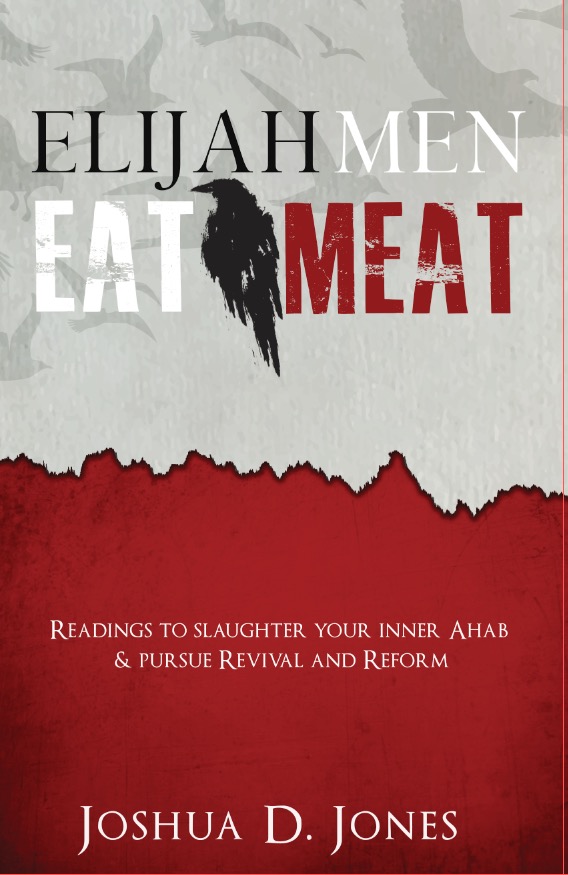 This post is an extract from the book Elijah Men Eat Meat: Readings to slaughter your inner Ahab and pursue Revival and Reform


February 10, 2018
The Gospel according to Elijah
 Elijah seems to stand alone at the serpentine synod. But a man who walks with God is never alone. He beings to pray before the King, the crowd, and the counterfeit clergy. His prayer reflects the eternal gospel. This is why we can look to Elijah: his life points us to Jesus. Elijah’s gospel is ours. This is true in three ways.
It is a gospel of repentance. Elijah’s message to all of Israel was to turn from idols, sin, and turn back to God. He sought to persuade them to action. This word of repentance is the first word of the gospel. It was the first word out of Jesus’ mouth at the start of his public ministry (Matt 4.17) and the first word from John’s. We are exhorted, ‘Repent, and believe the gospel.’
John the Baptist is not a figure that we can relegate to the Old Testament era. Jesus said, ‘the Law and the Prophets prophesied until John.’ To communicate the gospel, we need a prophetic word of repentance. We need the echo of an Elijah, of a John in our witness.
This is more than regret. A man or woman may look back and regret their sins and the consequences of their foolishness. But to be saved, a person must turn. It can be much easier for a church leader to get the congregation critiquing the faults of power structures, politicians, or big business rather than repenting of their own sin. Repentance involves realising that our deeds are evil and that they have offended a holy God. Only this produces the deep contrition that one needs to be fully born again by God’s Spirit.
When we preach, we not only confront people with the truth about who God is, but we seek to persuade them to turn to that God. Elijah appeals to the crowd’s reason, ‘If Baal is God serve him. If Yahweh is God, serve him.’
It is a gospel of atoning sacrifice. The Elijah ministry does more than issue a call to turn from sin. It’s a call to turn to Christ. The climax of John the Baptist’s ministry was in saying ‘Behold the Lamb of God that takes away the sin of the world.’ Elijah himself also points us to Christ at the climax of his revival ministry on Mount Carmel. There he called down divine fire upon the mountain to consume a sacrifice that he had made for Israel’s sins. He did this so that the hearts of God’s people might be turned to Him.
And this points us to the gospel. Jesus said in John 3, ‘when I am lifted, I will draw all men unto me.’ His sacrifice will turn people’s hearts to God. But what sort of sacrifice will this be? It will be a sacrifice like Elijah’s. Jesus says in Luke 12 ‘I am come to bring fire to the earth―and how I wish it were already kindled! I have a baptism to be baptised with―and how constrained I am till it is accomplished!’ Using typical Hebrew parallelism, he repeats the same thing in a different way for effect. He speaks of a baptism of suffering and of bringing fire to the earth. What does he mean by this?
The fire and baptism are one in the same. He speaks of the Cross. In his sacrifice, he brings the fires of divine judgement upon himself. The fires and fury of God’s violent punishment against sin descend upon the sacrifice. Jesus is offered the cup of hell and he empties it. He drinks damnation dry.
As we repent of and battle against the immorality of our day, we must always avoid moralism. We do not preach a world of good guys and bad guys. We are all bad guys and the one good guy was a sacrifice for us all. We do not preach the potential of human goodness. Our good deeds cannot erase our guilt before heaven. Only Jesus saves us from the coming wrath. Liberal theologians that are not centred on the Cross may see the fabrics of moralism as lovely and sophisticated serviettes to place on their philosophical dining tables. But, in reality, it is only Satan’s personal menstrual rags they’re wiping with.
It is a gospel of weakness. Like Jesus, Elijah chooses what looked like weakness. He chooses to be up north in Baal territory. He chooses a high mountain, the place of the Baals. He chooses a test well suited to Baal as a lightning god. He has given Baal all the advantages. To finish it off, Elijah handicaps himself by offering up his sacrifice in complete weakness by drenching it in water. Surely the Baalites thought Elijah was mad. They were spiritually insane, but not stupid. They knew that wet stuff did not burn.
But then the fire falls like a small, tactical nuke. The weakness of the sacrifice invites the power of God. Jesus’ sacrifice also seemed like an act of weakness to the world. It was an impossible act. Yet God’s power is made perfect in weakness―both in the weakness of Elijah’s sacrifice as well as the in the cross. Elijah’s story is our gospel: God saves through what looks to be ultimate weakness and ultimate folly.
___________________
This post is an extract from the book Elijah Men Eat Meat: Readings to slaughter your inner Ahab and pursue Revival and Reform
February 4, 2018
Fake Porn Videos and Gospel
 Picture taken from the BBC article on the subjectBy now, you’ve probably heard about the rising tide of fake porn videos. The BBC and others have run informative articles on the subject over the past week (here). Fake porn involves imposing an alien face onto someone in a porn video and, with the help of new easy to use apps, this has recently gotten a whole lot easier to do.
The phenomenon, also called 'deep fakes', has been mostly the digital lifting of female celebrity faces and attaching them to the bodies of porn actresses. (That is, if we may be allowed to assume the gender of these performers. I must confess to being one of those terribly backward types that still thinks of women in terms of having vaginas and men in terms of not having them.) But falling victim to fake porn could happen to anyone who has ever posted just a few selfies online―male or female.
It is even reported that Donald Trump is appearing in quite a few.
Yes.
These new apps will get even more accurate, user-friendly, and powerful over the next couple of years. This means that we can quite reasonably assume that an avalanche of fake porn is upon us and that no one is who has an online presence is safe. Our critics now have the power to easily turn us into porn stars. (Just choked laughing as I thought about my online critics and imagined some of the porn star names that I might get: Gyno Jonesy? Bacchus the Baptist?)
It used to be that if you didn’t want an ex-boyfriend to use revenge porn against you, the solutions were simple: don’t be stupid enough to let your boyfriend film you naked or, better yet, repent of your fornication and wait till marriage to have sex.
Problem solved.
But now, neither chastity nor sanity are safeguards against appearing in a cheap porno online. Now anybody can simply put you into one.
It’s moments like these when our sexually insane culture gets a brief glimpse of just how perverse it truly is. We are abhorred at what we see. At least for the time being. This isn’t the only manifestation of our sexual madness of course. So far this year, we’ve also heard about the growing market for sex robots, the wonders of open marriage, and the need to help primary school children explore what gender they really are.
With each new manifestation of our perversity, we get a glimpse of how wretched we actually are before our alarm bells stop ringing and we receive it all into the loony bin that we now think of as the new normal.
When we do get that glimpse of horror, we have only the faintest idea that this Frankensteinian phenomenon might just be a monster of our own creation. We have told God―and just who does He think HE is―to shove His rules and let us do whatever the hell we want with our pants. And He has done just that. He has given us over to the depravity of our own hearts and the result is hellish. He warned us long ago that Eros is a deity that is not easily tamed. We took God’s good gift of sex and made it into a god to be worshipped―and therefore it has fallen and become a devil.
We all stood up to condemn Harvey Weinstein for pressuring the Hollywood actresses into sexual submission. But now we realise we’re a whole generation of Weinsteins. Once the right technology is in hand, we force all the actresses we desire to perform our most titillating fantasies.
Fake porn will appeal to human brokenness with fresh power. You know that celebrity that everyone adores? She’s smiling at you. Now undressing and looking for your approval. You must be a somebody! Somebody powerful! And not just that celebrity. No. You know the girl that you study or work with? The one who is uber attractive but who was cruel enough to friendzone you? Download a few of her selfies from Facebook and now she is gladly frolicking about in your personal, digital harem. Congratulations. You are now a mighty man.
But only in the shadows of your lonely deception. In real life, your humanity continues to diminish.
Christianity offers us two things that we desperately need in this hour.
The first is the gift of Law. We need Law because we are confused sinners. For the moment, our society is objecting to fake porn because we are creatures made in His image and we instinctively feel the evil of it. But as we have rejected God from our thinking, we remember that we’re not supposed to believe in primitive ideas like evil. We may say we dislike fake porn (at least outwardly we say we do), but we have no objective basis on which to decry it as wrong. This is how our societal consciences get seared.
But God’s Law gives us a fixed moral reference point to uphold the good and expose the evil. God’s Law is clear on the issue: fake porn is evil because porn is evil. Porn is evil because it perverts the use for which sex was created. Sex and gender matter because they are essential to our identities as image bearers of God.
The second thing Christianity offers us is Gospel. We need Law because we are confused sinners―and we need Gospel because we are guilty sinners. The Gospel message announces that Jesus has shed his blood to forgive every porn actress and fake porn producer that will come to Him in repentance and ask for mercy.
It also announces that Christ has risen from the dead and is coming back to judge the world. This is especially good news in the face of a global fake porn tsunami. It means that no one will get away with anything. Every photo and video that has ever been maliciously doctored will one day have to be given account for before the One who died and was raised. And because the Judge offers forgiveness, it means that He can one day punish an evil world without also having to punish you and me.
God let His image become flesh, knowing that we would mar and mock it. Because of that, He is able to redeem a generation that does the same to one another.
___________________
For more on how the Gospel redeems us from our perversity, please check out our book: Elijah Men Eat Meat: Readings to slaughter your inner Ahab and pursue Revival and Reform
January 27, 2018
Anglican Resistance Fires Shots Ahead of Synod
 Next week is the Church of England’s (CoE) official Synod. Religious men, women, and non-binary will descend on London in their ecclesiastical garb in what is sure to be the oddest-looking gathering since last summer’s cosplay convention. Unlike the cosplay convention, this clerical congress likes to take itself and its discussions very seriously and we should do them the favour of playing along.
 In anticipation of this sober summit, a group of evangelical Anglican church leaders (CEEC) has just released a declaration formally referred to as 'Apostolic Life and Faith'. It's actually about sex. In releasing it they (presumably) hope to direct some of the synod’s discussion in a sane direction - something we cannot take for granted at Synod.
To understand why some people will find this interesting (other than the fact it's about sex), we need a bit of context.
The reason this synod is garnering more attention than normal is that the last one was more sin-odd than synod. Many Biblical Anglicans were caught off guard as theological revisionists denounced and pounced on those within the CoE who support ‘conversion therapy’ (a term that was ill-defined during the debates but is connected to the outrageous notion that Jesus might actually have the power to change someone’s sexual desires).
They also called for new ‘transsexual liturgy’ so that when a man who thinks he’s a girl tries to get others to join in the delusion, the church can solemnise his sad syndrome with some religious verbiage approved by the purple people. Perhaps it was exactly because the LGBT revolutionaries overreached at that synod that we are now seeing a degree of pushback in the form of today’s declaration.
Revolutionaries are often in too much of a hurry – they are eager to denounce and pounce on so much.
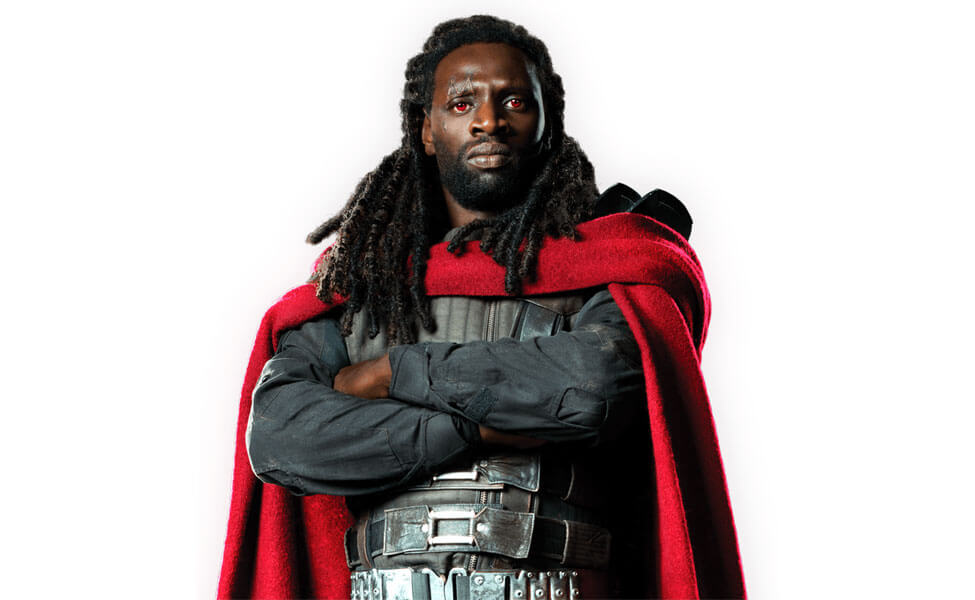 If you get it, you’ve just earned Marvel geek points.Of course, for some years, there has been reassuring talk by bishops of ‘good disagreement’ within the CoE between those with different views of on sexual and gender issues. Evangelical Anglicans should’ve known better. The reality has been that the priests and priestesses of the Rainbow Religion have repeatedly bitch-slapped the Anglican faithful (see last year’s Bishop North's witch trial). After a few years of trying to maintain dignity with a black and blue visage, the orthodox within the CoE are now growing something akin to a backbone. Hence, this declaration.
 This is a welcome change as, up till now, many of the Anglican Evanjellyfish have put up about as much fight against the bender blitzkrieg as an eight-year-old girl with candy floss. It may, even now, only be vertebrae the size of a man’s hand ascending out of the horizon, but it is something.
This declaration has supposed behind-the-scenes support from over fifteen bishops as well. That’s not a small amount of purple power as these things go.
What are we to make of it?
Some Evangelicals―and other orthodox Christians―have been leaving the CoE for alternative structures. But most have stayed within the CoE in hopes of either retaking their denomination or at least having a secure place for themselves within it. (The fact that the CoE owns their homes makes leaving a heavy price to pay.)
At first glance, this declaration may read as dry as well aged Vermouth to all but the keenest of theology geeks. One may think that a declaration on sex could be at least a little bit, well, sexy. But what it lacks in potential viral appeal, it makes up for in theological accuracy.
Cynics may remark that this is too little, too late. Wouldn’t a paper like this have been more appropriate three or four years ago? Where are the teeth? What’s to stop some purple Arch Jedi from saying ‘Thank you for your thoughts’ and then kicking it into far-left field never to be seriously discussed? The cynics may be wondering where is the ‘or else’ bit?
But these CEEC Anglicans are the real Resistance. They are holding onto hope amid the deluge of unbelief and cultural Marxism in their once great institution. And as long as they are willing to fight for it, spiritual fraternity calls upon us to support them. And support we shall.
There is potential for this thing to have teeth if you look carefully. Point five under ‘Application’ is worthy of our notice. In good Anglican style, it potentially says a lot while saying not committing itself to anything.
We do not wish for this differentiation, but recognise that it may become a tragic necessity. Our submission to apostolic teaching and practice means that, as apostolic Anglicans, we are deeply committed to being members of Church of England provinces which are similarly submissive and so communicating and clearly upholding—both de facto and de jure—the pattern of teaching and discipline handed down to us by the apostles.
Let me translate this from Anglicanese to common English. This is a warning shot. They are saying that if these revisionist nut-jobs succeed in fully hijacking our denomination, we must split. Preferably, we will take our own ‘province’ within the CoE so that we can actually follow Christ without interference and still be proper CoE (and keep our houses).
Will these two sentences get the attention and discussion they deserve? Or will the Archbishops & company simply place it to the side and then condescendingly warn us all (again) about the great spiritual danger of homophobia―that epic sin (along with capitalism and patriarchy) that is supposedly the great cancer of Western Christianity.
We support the true Anglican Resistance in their hope―and we wait to see how the boys, girls, and unspecified at Lambeth Palace will respond.
___________________
For spiritual fuel for the orthodox Resistance, check out our book: Elijah Men Eat Meat: Readings to slaughter your inner Ahab and pursue Revival and Reform
January 11, 2018
#MeToo, Potiphar's Wife & the Failure of Jacob's Patriarchy
 The first book of the Bible has a few #MeToo moments recorded in its brutally honest pages. And, as our church is going through Genesis, I am preaching them all. This means I tend to think about these accounts more than when I just read the book for myself.
This is at a Post-Weinsteinian time when the #Metoo and #ChurchToo movements are burning like a Southern California Autumn all over social media. The story of American pastor Andy Savage has helped add extra fuel to the flames this week alone. These hashtags accompany stories of sexual assault―victim stories being brought out of the closet. And, like most emotion fuelled movements, there is both good and bad that comes of it.
DinahIn Genesis 34 we read of Dinah’s #MeToo moment. While her family was still somewhat new in the neighbourhood, she went out to meet some of the other lasses in the area. It is recorded that Shechem, one of the princes of the area, saw her and sexually assaulted her. She comes back home and tells her dad, Jacob, what happened. What does this Father of the Faith do?
Nothing. Nada. Rien. Zilch. Nutt’n.
The story goes on to explain how, amidst Jacob’s sinful inactivity, her eleven brothers come up with a plan to get revenge on those responsible. It was an honour killing that went to the extreme. Many people who had nothing to do with the actual assault lost their lives.What can we learn from this account?
First of all, the text places no blame on Dinah for what happened to her. Moses, in recounting the narrative, never blames Dinah. Her choice of clothing is never mentioned. There’s not even a hint of her ‘asking for it’. Shechem is the guilty party and he should be punished for his actions. There is never an excuse which justifies crude behaviour much less sexual assault.
Secondly, we might ask how Dinah got into such a vulnerable situation to begin with. But this is not to ascribe any blame to the young girl. At the most, she would be guilty of the same youthful naivete that accompanies almost all at that age. The narrative implies that it was Jacob who had failed in his patriarchal duties. Remember: this is not your typical English village she wandered into. This was the Ancient Near East. There was no rule of law like we now know. This was a land where might was right. Why was a pretty teenage girl (who had elven brothers!) so unprotected at such a time and in such place as that?
What’s certain is that Jacob was not being the father he should’ve been. Dinah was hurt because of an absence of healthy fatherly oversight. It is negligence, not excessive patriarchy, that is to blame. Jacob failed to guard and protect his daughter’s feminine innocence before the assault and he then failed to seek justice after the event. He utterly failed to be the patriarch God had called him to be. The father’s self-centred negligence was the soil from which pain and injustice grew.
Lastly, Dinah was right to tell her story. This is perhaps the best thing that might come out of the current #MeToo and #ChurchToo movements: churches being environments where we can confess both our sin and the hurt of being sinned against.
It is tragic that Jacob doesn’t act on Dinah’s story. Because of his inaction, Dinah’s brother’s sought justice―but without wisdom or moderation. Like today, when victims do not get the justice they deserve, youthful and inexperienced mobs can be whipped up to go and pursue justice themselves. In the process, they do far more harm then good. When those in authority fail to act justly, there is always a void left. That void is not always filed with good things.
Potiphar’s Wife The next story is that of Joseph in Genesis 39. In this insistence, the accused man was the victim. A scorned woman didn’t get what she wanted and so falsely claimed the #MeToo tag for herself. The emotional fury that was provoked by her accusation landed the innocent Joseph into a prison with a life sentence.
What can we learn here?
First, we cannot always be certain who the victim actually is when an accusation surfaces. It’s easy to get passionate over a perceived injustice. It takes time and the exercise of wisdom to examine actual evidence and hear both sides―something that Mr. Potiphar fails to do (like most people). If the woman accusing the man is telling the truth, then she is the victim. If she is lying, then the man being accused is the victim.
[Though not directly related to the text, it should be kept in mind that men can be victims as well. And we don’t just mean in the sense of being falsely accused. We speak of sexual assault. Men get raped too. I remember one young man I pastored confessing to me how he had been raped by a group of other young men. He felt incredibly ashamed of what had happened to him and for that reason had been silent for years. Most male rape victims never admit it. It is perceived it as unmanly to be the victim. There is yet to be a #MeToo movement that most abused men feel they can claim as their own.]
The Joseph account also teaches us just how much we need cautious wisdom for times like these. It’s easy to jump on a bandwagon. That’s why Christians need to resist the mob mentality and look at each situation individually. Stoking the fires of perceived injustice among followers online is a lot easier than cultivating a mature gift of discernment.
Lastly, there is redemption. As Summer White wisely pointed out (HERE), our hashtag is #MeToo AND #ButGod. Our abuse does not define us. He can reach down into our pain and bring healing and beauty. Joseph’s false accusation and prison sentence was not the last word. God was with him.
What abusers mean for evil, God can use for good.
As with every social trend from BLM to Brexit to The Trump Train to #MeToo, we should resist the impulse to get completely caught up in blind enthusiasm―either 100% for or 100% against. All earthly movements are an incongruous compound: all contain potential both for good and for harm. In typical human fashion, they do both to varying degrees. As a prophetic people, it should be our goal to speak to the good and resist the errors―even in the best of them.
___________________
For more on engaging social trends with discernment, check out Elijah Men Eat Meat: Readings to slaughter your inner Ahab and pursue Revival and Reform (Get Here)
December 20, 2017
An Alien Christmas on a Theologian's Toilet
 In the Spring of 1517, a theological professor went to the crappers. While doing his business, he had an explosive breakthrough.
Possibly more than one.
He was teaching through the book of Romans at the local University and he was puzzled over an issue. Though possessing a sharp mind, a degree in Law, and a doctorate in Theology, he was still struggling to make sense of what St. Paul meant when he wrote about ‘the righteousness of God’.
This was more than a moot point for the North German theologian. He had trembled his whole adult life with the question of how a disgustingly sinful man―such as himself―could ever be good enough to stand in the presence of a thrice-holy God and not be killed. It was while on the john that he had a revelation that caused his heart soar in pure spiritual ecstasy and liberation―and which takes us to the heart of Christmas. What was that revelation?
Aliens.
 Truth.Or, to be more precise, ‘the alien righteousness of Jesus’. Martin Luther had been exceedingly scrupulous as a monk. Yet he always sensed that infinite qualitative difference between him, as a sinful man, and God. While doing his business that spring day in 1517, the penny (among other things) dropped. The monk got woke. He finally understood what Paul had been on about and why Jesus came to be born as a human in the first place.
He came to give us His righteousness.
For our sake, God made him to be sin, who knew no sin,so that in him we might become the righteousness of God.-II Corinthians 5
In the cross of Jesus, God’s righteousness―a righteousness wholly foreign and alien to our wicked world―invades our planet with a force and fury that makes every other blitzkrieg look like a Spanish tumbleweed. Jesus takes us in our sin and filth and makes us righteous and acceptable to God. His Blood washes us, making us clean.
This is True Christmas. As nostalgic as the season may be to many in the Western world, human sentimentality does not make us righteous. We can baptise ourselves in mulled wine while singing the hymns of Bing Crosby and Cliff Richards yet still sink in our damnables. Many Westerners may very well look to our modern Christmases with all the eagerness of a Weinstein before a new round of actress interviews. They count down the days to the 25th of December as a day of redemption for their otherwise empty lives.
Yet, for all this anticipation, many still suffer from post-Christmas blues. Many feel as if Christmas has somehow let them down. It lets them down because they were looking for a Saviour―and they were hoping Christmas would redeem them. Christmas makes a terrible god because Christmas cannot save. Most people only know Fake Christmas.
But True Christmas can point us to the One who can. God’s righteousness did not cross the borders of Heaven and come to Earth in a golden chariot to be welcomed by the ruling elite in Rome or the enlightened rulers of China. God’s alien righteousness came screaming and bloody, exploding out of a virgin’s vagina in the hillbilly backwoods of the Roman Empire and placed in an animal’s feeding trough.
This is why Luther’s personal rediscovery takes us to the very heart of Christmas. God’s alien righteousness comes down in the midst of our unrighteous crap. The biggest scandal is not that the holy babe was put in a manger that smelled of sheep drool and donkey farts. The biggest scandal is that God’s righteousness comes into our even filthier lives. Our lives―you know, those things that begin with glorious vision yet somehow seem to unravel into incoherent chronicles of ineptitude, arrogance, and sheer dumb-assery.
Yet, it’s into our lives that He comes. It’s not the healthy who need a doctor, it’s the sick―and the filthier we are, the more inclined He is to come. He comes for those who know they the worst of sinners―not for the self-righteous who spend all their time decrying the repugnant cultural other on social media. He comes for those who know that they, themselves, are the problem.
Mild, He lay His glory byborn that men no more may die
The ugly wooden manger was announced by the angel as ‘a sign unto you’. It is a sign because it points beyond itself to an even uglier wooden cross. The baby who shepherds see drinking milk from a broke, teenage girl will one day drink damnation dry. And this righteousness, one that is wholly alien to us, becomes the only gift that really matters. ___________________
For more on being righteous in a crappy world, check out Elijah Men Eat Meat: Readings to slaughter your inner Ahab and pursue Revival and Reform (Get Here)
December 19, 2017
Of Gilead and Gulag: 'Handmaids Tale' and 'Gulag Archipelago', a Comparative Review
 Elisabeth Moss plays Offred in the TV
version of Handmaid's Tale
Earlier this month I read both ‘The Gulag Archipelago’ and ‘The Handmaid’s Tale’. As they both centre on the themes of freedom and oppression―much talked about issues in our day―I thought it was worth doing a comparative review. I’ll briefly describe each book first.
Gulag Archipelago Gulag was written by the Russian author Alexander Solzhenitsyn (1918-2008). As its title suggests, it focuses on the numerous prison and work camps into which the Soviets threw millions of its own people who were suspected of political dissent. Solzhenitsyn himself spent nearly ten years there, so it contains biographical as well as historical elements. In addition to simply recounting history, there is considerable space given to literary and spiritual reflection as it describes his journey from atheism to Christianity while in the gulags.
I read the author-approved abridged version which is 500 pages (the original is 2,000). Gulag is credited as being one of the great books that helped to bring down the USSR.
The Handmaid's Tale Handmaid was written by Canadian author Margaret Atwood (1939-present). It is a dystopian novel set in in an imaginary futuristic New England that has been renamed Gilead. It is run by a religious, totalitarian, military dictatorship and, like Gulag, the novel follows the life of a character through an oppressive society dominated by an ideology to which everyone must conform and where dissent is severely punished. We follow the life of the protagonist, Offred, who has been chosen to be a handmaid (as one of the few fertile women left on the planet, she is selected to be a surrogate mother to a commander and his wife). She does not personally embrace the empowered ideology of the Republic, and so she struggles to keep her sanity in a system which would punish her for expressing disagreement and for breaking societal rules.
The book is about 320 pages. Handmaid has won many awards and is currently a popular television series.
How are they alike?Hopefully, by now, it is obvious why we are comparing a work of non-fiction with a work of fiction: they aim to take us on the same journey and feel what life is like under an oppressive regime. The author herself, though Canadian, was living in West Berlin at the time of writing. Atwood saw the Marxist oppression as close as a free person can without having to actually come under it. It is her experience of living there that adds realism to the many scenes she describes. She has taken what she has seen and heard from the secular, Soviet regime and transplanted it into an imaginary religious dictatorship. Many scenes that she describes have a remarkably similar feel to what we find in Gulag.
 Alexander Solzhenitsyn - a man whose book
helped bring down the USSR
Atwood has a great gift for words and our ability to experience the inner life of Offred is noteworthy. Gulag does the same thing because, well, it actually is a real man’s own experiences and thoughts. But Atwood makes her work feel almost as real. We can feel the loneliness and the questioning that Offred experiences as we do with Solzhenitsyn. Both books touch on the theme of restricted speech―something that is becoming more of an issue here in the UK. In both societies, there were certain un-PC words that one could get in trouble just for uttering. In Gilead, Offred longs for magazines that are forbidden. In the Gulag, Solzhenitsyn longs for the Bible and other books that are equally forbidden. One walks away from both book (hopefully) with a greater appreciation of how valuable the right to dissent and the freedom of speech really is.
Both books show how oppressive ideologies and regimes de-humanise their dissenters. Solzhenitsyn is given a number instead of a name. Offred is given her name by the new society (we are never told her real name).
Both books describe an existence where one has to continually question her friends and family. Who is a genuine believer? Who is secretly working for the regime? Who can I really trust? Will this person turn me in? The sense of isolation that comes from untrustworthy relationships is powerful in both works.
Neither book seeks to fully demonise the individual oppressors―this is to the credit of both books. One does not walk away from Gulag with the thought that all Marxists or all Atheists are evil. Solzhenitsyn even empathises with his interrogators at times. It’s in these experiences that one of his famous quotes about the line of good and evil running through the heart of every human occurs. Though Atwood doesn’t give the same depth of spiritual reflection to these issues, she does not make everyone in the regime purely demonic either―her characters are not cardboard. One does not walk away hating religious people after reading it. In fact, the ruling elite (apparently Protestants of some unspecified variety) war against Catholics, Baptists―and the Quakers are actually painted in a fairly good light. Atwood wields a nuance we can appreciate.
How are they Different?One of the biggest differences―other than the obvious genre difference and the religious/irreligious natures of the regimes―would be the spiritual nature of Gulag. Though Handmaid does spend a lot of time exploring the thoughts and feelings of the protagonist, one does not finish the book with a clear roadmap for how to handle life if one is ever in such a situation. Many times, the phrase ‘don’t let the bastards wear you down’ is used, but we are left wondering how to not let them do so. The ending of the book doesn’t give us clear instructions. But Gulag is different. When finished, one feels like she has an idea of what truths her heart must embrace if her soul is to survive, and even thrive, in such a situation.
This is inevitably connected to the larger issue of transcendence. For Solzhenitsyn, there are clear transcendent truths by which he evaluates and compares life in Russia pre- and post- Marxist Revolution. We have a clear standard by which to say that the freedom before is better than the oppression after. But though such ideas are implied in Handmaid, they are not―and perhaps from its secular standpoint cannot―be developed in much depth.
That is not to say Atwood is wholly silent on the subject. But her attempts to root Offred’s longing for freedom in something other than just a subjective preference―that is, in something actually morally verifiable―feels weak after reading Gulag. She contemplates the nature of ‘love’ at one point and even recites her own version of the Lord’s Prayer―but these reflections don’t go very far (at least not by comparison to Gulag). All this leads the thinking reader to ask ‘On what objective basis can we say that a free society is superior to an oppressive one? Offred may not like it, but there are others who do―so who cares what Offred thinks?’
We are left wondering if Offred would not treat her religious persecutors in the same way if roles were reversed and she were to suddenly come to power. By contrast, we sense that if the roles were suddenly reversed, Solzhenitsyn would really want freedom and good for those tormenting him. In the recesses of the gulag we find salvation and a clear answer to why freedom is better for all mankind―religious or irreligious. In the Republic of Gilead we find neither.
I’m glad I read the two books together. I would recommend reading the abridged version of Gulag to everyone as a great book to help grow your soul and to understand life under Marxism. I would also commend Handmaid as an engaging novel with good wordsmithery, syntax, and realistic psychological descriptions―even if the plot is a bit underdeveloped at points.
___________________
For more on growing spiritually in the midst of spiritual oppression, check out Elijah Men Eat Meat: Readings to slaughter your inner Ahab and pursue Revival and Reform (Get Here)
December 5, 2017
Book of the Month: Dare to Ask
 I have read some good books this month, but I’d like to highlight Dare to Ask by Israeli author and worship leader, Simcha Natan. She lives near Mt. Carmel where she helps to lead programs centred around intercession and worship.
It had been a while since I’d read a book of this sort. It is a reflective in tone and personal in application. It’s the type of book you’d want to take with you on a quiet prayer retreat – or the type to read at the end of the year to take stock of your spiritual health. It deals with personal dreams, gifting’s, serving others and personal sanctification. I often caught myself thinking of the Biblical story of Joseph and how God shaped his character and then resurrected his dreams.
I have well highlighted Natan’s book, but a few of favourite lines would be:
‘There is a tension we must learn to live with well: to be at peace that our dreams may never happen, while trusting that God placed them in our hearts for a reason.’
‘It is necessary to hold onto the Maker of our dreams rather than clinging on to the dreams themselves, or making idols of them.’
AND
‘When an audience of One is enough, we’re much more likely to be given a greater audience.’
Dare to Ask isn’t long and the chapters are served in digestible portions. It helped me to take stock of things in my own life. It is available in Kindle and paperback on Amazon sites worldwide. More information about the worship and prayer programs that Natan helps lead can be found at www.ascend-carmel.com
December 2, 2017
Prayer the Raises the Dead
 [Extract from the book Elijah Men Eat Meat]
‘And he stretched himself upon the child three times, and cried unto the Lord… and the LORD heard the voice of Elijah.’ -1Kg 17
Elijah is dealt an unexpected blow. The young mother that he had blessed is now facing an unspeakable curse: the death of her little boy.
Now Elijah knows a God who can redeem from the very worst of circumstances. But this redemption is not going to be brought down from heaven on the careless wings of half-hearted praying. Elijah doesn’t merely look at the boy, shrug his shoulders and mutter ‘Well if it’s your will God…’. No, none of that impotent praying will do the trick.
Rather, he takes the dead boy and brings him into his own bed. He makes this personal. He stretches himself out upon the boy. He identifies with him. He takes this boy’s death as if it were his very own. He does it three times. He persists. His faith will not be turned away by a lack of answer the first two times. Three times he stretches himself out in crying out for life. His praying transcends earthly boundaries and raids heaven to call upon a grace greater than death.
Elijah’s voice is heard. God sends life back into the boy. Not only is the boy raised to life, the mother finds an eternal life that cannot be taken away from her. Elijah had built a relationship with a woman who did not share his faith. He had blessed her with bread and she was grateful. But it was in seeing her boy raised that she came to personal faith. The heathen gal has not just been blessed, she has been properly converted.
Do we pray just to pray? Is it a mere exercise or form of personal meditation? Or do we pray in order to be heard? Few of our churches gather to pray anymore. Among those that do, prayer is sometimes presented as a creative hobby or as a way to help a person become more ‘spiritual’. How to grow in the art of intercession, the pamphlet to the seminar may advertise. But prayer is an art only in the sense that war is an art. It is an aggressive cry raised to God to come down and shake a demon-filled world. Prayer that calls down the Kingdom is not for the curious, but for the desperate. Prayer gatherings of desperate people are few and far between now in Britain, but any true reformation must begin as a reformation of prayer.
Churches do many activities that their wider communities benefit from. Christians have started countless soup kitchens, hospitals, and orphanages during the last 2,000 years. We’ve done so much of it, that society now expects it of us. Feeding the poor gives moral validation to the message of a God who generously and freely gives to those who are spiritually poor. This will soften some hearts. It makes some people appreciative and can give us a hearing. But charity programs are not listed as one of the ‘signs that shall follow those that believe.’ We can do such things without an ounce of supernatural help.
Some things simply will not happen until we learn how to pray in such a way that causes us to be heard. How many of us can say to an unbelieving world when it faces tragedy, ‘Give me your son’? How many of us are willing to risk such embarrassment? Are we willing to risk our image for God’s glory? We often say our prayers, but do we really pray? Those who are willing to be broken in prayer are the ones who will break hellish fortresses.
Power in circumstances such as Elijah faced comes from long hours spent alone with God. It’s not cultivated by praying with one eye on heaven and the other checking how many likes our last social media post got. It comes when we learn to pray specific prayers about issues in real space and real time.
___________________
Extract from Elijah Men Eat Meat: Readings to slaughter your inner Ahab and pursue Revival and Reform (Get Here)
November 21, 2017
Why We Hate Missionaries
 David Brainard - missionary to the American Indians.
His 'Journal' will rock your world.[Extract from the book Elijah Men Eat Meat]
Elijah’s mission to the foreign town of Zarephath is not a secondary episode. Rather, it gives essential perspective. Jesus cited this episode as having a parallel to his own, so we must get this. It is a key event that all potential reformers and revivalists must keep in mind or else they lose ultimate focus.
It is not enough to merely heal a wounded soldier. We must get him back onto the battlefield in fighting condition. It is not enough just to get the water out of the ship. We must get the ship back in the water and set it on its mission. Likewise, it is not enough merely to rid the church of fake teachers and immorality. We must keep our ultimate mission in view.So let’s talk mission. Let’s assume that we accomplish our goal of Bible-slapping the Jezebellic zeitgeist out of the church. Great. Then what? What would we then do with ourselves? What is our mission?
The church’s mission focus has been largely hijacked by the new regressives. For most of her history, the main mission of the church has been clearly understood: to preach the gospel and make obedient disciples of Jesus throughout the nations. But Satan has belched upon us a faux-guilt complex rooted in a dimly understood European colonial history. Somehow, we’ve believed the lie that sending preachers to other countries to proclaim the gospel is racist. How it is racist, we’re not quite sure. But this is what the cool kids have told us and we have believed them. As the church was made for mission, we replace gospel advancement with other causes: recycling, opposing fracking, reducing carbon footprints, wealth distribution―or whatever the latest Guardian approved cause may be. We hate real missionaries by neglecting pray for them, give to them, or even consider going ourselves.
There are some Biblical churches that rightfully disregard the hellishly humanistic substitutes for mission, but they then lose foreign mission as a focus themselves because ‘we have so many problems here at home.’ Given all the spiritual darkness that we see in Israel, it would be easy to assume that God might put foreign missions on hold. Elijah has no shortage of work to do within his national boundaries. After all, there are plenty of fake prophets to combat and plenty of seduced hearts to turn. Yet, God sends Elijah to another nation to spend two years of his life witnessing to one pagan woman and her son. How does one even begin to evaluate whether that was a wise use of time and resources? Surely a gifted preacher and miracle worker like Elijah could be doing more important things? He could be preaching to huge crowds back in Israel, no? God doesn’t seem to think so. He sends his premier prophet into foreign missions for a season.
Reformers can be so focused on awakening the church within their own locality that we forget the bigger call the Father has given us: to see Jesus exalted in all nations. This was a tendency among some Reformers 500 years ago. They were so focused on reforming the church’s theology and ecclesiology that sending out missionaries into foreign lands was neglected.
It was 200 years later that Protestants began to gain a significant vision for global evangelism. When they did start, they did amazing work. The biographies of Hudson Taylor, William Carrey, Amy Carmichael, David Brainerd, etc., are now Christian classics worthy of every growing Christian’s prayerful read. They didn’t just go to do service projects either. They went to preach, baptize, and disciple.
Today, 2/3 of all Christians live in the third-world. There are more active disciples in Asia than in the United States, and more in Africa than in Europe. This global shift in Christianity is thanks to men and women who obeyed God’s marching orders and gave their lives abroad just 200 years ago. In a beautiful (and ironic) turn, missionaries from countries that are poorer in material goods, but richer in God, are now coming to our cities and telling us Europeans that we need to repent. The bread we cast on the waters is returning to us. The POC (Primates of Colour) within third-world Anglicanism are the ones giving well-deserved rebuke to their (mostly) white ecclesiastical siblings who increasingly tolerate sexual immorality and fake teaching in their midst. Their voices are strong. May God help us listen.
Europe is the one continent where Christianity has been shrinking for more than a century - while it has grown in the other continents. There are still millions trapped in the shadow of Islam who have never heard the gospel. Who will go and tell them? Who will go to Spain? Who will go to Uzbekistan?
The Father’s goal is to see Jesus praised among the nations. Who is our widow? We may not be able to go abroad ourselves, but in today’s world of instant communications and affordable travel, we can all connect with global missions in some way. There are practical ways anyone can get involved, and it doesn’t take too long online to find groups that can point you in the right direction. We may rightfully desire to be a prophetic witness within our own church and nation, but where is our Zarephath?
___________________
Extract from Elijah Men Eat Meat: Readings to slaughter your inner Ahab and pursue Revival and Reform (Get Here)