Joshua D. Jones's Blog, page 2
April 15, 2020
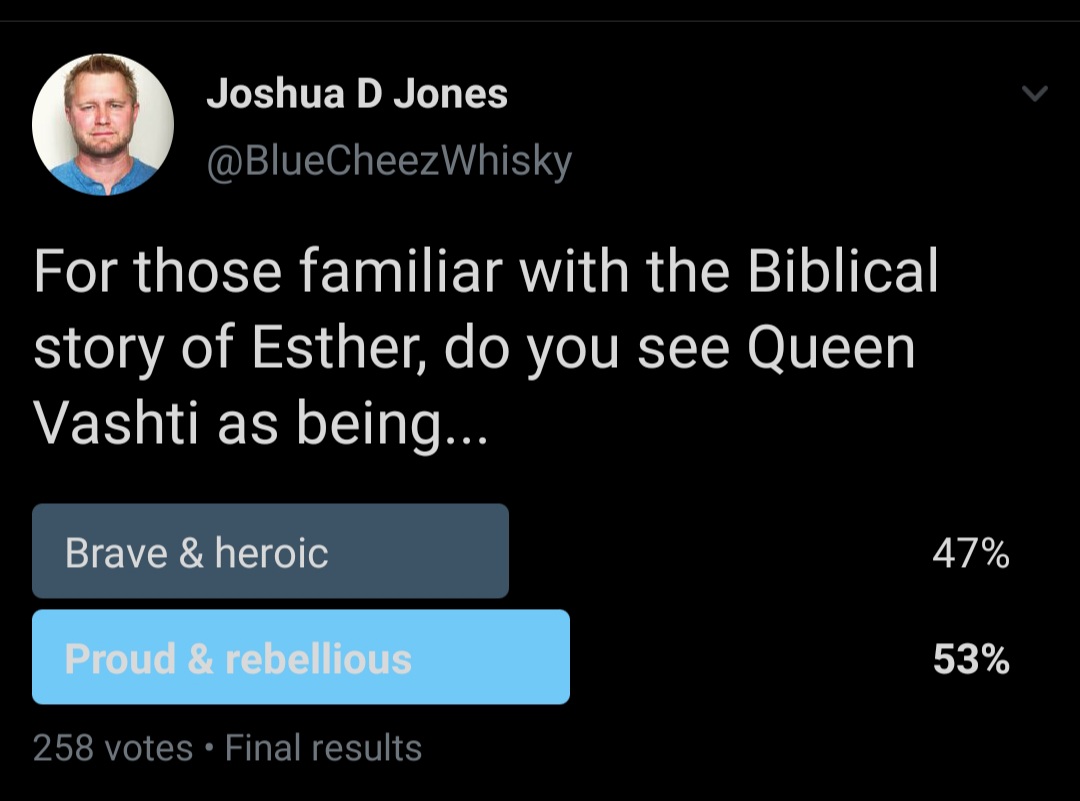
Hermeneutics: How do we understand Vashti?
 WHAT SHOULD WE make of Vashti? The King calls her to appear and she refuses. Is she brave and heroic? Or, is she just being proud and stubborn? What you or I might think of the whole situation is of limited importance. The question we must ask is: how did the author of Esther understand Vashti?
Two SidesNo matter how thinly you slice your bread, there is always going to be two sides. In the same way, the account of Xerxes’ divorce with Vashti currently has two views. If we are going to be careful readers of the Bible, we need to exercise our minds to determine which understanding of the events is most likely. This is not easy as the details on Vashti are sparse and there is debate among some scholars as to whether she existed or is just a fictitious plot device to set up the story.Now, most Bible teachers agree that Xerxes’ request probably wasn’t well thought out or timed given his having drunk too much. But some teachers go beyond this and argue that Vashti was a brave martyr for the cause of women everywhere because of her refusal to obey the king’s request. They believe that Xerxes was really calling Vashti out to the party only to humiliate or objectify her in a way that was contrary to her otherwise upright character. Some even see Xerxes’ request to come out wearing the crown to mean wearing only the crown (meaning to come out naked). Her refusal is therefore seen as something noble and exemplary. Mike Cosper expresses this view in his book, Faith Among the Faithless. He writes, ‘She heard the throb of the music, the roar of the mob. And tonight, Vashti would say no. For her dignity. For the dignity of her handmaidens. For the women of Persia, Vashti would say no.’Others, of which I am one, agree that Xerxes was a terrible husband, but also think that the Biblical authors want us to see Vashti as being just as proud and unexemplary as Xerxes. Why do we think so?
Too Far Between the Lines?First of all, we need to carefully see what words are and what words are not in the Bible. We need more details in the Biblical text itself before we should be prepared to grant Vashti some sort of martyr status for all Persian women. The author simply doesn’t use hero or victim language to describe her. Also, contrary to the imaginations of more than one commentator, there is nothing in the actual words of Scripture to indicate that Xerxes wanted her to come out naked or to do a striptease. Had the author wanted to convey that this was the king’s request this, there were many words available to him to describe it but he didn’t use any such words. Also, based on how Xerxes treats Haman when he approaches Esther too closely in chapter seven, it would seem that the author wants us to see Xerxes as the type of guy who likes to keep his women for himself. The author simply says that the king requested Vashti’s presence so that everyone could see her beauty and that he wanted her to wear a special crown. The writer of Esther simply never describes Xerxes request as sexually immoral nor does he affirm Vashti’s refusal of the king’s command as something noble. Some may argue that you have to 'read between the lines to see it.' Well, yeah, deep between the line!
Greek HistoriansSecondly, though there is not complete confidence in Vashti’s historical identification, many connect her with Queen Amastri, Xerxes first wife, someone who the Greeks viewed as being proud and cruel. One historian recorded that once, when Amastri felt threatened by a potential rival, she sent guards to find the woman’s mother and had her breasts cut off and fed to the dogs. If this Queen is Vashti, then it’s most likely that she was banished to the harem whee she continued to wield a degree of influence if it is to be syncretised with secular sources.
Jewish HistoriansThird, a lot of ancient Jewish Midrash also understands her as being wicked and corrupt like her husband, especially from those rabbis in nearby Babylon at the time. In this sense, their view is similar to the Greeks. The Midrash understands her to be a very proud woman as her father was also a king and she saw her husband as failing to live up to her father’s greatness. Admittedly this is not a universal view among ancient rabbis as some Midrash from back in Israel saw her in a more positive light.

Political DynamicsThe fourth reason many are slow to read simple heroism into Vashti is due to the politics involved. For many, this conflict is more about power than sex. Vashti was born with royal blood and her marriage to Xerxes helped merge two dynasties and, though Xerxes was the kingdom, his was also seen to be a family of upstarts. That she was holding a separate party, one that didn’t involve commoners like Xerxes’, may have had as much to do with class signalling as it did gender respectabilities. In short, politics makes it all more complicated.
Mixed Company in Ancient PersiaThe fifth issue concerns women in public life at the time. We need to question whether Vashti’s public presence would have been scandalous. Now, traditionally, this had been frowned upon and the sexes had always partied separately. By the time of Xerxes, however, things were changing. The role and activity of women wasn’t what it had been 100 years previous. Whether one wants to view that as progress or as decadence, or as some mixture of both, is up to the reader. The high-class Persian women of this period were becoming more powerful and more socially engaged. There was a school for wealthy girls in Susa and seeing women learning horseback riding, archery, or economics wasn’t unusual at this time. Joshua J. Mark writes in his entry in the Ancient History Encyclopedia about this epoch that, Women could own land, conduct business, received equal pay, could travel freely on their own, and in the case of royal women, hold their own council meetings on policy… women had more rights and responsibilities [in the Achaemenid Empire] than in any other ancient civilization except that of Egypt.He further writes of this era that Queens in particular, ‘were given places of honour at banquets alongside distinguished male guests.’ How the culture would have viewed the appropriateness of Xerxes’ request to come to a garden party where commoners were present is speculation. But saying, as some Bible commentators have, that Vashti was fully justified in her refusal of the king’s command because wives or queens were never to be seen at public banquets doesn’t seem to line up with the historical consensus for this era.
Obey the King?Sixth, it’s important for us to keep in mind that King Xerxes asking his queen to come to the banquet may have been somewhat different than a husband who has had a bit too much to drink might making inconvenient requests of his wife today. The author understood that Xerxes was seen as the god-king of Persia whose every word was to be taken as divine revelation if the whole Empire were not to fall apart. To the author, this is not an episode of the Simpsons where it’s fine to poke fun at the clueless dad and husband. That is a modern invention. The author understood, if not shared himself, that, when a Persian Emperor speaks, it is a command that was expected to be taken with the utmost gravitas. It is less like Marge ignoring Homer and more like the Prime Minister refusing to come to Buckingham Palace when the Queen summons him. Only this monarch has real authority. The author would not have seen this as a mere domestic spat. He would have understood this as a political crisis. And...NarrativeLastly, it seems that, based on the narrative flow of the book, Queen Vashti is set up by the author to be a contrast to Queen Esther. Esther is a book of contrasts. The pagan party at the beginning contrasts with the godly celebration of Purim at the end. Haman and his ambition contrast with Mordecai and his mission. Vashti contrasts with Esther. Vashti proudly refuses to come when she’s asked. Esther humbly comes when she’s not. One is banished. The other is exalted. This why John Robertson, in his commentary on Esther, writes ‘The book of Esther would make no sense if the king’s request for Vashti to come before him was vulgar or depraved. Esther honoured Ahasuerus and Vashti dishonoured him before his guests.’ Looking at all the evidence, we find it unlikely that the author of Esther wanted us to understand Vashti as a great moral example. The lack of textual affirmation, the historical context, and the flow of the story mostly point to the author intending her, along with Haman, to being the bad examples meant to contrast Esther and Mordecai’s good examples.
_______________________________________________________
 For more, see Elijah Men Eat Meat: Readings to slaughter your inner Ahab and pursue Revival and Reform

March 20, 2020
Is the Corona Divine Judgement?
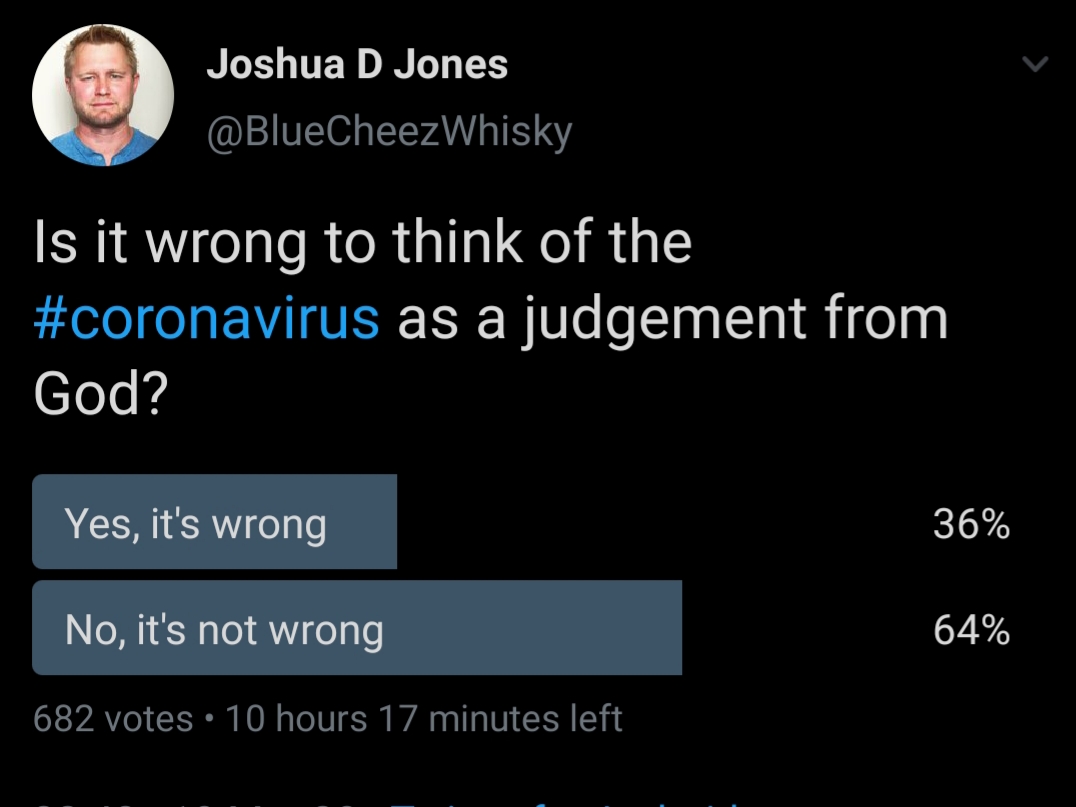 ‘Is it wrong to think of the Coronavirus as a judgement from God?’
 That may seem like an odd question at a time when we are all trying to cheer each other up. Initially, it may sound negative. But it’s a question that leads somewhere decidedly good.
I put the above question out to the boys, the girls, and the strange creatures of Twitter yesterday. Within fourteen hours 700 had responded―far more than usual. The results surprised me. 64% responded that such thinking was not wrong with 34% taking the opposing view.
Judgement is more popular than I had supposed.
What does the Bible say?To be sure, the God of the Bible certainly does send judgements on the world. Christians nowadays downplay these judgments. We mumble, roll our thumbs, and squeak out something about God going through an awkward phase. But God is not shy in taking credit for these reckonings. Remember that story of Noah and the Arc back in the book of Genesis? The one with all the animals we tell to our kiddos? Yeah, it was God who sent that flood and drowns them all. Yikes. And though no other judgement in the Bible ever matches that flood in terms of severity, there are other, smaller catastrophes that God seems to take credit for, particularly in the Hebrew scriptures―what most Christians call the ‘Old Testament’.
Why?Contrary to popular understanding, God doesn’t do such things because he gets moody or hormonal. His judgements, when they do come, are decidedly different than the outbursts that we humans have and they’re different in at least two ways. First of all, they are a long time building up. His judgements aren’t angry, knee-jerk reactions like the ones we get when the person behind us in the TESCO check out line coughs (you know who you are). Rather, the judgements that come on nations in the Bible often have a build-up of about 100 years or more and are repeatedly warned about by a series of prophets who are often dressed as grungy hillbillies like the boys sitting on the porch in the film Deliverance.
Secondly, His judgements are not mere actions of revenge in the way we humans tend to get back at one another (I’m still thinking about you Cough Man). In the Bible, God’s judgements have instructive purposes. He judges Egypt, after many warnings, because He’s trying to teach them about who He is and that it’s wrong to enslave a whole race of people. Often divine judgements come upon God’s own people of Israel because they are oppressing the poor or giving themselves over to idolatry, greed, and adultery. Isaiah the prophet, in about 700 BC reflecting on these issues wrote ‘When your judgments come upon the earth, the people of the world learn righteousness.’
The New TestamentWhen we get to Jesus and the writings of the New Testament, we see a change of focus. The thought of God sending judgements on the world is never denied. In fact, it’s somewhat presumed. But, the future Day of Judgement aside, it is not talked about much.
Let me give an example of what I mean. Jesus tells a story about two men. One builds his house on the rock with a strong foundation. The other builds his house on the sand using that cheap, pre-fab stuff like in the IKEA boxes. What happens? Well, a Florida sized storm comes and beats violently against the two houses. The strong house on the rock is able to endure the onslaught while the IKEA house on the sand collapses.
Now, in this story, the storm is simply acknowledged as being there. Storms come into our lives: to the clever and dummies alike. Jesus doesn’t focus on where the storm came from, whether it was a divine judgement or not. He simply says that it came. The focus is on how you are building your life. Are you building your life on things that will endure? Or, does your life have an attractive exterior but weak foundations?
And this is the emphasis of the followers of Jesus after his resurrection and the beginning of the church. It is recorded in the book of Acts that a major famine swept through part of the Roman Empire. People ran out of food much like TESCO at the moment. During this famine, the church is never recorded as sitting around speculating on whether it was a divine judgment or not―something that could be easily done considering how wicked and oppressive the Romans were. Instead, the early Christians focused on how to respond to the famine: by taking up collections for the poor. They sent their food, money, and toilet rolls to where it was needed.
Maybe it was judgment, maybe it wasn’t. What difference does it make? Either way, we are to respond with mercy to those in need.
Our JudgementsThis is not to say that judgment is never mentioned in the New Testament. But, when it is, it is usually done in one of two ways―both of which are radically personal. First of all, when spoken of it is often done in regards to THE Day of Judgment, the one which takes place at the end of human history. This is when all the fireworks go off and each person is judged according to what they have done or not done. It is the final assessment of our life’s worth and it is an event that should cause us to sit up and pay attention.
But the second-way judgement is talked about is different. The focus of Jesus good news, the ‘Gospel’, is that he has taken the ultimate divine judgement upon himself. On the cross, he accepted the punishment for human evil so that sinners like you can be forgiven and made new. He loved us by judging our evil on himself so that one day he could destroy all this world’s evil without having to destroy you and me.
Corona?So, is the Coronavirus a judgment from God? Maybe.
Maybe there is something we can learn from all this and become a better, wiser people. After all, God’s judgments are always meant to point us in the same direction if we’re willing to listen: turn back to your Creator from your empty way of living, treat people justly and place your life’s trust in God’s good salvation.
Listen and pass the loo roll.
_______________________________________________________
For more, see Elijah Men Eat Meat: Readings to slaughter your inner Ahab and pursue Revival and Reform January 21, 2020
Knowing a Biblical Jesus
 THE EARLY CHURCH EXPLODED from a small group of misfit disciples into the most dynamic and cohesive movement within the Roman empire in just three hundred years. They were the new kids on the block – and they were taking over the place. One early critic was claiming that they had ‘turned the world upside down’ (Acts 17.6).
We could contribute their success to a few factors:
1. They were courageous. They witnessed that Jesus was Lord in the face of persecution.
· 2. They prayed. Without much money, celebrities, or smoke machines, they relied on the power of God.
· 3. They were alternative. They preached a fiercely counter-cultural message against both sexual immorality and greed. They lived chaste lives and gave freely to the poor. All of these factors were essential to their success. But there is one more factor that is often overlooked…
The early Christians out-thought their opponentsJesus said that all of our discipleship should revolve around loving him with all of our soul, strength, and mind. When a child grows into maturity, she must learn a number of things: how to walk, talk, eat, read, etc. Similarly, our spiritual maturity must include mature thinking.
What usually happens when one brings up thinking, is that someone else objects to the role of intellectual learning in the life of faith. They do so because on its own, it can’t bring spiritual life. Well, yes. It is true that the devil is a great intellect, yet he is the devil still. I have met theologians who teach in Universities, yet keep mistresses on the side. One can have more degrees than Fahrenheit, yet still have a frozen heart.
Knowing the Bible involves our heads. We need to actually read and study. Can we explain what a given book of the Bible is about, how it glorifies Jesus, and why it matters to our lives. If our brain was the only organ of our body that was active – without kidneys, lungs or other organs operating – we would die quickly. But this does not mean the brain is an optional part. It is also necessary, even if it is insufficient on its own.
The Need for LearningA lack of Biblical thinking is one of the biggest tragedies – along with prayerlessness – of the modern church. Many Christians have difficulties in discussing issues with Atheists and people of other faiths, not because the other worldview is superior, but because the Christian hasn’t studied what Scripture says on the many issues we face in our society.Playing it stupid doesn’t help us reach our world.
The early church placed a premium on learning. Wherever the gospel went, the public reading of the Scriptures was emphasised along with discussion. Early Christians are largely credited with the development of the book. Previous to the book, people used scrolls. But scrolls are more difficult to handle when one is doing study and trying to flip from one section to another.
Wherever missionaries have gone, they have started schools and libraries. Literacy for both boys and girls has followed on the heels of the gospel. This is especially true of the Protestant branch of Christianity which emphasises the need to study the Scriptures for yourself.
We come to the Bible hungry to learn and to be changed. This is not just abstract knowledge, but stuff to be lived out. We do not look primarily for good advice in order to better ourselves. Rather, we look for the Good News about God acting in history to save us – culminating in the life, death and resurrection of Jesus.
Jesus, the LearnerJesus is not only the great theme of the Bible, but he is also the perfect model of a learner. He learned about the world he lived in. He understood his culture: the beliefs of the Sadducees, Romans, and Pharisees. He knew where they were correct, and where they erred.
And he also understood and loved the Scriptures. The one thing we know about his youth is that he was found in the temple, asking questions. If he took the time to ask questions and learn, how about us?
Jesus received every part of it as the very words of his Heavenly Father to be meditated on. He did not see the Old Testament as being cruel or irrelevant in any way. He was constantly quoting from it – as he does in the Sermon on the Mount. When he died, he died quoting Scripture.
Jesus lived and bled the Bible.
If we claim to be followers of Jesus, but treat the Scriptures with a different attitude than Jesus did, we are being hypocritical and intellectually dishonest. There are varying parts of Scripture that will be challenging to people of different cultures. But we must learn to take our Bibles like we take our whisky: straight up. If there are things the Bible says that bother us, we need to spend more time trying to understand why Scripture says what it does.
If we want to live the type of life Jesus did, we must engage the Scriptures in the way Jesus did: with a desire to understand, be strengthened by, and obey them. When we do this and commit ourselves applying what we learn to the world around us, we prepare ourselves to be disciples who can turn the world upside down.
January 20, 2020
(Feminine) Beauty & Ugly Christ

WE EXPERIENCE BEAUTY IN a variety of ways: through song, paintings, sunsets, people, etc. And, though we need to think about beauty generally, it is worth saying a word about human beauty first as it seems to be the most influential in our society.Girls!Now, between the two genders, God seems to have given considerably more beauty to the feminine than the masculine. This is not a clear and hard rule and, even among women, degrees of beauty vary. It seems to be a gift distributed rather indiscriminately and, some might think, with a good amount of unfairness.Feminine beauty, as part of the image of God, is both spiritual and bodily. It is drawn from God’s very light. His divine image exists in both men and women, but there is uniqueness in how it is manifest in women. This why Paul writes that ‘the woman is the glory of man’. Women adorn humanity, both spiritually and bodily, in a way that us men do not. Men need women. It is not good for men to be alone. The glorious image of God that you can reflect to us and is not something we men can produce amongst ourselves and to each other. In your femininity, you reflect the image of God in a way that brings nourishment and strength to the souls of men. Your physical beauty is as unique as your spiritual beauty. Yes, we men can be attractive or handsome in our own right―and we’re rather pleased with ourselves when you find us to be so. But this is different than the woman’s beauty. Ladies, your beauty as a woman is a unique gift from God. It is nothing to be ashamed of. It is to be celebrated and given thanks over. People are to see you as a testament to the truth that the Creator of the Universe and His ways are beautiful. Like a beautiful voice or painting, the beauty you carry can move a soul in and of itself, yet leave one hungry for the ultimate beauty that God will bestow upon his children.This why Paul, when writing to Timothy, says that women should ‘adorn’ themselves. They should celebrate their feminine beauty as a gift from God. But that they are to do so ‘modestly’. In context, Paul is speaking of women of a certain socio-economic level adorning themselves by means of gold and pearls while worshipping next to women of a lower class who could never afford such things. This was the type of modesty Paul was speaking of: a modesty that celebrates beauty while being aware of its potential divisive impact, due to human fallenness, among those with whom we worship. Of course, this could apply to men as well. A man who is especially rich would be unwise to wear tailored Armani suits if most of those he worships with are unemployed or poor. But Paul saw in his day that this would be an issue that was more likely to arise among women than among men and not a lot has changed since his day.Jesus the UglyThe problem of beauty, and not just with the feminine variety, is that sin has come into the world and now those channels through which divine glory is supposed to be refracted are now tainted by sin. Much of what we encounter as beautiful in this life is a mix of true beauty with human corruption. Beauty by its very nature can deceive. The fruit Eve ate was attractive in appearance yet brought death. Beauty can manipulate―it can promise to bestow itself upon a recipient in return for favours in unrighteous ways. When beauty is divorced from the true and the good, it is no longer true beauty.Not only is the object or person who reflects beauty affected by sin, but those of us on the beholding end are twisted by it as well. We can see beauty but, instead of giving thanks for it, we envy it. Or, we could worship and idolise the object reflecting that beauty, failing to acknowledge that God is the ultimate source of it. Eventually, the light of beauty we behold in such person or object will lessen. Christ came to wholly redeem us―including our experience of beauty. How?Christ dwelt in beauty indescribable. Sinless seraphim and angels had to cover their eyes to keep from being overwhelmed by His beauty. And what did he do with all that beauty? He gave it away. All of it. He took on the flesh of an unattractive man and died one of the ugliest of deaths. Isaiah said that ‘He had no form or majesty that we should gaze upon him, nor appearance that we should desire him…And we hid, as it were, our faces from him’.Why did he renounce all this beauty? So that you and I can have ultimate beauty. He exchanged his beauty for our ugliness. That’s why we look to Christ the rejected, the beaten, and the bruised for our salvation―not to Christ the glamourous or handsome model seen in far too many artworks by misguided believers. The Cross is a wrecking ball, shattering all the conceptions this world has about beauty. When we see this ugliness that Christ assumes on our behalf, it begins to set us free. The love which motivated such an act becomes for us the beautiful and precious thing in God’s Universe. We become liberated from our prideful desire to become more beautiful than others. We become enabled to enjoy and celebrate created beauty without being enslaved by it. We also have the hope that, aside from the love at work behind the Cross, the greatest of beauties are yet to come. The new and second Creation that is coming through Christ will far eclipse the first. The new Heavens and the new Earth will contain a beauty that our imaginations cannot now come close to fathoming. All the of this world’s beauties that are buried with Christ will be resurrected on that day in far greater glory―and the most breathtaking ones are yet to come. _______________________________________________________
For more, see Elijah Men Eat Meat: Readings to slaughter your inner Ahab and pursue Revival and Reform December 4, 2019
The Spoken Unfathomable
 ‘The Word became flesh and made his dwelling among us. We have seen his glory, the glory of the one and only Son, who came from the Father, full of grace and truth.’ -John 1.14
 WORDS ARE THE STUFF of magic. Every sentence has the potential to be a spell and every expression an enchantment. It was with His words that the Father created the heavens and the earth. It was with words that Adam took dominion over the animals and constructed a song of welcome for our beautiful mother. It was with words the Serpent seduced Eve into the suicide of sin and with which our parents blamed others for their own treachery.
Our history since Eden has been one of warped words. We violate verbs, abuse adjectives, and pervert pronouns all in futile attempts to justify our existence, excuse our sin, belittle others, and create and spread lies. We blaspheme the Storyteller and try to hijack His-story so that we can place ourselves at the centre of it.
In our attempts to whitewash sin, we call pride ‘self-confidence’ and wrath ‘being direct with people’. We call immorality ‘love’, call righteousness ‘bigotry’, call killing ‘choice’, call greed ‘prosperity’, call envy ‘justice’, and call the truth ‘hate speech’.
Words create worlds; and we have made some pretty poor ones with ours.
When the Storyteller sets about to remake the world, He sends in His own Word to do so. Not just his ‘words’―as He did through Moses and the prophets―but his ultimate Word, the Word that is His very self. This Word tells a story that unravels all of humanity’s dark sorceries. This Word is Good News that conquerors our countless centuries of Fake and Fearful News.
At Christmas, we recognise that this Word became flesh. The dream became reality, the myth became history, and a gift greater than our powers to imagine or appreciate was given. The Storyteller got written in. The director took the stage. God became a baby. The Ancient of Days was once eight minutes old. And something bigger than the whole of our Universe was placed inside an animal trough.
No earthly storyteller would dream up such unfathomables. It would seem too incredulous or too blasphemous or both. It is a tale of goodness stretched to a seeming insanity. But the story continues. We must ask, why was this Word wrapped in baby flesh? So that one day it might be pierced and torn off of Him.
The Truth had to die for liars―and the Word was buried while bearing all the twisted tales that this terrestrial ball ever told. All so that the narrative of His-story could be redirected and a villainous humanity reborn.
_______________________________________________________
For more, see Elijah Men Eat Meat: Readings to slaughter your inner Ahab and pursue Revival and Reform September 27, 2019
The New Masters of the Shame
MY EARLIEST CHILDHOOD MEMORIES of church culture are a cocktail. They're warm ones mixed together with… the other type.
 pic by Alexandra GormWithin that other type are memories of shaming. This wasn't uncommon in church culture in the late 80s. Traditional, and sometimes Christian, morality still had influence. If you held to ideas or behaviours that went against a traditional or churchy worldview, you were looked down upon.
 As a lad, I still remember once letting it slip in church that I enjoyed watching wrestling on TV. Some were horrified. Apparently, I had the wrong taste in entertainment and I was supposed to feel ashamed. It was the same when they discovered my taste in music. There was a moral high ground, and my thoughts on what constituted quality entertainment were not far enough up the scale.
It wasn’t just in church. It was also, to a lesser degree, in the culture. I became a Christian as a teenager and was occasionally teased for my sexual morality by other boys. There were times, however, when I was in a private conversation, that some boys would say something to the effect of ‘I know we give you hard time, but really, we admire your moral stance. That takes strength.’
All of this has changed over the last 25 years. The cultural shaping forces have changed. Traditional and church morality no longer have a place of prestige. They have lost the culture war. There is a new morality that is dominant and those who profess its creed are the new Masters of the Shame. These masters, and mistresses, have no qualms about using this bludgeoning tool to discourage opposition. And, hey, shame is always easier than actual debate.
So far, so bad. In practice, the view of sexuality that I held to as a teenager, which won me public teasing but private respect, now gets me only scorn. Those who hold to a Christian view of sexuality or a more traditional morality are not quietly looked up to, but rather publically looked down upon. Instead of Christians accusing ‘sinners’ of wrongthink or wrongspeak, the tables have been turned. Whereas Christians would sometimes be tempted to be silent on moral issues for fear of being made fun of, they now are tempted to silence by fear of being shamed.

Shaming the social other is what the empowered group does to those who hold views and practices contrary to their own. It is an act of insecurity, fear, and pride. Some traditional Christians were guilty of it in the past and now the new morality is wielding this tool with much enthusiasm in hopes to maintain their newfound influence.
‘If you do not hold to my ideas about what I say is ethical, you should feel ashamed! Don't you know it's 20_ _! How dare you?!’
Orthodox Christians need to get used to this. Being in this position is still new to many of us. Some Christians hate being looked down upon so much they compromise historic Christian morality in order to no longer be looked down upon and to be accepted by the cool kids from the pronoun brigade.
Those who resist waving a surrender flag will face, not just teasing as in the past, but shaming. How to handle this moral shame is the lesson much of the church in secular countries are currently learning. Should we be silent and bare it? Should we laugh and poke fun of their attempts to condemn our wrongthink?
We gain confidence knowing that this shaming tactic is not new. Early Christians were often shamed for holding views and practices that went contrary to the morality of the Roman Empire. Christian worship was thought immoral and looked down upon from those high aloft the ethical Roman peaks. Perhaps this is why there was such an emphasis in their preaching, not just on Christ’s death and resurrection, but on the fact that it was HE who was coming back to judge.
The Christians of the late 80s forgot that only Jesus can and will judge. It wasn’t their place to judge people for watching wrestling, getting tattoos, or listening to heavy metal music. Those doing the cultural shaming two decades into the new millennium are also fiercely judging those who disagree, but they have no basis on which to do so. If we’re all just grown-up germs, who's to say one set of practices is ‘right’ and another ‘wrong’?
Christ is coming to judge the living and the dead. Knowng this should be enough to keep us all humble and seeking to learn what His law says about what is moral and ethical―and resist all other cultural voices to the contrary. _______________________________________________________
For more, see Elijah Men Eat Meat: Readings to slaughter your inner Ahab and pursue Revival and Reform August 27, 2019
The Moral Case for Animal Products
 MASTURBATION MAY SEEM LIKE a strange place to begin a conversation about the moral case for animal products. But it wasn't to Mr. Kellogg.
In the 19th Century, Kellogg started making breakfast cereals. He was a 7th Day Adventist, a Christian sect of questionable orthodoxy, who wanted people to give up eggs, bacon and sausages as their morning food. He saw this as a way to both fight, what he saw as, the evils of meat eating as well as masturbation (he reasoned that his corn flakes were dull enough to kill the lust that meat eating masturbators were fuelled by).
Though Westerners probably masturbate (or not) as much as they ever did, they have reduced their meat consumption at breakfast time and now eat overly processed grains and sugar with factory distorted milk that has been pasteurised, homogenised, and skimmed poured all over it.
The war over animal products is not new in Christendom.
The Teaching of Demons 'In later times some will depart from the faith by devoting themselves to deceitful spirits and teachings of demons…who forbid marriage and require abstinence from foods that God created to be received with thanksgiving.’ -1 Timothy 4
Long before Mr. Kellogg's moral crusade against meat and morning masturbation, Paul warned Timothy that the Serpent is prone to attack humanity in both their sexual and gastronomical appetites. And, as many of Paul’s letters address faulty teachings or behaviours regarding these appetites, we shouldn’t be surprised if we also have to regularly address them too.
In the apostolic age, it was the food-pharisees, ‘Judaisiers’, who shamed Gentile congregations into not eating certain natural foods. Later, in the age of the Church Fathers, leaders wrote against legalistic plant-only diets that often came from Gnostic and heretical quarters. Ireneaus wrote against the Encratite sect, taking them to task for both their false teaching regarding marriage and that they ‘have also introduced abstinence from animal products.’The Reformers also faced sophisticated sounding moral arguments against both food and marriage. Luther not only reestablished the doctrine of justification by faith, but he also helped reform the church’s view of both marriage and food. He fought against the view that ‘good’ (enlightened, ethical, globally-minded, etc) Christians should abstain from all animal products on Wednesdays, Fridays, and Saturdays―a cultural norm like our new ‘meatless Mondays’.
Luther eventually married a renegade nun and switched his own diet from a plant-based one to one with lots of animal products. But it wasn’t just a private decision. He took this fight public. A big part of the Protestant Reformation was fighting a ‘Butter Ban’The eating of animal products has been under attack via moral shaming and trendy arguments within the church throughout its history. Here we present moral reasons for resisting the new, 21st Century vegan activism and for eating animal products.
To be clear: we are not against vegans or even veganism. Christians are free to eat whatever natural, God given foods they want. If you are happy only eating lettuce and pasta fine. Let no one put you into bondage to chicken wings. The battle that orthodox Christians have historically fought is against the teaching that says Christians should only eat a plant-based diet. We remind Christians that not only has Christ proclaimed all foods to be 'clean', but also that there are strong moral reasons for an animal based diet.
Moral Reasons for Animal Products1. The first moral reason for promoting animal products is because we love the poor . The vast majority of the vegans of the world are involuntary vegans―over one billion. They are malnourished, in part, because they lack the ability to buy the most nutrient-dense foods that nature provides: animal products. This is a shame because most traditional societies relied heavily on animal products generally with early humanity basing its diet primarily on meat (Here).
But now, the high-carb, highly processed Western diet has replaced much of what traditional societies used to eat. Diabetes from products high in sugar and vegetable oils is skyrocketing in India and many other developing countries. If we can help get the world's poor off the high-carb Western diets and help them return to more traditional, unprocessed foods (of which animal products are a key part) then we will be doing them great service.
Western vegans, who can afford expensive supplementation to their diets, push for taxes on meat and dairy, as well as resist any growth of livestock populations. This only puts traditional animal products further from the reach of the poor whose bodies need it the most.
2. Secondly, we care for animals . A green field with lambs grazing is full of life. Beatles, mice, rabbits and other animals and insects live out there with them. In order to turn it into a corn or soybean field, everything must die. The immediate ecosystem is destroyed. The field is razed, ploughed, covered in pesticides and all the life in that field is killed so that someone can have their soy-based veggie ‘burger’. Letting lambs and cows out in green fields to pasture, by contrast, is one of the best things one can do for the local ecosystem and the health of the field.
 Dr. Ian Paul (Here) argues for a plant based diet on the basis that ‘Animal suffering is therefore problematic to Christians, both because God loves and will redeem creation’. We agree. That’s why we're concerned about large tracks of land being razed and ecosystems being destroyed to help fuel, in part, the modern vegan crazeAll human food involves animal death, even vegan food. Field mice died so you could eat those veggies. By contrast, if I am eating milk, eggs, and cheese, no animal is dying. Only when I eat meat does an animal die and I doubt that I eat more than one whole cow per year. (Okay, I eat a lot; maybe two.) That’s still small numbers compared to what’s often done in the name of industrial agriculture. Cows are also put down far more humanly than having tractors ride over them and their homes. If industrial livestock has killed its thousands, industrial agriculture has killed its tens of thousands.
3. Third, to help the environment . Traditional, pasture raised livestock is a great part of the local ecosystem, as partially discussed above. In terms of wider environmental issues, one of the best cases for environmentally friendly cattle sustainability is made in a book by Nicolette Niman who was a vegetarian environmental lawyer who worked for Robert Kennedy Jr. against the meat industry who turned cattle rancher. Her book is 'Defending Beef'. She is one of the leading experts on this subject and includes plenty of research that should lay many of the out dated pop-environmental arguments to rest. I cannot fully represent in this short article, so I will make just a brief point:
 40% of this world’s land is suitable for raising livestock. Only 5% is suitable for agriculture. In order to transform a field where lambs or cows naturally graze in harmony with nature, the field needs to be completely flattened by heavy machinery with rocks removed. This involves tons of carbon emissions.
While the livestock industry is responsible for an estimated 2% of CO2 emissions into the atmosphere, the medical industry is around 10% (Here). If we were to get people off their cake and processed carbs and back onto a traditional diet of eggs and meat, we would drastically reduce some of the biggest health problems of our day: diabetes, obesity, and even (some studies have suggested) cancer. In addition, sheep and cows eat the grasses that would otherwise grow in excess and being to rot―possibly emitting more methane than cow farts ever could (Here).
Then there's the issue of availability. I live in Britain. Fruit and vegetables are not historically grown year round here. By contrast, local animals can yield their eggs, milk and meat any time of the year with zero air miles. Those who drink pineapple and banana smoothies year round, however, have those products flown in on fuel guzzling jets.
 4. The fourth reason is
health
. Now, if one was to leave leave the normal Western diet of sugar and high processed carbs for a vegan diet, they'd probably feel better initially - mostly because of all the crap they're cutting out. But long term, protein and other nutrients would become a problem if they avoided all animal products.
4. The fourth reason is
health
. Now, if one was to leave leave the normal Western diet of sugar and high processed carbs for a vegan diet, they'd probably feel better initially - mostly because of all the crap they're cutting out. But long term, protein and other nutrients would become a problem if they avoided all animal products.Somewhere in the 1970s, Western culture ate too many laced brownies, tie-dyed their brains, and accepted biased studies that told us to eat margarine instead of butter. The same 'experts' behind these studies also told us to get rid of eggs - one of the most nutrient-dense foods available to humanity - and eat more carbs. In the West, the eating of animal foods has gone down. Sugar and processed carbs, along with heart disease and cancers, has gone up. (Here)
Only now is it becoming more well known how the sugar industry invested heavily in studies that would make animal products look like the bad-health guy (Here). Refined sugars, carbs, and heavily processed foods are what’s bad for us. Eating eggs, cheese, raw milk, and meat like our ancestors have for thousands of years is not.
If we base our diets around eggs, (raw) dairy, fish, and meat we will thrive. If we base it on grain, sugar, seed oil and soy (AKA, the Western diet) we will continue to suffer.
At first our own health may not sound like a moral reason, but it’s actually a great way to love our immediate neighbours. By eating nutrient-dense simple, unprocessed animal products, we benefit our own health as we age. It may be argued that some plant food has almost as much nutrients as plant food, but such statistics often leave out a critical difference: bio-availability. A bowl of navy beans may have almost as much protein as a bowl of beef. The difference is that the protein from the beans is only 50% bio-available whereas humans can absorb 95% of the amino acids from the proteins in the beef (more by Dr. Sarah Place Here).
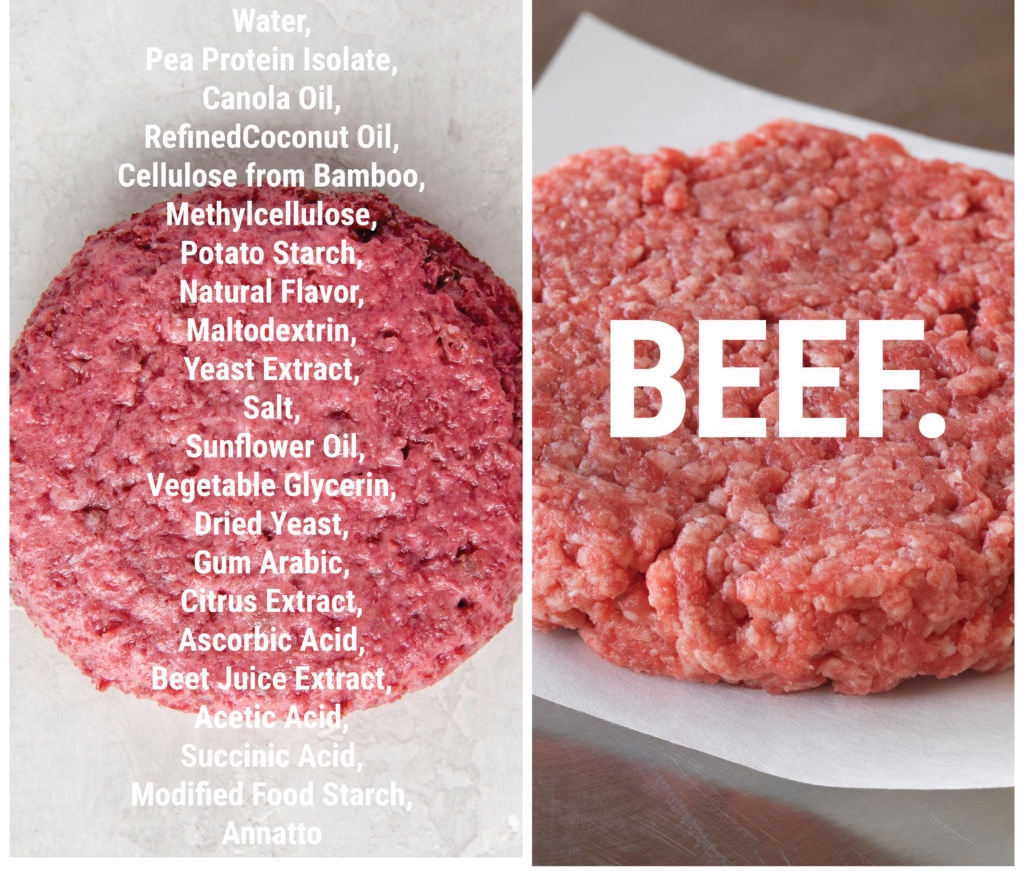 Veggie 'burger' vs real burger. Check the ingredients.In my late 20s, I followed the advice of my National Health Service doctor and became a high-carb, and near vegan/vegetarian. My health was terrible. Switching to a diet filled with animal fats and proteins (with our necessarily getting rid of fruit and veg) saved me and helped my family's health as well. I’ve heard countless stories of other people doing the same (meatheals.com). Caring for your health is ultimately an act of love for those in your family and community. As we age, we don’t want to be a burden on our children. If we are healthy, they won’t have to care for us to the same degree.
 When we are healthy, we are also less of a burden on the tax system as medical care is never truly 'free'. Trading in your scone with jam for steak and eggs is a great way to care for your health and love your neighbour.
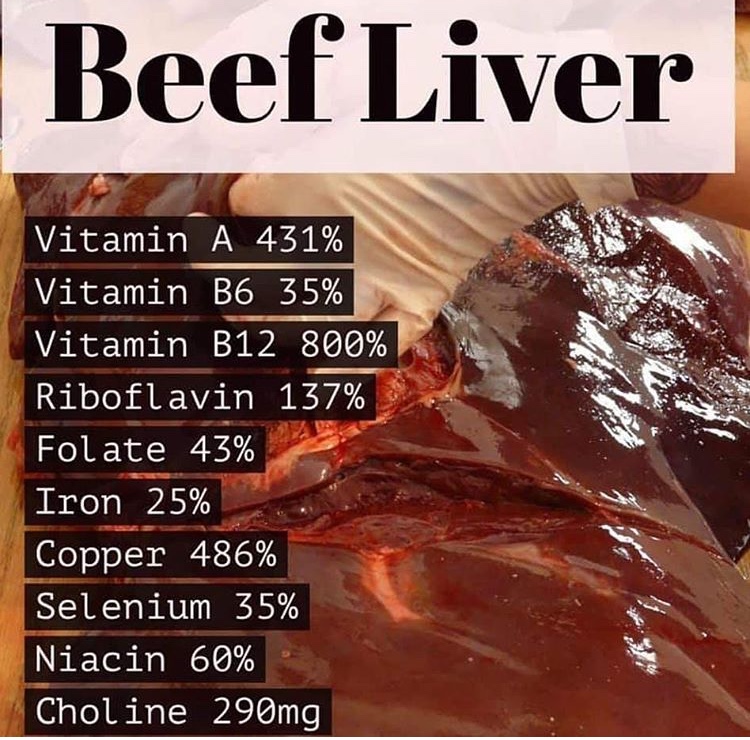
5. Fifth, valuing an animal diet for all humanity helps us become good managers of our resources. Some claim that current world population is unable to enjoy animal based products as a key component to their diet. We should not be too quick to embrace this argument. Rather, we should look at the wasteful way we handle our animals. Most Westerners only eat muscle meat and won’t touch the organs, leaving half to go to waste.
Part of the reason we tend to waste meat is that we largely no longer live in a culture that encourages hunting or the raising and slaughtering of one's own animals. When one has to hunt or raise their own meat, they experience both the glory and tragedy of having to kill an animal as opposed to buying their meat in a plastic wrapper at the supermarket. Such hunters or ranchers, in my experience, have a deeper respect for their meat and are less prone to waste it.
We need to rediscover liver, kidneys, brain, etc. We need to learn to eat nose to tail. Currently, my local butcher gives us bones and kidneys because he can't sell them - nobody wants them. Brains don’t even make it into the shop. It all goes to waste. Learning to eat the whole animal reduces the cost of meat for everyone and does more to make it available to everyone.
6. The last reason is theological rather than moral. T he Bible continually commends and celebrates animal products . Adam and Eve try to cover themselves with vegetation, but God clothes them with an animal product. Abel's meat sacrifice is accepted, while Cain's plant sacrifice is rejected. When David killed Goliath, he was on his way to deliver cheese to his brothers. When Yahweh and the angels visit Abraham, he serves them cheese, veal, and bread. Esau is cursed over lentil soup while his brother Jacob is blessed over meat stew. God gave the Jews the Passover, a meal centred on eating lamb. He promises to lead his people to a land of ‘milk and honey’. He sends Elijah both meat and bread twice a day in the wilderness. Isaiah prophesies that paradise will be a place of fine wine and quality meat.
Then in the New Testament, Jesus multiplies both the loaves the fishes for thousands. When Jesus rises from the dead, we only see him eating animal products: twice fish, once honey. When Jesus talks to Peter about letting Gentiles into the church, it's a vision where he's commanded to kill and eat animals (and in a tanner's home no less).
 What's the point of such a list? Simply that nobody who reads the Bible front to back would ever conclude that the God of Christian Scripture was less than enthusiastic about his people enjoying animal-based products on a regular if not daily basis. In Genesis 9 God says that he gives humanity animals for food. What human wisdom dares to to say that we should reject God's gift?
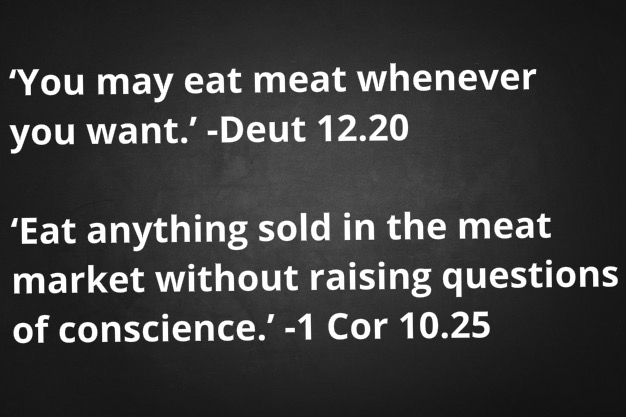
We resist vegan activism to preserve spiritual freedom in Christ. If you want to eat only vegetables, you are free to do so. If you want to eat only cheddar and rib-eyes, you are free to do so. There are only two Biblical injunctions about how we eat. First, that we give thanks for whatever eat. Second, that we don’t eat as gluttons: we have times to fast and say ‘no’ to our appetites.
The vegan industry is rearing up and are out to make billions, and they're pushing out tons of propaganda to do so. Let's not let the church get aught up in this monstrosity. Be good to yourself, your neighbour, and your world and thankfully enjoy some cheese.
_______________________________________________________
For more, see Elijah Men Eat Meat: Readings to slaughter your inner Ahab and pursue Revival and Reform July 30, 2019
Kissing Kalamity Hello
 NOT LONG AGO, MANY OF us were greeted by the sad news that Josh Harris, the man (then boy) who had written I Kissed Dating Goodbye, was separating from his wife. As if that calamity wasn’t big enough, a week later he announced, again via Instagram, that he was also no longer a professing Christian.
 How to handle the hellacious Harris headache:
1. The first thing we should reflect on is the legacy of Purity Culture. By ‘reflect’ we don’t mean ‘scorn’. That would be easy and it’s exactly what many, especially the boys and girls in the ExVangelical camp, are doing online at this moment. According to some, Purity Culture was the worst thing that happened to this world since Attila the Hun and they are only to gleeful to dance on its grave―in rainbow coloured, Stonewall approved attire, of course.
We need to be able to clearly identify just what it is that was wrong with Purity Culture. Simply saying ‘I didn’t like it’ isn’t enough. Some of the critique we’re currently seeing is about as profound as ‘Because I was raised in purity culture, it made me feel guilty when I cheated on my husband with a polyamorous crew I met on Tinder and we all know guilt isn’t from God.’ Their condemnation is just.
Identifying the excesses of Purity Culture is one thing. Find the way forward into true, Biblical purity is the next. And the church desperately needs a vision of Biblical Holiness. Some would want to use a failed attempt at creating a culture of purity to extol a culture of fornication―which is a bit like moving from a house with a leak in the roof to living in a sewage pipe. Let’s cast a vision for simply fixing the roof.
2. The second way we should be reflecting on is what exactly scripture does teach about ‘falling away’. ExVangelicals will be rejoicing that Josh has ‘seen the light’ and left the ‘toxic world of evangelicalism’. Some in the Reformed camp will simply quip that, as he no longer professes Christ, he was obviously ‘never really a Christian’. But for those who followed Josh’s ministry, heard his sermons, listened to his prayers, and were inspired by his devotion to the Lord, such a quip will not easily satisfy. Just what are we to do with all the warnings in the New Testament about falling away if indeed it is impossible to fall away? ___________Beware, brethren, lest there be in any of you an evil heart of unbelief in departing from the living God; but exhort one another daily, while it is called "Today," lest any of you be hardened through the deceitfulness of sin. -Heb 3__________
Minds much greater than mine have debated these points for centuries. I make no recommendations other than encouraging people to go back to their Bibles and to reflect on the relevant passages of Scripture―both those that seem to suggest that falling away is possible and those that seem to say it isn’t. It is all too easy to seek verses that confirm our bias and to quickly pass over the ones that don't.
3. Lastly, we need to let teachers grow up. Josh Harris wrote his kissing book when he was 21. How many of us have changed our mind about significant issues since we were 21? Instead of having a bonfire book burning to the tunes of ‘Losing my Religion’ perhaps we can simply see the book for what it was: a young man, living in a secular and immoral culture, trying to pursue the Biblical call to purity albeit in an imperfect way.
For those of you who were quick to throw stones, were you already wiser than Gandalf at 21?
What would have been ideal, had Josh kept his (supposed?) walk with the Lord and marriage intact, is to write a new book at 41 ‘I Kissed Wisdom Hello’ in which he evaluates what he wrote in his youth and paints a more mature way forward for those who what to embrace sexual holiness in an unholy world. We need leaders and teachers that are humble enough to confess that they’ve changed their mind. Being able to say ‘I used to teach this, but now I think that is not truly Biblical’ is a fine quality for nay Bible teacher.
_______________________________________________________
For more, see Elijah Men Eat Meat: Readings to slaughter your inner Ahab and pursue Revival and Reform July 24, 2019
Is Katie Hopkins the Anti-Christ?
 PREMIER CHRISTIAN, THE UK'S LEADING Christian magazine and one that publishes many fine articles, has now published 'Why Katie Hopkins is Wrong about Christian Culture' by Abby King. The supposed goal of this article is to convince us that a tweet from Hopkins misrepresents Christianity―thus protecting us all from nasty nationalist wrongthink. (For our non-British readers, Katie Hopkins is an English gal who tweeters out political verbiage on immigration.)
 The idea that Hopkins might not be a fully orthodox Christian theologian hopefully isn’t shocking. Most of us would be surprised if she did tweet out the Apostles Creed or a balanced theological reflection of atonement theology. It is not so much that someone might point out a deficiency in Hopkins’ understanding of Christian doctrine that we should take issue with, but rather that the article doing so seems to be at least as probelmatic as the original tweet.
First, here’s what Hopkins said…
“Call me what you wish. Islamophobe. Bigot. Racist. Vile. It matters not. What matters is the fight back for our Christian culture which we so desperately need to defend.”
Vagueness aside, this shouldn’t be too controversial among Christians. Admittedly, Hopkins fails to define what she means by ‘our Christian culture’. But Hopkins’ lack of a definition doesn’t stop the article from presenting its own presumption: Hopkins’ Christianity is (supposedly) ‘where we sing Jerusalem; hark back to the glory days of the Empire; and imagine God as an old, white man who, as novelist Anne Lamott would say, hates all the same people we do.’
And, voila! With that insertion, Hopkins suddenly becomes the Anti-Christ.
If Premier is right in its presumption about Hopkins, there is good cause to disagree with her. Sadly, this article doesn’t give us anything in Hopkins’ own words to go by. Such omissions are usually tactics used in hit pieces rather than articles published by respected Christian organisations. Instead of quoting the person’s own words, the article inserts presumptions that scurry through our minds like hungry rats across a dirty floor.
Where is the Love?This sad irony of this article is that it claims, in all seriousness, to argue for charity to be given to people different from ourselves while at the same time interpreting Hopkins’ original tweet in the most uncharitable of ways. The article implies that if Hopkins really understood what being a Christian was all about, she too would follow ‘in the footsteps of a brown, Middle Eastern rabbi.'
This is the polite, Christian way of calling someone a racist.
The article quotes from Greg Boyle who says that the true Christian values are ‘inclusion, non-violence, unconditional loving kindness and acceptance.’ Throw in a bit of ‘smash the patriarchy’ and you’d have all the professed values of most young 21st Century Western progressives. The article speaks about the need to show unconditional love and kinship to everyone―presumably everyone except Hopkins!
Later, the article finally begins to engage with Hopkins’ own words when it says ‘Rather than setting out to defend our values, as the Church we are called to embody them’. But what does this rhetoric actually mean? What does it mean to embody values without also, at the same time, defending them in the face of hostility and compromise? The article is setting up an unnecessary dichotomy. The presumption is that, if you wish to defend your values from challengers, then you are probably not living them out. Is this really necessary?
The Poor BombBut then the bomb drops. The article argues that, ‘Jesus came to bring good news to the poor, which invariably means bad news for those who are used to having wealth and power at their disposal.’ Bam! If you’ve got a successful retirement account or a bit of political influence, you might have less hope than a goose at Christmas!
What this bit of anti-hierarchicalism has to do with anything that Hopkins said is unclear. It’s an act of impressive gymnastics to argue for total inclusion in one paragraph and then exclude everyone middle class and richer in the next. When Luke, in chapter four, records Jesus as announcing that he’s bringing ‘good news to the poor’, he was not damning everyone who makes over a certain amount every year. Let’s remember that Luke’s gospel is dedicated (and probably paid for) by someone fairly high up in Rome’s socio-political hierarchy.
If Jesus isn’t damning the rich, what exactly did he mean?
There has been some diversity of thought throughout church history. The early Church Father Origen says that Jesus, in his Luke 4 sermon, is referring to, ‘the Gentiles, for they are indeed poor. They possess nothing at all: neither God, nor the Law, nor the prophets, nor justice and the rest of the virtues.’ Cyril, another Church Father, also commented on this passage that Jesus ‘preached the kingdom of heaven to the heathen. They were poor, having nothing… he preached it to those who were without spiritual riches.’
The great German reformer, Philip Melanchthon, was more willing than the Church Fathers to consider that Luke’s use of the word poor (Greek: ptōchos) could include the concept of economic destitution, but that it shouldn’t be understood only in the material sense. He writes, ‘It should also be understood that poverty does not praise itself as the monks imagine…Do the poor by their poverty merit the kingdom of heaven? No!’ In other words, people aren’t more holy just because they’re broke. There is a spiritual dynamic at play.
‘Good news for the poor but bad news for the rich’ is neither inclusive nor is it Christianity. The word for that ideology is Marxism. Christianity is good news for the world―whatever your economic or class situation.
Inclusivity...for SomeThe article ends with, ‘Perhaps it means there are parts of us that need to die too: our prejudices, our selfishness, our moral outrage, our judgement of those who are different from us. Perhaps it means we need to accompany those in our own communities who live on the margins: our gay colleague, our disabled family member, our immigrant neighbour.’ As a non-UK ‘immigrant neighbour’ myself, my family and I would welcome any acts of kindness we can receive from our British neighbours.
But, based on how this article refers to Hopkins, I wonder those who are quick to agree with it realise the full scope of what they are endorsing. To give up ‘judgment on those different from us’ may involve them showing love to their colleagues who endorse gay conversion therapy, a neo-Nazi family member, and their EDL neighbour. We should share this article’s desire to not see the name of ‘Christian’ hijacked by conservative politics. We should also have a desire to not see hijacked by left-wing ideals.
This article, in exalting the value of inclusivity, says that Jesus ‘identifies so strongly with the image of God he finds in other people that he is able to tell his followers - any time you’ve done it for someone else, you’ve done it for me.’ Nice words. I wonder, will that ‘someone else’ include Katie Hopkins?
Even if she is the Anti-Christ._______________________________________________________
For more, see Elijah Men Eat Meat: Readings to slaughter your inner Ahab and pursue Revival and Reform July 2, 2019
Job Vacancy: Prophet
 ‘Who did you go into the wilderness expecting to see? A reed blownabout by the wind or a man in soft clothing?’ -Mt 11
John was an Elijah Man in many ways. Both men ate meat. Elijah’s meat flew to him courtesy of Raven Airways. John’s meat flew to him with its own wings: he ate locust (which doesn’t sound great but it’s supposed to be uber-high in protein―plus John dipped his in wild honey which could be used as a type of BBQ sauce; all very paleo).
Like Elijah, John also lived in the desert. Both men were preachers. Neither man was ‘balanced’. Both men had hungry young men following them. Both had a powerful woman trying to kill them. Both were followed by someone with considerably better people skills. Like Elijah, John had a life of fervent prayer and fasting―not just for his own contemplative purposes, but to do battle for the destiny of a nation. Half an hour before Elijah spoke before Ahab, no one anticipated his prophetic cry. Before John the Baptist opened his mouth, there was no one in Jerusalem who knew he was there. (Half an hour after he proclaimed that word, there was no one who didn’t.)
John stepped into a spiritually barren desert. Herod and his lascivious lady reigned with Roman power and paraded their sexual immorality. The Romans proudly portrayed their paganism up and down the land allotted to God’s people. The Pharisees retreated into a cavern of fundamentalist orthodoxy but failed to shed a tear for those on the outside. The progressive Sadducees tried to make room for both their inherited allegiance to Yahweh and the powers and cultural ideas of the new Roman learning.
It seemed like any type of God honouring ministry would be impossible in such a place. The blind were horsewhipping the blind. It was black midnight on the spiritual landscape. And then the heavens opened and the mega-word spoken by this strange desert child was downloaded onto the nation with a power and speed that our current internet bandwidths can only envy.
WantedThe English-speaking church has a vacancy that needs filling. God’s Church in the UK has an opening and it is urgent that there are men who step into it. The role of prophet is wide open. With all our technology, money, and conferences, it is still (with occasional exception) getting darker. Baal and Asherah are worshipped in the Temple of God under deceptively worded but colourful banners. The fake teachings are old but they’re repackaged for a new generation. They are pedlars pimping out fake love, fake justice, and affirming people in their bondage instead of setting them free from it.
We have meetings aplenty but none of them seem to rock society at large or introduce the Fear of the Lord (a concept the Church has seemingly forgotten) into the world around us. Where is the spoken word which will cause people to say of us, as they did the early church, ‘these men have turned the world upside down’? With all our activity, we need one who can wield a word which will shake a nation. But who is fit to speak such a word?

Britain needs broken, godly men to break the hearts of wicked men. He who would reap with joy must first sow in tears. The lifespan of men in the Bible who carried the word of repentance was noticeably short. Those who would call sin, ‘sin’ better not value too much this present life with all its toys, accolades and comforts. Men who seek to fill this role will be familiar with much private prayer and fasting. It is these men who fast that feast at the tables of wholeheartedness.
I am thankful for our Bible colleges. God does not put a high value on ignorance. But though the Church has never had more men (and women) with such high levels of education than it does now, we are still losing ground with every decade. We have many people with great intellectual stature, but few of equal spiritual stature.
To qualify for the role of prophet, there is no requirement of formal education. There is, however, the requirement that you ‘have been with Jesus’ (Acts 4). Your life must be wholly his. All your treasure must be stored up with him. You cannot be one who is shaken by the tremors of time but you must tremble before Eternity’s throne. There is no pay. It will cost you everything. Your heart will break and you may not live to retirement. Great rewards will be in heaven. Please send your job application along with your sweat, blood, and tears to: The Altar of God. If selected, the world will know._______________________________________________________
This is an extract from Elijah Men Eat Meat: Readings to slaughter your inner Ahab and pursue Revival and Reform