
Gary Vaynerchuk's Blog, page 26
May 30, 2019
99% of the Tests in School Don’t Matter | Veecap
Gary dropped some insightful gems on school and education in today’s DailyVee that set the theme for this episode:
If you’re stressing about tests in school, you’re more likely to grow up and stress out about other “micro” goals that just don’t matter. You might become the type of person who’s trying to win awards instead of chasing “macro” goals like happiness.
Becoming a successful human being is about going beyond the “micro” and into the “macro.”
“The sooner you stop stressing about tests in school is the beginning of you navigating a happier life.” – Gary Vaynerchuk
In DailyVee 555, Gary crushed a bunch of meetings in NYC fresh off the first Trash Talk of 2019. You’ll see some glimpses of Trash Talk 4 being produced, and some powerful meetings with some young entrepreneurs.
Here are some time stamps of fun moments you can skip to:
2:39: Why Gary doesn’t stop at yellow lights (life advice, not driving advice)
3:40: Behind the scenes moments from Trash Talk 4
4:36: The only thing Gary has done wrong
7:19: The value of authenticity, and what Gary really wants for his audience
9:47: The real reason Gary loves baseball cards.
The post 99% of the Tests in School Don’t Matter | Veecap appeared first on GaryVaynerchuk.com.


May 28, 2019
4 Leadership Strategies of Great CEOs
As a CEO of a large organization that has grown quickly (from zero to $200 million+), I have a lot of POVs on leadership strategies that lead to strong internal culture and business results.
Here are a few concepts that I don’t see too many others talking about:
1. Look out for the “iceberg”
I stood in front of my entire company last September and rolled out a new vision for how we’re going to service clients, and 98% of them thought I was out of my mind. They didn’t believe in what I was saying at all.
Some of them thought I was like the “crazy founder” who has wild ideas on marketing opportunities that can’t actually be implemented in reality.
But I wasn’t upset about it. The truth is, if you have full, 100% buy-in from your employees, you’re in a dangerous spot.
There should be some sort of friction between a CEO or founder who sees everything that’s ahead and the people who are in the trenches. They both have different mindsets, experiences, and factors to take into account in their day-to-day.
The best analogy I can give is looking out for an iceberg.
As the captain of the ship, I’m at the top watching for icebergs and letting everyone know what we should do to avoid them. But if my employees are downstairs, they’re not seeing the same thing I see and they might disagree.
Leaders need to understand what’s happening next. Employees execute on the current and overvalue the past.
That’s something that should be expected. If you’re a leader, it’s your job to communicate.
2. Understand you’re a parent, not a babysitter
This is a huge difference between great CEOs and ones that aren’t. Great CEOs understand that they’re a parent, bad CEOs think they’re babysitters.
For example, I let people in my company do their thing. I don’t micromanage. I’m just watching and supporting as time goes on.
With my management style, my biggest vulnerability is creating entitlement. In other words, my ability to create top-line revenue and fix problems can sometimes give leaders within my company a false sense that they’re the ones executing and getting results within their departments.
As a “parent”, I always think a lot about giving people room to try, fail, and learn – but at the same time, helping them be capable of executing at high levels on their own so that they can still win without me.
Great CEOs sometimes seek out difficult situations and make decisions that the organization isn’t ready for. They might even make decisions that they themselves aren’t ready for.
If you’re a leader, it’s your job to make those moves that you know are right for the company in the macro, even if it causes some tension with executives or team members in the micro.
3. Make your employees feel safe
This is the number one thing I try to do as a leader. I try to make people feel safe around me.
Safety helps create speed in business for a couple of reasons:
First, when people aren’t spending time thinking how to navigate a situation, they’re spending time executing. When they’re executing, the entire machine moves faster and produces higher output.
Second, people are able to get to the punchline much faster than they otherwise would which helps me save time.
For example, there are a lot of meetings I sit in that I know are just “disguises” for an ask or a sale on the back end. When I feel that’s the case, I immediately try to make the other person feel comfortable asking me for what they want right away.
I don’t need people to spend 45 minutes on a “set up” for a sale – I need them to be honest about the expectations they have of me.
It’s on me to create a safe environment where they feel comfortable sharing their intentions up front.
4. Understand that you work for your employees, they don’t work for you
This one is hard for a lot of leaders to understand.
Most new managers think that becoming a manager is the “graduation.” Truth is, it’s the reverse.
Leaders work for their employees.
That means you have to understand what your employees want at a deep level. You have to be constantly adapting to their needs and what they want from the organization.
For example, one of my employees might want higher pay when he’s 24. But maybe he falls in love at 28 and decides he wants to spend more time with his family. Another might be more interested in a fancy title. Another might want to get access to me and build a relationship.
Another might want to go to one of our international offices and work there.
There are a million different variables, and it’s on you as a leader to adjust to reality as it changes.
When you go from being someone who “executes” to someone who’s managing a team, you go from trading on IQ to trading on EQ. You go from doing the actual work to listening to employees, catering to what they want, taking blame, and being the bigger person.
The best managers are actually the best mentors.
Please share this article on Twitter if you got value from it!
Check out this 71-minute business consultation I gave to CEOs and marketers at Vayner4Ds:
The post 4 Leadership Strategies of Great CEOs appeared first on GaryVaynerchuk.com.
May 25, 2019
My New Show for Kids: “The Adventures of Lil’ Vee”
I’ve always believed that “scratching your own itch” is the best business model.
When I was a little kid, I watched Saturday morning cartoons, and I loved them. I loved the excitement of looking forward to Saturdays to watch those shows.
I’m excited to announce the first episode of “The Adventures of Lil’ Vee”, which is exactly the cartoon I would have watched from 1981 – 1988 as a kid who loved selling stuff.
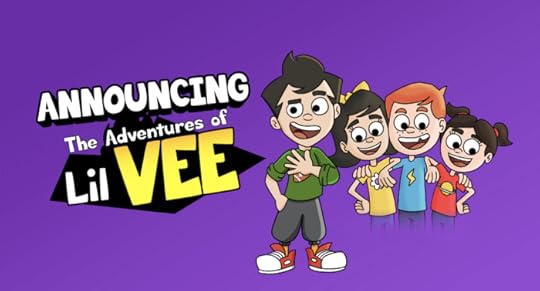
This announcement is for anyone who has young children in their family, or teachers with a classroom of young kids.
Over the years, I’ve gotten a lot of emails and messages from parents and teachers who wish they could share my content more.


The biggest thing I’m trying to do through my content is show people how it’s possible to be a successful entrepreneur while being a good, kind person at the same time. I’m trying to put positivity, empathy, kindness, and optimism on a pedestal for the next generation.
I’m aware that my content isn’t always the most conducive to kids because of my cursing, but I really want to be able to share my message with them in a relevant and contextual way … aka an animated YouTube kids series.
The show is inspired by the sorts of things I did as a kid (like selling lemonade and baseball cards), but contextualized for the modern world.
For example… in the first episode, Lil’ Vee gets an idea to make slime and sell it in school. He goes through the process of figuring out how to make something that people like and sell it to other people.
The Adventures of Lil’ Vee is built to entertain kids first, open their eyes up to what’s possible in business (especially if they’re showing some early signs of entrepreneurial talent), and show them how empathy and kindness can be cool.
The first episode is a pilot to get as much feedback as possible, dying to hear your thoughts 
May 21, 2019
Announcing the GaryVee 004
If you’ve been watching my vlogs recently, you’ve probably seen me rocking a new pair of K-Swiss sneakers…
Today, I’m excited to finally talk about it 
May 20, 2019
When a Millionaire Gets Excited About Making $5
I’m so excited to announce Episode 4 of my garage sale series, Trash Talk!
I’ve gotten so many emails, DMs, and comments from people who wanted to see more episodes since the last one dropped in October 2018.
Now that it’s garage sale season, I can’t wait to hit more town-wide garage sales on the weekends and film what happens.
For those of you who aren’t familiar, Trash Talk is a series I started in 2018 where you can watch me go to garage sales, pick out items, negotiate with sellers, and find what the items are worth on eBay. Some days turn out better than others, but you’ll get to see how much I spent on all the items, what I’m selling them for on eBay, and estimated profit.
My hope is that it shows more of you how much opportunity is just sitting out there in these garage sales that happen all across the country.
Let’s get into it.
Turning $10 into $100+
The first few garage sales of the day didn’t go super well.
But that’s just part of the game.

Patience is super important. But even I struggle with it when I’m trying to find stuff at garage sales
May 17, 2019
The Secret 99% of People Don’t Know About | Veecap
Is it possible to be a hardcore capitalist and a hippie at the same time?
A lot of people think you have to pick one or the other, but in this video “The Secret 99% of People Don’t Know About”, Gary talks about why he thinks it’s possible to be both.
In other words, he’s trying to be the greatest entrepreneur of this generation and be a good, kind person at the same time. Some of his goals are selfish like buying the New York Jets. But some of his goals are noble, like using the VaynerX’s communications machine to help cure his brother’s Crohn’s disease.
DailyVee 553 is a recap of Gary’s day in New York including a keynote, a Q&A with fans and …
1:02 – Why VaynerMedia is so successful
2:39 – Gary’s answer to “Is dropshipping dead?”
3:17 – Gary gives advice to a business owner who’s struggling to produce content consistently
8:23 – Leading a leadership meeting at VaynerMedia
9:29 – The real reason Gary is building VaynerMedia
12:44 – Gary drops a real gem you need to watch if you’re creating digital content.
Check out the full video here:
The post The Secret 99% of People Don’t Know About | Veecap appeared first on GaryVaynerchuk.com.
May 16, 2019
The Most Important Concept for Sales Success in 2019
Too many people are in the business of convincing others they’re wrong and criticizing their opinion.
It doesn’t work, and it’s a source of a lot of tension in this country today – both business and otherwise.
In this article, I wanted to talk about a concept for sales success that I’m struggling to see others talk about. It’s a big reason behind why people struggle to get others to buy into them – whether it’s trying to change someone’s mind, or sell them on a product.
You Can’t Sell the Unsellable.
Everyone has “tips” or “techniques” for turning a “no” into a “yes” in sales, but few people talk about this reality. You can’t sell someone who’s not ready to be sold.
This is such a big reason why most people aren’t winning – it’s because they’ve created this narrative in their heads about how they “need” to partner with a specific CEO or sell to a specific company.
The truth is, there are a million reasons why a specific executive or a certain company won’t work with you.
They might not work with even if everything “on paper” is going your way. You might have the better product. You might have a cheaper price. And they still might not work with you.
There are so many other factors in play. You never know – maybe their brother-in-law is married to the CMO of the agency they use so they’re putting off hiring a different one. Maybe the investors in their company have a different agenda and want to hire someone else. Maybe they’re dealing with personal issues at home and they’re just having a bad day.
The truth is, you don’t even have full 100% context on what’s going on in your own spouse’s mind. No one does. How will you know what’s going on in any other person’s head?
You have to be practical when it comes to sales. You have to be willing to take the opportunities in front of you and understand who you should spend your time on.
Of course I want to work with every Fortune 100 brand, but because of the market dynamics, and complicated politics that are in play, it’s easier said than done.
I come into every business meeting feeling massively optimistic that the person on the other end is going to buy from me. And when they don’t, I immediately “check out.” I’m not romantic about it.
Even when I try to sell wine or sneakers, I have no interest in “convincing” people to buy. I’m comfortable asking, but if you don’t normally buy wine, I’m not trying to push you to buy Empathy Wines. You don’t normally buy sneakers, I’m not trying to convince you buy mine.
I’m comfortable asking for a sale, but I’m also comfortable moving on because I have zero expectations about how the results will play out.
"I'm comfortable asking for a sale, but I'm also comfortable moving on because I have zero expectations about how the results will play out." – @garyvee
Click To Tweet
Instead, tell your truth and let people come to you.
This is a more effective way to go about it.
When someone doesn’t want to change their mind or says “no”, I don’t try to convince them or turn their “no” into a “yes.”
Instead, I double down on my truth. I keep putting out content talking about what I believe about Instagram and Facebook marketing. We’ll keep adding value to CMOs through VaynerMedia’s new podcast. Back when I was doing Wine Library TV, I said what I really believed about the wines I tasted on camera. If I didn’t like the wines my friends were selling, I would say it.
It wasn’t always easy, but the thing I believe in the most is that the truth always wins.
Telling your truth can put you in a position to be historically correct, which leads to more people trusting you over the long term. It can also attract people who also believe what you believe, and can lead to enormous sales success.
Let people come to you – stop trying to convince them.
Check out this business strategy and Q&A session for more on this:
The post The Most Important Concept for Sales Success in 2019 appeared first on GaryVaynerchuk.com.
May 15, 2019
What a Modern-Day Business Education Looks Like | Veecap
Ever wonder what many of the social media experts and real estate experts from the early 2000s are doing today?
A lot of them are the new experts in Bitcoin and cryptocurrency.
This is a key concept Gary talks about in his latest video “What a Modern-Day Business Education Looks Like.” Most people are just chasing the next big trend in business instead of taking the time to build actual expertise. They’re not taking time to learn their craft.
Succeeding over the long term means “holding your breath” and investing for tomorrow even if it creates less money today.
He recently led a business education and strategy session in Nashville, Tenn.
Below we have highlighted some of the most interesting moments from his 90-minute-plus master class video:
8:22 — “If you don’t go deep, then you’re scattered” is not true
13:09 — The real reason Amazon is winning today
21:56 — The scariest word of all time
43:46 — Gary answers, “My son hates college. What do I tell him?”
1:08:32 — What people are really doing when they claim they’re “bringing value”
Check out the full episode here:
The post What a Modern-Day Business Education Looks Like | Veecap appeared first on GaryVaynerchuk.com.
May 8, 2019
Why I Believe Sports Cards Are About to Explode in Culture and Value
When I was a young kid, I made a lot of money selling baseball cards, comic books and toys.
And I mean a lot.
I made thousands of dollars every weekend at baseball card conventions. I had tens of thousands of dollars under my bed.
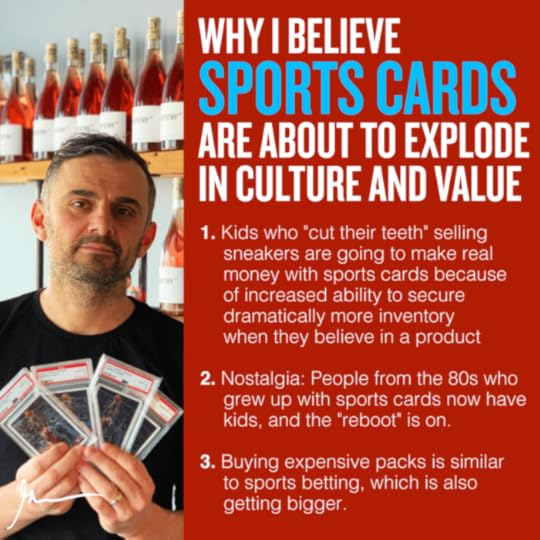
Recently, I’ve been talking about how sports cards are coming back in culture. I really believe that they’re going to explode in value in the next 3 to 5 years and could make a great alternative investment.
Here’s why:
1. Kids who flipped sneakers will start selling sports cards.
Sports cards and sneakers are similar games.
The main difference with sports cards is that kids would be able to get them in high volume. The inventory is there. With sneakers, kids didn’t have the option to buy high volumes of inventory – when they were “right” about a pair of sneakers, they would have to wait until they came out online, buy one pair and make around $600 on them.
When you’re right about Michael Jordan rookie cards, you can buy thousands of them. That’s what kids are going to do with underpriced sports cards today – it’s why they’ll be able to make a lot more money from it.
Sports cards are like graduation for kids who were flipping sneakers. The investment in sports cards will eventually outpace sneakers in the flip game.
2. Nostalgia: Sports card lovers from the ’80s now have kids.
Nostalgia is a big driver of purchase behavior.
It’s why toys like GI Joe reboot every 30 years or so. People put a lot of sentimental value on what they grew up with.
Men and women from the ’80s who grew up with sports cards now have 6-10-year-old kids, and we all love seeing our kids do what we did. It just feels good to watch our kids live out what we lived out. It’s fun to see yourself in your kid.
We’ll pay to see that happen, so the reboot is on for sports cards.
3. Sports betting is getting bigger
One fascinating thing about sports cards is that you can get limited edition items. You can get a card that’s completely unique, something no one else in the world has. You can collect signature cards, jersey cards, etc.
There are a couple of ways this ties into the rise of sports betting.
First, people are going to find cards worth tens of thousands of dollars in a $6 pack. It’s similar to lottery tickets. It gives people a shot at finding, say, a $50,000 Zion card in a cheap pack.
Once people start finding these cards people will also start getting their betting fix by buying packs of cards. This is going to bring more money and attention to the space.
Second, betting enhances the experience of the game. You might not care that much about a Houston Rockets game or a Floyd Mayweather fight, but if you bet money on the outcome, you’ll be more invested in watching. Betting on the outcome can enhance the experience of watching a game, which is a big reason why people do it.
Along similar lines, buying sports cards could get people more invested in watching games. It provides another option for escapism, which is another reason people will be drawn to it.
“I’ve got a ton of old cards in my closet from decades ago, what will they be worth?”
I’ve got a ton of sports cards from the early ’90s. Unfortunately, they won’t likely be worth much (unless you’ve got some very specific sets like 1986-87 Fleer Basketball).
For the most part, the collections people have from the ’80s and ’90s are not strong because those cards were over-produced. There was too much supply and not enough demand.
“What are some cards you’re investing in right now?”
There are a few cards right now that I really think will increase in value over the next few years:
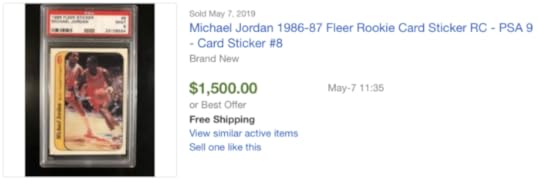
Michael Jordan Rookie Sticker Cards
I was buying these at $700 last year, now they’re already selling for $1,500 on eBay. I think it’ll go much higher.
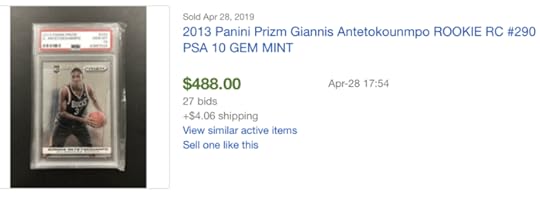
2013 Panini Prizm Giannis Antetokounmpo Rookie Card #290 PSA 10 Graded
Barring any catastrophic injuries, I think Giannis is going to be one of the great players in the NBA in a few years – which means the value of the card is going to go higher.
I was buying them for $250 to $300. Now they’re already selling for $400 to $500 and I think the value will go up.
Hakeem Olajuwon Rookie Cards
I’ve been buying up Hakeem Olajuwon rookie cards because in the long term, I believe Africa will be the next continent to rise up in the world. Hakeem Olajuwon is from Nigeria and he’s got fans all over Africa. So I think I’ll be able to sell these rookie cards to African businessmen and women for thousands of dollars in the future.
This is more of a 30+ year play, but I’m excited to see how it plays out in my 70s.
May 3, 2019
What Most People Don’t Think About When Running a Business in 2019
I get a lot of questions from business owners and founders asking me how to motivate their employees to care as much as they do about the business.
I tell them, “Give them half the company.”
Truth is, if your employees were like you, they wouldn’t work for you.
To motivate them, you’ve got to get to a place of understanding that they don’t work for you. You work for them. It’s about understanding what every single person in your company wants, and doing your best to deliver.
The biggest reason we have so much continuity at VaynerMedia is because of that culture.
For example, one of my employees might want higher pay when he’s 24. But maybe he falls in love at 28 and decides he wants to spend more time with his family. Another might be more interested in a fancy title. Someone else might want to get access to me and build a relationship. Maybe someone wants to go to one of our international offices and work there.
There are a million different variables, and it’s on you as a leader to adjust to reality as it changes.
2. When you have to fire someone, make it feel like a liberation, not a punishment
I hate firing employees. It’s the toughest thing to do when running a business.
So when I have to do it, I do my best to make it feel like a liberation rather than a punishment. Because the truth is, that’s what it is most of the time.
If someone gets let go at VaynerMedia, it could be for a variety of reasons. They might not be fast enough to keep up with the pace of execution. They might not be good at managing people and that’s what they were hired to do.
It could just be that we made a mistake and put them in the wrong position. They might just hate their boss, and it shows in performance.
I’m super willing to help my employees transition out of my company into another role where they could be successful for one main reason:
I’m more interested in how I feel about myself and what those who know me say about me as a man than the profitability of my company.
It’s why I try really hard to keep strong relationships with my employees, even after they leave or get let go. It’s why I aim to deliver 51% of the value of that relationship.
People always talk about why employees shouldn’t burn bridges with employers, but not many people talk about the reverse of that. Not many people talk about employers keeping relationships with employees even after they let them go.
It’s also just practical when running a business.
I don’t want to name names or put people on blast, but there have been situations where an employee left or got let go from VaynerMedia, ended up going to work in-house at another brand and recommended working with VaynerMedia to that company.
Keeping those relationships has led to actual business. It’s something that most companies don’t think about.
3. Whoever pays for the music gets to pick the song
This is a Russian saying that I really love.
In other words… when someone is paying you for something, you’ve got to do what they say. It doesn’t mean you can’t express your authentic point of view and steer them in a different direction. But it does mean that not every client will do what you want them to do.
And that’s okay. At VaynerMedia, not one client does every single thing I want them to do. Not one.
Sometimes, we’ll just tell them to go with a different agency. Other times, we’ll do what they want, depending on what feels right.
4. Die on your own sword
A while ago, I got a question on LinkedIn from Mike, who asked this:
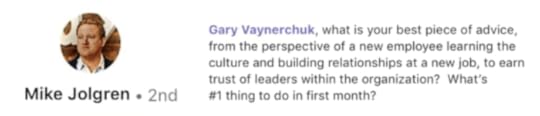
He asked, “What is your best piece of advice from the perspective of a new employee learning the culture and building relationships at a new job, to earn the trust of leaders within an organization? What’s the #1 thing to do in month 1?”
It’s actually the same advice I give to people who try to build expectations with clients when running a business.
Ultimately, there are two ways to go about it: either pander to what the client says, or stick to your own truth.
For example, as someone who runs an agency, a common problem I see is executives and leaders spending a bunch of money on things like billboards and TV commercials. A lot of companies will go out of business in the next decade because of this.
If I disagree with a client, I might still do what they say, but I’ll make it clear what my honest POVs are.
If you express your authentic opinions, you’ll put yourself in a position to be historically correct, and that’ll help you a lot in the long run.
5. Hire somebody. That is the fundamental answer to everything you’re not good at in business.
I’m a huge, huge fan of betting on your strengths and not caring about your weaknesses.
The key is to know something well enough to know whether someone is doing a good job, but let them do their thing at the same time.
When deciding who to hire, it often comes down to the decision of jack-of-all-trades or specialist. I believe there is one that will help your business far more, and that’s jack-of-all-trades.
Of course, it’s important to balance the different types of people who work there. You need to have specialists but you also need the jack-of-all-trades. When you strike a balance within the company, it’s beneficial for the task at hand. Both personality types work. I’m not denying that.
But I never think that you should focus on one particular skill. Never limit yourself to that.
So really, what I’m saying is: If that person is a specialist, do they possess the ability to see beyond their one skill? Are they curious to learn? Can they take their strengths, and turn them into more and more skills?
6. Tell your customers to not buy from you
This was a very counterintuitive thing I did when I was filming videos for Wine Library TV.
I was filming videos tasting wine and telling people how they tasted on camera. But when the camera turned on (right before my first video), I realized something:
Everything I said would be on the “record.”
I didn’t want to say I liked a brand of wine when I really didn’t just to get more sales. I knew that at some point, someone would confront me about it, and I wouldn’t know what to say.
That manifested in me telling the truth on video and building a strong relationship with my audience. It ended up being a great marketing strategy.
This is what I recommend for a lot of companies today. For example, if you’re a mechanic, put out a show every day about how not to buy your services. Teach people how to change the spark plug or other basic stuff they can do at home without a mechanic.
You’ll be blown away at the amount of trust you build and the amount of business you’ll get on the back end of that.
Check out this video for an hour and a half long business consultation where I talk more about these concepts:
The post What Most People Don’t Think About When Running a Business in 2019 appeared first on GaryVaynerchuk.com.


