
Jim Wilson's Blog, page 39
March 18, 2022
Spiritual War: Our Objective, part 3 of 3 - Decisive Points

A decisive point is a place where, if a battle were fought and won there, it would be a decisive victory, one that influences the whole war.
In the war for souls, the battles must be fought in every location on earth because our Lord Jesus Christ sent us everywhere.“Therefore go and make disciples of all nations, baptizing them in the name of the Father and of the Son and of the Holy Spirit” (Mt. 28:19).
“He told them, ‘This is what is written: The Christ will suffer and rise from the dead on the third day, and repentance and forgiveness of sins will be preached in his name to all nations, beginning at Jerusalem’” (Lk. 24:46–47).
“But you will receive power when the Holy Spirit comes on you; and you will be my witnesses in Jerusalem, and in all Judea and Samaria, and to the ends of the earth” (Acts 1:8).
However, some places in particular are decisive points, and taking them will get the message to all places faster. If we want to reach the whole, then we should know what sort of places to concentrate on. Two questions determine whether a point is decisive: 1) Is it important? 2) Is it feasible?
Here are two biblical examples. First, in Ephesus:
“Paul entered the synagogue and spoke boldly there for three months, arguing persuasively about the kingdom of God. But some of them became obstinate; they refused to believe and publicly maligned the Way. So Paul left them. He took the disciples with him and had discussions daily in the lecture hall of Tyrannus. This went on for two years, so that all the Jews and Greeks who lived in the province of Asia heard the word of the Lord” (Acts 19:8–10).
In Thessalonica:
“You became imitators of us and of the Lord; in spite of severe suffering, you welcomed the message with the joy given by the Holy Spirit. And so you became a model to all the believers in Macedonia and Achaia. The Lord’s message rang out from you not only in Macedonia and Achaia—your faith in God has become known everywhere. Therefore we do not need to say anything about it, for they themselves report what kind of reception you gave us. They tell how you turned to God from idols to serve the living and true God, and to wait for his Son from heaven, whom he raised from the dead—Jesus, who rescues us from the coming wrath” (1 Thess. 1:6–10).
These two cities were important and feasible, and they were therefore decisive in the effect they had on Asia, Macedonia, and Achaia.
Many years ago when praying about where to minister, I knew I wanted to go to a decisive point. There was no question in my mind that taking New York City would be decisive. If it could be taken it would mean that Wall Street, Madison Avenue, Broadway, NBC, ABC, CBS, Fox News, and ten million people would be saved. It would shake the world. It would be the greatest revival in history. However, I did not have the resources to bring the principles of war to bear on this stronghold of Satan. In other words, New York City could have been decisive, but it was not feasible. Without feasibility, a point is not decisive.
The Lord led me to small towns with major universities. The university makes such a place important. The small town makes it feasible. These are decisive points in any given state. Every student generation moves throughout the state and even the country upon graduation, and they can carry the message of Christ with them as they go. As in Ephesus, the battle can be fought in one place and win the whole state.
*Excerpted from Weapons & Tactics. To purchase, visit ccmbooks.org/bookstore.
How To Be Free From Bitterness and other essays on Christian relationships

March 16, 2022
Spiritual War: Our Objective, part 2 of 3

Here is the command stated again:
“Then Jesus came to them and said, ‘All authority in heaven and on earth has been given to me. Therefore go and make disciples of all nations, baptizing them in the name of the Father and of the Son and of the Holy Spirit, and teaching them to obey everything I have commanded you. And surely I am with you always, to the very end of the age” (Mt. 28:18–20).
All new Christians are to be taught to obey everything Jesus commanded, including this command. This means that the Great Commission is self-perpetuating. Each generation of Christians is supposed to hand it off to the next generation.
“On that day a great persecution broke out against the church at Jerusalem, and all except the apostles were scattered throughout Judea and Samaria . . . Those who had been scattered preached the word wherever they went” (Acts 8:1b, 4).
In the first century, thousands of Christians left Jerusalem, preaching the gospel everywhere they went. But the apostles (the official “evangelists”) stayed in Jerusalem.
We would be concerned if we knew that there were active terrorists in every neighborhood. What we don’t realize is that the Enemy has such spiritual terrorists everywhere. Is the world concerned that we have active, effective evangelists in every neighborhood? If we did have them, believe me, the Enemy would take every means to silence them. We do have them, but they are not being effective. It seems that our sleeper cells went to sleep.
“I have appeared to you to appoint you as a servant and as a witness of what you have seen of me and what I will show you” (Acts 26:16).
“Go! This man is a chosen instrument to carry my name before the Gentiles and their kings and before the people of Israel” (Acts 9:15).
“At once he began to preach in the synagogues that Jesus is the son of God” (Acts 9:20).
The common element in these three verses is that the Apostle Paul was sent as an evangelist at the time of his conversion. His position as an evangelist is one of the reasons the Bible gives for his conversion, and upon being converted he became that evangelist without further training or growth in the Lord. We might conclude that Paul was unique in this and that the rest of us cannot, nor are we expected to, follow this pattern. Or we can say this is God’s requirement for us all. The apostle says exactly that in his second letter to Corinth:
“And he died for all, that those who live should no longer live for themselves but for him who died for them and was raised again. So from now on we regard no one from a worldly point of view. Though we once regarded Christ in this way, we do so no longer. Therefore, if anyone is in Christ, he is a new creation; the old has gone, the new has come! All this is from God, who reconciled us to himself through Christ and gave us the ministry of reconciliation: that God was reconciling the world to himself in Christ, not counting men’s sins against them. And he has committed to us the message of reconciliation. We are therefore Christ’s ambassadors, as though God were making his appeal through us. We implore you on Christ’s behalf: Be reconciled to God. God made him who had no sin to be sin for us, so that in him we might become the righteousness of God” (2 Cor. 5:15–21).
When Paul speaks in verse 15 of “those who live,” and in verse 17 of, “anyone in Christ,” he is clearly not speaking of himself alone, but of all believers. He goes on to say this: “who reconciled us to himself through Christ, and gave us the ministry of reconciliation.” The “us” is “anyone in Christ.” Therefore, anyone who is in Christ, as soon as he is in Christ, is immediately commissioned in the ministry of reconciliation at his conversion. The ministry of reconciliation is not only given to reconciled men: it is given at the moment of reconciliation. The demon-possessed man Jesus healed is an example of this:
“As Jesus was getting into the boat, the man who had been demon-possessed begged to go with him. Jesus did not let him, but said, “Go home to your own people and tell them how much the Lord has done for you, and how he has had mercy on you.” So the man went away and began to tell in the Decapolis how much Jesus had done for him. And all the people were amazed” (Mk. 5:18–20).
God has given us the ministry and the message. We are to preach the Word everywhere, just like the new Christians in Acts.
*Excerpted from Weapons & Tactics. To purchase, visit ccmbooks.org/bookstore.How To Be Free From Bitterness and other essays on Christian relationships
March 14, 2022
Spiritual War: Our Objective, part 1 of 3

An army needs to understand in what direction it is supposed to march.
“Then Jesus came to them and said, ‘All authority in heaven and on earth has been given to Me. Therefore go and make disciples of all nations, baptizing them in the name of the Father and of the Son and of the Holy Spirit, and teaching them to obey everything I have commanded you. And surely I am with you always, to the very end of the age’” (Mt. 28:18–20).
Jesus’ first statement in the Great Commission is indicative: “All authority in heaven and earth has been given to Me.” That authority is absolute and comprehensive. This results in an imperative: “Make disciples!”
“He told them, ‘This is what is written: The Christ will suffer and rise from the dead on the third day, and repentance and forgiveness of sins will be preached in His name to all nations, beginning at Jerusalem. You are witnesses of these things. I am going to send you what My Father has promised; but stay in the city until you have been clothed with power from on high’” (Lk. 24:46–49).
This is the means of making disciples. Jesus Christ’s work was to suffer for sins and rise from the dead. The disciples’ work was to preach with the authority of His name. They were to preach repentance and forgiveness of sins to all nations, starting in Jerusalem, and they were to preach it with power from on high:
“But you will receive power when the Holy Spirit comes on you; and you will be My witnesses in Jerusalem, and in all Judea and Samaria, and to the ends of the earth” (Acts 1:8).
Jesus’ operational order is clear: 1) The apostles are to make disciples, 2) beginning in Jerusalem, 3) via adjacent countries, 4) to the ends of the earth, all nations.
“When He saw the crowds, He had compassion on them, because they were harassed and helpless, like sheep without a shepherd. Then He said to His disciples, ‘The harvest is plentiful but the workers are few. Ask the Lord of the harvest, therefore, to send out workers into His harvest field’” (Mt. 9:36–38).
Christ commands the apostles to pray for more harvesters. If it is still true that the harvest is plentiful and the laborers are few, then this prayer is still necessary today. If it is still true, then there are more non-Christians ready to become Christians than there are Christians who are ready to help them believe and repent. To be blunt, there are more people who want to get into the Kingdom than there are Christians who want them in.
“I will rescue you from your own people and from the Gentiles. I am sending you to them to open their eyes and turn them from darkness to light, and from the power of Satan to God, so that they may receive forgiveness of sins and a place among those who are sanctified by faith in me” (Acts 26:17–18).
This is the great commission given by the Lord Jesus to Saul of Tarsus, making him an apostle, a “sent one,” and this happened the instant he became a believer. This is the One who has been given all authority in heaven and earth giving instructions on evangelism to one of His greatest followers.
Let us look at those instructions:
1. Open their eyes.
2. Turn them from darkness to light.
3. Turn them from the power of Satan to God.
Paul had to do those three things in order to get two things for the people he witnessed to:
1. Forgiveness of sins
2. A place among those who are sanctified by faith in Him
This is the essence of the battle plan assigned to man for the conquest of the world.
*Excerpted from Weapons & Tactics. To purchase, visit ccmbooks.org/bookstore.
How To Be Free From Bitterness and other essays on Christian relationshipsMarch 11, 2022
The Weapons of Our Warfare

If this is a war, then there must be weapons. What are those weapons?
“For though we live in the world, we do not wage war as the world does. The weapons we fight with are not the weapons of the world. On the contrary, they have divine power to demolish strongholds. We demolish arguments and every pretension that sets itself up against the knowledge of God, and we take captive every thought to make it obedient to Christ” (2 Cor. 10:3–5).
The world wages war with weapons that kill and destroy, whether they be clubs, arrows, swords, rifles, bombs, missiles, starvation, or chemical, biological, and atomic weapons. The history of warfare is filled with pillaging, looting, raping, torture, murder, and prostitution. Secular warfare is motivated by envy, covetousness, pride, glory, fear, vengeance, patriotism, anger, hatred, and defense of home. There are legitimate reasons for war (there was, after all, war in heaven), but most of the warfare in this world is simply carnal.
But the weapons we fight with are not the weapons of the world. These are our weapons: the Gospel (1 Cor. 15:1–5), the grace of God, the mercy of God, the blood of Christ (Rev. 12:11), the name of Jesus Christ (Acts 4:12), the Holy Spirit (in divine power, 2 Peter 1:3, in conviction, John 16:7–11, in prayer, Ephesians 6:18, in preaching, Acts 8:4), the fruit of the Spirit (Galatians 5:22–23), humility (Eph. 4:2), the Sword of the Spirit (Eph. 6:17), terror (Lk. 21:26–27), and our testimony (Rev. 12:11).
Our weapons are not carnal weapons. Our motives for taking up these weapons should be love for God and love for man (our neighbors, brothers, and enemies).
*Excerpted from Weapons & Tactics. To purchase, visit ccmbooks.org/bookstore.
How To Be Free From Bitterness and other essays on Christian relationshipsMarch 9, 2022
The True Liberation Front

Men and women are never the enemy in the spiritual war. We have only one enemy—Satan. We fight him and those spiritual powers in league with him.
“Finally, be strong in the Lord and in His mighty power. Put on the full armor of God so that you can take your stand against the devil’s schemes. For our struggle is not against flesh and blood, but against the rulers, against the authorities, against the powers of this dark world and against the spiritual forces of evil in the heavenly realms. Therefore put on the full armor of God, so that when the day of evil comes, you may be able to stand your ground, and after you have done everything, to stand. Stand firm then, with the belt of truth buckled around your waist, with the breastplate of righteousness in place, and with your feet fitted with the readiness that comes from the gospel of peace. In addition to all this, take up the shield of faith, with which you can extinguish all the flaming arrows of the evil one. Take the helmet of salvation and the sword of the Spirit, which is the word of God. And pray in the Spirit on all occasions with all kinds of prayers introduction and requests. With this in mind, be alert and always keep on praying for all the saints” (Eph. 6:10–18).
The unsaved are captives of the Enemy. We fight to deliver them from his power. They are what the war is over—they are the contested territory.
“Don’t have anything to do with foolish and stupid arguments, because you know they produce quarrels. And the Lord’s servant must not quarrel; instead, he must be kind to everyone, able to teach, not resentful. Those who oppose him he must gently instruct, in the hope that God will grant them repentance leading them to a knowledge of the truth, and that they will come to their senses and escape from the trap of the devil, who has taken them captive to do his will” (2 Tim. 2:23–26).
These people are slaves to sin, and we are to seek their liberation.
“But thanks be to God that, though you used to be slaves to sin, you wholeheartedly obeyed the form of teaching to which you were entrusted” (Rom. 6:17).
“When you were slaves to sin, you were free from the control of righteousness” (Rom. 6:20).
Those enslaved to sin are not our enemies. At the fundamental level, we do not fight them; we are fighting to rescue them. The gospel is therefore the only true liberation front.
*Excerpted from Weapons & Tactics. To purchase, visit ccmbooks.org/bookstore.
How To Be Free From Bitterness and other essays on Christian relationshipsMarch 7, 2022
Weapons & Tactics
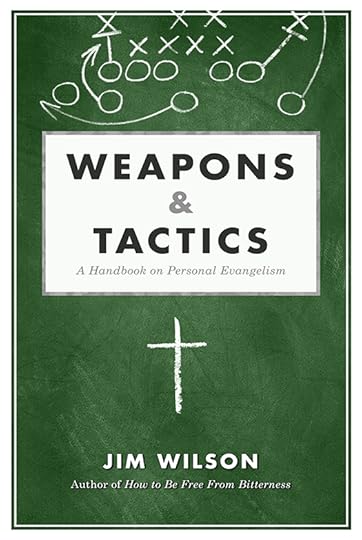
Many of my upcoming posts will be taken from my book Weapons and Tactics. Weapons and Tactics was written to give methods for implementing the principles laid out in my earlier book Principles of War. This book has many scriptural passages and some examples. I hope the scriptural quotations alone will hit you hard. I will quote Scripture extensively, and will draw your attention to certain parts of those passages by means of italics. The italics are not my attempt to make Scripture stronger, but are simply a way of pointing to what the Lord is saying to all of us.
The first half of the book speaks of the weapons that God has given us for the part of the spiritual war related to evangelism. The second half is on the use of these weapons, that is, the tactics of evangelism. It follows the principles of war, but on a personal level, illustrating methods for putting those principles into effect. I would encourage you to read Principles of War as preparation for this study, as what I have written presupposes that.
You may have already learned and practiced much of this. If any of it is new and fresh to you, please pray that God will give you an opportunity to practice what you have learned right away. Do not wait for the rest of the blog posts. There is no substitute for obedience now.
There is a simple command in Ephesians 5 which, if followed, would make all of the evangelism described in this book both normal and easy: “Be filled with the Spirit, speaking to yourselves in psalms and hymns and spiritual songs, singing and making melody in your heart to the Lord, giving thanks always for all things unto God and the Father in the name of our Lord Jesus Christ, submitting yourselves one to another in the fear of God” (Eph. 5:18b–21).
Keep on being filled with the Spirit. May God use you greatly as you participate in this great war that God launched to liberate the souls of men from death and from the fear of death.
How To Be Free From Bitterness and other essays on Christian relationships
March 4, 2022
Discerning Love

“And it is my prayer that your love may abound more and more, with knowledge and all discernment, so that you may approve what is excellent, and may be pure and blameless for the day of Christ” (Philippians 1:9-10).
In 1 Corinthians 8, Paul writes of a knowledge without love. Here it is suggested that it is possible to have love without knowledge. Paul here assumes that love is normal in the believers. He prays that love might abound more and more. He also prays that this love be accompanied with knowledge and all discernment.
There seem to be two reasons for this discerning love: 1) So that we may approve what is excellent. If we have love without discernment, we may end up approving things we should not approve. 2) So that we may be pure and blameless. These two reasons may be close together. If we approve what we should not approve, we will not be blameless.
One of the reasons that love sometimes occurs without discernment is because love does not have a precise, sharp definition in the minds of those doing the loving. Discernment might mean seeing things which are not pleasant nor approvable. Discernment might means disapproving, and “love” to many people does not allow for disapproving. Love becomes gooey and sweet and consequently sticky and messy.
March 2, 2022
Love Each Other Deeply

“Above all, love each other deeply, because love covers over a multitude of sins” (1 Peter 4:8).
This is not saying that love overlooks sin. Love sees sin, and then covers it. In this case, lots of them, “a multitude of sins.”
We know that this is true of the love of God, but is it true of us? The imperative is directed toward us: “Love each other deeply.” I think it must be true of us. 1 Corinthians 13:5 tells us that “love keeps no record of wrongs.” The opposite of covering sins may be keeping a record of them. “Love each other deeply.” “Deeply” has to do with the quality of the cover. Perhaps deep love provides deep cover, as in “Thou will cast all our sins into the depths of the sea” (Micah 7:19).
This cover is not speaking of our own sins, but of others’ sins, for two reasons:
l) “He who covers his sins shall not prosper but he who confesses and forsakes them will have mercy” (Proverbs 28:13).
2) “Love each other deeply.” This love is the love that forgives others. Let us love each other deeply regardless of the quantity or quality of sins committed. Love covers. Love forgives.
Written in 1978.
How To Be Free From Bitterness and other essays on Christian relationshipsFebruary 28, 2022
Principles of War: Obedience, part 3 of 3

Is there an upper limit to obedience in the Christian life? Is there a “danger above and beyond the call of duty”? Can we volunteer beyond the highest command of God? What is the greatest command? Jesus said: “And thou shalt love the Lord thy God with all thy heart, and with all thy soul, and with all thy mind, and with all thy strength: this is the first commandment” (Mk. 12:30). Now look at it again and see if by volunteering we can go beyond it. The superlatives are all there. God requires all of each of our faculties to love him.
In Christian churches today it is normal to hear challenges to greater heights than ever before, but less of the commands. Because the commandments of God are way beyond us—ideals that are not very realistic for the present—we make a graded scale and challenge Christians to follow the graded scale one step at a time. This is because we do not believe God provides the power and love and wisdom to obey His superlative commands as they are given. And since He does not provide, we decide we will dispense with the obedience, which is frustrating, and do it our way: challenge-volunteer. If we volunteer for less than the commandment requires, we are disobedient, even if we gain our objective.
There are many Christian works that are using the challenge today to get Christians supposedly to obey God in everything from Bible reading to the Great Commission. They are using it because it seems to work. Christians are proud, too proud to obey. They will go to foreign mission fields because of a challenge presented in a dynamic way describing the lostness of the people, the dangers, and the hardships, whereas they will not go in obedience to a simple command given by Jesus Christ. A challenge is an appeal to the pride, to human ego. The challenge is doubly wrong:
1. It puts people on the foreign field who should be there, but it gets them there with a wrong motive.
2. It puts people there who should not be there.
There are men who have gone to the field in response to a challenge only to find it was obedience that could keep them there.
If we are not to challenge and we are not to volunteer and our only experience of obedience has been reluctant, recalcitrant obedience, how do we get so that we willingly obey? It all has to do with our view of the Commander. Do we worship him, stand in awe of him, love him, fear him, long to be with him? Or are we buddy-buddy with him? Do we think it is a 50-50 relationship? The latter is not love and will never get instant obedience. All of our obedience will be qualified, and therefore disobedience.
“Now the end of the commandment is charity [love] out of a pure heart, and of a good conscience, and of faith unfeigned” (1 Tim. 1:5).
“If ye be willing and obedient, ye shall eat the good of the land” (Is. 1:19).
February 25, 2022
Principles of War: Obedience, part 2 of 3

There is a wonderful example in the New Testament of the enemy’s challenge and the proper response: Acts 4:17–31. The apostles’ response was first according to God’s directive. “But Peter and John answered them: You yourselves judge which is right in God’s sight, to obey you or to obey God. For we cannot stop speaking of what we ourselves have seen and heard” (vv. 19–20).
They were then threatened again. The apostles’ response to this second threatening was to present this challenge from the enemy to the Lord: “‘And now, Lord, take notice of the threats they have made, and allow us, your servants, to speak your message with all boldness…’ When they finished praying, the place where they were meeting was shaken. They were all filled with the Holy Spirit and began to speak God’s message with boldness” (vv. 29, 31). The apostles did not respond to the challenge in the flesh; they obeyed God and gained His power to be obedient.
Obedience is a willing or an unwilling carrying out of an order or a command. Most of our own experience from childhood up has been of the unwilling kind of obedience. This is one of the reasons “volunteer” has a better reputation than “obey.” In our experience volunteering always means being willing. Obedience always means to be unwilling. If, however, we had known something of willing obedience, then volunteering would be out completely. God does not ask for volunteers, nor does He challenge His own children. When Jesus called His disciples, He did the choosing. He said, “Follow me.” It was a simple imperative. There were also a great many volunteers who followed Jesus. The volunteers did not last.
Perhaps you think that volunteering is a greater expression of love than obedience. What is your basis? Jesus said, “If you love me you will obey my commands, and the man who has received my commands and obeys them—he it is who loves me” (Jn. 14:15, 21). He made simple, absolute, and authoritative statements. These were not challenges seeking volunteers, nor were they goals or landmarks to stretch our reach, to make us try harder. They were imperatives of an absolute nature. Not to obey them was sin. Every imperative from God since has had an absoluteness in its character that defies improvement of the commandment or satisfaction if one falls short of the requirement.
In order to get men into the armed forces, they put out recruiting posters. “Be all that you can be,” “Aim High,” “The few, the proud, the Marines.” These are challenges to appeal to the pride of men so that they will volunteer and join the army. However, once the man volunteers, the whole system changes. He is no longer appealed to. He is commanded, and he obeys. The army could not command him into the army, so they used the challenge in order to get him to volunteer. Once he is in, it is a different story. Enlisting is the beginning of a command-obedience relationship.
There is also an upper limit to this obedience, not as clearly defined as the enlistment at the beginning. In fact, it is always defined after the fact. For instance, an Army captain calls for his own position to be bombed with napalm in order to destroy the enemy who has his company outnumbered and is overrunning his position. He receives the Silver Star and is recommended for the Congressional Medal of Honor for “danger above and beyond the call of duty.” In the Army, there is a beginning to obedience, and there is a place above and beyond obedience. Between the lower limit and the upper limit the relationship is command-obedience. Is there a lower limit to obedience in our relationship with God? There may be a lower limit in our ability to obey, but not a lower limit in the requirement to obey. This ability begins when we know Jesus Christ. In 1 John 2:3 we are told, “If we obey God’s commands, then we are sure that we know him.” But before we knew Jesus Christ, we were under the command of God. And 1 Timothy 1:9 says, “It must be remembered, of course, that laws are made, not for good people, but for lawbreakers and criminals, for the godless and sinful, for those who are not religious or spiritual, for men who kill their fathers or mothers.” Even our repentance into life was commanded by God. In fact, it is a command to all men. Here it is in Paul’s declaration at the University of Athens: “God has overlooked the times when men did not know, but now he commands all men everywhere to turn away from their evil ways” (Acts 17:30).
No, God does not have a lower limit to obedience. He does not challenge us to volunteer for Christ. He commands all people everywhere to repent.
*Excerpted from Principles of War. To purchase, visit ccmbooks.org/bookstore.


