Cynthia Chapman Willis's Blog, page 5
January 31, 2012
Tagline, Anyone?
Do you read the taglines on the covers of some novels? Taglines are those catchy little phrases that smell of marketing. They often tease or tantalize and give a taste of what the novel promises. Sometimes they announce that the author or the book is a bestseller. Other times taglines distill the novel into a few well-chosen words that enhance a title by adding a bit more information about the story behind the cover. I took a stroll through one of my favorite bookstores the other day and found a few choice taglines.
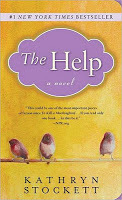
Consider this one for The Help, which is a quote from NPR.org: "This could be one of the most important pieces of fiction since To Kill a Mockingbird…lf you read only one book…let this be it."
Then there is this snippet for a book titled X-Isle: "In a drowned world, everybody wants to get to the island."
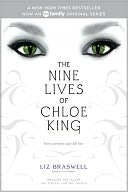
And this one for The Nine Lives of Chole King: "Even curiosity can't kill her."
Another tagline crafted to work with the title is on the cover of Divergent: "One Choice Can Transform You."
Did these lines entice you? I ended up buying a copy of The Nine Lives of Chole King. Taglines seem to work best when they are relevant, succinct, with a zippy hint of something. Think elevator pitch on steroids. Such a well-done tagline under a title in a manuscript might even catch the attention of an agent, or editor, or both.
What do you think about taglines? Has a tagline ever snagged your attention? If you are a writer, could you write a tagline for your work in progress?


January 24, 2012
Too Much Authorial Voice?
At the Miami SCBWI conference, I heard a lot of first page critiques--where the first pages of manuscripts are read aloud and then reviewed by agents and/or editors. A consistent theme in the comments had to do with too much of the author's voice distracting from the stories.

An author's voice is usually the writer's natural tone, rhythm, and choice of words. To put it more poetically--a reflection of the writer's soul. An author's voice is unique to each person, which is why the same story can be told in different ways by different people. In comparison, a character's voice is crafted by the writer to fit a certain character in a story.
When there is too much authorial voice, the reader can become distracted from the story and the emotional flow of it. This sometimes happens when the writer inserts too much set up or back-story instead of allowing this information to become apparent as the story unfolds. Or, the writer may be sharing information instead of allowing the characters to do this. Or, the author may have injected his or her own judgments or commentary or opinions.
To fix too much authorial voice, a writer can revise it into the voice of a character or characters. So, an author judgment or opinion such as "He looked like a total slob" would transform into a character's dialogue or thoughts, such as "You look like a total slob," or "She thought he looked like a total slob." Apologies for the lame examples, but hopefully they make the point.
What do you think? Have you ever stumbled over too much authorial voice in your writing or something you were reading?

January 17, 2012
An SCBWI Conference and A Blog Award
When a good friend suggested that I join her at the Miami SCBWI conference (it had an Alice in Wonderland theme), my first thought was of palm trees and sunshine. I could almost smell coconut oil. However, this fabulous conference turned out to be a lot more than warm temps, oranges, and alligators. Amazing speakers, workshops, critiques, intensives, and people made this conference one of the best I've attended. As a bonus, I got to meet a blogging buddy--Medeia Sharif http://www.medeiasharif.com/. It's always fun to meet blog and Twitter pals in person.
As with most conferences, I left with enough information and inspiration to fill multiple suitcases, but here are a few gems I can share with you:
An amazing book: SECOND SIGHT: An Editor's Talks on Writing, Revising, and Publishing Books for Children and Young Adults by Cheryl Klein, Executive Editor at Arthur A. Levine Books/Scholastic.
I am in the middle of this amazing book, but I also heard Cheryl Klein speak on character and plot this past weekend. She is brilliant. If you ever have the opportunity to hear her speak, go for it. In the meanwhile, I recommend her book.
A book that writers were gushing over: Plot Versus Character: A Balanced Approach to Writing Great Fiction by Jeff Gerke
I have ordered this, so I can't write much else about it yet.
A series of YouTube videos by Martha Alderson, a.k.a. The Plot Whisperer: http://www.youtube.com/watch?v=ESfT2Lh1cWo
These were recommended by the agent and author team who taught a novel intensive. I'll be logging onto YouTube as soon as possible.
Are you familiar with any of these?
* * *
In other news, I've been granted a blog award by Carol at http://carolriggs.blogspot.com/ Thank you, Carol! From what I understand, this is for regular and/or great blog comments, and I am to pass it on to 20 fabulous blog buddies—folks I've had the pleasure to "meet" by way of their wonderful comments and blogs. Here are my twenty picks in no particular order:
http://ten-lives-second-chances.blogspot.com/
http://getbusywriting.blogspot.com/
http://weavingataleortwo.blogspot.com/
http://gypsyjulesinmysoul.blogspot.com/
http://janetsumnerjohnson.blogspot.com/
http://www.karen-strong.com/blog/
http://paranormalpointofview.blogspot.com/
http://bish-randomthoughts.blogspot.com/
http://lisalregan.blogspot.com/
http://lydiakang.blogspot.com/
http://marciahoehne.blogspot.com/
http://doubtingwriter.blogspot.com/
http://lyndaryoung.blogspot.com/
http://nancysthompson.blogspot.com/
http://peggyeddleman.blogspot.com/
http://www.stinalindenblatt.com/
http://susanfieldswriter.blogspot.com/
http://thecharacterdepot.blogspot.com/
http://underthetikihut.blogspot.com/
There are more than twenty wonderful people who generously comment on my blog and have amazing blogs, but the rules said only name twenty. And who needs a bloggy slap on the wrist for not following the rules? Not me.
Happy reading, writing, revising, and blogging to you all!

January 10, 2012
The To-Be-Read Magazine Pile
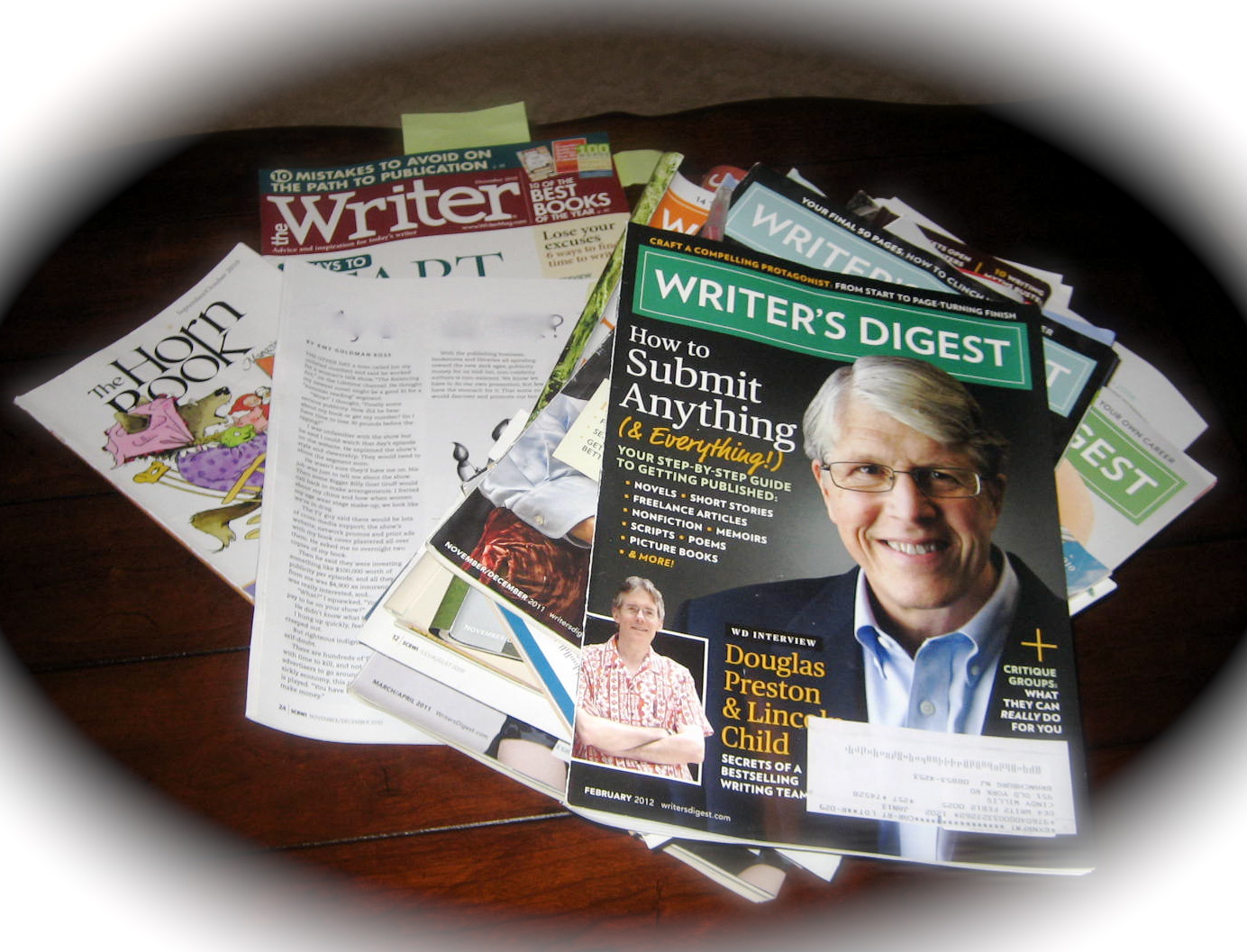
The most recent arrivals of assorted writing and publishing magazines, journals that review books, and newsletters focused on writing and publishing trends are forming a mountain on my desk. This pile is competing with the to-be-read novel pile. All this reading is cutting into my writing time. No lie--I've started keeping some book review magazines in my car to read when I show up somewhere a tad early or I have to wait for someone or something.
And there are lots of tempting magazines, journals, and newsletters available: Publisher's Weekly, The Writer, Writer's Digest, Poets and Writers, The Writer's Journal, The SCBWI magazine, Lion and the Unicorn, Horn Book Magazine, School Library Journal, The Bulletin of the Center for Children's Books, Children's Writer newsletter, Children's Writer Marketplace . . . And I've named just a few.
A little voice in my head is nagging that I must trim down on the subscriptions. The only thing I know for sure is that I will not (WILL NOT) give up my subscription to Writer's Digest. An issue of that magazine will have to be pried from my dead, rigor mortised hands at some point.
Am I alone here? Do you subscribe to magazines, journals, newsletters, and periodicals? If so, do you have a favorite or favorites? If you had to give up one or two, which would you let go?

January 3, 2012
Bestseller or Award Winner?
During one of the many holiday get-togethers, someone asked me if I'd rather be a bestselling author or an award-winning author (we had already been talking about how the two don't always go hand-in-hand). I announced "both," which didn't surprise anyone. However, my friend went on to ask which I would choose if I could only have one.
Tough choice.
A writer's job is to entertain, right? So, imagine the joy that must come to an author when her book lands on the bestseller list. The knowledge that lots and lots of readers are escaping into this novel must be pure satisfaction after the countless hours of love, blood, sweat, and tears that went into writing that story. And what if that novel lingers on the bestseller list? Or people stand in line, waiting for a bookstore to open, just to get their mitts on that book? That's the kind of crazy that most authors would love to experience.
But just because the buying public has become infatuated with a story doesn't mean that the reviewers and critics will praise it.
Most writers I know strive for critical approval. They work hard at the tricky and often frustrating balancing act of juggling how a story is structured with developing characters that breathe, settings that exist, and situations that engage, all while creating layers of meaning and painting prose that enraptures. When all of these elements synchronize just right, a book reaches a level of success that often leads to rave reviews and awards. Why wouldn't an author embrace this sort of acknowledgment?
But just because a story is a literary masterpiece doesn't mean that the buying public will fall in love with it.
So, which would you choose, if given the choice? Would you prefer to be the author of a best selling book, or to be an author of a book that wins awards for its literary merit?
As a reader, are you more likely to read a best-selling novel or one that has won a fabulous award?

December 27, 2011
Wishing You a Happy New Year!
Around here, all is still holiday hustle and bustle. There is still lots of visiting with family and friends going on, not to mention too much eating of too many Christmas cookies. So, this post is going to be short and sweet:
Wishing you a very happy and healthy 2012!!!
I have a bad track record keeping resolutions made on the cusp of a new year, so I make resolutions as I go along. However, I'll admit that I am looking forward to a 2012 of writing and completing projects. I am also looking forward to reading lots of wonderful books.
How about you? Are you making any resolutions for 2012? Dare I ask if you kept those you made for 2011?
Happy, happy New Year !
Cheers!


December 20, 2011
Rainy Days, Lost Luggage, and Tangled Lights
Maya Angelou said this: "I've learned that you can tell a lot about a person by the way he/she handles these three things: a rainy day, lost luggage,
 and tangled Christmas tree lights."
Now that the holidays are upon us, I've dealt with two out of these three in the last few weeks. Happily, not the lost luggage. Although, it's not hard to imagine how I would handle this—with lots of frustration, especially if I had a work in progress or even a good book in the missing bag. However, I'd be reminding myself not to kill the messenger. The person delivering the bad news that my luggage went missing in action probably wouldn't be the same person who hurled my bags out the back of the plane somewhere over Missouri.
As for a rainy day. . . Well, if I have the luxury of staying inside and I have my good book and my trusty laptop (assuming they didn't get lost with the luggage), bring on the sloppy weather.
Christmas lights are another story. No matter how hard I try to wrap these little buggers while taking them off the tree, they somehow tangle themselves in the basement from January until the following December. Every year I curse them and call them ugly names. It doesn't help that while unknotting and detangling, I am thinking about how much writing I could be getting done.
What conclusions might Maya Angelou draw from these scenarios? Probably that I adore writing, revising, and reading enough that I get cranky when life keeps me from indulging in them. Something tells me she'd understand.
How about you? How do you handle rainy days, lost luggage, and tangled lights? What does this say about you?
Wishing all of you a very merry Christmas and happy Hanukkah!

December 13, 2011
What's In a Name?
I have the hardest time naming my characters. The only thing more difficult for me is coming up with a title for a manuscript. Pure torment. I feel clumsy and awkward as I pound my head against my desk in search of the perfect character name. And why not? Names tell us so much about a character that we're reading about. The greatest of writers have sculpted the greatest of names. Think Draco Malfoy from the Harry Potter books. When I read that name, I think Dracula or dragon, and malice or malformed. As another example—Snape. It sounds like snake, don't you think? Or consider Ebenezer Scrooge. If someone suggested you have dinner with an Ebenezer Scrooge, I bet you'd think twice before accepting. I would. Yet I wouldn't hesitate if the name happened to be Stuart Little, even before realizing that he's a mouse.
When I am trying to come up with a character's name, I try to channel Charles Dickens, but that doesn't usually work. So, I try a few other techniques beyond the baby name books and the telephone directories.
I brainstorm and scribble down words that come to mind when I think about one of my characters. Then I mix and match parts of these words to see if something interesting pops up.
I search out names on the Internet. For example, I might do a search for names of famous warriors if my character has a strong and aggressive personality, or names of chefs if he or she loves to cook. By the way, did you know that Draco was the name of a 7th-century Athenian statesman and lawmaker responsible for a code of laws that prescribed death for almost every offence? Something tells me J.K. Rowling knew this. Anyway, you get the idea, but I should add that I will often play with the names I find to make them a little different. Draco isn't obvious, but Zeus and Thor are.
Year books, the Bible, dictionaries, and encyclopedias can also be great resources for names, but again, sometimes a bit of editing and word play may be required to nail that perfect name. And speaking of word play, why not check out the meanings of mundane names in other languages to add a bit of spice? Did you know, for example, that Antonio Banderas translates to Tony Flag?
What are some of the greatest names that you've encountered in stories?
If you are a writer, how do you come up with great names?

December 6, 2011
When to Ask What
I've heard authors say that as they write, they ask themselves what their readers want from the plot and characters at each moment or scene of the story. I find this admirable. I'm not surprised that writers care this much about their audiences and are passionate about giving their best. But. . .
I don't obsess in this way. I don't ask myself what potential readers want from plot and characters while I am beating at the keys of my laptop. Maybe I shouldn't admit this or blog about it. Believe me, I do care a lot about my audience, really I do, but once I'm writing the first draft of my stories, I don't ponder what the readers want. There is too much else going on in my brain. I am too immersed in my story and my characters while I am scraping out the first draft. I am right there with those characters, getting to know them, going through the motions of the story, tripping over road blocks, living the moments. To consider the audience too much would yank me out of this story world. A sports commentator might say I'm "in the zone."
I do, however, consider audience during my first step--when I'm outlining and crafting the skeleton of the story. Does that count?
As a reader, can you tell when an author has been keeping you in mind?
If you are a writer: At what point do you ask yourself what your readers want? Or do you ask yourself this at each moment and scene of the story?

November 29, 2011
Promises, Promises
In an article titled "6 Secrets to Creating and Sustaining Suspense" by Steven James, in the most recent Writer's Digest, Mr. James maintains that suspense occurs in the still moments of a story, between the promise of something happening and when it actually happens. He writes:
 "If readers complain that 'nothing' is happening' in a story, they don't typically mean that no action is occurring, but rather that no promises are being made."
Interesting. Suspense could be born of a promise or promises of a happening or happenings to come, couldn't it? It makes sense that "nothing" happening in a story could be attributed to a lack of promises. When I think about the novels I've most enjoyed reading, they have indeed made pledges. As I read, I anticipated what was coming based on how my expectations had been primed or set up. Make me big promises in a story, and I'll be flipping pages to find out what happens and if the commitments are fulfilled. Isn't this page flipping and inability to put a book down what readers crave and what writers strive for?
Which means, promises need to be kept. How frustrating to be expecting resolutions and get squat.
Are you aware of the promises being made to you when you are reading?
If you are a writer, are you aware of the promises you make in your writing? Do you keep your promises?