Jamie Parsley's Blog, page 42
December 18, 2018
Cranes in downtown Fargo.

Cranes in downtown Fargo.


December 16, 2018
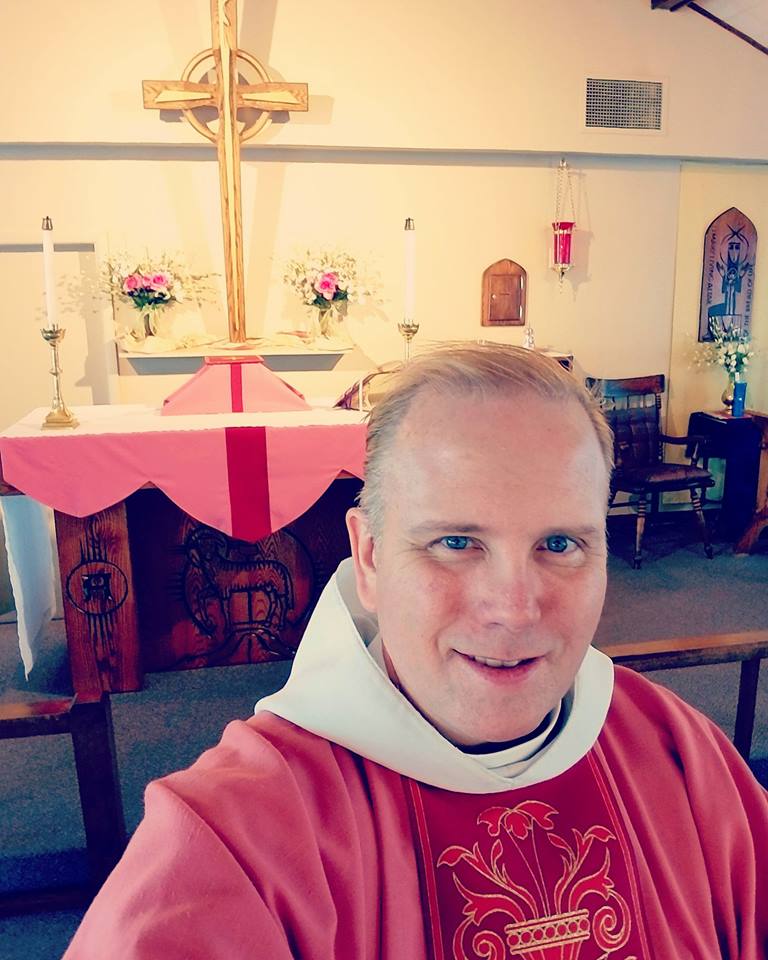
3 Advent/Gaudete Sunday
 December 16, 2018
Zephaniah 3.14-20; Philippians 4.4-7; Luke 3.7-18
+ Today is, if you haven’t noticed, Gaudete Sunday. It’s special Sunday. I LOVE Gaudete Sunday, as you all know!
Today we light our pink candle on the Advent wreath We bedeck the church—and your priest—in rosy pink.
It’s so called because in our reading from Paul’s letter to the Philippians, we hear this:
“Rejoice in the Lord always; I will say rejoice”
That word, “Rejoice,” in Latin is Gaudete.
As we draw closer and closer to Jesus’ birth, we find ourselves with that strange, wonderful emotion in our hearts—joy. It is a time to rejoice. It is a time to be anxious and excited over the fact that, in just a few weeks time, that Messiah, God’s chosen One, will come to us.
“Rejoice” is our word for the day today.
We are joyful because, as Paul says today,
“the Lord is near”
Or, in Latin (since we’re on kind of a Latin kick this Gaudete Sunday) Dominus propus est.
Now that scripture that we just hear from Paul in his letter to the Philippians is just chock full of Gaudete goodness. Every line of that reading is filled with joy and hope.
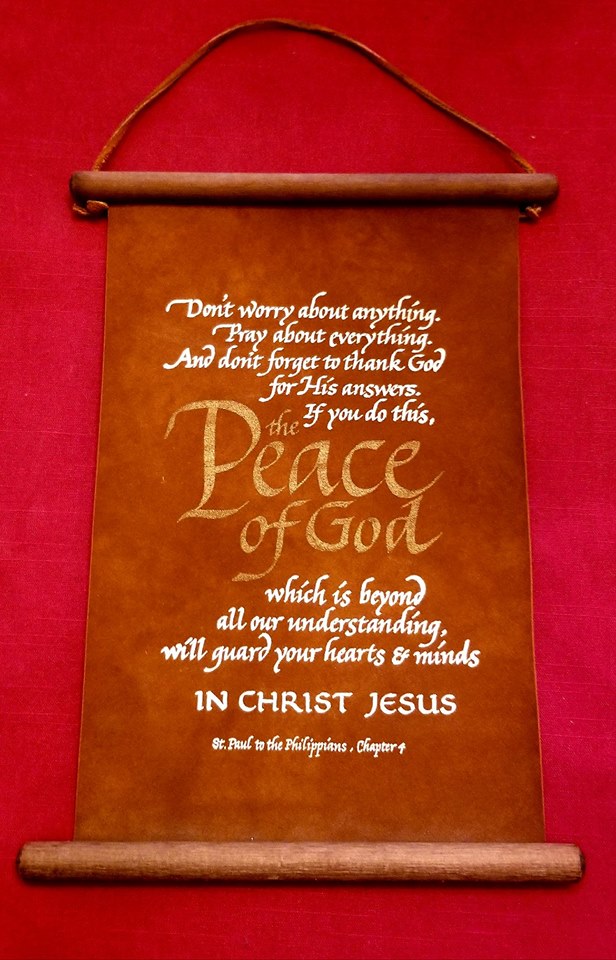
“Do not worry about anything, but in everything by prayer and supplication let your request be made known to God.”
When I was teenager, my mother gave me as a present a leather scroll with this scripture from Philippians chapter 4 written on it. I was a very worry-filled kid when I was young—a fact that worried by mother tremendously. I have shared with some of you how even as an 8 year old, I had terrible stomach ulcers.
So, my mother chose this scroll specifically for me. Do not worry, that scroll reminded me over and over again. I kept that scroll on my wall for years and then, as I moved around, I packed it up and it got lost, and for years thought it was lost for good. Well, a few weeks ago, as I was moving boxes out of the rectory into the twin home, I opened one up and there I came across the scroll, rolled up, at the bottom of a box of things from 30 years ago. As I read the scroll that day, and as I pondered it again for today, I realize how powerful this scripture really is:
Do not worry about anything.
But pray.
And if we do, if we release all our anxieties to God, God will reward us with a peace beyond all understanding.
We hear this scripture so much that we forget it’s real meaning. But it IS powerful. And important. And if we truly take it to heart, if we truly live it out, we realize it captures incredibly the spirit of this Sunday.
Don’t worry.
God is in control.
God is here, with us.
All will be well. Advent is a time for us to slow down, to ponder, to think. And… to wait. It is a time to be introspective, as well—to think about who are and where we are in our lives. So, in the midst of pondering and waiting and introspection, we also find ourselves looking forward.
Now, for some of us, that doesn’t seem all that exciting. The future can be a scary place. And what it holds may not be some wonderfully hopeful thing. Many people have a real fear of the future. It is important to remember that, as followers of Jesus, that in doing such introspection, in looking forward, we do not despair. We do not lose heart.
To go back to what Paul says to us today in our Epistle reading:
“Do not worry about anything…”
And in that incredible reading we hear this morning from the Hebrew scriptures, we hear so many truly wonderful and hopeful things from the prophet Zephaniah.
“Do not fear, O Zion;Do not let your hands grow weak.”
Why should we not fear? Because, according the prophet, God is in our midst.
God is with us.
And God “will rejoice over you with gladness,[God] will renew you with [God’s] love.”
But God is even clearer in this reading about how well cared for we are by God.
God exults over us “with loud singing.”
God will “remove every disaster” from us, so that we will not bear reproach.
God will deal with all our oppressors, and the lame will saved and the outcast gathered in.
God will change whatever shame we have to praise
These words of God are being spoken to each of us today:
God says, “I will bring you home at the time when I gather you:for I will make you renowned and praisedamong all the peoples of the earthwhen I restore your fortunesbefore your eyes, says the Lord. “
Those words are being spoken to us this morning, by the God who loves us and cares for us. We are well taken care of by our God. And if that doesn’t give you a true reason to rejoice today, I hate to say it: nothing will.
Rejoice today.
God loves you.
God cares for you.
God exults in you with loud singing and rejoices over you with gladness.
This is why we rejoice today.
See, the future is nothing to fear. Our future in God is a future of joy. Joy in the simple fact that God really does love us and delights in us and rejoices as well in us. That real and beautiful joy is why we are decorated in rose this morning.
That is why, in our pondering, we are pondering joy—even joy in the midst of sadness or loneliness or depression, which many people also suffer with at this time of the year. That is why, even despite all that happened in our lives, all that is happening at the moment and that will happen, we can still rejoice.
Gaudete.
We find, in our Gospel reading, that even formidable figure of John the Baptist, saying to us,
“Bear fruits worthy of repentance.”
These words speak loud and clear to us even now—in this moment of joy. Those words are speaking loud and clear to us as a congregation this morning. We are being told, bear good fruit .
Bear good fruit.
Let our joy be the seed of the good fruits we bear. Do good in this world, even if you’re depressed or lonely or sad. Do good even if the world does not, at times, do good to us. Do good always. Because in doing good, we are doing what God wants us to do in this world. In doing good, we embody true joy.
Bear good fruit.
We bear good fruit when we live out in our joyful lives. We bear good fruit when we do the sometimes difficult task of loving and fully accepting all people equally. We bear good fruit when we allow our love of God to guide us along right pathways. We bear good fruit when we strive to be good for the sake of loving God and one another even despite the fact that some body don’t deserve our love.
This is what Gaudete Sunday is all about—rejoicing.
Living in joy.
Letting joy reign supreme in us.
Letting joy win out over fear and uncertainty.
Being joyful in our love for God and for others.
We—Christians—bear good fruit when we are joyful in our God. How can’t we? That joy that we carry within us fertilizes the good things we do. It motivates us. It compels us. It gives us purpose and meaning in our lives.
We, as Christians, must embody that joy. We must live that joy in all we do and say and are.
Today, we must, in all honesty, proclaim:
“Gaudete!”
Rejoice.
And live that Gaudete out in our very existence, in the ministries we do, in how we deal with others.
So, let Gaudete be more than just what we say or do one Sunday a year. Let it be our way of life as we await the Messiah’s presence coming to us.
St. John and St. Paul are both right:
The Lord is near!
The Lord is near.
God has sent the Messiah to us to redeem us.
So…let us bear good fruit. And when we do we will truly know that “peace of God which surpasses all understanding….”
We too, as embodied joy, will be bearing good fruits.
December 5, 2018

December 2, 2018
I Advent
 December 2, 2018
Luke 21.25-36+ This morning is a special morning. You can tell. No, it’s not just Pledge In-Gathering Sunday (which is very important, mind you)
But, yes, it is the First Sunday in Advent.
We are lighting the Advent wreath.
We have the Sarum Blue
And we are praying the Great Litany.
The Great Litany is one of the treasures of Anglicanism and the Book of Common Prayer. In some churches the Great Litany is recited while in procession. Well, we don’t have the room here at St. Stephen’s to do it in procession. We could try. But I don’t think it would work very well.
But we do it on this First Sunday of Advent. We will do it again in Lent. And, of course, the Supplication of the Great Litany is also prayed, according to the Book of Common Prayer, “in times of war, or of national anxiety, or of disaster.”
The Great Litany is special for many reasons. It is the oldest piece of original-English liturgy we have, published 1544. Thomas Cranmer, the great Archbishop of Canterbury and the person almost single-handedly responsible for the Book of Common Prayer, used several sources in his writing of this version of the Great Litany. He used the Sarum Liturgies for Rogation, Processions and Death, the Litany written by Martin Luther, and the litany from the liturgy of St. John Chrysostom.
So, in a very real way, it represents our Anglican blend of Catholic, Eastern and Protestant theologies—our Via Media, our Middle Way. It’s appropriate that we pray this liturgy which essentially includes EVERYONE in the prayers on this First Sunday of Advent.
After all, we are now in this anticipatory season of Advent. Anticipation is a very good word to sum up what Advent is. We are anticipating. We are anxiously expecting something.
And in that way, I think Advent represents our own spiritual lives in some ways. We are, after all, a people anticipating something. Sometimes we might not know exactly what it is we are anticipating. We maybe can’t name it, or identify it, but we know—deep inside us—that something—something BIG—is about to happen. We know that something big is about to happen, involving God in some way. And we know that when it happens, we will be changed. Life will never be the same again.
Our world as we know it—our very lives—will be turned around by this “God event.” It will be cataclysmic.
What I find so interesting about the apocalyptic literature we hear this morning in our scripture readings is that we find anticipation and expectation for this final apocalypse. And that anticipation and expectation is a good and glorious thing, I think. That is what this season of Advent is all about. It is about anticipation and expectation being a wonderful thing in and of itself.
Because by watching and praying in holy expectation, we grow in holiness. We recognize that despite the doom and gloom some people preach when it comes to prophecies, doom and gloom doesn’t hold sway over us as Christians.
Still, despite this view, we are a people living, at times, in the dark doom and gloom of life.
In Advent, we recognize that darkness we all collectively live in without Christ. But we realize that darkness doesn’t hold sway.
Darkness is easily done away with what? With light!
And so, in Advent, we are anticipating something more—we are all looking forward into the gloom. And what do we see there? We see the first flickers of light. And even with those first, faint glimmers of light, darkness already starts losing its strength.
We see the first glow of what awaits us—there, just ahead of us. That light that is about to burst into our lives is, of course, Christ’s Light. The Light that came to us—that is coming to us—is the sign that the Kingdom of God is drawing near, as Jesus says in today’s Gospel, is near.
It is near.
Yes, we are, at times, stuck in the doom and gloom of this life. But, we can take comfort today in one thing: as frightening as our life may be, as terrible as life may seem some times and as uncertain as our future may be, what Advent shows us more than anything is this: we already know the end of the story. We might not know what awaits us tomorrow or next week. We might not know what setbacks or rewards will come to us in the weeks to come, but in the long run, we know how our story as followers of Jesus ends.
Jesus has told us that we might not know when it will happen, but the end will be a good ending for those of us who hope and expect it. God has promised that, in the end, there will be joy and happiness and peace. In this time of anticipation—in this time in which we are waiting and watching—we can take hope.
To watch means more than just to look around us. It means to be attentive. It means, we must pay attention. It means waiting, with held breath, for the Kingdom of God to break upon us.
So, yes, Advent is a time of waiting and it is this waiting—this expectant anticipation—that is so very important in our spiritual lives. Advent is a time of hope and longing. It is a time for us to wake up from our slumbering complacency. It is a time to wake up and to watch.
The kingdom of God is near. And we should rejoice in that fact.
In preparation for Advent, I have been re-reading some of those poets and writers that inspired me many years ago—way back when I was a teenager. One of the poets/theologians that I have been re-reading intensely lately is the great German Protestant theologian and poet, Dorothee Soelle. I’ve mentioned Soelle many times before. If you do not known Soelle, read her. She is incredible and important.
When I was in high school, I first read her book, Of War and Love, which blew me away.
But a poem of hers that I have loved deeply and that I have been re-worked as a poet myself is her poem, “Credo.” I was going to just quote a part of the poem here, but it’s just so wonderful, I actually have share it in full. This is the poem as I have adapted it.
The poem is
Credo
after Dorothee Sölle
I believe in a Godwho created what we walk uponnow in this holy moment
is something to be moldedand formedand tried.
I believe in Onewho rules not by tense lawswritten in stone
with no real consequencesnor with distinctions between those who have and those who have not,
geniuses or idiots,those who dominate and those who are dominated
I believe in a God who demands a creationthat protests and, if need be,
questions God.I believe in us,who must work to change
the failures of creationby any means.I believe in Jesus
who, as “someone who could do nothing”as we all areworked to change
injustice against God and humanity.He allowed me to see
how limited we are,how ignorant we can be,how uncreative we have consistently been,
how everything we attempted falls shortwhen we do not do it
as he did it.We need to do itas he did it.
A day does not go byin which I do not feara reality in which
he died for nothing.Nothing sickens me morethan the thought
that he lies at this momentdead and buriedin ornate churches
and cathedrals,laid out covered in goldand jewels,
encased in glass, to be gazed at and worshippedbut not touched or embodied.
I fear more than anything that we have failed himand his revolution
because we feared insteadthose self-absorbed authoritieswho dominate
and oppress us. I believe in a Christ who is not dead
and buriedand left in the groundbut rather who lives
and is resurrected in us,and in the flame of freedom that burns away
prejudice, presumption,crippling fear
and destroying hatred.I believe in the ongoing revolution he set into motion
and the reign of peace and justice that will follow.I believe in a Spirit
who came to us where we were,and with all those with whom we share
this Lenten place of tearsand hungerand violence
and darkness—this city of God—this earth.
I believe in peacewhich can only be createdwith the hands of justice.
I believe in a life of meaning and of true purpose
(adapted by Jamie Parsley)
Yes, we do live in “this place of tears/and hunger/and violence/and darkness—/this city of God—/this earth.”
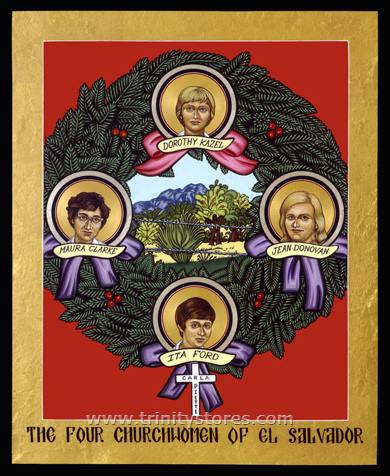
It was on this day in 1980 that four American women—three nuns, Sister Ita Ford, Sister Maura Clark and Sister Dorothy Kazel, and a layperson, Jean Donovan—were brutally murdered in El Salvador. It was a story that shocked all of us and challenged many of us, myself included. They reminded us that following Jesus means following him not only through the good times, through the happy stories of his birth, but through the violence and darkness of his life as well, through the story of the jealous despot who wanted to kill Jesus, through the slaughter of the Innocents, through the darkness of Gethsemane and the Cross.
This IS a place of tears/and hunger/and violence/and darkness—/this city of God—/this earth.”
But, like those women who died on this day in 1980, we too are hoping, in this Advent season, for “God’s future world/of love and peace.”
It is near.
The Kingdom of God—with its incredible revolution—is so close to breaking through to us that we can almost feel it ready to shatter into our lives.
So, in this anticipation, let us be prepared.
Let us watch.
Christ—the Messiah, God’s Anointed One—has come to us and is leading us forward. Christ—the dazzling Light—is burning away the fog of our tears and hunger and violence and is showing us a way through the darkness that sometimes seems to encroach upon us. We need to look anxiously for that light and, when it comes, we need to be prepared to share it with others, because is telling us that the God’s future world is breaking through to us.
This is the true message of Advent.
As hectic as this season is going to get, as you’re feeling overwhelmed by all the sensory overload we’ll all be experiencing through this season, remember, Watch.
Take time, be silent and just watch.
For this anticipation—this expectant and patient watching of ours—is merely a pathway on which the Christ Child can come among us as one of us.
November 28, 2018
My Stewardship Letter
 November 28, 2018Dear members and friends of St. Stephen’s,
St. Stephen’s is a unique place. Of course, I don’t need to tell you that. You already knew how unique we are. That is why you’re here. That’s why you are a member of this congregation that is not quite like any other congregation.
When parishioners move away they often tell me: why can’t I find a place like St. Stephen’s in our new city? The reason is: we are not your typical Episcopal congregation. In fact, we’re not even your typical Christian congregation.
That uniqueness is what makes us who we are. And we should rejoice in that uniqueness. We should celebrate it fully!
For some, this uniqueness scares people off. Not for us—the ones who stay. We are quite proudly an anomaly in the Episcopal Church and the Church as a whole. We are a liberal, fairly High Church, liturgical, fully welcoming, fully inclusive, though fairly orthodox congregation that actually grows and attracts new members .
When you think about it, everything about that statement put us against the odds. After all, we are in a far off corner of the city, far from the main traveled roads. To find us, one actually has to search us out. And yet, they do find us! And they stay!
In this past year of 2018 we have continued our growth spurt—with 18 new members included among us! I love that one of the most common complaints I get from parishioners is this: “I haven’t been in church for a couple of weeks, and then when I finally get back here, there are all these new faces!”
These are all things for which we are grateful to God. These are clear sign that God’s Holy Spirit is now only present in us, but also at work in us and the ministries we do here. But for us to be who we are, to be this unique place in which all people are welcome and included, we need your pledges of financial help, and physical presence.
I cannot stress how it important it is to pledge . As you know, we budget from what the congregation pledges. Your pledge determines how we are to budget for the upcoming year. For us to continue to do the work we do in this community and in the world, we need pledges.
But Stewardship is more than just about money. It is also about presence. One of the ways in which we can most easily and visibly contribute to Stewardship at St. Stephen’s is by our very presence on a regular basis at the Sunday morning celebration of the Holy Eucharist or on Wednesday evenings.
Attendance is not only about what each of us needs, it also what the larger congregation needs. We essentially need each other . We need the presence and proximity of each other.
My intent in sharing this is not to make anyone feel guilty. As you have heard me say many times, I do not take attendance at the door. I also understand that many people cannot attend due to illness or many other circumstances in their lives. My intent is simply to remind us that when we pledge to St. Stephen’s we pledge of our money, we pledge of our talent, we pledge of the gifts we have received and are willing to share with others, we pledge of our expertise in certain areas of our lives, and we pledge of our very presence.
So, please do give. Please pledge . Give of your time and your presence. Give from the abundance that God has granted to you. And share of yourself in what ministries God has called you to here at St. Stephen’s
I invite all of you to take time to reflect and to pray about your own stewardship. What talents can we offer to make St. Stephen’s a church that can reach out in love, compassion and radical acceptance to others? What material resources can we give to help maintain the ministries we do here?
As we continue our journey together, we look forward in hope and joy at the many incredible potentials that await us at St. Stephen’s.
Finally, please know of my gratitude in serving all of you as your priest. I feel blessed more and more each day for being here. Know that I pray for each of you by name in the course of a week in my daily prayers. I ask your continued prayers for me as well.
- peace,
Fr. Jamie A. ParsleyPriest-in-Charge
November 25, 2018
Last Pentecost/Christ the King
 November 28, 2018
Daniel 7.9-10, 13-14; Revelation 1.4b-8; John 18.33-37
+ For any of you who have known me for any period of time, you know that, invariably, you will discover that I am very political person. I have very strong political views. Which is something directly opposite of what I was taught as a priest.
I was taught that, despite whatever a priest’s personal political views may be, those views should not come into the pulpit. And, for the most part, I have followed that rule.
I do believe, to a certain extent, that a priest should not be up here sharing their personal political beliefs. Because not everyone in the pews is of the same political view.
Yes, even here at St. Stephen’s, not everyone agrees politically. We have people who cover the full spectrum of politics. And I love that. I love that people who think Donald Trump is the greatest president ever can worship with people who think Donald Trump is not.
I also believe a priest should not share their politics from the pulpit because many people here came from churches and denominations that had clergy who got up and not only shared their political views, but even went so far as to tell people how they should vote. And that, to me, is an absolutely terrible thing.
And just so no one would ever think that I would do that—and I would NEVER do that—I purposely try to avoid politics as much as possible.
The exception for me is when a politician crosses the line and starts advocating for things that oppose the Church or basic human rights or human equality. And I have spoken out on those issues. And will continue to do so any time it happens.
But today, on this particular Sunday, we deal, somewhat indirectly, with another kind of politics. Today, we recognize that no matter how terrible or how great a leader may be, there is one leader for us, as Christians, who is the ultimate Leader.
The King of Kings.
On one level, today, of course, is Christ the King Sunday. It is an important Sunday in the Church. Today marks the End of one Church Year—Year B. Next Sunday will be the First Sunday of Advent and Church Year C begins. So, it’s kind of like New Year’s, almost a month early.
You can just kind of feel it. Something is just…happening, at least from our scripture readings. Advent, that time of preparation for Christmas, is about to happen.
The Season of Advent is, of course, the season of anticipation—of longing. And dare I say, maybe a fair share of healthy impatience.
Maybe that’s why I like it so much. I am an impatient person—as anyone who has worked with me for any period of time knows. Certainly, we, as followers of Jesus, might get a bit impatient about that for which we are longing. Our journey as followers of Jesus, is filled with anticipation and longing.
We know, as we make this journey through life, that there is an end to our journey. We know there is a goal. But we might not always be aware of what that goal is or even why we’re journeying toward it.
But today, Christ the King Sunday, we get just a little glimpse of that goal. We get to get an idea of what it is we are anticipating. We get a glimpse of the THE END of the story.
We are invited, on this Sunday, to see this King—this ultimate Ruler—coming to us on clouds, and on wheels of burning fire. I, for one, love the drama and the splendor of such an image.
In our readings today—especially our readings from the Prophet Daniel and Revelation, we too, with Daniel and the Apostle John, get a glimpse of what it is we are hoping for, what we are striving for. We see a glimpse of the One we, as Christians, recognize as Christ—that Alpha and Omega—that Beginning and End—that Anointed One who is seated at the right hand of God and who is coming to us on the clouds.
But the Christ we see in our own collective vision this morning is not the humble carpenter, the amazing miracle worker, or the innocent newborn baby we are anticipating in a month’s time. The Christ we encounter today is the traditional Cosmic Christ—this Christ who is limitless, who is all-powerful, who transcends time and place. This Christ is there at God’s side, the One God has sent to us as ruler, who has come to us as God’s spoken Word. The Christ we encounter this morning is coming to us on clouds, yes, but he also comes to us while standing on the throne of the Cross—an about-to-be condemned criminal—engaging in a conversation with Pontius Pilate about who he is. The Christ we encounter today is crowned, yes—but he is crowned with thorns.
This message of Christ the King, Christ the Ruler is never more meaningful for us right now, in our own country, with a nation divided over its leaders.
And there IS division, sadly enough. I am hearing it from both sides of the issue. We are seeing our families divided over politics. We are seeing friends who are avoiding and separating themselves from each other. There has been much fear-mongering in the air.
And, as we know, fear-mongering is not an option for us as Christians. FEAR is not an option for as a Christians.
This King we celebrate today—this King crowned as he is with a crown of thorns—he is the Ruler of all of us, no matter who the rulers on earth may be. And because he is our ruler, in him whatever divisions—especially political divisions—there are between are eliminated. After all, he too lived in a world of terror and fear, in a world of division, where fear and terror were daily realities in his life.
This is the Christ we encounter as well today. The Christ we encounter today is Christ our King, Christ our Priest, Christ our ultimate Ideal. But he is also so much more than that.
He is also the one that some would also judge as Christ the Rebel, Christ the Misfit, Christ the Refugee, Christ the Failure. And what the Rebel, the Misfit, the Refugee, the Failure shows us powerfully is that God even works through such manifestations. God works through rebellion, through being ostracized, through failure even. And this is a very real part of our message on Christ the King Sunday.
In the midst of the brokenness of Christ, God is ultimately truly victorious. And because of what God does in Christ we too, even despite our own brokenness, despite our own rebelliousness, despite our own failures, we too will ultimately triumph in Christ.
The King we encounter on this Sunday, the King that awaits us at the end of our days, is not a despotic king. The King that we encounter today is not a King who rules with an iron fist and makes life under his reign oppressive. This King is not some stern Judge, waiting to condemn us to hell for what we’ve done or not done or for who we are.
But at the same time the King we honor today is not a figurehead or a soft and ineffective ruler. Rather, the King we encounter today is truly the One we are following, the One who leads us and guides us and guards us. This King does not allow us to have fear as an option in our lives. This King eliminates our divisions. The King we encounter today is the refugee, the misfit, the rebel, the outcast, the marginalized one, who has triumphed and who commands us to welcome and love all those who are marginalized and living with terror and fear in their own lives.
And his Kingdom, that we anticipate, is our ultimate home. We are all—all of us, every single one of us, no matter who we are—, at this moment, we are citizens of that Kingdom of God, over which God has put the anointed One, the Christ. That Kingdom is the place wherein each of us belongs, ultimately.
You have heard me say it in many, many sermons that our job as Christians, as followers of Jesus, is to make that Kingdom a reality. You hear me often talking about the Kingdom breaking through into our midst. That’s not just poetic talk from the pulpit. It is something I believe in deeply.
The Kingdom—that place toward which we are all headed—is not only some far-off Land in some far-away sky we will eventually get to when we die. It is a reality—right here, right now. That Kingdom is the place which breaks into this world whenever we live out that command of Jesus to love God and to love one another.
When we act in love toward one another, the Kingdom of God is present among us. Again, this is not some difficult theological concept to grasp. It is simply something we do as followers of Jesus. When we love, God’s true home is made here, with us, in the midst of our love. A kingdom of harmony and peace and love becomes a reality when we sow seeds of harmony and peace and love. And, in that moment when the Kingdom breaks through to us, here and now, we get to see what awaits us in our personal and collective End.
As we prepare for this END—and we should always be preparing for the END—we should rejoice in this King, who is the ruler of our true home. And we should rejoice in the fact that, in the end, all of us will be received by that King into that Kingdom he promises to us, that we catch glimpses of, here in this place, when we act and serve each other out of love for one another. The Kingdom is here, with us, right now. It is here, in the love we share and in the ministries we do.
So, on this Christ the King Sunday, let us ponder the End, but let us remember that the End is not a terrible thing. The End is, in fact, that very Kingdom that we have seen in our midst already. For us the End is that Kingdom—a Kingdom wherein there is a King who rules out of love and concern for us.
“I am the Alpha—the beginning—and the Omega—the End,” Jesus is saying to us.
But in our End, we truly do find our beginning.
“To [God] be glory and dominion forever and ever.” Amen.

November 22, 2018
November 18, 2018
26 Pentecost
 Stewardship Sunday
November 18, 2018
Daniel 12.1-3; Mark 13:1-8
+ Today is, of course, Stewardship Sunday, as you have heard many times already. And yes, it is a time for us to pray about and ponder and seriously consider giving. That is what the “theme” of stewardship Time is.
Giving.
It is time to give money. It is time to give of our time and talent and selves. And yes, it’s never exciting for us to think about the fact that we need these things.
We do need money. We need people helping out. And we do need people in general. We need the presence of people in our midst.
After all, we do have much to celebrate here. I don’t think any of us—myself included—can fully appreciate what has happened and what is happening here at St. Stephen’s. We are a unique and amazing congregation. There is no getting around that fact. There are not many places quite like St. Stephen’s. We are eclectic. We are a bit outside the norm.
I often call our congregation the Island of Misfit Toys.
Most of us have come here from other congregations in which we have experienced some hardship or oppression or some very unchristian-like behavior. For most of us, that is why we are here at St. Stephen’s. Many came here because this is a refuge from the difficulties of other religious communities. And I am very grateful today for us being that place. We are also a place in which people are not only welcomed but included because of who they are.
But being a congregation as we are also means we pay a price for being who we are.
Three years ago at this time when we sought Delegated Episcopal Pastoral Oversight, when we said, along with the larger Episcopal Church, that all people have a right to the sacraments including Marriage, we seemed to be alienating ourselves in this diocese. We seemed to be at odds with others, as though we were swimming against the stream. I received a fair of criticism personally for our decision at that time.
How dare you! I was told.
What hubris you and St. Stephen’s have!
This is not the right thing to do, I was told.
We need to be loyal to the Diocese.
Why not just roll over and present out tummies like submissive dogs to those in authority? It’s easier that way. And it avoids conflict!
But…look around us now. Now, as we look about us at the Episcopal Church as a whole and see the battles being waged in places like the Diocese of Albany, we realize (as we knew then) that we weren’t the ones in the wrong.
We were never in the wrong.
We were the ones who were always actually in line with the larger Episcopal Church.
And it is more than obvious that we are now very much part of the norm. Which, I have to admit, is strange to even say. For so long we have not been “in the norm.” We have always been out here, on the fringes, slightly of step with those more traditional congregations who are comfortable when things are safe and normal. It’s almost uncomfortable, dare I say, to be in the norm. To be on the inside looking out for once.
But this is who we are and who we always have been. We are the ones always, it seems, on the forefront. Though, as we all know, sometimes being the ones who are in the forefront of the battle is not a pleasant place to be. Guess who gets shot at first?
Being the mavericks, being the rebels, being the prophets means that we are going to be ostracized. We are going to be mistreated. We are going to shunned and rejected. Even by our friends, by our colleagues, by our fellow followers of Jesus. It shouldn’t be that way. But, sometimes, it just is.
And we have known that here at St. Stephen’s. We have felt that for a long time. Often we have felt that we are alone in our battles. But, we knew, in our core, that were only leading the way, and sometimes doing so means it takes a while for others to catch up.
In that interval, it can be lonely. But we knew. We saw. We believed.
I have asked you many times over the years to trust. Trust me. Trust our leadership. And you know what? You really have. And you can see that we were not led down the wrong path. We were following the right path all along.
In our reading from the book of Daniel we hear,
“Those who are wise shall shine like the brightness of the sky, who those who lead many to righteousness, like the stars forever and ever.”
We, this congregation, are wise and we have led the way.
This is where we are on this Stewardship Sunday in 2018. When anyone asks me what the “secret” of our success at St. Stephen’s is, I always say, two things.
First, the Holy Spirit. We do need to give credit where credit is due. Without God’s Spirit at work here among us, we would not be where we are and doing what we’re doing.
And second, it is because we welcome and accept radically and we love radically. Now, there are a lot of churches that are “welcoming.” I actually don’t know of very many churches that aren’t “welcoming” in some way. But it’s not enough just to welcome. We must take it one step further. In welcoming, we must include. We must be without judgement in our welcoming and in our including.
This is not rocket science. This is not quantum physics. This is basic Christianity that we are doing here at St. Stephen’s. Basic Christianity, as we live it out here at St. Stephen’s, is nothing more than following Jesus in his commandment to love God and love one another as we love ourselves.
To love God.
And to love others.
Love here means what? It means LOVE. It means treating people well. It means respecting one another. It means not treating some people differently than others just because they are not like us. It’s just that.
It is a matter of living out our Baptismal Covenant. It is a matter of saying that all people deserve the rites of this Church fully and completely.
It is a matter of LOVE.
I know. I preach it all the time. And you’re probably sick of hearing me preaching about love all the time. But…you know what? That’s tough. I’m not gonna stop preaching about love. Because it DOES make a difference.
To love—fully and completely.
To love—radically and inclusively.
I personally don’t see that as all that radical. I see that being as fairly basic.
In today’s Gospel, we hear Jesus saying, “you will hear of wars and rumors of wars.”
These words of Jesus are especially poignant for us on this particular Sunday, in this chaotic time in which we life, in which there are such deep and real divisions between us. There truly are wars and rumors of wars in this world and in our very lives this morning. Wars here does not only mean battles with guns and missiles. War here means war with our family and friends and fellow believers. War means all those conflicts we are having to endure in our own lives as well..
Jesus uses a very interesting description of these fears and pains—images of war and their rumors. He calls them “birth pangs.”
And I think “pang” is the right word to be using here, for us at this moment.
Yes, it may be painful to be going through what we may be going through as a congregation when we standup for what we believe is right.
It might be frightening when we as individuals stand up for what is right. It may be painful when we are at conflict with those around us. It may be frightening. The future may seem at times bleak. But it is not war. And it is not death throes. It is merely the birth pangs of our continued growth.
Yes, there will be wars and rumors of wars. Yes, there will be moments when church leaders and church attendees will say and do hurtful, war-like things or by their silence perpetuate hurtful, war-like things. There will be moments when even our congregation may go through lean times, when it seems like no cars about what we are doing, when people think we are too extreme and too “out there.” There may be times when people just simply want to avoid that Island of Misfit Toys.
But the words we cling to—that we hold on to and find our strength in to bear those pangs—is in the words “do not be alarmed.”
Do not be alarmed. There is a calmness to Jesus’ words. This is all part of our birth into new life, he is explaining to us. Because in the end, God will always triumph. And God always provides!
If we place our trust—our confidence—in God, we will be all right. Yes, we will suffer birth pangs, but look what comes after them. It is a loving and gracious God who calms our fears amidst calamity and rumors of calamity. Our job is simply to live as fully as we can. Our job is to simply do what we’ve always been doing here at St. Stephen’s. To welcome, to accept, to love. To not judge.
We have this moment. This holy moment was given to us by our loving and gracious God.
This Stewardship Sunday is about us doing our part as a congregation that does the things St. Stephen’s does. Yes, it means giving money to this congregation—it is about something as simple as tithing—of giving that 10% That is important.
It also means giving of our time and energy.
On Stewardship Sunday, we are being asked to serve as well. To serve in love. To serve fully as Jesus calls us to serve and love.
So, let us, on this Stewardship Sunday, continue to do what we’ve been doing. Let us welcome radically and love radically. Let us give of ourselves fully, so that we can serve fully. Let us, in our following of Jesus, continue to strive to be a powerful and visible conduit of the Kingdom of God in our midst. It’s already happening.
Right now.
Right here.
In our midst.
It is truly a time in which to be grateful and joyous.
Let us prayLord God, surround us with your love. Be present in this congregation of St. Stephen’s as you have been since our beginning. Let us know your presence among us—in the sacrament, in your Word and in those who have gathered here in your name. Let your Spirit be present with us and in all we do. Open our hearts and our minds to the goodness you are doing here through us. And let us respond appropriately. Bless St. Stephen’s with abundance and with the resources needed to do the ministries we do here. Let us, in turn, do good. Let peace reign here with us, even as wars and rumors of wars rage about us. And let your words of assurance to us to not be alarmed calm our hearts and souls so that we can do what you have called us to do. In the name of Jesus your Son, we pray in confidence.