Andrew Kozma's Blog, page 4
March 23, 2016
What I’ve Been Reading: March Edition
I Might Be Mistaken by Barbara Duffey
I dug through yards of disintegrating
feces around the ruins of the temple’s
outbuilding, all decked out in goat shit dust. (“Hircine”)
Barbara is more of a narrative poet than I am, by which I mean she tells stories. Her images and revelations startle because they are so apt and, often, shockingly personal or, simply, shocking in the audacity of what’s said (and how what’s said is never expected). She’ll dice up a story into bite-sized chunks, then twist them around so even though the story’s still coming through straight at you, you receive a series of aftershocks rather than an earthquake (the latter likely coming at the end).
Say, This is the Yellowstone Park of her body, doctor;
welcome, and enjoy your stay, but Can I confess
what I haven’t done, might not have done, am waiting for
the results of? (“To My Various Bodily Fluids, While Being Tested”)
The Weapon Makers by A. E. van Vogt
We have talked about The Weapon Makers. It’s that book where medical science has given up on women, but time travel is possible. See here.
Carry On by Rainbow Rowell
Rainbow Rowell wrote a book called Fangirl which is awesome and you all should go out and buy it and read it right away. The main character in that book writes extremely popular fanfiction for a Harry Potter-like mega-franchise, and throughout that book we get snippets of her writing, though the book itself isn’t about the fanfiction really but Cath’s experience of going to college finding how she fits in there. Those snippets, though, were amazing.
In Carry On those snippets are expanded into a book. And the resulting novel is delicious and sad and real and terrifying. Admittedly, I love all of the the Rowell books I’ve read, and what I love most about her books are her characters, but still the world she creates here is really interesting, and also impressive for how she condenses the essence of a seven-book series into a single, complete work.
The Mystery of Hollow Places by Rebecca Podos
This is a book about a stone heart broken in half, and how that heart leads a girl on a quest to find her missing father.
From that summary, you might think the book is fantasy of some kind, but it is solidly in the mystery/detective vein. The fantasy comes through only in flashbacks of stories that the father told the daughter, and those magical realist moments are amazing and beautiful and stunning and unsettling.
Podos’ book (the actual plotline) is also those things, just firmly in the real world. She creates flawed characters, and doesn’t let them unflaw, but makes us care deeply about them anyway (all of them).
Shadow Man by Gabriel Blackwell
As far as I can tell, Blackwell has a penchant for writing novels that interact and grow from other novels/works of art. The first book of his I read was The Natural Dissolution of Fleeting-Improvised-Men: The Last Letter of H.P. Lovecraft and he has a third book, a collection of stories, which announces in its name his intention to riff off of other people’s writings (it’s called Critique of Pure Reason).
This book takes a character from The Maltese Falcon and meshes him with the lives of real noir detective-fiction writers, stirring them all up into a single noir fantasy centered around personhood and deception. It’s a dizzying read. I prefer The Natural Dissolution of Fleeting-Improvised-Men, though I’m not sure if that’s because he improved as a writer between his first and second novels, or if the latter’s subject matter is simply more interesting to me. Still, in many ways, if a work of art confuses me or resists interpretation then I’m likely to enjoy it.
This has been enjoyed.
Teleny and Camille by Jon Macy
M picked this up at a convention she went to recently. It’s a graphic novel retelling/distilling a novel written by Oscar Wilde and his friends which describes a love affair between Teleny and Camille, two gay men living in London when homosexuality was punishable by imprisonment. It’s basically a sex fantasy, though the sex in the original novel (according to Macy) was mostly evoked through fanciful language rather than graphic description.
Macy does not avoid graphic description (or graphic drawings). There is a particularly frightening poodle with an erect penis that resurfaces several times. One man uses a bottle as a dildo and it breaks inside him. This is not a book for the weak of heart.
However, the book also disturbed me on other levels, most notably its view of women as basically evil/unpleasant. I imagine this is something conveyed in the original novel, but there’s no questioning of it in Macy’s book.
Artificial Absolutes by Mary Fan
What most intrigued me about Fan’s book (outside of the well-realized characters and intricate, fascinating plot) is the way she used point of view. Most of the novel is a pretty close POV alternating between the perspective of two siblings, Jane and Devin Colt. In those switches, we see how each doesn’t quite understand the world of the other, and how those misunderstandings influence their actions.
Now, my tendency as a writer is to always stay with the main character’s POV. I want to be locked into this tiny slice of the world, and to have his/her view color the world I’m creating through my words. But in Fan’s book there are a number of times she switches to a character who hasn’t played any part in the novel yet and probably won’t in the future. She does this in order to create mystery, and push forward the plot in a way that she wouldn’t be able to if she stuck with the main characters. In many ways, it’s obvious manipulation of the reader. Ha! You thought you were going to see what happens personally. Well tough luck! But the manipulation works, and it’s something I want to try on my own now, especially for those novel ideas that involve more mystery, where secrets are key.


March 10, 2016
Unpulped #10: The Weapon Makers by A. E. van Vogt
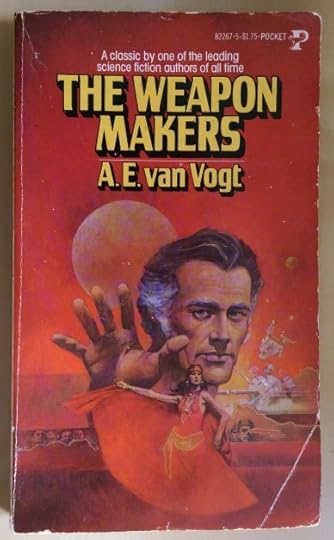
Today we will be talking about A. E. van Vogt’s THE WEAPON MAKERS. We’ve dealt with van Vogt before, talking about his influence on Philip K. Dick (in terms of throwing in so many new ideas that the novel dissolves into near incoherence) and how his books really aren’t that interesting in terms of characters. The novels are pure action, for the most part, pulp adventures where the actors are cardboard cut-outs rather than real people and the mystique of new scientific ideas are supposed to carry us through the relatively one-dimensional politics.
(In THE WEAPON MAKERS van Vogt posits a future where there is a hereditary government that is kept in check from becoming too despotic by a secret cabal called the Weapon Shops. They have that bland but utterly descriptive title because they have built impregnable Weapon Shops in every town in the world where ordinary citizens can go in and buy Weapon Shop weapons (the repetition gets a little inane) that can only be used for self-defense but are extremely powerful. The novel puts ordinary citizens against the government as two undeniably opposed forces which can’t work together because their interests are always going to be separate. Is this Libertarian?)
In true van Vogt fashion, the most interesting part of the novel is something he rather glosses over: the entire set-up of this future world has been designed by our protagonist, a virtual immortal whose at least been alive the last two thousand years and has repeatedly married into the hereditary ruling family (essentially having sex with his descendants over and over again). There is no explanation as to his immortality, or why he’s driven to perfect the world. Who is he and why is he doing this? Who cares? There’s plot to ravel!
However, what I want to focus on is the way women are treated in this novel. It’s a pulp novel by a (in)famous science-fiction author first published in 1943, and so it is perhaps not surprising that this far-future society is pretty much on par with mid-century America in the way it views women. The main antagonist of the novel is Empress Innelda Isher, but she is noted mostly (as was the main female character in the other van Vogt novel I’ve read) for being nearly as good as a man, both intellectually, morally, if not physically. Of course, her emotions come into play in a way that’s presented as a strength, but is also mostly a fault–she decides things by feeling rather than logic.
And, okay, all of that is nothing new. Sexism in science-fiction and fantasy, especially older SF&F, is so cliche it’s almost not worth mentioning except when it doesn’t occur (except that it still occurs, and mentioning it is the only way to evoke change, eventually, hopefully).
But what is most amazing in this novel is how science is presented. Our main character has designed a machine that removes him from the time-line so that he can, in effect, travel through time (even if only seven or so hours in either direction), and he creates a time-loop which deus ex machina’s him from the main climax of the novel, preventing a death that would be unavoidable otherwise. He’s invented teleportation, as well as a device he uses to grow to Godzilla-like heights so he can terrorize cities (all in the name of a justifiably good end) and is invulnerable, to boot.
All of this future science. All of this advancement in both technology and medicine.
And yet Empress Innelda, after giving in to her feelings for our “hero,” dies in childbirth.
She dies in childbirth.
You can tell what really matters to a culture by what problems they decide are worth investing time and money in to solve.
And she dies in childbirth.
February 26, 2016
Taking the Science out of Science Fiction
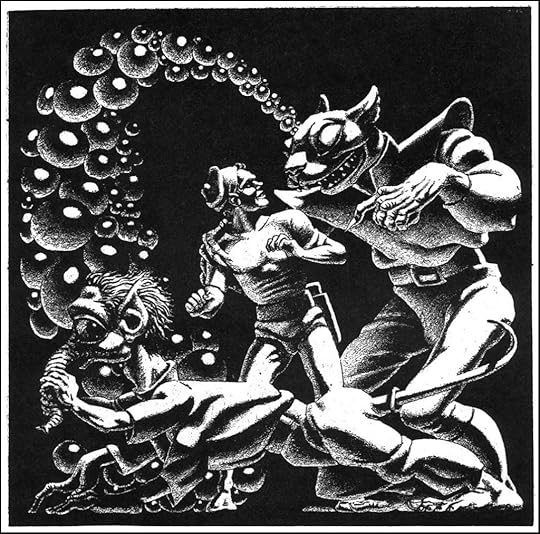
Hannes Bok
For a science-fiction writer, I am remarkably uninterested in science.
I mean, I love science. I LOVE SCIENCE. I love science so much I call it psyents, because we’re so close we have nicknames for each other (mine is endrue) (science has an accent). I love science so much I almost majored in physics instead of dramatic literature (though calculus is not my friend).
But what I loved about physics was the theoretical part. Imagining the heat death of the universe. Wondering what could go faster than light and how. Figuring out realistic ways for fantastic ideas to work.
Which means I was delving into science fiction, of course.
But for some writers and readers, science fiction means detailing exactly how a new, unheard-of procedure works, dissecting the possibility of a trans-universal engine based on present day theories, making everything as realistic as possible. Those novels which detail Martian colonies or asteroid mining fit here.
But if you’ve read Bradbury, you know there’s another kind of Martian colony out there. It’s one where martians exist. Where people can wander the planet without oxygen tanks. And on other planets, the important thing is not how we reached that far world, or how we terraformed it to our liking, but how in one mean-spirited decision a classroom of children can take from one child the glory of a rainstorm that only happens once every ten years.
It is exactly that which I’m interested in. Not the what happens, but how what happens affects those people living with the what-is-happening. In my Topoi stories, humanity is so outclassed by the technology of the rest of galactic society that what those alien races achieve might as well be magic. But I’m not writing fantasy (though I imagine some would argue the point), I’m writing about characters who are stuck in a situation they don’t understand, where the machines that surround them work mysteriously, on principles they don’t quite understand. Perhaps like cell phones. Or airplanes. Or magnets. (That one’s for you, Insane Clown Posse.)
How does all of humanity get transported to another planet all the way across the galaxy in what seems to be the blink of an eye?
Frankly, I don’t care. That interests me not at all.
But once it’s happened, oh, there you’ll find me, digging into every possible human reaction.
February 16, 2016
What I’m Reading (Mid-February Edition)
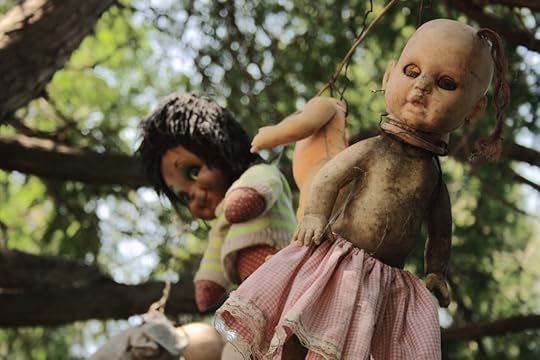
Some months I read as though the only way I can navigate the world is through words.
The War of Dolls by Michelle Painchaud
This is a book you can’t read (yet) because it hasn’t been published (yet). Instead, I have to point you towards Pretending to be Erica which you both can read and is awesome.
This book, that you can’t read (yet), is also awesome. Think of Battle Royale mixed with Attack on Titan, but in a world that’s pretty much pure fantasy, and with all girls, and a world who’s mythology is mysterious and detailed and filled with strangeness like China Mieville.
That’s the frustrating thing about reading another writer’s unpublished work. You want it to be published. YOU WANT IT TO BE PUBLISHED so others can read it. Because it deserves to be in the world because you will love it.
So there.
Chapelwood by Cherie Priest
M & I like Cherie Priest a lot. Her series that takes place in the late-1800s and deals with a pseudo-zombifying drug and steampunk alternate history is amazing for its world-building, but mostly for its characters. She can get you to care about someone from 0 to 100 in ten words flat.
This book is a sequel to Maplecroft, a book positing Lizzie Borden as the last defense for humanity in a small town slowly being overrun by Lovecraftian horrors. It’s beautiful and amazing and fascinating and dark. It’s also told in an epistolary fashion, which takes a second to get used to, but creates a special tension where you know the speaker is going to live but everyone else might die, and has already done so by the time the account is being written.
Chapelwood takes place thirty years on from the events in the first novel, meaning Borden is now in her fifties/sixties, which creates an interesting take on the action hero. Here is essentially Miss Marple with an axe. I was slow to be drawn in at first (despite the last sentence) because the novel focuses on other characters first, but once Borden officially involves herself in the plot, the book doesn’t let go.
A Noble Radiance by Donna Leon
This book was a Christmas present from my mom. We share books and authors and a love of reading, so we’re constantly trying to gift each other with our favorite writers, hoping our joy translates.
Leon made a name for herself writing mysteries taking place in Venice and focusing on Brunetti, a Venetian policeman. I’ll just say now that these books don’t drag me inside their pages easily. There’s a distance to the writing that puts me off, or maybe there’s just a sort of lazy progression in terms of the plot which doesn’t hook me in for just one more chapter.
This isn’t to say that the book isn’t enjoyable. What I loved most was seeing the different in culture, and learning how justice works in other countries. For example there many different kinds of police in Italy, and their jurisdictions often overlap, creating a sort of clandestine infighting as to who is responsible for investigating what.
Suffer the Little Children by Donna Leon
So, the basics out of the way, (see above entry) I just want to say one of the strange things about Leon’s book is how Brunetti is often not solving a mystery or bringing someone to justice. The mystery is often resolved separate to upholding the law, and many of the evils revealed by Brunetti don’t have any recourse under the law. He may find out someone is abusing their power as a doctor to destroy other people’s lives, spreading private information for rigidly moral reasons, but that’s not something which can be prosecuted.
For example, one of the tragedies in this book involves children being made orphans. Couples who can’t have children are buying them from immigrants, and then a year to a year and a half later, the police are taking those children away, but not returning them to the original parents, and not allowing the parents who’ve been caring for them for so long to adopt officially. The lives of everyone involved are scarred and/or ruined, but there is no solution offered. The book simply becomes a meditation on the cruelty of the world and how justice is not concerned with happiness.
Inside the Mouse: Work and Play at Disney World by The Project on Disney
If you like reading Marxist criticism of the largest and most iconic theme park in the world, then this book is for you!
No, really, it is for you.
Honestly, I love reading criticism and reviews and pop-culture think pieces, and that’s what this book contains. What does Disney mean in American or world culture? What does it mean to work at the rat, and how does it mold/destroy who you are? Is Disney about consumption or about conformity?
This book was published in 1996, I read it first in 2001, and again this past month. It still reads as fresh and real and traumatizing and glorious.
And now I want to go to Disney World again.
February 7, 2016
A Wyoming of the Mind
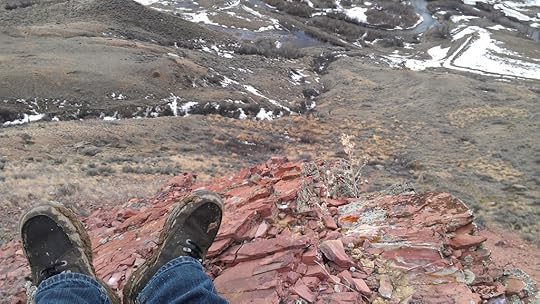
Back in 2012, I was lucky enough to have been given a residency by the Jentel Foundation, which meant I was able to spend a month at their remote ranch in the hinterlands of Wyoming and write. Another writer and four artists spent that month with me, but though we shared dinners and often saw each other for brief moments during the day, most of our time was on our own.
In the morning, I would make oatmeal, and bring a mug of instant coffee with me to my room in the writer’s house, and there I would stay until lunch. I’d return, and hang out there again until the sun descended and I was locked in darkness, the land outside my window disappeared. I wrote and read in that warm cocoon. There was no outside world and there didn’t have to be. My only obligation–to myself and to the Jentel Foundation–was to create.
I told M that if someone would put me up permanently is such a place, in such a situation, I would be hard pressed to say no. I love cities and I love people-watching and I love my friends and family, but that freedom to read and write, to create, without worrying about any of the daily-weekly-monthly business of life, it was intoxicating.
And I believed I could recreate that experience upon returning to Houston. I would go to my coffee shop and lock myself into my head, words steadily streaming out through my fingertips.
This did not happen.
The world does not wait, unless you have someone to hold it at bay.
So in the years since I’ve attempted to find what middle ground I can, setting aside part of the day for utter-immersion-in-my-own-head and the rest for getting-the-shit-done-one-needs-to-do-to-live.
But last week I attempted to dive back into that Wyoming of the Mind. I had been spending too long in the mornings (my present default writing time) looking through the internetz–e-mail, Facebook, Twitter, and all the interesting articles the latter two led to–procrastinating my writing until by the time I got down to writing, my excitement for writing was gone. The day had been wasted. I’d punch out some words, but they weren’t enough, and I didn’t savor them, and if my goal is to make a living off of writing things have to change.
And so I sequestered myself in my apartment and, upon rising, I made coffee, ate breakfast, and sat down to write. I have written. I wrote. I will write.
There is no empty expanse outside my window anymore. No hills stretching back over the shoulders of the horizon. No sky so wide and deep it dwarfs the landscape.
There is only this blank page, and my black-lettered footsteps across it.
January 19, 2016
What I’m reading: January Edition
And here is your probably-not-even-remotely regular list of things I’ve read, with short thoughts about each, because I can. Also, because what I read definitely influences what I write, and so knowing what I’m reading my explain what you receive every month.
Drama by Raina Telgemeier
A middle-grade story in graphic novel form about theater and drama and making friends and losing at love while succeeding at love. And I love Telgemeier’s art. Her drawing is just the right side of cartoonish for me (in a Scott McCloud metric kind of way) that illustrates a world I’d love to live in. She also manages to create really well-fleshed out characters from just a single appearance, so that everyone you meet is a real character, not a ventriloquist’s dummy or the same actor with a different mask.
That’s something I feel I always struggle with, especially in longer works (Oh hai, novels!), i.e., how to make each character real and true so that they live as much off the page as on it.
Beautiful Darkness by Fabien Vehlmann and Kerascoët
This is a French graphic novel about a young girl’s corpse slowly rotting away to bare bones. It is also about a bunch of people who live inside her and escape when she dies. It is also about how everything goes wrong, no matter how hard you try to make it right. It is also beautiful and depressing and glorious and dark. It is also something you should infect your imagination with.
Men Explain Things To Me by Rebecca Solnit
Everyone should read this. Most women will probably identify right away with what Solnit is talking about, though what she’s talking about is not just how some men automatically disregard women’s ideas (and even the idea that women can have ideas, some of which they even create ON THEIR OWN), but about the sickness that is misogyny in our society, both that of the United States (and other Western countries) and the world. A lot is covered in the essays in this book, and covered well and thoroughly.
My only nitpick is that, since it’s a collection of essays written over a number of years about related topics, there’s some repetition of argument. But sometimes an argument needs to be a hammer, and your skull the nail.
The Whisper by Aaron Starmer
This YA novel (second in a trilogy) continues to demonstrate that Aaron Starmer writes the kind of books I wish I’d written, only darker. More magical and whimsical, to boot. Don’t boot. Reboot.
This YA novel (second in a trilogy) continues to follow Alistair Cleary’s quest for the truth behind Fiona Loomis, who she is, why she’s so strange, and where’s she’s gone to. Actually, he knows where. The Riverman took her. So where does that leave you? (A: Reading this trilogy)
The Slow Regard of Silent Things by Patrick Rothfuss
If you haven’t read Rothfuss’ The Name of the Wind, you should, if you like epic fantasy with a personal twist. Part of that personal twist is what you’ll find in The Slow Regard of Silent Things, an in-depth focus on one side-ish character in Rothfuss’ main series. It’s beautifully written and endlessly strange.
M. pointed out that I might find the author’s afterword especially interesting, and she was right. In it, Rothfuss talks about writing something that doesn’t fit, that breaks the “rules” for writing, and which, therefore, is going to result in a story that no one wants to read. I never would’ve considered this book that sort of book except for that afterword. Is it strange? Yes. Does it approach narrative differently? Yes. But I’m excited by those things, both in reading and writing. On of my stories (in this mini-collection here) goes into long side-thoughts on philosophy and the way the world works, and several reviewers have found that distracting/uninteresting.
Which I understand, I suppose, though I’m overjoyed when I can figure out how to get a story to do something new, to turn against itself, to eat its own tail, to promise to lead you one place and take you somewhere completely different instead. I don’t know if that’s ever what I’m doing with my writing, but I’m trying. Dear lord, I’m trying.
What I’ve been reading: January Edition
And here is your probably-not-even-remotely regular list of things I’ve read, with short thoughts about each, because I can. Also, because what I read definitely influences what I write, and so knowing what I’m reading my explain what you receive every month.
Drama
by Raina Telgemeier
A middle-grade story in graphic novel form about theater and drama and making friends and losing at love while succeeding at love. And I love Telgemeier’s art. Her drawing is just the right side of cartoonish for me (in a Scott McCloud metric kind of way) that illustrates a world I’d love to live in. She also manages to create really well-fleshed out characters from just a single appearance, so that everyone you meet is a real character, not a ventriloquist’s dummy or the same actor with a different mask.
That’s something I feel I always struggle with, especially in longer works (Oh hai, novels!), i.e., how to make each character real and true so that they live as much off the page as on it.
Beautiful Darkness by Fabien Vehlmann and Kerascoët
This is a French graphic novel about a young girl’s corpse slowly rotting away to bare bones. It is also about a bunch of people who live inside her and escape when she dies. It is also about how everything goes wrong, no matter how hard you try to make it right. It is also beautiful and depressing and glorious and dark. It is also something you should infect your imagination with.
Men Explain Things To Me by Rebecca Solnit
Everyone should read this. Most women will probably identify right away with what Solnit is talking about, though what she’s talking about is not just how some men automatically disregard women’s ideas (and even the idea that women can have ideas, some of which they even create ON THEIR OWN), but about the sickness that is misogyny in our society, both that of the United States (and other Western countries) and the world. A lot is covered in the essays in this book, and covered well and thoroughly.
My only nitpick is that, since it’s a collection of essays written over a number of years about related topics, there’s some repetition of argument. But sometimes an argument needs to be a hammer, and your skull the nail.
The Whisper by Aaron Starmer
This YA novel (second in a trilogy) continues to demonstrate that Aaron Starmer writes the kind of books I wish I’d written, only darker. More magical and whimsical, to boot. Don’t boot. Reboot.
This YA novel (second in a trilogy) continues to follow Alistair Cleary’s quest for the truth behind Fiona Loomis, who she is, why she’s so strange, and where’s she’s gone to. Actually, he knows where. The Riverman took her. So where does that leave you? (A: Reading this trilogy)
The Slow Regard of Silent Things by Patrick Rothfuss
If you haven’t read Rothfuss’ The Name of the Wind, you should, if you like epic fantasy with a personal twist. Part of that personal twist is what you’ll find in The Slow Regard of Silent Things, an in-depth focus on one side-ish character in Rothfuss’ main series. It’s beautifully written and endlessly strange.
M. pointed out that I might find the author’s afterword especially interesting, and she was right. In it, Rothfuss talks about writing something that doesn’t fit, that breaks the “rules” for writing, and which, therefore, is going to result in a story that no one wants to read. I never would’ve considered this book that sort of book except for that afterword. Is it strange? Yes. Does it approach narrative differently? Yes. But I’m excited by those things, both in reading and writing. On of my stories (in this mini-collection here) goes into long side-thoughts on philosophy and the way the world works, and several reviewers have found that distracting/uninteresting.
Which I understand, I suppose, though I’m overjoyed when I can figure out how to get a story to do something new, to turn against itself, to eat its own tail, to promise to lead you one place and take you somewhere completely different instead. I don’t know if that’s ever what I’m doing with my writing, but I’m trying. Dear lord, I’m trying.
January 15, 2016
Revision is the Answer to a Question I Never Ask
Revision is my least favorite part of writing.
I’m what is generally termed a pantser, i.e. I write by the seat of my pants, making things up as I go along, trusting in fate and coincidence and chance and skill and my subconscious that everything, in the end, will tie together and make sense.
Those other writers, they’re plotters. No one likes a plotter. They talk about you behind your back. They leave post-its everywhere with instructions on what to do and how to do it. They use calendars. Every conspiracy in the world throughout time has been masterminded and implemented by plotters. What more do you need to know?
But revision is where the pantsers and the plotters meet. It’s a giant rave where the goths and the emo kids and the bikers and the stoners hopped up on goofballs all dance like crazy, fighting through the music coming out via stereo speakers the size of minivans. A rave doesn’t have a plot! What’s going on?! Who spiked the punch?!?!
And yet there’s a plot there in that one person who arrived to the rave late, and was supposed to meet up with his friends at the entrance, except the only person at the entrance is a creepy older dude with slicked back hair and patchy sideburns who keeps opening the door to the warehouse and peeking in. Our hero (i.e., protagonist (i.e., agonist)) decides to avoid that entrance and find another, going around the side of the building, stepping around couples making out, his too-long pants getting soaked in the evening dew, following the sound of the music until he reaches the back of the warehouse and finds a field of grass stretching away into the distance. In that distance, a towering skyscraper without a cradling city. His friends aren’t here. He’s pretty sure of that now.
By the way, I really enjoy making things up. That’s why revision is so hard. It’s not making things up, but making things make sense. Finessing, if you will, a clay sculpture’s details into focus rather than hacking a rough, messy shape out of a block of stone.
Revision isn’t just making sense. It’s also confronting all of one’s flaws. In order to see the need for change, I have to accept the lack of what’s already there. The cluelessly repeated metaphors and images. The shoehorned plot twists. I’m forced to understand that I’m simply not as good as I hoped I was.
As a pantser, I wear pants. This is not pertinent to this discussion.
However, as a revisionist, I have to believe that every change I make is a step closer towards becoming that writer I always imagined myself to be. Someday, perhaps, what’s on the page will truthfully echo what’s in the brain. And if I’m lucky, you’ll enjoy that echo.
January 1, 2016
Unpulped #9: They Walked Like Men by Clifford D. Simak
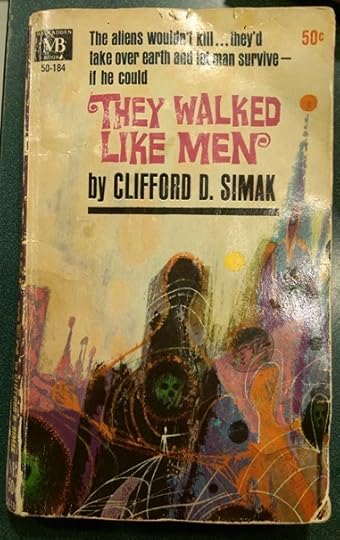
A book about bowling.
This novel is about bowling balls and talking dogs and the eventual takeover of the Earth by underhanded Galactic realtors. It’s a mess. It’s glorious in its insanity. It is the best example I’ve come across illustrating the A. E. van Vogt/Philip K. Dick principle of constant surprise through introduction of new elements, which is why it reads like the transcription of someone’s lucid nightmare. And it is not, in the end, all that good.
Now, that not-that-goodness isn’t a result of the plot. As you might expect, the plot is based around surprise, with each chapter ending with something new and strange and crazy and unexpected. I believe this is the case because Simak wasn’t expecting what was coming, because he didn’t know.
(This is how I work. I don’t like setting a path for myself–more like there’s a will-o-the-wisp leading me on through a dark forest, and each thing stumbling me upon the way is new to me, and hopefully to you, the reader, as well. I’m always afraid this means I’ll fall into quicksand or walk off a cliff or enter a cave no one was meant to enter and no one ever leaves, and the story will be ever-unfinished or, worse, not worth the reading.)
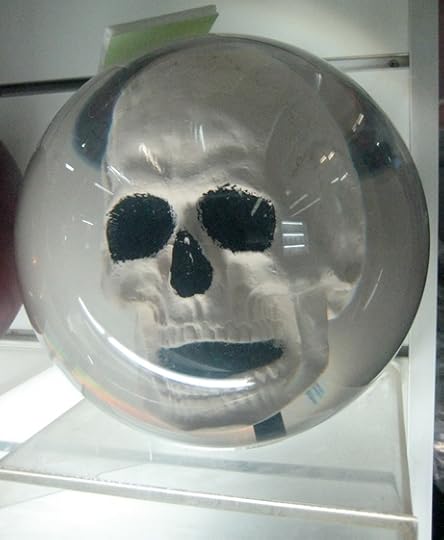
See? Not scary at all. Unless you are made of bowling pins.
THEY WALKED LIKE MEN doesn’t hold together. Why do the aliens have blow-up dolls they inhabit, that they then leave around for any snooping eye to find? Why are eyes snooping when they should be safely stowed in one’s head? What are the chances that an alien from another world, another solar system even, would look exactly like a large dog?
Nil. None. Zero. Bupkis.
But that’s okay, because reading the book is like living inside a story as it’s being created. Which is intoxicating. If you like that sort of thing. Which I do.
That said, the pleasure of this book (to me) is in seeing how the story propagates itself into a finished product, not so much in the writing (which is workman-like noir) or in the plot (which is interesting for its take on an alien invasion being economic, but otherwise unremarkable).
And I’m glad I read it because it reassures me that strangeness in SF&F has been here all along. I mean, that’s the whole purpose of the genre (to me), and to see such willful insanity in a pulp novel of the early 60s makes me think I can be successful creating such willful insanity again.
Without the bowling balls.
December 16, 2015
Unpulped # 8: The World of Null-A by A. E. van Vogt
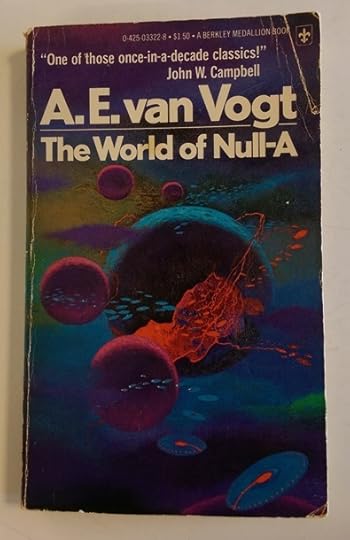
Who is Gosseyn?
So I recently finished reading A. E. van Vogt’s The World of Null-A, a story about a guy named Gosseyn who uses the ideas of General Semantics to thwart an invasion of our solar system. However, today I’m less interested in talking about the plot of the book than I am the author and his authorial practices.
Van Vogt is one of the first pulp science-fiction writers, having first published in 1939 and continuing to publish through the mid-eighties. Even though I took one of my Ph.D. exams on the history of science fiction, I’ve never read him—which means either that I was lax in my research or he just isn’t very well respected (SF critic Damon Knight would agree that he shouldn’t be respected) or he just isn’t a very good writer.
My interest in van Vogt stems from my love of Philip K. Dick, who cites van Vogt as one of his major influence. And part of that influence has to do with the way van Vogt wrote. Dick said of The World of Null-A that “All the parts of that book did not add up; all the ingredients did not make a coherency.” This lack of coherence was probably a result of van Vogt deciding to add a new concept every 800 words, which made his novels seem to spin out of control (in the same way that Dick’s books reveal layer upon layer of reality the deeper you get into them, your vision of the world you thought you were inhabiting constantly being radically adjusted).
If you haven’t figured out by now from what I’ve written above, this way of writing is fascinating to me. For myself, if I know where I’m headed in a story I’m writing, I get bored. And a secondary benefit to not boring myself is that I believe if I’m surprised by what I’ve written, then the reader’s likely to be surprised as well.
A. E. van Vogt is not a great writer. Critics lambast him for his inability to create believable characters or believable science or believable plots. However, his books are fascinating simply because of his (seeming) lack of control. The main character dies at the end of one chapter only to wake up resurrected in the next. This is a third of the way into the book, and there’s no mention before this point of this kind of death-cheat being possible. The other characters in the book (I might even say the book itself) is as confused about how such a thing could happen as the main character is.
I’d bet money van Vogt had no idea where the novel was going until he got there, chapter by chapter, new concept by new concept, because as I read the book I recognized the moves he was making. He was writing the way I write.
If you’ve signed on with me at Patreon to get a story a month, I’m assuming your down for this sort of chaos. (And if you haven’t, you can click on the link there to see whether or not such support is up your alley.)
It’s about time for a new concept.
Venus Fly Toasters.