
Michael Jecks's Blog, page 30
May 19, 2014
The End of an Era
And so we come to the last day of the contract with the Royal Literary Fund. To be fair, it’s not quite the last day, but it’s my last day in the RLF office in Exeter University. The rest of my time will be at home, collating all the data for the RLF for their own records.
RLF? Sorry, for those who are new to my blog, I should explain.
The Royal Literary Fund is a wonderful organisation which has two functions: one is to support authors who are struggling to survive – sadly a growing breed now since the end of the Net Book Agreement and the advent of ebooks. Many people are enthusiastically putting authors out of business. Every free ebook acquired helps kill off another author’s career. For many, free reading is considered to be a civil right, in the same way that they consider all films to view should be free. Until someone has figured out a way to support writers and writing in this brave new world, institutions like the RLF will be ever more essential, giving money to writers who cannot support their families.

Exeter University. I’m going to miss the joint!
However, the RLF is also keen to promote good writing. So in a perfect marriage of convenience and harmony, the RLF has associated itself with universities up and down the country. It hires authors to go to these universities for two years, purely to provide one-on-one tuition to students who want help with their writing.
Some want to learn how to make their writing more clear. Some feel a need to make their work read more “academically” and less colloquial. Others have a problem framing an argument, and have no idea how to follow a logical sequence of steps to form an essay on a topic. Others can’t decide on the jump-off point for their dissertations or theses. This is where the RLF comes in, bringing a little logic and experience to the art of writing.
It has been hard work. The RLF has done well to ensure that the students are aware of their services, and in two years at Exeter, I have average seven to eight students per day. During the run-up to exams, to have sometimes ten students, all from different disciplines, from difference years, and all with work varying from simple critiques to detailed Doctoral works, has been challenging but enormously rewarding.
Yes, it’s odd to think that my two years here is now over, and a little sad. However, it means I can concentrate on my own writing again, and that is great!

The wonderful Evesham Hotel
This last week has been busy. I’ve been up to Evesham and given a talk at the Aspara Writing Festival, which is a new literary festival aimed at those who want to learn how to write more effectively. It was enormous fun, and I’ve written a new speech, which I can incorporate into an hour long event. I’m calling it “Twenty Questions I Wish I’d Considered Before I Started Writing”, and it ranges over the life of a writer by taking in a series of anecdotes and themes. It’s all good fun, and the audience last week appreciated it, so I’m looking forward to taking this one out with me and putting it to other audiences in the future.
Other work continues. The video channel with YouTube is going from strength to strength, and tonight I have to record the latest so that my slave-driving daughter can edit it and put it up on Thursday. In the meantime I have to prepare for the Bloody Words festival in Toronto. In spare moments, I’m trying to paint some more watercolours, and I’ve acquired a sheet of copper which I’ll be attempting to form into a new paintbox. A friend who is competent at bending metal is coming to help me with that project!
So, my last day at Uni today, tomorrow will be the last day writing reports for the RLF, and then it’s back to the 1300s and writing the rest of the book on the Hundred Years War and siege of Calais. All good, clean, fun!
Thanks for reading, and have a great week!
Tagged: author, books, Dartmoor, medieval, novelist, Royal Literary Fund, Templar series, YouTube


May 12, 2014
New projects!
Every so often a project comes along that intrigues me, and recently I’ve had another one.
Ever since I first saw the Arnolfini picture by Van Eyck – Jean Arnolfini and Jeanne Cenani, his wife, by Jan Van Eyck (1434) - which, from memory, was when I found as an illustration inside the Folio edition of the Goodman of Paris, I have been struck by that picture. The brilliance of the painting is one thing. What always struck me was the historical detail of the shoes, the clothing, the decorations, and of course the atmosphere. There is so much in the photo that it’s hard to take it all in, but for someone interested in that period, it’s brilliant.
Well, a couple of weeks ago I was asked to take part in a very interesting project by the photographic artist Anna Grayson. She is reimagining old paintings and setting them in a more modern context. One on which she has worked is the Arnolfini painting, which looks excellent. To my shock, but delight, she contacted me to see whether I would pose for her for a reworking of Holbein’s The Ambassadors. I am delighted to show it HERE. I was proud to be able to stand at the table of Ian Mortimer, the excellent author who has done so much to influence my writing, with him taking the left-hand post at the table. I am really grateful to Anna and Ian for letting me get involved in this wonderful project. It was enormous fun, and I think the photo itself works really well.

In terms of other news, I’m in the process of preparing to go to Evesham on Thursday 16th for a talk at the AsparaWriting Festival, and then, early next month, I have to go to Toronto for the Bloody Words Festival, where I am the International Guest of Honour. It’s humbling to be asked to go and attend in a form of official capacity, but I’m going to really enjoy it. Toronto is one of my favourite cities in the world, and there are so many good, kind people out there in Canada that will make it a break to remember, I’m sure.
In between, though, I’ll be stopping my work at Exeter University. For two years I’ve been working there with students, helping them with their writing, and it’s been huge fun. However, all good things have to end, and so next week I’ll be sharing a cup of Raspberry and Chilli tea with Dr Sian Harris for the last time, and closing my laptop in the little office that has been my home two days a week since 2012. It’ll be odd to leave, and I’ll miss the place – but I cannot deny that I’m champing at the bit to get back to full-time writing!
So, that’s all for now, folks.
Don’t forget to check my YouTube videos if you want to learn more about how I write, what I write about, and why. Meanwhile, I’m going to start reusing my photo blog to put up more photos of Dartmoor as well as my own attempts at watercolouring and sketching. I was reminded last week that I last looked at this over two years ago – I think that since my poor old Bernese died, I’ve not been in the mood to put up photos of her favourite walks. But that’s silly. I’m back into pictures again. Take a look and see what you think.
For now, thanks again. Do please comment and keep in touch. I need all the feedback I can get!

The latest daub, taken from an ancient path on the north of Dartmoor.
Tagged: authors, books, crime writing, marketing, medieval, Michael Jecks, novelist, publishing, writing


April 30, 2014
Making Movies
It’s been an interesting time just recently, which is why you may have noticed that I’ve been noticeable by my absence.
Now that my daughter is a well-established teenager, naturally she has realised that her father is a doddery old twit without the brains he was born with. And he needs controlling and managing.It took her an age just to get me to tidy my desk for some photos!
Usually this would be as irritating to me as it would to any self-respecting grumpy old fart, but I’ve discovered a great attribute in my OCD child: she has the ability to film me and then do all the editing work without my needing to do a thing. She is saving me hours!
Every week just now we’re recording a short film, which we’re putting up on YouTube. So far we’ve covered various books – we’re up to six in the can, I think, with other films on research books, what my desk looks like, and a short piece on the Great European Famine, too. All jolly good fun, of course (for me). The only problem I do have is thinking up new topics to go here on my blog, because just because she’s putting up videos of me doesn’t mean I don’t have to remember this. And my newsletter. And Twitter … there isn’t much time to write any more, oddly enough. The first film was all about how the books came about, with location shots of places like West Henstill House, where the first story was planned.

Henstill, where the first book was planned and edited!
So far the films have been well received. Do please take a look at them on YouTube and tell me what you think. If you like them, please do make a comment or at least hit the “like” button. It helps to show me what is wanted. For the future, I have plans for every book to be discussed, for items on the history, items on the countryside (when we have a better camera microphone that doesn’t pick up every soughing wind and play it back like a hurricane), and views of the locations used for all the books. I’ll also be talking about new books coming, about my research, and about the life of an author. So pretty much everything I’d normally use in my talks. I’m putting it all here.

The stone outcrop at Hound Tor. The village was deserted because of the famine
It’s an interesting time just now. For the last couple of years I’ve been working with the Royal Literary Fund as one of their Fellows, helping students at Exeter University with their work. Basically, I have been working one-t0-one with them, helping them to communicate their ideas in a form that will improve, hopefully, their marks. It’s not been easy – usually I’m working with student who have better language skills, better vocabularies and, let’s be honest, far better brains than me. It’s been a real eye-opening experience, especially since I’ve been able to learn so much from these young students. However, now my time is almost up I cannot say I’ll regret being able to sit and concentrate on my books again. It’s been a huge distraction, getting up to go to Exeter first thing in the morning two days a week. It’s certainly cost me a lot of writing time, because trying to settle down and concentrate on the three days I’ve been at home has been difficult. I need time to get into my books, and when the week is badly disrupted, I find it hard to get back into the swing of writing. That is ending, luckily. I’m already diving back into the next story for next year, and enjoying the process again immensely.

Medieval Village of Hound Tor
However, I will miss the university. It’s been fun to work there. And I have certainly learned a lot more than I would otherwise!
One last thing: today I have received fibre optic broadband. In theory this makes my internet connection a great deal faster. Well, I’m not convinced entirely. I think a lot of the slowness of my system may have been more due to slow computers than slow wires, but we’ll see. If things go as planned, I’ll be starting to upload photos on Flickr again. There are many on this computer that are waiting to be sent off into the cloud ready for readers to look at: photos of daft authors trying to Morris dance, photos of office space, photos of locations in which the books have been set. So keep your eyes open there.
Finally, I’m also hoping to be able to draw up a map or two to show where the action in my books was set. This is much harder, because so many locations (I’m thinking London, Paris, Exeter and even Crediton) have changed out of all recognition. Still, there are places where I can take some pictures and occasionally put them up. Now I’ve replaced my camera lens (I dropped the other one while in New Orleans and smashed it completely!) I can start taking photos again, and I will.
So, that’s about it. Sorry to have taken so long yet again, but as I always say, things are a little hectic round here! Hopefully I’ll be more organised now I have a teenaged PA to keep me under control.

View back to the moors
Tagged: author, blogosphere, crime writing, Dartmoor, medieval, novelist, publishing, videos, YouTube


April 14, 2014
YouTube? I Tube
There are some aspects of a writing career that just get in the way. There is no other way to look at it.
When I started out (twenty years ago now, God help us!) the job was easy. An author was supposed to write. As my friend Quintin Jardine likes to remind me: “Writers write and agents age.” Back in 1994, life was so easy.
However now, of course, writers have to do a lot more. We must be sociable: we must tweet, facebook, blog, and become experts in all social media. Joy, joy.

A horrible sight. A grimacing author hoping to make a video that won’t scare away all readers!
It’s not that I’m not sociable generally. If there is wine or beer available, you’ve never met a more sociable fellow. I am a crime writer, after all, and crime writers tend to be cheerful chaps in a pub. In the Crime Writers’ Association it was a matter of pride that we could empty a pub’s cellars in an evening. In fact, at one notable location, we were informed that we had cleared all the bar’s stores during our AGM, and it was a source of shame that we had been beaten in doing so by the Romantic Novelists’ Association, who had met there a few months earlier!
Still, I come from a generation which enjoyed getting out and meeting people face-to-face. I still do. Social media suffer from the one big problem: they aren’t sociable.
Do not get me wrong: I have made many good friends on facebook and twitter. The Pauls, OT, Laurayne and many others have given me a lot of pleasure, and I hope one day to meet many of them. Yet in the main, these are not media for building close relationships. They divorce people from each other because human relations are built, surely, on shared experiences, on personal contact.
In any case, for me, it is enormously distracting to have to think up tweets and facebook messages. So I don’t. I put up messages and comments when I can, in between writing. Because I tend to work in one hour bursts, I can do that without too much difficulty.
But my main job is, to make up stories and put them down on paper. All social media are a distraction, a diversion. And that spells disaster for an author.
However, there is one type of social medium that I am enjoying getting to grips with: YouTube.
It is bizarre, but by starting to put down videos about all my books, I’m having to revisit all my stories, and rethink how the books came about. That itself has been great fun, but a lot of work. Yes, a lot of work! I’m having to remind myself what I wrote and why twenty years ago, and that’s not so easy when you’ve written just south of two books a year for two decades. I’m having to go back and look at what I wrote to remind myself what the hell they were about!
For all the effort involved, the five minute clips seem ridiculously short, but the time invested is quite large. And that makes it all much more pleasant because my director and producer is my daughter. We are spending a lot of time together making these videos. For me it’s fun, if a little daunting, while for her it’s the source of endless amusement. She can take the Mickey out of her dad and I’m unable to respond.
(At the time. I will get my revenge later, naturally.)
It’s been fun, but the problems have been a pain. First, of course, there is the difficulty that, with a cheap camera, the microphone is rubbish. Our first attempt was up on the hills in front of the house that inspired so much of my work: West Henstill House (see the video about The Last Templar). For that, the noise of the wind hitting the mike was so loud, we couldn’t use any of the original clip, which was a shame as I gave a very good talk, I think. Never mind.

West Henstill House
The second problem has been the internet upload speed. We have broadband here, but it’s ridiculously slow to load a video. As a result I’ve invested in a new fibre optic link, which will radically alter things, with luck! I’m looking forward to its arrival so that we can upload five minute clips in less than the two hours it takes presently.
So far we’ve recorded clips on three books: Last Templar, Merchant’s Partner and Moorland Hanging (which will go up on Thursday). We’ve also recorded one video as an introduction, and a second about the Famine, because I thought it could be useful. Later this week I have to record another all about research material, the books I use to get my historical insights, and I’ve been asked to do another on my office and workspace. That one will have to wait, for no other reason than the obvious one that it’s a tip! I have to tidy it first. Then, in the future, I’ll be putting up videos on writing, on discipline while writing, on research generally, writing tools, locations and money, amongst other things.
Please take a look at the videos here and, if you like them, subscribe and put in a “like” for them. However, I don’t want to be guessing at what readers generally want to hear about, so if there’s a specific topic you would like me to talk about, please let me know. It’s all very new to me still, but I’m hoping that these videos will build into a useful series of tools for people interested in my books and for those who are considering writing themselves.
And when you watch them, try to bear in mind that behind the camera there is a bossy teenager laughing at her father trying to sound sensible.
Happy viewing!
Tagged: authors, blogs, books, Devon, publishing, social media, writing


April 6, 2014
Let’s Get Inky
A short while ago, the very nice people at Cult Pens suggested I’d like to have some new inks to play with. Who am I to refuse an offer like that?

Lots of inks side-by-side
A year ago I started to use Cult Pens’ own Deep Dark Blue ink. This was a colour they designed to match their own logo, and it was made by Diamine in the UK (a brilliant firm with the best range of fountain pen inks, I think). I love Deep Dark Blue, and in fact it took over as my mainstay. I tend to have two or three pens with me while working, and the one I use daily (the Visconti, because it’s bullet-proof and will never scratch), is generally filled with this ink now.
Well, last month the nice people at Cult Pens gave me some more ink to try, and it was so good, I had to buy some more.
The inks I have tested are the Deep Dark range, including green, brown, red and purple. For comparison purposes I’ve also mentioned the blue again (which I’ll need to replenish soon, since the tide’s going out in my old bottle).
All the inks performed well in my pens. I used a pair of Cross pens, mostly my fine nibbed one, and my three Conway Stewarts, which include medium, B and italic medium.

Ignore the doctor’s prescription at the bottom!
First observation: it is clear to me that these inks deserve a fat nib. With the fine Cross the ink works well, but it’s not so effective as using my standard, Diamine Passion Red, for marking up and editing. The main thing I use this pen for is putting in corrections on my MSs, and for this the Deep Dark Red fails utterly! It’s so dark that (for my eyesight) when it is put on paper, it’s impossible to tell an inserted comma from blank toner on the page. And it makes my writing look like a drunken spider’s … (bottom para).
However, as with other inks, when it’s used in a fatter nib (middle para) it suddenly takes on a gorgeous life of its own. The thicker lines start paler and go dark as the nib moves with my italic nib. The variation of line thickness and ink colour is quite noticeable on my Rhodia paper – I just hope that comes across in the photo. I think it’s a very good alternative to Oxblood.
The brown ink in the top paragraph shows the colour depth with thicker lines even more distinctly, I think. The brown is a good colour that oddly seems to come out more pale than, say, Diamine’s Saddle Brown, but that’s no bad thing. I think I prefer this. It’ll almost certainly be a regular ink in my Kaweco with the italic nib.
I thought it would be useful to look at a standard Prussian Blue in comparison with the Deep Dark inks. On the photo at the top you can see how the Deep Dark Blue compares.

I like the purple in the middle!
The odd thing is, the purple comes over as darker than the Blue – and yet it’s got a slight reddish hue that shows up very pleasantly even with my Visconti medium nib (both were written using this pen).
Once, when talking to another author, he scathingly mentioned fountain pen users who were so – well, let’s just paraphrase – weird that they used green inks. I surreptitiously concealed my pen (Diamine Kelly Green at the time). This, for me, is the one colour I probably won’t use. I do like greens (as the above anecdote confirms), but this is, for me, either not quite dark enough or too dark. If it were a little more concentrated, so that the hints of the colour came through in the same way as with the purple, I’d like it more. It does show good depth – look at the last couple of lines, where I say “Diamine’s Emerald”, for example. You can see an almost black shade with the overlapped strokes. However, for my money it could be deeper black so that the greenish tint only shows on occasion.
But that is the only one I won’t be using regularly. I really love these new colours. The brown is a bit of an oddity, but I like the way the colour works. As for the others, they give hints of their base pigments which are not apparent at first sight. When I put down a page in Deep Dark Blue, for example, at first glance it could be a Mont Blanc black; the Deep Dark Purple could be anything. However, set the purple against the blue or the red, and all of them take on their own individuality. For me, working with several colours at the same time in multiple pens, this gives me a subtle variation in style that really appeals.
And for now, the only real problem I have is whether to refill my Visconti with Deep Dark Blue or Purple.
Decisions, decisions …
My thanks to Cult Pens for the Deep Dark Blue, Deep Dark Brown and Deep Dark Green – but I bought the other inks for myself. This review was not biased by bribery!

Tagged: author, books, crime writing, Cult Pens, pens, writing


March 31, 2014
Pens I Have Known – A Review of a Life in Pens
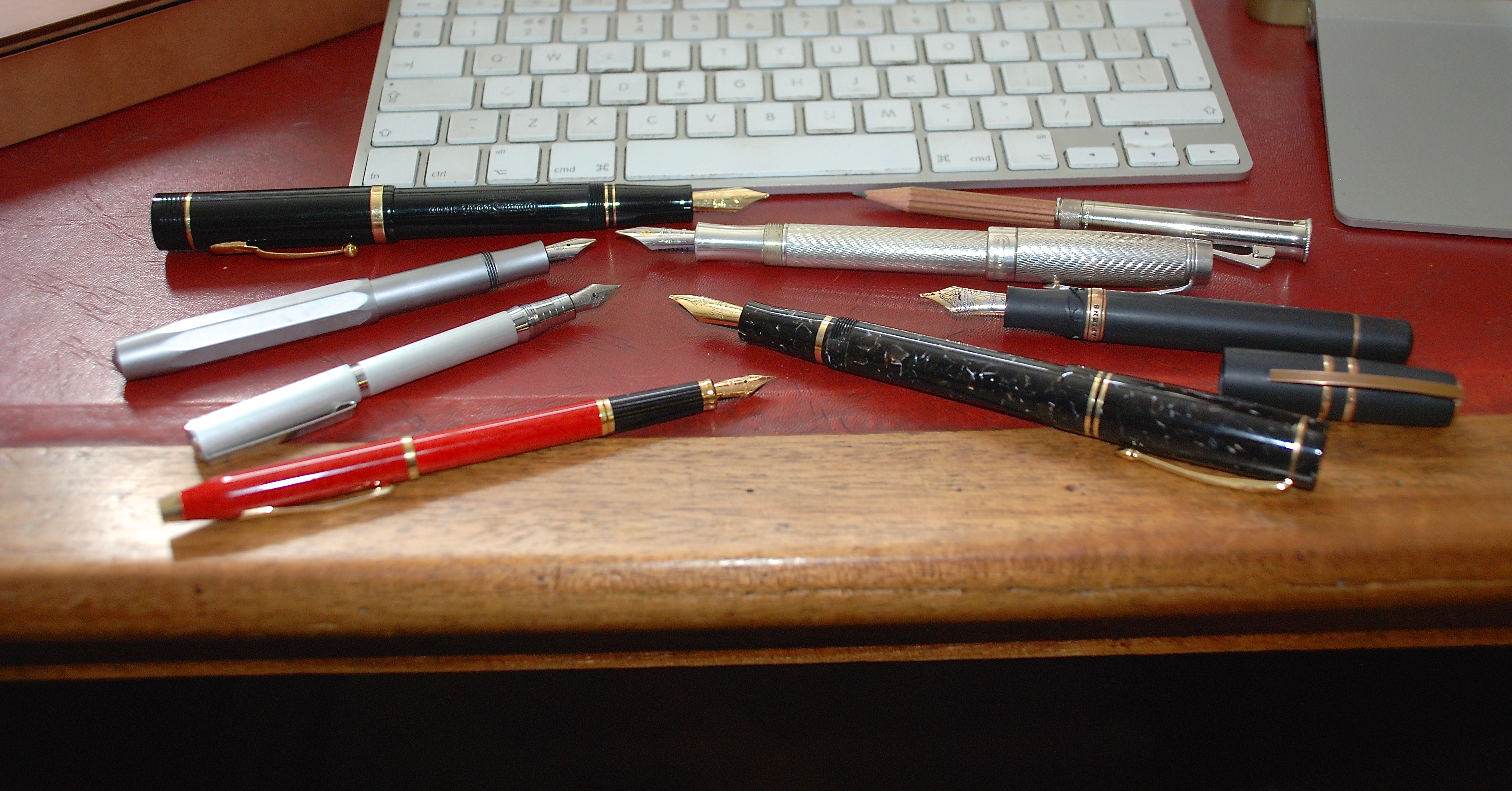
Kaweco, Cult, Cross, Visconti, three Conway Stewarts … heavenly tools!
I am madly keen on fountain pens. On my desk right now, I have three Conway Stewarts, three Crosses, one Kaweco and one Cult Pens pen. All of them are regularly used. When I am writing, when I am planning, when I am doodling or plotting, the only pens for me are fountain pens. I don’t use a biro more than a couple of times a year – usually because I have to sign a credit card or something similar. For me, it’s really essential to have several nibs in different styles, to have the ability to use various different coloured inks, and to have pens with different hefts for work through the week. I can vary everything about my writing with these!
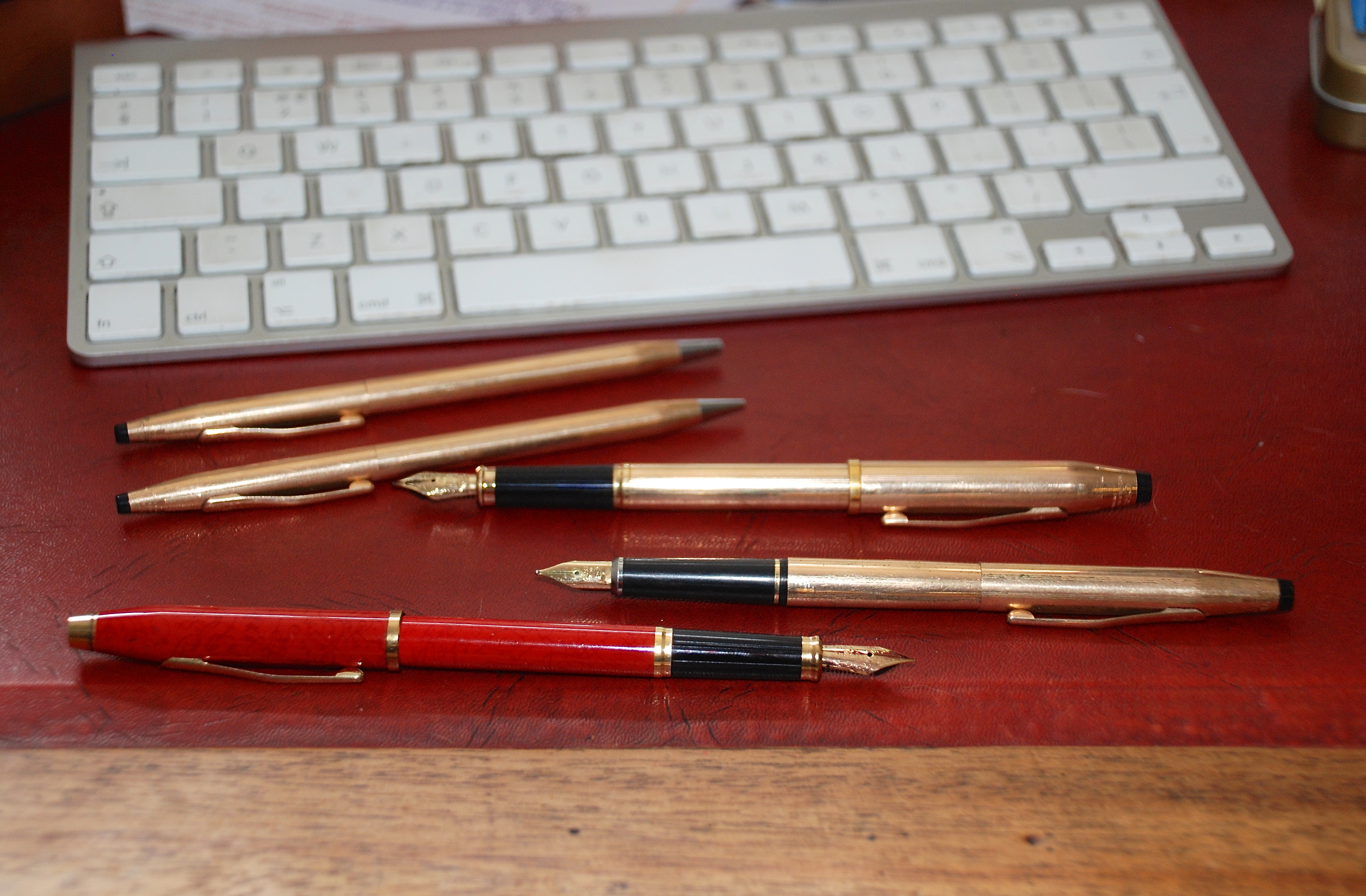
My Cross pens – even a biro (never used) and pencil (rarely). I’m more likely to grab a Tombow pencil now, fitted into my Graf von Faber Castell Perfect Pencil.
The Cross Pens I have now used for almost thirty years. They were the natural tool of choice for salesmen when I was young: real salesmen managed to get the incredibly slim and elegant Cross biros (like the one right at the back in this picture. Personally, I loved the slender design so much, I bought a gold fountain pen, biro and pencil. Then, because I was writing long tenders, I bought a red Cross too. This pen only ever had red ink in it. When I wrote a particularly long response to tender for Kent County Council, that pen was used to the full, and it still is now. I use it every week, with students at the university, and with my own works. Whenever I have to work on something, I’ll grab for it to make sure that I can see where I’ve made corrections or changes in my work. However, with my first good royalties, I celebrated by purchasing a Conway Stewart Churchill in black. I loved (and still do) the design of this classic-looking Edwardian fountain pen, and I adore the chunky feel. It has served me very well, taking notes in meetings of the Crime Writers’ Association while I was deputy chair and chairman, and has travelled with me to America, Colombia, Italy – and many other places. It is a classic. Some years later, I decided to give up air pistol shooting. The air gun I used was a fabulously expensive gun which I had bought with the (pitiful) compensation I was paid when my real pistols were all confiscated after the ban on legal pistol shooting in 1997. This airgun was all I had to remind me of my sport. So when I decided to stop shooting, I had to think of a way of celebrating pistols and my joy of shooting. And I found that celebration in a Conway Stewart Drake fountain pen.
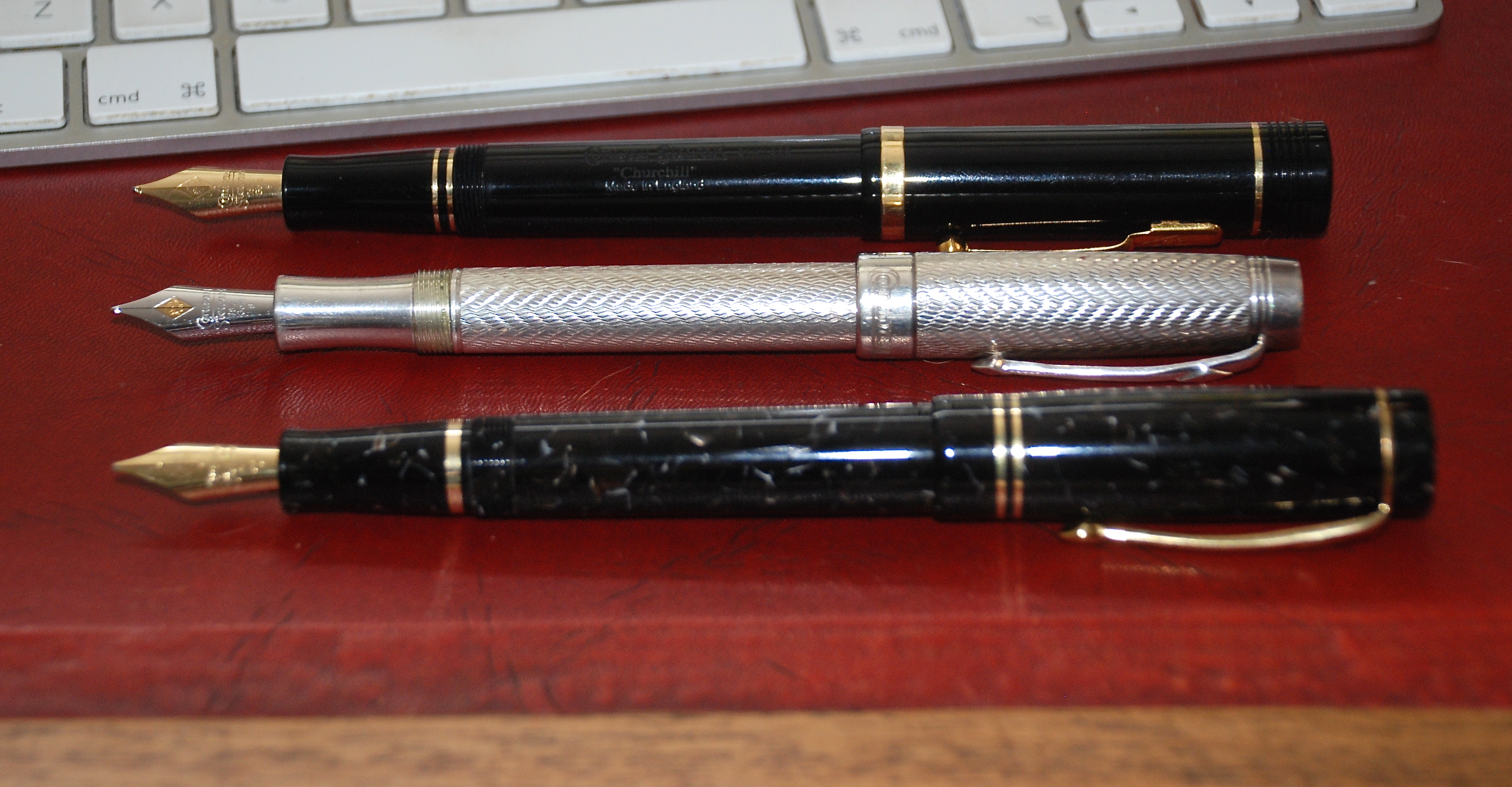
My beautiful Conway Stewart collection: Churchill at the back, solid silver Drake, and then the Michael Jecks at the front. Lovely!
Solid silver, beautifully balanced, this is a pen I love to use still. The weight is too much for many people. Not me. The size I find perfect, and the gorgeous nib will supply ink without effort. It is beautiful and a joy to use. Later, after some involvement with Conway Stewart, I decided to work with the company on a new idea: a pen designed with writers in mind. To this end, I helped create the “Michael Jecks” pen. This wonderful pen had everything I loved about Conway Stewart pens: a good weight, broad dimensions, and a superb, highly polished barrel in Dartmoor resin. This resin has flecks and gleams deep within it. It looks like polished granite, but is imbued with the greens, browns and greys of the moors themselves. I adore these pens. However, the pen I use every single day just now is the Visconti.
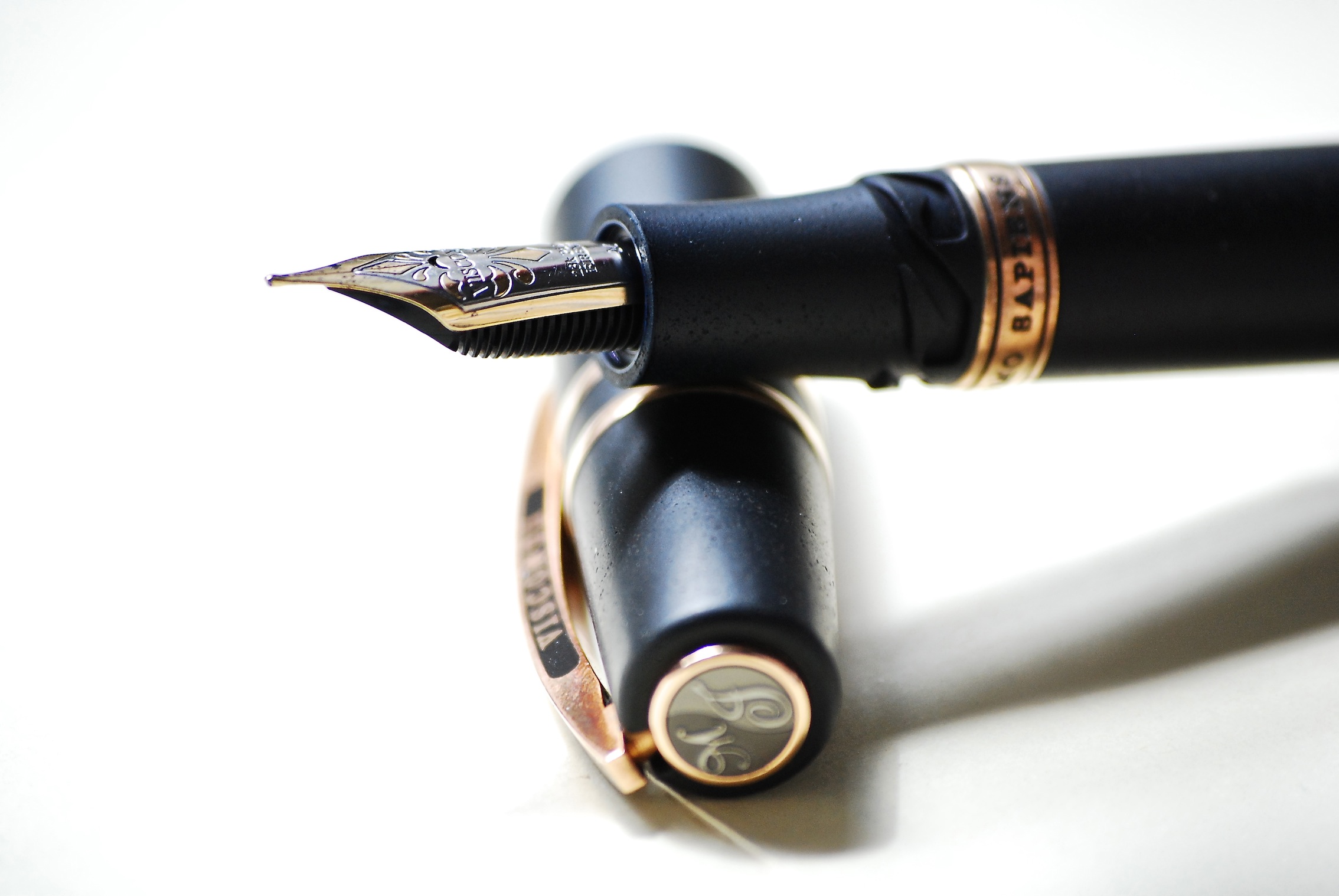
The unscratchable Visconti Homo Sapiens.
The Homo Sapiens is a marvellous shape. The barrel is slightly bulbous at the middle, tapering to the nib and the end. At the end itself, there is a slightly rounded design. No harsh edges here. The cap is set off by two circlets of bronze, has a strong clip, also of bronze, and has an end-piece that uses Visconti’s own personalisation. You can, if you want, keep to the Visconti badge. However, if preferred, a magnet will allow you remove this badge and replace it with a birth-sign, or a semi-precious stone, or even (as in my case) initials. I mentioned the use of bronze. There is another large band of bronze on the barrel, too. Bronze is a curious metal. It harkens back to an age before steel and iron, when mankind was learning about culture, about writing and reading. But the great thing about bronze is, it feels more natural in the hand than steel or iron. The way that it gains a patina all of its own is wonderful. It also offsets the main material of the pen. I love my Cross pens. The gold one stays in a leather case all the time now, but I like the slimness and the light weight. The Conway Stewart resin pens are just lovely, while the silver is superb. I adore that. However, I wouldn’t use them every day at, say, university. For one thing they are valuable, and while I trust my colleagues, I don’t trust my own ability to keep them. I have lost too many pens in the past. However, worse than that is the fact that all resin pens will eventually scratch and be damaged. I noticed that particularly with my Churchill. Over time, the barrel has been etched with a multitude of infinitesimal scratches. None of them dramatic, but as with spectacle lenses, even tiny one mark will affect its appearance. My Visconti will not mark. The first time I wore it in a shirt pocket, a zip rubbed against it. When I glanced at my new pen and saw the whitish erosion, I was inordinately depressed. Typical, I thought, that a pen should be wrecked in fifteen minute’s carelessness. I rubbed at the mark, and as I did so, it miraculously disappeared. The pen hadn’t been affected by the zip, it had worn away the metal of the zip.
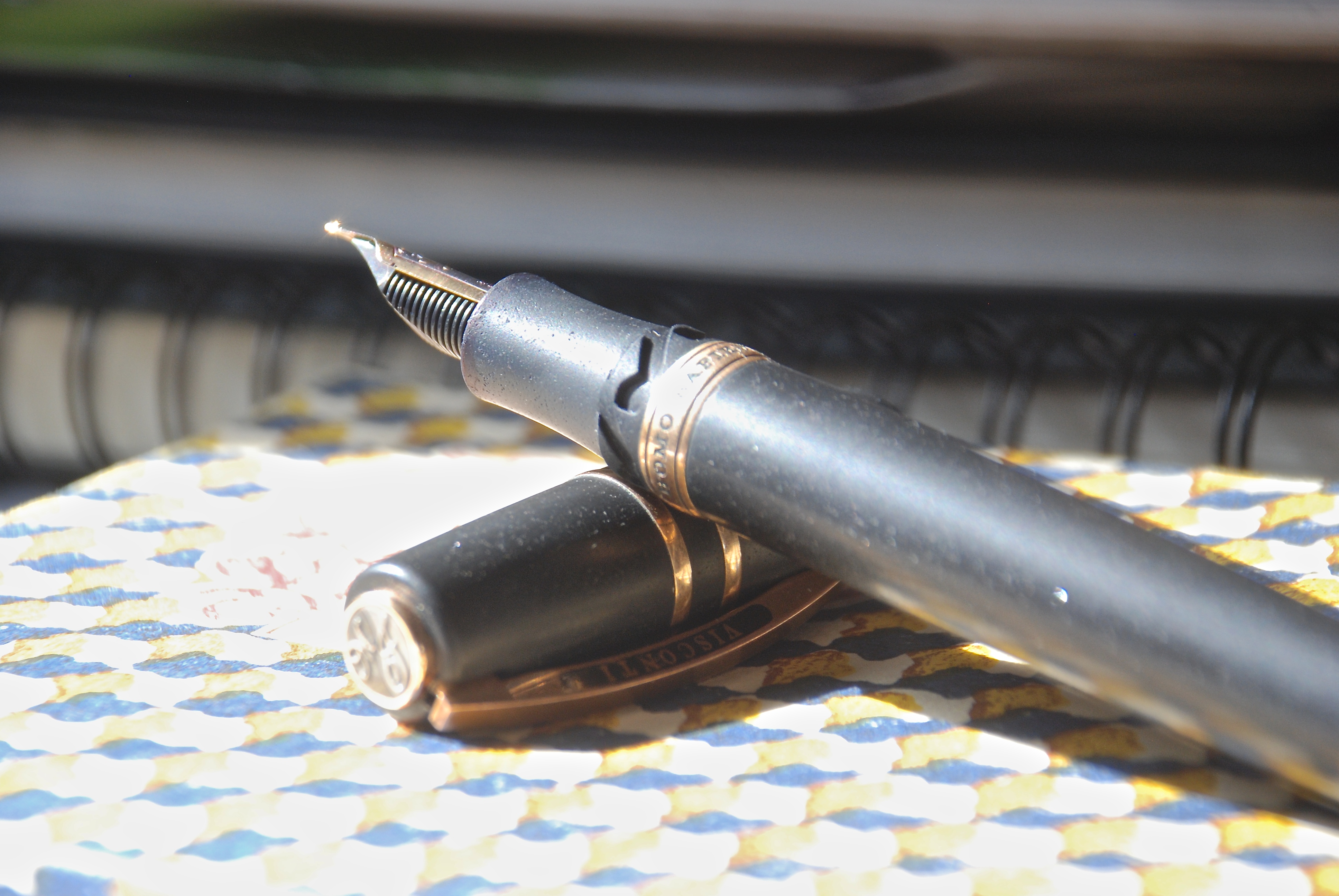
The superb Visconti with barrel formed from Etna’s lava
Homo Sapiens pens are made from an amazing material that is in part volcanic lava from Etna. It is pounded into dust and mixed with a (secret) compound including, I assume, rubber. When left, it forms a firm substance with a moderate weight. For me, it is ideal for a daily-used pen. It will never look damaged because the material is more or less bullet-proof. In my daily use over the last year, there has been not the slightest deterioration. Apart from the patination of the bronze, it looks exactly the same as the day I took it from its box. Some people have noticed that the material is slightly porous. It absorbs moisture. This can mean that the section above the nib can soak up a little ink if the user isn’t careful, although I haven’t found that a problem – perhaps because I use a Traveller’s Inkwell. The other aspect I do like, however, is that no matter how warm the weather, this pen always feels cool and comfortable. Perhaps it absorbs sweat from the hands, but for whatever the reason, it is a delight to use in midsummer as much as in the winter. One final comment on the material: it looks a plain, dull greyish black at first glance. However, the closer one peers at it, one can see flakes and specks of mica glittering. It is almost impossible to show this under ordinary daylight – I am not a good enough photographer – but the material shows a glorious depth. I like a pen I can use quickly, and here I have to mention a rather lovely aspect of this pen, the way that the cap is held on. Most pens will have either a push on, pull off cap or a screw fit cap. I won’t labour this point, but in my experience, a push fit can have problems. Such as the time that one Cross cap wasn’t properly fitted, and the pen came adrift in my jacket pocket, creating an unpleasant stain that was not cheap. On the other hand, I don’t want to sit unscrewing a cap for ages. The Visconti has a (to me) unique design. There is a simple push and twist fit which is more akin to a bayonet fitting for a light bulb than anything else I have seen or used. It is quick, effective and pretty much fool proof.You can see in the picture above that the barrel has some odd, deep slots cut into it. The cap has some lugs inside and a spring-loaded inner sleeve. The lugs engage with the slots, and the spring keeps the pen held in place. Simple, but very effective. Under the cap, the Visconti has a magnificent (there is no other word for it) nib of palladium. Now many people won’t have heard of this metal, but for my money, it is the best nib I own. It is soft, smooth, flexible and plain gorgeous, both to use and to look at. I can use it for hours at a time, and never get tired. That brings me on to the other thing I really, really like about my Visconti. I adore my Michael Jecks Conway Stewart pen. It is beautiful to look at and to use. I love my Drake because of the weight and the balance and the appearance of that lovely silver. However, the one aspect of both that limits their use is their ink capacity. I am a novelist. If I sit down to write, I will often take ten, twelve or more pages to note researches or to write a short story, or develop a character. It is the nature of my work. However, with most pens the capacity of the ink reservoir is frankly pathetic. I happen to like large writing. It is how I work. I like large nibs because that is how I work. But with most pens, large writing means having to refill the pen at regular intervals. Not so with the Homo Sapiens. It uses an ink reservoir that is massive. It is filled by pulling out the plunger. Once this is fully extended from the body, one inserts the nib into an ink well, and while it is fully submerged, the plunger is pushed down firmly. As the plunger is pushed down, a piston is forced down an internal cylinder. This creates a vacuum behind the seal. However, at the bottom of the cylinder is a section that is flared. Here the seal is broken and the vacuum sucks up the ink. A brilliant, simple, yet very effective way to fill a pen. I find that the pen works ideally for me. It is a good weight, has a sizeable heft in the hand, and writes like a dream. I love the massive reservoir, and I particularly adore the material from which it is made and the fact that it does not scratch. My Homo Sapiens has been with me now for over a year, and I can happily state that I have used it almost every day without mishap. If there was one potential aspect that could be altered, it would be to inset a viewing window so that the actual level of ink in the reservoir could be seen. However, since I always carry a Visconti Travelling Inkwell with me, that is less important. More key to me is the fact that this lovely pen works, works daily, and never fails. However, it is not quite perfect in every way. For the last eighteen months I have taken to carrying a small pen with me daily. The reason is simple: I always have a notepad with me and ideas for a story or character will occur to me at the oddest occasions. I love my Conway Stewart pens and my Visconti. In fact I love them so much that I won’t take them with me at all hours of the day and night. When I am walking the dog, for example, I don’t want to carry a £500 fountain pen. So, for occasional notes while dog walking, I bought my self a lightweight Kaweco Al-Sport. The Kaweco pens were originally designed, I believe, between the two World Wars. They had an octagonal section on an oversized cap, with a main barrel that was cylindrical. The reason for the oversized cap is simple to see when you first pick up a Kaweco. When closed the pen is a tiny size, only about four inches long. However, when posted, the length is nearer five and a half inches, which is big enough for even my hand when writing. I love this little pen. Even more so now that there is an effective convertor – I never have liked using ink cartridges. Cult Pens have been working for some time with Kaweco to produce their own little pen, and now they have it: the Cult Pens pen.
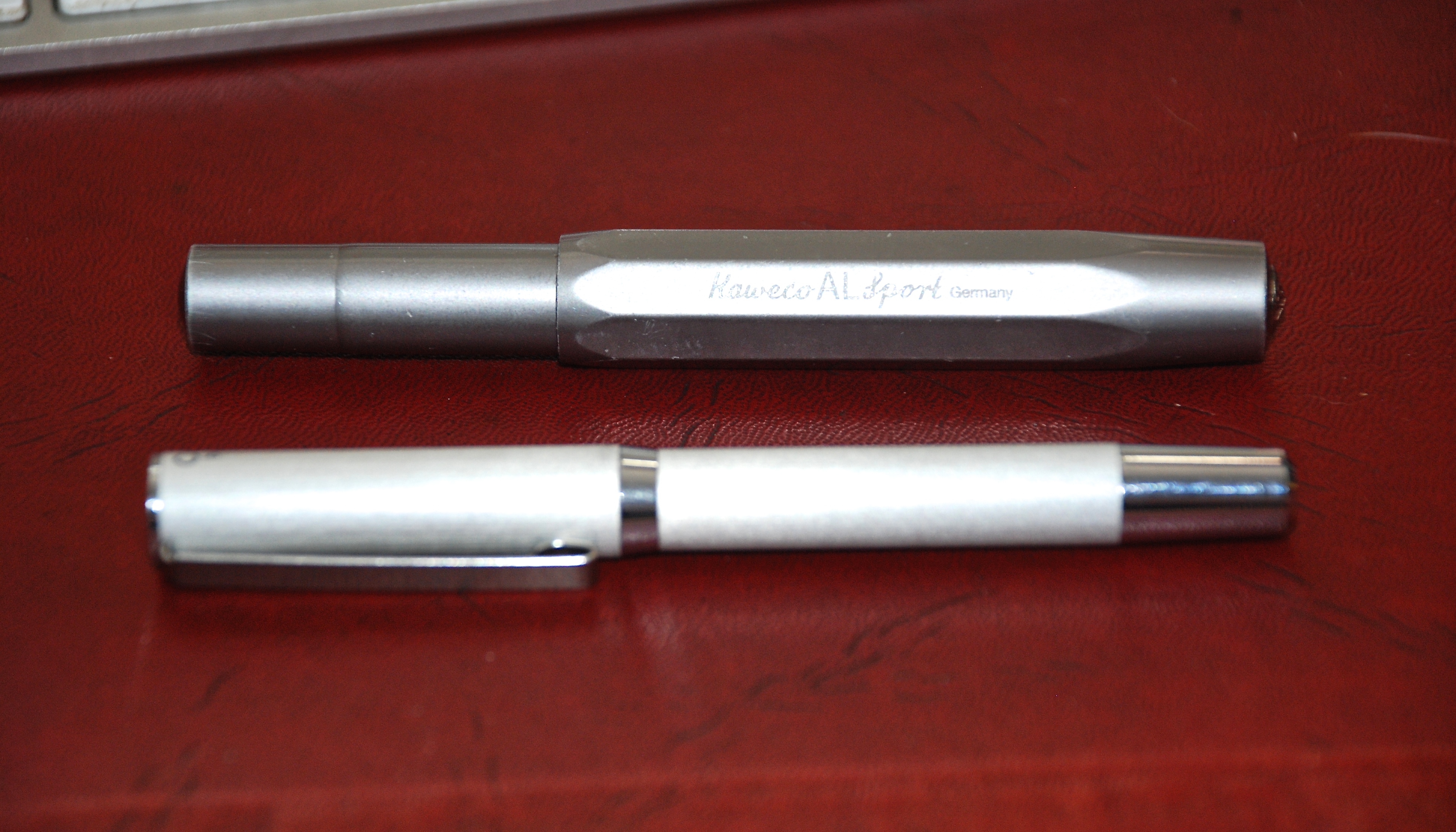
Kaweco and Cult
It is a light, but not too light, pen of a lightweight metal. I particularly like the brushed metal of the cap and barrel. This is a pen that could sit in a pocket and not show the marks of keys or penknives. The top and end cap of the pen are both ground flat. The cap itself has a very strong spring clip. I like that. I’ve had too many pencils and pens slip from their moorings to trust light spring clips. Externally, the Cult Pens pen has about the same length as the Kaweco, at just over four inches. However, when posted there is a significant difference. The Cult Pens pen is just about five inches, so a half inch shorter. This may not sound much, but in terms of the balance and feel, it makes a huge difference. The difference extends to the width, too. The Kaweco cap is a half inch wide, the section a little thinner at about thirteen thirty-seconds of an inch. The Cult cap is the same as the Kaweco section, while the section itself is from five eighths of an inch to nine thirty-seconds. This is very small, but for a small, pocket pen, it’s still very usable.
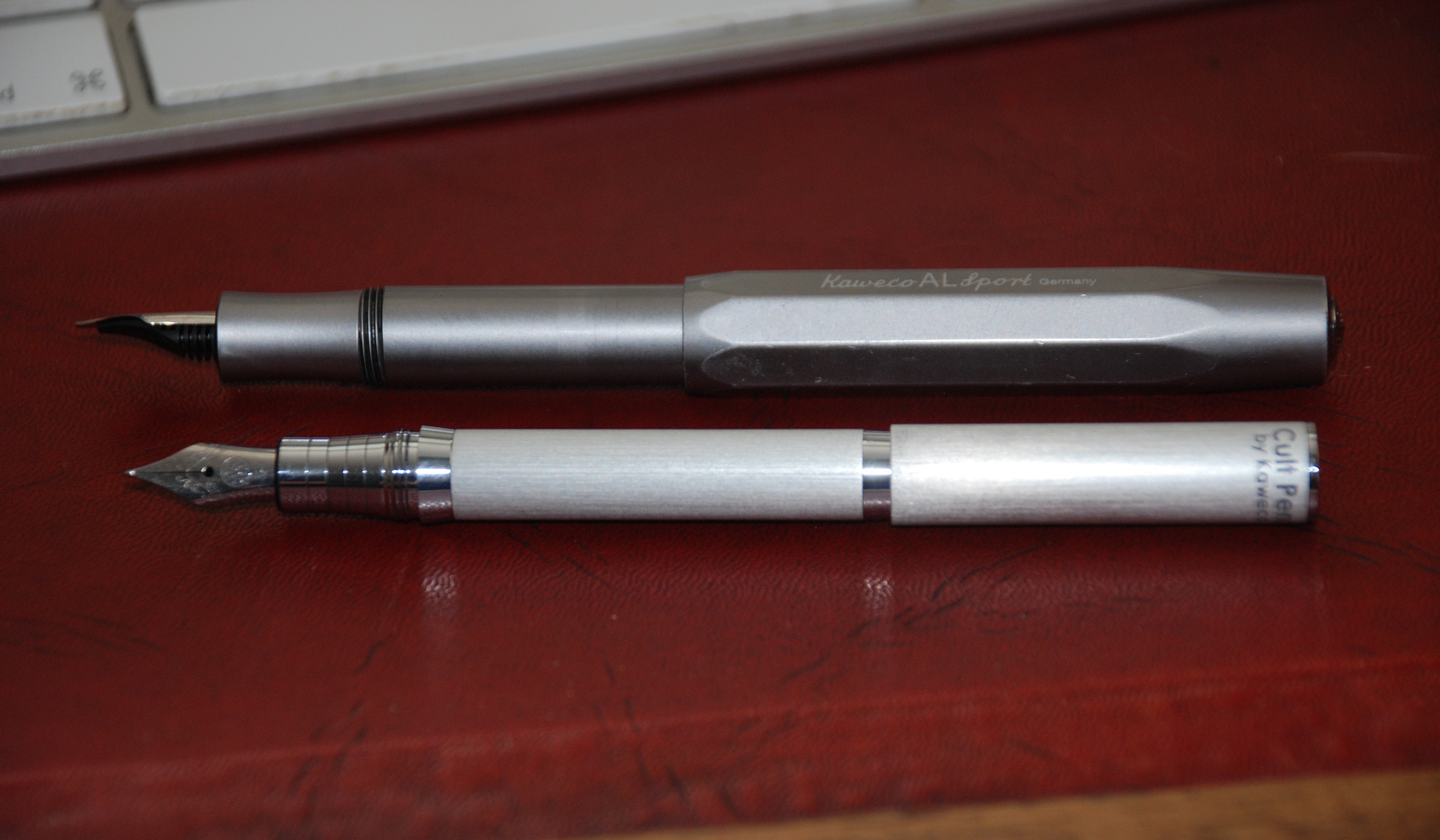
The Kaweco has it in terms of general size
The cap unscrews with about four turns of my fingers. This to me is a bit excessive. My Kaweco, for example, needs only two turns to uncap, and while I know that this is a minor detail to many, if I’m on the phone and need to hurry to make a note, I want to do so without fiddling. Still, it does mean that the likelihood of the cap coming adrift is remote. When posting the cap (which really is essential, the pen is so short), there’s a soft rubber or plastic insert inside the cap itself. It grips the pen really well and gives it more of a substantial feel when writing. Beneath the cap is a steel nib from Kaweco. In this case I chose a BB nib. It has the broadness of line that I look for in a pen, but it also has the advantage that the nib gives great flexibility. Use a little more force and you can get good line variation – use less and you can create almost a stub-like, italic effect. Kaweco steel nibs are renowned for their smoothness in writing, and this one is a perfect example of lovely softness. I did find that initially the ink didn’t flow very well, and was prone to skipping and drying. I confess I first blamed the cartridge. Cheaper pens using cartridges, I always used to find, would dry out and give a terrible writing experience. In the end, I admit, I gave up and contacted the pen supplier to ask whether the nib could be checked. The pen expert advised me to disassemble the pen first and wash the nib and section through with soapy water. I did this a few times, rinsed it well, and all was suddenly, miraculously better. Now the nib works like a dream. Very smooth, utterly responsive to a little pressure, and with a superb and reliable ink flow. However, I confess, I didn’t get on with it quite as well as I would like. Instead, I bought a Kaweco 1.1 italic nib. Suddenly the pen has a whole new feel and lease of life. It’s a beautiful nib, really smooth and delightful. Plus, I still believe very firmly that the best nibs are stubs or italics. Yes, I am a sad old sack and I promise to get out more, but I just find the look of writing when using an italic is so much better. Even the worst writer can look good with this style of pen.
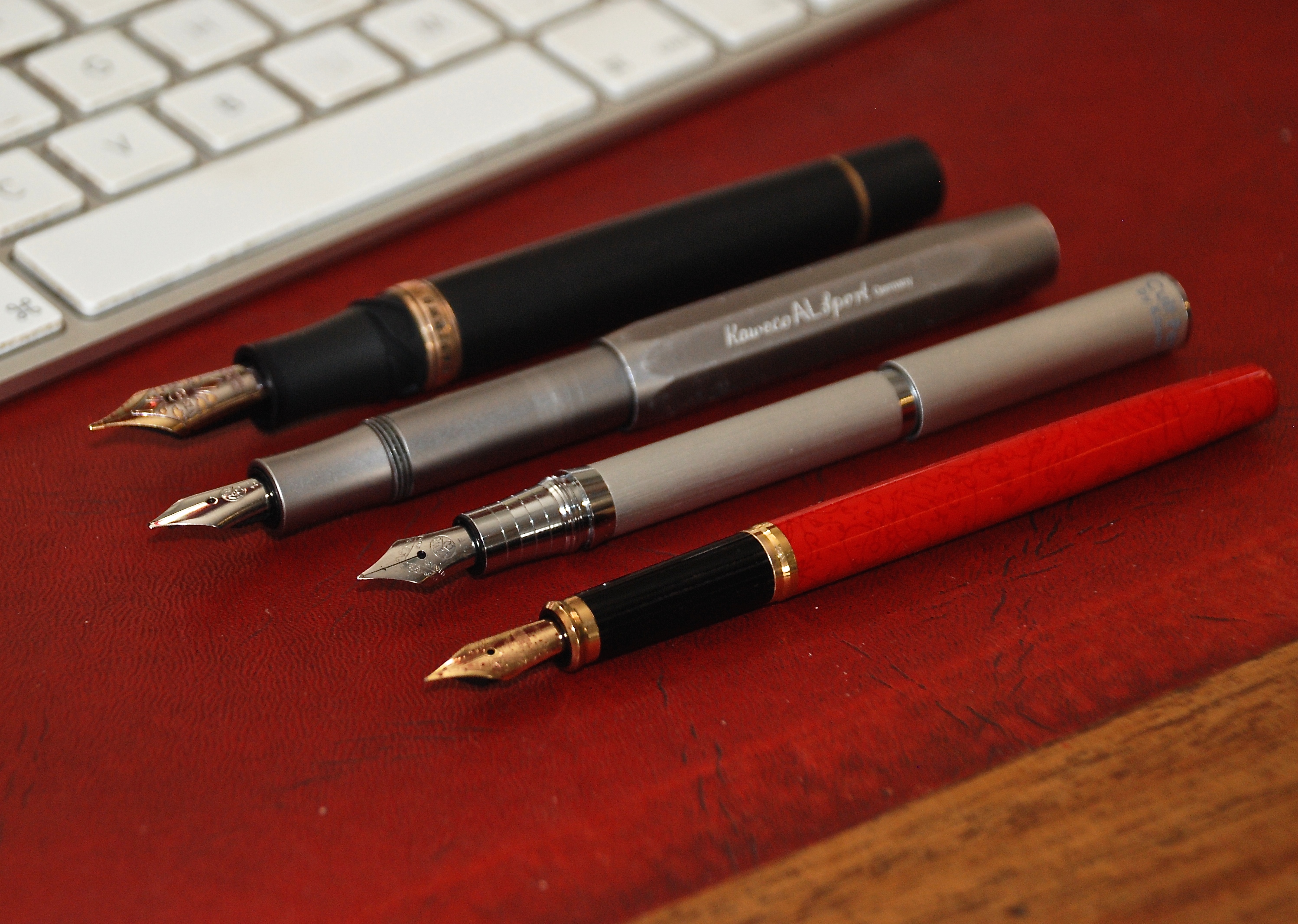
My daily set.
I still love my Kaweco. It has a slightly larger size in the hand, and I do like the smoothly rounded octagonal shape. However, the Cult Pens pen is taking over. I prefer the broad nib for daily use (my Kaweco has a fine), and I like the fact that the clip will hold it firmly wherever I put it. The feel in the hand is a little light and skinny, but for a general pen for use as a note-taker, in other words a pen to keep in a shirt or trouser pocket over the weekend, or in a handbag full time, the Cult is absolutely perfect. Added to that the very low cost, and I think Cult have got a winner here! So, there you go. The pens I’ve collected over the years, and which I still use. In the far-distant past I used to write with an old Parker pen at school. I still have it (although my son has commandeered it). But generally, although I have owned various biros, roller balls and other pens, I have never lost my love for fountain pens. The biros and others have all been discarded with the exception of a few special ones. Yet the fountain pens carry on, and all keep being used. My three go-to pens daily are the Kaweco, the Cult and the Visconti, while the Michael Jecks and the Drake are used here at my desk where they can’t be scratched or lost. All have their own delights. I love the Cult for its low cost and simplicity. I like the Kaweco because there is something glorious in the feel. My Drake is just heavenly, the Churchill is lovely to look at (although a little too light, really – it was one of the early models: more recent versions have more heft to them) and I do adore the Michael Jecks pen. The looks are wonderful, the nib a joy to use, and the feel is gorgeous. However, my favourite still is probably the Visconti. You cannot appreciate what a pleasure writing can be, until you experience a pen of this quality. And now, as I cast a glance over at the tray of inks, I can see that I have a total of 22 inks of different colours. Perhaps it’s time to fill all the pens with different colours and pretend I’m working again …! Meanwhile, for those who are interested, I’m recording a series of videos on YouTube which will go through my books, the moors, the stories and legends that inspired me to write – everything, in short, that led to me writing my books. If you have any specific questions about my stories, please let me know. The first, brief introductory video will soon go up – just as soon as I have sorted out permission to use some music – so I hope you’ll want to go there and see what inspired me to write. 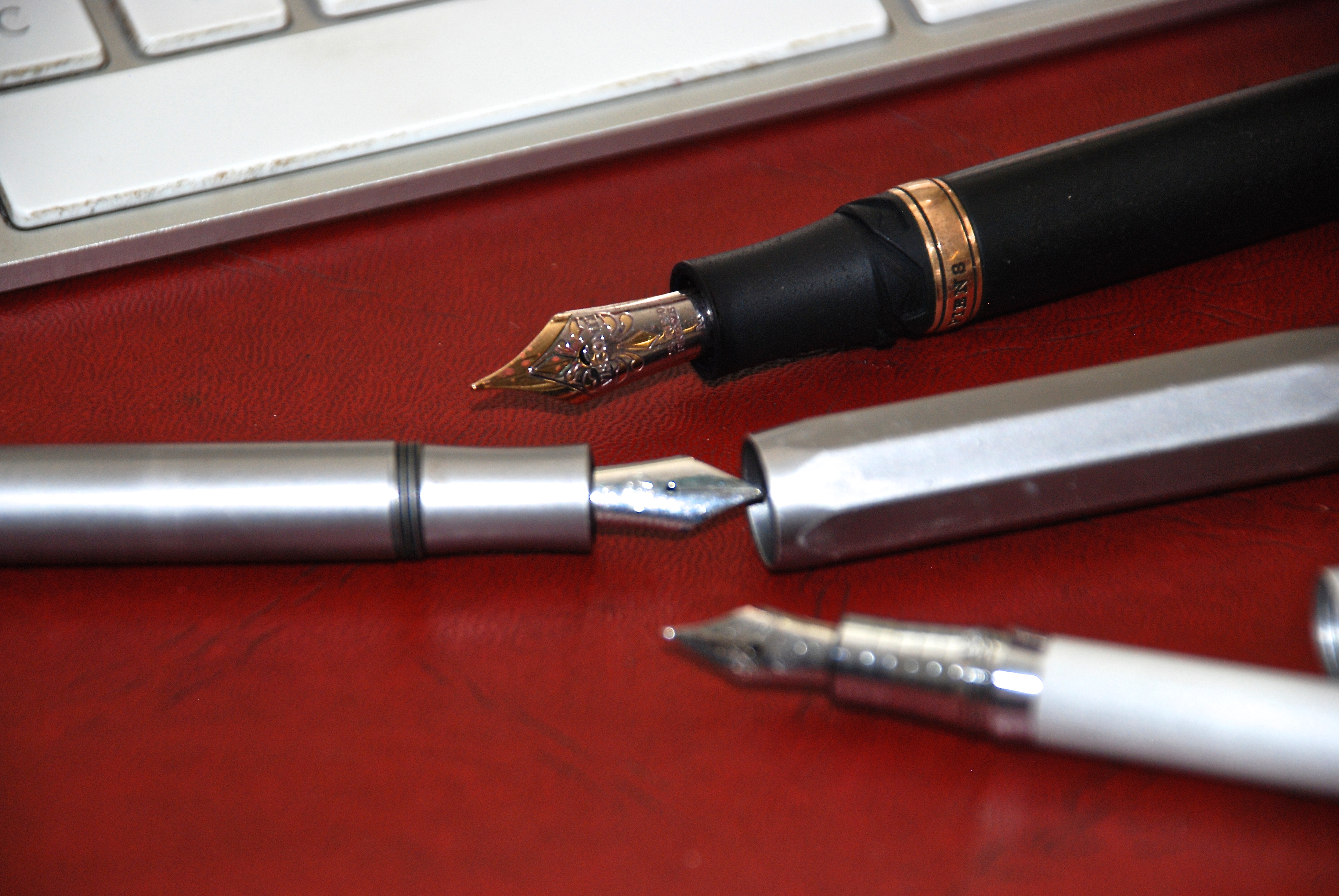
Tagged: Conway Stewart, Cross, Cult Pens, fountain pens, inks, pens, Visconti, writing


March 23, 2014
YouTube If You Want To
There are times when it seems like there’s no time to sit at the desk and write, and this has been one of those weeks.
University was – well, mayhem is a little too polite, I guess. From nine in the morning to four thirty, Monday and Tuesday, I had no time for even a cup of tea, let alone a break for lunch. There are just too many students clamouring for help. Which is very pleasant: after all, I depend on them to fill my day.
However, after a day at university, I find my brain is just too fried to think sensibly about a story, so my writing has been horribly affected, so when I get home it’s just impossible to do any effective work (either on my own work, or reading through students’ dissertations or theses), so for the first time in twenty years of writing, I’m finding that Monday and Tuesday are not personal working days. It’ll soon be over. I’ll miss the visits to Exeter University, but I will find it a huge relief to get back to real full-time working.
In the last week I’ve been busier, though. As well as university I had the delight of taking my daughter to be tested on her ability with a piano. Nerve-racking, I assure you, but it did at least give me a chance to get the camera out while wandering Exeter.

The old Canon’s Row beside the Cathedral
Thursday I had a visit to the library at Windsor (if you’re on Twitter, check them out at @RBWM). That was enormous fun, and I’m very grateful to Jeanette and the others for making me so welcome. Also to Waterstone’s for staying back so late just to sell all those books with my scrawl in the front! And of course to all the audience, who listened with such apparent interest and then proved it by buying several copies of my books!
What made it really special for me was, seeing so many friends. On the train from Exeter, while minding my own business and just as I was opening my book to do some work, a voice said, “What are you doing here?”
It was Ian Mortimer, the superstar author of the Time Traveller’s books and presenter of the TV series of the same name. We haven’t met up for many months, and had a hell of a lot to discuss and chat about, finally ending up with a conversation about our event later this year at Tavistock, when we’ll be sharing a stage for the first time.
Then it was time to see my old mate Andy Setchell again. Andy’s been really unwell for the last year and a half, and seeing him on the mend fixed was a real delight. I spent the afternoon with him at Windsor railway station, drinking excellent coffee, before going on to the gig.
The talk itself was a fun event, although, sadly, I admit, I was a coward. I had a new line to take with my talk, but didn’t actually go ahead with the idea on the night. It didn’t feel quite strong enough at the time. I need to rehearse and practise it more first, I think. I’ll have to save it for another evening! It will be a good way to break the ice with an audience, I think.
And afterwards, it was time to have an entire evening with Spike and Cathy. That was the first time I’d spent that long with them – without children of all models and ages getting in the way. And fortunately they put me up for the night, so I didn’t have to worry about a last train or anything. Which was also fortunate, because the next morning I had to catch one train from Maidenhead to Reading. One train. It was important, so that I could catch the London to Exeter train.
I arrived at the station with no time to spare because the traffic was appalling, and so I had to run through the barriers and on to the platform. My train was due to leave at 9.03, and as I arrived, the stairs were full of commuters leaving their train. Well, I knew that was my train and hurtled through the hordes to the platform, only to see the doors shutting. It was exactly on time, damn it. I sighed with irritation. If only all that traffic hadn’t been in the way … and then the doors opened again! Miracle of miracles, someone must have had an umbrella stuck in the doors or something, but I wasn’t going to miss the opportunity. As they opened, I jumped in.
Yes. I jumped into the fast train to London, and not the train to Reading.
These things happen in life, sadly. Especially to gormless authors who are let loose only too rarely, for good reason. Fortunately, I have a wife and a teenage daughter who are both determined to prevent me making any similar errors.
It is an astonishing thing, to see a daughter (who, somewhere in my subconscious, I know is still about eighteen months old) take me in hand. She today decided that it was time to have all the books logged on maps, so today she printed off some maps of Devon and similar areas with a view to getting me to mark out where the key action sequences are. That was fine, but then she peered at me with quizzical expression and asked why I don’t use video blogs. Well, because not too many people seeing my face would be overly happy with the thought of a five minute film of me, I suppose, but that wasn’t good enough for her. So this afternoon, while walking the dog, I have been fully briefed on how to direct a vlog (as these things are apparently known), what locations to use, how to reorganise my office – and then she did reorganise my office for me, took some photos, demonstrated the use of her camera … in short, she used up the entire day.
A horrible sight. A grimacing author hoping to make a video that won’t scare away all readers!
However, her ideas are sound (I have to say that, don’t I). And that means, whether you like it or not, in future I will be planning and putting up on the web various videos: some will be general posts looking at writing and how I plan and plot – the usual fare from me, I suppose – but the rest will be based on the books themselves: where they were based, how I gained inspiration for them, what the locations look like, and even (this is a scary one) how I paint those bits. Why painting? Well, when you are looking at an area, and want to describe it in a book, the best way to do that is to paint it, because that forces you to look deeper and more carefully into every aspect of the scenery.
Phew.
So today, I have managed to type up these few words. In weeks to come, you’ll start to see more blogs with links to videos on YouTube so you can see how I wrote the books, where they were set, and everything else about them! Hope you will like them.
Speak to you soon!
The latest daub, taken from an ancient path on the north of Dartmoor.
Tagged: author, blogs, books, crime writing, Dartmoor, Devon, ebooks, Michael Jecks, publishing, vlog, writing


March 5, 2014
A Review and Author Interview: Anthony Riches – THE EMPEROR’S KNIVES
The Emperor’s Knives by Anthony Riches, published by Hodder & Stoughton
ISBN: 978 1 444 73191 in hardback for £14.99 and also available as ebook
A brief disclosure. I know Tony Riches.
That’s hardly surprising. If there is a writer in the crime, historical or thriller market I don’t know, he or she must be pretty new to the market. I’ve been reading, writing and drinking with people from the business for twenty years now, and I’ve been fortunate to meet with all of them.
So, yes, I know Tony.
But when it comes to works like THE EMPEROR’S KNIVES, I have to make comments.
A couple of weeks ago, I had to fly to the US. Now, I know many people who pack one Kindle and don’t worry about reading. Which is nice for them, but it doesn’t work for me.
I’m infinitely happier with a book containing paper than an electronic doohickey. I’ve tried electronics – I tend to be an early adopter – but although I’ve attempted to consume books on ereaders, I’ve never found the experience pleasurable. There is something about the way that the thing works on my eyes, something about the way the pages turn, something about the lack of sensory alteration when you get to a third, a half, two thirds of the way through the book that just feels wrong to me. Don’t misunderstand me: I’m not a dedicated luddite. I love ebooks – for other people. They just don’t hit my own sweet spot.
So, there I was, on Delta, from Heathrow to Atlanta, and I opened Tony’s book.
Tony has several essential qualities (apart from buying rounds). One is his utter commitment to his research. He knows the period he concentrates on. Many writers conduct a little research into their periods, but Tony lives it. Along with Ben Kane, he has marched Hadrian’s Wall in full Roman armour of the period, as well as carrying the correct weaponry. He takes his research seriously. It’s not the case that a writer can sit in a quiet study and imagine everything about his period. To really understand how a warrior felt in his armour, it’s a good idea to wear it. Tony does.
I don’t know what his wife says to that.
In this, the seventh volume of his series, Tony has brought his young hero, Marcus Aquila, back to Rome itself, to find the men who were responsible for the murder of his family. He has to face them, no matter what the risk to himself. Four men: a senator, a gang boss, a praetorian officer, and finally a gladiator – he must confront and kill them all. No easy task for a man since they are all powerful in Rome. But the legionary won’t give up. Even when he realises he must pitch himself against Rome’s greatest gladiator.
This is a book that feels perfect, written by one of the best historical writers today, and with this Anthony Riches is on his very best form. There is something about the characterisations of the main characters that makes them come alive. The nastier types are superbly, oleaginously bad, and all, from them to Marcus and his friends, are convincing, realistic and believable.
I read THE EMPEROR’S KNIVES in a couple of sittings. There were plenty of distractions, from in-flight movies to bars, but I sat and read. If you like historical fiction, especially Roman, I recommend you try this!

An Interview with Anthony Riches
Tony, this is an amazing story, but the more so because you’ve woven the plot over seven books (so far!) – When I began, I thought I was writing one story. Did you too, or did you have the idea for the series from the very first title?
Thanks Mike. I guess when I started it was one story, but I very quickly realised that a) I’d have to offer more than that to a publisher and b) there was a slow burning revenge plot to be played out. I always knew that Marcus would be going back to Rome at some point, but (for example) I didn’t come up with the idea of the Knives until book five. Some of the plot weaving has been cleverish writing – but it’s in the minority next to the stuff that was just serendipitous.
The characters have all developed really superbly over the seven stories. Did you find that new characters were appearing and you kept them because you liked them, or was it a planned journey?
A colleague told me a while ago, when I was working with him in the States (writing in a walk in cupboard) and blocked, that all I had to do was invent more characters and let them do the heavy lifting. And it worked. I think of characters to support the plot, keep the ones I really like, and let them bubble under until their time for fame (and sometimes death) arrives. Having a large cast allows me to rotate them, so to speak, and thereby keep the reader guessing. There’s no real planning involved, from a ‘strategic’ perspective, although I do have one or two of them earmarked for specific books in the future.
You have set your scenes in the books in wonderful locations, from England to Romania to Rome. Recently you marched the length of Hadrian’s Wall in full Roman kit. Do you find that you have to visit every location to get the most from the action?
It really helps. I wish I’d gone to Romania for The Wolf’s Gold, but I just ran out of time what with the day job. I have a job that I really enjoy, which makes it all too easy to lose sight of the writing priorities (and let’s face it, these days more than ever the job has to come first). I’ve roamed the Wall (and the Antonine version, to a lesser extent), driven around the land between them, been to Tongres in Belgium (Tungria), had a few goes at Rome, and my real frustration now is that I can’t get to *REDACTED* for the next book! Mind you, the internet is obviously a godsend in that respect – I mean, Google Earth…just amazing!
I know that you have a full set of Roman armour and weaponry. I’d imagine that wearing such gear would give you a special understanding of how the soldiers must have fought and lived – do you find that?
Several full sets! Tungrian auxiliary, late Roman infantryman, and now a lovely set of early Principiate centurion kit. And I’ll tell you what it gives you – sore feet (those boots are brutal) and a huge appreciation of just how hard they must have been. And it makes you hate car drivers, while you’re footslogging around and they’re flying past bipping their horns at you! As for fighting in the stuff…they must have had muscles on their muscles!
The great thing about your novels is the strong characters – male and female. Have these developed and grown in your own mind as you have progressed with the stories?
Yes, I suppose they have. Julius, the Tungrian first spear, is a good example. He started out as an almost ‘baddie’ figure in my mind, and then suddenly there he was in the big man’s role, after a story in which his underlying vulnerability was suddenly revealed to us all (including me, to a degree). I guess if they weren’t growing as the series progressed the point would come where the reader would stop being interested in them.(Note to self – grow characters more often!)
Many writers depend upon a solid routine to be able to write. I know that you have a busy work life in a highly pressurised job – how do you find time to write?
It comes and goes. Sometimes I can rip off two thousand words in a couple of hours, sometimes I struggle. The one thing I always do is be scrupulous in keeping work and writing separate – anything else would be a slippery path. And the trick is to write every day, if you can, even when – especially when – you’re not in the mood. It can be amazing what will suddenly leap from your subconscious onto the page!
While I’m writing I cannot read other people’s books. I learned a while ago that I was starting to copy the style of the person I was reading. Do you find that too, or do you write in your own way even when you read other works?
Not a problem for me, in that I’m not that self aware a writer. Am I influenced? Undoubtedly. Do I know it? Not often. And I do have a style that’s my own, which has grown over time, and which I think is fairly impervious to transitory influence. Mind you, I’ve been reading a lot of very varied stuff for the HWA Debut Crown judging that I’ve volunteered to help with this year, so if Marcus turns up in a ruff and waving a rapier about, don’t be too surprised!
When you first start to think about a new book, do you spend a deal of time with a detailed plan, or does the story come to you as you write?
Nope, I get stuck in straightaway. I’ll always know the beginning and the likely end, and after that it’s a question of getting words on paper and seeing what comes out. I do tend to grow the story as I go, which sometimes means going back and inserting supporting events of characters, but it seems to work for me even if it does sometimes make me feel like a bit of a fraud compared with the master story tellers who have it all mapped out before they begin!
Some people write best in the morning, while I am better in the evening. Which suits you best?
During the day! Weekends are productive, for that reason. I struggle to crawl from my bed early enough to write much, and in the evenings I can be pretty tired, what with the commute into London and back, and the full on nature of what I do. I do write much better in the day – it’s just a shame I can’t afford to go full time. One day…
You must be one of the top four Roman legionary writers today, along with Ben Kane, MC Scott and Nick Brown. Is this a particularly tight-knit genre, do you think?
That’s kind of you. In truth I could name you a good deal more purveyors of high quality Roman military fiction – Simon Scarrow and Harry Sidebottom, for example, or on the self published side Simon Turney and Gordon Doherty, so I don’t think it’s all that tight knit. I think there are a lot of people writing about Rome, and I’m not sure we’ll all survive the inevitable reduction in traditionally published authors that must happen at some point – although I do think the internet will enable those of us that want to keep on writing for our own fan base to do so, which can only be a good thing.
Before too long, you will have to find the end of the base plot of the series, I would assume. Does that mean that you’ll continue with a new strand, or will you develop a new theme with different characters?
I’m going to write 25 books in the Empire series (and you know about long series’, eh?), as long as they keep selling. There’s a long way to go to AD211, Marcus will be 50, with wars, civil wars, huge battles and intrigue to keep us going. Commodus isn’t the half of it, as there’s a military strongman by the name of Septimius Severus lurking in the wings. And I think the initial arc ended – to a degree – with ‘The Emperor’s Knives.’ Now we can go and see some more of the empire, always remembering that the revenge Marcus sought isn’t complete yet…
Many writers move from action/thrillers into crime, whether modern or historical. Do you think you’d like to work with a different period or genre?
I started out as an (unpublished) thriller writer, and that first book, Eleven Target, is still waiting to get onto the page. One day… I’m not bright enough for crime though.
When I am writing, I tend to splurge words out in a hurry, and regret it later at my leisure as I edit the story into a more rational form. Would you say you write with a view to editing hard, or editing lightly because your first draft is more refined at the outset?
I tend to go over the script a lot towards the end, tying up the loose ends that result from my ‘inventive’ style of writing. This means that by the time I’m happy with the story the edit’s pretty much done. I don’t seem to need much editing (touching wood as I say it), simply because it’s been polished so much before my editor ever gets to see it.
What are the best things and worst things about writing?
Best thing: the best thing for me is meeting the readers – and the nicest thing ever was the utterly dumbstruck teenager who wandered up to me with his mum at an event with that look in his eye that I’ve felt before as a reader. He was just gobsmacked to meet the person who wrote that stuff he loved so much (been there!), and to know you’ve touched someone simply with the power of the written word is really amazing.
Actually I’ve just thought of an equal favourite – those moments when the words hitting the page bear no relation to what I intended to write. Quite amazing! And sometimes quite scary. I’ll never forget the shock when a bunch of tribesmen lifted a severed head over their line and I realised who it was that they…I…had just killed!
Worst thing: Having to write when I’m just not in the mood!
That’s great, Tony. Many thanks, and happy writing. Personally I’m looking forward to many more in this series. I want to know what happens to the men from the Tungrian!
Tagged: authors, books, ebooks, review, writing


February 8, 2014
Itinerary US trip 12th – 21st February
I have had a few people asking when and where I’ll be when I go to America this week, so here’s a short summary.
I fly in to New Orleans on Wednesday 12th in the evening. I’m honoured to have been invited to be the Grand Marshal of the parade of the Krewe of Little Rascals. I’m enormously grateful to Jack Spittler for arranging my invitation.
I understand my job will be to ride a float and hurl various gifts to the folks lining the parade. It’s not something I’ve done since my days at university in London, when I was on the float for the Royal Company of Saddlers, and I’m looking forward to it enormously. Usually I expect to have things thrown at me!
On the Saturday, I’m visiting the Barnes and Noble store at 3271 Veterans’ Boulevard, Metairie. It’ll be my first visit to a B&N in eight or nine years, and I’m looking forward to that immensely.
Then, on Monday 17th, I’ll be flying off to Greenville-Spartanburg.
On Tuesday I’m giving a talk to Lander University (it’s open to the public, so come if you can), organised by Connie Edwards. She and I almost met many years ago, when I was over in Ball State University with a literary festival, but her car broke down on her way there, so we never got to meet. Well, at last we shall get to see each other this year! I am vastly grateful to her for all her hard work getting this sorted.
On Wednesday I’ll be found loitering around from Ryan’s to Howard’s on Main, while on Thursday I’ll be off to another signing: this time at B&N’s store on Haywood Road. With luck I’ll see some of you there as well.
After all that, it’s back to the UK for the weekend ready for the next bunch of students. I’m not sure what condition I’ll be in for them, but hey ho. I’m a free resource!
I’m hugely looking forward to getting away for a few days, meeting American readers and writers, getting inside some American book shops and seeing what is sparking interest, sketching some scenes, spending ages photographing New Orleans buildings and streets, and (what else?) visiting a pistol range and playing with some grown-up toys again. All in all, it’s exactly what the doctor ordered because as I look out of my window now, all I can see is rain-lashed trees and grey skies!
So, with luck I will see you while I’m in America. If not, be reassured. Book 33 is ready on the blocks and will be out in hardback in the summer, and if you want to return to past books and new technology, all 32 books in the Templar series as well as Act of Vengeance will be available as ebooks from 27th February!
This is turning into a big year for me!
Tagged: author, Book tours, books, ebooks, Libraries, publishing, signings, Templar series, USA, writing


February 3, 2014
Blogs and Sales!
I have been a keen user of WordPress for some time now. It’s fast, it’s easy, and it lets me blog without having to worry too much about the sillier aspects of updating computers. In short, I like it.
But not always. Sometimes you find little irritations and glitches that get in the way. For example, over the weekend I was working on the AsparaWriting Festival pages which I’m setting up for the festival, when I hit a horrible set of problems. We were trying initially to set up the home page to look pleasant – and could I figure out how to align the photos of all the authors involved? Could I hell! I had to enlist the help of my excellent web page administrator, Roger Cornwell, to get things fixed.
In the same way, on Saturday, I was trying to work out how to add a Paypal button. I’m setting up my own page which will have books for sale – but of course I need to have a means of allowing people to pay for the books. They ain’t free, you know! Which seems great, until you try to instal the link.
I don’t know how many websites I looked at. Thousands, I’d guess. They all had that smug manner, by which you just know that the authors find such simple matters almost beneath them. They want to get on with cutting new code to prove Fermat’s last theory, or perhaps hack into the M & M factory to show that aliens helped develop the colours for the blue sweeties, rather than going on explaining to dingbats like me how I can “easily” insert a little simple code to bring up the button.
Except such simple, apparently trivial coding is way beyond my skills! Last night I took a good three hours to bring up one picture of a button, fail to produce any link behind it, and then somehow lost the coding again. I have a suspicion I’ll be questioning my friendly website administrator again before too long.
Why do I want the links set up?

I currently have 32 books in print. For each of these I was given 25 hardbacks and another 50 paperbacks or so. Then, I sold some into foreign languages. The earlier books were translated into German, Dutch, Greek, Italian, Spanish, Portuguese, and other languages – some, for example the Spanish, being reissued three or four times. And each time, I received my author’s copies.
Put simply, I have to make space in my house, and selling copies is a good way to do so. I don’t need 30-40 copies of DISPENSATION OF DEATH. All I need is about 15.
That is why, when I get copies I don’t need, I will be putting them up for sale. Some, like my first editions of THE LAST TEMPLAR and the next few books, are so incredibly rare now that I will not be offering them at the cover price. I don’t think that would surprise anyone! Others, such as the paperbacks, won’t be cheap either. There’s a simple reason for that: for me to acquire replacement books, I’ll have to buy stock in at 50% of the cover price. Amazon does sell books more cheaply – but they only pay 10-20% of the cover price. They can afford to discount because they demand such a heavy discount from their suppliers. I can’t. So I will have to ask the cover price, unless I have a pressing need for a new mobile phone or Bernese Mountain Dog (I have to save to replace my lovely old girl who died a year ago – she equates to a lot of book sales)!

It is not only for my own books, though. I occasionally get other books that really I don’t need. I was recently delighted to get a copy of the Oxford English Historical Thesaurus. What is it? Well, it’s a technical English geek’s delight, that’s what it is. It has every word, but takes that meaning back in time, so that you can check on what “nice” meant back in the middle ages, in comparison to the present. It allows me to find new curses and swear words, and to go through military slang or – well, just about anything, really. And because it’s so comprehensive, it’s big. Two large volumes that come in a slip-case in Oxford blue. All in all, it’s lovely. Just as lovely as the edition I bought some years ago, and which I use all the time. So, if you’re interested in that, please let me know.
Another development in the Jecks Enterprises catalogue is that I’m having discussions with a good friend about creating motivational talks for business. He, a senior management and project consultant, has a CV as long as one of my books, and I can talk (usually moderately sensibly) about work and how to keep yourself focused. We both get on really well, and there is a lot of potential, we think, for us to work together and collaborate on a series of lectures and keynote speeches. So watch this space for the Crawford/Jecks series of talks!
And finally, next week I’ll be posting my itinerary for my visit to America from 15th February.
It is not going to be an extensive trip, I’m afraid. I have too much work to get on with, and cannot afford to spend too much time away from my desk, but I will be fitting in visits to a few bookstores and wandering the streets of New Orleans and parts of South Carolina, so I hope to see both old friends and new ones while I’m over.
There is so much to do just now. I have one book (that is truly dreadful) that will become two (really very good) ones – a modern crime story based in Plymouth. There’s Calais to write – and Crécy to copyedit before I leave – as well as talks to write, signings to agree, short stories to write and ideas for three new titles to follow up on. The main problem, as always, is finding the time to get all the books put down on paper.
As well as getting things in order for the AsparaWriting Festival! Wish me luck. I’ll need it this year!

Tagged: blogs, books, Dartmoor, ebooks, projects, publishing, writing


