Chris Goff's Blog, page 59
October 23, 2016
HALLOWEEN - WHY?
...by Karna Small Bodman
Why do our children dress up in costumes and go door-to-door on October 31 calling out "Trick or Treat?" Besides knowing it's a great time to have fun and gather up enough candy for a month of sugar-overload, there is quite a history here....one of mystery and intrigue (which is what our Rogue Women Writers group of authors delight in creating in our novels). So all this week we are writing about various aspects of this holiday, how it has inspired books, movies, and especially TV shows ("Check your local listings" for all sorts of horror movies showing this week). But how did we get to this point:
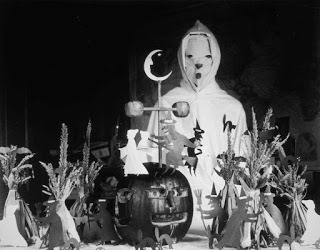
Many believe that Halloween originated in the ancient Celtic Festival, Samhain, the biggest holiday of the year. It was celebrated at the end of harvest season back in the Gaelic culture. This was a time to bring in the farm animals and supplies to shelter everything for the coming winter. This was also the time when they believed that the souls of those who died that year traveled to the otherworld, but
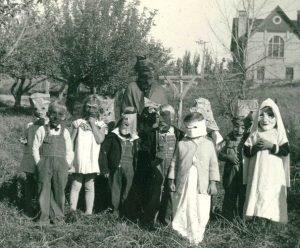 their ghosts were still able to mingle with the living just before finally departing. It is said that the ancient Gaels were afraid that some of the diseased might come back to life and create all sorts of havoc like damaging their crops. And so they wore costumes and masks to ward them off. For centuries, children did the same at that time of the year.
In trying to prove a direct connection between their Samhain and our Halloween (which was tough - I mean 2,000 years is a heck of a long time to connect the dots as we say) many scholars believed that since All Saints' Day (or all Hallows' Mass, celebrated on November 1) were so close together - they were combined into the celebration we now call Halloween (or All Hallows' Eve). In any event, these "festival" traditions continued through the Middle Ages all over Europe where poor people went door to door on Nov. 1 to receive food in exchange for saying prayers for the dead. (It was called "souling") In fact, Shakespeare mentions the custom in The Two Gentlemen of Verona (1593) when Speed accuses his master of "pulling (meaning whining) like a beggar at Hallowmas."
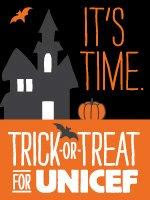
It turns out that Irish and Scottish immigrants carried some of these traditions to America in the late 19th century when children played tricks on October 31st. But actual Trick-or-Treating didn't really get started in the United States until around World War II (though it kind of stalled in 1942 when we had sugar rationing). The whole Halloween idea finally received national attention when the children's magazine Jack and Jill, wrote about it and we had network radio programs like the Jack Benny Show and Ozzie and Harriet who encouraged children to collect coins for UNICEF instead of candy for themselves.
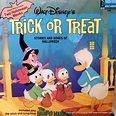
At that point, Walt Disney got into the act, and what child could resist getting dressed up and "becoming" their very favorite cartoon character -- or Superman, a fairy princess, or even one of those images of the dead -- harking back many centuries.
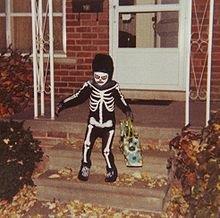 So here we are, celebrating a tradition begun, as many believe, some 2,000 years ago....one that has evolved from a festival where the ancients wanted to ward off souls who might TAKE the harvest of crops to an evening where contemporaries want to answer the doorbell and GIVE out a harvest of goodies to adorable costumed children.
Now, as you enjoy buying or baking the treats, reading the scary novels and choosing the horror movies to watch all week long, you might also reflect on the 2,000 year old answer to:
Halloween - WHY?
...Karna Small Bodman
Why do our children dress up in costumes and go door-to-door on October 31 calling out "Trick or Treat?" Besides knowing it's a great time to have fun and gather up enough candy for a month of sugar-overload, there is quite a history here....one of mystery and intrigue (which is what our Rogue Women Writers group of authors delight in creating in our novels). So all this week we are writing about various aspects of this holiday, how it has inspired books, movies, and especially TV shows ("Check your local listings" for all sorts of horror movies showing this week). But how did we get to this point:

Many believe that Halloween originated in the ancient Celtic Festival, Samhain, the biggest holiday of the year. It was celebrated at the end of harvest season back in the Gaelic culture. This was a time to bring in the farm animals and supplies to shelter everything for the coming winter. This was also the time when they believed that the souls of those who died that year traveled to the otherworld, but
 their ghosts were still able to mingle with the living just before finally departing. It is said that the ancient Gaels were afraid that some of the diseased might come back to life and create all sorts of havoc like damaging their crops. And so they wore costumes and masks to ward them off. For centuries, children did the same at that time of the year.
In trying to prove a direct connection between their Samhain and our Halloween (which was tough - I mean 2,000 years is a heck of a long time to connect the dots as we say) many scholars believed that since All Saints' Day (or all Hallows' Mass, celebrated on November 1) were so close together - they were combined into the celebration we now call Halloween (or All Hallows' Eve). In any event, these "festival" traditions continued through the Middle Ages all over Europe where poor people went door to door on Nov. 1 to receive food in exchange for saying prayers for the dead. (It was called "souling") In fact, Shakespeare mentions the custom in The Two Gentlemen of Verona (1593) when Speed accuses his master of "pulling (meaning whining) like a beggar at Hallowmas."


It turns out that Irish and Scottish immigrants carried some of these traditions to America in the late 19th century when children played tricks on October 31st. But actual Trick-or-Treating didn't really get started in the United States until around World War II (though it kind of stalled in 1942 when we had sugar rationing). The whole Halloween idea finally received national attention when the children's magazine Jack and Jill, wrote about it and we had network radio programs like the Jack Benny Show and Ozzie and Harriet who encouraged children to collect coins for UNICEF instead of candy for themselves.
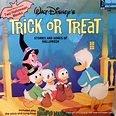
At that point, Walt Disney got into the act, and what child could resist getting dressed up and "becoming" their very favorite cartoon character -- or Superman, a fairy princess, or even one of those images of the dead -- harking back many centuries.
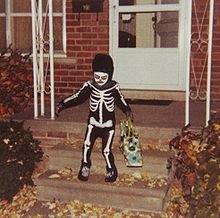 So here we are, celebrating a tradition begun, as many believe, some 2,000 years ago....one that has evolved from a festival where the ancients wanted to ward off souls who might TAKE the harvest of crops to an evening where contemporaries want to answer the doorbell and GIVE out a harvest of goodies to adorable costumed children.
Now, as you enjoy buying or baking the treats, reading the scary novels and choosing the horror movies to watch all week long, you might also reflect on the 2,000 year old answer to:
Halloween - WHY?
...Karna Small Bodman


October 22, 2016
HOLIDAYS AROUND THE WORLD
by KJ Howe
 The topic of holidays fires up my engines, as I'm all about finding a reason to celebrate. In my world, raising a glass of champagne and being thankful should be an everyday experience. My father worked in telecommunications, so I lived in many different countries growing up. This upbringing allowed me to experience many cultures and unique holidays around the world--so I truly can celebrate something special most days. I'd love to share a snapshot of some of these holidays with you.
THREE KINGS DAY
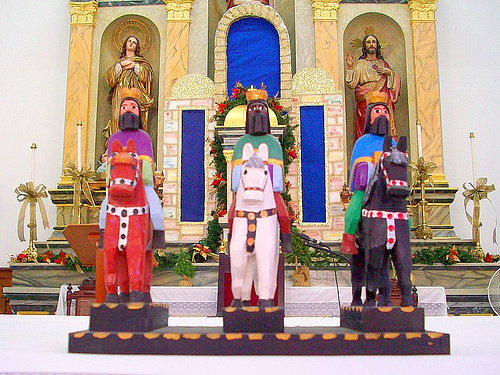
In Puerto Rico, there was no letdown after Christmas because Three King's Day followed close behind. Thousands of children in Latin America and Spain anxiously await "El Dia de los Reyes" every year on January 6th. For many Christians, the holiday marks the biblical adoration of baby Jesus by the three Kings who are also known as three Wise Men or Magi. These Kings found the divine child by following a star across the desert for twelve days to Bethlehem.
Melchior, Caspar and Balthazar--representing Europe, Arabia, and Africa respectively--travelled by horse, camel, and elephant in order to present baby Jesus with three symbolic gifts, gold, frankincense and myrrh. Three Kings Day or "Feast of the Epiphany" is often celebrated with parades, performances, and even celebrations at Disneyland now. When I was in Puerto Rico as a kid this special day and its religious significance meant spending it with my Puerto Rican friends, and receiving not one, but three gifts. Ole!
KRAMPUS
Salzburg, Austria is one of the most beautiful cities in the world. I spent a magical year there at a boarding school--and this is where I learned about Krampus. In Austro-Bavarian Alpine folklore, Krampus is a horned figure that is half-goat, half-demon who punishes children who have misbehaved, in direct contrast with Saint Nicholas who rewards the well-behaved with gifts.
The terrifying and demonic Krampus arrives in Austrian, Bavarian, and some Italian towns on December 5, the day before St. Nicholas day, for Krampusnacht or Krampus night. Men and boys dressed as the horrible creature host a parade through town accompanied by smoke and fireworks, chasing children and adults alike with their birch switches and bags of coal. In smaller towns, men dressed as Krampus go door to door demanding shots of schnapps to protect the owners from evil spirits in the winter months. The video above shows a typical Krampusnacht celebration in Austria. In German with english subtitles, it is best viewed in full screen mode. Worth watching. Enjoy!
HERO'S DAY IN KENYA

Mashujaa (Swahili for Heroes) Day is a national day in Kenya, observed on October 20 as a public holiday to collectively honor all those who contributed towards the struggle for Kenya's independence. Previously known as Kenyatta Day, which was celebrated to commemorate the detention of the Kapenguria Six freedom fighters, it was renamed in 2010.
It is usually celebrated with an event at Nyayo Stadium in Nairobi. A military parade takes place with troops wearing colorful uniforms from the red, black, and green on the Kenyan flag. The honor guard is presented, the president of Kenya shares a speech that is similar to the U.S. State of the Union Address, and then motorcades and a skydiving display close the celebrations.
There are too many special days to share them all, but I hope this piques your curiosity to study other cultures, their holidays, and how there is truly something to celebrate every day! If you'd like to see more travel photos and memories, please drop by my website at www.kjhowe.com.
October 20, 2016
DRACULA AND ME
S. Lee Manning: It’s Halloween in two weeks, and in honor of the holiday, I’ve decided to talk about my lifelong
 connection with vampires – and how it has affected my writing.
It all started when I was thirteen years old – which probably has some psychological significance. At thirteen, I officially became a teenager. I celebrated my bat mitzvah, becoming a full congregate in my conservative Jewish congregation. I was a voracious reader, as I had been since early childhood. Sometime in the fall of my thirteenth year, I took Bram Stoker’s Dracula out of the library. I read straight through until about nine o’clock at night, to the point in the book where a sweet young woman, Lucy, dies from Dracula’s draining her blood and then rises as a vampire.
I was up all night, terrified. I remember lying rigid in my bed, too scared to close my eyes. Every breath of wind, every brush of a branch across the window became in my imagination a vampire trying to get inside my house and inside my room.
Now, I wasn’t a total idiot, even though I was thirteen. Intellectually, I knew that vampires didn’t exist, that they were creatures of myth and fiction. But my imagination has always been my strength – and my weakness. Lying in the dark at night, what I knew intellectually had no effect whatsoever on my terror.
In the morning, exhausted and still traumatized, I made a plea to buy a crucifix to ward off vampires. Jewish parents can be pretty indulgent, but this was pushing it. My father instead bought me a mezuzah, a pendant containing parchment and the Shema - recited by Jews for over two thousand years. I was a little concerned that vampires might not recognize Judaism or sacred Jewish prayers, but I wore it and eventually calmed down. (I still wear it, but now in memory of my father and not as a charm against vampires.)
Years passed before I could bring myself to return to Bram Stoker’s novel – when I found the book to be a decent read and tried to analyze what had so frightened my younger self. What was it about vampires, more than any other monster or ghost story, that had so affected me? I embarked on research into the origins of Dracula – because that’s what I do.
The myths
Vampire folklore has a long history, originating in the human fear of the dead. Many ancient cultures had myths of blood sucking creatures, most of which were demons or spirits rather than reanimated corpses. The vampire myths of the returned and malevolent dead became more prevalent in Eastern Europe sometime around the beginning of the eighteenth century.
There are a lot of theories as to why the folklore took hold. In the seventeenth century Balkan area, the origin of disease was not understood. It was thought that people and animals fell ill not from a natural process but from supernatural acts.
When an epidemic took hold in an area, terrified villagers would dig up the body of a recently deceased person and find what they thought was evidence of vampirism. The process of decay of a corpse was misunderstood – and the natural bloating and changes that occur after death were mistaken as evidence that the recently dead were feeding on blood.
How one became a vampire differed from region to region. In some tales, the vampire is an immoral person or a witch. Babies born with teeth would become vampires. Those who had committed suicide or been excommunicated could become vampires. In some folktales, a cat or dog jumping over a corpse could create a vampire.
Writers eventually picked up on those myths. In the beginning of the nineteenth century, a short story, The Vampyre, described an aristocratic vampire preying on young women. In 1872, Sheridan Le Fanu wrote Carmilla, a lesbian vampire story. Interestingly, Le Fanu gave Bram Stoker his first newspaper job.
Enter Dracula
Bram Stoker’s novel, published in 1892, drew upon those prior works and an amalgam of Eastern European myths. Stoker’s novel also incorporated Victorian views of sexuality in the depiction of the evil emanating from the vampire. A bite from Dracula turns an innocent into a vampire. Women
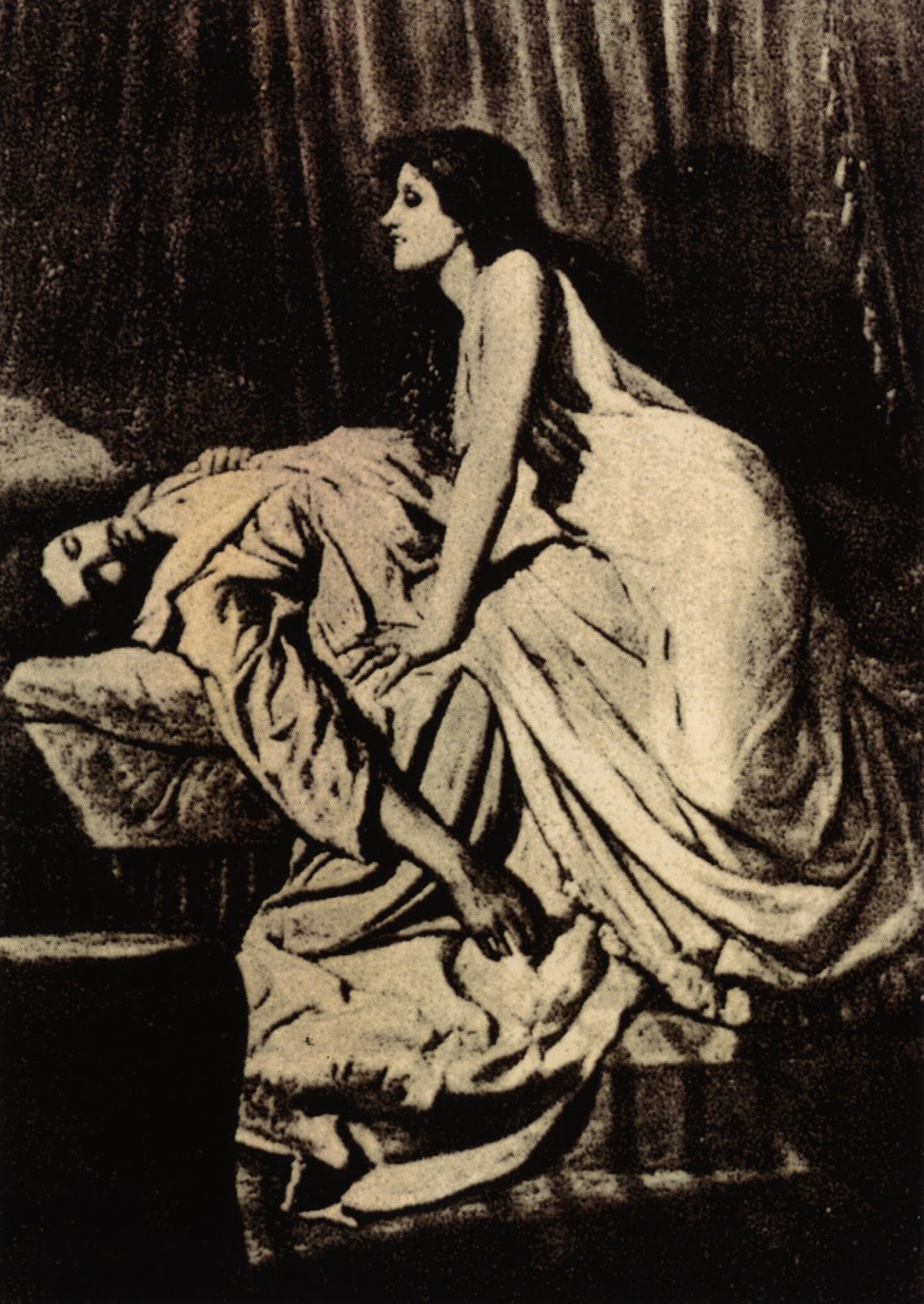 drained by a vampire lose their purity and become “lustful.” There is the hint of forbidden homosexuality when the male Dracula preys on men.
 Then there are the historical underpinnings of Dracula. Oddly, though, while people believe Stoker based his character on the historical figure of Vlad III of Wallachia, that is not entirely clear according to Stoker’s notes, discovered in a museum in 1972.
Vlad III of Wallachia, called “Dracula,” was an anti-Turkish hero in his homeland. His father, Vlad II, had been a member of the knightly order of the dragon -"dracul." Vald II was called “Dracul” ; thus his son, Vlad III ,became Dracula, or son of the dragon. His penchant for execution by impalement, led to his also becoming known as Vlad the Impaler.
The vampire in Stoker's book shares the name Dracula with Vlad III. He also shares a history of fighting the Turks. Stoker’s notes, however, show little other evidence that he modeled Dracula on Vlad III. He chose the name Dracula after finding a textual reference that Dracula meant "devil" in Wallachia – and was used for people who were especially courageous, cruel, or cunning. In fact, Stoker’s notes indicate that he first intended his vampire to come from Austria. Nevertheless, the vampire Dracula and the historical figure of Vlad III have been merged in popular imagination so much that movies and books often intermingle the two.
My writing
Despite my younger self’s fascination with vampires, I have never written in the genre. I rarely read supernatural novels at this point in my life. I will confess to having watched Buffy and True Blood, but I don’t like horror films nor have I watched the multitude of Dracula movies out there.
However, my early fascination with Dracula may have influenced choices I made while writing my espionage thriller, Trojan Horse. Romania’s recent history - the overthrow of the dictator Ceausescu, the current economic strains on the country, and the presence of an American base - made it an attractive setting for an espionage thriller. Then there’s my villain. The figure of Vlad III, as a historical figure reviled in the west but loved in Romania, intrigued me. I wanted to create a villain who did horrific things but thought he was a hero. My villain became the descendant of Vlad III. No vampires, although I did indulge in one or two Dracula jokes.
There was also something deeply satisfying in incorporating into a thriller some elements of a story that had so affected me as child.
So why did Dracula have such a powerful effect on me as a thirteen year old? I’m still not completely sure. It’s difficult to put myself back into my mindset at that age. However, from what I remember, what scared me most was the idea that anyone could become a vampire: my mother, my father, me. One moment, a person would be alive, normal. The next moment, a vampire. Just as death can strike anyone at any time without notice. And maybe that’s it. At an age between childhood and adulthood when I was just becoming aware of mortality, I read a book that somehow crystalized my fear of the randomness of death.
How about you? What terrified you as a child?
October 18, 2016
YES, HOLIDAYS IMPACT WRITERS ... HOW ABOUT YOU?

Gayle Lynds: All right, folks. Confess. You’re now over 30 years old, or maybe 50, or even 60. Do you have childhood Halloween memories you can’t forget — or wish you could? From costumes to candy, from pranks to ghost tales, it’s a holiday that feeds a budding writer’s heart while giving a lot of other folks a sugar high.
Let’s take a deep breath ... and remember....
When I was growing up, we kids helped our mothers make all sorts of candies and cakes to give out on the Big Night. I remember Mother pouring a hot Karo syrup mixture over popcorn spread across a cookie sheet. Steam rose. Her face turned bright red from the heat as she slapped the sticky mixture into fist-size balls. As soon as the popcorn balls cooled, my job was to wrap each one in waxed paper and tie a ribbon around the ends. Her trust made me proud.
On the day of Halloween, we weren’t allowed to wear costumes to school where the serious business of education took place. But the moment the last bell rang, we ran home and dressed up as witches and goblins, Supermen and princesses, ate early dinners, and sat on our front porches to wait until the sun went down. No, we didn’t do homework first — no one had homework until junior high school. As the time passed toward sundown, and the shadows lengthened, we children squirmed with excitement. Halloween!

Although I knew they were coming, I didn’t recognize the older kids who arrived to take us out trick-or-treating — until, with great drama, they removed their masks. Who knew your big friends could be so scary? As we walked down the street, they told us spooky stories and warned us about headless spirits lurking behind trees.
At every neighbor’s door, we had to give our names, because no one had much money so there were just enough treats for those of us who lived nearby. And what treats they were! The aroma of freshly baked goods rising from our paper sacks made our mouths water.
Of course, my parents were embarrassing. One year they went trick-or-treating, too, carrying an empty bushel basket. The neighbors laughed so hard we could hear them a block away. Another time, a group of teenage boys wearing sheets leaped up from behind a wall and shrieked and waved their arms. We ran screaming. Then there were the years of water balloons, marshmallow fights, and the horrible grating moans of “the dead” who’d taken up residence in a hollow. That really made us run, yelling so hard I thought my chest would explode.
What fun we had, and what a terrific foundation it gave me to write thrillers. The dark of night, strange sights, threatening sounds, and masks — who is that character, really? What are they hiding? What do they want?

Compared to today, those were tame, sweet times, but like much of life, even that is relative.
We had no computers, only black-and-white TVs, and the worst thing boys did was go to school without a belt through the loops of their blue jeans, and the worst girls did was wear blue jeans, with or without a belt. But despite the lack of violence and threats so many of our schools face today, or perhaps because we lacked the horrible violence, somehow my generation went on to found Microsoft and Apple, use cable TV to beat network TV into submission, build tanks and the NFL into powerhouses, and discover intolerances of gluten were making a lot of people feel lousy.
The truth is, spy thrillers are simply reflections of life, with all its politics, hubris, questioning of the unknown, and search for adventure. We thrive when we ask questions. We expand our horizons when we seek answers. And international espionage thrillers do both. They’re also a lot of fun to write and read.

I send all best wishes for a very Happy Halloween to you and yours. May you and your goblins have a spirited evening. We'll be sitting home quietly, working, hoping for a grand bunch of youngsters with memorable costume and happy hearts.
With this post I begin the Rogue Women’s next series, this one about Halloween and other holidays and how they affect our writing. You won’t want to miss these wonderful tales. To get your personal subscription, just click here.
October 16, 2016
THE BANE OF ANIMALS
by Chris Goff

I'm not sure I have any animals other than the human-kind in my thrillers. There may be a stray cat in DARK WATERS. It takes place in Israel, often in Tel Aviv, and there are hundreds of thousands of stray cats living there. The cats are everywhere. There are special programs to capture, spay and release the felines. Gayle read an article on the cats of Tel Aviv and sent me the article. If I don’t have a cat in that book, I should.
RED SKY, the second book in my thriller series coming out in June, begins in Ukraine and ends in Poland. I know I have a barking dog in that book. Looking for info on the Rogue Women Writers' upcoming novels, subscribe to the blog by clicking here .
This subject hits home in a personal way. In addition to my thrillers, I write an environmentally-based Birdwatcher’s Mystery series. As such, there are birds in those books – wild birds – and the subject matter ranges from the theft of endangered species from our national parks, the effect of the coffee industry on the migratory songbird and prescribed burns and the effect on habitat. By and large the books are set outdoors, have a milieu characters from amateur birdwatchers to park service employees to ornithologists to business people, and are more traditional than cozy. That said, I have ended up on more animal/pet-oriented panels than I care to mention.
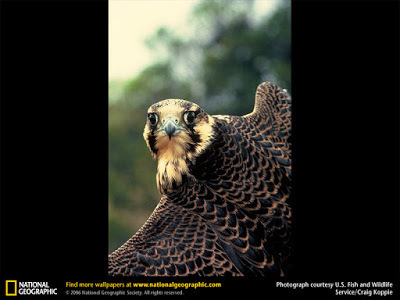 Please know, in my mysteries there are no birds typing clues on the keyboard, no birds pecking Morse code on the windows.
One time,I was assigned to moderate a panel of pet detective-mystery writers. We had Patricia McGuiver who writes the Delilah Doolittle Pet Detective series; Laurien Berensonwho writes the Melanie Travis mystery series; Jessica Speart who write a hard-bitten US Fish and Wildlife agent; Lauren Haney who writes an Archaeological mystery series and myself. I asked each of them to send me something on their pet detectives and got back answers only from Pat and Laurien. Jessica told me she didn’t have any pets in her latest book, only a crocodile. And Lauren Haney told me, “I think there may be a camel on page 50.”
Perhaps the most frustrating aspect is the pigeonholing (forgive the pun) that is done in regards to my work. When DARK WATERS debuted, despite having turned in a bio, book info and a request for a panel to promote an international thriller, I was assigned a panel entitled “Small Towns, Big Crimes.” When I requested a different panel so I could promote my newest title to an audience who might be more interested in thrillers, I was told “once a traditional mystery author, always a traditional mystery author.” The individual who told me this explained that "the business" didn’t work that way; that it didn’t matter if I wanted to switch genres, I would never be able to break free of the label. To this person’s credit, we did discuss the potential for making it happen and I was assigned to another panel with an audience more suited for my newly adopted genre.
All this is to say, perhaps it’s a psychological thing on my part that I haven't populated my thrillers with any animals for fear of being labeled as writing “animal books.”
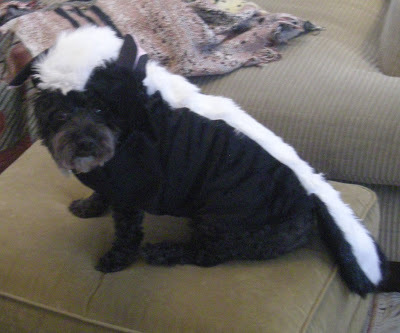 Winston ready for HalloweenHowever, I will admit, I am an animal person. I have always loved dogs—big dogs, little dogs, AKC registered dogs, and mutts. I once owned horses. I’ve even owned cats. My current faithful companion is my daughter’s trusty miniature poodle – a little “party-colored” fellow (mostly black with some strategically placed white) who can be quite a character and who curls up near my chair while I type.
And—don’t tell anyone—I actually am a birder. I have been known to sign up for conventions (not unlike mystery conventions) where all everyone does for three days is go birding. We get up at 4:00 a.m. so we’re in the field at dawn. Sometimes we’re out until dusk. We have banquets and give awards to important birders, throw silent and live auctions to raise money for organizations like the Nature Conservancy or Young Birders or the Raptor Rehabilitation Center, and spend thousands of dollars on good binoculars and spotting scopes so we can actually see the birds when we’re out in the field.
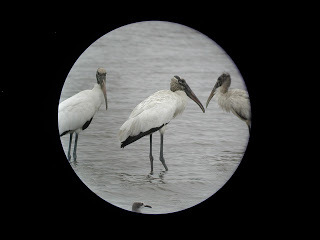
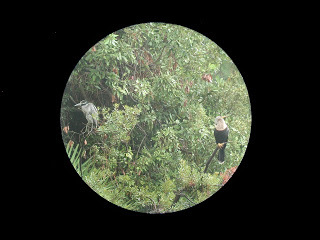 Top: Wood Storks; Bottom: Anhinga and Yellow-Crowned Night-HeronTaken on Jekyll Island researching Book #5 in the Birdwatcher's Mystery series
I must also admit, I am an amateur birdwatcher at best. I have identified over 261 bird species in the field, but there are 993 bird species in North America (which may change in 2017 if the American Birding Association members vote to add Hawaiian birds), and approximately 10,.500 bird species world wide. I’ve even participated in a birding competition ( à la the Big Year only on a much smaller scale). Picture playing golf in a scramble and your ball is never the one that is used for play. I’m fairly good at spotting the birds, but not so great at being able to identify them on the fly. I often depend on my expert birder friends to tell me what I’m actually seeing—but it’s fun!
There are more of us in the mystery community than you might think. I know of at least five others who secretly—or not so secretly—go birding while at mystery conventions around the world. I’ve gone with them.
Ask and I will name names!

I'm not sure I have any animals other than the human-kind in my thrillers. There may be a stray cat in DARK WATERS. It takes place in Israel, often in Tel Aviv, and there are hundreds of thousands of stray cats living there. The cats are everywhere. There are special programs to capture, spay and release the felines. Gayle read an article on the cats of Tel Aviv and sent me the article. If I don’t have a cat in that book, I should.
RED SKY, the second book in my thriller series coming out in June, begins in Ukraine and ends in Poland. I know I have a barking dog in that book. Looking for info on the Rogue Women Writers' upcoming novels, subscribe to the blog by clicking here .
This subject hits home in a personal way. In addition to my thrillers, I write an environmentally-based Birdwatcher’s Mystery series. As such, there are birds in those books – wild birds – and the subject matter ranges from the theft of endangered species from our national parks, the effect of the coffee industry on the migratory songbird and prescribed burns and the effect on habitat. By and large the books are set outdoors, have a milieu characters from amateur birdwatchers to park service employees to ornithologists to business people, and are more traditional than cozy. That said, I have ended up on more animal/pet-oriented panels than I care to mention.
 Please know, in my mysteries there are no birds typing clues on the keyboard, no birds pecking Morse code on the windows.
One time,I was assigned to moderate a panel of pet detective-mystery writers. We had Patricia McGuiver who writes the Delilah Doolittle Pet Detective series; Laurien Berensonwho writes the Melanie Travis mystery series; Jessica Speart who write a hard-bitten US Fish and Wildlife agent; Lauren Haney who writes an Archaeological mystery series and myself. I asked each of them to send me something on their pet detectives and got back answers only from Pat and Laurien. Jessica told me she didn’t have any pets in her latest book, only a crocodile. And Lauren Haney told me, “I think there may be a camel on page 50.”
Perhaps the most frustrating aspect is the pigeonholing (forgive the pun) that is done in regards to my work. When DARK WATERS debuted, despite having turned in a bio, book info and a request for a panel to promote an international thriller, I was assigned a panel entitled “Small Towns, Big Crimes.” When I requested a different panel so I could promote my newest title to an audience who might be more interested in thrillers, I was told “once a traditional mystery author, always a traditional mystery author.” The individual who told me this explained that "the business" didn’t work that way; that it didn’t matter if I wanted to switch genres, I would never be able to break free of the label. To this person’s credit, we did discuss the potential for making it happen and I was assigned to another panel with an audience more suited for my newly adopted genre.
All this is to say, perhaps it’s a psychological thing on my part that I haven't populated my thrillers with any animals for fear of being labeled as writing “animal books.”
 Winston ready for HalloweenHowever, I will admit, I am an animal person. I have always loved dogs—big dogs, little dogs, AKC registered dogs, and mutts. I once owned horses. I’ve even owned cats. My current faithful companion is my daughter’s trusty miniature poodle – a little “party-colored” fellow (mostly black with some strategically placed white) who can be quite a character and who curls up near my chair while I type.
 And—don’t tell anyone—I actually am a birder. I have been known to sign up for conventions (not unlike mystery conventions) where all everyone does for three days is go birding. We get up at 4:00 a.m. so we’re in the field at dawn. Sometimes we’re out until dusk. We have banquets and give awards to important birders, throw silent and live auctions to raise money for organizations like the Nature Conservancy or Young Birders or the Raptor Rehabilitation Center, and spend thousands of dollars on good binoculars and spotting scopes so we can actually see the birds when we’re out in the field.

 Top: Wood Storks; Bottom: Anhinga and Yellow-Crowned Night-HeronTaken on Jekyll Island researching Book #5 in the Birdwatcher's Mystery series
I must also admit, I am an amateur birdwatcher at best. I have identified over 261 bird species in the field, but there are 993 bird species in North America (which may change in 2017 if the American Birding Association members vote to add Hawaiian birds), and approximately 10,.500 bird species world wide. I’ve even participated in a birding competition ( à la the Big Year only on a much smaller scale). Picture playing golf in a scramble and your ball is never the one that is used for play. I’m fairly good at spotting the birds, but not so great at being able to identify them on the fly. I often depend on my expert birder friends to tell me what I’m actually seeing—but it’s fun!
There are more of us in the mystery community than you might think. I know of at least five others who secretly—or not so secretly—go birding while at mystery conventions around the world. I’ve gone with them.
Ask and I will name names!
October 15, 2016
THE TRUTH ABOUT CATS AND DOGS
By Sonja Stone
Cats are useless. There, I said it. Let the hate mail begin.
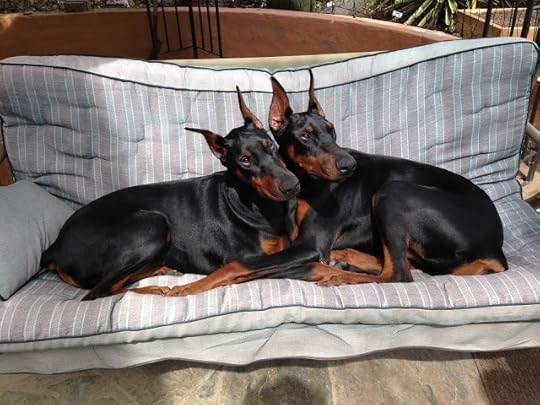 Sleek and beautiful: Raja and Raven, my Dobermans
CONDITIONS OF COHABITATION
I know I’m about to make a lot of enemies, but here’s my feeling about pets: If an animal is going to live in my home, eat my food, drink my water, and breathe my oxygen, it needs to be willing AND ABLE to kill for me.
I know, I know. Everyone thinks either:
a) their kitty-cat would defend them to the death if he could, or b) their kitty-cat could defend them, if he were so inclined.
For an animal to share my living quarters, it must meet BOTH of these requirements. Consistently.
Before you unsubscribe to our blog, let me say that I’m mostly kidding about the useless-cat thing. My dad has a cat, my sister has cats, my friends have cats. One of my friends willed her cat to me (I beg you, pray for her continued good health). My personal experience with cats is this: when you want to snuggle, they’re nowhere to be seen. When you want to be left alone, you get shedding hairs in your nose and cat ass in your face. And don’t get me started on the anus-trailing icicles from the Christmas tree.
But, oh, my Dobermans. Love at first sight.
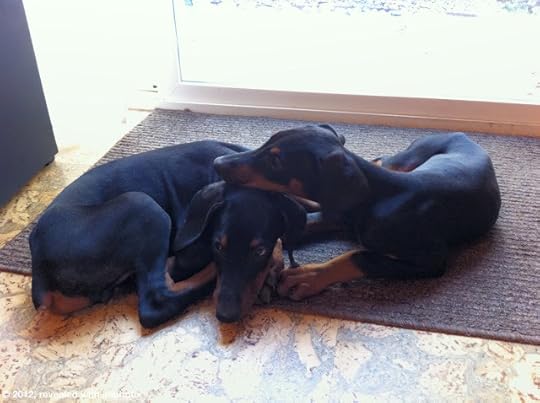 Raja and Raven, brother and sister
DEVIL DOGS
Though often portrayed in novels and movies as violent aggressors, Dobermans make excellent family dogs. We chose Dobermans to join our pack for several reasons. First, I wanted a protective breed. I adore German Shepherds, but it’s 120 degrees during a Phoenix summer, and I was concerned about long-haired dogs (though I know Shepherds live here and certainly thrive). Second, Dobermans are known to be loyal, intelligent, alert, and gentle (despite their reputation).
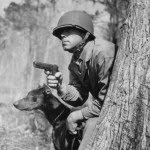
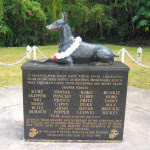
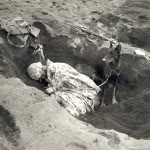
Dobermans have a long history of military service. As soldiers in WWI & WWII, they’ve served as sentries, scouts, messengers, and protectors. On Guam, a life-sized memorial honors the service and sacrifice of Doberman soldiers.
THE CARE AND KEEPING OF A HAPPY DOG (AKA, HOW NOT TO RAISE A NEUROTIC DOBERMAN)
As puppies, Dobermans require socialization. We took ours to our neighborhood Home Depot (in case you’re wondering why we didn’t go to the park, very young pups shouldn’t be around the feces of other dogs until fully vaccinated). Dobermans are affectionate and energetic; this is not a breed to lock outside in the yard all day. (I’m not sure that’s okay with any breed, but hey. You do you.) They require training and loving discipline, frequent exercise, and lots of attention. I work from home, so Raja and Raven have plenty of company.
Our dogs respond to commands issued in several foreign languages. They are courteous to guests, and have only exhibited threatening behavior on one occasion. We’d ordered a pizza for dinner, and rather than come to the front door (which, I might add, was well-lit), our delivery guy chose to open the side gate leading to the darkened back yard and enter the walled space behind the house. (Everyone in Phoenix has block walls around their property. You think fences make good neighbors? Try an eight-foot wall.) Raven, the more protective of the two, guarded the kitchen, barking fiercely at the back door. This poor guy stood outside frozen with fear until we figured out why she was so upset.
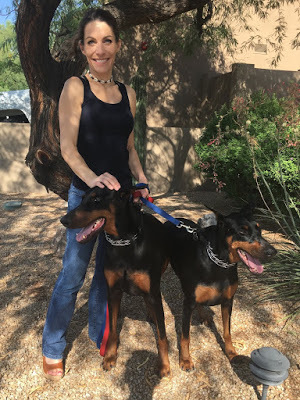 Me and my babies
WHY WOULDN'T YOU?
Before you judge me for those spiky collars, let me explain. My puppies are eager hunters, and we have more rabbits in our neighborhood than the Teletubbies. My dogs are well-trained; it’s not that they’ll break free and chase down the bunnies. But they will pull the leash so hard that while wearing flat nylon collars, they bruise their little tracheas. The silver collar actually disperses the force exerted against it, so the throat avoids injury.
To me, owning a Doberman is like carrying a knife. I’d rather have it and not need it, than need it and not have it. And come on, if they’re good enough for the United States Marine Corps…
P.S. Is anyone surprised that I chose a breed known as "devil dogs"?
Photo credits for the military pictures: http://dobermansden.com/doberman-military-service
Okay, I’m braced for your pro-cat arguments. Leave your hate mail pet story in the comment section below!
Cats are useless. There, I said it. Let the hate mail begin.
 Sleek and beautiful: Raja and Raven, my Dobermans
CONDITIONS OF COHABITATION
I know I’m about to make a lot of enemies, but here’s my feeling about pets: If an animal is going to live in my home, eat my food, drink my water, and breathe my oxygen, it needs to be willing AND ABLE to kill for me.
I know, I know. Everyone thinks either:
a) their kitty-cat would defend them to the death if he could, or b) their kitty-cat could defend them, if he were so inclined.
For an animal to share my living quarters, it must meet BOTH of these requirements. Consistently.
Before you unsubscribe to our blog, let me say that I’m mostly kidding about the useless-cat thing. My dad has a cat, my sister has cats, my friends have cats. One of my friends willed her cat to me (I beg you, pray for her continued good health). My personal experience with cats is this: when you want to snuggle, they’re nowhere to be seen. When you want to be left alone, you get shedding hairs in your nose and cat ass in your face. And don’t get me started on the anus-trailing icicles from the Christmas tree.
But, oh, my Dobermans. Love at first sight.
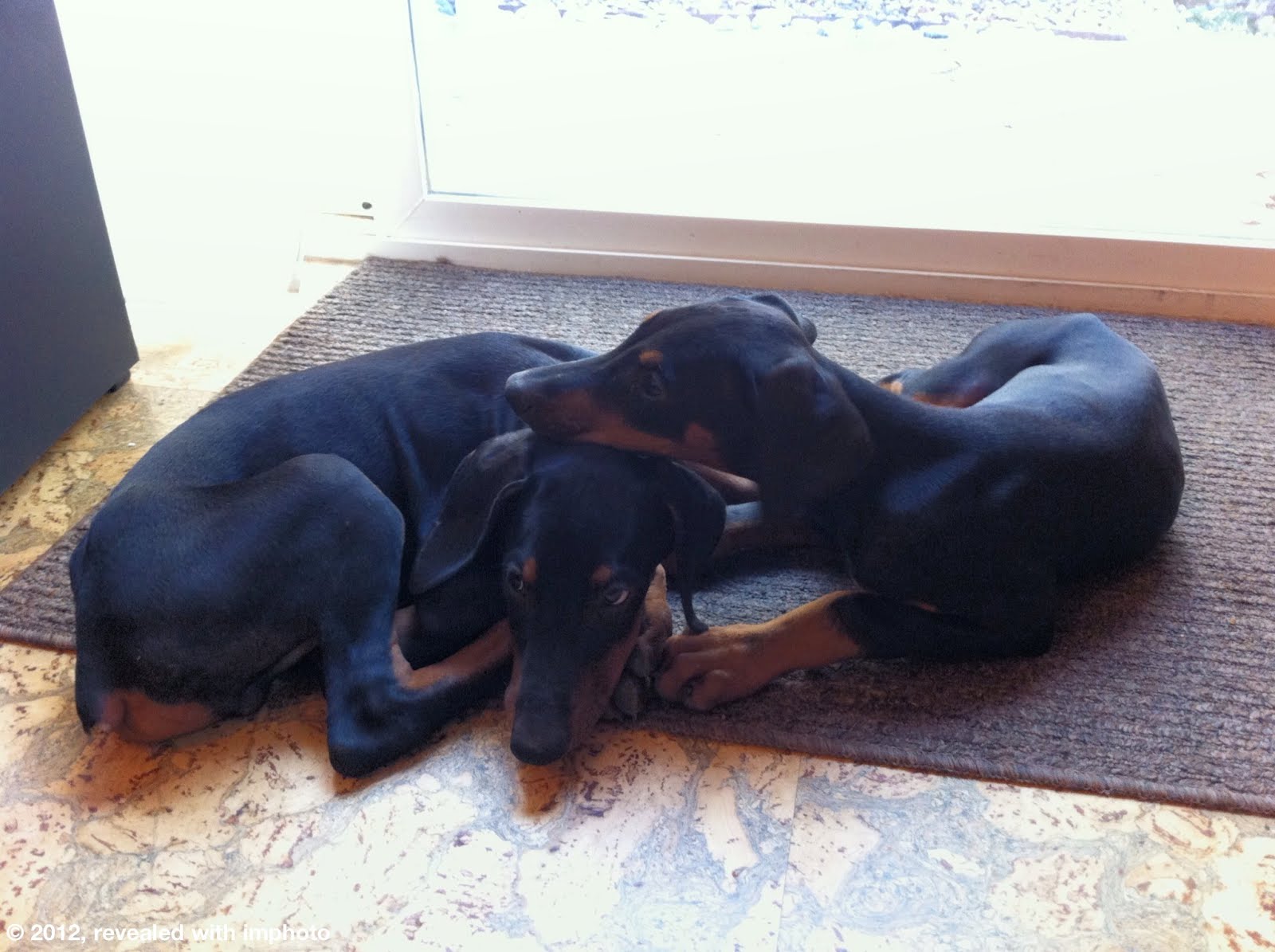 Raja and Raven, brother and sister
DEVIL DOGS
Though often portrayed in novels and movies as violent aggressors, Dobermans make excellent family dogs. We chose Dobermans to join our pack for several reasons. First, I wanted a protective breed. I adore German Shepherds, but it’s 120 degrees during a Phoenix summer, and I was concerned about long-haired dogs (though I know Shepherds live here and certainly thrive). Second, Dobermans are known to be loyal, intelligent, alert, and gentle (despite their reputation).
Dobermans have a long history of military service. As soldiers in WWI & WWII, they’ve served as sentries, scouts, messengers, and protectors. On Guam, a life-sized memorial honors the service and sacrifice of Doberman soldiers.


THE CARE AND KEEPING OF A HAPPY DOG (AKA, HOW NOT TO RAISE A NEUROTIC DOBERMAN)
As puppies, Dobermans require socialization. We took ours to our neighborhood Home Depot (in case you’re wondering why we didn’t go to the park, very young pups shouldn’t be around the feces of other dogs until fully vaccinated). Dobermans are affectionate and energetic; this is not a breed to lock outside in the yard all day. (I’m not sure that’s okay with any breed, but hey. You do you.) They require training and loving discipline, frequent exercise, and lots of attention. I work from home, so Raja and Raven have plenty of company.
Our dogs respond to commands issued in several foreign languages. They are courteous to guests, and have only exhibited threatening behavior on one occasion. We’d ordered a pizza for dinner, and rather than come to the front door (which, I might add, was well-lit), our delivery guy chose to open the side gate leading to the darkened back yard and enter the walled space behind the house. (Everyone in Phoenix has block walls around their property. You think fences make good neighbors? Try an eight-foot wall.) Raven, the more protective of the two, guarded the kitchen, barking fiercely at the back door. This poor guy stood outside frozen with fear until we figured out why she was so upset.
 Me and my babies
WHY WOULDN'T YOU?
Before you judge me for those spiky collars, let me explain. My puppies are eager hunters, and we have more rabbits in our neighborhood than the Teletubbies. My dogs are well-trained; it’s not that they’ll break free and chase down the bunnies. But they will pull the leash so hard that while wearing flat nylon collars, they bruise their little tracheas. The silver collar actually disperses the force exerted against it, so the throat avoids injury.
To me, owning a Doberman is like carrying a knife. I’d rather have it and not need it, than need it and not have it. And come on, if they’re good enough for the United States Marine Corps…
P.S. Is anyone surprised that I chose a breed known as "devil dogs"?
Photo credits for the military pictures: http://dobermansden.com/doberman-military-service
Okay, I’m braced for your pro-cat arguments. Leave your hate mail pet story in the comment section below!
October 13, 2016
WHEN THE SIDEKICK HAS YOUR BACK
 By Francine Mathews
One hundred and one years ago this week, Edith Cavell--a British nurse in German-occupied Belgium in the first World War--was executed by firing squad. It was the Germans who killed her, allegedly for treason, although that seems an odd word to choose for aiding and abetting her own country. Edith was fifty years old when she died, and is famous for her final statement to the Anglican confessor who visited her a few hours before she faced death: "Patriotism is not enough." She had helped two hundred soldiers escape across the Belgian border to eventual safety in England, she is credited with saving civilian refugees as well, and last year the former head of MI5, Stella Rimington, revealed that she had found documents in Belgian archives that suggest Edith Cavell was a witting spy for Britain's nascent intelligence service. German occupiers were probably justified in shutting her down. But Allied observers were horrified that anyone would execute a noncombatant woman--and a nurse.
 Edith Cavell Monument, London
Edith was lionized back in England, where her victimhood was swiftly employed in lurid propaganda posters and official postage stamps. Her statue stands in St. Martin's Place, near Trafalgar Square, and one of her dogs--Jack, the shepherd mix at the right of the picture above--was stuffed and placed on display at the Imperial War Museum. Apparently, he suffered this indignity for having survived Edith and the rest of the war.
But I confess that's not why I was riveted by Edith's picture in the New York Times. I noticed it immediately because of the other dog, the one that didn't survive her, the dog at her left.
The Airedale Terrier.
He's a terrier mix, it's true, and less than recognizable to those who love the breed today, but a hundred and one years ago Airedales were still evolving to their present state of perfection. And they were all over the Western Front, serving alongside the Allies as sentries, scouts, messenger-bearers and Red Cross rescue dogs. Some of them were discovered at the Battersea Dogs Home in London, others were donated by their owners, but most were trained by Colonel Edwin Richardson, who lived and worked in Carnoustie, Scotland. He was charged with preparing dogs for military field work at the Front, and quickly realized, he said, that the Airedale Terrier was by far the most able breed he could train, because--to paraphrase Col. Richardson--they cannot be dissuaded. They cannot be stopped. They are a force of nature that when deployed, turns out to be a powerful weapon. The Airedale Terrier became the Official Breed of the British Army.
 Colonel Edwin Richardson and his Airedales-in-training
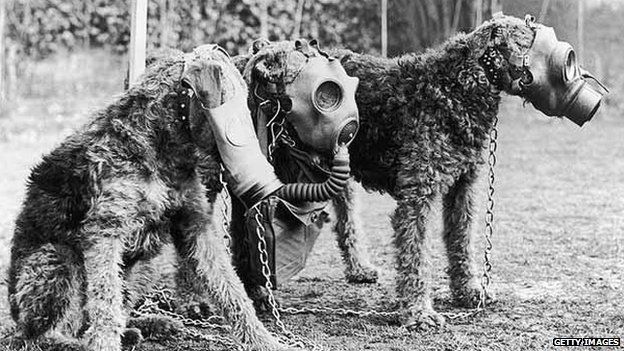 Richardson put his canines through a six-week course of operations before dispatching them to the Front. Terriers are bred to hunt rodents by following them into burrows; like most terriers, Airedales love tunnels, culverts, drains--and trenches. They were perfectly comfortable finding their way through mazes of trenches criss-crossing the frontlines of France, and once accustomed to gas masks, could navigate with less danger. Many of them carried small first-aid kits strapped to their necks and were trained to find the wounded after battle. Others delivered communications tied to their collars.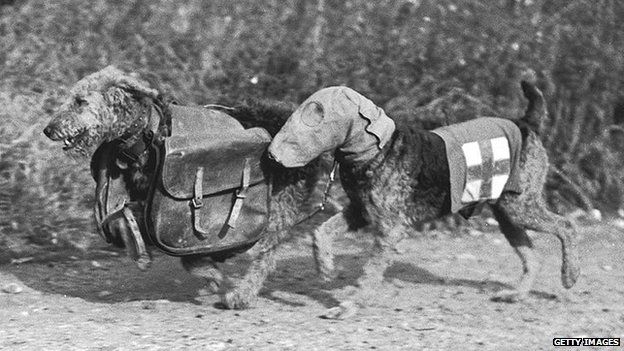
By the end of the war, the BBC estimates that twenty thousand dogs were serving at the Front. During the 2014 First World War Centenary, as it was called in the UK, Airedales were honored with poppy-decorated neckerchiefs that read: We Also Served.

And why, you ask, do we care?
One hundred and one years ago, in that first year of world war, my father was born in western Pennsylvania. I never knew his parents--they died before I was born. It was only as an adult--raising my first Airedale puppy--that I learned something about my grandfather.
I was visiting my father's younger sister, whom I had never known well. She was elderly and infirm. But when she answered her front door, I was surprised to see an Airedale by her side. The breed is not that common, particularly in Colorado where we both lived. I'd had to travel to Utah for my first puppy, and I did so because for much of my life I'd yearned for just this breed of dog. I couldn't explain why--it had something to do with their jauntiness, their independence, their intelligence, their noble profiles. When I exclaimed to Aunt Peg at the coincidence of us both having Airedales, she looked at me quizzically and said, "Well you know--your grandfather bred them...."
 Nessa and me, one Christmas
No, I hadn't known. And I shivered at her words. Ever since, I have been convinced that the bond between dog and human can come down through the generations. Airedales are in my blood. I've shared my life successively with five, at this point, each of them stretched luxuriously at my feet while I have typed away at novels. They are my Official Companions of the Writing Room.
So tell me, Readers: What breed can't YOU live without? Which dog will always have your back? Share your thoughts--and your pictures--with us.
Cheers,
Francine
October 11, 2016
The Pet Menagerie
 Sahara or "Kitty"
So this week we’re talking about our pets. I’ve had a lot of pets over the years and all have enriched my life, but the cats, well, they’re something else. I can see why the Egyptians revered these animals.
I grew up in what was then a rural area outside of Chicago and, with the exception of our first dog, a super intelligent poodle named Princess, most of our animals just showed up. There was a trestle about a mile from the house and people routinely dumped their animals there. They’d eventually find their way to our doorstep, where my mother would take them in for a short while before finding them a new home.
My first cat marched right in the front door. There we all were, sitting down to eat dinner and my brother’s friend, who was leaving for his own family dinner, called from the front hallway, “I let your cat in!” We all stopped eating and stared at each other, perplexed. We didn’t have a cat and my mother claimed not to like them very much. Around the corner came an adorable white and black kitten, half Persian, who stumbled into the kitchen, sat down, and looked at us with these wide blue eyes. Princess was sitting in the corner and looked from my mom to the kitten and back again as if to say, “Uh, oh.”
 Mom insisted that the kitten could only stay until we found her a home or sent her to the shelter. That lasted about one day. After a week my mom fell in love with “the Kitty.” Princess, the most wonderful dog in the world, tolerated her well enough, and the rest of us loved her. Kitty stayed for nineteen years until she died of old age in my Chicago townhouse.
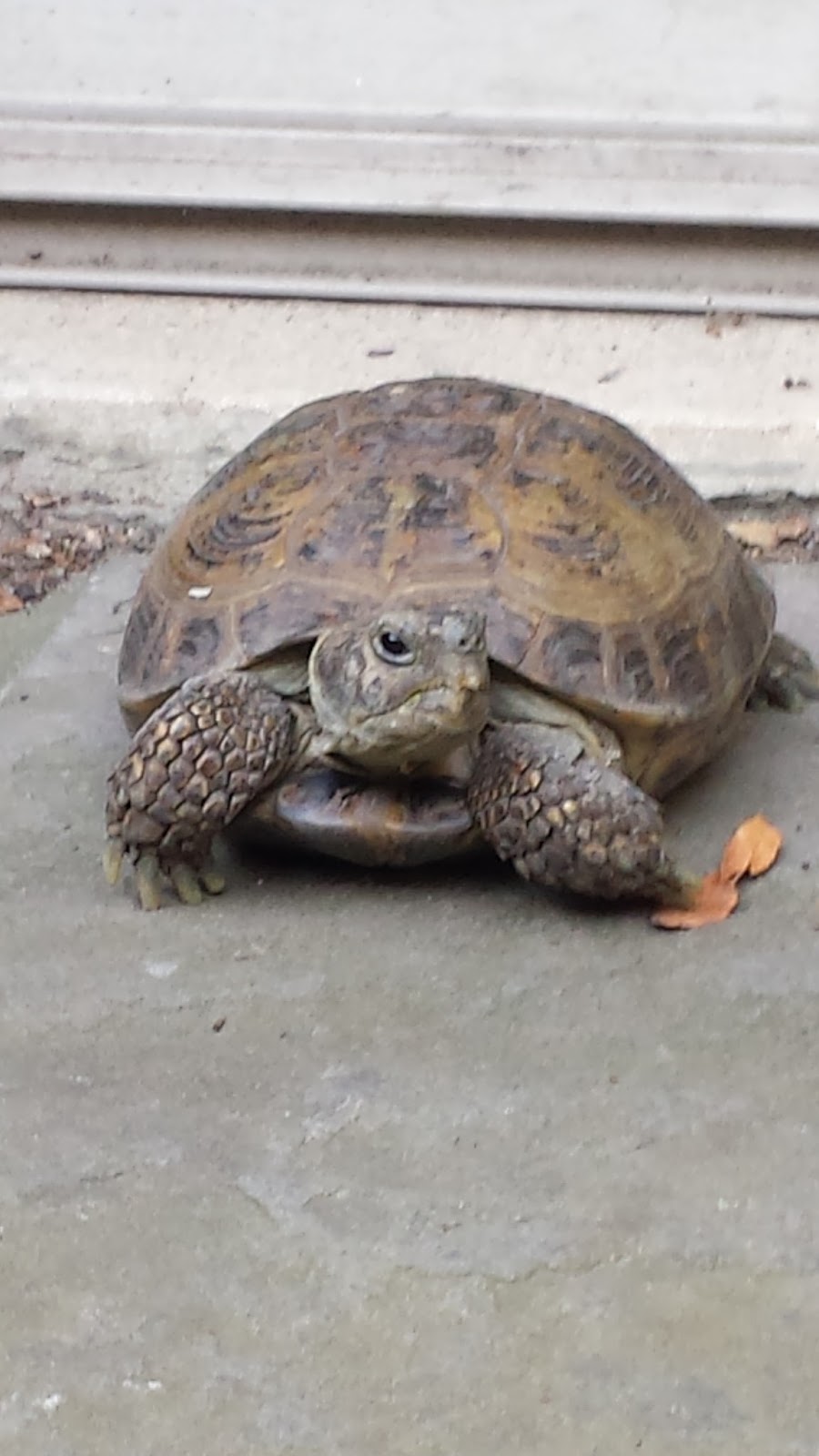
My son wanted a turtle and the next pet in the house was Will. He’s a desert tortoise and just about the perfect pet. He lives in our backyard all summer and hibernates in a terrarium in our cool and dark crawlspace all winter. Will comes when called. Well, I suppose a big part of that is that he knows I call him when I bring his romaine lettuce outside. He lumbers out and stops in front of me, his neck craning upward. He knows his name, I’m sure, but I imagine he calls me “She Who Brings The Lettuce.”
He enjoys greeting people when they sit in the yard and I usually hear someone yelp when he appears and crawls onto their shoes. He enjoys shoe sitting, I don’t know why.
Will gets along with all of the urban animals that visit him outside. Once late at night I looked out and saw a mouse sitting on Will’s broad back and cleaning its paws. Will didn’t seem to mind at all.
Our next cat, Sahara—also called Kitty-- joined us from the PAWS shelter when my daughter begged to have a cat. Kitty is sweet, afraid of her own shadow, and inordinately attached to my daughter. The cat will jump in the shower with her if she could. I usually find her pressed to the bathroom door waiting for “The Goddess” to emerge. When there’s a girl sleep over I find a pile of teenagers asleep on the bed and one female cat draped on top.
And for me, that means life is about perfect.
October 9, 2016
Dogs: Our Loveable Heroes
...by Karna Small Bodman
The 19th century humorist, Josh Billings, once said "A dog is the only thing on earth that loves you more than he loves himself." How true.
 A trainer with her companion
There are so many great books written and movies produced over the years about wonderful, heroic dogs. Remember "The Bravest Dog Ever: The True Story of BALTO" by Natalie Standiford and her illustrator, Donald Cook, based on an event that occurred back in 1925?
Up in the northern Alaska wilderness there was an outbreak of diphtheria. The nearest medicine was in Anchorage, some 800 miles away, and a train carrying this precious cargo became buried in heavy snow. It was 30 degrees below zero, and the state was being hit by one of the worst storms ever. The sick little ones undoubtedly would not survive. What to do?
The answer was Balto, a sled dog who led his team through that snow and ice over 53 miles of treacherous terrain to deliver the life-saving drug. Children of all ages read about the drama and dreamed of having a dog like Balto.
The next classic story was about a boy and his dog living in the Texas hill country in the late 1800s. The father had to go away on a cattle drive leaving his two young sons, Travis and Arliss in charge of the family farm. One day Travis was furious to find a strange looking yellow dog with a chewed off ear and a stub tail eating some of their scarce food and drinking their water. The dog
 redeemed himself, though, when he performed the amazing feat of saving Arliss's life as he was about to be attacked by a bear. After that the dog, "Old Yeller" and the older brother, Travis, became inseparable. Author Fred Gipson brilliantly described how a dog will do anything to protect "his family."
The story was so compelling that Walt Disney created a movie version that delighted young and old for years to come.
Another author who created a bestselling series of thrillers about a man and his dog is Robert Crais who writes about an LAPD officer, Scott James, and his K-9 partner, Maggie, a German Shepherd who did several tours in Afghanistan and remains a partner in cases back in the states. It looks like all kinds of pets enjoy those books.
 It's amazing to see how our military takes dogs like this and trains them for combat. It's one thing for us to train our puppies to sit, heel or roll over, but imagine the time and dedication our service men and women take to train war dogs to respond to verbal commands as well as hand signals so the dogs
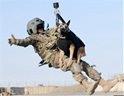 won't bark when confronted with small arms fire or exploding shells, but remain completely silent so they don't reveal their troop's position to the enemy. These terrific dogs learn to perform sentry duty, sniff out mines and bombs, and even jump in tandem with their Air Force handlers.
Then there are the little ones. Charles Schulz was quoted as saying, "Happiness is a warm puppy." And did I ever find that out when we acquired out little "Gambit" (the title of my second novel).
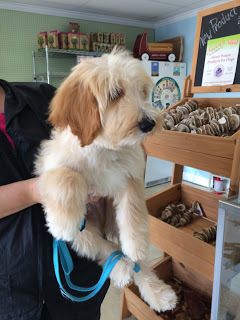 "Gambit" at 15 months
This loveable little guy has captured our hearts for the year and a half since we brought him home. Watching him grow as an integral part of our family and yes, acting as our "protector" as well as devoted companion, gave me the inspiration to create a unique puppy "character" in my new novel, Affairs of the Candidate, which I have not finished yet (but I'll let you know when it's out). I also feature him as the "star" in a children's picture book I just wrote about young twins living in The White House who get a new puppy for their birthday, one who promptly gets into all kinds of trouble roaming around the State Dining Room, the West Wing and the Oval office. This is just a light-hearted attempt to introduce little ones to the intriguing and historic home of our First Family.
In a post here a few days ago, my colleague, the great writer Gayle Lynds, wrote about her wonderful dog and a "diet" of bananas and peanut butter. I discovered that Gambit loves those tastes as well. In fact, here's a recipe for all you dog lovers to give your pet as a treat: Mix those two ingredients together with a bit of plain non-fat yogurt. Put a spoonful into tiny dishes (or Dixie cups) -- stick a "Milk Bone" in the center and freeze them. Now you have "Pup-sicles."
 And wouldn't you say that our "Loveable Heroes" deserve such a reward once in a while? Now please leave a comment and tell us about your favorite pet and how it has changed your life! .....by Karna Small Bodman
The 19th century humorist, Josh Billings, once said "A dog is the only thing on earth that loves you more than he loves himself." How true.
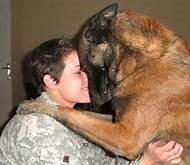 A trainer with her companion
 There are so many great books written and movies produced over the years about wonderful, heroic dogs. Remember "The Bravest Dog Ever: The True Story of BALTO" by Natalie Standiford and her illustrator, Donald Cook, based on an event that occurred back in 1925?

Up in the northern Alaska wilderness there was an outbreak of diphtheria. The nearest medicine was in Anchorage, some 800 miles away, and a train carrying this precious cargo became buried in heavy snow. It was 30 degrees below zero, and the state was being hit by one of the worst storms ever. The sick little ones undoubtedly would not survive. What to do?
The answer was Balto, a sled dog who led his team through that snow and ice over 53 miles of treacherous terrain to deliver the life-saving drug. Children of all ages read about the drama and dreamed of having a dog like Balto.
The next classic story was about a boy and his dog living in the Texas hill country in the late 1800s. The father had to go away on a cattle drive leaving his two young sons, Travis and Arliss in charge of the family farm. One day Travis was furious to find a strange looking yellow dog with a chewed off ear and a stub tail eating some of their scarce food and drinking their water. The dog
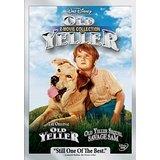 redeemed himself, though, when he performed the amazing feat of saving Arliss's life as he was about to be attacked by a bear. After that the dog, "Old Yeller" and the older brother, Travis, became inseparable. Author Fred Gipson brilliantly described how a dog will do anything to protect "his family."
The story was so compelling that Walt Disney created a movie version that delighted young and old for years to come.
Another author who created a bestselling series of thrillers about a man and his dog is Robert Crais who writes about an LAPD officer, Scott James, and his K-9 partner, Maggie, a German Shepherd who did several tours in Afghanistan and remains a partner in cases back in the states. It looks like all kinds of pets enjoy those books.
 It's amazing to see how our military takes dogs like this and trains them for combat. It's one thing for us to train our puppies to sit, heel or roll over, but imagine the time and dedication our service men and women take to train war dogs to respond to verbal commands as well as hand signals so the dogs
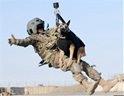 won't bark when confronted with small arms fire or exploding shells, but remain completely silent so they don't reveal their troop's position to the enemy. These terrific dogs learn to perform sentry duty, sniff out mines and bombs, and even jump in tandem with their Air Force handlers.
 Then there are the little ones. Charles Schulz was quoted as saying, "Happiness is a warm puppy." And did I ever find that out when we acquired out little "Gambit" (the title of my second novel).
 "Gambit" at 15 months
This loveable little guy has captured our hearts for the year and a half since we brought him home. Watching him grow as an integral part of our family and yes, acting as our "protector" as well as devoted companion, gave me the inspiration to create a unique puppy "character" in my new novel, Affairs of the Candidate, which I have not finished yet (but I'll let you know when it's out). I also feature him as the "star" in a children's picture book I just wrote about young twins living in The White House who get a new puppy for their birthday, one who promptly gets into all kinds of trouble roaming around the State Dining Room, the West Wing and the Oval office. This is just a light-hearted attempt to introduce little ones to the intriguing and historic home of our First Family.
In a post here a few days ago, my colleague, the great writer Gayle Lynds, wrote about her wonderful dog and a "diet" of bananas and peanut butter. I discovered that Gambit loves those tastes as well. In fact, here's a recipe for all you dog lovers to give your pet as a treat: Mix those two ingredients together with a bit of plain non-fat yogurt. Put a spoonful into tiny dishes (or Dixie cups) -- stick a "Milk Bone" in the center and freeze them. Now you have "Pup-sicles."
 And wouldn't you say that our "Loveable Heroes" deserve such a reward once in a while? Now please leave a comment and tell us about your favorite pet and how it has changed your life! .....by Karna Small Bodman
October 8, 2016
THE LONE WOLF
KJ Howe hosting Ali Karim
I'm honoured to be hosting crime fiction savant Ali Karim on Rogue Women Writers. I've had the pleasure of knowing Ali for many years, and the SHOTS eZine he is Assistant Editor for offers outstanding coverage of mysteries and thrillers along with the most in-depth analysis of crime fiction that I've seen. Smart, funny, kind, Ali is someone that brings a special enthusiasm to our genre, as you'll soon see. Please don't forget to check out the phenomenal video links at the end of the article. You're in for a treat.
Take it away, Ali...
When KJ Howe asked me to guest blog at Rogue Women, it was an invitation I couldn’t refuse as I love talking about thriller fiction. I first met KJ at the Inaugural Thrillerfest in Phoenix in 2006, as we’re both avid readers of thriller fiction.
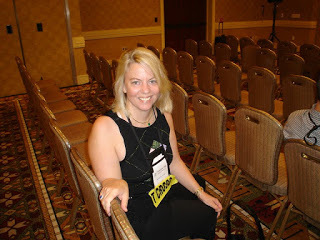 KJ in 2006 at inaugural ThrillerFestI was unable to attend this year’s Thrillerfest due to diary clashes, though I’ve been bumping into KJ a great deal recently, with her appearance at Theakstons Old Peculier Harrogate Crime Writing Festival [following her work at ITW Thrillerfest 2016], as well as Bouchercon New Orleans.
So while pondering what to write; I was backing up my photos on my spare hard drive, and discovered I had a photo of KJ from Thrillerfest 2006, and emailed it to her. We both laughed as fast forwarding a decade, we find KJ about to publish her debut thriller The Freedom Broker, and coincidentally my very old friend, Vicki Mellor of Headline Publishing has UK rights.
Anyway, I digress. The issue was the topic or theme she asked me to write about, had me scratching my head - ‘Animals in Thriller Fiction’. I initially thought about fiction that featured Animals, such as the work of Dean Koontz, the work of Nevada Barr, even CUJO by Stephen King. But my knowledge of Animal Fiction is pretty skimpy, so as I pondered on what to write, I recalled the essay, I wrote for MJ Rose that was used as the introduction in the Inaugural Thrillerfest Brochure in 2006. In that introduction I mentioned the significance of Geoffrey Household, and his 1939 novel Rogue Male to thriller writers and readers – as it is a great example of ‘The Lone Wolf’ as Protagonist. Rogue Male features a “Hunter” who becomes “The Hunted”, with a deadly game of Cat and Mouse.
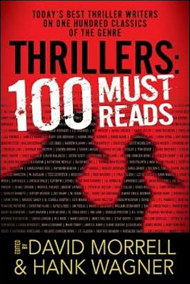
David Morrell wrote about Household’s novel in an essay in ITW : 100 Thriller Novels [Oceanview Publishing] that he edited with Hank Wagner -
 Few novels have a more claustrophobic atmosphere. The mud at the start and the burrow at the end are paralleled by an empty water tank in which the main character is compelled to spend a night. He survives a lethal fight in a dark subway tunnel. Chased, he squirms into clay amid soaked cabbages on a field drenched by rain. He hides in night-shrouded ditches. While these constricted settings add to Rogue Male’s tension, they also reinforce one of the elements that make the book distinctive—the vividness with which the protagonist merges with his surroundings, particularly fields, woods, and streams, as if Household felt a kinship with the transcendentalism of Wordsworth’s nature poetry.
But this is a version of Wordsworth channeled disturbingly through Robert Louis Stevenson’s Robinson Crusoe, Joseph Conrad’s Heart of Darkness, and John Buchan’s The Thirty-Nine Steps, antecedents that Household acknowledged. In the end, the big-game hunter is so absorbed into nature that he descends to the level of one of the animals he used to hunt, a theme suggested by the book’s title and by an epigraph that discusses the fear and cunning of a rogue animal who relies on ferocity after pain or loss separates it from its fellows.
David Morrell had asked Household if he would provide a review or quote for his debut novel First Blood, which like Rogue Male was an outdoor tale of survival where the hunter becomes the hunted. Household declined, citing that he was uncomfortable with the level of violence in First Blood; something that always makes David smile wryly.
The author of a novel in which a rotting polecat is skinned and its guts are used to build a catapult to drive a stake through someone’s forehead told me that he couldn’t possibly give me a quote. “Your novel is far too bloody.”
 Ali Karim and Lee Child
Read the Full Essay by David Morrell relating to Geoffrey Household’s Rogue Male HereI recalled that first Thrillerfest Convention in 2006 and how much fun it had been, with especially warm memories of an earlier event, when I first met Gayle Lynds and David Morrell, the founders of ITW [with many colleagues] back at Bouchercon 2003 in Las Vegas. It was there that David Morrell and I went to Lee Child’s Jack Reacher party at The Peppermill. That time is a much cherished memory for me, as it was there in Las Vegas that the creator of Rambo first met the creator of Reacher.
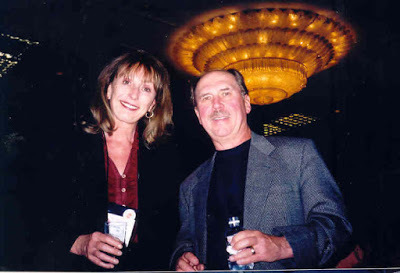 Boucheron in Vegas, David Morrell and Gayle Lynds
I had arrived in Las Vegas early, and attended a writing workshop which was split into two sessions. The first session was presented by the late Jerry Healy. The second session was presented by Gayle Lynds. I had recently enjoyed her novel The Coil, as well as the thrillers she wrote in-concert with Robert Ludlum which were published in the UK by Orion Publishing. Gayle’s session was most interesting as she focused on the common problems in thriller writing. One issue related to much genre work featuring ‘the lone wolf’, which there are many such as Joe Finder’s Nick Heller, Highsmith’s Tom Ripley, Richard Stark’s Parker, Ian Fleming’s James Bond, Tom Cain’s Samuel Carver, Carol O'Connell’s Kathleen 'Kathy' Mallory, Sara Paretsky’s V I Warshawski, Lee Child’s Jack Reacher, David Morrell’s Rambo, Fredrick Forsyth’s Day of the Jackal, Robert Ludlum’s Jason Bourne, John Connolly’s Charlie Parker, True Detectives Marty Hart and Rust Cohle, Peter James’ Roy Grace, Ian Rankin’s John Rebus and many, many others as the list is long.
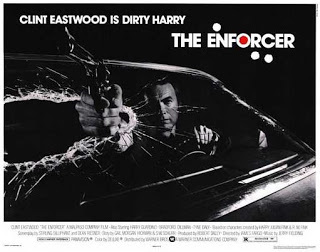
Gayle Lynds explained during her writing seminar on Thriller Fiction, that one of the most common criticisms of this sub-genre of literature is poor characterisation. This is especially true of the protagonist as he/she is often a ‘Lone Wolf’ and like Clint Eastwood’s ‘Dirty Harry’ Callahan, or ‘The Man With No Name’, they often are silent types, as their actions speak louder than words. It takes great skill writing thrillers with a Lone Wolf as Protagonist, without moving across the line that separates Convention from Cliché. This was one of the reasons why Michael Connelly was very careful in selling movie rights to his Harry Bosch novels, as his eponymous detective is a lone wolf. In the end, the Amazon Prime TV series appeared the best option, especially in terms of character development of Harry Bosch over a series of TV Episodes, as opposed to the limitations of a 90 minute film. I discussed this very point with Connelly when I was fortunate to be on set and on location in Los Angeles, with Titus Welliver [who plays Harry Bosch] and the Bosch Production team.
 I quizzed the author about the task he faced in casting Harry Bosch for the small screen. Connelly explained that finding the right actor to portray Bosch had been difficult, as they needed someone who could command the stage in minimalist fashion (i.e., have an expressive persona). Welliver was ultimately deemed the perfect fit, though I’d always imagined Bosch as being chunkier or bulkier, not so svelte as Welliver.
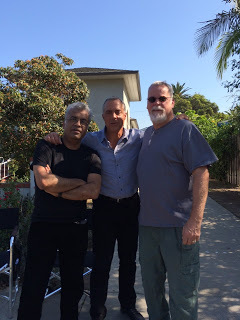 Ali Karim, "Harry Bosch", and Michael ConnollyWhen I told Connelly that, he smiled and said, “Funny you mention that. Just after we cast Titus as Bosch, I did get a call from
James Gandolfini
[of The Sopranos fame], who said he was a huge fan of the Harry Bosch novels.” He told Connelly, “Yes, I know I’m a little heavy, but believe me, I could be a great Harry Bosch.” Connelly looked at me with a bit of sadness as he said, “Though we cast Titus, I was flattered by the call from Tony Soprano. But either way, I very was saddened to hear of
his passing [in 2013]
.” It’s fitting at least that crime-fiction enthusiast Gandolfini’s last, posthumous role was in
The Drop
, a movie based on
Dennis Lehane
’s short story “Animal Rescue.”Read More Here and Here
Ali Karim, "Harry Bosch", and Michael ConnollyWhen I told Connelly that, he smiled and said, “Funny you mention that. Just after we cast Titus as Bosch, I did get a call from
James Gandolfini
[of The Sopranos fame], who said he was a huge fan of the Harry Bosch novels.” He told Connelly, “Yes, I know I’m a little heavy, but believe me, I could be a great Harry Bosch.” Connelly looked at me with a bit of sadness as he said, “Though we cast Titus, I was flattered by the call from Tony Soprano. But either way, I very was saddened to hear of
his passing [in 2013]
.” It’s fitting at least that crime-fiction enthusiast Gandolfini’s last, posthumous role was in
The Drop
, a movie based on
Dennis Lehane
’s short story “Animal Rescue.”Read More Here and Here
Gayle also explained that care also needs to be taken when considering the Antagonist - the villain. She explained that no one is totally good, nor is anyone totally bad. The best villains are those that the writer makes multi-dimensional, showing all the facets of character, not just focusing on the bad. She quoted Thomas Harris, with his Dr Hannibal Lecter. Apart from the evilness of his nature as a cannibal, he is also incredibly cultured, an epicurean, very well read, and a man of the arts. In later novels such as Hannibal, and Hannibal Rising he becomes an Anti-Hero of sorts, almost akin to his precursor, Patricia Highsmith’s Tom Ripley.
“….and did you know Adolf Hitler loved Dogs…..” That statement from Gayle’s Thriller Writing seminar really brought home the importance of characterisation of villains – and brought a silence to the room, as we pondered the significance of that insight into our own work. We are all familiar of the photos of Hitler and his beloved German Shepherd Dogs; for when we contrast the horrors Hitler and his henchmen brought in terms of their inhumanity to their fellow man; his love of Animals makes the horrors he inflicted upon fellow humans, even more repellent.
And coming full-circle, readers of Geoffrey Household’s 1939 Rogue Male will realise that the target [the European Dictator] that the unnamed hunter goes after is a thinly disguised avatar of the leader of the Nazi party in Germany; the same real life villain who was ultimately responsible for the cruel deaths of millions in World War Two; but we must also remember that he loved Animals, especially Dogs.
To conclude this theme of characterisation of Lone Wolves, Protagonists and Antagonists in Thriller Fiction, why not watch last year’s New England talk between Lee Child and Stephen King where they discuss that Lone Wolf, Mr. Jack Reacher, as Lee Child once told me -
“……Seriously neglected among modern works would be Rogue Male [1939], by Geoffrey Household -- the protagonist in that story could have been Reacher's granddad.”
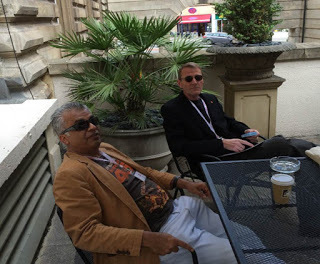
Thanks KJ and fellow Rogue Writers, for inviting me to your Web-Resource allowing me to ramble about Thriller Fiction, which is something of an obsession of mine.
I should also add, I don’t actually like Dogs – in fact I fear them due to a childhood incident, when some Dogs were set on me, but that’s another story, and another time.
 Ali Karim - is the Assistant Editor of Shots eZine and writes and reviews for many US Magazines and Ezines. He was awarded the 2011 David Thompson Memorial Award for Special Services to the Crime and Thriller Genre and in 2013 awarded the Don Sandstrom Lifetime achievement award for services to Crime and Mystery Fandom. Ali contributed to Dissecting Hannibal Lecter ed. Benjamin Szumskyj [McFarland Press], The Greenwood Encyclopaedia of British Crime Fiction [ed. Barry Forshaw] and ITW 100 Thriller Novels ed David Morrell and Hank Hagner [Oceanview Publishing].Karim is also an associate member of The Crime Writers Association [CWA] and was judge for the CWA Gold Dagger Award and is currently a judge for the CWA Ian Fleming Steel Dagger; an associate member of International Thriller Writers Inc. [ITW] and a former literary judge for both best debut novel and best thriller; and an associate member of the Private Eye Writers of America [PWA], and one of the judges of Deadly Pleasures Magazine’s Barry Awards.Karim is a Board Member to Bouchercon [The World Mystery and Crime Convention] and co-chaired programming for Bouchercon 2015, held in Raleigh, North Carolina.
© 2016 A S Karim
Video Links to LONE WOLF
THRILLERFEST VIDEO
https://www.youtube.com/watch?v=cC-buoSM7aQ
TITUS WELLIVER AS BOSCH FILMING BY ALI
https://www.youtube.com/watch?v=N96CfvBJDpQ
RIPLEY’S GAME TRAILER
https://www.youtube.com/watch?v=izIgroi7_NU
LEE CHILD WITH STEPHEN KING
https://www.youtube.com/watch?v=4PaxX-DTGo0
I'm honoured to be hosting crime fiction savant Ali Karim on Rogue Women Writers. I've had the pleasure of knowing Ali for many years, and the SHOTS eZine he is Assistant Editor for offers outstanding coverage of mysteries and thrillers along with the most in-depth analysis of crime fiction that I've seen. Smart, funny, kind, Ali is someone that brings a special enthusiasm to our genre, as you'll soon see. Please don't forget to check out the phenomenal video links at the end of the article. You're in for a treat.
Take it away, Ali...
When KJ Howe asked me to guest blog at Rogue Women, it was an invitation I couldn’t refuse as I love talking about thriller fiction. I first met KJ at the Inaugural Thrillerfest in Phoenix in 2006, as we’re both avid readers of thriller fiction.
 KJ in 2006 at inaugural ThrillerFestI was unable to attend this year’s Thrillerfest due to diary clashes, though I’ve been bumping into KJ a great deal recently, with her appearance at Theakstons Old Peculier Harrogate Crime Writing Festival [following her work at ITW Thrillerfest 2016], as well as Bouchercon New Orleans.
So while pondering what to write; I was backing up my photos on my spare hard drive, and discovered I had a photo of KJ from Thrillerfest 2006, and emailed it to her. We both laughed as fast forwarding a decade, we find KJ about to publish her debut thriller The Freedom Broker, and coincidentally my very old friend, Vicki Mellor of Headline Publishing has UK rights.
Anyway, I digress. The issue was the topic or theme she asked me to write about, had me scratching my head - ‘Animals in Thriller Fiction’. I initially thought about fiction that featured Animals, such as the work of Dean Koontz, the work of Nevada Barr, even CUJO by Stephen King. But my knowledge of Animal Fiction is pretty skimpy, so as I pondered on what to write, I recalled the essay, I wrote for MJ Rose that was used as the introduction in the Inaugural Thrillerfest Brochure in 2006. In that introduction I mentioned the significance of Geoffrey Household, and his 1939 novel Rogue Male to thriller writers and readers – as it is a great example of ‘The Lone Wolf’ as Protagonist. Rogue Male features a “Hunter” who becomes “The Hunted”, with a deadly game of Cat and Mouse.
David Morrell wrote about Household’s novel in an essay in ITW : 100 Thriller Novels [Oceanview Publishing] that he edited with Hank Wagner -
 Few novels have a more claustrophobic atmosphere. The mud at the start and the burrow at the end are paralleled by an empty water tank in which the main character is compelled to spend a night. He survives a lethal fight in a dark subway tunnel. Chased, he squirms into clay amid soaked cabbages on a field drenched by rain. He hides in night-shrouded ditches. While these constricted settings add to Rogue Male’s tension, they also reinforce one of the elements that make the book distinctive—the vividness with which the protagonist merges with his surroundings, particularly fields, woods, and streams, as if Household felt a kinship with the transcendentalism of Wordsworth’s nature poetry.
But this is a version of Wordsworth channeled disturbingly through Robert Louis Stevenson’s Robinson Crusoe, Joseph Conrad’s Heart of Darkness, and John Buchan’s The Thirty-Nine Steps, antecedents that Household acknowledged. In the end, the big-game hunter is so absorbed into nature that he descends to the level of one of the animals he used to hunt, a theme suggested by the book’s title and by an epigraph that discusses the fear and cunning of a rogue animal who relies on ferocity after pain or loss separates it from its fellows.
David Morrell had asked Household if he would provide a review or quote for his debut novel First Blood, which like Rogue Male was an outdoor tale of survival where the hunter becomes the hunted. Household declined, citing that he was uncomfortable with the level of violence in First Blood; something that always makes David smile wryly.
The author of a novel in which a rotting polecat is skinned and its guts are used to build a catapult to drive a stake through someone’s forehead told me that he couldn’t possibly give me a quote. “Your novel is far too bloody.”
 Ali Karim and Lee Child
Read the Full Essay by David Morrell relating to Geoffrey Household’s Rogue Male HereI recalled that first Thrillerfest Convention in 2006 and how much fun it had been, with especially warm memories of an earlier event, when I first met Gayle Lynds and David Morrell, the founders of ITW [with many colleagues] back at Bouchercon 2003 in Las Vegas. It was there that David Morrell and I went to Lee Child’s Jack Reacher party at The Peppermill. That time is a much cherished memory for me, as it was there in Las Vegas that the creator of Rambo first met the creator of Reacher.
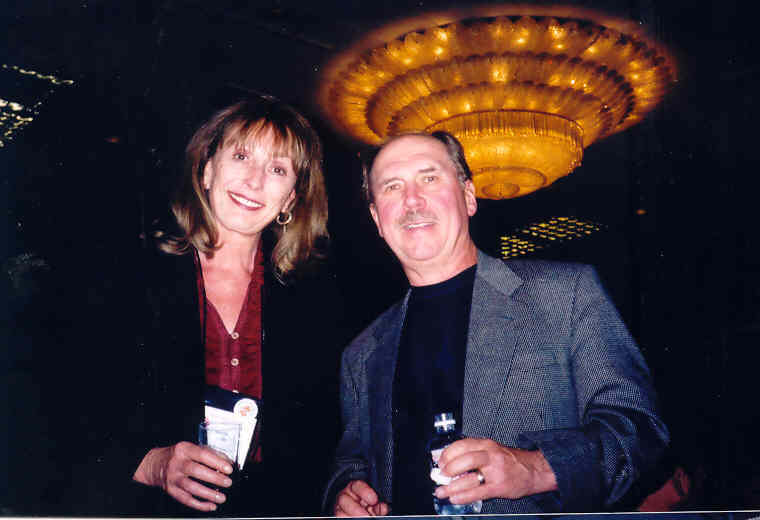 Boucheron in Vegas, David Morrell and Gayle Lynds
I had arrived in Las Vegas early, and attended a writing workshop which was split into two sessions. The first session was presented by the late Jerry Healy. The second session was presented by Gayle Lynds. I had recently enjoyed her novel The Coil, as well as the thrillers she wrote in-concert with Robert Ludlum which were published in the UK by Orion Publishing. Gayle’s session was most interesting as she focused on the common problems in thriller writing. One issue related to much genre work featuring ‘the lone wolf’, which there are many such as Joe Finder’s Nick Heller, Highsmith’s Tom Ripley, Richard Stark’s Parker, Ian Fleming’s James Bond, Tom Cain’s Samuel Carver, Carol O'Connell’s Kathleen 'Kathy' Mallory, Sara Paretsky’s V I Warshawski, Lee Child’s Jack Reacher, David Morrell’s Rambo, Fredrick Forsyth’s Day of the Jackal, Robert Ludlum’s Jason Bourne, John Connolly’s Charlie Parker, True Detectives Marty Hart and Rust Cohle, Peter James’ Roy Grace, Ian Rankin’s John Rebus and many, many others as the list is long.
Gayle Lynds explained during her writing seminar on Thriller Fiction, that one of the most common criticisms of this sub-genre of literature is poor characterisation. This is especially true of the protagonist as he/she is often a ‘Lone Wolf’ and like Clint Eastwood’s ‘Dirty Harry’ Callahan, or ‘The Man With No Name’, they often are silent types, as their actions speak louder than words. It takes great skill writing thrillers with a Lone Wolf as Protagonist, without moving across the line that separates Convention from Cliché. This was one of the reasons why Michael Connelly was very careful in selling movie rights to his Harry Bosch novels, as his eponymous detective is a lone wolf. In the end, the Amazon Prime TV series appeared the best option, especially in terms of character development of Harry Bosch over a series of TV Episodes, as opposed to the limitations of a 90 minute film. I discussed this very point with Connelly when I was fortunate to be on set and on location in Los Angeles, with Titus Welliver [who plays Harry Bosch] and the Bosch Production team.
 I quizzed the author about the task he faced in casting Harry Bosch for the small screen. Connelly explained that finding the right actor to portray Bosch had been difficult, as they needed someone who could command the stage in minimalist fashion (i.e., have an expressive persona). Welliver was ultimately deemed the perfect fit, though I’d always imagined Bosch as being chunkier or bulkier, not so svelte as Welliver.
  Ali Karim, "Harry Bosch", and Michael ConnollyWhen I told Connelly that, he smiled and said, “Funny you mention that. Just after we cast Titus as Bosch, I did get a call from
James Gandolfini
[of The Sopranos fame], who said he was a huge fan of the Harry Bosch novels.” He told Connelly, “Yes, I know I’m a little heavy, but believe me, I could be a great Harry Bosch.” Connelly looked at me with a bit of sadness as he said, “Though we cast Titus, I was flattered by the call from Tony Soprano. But either way, I very was saddened to hear of
his passing [in 2013]
.” It’s fitting at least that crime-fiction enthusiast Gandolfini’s last, posthumous role was in
The Drop
, a movie based on
Dennis Lehane
’s short story “Animal Rescue.”Read More Here and Here
Ali Karim, "Harry Bosch", and Michael ConnollyWhen I told Connelly that, he smiled and said, “Funny you mention that. Just after we cast Titus as Bosch, I did get a call from
James Gandolfini
[of The Sopranos fame], who said he was a huge fan of the Harry Bosch novels.” He told Connelly, “Yes, I know I’m a little heavy, but believe me, I could be a great Harry Bosch.” Connelly looked at me with a bit of sadness as he said, “Though we cast Titus, I was flattered by the call from Tony Soprano. But either way, I very was saddened to hear of
his passing [in 2013]
.” It’s fitting at least that crime-fiction enthusiast Gandolfini’s last, posthumous role was in
The Drop
, a movie based on
Dennis Lehane
’s short story “Animal Rescue.”Read More Here and HereGayle also explained that care also needs to be taken when considering the Antagonist - the villain. She explained that no one is totally good, nor is anyone totally bad. The best villains are those that the writer makes multi-dimensional, showing all the facets of character, not just focusing on the bad. She quoted Thomas Harris, with his Dr Hannibal Lecter. Apart from the evilness of his nature as a cannibal, he is also incredibly cultured, an epicurean, very well read, and a man of the arts. In later novels such as Hannibal, and Hannibal Rising he becomes an Anti-Hero of sorts, almost akin to his precursor, Patricia Highsmith’s Tom Ripley.
“….and did you know Adolf Hitler loved Dogs…..” That statement from Gayle’s Thriller Writing seminar really brought home the importance of characterisation of villains – and brought a silence to the room, as we pondered the significance of that insight into our own work. We are all familiar of the photos of Hitler and his beloved German Shepherd Dogs; for when we contrast the horrors Hitler and his henchmen brought in terms of their inhumanity to their fellow man; his love of Animals makes the horrors he inflicted upon fellow humans, even more repellent.
And coming full-circle, readers of Geoffrey Household’s 1939 Rogue Male will realise that the target [the European Dictator] that the unnamed hunter goes after is a thinly disguised avatar of the leader of the Nazi party in Germany; the same real life villain who was ultimately responsible for the cruel deaths of millions in World War Two; but we must also remember that he loved Animals, especially Dogs.
To conclude this theme of characterisation of Lone Wolves, Protagonists and Antagonists in Thriller Fiction, why not watch last year’s New England talk between Lee Child and Stephen King where they discuss that Lone Wolf, Mr. Jack Reacher, as Lee Child once told me -
“……Seriously neglected among modern works would be Rogue Male [1939], by Geoffrey Household -- the protagonist in that story could have been Reacher's granddad.”

Thanks KJ and fellow Rogue Writers, for inviting me to your Web-Resource allowing me to ramble about Thriller Fiction, which is something of an obsession of mine.
I should also add, I don’t actually like Dogs – in fact I fear them due to a childhood incident, when some Dogs were set on me, but that’s another story, and another time.
 Ali Karim - is the Assistant Editor of Shots eZine and writes and reviews for many US Magazines and Ezines. He was awarded the 2011 David Thompson Memorial Award for Special Services to the Crime and Thriller Genre and in 2013 awarded the Don Sandstrom Lifetime achievement award for services to Crime and Mystery Fandom. Ali contributed to Dissecting Hannibal Lecter ed. Benjamin Szumskyj [McFarland Press], The Greenwood Encyclopaedia of British Crime Fiction [ed. Barry Forshaw] and ITW 100 Thriller Novels ed David Morrell and Hank Hagner [Oceanview Publishing].Karim is also an associate member of The Crime Writers Association [CWA] and was judge for the CWA Gold Dagger Award and is currently a judge for the CWA Ian Fleming Steel Dagger; an associate member of International Thriller Writers Inc. [ITW] and a former literary judge for both best debut novel and best thriller; and an associate member of the Private Eye Writers of America [PWA], and one of the judges of Deadly Pleasures Magazine’s Barry Awards.Karim is a Board Member to Bouchercon [The World Mystery and Crime Convention] and co-chaired programming for Bouchercon 2015, held in Raleigh, North Carolina.
© 2016 A S Karim
Video Links to LONE WOLF
THRILLERFEST VIDEO
https://www.youtube.com/watch?v=cC-buoSM7aQ
TITUS WELLIVER AS BOSCH FILMING BY ALI
https://www.youtube.com/watch?v=N96CfvBJDpQ
RIPLEY’S GAME TRAILER
https://www.youtube.com/watch?v=izIgroi7_NU
LEE CHILD WITH STEPHEN KING
https://www.youtube.com/watch?v=4PaxX-DTGo0