Chris Goff's Blog, page 50
May 31, 2017
Six Tips For Writing About Exotic Locations In Thrillers
by Jamie Freveletti
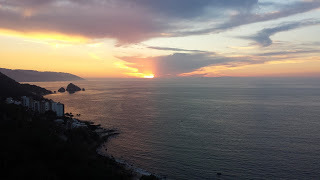 Sunset in Puerto Vallarta Mexico
Think that as a writer you'll be able to sit in an exotic locale and write? Well, you're half right, I've been known to write in any number of exotic locations, but not for the reasons one would think. I've written in Mexico, Brazil, Colombia, Chile, Argentina, Germany, England, Italy and every August in Anguilla, where my family and I would spend two weeks on vacation.
But more often than not I've been writing because my daily word count requires that I do. And don't get me wrong, I love it, but there is definitely something to be said for actually seeing the sunset rather than writing like a crazy woman on a laptop as the sun sets around her. Luckily, I usually write in the early am, so sunsets do not occur without me noticing. Like this one above, taken from the rooftop pool at the Hotel Mousai in Puerto Vallarta with a margarita in hand while my laptop remained locked in the hotel safe.
So let me get to the tips of writing in exotic locales. Some are practical, and some just an observation from my experience and you can take them or leave them as you see fit.
1. Sadly, most places you'll write about in thrillers are just too dangerous to visit.
My first book, Running From The Devil, was set in Colombia during the time of the FARC paramilitary kidnappings. I obtained most of my information from interviews with locals and research, research and more research. Towards the end I was able to fly to Cartagena to visit one of the beaches that I used for the final scene of the book. I checked into the Sofitel there--past the soldier guarding the door with a machine gun and a German Shepherd police dog, and was told by the concierge that a kidnapping at the beach just three weeks ago made it too dangerous for me to attempt. None of the hotel management thought it was a good idea. At all. l made do with more interviews and stayed near the hotel.
My second book, Running Dark, was set partially in Somalia. More interviews with Somalis here in the US and one reporter who was there as we corresponded by email. Not a chance for me to travel there safely, he warned. More research ensued.
2. But the limitations above will often work in your favor.
The biggest mistake some writers make is when they assume that their experience of a location is all that's required. This is not true. Though I've visited St Martin many many times in my annual trips to Anguilla--we fly there and charter a boat because there is are no direct flights in the summer, my actual knowledge of St. Martin was superficial. Sure, I could describe the island as I drove it, could describe the airport, even could talk about the interior, but it took actual research to discover the political and social issues that St. Martin was grappling with. Tourists don't learn of these unless they ask. These issues ended up in my fourth book, Dead Asleep, but I would not have known them had I simply relied on my travel there. Word to the wise, even if you think you are well versed in an area, research will show you even more. Just like those times you've had visitors to your home town, taken them around, and ended up learning more about the city in which you live.
3. Travel blogs are your friend.
My upcoming Emma Caldridge book is set partially in the Sahara desert. Big portions of the book take place in Mauritania. Not a tourist destination. My research made it sound like a bleak place with lovely people but few natural resources or industry to speak of, and even less opportunity. To research this country, I found blogs written by Peace Corps members and intrepid travelers with photos and video. In many cases these were even better than had I been there, because they had a local connection through their Peace Corps posting. Look for these bloggers. They'll really give you an inside scoop into an area.
4. Always try to read local newspapers.
You'll learn about the issues affecting the locals and you'll get a feel for the underbelly of an area. This is even applicable to here in the US. For my first Ludlum book, The Janus Reprisal, I happened to be researching the large ports of Europe and discovered a small report in an Italian paper (in English) about the local police intercepting a shipment of guns with bayonets attached that were hidden in a cargo ship sailing a route between Italy and North Carolina. The reporter noted that this shipping route originated elsewhere, but was a common one for contraband smuggling. I used the information to create a fictional shipment. That report was a great help.
5. Think about insects and wildlife.
If your locale is exotic it's likely the wildlife is as well. Look into the insects that thrive and the local animals. Check out to see if they have wild dogs, feral pigs, vampire bats, and scorpions. Even ritzy hotels in tropical climates have geckos running around and palmetto bugs the size of collies. Write about them. Adds a lot to your story.
6. Drink the local brew.
Aguardiente is quite cheap and common in Colombia and tastes like cough syrup. I drank it in a small bar in Cartagena. Awful stuff to my mind, but many drink it and it plays a role in my first book.
And lastly, if you do get to travel to the locale, enjoy your research trip!
 Sunset in Puerto Vallarta Mexico
Think that as a writer you'll be able to sit in an exotic locale and write? Well, you're half right, I've been known to write in any number of exotic locations, but not for the reasons one would think. I've written in Mexico, Brazil, Colombia, Chile, Argentina, Germany, England, Italy and every August in Anguilla, where my family and I would spend two weeks on vacation.
But more often than not I've been writing because my daily word count requires that I do. And don't get me wrong, I love it, but there is definitely something to be said for actually seeing the sunset rather than writing like a crazy woman on a laptop as the sun sets around her. Luckily, I usually write in the early am, so sunsets do not occur without me noticing. Like this one above, taken from the rooftop pool at the Hotel Mousai in Puerto Vallarta with a margarita in hand while my laptop remained locked in the hotel safe.
So let me get to the tips of writing in exotic locales. Some are practical, and some just an observation from my experience and you can take them or leave them as you see fit.
1. Sadly, most places you'll write about in thrillers are just too dangerous to visit.
My first book, Running From The Devil, was set in Colombia during the time of the FARC paramilitary kidnappings. I obtained most of my information from interviews with locals and research, research and more research. Towards the end I was able to fly to Cartagena to visit one of the beaches that I used for the final scene of the book. I checked into the Sofitel there--past the soldier guarding the door with a machine gun and a German Shepherd police dog, and was told by the concierge that a kidnapping at the beach just three weeks ago made it too dangerous for me to attempt. None of the hotel management thought it was a good idea. At all. l made do with more interviews and stayed near the hotel.
My second book, Running Dark, was set partially in Somalia. More interviews with Somalis here in the US and one reporter who was there as we corresponded by email. Not a chance for me to travel there safely, he warned. More research ensued.
2. But the limitations above will often work in your favor.
The biggest mistake some writers make is when they assume that their experience of a location is all that's required. This is not true. Though I've visited St Martin many many times in my annual trips to Anguilla--we fly there and charter a boat because there is are no direct flights in the summer, my actual knowledge of St. Martin was superficial. Sure, I could describe the island as I drove it, could describe the airport, even could talk about the interior, but it took actual research to discover the political and social issues that St. Martin was grappling with. Tourists don't learn of these unless they ask. These issues ended up in my fourth book, Dead Asleep, but I would not have known them had I simply relied on my travel there. Word to the wise, even if you think you are well versed in an area, research will show you even more. Just like those times you've had visitors to your home town, taken them around, and ended up learning more about the city in which you live.
3. Travel blogs are your friend.
My upcoming Emma Caldridge book is set partially in the Sahara desert. Big portions of the book take place in Mauritania. Not a tourist destination. My research made it sound like a bleak place with lovely people but few natural resources or industry to speak of, and even less opportunity. To research this country, I found blogs written by Peace Corps members and intrepid travelers with photos and video. In many cases these were even better than had I been there, because they had a local connection through their Peace Corps posting. Look for these bloggers. They'll really give you an inside scoop into an area.
4. Always try to read local newspapers.
You'll learn about the issues affecting the locals and you'll get a feel for the underbelly of an area. This is even applicable to here in the US. For my first Ludlum book, The Janus Reprisal, I happened to be researching the large ports of Europe and discovered a small report in an Italian paper (in English) about the local police intercepting a shipment of guns with bayonets attached that were hidden in a cargo ship sailing a route between Italy and North Carolina. The reporter noted that this shipping route originated elsewhere, but was a common one for contraband smuggling. I used the information to create a fictional shipment. That report was a great help.
5. Think about insects and wildlife.
If your locale is exotic it's likely the wildlife is as well. Look into the insects that thrive and the local animals. Check out to see if they have wild dogs, feral pigs, vampire bats, and scorpions. Even ritzy hotels in tropical climates have geckos running around and palmetto bugs the size of collies. Write about them. Adds a lot to your story.
6. Drink the local brew.
Aguardiente is quite cheap and common in Colombia and tastes like cough syrup. I drank it in a small bar in Cartagena. Awful stuff to my mind, but many drink it and it plays a role in my first book.
And lastly, if you do get to travel to the locale, enjoy your research trip!


May 28, 2017
Writing About Exotic Locations
...by Karna Small Bodman
If you could go anywhere, do anything - and write about it -- where and what would it be? That's the question some of my Rogue colleagues have been answering over the past few weeks. Now it's my turn. Thinking about a few of my travels over the years, there were some truly exotic locations where I'd love to return. As for writing novels about these places, let me tell you some stories about them, their histories, along with experiences I've had -- then you decide if they would make good settings for thrillers.
My all time favorite is Lake Como in northern Italy. And what a history: In 49 B.C. Julius Caesar sent 5,000 Roman citizens along with 500 Greek slaves to colonize Como. In 1568 the Cardinal of Como built a villa there, and in 1615 the Sultan of Morocco arrived to check it out. In 1815 the Princess of Wales and future queen of England brought her entourage there and changed the name to Villa d'Este. In 1945 Mussolini and his mistress, Claretta Petacci, were captured in a nearby town and shot. Can you just imagine a thriller plot revolving around that bit of history?
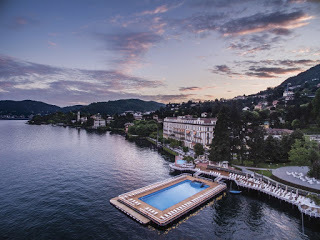 Villa d'Este on Lake ComoThis incredible hotel has inspired poets, writers and artists from the time of Virgil, and more recently became known as a favorite haunt of Clark Gable, Frank Sinatra and Alfred Hitchcock. I've often wondered if the famous producer got inspiration for his films by gazing at the spectacular blue waters, relaxing in the hotel's many pools or simply reflecting on its storied past.
We've had the pleasure of staying there on three occasions, and we learned that there certainly are some interesting characters roaming the area who would make great heroes in any new thriller.
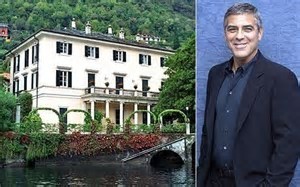 George Clooney's Lake Como villaFor example, George Clooney bought a nearby villa on the lake. We didn't see him or his wife, Amal, on our various sojourns, and now, word has it he is considering a $100 million offer for the place. I'm sure the local paparazzi are hoping he doesn't sell.
Before those trips, I recall an invitation I received to board a friend's 50' sloop and sail through the Lesser Antilles. A particularly memorable anchorage was at the island of Grenada, known as the spice island ever since early explorers brought nutmeg to its sandy shores. You can don your scuba gear and visit one of their 32 famous dive sites, pick up lots of local art and sample delicacies at dozens of great restaurants.
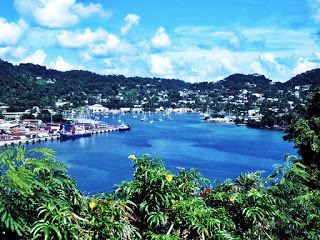 The Harbor at Grenada
However, when it comes to Grenada, the residents will tell you that the most harrowing experience they ever had was back in 1983 when there was a bloody military coup. With a Soviet and Cuban presence on the island and a government "shoot to kill" curfew, American students studying at St. George's University School of Medicine cowered on the floor as bullets crashed through their dormitories.
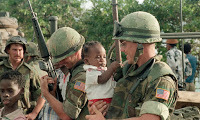
Then, at the urging of the Organization of American States (OAS), President Reagan launched what he called a rescue mission (although others dubbed it an invasion) as US Marines, Army Delta Force and Navy SEALS landed, evacuated the students and restored constitutional order in a matter of weeks.
The New York Times reported, "The students endured days and nights of terror before the American troops arrived." And when six military transport planes carried nearly 400 young Americans back to the United States,
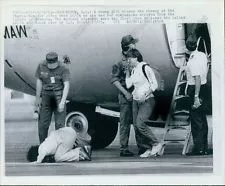
"Some were so happy to be home, they knelt down and kissed the ground." Now imagine how that whole episode could be turned into a heart-pounding thriller.
What type of location should I use in my next thriller? At two recent dinners with friends in Washington, D.C., both groups suggested North Korea. I haven't exactly set foot in that country - but I saw it first-hand standing in the tower overlooking the DMZ from the South Korean side.
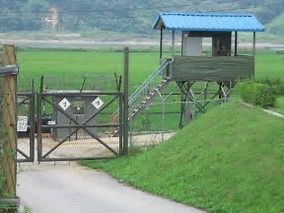 At the DMZ While serving in The (Reagan) White House, I was sent to the Far East (Manila, Hong Kong, Tokyo and Seoul) to give talks on administration policies. Our South Korean Ambassador asked me if there was any special place I would like to see while I was there, and I said, "Yes. Could I possibly go up to the border with North Korea?" And so I climbed aboard an Army helicopter and was transported the short distance to the DMZ (it's about as far from Seoul as Dulles Airport is from downtown Washington - talk about a tense, close environment!). I received a briefing from the Colonel in charge and, on a lighter note, he told me that every time our staff has American visitors, the North Korean soldiers rush to the border to gawk at them. And the times the most North Koreans raced to have a look was when our troops hosted Miss Universe and the Dallas Cowboy Cheerleaders!
I also learned a lot about the North Korean dictators and their policies that have led to a dire economy, lack of food and scant development of resources (except missiles). Their people don't even have basic electricity. One only needs to take a look at photos taken at night by our space Shuttle, of the Korean peninsula to see the stark contrast of lights available to the people of the North vs. the South.
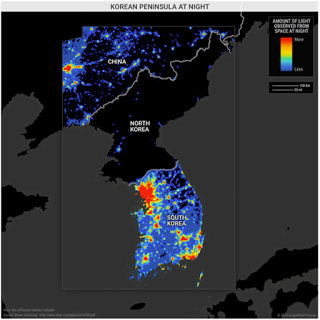 Night photo from space of N. and S. Korea lights
Now I am now doing research on various locations, especially North Korea, for my next thriller. If any of you has a suggestion about plot lines or intriguing characters I could incorporate in the new novel, I would love to add your ideas to the mix. We would also like to hear what thrillers you've enjoyed that were set in exotic locations. Please do leave a comment below. And thanks for visiting us here on Rogue Women Writers.
...Submitted by Karna Small Bodman
If you could go anywhere, do anything - and write about it -- where and what would it be? That's the question some of my Rogue colleagues have been answering over the past few weeks. Now it's my turn. Thinking about a few of my travels over the years, there were some truly exotic locations where I'd love to return. As for writing novels about these places, let me tell you some stories about them, their histories, along with experiences I've had -- then you decide if they would make good settings for thrillers.
My all time favorite is Lake Como in northern Italy. And what a history: In 49 B.C. Julius Caesar sent 5,000 Roman citizens along with 500 Greek slaves to colonize Como. In 1568 the Cardinal of Como built a villa there, and in 1615 the Sultan of Morocco arrived to check it out. In 1815 the Princess of Wales and future queen of England brought her entourage there and changed the name to Villa d'Este. In 1945 Mussolini and his mistress, Claretta Petacci, were captured in a nearby town and shot. Can you just imagine a thriller plot revolving around that bit of history?
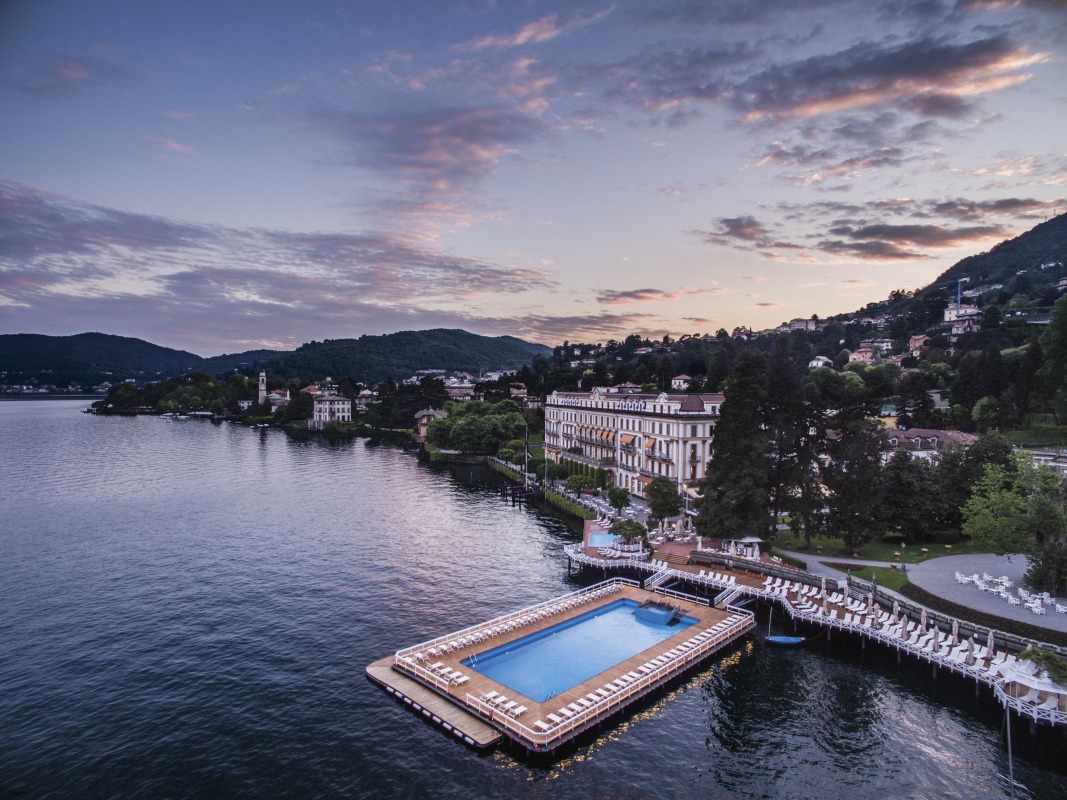 Villa d'Este on Lake ComoThis incredible hotel has inspired poets, writers and artists from the time of Virgil, and more recently became known as a favorite haunt of Clark Gable, Frank Sinatra and Alfred Hitchcock. I've often wondered if the famous producer got inspiration for his films by gazing at the spectacular blue waters, relaxing in the hotel's many pools or simply reflecting on its storied past.
 We've had the pleasure of staying there on three occasions, and we learned that there certainly are some interesting characters roaming the area who would make great heroes in any new thriller.
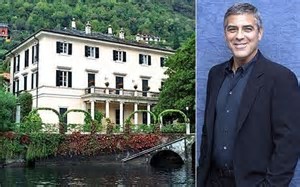 George Clooney's Lake Como villaFor example, George Clooney bought a nearby villa on the lake. We didn't see him or his wife, Amal, on our various sojourns, and now, word has it he is considering a $100 million offer for the place. I'm sure the local paparazzi are hoping he doesn't sell.
Before those trips, I recall an invitation I received to board a friend's 50' sloop and sail through the Lesser Antilles. A particularly memorable anchorage was at the island of Grenada, known as the spice island ever since early explorers brought nutmeg to its sandy shores. You can don your scuba gear and visit one of their 32 famous dive sites, pick up lots of local art and sample delicacies at dozens of great restaurants.
 The Harbor at Grenada
However, when it comes to Grenada, the residents will tell you that the most harrowing experience they ever had was back in 1983 when there was a bloody military coup. With a Soviet and Cuban presence on the island and a government "shoot to kill" curfew, American students studying at St. George's University School of Medicine cowered on the floor as bullets crashed through their dormitories.

Then, at the urging of the Organization of American States (OAS), President Reagan launched what he called a rescue mission (although others dubbed it an invasion) as US Marines, Army Delta Force and Navy SEALS landed, evacuated the students and restored constitutional order in a matter of weeks.
The New York Times reported, "The students endured days and nights of terror before the American troops arrived." And when six military transport planes carried nearly 400 young Americans back to the United States,
"Some were so happy to be home, they knelt down and kissed the ground." Now imagine how that whole episode could be turned into a heart-pounding thriller.
What type of location should I use in my next thriller? At two recent dinners with friends in Washington, D.C., both groups suggested North Korea. I haven't exactly set foot in that country - but I saw it first-hand standing in the tower overlooking the DMZ from the South Korean side.
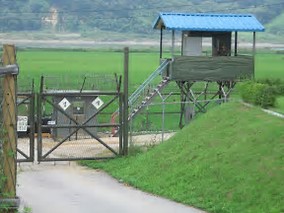 At the DMZ While serving in The (Reagan) White House, I was sent to the Far East (Manila, Hong Kong, Tokyo and Seoul) to give talks on administration policies. Our South Korean Ambassador asked me if there was any special place I would like to see while I was there, and I said, "Yes. Could I possibly go up to the border with North Korea?" And so I climbed aboard an Army helicopter and was transported the short distance to the DMZ (it's about as far from Seoul as Dulles Airport is from downtown Washington - talk about a tense, close environment!). I received a briefing from the Colonel in charge and, on a lighter note, he told me that every time our staff has American visitors, the North Korean soldiers rush to the border to gawk at them. And the times the most North Koreans raced to have a look was when our troops hosted Miss Universe and the Dallas Cowboy Cheerleaders!
I also learned a lot about the North Korean dictators and their policies that have led to a dire economy, lack of food and scant development of resources (except missiles). Their people don't even have basic electricity. One only needs to take a look at photos taken at night by our space Shuttle, of the Korean peninsula to see the stark contrast of lights available to the people of the North vs. the South.
 Night photo from space of N. and S. Korea lights
Now I am now doing research on various locations, especially North Korea, for my next thriller. If any of you has a suggestion about plot lines or intriguing characters I could incorporate in the new novel, I would love to add your ideas to the mix. We would also like to hear what thrillers you've enjoyed that were set in exotic locations. Please do leave a comment below. And thanks for visiting us here on Rogue Women Writers.
...Submitted by Karna Small Bodman
May 24, 2017
SNATCHED--Goldie Hawn and Amy Schumer
by K.J. Howe
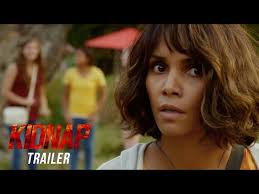
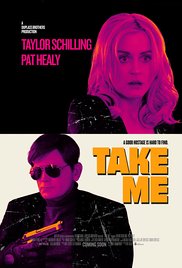
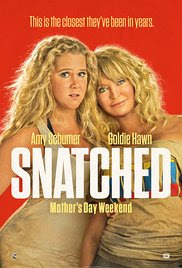 Kidnapping has captured the imagination of Hollywood. Halle Berry fights for the return of her daughter in Kidnap, a mama lion ready to defend her cub at any cost. Taylor Shilling engages in a cat-and-mouse game when she hires a company to abduct her in Take Me. And comedic geniuses Goldie Hawn and Amy Schumer go off the grid when mother and daughter are kidnapped in Snatched, an outrageously funny jungle adventure.
But kidnapping is no laughing matter. With over 40,000 reported cases a year, it has become an international crisis, one that is appearing daily in the news. With spring break season upon us, it’s critical to be aware of your personal safety, especially if you’re traveling to one of the world’s kidnapping hotspots.
After researching and working with some of the best hostage negotiators in the country and abroad while writing my novel The Freedom Broker, I can offer advice to Amy and Goldie—and others—during a kidnapping. If you ever have the misfortune of being abducted, it’s critical to be prepared for every eventuality. In fact, following the lessons in these five points could be key to your survival:
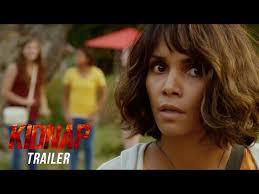 1 When you’re first kidnapped, remain calm and offer no resistance. The abduction is one of the most dangerous moments during a kidnapping, so your captors will be on edge. They will immediately want to establish their dominance, so be prepared for harsh or forceful treatment. To maintain control, your captors might also drug, blindfold, or gag you. Don’t panic, they want to keep you alive and healthy so they can secure your ransom. If you are able, try to remember the details of your journey so you have a sense of where you are being held.
“Never try to negotiate for yourself while being held captive. Know that despite what the kidnappers may say, your family and/or employer is working diligently on your behalf to effect your safe and timely release.” Gary Noesner, former FBI Hostage Negotiator
2 While in captivity, try to gain the respect of your captors—without directly challenging them—by asking for small luxuries like extra food or toilet paper. You want the kidnappers to see you as a person rather than a dehumanized victim. Bond with them so you will receive better treatment. To maintain your strength, eat and drink everything you are given. Establish a routine, as you may be in captivity for a long time. Keep yourself clean and exercise every day. Boredom is your enemy, so keep your mind active by taking on a mental project, like building your dream house or writing a book.
“Humanize yourself and build a rapport with your captors. Start small with getting different foods, and build up from there.” Peter Moore, former hostage held almost 1000 days in Iraq
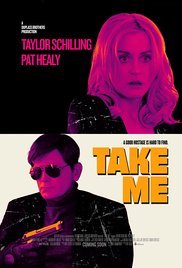 Maintaining hope is critical during a kidnapping. Remember that your loved ones will be working hard for your release. Remain positive knowing the vast majority of hostages survive. This is not the time to be demanding and difficult. Try to blend in with other captives and avoid being confrontational.
“It is extremely rare for a hostage in a kidnap for ransom case to be killed—it becomes a bad business model for the kidnappers. Their goal is to obtain money, plain and simple, and that is less likely when they kill the hostage. If they killed a hostage after securing the money, future victim families will stop paying money, seeing it as ineffective.” Gary Noesner, former FBI hostage negotiator
4 If you are attempting an escape, plan a route before you leave. Once you commit to your course of action, don’t hesitate. Act with speed and aggression, and make your way to a previously identified safe haven or secure location. If you are caught, your kidnappers may make an example of you to dissuade other escape attempts.
“If you choose to escape, then you must be totally committed—think it through and prepare yourself now, as later may be too late.” Dr. Frank Grimm, hostage negotiator, Constellis Group
During a rescue, make sure you drop to the ground, spread your arms, hands open and flat on the floor. Do not move voluntarily, even if you think the action has stopped. Follow the rescuers' instructions without hesitation until you are safe again.
“Expect to be treated as a suspected hostage taker. You may be restrained and treated in a forceful manner.” Dr. Frank Grimm, hostage negotiator, Constellis Group
In closing, with kidnapping becoming a serious international issue, it’s critical for travelers to take extra precautions to protect themselves. Prevention is the best solution.
"Remember that kidnap for ransom is a crime in which both parties, the kidnappers and the family/corporation, both want the same outcome, the release of the hostage. The kidnappers want money but can only sell the hostage to one entity, therefore the family or corporation has some measure of control over the outcome. Simply put, the kidnappers need the good guys to pay. Resolving a kidnap requires a thoughtful quid pro quo negotiation process to be effective.”
Gary Noesner, former FBI hostage negotiatorOhohHostHOatage
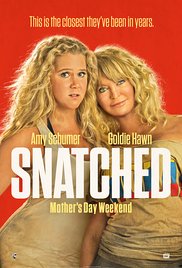 Kidnapping has captured the imagination of Hollywood. Halle Berry fights for the return of her daughter in Kidnap, a mama lion ready to defend her cub at any cost. Taylor Shilling engages in a cat-and-mouse game when she hires a company to abduct her in Take Me. And comedic geniuses Goldie Hawn and Amy Schumer go off the grid when mother and daughter are kidnapped in Snatched, an outrageously funny jungle adventure.
But kidnapping is no laughing matter. With over 40,000 reported cases a year, it has become an international crisis, one that is appearing daily in the news. With spring break season upon us, it’s critical to be aware of your personal safety, especially if you’re traveling to one of the world’s kidnapping hotspots.
After researching and working with some of the best hostage negotiators in the country and abroad while writing my novel The Freedom Broker, I can offer advice to Amy and Goldie—and others—during a kidnapping. If you ever have the misfortune of being abducted, it’s critical to be prepared for every eventuality. In fact, following the lessons in these five points could be key to your survival:
 1 When you’re first kidnapped, remain calm and offer no resistance. The abduction is one of the most dangerous moments during a kidnapping, so your captors will be on edge. They will immediately want to establish their dominance, so be prepared for harsh or forceful treatment. To maintain control, your captors might also drug, blindfold, or gag you. Don’t panic, they want to keep you alive and healthy so they can secure your ransom. If you are able, try to remember the details of your journey so you have a sense of where you are being held.
“Never try to negotiate for yourself while being held captive. Know that despite what the kidnappers may say, your family and/or employer is working diligently on your behalf to effect your safe and timely release.” Gary Noesner, former FBI Hostage Negotiator
2 While in captivity, try to gain the respect of your captors—without directly challenging them—by asking for small luxuries like extra food or toilet paper. You want the kidnappers to see you as a person rather than a dehumanized victim. Bond with them so you will receive better treatment. To maintain your strength, eat and drink everything you are given. Establish a routine, as you may be in captivity for a long time. Keep yourself clean and exercise every day. Boredom is your enemy, so keep your mind active by taking on a mental project, like building your dream house or writing a book.
“Humanize yourself and build a rapport with your captors. Start small with getting different foods, and build up from there.” Peter Moore, former hostage held almost 1000 days in Iraq
 Maintaining hope is critical during a kidnapping. Remember that your loved ones will be working hard for your release. Remain positive knowing the vast majority of hostages survive. This is not the time to be demanding and difficult. Try to blend in with other captives and avoid being confrontational.
“It is extremely rare for a hostage in a kidnap for ransom case to be killed—it becomes a bad business model for the kidnappers. Their goal is to obtain money, plain and simple, and that is less likely when they kill the hostage. If they killed a hostage after securing the money, future victim families will stop paying money, seeing it as ineffective.” Gary Noesner, former FBI hostage negotiator
4 If you are attempting an escape, plan a route before you leave. Once you commit to your course of action, don’t hesitate. Act with speed and aggression, and make your way to a previously identified safe haven or secure location. If you are caught, your kidnappers may make an example of you to dissuade other escape attempts.
“If you choose to escape, then you must be totally committed—think it through and prepare yourself now, as later may be too late.” Dr. Frank Grimm, hostage negotiator, Constellis Group
During a rescue, make sure you drop to the ground, spread your arms, hands open and flat on the floor. Do not move voluntarily, even if you think the action has stopped. Follow the rescuers' instructions without hesitation until you are safe again.
“Expect to be treated as a suspected hostage taker. You may be restrained and treated in a forceful manner.” Dr. Frank Grimm, hostage negotiator, Constellis Group
In closing, with kidnapping becoming a serious international issue, it’s critical for travelers to take extra precautions to protect themselves. Prevention is the best solution.
"Remember that kidnap for ransom is a crime in which both parties, the kidnappers and the family/corporation, both want the same outcome, the release of the hostage. The kidnappers want money but can only sell the hostage to one entity, therefore the family or corporation has some measure of control over the outcome. Simply put, the kidnappers need the good guys to pay. Resolving a kidnap requires a thoughtful quid pro quo negotiation process to be effective.”
Gary Noesner, former FBI hostage negotiatorOhohHostHOatage
May 21, 2017
Paris in the Spring
S. Lee Manning: This round, all of us Rogues are individually answering the question: If I could be anywhere and do anything, what would it be? Well, in my case, I’d be exactly where I am now. I’m writing this blog ten days before my flight, but by the time you read it, I’ll be there. Paris.
Assuming all goes to plan, I am spending my mornings writing in a café near the apartment that we’re renting in the Marais. I am sipping cappuccinos and nibbling on pastries while scenes and dialogue flow from my mind through my fingertips and onto the computer screen. Then, after getting down an astonishingly great few pages, I spend my afternoons and evenings exploring the city of lights and trying to improve my very basic French. I am with the man I love who’s been by my side, if you count the time before our marriage, for 36 years.
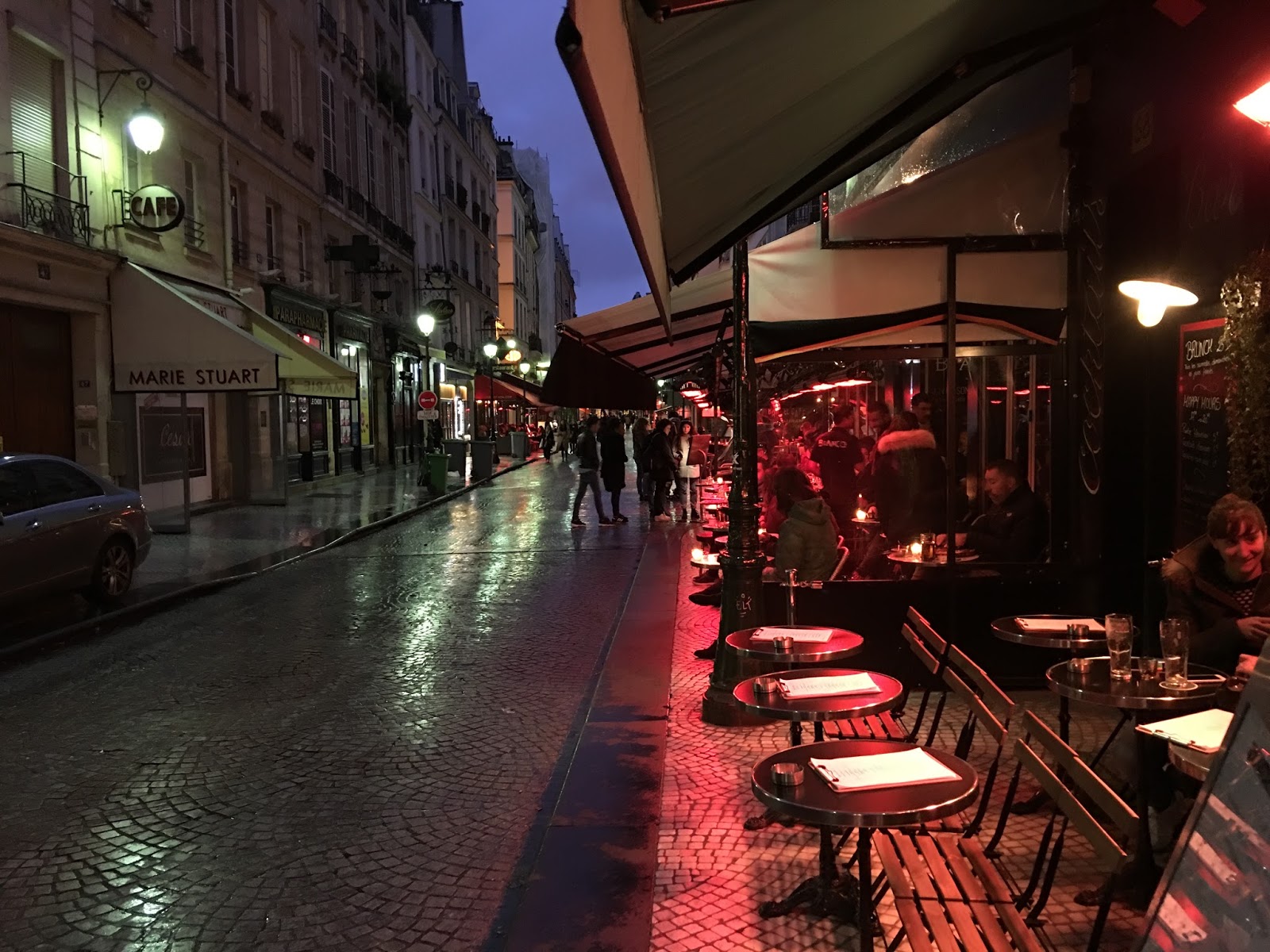 A bistro in Paris at night.It doesn’t get better than this.
Oh, yeah, there is the question of reality. I’m writing this before my arrival in the city. Will the pages actually get written, and will they actually be amazing? Or will I get up in the morning and say, screw writing, I’m in Paris. Will I spend a month eating French pastries and balloon up twenty pounds? Will I be trying to write at a table outside while Europeans light up and cigarette smoke blows over me? Will there be terrorism scares? Will the apartment we rented sight unseen actually be charming and not cramped and a little too small for two big people – and will the bed feel like sleeping on cement? Will my husband and I argue over whether we go shopping or go to the Louvre?
All is quite possible in the real world.
But screw reality. This blog is about fantasy fulfillment.
There is something about Paris and writing. Woody Allen explored it a little in his movie, Midnight in Paris. There is a certain – je ne sais quoi – about the idea of writing in a city where so many have written – a city with so much richness in culture and history.
 At the Seine, with the Eiffel Tower in the distance.There is something about just being in Paris. We were there just around a year ago, traveling with our daughter, who flew out from LA to join us. We visited the Tour Eiffel and Notre Dame in our winter coats, because that April was amazingly cold. But there was still the charm – and the magic. The cafes – the bistros – the pastries….
I didn’t even make a token effort to write last year. We were traveling every few days. I didn’t schlep my computer to Europe because I had enough to carry, and I knew I wouldn’t be writing. I did scribble some notes here and there, sort of a travel diary, although I wasn’t consistent even with that. There was just too much to do and too much to see.
Last year was something of a sampling menu. We took small bites of London, Paris, Beaune, Lyon, Arles, Avignon, Nice, Cannes, Dublin, and the wild Atlantic coast of Ireland. All wonderful, but not enough time to really feel a part of any of the places we visited.
 Jenny and Jim last year on the Promenade des Anglais in Nice.
This trip to Paris is different. Three weeks should be enough time to get a real feel of what the city is like. Hopefully, I am relaxed enough about being here to be comfortable, and motivated enough, to spend time writing as well as exploring. After all, these are two of my favorite things to do.
And this time, it's just the two of us. It's different traveling just with my husband. I love my children, and I like traveling with them, but there's something about three weeks in the city of love with just my husband that is pretty damn good.
Of course, my next fantasy is about renting a castle in Scotland. In this fantasy, both my kids, with their significant others, join us. I spend mornings writing and the afternoons exploring Scotland with my family. I produce an amazing novel. No one argues with anyone. Everyone has a fabulous experience.
Aren’t fantasies wonderful?
Postscript: May 18. I'm in Paris in an absolutely charming apartment, with a comfortable bed and a view of the Paris streets and rooftops. We have been exploring the city non-stop, and I'm walking between 5 and 7 miles a day, so although I'm eating enough French pastries and French cooking to otherwise put on the pounds, my weight has been stable. We've had wonderful experiences, and we've managed to hold limited conversations in French. Yesterday, I holed up with my computer in a little cafe close to the Picasso museum, sipping espresso and nibbling on a heavenly piece of lemon tart dusted with white powdered sugar. I finished a chapter while jazz music played. Jim will be taking a cooking class at the Cordon Bleu today while I ensconce myself in a cafe close to the apartment and hope for another good writing day. C'est magnifique.
 View from our apartment in Paris.
Waving to you from Paris.
May 16, 2017
Going to Moscow ... Want to come along?
 I'm currently reading 4 great books. Why the Post-its & paper scraps marking passages? Read on....
By Gayle Lynds. Recently a fellow writer asked me to suggest a book to learn about espionage “so I can write more detailed, knowledgeable fiction.”
What a wonderful question. But my head reeled. How do I choose? And then, how do I explain about the wealth of books, magazine articles, online articles, and intelligence-gathering sources I use that’ll answer your questions and feed your curiosity for more answers?
Plus of course there are human sources — humint — men and women in the intelligence field or retired from it who are generous with their insights and observations.
All of this available in one book?
 Books & other research on espionage, in my office.
For me, writing about the spy field is a lifestyle, a constant intake of information, finding one nugget and pursuing it as it dies a natural death or explodes into more nuggets. My only problem is knowing when to stop.
The spy novel on which I’m working is set largely in Moscow, and I’m fascinated by the culture, the beauty, the depravity, the generosity. I need to know about that and more.... Sights, odors, colors. People. Spassky Gate. The bridges illuminated by twinkling lights. Busy Komsomol Square where three rail terminals converge and a tall statue of Lenin stands nearby, watching as he holds the lapel of his coat with one hand while the other reaches for a back pocket. Lenin appears to have just realized his wallet has been swiped. That’s Komsomol Square.
Here’s an example of the variety research I find useful....
History: “... parades in the Soviet Union were not something you watched, they were something you participated in. The only observers were the members of the ruling Politburo atop Lenin and Stalin’s tomb in Red Square and a few invited members of the diplomatic corps in the bleachers alongside.” — Moscow Stories by Loren R. Graham
Traffic: “I soon learned that an ambulance stopping to pick up a fare in Moscow wasn’t unusual. Every vehicle was a potential taxi. Private cars, dump trucks, police cruisers — everyone was so desperate for money that any and all would take fares.” — Red Notice: A True Story of High Finance, Murder, and One Man’s Fight for Justice
by Bill Browder
 Books on floor shelves, with Soviet-era map above
Vladimir Putin, 2005: “... Putin pulled a pack of 3-by-5 cards from his inside jacket pocket — the Americans called them his ‘grievance cards’ — and began lecturing [President George W.] Bush about ... well, about how fed up he was being lectured to by the Americans.” — The Strongman: Vladimir Putin and the Struggle for Russia by Angus Roxburgh
Oligarchs at a swank nightclub: “New arrivals were greeted by women who were beautiful on a surreal level. The interior design was out of Somerset Maugham, all dark woods and lazy ceiling fans. Here a man could sip Johnnie Walker Blue, light a Cuban cigar, sip a brandy, unwind, and make more money.” — “Moscow Never Sleeps” by Martin Cruz Smith, National Geographic.
All of the above play roles in my new spy novel, plus of course the machinations of the FSB, the Kremlin, dissidents, apologists, old Communists, new democrats, the ordinary citizen just trying to get by. They’re the heaving, striving, boisterous testament to a city fueled by ambition and guaranteed never to be boring.
So in answer to my friend’s question of one book to fill out the details of espionage, how can I choose? Instead, let’s all go to Moscow and find out for ourselves. Guaranteed, we won't be bored.
With this post I begin the next round of Rogue offerings that ask the timeless question: If you could go anywhere and do anything, where and what would it be?
May 14, 2017
I'M A WRITER?
by Chris Goff
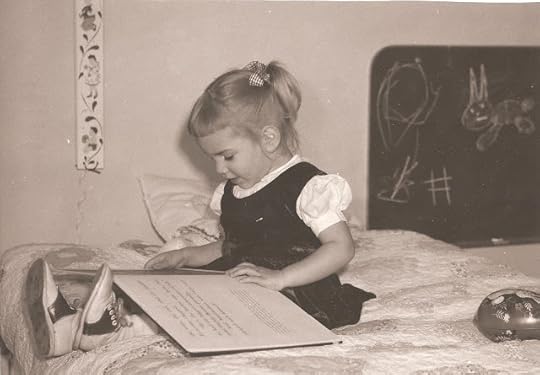 The author at age 2When I was little, very early on I learned how to tell a story. Both my mom and dad were storytellers. My mother could mesmerize a room. My father was a musician, who'd had his own radio show and loved community theater. Both were fearless when it came to entertaining a crowd. My biggest challenge growing up was to know how much of what they told me was true, and how much was a tad embellished.
As a little girl, my favorite story was about me, of course. It goes something like this.
When I was about two, and newly potty-trained, I sat down on the settee to "read." The pictures in the book must have been enthralling because I totally missed the fact I needed to go to the bathroom. My mother, who was talking on the phone, walking the house tethered to the 25' long telephone cord, came out from the kitchen and found me standing up and staring down at a giant wet spot on the velvet. She gave me a look, then watched the wheels start turning in my head looking for someone else to blame. The thing was, I was an only child. Finally, copying her look, I pointed at the puppy and said, "Vicky, naughty dog!"
Throughout my childhood I remember them telling stories about our escapades.
There was the time my father taught me to sing "The Cat and the Mouse." Mind you, I was five. His version goes like this:
 Oh, some liquor was spilled on the barroom floor
The bar was closed for the night
When a little mouse crawled from a hole in the wall
Out in the pale moon light
He lapped up the liquor on the barroom floor
And on his haunches he sat
And all night long, you could hear him roar: "Bring on your G--damn cat!"
I practiced, and practiced, and then on Sunday, when the Sunday school teacher asked if anyone knew any songs, I proudly stood and shared my ditty. As my mother tells it, the teacher's eyes grew wide, then she cleared her throat and said, "That was lovely, Christy. Now let's all sing 'Jesus Loves Me.'"
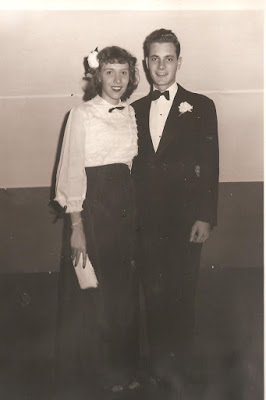 And there was the time my mother and her college roommates thought it would be funny to drop water balloons down the stairwell of the dorm—and their timing was perfect. Just as my mother dropped her balloon, the dean's wife crossed the foyer in a black crepe dress and pearls. In case you don't know, crepe shrivels when it gets wet...
And the time that my dad and his best buddy, Vic, went down to Michigan Lake, at night, when the smelt were running. They came home with a huge tub full of the little silver fish, way too many for our families to eat. After a day of offering smelt to friends and neighbors, the fish began to smell and Dad and Uncle Vic soon realized they needed to think of a better way to dispose of their catch. It was my mother and Aunt D who came up with the plan. The next day was Sunday, so while everyone including me was at church, my folks slipped out with Uncle Vic and Aunt D, and they left small, smelly pails of smelt on the doorsteps of all the parishioners.
I loved all types of stories. My dad had a book of poems from when he was a little boy, Silver Pennies, a Collection of Modern Poems for Boys and Girls by Blanche Jennings Thompson (The MacMillan Company, 1925), and I remember memorizing the poems as he read them aloud, me curled up on the sofa while he balanced on the bongo board. My all time favorite in the collection was a poem by Oliver Herford:
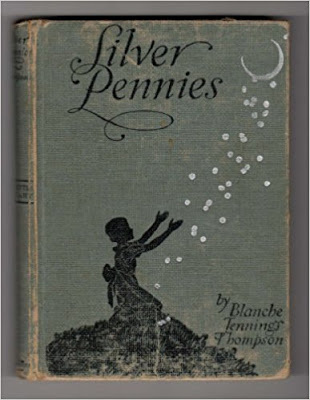 The Elf and the Dormouse
Under a toadstool crept a wee Elf, Out of the rain to shelter himself. Under the toadstool, sound asleep, Sat a big Dormouse all in a heap. Trembled the wee Elf, frightened, and yet Fearing to fly away lest he get wet. To the next shelter maybe a mile! Sudden the wee Elf smiled a wee smile, Tugged till the toadstool toppled in two. Holding it over him, gaily he flew. Soon he was safe home, dry as could be. Soon woke the Dormouse " Good gracious me! "Where is my toadstool?" loud he lamented. And that's how umbrellas first were invented.
The first book I remember was Pinocchio. When I turned six, my dad began reading me a chapter, sometimes two, every night at bedtime. After we finished the book, we read The Wind in the Willows, followed by The Adventures of Danny Meadow Mouse. My dad loved to read, and he passed that love on to me.
My mother loved to write.
When I was nine, I wrote my first real story. It was a class assignment, and supposed to be short, but mine turned into a mini-novella. It was called The Haunted House, and it was about a group of neighborhood children who discovered a haunted house inhabited by a witch. They would spy on her, and soon realized that every night she would go out flying around on her broom. One night, wanting to know what was inside her house, the kids waited for her to go out, and then they snuck inside and messed around with her Eye of Newt. It was a great story, and I got an A, but that "book" never sold.
Nor did the one that followed.
By then I was a working journalist, married and living in Frisco, Colorado. At a library presentation one evening, I met a bestselling romance writer who had recently moved into town. When she agreed to mentor me, I decided to tackle writing a novel of romantic suspense. I set the book in Breckenridge, CO, and told the story of a handsome ski instructor and the woman who fell in love with him. After uncovering a counterfeiting operation, my heroine found herself the target of gangsters. The hero wanted to help her, and the two of them fell in love. There was lots of skiing, romance, danger, mystery and snow. I called it—wait for it—Frozen Assets.
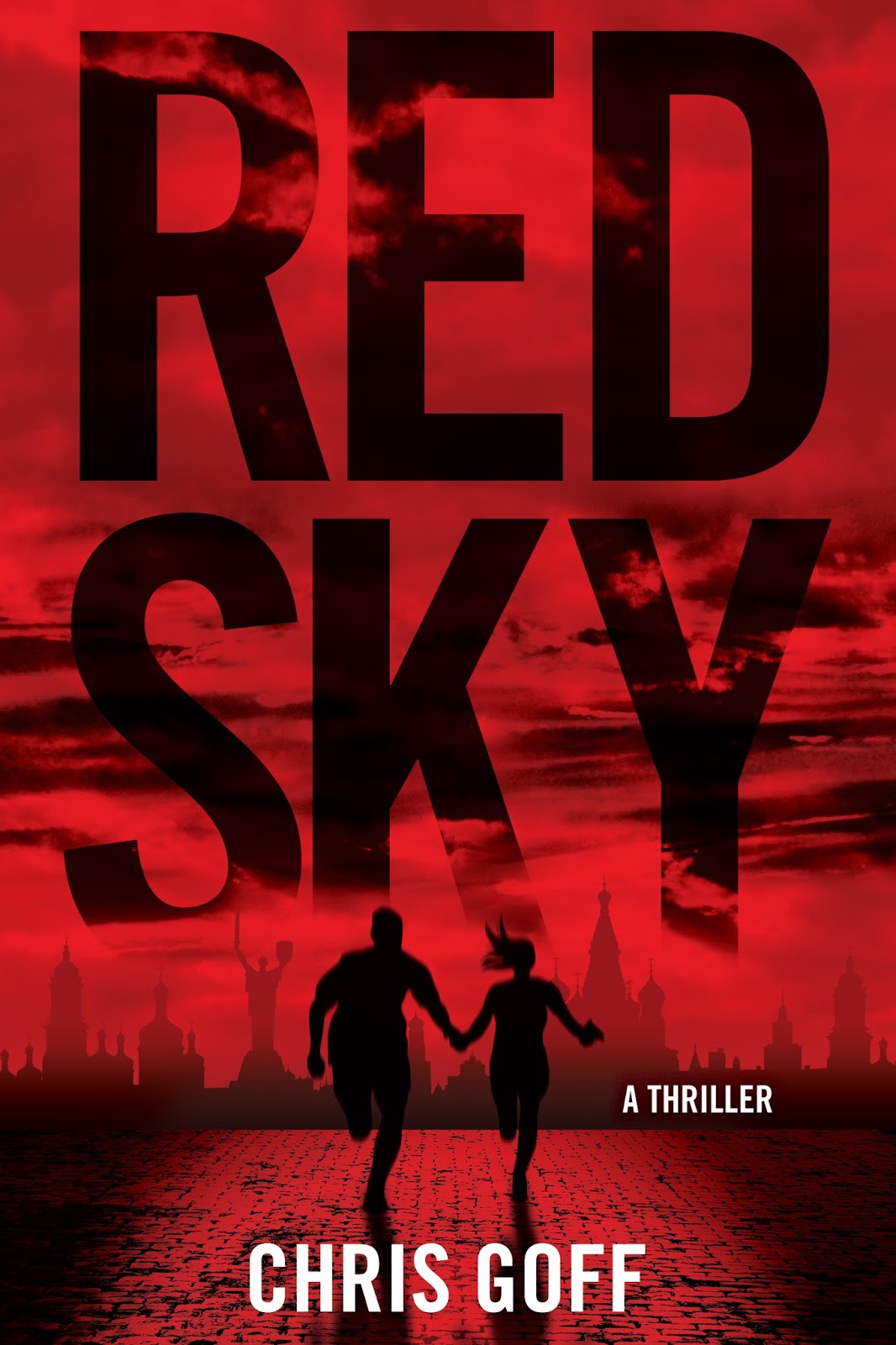
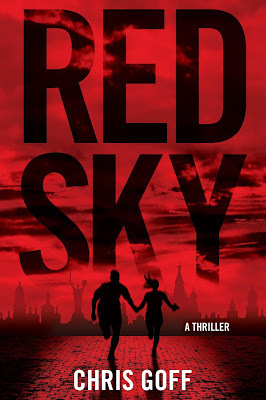 That book never sold either. Nor did the one that followed it. But I eventually did sell a book. Actually, I sold a few books. I studied the craft of writing, got better at telling my stories, and then sold even more books. Today I am the author of six books in a Birdwatcher's Mystery series and two international thrillers, Dark Waters and Red Sky.
Quick pause for a moment of Blatant Self Promotion. Red Sky comes out in June and tells the story of U.S. Diplomatic Security Service agent, Raisa Jordan. When People’s Republic Flight 91 crashes in northeastern Ukraine with a U.S. diplomatic agent on board, Jordan is sent to the scene to investigate. It quickly becomes apparent that the plane was intentionally downed. But why? As international relations crumble and more lives hang in the balance, Jordan must race to stop a new Cold War. Catherine Coulter called it, "Breathtaking suspense." It is currently available to Pre-Order. And, if you haven't had the chance to read Dark Waters, the eBook and hardcover are currently down-priced.
Back to becoming a writer.... Even with eight books published and a new one in the works, I've never really thought much about it. You see, I've been a storyteller all of my life. I guess putting the words on paper was just part of a natural progression.
What did you become, and how did you decide to become it? I'd love to hear your stories.
 The author at age 2When I was little, very early on I learned how to tell a story. Both my mom and dad were storytellers. My mother could mesmerize a room. My father was a musician, who'd had his own radio show and loved community theater. Both were fearless when it came to entertaining a crowd. My biggest challenge growing up was to know how much of what they told me was true, and how much was a tad embellished.
As a little girl, my favorite story was about me, of course. It goes something like this.
When I was about two, and newly potty-trained, I sat down on the settee to "read." The pictures in the book must have been enthralling because I totally missed the fact I needed to go to the bathroom. My mother, who was talking on the phone, walking the house tethered to the 25' long telephone cord, came out from the kitchen and found me standing up and staring down at a giant wet spot on the velvet. She gave me a look, then watched the wheels start turning in my head looking for someone else to blame. The thing was, I was an only child. Finally, copying her look, I pointed at the puppy and said, "Vicky, naughty dog!"
Throughout my childhood I remember them telling stories about our escapades.
There was the time my father taught me to sing "The Cat and the Mouse." Mind you, I was five. His version goes like this:
 Oh, some liquor was spilled on the barroom floor
The bar was closed for the night
When a little mouse crawled from a hole in the wall
Out in the pale moon light
He lapped up the liquor on the barroom floor
And on his haunches he sat
And all night long, you could hear him roar: "Bring on your G--damn cat!"
I practiced, and practiced, and then on Sunday, when the Sunday school teacher asked if anyone knew any songs, I proudly stood and shared my ditty. As my mother tells it, the teacher's eyes grew wide, then she cleared her throat and said, "That was lovely, Christy. Now let's all sing 'Jesus Loves Me.'"
 And there was the time my mother and her college roommates thought it would be funny to drop water balloons down the stairwell of the dorm—and their timing was perfect. Just as my mother dropped her balloon, the dean's wife crossed the foyer in a black crepe dress and pearls. In case you don't know, crepe shrivels when it gets wet...
And the time that my dad and his best buddy, Vic, went down to Michigan Lake, at night, when the smelt were running. They came home with a huge tub full of the little silver fish, way too many for our families to eat. After a day of offering smelt to friends and neighbors, the fish began to smell and Dad and Uncle Vic soon realized they needed to think of a better way to dispose of their catch. It was my mother and Aunt D who came up with the plan. The next day was Sunday, so while everyone including me was at church, my folks slipped out with Uncle Vic and Aunt D, and they left small, smelly pails of smelt on the doorsteps of all the parishioners.
I loved all types of stories. My dad had a book of poems from when he was a little boy, Silver Pennies, a Collection of Modern Poems for Boys and Girls by Blanche Jennings Thompson (The MacMillan Company, 1925), and I remember memorizing the poems as he read them aloud, me curled up on the sofa while he balanced on the bongo board. My all time favorite in the collection was a poem by Oliver Herford:
 The Elf and the Dormouse
Under a toadstool crept a wee Elf, Out of the rain to shelter himself. Under the toadstool, sound asleep, Sat a big Dormouse all in a heap. Trembled the wee Elf, frightened, and yet Fearing to fly away lest he get wet. To the next shelter maybe a mile! Sudden the wee Elf smiled a wee smile, Tugged till the toadstool toppled in two. Holding it over him, gaily he flew. Soon he was safe home, dry as could be. Soon woke the Dormouse " Good gracious me! "Where is my toadstool?" loud he lamented. And that's how umbrellas first were invented.
The first book I remember was Pinocchio. When I turned six, my dad began reading me a chapter, sometimes two, every night at bedtime. After we finished the book, we read The Wind in the Willows, followed by The Adventures of Danny Meadow Mouse. My dad loved to read, and he passed that love on to me.
My mother loved to write.
When I was nine, I wrote my first real story. It was a class assignment, and supposed to be short, but mine turned into a mini-novella. It was called The Haunted House, and it was about a group of neighborhood children who discovered a haunted house inhabited by a witch. They would spy on her, and soon realized that every night she would go out flying around on her broom. One night, wanting to know what was inside her house, the kids waited for her to go out, and then they snuck inside and messed around with her Eye of Newt. It was a great story, and I got an A, but that "book" never sold.
Nor did the one that followed.
By then I was a working journalist, married and living in Frisco, Colorado. At a library presentation one evening, I met a bestselling romance writer who had recently moved into town. When she agreed to mentor me, I decided to tackle writing a novel of romantic suspense. I set the book in Breckenridge, CO, and told the story of a handsome ski instructor and the woman who fell in love with him. After uncovering a counterfeiting operation, my heroine found herself the target of gangsters. The hero wanted to help her, and the two of them fell in love. There was lots of skiing, romance, danger, mystery and snow. I called it—wait for it—Frozen Assets.
 That book never sold either. Nor did the one that followed it. But I eventually did sell a book. Actually, I sold a few books. I studied the craft of writing, got better at telling my stories, and then sold even more books. Today I am the author of six books in a Birdwatcher's Mystery series and two international thrillers, Dark Waters and Red Sky.
 Quick pause for a moment of Blatant Self Promotion. Red Sky comes out in June and tells the story of U.S. Diplomatic Security Service agent, Raisa Jordan. When People’s Republic Flight 91 crashes in northeastern Ukraine with a U.S. diplomatic agent on board, Jordan is sent to the scene to investigate. It quickly becomes apparent that the plane was intentionally downed. But why? As international relations crumble and more lives hang in the balance, Jordan must race to stop a new Cold War. Catherine Coulter called it, "Breathtaking suspense." It is currently available to Pre-Order. And, if you haven't had the chance to read Dark Waters, the eBook and hardcover are currently down-priced.
Back to becoming a writer.... Even with eight books published and a new one in the works, I've never really thought much about it. You see, I've been a storyteller all of my life. I guess putting the words on paper was just part of a natural progression.
What did you become, and how did you decide to become it? I'd love to hear your stories.
May 9, 2017
SOMETHING’S GOTTA GIVE
by Sonja StoneMOTHER'S DAY BINGE-WATCH LINEUP. For those of you without imminent deadlines.Eventually my manuscript will be finished and I’ll have the chance to take a walk, pick up a book, cook a meal. But until then, my free time consists of thirty minutes a day on the elliptical.
I don’t mind the indoor workouts, provided I have a little entertainment. I write in silence, so Netflix during my downtime serves as a nice distraction. There a few shows that stand out for me—so much that I might even call them “research.” I just finished re-watching BONES, but rather than pick up a new series (I can’t get involved in a new series until AFTER I’ve turned in my manuscript), I revisit old friends. That way, I can come and go without feeling the obsessive drive to find out what happens next.
THINGS TO WATCH WHILST PRETENDING TO WORK
Here are a few suggestions, in no particular order:
For a STUDY OF PLOT, I suggest PRISON BREAK. The first season is remarkably well-crafted, and unfolds like a game of chess between two masters.
For a STUDY OF CHARACTER, go with LOST. The series includes flashbacks of all the main characters, illustrating what their lives were like before their plane crashed on a tropical island. Each character’s story is so compelling; it’s a great reminder to me (as an author) that no one is a secondary player in his or her own life. The writers develop complexity and nuance, and brilliantly weave the strangers’ lives together, on and off the island.
 Watch LOST for an excellent illustration of the effective use of backstory.For a STUDY OF DIALOGUE, try WEST WING, NEWSROOM, or, if pressed for time, FRASIER. The first two, written by Aaron Sorkin, are marked with his trademark rapid-fire banter. I find the later seasons of FRASIER to be wittier than the first few.
For those of you who prefer a more laid-back viewing experience, might I suggest British television. My mom likes anything by the BBC, and now that I think about it, DOWNTON ABBEY nails character and dialogue. The plot was fairly riveting, as well.
Speaking of mothers, this Mother’s Day I’m sending my mom a book: Stephanie Barron’s (aka Francine Matthews) Jane and the Unpleasantness at Scargrave Manor. My mom’s a huge Jane Austin fan, and I think she’ll really enjoy this series.
AND SPEAKING OF MOTHER’S DAY
I’m a few months away from becoming an empty nester, which makes this Mother’s Day bittersweet. I miss the days of wet kisses on my cheeks and sticky little hands on my arms. I miss the movies with small children—especially 3D films at the IMAX. My oldest would reach through the air to touch the tropical fish swimming out of the screen; my youngest would inevitably climb into my lap twenty minutes into the film, regardless of genre.
Before you extend sympathy as I go through this phase of life, please know that I’m not wading in self-pity and nostalgia. To ease my malaise, I’ve decided to convert one of the kids’ bedrooms into a reading room. Or maybe a meditation space/yoga room. Or a craft room!
How’s that for silver lining?
For those of you who’ve been through this, what’s the appropriate length of time to wait before converting the bedroom of a college-aged child? You know, so I don’t look completely self-involved…
PHOTO CREDITS:
Prison Break: http://www.mamapapabarn.com/2015/07/new-episodes-of-prison-break-coming-up.html Lost: http://lostpedia.wikia.com/wiki/Lost
Newsroom: http://static2.hypable.com/wp-content/uploads/2012/12/newsroom-cast.png
I don’t mind the indoor workouts, provided I have a little entertainment. I write in silence, so Netflix during my downtime serves as a nice distraction. There a few shows that stand out for me—so much that I might even call them “research.” I just finished re-watching BONES, but rather than pick up a new series (I can’t get involved in a new series until AFTER I’ve turned in my manuscript), I revisit old friends. That way, I can come and go without feeling the obsessive drive to find out what happens next.
THINGS TO WATCH WHILST PRETENDING TO WORK
Here are a few suggestions, in no particular order:
For a STUDY OF PLOT, I suggest PRISON BREAK. The first season is remarkably well-crafted, and unfolds like a game of chess between two masters.

For a STUDY OF CHARACTER, go with LOST. The series includes flashbacks of all the main characters, illustrating what their lives were like before their plane crashed on a tropical island. Each character’s story is so compelling; it’s a great reminder to me (as an author) that no one is a secondary player in his or her own life. The writers develop complexity and nuance, and brilliantly weave the strangers’ lives together, on and off the island.
 Watch LOST for an excellent illustration of the effective use of backstory.For a STUDY OF DIALOGUE, try WEST WING, NEWSROOM, or, if pressed for time, FRASIER. The first two, written by Aaron Sorkin, are marked with his trademark rapid-fire banter. I find the later seasons of FRASIER to be wittier than the first few.
For those of you who prefer a more laid-back viewing experience, might I suggest British television. My mom likes anything by the BBC, and now that I think about it, DOWNTON ABBEY nails character and dialogue. The plot was fairly riveting, as well.
Speaking of mothers, this Mother’s Day I’m sending my mom a book: Stephanie Barron’s (aka Francine Matthews) Jane and the Unpleasantness at Scargrave Manor. My mom’s a huge Jane Austin fan, and I think she’ll really enjoy this series.
AND SPEAKING OF MOTHER’S DAY
I’m a few months away from becoming an empty nester, which makes this Mother’s Day bittersweet. I miss the days of wet kisses on my cheeks and sticky little hands on my arms. I miss the movies with small children—especially 3D films at the IMAX. My oldest would reach through the air to touch the tropical fish swimming out of the screen; my youngest would inevitably climb into my lap twenty minutes into the film, regardless of genre.
Before you extend sympathy as I go through this phase of life, please know that I’m not wading in self-pity and nostalgia. To ease my malaise, I’ve decided to convert one of the kids’ bedrooms into a reading room. Or maybe a meditation space/yoga room. Or a craft room!
How’s that for silver lining?
For those of you who’ve been through this, what’s the appropriate length of time to wait before converting the bedroom of a college-aged child? You know, so I don’t look completely self-involved…
PHOTO CREDITS:
Prison Break: http://www.mamapapabarn.com/2015/07/new-episodes-of-prison-break-coming-up.html Lost: http://lostpedia.wikia.com/wiki/Lost
Newsroom: http://static2.hypable.com/wp-content/uploads/2012/12/newsroom-cast.png
May 7, 2017
PUT UP OR SHUT UP: WRITING ON A DARE

By Francine Mathews
Twenty-five years ago, my husband Mark and I were celebrating our fourth wedding anniversary on a weekend out of town with friends. We'd spent those four years in Washington, DC--he as a lawyer with the Justice Department, and I as an intelligence analyst at the CIA. That Friday we'd both cut out of work early and were driving south to a bed-and-breakfast in the Shenandoah. We'd rented a convertible just for the hell of it, and the top was down. We had no children yet. We were unaware just how young we were. And we were talking about the future.
I risked telling him the truth.
"I hate working in an office," I said. "Sometimes the world is ending and it's important that I'm there. But most of the time, I could be doing something much more useful than pretending to be busy." Which is, in my view, what most of us do in offices. We're required to be there for eight to ten hours of the day in order to earn our salaries, but we're probably only truly productive for half that. Why dawdle around looking purposeful when we could be gardening? Or getting exercise with our dogs? Or helping a child learn to read? Or mastering a new cooking technique? I found the sheer waste of available hours excruciating, every day.
Plus, I hated having to wear stockings. Which, in that era in DC, was still a thing.
"Everybody works in offices," Mark said patiently.

"I want to work at home," I replied. "I want to write fiction four hours a day, and have an integrated life." This was a phrase I'd come up with the explain my dream schedule: Time for everything, not just work. A conscious balance among all the pursuits I loved. I felt, back then as an intel analyst, that the only true hour of the day I owned was the one right before bed, when I could pick up a book and read in silence before turning out the light. The paucity of time to call my own felt like a slow-motion tragedy. "I wasn't born for this," I said.
Mark was astounded. "You're paid to think. Do you know how rare that is in this country? You should be down on your knees thanking God for that job."
He had a point. But those stockings. And all the silly, wasted hours...
"Look," he said. "Here's the deal. If you can begin, middle and END a book--not just get sixty-five pages into a great idea and stop--we'll talk about you quitting. But you're not going to quit for a pipe dream."

Mark hates it when I tell this story, because it makes him sound like a jerk. But nearly thirty years of marriage later, I can attest that he's a very wise person. He was challenging me to put my money where my mouth was. To take my dream seriously. To honor it with commitment, discipline, and purpose--rather than cop out of a situation I found onerous, and drift for awhile looking for meaning.
From that point on, I used his words--what I came to think of as the bet we'd taken between us--as incentive. I'd walk into the headquarters at Langley each morning and say to myself, "You're going to write after dinner tonight. It's your ticket outta here." Don't get me wrong--I loved so many aspects of the intelligence world. I had a deep fascination with the complexity of security issues that I sustain to this day--but it wasn't my dream to sign over my life to the pursuit. And so it became a daily practice to acknowledge my real dream.

This brings me to an important point I'd like to stress for anyone interested in a creative life: It requires the acceptance of risk, obviously--you have to put your soul out into the world for judgment, and that has a price both psychic and economic--but you also have to back that risk with commitment. All too often, would-be writers are viewed by the people closest to them as feckless, indolent, wishful dilettantes. The time they need to carve out for disciplined work is the very last time they're accorded. The spouse or the friend says, "Oh--you're working on your book....Come on. You can do that later. Come out for a few hours with me!" The implication being, that the book isn't serious. It's a dream.
Just a dream. Nothing real. Nothing that's actually going to go anywhere. In fact, a waste of time better spent at a bar.
Dreams don't become reality unless they're taken seriously. Which brings me back to my first novel.
I sat down and thought hard about what I should attempt to write. This was just an exercise in my mind--tangible proof that I could begin, middle and end a book, as Mark said. So I should weight the scales in my favor. The project of conceiving a manuscript felt so immense that I figured I needed some sort of framework. An inherent structure I could appropriate. It didn't occur to me in my writer-infancy that all good backs have structure; I was looking for the obvious: a template I could follow. I pounced on the detective novel.
I had been reading mystery fiction most of my life. I was a huge aficionado of Golden Age detectives and contemporary voices alike. I eschewed brutality and suspense, I admit, for the psychological development of characters. I was aware that the novels I loved showed the progression and maturation of their protagonists through confrontation with conflict, and its eventual resolution--a conflict in a small social circle that rippled outward to disturb the characters' lives.
Plus, there was the puzzle plot--the clockwork gears at the heart of the story. Craft the puzzle plot, drape it with interesting people, and bingo! I'd have a book.
I indulged myself for a few weeks. I reread every mystery novel I'd ever adored, from an analytic standpoint, and took notes about why they worked for me. I tried to figure out other authors' successful techniques in revealing information to the reader, or to the sleuth, and how that timing was essential for the revelation at the end. I considered point of view--whether the book was written from the omniscient third-person, or the more intimate first person--and decided omniscient was much more useful for the manipulation of clues. Then I thought about location.
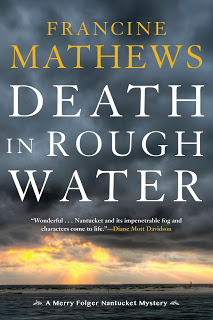 Available on Amazon
There is an enduring appeal to the small English village with a few related people caught up in a nightmare. But I didn't live in England. I didn't think my bet with Mark would extend to several weeks of research in situ. So I considered, instead, a place I knew and loved that felt like a small English village. Which brings me to a final point I'll offer nascent writers: You'll spend a long time embedded in your manuscript. Make sure it's a place you love; you'll be living there mentally for months. And make sure that place is populated with interesting people. If you're bored, your readers will be, too.
My place was Nantucket Island.
I first saw Nantucket when I was four. My family spent each summer on Cape Cod, and ferry trips to the island were an annual ritual. Later, as a teenager, I worked as a nanny for a wealthy family with a grand house on Orange Street. It was a second marriage between a Washington Power Couple, and they entertained constantly with a rotating roster of house guests. They dined out every night. They weren't much interested in seeing their three year-old; my job was to keep her amused and out of the way for the entire summer. They rented me a bike with a baby seat and Elizabeth and I spent hours trekking all over the island.
I didn't realize it at the time, but that single summer infused me with a lifelong intimacy with trails through dunes, hidden coves, incredible and lonely vistas, and a passion for the changeable island atmosphere that can shift from vivid sunlight to impenetrable fog in the space of minutes. Nantucket entered my soul that summer, and ten years later as I sat down to write my first novel, it was the natural place to go.
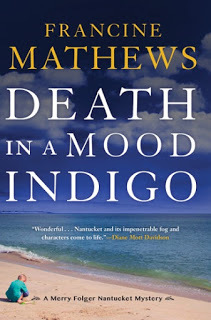 Available on Amazon
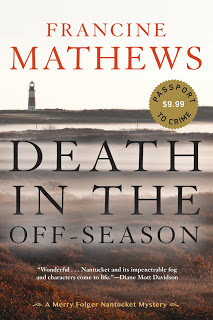
It took me nine months to write DEATH IN THE OFF-SEASON.
But it had a beginning, a middle, and an end. Remarkably, I found an agent--who is still my agent, twenty-five years later--and he found a publisher. I quit my job. Mark quit his. We left Washington, and both our dreams took us to new places. I wrote four books in the Meredith Folger Nantucket series, returning again and again to the island with my two young sons to do research--and the series gave me the courage to attempt other dreams: My Jane Austen mysteries, and eventually, my standalone spy novels.

Last year, Soho Crime approached me with a request to reissue the Merry Folger books. They had gone out of print during the years I'd turned to other projects. They had never been digitized for eBook downloads. Soho also wanted a fifth book--a new one--in the series. But twenty years had elapsed since the publication of the fourth novel. Twenty years is a large gap in the lives of characters, and so much about criminal investigation had changed since the 1990s, the original time period of the series. Nobody has paper files anymore. Google exists. DNA has changed the world of forensic science. Blackmail is no longer confined to a letter, but can go viral.
I agreed to reissue the series, but on one condition: That I be allowed to revise and update each of the original books before writing the new one. I wanted the transition between novels to be seamless for readers who'd never met Meredith Folger before.
 Courtesy Nantucket Book Festival 2017 https://nantucketbookfestival.org/
The fourth and final revised book, DEATH IN A COLD HARD LIGHT, comes out this Tuesday--May 9th. The newest Meredith Folger, DEATH ON NANTUCKET , debuts in hardcover next month, on June 6th, and I'll be posting my signing schedule here on Rogue Women Writers for anyone interested in a little beach reading.
But first, dear friends: What's your dream? What are you willing to wager on it? Share with all of us here--we'll help you commit.
Cheers,
Francine
www.francinemathews.com

May 3, 2017
When Someone Rains On Your Writing Parade -Part II
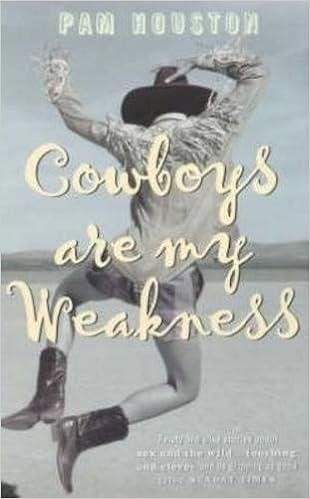
 A promotional disc of Love's Gonna Find YouMothers Day is around the corner and I wanted to both pay tribute to moms and to follow up on my last post. That last post dealt with the rain that some pour on the creatives of the world for reasons that elude me. This post deals with some of the fall out that can occur when your joy is stifled-- and parts of the story are not mine, but comes from one of my favorite writers: Pam Houston. I discovered her writing during her tour for a book called Cowboys Are My Weakness. This collection of stories about women, men and life really caught me. I recall heading to an author event to have my book signed. I wasn't writing then, but I was always an avid reader. My girlfriend went with me to the event and I went home wishing I could write as Houston did.
Last night I read this essay she wrote in Elle magazine and was struck by how our mothers were the same: creative women forging a career in an industry that can be brutal, but also more fulfilling than anything put before them otherwise. The creative world is that way. And with mother's day approaching, I thought it appropriate that I write about my mother's experience as well.
Houston's mother ran away as a teenager to New York and Broadway and made a living on the stage, even touring with Bob Hope. At a late age she met Houston's father and gave it up for a settled life of a wife and mother. Houston recalls that her mom often mentioned the life she'd left behind. Her mother sounds like a woman who did work that she loved most of her life and missed it terribly toward the later years, and Houston credits her mother for giving her ambition. It certainly sounds as though she did, because running away to New York and making it work is quite an achievement. That took courage and determination.
 Worth buying!
The difference between our mothers was that mine began her career after starting a family, and so we were around for the ride. After my first brother was born my mother soon realized that the life of a homemaker was financially out of her and my father's reach. She decided that if she would be forced to work, then she'd do something she loved. She started singing in clubs shortly after, progressing to recording, producing and finally movie acting and did it all as a divorced mother juggling four children. For her the issue wasn't that she gave anything up for us, but that she, too, hit many, many walls erected by a mostly male establishment that often attempted to manipulate her and her career to fit their needs. But for as many that tried to block her, there were some that attempted to help and her mantra to us was: You can do anything. You want it? Go for it.
It's a mantra that is an invaluable lesson for anyone going into a profession as tough as that laid out for a writer, musician, actor or artist. My mother didn't just say it, she showed us how to do it. When she wanted to be the leader of her own band she was brushed off and when she wouldn't give up was told that she'd have to join the musician's union to do it. She couldn't play an instrument, but she took a tambourine into the offices of the union and banged away at it until the man couldn't take it anymore and signed the form and waved her out.
When disco arrived and the clubs closed and the opportunities for performers who sang jazz were replaced by a spinning disc and bright lights, she looked for other options. She headed to Second City to learn acting, dragging us to sit on the side because she couldn't afford a babysitter. And during that time she had a side gig booking punk rock acts, an interesting development for a woman who sang the standards. She loved Sinatra, yes, but to her, music was music and all types of performers were welcome and interesting. She booked Iggy Pop and I recently found an old contract. It mentions a poster. I wish I could have found it in her things after her death, but I suspect she gave it to Iggy after the show.
When she wanted to record a demo and was turned away from the bigger companies, she filed for a record company license (controlled by another set of gatekeepers) and bought studio time. Her demo turned the big companies around and she landed a contract with Warner Curb. She did the rounds of radio stations without any real money for promotion and when her song started trending it was quashed for another's who was pushed ahead. That performer had that one hit only and disappeared from sight. She, though, kept going. She put her Second City training to work and started landing roles in movies and television shows.
And through it all she showed us that going for it was the base line. Failure was always around, rejection too, but forging ahead is better than living with regret. I'm glad she showed us that, because it's a lesson that usually only comes with age and wisdom and I was lucky enough to be taught it as a child.
When my mother died one of her oldest friends came up to me at the funeral and said, "Your mother showed us what was possible." It was a lovely thing to say, and it sums up her life perfectly.
And so for those who struggle in this creative world that we love, keep going. The walls are real but so are the ways around them. In the words of my mother:
You can do anything. You want it? Go for it.
April 30, 2017
Becoming a Writer
. . . by Karna Small Bodman
Is a writer "born" or "developed over time?" I don't have an answer for that - perhaps you do. What I do know is that there are several questions that authors invariably get on book tours. For example, "How long does it take you to write a book?" "Is your protagonist really you in disguise?" "Where do you get the ideas for your novels?" And then there is, "When did you first know you wanted to be a writer? What were your first efforts?" And that is the subject of our Rogue articles right now. So I had to sit down and try to remember.
Now that I think about it, I confess that I started writing poetry as a child. I thought I had saved some of it. Sure enough, when I rummaged around in my files, I pulled out a poem I wrote about my first "serious" boyfriend and thought I was in love.
The verses were pretty "sappy" (well, really sappy) - but since we all are sharing life experiences here - I'll go ahead and give you a sample of that early scribbling:
You ask - how do I love you? Please let me count the ways.
I love you as the stars love nights and rainbows love the days.
I love you as the eagle loves the sky in which to soar
Or as the rosebud loves the Spring and then, so much, much more.
I love you as a beachcomber must love the blazing sun
Or as the brand new champion - the title he has won....
And it went on from there. But note -- I was only 14! I have to admit that I have always been a sucker for romance, in film (love the Hallmark Movie Channel) as well as in novels. While I did end up writing dozens of (hopefully better) poems for friends and family birthdays, anniversaries, and even memorial services, I didn't have time to even think about writing a book during my career in broadcasting or serving in The White House. In both of those jobs, I was writing "non-fiction" (if you can call every news story "non-fiction" - at least we tried our best). And there was always a premium on brevity -- writing a 20 second live, or short narration for B-roll. At the White House, I had to put together briefing papers for the Press Secretary (I was his Deputy at the time) and later talking points for President Reagan. (Imagine outlining our Middle East policy in a one-pager! I had to do that while also writing summaries of dozens of other domestic and foreign policy positions as preparation for his press conferences).
After I left The White House I did think about writing a novel. Once again, I admit my first endeavors revolved around romance. In fact, I sat down and wrote two romance novels titled The Corporate Wife (had experience in that role) and Built to Code (having just finished building our vacation house). I went to writers' conferences and learned I had to snag an agent. Alas, after dozens of attempts and dozens of "I'm sorry but this story does not fit my list" replies, I shoved both manuscripts under the bed and started over.
Now it was time to get serious. And reflecting again on the advice all authors hear, "Write what you know," I wrote my first political thriller complete with familiar scenes inside the Oval Office, Roosevelt Room, State Dining Room, Situation Room - all over the complex I came to call "the most
 protected 18 acres on the planet" (except for a few fence jumpers now and then). I was so impressed with one of President Reagan's new policies -- the announcement of his "Strategic Defense Initiative" (missile defense or "Star Wars") -- I knew I wanted to write a story about it. So I created a character, Dr. Cameron Talbot, who works for a defense contractor and invents a breakthrough technology for a defense against cruise missiles. (And no, my protagonist is not me in disguise. She's much smarter). The title is CHECKMATE, and in this novel, as in all of my subsequent books, certain aspects of the stories ended up coming true (which, as I believe I've mentioned in previous posts, kind of freaks me out).
 "Gambit"The next story was inspired by experiences I had traveling throughout the Far East (Manila, Hong Kong, Seoul, Tokyo) to give speeches on behalf of the President. It focuses on a different threat to our national security, different villains, along with several continuing characters. The title of that one is GAMBIT. (And many years later when we had an addition to the family, we named him after that book.)
Number three, FINAL FINESSE, was, once again created when I reflected on another White House adventure. This time to South America. Then my latest thriller, CASTLE BRAVO, was "born" when a Major General explained what really kept him up at night - the threat of an Electro Magnetic Pulse - or "EMP" attack.
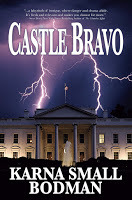
When I gave a talk about it to a terrific book club here in Florida last week, I entertained many of those same questions I mentioned at the outset, including "When did you know you wanted to be a writer?" I smiled and thought about sitting at my desk here in Naples, doing research, creating characters and writing chapters while enjoying a chance to stay cool in my office. Yet I was still able to gaze out my window at a lovely view. So I replied, in half-jest, "I guess it was when I figured out I have a love affair with the indoors."
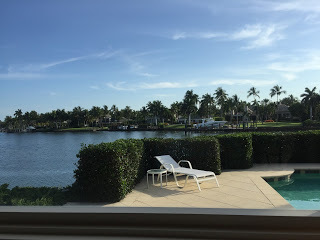 View from my desk
Now, what do you think? Can you answer the first question: "Are writers born or developed over time?" Please leave a comment below. All of my Rogue colleagues would enjoy reading your answers.
. . . submitted by Karna Small Bodman
Is a writer "born" or "developed over time?" I don't have an answer for that - perhaps you do. What I do know is that there are several questions that authors invariably get on book tours. For example, "How long does it take you to write a book?" "Is your protagonist really you in disguise?" "Where do you get the ideas for your novels?" And then there is, "When did you first know you wanted to be a writer? What were your first efforts?" And that is the subject of our Rogue articles right now. So I had to sit down and try to remember.
Now that I think about it, I confess that I started writing poetry as a child. I thought I had saved some of it. Sure enough, when I rummaged around in my files, I pulled out a poem I wrote about my first "serious" boyfriend and thought I was in love.

The verses were pretty "sappy" (well, really sappy) - but since we all are sharing life experiences here - I'll go ahead and give you a sample of that early scribbling:
You ask - how do I love you? Please let me count the ways.
I love you as the stars love nights and rainbows love the days.
I love you as the eagle loves the sky in which to soar
Or as the rosebud loves the Spring and then, so much, much more.
I love you as a beachcomber must love the blazing sun
Or as the brand new champion - the title he has won....
And it went on from there. But note -- I was only 14! I have to admit that I have always been a sucker for romance, in film (love the Hallmark Movie Channel) as well as in novels. While I did end up writing dozens of (hopefully better) poems for friends and family birthdays, anniversaries, and even memorial services, I didn't have time to even think about writing a book during my career in broadcasting or serving in The White House. In both of those jobs, I was writing "non-fiction" (if you can call every news story "non-fiction" - at least we tried our best). And there was always a premium on brevity -- writing a 20 second live, or short narration for B-roll. At the White House, I had to put together briefing papers for the Press Secretary (I was his Deputy at the time) and later talking points for President Reagan. (Imagine outlining our Middle East policy in a one-pager! I had to do that while also writing summaries of dozens of other domestic and foreign policy positions as preparation for his press conferences).
After I left The White House I did think about writing a novel. Once again, I admit my first endeavors revolved around romance. In fact, I sat down and wrote two romance novels titled The Corporate Wife (had experience in that role) and Built to Code (having just finished building our vacation house). I went to writers' conferences and learned I had to snag an agent. Alas, after dozens of attempts and dozens of "I'm sorry but this story does not fit my list" replies, I shoved both manuscripts under the bed and started over.
Now it was time to get serious. And reflecting again on the advice all authors hear, "Write what you know," I wrote my first political thriller complete with familiar scenes inside the Oval Office, Roosevelt Room, State Dining Room, Situation Room - all over the complex I came to call "the most
 protected 18 acres on the planet" (except for a few fence jumpers now and then). I was so impressed with one of President Reagan's new policies -- the announcement of his "Strategic Defense Initiative" (missile defense or "Star Wars") -- I knew I wanted to write a story about it. So I created a character, Dr. Cameron Talbot, who works for a defense contractor and invents a breakthrough technology for a defense against cruise missiles. (And no, my protagonist is not me in disguise. She's much smarter). The title is CHECKMATE, and in this novel, as in all of my subsequent books, certain aspects of the stories ended up coming true (which, as I believe I've mentioned in previous posts, kind of freaks me out).
 "Gambit"The next story was inspired by experiences I had traveling throughout the Far East (Manila, Hong Kong, Seoul, Tokyo) to give speeches on behalf of the President. It focuses on a different threat to our national security, different villains, along with several continuing characters. The title of that one is GAMBIT. (And many years later when we had an addition to the family, we named him after that book.)
Number three, FINAL FINESSE, was, once again created when I reflected on another White House adventure. This time to South America. Then my latest thriller, CASTLE BRAVO, was "born" when a Major General explained what really kept him up at night - the threat of an Electro Magnetic Pulse - or "EMP" attack.

When I gave a talk about it to a terrific book club here in Florida last week, I entertained many of those same questions I mentioned at the outset, including "When did you know you wanted to be a writer?" I smiled and thought about sitting at my desk here in Naples, doing research, creating characters and writing chapters while enjoying a chance to stay cool in my office. Yet I was still able to gaze out my window at a lovely view. So I replied, in half-jest, "I guess it was when I figured out I have a love affair with the indoors."
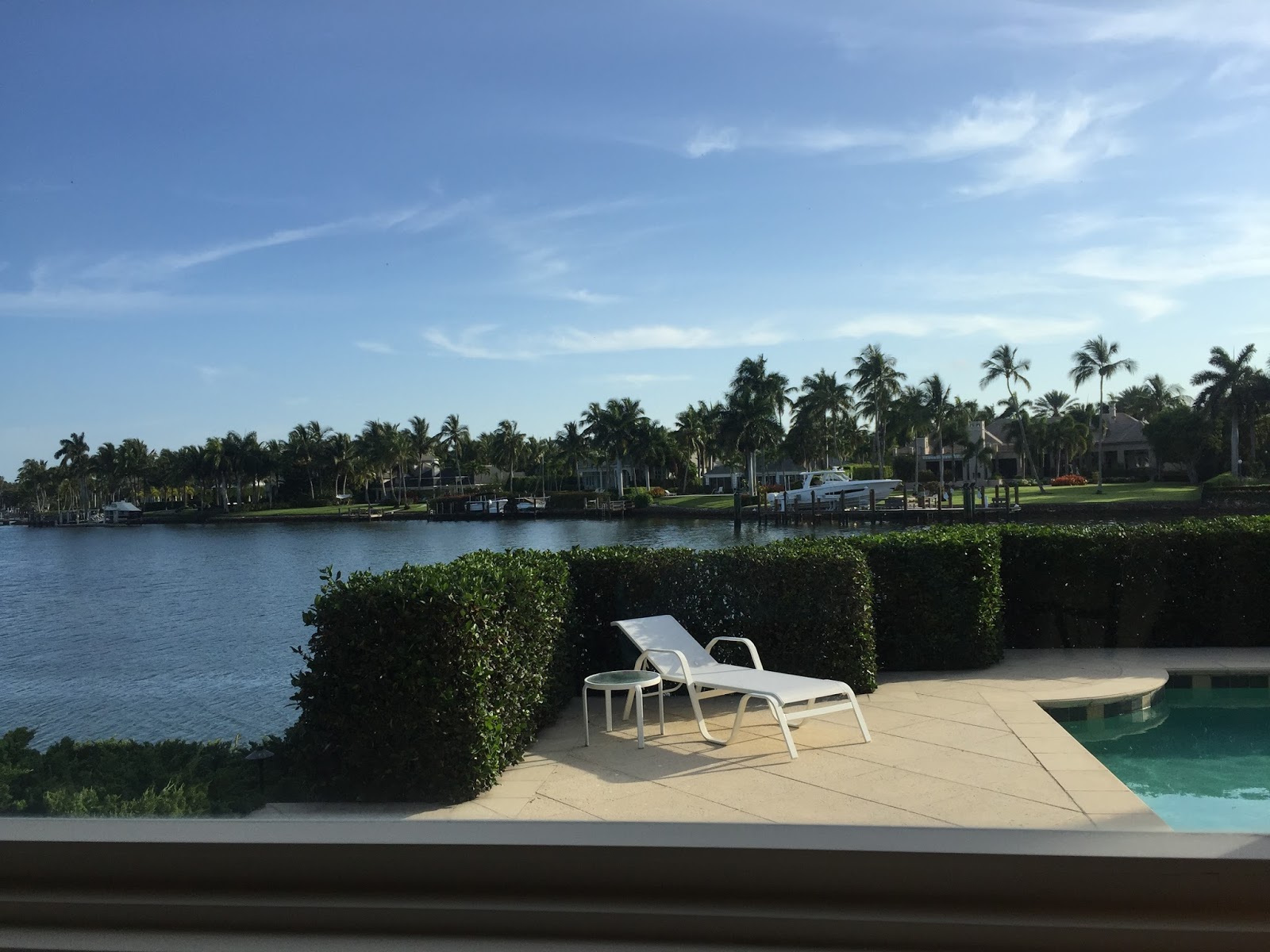 View from my desk
Now, what do you think? Can you answer the first question: "Are writers born or developed over time?" Please leave a comment below. All of my Rogue colleagues would enjoy reading your answers.
. . . submitted by Karna Small Bodman