Chris Goff's Blog, page 46
September 22, 2017
C. J. LYONS GOES ROGUE - WELCOME!
...posted by Karna Small Bodman
Here at Rogue Women Writers, we are delighted to welcome as our Guest Blogger, the New York Times bestselling author, C.J. Lyons.
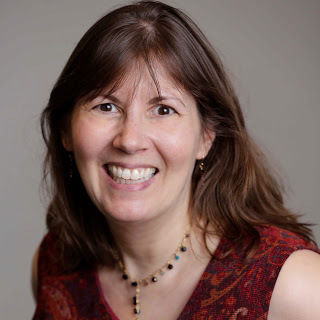 Author C. J. Lyons
I met this talented woman when we were both starting out as novelists with the same editor, and we both joined and attended one of the initial "Thrillerfest" conferences staged annually by International Thriller Writers. I recall being extremely impressed with C.J.'s background as an ER doctor, flight physician and expert who assisted police and prosecutors in criminal investigations. Talk about "writing what you know" -- she certainly has a terrific resume and draws much inspiration from her varied experiences. I invited her to tell us about her new thriller, Gone Dark, along with some of her other endeavors. Here's her story:
From Cold Case to Hot ThrillerCJ Lyons
Thanks so much to Karna and the other Rogues for inviting me to join in on the fun! I’m especially grateful as I’m currently celebrating the release of my fortieth published novel and the tenth in the award-winning, bestselling Lucy Guardino thrillers, GONE DARK.
Who knew when I created Lucy that readers would fall in love with this Pittsburgh soccer mom turned kickass crime fighter? But I'm grateful that they have, following her struggles working crimes against children for the FBI, watching her fight to balance the needs of her family while serving the victims she protects, suffering with her when she had a career-ending injury, and now enjoying her second career searching for answers to cases grown so cold no one except the victims’ families even remember.
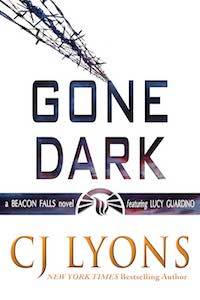
In all of my Lucy thrillers the crimes are real—torn from headlines, often with only the names changed to protect both the innocent and the guilty (I never use real life people in any of my books).
Why use real life crimes and in particular cold cases? Because, growing up in rural Pennsylvania and then working as a physician in various remote regions of the country, I learned that there ARE places in this country where you can get away with murder.
Not because law enforcement is lazy or ignorant. Rather because they are out-numbered, over-worked, and under-funded. This is the reason why I established my Buy a Book, Make a Difference http://cjlyons.net/buy-a-book-make-a-difference/ charity foundation that sponsors scholarships for community police officers to receive forensic training otherwise beyond their budgets. So far we’ve provided 78 scholarships to small town forces across the USA.
For GONE DARK, there were several real life inspirations. The first came from an FBI press release announcing the search for a fugitive who had been on the run since 1971. The enormous amount of time that had elapsed caught my attention so I kept reading to see why the FBI would be sending out a new plea for information on such a cold case.
That’s when I learned that the man had been a juvenile when arrested and sentenced to life without parole. During a riot in Pittsburgh in 1968 a Molotov cocktail set a house on fire and a woman died as a result. I couldn’t find any documentation that this man had thrown the incendiary device or even knew who had, merely that he’d been arrested along with several others and charged after waiving his Miranda rights to an attorney.
The twist here was that 41 years after this juvenile was sentenced to spend the rest of his life in adult prison and escaped custody, the Supreme Court declared juvenile life without parole unconstitutional.
Which meant that the manhunt for this escaped fugitive was based on his sentence being overthrown. He could conceivably return to his real life, even after all these years living a lie.
That idea had me scrambling to research the juvenile justice system. Only to be horrified by what I found. Entire jurisdictions routinely incarcerating juveniles with no access to a lawyer or to their parents once they were arrested—and often they were arrested, locked up, and days, weeks, months later with no charges actually filed. This was happening even after the 2012 Supreme Court ruling—to the point where the Department of Justice had to take control of entire juvenile justice systems in order to make sure kids were granted basic constitutional rights.
(If you’re interested in reading some of these horror stories yourself, here’s a 2017 report by the National Juvenile Defender Center: http://njdc.info/wp-content/uploads/2017/05/Snapshot-Final_single-4.pdf)As that idea rumbled through my mind, I came across several more real life crimes that warped the concept farther until I came up with the “what if?” that drove the plot of GONE DARK:What if a girl accused of murder escapes and spends half her life on the run only to learn that she has a chance to go home? What would she risk to finally get the chance to tell the truth and leave her life of lies behind?And who would pay the price?Like all of my Thrillers with Heart, the answers aren’t black or white but rather lie in the grey areas between good and evil—that messy, dark place where we are all put to the ultimate test.Thanks for reading!CJNow, after learning about C.J, her experiences, extensive research and award-winning writing style, I'm sure you will want to check out Gone Dark, available at major retailers -- or simply go to:http://CJLyons.net/books. Thanks to C.J. for visiting us here at Rogue Women Writers.
....Karna Small Bodman
Here at Rogue Women Writers, we are delighted to welcome as our Guest Blogger, the New York Times bestselling author, C.J. Lyons.
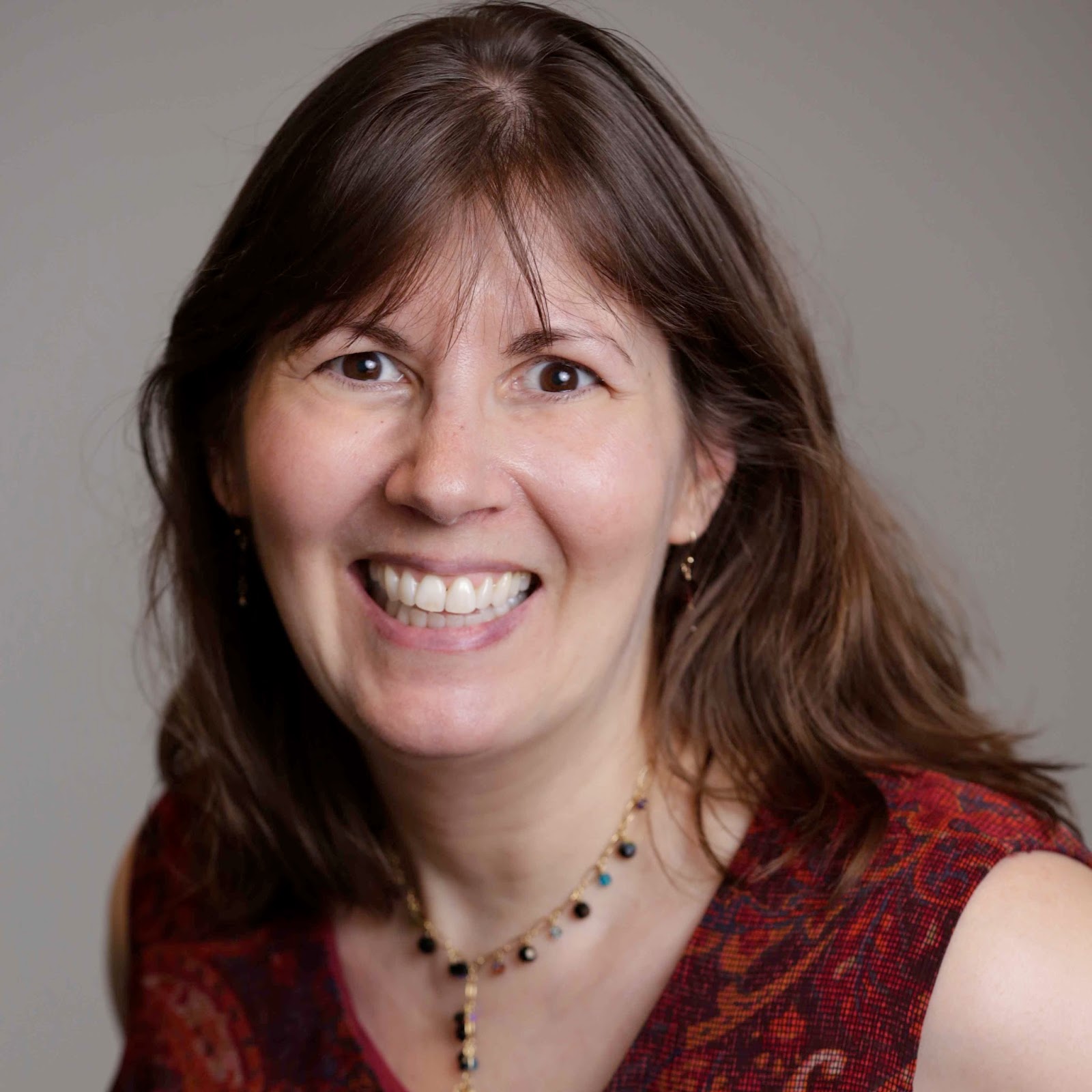 Author C. J. Lyons
I met this talented woman when we were both starting out as novelists with the same editor, and we both joined and attended one of the initial "Thrillerfest" conferences staged annually by International Thriller Writers. I recall being extremely impressed with C.J.'s background as an ER doctor, flight physician and expert who assisted police and prosecutors in criminal investigations. Talk about "writing what you know" -- she certainly has a terrific resume and draws much inspiration from her varied experiences. I invited her to tell us about her new thriller, Gone Dark, along with some of her other endeavors. Here's her story:
From Cold Case to Hot ThrillerCJ Lyons
Thanks so much to Karna and the other Rogues for inviting me to join in on the fun! I’m especially grateful as I’m currently celebrating the release of my fortieth published novel and the tenth in the award-winning, bestselling Lucy Guardino thrillers, GONE DARK.
Who knew when I created Lucy that readers would fall in love with this Pittsburgh soccer mom turned kickass crime fighter? But I'm grateful that they have, following her struggles working crimes against children for the FBI, watching her fight to balance the needs of her family while serving the victims she protects, suffering with her when she had a career-ending injury, and now enjoying her second career searching for answers to cases grown so cold no one except the victims’ families even remember.
In all of my Lucy thrillers the crimes are real—torn from headlines, often with only the names changed to protect both the innocent and the guilty (I never use real life people in any of my books).
Why use real life crimes and in particular cold cases? Because, growing up in rural Pennsylvania and then working as a physician in various remote regions of the country, I learned that there ARE places in this country where you can get away with murder.

Not because law enforcement is lazy or ignorant. Rather because they are out-numbered, over-worked, and under-funded. This is the reason why I established my Buy a Book, Make a Difference http://cjlyons.net/buy-a-book-make-a-difference/ charity foundation that sponsors scholarships for community police officers to receive forensic training otherwise beyond their budgets. So far we’ve provided 78 scholarships to small town forces across the USA.
For GONE DARK, there were several real life inspirations. The first came from an FBI press release announcing the search for a fugitive who had been on the run since 1971. The enormous amount of time that had elapsed caught my attention so I kept reading to see why the FBI would be sending out a new plea for information on such a cold case.
That’s when I learned that the man had been a juvenile when arrested and sentenced to life without parole. During a riot in Pittsburgh in 1968 a Molotov cocktail set a house on fire and a woman died as a result. I couldn’t find any documentation that this man had thrown the incendiary device or even knew who had, merely that he’d been arrested along with several others and charged after waiving his Miranda rights to an attorney.
The twist here was that 41 years after this juvenile was sentenced to spend the rest of his life in adult prison and escaped custody, the Supreme Court declared juvenile life without parole unconstitutional.
Which meant that the manhunt for this escaped fugitive was based on his sentence being overthrown. He could conceivably return to his real life, even after all these years living a lie.
That idea had me scrambling to research the juvenile justice system. Only to be horrified by what I found. Entire jurisdictions routinely incarcerating juveniles with no access to a lawyer or to their parents once they were arrested—and often they were arrested, locked up, and days, weeks, months later with no charges actually filed. This was happening even after the 2012 Supreme Court ruling—to the point where the Department of Justice had to take control of entire juvenile justice systems in order to make sure kids were granted basic constitutional rights.
(If you’re interested in reading some of these horror stories yourself, here’s a 2017 report by the National Juvenile Defender Center: http://njdc.info/wp-content/uploads/2017/05/Snapshot-Final_single-4.pdf)As that idea rumbled through my mind, I came across several more real life crimes that warped the concept farther until I came up with the “what if?” that drove the plot of GONE DARK:What if a girl accused of murder escapes and spends half her life on the run only to learn that she has a chance to go home? What would she risk to finally get the chance to tell the truth and leave her life of lies behind?And who would pay the price?Like all of my Thrillers with Heart, the answers aren’t black or white but rather lie in the grey areas between good and evil—that messy, dark place where we are all put to the ultimate test.Thanks for reading!CJNow, after learning about C.J, her experiences, extensive research and award-winning writing style, I'm sure you will want to check out Gone Dark, available at major retailers -- or simply go to:http://CJLyons.net/books. Thanks to C.J. for visiting us here at Rogue Women Writers.
....Karna Small Bodman


September 20, 2017
Fascinating Settings for Thrillers
 The Sahara desert
Settings mean a lot for thriller writers. In some cases the settings are the thriller. I'm thinking of stories like The Perfect Storm and Into Thin Air. The latter in particular utilizes the endlessly fascinating setting of Mount Everest. What could be more nerve-wracking than marching up a frozen mountain in air so thin that only 200 people since 1978 have climbed to the summit without supplemental oxygen? Where the corpses of those who died in the attempt litter the trail because it's impossible to carry them down? Just reading this, doesn't it make you want to find a book on the subject and learn more about the mountain, what it takes to climb it, and why those who attempt it feel compelled to do so?
Many thrillers combine dangerous locales and action into their stories. For my first Emma Caldridge novel, Running From The Devil, I had the idea to place an average person in an unusual area that cut her off from the support systems that most of us take for granted. That meant no police assistance, no ambulance, no hospitals and no way to reach any of it easily. Outside of war zones, such areas are usually found in extreme climates. I chose the Colombian jungle because it ticked off all the boxes. It's dense, so Caldridge would not see the sun rise or set and use it to determine direction, it's used by the paramilitary groups to hide their hostages and those same groups place land mines throughout to discourage intrusion, and it's vast and whole sections can only be reached by air. The setting informed the novel and allowed me to provide numerous, fascinating facts along the way.
Which brings me to another advantage of locale in thrillers.
 Set in the Sahara DesertExtreme locations allow you to discover some interesting, true facts. As you can tell from my comment above, I love to learn while I read, and this doesn't always require a non fiction book to do it. I've discovered fascinating facts reading thrillers. For my novels, I usually try to find intriguing, real, facts that I then weave into the thriller. I think it adds to the story.
For example, my next Emma Caldridge novel Blood Run starts in Dakar, Senegal and ends with a deadly march through the Sahara desert. I researched the political situations in various African nations as well as the climate of the countries. Insurgencies operate in various locations on the continent, and many can be found in a small area bordering Senegal, Mauritania and Mali. I decided to place Caldridge in this area and to have her take on the challenge of avoiding danger while crossing the Sahara. For this setting I needed to learn the average temperature in the desert, the existing trails, and the possible sandstorms that could occur.
Needless to say, the Sahara provides a lot of interesting facts. The average temperature is between 40 (C) or 104 (F) to 47 (C) or (117 F). Couple this with a complete lack of vegetation or shade and you get the idea of how deadly the desert can be. The photo at the top of this post shows you what you are facing on a march through the desert; miles and miles of endless sand. Camel trains still take the paths along the dry riverbeds, but the Tuareg nomads have the knowledge of the area that a Westerner might never learn.
Sandstorms in the desert are deadly. There's an ancient story that the Persian ruler Cambyses II's army of 50,000 conquered Egypt only to be swallowed up alive by a sandstorm on their way to the Siwa Oasis, never to be seen again. Can you imagine? 50,000 men buried without a trace? The number boggles the mind. Many thought this was a myth, but recently some artifacts have been found that some believe may be from this doomed army.
All of these facts added to the story and allowed me to get a real sense of what my protagonist was facing in attempting the trek. In this case the setting really informed the story, just as it did for the first in the series.
If you're writing a thriller and have an idea that can be set in an unusual locale, by all means give it a shot. Locations can add to the complexity and interest of the story, and the exotic ones give readers like me a chance to experience what it would be like to experience Everest or the Sahara and to learn something in the process!
September 17, 2017
INTRIGUING—AND EXOTIC—SETTINGS
posted by Karna Small Bodman
Have you ever seen a Legislative chamber that looks like this? Do you have any idea where this is - what country? What capital city? When I was sent to this particular location back when I was serving on the National Security Council staff at The White House, my first reaction was, "Wow, what a strange-looking place." So when I wrote my second thriller, Gambit, and my hero, Hunt Daniels, traveled to the same place, I figured he would have the same reaction. Here it is:
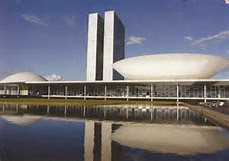 National Congress Building"This place looks like a set for a sci-fi flick," Hunt said, gazing out the window of the embassy car transporting him and an NSC staffer from the airport to the National Congress building.
 Metropolitan Cathedral"When they built this capital back in the sixties they wanted to be on the cutting edge," she explained, turning to point to a building that looked like a flying saucer with a crown on the top. "See that one? It's their Metropolitan Cathedral."
She goes on to explain, "They literally carved the city out of the jungle . . .a lot of the buildings were designed by Oscar Niemeyer
. . . he was a communist you know."
One more clue, wh en I arrived, my luggage was stolen, I discovered the country has one of the highest murder rates in the world and drug gangs and corrupt politicians seem to be ubiquitous. However, it also has some of the nicest people and most beautiful scenery I'd ever encountered. So wouldn't you say that's a perfect setting for a political thriller? Or at least a place where an author could create some memorable scenes? That's what I was trying to do in Gambit.
I was so intrigued when I first set foot in that city, I simply had to write about it. Figured it out yet? Well, it was Brasilia, the capital of Brazil.
All this month, my Rogue colleagues are writing about the importance of settings to take the reader on an adventure to a location they might never be able to see for themselves, or to act as a "character" in the story, as another Rogue - K.J. Howe - explains in her great blog below.
When we think about locations, I'm reminded of an absolutely harrowing tale where the setting IS the story...a landscape of ice, snow and wind - the true account of unbelievably brave souls. The title is Endurance: Shackelton's Incredible Voyage.
This story takes you back to the year 1914 when the famous polar explorer set out to cross "the last unchartered continent" but his ship became encased in ice. It's a tale of determination and heroism as he and a small crew battle -- yes -- the setting.
Of course, an author can't always travel to every location she wants to use when creating a thriller. When I was working on my fourth novel, Castle Bravo, I had to conjure up a believable setting as it involved a former Soviet Republic and centered on the threat of an attack on our country by villains using an "Electro-Magnetic-Pulse" (That's what happens when a nuclear device is detonated high in the atmosphere. The blast doesn't kill people. Instead it "fries" all electronics on the ground. We would have no internet, co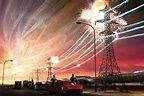 mmunications, refrigeration, sanitation, transportation -- as one Major General explained to me, "It would set us back to the year 1910 -- and don't think our enemies aren't working on this one.") As a matter of fact, several countries are - today - examining this technology to use as a weapon against us (North Korea recently made such an announcement).
The location I wanted to use in that novel was Kazakhstan. Since I had never been there and didn't have any way to get to that country, I had to turn to "research." I contacted our former Ambassador to that country.
 KazakhstanI have found that while government officials may not want to talk to a working reporter, they will usually be glad to share information with an author. In fact, when I asked for an appointment with this Ambassador to learn more about the country where she had served, her reaction was, "How great. Let's have lunch." She ended up giving me several books, along with wonderful descriptions not only of the cities, but the countryside, the languages, the "mood" of the people -- all absolutely invaluable to any story.
So the question is: What places have YOU visited that you believe would make great settings for a novel, especially a thriller? Please leave a comment. Your thoughts just might give inspiration to the eight of us here on Rogue Women Writers. Now, thanks for visiting.
....Karna Small Bodman
Have you ever seen a Legislative chamber that looks like this? Do you have any idea where this is - what country? What capital city? When I was sent to this particular location back when I was serving on the National Security Council staff at The White House, my first reaction was, "Wow, what a strange-looking place." So when I wrote my second thriller, Gambit, and my hero, Hunt Daniels, traveled to the same place, I figured he would have the same reaction. Here it is:
 National Congress Building"This place looks like a set for a sci-fi flick," Hunt said, gazing out the window of the embassy car transporting him and an NSC staffer from the airport to the National Congress building.
 Metropolitan Cathedral"When they built this capital back in the sixties they wanted to be on the cutting edge," she explained, turning to point to a building that looked like a flying saucer with a crown on the top. "See that one? It's their Metropolitan Cathedral."
 She goes on to explain, "They literally carved the city out of the jungle . . .a lot of the buildings were designed by Oscar Niemeyer
. . . he was a communist you know."
One more clue, wh
 en I arrived, my luggage was stolen, I discovered the country has one of the highest murder rates in the world and drug gangs and corrupt politicians seem to be ubiquitous. However, it also has some of the nicest people and most beautiful scenery I'd ever encountered. So wouldn't you say that's a perfect setting for a political thriller? Or at least a place where an author could create some memorable scenes? That's what I was trying to do in Gambit.
I was so intrigued when I first set foot in that city, I simply had to write about it. Figured it out yet? Well, it was Brasilia, the capital of Brazil.
All this month, my Rogue colleagues are writing about the importance of settings to take the reader on an adventure to a location they might never be able to see for themselves, or to act as a "character" in the story, as another Rogue - K.J. Howe - explains in her great blog below.

When we think about locations, I'm reminded of an absolutely harrowing tale where the setting IS the story...a landscape of ice, snow and wind - the true account of unbelievably brave souls. The title is Endurance: Shackelton's Incredible Voyage.
This story takes you back to the year 1914 when the famous polar explorer set out to cross "the last unchartered continent" but his ship became encased in ice. It's a tale of determination and heroism as he and a small crew battle -- yes -- the setting.
Of course, an author can't always travel to every location she wants to use when creating a thriller. When I was working on my fourth novel, Castle Bravo, I had to conjure up a believable setting as it involved a former Soviet Republic and centered on the threat of an attack on our country by villains using an "Electro-Magnetic-Pulse" (That's what happens when a nuclear device is detonated high in the atmosphere. The blast doesn't kill people. Instead it "fries" all electronics on the ground. We would have no internet, co
 mmunications, refrigeration, sanitation, transportation -- as one Major General explained to me, "It would set us back to the year 1910 -- and don't think our enemies aren't working on this one.") As a matter of fact, several countries are - today - examining this technology to use as a weapon against us (North Korea recently made such an announcement).
 The location I wanted to use in that novel was Kazakhstan. Since I had never been there and didn't have any way to get to that country, I had to turn to "research." I contacted our former Ambassador to that country.
 KazakhstanI have found that while government officials may not want to talk to a working reporter, they will usually be glad to share information with an author. In fact, when I asked for an appointment with this Ambassador to learn more about the country where she had served, her reaction was, "How great. Let's have lunch." She ended up giving me several books, along with wonderful descriptions not only of the cities, but the countryside, the languages, the "mood" of the people -- all absolutely invaluable to any story.
So the question is: What places have YOU visited that you believe would make great settings for a novel, especially a thriller? Please leave a comment. Your thoughts just might give inspiration to the eight of us here on Rogue Women Writers. Now, thanks for visiting.
....Karna Small Bodman
September 12, 2017
FULL IMMERSION: Don't Just Dip Your Toe In

by K.J. Howe
International intrigue offers readers an exceptional opportunity to travel--without leaving their couch. And the more lush, precise, and immersive the setting, the better. Like all elements of the writing craft, the way setting is utilized has evolved over the years, but the goal of entertaining and entrancing the audience has never changed.
Before television and the internet, settings in novels played such a key role, as audiences couldn't easily access online photos and enjoy TV shows set in exotic locales. In today's world, a few keystrokes or the click of a remote can bring the world to the anyone interested. Given this tough competition on the setting front, how can you make your writing and setting stand out? Three tips can help you travel to the bestseller list:
Character: Setting can be powerful when used to reflect and reveal character as well as character emotions. Character is central to most novels, and readers need to identify with the protagonist. Setting can be used to reinforce many aspects of character. This technique is actually a rebirth of the metaphoric use of setting.
Weather, used by the great romantic writers like Byron and Bronte, offered landscapes that mirrored and exemplified the inner lives of their characters. This technique has seen a renaissance in the modern era where character is king. The mood evoked by the environment can match the emotional state of that character, emphasizing their inner life. The technique can also be used in the opposite fashion, where the emotion evoked by the setting is the exact opposite of your character’s heart. Your character’s mood can be emphasized, defined, and clarified by its contrast to the surroundings. I enjoyed using this tactic in The Freedom Broker. Thea Paris is climbing the stairs in Santorini, one of the most picturesque places in the world--the sapphire waters, the lapping waves, the stunning white buildings--everything seems picture perfect...until she reaches the top where the glorious view reveals her father's yacht is leaving the harbour. Someone is abducting him.

Description: The pre-internet reader had significant tolerance for, perhaps even craved, long amounts of description of detail and setting. An example of this is James Michener, whose detailed descriptions are legendary. While this technique brought him unparalleled success, the modern audience has different expectations--and a much shorter attention span. Authors need to be more economical in the use of setting, using a microscope rather than a wide angle lens. Focus on a few key details that exemplify the essence rather than penning broad and expansive descriptions of the scene.
A surgical phrase describing a piece of jewelry, a feature of a building, a piece of clothing, an odd way of speaking, or even the local cuisine can quickly ground your reader in the location you want, and be far more pleasing than reading a description that sounds like a travel guide. To capture the readers' attention: less is more.
Obstacles: Settings are wonderful obstacles. Unique and harsh milieus can create wonderful barriers for your protagonist, functioning as an antagonist. Weather or a terrain feature can serve as an epically challenging obstacle to your character’s success, and classic and modern literature are rife with magnificent examples to learn from. Who can forget the terrifying setting of London’s To Build a Fire? A similar environment plays a critical role in Andrew Gross’ historical thriller The Saboteur--where the mountains and weather are perhaps the fiercest challenges his protagonist faces. There is something quintessentially human and primal in how difficult terrain, culture or weather can be to overcome. Adding it into your fiction can make your story come alive.

While the “dark and stormy night” opening is now in the cliché hall of fame, modern fiction can still be enhanced by the effective use of setting. If deftly handled, and sparingly applied, thoughtful settings can elevate your fiction from good to great. Take your readers on an unforgettable journey, and they'll never forget your books.
What are some of your favorite settings in novels? Was the sense of place a powerful addition to the story?
Thanks for stopping by today!
September 10, 2017
In the eye of the beholder
S. Lee Manning: International espionage thrillers, by definition, include scenes in countries besides the United States. The reader needs to know something about the location of the action. But what matters most is not merely the description, but pulling the reader into that description.
In other words, how do you make the location come alive?
In the novel I am currently writing, Ride a Red Horse, my characters arrive in St. Petersburg, Russia and I start with the most prosaic of descriptions – because the reader needs to know something about the city.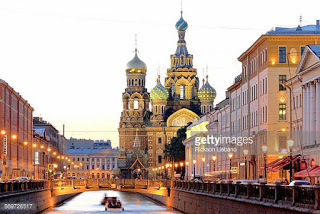
St. Petersburg was a city of canals and bridges, built by Peter the Great, out of what had once been swampland, at the cost of the lives of men who toiled on its construction.
Something the reader needs to know, but it doesn’t really express what I want the reader to experience. To better capture the city, I decided to go into Kolya’s mind – and his reaction to being back in the city where he was born.
The last time he had walked this stretch of the Neva during the White Nights, the city had still been shabby, with decaying facades and few tourists. But he remembered it as beautiful. He had been nine years old, and his mother had held his hand. Nine o’clock at night, and the bright summer night had smelled of lilacs. Six months later, his mother was dead from flu.
Wasn’t it absurd to die of something so common?
So in seeing the city through Kolya’s eyes, you get a sense of place – but you also learn something about Kolya in how he views the city. His mother’s death when he was a child was the event that changed him into the man that he has become. The description of the city not only brings the place alive, but illuminates key aspects of Kolya’s character.
I do something similar in the beginning of Ride – where a Canadian smuggler is planning to bring a package across the border. I set the scene in an odd little town where one side of the street is Canadian, the other, American.
Despite the dark night and the pelting rain, he could see flags decorated with stars and stripes waving in the cold gusts of wind in the front yards of the Vermont homes, while across the street flags bearing the maple leaf of Canada whipped back and forth in the front yards of the homes there.
An interesting town, but how the smuggler views it is more important than the mere fact of the international line running down the middle of the street.
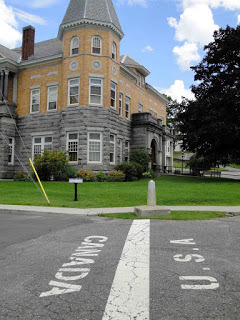
He’d grown up here in Beebe Plains, on this odd street that divided two nations. Back then he’d cross over to play with American kids, and they’d cross to play with him in Canada. In his teens, he’d briefly dated an American girl he’d met in a library in Stanstead where the international border was marked by a black line down the building’s center, the front door in Vermont, and the parking lot in Canada. Back then, everyone smuggled, at least a little.
The smuggler is not a major character, but it’s important to understand how he sees the border. He sees it as fluid, as something that should not be closed. Smuggling is something casual for him, like flirting with a girl when he was a teenager. Again, by describing the town through the smuggler’s eyes and experience, I am trying to not only convey a sense of place – but a sense of character – so that you understand who the smuggler is – and why he does what he does.
How about you? What are the most memorable descriptions of place in books you’ve read? When is a location more than just a location?
In other words, how do you make the location come alive?
In the novel I am currently writing, Ride a Red Horse, my characters arrive in St. Petersburg, Russia and I start with the most prosaic of descriptions – because the reader needs to know something about the city.
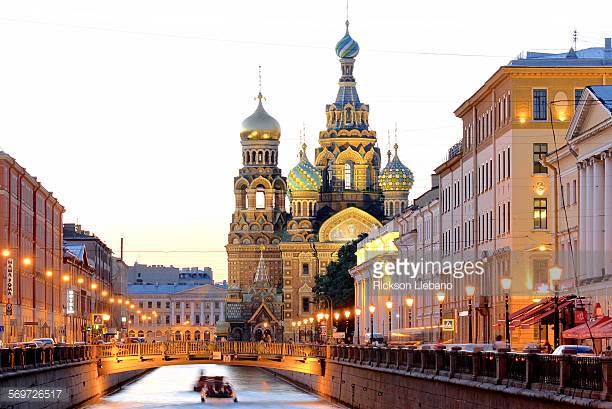
St. Petersburg was a city of canals and bridges, built by Peter the Great, out of what had once been swampland, at the cost of the lives of men who toiled on its construction.
Something the reader needs to know, but it doesn’t really express what I want the reader to experience. To better capture the city, I decided to go into Kolya’s mind – and his reaction to being back in the city where he was born.
The last time he had walked this stretch of the Neva during the White Nights, the city had still been shabby, with decaying facades and few tourists. But he remembered it as beautiful. He had been nine years old, and his mother had held his hand. Nine o’clock at night, and the bright summer night had smelled of lilacs. Six months later, his mother was dead from flu.
Wasn’t it absurd to die of something so common?
So in seeing the city through Kolya’s eyes, you get a sense of place – but you also learn something about Kolya in how he views the city. His mother’s death when he was a child was the event that changed him into the man that he has become. The description of the city not only brings the place alive, but illuminates key aspects of Kolya’s character.
I do something similar in the beginning of Ride – where a Canadian smuggler is planning to bring a package across the border. I set the scene in an odd little town where one side of the street is Canadian, the other, American.
Despite the dark night and the pelting rain, he could see flags decorated with stars and stripes waving in the cold gusts of wind in the front yards of the Vermont homes, while across the street flags bearing the maple leaf of Canada whipped back and forth in the front yards of the homes there.
An interesting town, but how the smuggler views it is more important than the mere fact of the international line running down the middle of the street.

He’d grown up here in Beebe Plains, on this odd street that divided two nations. Back then he’d cross over to play with American kids, and they’d cross to play with him in Canada. In his teens, he’d briefly dated an American girl he’d met in a library in Stanstead where the international border was marked by a black line down the building’s center, the front door in Vermont, and the parking lot in Canada. Back then, everyone smuggled, at least a little.
The smuggler is not a major character, but it’s important to understand how he sees the border. He sees it as fluid, as something that should not be closed. Smuggling is something casual for him, like flirting with a girl when he was a teenager. Again, by describing the town through the smuggler’s eyes and experience, I am trying to not only convey a sense of place – but a sense of character – so that you understand who the smuggler is – and why he does what he does.
How about you? What are the most memorable descriptions of place in books you’ve read? When is a location more than just a location?
September 8, 2017
NEW YORK TIMES BESTSELLING AUTHOR, ROBIN BURCELL GOES ROGUE AND SHARES SECRETS
We are delighted to welcome Robin Burcell, coauthor of the New York Times bestselling Fargo series, to bask In the Rogue Limelight.
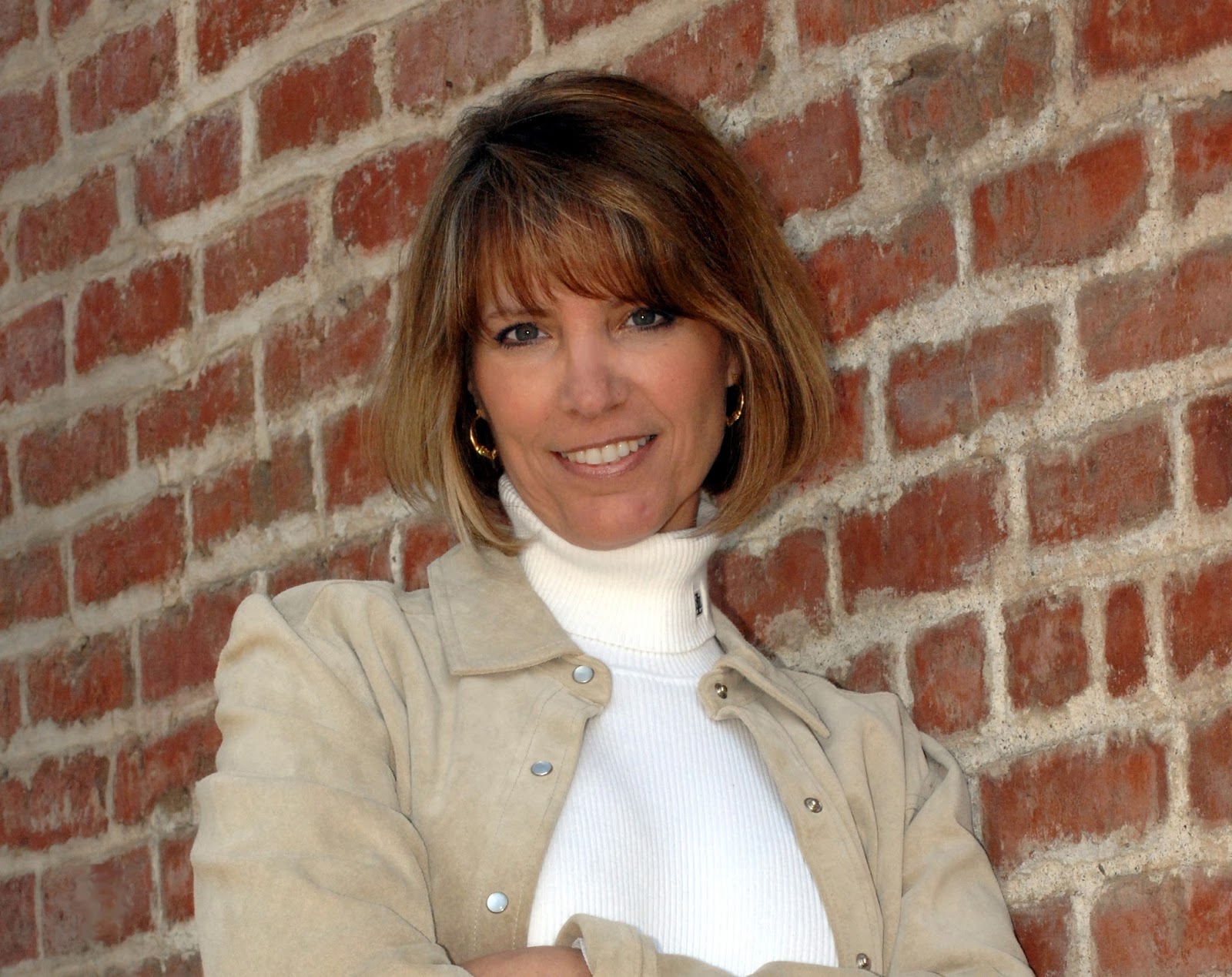
I can't tell you how long I've known Robin, but I can tell you she's one heck of a poker player, a regular card shark. Fitting for someone who spent nearly three decades working in law enforcement as a police officer, hostage negotiator, criminal investigator and FBI Academy-trained forensic artist. What I didn't know was that she was the first female officer for her department, or that her badge read "Policeman" and her locker room was actually a converted storeroom. I also never knew that her childhood dream was to be an Olympic ice skater. Lucky for us she became a writer.
Have you ever wished for something, while keeping it secret from everyone, because it was one of those wishes that seemed less than honest and more than likely unattainable? I had that wish the very first time I saw a James Patterson book with a co-author’s name on it—he was one of the first to take up co-writers. I recall thinking to myself that I’d love to have a job writing with an established author.
At the time, I was a fairly new midlist author with aspirations of one day making the New York Times list—something that in my naiveté, I’d always thought of as the holy grail of writers everywhere. Was it less-than-honorable getting there by holding onto the coattails of another, bigger author? As the years went by, some of my friends were either co-writing, creating, or stepping into established series (including Rogue Women writers Gayle Lynds and Jamie Freveletti). I was afraid to even mention my aspirations of following in their footsteps. Co-writing, while an honest profession, makes some writers uncomfortable, as though they’re selling out at the expense of true art. How can you be a real writer, when you’re writing for someone else?
Not that it mattered. I didn’t have the secret decoder ring to get into the co-writers club.
 The closest I’d ever come to a brush with big-name fame was when TV writer and Brash Books publisher Lee Goldberg called me up, asking if I’d write the next installment of the late Carolyn Weston series. Her books were the basis for the TV show The Streets of San Francisco. My background of being a police officer, and my earlier police procedural series set in San Francisco, made me a good fit for the project. I jumped on the chance, penning The Last Good Place. I’d no sooner finished that book, when I was wandering the bookstore as I often do when I’m looking for inspiration, and I happened to see a Clive Cussler book with the name of another friend, Boyd Morrison, listed as his co-writer. I bought the book, brought it home to read—wanting desperately to ask Boyd how he landed that job, but still not wanting to reveal I’d secretly longed for something similar.
 Sometimes you have to wonder about Fate. Before I even had a chance to broach the subject with Boyd, I received an email from Clive Cussler’s agent, telling me that Mr. Cussler wanted to speak with me.
I swear I stared at that email for a long time, wondering if it was possible that the Fates knew my secret wish. I was fairly certain that I’d never told anyone. Being the trained detective I am, I immediately went to the internet and Googled the various series that Cussler had running. And I immediately discounted each of them but one: The Fargo series. Multimillionaires, Sam and Remi Fargo, travel the world in search of treasure, and naturally run into some very bad people along the way. It was the least techno-type thriller series Cussler wrote—thank goodness, since I knew little about seafaring, missile-carrying ships or underwater anything. (Although a little voice in the back of my head said: you could learn!)
 But what if I was wrong? What if this email had to do with something else? Something not book related? When I failed to come up with any other logical reason why someone of Mr. Cussler’s caliber would want to talk to a budding thriller writer like me, well, let’s just say I was a tad bit excited. A (very long) week later, the call came, and I was invited by the Cusslers to stay with them in Arizona and discuss the possibility of co-writing the Fargo series. By the time I left Arizona, Clive and I had plotted out an entire novel, and were well on our way to our first collaboration. After that, we went back and forth via email, or a phone call. When something really needed clarification, a quick trip to Arizona going over things page by page usually did the trick.
 Clive is a very hands-on co-writer, which I love. What surprised me the most was that my switch from writing international law enforcement action/adventure to writing international treasure hunting action/adventure wasn’t as easy as I’d imagined. On one occasion, going over a scene in PIRATE (where Sam is trying to rescue someone from kidnappers), Clive and I both had different ideas on how it should be written. In my version, I was coming at it like a cop, and I pointed out that his version bordered on illegal. He reminded me that Sam wasn’t a cop. In the end, we melded both versions and the scene turned out great.
Our second book, THE ROMANOV
 RANSOM, comes out September 12th. We’re actually on our third book together, and I’ve enjoyed every bit of the process. Of course, one question that comes up quite often when anyone hears my story is how my name and books came to the attention of Clive Cussler and his publisher. (Heaven knows, that was one of my first thoughts as well.) I found out later that the Cusslers knew Barbara Peters of the much-beloved Poisoned Pen Bookstore in Scottsdale, Arizona. When she learned that Clive was looking for a new co-author for the Fargo series, she recommended me for the job. So, I hope you’ll forgive the cliché, but in my case, wishes really do come true.
http://www.robinburcell.com
https://www.facebook.com/RobinBurcell.Author
https://twitter.com/RobinBurcell
September 6, 2017
HOW DO WRITERS CHOOSE SETTINGS?
 In 1918, it was a thriving city of commerce and culture.
By Gayle Lynds. Here’s a brain teaser for you, dear readers. Can you identify the location of the following?
Night gave the city little relief. Electricity was fitful, garbage rotted along the boulevards, and clean running water was a memory. Gunfire crackled across rooftops as looters carried off computers, chairs, and crates of canned goods. Since the invasion, there was no more dictator and no more law....
I’ll tell you more about the city in a few moments. First, you should know that with this blog I’m kicking off a month in which we Rogue Women will reveal how we choose settings for our books, and the techniques we use to enrich your experience through describing those settings.
Personally, I love locales that are unfamiliar to most Americans, including to me. Especially to me. If I can’t visit a location, I interview those who’ve been there, and I research extensively. By the time I’m finished, I can smell, hear, and see the place.
Maybe this description will help you figure out what the city is, where it is, what happened there:
The night air stank of oil fires. Gunfire crackled in the distance. Watchful, the assassins waited in the night shadows at the museum’s rear security wall. They were dressed like locals, in loose shirts, Western trousers, and ghutrahs — cotton scarves — wrapped around their heads and across the lower parts of their faces. Only their eyes showed. They checked their watches.
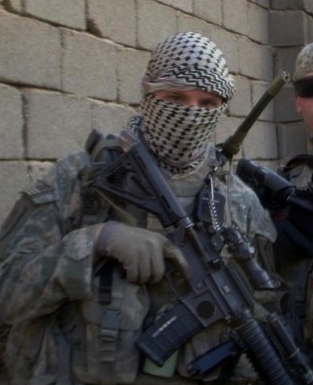
We humans go through life with little conscious recognition of the extraordinary feast of sensory information around us. The advice to “stop and smell the roses” is particularly apt for those of us who write. It’s our job to entertain you with what you may easily miss even if you’re there in person. . . .
At precisely 12:10 a.m. the door in the wall opened, and General Mulh Alwar appeared. A tall blade of a man with refined features, he wore the uniform of the Special Republican Guards, but his shirt was unbuttoned, he was capless, and his eyes were over-bright. His Kalashnikov dangled carelessly from one hand.
Part of any location is its inhabitants. What the people wear, how they present themselves, what they care about and want and fear. General Alwar is obviously disturbed and probably in some kind of deep trouble. If you guessed this scene is taking place in the Middle East, you’re dead on.
Here’s your final clue: In earlier, better times, the country was known as Mesopotamia, a rich land where the wheel and writing were invented. It was all documented here, in the National Museum of Iraq, which contains priceless antiquities dating back a hundred thousand years.
Yes, now you’ve got it. We’re in Iraq, and the National Museum is located in Baghdad, the city I’ve been describing. As for the time, it’s more than a dozen years ago, April 10, 2003. The United States and allies are moving into the city. What’s about to happen is a memorable moment in war, a true story about an act of gallantry by U.S. troops.
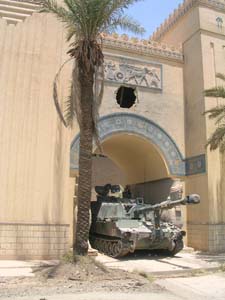 Days later, US tank parked beneath giant hole
Special Republican Guards have taken over the 11-acre museum complex, although international law forbids anyone to use a cultural site like it for military purposes. But they hide in the buildings and fire automatic weapons and rocket-propelled grenades — RPGs — at the American soldiers.
Days later, US tank parked beneath giant hole
Special Republican Guards have taken over the 11-acre museum complex, although international law forbids anyone to use a cultural site like it for military purposes. But they hide in the buildings and fire automatic weapons and rocket-propelled grenades — RPGs — at the American soldiers.A U.S. tank responds with a single round from its nosebleed 120-mm main gun. It takes out the RPG and leaves a shocking hole in one of the museum’s tall outer walls.
Under the laws of war, the Americans were entitled to defend themselves, but their tank round has proved how easily they can flatten the great museum and destroy its one-of-a-kind art and historic artifacts. So what do they do? They roll back out of range. They save the museum.
I am thrilled, inspired, by such restraint despite being under attack.
And that’s why I began THE ASSASSINS , my recent novel, outside the museum in Baghdad — with the locale, the situation in 2003, and the descriptions.
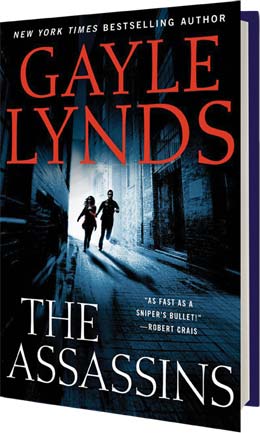
And then I moved the story inside the compound, where six international contract killers rendezvous with General Alwar. And from there ... Washington, D.C., a Maryland hunt club, CIA headquarters in Langley, Marrakech’s grand marketplace, the Cairo airport, and back to Baghdad ... back to the National Museum, of course, where my fascination began.
Do you have a favorite locale you’d like to revisit? Perhaps even to write about? Please tell!
September 3, 2017
FADE TO BLACK
by Chris Goff
 Nicole Kidman and Tom Cruise in Eyes Wide Shut
Truth be told, I love a good sex scene. I love nothing more than curling up in front of the fireplace on a snowy Colorado night with a great romantic suspense novel, or a steamy Regency romance. Sex in thrillers is another matter.
I’m not a prude.
But too often it seems, sex in crime novels seems gratuitous. Sure, we’re all grownups and sex is a natural part of relationships, but that’s not a great reason to put sex into our books. Consider the facts.
1. The timeline in a thriller is tight.
In reality, most people running for their lives or trying to catch a killer or working against the clock to save the world don’t have time for sex.
 2. Writing sex that satisfies both male and female readers is nearly impossible.
Bottom line, men and women view sex differently. Men are easily aroused, while women need more to make them interested. According to Leon F Seltzer Ph.D., “men’s brains are designed to objectify females,” (Psychology Today, May 11, 2012), while “women respond to a truly astonishing range of cues across many domains. The physical appearance of a man, his social status, personality, commitment, the authenticity of his emotions, his confidence, family, attitude toward children, kindness, height, and smell. . . . For women, no single cue is either necessary or sufficient." (Psychology Today, May 14, 2012). In other words, women are looking for the potential for love and a long term relationship.
3. Writing sex is hard to do well.
Granted, there are some thriller writers who can handle it. Mostly women. Most with a background in romance writing. But for many of us, it’s difficult and ugly.
The Bad Sex in Fiction Award.
Every year since 1993, the Literary Review has presented an award to “honor” some lucky recipient and draw attention to “perfunctory or redundant passages of sexual description in otherwise good literary novels.” Among the winners and nominees are a number of multiple award-winning and New York Times bestselling authors.
 On the shortlist for the 2016 Bad Sex in Fiction Award was Ian McEwan’s Nutshell (possibly the first passage of sexual description told from the point of view of a fetus). It was dismissed for being too well written to qualify. After all “the purpose of the award is not to discourage writing about what goes on in the bedroom (or elsewhere)," but to draw attention to “poorly written passages of sexual description.” According to the Literary Review website, “the hallmarks of ‘bad sex’ are, broadly speaking, euphemism, confusion about what’s actually going on, the clumsy use of language and metaphor, and hyperbole.”
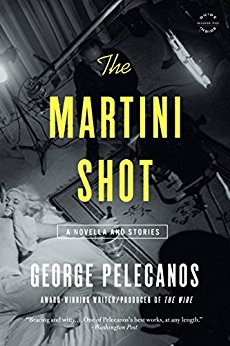
George Pelecanos was a 2015 Award Nominee. This passage came from his first collection of short stories, The Martini Shot. Literary Review had this to say, “An acclaimed crime writer…it seems he’s also an ingénue when it comes to writing sex.”
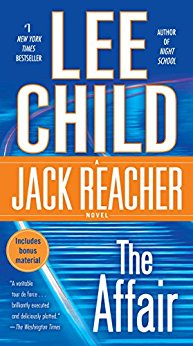
She lay back on the couch and arched her back, and I peeled off her pants and thong. Now she was nude. I stripped down to my boxer briefs and crouched over her. I let her pull me free because I knew she liked to. She stroked my pole and took off my briefs, and I got between her and spread her muscular thighs with my knees and rubbed myself against her until she was wet as a waterslide, and then I split her.And Lee Child was a 2011 Award Nominee. His blockbuster The Affair “offers a seduction scene that achieves a prose-poetry all of its own.”
Then it was time. We started tenderly. Long and slow, long and slow. Deep and easy. She flushed and gasped. So did I. Long and slow.
Then faster and harder.
Then we were panting.
Faster, harder, faster, harder.
Panting.
‘Wait,’ she said.
‘What?’
‘Wait, wait,’ she said. ‘Not now. Not yet. Slow down.’
Long and slow, long and slow.
Breathing hard.
Panting.
‘OK,’ she said, ‘OK. Now. Now. Now!’
Faster and harder.
Faster, harder, faster, harder.
The room began to shake.
 Which is why, Chapter 34 in RED SKY, the second my Raisa Jordan series, begins like this:
Jordan woke up in Davis’s arms. It wasn’t what she’d planned or expected, but she hadn’t resisted. In her line of work, relationships were hard to maintain. She didn’t much go for casual sex, but she had to admit it—last night was nice.
Fade to Black. Need I say more?
August 29, 2017
5 THINGS TO AVOID WHEN WRITING FOR YOUNG ADULTS
Avoid these pitfalls for maximum success.
by Sonja Stone
There aren't a lot of rules when writing for the young adult (YA) market, but there are a few pitfalls you'll want to avoid.
My youngest heads off for college in a few weeks, so it's time to drag out my binder-full of lectures (Why You Shouldn't Go to Frat Parties; Don't Have Casual Sex But If You Do Use Protection; Don't Drink, Smoke, or Use Drugs; Always Carry a Sweater Because You Never Know When a Cold Snap Will Roll In; Don't Drink Caffeine After 3pm; Hang Up Your Wet Towel; Skype Your Mother Once a Week So I Know You're Still Alive; etc, etc, etc). Two minutes into the first lecture I'm met with a heavy sigh, eye rolling, and the facial expression meant to convey that I'm old and don't know/understand anything about the teenage experience... Which brings me to my first point of What Not To Do in a YA Novel.
1. DON'T PREACH.If your goal is to share a moral lesson with young adults, don't bother writing a novel. Teens (and many adults) won't suffer a ten-minute verbal lecture, much less 300 pages of preaching. This isn't to say that your protagonist cannot have a strong moral compass, perhaps even one that deviates from the new norms of society, but if your voice (as the morality-police-turned-author) seeps through the pages, do not expect a warm reception. (That said, it's perfectly acceptable to stick to your own code of ethics. As I've mentioned, I'm not comfortable writing sex scenes for young adults, so I don't. But plenty of YA writers do it very well.)
2. DON'T TRY TO SOUND LIKE A TEENAGER.Let me rephrase: don't try to sound like what you think a teenager sounds like. For me, this would include addressing one's mother as 'brah,' and grunting in response to a variety of questions ranging from 'did you register for your classes yet?' to 'what would you like for dinner?' Trendy phrases quickly date your manuscript ('groovy' turned to 'cool' turned to 'wicked' turned to whatever-the-hell-kids-say-now).
Remember that teens--as a general rule--are fairly self-involved (this is why I write YA--it's totally natural for me to be in that same mindset :)). A teenage girl will usually not think to herself, "Boy, my mom seems really tense. She's been snapping at me a lot lately. I wonder what I can do to help her through this difficult time?" Her thought process is more like this: "My mom's being a total bitch. What is her problem?"
3. TECHNOLOGY CHANGES.Along this same line, I would avoid naming specific social media outlets, as these change and fluctuate. Anyone remember MySpace? Vine (the 6-second video platform) was huge last year, and as far as I know, no longer exists. If technology is critical to your story, consider inventing your own social media platform. You're a creative writer, after all.
4. DON'T TALK DOWN TO TEENS.Teenagers are intelligent. As a rule, while they may not communicate (at all) with their parents, they really are quite adept at navigating social nuances among their peers. There's no need to over-explain your scene. Be subtle, and when in doubt, less is more (never use two words when one will do). Don't be afraid to use intelligent vocabulary--there's no need to dumb down the language. Furthermore, I hate to be the one to tell you this, but your teenager probably knows way more about sex and drugs than you do. (Thanks, google.)
5. RULES ARE MADE TO BE BROKENThis seems especially true in YA literature--it seems anything goes. The Twilight and Harry Potter series successfully ignored the typical YA word count of 80-90K. No topics are off limits--drug use and abuse, suicide, sex, sexuality, racism, gender identity, dealing with death and grief. A great book doesn't tell me how I should live my life. I believe the gift of a well-written YA novel sends the message: You are not alone.
Keep these tips in mind as you're writing for teens, and please: add to this list in the comment section below!
*****Post Script: charity navigator.org
Our thoughts and prayers are with the victims of Hurricane Harvey. If you'd like to donate, consider searching Charity Navigator. This website offers unbiased, friction-free ratings of charitable organizations, and grades charities based on their financial health and the transparency and accountability of their financial records. The site is not affiliated with any particular faith, denomination, organization, or political party.*****
photo credits: whatever, Photo by Jerry Kiesewetter on Unsplash
boy on dock: Photo by Ben White on Unsplash
by Sonja Stone
There aren't a lot of rules when writing for the young adult (YA) market, but there are a few pitfalls you'll want to avoid.
My youngest heads off for college in a few weeks, so it's time to drag out my binder-full of lectures (Why You Shouldn't Go to Frat Parties; Don't Have Casual Sex But If You Do Use Protection; Don't Drink, Smoke, or Use Drugs; Always Carry a Sweater Because You Never Know When a Cold Snap Will Roll In; Don't Drink Caffeine After 3pm; Hang Up Your Wet Towel; Skype Your Mother Once a Week So I Know You're Still Alive; etc, etc, etc). Two minutes into the first lecture I'm met with a heavy sigh, eye rolling, and the facial expression meant to convey that I'm old and don't know/understand anything about the teenage experience... Which brings me to my first point of What Not To Do in a YA Novel.

1. DON'T PREACH.If your goal is to share a moral lesson with young adults, don't bother writing a novel. Teens (and many adults) won't suffer a ten-minute verbal lecture, much less 300 pages of preaching. This isn't to say that your protagonist cannot have a strong moral compass, perhaps even one that deviates from the new norms of society, but if your voice (as the morality-police-turned-author) seeps through the pages, do not expect a warm reception. (That said, it's perfectly acceptable to stick to your own code of ethics. As I've mentioned, I'm not comfortable writing sex scenes for young adults, so I don't. But plenty of YA writers do it very well.)
2. DON'T TRY TO SOUND LIKE A TEENAGER.Let me rephrase: don't try to sound like what you think a teenager sounds like. For me, this would include addressing one's mother as 'brah,' and grunting in response to a variety of questions ranging from 'did you register for your classes yet?' to 'what would you like for dinner?' Trendy phrases quickly date your manuscript ('groovy' turned to 'cool' turned to 'wicked' turned to whatever-the-hell-kids-say-now).
Remember that teens--as a general rule--are fairly self-involved (this is why I write YA--it's totally natural for me to be in that same mindset :)). A teenage girl will usually not think to herself, "Boy, my mom seems really tense. She's been snapping at me a lot lately. I wonder what I can do to help her through this difficult time?" Her thought process is more like this: "My mom's being a total bitch. What is her problem?"
3. TECHNOLOGY CHANGES.Along this same line, I would avoid naming specific social media outlets, as these change and fluctuate. Anyone remember MySpace? Vine (the 6-second video platform) was huge last year, and as far as I know, no longer exists. If technology is critical to your story, consider inventing your own social media platform. You're a creative writer, after all.
4. DON'T TALK DOWN TO TEENS.Teenagers are intelligent. As a rule, while they may not communicate (at all) with their parents, they really are quite adept at navigating social nuances among their peers. There's no need to over-explain your scene. Be subtle, and when in doubt, less is more (never use two words when one will do). Don't be afraid to use intelligent vocabulary--there's no need to dumb down the language. Furthermore, I hate to be the one to tell you this, but your teenager probably knows way more about sex and drugs than you do. (Thanks, google.)
5. RULES ARE MADE TO BE BROKENThis seems especially true in YA literature--it seems anything goes. The Twilight and Harry Potter series successfully ignored the typical YA word count of 80-90K. No topics are off limits--drug use and abuse, suicide, sex, sexuality, racism, gender identity, dealing with death and grief. A great book doesn't tell me how I should live my life. I believe the gift of a well-written YA novel sends the message: You are not alone.

Keep these tips in mind as you're writing for teens, and please: add to this list in the comment section below!
*****Post Script:
charity navigator.org
Our thoughts and prayers are with the victims of Hurricane Harvey. If you'd like to donate, consider searching Charity Navigator. This website offers unbiased, friction-free ratings of charitable organizations, and grades charities based on their financial health and the transparency and accountability of their financial records. The site is not affiliated with any particular faith, denomination, organization, or political party.*****
photo credits: whatever, Photo by Jerry Kiesewetter on Unsplash
boy on dock: Photo by Ben White on Unsplash
August 26, 2017
TRUTHS MY FATHER TOLD ME

By Francine Mathews
As the country has gone through a deep chasm of soul-searching this August, I've cast my thoughts back to a childhood I never knew, only heard about in stories: my father's early years in rural Western Pennsylvania.
Why? Because he watched a cross burn in front of a good friend's house one winter night, and decided to do something about it. He was probably ten years old.
We tend to think of the Ku Klux Klan as a Southern oddity these days--an outgrowth of Reconstruction and the Civil War that spawned it. But in 1920s America, when the Klan was nascent and powerful, it sprang up all over northern states as well. In places like Colorado and Ohio and Pennsylvania, white Protestants resentful of immigrants and ethnic minorities--Irish, Italians, Poles and Germans who practiced the Catholic faith--used horses and white hoods to intimidate their neighbors. In my dad's small town of Tremont, where his family had lived for three generations, this meant him.
Joe Barron was born in 1915. On his father's side, the Barrons had emigrated from County Waterford, Ireland, as so many others did--to flee the potato famine of 1848. On his mother's side, the Lorenzes had left Alsace-Lorraine to avoid the frequent wars between France and Germany that made the two provinces perennial bargaining chips. Joe was a classic Northern European, blond-haired and blue-eyed, born during the First World War. His father ran the Tremont General Store. His grandfather Lorenz was a mining engineer who died in an underground explosion before he was born.
His childhood nights were lit by burning crosses, left on the lawns of Catholic neighbors by mounted horsemen disguished in white hoods. He found them terrifying, and because he was afraid he hated the crosses and the robed figures who torched them.

In the winter of 1925, the Grand Wizard of the local Klan suddenly died. All of Tremont knew who he was--and that his faithful followers intended to stage a public funeral procession through the main street of town. The Klansmen would go mounted on horses, robed in white, following the Grand Wizard's hearse.
My father made some plans, too. Heavy snows had recently fallen, and he knew of a hillside not far from the funeral procession's end point that would make a perfect tactical redoubt. He gathered his friends together well before the ominous parade started and built fortifications. Stockpiled arms. When the Grand Wizard's hearse hove into sight, they were ready.
The funeral procession was ambushed by a fusillade of snowballs.
Horses reared and broke from their ranks. Hoods were pelted. Men ducked and swore, and confusion reigned. The ground was trampled and the hearse veered into a ditch.
My dad and his friends fired the last of their ammunition and took off pell-mell down the back of the hillside before any of the mounted Klansmen could pursue them.
Sometimes, as the Duke of Wellington noted, retreat is a means to fight another day.

What matters about this story, however, is the aftermath--the reason my father bothered to tell it at all.
When he returned home triumphantly to explain what he'd done, his mother was breathtakingly angry.
It's possible she was afraid he'd been seen and identified by one of the Klansmen, along with his friends, and that next time the cross--or worse--would burn on the Barron house's front lawn. Or maybe she was terrifed one of the boys, or one of their fathers, would be strung up from a tree one dark winter's night, in retribution.
She ordered my father to change into his best suit, buy a bouquet of flowers with his pocket money, and walk alone to the Grand Wizard's doorstep.
There, he was required to apologize in person to the man's widow, for having added to her grief.
My father never forgot his mother's lesson. She was determined that he learn forgiveness--and learn to ask for it in turn from those who made a hobby of terrorizing their neighbors. She was determined that he turn the other cheek, as his Catholic faith urged. Only then would he defeat the men who rode with torches, in darkness and in hoods.
Joe went on to fight against the Nazis, of course, as a pilot in the Army Air Corps during World War II. There was no question in anyone's mind, in 1941, what purity of race--and the violence that drove it--meant. But as my father's generation has aged and passed from this earth, so has that absolute sense of moral certainty in the face of evil.
Except, perhaps, in the minds and hearts of those who have heard such stories--recognize their truths--and pass them on.
Tell us, fellow readers--what childhood lessons have marked you indelibly?
Happy end of summer--
Francine