Madeline Smoot's Blog, page 5
January 26, 2023
What’s at Stake?
Are the stakes of your story enough to get the reader turning the page?
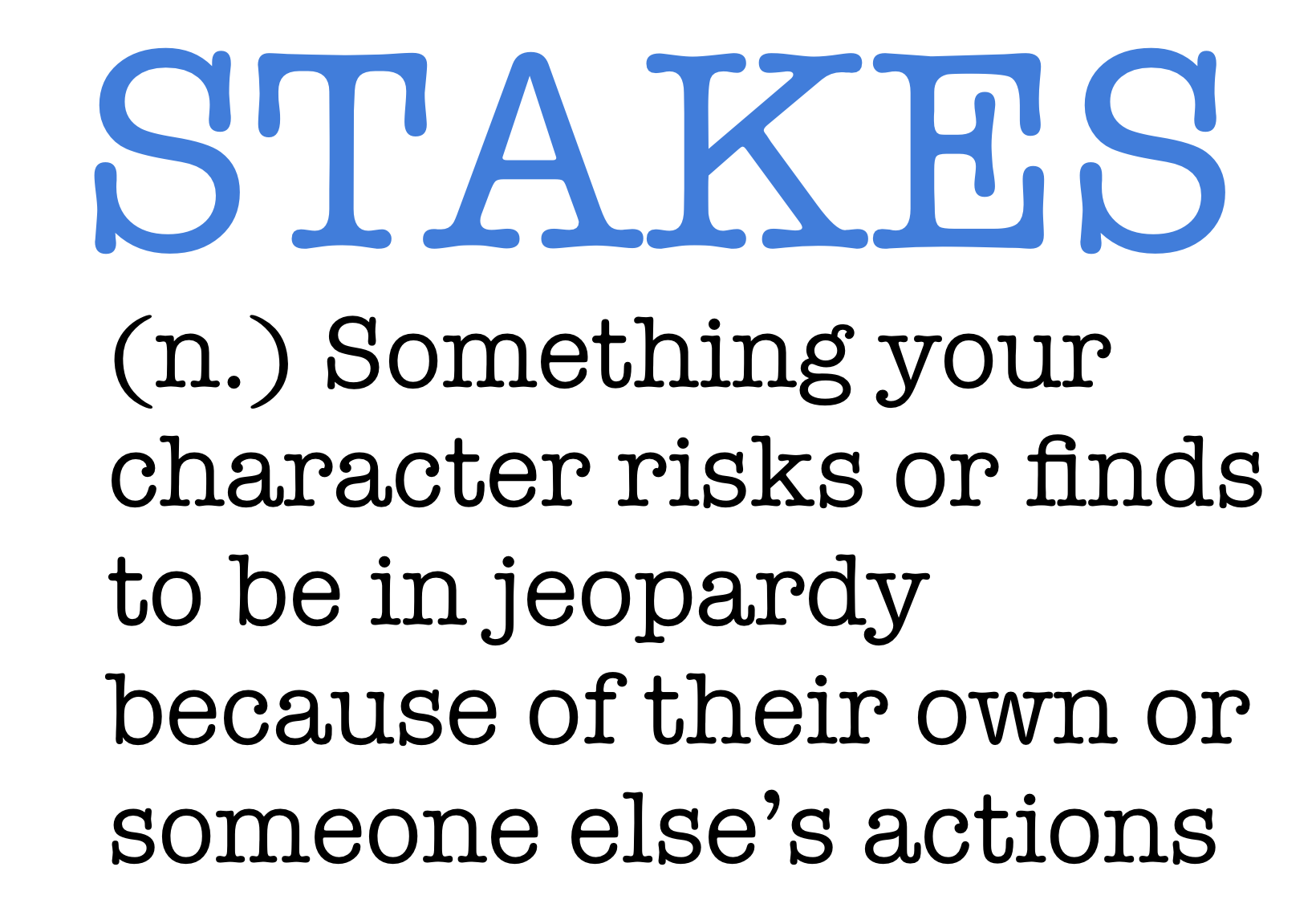
My definition of stakes is something your character risks or finds to be in jeopardy because of their own or someone else’s actions. Basically, the stakes are the external or internal problems that are vexing our characters. Stakes are one of those things that build tension and keep the reader turning the page of our children’s books so you want to give readers stakes they can really sink their teeth into.
However, your stakes need to start small and get big.
You don’t want to start with the world burning from the very first page. Instead we want our stakes to escalate and get bigger as the story goes on. How do we make sure our stakes are doing that?
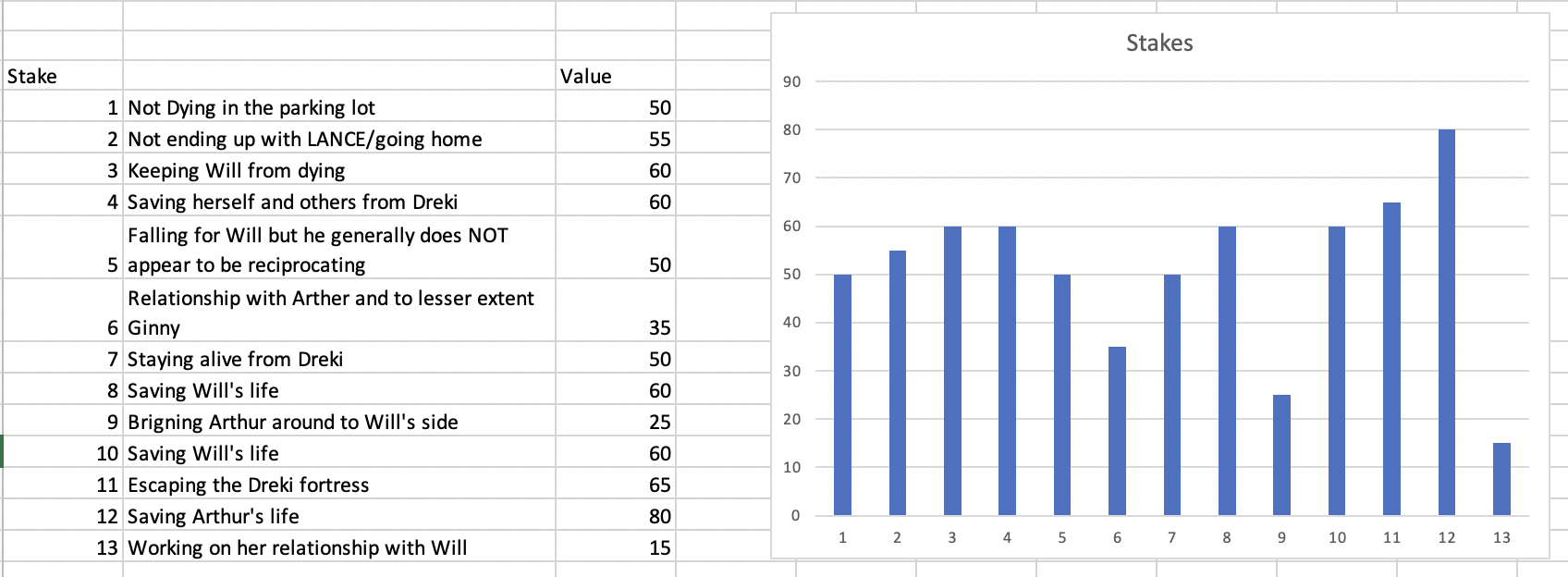
Well, we can actually graph them out and see. You can use a dot plot, a line graph, or a bar chart — basically anything that shows progression. On the x axis we’re going to put the stakes and on the Y will put how big of an impact the stakes has on the story or character using a scale from 0-100. A really high 100 stake is some sort of McGyver style stake. This is where you have ten seconds to defuse a nuclear bomb with a safety pin otherwise you and the State of Kentucky are going to die. An exceptionally low 1 value stake is where you need to remember to buy another bottle of multivitamins when you go to the grocery today, because you only have a two week supply left. Not exactly dire. Then you take your stakes, use your gut to assign them an impact value, and graph it.
Here’s an example of what you want your stakes to look like. Does every single one have to rise? No, but you want the overall progression to be rising. These are the stakes from my book Pendragon’s Heir.
So as you go into your writing or revising of your children’s book, keep your stakes in mind. I will.
*Note: the idea of dot plotting or graphing parts of your book is not original to me. I once learned about the idea of graphing parts of your book at an Austin SCBWI retreat at some point. The thing is, I can’t remember who taught it or whether or not they had applied it to stakes or to character arc and then I applied it to stakes. If anyone knows who (or what) I’m talking about, let me know.


January 19, 2023
When a Formula Isn’t Formulaic
Lots of authors think they hate formulas when it comes to writing. They say that structures are confining and stifle creativity.
But they don’t have to.
Story structures like the Hero’s Journey or Three Act or Fairy Tale style plots do not inherently limit how or what a person writes about. They simply provide guideposts for what readers expect and connect with in children’s books.
But let’s actually look at a framework and creativity in action in real children’s books.
Take the Hero’s Journey plot structure in the works of Robin McKinley, specifically her middle grade book The Hero and the Crown and her YA/Adult novel Sunshine.
Now, McKinley uses the Hero’s Journey framework in writing many of her children’s books, but in these two she specifically parallels them to a greater degree than any of her other works. Nearly every major character in Sunshine has an analog to the characters in The Hero and the Crown. They serve the same purpose in the story and behave in similar manners.
In case you’re curious, they breakdown in this way:
Character Archetype Hero and the Crown Sunshine Main Character/ProtagonistAerinSunshine (Rae)Mentor/Love InterestLutheConstantineSidekick/Love InterestTorMelAntagonist (Major)Aerin’s uncle AgsdedBeauregardeSidekick/SupportTalatSOF officer PatAnd the list goes on…
From there, these same sorts of characters then go on a classic Hero’s Journey. Originally detailed by Joseph Campbell, screenwriter Christopher Vogler turned the Hero’s Journey into actionable plot story beats in his book The Writer’s Journey. (A must read if you are into writing fantasy books or love plotting.)
Both books hit all the major story beats at the same time and in a similar manner. Even some of the detailing in the books are similar. To get to Agsded at the end, Aerin must climb a never-ending set of stairs. To get to Beauregarde at the end, Rae and Constantine have to fight a never-ending onslaught of minions. And (SPOILER!!), both ultimately succeed by throwing something at their adversary.
Sounds the same right? Formulaic even.
But these books are anything but cookie cutter. No one reading Sunshine would think it’s a recycled rehashing of The Hero and the Crown.
Because that’s where creativity comes in.
Story structure doesn’t stifle a writer’s creativity. It provides a framework for creativity to spread and grow.
Recommended Reading:
The Writer’s Journey
The Hero and the Crown
Sunshine
January 13, 2023
One of Those Days
Today I need to write.
I need to write at least 500 words on my current novel if I want to keep my momentum going.
I need to write about writing for this blog and for my newsletters.
I need to write the lesson plans for the next course I want to offer.
So, I set aside three hours today specifically to work on all this writing, one hour for each project. I’m forty-five minutes in, and here are the absolutely, earth-shattering tasks I’ve done instead:
· Unloaded the dishwasher
· Got sucked into a TikTok rabbit hole while unloading the dishwasher that extended past unloading said dishwasher
· Gone outside to figure out where my garbage bin blew away to (It was really windy last night.) Spoiler: It was in front of the neighbor’s house.
· Texted people
· Checked email. Twice.
· Fed the dog. (To be fair, she eats at the beginning of my writing time every day. I need to adjust that.)
· Made hot chocolate
· Wrote this post instead of the one I should be writing.
· Opened a package that was delivered
The point (assuming this post has one) is that some days you are enthusiastic about your writing. You cannot wait to dive in and put your characters through the wringer.
And then other days are like today when literally anything and everything is more appealing than writing a children’s book.
Neither kind of day is better than the other (although admittedly, one is singularly more productive). They just are.
If not writing on your children’s book stresses you out or if you have a deadline stalking you, then power through. Even if it’s a struggle some words will flow—if only in fits and spurts. And remember, it’s always easier to edit bad writing than it is to edit a blank page.
But if there isn’t anything pressing, and if this isn’t happening every single day, then cut yourself some slack. Sometimes we have to clear out the clutter in our homes, our lives, and our minds in order to write.
So, make yourself that cup of hot chocolate or coffee or margarita and try to write. But don’t beat yourself up if today is not one of those days.
It just means tomorrow might be.
Pens up!
January 5, 2023
Can’t I Do It Myself?
When I was a kid, my favorite phrase was By Myself.
I wanted to be independent. I wanted to be self-sufficient. I wanted to be left alone to do my own thing.
In some ways, I haven’t really changed. In many ways, I still prefer to do things on my own including things like learning how to publish kid’s books. The thing is, I now understand that most of life is a team sport. There’s very little that can be done 100% by yourself. And publishing definitely isn’t one of those things.
If you are publishing with a traditional publisher, the team is going to be huge. But even before you have that contract you’ll have your critique group or writing group giving you feedback. You also have any paid professionals like free lance editors or critiques from agents, editors, or writing coaches that you get at a writing conference. Finally, you also have your agent. Some are more editorial than others, but all of them are dedicated to you and your book. They are there to make sure the relationship between you and your publisher runs as smoothly as possible.
But what about self publishing? Surely that can be done alone.
Yeah. Not so much.
Self publishers have teams too. Unless they are an expert in writing, editing, graphic design, and possibly illustration, they are going to need to work with experts in those fields. And even once the book has been created, they still have to get the books to readers through distributors and their sales teams. And let’s not forget marketing! Authors with traditional presses have to do a fair bit of marketing both on their own and in conjunction with their publisher. A self-publisher does it in conjunction with firms they hire.
And then after all that is done, there’s still the readers. They are a part of Team Book too.
Despite the cliche of the lonely author hunched over a keyboard, the truth is no one writes in complete isolation. No one learns how to publish kid’s books alone either.
And that’s why we’re all here. To learn, to publish, and to celebrate our successes.
Together.
December 23, 2022
New Year, New Goals!
It’s that time of year again. That time when we evaluate where we want our lives to go in this shiny new year.
I won’t lie. Last year all of my goals revolved around my health. I had my final chemo treatment in January of 2022, and I was still facing 3 surgeries and 6 more months of immunotherapy. Writing and publishing and other professional goals weren’t even on my radar.
But all that’s done for this year.
This year it’s time to get my writing life back on track.
So, I’m setting my goals for this year, and I encourage you to do the same.
Personally, I like to break my goals up into doable bits so they won’t become overwhelming. This year I’m setting 2 daily, 2 weekly, and 2 monthly goals for my writing. They are:
Daily
Walk 1 mile everyday
Drink more water everyday
(I know these don’t look like writing goals, but they are mental/physical health goals. And if I’ve learned anything in the last 18 months, it’s that your writing suffers when your mental or physical health suffers.)
Weekly
Write 3500 words
Read 2 fiction books
(Some people swear by daily writing, but I personally prefer to set weekly goals instead. That way if I miss a day, I can still catch up without feeling guilty.)
Monthly
Develop 1 writing/editing workshop
Read 1 craft book
(We should never stop developing and improving our writing craft or sharing what we’ve learned with others.)
And then, as sort of a stretch goal, I hope to release 2 new fiction books and re-release 2 backlist titles this year.
Now, as you go to set your own goals, remember to make them realistic and attainable. Have that pie in the sky goal, but also have ones you know you can accomplish.
And if you want, share your goals here or in our Facebook Group so we can cheer each other on (and hold each other accountable).
Let’s have an amazing year of writing!
Stop submitting manuscripts with main characters that are the wrong age.
Nothing says you don’t know the children’s market like querying a YA novel with a six year old protagonist or a fifteen year old middle grade.
When I read a query or submission that says something like this, I immediately know that the author is either new to children’s books and hasn’t done the research or they don’t care. Neither inspires a ton of confidence.
So, let’s get characters that are the right age for the different segments of the children’s market.
For picture books, that means your characters are going to be little kids. Usually in these books, the character’s age isn’t specified, but they generally act like preschoolers or kindergartners. Occasionally, they’ll be as old as first or second grade.
From there, kids begin independent reading into chapter books. (Think Magic Tree House or A to Z Mysteries kind of series books.) Here the characters are usually 6 or 7 or 8. The main character’s age should match the reader’s age. Kids at this age are very egocentric. They want to read about characters that are like themselves. So a book for six year olds will have a six year old main character. And so on.
Once they hit nine, most kids prefer to read about kids that are older than themselves. Since middle grade readers tend to be between the ages of 9-12, that means that most middle grade main characters range in age from 10-12. Ten falls on the younger side of middle grade, twelve on the older. You do get a few thirteen and even fourteen year olds, but they are rarer. What you almost never see is a kid that’s nine.
For YA, again, the kids are reading up. Most YA readers are thirteen to around eighteen although there are exceptions. You do get some kids as young as eleven reading some of the younger YA, and you also have some adults that read upper YA, especially the romance ones. However, the primary audience is considered to be teens 13-18. So, the character age tends to be 15-18 with 16 YOs for the younger end and 18 or even 19 or 20 YOs.
I encourage you to double check that your character age matches the type of book you’re submitting. And if for some reason it doesn’t, consider why that might be. Do you need to age your character up? Do you need to re-evaluate whether or not you’ve written a middle grade?
No matter what, show the world that you are familiar with the children’s market and how the age of main characters works within it.
December 16, 2022
Chunking Up Your Book
A pretty standard part of setting big, long-term goals is to chunk it up into a bunch of smaller goals.
And what is writing a book if not setting a big, long-term goal?
So, let’s chunk a book up into a bunch of smaller easier goals.
First, set the major goal: Get your book published. (I mean, that is the ultimate goal of all of our books, right?) Then, you have to start actually writing that book. (You can’t publish a blank page. Well, you can, but unless you are making really avant-garde art, it isn’t going to go over very well.)
But writing the book is the overwhelming part. So, let’s chunk that down.
If you’re a plotter, make your first goal to be doing your outlining and other pre-planning. Break that down into as many small tasks as you need. Then once you start writing, join the pantsers in putting words to the page.
For the people pantsing it (and the plotters once they are done with their pre-planning), make the goal be to write your first chapter. From there, start having word count or scene goals.
Try to write regularly, but don’t beat yourself up if it doesn’t happen. Life can throw you some doozies. Give yourself some grace when that happens.
And if you are kind of person who likes rewards, be sure to reward yourself for each milestone made!
Once that very first draft is down, you can start into all the other steps that you’ll have to do to get published (editing, revising, querying, etc). But for now, just concentrate on that first draft.
It’s one word at a time, one letter following another. That’s how books get written, one little piece at a time.
November 28, 2022
Whose genre is it anyway?
I’m into watching TikTok right now.
I know. I know. I’m too old. And for a lot of the stuff over there, I really am too old. I’m never going to be doing any fancy pants dances. My days of kicking up my heels passed when I hung up my pompoms.
But one of the people I follow on TikTok is author Mary Robinette Kowal. I love her takes on writing and if you do TikTok, I highly recommend looking at her content.
In one of my favorite videos of hers, she breaks genres into two types: structural genres and aesthetic genres. Here’s the video so you can watch her explain it fully.
For those of you (like me) who didn’t watch just now, basically a structural genre is any genre where you need to hit certain story beats or have certain structural elements in place in order for your work to be considered a part of that genre. Mysteries and Romance are the examples she uses for this. If you don’t have a Happy Ever After or Happy For Now ending in a romance, you haven’t written a romance. You’ve written a book with romantic elements.
An aesthetic genre is one where the book is defined by an overall feel or look to the story. A historical would be a good example of this. You don’t have to hit any specific story beat or have a certain type of character to be a historical; you simply have to set your work in a historical period.
Kowal thinks it interesting when authors mix structural with aesthetic genres. Think a historical romance. She points out to all the nuance that a mixed genre book can bring.
I love thinking about genre in these terms. I’ve never seen it anywhere like this before, and in the comment section of the video Kowal admits that she may have made it up. Absolutely brilliant.
But, Kowal is an adult writer talking about adult books.
Let’s extend this to kiddie lit.
Like with many things when it comes to children’s novels, two is going to be the magic number. These books have dual audiences, dual markets, and at a bare minimum dual genres.
Every kid’s novel will be in one of three categories:
· Chapter Book
· Middle Grade
· YA
And books in these genres come with their own structural expectations. The main character should be a certain age. Certain themes are expected to be present in some capacity. There are word length and reading level expectations to be met. All of these are structural things meaning that all children’s novels are inherently structural in nature.
But, there’s also the genre of the actual story. Is the book a contemporary or fantasy or mystery?
Like I said, a minimum of two genres.
But, where it can get really interesting is when you start mixing three or more genres together. For example, I’m working on plotting a YA Science Fiction Heist Romance. Or you could say I’m working on a Structural Aesthetic Structural Structural Novel. Fun, right?
Take a moment to think about the genre of your work and whether it’s more structural or aesthetic in nature. And then consider how that informs the book and your writing. I suspect you’ll make some fascinating discoveries.
Also, I’m thinking of starting a Writing focused TikTok of my own. Let me know what topics you’d like to see covered in 3 minutes or less…
November 9, 2022
What’s Motivating Your Characters?
When we talk about characters, we always talk about their internal wants/needs as if the two are interchangeable concepts. We say that a character must have one to sustain their inner plot arc and that meeting this want or need is what propels the character to grow. That simply giving your character something to want or need is enough to motivate them towards their goals.
And all this isn’t wrong. Exactly.
However, there is a difference between the two. In a nutshell, a need is more primal than a want.
For example, I’m on this whole house organization kick these days. I want all these random clear bins and baskets for different rooms in my house. As another example, when the new Xbox One was coming out for the first time way back in the before days, my then husband and child informed me that if they did not get an Xbox One X when it came out, their lives could be considered incomplete. These are both powerful wants. My son works hard at the various tasks we set him in order to earn the video games he enjoys. These things can be powerful motivators to set him on paths of growth.
But let’s be realistic. Dramatic statements aside, my ex and child survived just fine when an Xbox One X didn’t materialize on release night. My house has not descended into disorganized chaos because I can’t store my stuff in Pinterest worthy clear bins.
A need, though, are the things we can’t live without. These are the things we’re sending to the areas affected by hurricanes and earthquakes. The things like food, water, fuel, medical supplies—the absence of which directly leads to death. True, a need can go beyond the physical. We all have emotional needs like friendship, love, and respect. However, the more physical the need, the more time constrained the character is bound, the more tension and drama is created in your story.
In the end, this means that a need will always be a stronger motivator than a want. A need will always cause more tension because no matter how cherished the want may be, it can always be set aside. A need can’t. For that reason, I encourage you to consider whether you are motivating your character with a want or a need. Remember that either will work, but consider if your story would be strengthened by using a need rather than a want.
November 14, 2018
What to Expect When Working With an Editor
[image error]
I read a tweet yesterday where I realized that not everyone entirely understands the purpose (or job) of an editor. Let’s discuss.
An editor is someone who reads an author’s work with a critical eye for the purpose of making meaningful suggestions and comments. They are there to help guide your work into the best story possible. They are experts in their craft from years of working their way through the office from intern on up. Their suggestions are not made on whims but after a thoughtful consideration of your work. An editor is your ally and your champion, even when they don’t see your manuscript the exact same way you do.
At the same time, an editor is not an author, a publisher, or a publicist—even though we may wear those hats at other time during the publication process. I, for instance, have been known to be multiple things. But when I’m sitting with my editorial hat on in front of your manuscript, those other parts of me drift away. During my time with your story, I don’t worry about market concerns, how I would write this, or what trade show would be perfect for a book signing. It’s just me and your words. As it should be.
So, what can you expect when working with an editor?
Collaboration
We both want what is best for your manuscript. If one of my suggestions seems completely off-base, then we need to discuss it. I am not some unholy dictator unable to see other sides. I have had authors who chose not to implement major critiques or suggestions before. If you are strongly opposed to something, first figure out why you are opposed. From there make a reasoned argument for your case. Sometimes it turns out to be a communication issue. Sometimes what you think you are articulating in the story isn’t actually there and this discussion brings to light for both of you what really needs to be done. Some of the best work has come out of these back and forth dialogs.
Working with an editor can be one of the most rewarding experiences. There’s something invigorating about discussing your work with someone who is as passionate about it as you are. Even though their comments and revision needs might be extensive, knowing an editor only wants what is best can be an amazing experience.