Madeline Smoot's Blog, page 4
April 7, 2023
If you want to write, read.
I did not grow up wanting to be a writer. I don’t have any of those cute journals from when I was a kid. My parents didn’t save any sweet little books I made about my stuffed animals—because I never made any. I got a marketing degree in college because in the business school you did presentations instead of writing papers. I hated to write. HATED IT.
So, how did I end up here today?
I was a reader.
I was a comprehensive, “will read anything in front of me” reader. I was a “had to have my reading time limited because going outside and running around won’t kill you” reader. I was voracious. I was insatiable. I still am today.
And it turns out, the first step to becoming a writer is being a reader.
Because although I wasn’t actively learning to write, I was absorbing many of the basics of good storytelling. I was learning how a character grows. I was seeing how a red herring worked, how a quest is structured, how to tell a love story.
So, when I randomly decided to try writing in my early twenties, I didn’t start completely from scratch.
Yes, I did go back and take writing classes. A lot of writing classes. Go get an MA in children’s literature amount of writing classes. And that was helpful, extremely helpful. I’m grateful for every class I’ve ever taken.
But the base was there in the books I’d been devouring since I was nine.
So, if you want to write, if you find yourself stuck in your current manuscript, if you have some downtime between deadlines—there’s only one thing you should be doing.
Hit your library, your local indie bookstore, or download an ebook because the best thing you’ll ever do for your writing career is one very simple thing.
Read.


March 29, 2023
When Writing Feels So ALONE
I love watching DIY home-improvement shows. Watching someone demo a wall or grout tile or reorganize a closet is Madeline catnip. In my free time I rearrange my furniture, wallpaper the odd wall, and reorganize my own closets for fun. (I have an odd idea of fun.)
However, there comes a point in every DIY project where occasionally I have to accept that the project I have taken on has gone beyond anything I can do on my own. It’s time to call in the professionals.
Writing can turn into that same kind of seemingly endless DIY project. Sometimes the project simply becomes too big, the edits too confusing, the revision too overwhelming to go it alone.
When that happens, there’s no shame in asking for help!
When you’ve gone as far as you can alone, it’s time to reach out to the professionals:
Your Critique Group—These people may not be paid readers, but they know writing, and more importantly, they know YOUR writing.
Freelance Editors—These people know their stuff. On average, these are people who have been working in publishing and editing for many, many years. They’ve edited countless manuscripts. They’ve seen it all. They can help you out of the writing hole you’ve dug yourself. Depending on where your manuscript is at and how your writing has gotten stuck, you’ll probably want some kind of editorial analysis or developmental edit. Most editors charge by the word, so be prepared if you’ve written an epic 150,000 word YA fantasy that the price is going to be higher than a 10,000 word chapter book.
Mentors—These can be either paid or unpaid mentors who look at your work and provide constructive feedback. This might be an established author in the field that reads through your work in between their own deadlines. Or this could be a group or individual mentor you pay to give your manuscript the sort of attention you would get from an involved MFA thesis advisor.
The 1on1 mentorships I provide involve everything from writing lessons for newer authors to full developmental edits and revision planning assistance. For my self-publishing mentorships, I do all the editorial mentoring in addition to helping authors with some of the book production tasks required to get the book published. It’s a comprehensive and extensive mentorship that covers more than just the basics. (And yes, that was an absolutely shameless plug for my mentorship services because you should know that they exist in case you need them.)
Writing does not have to be you and your laptop, stuck in solitary with DIY. If you’re stuck, ask for help. You’ll be surprised how many people are willing and able to help.
March 22, 2023
Perfect Scene Pacing
I spend a lot of time talking about Perfect Pacing when it comes to the overall work, but scene pacing is incredibly important too. This is the rate that your scene progresses. Some scenes we want to be fast; others slow, even languid. It just depends on what’s happening in the scene.
There are two ways to do this:
· Scene Length
This is literally how long a scene is. Do you spend pages on it? Or can the scene show everything you need (while still doing Double Duty!!) in a few paragraphs?
· Sentence Length
Short, clipped sentences read fast. Long, elaborate, drawn out sentences which use multiple clauses or phrases take longer to read and slow the reader down. If you are doing an action scene, you’ll most likely want to use shorter sentences to keep the action moving and to create a sense of urgency. Something more leisurely (like a heartfelt conversation) can be written to read more slowly.
Neither of these things impact the overall pacing of the story. As long as your scenes are doing Double Duty and aren’t hyper-realistic with tons of info dumping, they won’t bog down your overall story, no matter how quickly or slowly they are written.
However, Scene and Sentence Length can set the mood for that particular scene. And there’s no reason not to capitalize on that.
March 17, 2023
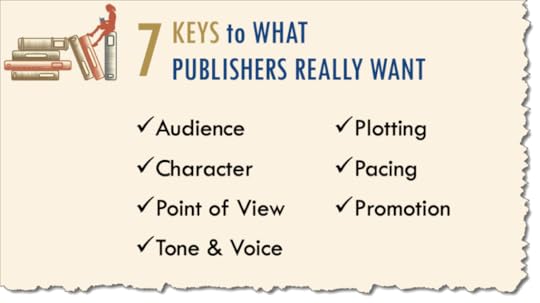
7 Secret Keys to What Publishers Really Want
It’s the mystery that keeps authors up at night: What do publishers really want in a middle grade or YA?
Well, seven things.
AUDIENCEThey want a manuscript that takes into account the DUAL NATURE of the audience. When it comes to children’s novels, you’re writing for kids AND adults.CHARACTER
Publishers want COMPELLING characters that readers like and empathize with.POINT OF VIEW
They want a LIMITED number of points of view.TONE & VOICE
Publishers want a kid ACCURATE voice that matches the STYLE of the tone.PLOTTING
They want a well-plotted book that keeps the reader TURNING the page.PACING
Publishers want DYNAMIC pacing that keeps the reader’s attention.PROMOTION
They want authors with a following and a SOCIAL MEDIA presence and NEWSLETTER that can engage with readers and leave them hungry to read more.
The list is simple, but what do each of these actually mean, right?
If you would like us to do our (usually live at an event) training on the 7 Secret Keys Publishers Really Want for our writing family, just sign up here and we’ll set up a web training for the fam!
March 8, 2023
Restricted Realism
Novels, even fantasies and science fiction, need to be realistic. There have to be things the reader relates to in order to connect with the story. Something has to ground them to the world you’re building, and realism does that.
However, you can have too much of a good thing.
When you start showing every moment of every day, you start becoming hyper-realistic. The truth is, we don’t need to see every second, only those that relate to the story you’re telling. If the story still makes sense without watching your character eat breakfast, sit through calculus, and text a friend between classes, then you can probably skip over that part.
On a related note, you also have to watch for info dumping. This is where you drop a large chunk of information about your world or character or something pertinent to the story in one huge chunk. An info dump can be as small as a couple of paragraphs or as long as multiple pages. And usually, some (if not all) of that information IS needed. Your reader needs that info for context or to follow what’s going on. The problem is when that info dump impedes the story either by disrupting pacing or by going off on a tangent that isn’t relevant in that exact moment.
Instead of info dumping, it’s better to strew that information out throughout the scene in small little breadcrumbs. The reader still gets all the information they need without losing track of the story.
In both hyper-realism and info dumping, you end up with a bit too much reality for your story. For the sake of the story you are telling and the pacing of your book, try to determine whether every moment you’ve included, every fact you’ve shared needs to be told. Avoid the trap of sharing every little detail.
Trust me, your story doesn’t need it.
March 6, 2023
Lessons Learned as a Bookseller
For many years, I spent most of my days in a bookstore. First for one year at Barnes & Noble, and later more years than I can remember at BookPeople in Austin.
I have always believed that everyone in publishing from the author to the publisher would benefit from spending time working in a bookstore. There’s so much, not just about the industry, but books themselves that you can learn there. For example:
How to write catchy copy. You get to see firsthand what books people pick up and what leaves them confused or uninterested.
How to pitch a book in one sentence or left. When you only have the time it takes from pulling a book off a shelf to placing it in the customer’s hand, you get good at making that book as appealing as possible in as few words as possible.
To put your barcodes on the right side of the book, by the spine. Not on the left side. Not in the center. Right side by the spine. When you’re having to scan book after book for inventory checks, you want to pull the book out as little as possible.
To never do white covers. They just look filthy.
To never do black covers. They also manage to look dirty. Solid covers in general don’t hold up that well.
To never, ever, no matter how cool they are, have some sort of cutout on the dust jacket or cover. They just get ripped. Then they get sent back to the publisher for pulping. It’s just a waste.
How much readers truly love to talk about books. Of course, there are all sorts of places these days for book lovers to come together. There are all kinds of online communities. But there’s just something about geeking out with a complete stranger over a book you love that bonds you in a way you don’t find online.
I realize that it’s unrealistic for everyone to spend time like that working in a bookstore, but there are libraries to volunteer in, book festivals, and other ways to connect with books and readers in a similar way. If you get the opportunity, definitely take it.
I can’t recommend it enough.
February 22, 2023
Double Duty
One of the best ways to know whether or not your scene is meant for your story is to consider whether or not it’s doing Double Duty.
Double Duty is the concept that every scene needs to be doing at least 2 of the following 3 thing:
1. Furthering the Plot
2. Furthering the Character’s arc
3. Establishing Something (Theme, Setting, New Characters, etc)
If you have a scene that’s doing only one of these things (or worse! none of them!), then that scene needs to be rewritten. Either:
· Combine it with another scene
· Summarize the main action (usually to show the passage of time)
· Delete it entirely
This is a very easy way to see if your scene has gotten off-track. After all, sometimes we write scenes that are good for the author to know, but really aren’t needed for the reader.
My classic example of that is the time I wrote a scene where a character goes into excruciating detail on how he had done the estate planning for his death. In a YA novel. For teens. Who do not care about that sort of thing. That scene didn’t do anything, much less manage to pull Double Duty.
Needless to say, I cut it!
And you can do that too. Just ask yourself, is this doing Double Duty and if it’s not, eliminate your extra, unneeded scenes and your readers will be much more engaged in your story.
February 16, 2023
Breaking Down Your Chapters
One of the key parts of any children’s book revision plan is the chapter or scene breakdowns. These are chapter (or scene) summaries that highlight the main points of the existing edit.
Chapter summaries can be extensive multi-page entries for each chapter, or they can be a single paragraph. It really depends on your personal style and preference.
My chapter summaries tend to be a few paragraphs. Anything more than that, and I feel like I’m simply rewriting everything again. (But, again, there’s no right way to do this. It’s whatever works for you.)
Once you’ve made a revision outline and your chapter summaries, you can plan the specific changes you’ll want to make in your next draft.
I like to do this in another color so I can easily see the changes when I reach that part of my revision.
For example:

In the original they go to where Mom disappeared to find the portal, but that didn’t make sense for the pacing (or plot) of the story. This way, they get to action faster.
With this particular method, I can easily see which parts of the chapter can be kept pretty much intact (the very beginning) and how much needs to be rewritten (basically all of it).
From there, it’s just a matter of doing the actual rewrite of your children’s book.
You know, the fun stuff!
February 10, 2023
Make Your Characters Suffer
Recently my writing partner and I were CLEARLY the main characters in someone’s novel.
First my writing partner came down with a kidney stone. That alone is enough misery to fuel fifty novels.
My ex was in town staying with me, so he stayed with our kid while I went to help my partner and his kid—and see my partner through the agony of passing the stone.
The stone eventually passed, (Huzzah!) only for an ice storm to hit. That caused a tree limb to fall on my partner’s car and the electricity to go out—for 5 days.
Fortunately, my house never lost electricity and the roads were clear enough to semi-safely travel. So, we all bundled up (me, my partner, his kid, their dog) and trekked over to my place to join my kid and ex and our two dogs.
Only to have a second kidney stone make itself known five minutes from my house.
And so on …
That week was terrible to live through. I wouldn’t wish it on anyone.
But it makes an amazing story.
And as we’re trying to make amazing stories, we have to make our characters suffer just as much as my writing partner and I suffered that week.
We want to put our characters through the wringer so they can come out better on the other side. Challenge leads to growth, and nothing builds a character like suffering in some capacity.
Did my writing partner grow from this experience? Yes. He’s now committed to asking for help sooner—and not wait until he and his kid are stranded in the ER because he can’t drive home.
And even the secondary characters in this drama grew from it. My ex-husband and kid were able to show compassion and grace under stress. Neither excels at sharing their spaces (like me, they are fiercely territorial introverts that struggle with others in their space for long periods of time). And yet all three of us existed harmoniously with the new arrivals without meltdowns or snarky comments. We all came together to help.
And as for me? I got to practice boundaries in action, namely not overextending myself. I helped when I could and made peace with the times I could not. It’s very hard to watch someone in extraordinary pain and not be able to do anything about it. But, it’s not my job to fix another’s pain, merely to support them as they work through it themselves. A valuable lesson indeed.
So, put your character in that painful situation. Make them make tough choices. Hold them accountable for their actions. Force them to grow.
Your story will be the better for it.
February 2, 2023
Editors Don’t Revise
Editors are amazing. (Yes, I may be biased, seeing that I am one.) But editors have their limits.
A good editor—whether they’re a freelance editor your hire or one that works for your publisher—is there to help you make your book the best that it can be. But they aren’t there to rewrite it for you.
This means that an editor tells you WHAT is wrong with your manuscript, but they don’t really tell you HOW to fix it…
Sure, your editor will make suggestions. They might even give examples of what they mean. But in the end, the revision is up to you.
You. All you.
And that can be an overwhelming, even daunting task.
There are all sorts of ways to revise: go from the big issues to the small, using index cards or sticky notes, or even to wing it.
Personally, I like to make a plan. It looks a little something like this:
Goals List of areas to change based on editorial feedback Summaries of new/rewritten scenes I’ll be doingReally, it comes down to chunking my revision. Like most things in my life, I like to reduce giant, overwhelming tasks (revising) down into doable bits (summaries). I find the small to be manageable, turning the revision from a task to avoid to a task where I can succeed.
And who doesn’t love a new, better book that’s even more of a pleasure to read?