Madeline Smoot's Blog, page 11
January 14, 2015
Just Submit Already

Today I did that scary thing all authors have to do at some point if they ever plan to publish their work (regardless of whether they go the traditional or indie publishing route). I opened myself up to rejection. In my specific example, I submitted to an agent.
Now, submitting to a single agent is not exactly a huge feat. But she is just the first of I suspect many, and with each submission the chance for rejection exists. (The chance for acceptance also exists. We must stay positive.)
So why did I take so long to submit? Well partly, because last year I had to conserve my energy. Working on others people work with CBAY was more important to me than getting my own work out. Now that I feel better I can prioritize both CBAY and my own stuff .
.
So what was the pep talk I gave myself as I sent my things into the wide world?
The worst that can happen is that they might say no.
True, this is the very definition of rejection, but to paraphrase one of my brilliant writer friends who just signed with an agent: I’m no worse off than before I queried.
They can’t say yes if I don’t ask.
Let’s face it. The agents are not going to coming looking for me or you. We have to let them know we have something to offer. They are neither omniscient nor omnipresent. They have to know we exist.
This is not a personal rejection.
This isn’t a statement on me as an author or even on my writing. It’s a statement on whether or not the agent is passionate about my work.
Of course, once we decide to submit, we have to keep it organized so we don’t end up querying the same person multiple times. To get a copy of my the spreadsheet I use to query agents, click here.


January 12, 2015
How to Have Your Own Low-Key Retreat
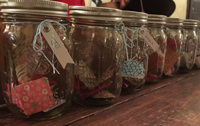
Leaving supportive messages for each other.
I have just gotten back from a writing retreat. This was a very informal thing where a large group of writing-oriented friends rent a house in the middle of nowhere. We take turns making meals and we spend hours, hours just working in silence. It’s great. It’s one of the things I look forward to every six months. And I get so much done.
This kind of “get away from it all” is really key for everyone, especially creative types. So, here are the tips I’ve accumulated over the years from watching our retreat’s organizers:
Find someplace without internet
We use a house in the middle of nowhere about 1 hour outside of Austin. Although the place has TVs with DVD players, they are strictly forbidden. There’s only about 3 of us who get cell service, so internet is out for most folks. (I’m one of the lucky ones, so I act as switchboard for calls, thus no one begrudges me my email time.) If you just want to have a writing weekend with a close friend, you could always get one room and not ever use the hotel wifi.
Use a Google Doc Spreadsheet to Decide Food and Cleaning Duties in Advance
We take turns preparing the meals and then someone else cleans up. This way we know in advance who needs to bring what food, and there are no fights over clean-up. Also, everyone knows when she’s doing stuff, and this helps budget writing time.

Our inspirational activity — reminding ourselves to succeed.
Have Plans for the Evening
We try to do something inspirational every night. We also set one night aside to read from our work and get a little feedback.
Have fun.
We have a great mix of people that all get along. It’s fun to gossip about the industry, discuss our various works in progress and generally re-inspire each other.
Today my email was filled with all of us lamenting that fact that we had to go back to our regular lives and lauding our accomplishments. (One woman wrote over 40k words the 3 days she was there. 40k! I find that a cross between very inspiring and very intimidating.)
January 9, 2015
Unlooked for Compliment
The other day I got something that a parent of a kid like mine – a kid with a lot of negative labels – doesn’t get all that often. A complete and total stranger told me I have a “good kid.”
Let’s set the scene.
I got a new phone that did not activate. I did everything you’re supposed to do, but my cell service stubbornly stuck with the old phone. So, with my husband out of town, I dragged my kid up to the cell phone store. On a Saturday.
The little storefront was packed. The guy at the door pointed us to a table, and we sat down. Without a fuss (and to my surprise), child handed over my old phone so the guy could look at it. While the guy helped me call the number that would switch my service, my kid played on the iPad. When there was a lull, he leaned over and whispered in that very loud stage whisper only little kids do, “What his name?”
“His name is Bob,” I said, reading the guy’s name tag.
“I can talk Bob?” he whispered.
“Sure, you can talk to Bob if you want,” I said.
He turned and in a huge exaggerated voice (as if Bob hadn’t just heard the entire exchange) said, “Hi, Bob.”
“Hi,” said Bob, with a smirk, clearly trying to suppress a grin.
For the rest of our time there, Castle would occasionally share his iPad with Bob. At the end as we left, Bob smiled and said, “You have a good kid there.”
I know, Bob. I know. It’s just nice that you see it too.
January 7, 2015
12 Months of Writing
My first goal of the year is to write more. This particular goal doesn’t really need a detailed plan or timeline. I can say it all in one sentence: I’m going to write for at least one hour everyday.
Although initially this goal is about little more than putting words on a page, eventually I want those words to add up to well-crafted work. So, as a corollary to this goal, I’m going to focus on my craft this year as well.

My Twelve Months of Writing:
Character
Plot
Theme
Dialog
Setting/World Building
Show vs. Tell
Motivation
Types of Fiction
Genre Fiction
Revision
Novels
Nonfiction
If you want to join me on my journey through craft, sign up for my newsletter. Every month I will be sending our a special “Art & Craft” edition of Madeline’s Mutterings. To join my newsletter, click here.
And if there’s anything special, craft-wise, that you’d like to discuss, let me know in the comments below.
January 5, 2015
How To Still Focus on Your One Thing

 Today most kids go back to school after the holiday break. For some reason that got me thinking about the book The ONE Thing that I read a while back. You see, school is sort of the antithesis to that book. In school you spend your day broken into a whole bunch of parts skipping around to various subjects. On the other hand, in The ONE Thing, the goal is to spend a good chunk of time (ideally four hours) on one specific goal, task or project. This allows you to become very focused and “in the zone” without getting distracted by other, lesser tasks. I have to admit that I completely buy into this idea. I know that when I get deep into a project, not only is it difficult for me to tear away, it’s also hard to focus on something else.
There’s just one little problem. Where do I get four hours every day?

My schedule? I wish. Maybe if I was single, with no kid, and no life.
I don’t know about you, but my day looks more like a school day than an ideal ONE Thing day. Yes, I have a flexible, set my own hours work schedule, but that just means that I can schedule my son’s therapy for whenever not that I have huge blocks of unscheduled time.
Granted, the book offers all sorts of suggestions for how to get your block of time, but they weren’t all that practical for me or any of the other writers that are writing as we can. So how can we still harness 1 Thing focussed thinking while still getting through life? Here are my ideas.
Try not to stop thinking.
I had to take a shower half way through this post. I thought of the items on this list in there.
Get original.
I don’t mean that your writing should be original — although of course it should be. Think of different ways to get your words on the page. Maybe you’ll have to start keeping stuff in a notebook or get a keyboard for your tablet. My husband got me Dragon Dictation for Christmas, so I’m going to start experimenting with dictating stuff while I cook or fold laundry or other mindless tasks.
Carve yourself out a niche of time. Then schedule it, notify others, and stick with it.
Develop “food poisoning.” Tell your family you are not to be interrupted for anything less than the apocalypse, lock yourself in the bathroom, and enjoy 15-20 minutes of furious writing.
Leave yourself notes.
Yes, in a perfect world we would get that four block, but the world isn’t perfect. We’re all going to lose time refocussing in on a project. However, we’ll lose less time if we leave ourselves a little note about where to start back up.
Of course, all of these ideas don’t mean a thing if you haven’t picked your one thing — not a goal, but the one thing you are so passionate about that your life would lose a little color without it.
For me, writing is my one thing for this year. What’s yours?
January 2, 2015
A Hero My (Autistic) Kid Can Relate To

Step nine, eat a complete breakfast with all the special people in your life.
My child loves superhero. He’s pretended to be Tony Stark/Ironman. He’s dressed up as Spiderman to go to the park. He was Chase from Paw Patrol for Halloween. (Well, he looked like a cop, but we called him the little K9 dog from the Nickelodeon show.) But now Castle has a new hero in town.
Emmet. From The Lego Movie.
Yes, my child’s new hero is a 1.5 inch minifig.
Don’t get me wrong. My child has liked Lego characters before. Lego Harry Potter from the video game helped us to get him to wear his glasses when they were first prescribed. Lego Marvel Super Heroes (the video game) began his love for Ironman and the Robert Downey Jr. movies which led to his love for the Avengers and the various Marvel cartoons featuring them. The same happened with Batman.
But there’s something special about Emmet. Something that Castle actually relates to instead of just admiring. He doesn’t pretend to be Emmet like he does the others. He’s already too much Emmet to have to pretend.
You see, Emmet, voiced by Chris Pratt, is a guy who lives life by the instructions. These instructions allow him to fit in with his society — to communicate and have friends (of a sort), hold down a job and live on his own.
Sound familiar? It does to every parent with a high functioning autistic child.
Since my child started OT, he regularly makes plans — a written set of instructions if you will — of how various parts of his day will go. For example, we may go 1) Speech Therapy 2) School 3)Home 4) Play Xbox. Emmet starts his day following a specific plan:
And although Emmet’s plan is funny and a little silly, my kid very much identifies with it — down to having to do exercises in the morning. Since we started watching the movie regularly on HBOGo, we now get up and “just like Emmet” follow Emmet’s instructions/plan. I’m happy to report that mornings have been going much smoother. (I even got him to eat breakfast today.) True, he now wants to build some sort of small Lego thing now before school/therapy, but that’s much better than trying to keep him from the Xbox or iPad.
And unlike a lot of movies that start with ordinary guys discovering their extraordinary gifts, Emmet still maintains respect for the place where he started, the place where he followed instructions. My kid doesn’t have to feel bad that he needs plans, has at times learned scripts for social situations and generally needs a little more help (generally in written form) to get through the day. Although creativity and individuality is highly prized in the movie, so is teamwork and working from a plan. In the end all forms of play — from freeform building to mapped out Lego packages — are, like the song says, awesome.
December 31, 2014
How To Turn a Dream Into a Goal
On Monday I wrote about my wishes and dreams for 2015, and I mentioned how I was going to turn those dreams into goals for the new year. But before I start turning my dreams into goals, let’s review the definition of a goal. According to Google, a goal is “the object of a person’s ambition or effort; an aim or desired result.” I would also add:
Goals are realistic.
Goals are achievable.

1-4 image courtesy of Shutterstock.com
And in order to create a goal we need to do four things.Dream.
We need to have a dream. Fortunately we did that the other day. If you haven’t already written out your wishes for 2015, now is the time to do it. Remember if you share those dreams, it creates accountability. You can share your wishes either on your own blog, Facebook page, or even in the comment section of my post.
Plan.
We need to have a plan. We need to formulate a list of steps or even a checklist of things that we need to do to achieve our goal. For example, a good goal is to lose 5 pounds. It’s realistic. It’s achievable. But if you don’t figure out how you’re going to lose that weight, then it’s never going to come off. You have to plan to cut your calories and increase your fitness level.
Timeline.
We need to create a realistic timeline. I might set a goal to get an agent. I might draw up a list of all the different agents I could submit to and draft an email to use as my query letter. But if I don’t actually start querying in a timely manner, this goal could take forever to achieve. On the other hand if I decide to send out 10 letters a day that’s as unrealistic as sending 10 letters a year. I have to find a balance that makes sense for that particular goal.
Adjust.
We need to make adjustments to our dreams, our plans, and our timelines as necessary. Sometimes the way we worded our dream ends up being unrealistic. We then need to adjust accordingly. Or we may discover that the plan we have made is not actually practical. For example, my husband and I wanted to create and sell Lego play tables. However, we have been unable to source parts for our table at a reasonable price. This has forced us to rethink our plan. Finally, we also sometimes need to adjust our timelines. Life happens. We can’t always predict when and how much time a project will take. If you find you are speeding through your plan, great! Adjust your timeline accordingly. By the same token if you find that you just are having trouble meeting a specific timeline, again adjust. These are goals you are setting for your self. There is no need to unduly pressure yourself with unrealistic or unworkable timelines.
December 29, 2014
2015 Wishes

Image courtesy of Shutterstock.com
It’s that time of year again – when the old year ends, and we start anticipating the new one. I, for one, cannot see the back of 2014 fast enough. This has been a hideous year for me health-wise, and that affected everything else in my life from work on down. In fact, you can see on my blog right when my health started to decline. I was going great in January, but then started having problems beginning in February.
But after a year of travelling diagnoses (everything from liver to my oavaries have been accused of causing my wide range of symptoms), my doctors and I seem to have gotten the major symptoms under control. And that means that I can be optimistic that I’ll be able to do more in 2015 than lie in bed and stare at the ceiling. (Which is basically how I spent October and November this year.)
To celebrate my new health and the new year, I’m putting together my wish list of 2015. These aren’t my goals, per se. It’s more a list of dreams.
Write more in general.
I didn’t get much writing done in any way, shape or form. I want this to change.
Write 3 novels and 5 short stories/chapter books. In one year.
No, I have not lost my mind. One of my authors Susan Bianculli wrote two novels and two novellas for her Mist Gate series that debuts in 2015. It has seriously inspired me. (Also two of the novels in question are collaborations so I’ll have help.)
Become involved in the Dallas writing community while maintaining my ties to the Austin one.
I loved the Austin writing community, and it’s the biggest thing I miss after having moved. It’s time to find my Dallas tribe. And do better at staying in contact with the Austin one.
Travel more.
This is both a personal and professional goal. One of my dreams has always been to go to some of the Christmas markets in Germany. I want that to happen this year. And on a professional level, I want to start speaking more at conferences and on panels at various events.
Win the lottery.
Well, this IS a wish list.
Like I said, these are just dreams at the moment, but I plan to turn each of these into a goal with a realistic plan for achieving it. In fact, that’s what I’ll be doing here over the next few weeks.
And now it’s your turn. I’ve found that actually writing down what I want helps make it more real. In the comments or on your own blog/page, write down your dreams for 2015. Together, we’ll turn our dreams into achievable goals.
What are your wishes for 2015? Leave a comment with your wishes or the link to your wishes below.
February 14, 2014
Collaboration for Fun and Profit
 The best conversations, and the best collaborations, begin with one question: “What if?” “What if the people who colonized the Moon were trapped there because their hearts and lungs could no longer support Earth Gravity?” “Oooh, and what if they developed a distrust and hatred of Earthers because of it?” “That makes sense. What kind of a political system do you think would develop?” “I’d prefer something not too derivative of Earth, a little alien, but that would make it harder to convey.” “Oh, if the main character is an Earther trying not to get spaced during the Revolution, we could have the way things are there unfold in front of his or her eyes….” “Great. What scope were you thinking of?” “I was thinking YA short story for this one, maybe turning into a novel down the road, so I want to have the main character survive.” “OK, but we’ll need an important secondary character among the Lunars. Are you thinking romance element?” “Maybe, but only as subplot.”
That’s the kind of way our collaborations begin. Ideas boomerang between each other and then start to come together into a shaky structure. We knock pieces off and add others on, shorten here, lengthen there, find the supports that will help it stand on its own. The questions continue to spring out during the process. “How about this?” “What do you think of that?”
We have an advantage; being married to each other, we can throw out ideas at 6:30 in the morning or eleven at night, in the middle of dinner or while helping kids with homework. Usually the one who started the idea springboard writes—perhaps the first draft, perhaps only the first scene. The second may revise, or may take over a scene or a point of view. Sometimes the story gets passed back and forth like a snowman’s body, growing all the time.
In solo writing a story can evolve into something very different than it seemed at the start; writing takes off, plot deviates, and soon the story is unrecognizable. With collaborating, a lot of the trying out of ideas happens before the writing stage, so often beginning and end are both set before the first words are written. Only the roads that connect them are still to be laid out, stone by stone. One person may build a bridge to shorten that road, or the other may bring in a detour, but by this point there is a feeling that you are only uncovering something that is already there—the story you were meant to tell, together.
It’s fun, at the very worst. For it to also be potentially profitable, at least one of you needs to be willing to hunt up markets, revise, and submit. This is easier working together; the person who is optimistic today writes this cover letter, while tomorrow it may be the other who actually has the energy to check formatting requirements. Together, you eventually find…anything is possible.
January 27, 2014
Writing with Fear
 Last weekend I attended a conference for working Moms. As usual, I found writing inspiration in the strangest places. I attended a session by Melinda Garvey of Austin Woman’s Magazine. Now, the session was designed to inspire entrepreneurs to embrace fear so that fear doesn’t ruin their chances for success.
An admirable message, but I couldn’t help but think that this could be extended into all parts of life from deciding to move to a new city or take a new job to whether or not to date that new guy or get a divorce.
And of course because I have fairly limited interests, I immediately extended the idea to writing. Here are three things I think we should all do to add a little danger (aka fear) to our writing:
Write what you don’t know.
Everyone always tells you to “write what you know.” Well, I’m telling to write about stuff you know nothing about. Have a vague interest in ancient aliens but not enough to watch the TV show? Write about it anyway. Normally write hard hitting contemporary teen romance? Try writing an archeological adventure for boys. These stories may not go anywhere, but stretching our writing muscles in new and interesting ways are always a good thing.
Write outside your comfort zone.
Write in a genre or an age range that you never write for. Are you a novelist? Try to write a picture book or concept book. Can’t write a book under 80k words? Try flash fiction.
Write scary new stuff.
This is sort of the culmination of the other two. Think of the most terrifyingly, horrible thing and then try to write it. No matter what it is, no matter what the subject matter deals with. Write it, and exorcise some of your demons. (For me, this is generally about how miserable parenting makes me. It’s not the kind of thing you’re supposed to say out loud. There’s some real liberation, though, in writing about the taboo.)
Now, I know it’s easy to say or read about writing scary stuff. But, I’m going to actually practice what I preach.
I never write romance. I often skim romance sections in books. So, I’m going to challenge myself to write a romance: specifically to write a 15k word superhero romance to submit to Good Mourning Publishing. The idea of writing outside my comfort zone and then submitting it is, frankly, terrifying. But that is how I know my goal is big enough. Without fear, then we’re merely living in our comfort zone. Without fear we aren’t challenging ourselves.
How are you going to challenge yourself and your writing? Tell me in the comments.