N.E. White's Blog, page 4
June 18, 2025
The Last Qs
For the past four of weeks (how time flies), I’ve been going through the questions posed in a video produced by the BookFox. The video is titled: 9 Craft Questions Every Wrier Should be Able to Answer.
If you want, watch it. If not, I’ve gone through the questions in these following blog posts and this one you’re reading right now:
What Type of Writer Are You?Crossing that LineMorally Gray GroundThe Last Qs (this blog post)As a reminder, here are all nine questions:
Do you prefer language as trance or as entertainment? Or both?Do you take advantage of the novel’inherent advantages as a communication medium (as opposed to films): interiority, time fluctuations, & point-of-view (POV) variation?What should you never show? Do you show everything (i.e. no topic is off the table)? Where do you draw the line? Do you have a line?Should you always write round characters? Or flat characters? Or both?Is your novel or writing moral or amoral?Should you include coincidence in your fiction? (If you do, make sure it is at the beginning and not the end.)Anticipation or surprise? Which do you prefer to write? Or a bit of both?Should you use brand names in your fictions? This will time-stamp your work.Should you create themes in your story? Or allow them to emerge organically from the work?In this final installment of this series of questions, let’s explore the last three (seven, eight, and nine).
7. Anticipation or surprise?This question speaks to a literary technic: Do you spring information on your readers at the last moment, surprising your readers? Or do you tell them what’s gonna happen so they are hankering for the big showdown throughout the book?
I’ve never given this question much thought. Tell you the truth, I didn’t even know it was a literary technic. I just thought, some things are surprises while others are not.
But, of course, as writers, we control the anticipation or surprise.
Unwittily, I use anticipation in a lot of my stories. In my Ghost Stories (unpublished–yet!), in the very first paragraph, my main character tell us she’s not gonna make it to the end of her pay period. She worries about losing her job throughout the entire series.
And she does lose her job.
But not in the way you’d think.
I surprise the reader at the end with her death (the only way she can finish off a demon is to join it on the other side).
For writers, I don’t think it’s a matter of either/or. You might find as you write that you naturally gravitate towards surprising your readers with information or perhaps you broadcast major events. Or maybe you use both like I did in my Ghost Stories.
With that said, there are writers and specific works that are known for either surprising their audience (think any movie directed by M. Night Shyamalan) or keeping their viewers in suspense (think any horror movie).
What do you want to be known for?
8. Should you include brand names in your fiction?This is kind of a no brainer.
Or is it?
Let’s think about it. When you mention in your novel that Billy drank a Pepsi, what are you subtly conveying to your reader?
Pepsi has been distributed throughout the United States for, like, forever. More specifically, Wikipedia informs me that Pepsi started out in 1893 as “Brad’s Drink” and changed it’s name to “Pepsi-Cola” in 1898 before shortening it to “Pepsi” in 1961.
If I mention that my character is drinking Pepsi-Cola, I can safely assume the story takes place between 1898 and 1961–and medicinal qualities of the drink are probably important (if unfounded).
If I write Pepsi only, then the reader can assume the story is set in post-1961 America. The soda company didn’t really start its foreign markets until the mid-20th century, so after which, there is the possibility that Billy is somewhere in France or Russia.
Did you also know that Pepsi was once considered a “Black” drink? And Coke (its rival) anti-Black?
So… What more are you saying when you write Billy drank a Pepsi?
I may be writing too much into the one word ‘Pepsi’, but with these examples, you can see how brand names bring in a whole host of issues into your piece. The use of one word not only dates your work, but implies whatever connotations (subtle or otherwise) associated with it.
You might not want that.
Or maybe you do.
Your story about a black, teenager in New York drinking a Pepsi before his job interview might be exactly the time-stamp you’re after. If that’s the case, run with it.
But if you want your story to feel more timeless, ditch the corporate names and use something generic like ‘cola’, ‘soda’, or ‘pop’ (which convey regional preferences and meaning in themselves).
Since my stories almost always are set in imaginary worlds of my own making, I often don’t have to worry about brand names. They are, of course, not used. I do have to be careful when brand names that are now used as generic words sneak in. I mean, who knew “dumpster” was a brand name?
What about you? Do you take care not to use brand names? Or do you litter your writing with them to help flesh out and convey a time and place?
9. Should you create themes in your story?Similar to the morality question, should you purposefully hang your story around a theme (i.e., acts of kindness, environmental destruction, rich people are evil, etc.)? Or not?
The BookFox’s argument here is that themes should arise naturally from the story and not whacked into the reader with every paragraph.
I’m sort-of gonna disagree with this because, as a dense reader, I often miss the theme of books unless they are smacked into me a thousand times. I’m just dense that way.
And I’ve noticed with my critique partners and beta-readers, they don’t see themes I plainly repeat over and over either. So, it’s not just me.
I definitely don’t want to imply that readers are stupid.
We’re not.
But we are bombarded with a lot of distractions and stress. When we read for pleasure, we don’t want to “figure out” what the text is trying to say.
So, my advice, if you want to convey a theme with your writing, make it simple on the readers to get it. Have a character say it. Then another character paraphrase it. And maybe have it in the narration, too.
Or best of all, don’t worry about theme. For sure, write with your theme in mind, but whether that gets across or not–don’t worry about it. The readers paying attention will get it. And those of us who aren’t will thank you for keeping the reading simple.
Phew! We got through all nine questions.
After going through all of them, do you feel like you know what sort of writer you are? Do your readers? What kind of story can they trust you to write?
Until next time, write like you know what you’re doing.
Nila


June 16, 2025
Ecotones–10th Anniversary
This December will mark the 10th anniversary of the publications of Ecotones: Ecological Stories from the Border Between Fantasy and Science Fiction.

What is Ecotones?
“ECOTONES is an anthology of speculative fiction featuring fourteen tales from best-sellers, award-winners and nominees, established talents, and up-coming authors.
Ecotones exist wherever different ecosystems make contact. Where forest meets field… where the land meets the sea… where swamp gives way to jungle… where the surface descends beneath the ground… these are borders across which different ways of life come into conflict, and sometimes cooperation.
But in speculative fiction we might envision other borders: where the mundane meets the fantastical. Where countries clash and cultures mix. Where technology is joined to flesh. Where the known meets the unknown. These are ecotones of the imagination — where anything could happen.
Featuring the work of Ken Liu, Lauren Beukes and Tobias S. Buckell, as well as eleven stories from members of SFFWorld.com’s writing community, ECOTONES is a collection like no other — a point of contact between fantasy and science fiction with a timely environmental theme.”
In celebration of ten years in publication, I plan to review each story in a blog post on this here blog on a Monday. I’ll start sometime in July.
If you’d like to follow along, Ecotones is available for free in Kindle Unlimited. Check it out.
Until then, let us know what interesting short stories you’ve read recently in the comments below.
June 11, 2025
Morally Gray Ground
For the past couple of weeks, I’ve been going through the questions posed in a video produced by the BookFox. (Don’t you wish you had a cool name like that? Yeah, me, too.)
Anyway, the video is posted here if you haven’t seen it yet. No need to watch it, if you don’t want to. I’ll go through it here, below, in this post you’re reading right now, coupled with a couple of past posts and in a future posts.
In the short film, he poses: 9 Craft Questions Every Wrier Should be Able to Answer.
The nine questions are stated as the end all and be all of what it means to “define” a writer. But we know that’s not true! There’s a lot that defines a writer–probably most of it unwritten. But I’m blabbing now. Let’s do this.
As a reminder, here are all nine questions:
Do you prefer language as trance or as entertainment? Or both?Do you take advantage of the novel’inherent advantages as a communication medium (as opposed to films): interiority, time fluctuations, & point-of-view (POV) variation?What should you never show? Do you show everything (i.e. no topic is off the table)? Where do you draw the line? Do you have a line?Should you always write round characters? Or flat characters? Or both?Is your novel or writing moral or amoral?Should you include coincidence in your fiction? (If you do, make sure it is at the beginning and not the end.)Anticipation or suspense? Which do you prefer to write? Or a bit of both?Should you use brand names in your fictions? This will time-stamp your work.Should you create themes in your story? Or allow them to emerge organically from the work?If you want to read my answers to the first two questions, read this blog post. Questions three and four are in this blog post.
Now, let’s explore questions five and six.
5. Is your novel or writing moral or amoral?Ew. Morality. Like that old mac and cheese tuna casserole your aunt brings to each family party: best left untouched.
But we all have our own morals, right? A credo we live by?
Some of us might think: love conquers all. Or humanity’s good outweighs its bad. Maybe: money rules the world.
Whatever basic premise we hold to be true in the world, we can’t help for some of that to leak out into our writing, but do you purposely highlight a particular moral in your writing? Or do you leave the narrative and events ambiguous to allow the reader to come to their own conclusions?
In my own writing, I’m pretty big on morals. My characters are often sanctimonious and “do the right thing” (whatever they interpret that to be). Though I’m an atheist, many of my stories and characters definitely are not. It’s just what I write about. For me, writing from a particular ethical ground comes as second nature. And I don’t want readers to be confused about what I think is morally correct.
It is my sincerest hope I don’t preach it, but… well… you’ve been warned!
What about you? Do your bad guys always get what they deserve? Does your protagonist?
6. Should you include coincidence in your fiction?Coincidences happen in real life all the time.
But at the end of a novel, if your protagonist just happens to find a loaded gun right before the evil antagonist lifts their own weapon? That sort of coincidence will leave your readers feeling cheated.
Your protagonist didn’t win against their enemy because they were smart or strong or persevered. No. They got lucky.
If you’re story is about “getting lucky,” then that might work, but most times–it won’t.
So, there is a rule out there that states: fiction can’t have coincidences.
Which is silly!
Coincidences in fiction, particularly at the beginning of a book, often mimic real life in a good way. And those fateful encounters can put your protagonist in a bind. So, by all means, use chance meetings and inopportune weather events.
The question is: should you?
In other words, is every event in your novel the result of disparate character trajectories? Or not?
For some readers (and writers), this is a big deal. They want that happenstance meeting between the book’s lovers to mean something. And if it doesn’t, again, they feel cheated.
I’m a huge plotter. I outline the heck out of my stories so coincidences don’t always play a huge role in my books, but I don’t purposely exclude them. Sometimes, my imagination throws a wrench into the works and my characters have to figure a way out of a bind. In that manner, I embrace coincidences in my fiction.
How about you?
That’s it for today. I’ll expound on the remaining questions in my next post.
Until then, write like you left your morals at the door.
Nila
June 4, 2025
Crossing that Line…
Last week, I mentioned that I follow John Fox’s YouTube channel: BookFox. He’s a writing teacher, editor, and it seems to me, also a coach. Whatever your skill level, his channel and website are full of helpful material for any writer.
In my last blog post, we watched his video titled 9 Craft Questions Every Wrier Should be Able to Answer.
If you have watched it, take fifteen minutes and watch it. Don’t worry, I’ll still be here when you’re finished. 
Previously, we went over the first two questions posited in the video. Now we’ll do the next two.
As a reminder, here are all nine questions:
Do you prefer language as trance or as entertainment? Or both?Do you take advantage of the novel’s inherent advantages as a communication medium (as opposed to films): interiority, time fluctuations, & point-of-view (POV) variation?What should you never show? Do you show everything (i.e. no topic is off the table)? Where do you draw the line? Do you have a line?Should you always write round characters? Or flat characters? Or both?Is your novel or writing moral or amoral?Should you include coincidence in your fiction? (If you do, make sure it is at the beginning and not end.)Anticipation or suspense? Which do you prefer to write? Or a bit of both?Should you use brand names in your fictions? This will time-stamp your work.Should you create themes in your story? Or allow them to emerge organically from the work?If you want to read my answers to the first two questions, read this blog post. Otherwise, let’s explore questions three and four.
3. What would you never show? Where do you draw the Line? Do you have a line?By line, the Bookfox is referring to what subject would you just not ever–ever–in your lifetime consider putting in your fiction writing.
For example, there are some writers who refuse to use certain swear words. They just don’t. They’ll come up with alternatives or describe the swearing in such a way that the reader can allude to what is said.
Another example, could be specific subject or action. Take for instance, animal cruelty. Would you write a scene where a character beats a dog? Or otherwise harm a pet? What about a child?
This is a heavy subject. And one you should think about. Do you want to me known as that writer? The one too timid to write about sex? Or so vulgar you offend half your potential audience?
We all like to think we are artists and will go where ever our muse takes us or where the story demands. And my imagination has indeed taken me to some dark places. I’ve written about subjects I hadn’t even known were on my radar. The words vomited onto the page and there they sat, glistening. (shudder)
But while the first draft may get the full brunt of my (damaged) psyche, I tend to edit the worst stuff out.
I won’t use the c-word. Animals may get killed, but I don’t allow them to suffer. But I’ll happily chop off someone’s head. And I’m just not interested in writing erotica for the sake of (ahem!) eliciting a specific response in a reader. Just… no.
What about you? Is there a subject so taboo you don’t write about? Or, maybe, won’t share?
4. Should you always write round or flat characters? Or both?Phew! Back to safer ground. This is a craft question. And many may not even consider this question at all because, of course, you would write well-rounded, fully realized characters.
But does every story demand that? And do all characters in your story need to be fully fleshed out?
The Bookfox provided some excellent examples in his video that I hadn’t even thought of, and illuminates that indeed, the default to completely inundate the reader with rounded characters may not be necessary or serve the story you’re telling.
It’s been drummed into me over and over to have characters with a complete background story, but maybe that’s not always needed. In the future, I’ll examine this question when I embark on a new project.
How about you? Are your characters flat, not fully described, allowing the reader to determine their own idea about the character’s actions? Or are they so well-rounded that as soon as we meet them, we have an idea of what they’ll be having for lunch?
That’s it for today. I’ll expound on the remaining questions in my next post.
Until then, write like you know what type of writer you are.
Nila
May 28, 2025
What Type of Writer Are You?
I follow John Fox’s YouTube channel: BookFox. He’s a writing teacher, editor, and it seems to me, also a coach. Whatever your skill level, his channel and website are full of helpful material for any writer.
During lunch, I make a point of watching one of his videos. Some of them are long, but most are under fifteen minutes. One of his older (ha! only seven months ago) videos highlights nine questions he thinks every writer should be able to answer for themselves regarding their writing craft.
In other words, answering these questions can help you determine the type of writer you are or the type of writer you want to become. I thought it was fascinating because I struggle with this questions all the time.
Below is the link to the video. Go ahead and watch it. I’ll still be here when you’re finished.
After watching this video, a lot of things about my writing became clear:
I want to put my readers in a trance.I like to think I stand on high moral ground.And no subject is off limits.But whoa whoa whoa, cowboy!
Not so fast.
Do I really want to grandstand in my fiction? Are there truly no subjects I won’t write about? In other words, would I write about, say, masturbation? Pedophilia? Rape?
By the way, I have written about those things. But do I want to be that sort of writer?
Explore with me these questions to find out what sort of writer you and I want to be.
Of course, keep in mind that a “type” of writer is ephemeral and not static. These questions help to apply guardrails on a very wide path, but we all know the best journeys veer off the well-trodden road.
Let’s start by re-iterating the questions from the video:
Do you prefer language as trance or as entertainment? Or both?Do you take advantage of the novel’s inherent advantages as a communication medium (as opposed to films): interiority, time fluctuations, & point-of-view (POV) variation?What should you never show? Do you show everything (i.e. no topic is off the table)? Where do you draw the line? Do you have a line?Should you always write round characters? Or flat characters? Or both?Is your novel or writing moral or amoral?Should you include coincidence in your fiction? (If you do, make sure it is at the beginning and not end.)Anticipation or suspense? Which do you prefer to write? Or a bit of both?Should you use brand names in your fictions? This will time-stamp your work.Should you create themes in your story? Or allow them to emerge organically from the work?These are all heavy topics. I don’t like to inundate my readers with too much in one go, so in the next few weeks, I’ll tackle one or two questions in my Wednesday Writer series. Let’s start!
1. Do you prefer language as trance or as entertainment? Or both?By trance, the Bookfox is referring to the kind of writing that doesn’t get in the way of the story. The reader can “fall” into your world and is so immersed, they are not aware of the physical words on the page. They simply enjoy the ride and aren’t paying attention to whether you used ‘and’ or ‘then’. The text is so unobtrusive, they don’t see it.
On the flip side is writing for the sake of entertaining the reader. I would argue that this is what most poets do. The words are the point. The text will have several clever turns of phrases or sentences. The reader may even stop to re-read something not because they’re confused, but because they want to relish the rhythm or cadence of the words again and again. Or they may paint a unique picture in the reader’s mind that they can’t help but stop reading the story to notice.
For myself, I have to admit I’m the kind of writer that aims for my readers to fall into a trance. I don’t want to break that fourth wall. For sacred sake, don’t notice me–the writer! Fall in love with my characters and the places I take them. While I might enjoy a metaphor here or there, I primarily write from my character’s perspective and I hope you get into their heads so completely, I’m the last person you’d think of when reading my stories.
That’s what I aim for.
How about you?
2. Do you take advantage of the novel’s inherent advantages as a communication medium (as opposed to films): interiority, time fluctuations, & point-of-view (POV) variation?This question won’t have a clear answer, but it illuminates the degree to which a fiction writer uses the narrative tools at their disposal. The primary three Bookfox highlights are:
Interiority–the deep, personal thoughts of the characters.Time fluctuations–the inherent ability in a novel to be able to write “one week later…” to skip time. Or to slow down time by describing the most minute detail.POV variation–we can experience a story from multiple perspectives, not just one, painting a complex and rich story.How much you use these techniques will define your writing. And of course, you may adopt varying levels of each depending on your writing project.
In my case, for the Mapmaker Trilogy, I adopted to use a close third-person narrative using a single POV throughout the series. Though I did dip briefly into another character’s POV at the end of each book, the reader primarily experiences the story through only one character. That was a deliberate choice. I could have opted to tell the story from two or three or more POVs, but I felt I didn’t have the skills to pull it off. And I wanted to finish it within a reasonable amount of time.
I’m doing something similar with the series I’m working on now. The Damndrake Chronicles will take advantage of two POVs, but it’s written in very close first person of the main character and her partner.
However, in my next project, I’ll have four POVs in a sprawling war epic that will make huge jumps in time and space, though I’ll keep the narrative very close to each character in first person.
The mix of each tool will lead to a difference reading experience for each story. In this regard, I like to think my work spans the breath of what these tools give a writer. I don’t want to be pigeon-holed as the author whose stories are always a single POV in first person. I want to offer some variability. Whether that’s a good thing or not, I’m not sure.
What’s your go-to when you start to write a story? Do you always use 3rd or omniscient? Multiple POVs or just one? Does your narrative jump around in time and place?
That’s it for today. I’ll expound on the remaining questions in my next post.
Until then, write like you know what type of writer you are.
Nila
May 26, 2025
All is Well
WordPress Daily Prompt: Do you remember life before the internet?
Oh, yes.
I read real books back then.
I talked to my neighbors. Like, face to face.
I traversed mountains. Sometimes out in the wilds for more than twelve or fourteen hours. Alone. No phone to check in. We never worried.
Heck, we worked and went about our normal daily lives without ever once texting our loved ones or checking to see if the world had ended.
Our collective assumption: all is well until we heard otherwise.
But that’s different now.
Like an invasive noxious species, the internet–and more importantly, access to the internet and social media–settled into our existence, transplanting routines and habits we once thought immovable.
Now, we know that all is not well.
Maybe it never was.
May 22, 2025
Ready for Your Summer Read?
This Memorial Weekend, I’m holding a huge sale on the entire Mapmaker Trilogy. For only 99 cents each (less than $3), lock into a journey across land and sea to freedom!
Okay, not quite freedom from your family, obligations, and crappy job, but wouldn’t you enjoy an adventurous escape into a wonderful world with winged cartographers? WWWWC? Should that be a thing?
It is now.
Take an AdventurePrice drop to follow on Barnes & Noble, Apple Books, Kobo, Smashwords, and other venues on Friday, the 23rd of May.
But don’t wait–sale will end on Monday.
Until then, don’t forget your adventure cape!
May 21, 2025
Ninja Squirrels
We’ve probably all seen those wonderful YouTube videos crafted by engineer Mark Rober where he mercilessly puts a host of squirrels through an obstacle course. If you haven’t seen it, check it out below. Don’t worry. Go watch. We’ll wait.
Hilarious, isn’t?
And frankly impressive. Having lived with squirrels in the Sierra Nevada mountains, I was well acquainted with their antics, but this video really shines a light on their dexterity, smarts, and resilience.
I often find animals, our fellow earthlings, inspirational–including critters from the Rodentia family. Who hasn’t been moved to tears by Watership Down‘s rabbits? Richard Adams adventure novel explores the struggles of four rabbits and their warren when they must seek a new home. It is a heart breaking story, but triumphant as well. I can honestly say it is one of my favorite reads of all times.
My own stories often involve people others might interpret as animals, so I’m naturally drawn to stories that feature anthropomorphize animal characters. So, when I discovered a fantasy novel series that combined cute and capable squirrels with a similar story-telling depth of Watership Down?
Well, I gobbled up the stories and had to find out more from the author, PC Nottingham.
Welcome to another edition of…
Fantasy Author Confessions
But first, here’s a taste of the first in his latest series, Gnaverworld: Ghost and Iron—The Ghost in the Trees.
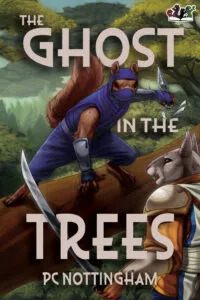
Risu is Ghost-trained in the art of stealth and sabotage. After her village is attacked, Risu sneaks away to the big city to deliver a message to their allies. But when she comes home, she finds her village aflame and her family disappeared. Her adopted brother and sword-wielding rival agree to help her find her family at the evil emperor’s citadel in the capital. The fastest route is through the dark Sea of Trees, where they have to navigate wild animals and roaming bandits.
The Ghost in the Trees is a heart-felt epic journey across a small island that feels as big as the world. PC Nottingham immerses the reader in his Gnaverworld completely. The well-drawn characters will tug at your heart and make you laugh.
The main character, Risu, is a ninja-trained squirrel who takes up the family torch to keep her village safe from the island’s oppressors, but that’s really the last thing she wants. She’s on the hook because her twin brother died in the line of duty. As challenge after debacle assails the young squirrel, she must navigate her own short-comings to make unexpected alliances.
While this is a novel series aimed directly to middle grade readers, this fifty-five year old really enjoyed the stories. I highly recommend them for your kids and yourself!
I reached out to PC to find out more about Risu and her rodent entourage. Without further ado, here’s a snippet of our conversation:
Q. Many of your books feature spunky, opinionated gals. That’s definitely the case with Risu, one of your main characters in The Ghost in the Trees. Who (or what) inspired her?
Definitely the squirrel who broke into my basement! When I’m making a main character after I’ve figured out the general plot, my first thought is usually “who is the worst-equipped person to solve this problem?” My follow up thought was that a kid who hated the role and was pressured into it by her family would make for a relatable character. I also liked the idea of inverting the “Chosen One” trope by having her be the surviving twin of a failed Chosen One. All that equaled a kid whose experiences made her sarcastic with a chip on her shoulder.
Q. You books often delve into political, religious, and moral issues. Do you ever worry that will put off readers?
If it does, then they’re not my target audience. Books and the practice of reading are political. Fiction is a safe place to explore solutions to real world problems.
Q. Can you tell us a little bit more about your world-building? I understand the inspiration for the use of the squirrel as the main character, but just about all your other characters are some sort of rodent. Do you find yourself drawn to specific rodents or are they all inspiration for your stories?
For this first series in the Gnaverworld universe, I started with Risu and built out from her. I wanted to make her stand out more, so she and her family are some of the only flying squirrels we see. Her rival, Itansha, is a ground squirrel, to give him both one degree of separation from her and a clear similarity. I then went to the evil emperor, who is the only beaver (you’ll discover why in the story!). From there, I wanted as many different types of rodents on the island as possible to make the island’s society feel deeper. When it came time to develop the other islands’ cultures, I gave them all a theme to fit together better. The rodents from Llygoden all live in Wales, and the rodents of Mausfjord could all be found in a pet store. I’ve got at least two more series in the Gnaverworld universe in the works, and the rodent species will stick to geographic themes.
Q. Very cool! So, what are you working on now? What’s next?
The next series to come out in my Gnaverworld universe will be called Grove Guardians, in which two brothers are caught in the middle as two religions collide in a holy war.
(And if adult space opera is your jam, check out the Earthquake War series!)
Great! I can’t wait for the next series that I’m sure will be just as rich as Ghost and Iron. Don’t miss it–The Ghost in the Trees is available for the low price of $4.99 (current). It’s an adventurous tale of intrigue you can share with the entire family. Enjoy!
Until next time, happy (indie) reading.
SubscribeEnter your email below to receive updates.
May 20, 2025
Ad Poll
Howdy Folks!
I need your help.
I’m gonna run a bunch of promotions and advertisements (Ads!) this coming Memorial Day weekend for my Mapmaker Trilogy.
It’s gonna be big!
Well, big for me.
The strategy:
Lower the price of all three books to $0.99 cents for four to five days.Run a three-day promotional stack through Written Word Media over the weekend.Run a BookBub Ad during that same period.Run a Facebook Ad during those days, too.Remember to post everything on my social media accounts–yikes!Coordinating this all will be a nightmare, but I’m determined to try my best.
For the Written Word Media promotional stack and the BookBub Ad, they provide templates for the advertisement that include my book cover, so I don’t have to do too much. Yay!
But for the Facebook Ad, I have to come up with the some enticing images that are not my book cover.
What?
I have no idea what that could be!
A successful author I know who uses Facebook Ads a lot relies on AI-generated character images. They are stunning and eye-catching, but I don’t want to use AI (personal reasons). So, I asked a good friend of mine to put something together.
Here’s what he came up with:
 Ad with Three Covers
 Ad with Colorful Mountains
 Ad with Gray Mountains
If you picked “None of the above”, do you have some ideas on what would make you click on the Ad?
Thanks for reading and your help.
Until next time, consider picking up my book over on BookSprout and leave a review!
Nila
May 19, 2025
Fruity Endeavors


 View all responses
I grew up on a vegetable farm. We primarily grew tomatoes, zucchini, onions, radishes, watermelons, and various squashes–supermarket staples.
But in our yard, we had all sorts of fruit trees. Plum. Loquat. Persimmon. (Pronounced PER-sa-mon.) Peach. Apricot. Nectarine. Orange. (Three varieties.) Lemon. (Meyers cross.) Lime. And probably something else I’m forgetting.
But we didn’t have any of my favorites.
It wasn’t until I became an adult, and had the budget for it, that I found my belly-friends*: Blueberries, Kiwi (or Gooseberry), Apple, Grapefruit, and Cherries.
I’ll add a sixth: Vanilla.
What are your favorite fruits?
*They keep me “regular”!