
Warren Adler's Blog, page 36
June 8, 2015
Writing Contests: A Cautionary Tale
When I started the Warren Adler Short Story Contest in 2006 I had rather lofty ideas about integrity and fidelity to the goal of resurrecting the popularity of the short story which was in decline. I appointed qualified people, meaning people who were either authors themselves or teachers of literature or creative writing with the taste and experience to judge the submissions honestly.
It was a difficult chore at best and I wanted to guarantee that those who were the chosen winners were the very best of those who submitted their work. I offered cash prizes out of my own pocket. The first Prize Winner received $1000 and prizes were offered for our second and third choices. The submissions were free of charge.
In addition to the cash prizes I promised that the prizewinning stories would be published as an e-book anthology on Amazon and offered for sale with royalties given to the authors of the stories. My hope, of course, was to give a boost not only to the short story format but also to the writing careers of the talented writers who participated. The book, as promised, is available on Amazon.
The digital publishing revolution was in its infancy and I believe I was the first novelist to ever create such a contest on the Internet. As the cyber world grew so did the submissions. It became difficult and time consuming to read all of the offerings and finding enough quality judges to devote the time to honest assessment was becoming exceedingly burdensome to administer. The last thing i wanted to do was jeopardize the integrity of the contest.
Eventually I had no choice but to begin charging a small submission fee designed to perhaps curb the number of submissions as well as to provide judges with a stipend that would make it worth their time. Above all, the goal was to maintain the integrity of the contest and further the original goals of the enterprise.
Do Writing Contests Offer Quality Promotion?
After seven years of sponsoring the contest, I opted for a hiatus. It was a victim of its own success. To do it right required time, personnel and resources. I finally suspended the contest. I had no desire to create a startup and it was interfering with my own busy writing career.
What I didn’t imagine was the tsunami of writing contests that it inspired. Worse, I never suspected that it would serve as a business model for entrepreneurs to get into the game just for profit.
I am somewhat suspect of the value these contests hold for participants.
Self-publishing requires self-promotion. It is an absolute necessity and comes with the territory, requiring time, effort and funding. The goal is “discoverability.” Most never achieve it, regardless of the quality of their work.
The rise of self-published fiction authors has been spectacular. Unfortunately the glut has also made it difficult for them to stand out from the crowd however excellent their writing is. Genre writers with promotional skills along with lots of money and time might find a niche, although the odds of making enough money to give up their day job is long.
Writers of standalone works outside of the constriction of genre have the toughest time of all. I hesitate to use the term “literary novel” since I have never totally understood that definition. It often strikes me as snobbery.
These writing contests, with their prestigious sounding names, offer the impression of quality promotion for the winners and, of course, bragging rights which can be dubious and of suspect value. One wonders who the judges are that are taking on such a massive amount of submissions. Few of these contest sponsors reveal their methods or the people who read this mass of material and make their judgments. It is often true of the most prestigious awards like the Pulitzer and the Nobel and I often wonder how some of the winners have reached the attention of the judges and who makes the screening decisions.
Writing Contests for Profit? Beware of Exploitation
By and large, internet-based contests tend to always charge a submission fee, which accounts for the sponsor’s profits as well as its proliferation. Considering that these contests are expanding they must be profitable for the sponsors and are inspiring others to create mirror image money-making opportunities using a similar business plan. Their targets are vulnerable, aspiring writers desperate for recognition and the realization of their dreams.
Are the bragging rights of winning prizes in these contests worth the submission fees? Some winners might acknowledge that they have taken advantage of their prize and have used it to help promote their work and I am sure there is no end of puffery about their success. Nevertheless, they continue to be dubious.
Most of these contests are based upon dreams of literary glory, popularity, riches and movie adaptations on the part of authors. All truly believe that their work is deserving of recognition, popularity and prestige. Many probably fit that description. Indeed the sponsors know this and exploit it. It is the key to their monetary success.
There is a great deal of literary talent out there who go unrecognized and do not attract the traditional publishers. Of course it works both ways. The traditional publishers sometimes gamble on first novels and often lose their bets in the sales arena. Such is the nature of the beast.
This is not meant to be a blanket condemnation of writing contests. But since the Internet is a vast swamp of snake oil salesman hawking worthless schemes, products and ideas, consider this a cautionary tale.
As they say, Caveat Emptor – let the buyer beware.
The post Writing Contests: A Cautionary Tale appeared first on Warren Adler.


June 1, 2015
What I Did With My Backlist Titles
When I decided to set up my own publishing company, Stonehouse Press, I had published 27 novels with major legacy publishers. Many had been translated into numerous foreign languages and nearly half this output were sold or optioned for films. Two feature films had been made, “The War of the Roses” and “Random Hearts,” along with a three-hour trilogy on PBS, titled “The Sunset Gang.”
My plan was to digitize all the novels and set them up in both eBook and Print-on-Demand form. They were older backlist titles under contract long before eBooks and Print-On-Demand were created, but I was able to get the rights back from the original publishers. Some were out of print. My motive, then and now, was to keep my authorial name alive beyond my lifetime and attempt to take control of my writing career, never again to be beholden to agents or publishers to determine the course of my creative life.
The Secret, Powerful Fantasy
While admittedly attaining contemporary fame and fortune is a most seductive and primary lure, the possibility of longevity can be a powerful fantasy that lodges itself secretly and obsessively in the mind of the serious artist. Since no one can truly predict the future, this field of dreams will always remain an intriguing possibility whatever the tenor of contemporary judgment.
It follows that I was hopeful that my past novels and those that would be written in the future were worthy of longevity, and would remain “shelved” and available in cyberspace forever, never declared “out of print” and be always available for the possibility of discovery by readers.
Transferring my backlist to eBooks and print-on-demand was, thankfully, not economically challenging to me at the time. It has since become much less expensive for the novice self-publisher. Of course, the transfer is only the first step. By self-publishing even one novel you are essentially going into business and this entails investment in marketing alongside time and self-promotion on every avenue available, both on the net and off.
Stonehouse Press has now published 13 additional novels by yours truly. It has proved to be a major investment, staffed to carry out not only promotions to introduce new novels but funding for promoting older novels. With no middlemen to interfere with my creative production, I have found myself growing ever more prolific now that I am essentially working for myself. Self-determination really focuses the mind.
We allocate time and funds to old novels as well as to new novels, although the introduction of new novels requires additional expense. Distribution is handled by Rosetta Books, a pioneering company that has, like Stonehouse, been through all the growing pains of what is essentially a new medium for the distribution and marketing of books.
The Self-Publishing Battleground
There was a time when traditional publishers who believed in a particular writer might “stake” him or her and publish two or maybe three subsequent offerings, knowing there would be a revenue loss but hopeful that the writer would catch fire commercially at some time in the future. That type of publishing gamble is unlikely to happen in today’s publishing environment.
There are, of course, publishing choices made on the basis of what is considered “literary” or “critic friendly” but within the publishing houses they are largely considered loss leaders, published for supposed prestige. Occasionally there is a breakout surprise.
Today there are literally thousands of schemes being offered to allegedly help those with ambitions to self publish in cyberspace. Unfortunately, there is no magic wand and those who wish to enter the fray are cautioned to be wary of cleverly packaged promises geared to guiding the author/publisher into marketing and sales success. In the end, once the hopeful author is parted with his money, reality sets in and the disappointed victim is left to ponder his or her naiveté.
Self-publishing still carries with it the “vanity” label. There is no screening process by experienced editors and bean counters among the traditional publishers who choose their novels on the basis of what is believed to be their sales potential.
Then there is the stark fact that the cyber pipeline is choked with reading choices both from the legacy publishers and a myriad of self-publishers. Combine this with the media competition from other sources and the new paradigm that favors short content.
Consider, too, the social media explosion with its “notice me because I am“ allure and the illusory phenomenon of “friending” and you have only just begun to scratch the surface of the giant attention wall that must be climbed in order to get noticed by readers who must opt to spend hours or weeks reading a serious novelist’s literary effort.
A significant handicap of self-publishing is that a self-published novel done in Print-on-Demand mode has no chance of being shelved in Barnes & Noble or independent bookstores and there is really no way of being reviewed in the major media outlets still in existence. Even as they decline, traditional publishers still have the clout to control the agenda of the “prestigious” novel market, that pantheon of prestige which awards the serious novelist with ecstatic reviews, literary awards and recognition – a space practically non-existent for a self-published novel.
There are now thousands of self-appointed book critics using YouTube and other outlets to review books, both legacy and self-published, and while many of them are serious, having developed a devoted following, their clout is fractionalized by too many competitors. The starred review system created by Amazon is suspect and seems to have defied all attempts by Amazon to police it.
Against All Odds, Continue to Keep Your Work in the Game
When I started this self-publishing venture I must admit that I had not foreseen the mind-boggling effects of the digital revolution. There are many unintended consequences to deal with that have occurred and are still occurring at an astonishing pace.
Keeping up with new start-ups and applications designed to assist making an authors fictional output viable, reader-friendly and relevant in all categories is a challenge in itself. For the serious novelist it is a gargantuan task. Nevertheless beating the bushes for readers, while important, is fortunately not the sole motive for undertaking such an enterprise.
It is the work itself that gives meaning and dedication to the pursuit. Those practitioners who labor in this creative vineyard know exactly what I mean.
As for the lessons learned by this scribbler over many years, if you have a backlist or are building one from scratch keep it in the game via eBooks or print-on-demand and continue to hope that one day a spark of interest will grow into a conflagration.
TWEETABLES
“For serious novelists, it is the work itself that gives meaning and dedication to the pursuit”Click to Tweet
“Self-determination really focuses the mind” Click to Tweet
“Against all odds, continue to keep your work in the game” Click to Tweet
The post What I Did With My Backlist Titles appeared first on Warren Adler.
May 12, 2015
#eBookdeals – Bestselling Historical Thriller TARGET CHURCHILL is now just $1.99 on Amazon Kindle!
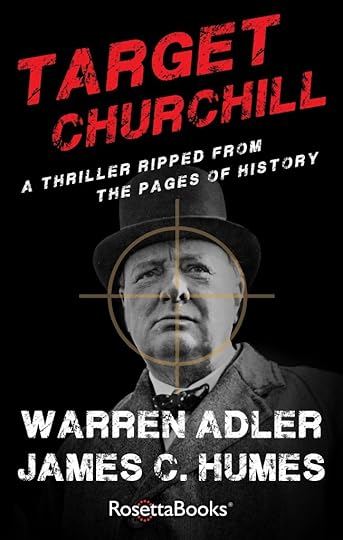
What Readers Have to Say About TARGET CHURCHILL
 This was a great book, I couldn’t put it down, 2015
“This was a great book, I couldn’t put it down. If you like history, you will enjoy this – lots of intrigue and good character development.”
 Historic triller, 2015
“Well written intrigue, with enough history to make it all plausible. Diverse cast of characters keeps you reading to see how they will come together.”
Excellent political thriller!!!, 2015“An excellent mixture of truth and fiction make this an exciting and page-turning novel !! A very good insight into the character of Churchill, and his views toward Russia. A must read for political thrillers!”
A compelling intrigue involving world players Post WWII, 2015“A compelling tale about post WWII activities resulting in The Cold War. An assassination attempt on Winston Churchill orchestrated by the Russians that would be blamed on Nazi sympathy. Intrigue about interesting times.”
BUY NOW
The post #eBookdeals – Bestselling Historical Thriller TARGET CHURCHILL is now just $1.99 on Amazon Kindle! appeared first on Warren Adler.
May 6, 2015
Warren Adler’s Thriller TORTURE MAN in the Works as a Movie
Warren Adler’s Grey Eagle Films has tapped Hernany Perla to adapt Adler’s upcoming thriller “Torture Man” as a movie.
Perla’s credits include the Blacklist script “Blink,” set up with Atlas Independent, along with “Revelations” at Lotus Entertainment. Adler is best known for writing the novel “The War of the Roses,” which was adapted into a 1989 movie starring Kathleen Turner, Michael Douglas and Danny DeVito.
“Torture Man” follows a former CIA operative and a prominent anti-war activist whose 11-year old daughter is kidnapped by Islamist terrorists for a $10 million ransom.
Read the entire VARIETY Exclusive
The post Warren Adler’s Thriller TORTURE MAN in the Works as a Movie appeared first on Warren Adler.
May 5, 2015
Remembering Ruth Rendell 1930 – 2015
I am greatly saddened by the death of the brilliant novelist Ruth Rendell. Although she was dubbed a “crime” writer she was much more. Her work probed deeply into the psychological aspects of the human condition. She wrote a masterful series, The Inspector Wexford novels, about the inner workings of a moral man who is one of the most truly three dimensional figures in the mystery genre. Her psychological novels were brilliant commentaries on the nature of evil and the dark forces that spread their poison among the innocent and unsuspecting.
She did not always follow the rules of genre and often broke through the boundaries that restrict creativity. Although she was greatly celebrated and rewarded for her talents during her lifetime, I hope her work will survive in a climate that quickly consumes great talent and relegates their work to the trash bin of anonymity. Ruth Rendell deserves not only our respect, but the better reward of authorial durability for future generations to understand and enjoy.
The post Remembering Ruth Rendell 1930 – 2015 appeared first on Warren Adler.
“Top 10 (Normal) Struggles When Writing a Novel” Featured on BANG2WRITE
1) Title dilemmas
Like every author on the planet, I’ve spent endless hours mulling over title options for my work. One strives, of course, to be both memorable and honestly descriptive of the content. But then, by and large, a great title is an art form unto itself and a great title does not necessarily signify a great book.MORE: More About Titles
2) Deleeeeeeeete!!!!
This may seem insane but I normally know whether or not I am on to something good only after being 100 pages into a story. I’m willing to bet some you go much farther?? MORE: WHY This Story? … Or 8 Questions They’re **Really** Asking
3) Other people don’t understand
I’m usually very regimented about my writing schedule and typically wake up at about 5Am and start writing until 10 AM. There have been times, however, where I’ve spent an entire day in my study working on a novel. Little do these friends know the kind of dynamic journey writers go on in their work. MORE: Help – My Partner Won’t Let Me Write!
4) Choosing between Creativity & Money
We don’t live by money alone. For those who aspire to the high art of literary writing, similarly to painters, composers, musicians, and others who prize, above all, discovering insight into the human condition, we will always put creation over the clink of coinage (or at least find a clever way to bridge the gap). MORE: Writers, Make A Choice
Continue Here for More!
The post “Top 10 (Normal) Struggles When Writing a Novel” Featured on BANG2WRITE appeared first on Warren Adler.
April 24, 2015
Are All Writers Suicidal? Huffington Post features Warren Adler’s THE MYTH OF THE SUICIDAL WRITER
Warren Adler’s “The Myth of the Suicidal Writer” featured on the Huffington Post
“The underlying causes of suicide are complex and numerous. It is a human fault line and is not exclusive to artists.” Continue Reading here
The post Are All Writers Suicidal? Huffington Post features Warren Adler’s THE MYTH OF THE SUICIDAL WRITER appeared first on Warren Adler.
April 22, 2015
Should We Believe the Myth of the Suicidal Writer?
Looking at the long list of writers who have committed suicide, one is tempted to associate the so-called artistic temperament, the agony of creative achievement, with the primary motivation for that final act.
The list is long and includes many well-known literary figures like Earnest Hemingway, Richard Brautigan, Louis Adamic, Romain Gary, Sylvia Plath, Arthur Koestler, Primo Levi, Ross Lockridge Jr., John Kennedy Toole, David Foster Wallace, Virginia Woolf, Jack London Stefan Zweig, Raymond Chandler and Hunter Thompson among others.
Those who tend to associate the internal struggles of the creative life with suicide often concoct reasons based on romantic, legendary assumptions that making art requires a private agony based on a God-given talent that forces its possessor to see and feel more than ordinary mortals.
The myth contends that because the artist is blessed with such extraordinary insight, he or she can see into deeper truths where there is only futility, darkness, disillusion and death. It is all part of the tortured artist stereotype.
I’m not entirely sold. Granted, the gift of talent is mysterious and for lack of better definitions, God-given or gene-driven. Its development and flowering requires grueling work, deep discipline and ferocious dedication.
Writers of fiction, of which I am a practitioner, spend a lot of time creating parallel worlds in which characters interact and pursue experiences that are activated within the mind. These worlds are based on the writer’s own experiences, hearsay and an amalgamation of memories, observations and ideas scrambling around in the imagination, all willfully whipped into order in a story format that seeks to find truth out of this muddle.
It is hard to convey the difficulties required to create fiction whether in the form of a novel, play or short story. It requires long hours of deep thinking and is a time-consuming and lonely effort of physical and mental labor to write and rewrite, ponder and argue with one’s muse on how best to render a story. It is, indeed, a profound exercise difficult to explain as a process except to like-minded people engaged in such a pursuit.
It’s easy to attribute a breakdown or a wish to escape from such a difficult and mysterious process. There have been many false romantic notions created by those who do not share these singular human talents. Some might conclude that one motive for suicide might be that the well has run dry, and the writer has reached the end of some mythical creative journey that has taken them to the edge of an equally mythical cliff, leaving the sole option of jumping into oblivion.
This so called “well run dry” theory has a long history and offers a satisfying explanation. It can’t be rejected completely. For writers and all artists, the creative impulse is the oxygen that sustains them, and the possibilities of its perceived loss is consequential and could very well spark end of life thoughts.
Then there is the theory of the failed writer, those who believe in their talent and creations, yet are repeatedly rejected and, out of frustration and failure, take their own life. John Kennedy Toole seems to be an example of that category. His literary recognition came after his suicide by his mother’s efforts to get his work published.
Perceived failure has long been a motive for suicide. But doesn’t that apply to anyonewho is unable to cope with unfulfilled dreams? Strangely, there is the case of Ross Lockridge, Jr. who authored the well-received novel Raintree County. Favorably compared to Gone With the Wind, it was made into a movie with the two reigning stars of the day, Elizabeth Taylor and Montgomery Clift. Any creative writer would consider this a home run. Not Mr. Lockridge. He shot himself on the eve of the movie’s release after the novel’s long run on the New York Times bestseller list.
But there are many wonderfully creative and successful writers, Shakespeare may be a pinnacle example, who seem to have decided to pack it in for other reasons. As they say, using the poker analogy, there is a time to hold and a time to fold.
The list of famous writers who chose the path of continuation of their creative efforts or simple retirement is far longer than those writers who snuffed out their lives through suicide, and many have engaged in a large spectrum of occupations and endeavors.
My own view is that the creative life offers both agony and ecstasy. Whether one is a writer, painter, composer or any other occupation where the gift of imaginary invention is required, one should accept their talent as a cause for celebration. The lucky possessor who discovers its power should accept the gift as long as it lasts. Sometimes it lasts a lifetime. Sometimes it flowers and wilts. As the poet Robert Herrick opines.
Gather ye rosebuds while ye may,
Old Time is still a-flying;
And this same flower that smiles today,
Tomorrow will be dying.
The underlying causes of suicide are complex and numerous. It is a human fault line and is not exclusive to artists.
The post Should We Believe the Myth of the Suicidal Writer? appeared first on Warren Adler.
April 20, 2015
CHECK IT OUT! NEW WARREN ADLER INTERVIEW with MYSTERIAS
What’s your idea of a perfect day?
My idea of a perfect day is getting five pages of an original novel completed.
 Do you have a signature accessory, color, fragrance, phrase, or meal?
I often say ”Time is my most precious commodity”
Excluding family, name three people who either inspired you or influenced your creativity.
My mother was an avid reader which probably subconsciously gave me the idea that writing was an important vocation. But my real inspiration was my freshman English teacher at NYU. Don M. Wolfe. He was truly the one who put the idea in my head that I might have the talent to pursue a career in the writing game.
Do you listen to music when you write?
Come to think of it, I never do!
If your latest book were chocolate, what kind would it be and why?
I don’t eat chocolate. It interferes with my digestion 
What made you interested in writing TREADMILL?
Honestly, my frequent visits to the gym. I think I did a good job at capturing certain peculiar aspects of the gym experience but I’ll let readers be the judge of that.
What themes do you regularly (re)visit in your writing?
Love, relationships in general, the spectre of death, integrity, and idealism.
Tell us about your main character’s psyche or personality. What led him to be the person he is today?
He is defeated and depressed. He wants to find a human connection and has not been able to. He reaches out, tries to find that connection, and discovers that because of this impulse, he is in danger.
Describe your protagonist as a mash-up of three famous people or characters.
I do not create characters that are mash-ups. In my view they are original and organic to the story I am telling. Famous is an implication that never enters my mind.
If you could host an author dinner party, who are the six writers (living or otherwise) you’d include?
Shakespeare, Hemingway, Fitzgerald, Simenon, Balzac, and Dickens
What’s next for you?
It’s a continuous process. In recent development are the Broadway Production of The War of the Roses, to be produced by Jay and Cindy Gutterman, “The War of the Roses – The Children” (Grey Eagle Films and Permut Presentations), a feature film adaptation of the sequel to “The War of the Roses,” “Target Churchill” (Grey Eagle Films and Solution Entertainment), “Mourning Glory,” to be adapted by Karen Leigh Hopkins, and “Capitol Crimes” (Grey Eagle Films and Sennet Entertainment), a television series based on my Fiona Fitzgerald mystery series. My newest thriller,Treadmill, is now officially available. You can keep up to date with what I have going on at Warrenadler.com and of course my official Facebook page.
Visit Mysteristas here!
The post CHECK IT OUT! NEW WARREN ADLER INTERVIEW with MYSTERIAS appeared first on Warren Adler.
April 15, 2015
THE WARREN ADLER INTERVIEW with INDIEREADER
Loren Kleinman (LK): You wrote the book The War of the Roses. Currently in development is the Hollywood sequel to The War of the Roses – The War of the Roses: The Children. Were you prepared for the success of these projects? Is one ever really prepared?
Warren Adler (WA): That’s a hard NO. Who knew? Writing The War of the Roses in my basement over thirty-five years ago, I hadn’t a clue that it would plant itself so firmly in the public mind. But then no novelist, or any artist for that matter, can possibly predict which of their works will take root in the worldwide zeitgeist.
As for the children – their fate haunted me. It was clearly a missing link to the story which prompted me to write and publish the sequel The War of the Roses: The Children.I am hopeful that it will bring the visual story full circle when it hits the big screen.
I am, of course, delighted that my work has made such a tremendous worldwide impact. I will admit that it once caused me some concern that it would “typecast” my many other novels, but in retrospect I have concluded that whether they might be categorized as love stories, thrillers, mysteries, or whatever, at heart they are all about human relationships in crisis, and thanks to my leading book brand, they are building their own international following. What more can a novelist ask for?
LK: Who’s your favorite character in The War of the Roses? How do you relate to him/her?
WA: The Michael Douglas character, a guy who never saw the changes coming re: women.
LK: Your books focus on the dark side of relationships. Is this something that society forgets about? The real side of relationships? The reality that two people might not end up happily ever after?
WA: It is a common problem, which is why nearly half of all marriages end in divorce.
LK: One of my favorite movies (in addition to The War of the Roses) is “Melinda and Melinda” by Woody Allen. The storyline for that movie attempts to separate tragedy from comedy, which I think relates to your books, especially The War of the Roses. The Roses experience great darkness, but somehow, there’s humor in the macabre nature of the story. Can tragedy ever be separated from comedy? Or is it inevitable that they’ll co-exist?
WA: The Roses go through dark experiences that end in death. The comedy is how they made a tragedy out of their marriage experience.
LK: Your Huffington Post article, “ So You Want to Be a Famous Self-Published Author?” notes that most important aspect of becoming a successful indie author is getting your audience’s attention: “Getting their attention for any length of time is a paramount. Keeping their attention is a small miracle.”
How do authors balance promoting their work and connecting with their readers on a more authentic level? How can authors keep up their stamina? Or for that matter, their tenacity?
WA: Everything depends on their single-minded obsession with finding readers to connect with their work. The act of creation is no small achievement. But novel writing is a communication system, a one on one experience. It is one thing to create the story, but without another person to read, it is merely a record of private creation. There is also a commercial aspect if one wishes to gain income from the process. It is not a question of balance. Without attempts at discovery, how will readers find your work in a sea of millions of books available, new and old. Stamina? As a self-publisher the burden of discovery is on you. Unless you cross media into mass distribution material like movies, television, translations into other media and languages, you will be forgotten no matter how wonderful you think your book is.
LK: Treadmill is your latest (self-published) thriller from your independent press, Stonehouse Productions. Your main character, Jack Cooper, is on a metaphorical treadmill after tragedy strikes his life. He loses everything until he meets Mike Parrish, who awakens the desire to get off that treadmill, until he vanishes. Jack goes on a chase to find him, until his search takes him back to where he started. The storyline sounds close to humanity’s routines. How do we awaken ourselves? How can we get off the treadmill and search for the real missing parts of ourselves?
WA: By never surrendering to despair, discouragement, and pessimism. The end game is the same for all of us. Many doors are closed to us. The trick is to find an open door that enters into a place where you want to be. To find that open door you might have to turn many knobs.
LK: What’s broken in regard to the traditional publishing model? I see tons of bestselling authors, originally traditional, go the self-publishing route. Why?
WA: People forget. Best sellers are a record as a moment in time. In today’s world we are on a bullet train, objects pass by in the blink of any eye. Also the word “bestseller” is a blink, quickly forgotten. The real game is reach for endurance and that takes repetition and the effort to keep your name out there.
LK: How do you define the term indie? Does it necessarily have to do with self-publishing?
WA: Indie means independent. It means you are your own master, your own business, your own company. A self-publisher fits that definition.
LK: A close friend of mine, a writer, once told me that inspiration is for amateurs. Do you agree? Why or why not?
WA: Inspiration means discovering an idea and acting on it. To bring it to fruition in an art form, a novel, for example, requires hard work, diligence, talent, dedication, and single mindedness. Many people have ideas, but acting on it requires professionalism, dedication, skill, craft and above all, talent.
Visit IndieReader!
The post THE WARREN ADLER INTERVIEW with INDIEREADER appeared first on Warren Adler.
Warren Adler's Blog

- Warren Adler's profile
- 111 followers

