Patrick O'Duffy's Blog, page 26
January 15, 2012
Chicken lebensraum for the soul
Let's start tonight by casting our minds back to last weekend's post, where I said some things about extrapolation, imagination and the way in which I struggle to understand how other people can see a book/movie/text as 'real' (or perhaps 'choose to treat as if it were real', which is longwinded but perhaps more accurate).
Two things:
In hindsight, that post was kind of crap. I was shooting for thoughtful, but instead hit incoherent and waffly. I'm staggered that as many people read and commented on it as they did (more than any other post I've written!), but I wish I'd written something more worth posting on. I can do better.
Like I said, lots of comments – a number of which don't seem very happy. People seem to have got the impression that I was holding up the way I approach texts as the 'right' way and criticising other views. That wasn't what I was trying to say, which is why I loaded the posts with phrase like "I can't turn it off" and "a boor with a stick up my butt" and "I wish I could overcome this". I mean, I enjoy reading the way I do, but I'm hardly trying to say it's the best way, and I genuinely suspect that most people enjoy texts in perhaps a more immediate and emotionally fulfilling way than I do. I'm spinning ideas up here like plates, albeit clumsily and with lots of broken crockery underfoot; believe me, folks, I'm rarely trying to tell you what to do or judge you. Not unless you vote LNP or like Brussels sprouts, anyway.

Books should taste like bacon
Anyway, let's move on and see if we – okay, if I – can marshal some of those muddy points and turn them into a useful blog post this time around.
–
Okay, so some readers (e.g. me) look at a book solely as a crafted text, a mass of words that creates an interesting effect; many other readers (e.g. most normal people) look at a book as a window into an imagined world that can be treated as if it were real. And that's cool; neither approach is the 'wrong' way to read a narrative, and nor are any others, except perhaps for those people who spread jam on the pages and eat books like toast.
Can a book appeal to both these kinds of readers? Well, sure – pretty much every successful book does. Can you try to keep both kinds of reader in mind when writing? Yeah, and here are a few ideas on how to do that. They're standard writing principles that everyone talks about, but I think there's benefit in getting them all in one place and talking about why you want to apply them.
Put it on the page
If there's something in your head about your story, your characters, your theme or anything else that matters, the best place for it is written down on the page for everyone to see. It might be obvious, it might be subtle, it might be text or subtext or metatext, but the best way to get it from your head into that of your reader is to give it to them embedded in the narrative they're reading. You can't be sure that they'll read your afterwords, your indicia, your RPG sourcebook or your mind; you can be sure that the people that read your book read your book.
If it matters, include it in the text. If you don't feel right about including it there, ask yourself why. Is there a way to bundle that idea up into your narrative without making it either totally invisible or dumping it in a steaming pile of exposition? If yes, then do that. If not, then have a think about why that idea matters to you, and whether it matters to your story and reader or just to your idea of your story and reader.
Make them care
The reason readers imagine your story as a glimpse of another world is (probably) because they want to – because they feel an emotional and intellectual engagement with not just your book but your ideas and they want to keep exploring those ideas over and over again.
How do you make them love your ideas? Well, yeah, good writing, but you want to write the best book you can no matter what. And people like me will just engage with your craft, but other readers need more than that. They need characters they give a damn about, dropped into situations that put them in peril, fighting for rewards that stir the minds and emotions of reader and creation alike. They need to want that world to be real, even in just one awesome-filled pocket of their imagination, even just for a little while. Characters that love and fear and hurt and need, in a setting with equal parts beauty and terror; that makes people care. Hell, that sounds goddamn boss even to me.
Leave some breathing room
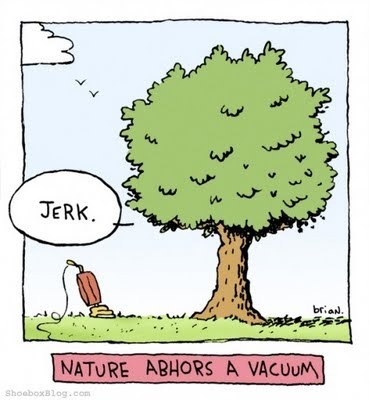
The reverse of the put-it-on-the-page principle is that you don't have to spell everything out, and that sometimes it's best if you don't. Nature abhors a vacuum and so does a reader, and what rushes in from our brains is not oxygen (oh thank god) but imagination. You need to give people something to work with, of course, but if you leave blank space carefully bounded by defined concepts and foundations, it's human nature to take that canvas and fill it with our own ideas of what your ideas might be.
 This sounds like it clashes with the first point, but it really doesn't. If it's important to you that every reader takes on board an idea the same way, include it in your narrative, be it the nature of magic or how your hero grooms his goatee. Lock that shit down. On the other hand, if you want every reader to have their own idea about the way the polar barbarians train their terrible war-penguins, just sketch the barest of essentials. Every bit of fan art you get will look totally different, but every artist will have bent their imagination to those bloody beaks because they wanted to fill the gap their own, with their own version of right. The one they cared about.
Be deliberate in your ambiguity
All of this ruckus kicked off from a death scene in Sherlock Holmes that no-one liked but that some viewers saw as ambiguous. Ambiguity is imagination fuel; ideas spill out like brain glue from your audience to fill up any fascinating little gaps in your narrative, even if those gaps are actually full in the first place. Lay down a couple of mysteries, or just a scene that could be interpreted in a couple of ways, and give the audience just enough clues to let them know that you didn't give them enough clues, and they will take it and run with it and love the work that little bit more.
But that's if you do it on purpose. The thing you need to avoid is accidental ambiguity – of not giving the audience enough clues simply because you didn't think of enough clues, or because they don't make sense, or because you just didn't describe the scene properly and there's not enough definition penning in the blankness. Accidental ambiguity is pretty much another way of saying 'sloppy writing', and it leaves the audience confused and annoyed rather than intrigued and theory-spinning. Don't do that; play coy rather than play dumb.
Or, you know, don't
It's kind of strange to say it baldly, but it's true – not every story has to 'make sense'.
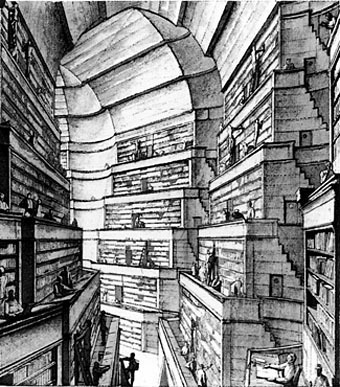 My favourite fantasy writer is Jorge Luis Borges, who never cared too much about the 'reality' of his stories. His work was more about imagery and resonance than about evoking a sense of describing a genuine place or state of affairs. If you read 'The Library of Babel' and wonder where the hermit librarians in their infinite expanse of full shelves and gibberish books get their food from, you've missed the point. It's a story about knowledge, infinity and the need to search for meaning in the universe no matter how futile; it's not a story about a place or situation that you could visit. And that's what makes it awesome.
If your idea is awesome but doesn't make sense, decide if you actually want it to make sense. If you do, well, you need to work on it some more and maybe file some of the fractally incoherent edges off that thoughtshape. If you don't, write that fucker. I'll read it. I promise.
–
…anyone offended by any of that? God, I hope not.
Got more ideas? Thought of a principle I should have developed but didn't because this post is already 1500 words long? Leave comments! Talk to me! I'm slowly going back and responding to comments on last weekend's post, so say something here and I promise to reply before the stars grow cold and dark.
Well. Most of the stars, anyway.


January 12, 2012
Hearts of Ice
You know, the day after I posted that last blog post, I kinda regretted it – it was a half-baked mess of ideas that didn't really get across any point I was trying to make.
And yet it's getting more comments and discussion than any other post I've made on this blog. Go figure. Anyway, I'm going to come back to that topic on Sunday and try to say something more coherent.
–
Tonight, though, something completely different – free short fiction!
Once again I've taken one of the stories I've written over the last few years and uploaded it to the internets for free download. This time it's 'Hearts of Ice', a story about you – yes, you, you reading now, you right there!
 More precisely, it's a story written in second person that makes you the subject whether you like it or not; a story about need, addiction, choices, loss, love and the way meth smokes pools like liquid in the bowl of a glass pipe, pools in a way you could watch for hours because it's so much more engrossing than the rest of your life. You know, stuff like that.
If you enjoyed Hotel Flamingo or Godheads, this is, well, completely different. But it's a cool story nonetheless and I hope people will dig it.
Like my other free stories (details on the Downloads page), 'Hearts of Ice' is available in a number of formats. Smashwords can give it to you as a MOBI or EPUB file, or as a pretty crappy PDF. Alternatively, you can download it right here as a PDF with better formatting.
I was all set to upload this story, along with my other free short stories, to the Kindle Store tonight, but was brought up short when I realised that you can't upload a free file to the Kindle Store. The lowest you can go there is 99 cents; the free ebooks they offer are either special promotions or (I think) public domain works specifically published by Amazon themselves.
I can get where they're coming from, I suppose; Amazon's Whispernet delivery service for Kindle book is free to customers but still racks up costs, and there's not much return in them spending money to help authors give their stuff away. And setting a 99 cent minimum has some benefits to writers too – specifically, by setting some kind of lower limit on the race to the bottom on ebook pricing. Bad enough that so many consumers demand a 99 cent price point; I don't really feel like competing with a 49 cent or 10 cent price point.
That said, it's still annoying that I can't put these stories up on the Kindle Store; there's no way I can get sales at 99 cents for a single story when I'm also selling a novella and an anthology at that price. Giving them away is the only practical option – and hey, not something I struggle with or grumble about – but I can't do so in the biggest ebook market, and nor can anyone else.
Ah well, such is life.
Speaking of cheap 99 cent ebooks, the change in price for Flamingo and Godheads is paying off, at least in terms of sales numbers. Sales returns… meh, not worrying about that so much. Let's be honest here, I still haven't received any payments from Amazon (who pay by cheque), and I've asked Smashwords to hold off on payment until I get a US tax number sorted out. So no matter how many books I sell, I'm not seeing any cash any time soon, so I may as well not stress about it.
–
Anyway, hope you like the story. Going to put some more up in the next couple of months.
Come back Sunday for some more focused and (hopefully) useful thoughts about extrapolation versus invention. And maybe some swearing.
January 8, 2012
I can't turn it off
So we went to see Sherlock Holmes: A Game of Shadows a couple of nights ago. It was decent, if not amazing; it was more a straightforward action-adventure movie than a mystery, and the script was crammed with obviously deliberate Holmes-on-Watson shipping subtext, but the pace was cracking and the characters interesting. I liked the first one more, but this was okay.
Afterwards, though, there was a post-movie -dinner conversation about the fate of one character who is killed off early in the film (no spoilers – well, unless you count 'people die' as a spoiler). Everyone found the death unsatisfying and a waste of an interesting character, and a number of my friends speculated that perhaps the character faked his/her death, and wasn't really dead, and what had really happened was an elaborate ruse.
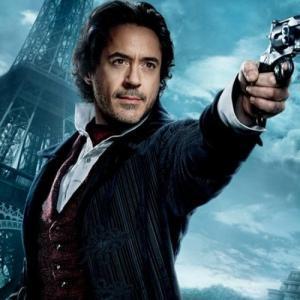 I came back with my standard response to this sort of thing: 'Well, nothing 'really' happened. These are actors performing from a script, not real people, and nothing that's not up on the screen is part of the narrative. Unless there's a scene in which the death is shown to be a fake, there's nothing else to say.'
And this makes me sound like a boor with a stick up my butt, I know. That may in fact be true. Lord knows I can be a humourless git at times. But what I'm trying to say that is when I read a book or see a movie or whatever, all I see is the text; all I see is what's there in front of me. Because that's the thing that actually exists, that can be analysed and understood and picked apart, that's the thing that causes an intellectual/aesthetic/imaginative/indigestive reaction in me. It's an artefact that can be understood and/or appreciated for its own beauty.
But for many readers, there is the urge to extrapolate, to imagine further; to see the book/story/movie as a window into another reality about which statements can be made. This is the fanfic urge, the worldbuilding urge; the urge to see implications, to imagine the unseen scenes between the ones on screen/the page, to see the text as a partial glimpse of something larger.
And it's fundamentally an urge I don't understand. And my inability to understand that desire and that state of mind – to see a text as reportage rather than artifice – is something I often wish I could overcome. I think I'm missing something, because to me the book is only ever words on a page. Hopefully smart, beautiful, well-chosen and properly-punctuated words, words that make my brain race as I stitch together imagery and meaning from them… but still, I can't understand how you go outside the text, how you can ask whether what happened on the page/screen was what really happened.
Nothing really happened. Someone made it up. And I always feel that that's a much more amazing and wondrous thing that the notion that the author/creator is someone just channelling a reality that exists somewhere else.
If you like to imagine books as windows into another reality, one that can be envisioned and then examined… honestly, I kind of envy you. That's pretty cool. There are times when I'd like to turn off the constant analytic assessor in my head and believe, even if only for a second, even if only as a deliberate choice. But I can't, and when conversations turn to that, I get a bit incomprehending and should probably learn to be quiet.
I have a similar mix of incomprehension about, for example JK Rowling's claims that the character of Dumbledore in the Harry Potter novels is gay. (Disclaimer: I haven't read any of them, but I did hear about this in the news on a slow day a few years ago.) As I understand it, when criticised for not including any gay characters, she said that Dumbledore was gay but that she chose not to include any signs or suggestions within the text that that was the case. But that's fine, because the character has a reality, and this utterly-invisible reality is enough to deflect any criticism.

This is my Potter-truth
For me, that's the same as saying that Dumbledore was actually an animated chocolate golem, or fought crime as Batman between novels. Sure, it never came up in print, but if he can be gay without, y'know, being gay, then my theory that Harry is actually a sackful of ferrets perfectly pretending to be a human being is just as valid, because that's a reality that just doesn't happened to be mentioned in the text. And yet, if I say that loudly at Potter conventions, suddenly I'm the guy escorted from the building by security and beaten up in an alley by Hermoine cosplayers. Again.
Mind you, saying that you can't extrapolate from the text isn't the same as saying there's no such thing as subtext. Subtext is the foundation of meaning upon which a narrative rests; it's not overt, but it's still internal the text. Extrapolation, on the other hand, is external to the text; it's the reader/viewer bringing their own desires to the material and reshaping the narrative to fit. Which is an interesting process, and it's one I'd like to understand more, but it doesn't seem to be doable. This is the way my head is, and I can't turn it off; all I can do when I encounter a text is dissect it on its own terms. It can't be real for me; it can only be a crafted object.
But on the flip side, there's something great about taking books (and movies and plays and comics, yeah, but mostly books) on their own terms – as works of craft and art and imagination. For me, saying that all there is is what's on the page isn't a way of denigrating narrative, or saying that those who like to extrapolate are crazy/bad/wrong/Republican; it's a way of celebrating the text and the act of creating it. Text is a joyous thing; text is what you get when a (hopefully) passionate, inspired writer sets out to create a thing of beauty. To celebrate it for what it is, rather than what it can be inferred to be, is no different than celebrating the Sistine Chapel ceiling as a work of great artistry, skill and technique, rather than as an accurate depiction of God and, um, whoever the other guy is. Is it Adam? That would make sense, I suppose. But I don't need to know that in order to appreciate the power of the work, and I don't think we need to act like a narrative is 'real' to still acknowledge its power and its worth.
Invention is more fun than extrapolation. If only so we can argue that it was the Potter-ferrets that faked their death to throw Sherlock off their trail.
January 1, 2012
New year's repricing solution
I'm not really going to enjoy writing this blog post. Partially because it's about a subject that doesn't make me very happy, but mostly because it's a million fucking degrees right now, and I'm writing when I could be sitting under an airconditioner in my underwear drinking chilled Mountain Goat and eating NYE leftovers.
Oh yeah. Happy New Year! Hope that some of you don't live in Melbourne or Adelaide and thus have escaped the crippling heat that's only going to be worse tomorrow.

Om nom nom
But heat aside, I want to talk about the sales of my ebooks Hotel Flamingo and Godheads, which – and I need to use a technical publishing term here – suck rancid iguana testicles. Possibly not in relative terms, since most ebooks don't sell squat, and every time I do sell a copy of something it briefly catapults about 400 000 places on the Kindle Store charts, but in absolute terms the big lizard nuts are on the table and they stink something fierce.
In the spirit of openness, let me share some sales figures with you.
I published Hotel Flamingo on Smashwords back in December 2010, and then on the Kindle Store in April 2011. (I was waiting for Smashwords to organise their distribution deal with Amazon, but that's still in progress, so now I just publish versions through each outlet.) In that time, I've sold 65 copies through Smashwords (most of those in the first couple of months) and 13 through Amazon, netting me a total of 78 sales and $148.13 (US) for that book. That's obviously small change, and once I get through paying tax on it twice (both the US and Australian governments take a cut) it's closer to chump change, but again, it's probably more than a lot of other self-epublishers ever see. It stops short of respectable, but it's a start.
Godheads is newer – published in May 2011 on both sites – and has had a less successful sales profile. Okay, a bloody shithouse sales profile – 18 copies on Smashwords and 15 on Amazon, for a total of 33 sales and $56.90. Whoot. That's well short of respectable; that's one toe over the line of stillborn.
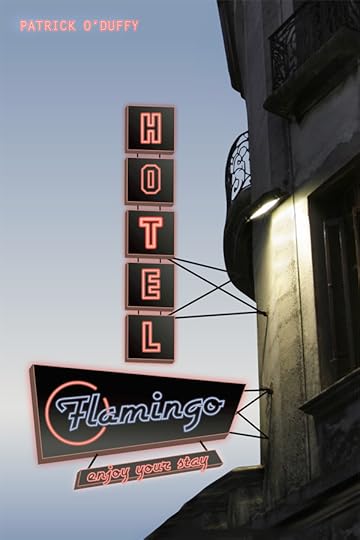 So that's a grand total of $205 (and 3 cents) made from my ebook publishing efforts over the last 13 months. Which is disappointing. It's even more so when you consider that the covers of each ebook cost me $217 a pop. And I was happy to pay that, because they look amazing and they stand out from the terrible clip-art and MS Paint covers on a lot of other ebooks. But given that, I'm still about $230 in the hole at this point, and it seems pretty obvious that I'm not getting out any time soon unless I do something differently.
Am I angry about this? No, not at all. All along I've considered this project as an experiment, and an experiment that fails is still an experiment that yields a result. So what I need to do now is consider what the result of this experiment means at this point, and what needs to be done next.
There are a couple of questions I've asked myself:
Do my books suck? Ego aside, I think Hotel Flamingo is an occasionally uneven but worthwhile piece of prose, and I know a lot of people who've really enjoyed it. Godheads is… you know, I'm prepared to say that Godheads isn't all that it could be, and that the quality of the stories in it is too variable. But hell, none of the stories are bad, and the collection as a whole is decent. 'Decent' isn't that great, though, and if I do another anthology I'll spend more time honing it rather than rushing it out. But still – no, I feel confident saying that my books don't suck.
Is there a market for my writing? It's certainly possible to write material that is good but that simply doesn't appeal to anyone but a small audience. Certainly the kind of new weird/paranormal fantasy/horror in those books doesn't align that well with the popular titles and concepts in those genres. I'm writing niche stuff and I know it. But I also know that the three free short stories I have up on Smashwords are popular; last year I had 417 total downloads of those stories through Sony and 2339 (!) through Barnes and Noble/Kobo. That's close to a thousand people that have read (or at least thought about reading) those stories, which is both a massive egoboost and a sign that there's an audience for my work.
Do I need to do more marketing? Well, yes, obviously. You always need to do more marketing. I certainly haven't done much, and that's a self-fulfilling prophecy of failure – and when I have done some, I've seen results. Well, I think I've seen results; there seems to be an Amazon sale or two popping up in the weeks after I get a review or a retweet or whatever. But at the same time, it's a question of return – will the (potential) sales I get from marketing my stuff compensate for the time and effort I spend on marketing my stuff? Time and effort, I should point out, that could otherwise go towards writing new books. (Or to playing Dragon Age 2. Whatever.)
Are my books too expensive? Having thought about it for a month or two, I'm gonna say yes. And move out of bullet-point-time to talk about this more.
There's a definite desire – hell, let's call it what it is, an expectation – in the ebook market that 99 cents is the standard price for an ebook. Not the baseline, the standard, just as it's the standard for a iPhone app. As a reader, I don't share that desire; I think 5 bucks is a better baseline for a full-length novel, and that shorter work can justifiably be set at 3 or 4 dollars, working all the way down to a short story at maybe a dollar. Those are prices I'm happy to pay, and that's as a starting point for epub-only work; I'd happily pay more for work that I think is worth it.
But that is not a common view. As usual, Chuck Wendig has written a terrific essay on this that is worth reading, and I've been mulling over that piece and readers' comments on it a lot – comments that showed that a lot of readers, people who loved books and fiction, felt that a dollar or two was still all that they were prepared to pay for an ebook. And I'm not egotistical enough to tell them, and all the others with the same attitude, that they're wrong to feel that way. I don't have to like it, but I do have to accept it and work with it.
Author Mur Lafferty also wrote a blog post recently about her own experiences in repricing her e-novellas down to 99 cents, and the increase in sales that followed, and that's what prompted me to give it a try as well. So as of today, I've dropped the price of both books to 99 cents (US) on both outlets, and presumably on all the other sites that Smashwords distributes its files to.
 Once again, it's an experiment, and if the sales stay the same but pay me even less, well, that's an experiment that Armin Zola will be confining to a cage and never letting out again. I don't know that I'll up the prices of those books again – I think that kind of sends the wrong message and makes it look like I'm just throwing shit at a wall to see what sticks, which is true but I don't want other people to realise that – but it'll inform the pricing decisions I make for The Obituarist and any other work I publish online. And, more than likely, cement my desire to focus on shorter works like novellas and anthologies for self-publishing, while trying to find a print publisher for Arcadia and other full-length works.
Because I don't want to put a 90 000-word novel up for sale for a dollar. Even RPG writing pays better than that.
In any case, the takeaway here is not doom and gloom, and it's not grumbling about cheapskate readers who aren't prepared to spend the price of a takeaway coffee on an ebook. (And I'm not even talking the good coffee, I'm talking McCafe-level shit, but whatever.) The takeaway is, like always, what happens when I do this? And all I ask is that the world not end.
…if the world does end in 2012 as a result of me making my ebooks cheaper, you have my sincere apologies.
–
And if you read the above and feel like taking the 99 cent plunge, some links to make it a bit easier:
Hotel Flamingo at Amazon.com
Hotel Flamingo at Smashwords
Godheads at Amazon
Godheads at Smashwords
December 29, 2011
Swag!
Christmas has come and gone, and has brought with it the true spirit of the season.
Getting (and giving) kick-arse gifts!
(Yeah, I know there's some stuff about Jesus and family and peace and so on, but I like the present part best.)
What did I get for Christmas? Well, I'm glad you asked, particularly since almost all my gifts have relevance to writing in some way. Which makes this blog post relevant, rather than just self-indulgent filler.
 A new office chair: Well, technically I got two new office chairs from my wife, because the height controls on the first one stopped working after two days, and we had to replace it lest I be left typing with my head level with the PC's keyboard. But fortunately the folks at Officeworks were very understanding and replaced it with an even better make & model for the same price. Obviously the main thing I do at my computer is writing, and over the last few months, as my old chair fell apart and became awkward and uncomfortable to sit in, I came to realise how important a solid, comfortable chair is for sitting and writing for long periods, or even short periods. I'm not saying that all of my lower-than-acceptable 2011 writing output can be blamed on my old chair, but it's not here to defend itself, so yeah, it's all about the chair.
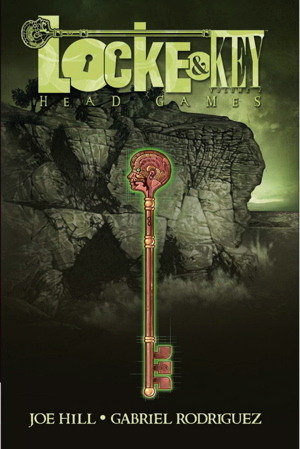 Locke & Key Volume 2: I've waxed rhapsodic about this stellar comics series before, and that was just based on the first collection. Now I have the second, and will be reading it tomorrow while hooked up to a platelet extractor at the blood bank for a couple of hours. The interesting point about this title is that author Joe Hill is best known for his prose work, the horror novels Heart-Shaped Box and Horns and the anthology Ghosts. L&K is his first foray into comics, but he doesn't write it as if it was prose, as too many novelists or scriptwriters do (and yes, I mean J. Michael Straczynski), with an emphasis on captions, expository text and dialogue. Instead, Hill lets the artist do what he needs to do, to lay down visual information and structure so that dialogue and captions add depth and meaning, the two parts working together to tell the story. It's wonderful stuff, it's great craft, and it's a reminder that different forms require different approaches.
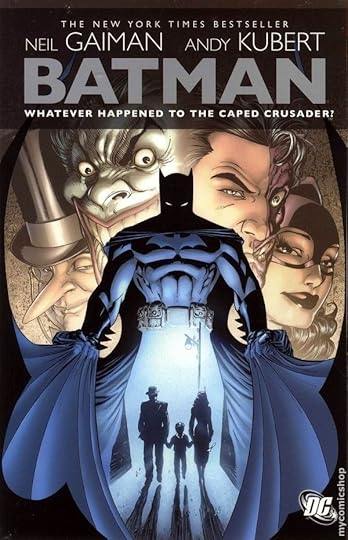 Batman: Whatever Happened to the Caped Crusader? Yes, another graphic novel, but this one was signed by author Neil Gaiman when he did a presentation at the State Library a couple of weeks ago. There are a few takeaways here. There's the primarily metatextual nature of the story (it's at least as much a comic about Batman comics and Batman's place in pop culture as it is a comic about Batman), and as we know I'm kind of a fool for metatext and stories about stories. There's the fact that a fictional character can gain and develop so much recognition and complexity over time that a comic about his place in pop culture can actually work as a narrative. And, of course, the point that Gaiman is so successful as a writer that he now spends far more time talking about his writing than he does actually writing. Much like me. Sort of.
A new wireless USB adapter: My old one had terrible internet connectivity and often just stopped working for no good reason. Now I have a sleek black one that holds the signal and is more reliable. Which is important, because how can I write without an internet connection? Um… well, to be honest, I think it would be good for me to get away from the internet and just focus on writing without the constant distractions of websites and MMOs. And I'm going to do more of that in 2012 – getting out of the house with my little laptop and setting up in a cafe for an hour or two. It's very Northcote. Then I'll come home and use my reliable connection to blog about doing it. It's win-win.
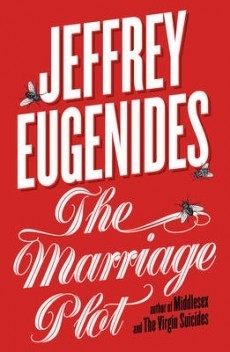 The Marriage Plot: I had requested this new Jeffrey Eugenides novel at the local library, but I was 15th in the queue, which is more interest in one novel than I've ever seen there before. It's refreshing to see that much demand for a non-Stephen King, non-Twilight novel. There's always doom and gloom out there about declining reading rates and the death of literature and wah wah wah, but the truth is that there is a real and thriving market for literary fiction and for rich writing. It needs work and luck to get attention, sure – I doubt so many people would have read Middlesex if it hadn't won the Pulitzer – but once you find that audience, you keep that audience, and it's hungry for more of your work. I know I sure as hell am.
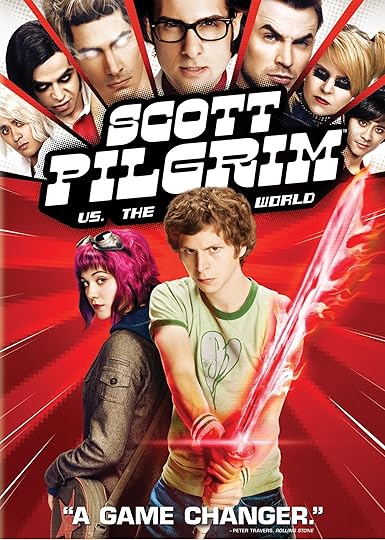 Scott Pilgrim Versus the World (DVD): It was a fun movie that deserved more attention, the cast was great (especially Chris Evans, which was unexpected) and I plan on both watching it again and lending it to friends that haven't seen it. And yet, the important thing is that the original series of graphic novels had a great deal more complexity and depth, not to mention much more consistent pacing and character development. Like I said above, different forms require different skills and approaches, and adapting a work from one medium to another is a difficult task. Something is always lost, and in return something is (hopefully) gained. I think that, on the whole, Scott Pilgrim lost more than it gained in the transition – but then again, nothing was lost, because the graphic novels are still there. So it's a lesson in the difficulties of adaptation, but also in the fact that the original work endures.
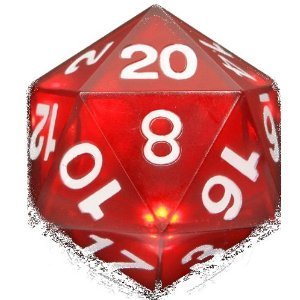 A flashing d20: It lights up and flashes when you roll a 20. FUCK. YEAH. That'll put the fear of god into the players in my 4E D&D Eberron campaign, which I want to get back to on a more frequent basis in 2012. Is that relevant to writing? Well, yeah – roleplaying doesn't help your writing per se, but it's a great way to hone and develop storytelling skills like pacing, plotting and characterisation. Chuck Wendig's got a good essay here on why writers should play RPGs. But fine, alright, I'm reaching a bit on this one. I'll try to be more relevant with the writing benefits of the next item.
 A bottle of Wild Turkey American Honey bourbon liqueur: Yeah, okay, I'm just gonna drink this. And I'm gonna really enjoy it.
–
So what about you guys? Any good presents? Anything that's got a buried lesson about the craft of writing, or that makes writing easier? Or, alternatively, any good booze?
December 25, 2011
Black Veil and Gloves
Every boxer in the county came to pay their respects when Mickey Duggan died of a broken heart. Whether bleeders who went the distance or mooks who led with their chin every damn time, they were all there. The line went down the block from where Mickey's body lay in state in O'Malley's Gym, dressed in his Sunday best jacket and his trademark purple trunks.
One by one the boxers filed in to view the body. And then, after saying goodbye, each took a seat around the ring to watch his widow and his mistress beat the hell outta each other.
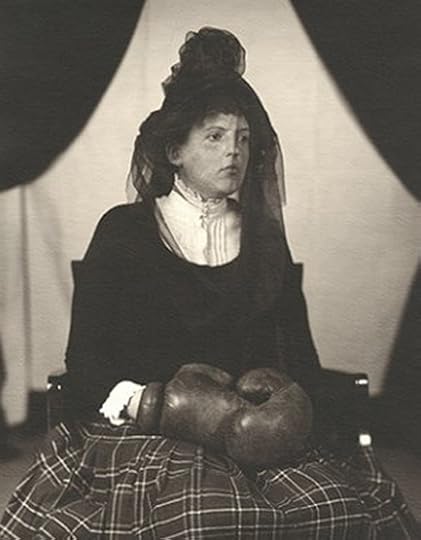
Lettie Duggan sat in the black corner, face covered by the widow's veil, hands in the widow's boxing gloves. She had eschewed the widow's mouthguard; it made her lose the disapproving expression she had perfected over two decades of infidelitous marriage. She glared implacably at her opponent, Miss Charlene Piscoperra, late of the saloon at 9th and Overeasy, late of the Zoidfield Follies, late of Mickey Duggan's bed. The bed where he drank himself to death after Lettie tossed him out for the last time and screamed I never loved you, you worthless palooka! loud enough for the whole borough to hear.
Charlene had matched her low-cut dress with a pair of shiny red boots. This was a chance to show off her curves and curls, after all, and she missed Mickey and all but hell, mister, a girl's gotta eat.
Widow's matches were traditionally for the wife's right to keep her husband's belt and medals, but Mickey had never been a contender. He rarely won fights; he just lost them hard. He had all the chin in the world, and no-one qualified for a title shot until they could say they'd lasted twenty or thirty rounds with Mickey.
These women were fighting for something more important – the right for the widow's seat by Mickey's coffin, the right to hear the boxers mumble something sad and pointless on the way out. The right to say that they were Mickey's one true love, to the end.
The boxers stood as the referee entered, formal in his striped shirt and dog collar, ready to lead Mickey's service as soon as he judged the winner. He rattled off the rules and conditions, by the powers invested in me by God and the Boxing Commission and so on. Lettie's brother Claude checked the ties on her gloves, while Charlene blew kisses to the crowd.
Round one! Lettie laid into Charlene with a hard right to the bodice. She followed up with a left and another right, sledging the bargirl around the ribs. Charlene stumbled back, fists flailing. The widow pushed the hussy back to the ropes, pounding away until the bell rang and the ref yelled at them to get back to their corners.
Round two! Lettie came out hard again but this time Charlene was ready, blocking low and tight, protecting her assets from the widow's fury. Punch after punch connected but did little damage. A mutter swept the crowd as it became obvious that Lettie had passion but not enough power. Charlene went back to her corner with a smile; Lettie went back with aching wrists.
Round three! Now the balance swung to Charlene. Her looping crosses lacked finesse but were backed up by five years of tap and three of pulling beers. It was all Lettie could do to block the blows. Charlene snarled at her: You maybe think you made a mistake, old lady? When the bell rang Lettie thundered back to her corner in outrage.
Round four! The two women punched back and forth, back and forth, until Lettie put too much into a cross and left herself open.
And from nowhere Charlene came back with a left hook that crunched into Lettie's nose and threw her eggs over breakfast down to the mat.
The ref ran in for the count.
One!
Two!
Lettie flopped on the canvas like a drunk marionette, strings tangled up, hand in the sky all broken.
Three!
Four!
Charlene paraded around the ring, screaming at Lettie. Stay down, consarnit it! You didn't love him! You told everyone you didn't love him! Stay down!
Five!
Six!
Seven!
Lettie got to her shaking knees like a newborn fawn. Charlene screeched as the ref stopped the count and pouted back into her corner while Lettie crawled back to Claude, barely conscious.
You want me to throw in the towel, sis? Lettie fixed Claude with a look that coulda boiled an egg.
Like hell.
She flopped onto the stool, spat a glob of blood and adrenaline drool into a bucket, a lost tooth clanking as it hit metal. Claude quietly plucked it out and stuck it in his pocket. Win or lose, it'd be worth a couple of bucks from a collector or something.
Right then, muttered Lettie. Enough of this.
Round five! Lettie did the stick-and-move, showering Charlene with long punches while dancing to the side, staying away from that terrible left hook. She snapped off a jab into Charlene's face, enough to rattle her, then came in for a clench. In the seconds before the ref split them up, she put her lips to Charlene's ear and slurred I said I didn't love him, but maybe I lied.
Another jab. In for the clench again.
And maybe I didn't.
Jab. Jab. Clench. A last hiss. I'm the only one who gets to know.
And with that Lettie put everything she had into a roundhouse haymaker that started at the small of her back and swung out through Timbuktu before coming back smack dab onto Charlene's chin.
Charlene, as it happened, did not have all the chin in the world. She kissed canvas hard and didn't move again.
Lettie slumped against the ref as he proclaimed her Winner and marital champion! With his help she staggered out of the ring and collapsed in a chair next to Mickey. Blood dripped from her nose, her veil glued to her battered face like a mask of red.
But she was a boxer's widow. And that was the makeup you wore to anything worth fighting for.
Lettie smiled sweetly through torn lips and waited for the service to start.
–
Happy Christmas, PODcommers!
No, I know this isn't what you'd call a Christmas story, but it's my flash fiction gift from me to you.
Like a lot of my flash fiction, this one's a response to one of Chuck Wendig's flash challenges, this time to create a story based on one of these 50 Unexplainable Black & White Photos. Visual stimulus is a tricky thing, and images either speak to me or they don't – but when they do, they speak loudly. 49 pictures on that site did nothing for me – when I saw the one above, the entire story popped into my head. Then it was just a matter of trimming my 1300-word draft down into 1000 words, which was terrible hard work, but it's done now and the results are yours.
Don't say I never do nothing for youse.
December 22, 2011
Thursday come around again
Hey gang,
Man, it's been a while since I did a mid-week post, hasn't it?
In my defence, I simply didn't want to do them. Well, I was sick, and my cat was sick, and it was really hot and blah blah blah whatever. Let's be honest here, it's mostly that I'm lazy, and 2700 word posts about Arkham City don't come to be unless you give some serious attention to hunting down Riddler trophies on weeknights, you feel me?
But Arkham City is done (for now), and my new distractions of Dragon Age 2 and Portal 2 have yet to fully get their claws into me, so I thought I'd come briefly chat about a few bits and pieces.
…umm, lemme see, I had some conversation starter notes written down somewhere…
–
[image error]Really, our cat is sick. Graeme Riley, Ace of Cats – whose inexplicable fame I have discussed before – has either lymphoma or hepatitis, neither of which is a good thing and have caused him to lose too much weight and become more needy and unhappy than usual.
Fortunately, we took him to the vet early enough, and whatever is wrong with him is easily and affordably treatable, once the diagnosis is confirmed. The affordable part is important – turns out that diagnosising pet ailments is really fucking expensive.
But with any luck he'll soon be well again, just in time for his next round of international media events. Seriously. Like he needs any more Facebook fans.
–
One of the best things that happened for me this month was a review of Hotel Flamingo at the eNovella Review website. Writer Trevor Price seemed to really enjoy the book, calling it 'exceptionally clever' and that my writing 'at times borders on the gnomic, but never fails to entertain.
More to the point, he called me 'a sort of skittish Borges', which may in fact be the most awesome thing anyone's ever said about me, as a writer or as a human being. I'm going to be riding high on that for months. And it made Greg Stolze jealous, which is kinda cool.
So that was very cool, and it was gratifying to finally have one of the review submissions I've made bear fruit. If you're looking for reviews of shorter ebooks, I recommend the eNovella Reader; they seem to be really interested in finding good material and putting the word out.
–
Speaking of novellas, it looks as if the core concept of The Obituarist – a social media undertaker – has gone from an odd fringe idea to mainstream, as reported by this story in the Fairfax press this week.
There was a window there where I could have been a visionary. Instead of being a bum.
Still, this article doesn't involve identity theft, bad plastic surgery or aggressive neckbeards, so my novella is still charting some new ground. And it's coming along.
–
And speaking of publishing, there's been a lot of noise in the Australian community (although less in the press than you might expect) about Dymocks' new D Publishing initiative. The bookseller's venture into vanity publishing isn't getting a lot of good publicity, largely because their contracts seem to have been written by lawyers who thought that Amazon were being way too generous with their publishing contracts – you know, the ones where they can change the price of your books whenever they like, hold all the writers and can trademark your internal organs.
Jason Nahrung has collected some links that analyse and criticise D Publishing's initial positions, and they're well worth reading for anyone who's thinking about approaching Dymocks to publish their book. Which, let's be clear, is a Pretty Bad Idea.
–
 There's this podcast, War Rocket Ajax, that N. and I listen to every week. It's about comics, mostly, and it's funny and clever and the guys who present it understand what makes for good and bad writing.
This week, though, for their Christmas special, the regular presenters (Chris Sims and Matt Wilson) teamed up with rapper Adam Warrock and comics writer Matt (Iron Fist, Iron Man) Fraction to spend nearly two hours dissecting the Insane Clown Posse/Psychopathic Records Christmas album Holiday Heat, and this may be the single greatest, wrongest thing ever committed to podcast. I mean, fuck, I listened to this at work, and within 7 minutes I was hunched over at my desk, face in my hands, struggling to laugh silently while I totally lost my shit.
It doesn't matter if you're into comics, hip-hop, pop culture, whatever – listen to this. It will chainsaw your fucking mind.
–
In a few days – grief, social mores, uppercuts and visual stimulus.
It'll make sense, trust me.
December 18, 2011
Arkham City – the writing dos and donts
I don't think anyone will be terribly surprised to hear that I spent most of the last two weeks playing Arkham City, rather than Christmas shopping, writing or spending quality time with my wife. I mean, come on, it's a video game about Batman; the only way to make that more attractive to me as a package is have it dispense a shot of bourbon from the controller every time you get an achievement.
 But as of yesterday I have finished the game (both the core plotline and the host of side missions) and having done so I think there's a lot to consider from a writing POV about the way the game handles its stories and characters. Arkham City does some things right and some things wrong – more the latter than the former, to be honest – and a lot of that is pretty directly applicable to writing fiction. So let's step away from the fact that the game is a lot of fun and features my favourite character and see what else we can learn from it.
(No, this isn't a transparent attempt to justify the hours I've spent beating the crap out of bad guys on the TV. Honest. Cross my heart.)
Also, warning: if you haven't finished the game yet, there'll be some spoilers here. They might ruin your enjoyment. Or they might not.
Plot from premise
For a start, let's talk about plot. Although promoted as being sandboxy and 'open-world', AC has in fact a very central plotline. More specifically, it has two central plotlines. First up, Hugo Strange has turned half of Gotham City into a giant prison, full of psychopaths and lowlifes, and Batman has to find out what Strange is really up to. On top of that, the Joker has infected Batman and a lot of hospital blood supplies with a deadly disease, so Batman has to determine and find the cure before he (and hundreds of others) die.
This is classic stuff – you have an A-plot and a B-plot, you move the spotlight between the two as the story progresses, and you use developments in one to modify the other. It's very much the approach I'm taking with The Obituarist, for example. By having two main plotlines, you can build tension in one and then move to the other to maintain suspense, or pull the trigger in one to ramp things up in the other. Having just one core plotline in a long-form work doesn't give you the same richness or as many tools, and you run the risk of pushing that plot too hard and boring your readers.
In addition, AC has about a dozen side plots and missions, plus a parallel storyline about Catwoman. Most of these link strongly to the strong central premise of the game – Gotham City is now a prison that causes far more problems than it solves. As I've said before, a strong premise is a constant story generator; you can bring an simple idea to it, put it through the premise/machine and some kind of plotline will come out. Video games tend to be premise-driven, of course, but AC's a good (not exceptional, but good) example of how it can work.
Bait, switch, drive a truck through the holes
But while AC has a central plot, that's not to say it's a strong plot. Or a coherent one. Or one that makes a goddamn lick of sense in some cases.
So yes, Hugo Strange is doing something bad. But you spend most of the game ignoring that, despite the fact that it's the A-plot that's central to the premise and plastered all over the blurb of the CD case. Instead, the Joker-infection plot takes over the core of the game and drives it forward, forcing you to ignore the increasing urgency of prison developments while you look for a cure. Which requires you to fight ninjas in an abandoned subterranean steampunk cult temple.
…yup.
 You'll go on a vision quest. You'll punch a giant shark and a pair of one-armed former Siamese twins. Solomon Grundy throws electrified balls at your head. And a bunch of other stuff that floats in and out of the story for no really comprehensible reason. Finally you'll get a cure, only for it to be stolen and the Joker to target Batman. At which point the A-plot comes back and Strange gets the legal right to kill everyone in the prison (!), and you rush to stop him while the Joker allies with the ninjas. Except that's all bait-and-switch too, and brings with it a couple of plot holes that left me staring slackjawed at the TV, wondering how no-one on the writing team stopped and said 'wait, correct me if I'm wrong, but that's just fucking stupid'.
The main reason why these plot turns and events are problematic (apart from the huge holes) is that they're divorced from the central premise discussed above. Playing a shellgame with plotlines can be interesting if done well, but are frustrating when bungled, and when your story wanders too far afield from the concept that got the reader interested in the first place. Similarly, while some side plots emerge fairly naturally from the central plotline and core premise, others come out of nowhere and feel completely tacked on (especially the one involving Azrael, which is either utterly pointless or an extended teaser for the next game in the series). Fun in and of themselves, their stories don't satisfy, just as a disconnected subplot in a novel leaves the reader feeling distanced from the main story because of the apparently-pointless detour.
Oh, and the game finishes before you get a chance to cure the hundreds of infected patients in wider Gotham. Apparently there's a post-credit epilogue that deals with that. But here's a free tip for writers – if 80% of your novel has focused on a race towards a vital goal that must be achieved, forgetting about it and leaving it to be resolved off-screen and mentioned after the novel wraps up is bad fucking writing.
Rising tension
The advancement model of most video games is well-established by now, and AC does not do anything all that different. You start off fighting small groups of weak opponents, mooks and thugs who do their best to fuck you up but fail because you put your boot through their faces. You fight a few more groups, encounter a boss who has to be fought using different tactics, gain a new gadget or skill, and after a scene advancing the plot you're back on the streets – except now the groups of thugs are a little bigger, a little tougher and using new weapons/tactics that you have to adapt to with your new powerups.
This is so far from radical it's practically voting for Malcolm Fraser, but AC does it very well indeed. As the inmates form into massive gangs and get access to guns, shields, body armour and other toys, you never get the chance to feel complacent, even though you've also gained new advantages. There's a constant pressure there to counterbalance but not negate your sense of achievement and to push you to do better, to give you the feeling that the stakes are continually rising.
As in games, so too in prose. This kind of rise / plateau / fall back to a slightly-elevated status quo / rise again pattern occurs over and over again in novels, and that's because it works. It's a slow dance of action, consequence, elevated stakes and into action again that gives a story an engaging pace and a reason to keep reading, if only to find out how the protagonist deals with this new turn of events. And it works for both action-packed page-turners and more introspective works; the raised stakes may be bruised emotions rather than 20 dudes with knives and tasers trying to slice your nipples off, but it's an elevation nonetheless.
Too many c(r)ooks
The premise of AC gives a lot of room for including distinctive characters, as does Batman's massive rogue's gallery, almost all of whom have enough depth and history to be a convincing central threat as a core antagonist. What we get instead is a lumpy mishmash of unclear roles and pointless cameos, where characters that deserve substantial development time instead get five minutes of focus before tagging in a replacement to handle the next blip of plot. Within the main plotlines alone there's a confusing blur of characters, from Mister Freeze to Two-Face to R'as al-Ghul to the Penguin, and they fall over each other in the race to take centre stage and justify their existence.
The side quests are even more rife with these additional characters, such as Mr Zsasz, Mad Hatter, the aforementioned Azrael and (sigh) Hush. In addition, riddles and clues about the whereabouts of more villains are all through the game, in such volume that they become overwhelming. When you find Calendar Man, of all people, sitting talking to himself in a glass-walled cell under a building, not contributing anything to any plotline in any way, it doesn't make you feel that you're glimpsing a wider world, it makes you feel like DC is throwing every bit of their IP against the wall in the hope you'll go on to buy the action figures. Or inaction figure, in this case.
More is not always better, and a massive dramatis personae doesn't automatically make your setting feel vast and varied; if you stick them all into your story at once, it makes it feel cramped and cluttered. It's better to use a small number of characters and give them multiple story roles, so that they have recurring reasons to take focus, undergo development and then organically move that focus to another character with an overlapping remit.
Also, don't put characters behind glass. They might suffocate.
The perfect antagonist
But for all that there are too many characters, there's one that stands out above all the others as an incredibly engaging and fascinating opponent.
No, not the Joker or Two-Face, and certainly not the barely sketched Hugo Strange. No, it's the Riddler. Who can kiss my entire arse.
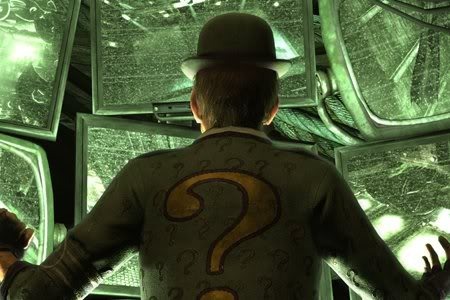 The Riddler's shtick is that he's littered Gotham with riddles and trophies, which you obtain by solving puzzles, some of which are simple, some of which are just goddamn bullshit. You could ignore them, but he has hostages, and to free them you need to solve the puzzles, unlocking the locations of deathtraps as you go. And all the while he's alternately mocking you for your stupidity and accusing you of cheating when you work out the combination of tricks and gadgets required to save a hostage.
It took me a week to finish the core plot. I spent the second week collecting trophies and solving ridiculously complicated puzzles because it was personal – because everything about this plotline was the Riddler saying that I, the player, was not smart enough to figure out his shit. So when I finally found him, pulled him through a set of weak floorboards and punched the question marks off of his hat, the triumph wasn't just Batman's, it was mine.
Now, as a writer, you can't make the reader solve puzzles to turn the page – not unless you're doing some very interestingly ergodic sort of stuff – but you can target the reader directly through a character's portrayal and development. If you can make the reader take a character's actions personally, whether thanks to identification with the protagonist or pushing emotional buttons directly (which is tricky, but kudos if you can pull it off), you give the reader a big reason to care what happens next. Don't just leave them wanting the protagonist to succeed – leave them wanting the antagonist to fail. Do that and they're yours.
Action is character
I've harped on this in the past, and I'll probably harp on it again in the future, but action – stuff actually happening, onstage, front and centre – engages the reader and defines character far more than description. And like most video games, AC is action-adventure focused, and you're constantly doing stuff. Well, more precisely, Batman is constantly doing stuff, and that's a meaningful distinction. You're more like a director than an actor or author in this game, guiding and making decisions for Batman rather than micromanaging him. He knows what he's doing, and his actions show it – he fights hard, he always knows what gadget to pull out, he moves confidently from hiding place to hiding place, pausing only to silently smother a goon or electrify Mister Freeze's armour. And outside the fights, it's action – confrontation with villains, working out puzzles, infiltrating hideouts – that advances the story (albeit unevenly at times). There are cut scenes and conversations, yes, but those are still focused around conflicts and the actions required to resolve them.
The upshot of this is that the story never stalls, because there's always something happening – even if, yes, that story and those actions don't always make sense or connect properly. And because of this, we never have to be told that Batman is a man of action, that he's prepared to do whatever it takes, that he thinks on his feet and refuses to lay down even when weakened near to death by the Joker's disease – because we see him doing those things, and because we help and guide him as he does those things. There are dozens of backstory snippets that you can collect as the game goes along, but you lose nothing by ignoring them, because the story and character development doesn't take place there – it takes place in the now, in the action, and in the immediacy of the moment. Just as it does in a novel.
Action is character, even when you don't want it to be
The flip side to the above, of course, is that when a character says one thing and does another, it's the action that presents the character to the reader.
And what AC presents is a Batman that talks a lot about never killing and doing the right thing (he even makes a little speech about it at one point), but his actions say something else. No, he never kills anyone, but he's fine with letting people die through inaction. The game is rife with instances where you stand by and let the body count rise because you're too concerned with other priorities. For example, a plotline with Deadshot has Batman waiting for the assassin to pick off targets so that he can pick up clues afterwards, rather than working from day one to prevent the killings. And that's not even touching on the ending, where Batman slowly and reluctantly gets himself organised while Strange's men deliberately massacre a third of the inmates, or where he carefully knocks out and incapacitates half-a-dozen armed gunman and leaves them littered around Strange's HQ, only to abandon them to die when the joint explodes. These actions reveal him as either callous or incompetent, no matter his stated plans and sensibilities.
Ditto the thuggishness of his brutal interrogation of captured henchmen – bad guys or no, you can't help but feel a moment of sympathy for them when Batman first terrifies them and then smashes their heads into brick walls or drops them off ledges once they spill the beans. I get that Rocksteady's vision of Batman is darker and grimier than the traditional DC version – although it's a pretty good fit for the less-well-written depictions in the new DC continuity that's deliberately targeting the age-18-35-male demographic – but they're still trying to describe the character as heroic within the game, and his actions belie that, leaving their protagonist more like an easily-distracted bully.
As I've said before, actions speak louder than words, especially in prose – which is weird, given that it's all words, but you know what I mean. It's all show not tell once again, and if you show your character doing the opposite of what you tell the audience he's doing, they'll think he's a hypocrite and that you're confused about your work. Make sure it all lines up, and remember that what happens on the page is what the reader will take in above all else.
–
See, folks, that's all it takes to get me to write 2500+ words – Batman. If only he popped up in Arcadia I'd have finished the book months ago.
Next week, some flash fiction (plus visual stimulus!) for your Christmas reading. Just the thing for warming your heart after you have your pudding.
December 11, 2011
A Q-and-A with Foz Meadows
'You write fantasy, don't you? You should meet the new girl, she's written a fantasy novel.'
That was my introduction to Foz Meadows. As it turned out, the temp working with the sales department at my publishing day job was one of Australia's most promising (and likeable) up-and-coming YA authors, who had just published her first novel, Solace and Grief, the first in a trilogy about a young girl born as a vampire and now trying to find other teenagers with similar gifts/curses. You can't go past a premise like that; it's like a cross between Requiem and X-Men.
Over time we bonded through a mutual interest in reading, writing, alcohol and webcomics. And she never seemed to bear a grudge for that time I nearly cut off her thumbs while we were fixing the photocopier.
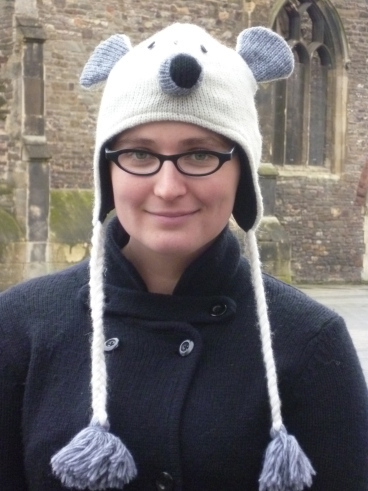
Recently Foz moved to Scotland for an indeterminate period with her husband, while back in Australia The Key to Starveldt, the second book in her trilogy The Rare, has recently been published. With the third book on the horizon, posts-a-plenty on her thought-provoking blog Shattersnipe and other projects in the offing, I thought it a good time to ask Foz a few questions about writing, blogging, YA fiction and what it all means to her.
I always like to start with the big one. Why writing? Why do this rather than some other creative outlet, or indeed some kind of office/publishing job that pays better?
Words got their claws in me early. As much as I loved to draw and sing as a kid, neither art nor music ever moved me like writing did. From the time I could read, I loved stories; because I loved stories, I read; because I loved reading, I wrote – and the more I wrote, the easier it became, so that by the time I was in my early teens, not-writing was unthinkable.
Which isn't to say I never daydreamed about being a palaeontologist or an actor or a foreign correspondent, but even when I started choosing school subjects around a planned career in archaeology, it never once occurred to me to stop writing stories. I might as well have anticipated cutting off a hand.
And so, authorness. Which – alas! – does not preclude the necessary holding of various office jobs that most certainly do pay better. It just means I tend to write worldbuilding notes by the photocopier as well.
You write YA fiction and read/review a lot of it too. But a lot of people (and I am kinda thinking of me here, I admit it) tend to consider YA fiction a poor cousin of 'proper fiction'. How do you react to that perception?
The fallacy about YA novels is that they constitute a sort of writing-down, as though teenagers are necessarily presented with inferior prose, plotting, characterisation, worldbuilding and/or themes until they grow up and thereby prove themselves worthy of Adult Literature. Further offhand disparagement frequently centres on structure: that YA stories are simpler and shorter than their adult counterparts, with all-over happier endings and more predictable catharsises.
To which I say: bullshit.
As a genre – or, more relevantly, as a marketing concept – YA is new. No sane person would ever accuse C. S. Lewis, A. A. Milne, Rudyard Kipling or Astrid Lindgren of having dumbed down their writing, but only because we think of their works as Classics. This is a very tricksy label and one it pays to keep tabs on, because by seemingly automatic and unspoken covenant, all non-literature novels raised to Classic status instantly loose their genre. This way, the very best YA, SFF, crime, horror and romance novels are spared the burden of representing the pinnacle of achievement in their respective genres, and are instead lumped together in a sort of margarine-category, the I Can't Believe It's Not Literary Fiction! of the writing world.
Which means, to get back on track, that only new YA authors are ever accused of dumbed-down prose and simplistic plotting, as though commercial success and popularity must always be anathema to substance, damn kids with their rap music and skateshoes and colourful hardbacks, GET OFF MY LAWN.
What is it about YA fiction that attracts you, as a reader and as a writer?
I find it hard to say sincerely what attracts me to YA fiction, because as much as I've just been calling it a genre, it also sort of isn't. No other genre has its conventions gauged by the status of its (supposed) intended readership, because such a factor has nothing to do with narrative structure and everything to do with backward inference. Saying 'geek fiction' instead of SFF, for instance, conveys information about who, in my subjective estimation, such books are written for, but nothing about what they actually say.
 And while that might be helpful if the object of the exercise is simply to match stories to demographics, we end up leading the witness when we ask why people choose to write or read it, because we're implicitly making a judgement about what sort of person they are. I've never seen myself as writing for an age-group: I write the sorts of stories that I enjoy reading, and whether those are deemed externally to be more appropriate for teenagers or adults, the most relevant consideration to me is that I write fantasy. I love asking 'what if' questions about how the world works; I love the idea of hidden layers of reality, of magic doors to different places that can unpick all our notions of normality; I love mythology; and I really love making things up.
Do you have any plans to eventually write adult books, despite the fact that that label sounds kinda dirty?
I am working on at least one project right now that would be unequivocally termed 'adult', if only because of the sex scenes. So while I love the idea of teenagers reading my books, they're by no means an exclusive audience.
You've written a lot of blog posts this year about the social issues surrounding YA fiction, such as the depiction of race and gender and the privilege and assumptions many readers bring to the work. What is it that drives you to write about these topics? Is this an area where YA fiction has a lot of problems, and if so, why is that?
If I've tended to talk about these problems largely in relation to YA, it's because I've often been responding to existing discussions about specific YA novels, or which have been driven by YA authors. Issues of race, gender and privilege are by no means exclusive to YA, nor does it have a worse problem than any other genre (although whether the presence of a mostly teenage audience makes those concerns more pressing in YA is a different question).
What drives me most about these concerns is the extent to which so many people seem unaware of how deep-seated and toxic some of our unconscious biases are. Over and over, I find myself repeating that people are shaped by culture. Stories are part of culture: they both shape and are shaped by it. The same is true of their authors. When negative patterns emerge in types of stories in aggregate, a natural response is to try to address them at a personal level, attempting a culture-shift by subverting them in our own works. But how can you criticise the tropes in an individual work when the problem isn't that any one book should feature them, but rather that they've become the default setting?
Take, for example, the ongoing discussion about the overwhelming number of pretty dead girls on YA covers. Taken singly, each of these cover images could be considered beautiful and relevant to the story it represents. Taken en masse, we're forced to ask questions about why photos of passive, pretty, lifeless women are universally being used to sell books to teenage girls, and what that says about the culture of story-selling (if not story-telling) we find ourselves in.
This particular example has the benefit of being visual. But try the same trick with the overabundance of stories about straight, white protagonists, and suddenly the issue becomes murkier. Detractors ask: Why does it matter? Are we suggesting authors should have a diversity quota? Does the absence of queer or POC characters make a book less morally worthy than it otherwise might be? Shouldn't it just be about the story? These might seem like ridiculous questions, but that doesn't stop people from asking them when confronted with the prospect of criticising their favourite tales.
Unlike the example of dead girls on covers, the contents of stories can't be blamed on the whims of marketing departments: instead, we must confront the prospect that authors are using popular tropes without necessarily stopping to think about what they mean. And if we love an author, series or story, then criticising them along those lines is a difficult thing to do. As I've recently said elsewhere , loving something should mean we hold it to higher standards, not lower; ask more questions of it, not fewer. And yet we flinch from doing so for fear of what it might mean. That's the reason I end up blogging so often: love your stories by all means, but think about them, too!
I often see you blogging or tweeting about new ideas for stories and novels, and things you work on for fun that wind up becoming more serious. What's your process like as a writer?
When I'm in a writing groove, whatever story I'm working on quite literally obsesses me. If I have a dayjob when the frenzy strikes, every free second will be spent doing sneaky edits and worldbuilding; my lunch break will become writing time, and instead of reading on my commute home, I'll think about my characters. If I don't have a dayjob or it's the weekend, I'll frequently start writing at around 10am and work nonstop until 5pm – given the opportunity, I tend to forget about such niceties as pants, bathing and lunch. I'll usually break for dinner, but I'm also a night-owl, and if I haven't written myself into a corner by then and provided there are no social outings to distract me, I'll go straight back to the keyboard and work until circa 1am.
 My minimum daily output tends to hover somewhere around 2000 words, with the uppermost limits being around 10 000. I can keep up the pace for as long as inspiration holds out, which might be anywhere from a week to a month, but (so far) never any longer. I do sometimes take up ambush-projects, little side-stories and worldbuilding and whathaveyou. The same rules don't apply in those cases, but even if I'm fixated only for an hour or an afternoon, I'm still pretty much fixated.
When I'm not writing, I read, play video games, watch DVDs, go to the movies and generally sloth, though I tend to think of this less as leisure than brainfuelling. Part of my subconscious is always concerned with storytelling, and the more I engage with narrative, the more assertive it becomes. Writing binges take a lot of energy: reading in particular replenishes me, and once the gauge is full, I can't help from tearing off again. It's a rhythm of sorts, but not very ordered or restrained.
Is there an aim for you in your writing – something you want to achieve through your work, over and above creating good stories that people want to read?
Very much, I'd like to subvert expectations. I want my books to make people ask questions – and for the writing of them to turn me quizzical, too.
What are you currently working on?
I'm splitting my time between two very different and unrelated projects. One, as mentioned above, is noticeably more adult; the other is proving impossible to characterise. Both are most properly described as epic fantasy (though each with a respective caveat), and both are reworkings of very old ideas, but other than that, their structure, pace and themes are quite disparate. I'm madly in love with the pair of them, and can't wait to see where they end up!
–
You can find more of Foz at Shatterspike, where you can also find more information about Solace and Grief and The Key to Starveldt. Both books are available in major Australian bookstores, while the ebook version of Solace and Grief can be found in the Kindle Store.
Plus she's on Twitter as @fozmeadows. Which is fairly easy to remember.
December 7, 2011
Calling in sick
I know I've been very slack in the last few weeks about the mid-week/Thursday night updates.
And tonight will be no different. It's 30 degrees, it's been a long day at the publishing office and I'm sick as a dog with a bad flu. I'm going to bed at 7.30pm and there's not a thing you can do about it.
Sunday will be better. I promise. And have I ever broken a promise before?
…those were non-core promises. They don't count.