Patrick O'Duffy's Blog, page 11
June 30, 2014
The state of the union, 2013-14
Hiya kids,
Last week’s post was a bit epic; this one is a lot shorter. It’s the end of the financial year, so I’m doing a bit of an audit of projects past, present and future to see what’s what.
In no particular order:

I spent about eight times more on publishing my ebooks this year than I made back in sales. This may be some kind of record. Oh well, good thing I don’t rely on writing (or at least this kind of writing) to pay the rent.
I made 82 cents from Smashwords sales. Pretty much ready to stick a fork in that site. But how else to get my books onto non-Amazon sites?
Alpha-reader reports on Raven’s Blood are coming back in, and so far they’re all pretty positive. There’s work to do, but it’s not like the whole concept and/or execution is fucked. And believe me, I was worried.
I’m behind schedule on Obituarist II, which I’m sure comes as a huge fucking shock. But the cover is done! And it’s great!
Kinda gotta start getting my shit together for this year’s US trip in November.
Speaking of shit, plotting out a new short story. It’s about the Devil. And bowel movements.
Trust me, it’ll be good.
My dog is pretty freaking cute.
Even if he does keep stepping on my crotch when I’m trying to write.
The X-Men: Days of Future Past soundtrack is boooooooooooooooring.
Okay, that’s me done. See you on the opposite side of the profit/loss ledger.


June 23, 2014
What’s the Storium, morning glorium?
If you’re on Twitter, Kickstarter or probably every other site online, you’ve probably heard about Storium - it made a big crowdfunding splash back in April/May, raising like a quarter of a million dollars and drawing in an astounding number of writers, artists and game designers to create content.

If you somehow managed to miss all of that… well. Storium is an online storytelling game, as the above logo indicates – although it’s one where ‘game’ plays a very distant second fiddle to ‘storytelling’. It’s primarily a platform for collaborative writing, where contributors use prompts to guide their efforts and work towards building a coherent story. There are RPG-like elements in there, such as one contributor being a ‘Narrator’ that directs the group effort and the prompts being measured out using virtual cards, but they’re pretty light, and a like-minded group could probably ignore all that if desired and just use the clean, intuitive online platform to write-jam-party together.
I’ve been a Storium playtester since last year, through the Alpha test (which was quite different) and the Beta into what is now the… I think it’s the open Beta? Not sure. Anyway, I’ve been using it for a while, and currently have two games/stories on the hop – Zero Zero One, a cyberpunk story about memory husking and treacherous corporations, and Ravenloft Redux, an experiment in turning a old location-based D&D adventure into a more narrative experience. And those games are a lot of fun; they don’t replace roleplaying for me, but they’re an enjoyable aside.
Enjoyable and educational. Because Storium is also a concrete demonstration of some key principles of writing, and I’d like to look now at five things using it has borne home for me.
Plot is character
In Storium, every player (other than the Narrator) controls a single character, designed once the stage has been set and the context/setting/genre decided. Characters are sketched lightly using prompt cards – a central concept with Strengths, Weaknesses and Suplots attached to it. Backgrounds can be added/written to your heart’s content, but aren’t necessary. Once play starts, the Narrator sets a scene with a situation or event and then the players write their characters’ actions and responses, with (some) freedom to also write the way the scene changes as a result. Players write back-and-forth, possibly with occasional extra inputs from the Narrator, until things are resolved and the scene ends.
The key point here is that every scene revolves around these characters – what they feel, what they say and (especially) what they do. If you set up a scene and no-one acts, then nothing happens – all you have is a dead screen. There’s no option for a scene without characters – I mean, you can write it, but only by ignoring all the structure that’s set-up. Importantly, Narrators don’t have characters (well, not in the same way) and can’t write a scene that just involves other people doing stuff – they have to open it up and let the main characters drive the story.
The stuff around characters matters too
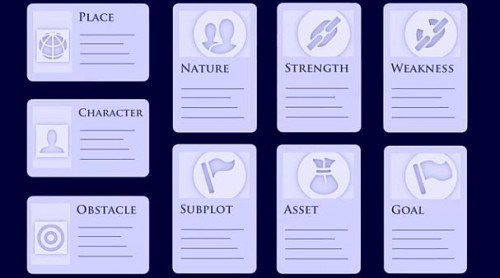
Most of Storium’s stretch goals were about bringing in well-known creators to make worlds – sets of prompt cards and the story concepts attached to them – and Narrators can create their own from scratch as well. In addition to their base cards, characters can pick up Goals and Assets to help define them, while Narrators have sets of Place, Character and Obstacle cards. (The full Storium release, due later in the year, also promises other non-card world material, such as opening scenes, setting data dumps and so on.) As play progresses, more of these cards come into play to sketch out the world and reflect the story.
Call it a world, a setting, a context – stories have to happen somewhere, not against a blank backdrop. Characters may drive the story, but the story is better if they drive through interesting scenery . A bland set of setting elements don’t have to damage a story – you can do a lot with stock elements, especially if you tweak them here and there – but a rich, vivid set gives it real colour and flavour. Maybe too much flavour – you have to be careful not to overload things and pull the spotlight off the characters. (Storium gets the balance pretty right, but I do wonder how much fun some of these heavily-defined worlds will be to work with.) Keep the focus on the character, but make sure what’s outside the spotlight throws up fascinating shadows.
Conflict drives story
Storium players have their characters and associated cards, so what does the Narrator have? She has Challenges – the Character and Obstacle cards, each of which is given a numerical rating when put into play. That number is the amount of player cards that have to be played on that challenge before it’s met in some way. Scenes end when all the challenges are met – and once players write their moves to demonstrate how those elements of the character impact the challenge. With limits on how many and what types of cards can be played by each character in each scene, there are lots of ways in which challenges can be met and scenes can unfold.
You can pitch a scene where characters just talk to each other, and for some people I’m sure that’s fun – but nothing actually happens until the main characters rise to meet conflicts, either pitting themselves against other characters or against situational dangers and problems. Conflicts bring the drama, the tension, the uncertainty – even if it’s uncertainty about how characters will overcome them (and the price they pay in doing so) rather than whether they overcome them. A story without conflict is a squashed doughnut, edible but unappetising – or possibly an inappropriate metaphor that doesn’t make sense. Anyway, they suck. Don’t write them.
Failure is as interesting as success
Depending on the cards that are played on it, every challenge has a Strong, Weak or Neutral outcome – and players, not the Narrator, write the Strong and Weak outcomes. The player of the last card gets to decide how their character has met the challenge and what that means – whether they get what they want or not and how that impacts the rest of the scene, the next challenge and the rest of the characters. Narrators write neutral outcomes, which tend to maintain the status quo or have a smaller, more ambiguous impact on the story – they’re serviceable, but they’re not as much fun as writing it yourself.
The single smartest thing in Storium may be the way challenges are handled. Letting players write both good and bad outcomes is inspired – because the story remains focused on them, even if things aren’t going their way. Narrators get to shape this to an extent by suggesting strong/weak outcomes for each challenge card – and the best pre-written ones all give broad suggestions, with weak/failure outcomes that keep the story going but introduce complications, rather than grinding things to a halt. It’s glorious stuff; it means that failures are fascinating, maybe even more so than successes, and both are much more engaging than neutral coasting.

Pacing is hard
How many challenges should you use in a scene? Is one 6-point challenge easier or harder than two 3-point challenges? Is it better to conserve your Strengths or to alternate them with Weaknesses? How often should the Narrator hand out Asset and Goal cards? Are Asset and Goal cards worth playing? These are the questions that really affect the pace and flow of play/story, and Storium doesn’t give a lot of guidance on the best way to answer them – so pacing is a really tricky beast, especially on a platform where players might go days or weeks between moves. It’s the roughest part of the product, and I hope they give more clarity once the full release goes live.
Just as every Storium game is its own beast and needs its own unique practices to keep things interesting and moving, so does your writing. Your pacing and flow issues might not relate to card play, but they’re still there and they’ll probably never go away. You just gotta try different things until you find something that works – and it might work differently in the next project.
–
Well, I wrote a lot more on that topic that I’d planned. That either means it’s super interesting or that I get carried away – you decide.
Anyway, in summary: Storium’s pretty cool. And like any platform that you can use for telling stories, there are things that are unique to it and things that might be applicable elsewhere. If you get a chance, dive in and give it a try; it’s fun in and of itself, and you might learn something. Or you might not. I mean, pulling apart the progress of a Storium game won’t fix your novel – but fuck it, try it, it probably can’t hurt.
Probably.
June 16, 2014
Intergalactic planetary
Greetings, fellow spend-what-you-can-before-the-end-0f-the-financial-year-folk.
While (as previously noted) 2013-14 has been a pretty rotten year for ebook sales – although I did sell a dozen copies of The Obituarist after that teaser of the sequel, which is rather awesome – it’s been a pretty decent year for the ol’ day job. And so, with an eye towards getting a nice tax-deductible tool that can be used for publishing, writing and wasting the precious years I have between now and the ever-dark, I bought myself a Samsung Galaxy Tab last weekend.

So sleek. So light. So claimable as a business expense.
(This is the second Android tablet I’ve bought this year. The first was a $99 reconditioned Pendo Pad I bought off eBay, and if it was possible for me to melt plastics with the power of my hate, that goddamn useless piece of shit would be a puddle still cooling in the corner of my study. Whatever you do, do not buy one; just pay someone a hundred bucks to repeatedly punch you in the dick instead.)
I bring this up not to boost or make myself look cool – because hell, we already all know that I’m cool as a motherfucker. But the Galaxy is hopefully more than an executive toy; I want to use this to help with my writing, my business and my general ability to remember to wear pants every day.
So what can it do? I’ve downloaded a fair few apps already; here’s what’s on my mind.
 Reading
I’m not giving up my Kindle; I think there’s a real advantage to having a device that can only be used for reading, with no other distractions (plus e-paper is better on the eyes). But I’ve got a Kindle app on the Galaxy, if only so I can check how my ebooks look on it. The Galaxy also comes pre-loaded with Google Play Books and Samsung Readers’ Hub, which let me discover that my books aren’t on their respective stores anyway – whoot.
One of the main things I needed the tablet for was reading PDFs; it came installed with Aldiko, but that was a bit unsatisfactory, so after much testing of various apps I replaced it with Mantano. And you know, it’s interesting how much both those apps sound like kaiju. Or sex toys. Or both. Anyway, Mantano’s got its quirks, but it renders PDFs fast and has strong tagging/metadata functionality, which let me spend many a pleasant hour tagging the hundreds RPG PDFs I’ve put on it.
No, I’m not kidding; I really love doing that kind of thing. This is probably why I’ll die alone.
Writing
I’m not a big fan of writing directly to a touchscreen; at some point I’ll need to get a keyboard add-on if I’m going to actually use this as a serious writing tool. If/when I do that, I’ll need to look at writing apps; all I have now is an MS Office emulator with limited functionality, good for editing stuff in Dropbox (oh yeah, it has Dropbox and Google Drive) but not much else.
I’m more interested in tools that might help with writing, specifically with tracking and developing ideas and keeping me focused. Evernote was an obvious option; I’ve never used it but I’ve seen other people use it or OneNote to excellent effect as a way of creating notes and collecting information. And I thought I might try mind-mapping ideas occasionally, so I got Mindomo and will see if that does anything for me.
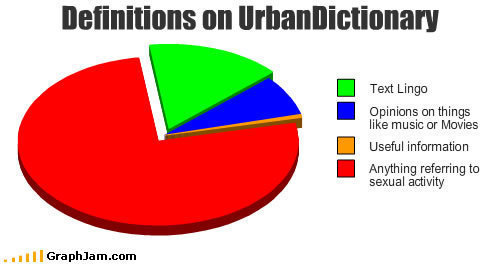
Plus, of course, Wikipedia to look up information. And Urban Dictionary to find out what the young people are calling the stuff I look up on Wikipedia.
Productivity
You know, I really hate the way we fetishise ‘productivity’ these days. It’s this all-important principle, as if efficiency and output and KPIs were all that mattered. It shits me. On the other hand, I’m lazy and unmotivated and I need to write and to do my job, so a couple of tools won’t go astray.
So far, a couple of tools are all I have; Todolist to make, um, to-do lists, a pomodoro timer to break my various tasks into manageable chunks, Skype and GoToMeeting to communicate with people… I think that’s about it so far. I need to do more thinking here about what I’m trying to achieve (finishing projects, meeting deadlines, not getting fired) and what assistance I might need to do that.
Day Job Stuff
Got quite a bunch of these. But I generally don’t talk much about the ins and outs of educational publishing on this blog, and I’m not going to start now.
Games and Social Media
Nope, not doing that. Leave that for the phone.
Entertainment
Generally not doing that either, except for a music player for bumping soundtracks during gaming writing sessions. The two built into the Galaxy – Samsung Music Player and Google Play Music – are both a bit unsatisfying, and I need to look at alternatives, especially ones that allow me to update song titles and visuals.
Oh, and I found an animated image of a red galaxy slowly rotating through space to use as my wallpaper. Because why the hell not.

What else?
The upshot of this is that I have a very respectable chunk of computing power that I can now hold one-handed while drinking coffee with the other. And I want to do more with it than just stream pirated video while leeching cafe wifi.
So what else can I do? What other apps can I download that aren’t distractions but might instead improve, enhance or at least focus my writing (and publishing) work?
Send me links, people. Recommend me stuff. Tell me what to buy.
I AM YOUR MEAT PUPPET.
June 2, 2014
Diving into Dead Men’s Data
Welcome to June, or as I call it, The Month (and a half) in Which I Write Another Bloody Novella.
Yes, the omens are clear, the nights are still warm enough to write without losing a finger and I won’t have my Raven’s Blood notes back until the end of July, so it’s time to knuckle down on The Obituarist II: Dead Men’s Data!
 This book has been on the agenda since, well, pretty much since people finished reading The Obituarist – still available from all fine ebook retailers, and also Amazon – and started demanding a sequel. I wrote the short story ‘Inbox Zero’ as a quick thank-you to tide them over, but that was ages ago. Now, two years since I published that first story about Kendall Barber, social media undertaker, it’s time to visit Port Virtue again and see what’s hiding under its grease-stained rocks.
This time around, Kendall is hired to disentangle the online affairs of the late, unloved Earl Northanger, a scrap metal tycoon who killed himself in his private zoo. At the same time, he reluctantly takes on a job for a Port Virtue police captain whose online identity was hacked – and he’s being pursued by a local journalist who wants to find out all his secrets. And Kendall has more secrets than anyone else might think.
The world of the digital afterlife industry is again the focus for this second book – a world that’s had some interesting developments in two years, a world that’s no longer so unfamiliar to people. But Dead Men’s Data also explores some other ideas – secrets, lies, death, identity, Nazis, poor tattooing decisions, unexamined privilege, urban decay, the speed at which limbs decay in cement and more.
It also has a fight between a badger and a baboon, because I don’t know why just roll with it.
Anyway, this is the start of the writing process, and I’m hoping to get through this book faster than the last couple. The target is around 24 000 words, writing a full 1000-word-odd chapter (two pages of manuscript, because I find it’s easier to calibrate by page than paragraph) a night, four nights a week for six weeks. I could write it faster than that if I knuckled down – my friend Peter Ball is cranking out 2000 words of novella a day, because he’s hugely talented and works hard. I, on the other hand, have both a terrible work ethic and I’m (as usual) pantsing the hell out of this book. I know the start, I have a pretty good vision of the end, there are some snapshots in the middle… and then the writing process is a day of typing, a day of checking my Port Virtue map, looking through all my digital-afterlife-links and working out what the hell to do next.
(That approach also tends to mean I miss that 1000-word target at the start of the book, but nail chapters thick and fast by the end. It’s all much easier when you have some idea what you’re doing. I should probably learn from that. But I won’t.)
Anyway, enough talk of process – let’s wrap this up with the WORLDWIDE EXCLUSIVE first glimpse of the novella-in-progress! (Please note, this is unedited, untweaked and not yet funny-clever enough. But it’s a start.)
ONE
ECCENTRIC MILLIONAIRE COMMITS SUICIDE-BY-BEAR read the headline. The subtitle underneath directly contradicted it – Scrap metal tycoon Earl Northanger shoots himself; body mauled by bear in his private zoo – but who reads subtitles? The headline was pure print-clickbait and it did the job of grabbing eyeballs and sales. God knows the Port Virtue Voice and Advertiser needed them.
‘I’m very sorry for your loss,’ I said to my new client. That sounds like a lame platitude, but it’s usually the right thing to say to someone in mourning. You’re not saying you know how they feel, you’re not claiming to also be in mourning. You’re just expressing a personal sympathy for them and the difficulties they’re having in their time of grief.
Imogene Northanger shrugged; she didn’t seem especially grief-stricken. ‘My grandfather and I weren’t what you would call close, Mister Barber,’ she said. ‘I just want to focus on sorting out his affairs, execute his will and then go back home.’
‘Understood,’ I said, and mentally trashed the remainder of my sympathetic-yet-professional-in-this-difficult-time routine. Fortunately I could use the let’s-get-this-over-with routine instead. I had a bunch of these filed away in my head; I’d practiced them in front of the mirror.
I tried to give her back her newspaper; when she waved it away, I put the Voice and Advertiser to one side. In truth I’d read the paper a few days ago when it was new, although I’d only skimmed the story on Old Man Northanger. I was more interested in the story about the human remains being recovered from the bridge construction site, which had already faded back to page four. There was also a story about me on page twelve, but that was a problem for another time.
Ms Northanger was a well-dressed, well-accessorised woman in her I-would-guess-forties, with short hair and square-rimmed glasses, and when she took those glasses off it was an obvious signal that she was ready to Tell it Like it Was.
‘Let’s just cut the bullshit, Mister Barber. My grandfather was racist, sexist, homophobic, Islamophobic, anti-Semitic – if it wasn’t like him, he hated it and he let everyone know it. Family gatherings were dire at best, at worst… it was a relief when I came out and the family just shitcanned the whole idea of ever getting together in case it gave him apoplexy. I’m sure he was furious that I was the only family he had left, and if he’d realised that I’d be the one made executor of his will he would have broken his neck sprinting to change it. But too bad for him. Now I just want to wrap up his affairs, sell off his assets, put him in the ground and get the hell out of this town once and for all. Can you help me with that?’
Oh, I liked this lady. She was not at home to Mister Fucking About.
More to come. Watch this space. And so on.
May 26, 2014
Beware the ides of May
I know I said I would take time off after finishing the foundation draft of Raven’s Blood, and I have. More or less.
But May has had other ideas, and in fact it’s been a bit hectic down on the ranch this last while. Some of that hecticness has been respectable and productive, and some of it has involved the kind of aggressive, determined sloth that accomplishes nothing but leaves you nonetheless exhausted.

…holy shit, that is a really scary-looking aggressive sloth. Calm the fuck down, man. Have a burrito or something.
Anyway, in lieu of a more substantive post – that may come next weekend, once I regrow some updates – here’s a swag of updates, links and disconnected bits. Which is pretty much like the rest of the internet, I guess.
–
 Continuum X is in two weeks! The programme is out now, and you’ll find that I am speaking on a number of panels, as if I had something to say rather than just being some random yahoo off the street. Those are:
Remembering Iain Banks
It’s All Been Done: Writing in the Age of TV Tropes
Modern Roleplaying
Those are all on Monday 9 June, the last day of the con, so come along to hear my too-rapid ramblings after you’ve had your fill of everything and everyone else. On the other days, look for me in the local bars, especially if they’re karaoke bars; I have a feeling some of the GenreCon crowd and I are going to want to belt out ‘Sweet Child o’ Mine’ over a couple of tequilas.
–
As we all know, when I’m not writing I’m slacking off playing games, and I felt I deserved to play something after April’s efforts. So I borrowed Batman: Arkham Origins from a co-worker, and thanks to some time off caused by mild food poisoning (yay) I was able to play it all the way through over a couple of weeks.
And I kinda liked it! I played Arkham City a few years back, and you may recall that while I enjoyed the gameplay I thought the story and tone was aaaaallll over the shop, and that the constant misogyny just ground all the joy out of playing. Well, Origins avoids the worst of that; it has a clear, consistent direction and it knows where to draw the storytelling line to keep everything hanging together. The core storyline – Batman fights a horde of assassins in the course of one night while early in his career – stays the course, while the side adventures never drift too far away from that in mood. (And it avoids misogyny largely by having no female characters to speak off, but that’s sadly predictable.) There’s even an honest-to-god character arc.

Of course it’s still overly grimdark to the point of being goofy, Batman is a violent thug and everything in Gotham is on fire ALL THE TIME, but that seems to be the established norm for this character now. While the addition of more detective-oriented plot bits is welcome, they all boil down to [push button to have Alfred identify murderer for you], the end-game is anti-climatic, and it runs into the problem all prequels do in that it has to try to foreshadow everything that comes later.
But still. Pretty fun. Definitely worth the nothing I paid for it.
–
In other gaming, I finished my other ongoing RPG campaign, the extremely intermittent Weird-West game Tribulation. We were a long time getting to the end, but I think it was worth it.
It was a strange ending, though, one that took in time travel and paradoxes, and pushed those to the point of rewriting everything that had gone before. That’s a hard road for a story to follow, and it’s made me think a fair bit about the nature of stories like that, the need for foreshadowing (and how to make that work), and whether you can end a story with ‘this story didn’t happen’ while still making it satisfying for the audience for whom it did.
Hmm. More thoughts on that later, perhaps – especially once I see X-Men: Days of Future Past, which looks to be trying to pull off something similar. Hopefully their special effects budget is bigger than mine. Although will they have as many Dr Who references? Probably not, he said smugly.
–
My dog continues to be pretty freakin’ cute.
–
 The Emerging Writers Festival starts this week! I’m not involved in it this year, but if I get organised I’ll be heading off to various events and seeing how many friendly faces I recognise. If you’re headed that way, let me know what you’re going to and maybe we can have a play date. Come on, motivate me; don’t let me slack off.
–
Speaking of writing, the first couple of alpha-reader reviews have come back on Raven’s Blood, and they’re pretty positive. I think. I haven’t really looked at them; I’m trying to keep that book out of my head entirely for a while until I’m ready to rewrite.
In the meantime, I just finished a short story for an anthology that… actually, I don’t know if I’m allowed to talk about that yet. But it’s an odd little piece that was fun to write; let’s hope the editor likes it.
And then next week, to kick off June, I begin work on the next book, for which I can finally reveal the title:
The Obituarist II: Dead Men’s Data
Yes, the continuing adventures of Kendall Barker, um, continue. Come back to the poorly-swept streets of Port Virtue for another tale of death, social media and spreadsheet abuse! There’ll be thrills! Spills! Returning characters! New characters! Poor life choices! Swearing! And some bits that I hope take readers by surprise.
The plan is to write this novella throughout June, aiming for a total of around 24 000 words by the start of July ready to hand over to test readers and my editor. (Who I also have to hire again, along with my cover designer.) I found a good rhythm with the first novella, punching out one 1000-odd word chapter each night; if I can get that vibe again I should easily be able to hit the deadline while still taking time off a few nights each week for nerding and bourbon.
And once that’s done, it’ll be time for Raven’s Blood rewrites.
This momentum is probably good.
I may need defibrillation by August.
May 12, 2014
Vision thing
Folks, I have something to show you, and I AM EXCITE
But first, some context.
For as long as I’ve known him, Cam Rogers‘ writing workspace has been the centre of a visual explosion, his walls bedecked with artwork, quotes, photos, magazine covers, nightclub flyers… a whirlwind of hooks and homes for the eye. When I visited him in Helsinki last year I asked about it, and he told me that they’re less about inspiration and more about confirmation – that when he sits down and looks at that space, those images and ideas that speak to him, they engage him and tell him that it’s time to write, time to re-enter the world in his head that those sights inhabit.
I thought about this when I got back from Europe, and also about what Kevin Powe – yeah, I’m just name-dropping my inspirational friends tonight, so sue me – did with the animation series he’s developing, Altered, where he commissioned a separate artist to create images of the major characters well before things got to the production stage, so that he has a visual touchstone to guide and propel his own work and keep him engaged.
Engagement. That’s the ticket.
So with these things on my mind, I got in touch with an artist and commissioned them to do some artwork of the Ghost Raven, one of the two major characters from Raven’s Blood – to create something I could put next to my computer, to look at every night and pull me back into Crosswater and into that story. Sadly that commission didn’t work out, and I forged ahead and finished the book without that visual push.
But recently I contacted another artist, Stacey Richmond, and commissioned her to work on a piece. It arrived at the start of last week, and holy hell y’all it is amazing.

LOOK AT IT LOOK AT IT LOOK AT IT
Stacey worked directly from a manuscript extract to create this, and it’s pretty much perfect. There are a couple of details that aren’t quite what I imagined, but you know what? I like them better than I like what I’d imagined. I look at this and I want to read this guy’s story – more than that, I want to write his story, even knowing that he… actually, never mind, you can wait to find out that part.
That’s the point of this post, rather than just boasting about the beautiful thing I got – although I’m doing that too. It’s about engagement, about being drawn into just into your story but into your writing, your work itself – it’s about roadmaps and signposts that guide you into the headspace where you need to be. There are lots of reasons why it took me two years to write this foundation draft, but a lot of it comes back to engagement, or a lack thereof. Would I have written the book faster with this glued to my office wall? I think I might.
We all need something to keep us in the zone. Maybe you’ve got that inside you, and good on you if you do – but if you don’t, think about the benefits of some focusing art in your workspace. Images can be your touchstones, your motivators – the pictures that launch a thousand words. I want to do more with those visual spurs that keep me focused, especially once I start revising Raven’s Blood in July.
What will you use? Let me know in the comments.
Also holy crap Stacey did me a second picture OMG:

And if you’re wondering whether you should commission your own art from Stacey – yes, yes you should. But not before I get her to do some pictures of Kember, my heroine. HANDS OFF.
May 5, 2014
Okay, now what?
So, you’ve finished writing a book -
Really? Me too! What a coincidence!
…sorry. Couldn’t resist.
In my right mind I’d lead things off more strongly, but I’ve spent the last week staring blankly at things and walking into doors while trying to remember how to brain. In the post-Raven’s-Blood-world – a world that’s taken far too long to reach – my head is grey and muzzy, as if I’d dropped all the pills at once and was now trying to climb back out of a serotonin-hole long enough to remember how to write even something as simple as an email or a text message.
But yeah, let’s back it up. I finished my book! And maybe you too have finished writing a book, or a story, or a really satisfying bit of toilet wall graffiti. What to do next?
For me, there are three things on the agenda.
 Get someone else to read it
I’ve sent the Raven’s Blood MS to about half-a-dozen alpha readers – and can we just talk about how great a phrase ‘Alpha Reader’ is? That’s a superhero or space adventurer name, that is: Blam! And in a hail of laser fire, Alpha Reader smashed through the enemy barricades, intent on rescuing his beloved editor Lance Commacutter! Much beta than ‘beta reader’, which sounds either like a defunct style of videotape player or some kind of Men’s Rights Activist/Pick-up Artist kind of insult.
But yes, I’ve sent the book to a few people, including established authors and emerging ones, and asked them to beat the living shit out of it. Lovingly, perhaps, but I need to see bloodstains when I get their notes back, because being nice about it isn’t going to help me fix it. There are definite issues with voice, character, dialogue and consistency in the book – and I know about these problems, and I have some ideas on how to fix them, but having someone else back me up on that, or better yet point out failings I don’t realise, will be vital.
If you’ve finished writing a book, ask someone else to read it before you do anything else. Even if you’ve got a contract. Even if you don’t know any other writers. Even if – especially if – you think it’s already perfect. And ask them to be as friendship-shatteringly honest as possible in their notes. Because tough love is the best love.
Write something else
In On Writing, Stephen King advised putting a finished manuscript into a desk drawer and ignoring it for at least six weeks, and in that time starting work on something else. In this, as in so many things that weren’t writing The Tommyknockers, SK is hitting all the correct buttons. The worst possible time to start rewriting a book is the moment you’ve finished it, or anytime while it’s still super-fresh in your mind – because all you’re going to have in your mind is the stuff at the end that you know wasn’t quite right, and you’ll get stuck in a Groundhog Day loop on that while the earlier problems pass by unseen. Shelving it for a while gives you distance; writing something else keeps your word-brain engaged so it can come back to the problems while you sleep or shower or drink all the coffee in the world.
In my case, I’m writing a new short story that was commissioned for an upcoming anthology – yes, that’s right, someone contacted me and asked me to contribute a piece to this project. That’s a nice feeling that never gets old. I need to get that done in the next couple of weeks, after which it’s time to start work on The Obituarist II: The Quickening – because yes, the second half of that story sorted itself out in my brain while I was still wrapping up Raven’s Blood. With any luck I can get the core draft finished by the end of June, which is when I’m hoping to get my RB notes back. Oh, and I’m going to ramp my blogging efforts back up to a regular two posts per week, which I’m sure will make all y’all very happy.
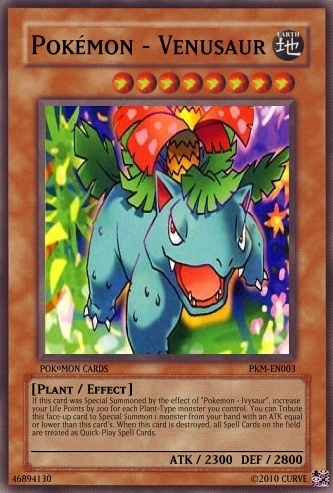
Chain that shit, homes, like you’re summoning Pokemons or sumthin’.
Do nothing
After a burst of frenzied word-humping, you need to take some time off to recharge your grammar-glands, and I’m going to stop this metaphor now before we all regret it.
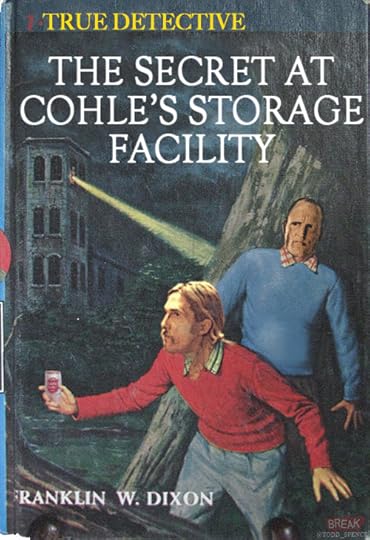
But yes – downtime. Non-writing time. Coming home and not smacking mtself in the face with a manuscript every night. Doesn’t that sound like fun? My plans include reading some books – because jesus shit, I haven’t read an actual book so far this year – and graphic novels, playing a variety of games – including Lego Marvel Heroes, Netrunner, Dishonored and Sentinels of the Multiverse – and even watching television, a pastime which has mostly eluded me for several years, but I hear True Detective is just too good to miss.
And of course, all this downtime is time when my subconscious can grapple with Raven’s Blood and worry about whether the romance plotline is engaging enough or whether it has enough parkour. That’s what writing brains do when you don’t write – they begin stockpiling their moist and musky word-oozes, and sorry I know I said I’d stop that metaphor I’m sorry I’m sorry.
But yes – one of the best things to do after writing something is to not write something. At least for a while.
And in that spirit, WE BE DONE HERE.
April 28, 2014
The big push – an update
Dateline: 28 April 2014
Status of Raven’s Blood draft:
IT’S FINISHED
IT’S FINISHED
IT’S FINISHED
45 CHAPTERS (AND AN EPILOGUE)
82 954 WORDS
IT STILL NEEDS TO BE THOROUGHLY PICKED APART BY BETA-READERS AND CAREFULLY REVISED TO FIX A NUMBER OF FUNDAMENTAL PROBLEMS
I MEAN, IT’S FINISHED
NOW THERE IS ONLY SLEEP

Night, folks.
April 13, 2014
The write-finer monologues
So what’s up man?
Cooling, man.
Chillin’ chillin’? Yo you know I had to call, you know why right?
To reprise the opening lines from the Wu-Tang Clan’s classic track ‘Protect Ya Neck’?

Well, yes, but also to see how the writing’s going. Are you doing it? The big push to finish Raven’s Blood?
I’m doing my best.
Which is… what?
Three chapters since the start of the month, which is, um… 7000 words in 13 days.
Hey, that’s pretty good!
Thanks. I’m not 100% happy with the level of polish, but I gotta put that aside for the moment. That’s what later drafts are for.
How much do you have left to do?
Probably five more chapters and an epilogue. I’d say about… 11 000 words? Maybe 12 000?
And you’ve got 17 days until the end of April? That sounds doable if you work a little bit harder, do a thousand words a day.
I hope so. I’m trying to wrap it up by the 28th so I can give the finished MS to my wife as a birthday present.
How romantic.
It was her idea, okay?
Fine, whatever. Still, you should be able to make it if you stay focused.
Yeah. ‘If”. Assuming I don’t lose any time to distractions.
Is that likely?
Oh shit yeah. I’ve already lost plenty of time in these last two weeks.
I thought you were working hard at this!
I am! But hey, it’s Comedy Festival season, you know?
Slacker. Any show recommendations?
Yep – Ben McKenzie, Laura Davis and Justin Hamilton all have terrific shows this year. You should go see them next week before the Festival finishes.
I’ll try, but as a figment of your imagination I find it tricky to get out on my own. But that’s been your only distraction, right? Right?
…I might have gone to see Captain America: The Winter Soldier.
Oh for god’s sake.
Come on, this surely comes as no real surprise to anyone. And I worked on the book before and after!
Fine, fine. Was it any good?
Oh yeah, it’s terrific. A top-notch superhero movie with great performances and a solid thriller aesthetic. And Batroc the Leaper!
Shit, really?
Well, he doesn’t do much leaping, or any savate. Still cool, though. Best Marvel Studios/Avengers-family movie so far – top of the rankings list!
There’s a list?
Yep. The official ranking is:
Captain America: Winter Soldier
Captain America
Iron Man 3
Iron Man
The Avengers
Thor 2
Thor
Incredible Hulk
Iron Man 2
Hmm. Interesting. Official in what sense?
In the sense that it’s my bloody blog.
Jeez, fine, settle down. But that’s it, right? Knuckling down from this point?
Definitely. Largely. Probably. Okay, look, I’m going to lose some time to shows and gaming and day job stuff, but that’s the way it goes. Nobody gets to just lock themselves in the writing box and only come out when it’s done, okay? Not unless they live in a shack in the woods, peeing into bottles and working on a manifesto. Life has its own demands, and you have to roll with them rather than beating yourself up for being human. The important thing is to work as hard and effectively as you can, when you can, and keep the deadline in mind. It’s like the inverse of Parkinson’s Law, you know? ‘Work expands so as to fill the time available for its completion.’ So if you have a set amount of time available to work, your work level will rise to make use of it.
Hopefully.
Well, yeah.
Is talking to yourself on your blog one of the ways you’re expanding to fill the time available to you?
It’s this or talking to the dog.
I probably would have done that. He’s less critical than I am.
This is true.

March 30, 2014
The big push
Last week I talked about writing a polished (or at least satisfactory) foundation draft, which obviously takes longer than a rougher first draft.
In saying all that, I wasn’t trying to say that one approach is better than the other; it’s all about what works for you as a writer. Write fast, write slow; it takes as long as it takes, and what matters is how happy you – and your readers – are once you reach the end.
For my part, I’ve been working slow but (mostly) sure on Raven’s Blood. It’s taken nearly two years but I’m into the final act, and I reckon there’s about 20 000 words left to go. At my current rate, I think that would take maybe… hmm, four months to write, giving me a finished, relatively polished draft by the end of July.
But see, here’s the thing:
End of July? No way, no hay. I won’t have it.
Instead, I am devoting myself – deliberately and very publicly – to the goal of finishing this book by the end of April. That’s 20 000 words in about four weeks – completely doable, even with editing and polishing and I go.
That means working harder than I have to date and it means finding time to write. Fortunately, April offers me assistance in the form of the Comedy Festival, which will be taking up the time of my wife and friends. I’m seeing a few shows, but I’m not reviewing for anyone this year, and so I’ll be home alone more nights than not – and since I’ve cunningly made sure to not have any new video games to hand, and since Ernie doesn’t know how to play Netrunner, I’ve got few distractions to feed my addiction to procrastination. Ideal circumstances for The Big Push – the last headlong rush to the finish line, lest I humiliate myself in front of the literally tens of people that read this here blog.

Now stand back and let me work, damnit.