Rob Kitchin's Blog, page 40
April 19, 2019
Review of Evil Things by Katja Ivar (2019, Bitter Lemon Press)
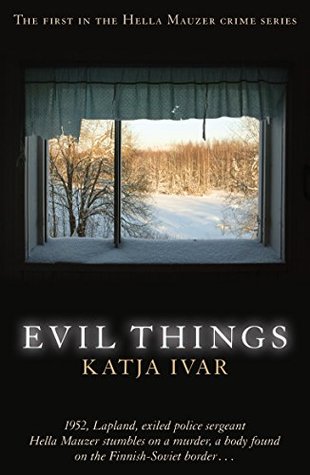 East Finland, 1952. The first female member of the Helsinki murder squad, Hella Mauzer, has been transferred to Lapland for being ‘too emotional’ (shorthand for ‘being a woman’). Her new boss is also a chauvinist, and the inspector is lazy and likes to borrow things from her office. When a village reports an elderly resident missing Hella wants to investigate but her boss is reluctant to let her, arguing that he probably just got lost in the forest. Getting her way, she travels on a logging truck the forty miles into the forest, taking up residence with an Orthodox priest, his wife, and the grandson of the missing man. Some of the villagers are reluctant to help, but others aid the search, turning up the head and ribs of a blond woman, killed by a shot to the temple. Hella continues to work away at the case, but makes little progress. In the meantime her boss has stepped up his efforts to recall her to base. Hella, however, is stubborn, abrasive and determined to discover the truth.
Evil Things is a police procedural set in Lapland in 1952, close to the Soviet border. The story very much focuses on Hella Mauzer, a sharp-tongued, tough, smart woman who is prepared to tackle patriarchy in the police and the misogynistic behaviour of her colleagues and public. Regardless, it’s a difficult job being the first female detective in a country where the woman’s place is considered the home. She’s been transferred from the Helinski murder squad to a small regional police station. When an elderly man disappears in the forest surrounding his village she insists on investigating, despite the wishes of her boss. She quickly uncovers the remains of a middle-aged woman. The locals are clearly holding back information and she has to work hard to unearth clues. Ivar does a nice job at recreating the claustrophobic conditions of the small village heading into winter. There's a relatively small cast, with the local priest’s wife cast as Hella’s opposite: the dutiful, loyal housewife. The star of the book is undoubtedly, Hella, a feisty, uncompromising character, who rubs people up the wrong way even when she’s trying to be careful. She a wonderful creation. The story itself unfolds at a sedate pace, but has enough intrigue to keep the pages turning. It starts to unravel a bit towards the end, changing tempo and style, skipping forward and becoming more sketchy, whereas the majority is meticulously plotted and paced. And the denouement is a little far-fetched, not in the conspiracy but the unfolding. Nonetheless, Evil Things is an enjoyable read, elevated by a strong lead character.


April 16, 2019
Review of IQ by Joe Ide (2016, Mulholland)
 Growing up in a poor L.A. neighbourhood Isaiah Quintabe (IQ) was on track for a university scholarship when his brother Marcus was killed in a hit-and-run. Isaiah starts spinning stories to keep social services at bay and working jobs and taking in a lodger, a hustler and drug-dealer he meets at school, Dodson, to pay the rent. His grades takes a nose-dive as he obsesses with tracking down his brother’s killer. Several years later and Isaiah is the go-to neighbourhood detective who’ll solve cases for whatever clients can pay. He still hasn’t shed Dodson, who brings him a new case – a rap star who fears his life is in danger. The star is paranoid, surrounded by sycophants, haunted by his ex-wife, and hassled by the record company boss for a new album. He’s everybody’s meal ticket, but he might be worth more to them dead than alive. And it seems that someone has hired a lunatic assassin who when he can’t use his gun employs his one hundred and thirty-five pit bull as a weapon. IQ’s job is to identify and stop the assassin, regardless of the dangers, though only the rapper seems to care as to whether he’ll succeed.
IQ is the first book in the Isaiah Quintabe series that charts the cases of a L.A.-based, unlicensed private investigator. Isaiah is not the usual PI. He works out of his house and car and his jobs are all sourced through word-of-mouth, are nearly all neighbourhood-based, and his payment is whatever his clients can afford – food, goods, cash. Bought up in a poor part of the city dominated by drugs and gangs, Isaiah was on the path to escape poverty through his intellect before fate intervened. Now he is trying to atone for past sins. In this opening book Ide tells two tales. The first is set in 2005 and is IQs origin story and his transition from star pupil to dropout detective. The second is set in 2013 and is his present case, investigating a possible assassination attempt on a star rapper. There’s a lot to like about IQ. In a marketplace of derivative detectives Isaiah manages to find a niche – black, reserved, complex, conflicted, smart, principled but with a closet full of secrets and regrets, rooted in his neighbourhood yet somehow still apart. And Dodson, his loud-mouthed, hustler partner acts a good sidekick foil. The characters and the second storyline play as a kind of homage to Sherlock Holmes and Watson, and in this outing, The Hounds of the Baskervilles, but have their own distinct take. The double story line works well, balancing back story with present case, and provides a strong sense of place and also a view of gang culture, crime, community and the music biz. Ide spins the stories out with an undercurrent of humour, and a nice mix of pathos and action. Overall, an engaging and entertaining read and very nice opening to what promises to be a good series.

April 14, 2019
Lazy Sunday Service
 A quiet week of reading and buying books. The only new book into the house was a gifted copy of The Spy and the Traitor by Ben Macintyre - the story of Oleg Gordievsky, a KGB double agent who was a British spy during the cold war. I haven't read any non-fiction for a while, so it's gone near to the top of the TBR pile.
My posts this week
Review of Overkill by Vanda Symon
Lose the anger
April 13, 2019
Lose the anger
‘Why are you so god-damn angry all the time?’
‘Because I work with idiots! The only way Kelly could track down a suspect is if he handed himself in.’
‘But you treat everyone like Kelly.’
‘Draw your own conclusions.’
‘This can’t carry on, Stephanie. People don’t like working with you.’
‘I don’t like working with them.’
‘You can’t solve every case on your own.’
‘That’s not what the stats say.’
‘They also say that you’re pissing everyone off.’
‘They deserve it.’
‘And maybe Traffic deserves you.’
‘I’m the best detective in Homicide.’
‘Then act like it. And lose the anger.’
A drabble is a story of exactly 100 words.
‘Because I work with idiots! The only way Kelly could track down a suspect is if he handed himself in.’
‘But you treat everyone like Kelly.’
‘Draw your own conclusions.’
‘This can’t carry on, Stephanie. People don’t like working with you.’
‘I don’t like working with them.’
‘You can’t solve every case on your own.’
‘That’s not what the stats say.’
‘They also say that you’re pissing everyone off.’
‘They deserve it.’
‘And maybe Traffic deserves you.’
‘I’m the best detective in Homicide.’
‘Then act like it. And lose the anger.’
A drabble is a story of exactly 100 words.
April 10, 2019
Review of Overkill by Vanda Symon (2007, Orenda Books)
 A young mother is forced into an assisted suicide in the small New Zealand town of Matuara. Sam Shephard, the sole-charge police constable in the town, is called to the home. She has mixed feelings about the woman’s disappearance given that she used to be in a relationship with her husband before he ended it. When the woman's body is found in the river the signs are that it was suicide, although Sam has her doubts. A short while later her suspicions have been confirmed and a murder team are bought in to investigate. Sam’s excitement at being part of the team is short-lived when her status moves from police officer to suspect and she’s suspended from duty. Unhappy with her bosses and unwilling to stand-down she continues to investigate, placing her relationship with her senior officers under strain and putting herself in danger.
Overkill is the first in the Sam Shephard police procedural series set in New Zealand. Originally published in 2007 in NZ, it was difficult to get hold of but now has an outlet globally through Orenda Books. The story is set in the small rural town of Matuara, where Sam is a young sole-charge police constable. When a young mother is found dead, it at first appears to be suicide, but then evidence emerges that it could have been murder. It’s Sam’s first murder case, but there’s an added complication: the mother just happens to be the wife of a man Sam dated for a couple of years. That’s not going to stop Sam getting the woman justice, however. Small in stature, Sam is feisty in personality, and when she is deemed a suspect by a visiting murder team and is suspended she vows to solve the case regardless. Despite warnings from her bosses she keeps poking around and to annoy them further she makes better headway than them, though it is also making her a target. The tale is a pretty standard rural police procedural with a head-strong lead character who doesn’t mind bending rules to get results but has her vulnerabilities. Symon does a nice job spins the story out, providing a couple of viable lines of enquiry and suspects, and Sam is an interesting enough character with whom to spend some time. The conspiracy at the heart of the story was viable, but the wall of silence around it felt a little unrealistic. Overall, an enjoyable procedural tale.

April 7, 2019
Lazy Sunday Service
 Last Sunday was my final day as Managing Editor of
Dialogues in Human Geography
. After 10 years at the helm it was time to step down and let someone else inject some fresh enthusiasm and ideas. I first had the idea for the journal as a graduate student. I pitched it to a commissioning editor at Carfax (now T&F) in 1998, they said no but went for the idea for Social and Cultural Geography instead (which I also edited for ten years). I pitched the idea again to Sage in 2003. They passed but came back to me in 2008 having reconsidered. We signed the contract and started to initiate things, setting up an editorial board in mid-2009 and working on getting the journal in train. The first issue was in March 2011. Thankfully Sage have stuck with it, despite it losing them money every year; and so have the Geography community. Hopefully, with the ISI ranking (1/84 for Geography) the circulation and readership will increase in the coming years. Many thanks to everyone who has worked on the journal: Sage staff, reviewers, authors, commentators, and in particular the various editors: Lily Kong, John Paul Jones, Richard LeHeron, Reuben Rose-Redwood, Ayona Datta, Jeremy Crampton, Ugo Rossi, Lauren Rickards and Barney Warf.
Last Sunday was my final day as Managing Editor of
Dialogues in Human Geography
. After 10 years at the helm it was time to step down and let someone else inject some fresh enthusiasm and ideas. I first had the idea for the journal as a graduate student. I pitched it to a commissioning editor at Carfax (now T&F) in 1998, they said no but went for the idea for Social and Cultural Geography instead (which I also edited for ten years). I pitched the idea again to Sage in 2003. They passed but came back to me in 2008 having reconsidered. We signed the contract and started to initiate things, setting up an editorial board in mid-2009 and working on getting the journal in train. The first issue was in March 2011. Thankfully Sage have stuck with it, despite it losing them money every year; and so have the Geography community. Hopefully, with the ISI ranking (1/84 for Geography) the circulation and readership will increase in the coming years. Many thanks to everyone who has worked on the journal: Sage staff, reviewers, authors, commentators, and in particular the various editors: Lily Kong, John Paul Jones, Richard LeHeron, Reuben Rose-Redwood, Ayona Datta, Jeremy Crampton, Ugo Rossi, Lauren Rickards and Barney Warf.My posts this week
Review of Six Four by Hideo Yokoyama
Make the best of it
April 6, 2019
Make the best of it
‘I’ve no regrets.’
‘Liar.’
‘Well, not too many.’
George squeezed Janice’s hand.
‘We’ll get through this.’
‘Well, one of us will.’
‘Don’t. We have to hope. The treatment …’
‘Might delay things. Its stage four, love. It’s alright, it’s been a good life.’
‘George.’
‘There’s no point denying things. It is what it is. Let’s just try and make the best of it.’
‘The best of it?’
‘What time we have left.’
‘George, don’t. Be positive. For me.’
‘I am, love. But I’m also being realistic.’
‘Well, I prefer hope.’
‘Either way, let’s live every day like it’s our last.’
A drabble is a story of exactly 100 words.
‘Liar.’
‘Well, not too many.’
George squeezed Janice’s hand.
‘We’ll get through this.’
‘Well, one of us will.’
‘Don’t. We have to hope. The treatment …’
‘Might delay things. Its stage four, love. It’s alright, it’s been a good life.’
‘George.’
‘There’s no point denying things. It is what it is. Let’s just try and make the best of it.’
‘The best of it?’
‘What time we have left.’
‘George, don’t. Be positive. For me.’
‘I am, love. But I’m also being realistic.’
‘Well, I prefer hope.’
‘Either way, let’s live every day like it’s our last.’
A drabble is a story of exactly 100 words.
April 5, 2019
Review of Six Four by Hideo Yokoyama (2016, Riverrun; 2012, Japanese)
 1989, a seven-year-old girl is kidnapped. The police botch the investigation and the kidnapper retrieves the ransom money and the girl is found dead. Yoshinobu Mikami was a young detective working on the Six Four case, as was his wife. 2002, Mikami has just been transferred from the Criminal Investigations to Administrative Affairs to take up the role of Press Director. It’s a bureaucratic and political role, caught between his police colleagues and demanding journalists. To add to his woes, his home life is in turmoil, his teenage daughter having run away and his wife refusing to leave the house in case she calls. The press are making his and his team’s life hell over a case in which the police are unwilling to share information, and there is clearly a major battle going on between Administrative Affairs and Criminal Investigations, the details of which he’s not privy to. Given his career to date, Mikami has split loyalties and is determined to try and discover what is underway. Then a bomb-shell lands on his desk. The police commissioner general is going to pay the prefecture a visit and he wants to meet the Six Four family. Mikami is to arrange the visit and the press coverage. Only the father is not interested, the press want his head, and the internal battle is threatening to turn into all out war. Determined not to pick sides and for his team to survive, Mikami tries to try and find out the truth about the Six Four case and act as peace-maker.
Six Four is a police procedural tale set in Japan in 2002, with flash-backs to 1989. It’s a long read (635 pages), somewhat of a slow burner, and is more akin to a multi-part television series than a two hour movie. It has a large cast of characters and focuses a lot on the internal politics between fiefdoms inside of a prefecture, particularly the battles between the press and administrative affairs, and criminal investigations and administrative affairs. The lynch-pin to the story is Mikami, a former detective who has become the press director against his wishes, and the Six Four investigation, a fourteen year old kidnapping case that the police botched leading to the death of a seven-year-old girl. The Six Four case has resurfaced and it seems as if it’s being used for internal political leverage, with Mikami trying to get to the bottom of the conspiracy as well as battle the media. The strength of the story is portrayal of institutional politics and conflict as inflected by Japanese culture, and the stoic and embattled character of Mikami. There’s a lot of moving parts, but Hideo Yokoyama keeps it all ordered. However, it did feel overly long and drawn-out at times, especially the first 150 pages, and the plot devices around the timing of events and the denouement felt forced and unlikely. Overall, though an interesting and engaging read and if you like really detailed police procedurals with a strong dose of institutional politics you’ll probably enjoy.

March 31, 2019
Lazy Sunday Service

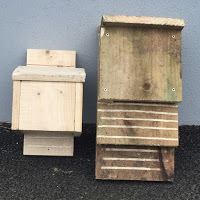 For some time I've been meaning to get some bat boxes and put them up, but never quite got round to it. I finally decided to make some rather than buy and spent a chunk of the weekend making four different designs - two crevice and two cavity boxes. Hopefully, once I've put them up, they will create some roosts for local populations. On the reading front, I'm slowly working my way through Six Four by Hideo Yokoyama, a fairly lengthy (640 pages) and dense police procedural
My posts this week
Review of The Girl Without Skin by Mads Peder Nordbo
Review of Sweetpea by C.J. Skuse
She probably doesn’t want to be found
March 30, 2019
She probably doesn’t want to be found
‘I’m retired.’
‘I was hoping you’d …’
‘There’s a police station in town. By the library.’
‘They’ve given up,’ the woman said. ‘They’ve found no trace of her.’
Jack sighed and thrust the spade into the ground.
‘How long’s she been missing?’
‘Just over four months.’
‘And you’ve not heard anything since?’
‘No.’
‘How old is she?’
‘Nineteen.’
‘And there was no note?’
‘No.’
‘She probably doesn’t want to be found.’
‘Or she’s …’
‘Madness lies there.’
‘There’s madness either way. I just need to know.’
‘I can’t help.’
‘You were a police officer.’
‘Were.’
‘Please.’
‘I can’t promise anything.’
A drabble is a story of exactly 100 words.
‘I was hoping you’d …’
‘There’s a police station in town. By the library.’
‘They’ve given up,’ the woman said. ‘They’ve found no trace of her.’
Jack sighed and thrust the spade into the ground.
‘How long’s she been missing?’
‘Just over four months.’
‘And you’ve not heard anything since?’
‘No.’
‘How old is she?’
‘Nineteen.’
‘And there was no note?’
‘No.’
‘She probably doesn’t want to be found.’
‘Or she’s …’
‘Madness lies there.’
‘There’s madness either way. I just need to know.’
‘I can’t help.’
‘You were a police officer.’
‘Were.’
‘Please.’
‘I can’t promise anything.’
A drabble is a story of exactly 100 words.