Rob Kitchin's Blog, page 178
May 27, 2013
Review of Behind the Battle: Intelligence in the War with Germany 1939-1945 by Ralph Bennett (Pimlico, 1999)
 The back cover blurb for Behind the Battle states: “Many recent studies have covered aspects of the military intelligence available to Britain and her allies during the Second World War, but until now no succinct and authoritative survey of the whole field has existed.” Unfortunately, this book does not provide a survey of the whole field and neither does it seem authoritative. Rather, it principally focuses on Ultra and the use and misuse of intelligence gleaned from decrypting German enigma encoded radio traffic in various theatres throughout the war. All other forms of intelligence gathering including aerial photography, the use of agents, interrogating and eavesdropping on prisoners, and Y traffic (the interception of localised radio traffic along the front line) are largely ignored and dealt with in a very cursory way. Further, how intelligence was implemented in the field is also largely restricted to how Ultra was used tactically. To be sure, Ultra proved highly useful for revealing strategic intelligence and shaping the Allied response. However, it would have been very interesting to get an overview of all forms of intelligence employed, with some detailed vignettes of particular cases and personalities. Even with respect to the analysis of Ultra the discussion tends to provide a broad brushstroke overview, rather than providing some in-depth illustrations. The focus on Ultra should not perhaps be a surprise given that Bennett worked at Bletchley, where enigma traffic was decoded during the war. That Bennett pushes the argument that the only meaningful intelligence came via Ultra, often in a very tiresome fashion, however is less forgivable, providing an overly narrow view of the many ways in which intelligence was gathered and used. If you are interested in Ultra, then you might find this book of interest; if you want a broader overview of British intelligence operations during the war then you’ll need to look elsewhere.


May 26, 2013
Lazy Sunday Service
 Last September I decided to write a new academic book about data. For some unfathomable reason I thought I would have it written by January/February time. It's now the end of May. I've managed to work out a chapter structure and have populated each chapter file with masses of notes. However, I've only cobbled together three just about complete chapters (out of eleven). I also said I'd finish the book then seek a publisher. Instead, I received and signed a contract on Friday to publish the book with Sage, who have published a couple of my previous books and for whom I edit two academic journals. The submission date is January 2014 and I'm now worried whether I'll achieve that deadline given the pace at which I've managed to progress the text so far. Hopefully I'll make up ground over the summer months as I'd really like the book to be published next year. The good thing is that I'm enjoying the process of researching and writing it, and I'm learning a lot.
My posts this week
Smiley's People
Review of The Woman Who Walked into the Sea by Mark Douglas-Home
Irregulars by Kevin McCarthy
Exit strategy
May 25, 2013
Exit strategy
‘Don’t move.’
‘We’re not moving,’ Brady answered, quickly crossing an aisle and hiding behind shelves stacked with tins.
‘I said, don’t move.’
‘We’re not moving. Just let the woman go. This has got nothing to do with her.’
‘I’ll let her go once I’m safely away from here.’
‘That’s not going to happen.’ Brady peaked round the corner and signalled for his partner to creep up an aisle.
‘I’ll shoot her if you don’t let me leave.’
‘You do and you’ll be leaving in a body bag.’
‘I’ll fucking do it, man.’
‘Please, just let him leave,’ the woman pleaded.
A drabble is a story of exactly 100 words.
‘We’re not moving,’ Brady answered, quickly crossing an aisle and hiding behind shelves stacked with tins.
‘I said, don’t move.’
‘We’re not moving. Just let the woman go. This has got nothing to do with her.’
‘I’ll let her go once I’m safely away from here.’
‘That’s not going to happen.’ Brady peaked round the corner and signalled for his partner to creep up an aisle.
‘I’ll shoot her if you don’t let me leave.’
‘You do and you’ll be leaving in a body bag.’
‘I’ll fucking do it, man.’
‘Please, just let him leave,’ the woman pleaded.
A drabble is a story of exactly 100 words.
May 24, 2013
Irregulars by Kevin McCarthy
 Back in January 2011 I reviewed Peeler, Kevin McCarthy's Peeler set in West Cork in 1920, featuring Sergeant Sean O’Keefe of the Royal Irish Constabulary. This month, New Island release the second book in the series, Irregulars, this time set in Dublin a couple of years later. The blurb runs thus:
Dublin, 1922, as civil war sets brother against brother and Free State and Republican death squads stalk the streets and back lanes of Dublin, demobbed RIC-man, Sean O’Keefe, takes a break from life as a whiskey-soaked waster to search for the missing son of one of Monto's most powerful brothel owners.
Hired to find the boy amid the tumult and terror of a country at war with itself O’Keefe soon finds that the story is not as simple as it first seemed and that the truth can be hard to pin down.
The second book in the O’Keefe series, Irregulars explores a fascinating and complex period of Irish history.
Another Irish crime novel I'm really looking forward to reading. Along with Mark O'Sullivan's Crocodile Tears, Eoin Colfer's Screwed, and Alan Glynn's Graveland, the next couple of weeks is set to be a bit of an Irish crimefest.
May 23, 2013
Review of The Woman Who Walked into the Sea by Mark Douglas-Home (Sandstone Press, 2013)
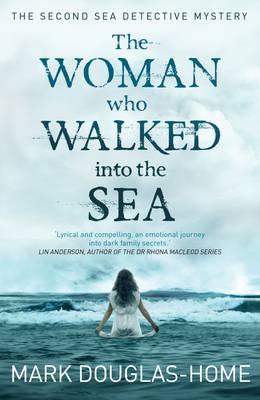 When just a few hours old Anna Wells was dropped at a hospital in Inverness, anonymous except for a broach left with her. Twenty six years later, events in the coastal village she was born in lead to her being informed as to the identity of her mother. Leaving her young daughter with a friend she travels to Poltown to discover why she was abandoned, lodging in her mother’s old house. What she discovers is that the night she was born her mother walked into the sea, her hat and bag being found in the next bay. As Anna comes to terms with her history and tries to discover the reasons for her mother’s apparent suicide, her presence unsettles a community that is already divided between those wanting the place to stay as it is and those who favour allowing a large electricity company to build an offshore windfarm and onshore facility. She’s also being used as a pawn in a bitter personal rivalry. Coming to her aid is Cal McGill, a young oceanographer who runs a detective agency tracing how bodies and objects move with the wind and currents, who is in Poltown to talk to a local beachcomber about his finds. As Anna pushes on with her quest, those with secrets to hide move against her.
The first Cal McGill book, The Sea Detective, was one of my reads of the year so far. I therefore had high expectations for The Woman Who Walked into the Sea. In many ways it is quite a different kind of book. The pace is much slower, the narrative is dominated by long descriptive passages that, for my tastes, are too much show and not enough tell, and nearly the entire story takes place in and around one village. Whereas the first book had a set of intersecting storylines and a relatively large cast of characters and rivalries, this book is more circumscribed and the focus is for the most part follows Anna, the daughter of the woman who walked into the sea, rather than Cal. In fact, there is very little sea detection in the story. Given the amount of work that Douglas-Home does in providing the back story to the tale and setting up the end play to the book it concludes quite quickly and linearly, reliant on a couple of coincidences and underplays the possibilities for dramatic tension or twists and turns. Personally, I would like the next book in the series to focus more on Cal McGill and his sea detection and to have the same faster-paced storytelling style as the first book. Overall, a solid, okay read, but in my view not in the same class as the excellent first book in the series.

May 22, 2013
Smiley's People
 Having watched the excellent, Original BBC adaptation of Tinker, Tailor, Soldier, Spy a few weeks ago, I've just finished viewing the sequel, Smiley's People. If anything, Alec Guinness' Smiley has become even more dour and withdrawn, and the pace of the storytelling is positively glacial compared with present-day television dramas. Nevertheless, it is completely compelling, hooking the viewer in early on then slowly spinning out its yarn in a very understated fashion. This is spy drama as it's played out in reality - a chess game of patient, minor moves within a larger strategy, with many pawns of weak insights and powers and a grandmaster in the background pulling the strings - rather than the whizz-bang of Bond, Bourne, etc. If you want to watch a pair of clever, thoughtful and layered drama's then these BBC adaptions of John Le Carre's novels are worth a viewing.
May 19, 2013
Lazy Sunday Service
 You know when you have a book problem when you go away for two nights - knowing that you will be busy all day and in the evenings - yet you take four books with you. Just in case there's some weird re-arrangement of time and space that will free up a couple of dozen hours. I was thirty pages into Death of a Nationalist when I left for Galway. I am presently at page fifty.
 My posts this week:
Review of The Third Pig Detective Agency by Bob Burke
New Irish crime fiction releases
Review of Black Irish by Stephan Talty
Review of The Dance of the Seagull by Andrea Camilleri
The morning after
May 18, 2013
The morning after
Kevin’s arm flopped out of the bed. He slipped into consciousness through the thick fog of a hangover.
‘Oh, feck,’ he muttered and wished he hadn’t.
He lay motionless, his eyes closed, stomach queasy, memories of the previous evening flitting across his mind’s eye like the flipping of television channels.
A street, a bar, a crowd of people, then an altercation -- a flash of auburn hair, a slither of white skin, an angry voice, raised hands -- a street again, another bar.
He tried to flip back, already sensing shame and regret, wanting but dreading the moment of recall.
A drabble is a story of exactly 100 words.
‘Oh, feck,’ he muttered and wished he hadn’t.
He lay motionless, his eyes closed, stomach queasy, memories of the previous evening flitting across his mind’s eye like the flipping of television channels.
A street, a bar, a crowd of people, then an altercation -- a flash of auburn hair, a slither of white skin, an angry voice, raised hands -- a street again, another bar.
He tried to flip back, already sensing shame and regret, wanting but dreading the moment of recall.
A drabble is a story of exactly 100 words.
May 17, 2013
Review of The Dance of the Seagull by Andrea Camilleri (Penguin, 2013; Italian 2009)
 Inspector Montalbano is just about to head away for a few days holiday with Livia when he witnesses a seagull plummet from the sky, hitting the ground hard. It staggers to its feet, does a strange dance then drops dead. Disturbed by the bird’s demise he heads into work to sign some forms before departing on his break. There he learns that his trusted right-hand man, Fazio, has disappeared having gone to the docks to investigate an allegation of drugs smuggling. Forgetting his trip, Montalbano starts to hunt for Fazio, fearing the seagull was a portent sign. As he follows the trail, he is soon drawn into a conspiracy of smuggling, blackmail and murder.
The Dance of the Seagull is the fifteenth book in the Montalbano series. Whilst Montalbano is a reasonably serious character, the books are light-hearted and witty, as much as about Sicilian life and culture, especially its food, as about solving the crime. The atmosphere and sense of place are nicely realised. The characterisation is well observed and some of the dialogue exchanges are wonderful. As were the internal dialogues between Montalbano 1 and 2, sitting on each of his shoulders. The plot for the most part worked okay, though the resolution felt a little clunky, as if Camilleri wasn’t quite sure how it was going to end then somehow muddled through. Moreover, as with the other books, time and space seemed a little elastic -- the investigation takes place at a leisurely pace and everywhere seemed to take a long time to get to and was far away, yet it is meant to be a local police force and Montalbano had an intimate knowledge of the local geography. Overall, a fairly dark story told through witty and light storytelling.

May 14, 2013
Review of Black Irish by Stephan Talty (Headline, 2013)
 Absolam (Abbie) Kearney grew up in The County, the close-knit, clannish south Buffalo district dominated by an Irish working class community. As a non-Irish orphan with gypsy looks adopted by an Irish cop she had never quite fitted-in despite her efforts. Headstrong and determined to prove she’s her father’s daughter, she has followed him into the police, but after a disastrous stint in Miami she’s ended up back in Buffalo as a detective and caring for her father who has early-stage Alzheimers. When a call comes in from the County about a missing man, Abbie heads there to investigate. Shortly afterwards he is found, brutally murdered. As Abbie and her partner, Zangara, start to investigate it’s clear that the County is turning inward, refusing to offer up what it knows, and that Jimmy Ryan is the first victim in a set. Moreover, the killer is taunting her. Under pressure from her boss, Abbie manages to unearth a trail and tries to get the County to give up its secrets, but there seems little chance of catching the killer before he completes his task and Abbie is clearly part of his plans.
Black Irish is a police procedural thriller that rattles along a quick clip. The strength of the novel is its characterisation and sense of place. Absolam Kearney is a strong, proud and feisty cop with a sizable chip on her shoulder who makes for a compelling lead character. The other characters are well-penned and Talty captures well the close relations of a clannish community. He also creates a vivid sense of the County and Buffalo in general as a rust-belt city down on its heels. The plot for the most part works well, revealing the Irish republican history of the community and its legacy, and the tension builds throughout. However, the tale falters somewhat towards the end, with what for me was one twist too far that felt too implausible and contrived. Nonetheless, this was an enjoyable start to a series, with a lead character and setting I look forward to following.