Rob Kitchin's Blog, page 174
July 16, 2013
More for the pile

 I headed back to The Book Lady bookshop again on Saturday and picked up two other books: Val McDermid's Trick of the Dark and Karin Fossum's Black Seconds. I also bought six other books last week (two novels and four academic), and two other academic books this week so far. I have no idea when I am going to find time to read them all. I guess I'll just keep turning the pages.


July 15, 2013
Review of Graveland by Alan Glynn (Faber, 2013)
 Ellen Dorsey used to be a frontline journalist who now writes longer, investigative pieces for a monthly current affairs magazine. When an investment banker is shot dead in Central Park, given her nearness and curiosity she heads to the scene. The murder re-ignites her old news reporter instincts -- she’s sure this is more than a random killing and she wants to uncover and break the story. Frank Bishop used to be an architect before the financial crash, now he’s a store manager in an ailing mall. To add to his woes he’s becoming increasingly concerned for the safety of his daughter, Lizzie, a university student who won’t answer and return his calls. Craig Howley is second in charge of a private equity group, Oberon Capital, and is hoping to take control once aging, patriarch, James Vaughan cedes his position due to ill-health. Vaughan, however, has other ideas and is determined to cling on to power, or at least retain being the puppet-master. Ellen, Frank and Craig’s lives are about to intersect, with fatal consequences.
Graveland is the third book in a loose trilogy that all feature the well connected, aging and secretive, James Vaughan and the tentacles of Oberon Capital Group, and a handful of other overlapping characters. As with Winterland and Bloodland, Glynn has written a well plotted, nuanced and layered political/financial thriller -- this time weaving together radical politics and Wall Street greed. And although there are several intersecting plotlines and subplots, Glynn guides the reader effortlessly through them. The telling feels polished, the prose and narrative thoughtfully crafted, and the style is all tell and no-show. The characterisation is nicely realised, with each of the principal characters vivid, complex and three-dimensional. Overall, a fitting end to the trilogy, that also closes off Glynn’s first book, The Dark Fields -- an enjoyable, cerebral, contemporary thriller.

July 14, 2013
Lazy Sunday Service
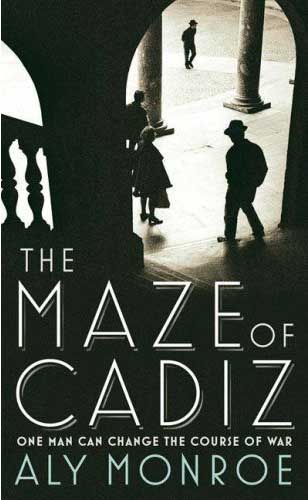 Another sunny day in Ireland. We've now had a whole week of them. For the first time in a few years we're actually having summer weather. No doubt usual business will resume shortly so I plan to spend most of the day in the garden slow roasting with my head in Aly Monroe's The Maze of Cadiz. Unusually, I actually have three books on the go at present. The other two are Laidlaw by William McIlvanney and The Signal and the Noise by Nate Silver. They've become my outdoor, downstair's and upstair's reads. Expect reviews shortly. I'm a little behind with reviewing, so when I get too hot, I might wander in and draft a couple.
My posts this week
Review of Irregulars by Kevin McCarthy
A tanuple of drabble words
Review of The Deal by Michael Clifford
Cover for The Song of the Sea
Too slow on the draw
July 13, 2013
Too slow on the draw
‘Hey! Hey! What the ...’
He shot out a hand, but was too slow on the draw.
The man stepped calmly off the platform just as the train drew level with Donny.
And vanished.
Lost to the squeal of brakes, the screams of would-be passengers, and the warm breeze barrelling down the tunnel.
‘Fuck!’
Donny stared at his outstretched hand, a carriage just centimetres away, wondering at what might have been. Could have been if he’d reacted more swiftly.
The train shuddered to a halt, the faces gazing out oblivious to the fact that they’d be stuck there for hours.
A drabble is a story of exactly one hundred words.
He shot out a hand, but was too slow on the draw.
The man stepped calmly off the platform just as the train drew level with Donny.
And vanished.
Lost to the squeal of brakes, the screams of would-be passengers, and the warm breeze barrelling down the tunnel.
‘Fuck!’
Donny stared at his outstretched hand, a carriage just centimetres away, wondering at what might have been. Could have been if he’d reacted more swiftly.
The train shuddered to a halt, the faces gazing out oblivious to the fact that they’d be stuck there for hours.
A drabble is a story of exactly one hundred words.
July 12, 2013
Cover for The Song of the Sea
 Having spent a bit of time reflecting on the two cover choices for the forthcoming drabble collection - The Song of the Sea - I've decided to go with the one right. It was a tough choice, but the more crafted font is I think more representative of the nature of the stories. Either one would have been good though. Thanks to everyone who an expressed a view and to JT Lindroos for designing it for me.
July 11, 2013
Review of The Deal by Michael Clifford (Hachette, 2013)
 After ten years in Australia, Karen Riney returns to Ireland after the death of her husband. On the rebound she ends up in Kerry with Jake, who is paying off a debt to Dublin crime boss, Pascal Nix by running a grow-house. When the house is raided and Jake arrested, Karen heads to Dublin with the idea of using her new knowledge and Jake’s contacts to go into the grow-house business herself, with the aim of making enough money to make a fresh start. Without the capital for set-up costs she turns to Nix, a man nobody wants to be in debt to. As Kevin Wyman well knows; a builder who chased the bust to the bottom, borrowing money from Nix to try and keep his business float. Nix ensures a healthy return on his investments through the services of Charlie Small, an overweight thug, and Dara Burns, a cold hearted killer for hire. Karen has little conception of the terms of her debt, confident that she can use her business skills to make a quick profit. But when Nix is involved there’s no such thing as easy money.
The Deal is a story about ordinary folk, down on their luck in a recession, turning to the fringes of crime to try and make a quick buck and keep their heads above water, and the criminals who exploit them ruthlessly. It had a strong feel of social realism, as might be expected from a journalist author, and my sense was it gave a good portrayal of dark underbelly of post-Celtic Tiger Ireland, much like Clifford’s excellent first book, Ghost Town. Indeed, the story is an interesting tale and its competently told, but it felt a little flat until the last third when it picked up in pace and tension. Likewise the characters felt somewhat two-dimensional and I never really connected with them or their troubles. Overall, then, whilst the plot was well worked and is a timely portrait of contemporary Ireland, the telling seemed to lack bite and sparkle. Nevertheless, I look forward to Clifford’s next offering.

July 10, 2013
A tantuple of drabble words
 Back in May 2011 I took up the challenge by Oxford Dictionaries to save a word that was in danger of slipping from use and vanishing from our lexicon. The word I chose was 'tantuple', which is a number multiplied by itself. I've managed to use it a few times, but its not the easiest to drop into a conversation. I can use it now as, as of Saturday, I have produced a tantuple of words from my drabbles - 100 stories each of 100 words. Somewhat ironically, the save the words website has been closed down, so maybe there weren't that many words that needed saving after all. As I announced a couple of weeks ago, I'm going to collect all the drabbles together into a collection - The Song of the Sea - and publish it as a free ebook later in the summer. I'll announce my choice for the cover on Friday.
July 8, 2013
Review of Irregulars by Kevin McCarthy (New Island, 2013)
 Dublin, 1922, and Sean O’Keefe has been demobbed from the Royal Irish Constabulary and has become one of the great mass of unemployed, sitting on the sidelines of the civil war raging between former comrades, the pro-treaty Free Staters and the anti-treaty Irregulars. He spends his days drinking to forget his time in the Great War and subsequent fight for independence until he agrees to help pay off the debt his father owes to Ginny Dolan, a madam of a Monto brothel. She wants O’Keefe to use his policing skills to find her missing son, Nicky, an idealistic teenager who acts as a runner for the Irregulars. To aid him, she partners O’Keefe with Albert, her strong-arm protection, who has a tendency to hit first and ask questions later. Given Nicky Dolan’s links to the Irregulars, they are not the only ones seeking the boy and his leader Felim O’Hanley. The newly formed CID and intelligence service, staffed by battle-hardened men who will kill to maintain the fledgling new state, are hunting him down after one of their own was killed when a sting operation went wrong. Thus ensues a game of cat and mouse as O’Keefe and Albert traipse round Dublin’s seedy underbelly seeking Dolan’s hiding place whilst avoiding the attentions of the police.
Irregulars is the second Sean O’Keefe story, set a couple of years after Peeler, during the Irish civil war. Like Peeler, the story is multi-layered and nuanced, capturing the convoluted national politics and family allegiances of the time. And by demobbing O’Keefe and having him search for a politically-motivated and adventure-seeking teenager, the plot allows McCarthy to portray the vast social differences between the well-to-do and the slums, as well take a relative impartial path through the politics and skirmishes between pro- and anti-treaty forces. In so doing, he creates a very strong sense of place and time. Indeed, the contextual history is very much front stage in the telling, with McCarthy demonstrating and imparting a detailed knowledge of Dublin and the civil war in the early 1920s. This does work to slow the story a little, and at times veers the book towards a history lesson rather than crime tale, but it is generally fascinating stuff. Where the telling does falter, however, is in the inclusion of a number of passages which are superfluous or overly long and little progress the story and the narrative would have benefitted from them being omitted or tightened. This is countered by the generally strong characterisation, especially Sean O’Keefe, Nora Flynn, the agent employed to track him, and Just Albert, the brothel strong-arm, and some really wonderful dialogue. Overall, Irregulars is a very good read, with a strong sense of place and history, excellent prose and dialogue, and an engaging, page-turning plot.

July 7, 2013
Lazy Sunday Service
 I discovered 'Ireland's smallest bookshop' yesterday in Boyle - The Book Lady. The shop probably measured eight feet by six and was floor to ceiling books, mostly selected literary fiction. I think it's the first bookshop I've been in that had a free section - 'books that can be picked up for three for a euro in charity shops that are unlikely to be sold and are taking up space,' as the friendly owner put it. I picked up a copy of The Book Thief by Markus Zusak, of which I've been dimly aware but taken no notice. I've now discovered that it's been on the New York Times bestseller list for seven years and has over 320,000 ratings on Goodreads. Which just goes to show how much attention I pay to bestseller lists. Hopefully it'll be as good a read as reviews say it'll be.
My post this week:
June reviews
Review of Zugzwang by Ronan Bennett
Irish crime binge
Review of Little Criminals by Gene Kerrigan
Rock and a hard place
July 6, 2013
Rock and a hard place
The garda held out a photograph. ‘Would you like to tell us about this place, Darren?’
He glanced down at the photo. It showed him exiting an apartment block.
‘No.’
‘Trafficking and profiting from prostitution are serious offences. You’ll get several years in the clink.’
Darren tried to brush past the cop, but his path was blocked.
‘We know you’re just the handy man, Darren. That Kenny H owns the brothel and several others. We’re offering you witness protection if you’ll testify.’
‘Are you joking? He’d kill me and my family.’
‘Those are your choices, Darren, prison, death or protection.’
A drabble is a story of exactly 100 words
He glanced down at the photo. It showed him exiting an apartment block.
‘No.’
‘Trafficking and profiting from prostitution are serious offences. You’ll get several years in the clink.’
Darren tried to brush past the cop, but his path was blocked.
‘We know you’re just the handy man, Darren. That Kenny H owns the brothel and several others. We’re offering you witness protection if you’ll testify.’
‘Are you joking? He’d kill me and my family.’
‘Those are your choices, Darren, prison, death or protection.’
A drabble is a story of exactly 100 words