Rob Kitchin's Blog, page 172
August 9, 2013
Review of The Lost by Claire McGowan (Headline, 2013)
 Paula Maguire fled to London from Ballyterrin in Northern Ireland, close to the border with the South, in her late teens. There she trained as a forensic psychologists specialising in finding missing persons. Twelve years after leaving, her help is requested from the local force, seeking to locate two missing teenage girls, plus her father has broken his leg. Having fallen out with her boss yet again, Paula reluctantly accepts the secondment. But going back to the small border town that is still carrying the scars of The Troubles is as every bit as unsettling as Paula feared. As are the cases of the two missing girls, one the eldest daughter of a local developer and politician, the other a Traveller. She is meant to be reviewing the files, getting a sense of the two girls, and seeing if the cases matched any previous disappearances, but headstrong and authority adverse she starts to take a more active role in the investigation, focusing on the role of a local mission group. And when she is told to desist, she continues on regardless, throwing fresh light on the cases, but also jeopardising them and herself. But as with most things in Ballyterrin and its recent history, nothing is quite what it seems.
There’s a lot to like about The Lost. Paula Maguire is an engaging character with a strong personality and interesting personal history, and Ballyterrin, a fictional Irish border town, has its fill of sectarian ghosts and secrets. The support characters are a little clichéd, but generally well realised, and the story has a nice swirl of main plot and subplots. In particular, the contextualisation with respect to the role of the mission and the history of the treatment of young women by families and the Church is well done. That said, the story is a little overwrought at times, veering towards melodrama (especially in the last quarter), and it’s hard to believe that Paula wouldn’t have been reined in more tightly by her police colleagues given her propensity to stray (she’s not a police officer and she’s in Northern Ireland, the most officious and rule bound police force in the UK). Nevertheless, it’s an engaging read that I sense might be the first in a series; if so, I look forward to the next instalment. Both Paula Maguire and the storytelling reminded me quite a bit of Elly Griffiths ‘Ruth Galloway’ series and I suspect if you like those books you’ll enjoy The Lost.


August 8, 2013
Launch of The Doll's House by Louise Phillips
 Yesterday saw the launch of The Doll's House by Irish crime fiction writer, Louise Phillips. Unfortunately, I couldn't go to the launch in Dublin as I was on the other side of the country, but it seems to have gone well according to the comments on Twitter/Facebook. The book is the second to feature Dr Kate Pearson, a criminal psychologist, and is the sequel to Red Ribbons. You can read the blurb and find out more on Louise's website.
August 7, 2013
Review of Ready Player One by Ernest Cline (2011, Arrow Books)
 It’s 2044 and the excesses of the late twentieth and early twenty first centuries have taken their toll -- oil has all but run out, climate change has led to famine, and the economy and public services have gone to hell in a hand basket. Folk have fled suburban sprawl and commuter towns and have moved into the cities, crammed into buildings or occupying trailers stacked into skyscrapers. In order to escape the drudgery of their lives they escape into the OASIS, an enormous virtual reality made up of thousands of worlds. Five years previously, James Halliday, a pioneer inventor of video games and the creator of OASIS, announced in his will that hidden in the system are three keys that open three gates leading to Halliday’s Easter egg and control of his business empire and fortune. The only clue to the location of the first key is a riddle, which proves difficult to decipher. Wade Watts is a poor teenager living in the stacks of Oklahoma City obsessed with Halliday’s quest. Like millions of others he spends his free time trying to crack the riddle, immersing himself in the folklore surrounding Halliday and the culture of his favourite decade, the 1980s. Also in the hunt is Innovative Online Industries, a massive conglomerate that uses indentured labour and wants to own and monetize the OASIS, and they don’t care how they achieve their goal. People are starting to tire of game, but then Watts manages to solve the first riddle, his character, Parzival, suddenly gaining worldwide fame and unwittingly putting himself in real life danger. The race is now on to pass through the other two gates and claim the prize.
The front cover blurb states that Ready Player One is Willy Wonka meets The Matrix. In my view it’s more Willy Wonka meets Ender’s Game and Virtual Light. Wade Watts is the poor kid living in a post-apocalyptic, gerry-built, bricolage landscape, escaping into the virtual worlds of the OASIS with the dream of solving an eccentric inventor’s challenge and inheriting the company and associated fortune. There’s very little to fault in Cline’s storytelling or the detailed world he creates, which has a strong sense of plausibility and realism. Wade is on a dungeons and dragons style adventure through an enormous set of virtual worlds, where the quest is steeped in references to 1980s culture - the music, video games, movies and fashions. On his journey he undertakes challenges, collects artefacts, builds the powers of his character, makes friends, falls in love, and battles an evil empire to save the future of humanity. And just like an addictive game, the story hooks the reader in and the pages keep turning. The characterisation is nicely done, the plot is excellent, and the contextualisation is very well realised. Indeed, it’s clear that Cline spent a lot of time on the details and it shows -- it’s a tale about a bunch of geeks doing geeky stuff that is geeky in its creation. At times it’s a little too linear, and once Wade has found a path he tends to travel down it relatively easily, and the real world tends to fade into the background, but this is all very minor stuff. Overall it was a joy to read and given its strong plotting and intertextuality, I can envisage the story being made into a TV series or a movie.

August 5, 2013
Review of The Barber Surgeon’s Hairshirt by Douglas Lindsay (2001; reissued 2011, Blasted Heath)
 After his exploits in The Long Midnight of Barney Thomson, Barney is on the run accused of being one of Scotland’s worst serial killers. Heading north from Glasgow he has made his way deep into the highlands using his barbering skills to leave a trail of neatly trimmed heads in his wake and nobody with a bad word to say about him. Running out of money and places to hide he enrols in an isolated monastery cut off from the rest of the world. Shortly after his arrival the brothers start to drop dead. It seems like Barney is a natural catalyst and fall guy for serial killers. With bodies piling up and the snow coming down the only solution to his predicament is to catch the real killer, a task he’s wholly unsuited to. Meanwhile, DI Joel Mulholland and DC Erin Proudfoot are hot on his trail, and hot for each other, their unconsummated flirting preceding them as they systematically visit every hotel and B&B in northern Scotland. The question is whether they’ll find Thomson before all thirty monks are murdered and whether they’ll be able to keep acting like monks during their search.
The Barber Surgeon’s Hairshirt (originally published as The Cutting Edge) is an outrageous farce from start to finish. The tale is divided into two parallel storylines that eventually collide: DI Joel Mulholland and DS Erin Proudfoot journey across northern Scotland hunting the notorious barber Barney Thomson who’s wanted in connection to multiple murders; and Thomson’s refuge in a remote monastery full of men hiding from the world, amongst whom lurks two serial killers, one accused, one real. Lindsay amplifies all the elements of the plot -- the brooding romance between Mulholland and Proudfoot, the trail of local residents who didn’t feel the need to tell the police when they gave Thomson lodging, the tabloid headlines that accuse Thomson of every crime and missed goal in Scotland’s history, the murders in the monastery, and the bleak winter weather -- and liberally doses the narrative with humour. For the first half of the novel this works really well. The story is a funny spoof on crime fiction, told through an engaging voice. In the second half the telling becomes a bit tedious, repetitive and trying as Lindsay demonstrates his cleverness by spewing a dictionary and quotes, and the plot gets stretched to breaking point as it becomes more and more ridiculous. Nevertheless, it’s an enjoyable ride overall, especially Mulholland and Proudfoot’s journey, and the next book in the series is queued up on my kindle.

August 4, 2013
Lazy Sunday Service
 Had a lovely morning so far trying to deal with a 'blue screen of death'. I'm reasonably technically literate, but trying to follow the advice on help forums is still bewildering. Could be a malware issue, a driver issue, a hardware issue. The joys of living a life over-determined by code. I think I'll just go back to reading Claire McGowan's The Lost and hope that it goes away on its own. At least the title sums up my predicament
My posts this week
Review of The Go-Go Girls of the Apocalypse by Victor Gischler
Fiddling with Rome burns: Housing in Ireland
Review of Cripple Creek by James Sallis
July reviews
Review of Black Seconds by Karin Fossum
All sins require justice
August 3, 2013
All sins require justice
‘You must have done something?’
Paulsen kept his gaze on a spider wrapping a trapped fly. ‘What?’
‘Even if you are innocent, you must have done something that demands penance.’
‘A few minor infractions doesn’t deserve life imprisonment.’
‘So you did do bad things. All sins require justice.’
‘There’s a difference between bad and illegal and they're irrelevant anyway. I didn’t kill that girl.’
‘So you say. But nobody believes you, man: the police, her family, the jury. You need to bow down before the lord and pray for forgiveness.’
‘I need a better lawyer. And a different cell mate.’
A drabble is a story of exactly 100 words.
Paulsen kept his gaze on a spider wrapping a trapped fly. ‘What?’
‘Even if you are innocent, you must have done something that demands penance.’
‘A few minor infractions doesn’t deserve life imprisonment.’
‘So you did do bad things. All sins require justice.’
‘There’s a difference between bad and illegal and they're irrelevant anyway. I didn’t kill that girl.’
‘So you say. But nobody believes you, man: the police, her family, the jury. You need to bow down before the lord and pray for forgiveness.’
‘I need a better lawyer. And a different cell mate.’
A drabble is a story of exactly 100 words.
August 2, 2013
Review of Black Seconds by Karin Fossum (Harvill Secker, 2007; Norwegian 2002)
 Nine year old Ida Joner lives with her mother in a small neighbourhood some way from the nearest town. Early one evening she gets on her new yellow bike and heads to the local shop to buy some sweets. A short while later and she has not returned and her mother, Helga, has grown anxious. When she calls the shop the owner says Ida never arrived. Helga calls her daughter’s friends, then her sister, Ruth. With her panic rising the sisters search the local area to no avail and then call the police. Inspector Konrad Sejer tries to reassure the mother and sets about organising a search. Two days later and Ida’s disappearance is front page news, her mother is distraught, and Sejer’s investigation appears to be going nowhere. He has few clues, but is methodological and patient. Time, however, is not on his side; Sejer knows that the longer Ida is missing, the less likely it is she’ll be found alive.
 Black Seconds is the sixth book in the Inspector Sejer series and the first I’ve read. I found it somewhat of a curious read as there was not much mystery to the case, yet it was oddly compelling. I think there are a couple of reasons for this. First, the storytelling is quite understated, simply focused on the unfolding of the events and its consequences to those involved. The characterisation and social interactions are keenly observed, providing a high degree of social realism and emotional sensitivity. The hook is the exploration of how crime and life are rarely black and white; through mishap and misadventure people can find themselves on the wrong side of the law and bound up in situations that are difficult to resolve. Second, the telling had a nice cadence and descriptive prose. The combination produced an engaging style that kept the pages turning, despite there being few moments of high drama and the plot being relatively transparent. Overall, a story where style and telling elevated a somewhat average story to into a captivating read.

August 1, 2013
July reviews
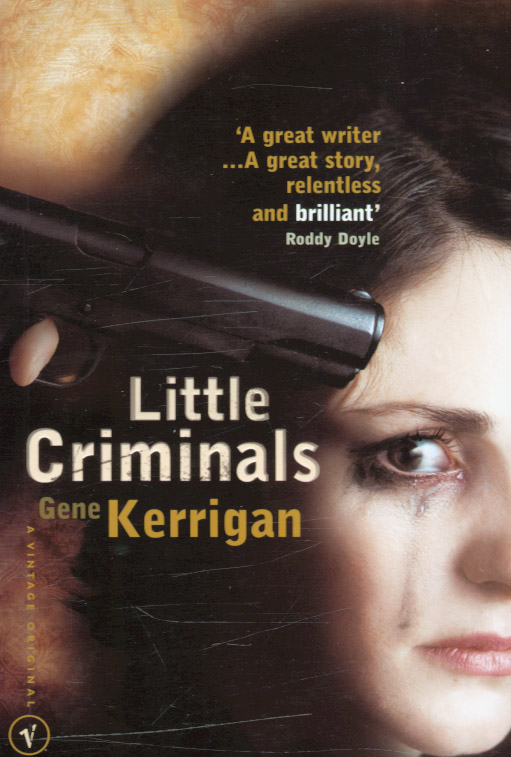 A good month of reading, with three standout reads from Alan Glynn, William McIlvanney and Gene Kerrigan, with Kevin McCarthy not far behind. Difficult to pick a book of the month from those three but I'm going for Little Criminals. A wonderful, dark tale set in Ireland just prior to the crash.
Cripple Creek by James Sallis ***.5
The Go-Go Girls of the Apocalypse by Victor Gischler ***
The Maze of Cadiz by Aly Monroe ***.5
Laidlaw by William McIlvanney *****
Graveland by Alan Glynn *****
Dead Man's Time by Peter James ***
Irregulars by Kevin McCarthy ****.5
The Deal by Michael Clifford ***
Zugzwang by Ronan Bennett ***
Little Criminals by Gene Kerrigan *****
July 31, 2013
Review of Cripple Creek by James Sallis (No Exit Press, 2006)
 John Turner, an ex-soldier, ex-Memphis cop, ex-con, and former therapist, has retreated into rural Tennessee where he has been persuaded to work as a deputy sheriff. His life has found a contented rhythm with his new partner, Val Bjorn, a local legal counsel. However, that is about to change after Don Lee, the acting sheriff, arrests a man from Memphis for speeding and threatening behaviour. In the trunk of the car is a nylon sports bag containing 200,000 dollars. Shortly after, the man is sprung from the police station, Don Lee brutally assaulted and left in coma. Seeking justice, Turner heads to the city, a place that still haunts him, where he violently confronts the gang responsible, but rather than securing closure he opens up a slow burning feud that threatens his new life.
Cripple Creek is the second book in the John Turner trilogy and although best read in sequence can be read as a standalone. The three standout qualities of Sallis writing, in general, and which are all evident in this story, are his prose, his characterisation, and his atmospherics. Sallis is a poet and his storytelling has a wonderful cadence, his style is all tell and no show. The reader is dropped into Turner’s world of rural America and its inhabitants, its sense of place and social life. Sallis has a keen eye for the human condition and the ways in which life unfolds. He paints a picture of Turner as an enigmatic man who cyclically creates moments of contentment that unravel through his own follies; a man reflexive of his own propensity to reinvent and self-destruct almost without effort. It’s a compelling mix. On the other hand, the plot seems merely a vehicle for these explorations, and whilst interesting has gaping holes in it, especially with respect to police procedures: Turner is seemingly inured against the legal consequences of his actions and in Cripple Creek manages to kill a couple of people without anyone else batting an eyelid or even filling out a form. If the plot was as skilfully composed as the rest of the tale, the book would be a knockout. As it is, it’s somewhat of a flawed diamond.

July 28, 2013
Review of The Go-Go Girls of the Apocalypse by Victor Gischler (Touchstone, 2008)
 When the world started to go to hell in a handbasket newly divorced Mortimer Tate headed for the hills in Tennessee and a well stocked cave. Nine years later, after spotting three men hunting, he ventures out intent on finding out what happened to the world and his ex-wife. What he finds is a society divided into clans and regressed into the pioneer territory of the wild west. After being rescued from the clutches of a mad man by a clone of Buffalo Bill, Tate is directed to a Joey Armageddon’s Sassy-Go-Go bar, a kind of cross between a saloon, bordello and trading store, where he swaps some of his stockpiled goods for Armageddon dollars. He discovers that after the apocalypse his ex-wife had become a stripper at the club and had been traded to another venue. Using his new dollars he sets off after her with his new sidekick, navigating through a treacherous landscape where there is no law, only the vestiges of some ancient decency and the power of dollars and guns.
The Go-Go Girls of the Apocalypse is best taken for what it is, a slice of fun, often cartoonish and violent, apocalyptic noir. Think of it as a summer action movie, not an art-house film. The plot just about hangs together, although it sometimes uneven and teeters on the edge of collapse, the prose is workmanlike and the characterisation a little thin, but the pace and energy keeps the tale moving forward through a series of trials for Mortimer Tate, his sidekick, Buffalo Bill, and tag-along stripper, Sheila. Moreover, Gischler does conjure up a reasonably coherent vision of a post-apocalyptic society that is part Mad Max and part Wild West. Taken on those terms, the book is an entertaining and enjoyable escapist yarn.