Roshen Dalal's Blog, page 11
September 12, 2016
Preserving forests
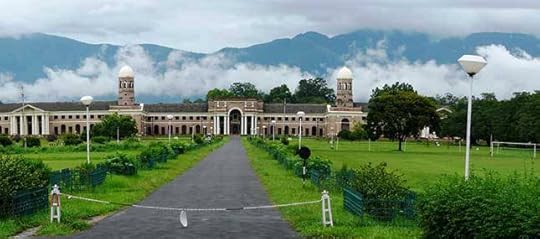
On 11 September National Forest Martyrs Day was observed at the Forest Research Institute, Dehradun, depicted above. How many are aware that there is such a day? In 1730 more than 360 people were killed in Khejarli, in present Rajasthan, while protecting the khejri trees that the then king of Jodhpur state, wanted to cut down.All of them belonged to the Bishnoi, a group that continues to protect trees and animals. In the 1970s there was the chipko movement, where people in present Uttarakhand clung to trees to stop them being cut down. And since independence, more than 1400 foresters have been killed protecting forests and wildlife. Yet few seem to understand the importance of trees, and despite tree plantation drives, existing trees are constantly being cut.
People don’t seem to realize that trees are living beings. They communicate with one another, perhaps if we have enough sensitivity they would communicate with us too. According to various studies, they sleep at night, and cry out when being cut, though at a frequency we cannot hear. They absorb pollutants, provide oxygen, and shelter birds and other creatures. What would our planet be like without trees? Perhaps we will soon find out!
Filed under: Dehradun, Trees Tagged: Bishnoi, Dehradun, Forest Research Institute, National Forest Martyrs Day, Trees





September 3, 2016
Red Scarf Girl
Many years ago I was involved in a project on post-Mao China. Reading through copies of the Beijing Review, I was captivated by the Chinese method of encapsulating long statements and concepts in a couple of words. Of course, the ‘double hundred’, was easy to understand, it was Mao’s policy stating ‘Let a hundred flowers bloom, let a hundred schools of thought contend,’ but several others were not so simple. The ‘two whatevers’ referred to following whatever policy Mao laid down, and whatever instructions he gave, which in the post-Mao period was not recommended. ‘Eating from the same pot’, meant that everyone got the same payment, regardless of the amount and quality of the work done, while ‘the iron rice bowl’ was a term for a permanent job, which could not be terminated on any grounds. Even some longer phrases were intriguing, for instance, ‘The Kremlin wants to pluck the ripe apple and put it in the basket.’ In this case, the ‘ripe apple’ was a reference to Iran.
I was reminded of all this when I read Red Scarf Girl, and the key phrases, the‘Four Olds’ and the ‘Four News’. Red Scarf Girl by Ji-Li Jiang, is actually a book for young people, describing Ji-Li’s life between the ages of twelve and fourteen, at the beginning of the Cultural Revolution, which lasted from 1966-1976. The red scarf they proudly wore was a symbol representing communism and Mao. The name ‘Ji-Li’ means ‘lucky and beautiful’, and Ji-Li was a happy young girl till she was twelve. In the prologue to the book she says, ‘I never doubted what I was told: “Heaven and earth are great, but greater still is the kindness of the Communist Party; father and mother are dear, but dearer still is Chairman Mao.”’
Ji-Li’s family lived in Shanghai. Her father was a theatre actor, who also loved reading and was knowledgeable about all sorts of things. Her mother worked in a sports store, and her grandmother had been the vice-principal of a school. The family included Ji-Li’s younger brother and sister, as well as a housekeeper, who had been their nanny and was was like a family member. There was also a pet cat, to complete the household.
Chairman Mao’s picture adorned her classroom, and was respected and revered. Ji-Li was a bright and confident girl, who excelled in school and had many friends. Her life began to change when a Liberation Army member from the Arts Academy, visited their class and chose Ji-Li as one of the students to audition for entry into this Academy. When an excited Ji-Li shared this news with her parents and grandmother, they asked her not to go for the audition, and explained that she would not be selected, because of a wrong background. Later, Ji-li learnt that her father was the son of a landlord. In the new China landlords were criticised, yet tradition mingled with the new, as the background and ancestors of a family were still considered important. Every day the people of China listened to Chairman Mao on the importance of removing the ‘Four Olds’, old ideas, old culture, old customs, and old habits, but did not seem to realise that looking at a family through its background, could also be one of the ‘four olds’, an inability to break with the past.
As the Cultural Revolution set in, the names of shops reflecting old culture had to be changed, for instance ‘Great Prosperity Market.’ ‘Prosperity’, ‘good fortune’, ‘innocent’ and even ‘peace’ were among names considered part of old culture. ‘Prosperity’, for instance, could only be achieved by exploitation, and ‘good fortune’ indicated superstition. Clothes too reflected the old, such as pointed shoes and pants with narrow legs. At first Ji-li and her siblings felt proud and excited to contribute to the new way of life and wondered why their parents and grandmother were not as enthusiastic, when initially they had been staunch supporters of Chairman Mao. Gradually Ji-li felt increasingly confused, as the ‘Four Olds’ were extended to all walks of life, and youngsters gained the right to torment others. Respecting parents, teachers and elders, long hair worn in braids, the prevailing educational system, protecting one’s own property, storing old clothes of the pre-revolutionary period, reading stories from other lands, were all among the ‘four olds’. Even pictures of people of the past wearing long gowns or mandarin jackets, were burnt. Weak students used the opportunity to criticise those who did well . Getting good marks in school was a hazard. Youngsters became Red Guards while those even younger were named Red Successors. Final exams were abolished in Ji-li’s school. She could not go to the high school of her choice. Red Guards approaching with gongs and drums ransacked houses looking for ‘four olds’. Punishments began to be meted out to older people by these young Red Guards. When Ji-li’s house was searched even her stamp album was taken away. Her father was detained, her mother and grandmother suffered.
Confused by what was going on, Ji-li even thought of changing her name and repudiating her family, something she was encouraged to do. But finally the love for her family prevailed. One thing that stands out in this book, is that there was no discrimination on the basis of religion. Ji-li and her family were Muslims, and there were very few in Shanghai, but among all the problems they faced, this was not one of them.
The Cultural Revolution had some good points, it emphasized equality, the dignity of labour and the need to forget about a ‘glorious heritage’ and move into the future. But everything was taken to illogical extremes. Behind this revolution were political struggles and Mao’s attempts to retain his power. Gradually the extreme phase of the Cultural Revolution subsided, and after Mao’s death in 1976, China began to rethink its policies. According to statistics 1.5 million people died during the Cultural Revolution. Many were killed by Red Guards, others committed suicide. Fighting among Red Guard factions, killed some more. Did this phase in China’s history have long-term effects? Was eliminating aspects of the past a contributing factor in making China an economic super power? Today China once again has huge inequalities.
Ji-li moved to the USA in 1984, where she wrote this book. Though there are several books on the Cultural Revolution, this memoir is among those that provide the details of everyday life at the time, the difficulties that so many ordinary people faced, and the insanity of those times. Other memoirs include Ji Xianlin’s, The Cowshed: Memories of the Chinese Cultural Revolution; Anchee Min’s Red Azalea, and several more.
Filed under: book review., Books, History, Literature Tagged: book review., China, Memoir of the Cultural Revolution, Red Scarf Girl





August 19, 2016
Favourite Books-1
When I was around four years old, my family and I moved to Mt Abu where we lived in a huge house called Eagle’s Nest, perched on a small hill. Apart from the other aspects of the place, I remember the books I read there, in different corners of the house, or on a rock in the garden. Among the earliest books, two were my favourites, Whose Little Bird am I?, and a book about a koala bear named Wish. The second was one I liked so much, that I requested twelve live Koala bears as a present for Christmas. I am not sure why despite living in India and not being Christians I was writing a letter to Father Christmas [no Santa Claus those days]. Was it because of the Catholic school I was going to? Or was it a family tradition, a remnant of British days?
My mother, a well-known writer used to review books for both adults and children, and many of my favourites were among those, perhaps Wish had arrived as a book for review, the year would be 1958. She also wrote about the oddities of her children, and my request for twelve koala bears formed one of her articles.
Looking up the internet I found Whose Little Bird am I. It is by Leonard Weisgard, and a second edition is still available on Amazon. But I could not find anything about Wish, the koala. I located a good site for old children’s books, www.oldchildrensbooks.com, but there was nothing there on Wish.
So if anyone who reads this knows about this book, do let me know.
These two books remained my favourites, even as I progressed to more complex reading, including Enid Blyton, James Barrie’s Peter Pan, A.A. Milne’s Pooh books and poems, Lewis Carroll’s Alice in Wonderland, Anna Sewell’s Black Beauty. I still remember the horror I felt while reading Uncle Tom’s Cabin. Apart from these classics there were many more, including Wild Animals I have Known, that had several sad stories, fairy tales from across the world, poems, stories of all kinds. In non-fiction I was fascinated by The Buildings of Ancient Egypt and the Golden Book of Astronomy.
We moved from there when I was around eight or nine. Before that I had started on adult fiction. The very first adult book I read was called Capitan China. I never forgot it as for an eight-year old or perhaps eight-and-a-half, it was fascinating and scary. Looking it up on the net I found it was by Susan Yorke, first published in 1961, it must have been one of my mother’s review books that I picked up. If I remember right, this was about a Malay peasant girl, planting rice, who looks up, finds that no one observes her, and decides to walk away. Many adventures follow, she lands up in a brothel, is sold to some king or chief, has to make a journey across the seas to him, and along the journey has an Italian guard–he teaches her about the world, answers her simple questions on life and god, and they fall in love. Was his name Cavileri? Perhaps. Anyway reaching their destination, she is given to Cavileri as a gift by the king, they are married [?], but she has this horrid job of counting heads in some war, and as Cavileri is fighting in the war,she one day gets his cut off head. Going off in grief into the jungle, she is bitten by a snake and dies. I remember this book as its powerful story haunted me for many years, and I reread it several times, though perhaps if I had read it as an adult, it would not have meant much.
On the net I find Susan Yorke was born 24 March 1915 in Mannheim, Germany, moved to Australia in 1965, and died 4 May 1997 in Sydney, New South Wales. She wrote thirteen books.
Filed under: Books Tagged: books, Capitan China,




August 9, 2016
Batya Gur: Writer and Journalist
Batya Gur [1947-2005], an Israeli and a writer in Hebrew is best remembered for the creation of complex, closed worlds in her detective fiction. Her writing reflected the social, economic and political realities of Israel. As the Israeli newspaper Haaretz said: ‘No part of Israeli reality escaped her eye: ethnic discrimination, poverty and unemployment, the life of new immigrants and all those at the margins of society.’
She taught literature for several years before writing her first novel, in which she created the sensitive and intelligent detective Michael Ohayon, whose ideas reflected her own . Born in Morocco and educated at Cambridge, Ohayon joined the Jerusalem police, but remained to some extent an outsider. Writing in Hebrew, her Ohayon books have been translated into English and other languages. The Saturday Morning Murder [1992] takes a look at the world of psychoanalysis. In Literary Murder [1993], the background is the academic setting of Hebrew University. Murder on a Kibbutz [1994], includes an interesting sociological and historical analysis of the changes and development of the institution of the Kibbutz. A Kibbutz member recollects, “ It’s difficult to transmit what the first contact with the land was like. The hardship, the dryness, the water, the hunger. Especially the hunger, and the hard work. Twelve hours at a stretch sometimes, clearing and ploughing and gradually building…” But as the years passed the Kibbutz movement and its communal way of life was questioned, and individual freedom became more important.
The next book, Murder Duet [1999] is about a murder in a musical family, and rich in detail on music and the life of musicians. Another in the Michael Ohayon series, Bethlehem Road Murder was published in 2004, and Murder in Jerusalem in 2006. Gur’s other books include I didn’t Imagine It Would Be This Way and Stone For Stone.
Her novels were also televised.
At times the troubled conditions in Israel forced her to comment on politics.
At a conference in Brussels in March 2004 to celebrate International Women’s Day she said, “The suicide bombers sadden me and are destroying my heart”. But, she added, it was the Israeli leaders who were responsible for this tragic situation.
A frequent writer for Haaretz, Gur recounted in one article how she was arrested when she asked three young policewomen why they were harassing a Palestinian, old enough to be their grandfather. She wrote, “I found myself saying that I refuse to feel like a German walking past an abused Jew in Nazi Germany and turn away indifferently or fearfully. ‘You’re calling us Nazis!’ shrieked the soldiers, and within a minute the word became a precious possession on their lips. They rejoiced in their justice and I could already imagine all the self-righteous people gloating over the use of this word.”
The history of Israel and Palestine in some ways reminds us of India and Pakistan, and causes one to reflect on problems that seem created and fanned by political decisions. Batya Gur, both in her books and her articles, looks beyond man-made conflicts, at the common humanity of all people. Regarding her support of the old Palestinian, she says, “ I know very well that such an act by a woman like me, someone who avoids any political activity or any consistent struggle for human rights, is actually a sentimental act. Such a trivial act of protest is a bit like sweeping the path to my own private garden ….”. Yet it is perhaps such trivial and seemingly irrelevant acts, that could one day bring about positive change.
Unfortunately Batya Gur died on 19 May 2005 after a nine-month battle with cancer. She was 57 years old.
Filed under: Batya Gur, Books, writer Tagged: Batya Gur, detective fiction, Israeli writer, Michael Ohayon series





July 30, 2016
Polish children in India–1942
Writing about Poland in an earlier post, I was reminded of Poland’s links with India.During the Second World War, 5000 Polish children came as refugees to India. A documentary on this, Little Poland in India,was released on 7 November 2013, and can be watched on youtube. The 52 minute documentary is based on records and on the memories of the now grown-up children.. The children were orphans, evacuated from Poland to Siberia during the war. They reached India in 1942 and lived in special camps, returning to Poland later.One such camp was set up by K S Digvijaysinhji, the maharaja of Jamnagar in Gujarat. He looked after the children as a father would. There were other camps in Gujarat and Maharashtra.
Filed under: History, India, Poland Tagged: history, India, Little Poland, Poland, Polish children in India, World War II





The siege of Sarajevo
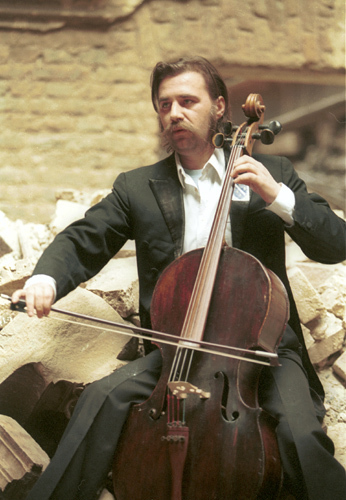
Vedran Smailovic playing in the destroyed building of the National Library in Sarajevo, 1992. Photo by Mikhail Evstafiev
——————————————————————
Radovan Karadzic was in the news a few months ago, appearing on TV screens as an old and tired man. I would not have paid much attention to him, if I hadn’t recently read a novel based on the siege of Sarajevo in Bosnia and Herzegovina. Radovan, b.1945, a Bosnian Serb, was the president of the Republic of Srpska from1992-96 during the Bosnian war. He wanted to unify Srpska with Serbia.Sarajevo was part of the struggle.
Sarajevo, located in a valley through which the Miljacka river flows, has a chequered history. It became a city under the Ottomans in the 15th century, though it has ancient settlements, the neolithic Butmir culture, with flint tools and pottery. This was followed by the Illyrian culture, and later there was Roman occupation. In the Middle Ages it was part of the province of Vrhbosna in the Bosnian kingdom. In 1875 Austria-Hungary took over the region, though technically it remained under the Ottomans. In 1885 it was so advanced, that it had an electric tram network, only the second city in the world to have one, after San Francisco. In 1914 the archduke of Austria was assassinated here, and the First World War started. After this, it became part of Yugoslavia. In World War II it was captured by Germany and formed part of Utashe’s independent state of Croatia. After the war, it was again part of Yugoslavia, as the capital of the Socialist Republic of Bosnia and Herzegovina. Bosnia and Herzegovina declared independence from Yugoslavia, on 3 March 1992, but the Serbs did not accept this. The Bosnian Serbs wanted a new state, Republika Sprska, that would include some Bosnian areas. At first the Yugoslav army besieged Sarajevo, and then Sprska forces from 5 April 1992 to 29 February 1996. A siege force of about 13,000 encircled the city on the hills, and attacked with artillery, tanks and guns. Though there were 70,000 Bosnian troops in the city, they were poorly equipped. Snipers on the hills shot people on the streets.
The siege of Sarajevo was possibly the longest siege of modern times. Sarajevo at that time was a city of about 500,000 people, but several were killed and 70,000 Sarajevan Serbs left and went to Republika Sprska. According to UN estimates, almost 11,541 people were killed, and 56,000 wounded. Fifteen hundred children were among those dead and 15,000 among the injured. Hundreds of shells hit the city every day and in one case, 22 July 1993, there were 3777. Finding ways to survive, ‘Sarajevo Roses’ was a poetic name given to craters created by shells.Ten thousand apartments were destroyed, and thousands more damaged.
There are more than 20 books, films, plays, and songs on the siege, as well as two video games. How accurate are these? And is accuracy important in fiction?
The Cellist of Sarajevo by Stephen Galloway dramatizes a real incident that took place. According to the book, on the afternoon of 27 May 1992, mortar shells hit a group of people waiting to buy bread behind the market on Vase Miskina. Twenty-two people were killed and more than 70 injured. To honour the dead, a well-known cellist of the city, came to the exact spot at the same time for 22 days, and played on his cello. Every day he played the same piece, Albinoni’s Adagio in G minor. There were snipers on the hills, and the cellist could have been killed at any time, but he played on. The book is quite gripping, revealing the life of ordinary people living under a terrible siege. Water, power, health care, and life itself were all problematic.
The real cellist, Vedran Smailovic did not appreciate the book. He said he did not play for 22 days, but every day for two years, at different times and in different places. He was not so crazy that he would go to the same place every day. He was also annoyed that the writer never met him or asked him his version of events.
In real life, Smailovic, playing his cello in the midst of ruined buildings, became a symbol for the whole world. Impressed, Joan Baez joined him one day. But the man himself did not want publicity. He left Sarajevo in December 1993 and moved to northern Ireland. He lives in Warrenpoint in an attic flat overlooking Carlingford Lough, where he composes music and plays chess.
Vedran was the focus of another book too, this time for children. But in this case, the author, Elizabeth Wellburn, actually worked with Vedran, and consulted him, producing a more authentic account, Echoes from the Square. This fictionalized story of Vedran, has an added character of a young boy, and was published in 1998. The boy’s life is almost destroyed by the war, but hearing Vedran playing every day gives him courage. This picture book illustrated by Deryk Houston, is available as an audio book on youtube.
History records massacres at Sarajevo worse than that described in the book. In the Markale marketplace massacre on 5 February 1994, 68 civilians were killed and 200 wounded; there was a second Markale massacre on 28 August, with 37 killed, 90 wounded. Others provided records of the siege. There was no light, no gas, no water, no schools, phones, transport or industry. ‘We learned to live by candlelight again,’said Resad Tribonj.
A memorial of 521 children killed was erected on 10 May 2009. The case of 500 more children was being investigated.
Radovan Karadzic and Ratko Mladic were charged with war crimes in 1996.
And to get back to the question of whether accuracy is important in historical fiction. Steven Galloway’s account of the cellist was not accurate. Even so, it led me to read more about him, and about that terrible siege, and about Sarajevo itself. But would a more accurate portrayal have detracted from the book? I don’t think so–in fact it would have improved it. To know what the cellist thought, how he chose the different places in which to play every day–it would actually have taken the book to a higher level.
Filed under: Books, History, Music Tagged: Elizabeth Wellburn, historical fiction, history of Sarajevo, siege of Sarajevo, Steven Galloway, Vedran Smailovic





July 21, 2016
Berthe Morisot
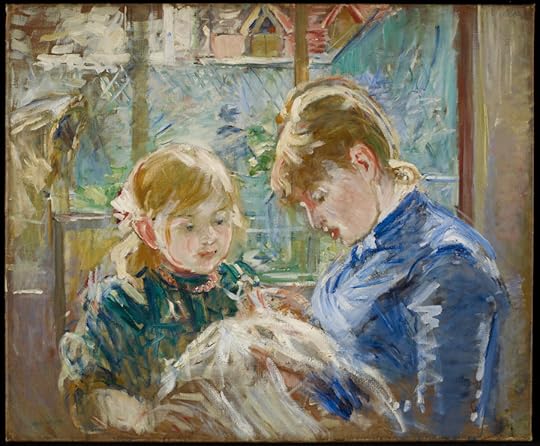 Berthe Morisot, French, 1841 – 1895; The Artist’s Daughter, Julie, with her Nanny; c. 1884; Oil on canvas; 22 1/2 x 28 in. (57.15 x 71.12 cm) (sight); Minneapolis Institute of Art; The John R. Van Derlip Fund 96.40
[By Berthe Morisot – https://collections.artsmia.org/index.php?page=detail&id=10444, Public Domain, https://commons.wikimedia.org/w/index.php?curid=44191722%5D
One of the paintings of Berthe Morisot, a French impressionist. I was inspired to read more about her after seeing a programme on TV [in French, with subtitles].
The documentary focused on her relationship with the painter Edouard Manet–she later married his brother. Living in Paris, she seemed an independent woman, unmarried at the age of 33, exhibiting her paintings, and making a name for herself. She was associated with Monet and other impressionists–the attitude towards their new style was not favourable at the time.
And the historical background includes the Prussian invasion of Paris.
Adding a brief extract from wikipedia, below:
“Berthe Marie Pauline Morisot (French: [mɔʁizo]; January 14, 1841 – March 2, 1895) was a painter and a member of the circle of painters in Paris who became known as the Impressionists. She was described by Gustave Geffroy in 1894 as one of “les trois grandes dames” of Impressionism alongside Marie Bracquemond and Mary Cassatt.
In 1864, she exhibited for the first time in the highly esteemed Salon de Paris. Sponsored by the government, and judged by Academicians, the Salon was the official, annual exhibition of the Académie des beaux-arts in Paris. Her work was selected for exhibition in six subsequent Salons[2] until, in 1874, she joined the “rejected” Impressionists in the first of their own exhibitions, which included Paul Cézanne, Edgar Degas, Claude Monet, Camille Pissarro, Pierre-Auguste Renoir, and Alfred Sisley. It was held at the studio of the photographer Nadar.
She was married to Eugène Manet, the brother of her friend and colleague Édouard Manet.”
Filed under: Art, Berthe Morisot, Impressionism Tagged: art history, Berthe Morisot, French impressionist





July 9, 2016
Chopin and Poland
Yesterday, on Japan TV, [NHK news channel] I came across a one hour class on Chopin’s mazurkas, recorded at the Royal Academy of Music. The teacher, an attractive young woman, whose name I did not get, was playing extracts from the mazurkas on a Steinway grand piano. She was an expert pianist, and held the students spellbound with her playing and her commentary and explanations.
And as I had just been thinking about the division of countries, my thoughts turned not just to Chopin and his music, but to the history of Poland, that country so often partitioned. Chopin was born on 4 March 1810, in Żelazowa Wola, near Warsaw. His father was a French immigrant and his mother, Polish. What was the situation in Warsaw at the time?
By 1795 Poland had ceased to exist after three partitions led to its occupation by Prussia, Russia, and Austria. Napoleon, though, brought hope to Poland, promising to revive the nation. After his defeat, by the Congress of Vienna in 1815, a new small kindom of Poland was created, out of part of the duchy of Warsaw, with the Russian emperor as the king. Krakow became a city republic, but the rest of Poland was again divided between Russia, Austria and Prussia.
Poland began a movement for independence, but after a brief success, was taken over again by Russia. Independence came again only after World War I.
Chopin moved to Vienna in 1829, and to Paris in 1831, but his heart was with Poland, and his compositions were influenced by the music of Poland. With the revolutions in Europe in 1848, he went to Scotland and England, but returned to Paris, where he died on 17 October 1849, of tuberculosis. In this short life he composed 55 mazurkas, 27 études, 24 preludes, 19 nocturnes, 13 polonaises, 3 piano sonatas and some concertos.
Another later great Polish pianist, Ignace Paderewski, was valued so highly, that he even became the prime minister for a short time in the newly independent Poland!
Filed under: Chopin, History, Music, Poland Tagged: Chopin, history, Music, Partition, Poland





July 8, 2016
Brexit and country divisions
Brexit has been in the news lately and gave rise to some thoughts. All EU states have a right to withdraw from the European Union, and Article 50 lays down the procedure.Two years is provided for the withdrawal and the UK can control the starting date for this. It seems a fair procedure, much better than the way in which individual countries were divided in the past.
So many countries have been divided over the centuries. I am not sure how the details were worked out in each case, though it would be interesting to study them. What happened in Israel and Palestine in 1948? How was the break up of Yugoslavia handled? We know how Sir Cyril Radcliffe and his assistants sat in an office and divided the Punjab on a map. No time was given to the countries to work out the details. W. H. Auden even wrote a poem on this.
‘Unbiased at least he was when he arrived on his mission,
Having never set eyes on this land he was called to partition
Between two peoples fanatically at odds,
With their different diets and incompatible gods.
‘Time,’ they had briefed him in London, ‘is short. It’s too late
For mutual reconciliation or rational debate:
The only solution now lies in separation.
The Viceroy thinks, as you will see from his letter,
That the less you are seen in his company the better,
So we’ve arranged to provide you with other accommodation.
We can give you four judges, two Moslem and two Hindu,
To consult with, but the final decision must rest with you.’
Shut up in a lonely mansion, with police night and day
Patrolling the gardens to keep assassins away,
He got down to work, to the task of settling the fate
Of millions. The maps at his disposal were out of date
And the Census Returns almost certainly incorrect,
But there was no time to check them, no time to inspect
Contested areas. The weather was frightfully hot,
And a bout of dysentery kept him constantly on the trot,
But in seven weeks it was done, the frontiers decided,
A continent for better or worse divided.
The next day he sailed for England, where he quickly forgot
The case, as a good lawyer must. Return he would not,
Afraid, as he told his Club, that he might get shot.’
We generally read about wars, riots and migration, but very little about the details of dividing assets.Below are some aspects of the administrative division of India and Pakistan, based on my book, The Puffin History of India, vol 2.
When the Partition of India and Pakistan took place in 1947, the entire administrative machinery and all assets had to be divided. A Partition Council with representatives from both sides were responsible for this. In general, it was agreed that 80 per cent of the assets would go to India and 20 per cent to Pakistan.There was gold in the Reserve Bank and cash in other banks.There was also a national debt. Pakistan was to get 17 per cent of cash and sterling assets, amounting to 75 crore rupees, out of which 20 crore was paid before independence. Pakistan would take on 17 per cent of the national debt and pay this over 50 years. Money notes too were divided, but the notes had the name of India on them and Pakistan stamped all the notes with a rubber stamp, with their new country’s name. Pakistan also had to print new postage stamps.
In all the government offices in the country, tables, chairs, paper,pens, pencils, were counted and divided. Then there were typewriters, hat-pegs, mirrors, sofas, ink-stands, clocks, fans, water jugs, pin cushions, official portraits and photographs, and even chamber pots.A lot of arguing and quarrelling went on, about whom should get what. There were cars and bicycles, lathis and guns, and official uniforms and clothes. Musical instruments from the official
bands were divided, and books from the libraries. When books were divided, there was no attempt to keep volumes of encyclopaedias or similar book series together–some went to Pakistan, some to India.
Out of approximately 65,000 km of railways 11,379 would go to Pakistan, and out of 5,50,000 km
of roads, about 1,50,000 would fall in Pakistan. Since Pakistan was getting 27 per cent of roads and 17 per cent railway tracks, should it still get 20 per cent of railway wagons, engines, bulldozers and other equipment? These were some of the major questions raised. There was the long gold and white train, which the viceroy used to travel in. There were luxury cars and there were twelve horsedrawn carriages, six decorated with gold and six with silver, used in the viceroy’s house.The royal train stayed with India, while some cars went to Pakistan. As for the coaches, their fate was decided by a toss of the coin—the gold ones stayed in India and the silver went to Pakistan.
Stocks of wheat, rice, and food grains were divided. Boundary lines sometimes divided fields of crops. In Bengal, the division left jute mills in one country and jute crops in the other.
It was not just money and material goods that had to be divided, but also the government officials, police and army. From Pakistan, most of the Hindu and Sikh officials moved to India, while in India, Muslim officials had a choice about whether to stay back or to go. As for the police, there were some 7000 Muslims in East Punjab, and in the process of their transfer, the region was left without law and order.
For the armed forces, a reconstitution committee was set up, under the Partition Council. Before partition, the army had 5,00,000 men. After partition,2,80,000 were left in India.The Navy and the Air Force, as well as stores and equipment, vehicles and guns, were also divided.
Filed under: History, India Tagged: Brexit, history, India, Pakistan, Partition





June 22, 2016
Uttarakhand News–1
 I’ve often thought of writing a weekly news item on Uttarakhand, the state in which I live. I was born here, in Mussoorie, and though I never spent many years here, visits were constant. Can’t forget those up and down Delhi-Dehradun trips, by bus, by train, and after Sweetie began living with me, by taxi, and all the hazards and delays on those trips. I used to love the forests, trees and birds of Dehradun, and they are still here, though diminishing every day. Newcomers, if they think about the road names might wonder at the names, Canal Road, Eastern Canal Road, Eucalyptus Road. Once canals crossed Dehradun and were used for many purposes, now they are covered up and perhaps dry. Eucalyptus Road was lined with huge Eucalyptus trees, now none remain. Changing the names of localities, a constant pastime of most city officials, has happened in Uttarakhand, though not to the same extent as elsewhere. Thus we still have Jolly Grant Airport, because the land was once owned by Jolly Grant, Herbertpur, after someone named Herbert, Astley Hall and Nashville Road; Survey Road and Old Survey Road, as Dehradun was the headquarters of the Survey of India, right from British days. Some locality names, I don’t know the origin of, such as Selaqui or Sinola.
Uttarakhand hardly figures in the national news unless there are disasters. The 2013 flood was prominent in the news, and more recently the death of the horse Shaktiman, and the government destabilisation. Then after the opening of the Char Dham in May, the four sacred temples, and Hemkund Sahib, the Sikh shrine, the news is about the pilgrims.
Now the monsoon has arrived with steady rain. In 2013 Dehradun got even more rain than Mawsynram, the place with the highest rainfall in India.
In the local news today it says that 83 villages in the Kumaon region may be washed away by rising rivers with the current rains. It also says there are 3 lakh [300,000] empty houses in the hills, with migration taking place because of poor facilities. And it has been noticed that there are 12,000 dry springs. The president tried to visit the shrine at Kedarnath, but returned because of the weather.
Filed under: Dehradun, Uttarakhand Tagged: #everyday inspiration, Dehradun, news, Uttarakhand