
Darcy Pattison's Blog, page 8
June 8, 2016
Reader Confusion: Your Story Needs Clarity
September 9-11!
Get more information!
Reader confusion is a common problem with first drafts. Prose is ambiguous, and scene details leave conflicting ideas of the time line or the physical location of the characters.
Reader Confusion: Clarify Your Prose
The problem of ambiguous prose lies in the writing itself. Let’s look at some common problems and how to solve them.
Fuzzy thinking. OK, you were knocking off a draft of a chapter at midnight and, well, you got fuzzy in your thinking. It happens. But you can’t leave prose that is garbled. As you read through your draft, mark places where your sentence structure got complex in an effort to explain something. To revise, first get the thought straight in your own head. Then, write it in simple sentences because it will force you to clarify your thoughts. Then, if appropriate for your audience, combine those sentences into a prose that flows better.
Technical explanations. When I have technical explanations — in my WIP, I have to explain a complicated process to defeat a black hole — I often find a new or naive reader. I want to know where they got confused or what they still had questions about. Then I’ll rewrite and repeat until the naive reader understands. Try to make even technical explanations simple enough for a child to understand.
Pronoun Antecedent. A good command of language means that sometimes you use pronouns to avoid repeating a noun over and over. But too often, it’s not clear who/what the pronoun is referring to. The rule is that a pronoun refers back to the noun closest to it.
When Jack and Bob decided to eat out, he decided they should go to a Mexican restaurant.
Who decided? Jack or Bob? The noun immediately before “he” is Bob. When there are multiple people involved, it’s usually best to repeat the person’s name.
When Jack and Bob decided to eat out, Bob decided they should go to a Mexican restaurant.
This one is a pet peeve of mine, and I’m always aggravated when the pronoun’s antecedent is confusing. If repeated often, it can make me close the book and move on to something else.
Word Choices. When I was teaching Freshman Composition, I laughed at the confusion created in an essay by the use of the wrong homophone word. Homophones are words that sound alike, but are spelled differently. They are confusing to poor spellers! And spell-check won’t catch these errors because the alternate spelling is a correct word. Here’s the poor freshman’s sentence; he’s talking about cheerleaders at a basketball game.
With her enthusiasm and loud cheering, she was the hart of the team.
Of course, he meant “heart.” But I still have visions of a deer with big antlers cheering for a slam dunk.
If you’re one of those poor spellers, you MUST have someone else read through your story before sending it out. Spell-check alone isn’t enough for you.
Other word choices can be confusing, too. One that I see frequently is “S/he yelled, “xxx xxx xxx!”
It’s confusing because I didn’t see any reason for that character to be yelling. The author obviously wants to signal that the character speaking is upset. But merely “yelling” doesn’t do that. Instead, I’m confused about why this character is acting so weird. Be careful that your choices accurately reflect the emotional state of your character. You can’t have any unearned emotional moments. If there is truly a reason to yell, take the time to explain the reasons.
Reader Confusion: Clarify the Scene Details
Another confusing story element is the setting, which includes both time and physical location.
Where? Stories are grounded in a particular place. When a story presents a talking head, it fails to take advantage of the full range of storytelling techniques. The place or setting of a story should be revealed in enough detail to make it come alive, without intruding on the story line or pacing. Most people err on the side of too little detail, whether worrying about dragging down the story with “unnecessary description” or a failure to imagine the scene in enough detail. That’s akin to a bare stage and a solo performer. That works. But not in a novel.
Time. The story’s descriptions should locate the story in a particular historical period or a specific year, a season of the year or a specific day/month, a rough time of day or a specific minute/hour. A friend once wrote a story that was set in December in the U.S., but lacked any Christmas decorations. It didn’t take much, but the bits added were essential to ground the story as a December story.
Map of Scene. It may also be necessary for you to draw a map of where a scene takes place, whether that’s a single room or a neighborhood or a city. It’s helpful to put a finger on the map and tell the story as you move your finger from place to place. Let’s say you wanted to write a fight scene in a living room. You start by describing the child’s rocking horse in the middle of the rug. But when the two men start to fight, they never trip over that rocking horse. The exact details should be clear in your mind as you describe characters moving across the scenery. If they aren’t, go back and get your map straight.
When? Here are some friendly time words:
at the present time
from time to time
sooner or later
at the same time
up to the present time
to begin with
in due time
as soon as
as long as
in the meantime
in a moment
without delay
in the first place
all of a sudden
at this instant
first, second
immediately
quickly
finally
after
later
last
until
till
since
then
before
hence
since
when
once
about
next
now
formerly
suddenly
shortly
henceforth
whenever
eventually
meanwhile
further
during
in time
prior to
forthwith
straightaway
by the time
whenever
until now
now that
instantly
presently
occasionally
You’ve likely heard the advice not to use adverbs. Here’s a big exception. Time words help ground the scene and create the narrative sequencing of details. Don’t leave your reader confused about the “When” of the story.
As you work through your draft, clear up all confusions possible, especially prose and scene details. Otherwise, your reader may not stay with you!
NOVEL REVISION RETREAT
September 9-11!
Get more information!
The post Reader Confusion: Your Story Needs Clarity appeared first on Fiction Notes.


June 6, 2016
Complex Character Reactions
at Highlights Foundation
Picture Books and All That Jazz - How to Write a Picture Book
Master Class in Novel Writing
Character reactions to an event, comment or action are often complex. For instance, what if Jill slaps Jack.
So what? The physical action alone isn’t enough to determine meaning in the story. Instead, the writer must give the reader some kind of clues as to what is really happening and what Jack and Jill think about it.
Character Reactions in 3 Easy Steps
Basically, there are three things you can use: a physical action, an internal emotion or thought, and dialogue.
You’ll see this recommended in a couple of conflicting ways. Some say the sequence should be Physical action – Emotion/thought – dialogue. Others say the inner reaction should come first, as in Emotion/thought – physical action – dialogue. Either works for me. Let’s try it.
Physical action: Jill stared at her stinging hand.
Emotion/thought: She’d been wanting to do that for days now, but had been too scared. She should be scared now!
Dialogue: “I’m sorry,” her voice quavered.
Or, switch it up.
Emotion/thought: Jack deserved that! But he wouldn’t leave it there. Fear suddenly gripped her.
Physical action: Jill turned and ran.
Dialogue: “You’ll never catch me.”
The point is that the reader needs more than a simple action. We too often get this wrong when we talk about the rule to Show, Don’t Tell. There was a time when I interpreted the rule so strictly that I was left with actions that floated ambiguously within the story and didn’t add up to anything.
The Complex-Reaction formula of action-thought-dialogue will help pull you back to a specific place and time.

The post Complex Character Reactions appeared first on Fiction Notes.
June 3, 2016
Book Notes: American Girls
at Highlights Foundation
Picture Books and All That Jazz - How to Write a Picture Book
Master Class in Novel Writing
This is a new feature where I highlight a book for some reason. It’s just my opinion of a book I’ve been reading.
American Girls: Social Media and the Secret Life of Girls is the tale of contemporary girls and their love/hate relationship with social media. Author Nancy Jo Sales is a journalist who took a couple years to talk with girls, ages 13-19, about their use of social media.
The chapter on 13-year-old girls begins like this:
“Montclair, New Jersey
“SEND NOODZ”
The boy sent the message in the middle of the day, when she was walking home from school. He sent it via direct message on Instagram, in the same shaky, childlike font as the new Drake album (“IF YOU’RE READING THIS ITS TOO LATE”)Sophia stared at her phone.
“Wait What???” she responded.
No answer.”
It’s an example of what’s happening to girls as young as 13. Boys ask them via social media channels for nude photos. Sophia eventually asked the boy why he wanted the photo. She was starting to feel warm and mushy inside because maybe the boy really liked her and she just hadn’t known it. Surely, that was why he wanted her photo.
Turns out, the boy just wanted her photo to win a bet. And, if he passed it along to an older guy that he thought was a senior, he could get some “lq.” Liquor. Booze.
There was no love interest here, just playing around with social media to get what he needed. A photo to trade for some lq.
YA Writers, Listen Up! You MUST Read This Book
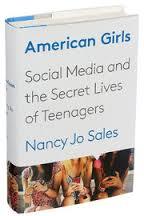 you’re writing YA books, you really need to read this book. It tells the story of multiple girls from ages 13-19 and how the social media climate has affected their lives.
It’s a tale of double-standards: if a girl gives up a nude photo, she’s a slut, but the transaction says nothing about the boys.
It’s a tale of bullying and cyber-bullying: the use of social media, especially photos, has ruined many a teenage life. Read the range of problems this causes.
It’s a tale of fake-personas: girls are increasingly pressured to put up sexy selfies, even when they see themselves as something different.
Every decade or so, we need a book like this where a journalist goes out into the street to talk with kids today. How will these detailed stories affect your next novel?
The post Book Notes: American Girls appeared first on Fiction Notes.
May 27, 2016
GoodReads Giveaway: Liberty
at Highlights Foundation
Picture Books and All That Jazz - How to Write a Picture Book
Master Class in Novel Writing
A Rousing Tale of Danger on the High Seas
Why Did You Write This Story?
Soon after 9/11, I was sitting at the table with my son, his friend, and my daughter. We talked about the 9/11 tragedy and then hoped for better times.
I asked, “What should I write about next?”
My son said, “Pigs at sea.”
That was the working title for this story for a long time. It’s a story of leaving home and finding your way in the world. What is that like to leave behind everything you know and go strange and wonderful new places?
Penelope and Santiago find their way to the Wider World, a place where an intelligent human or animal can get ahead in this world. The pigs do find their way to the sea and discover a rich and interesting life. Throwing in the sea serpents and the Ice King, well, that just made it more fun. As we move along in life, we will inevitably find friends and enemies.
Interestingly, when I read this to a sixth grade classroom, I asked them, “What do you think will happen at the end?”
Almost everyone said, “They’ll go home.”
Even in sixth grade, it’s hard to face the Wider World with an attitude of adventure and confidence. I think kids absorb such things from stories like this.
The story is now available for preorders.
Enter the GoodReads Giveaway
.goodreadsGiveawayWidget { color: #555; font-family: georgia, serif; font-weight: normal; text-align: left; font-size: 14px;
font-style: normal; background: white; }
.goodreadsGiveawayWidget p { margin: 0 0 .5em !important; padding: 0; }
.goodreadsGiveawayWidgetEnterLink {
display: inline-block;
color: #181818;
background-color: #F6F6EE;
border: 1px solid #9D8A78;
border-radius: 3px;
font-family: "Helvetica Neue", Helvetica, Arial, sans-serif;
font-weight: bold;
text-decoration: none;
outline: none;
font-size: 13px;
padding: 8px 12px;
}
.goodreadsGiveawayWidgetEnterLink:hover {
color: #181818;
background-color: #F7F2ED;
border: 1px solid #AFAFAF;
text-decoration: none;
}
Goodreads Book Giveaway
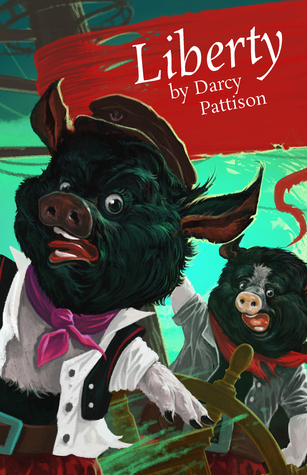
Liberty
by Darcy Pattison
Giveaway ends July 19, 2016.
See the giveaway details
at Goodreads.
Liberty – A ROUSING TALE OF DANGER ON THE HIGH SEAS —
When Santiago is thrust into the farm’s pigsty, Penelope is captivated by Santiago Talbert’s boast, “I plan to sail the Seven Seas.” Together, these extraordinary pigs escape the farm and cross into the land of Liberty, a parallel world where an intelligent human or animal can get ahead. They follow their dream to Boston Harbor, where they try to convince sea captains that pigs can sail. First, though, Santiago learns mapmaking, while Penelope works on the docks loading ships. Eventually Penelope signs onto the Ice King’s crew as he cuts and packs ice to ship to the far-flung corners of the world.
When the fleet of ice ships sails, Penelope and Santiago join the crew of the flagship, captained by Captain Kingsley, the Ice King himself. A massive polar bear, he harbors dark secrets, and the pigs face the shocking truth: they alone can save the friendly sea serpents from the Ice King’s clutches.
From the fascinating world of tall ships comes this unlikely tale of humble pigs who follow their dream. Come and join the Talberts on their journey.
The post GoodReads Giveaway: Liberty appeared first on Fiction Notes.
May 25, 2016
GoodReads Giveaways: Rowdy
at Highlights Foundation
Picture Books and All That Jazz - How to Write a Picture Book
Master Class in Novel Writing
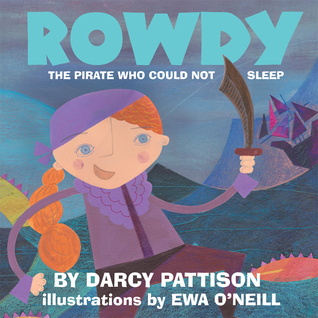
ROWDY: The Pirate Who Could Not Sleep comes out on June 1. One week away!
To celebrate, we’ve set up a Goodreads Giveaway that will end – appropriately – on Father’s Day. The giveaway ends on Father’s Day.
Rowdy: Father-Daughter Bedtime Story
A rowdy heart doesn’t know what it wants or needs! When a rowdy pirate captain returns to port, she can’t settle down and sleep. She sends her crew in search of a lullaby. This is a great gift for fathers to read to their daughters. Here’s a video showing a father reading to his daughter.
ENTER THE GIVEAWAY
.goodreadsGiveawayWidget { color: #555; font-family: georgia, serif; font-weight: normal; text-align: left; font-size: 14px;
font-style: normal; background: white; }
.goodreadsGiveawayWidget p { margin: 0 0 .5em !important; padding: 0; }
.goodreadsGiveawayWidgetEnterLink {
display: inline-block;
color: #181818;
background-color: #F6F6EE;
border: 1px solid #9D8A78;
border-radius: 3px;
font-family: "Helvetica Neue", Helvetica, Arial, sans-serif;
font-weight: bold;
text-decoration: none;
outline: none;
font-size: 13px;
padding: 8px 12px;
}
.goodreadsGiveawayWidgetEnterLink:hover {
color: #181818;
background-color: #F7F2ED;
border: 1px solid #AFAFAF;
text-decoration: none;
}
Goodreads Book Giveaway
Rowdy
by Darcy Pattison
Giveaway ends June 19, 2016.
See the giveaway details
at Goodreads.
Watch Fathers Reading this book to their Daughters!
Four brave fathers agreed to read this bedtime story to their daughters and tape the process. WARNING: You’ll find some sweet father-daughter moments in these videos!
If you can’t see the video, click here.
The post GoodReads Giveaways: Rowdy appeared first on Fiction Notes.
May 23, 2016
Shrunken Manuscript: Watch this webinar
at Highlights Foundation
Picture Books and All That Jazz - How to Write a Picture Book
Master Class in Novel Writing
One of the hardest things to find is a great critique of the overall structure of a novel. You’ll get great feedback on a scene or line edits of paragraphs. But the overall structure of a novel is hard. Enter, the Shrunken Manuscript.
I’ve taught the Novel Revison Retreat since 1999 and a mainstay has been the Shrunken Manuscript, a technique that makes a novel structure visible by shrinking the manuscript to a size that fits into your field of vision.
Because I’m teaching a master novel class at Highlights Foundation this summer, they asked me to do a webinar and they recorded it. Watch this webinar for a full explanation of how to shrink a manuscript, how an ideal manuscript would look when shrunk, common mistakes, and an example of lessons from my work-in-progress using the Shrunken Manuscript.
If you can’t see this video, click here.
Have fun looking at your Tiny Story!
The post Shrunken Manuscript: Watch this webinar appeared first on Fiction Notes.
May 16, 2016
Fallow: When a Novel needs to Rest a While
at Highlights Foundation
Picture Books and All That Jazz - How to Write a Picture Book
Master Class in Novel Writing
I’m in a fallow period. I have finished a draft of a novel, Book 2 of the sff trilogy I’m writing. While life has taken me off in crazy directions, it’s okay. Sometimes, stories need to rest a while. You need time to forget what you wrote so you can come back with fresh eyes.
One problem with just-finished novel manuscripts is that it has become a coherent story; unfortunately, it’s not the story you meant to write. It’s likely close to what you envisioned, but it’s never a perfect version of the story. There are two manuscripts: the one in your head and the one on paper. If you try to polish and revise immediately, it’s too easy to say to yourself that you DID include such and so. It’s in your head, surely it must be on paper. Alas. It’s not so.
Allowing a manuscript to rest means that when you come back, your memory has less of an opportunity to trip you up. You must see the story you put on paper! You must take it as the starting point for any revisions. Here are some things you may discover.
Not on the page. You may discover that there are things in your head that still haven’t been written. You meant to write it later. Sometimes, you unconsciously put in a “place holder,” or a scene that is just bare-boned and full of cliches. The story may be complete, but the actual writing has been done quickly, and without enough thought.
Jumbled. When I write action scenes, I have to be very careful about the time line. What action came first and what came second? In the melee of writing, I’m throwing punches right and left. I have to be very methodical about sequencing a string of actions.
Repetition. I also tend to repeat things. Perhaps it’s a bit of philosophy or advice to the main character. Or, I repeat one word endlessly. This is line-editing stuff, and I’ve found that I can’t SEE the words unless I’m taken a break from the story.
There are times, though, when you must read and revise immediately. Then you need to turn to tricks to help you see what you wrote.
Reading from the last page. One proofreading strategy is to start from the last page and go forward from there. It’s like artists who turn a picture upside down to draw it. Right-side up, the drawing says, “I’m a dog.” But upside down, the drawing says, “I’m a straight line that extends this far, followed by a squiggly line that crosses that other line and . . .” In other words, removing the context allows artists to see the drawing as a series of marks on the page.
Likewise, editing from the last page forward removes the context of the story and allows an author to see the words and sentences.
You may also want to revise using handy tools provided by the computer. On your word processor, you can change the font, the size of text, the spacing and so on. As in the shrunken manuscript, I’ve found that these manipulations change the context and allow me to see what’s on the page.
I’ve tried an online word counter, TextFixer, with some luck. It tells me how many times I’ve repeated a certain word. I tried this blog post up to this point, about 500 words and found these words were repeated lot.
Primary Keywords Frequency
story 7
page 6
strong 6
see 6
one 5
line 5
head 3
write 3
things 3
revise 3
need 3
paper 3
manuscript 3
words 3
context 3
last 3
drawing 3
writing 3
What do you think? Should I try to find alternatives for story, page, strong and see? Even if I’m including keywords a lot for Search Engine Optimization standards, those four are repeated a lot. (I didn’t change them, so you can see where they are and decide if you’d change some or not.)
To try out the TextFixer, I’ve embedded a form here (You must be on the website, this won’t work from an email.)
Free tool from TextFixer.com: Online Word Counter
In agriculture, fields are left fallow so they can rest and rebuild the necessary minerals and such needed by plants to grow well. In our case, a manuscript goes fallow so that whey we come back to it, we can do a better job of revision.
The post Fallow: When a Novel needs to Rest a While appeared first on Fiction Notes.
May 11, 2016
Novel Metamorphosis: Now an eBook!
at Highlights Foundation
Picture Books and All That Jazz - How to Write a Picture Book
Master Class in Novel Writing
In 1999, I started teaching the Novel Revision Retreat. In order to come to the retreat, you must have a completed draft of a novel. We spend the weekend talking about how to revise your novel. Many break-through or debut novels have resulted. The workbook that accompanies the retreat is Novel Metamorphosis: UnCommon Ways to Revise. Since it was published in 2008, it’s only been a paperback book – till now.
This is an excerpt from Novel Metamorphosis: UnCommon Ways to Revise, the “Appendix A: I Don’t Want an Honest Critique.” It’s one of the most popular essays I’ve written because it’s an deeply personal and emotional response to the whole process of letting others read your novel. Writing is personal because it reveals who you are. And when that is critiqued – it is disheartening!

PAPERBACK
DIGITAL
KINDLE

iBOOK

KOBO
I Don’t Want an Honest Critique
Fear
No, don’t tell me what’s wrong with this novel. I don’t want to hear it. Minor problems? OK, I’ll fix those. But major structural, plot or character problems? Don’t tell me.
Cynthia Ozick says, “Writing is essentially an act of courage.” When I get an honest critique, my courage fails me.
I fear the revision needed: I won’t ever be able to “get it right.” Obviously, I thought that I had communicated my intentions well in the first draft, or I would have changed it before you read it. But you say that you don’t understand, or that I’m inconsistent, or that I’m unfocused. How could that be? I see it so clearly. And if my vision of my story is so skewed, then how will I ever get it right?
I fear that you’re right and I’m wrong. But how can I be sure? This is my story and it comes from my psychological leanings, my background, my research. How can you tell me what is right for my story? If the story doesn’t communicate what I want, then, yes, I need to revise. I repeat: Obviously, I thought it did communicate what I wanted, or I would have revised it before you saw it. Do you just have a different vision of the story because of your psychological leanings, your background? Are you trying to envision what I intended, or are you envisioning what you would have written? Where does your ego slam up against my ego? And where does your objective appraisal need to push my ego back into line with what it really wants to do anyway? Perspective is hard to achieve.
I fear that all my hard work, all the months spent thinking and rewriting, will be wasted.
As a novelist, time haunts me. To write a novel isn’t the work of a week or a month. It takes many months, a year, a year and a half. More. It’s a long, long process. Your revision notes mean that the time is extended, and that without any guarantee of being finished even then. Meanwhile, that means that I’m a year older, that it’s a year in which I couldn’t write anything new (even if I could find the courage to begin again).
I fear your honesty; I need your approval (or someone’s approval; if not yours, then whose?). Will it crush me emotionally if you don’t “like” my story? I gloss over the approval part of critiques and agonize over the “needs work” assessment. Is there a way for you to only show approval, yet open my eyes, so that I recognize what needs work? I’d rather recognize it for myself than have it pointed out.
I fear that my standards are too lax. I want to be finished, I want to have this story out there. I want to have written, but in the throes of writing, I want the end of the process long before the story is really finished. Submission comes too early and then I get rejections. Then, it’s harder than ever to revise. But waiting is excruciating. Typical advice: Put the manuscript in a drawer for three months and then pull it out and read it with a fresh eye. What? Waste three more months? Never. It’s done and ready to send out. (Ok, maybe it isn’t, but I can’t stand looking at it one more time and in three months, my editor could read it and buy it. OK, maybe they won’t buy it until I revise, but three months? Isn’t there any other way?)
Critiques, especially honest and on-target critiques, are fearful things. I know that I need them; but they are painful, emotionally draining, and confidence shaking.
But I need them. OK, can you give me a minute? Let me find my mask of courage. There. I have it on. Now bring on your best critique!
More reading:
Other thoughts on critique of an artist and humility.
Art and Fear: One of my favorite books on the psychology of making art. It deals with fears about our unworthiness, fears of critiques, fears of displaying our art and much more.
Top 10 Ways to Stop the Sting of Critiques
Here are my slightly tongue-in-cheek Top 10 Ways to take the Sting out of Critiques
Avoidance: Have someone else read the critique for you and only highlight the good comments. Read only the highlighted comments.
Revenge: Give the creep back an ever harsher critique than you just got.
Denial: Write out the reasons why the critiquer is totally off base. Ignore all suggestions.
Excitement: Fake excitement about the critique and tell everyone you know exactly what’s wrong with the story and how you plan to fix it.
Suspicion: Read each comment with the suspicion that the critiquer is trying to get your manuscript out of the running, so their own manuscript will do well. Therefore, you can safely ignore any comments you want to.
Surprise: Allow each comment to be a revelation at how far off base this critiquer is.
Pride: Take pride in your ability to “take it” from the tough ones.
Loneliness: Understand that you and you alone are in the situation of receiving harsh critiques; such things have never been written about any manuscript and will never be written again.
Forgiveness: Realize that the critiquer has sinned by so harshly criticizing your story and at some point they will have to come and ask for forgiveness; be ready to give it gracefully.
Hope: Find hope in the good things the critiquer noticed, and Hope in the process of revision.
PAPERBACK
DIGITAL
KINDLE
iBOOK
KOBO
What They are Saying about NOVEL METAMORPHOSIS
“I found many books useful, but I found your Novel Metamorphosis absolutely the best for a workshop. For the first time in 18 years of doing The Manuscript Workshop in Vermont, I offered one this year for novels – for those who had a first draft or more that needed revision. The most interesting session was the one where we dealt with the Shrunken Manuscript, and we were all really impressed about how much we learned from this hands on activity.”
—Barbara Seuling, Director
The Manuscript Workshop in Vermont
www.barbaraseuling.com
“Darcy Pattison’s shrunken manuscript technique for analyzing the overall flow and pacing of my novel was the single most helpful tip I have ever picked up at a workshop. Highly recommended!”
—Carole Estby Dagg
www.caroleestbydagg.com
The Year We Were Famous, Clarion Books/Houghton Mifflin Harcourt,
2011. Would you walk over four thousand miles to save your family’s home?
“My initial reaction after finishing a first draft is to ask myself “Now What?” That question is answered and then some in Darcy’s novel revision retreats (I’ve done two so far). The large group sessions where Darcy discusses things like character, plot, setting and word choice help you wrap your brain around where your novel needs work. The break-out sessions with your critique group help you apply Darcy’s revision principles to your specific story. In the end, you walk away with a clear picture of how to take your novel apart and put it back together in a way that will make it a much stronger story. Hanging out with Darcy and other writers (at a retreat) who are in your shoes is a big bonus too!”
—Christina Mandelski
The Sweetest Thing, Egmont USA, 2011
www.christinamandelski.com
www.willwrite4cake.com
“Darcy gets you to see through your own words to find the heart and bones of your story, then gives you strategies that help you cut the fat away from that heart and keep it singing while you rearrange the bones and sinew to make the structure strong.”
—Sue Cowing
You Will Call Me Drog, Carolrhoda, 2011.
A debut middle-grade novel and a cleverly framed story of self-determination and family relationships. Fresh, funny, unexpected and, at times, just a little dark. “I revised a manuscript for an editor at Scholastic before it was accepted. His offer letter said, “The ability to have such insight about one’s own work is as rare as the talent to generate a fun and meaningful story.” Darcy Pattison taught me how to look at my own work with a powerful set of tools for considering voice, structure, action, sensory detail, and more. “It always feels magical to make a story better, but it’s not magic. It’s a matter of understanding and using the tools we writers have. Darcy built the toolbox for us with her blog, her workshops, and her book, Novel Metamorphosis. We still have to do the heavy lifting, but we’re not doing it alone.”
—Martha Brockenbrough
Devine Inspiration, Arthur Levine/Scholastic, 2012
http://marthabrockenbrough.com
Darcy Pattison’s shrunken manuscript technique pushed me to see my book in its entirety — what was working and what needed to change. On the micro level, I appreciated Darcy’s emphasis on imagery and the senses — particularly taste, touch, and smell — which bring to a story texture and depth.
—Caroline Starr Rose
May B., Schwartz and Wade/Random House Children’s Books, 2012
www.carolinestarrrose.com
“I’ve used the techniques that Darcy lays forth in Novel Metamorphosis, and my guess is you will copy, dogear, highlight, flag, and write all over this book. And while you’re marking up this text, your own novel will emerge cleaner, sharper, and more publishable.”
—Kristin O’Donnell Tubb, author of middle-grade historical novel,
Autumn Winifred Oliver Does Things Different (Delacorte 2008), which was accepted by the first editor who read it after Tubb revised it at Darcy Pattison’s workshop. Class of 2k8. www.kristintubb.com
“Writers know we must revise, but few know how. Pattison’s Novel Metamorphosis
offers focused questions and inviting worksheets to help you reimagine
your novel and develop the heart that will take it out of the slush pile and into
print.”
—Elaine Marie Alphin,
Edgar-winning Counterfeit Son
www.elainemariealphin.com
“There are a lot of books out there on revision, but this is the only one I’ve
found that takes you by the hand and leads you step-by-step through the process.
With Darcy, it’s actually FUN!”
—Dori Hillestad Butler, EDGAR Award winner for The Buddy Files
www.kidswriter.com
The post Novel Metamorphosis: Now an eBook! appeared first on Fiction Notes.
April 25, 2016
I Want to Write a Children’s Book and Get it Published!
at Highlights Foundation
Picture Books and All That Jazz - How to Write a Picture Book
Master Class in Novel Writing
If you’ve been writing or illustrating chidlren’s books (picture books or novels) for long, you’ll hear this comment and question: I’ve got a great idea for a children’s book. How can I get it published? Here’s some answers to get you started.
Write a Great Book
The first thing to do is write a great book. OK, you say. That’s easy.
Is it?
When you fail at the rest of the stuff below and decide to circle back around to this one, here are some resources.
Society of Children’s Book Writers and Illustrators – the only professional organization for those creating children’s literature. Get involved and get published!
How to Write a Children’s Picture Book.
Novel Metamorphosis: Uncommon Ways to Revise
Another big hint: Spend a couple hours in a bookstore studying current children’s books. Read 100 children’s books this month, making sure the copyright is within the last year or so. After that immersion in the current children’s publishing market, do you still think your story stacks up? Great. Move on.
Get the Great Book Published
Now that you have your Great Book, let’s talk about how to get it published.
Ah, this is where most people want me to wave a magic wand. Unfortunately, I can’t. Children’s publishing is an industry like any other, with its own best practices, fads that come and go, and a network of professionals who look askance at outsiders.
To break into the publishing world, you need to send your Great Book to someone for evaluation. This could be a publishing house or an agent.
The manuscript must be in standard manuscript format, and you’ll usually want a killer of a query letter.
Then comes the big question: WHERE do you send Great Book?
The annual Children’s Writers and Illustrator’s Market (CWIM) is like a big telephone directory of children’s publishers. It lists contact information, what types of books this company publishes and specific information on how to contact them. The CWIM also lists agents who represent children’s books, so you’ll want to study those listings, too. For members, the SCBWI also has listings of publishers and agents that are helpful.
Unfortunately, I can’t tell you where to send YOUR mss. You’ll have to study the market and find the best fit for you and your story. There are five mega-publishing houses, but each has multiple imprints that often operate as a separate company in many ways. For editorial purposes, you can usually submit to each imprint. So, would you be happier with one of the mega-publishers or a small, local or independent publisher? Does your book have widespread appeal for the bookstore (or trade) market? Or do you anticipate a niche market audience, such as 2nd grade teachers? Are you only writing for a religious market or an education market? Who is your audience and where would you expect them to buy this book?
In other words, there’s no free ride on this question. You must research your options and the best I can do is to say get started. Use the market guies as a starting point, but then move online. For example, today, it’s easy to find an editor or agent on Twitter and follow them for a while to see if they’ll be a good fit. Are they encouraging or contemptuous of authors? Do you like their approach to problems? And so on. Follow a local publisher’s Facebook page or sign up for their newsletter. Research on the market is key to getting published.
Whether you decide to submit to an agent or a publisher, there are some common tips:
No, you don’t have to have an illustrator lined up. In fact, this could hurt your chances for a sale.
The waiting game. Major publishers can receive up to 10,000 manuscripts a year. Of those, they might publish 200. Of those 200, maybe three or four are from new authors. Why should they pick up your story and read it? As for agents, they are also bombarded with manuscripts and are taking on few new clients. To wade through the tsunami of manuscripts, each company (publisher or agent) has developed certain strategies. Be sure to follow their instructions. But even then, it can easily be 3-6 months before they respond. Often, they won’t respond unless they are interested.
The personal touch. If that sounded depressing and like you’re fighting an uphill battle, you’re right. In business they say that people do business with people they know. It’s a cliche that holds true in children’s publishing! In other words, you can shortcut some of the waiting by meeting an editor or agent at a conference. The SCBWI national summer conference is now open for registration. But also check out the SCBWI chapters for local or regional conferences.
People do break into children’s publishing every day. The industry needs newcomers with fresh ideas and amazing stories told in amazing ways. They need illustrations that capture a child’s imagination. But this is an industry with a rich history, career professionals and dedicated creative writers and artists. If your interest is casual and by-the-way, you won’t have much of a chance. If you’re ready to dig in and devote a career to children’s literature, welcome! Take that next step and submit your story!
,a href=”http://www.darcypattison.com/picture-...
Read More About How to Write Your Children’s Book and Get it Published
Dangerous Myths by Aaron Shepard
How Do I Get Published by Elizabeth Dulemba
Getting Started: The Basics of Children’s Writing and Illustrating by Harold Underdown
The post I Want to Write a Children’s Book and Get it Published! appeared first on Fiction Notes.
April 11, 2016
It Hurts So Good: Revising Your Novel
at Highlights Foundation
Picture Books and All That Jazz - How to Write a Picture Book
Master Class in Novel Writing
 Guest Post by Cynthia Reeg
Revisions can hurt; but revisions are good. In this guest post, Cynthia discusses the revision of her forthcoming debut novel. From the Grave is due out on October 18, 2016 from Jolly Fish Press.
Cover Reveal for From the Grave
Okay, I know I’m totally dating myself with this musical reference, but for me the revision process can be summed up in this lyrical one-liner from John Mellencamp, “It’s hurts so good!”
After I’ve created my first draft (or subsequent 2nd, 3rd, 4th,… drafts), I allow some down time. After the first draft, this is necessary because I’m too love in with what I’ve written to notice many of its faults. And after the following revisions, I’m probably too weary of what I’ve written to notice what’s truly good. By this time, it most likely seems rather tired. FROM THE GRAVE has been a work in progress over a number of years.
In an effort to be somewhat analytic about my revision process (which is the painful part for me), I draw up a spreadsheet and break down each chapter. I note the characters and emotions, setting, plot elements, theme, time, action. This helps me see if I’m maintaining my theme, keeping things moving, involving characters across the board, and being consistent with the time frame. This is similar to what Darcy discusses in her NOVEL METAMORPHOSIS, which I learned at a workshop she conducted.
Darcy’s workshop also highlighted the importance of pacing. Noting the amount of white space on each page can help give an indication of this. Although there are times when exposition is necessary, I try to be vigilant (especially in writing for middle grade readers) about keeping the story moving with dialogue and action. In my revision process, I study the pacing. I use a middle grade plot points guide to see if I’ve stayed on track for a Three Act structure.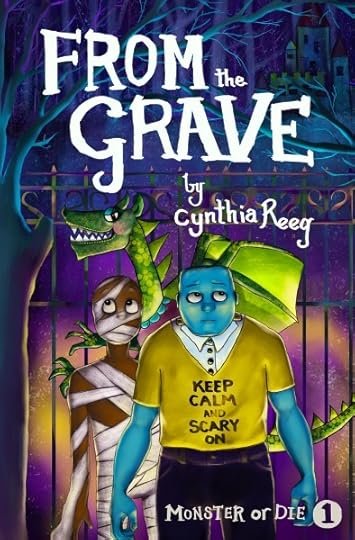
With my monsters story, I also made a notebook on Rules, Food, Language, Setting, and Character, writing down specifics from each chapter. This was to help me analyze the monster world I’d created. I love writing fantasy because I can make most anything happen, but I have to stay within the boundaries I’ve created for the story to work. When I’m writing on the fly, my muse may throw out an astounding new creature, event, or setting that I didn’t plan for. I need to document all these for future reference and see if there is a conflict.
After the general shape-up of the manuscript is done, the line edits come next. This part of the revision I truly enjoy. Although when it comes to deleting 10,000 words from a story, this can be extremely painful. Writing a manuscript that is as tight as possible is absolutely essential for middle grade. It’s a challenge to keep the story engaging and the voice strong, while pairing down the word count. At this stage, I’m choosing words carefully, making phrases sing, trying to plug in more dialogue and delete lengthy exposition. I pay particular attention to sensory details. But I also focus on story emotions. I can’t afford to lose the impact of my tale in the edits. Most likely, you’ve heard this before: read your story out loud. Especially at this stage of revisions, the lines beg to be read. You’ll quickly hear jumble that slows the pace. You’ll notice words that don’t quite work. You’ll cringe at flat dialogue.
I just finished reading Elizabeth Gilbert’s BIG MAGIC: Creative Living Beyond Fear. In it she asks the question, “Do you have the courage to bring forth the treasures within?” She stresses that fear is always part of the creative process, but you can’t let it take control. Courage is certainly an important part of the revision process. You have to believe you can make your story stronger. You have to believe you can address all your editor’s challenges. And you have to believe that the finished product is going to make a difference in some young reader’s life.
So fight through the fear—and the pain! Be courageous and steadfast! Take up your pen and REVISE!
The post It Hurts So Good: Revising Your Novel appeared first on Fiction Notes.


